Six Americans among Nairobi mall attackers

kenyamall
Shopping hostages set free

Al-Shabab has released the names of the attackers in the weekend mall siege in Nairobi, Kenya, and they include at least six Americans, two from Minnesota, one from Kansas City, as well as one each from Maine, Illinois, and Arizona.

The attackers sparked a two-day hostage crisis at the upscale Westgate Mall which has killed at least 68 and has fueled concerns about al-Shabab’s revitalization in the region, despite many, many times when they were predicted to be on the verge of defeat.

The attack is believed to be retaliation against Kenya for its military operations in southern Somalia.

Though the group’s rank-and-file are overwhelmingly Somalis, the attackers were predominantly ethnic Somalis from overseas, and mainly Western countries including not only the Americans, but Canadians, English, Swedish and Finnish citizens.

Journalists and their cameras have been moved and no longer have a clear sight of the mall, but can see its perimeter.

Gunfire and explosions have been heard throughout the day from the Nairobi mall where fighters are holed up, possibly holding a number of civilians hostage.

Three al-Shabab fighters have been killed and ten soldiers wounded in the military operation to end the standoff, Kenya’s Cabinet Secretary for the Interior Ole Lenku said on Monday.

“We don’t want to give you a definitive position on when we think the process will come to an end, but we are doing anything reasonably possible, cautiously though, to bring this process to an end,” Lenku told a news conference.

Black smoke was seen rising over the mall complex, two days after it was stormed by al-Shabab fighters. Lenku said the smoke came from a fire set by the fighters.

Television images on Monday showed troops in camouflage running to new positions, while an armoured personal carrier was also seen shifting position

“They’ve got a huge job to secure the premises,” a former officer in the British special forces regiment, the SAS, told Al Jazeera, adding that the operation would likely take another 24 hours. – Al Jazeera/antiwar.com

Software army of fake virtual people

fakeThese days, with Facebook and Twitter and social media galore, it can be increasingly hard to tell who your “friends” are.

But after this, Internet users would be well advised to ask another question entirely: Are my “friends” even real people?

In the continuing saga of data security firm HBGary, a new caveat has come to light: detailed proposals for software that manages online “personas,” allowing a single human to assume the identities of as many fake people as they’d like.

The revelation was among those contained in the company’s emails, which were dumped onto bittorrent networks after hackers with cyber protest group “Anonymous” broke into their systems.

In another document unearthed by “Anonymous,” one of HBGary’s employees also mentioned gaming geolocation services to make it appear as though selected fake persons were at actual events.

“There are a variety of social media tricks we can use to add a level of realness to all fictitious personas,” it said.

While there are certainly legitimate applications for such software, such as managing multiple “official” social media accounts from a single input, the more nefarious potential is clear.

The software would require licenses for 50 users with 10 personas each, for a total of 500. These personas would have to be “replete with background , history, supporting details, and cyber presences that are technically, culturally and geographacilly consistent.”

It continues, noting the need for secure virtual private networks that randomize the operator’s Internet protocol (IP) address, making it impossible to detect that it’s a single person orchestrating all these posts. Another entry calls for static IP address management for each persona, making it appear as though each fake person was consistently accessing from the same computer each time.

The contract also sought methods to anonymously establish virtual private servers with private hosting firms in specific geographic locations. This would allow that server’s “geosite” to be integrated with their social media profiles, effectively gaming geolocation services.

“Persona management software” can be used to manipulate public opinion on key information, such as news reports. An unlimited number of virtual “people” could be marshaled by only a few real individuals, empowering them to create the illusion of consensus.

You could call it a virtual flash mob, or a digital “Brooks Brothers Riot,” so to speak: compelling, but not nearly as spontaneous as it appears.

That’s precisely what got a DailyKos blogger: the potential for military-run armies of fake people manipulating and, in some cases, even manufacturing the appearance of public opinion.

“I don’t know about you, but it matters to me what fellow bloggers think,” the blogger wrote. “I consider all views. And if there appears to be a consensus that some reporter isn’t credible, for example, or some candidate for congress in another state can’t be trusted, I won’t base my entire judgment on it, but it carries some weight.

“That’s me. I believe there are many people though who will base their judgment on rumors and mob attacks. And for those people, a fake mob can be really effective.”

It was this blogger who was first to highlight the Air Force’s “persona” contract, which was available on a public website.

A call to MacDill Air Force Base, requesting an explanation of the contract and what this software might be used for, was answered by a public affairs officer who promised a call-back. No reply was received at time of this story’s publication.

Other e-mails circulated by HBGary’s CEO illuminate highly personal data about critics of the US Chamber of Commerce, including detailed information about their spouses and children, as well as their locations and professional links. The firm, it was revealed, was just one part of a group called “Team Themis,” tasked by the Chamber to come up with strategies for responding to certain bloggers and others.

“Team Themis” also included a proposal to use malware hacks against certain organizations, and the submission of fake documents in an effort to discredit established groups.

HBGary was also behind a plot by Bank of America to destroy WikiLeaks’ technology platform, other emails revealed. The company was humiliated by members of “Anonymous” after CEO Aaron Barr bragged that he’d “infiltrated” the group.

A request for comment emailed to HBGary did not receive a reply.

A list of interested vendors responding to the Air Force contract for “persona management software” included HBGary subsideary HBGary Federal, further analysis of a government website has revealed.

Other companies that offered their services included Global Business Solutions and Associates LLC, Uk Plus Logistics, Ltd., NevinTelecom, Bunker Communications and Planmatrix LLC. – Raw Story

Turkey hires 6 000 trolls

trollsSay you’re a government that recently faced massive public opposition that organized through social media, bad enough you considered banning Twitter outright. What’s your next step?

If you’re Turkey, you start playing that game yourself.

The country’s ruling Justice and Development (AKP) party has announced plans to develop a 6,000-member team devoted to shaping public opinion through social media, the Wall Street Journal has reported.

The goal is to mostly hire young people, and will focus primarily on Twitter and Facebook, though Instagram and YouTube will get some attention too.

A senior party official quoted in the Journal described the project as “aim[ed] at developing a positive political language which we are teaching to our volunteers,” and that “when the opposing camp spreads disinformation about the party, we correct them with valid information, always using positive language.”

A handful of other countries officially employ similar propaganda tactics. Such countries are ranked far more harshly on Reporters Without Borders’ “Enemies of the Internet” index.

In May and June, the AKP received resounding international criticism for its violent crackdown of a popular uprising surrounding the government’s attempt to replace Istanbul’s Gezi Park. The party apparently was caught completely off guard with how protesters can organize through Twitter, especially as Turkey’s traditional media barely mentioned the protests.

At the time, Turkey arrested at least 29 people were for tweeting “misleading information” or “propaganda.” The head of AKP, Recep Tayyip Erdoğan, has yet to tweet the Turkish word for irony. – The Daily Dot

Al Qaeda-linked chemical weapons program in Somalia?

John Miller
John Miller

A document filed before the attack on a shopping mall in Nairobi Kenya, in a still-developing terrorism case in New York seems to confirm the long-held fear that al Qaeda is working to develop chemical weapons.

On Wednesday, CBS News obtained a document filed by the United States Attorney’s Office for the Eastern District of New York indicating that three men charged with being members of the al-Shabab terrorist group in Somalia had “substantial knowledge regarding an al-Shabaab research and development department that was developing chemical weapons.”

CBS News senior correspondent John Miller told “CBS This Morning” the lead defendant in the case, Mahdi Hashi, and two others were arrested in August, 2012, by African authorities while allegedly on their way to Yemen. They are charged with participating in a weapons and training program with al-Shabab over a four-year period beginning in 2008.

Hashi, who left his home in the U.K. to join the Somali group, had been part of an elite suicide bomber unit with al-Shabab. – CBSNews

‘Marriage between different races not good’

racialmarriageThe SA Human Rights Commission (SAHRC) is investigating a Seventh-Day Adventist pastor who allegedly refused to marry a white woman and coloured man, the Sunday Times reported.

The father of the bride lodged the complaint after the pastor allegedly told the couple it was not good for people of different races to marry.

However, the pastor, who is based on the Cape’s West Coast, reportedly told the Sunday Times he had counselled the couple, but he could not marry them because he was not a registered marriage officer.

SAHRC spokesman Isaac Mangena reportedly confirmed to the newspaper that an investigation was taking place.

The couple had since been married by a minister in the Dutch Reformed Church, it reported. – Sapa

Kenya to host first yuan clearing house in Africa

Kenya wants to host a clearing house for China’s yuan currency – a bold African first that would deepen the continent’s ties with Beijing, already a big investor from The Cape to Cairo.

Such a venture would not eclipse the dollar in Africa anytime soon, however, because the yuan is tightly managed and traders are wedded to the greenback’s flexibility.

Africans can already get quotes for their currencies against the yuan . A clearing house would cut the need for dollar settlements, speed things up and reduce costs.

yuanBut the real prize for Kenya, or any other African host, would be the symbolism of being the continent’s business gateway with Asia’s economic emperor, even if business starts modestly.

Such an exchange would also be the first outside Asia.

Its prospect is a measure of China’s challenge to Africa’s traditional partners in Europe and the United States and reflects the increasing attractions of a continent with some of the world’s fastest growing economies.

“Even if the benefits to business have probably been slightly overblown by diplomats on both sides, I don’t think you can understate the symbolic aspect,” said Shilan Khan, Africa economist at London-based Capital Economics.

China’s ties with Africa have expanded fast.

In 2012, the total volume of China-Africa trade reached $198.49 billion, a rise of 19 percent over the previous year, Chinese government figures show. China accounted for 18.1 percent of Africa’s total trade volume in 2012, up from 3.8 percent in 2000.

“The proposal is basically to consider Kenya favourably given that the financial market is deep here,” Kenyan Finance Minister Henry Rotich told Reuters in August, citing rivals such as Nigeria, which already holds some reserves in yuan.

South Africa had a financial centre that dwarfs Kenya’s and has been mooted as a potential host, though officials there have not said they are pursuing such a plan.

“We are sort of competing and at the end of the day, the Chinese government is the one to decide where this clearing house will be,” Rotich said, making his pitch for east Africa’s biggest economy which aims to become a financial hub.

Early signals look good for Kenya.

“We are very positive about this clearing house and I think it is very important for Kenya to set up a financial hub here and to process the Chinese currency renminbi,” China’s ambassador to Kenya, Liu Guangyuan, told Reuters on the sidelines of a conference in Nairobi on Wednesday.

The value of potential business through such a clearing house was still a subject of discussion, he said.

Kenya’s daily turnover of foreign exchange is $330 million to $370 million, sometimes rising to $500 million.

Highlighting Nairobi’s enthusiasm for a clearing house based in Kenya’s central bank, President Uhuru Kenyatta made his bid for Beijing’s backing during a visit to China in August.

Business between Kenya and China is growing, even if Europe is still a bigger trade partner. Kenya’s Equity Bank, for example, has opened a branch in Nairobi for Chinese business executives, complete with Chinese tellers serving them.

“Everyone is trying to clinch a deal to directly clear and settle yuan transaction with the People’s Bank of China,” said an official at a Chinese state think-tank that often advises Beijing on policy, speaking about Africa’s clearing house plans.

In the meantime government officials in Niger have reportedly found evidence of bloated costs in oil deals with China National Petroleum Corporation (CNPC), leading the government to seek renegotiations on sections of
its contracts with CNPC. In Chad, CNPC operations have been suspended due to alleged “gross environmental negligence”, reports The New York Times.
Gabon, in another controversial move, will also be reclaiming Sinopec assets in 2015, because of breaches of contract, according to Macau- Daily Times

In August Chad’s oil minister Djerassem Le Bemadjiel told state radio that the Chadian government had “found flagrant violations of environmental standards by […] CNPC.

Not only do they not have facilities to clean spilled crude, there were also intentional spillages in order
reduce costs”, reported Reuters.

Hundreds of migrants storm EU fence

melillaHundreds of migrants from Morocco were trying to cross the southern EU border at Melilla, a Spanish exclave, on Monday before dawn.

Having torn down a part of a triple six-meter high fence, about 100 made it through, Spanish government officials in the territory said in a statement.

They were the latest of thousands of migrants who try to reach Spain from Africa across the fence or by sea, forced to leave by unrest in Northern Africa, most of them from Algeria, Morocco and Tunisia. – RT

Russia believes chemical attack was provocation

Vladimir Putin
Vladimir Putin

Russia has every reason to believe that the use of chemical weapons in a Damascus suburb in August was an adroit and smart provocation, President Vladimir Putin has said.

“We have every grounds to believe that it was a provocation. Of course, it was adroit and smart, but, at the same time, primitive in terms of technical performance. They took an old Soviet-made missile, which was taken out of service in the Syrian army long ago. It was most important to have ‘made in the USSR’ written [on the missile],” Putin said at the Valday discussion forum on Thursday.

The Russian president pointed out that the August 21st attack in Damascus was not the first time chemical weapons had been used in Syria.

“But why haven’t other cases been investigated?” he asked.

The chemical weapon attack must be thoroughly investigated and those behind it must be identified, Putin told the Valday Club meeting in Russia’s Novgorod Region.

“No matter how difficult it might be, but if in the end we manage to answer the question… as to who committed that crime – and that was certainly a crime – the next step will follow. Then, together with our colleagues from the United Nations Security Council we will have to define the level of responsibility of those who committed the crime,” Putin said.

He stressed that measures like military strikes cannot solve every international issue, while they should also be brought to the UNSC rather than discussed in the US Congress.

“This would be a strike on the world order, not Syria,” the Russian leader said.

Earlier this month, Russia and the United States reached a deal on a framework that will see the destruction or removal of Syria’s chemical weapons by mid- 2014. That came after Moscow suggested that Damascus should put its chemical weapons arsenal under international control and the Syrian government accepted the proposal. The republic also agreed to join the Chemical Weapons Convention which bans the production and the use of such arms.

Speaking at the Valday gathering, Putin noted that Syria not only agreed to sign the international convention, but announced it already considers itself a party to the treaty.

“These are practical steps that the Syrian government has already made,” Putin said.

The United Nations confirmed last Saturday that it had received all the necessary documents from Syria for joining the chemical weapons convention and that Syria would become a member from October 14.

Russia’s proposal for Syria was voiced as the Congress was readying itself to vote on President Barack Obama’s plan to launch a limited military strike against Syria in response to the chemical weapons attack in August. The US blamed the country’s government for the incident. The decision was put on hold after a suggestion from Moscow, which was discussed in detail by Secretary of State John Kerry and Foreign Minister Sergey Lavrov in Geneva.

Putin said that any attempt to interfere in the conflict by supporting one of the sides would bring imbalance. When the crisis began over two years ago, it immediately started getting support from abroad, he said.

“How did terrorist groups like Al-Nusra appear there? Even the State Department admits that Al-Qaeda’s branches are fighting [in Syria],” Putin observed.

The Russian leader is frustrated that Western states have no idea what they would do if, after their interference in the ongoing war, extremists came to power in Syria.

“Would they drive them away with a newspaper?” Putin said.  – RT

Crime stats: Farm attacks trending

killboer2It is a dark day for the country when its National Commissioner claims that crime is under control, while the murder rate has risen to 16,259 cases per year. This means that almost two murders a day more occurred to bring the total number of murders committed daily to almost 45!

Farm murders shows an even more alarming picture. In the same period farm murders increased by 34% to 68 in 2012/2013 compared to the 50 murders in 2011/2012. Farm attacks increased from 112 cases to 176 cases. Farm attacks in fact are violent crimes against people and not on property. Therefor it can be assumed that many of these attacks are nothing less than attempted murder, which were successfully averted.

“What is even more disturbing is the apparent ignorance of the police in this regard. On the police`s official website the page titled ‘Farm Attacks` under `Crime Prevention` has been ‘under construction’ for months now, leaving the impression that the police do not regard this category of crime as a seriousness matter,” said Mr Henry Geldenhuys, Deputy President of TAU SA and Chairman of the Safety and Security Committee. “Because the police stubbornly refuse to list farm murders as a separate crime category in their statistics, they are not even aware of this alarming increase in farm attacks. Furthermore it has to be borne in mind that TAU SA`s database on farm attacks and farm murders is probably incomplete because it relies on the feedback of members or on media reports which are then verified. Therefore the true picture could be worse,” says Mr Geldenhuys.

Since April 1 this year to date TAU SA`s database lists 37 murders and 110 farm attacks. If this trend was to continue until the end of the current year 74 murders and 220 attacks could be expected, which will represent a further increase of 24%.

“The fact that the National Commissioner considers crime to be under control indicates that farmers should not expect any increased police interest in their problems, and therefore should continue their need to ensure that they are versed in self defence and the upgrading of their physical safety- and security measures,” said Mr Geldenhuys.

Black classmates cheer as white pupil attacks teacher

glenvistaThe Gauteng education department has condemned the assault of a teacher by a white Grade Eight pupil at Glenvista High School in Johannesburg south.

“The head of department has already dispatched a team of senior officials to the school to ensure that immediate action is taken to suspend the learner, provide counselling to the educator and begin disciplinary process,” said spokesman Gershwin Chuenyane on Thursday.

A video of the assault – which happened on Wednesday – was captured by a fellow black pupil and went viral on Thursday.

It shows the pupil unsuccessfully trying to retrieve what looks like a school bag from the teacher.

After failing to get it back, he hits and kicks the teacher, then throws a chair and a broom as the teacher walks out of the classroom.

His black classmates can be heard off-camera, encouraging the youth to “get him”.

The department commended the teacher for remaining calm and not retaliating. – Sapa


Tony Blair’s daughter held at gunpoint

kathrynblair
Kathryn and Tony Blair

Tony Blair’s daughter Kathryn has been threatened at gunpoint in a botched robbery.

The young barrister was walking her dog with her boyfriend and a group of friends when the attackers struck.

The pair were in Marylebone, a mile from the million pound home her father bought her in 2010, and near his own central London property.

Neither 25-year-old Miss Blair nor her boyfriend were harmed in the attack, which took place at around 8pm on Monday.

The attempted mugging is thought to be linked to another similar incident in the area on the same night.

The two attempted robberies took place just half an hour apart and both involved the use of a firearm to threaten a couple.

A spokesman for the Blairs said:  ‘Kathryn was with a group of friends. No one was hurt and nothing was stolen.’

The group were approached by two men, one armed with a gun, and were asked for cash and jewellery before the suspects fled empty-handed.

No arrests have been made and the race of the attackers were not mentioned.

The attack raises concerns for the safety of the Blairs, who could be  targeted due to the former prime minister’s role as peace envoy to the Middle East, and to his decision to go to war in Iraq in 2003.

One security expert said last night: ‘It seems staggering that the daughter of a man who evokes such extreme emotions in some should be wandering around in the dark at night without protection.

‘Neither of the two victims were injured. A firearm was shown on each occasion though no shots were  discharged. Officers are investigating both attempted robberies. There have been no arrests at this stage.

‘We would urge anyone with information to contact us immediately,’ the police said. – Daily Mail

Strikes in mining sector hit five-year high

labourThe number of strikes last year in South Africa hit a five-year high, with the mining sector accounting for 82.4% of them, says the labour depratment.

A total of 99 strikes were recorded in 2012, close to half of them unprotected or wildcat strikes, and many of them characterised by violence, labour director general Nkosinathi Nhleko told journalists in Cape Town on Wednesday.

Tabling the latest Industrial Action Report, which covers the 2012 calendar year, he said strikes over the period involved 241 391 workers, cost the economy 3.3-million working days, and resulted in workers losing R6.6-billion in wages.

The trend was continuing into this year.

“From what we can all see, there is a continuation of the trend we experienced in 2012,” Nhleko said.

However, no figures were yet available for the current calendar year. Asked why so many strikes involved violence, he suggested this had to do with leadership.

“The issue of how parties in the dispute have got to conduct themselves … hinges largely around the issue of exercise of leadership.

“And when we cite leadership as a factor … it is also informed by the mere fact that when these things begin to happen, it is something that wants to suggest that at a level of exercise of leadership, there is something that has not been handled properly and … accordingly.”

‘Worrying’
This, Nhleko said, was a “worrying point”. He said “social partners” needed to tackle the issue of how to prevent violence during strikes.

According to the report, 99 “strike incidents” were recorded in 2012, compared to 67 in 2011; 74 in 2010; 51 in 2009; and, 57 in 2008.

“South Africa experienced violent, bloody and deadly industrial actions in the mining, transport and agricultural industries … Out of 99 strikes processed within the department, 45 strikes were unprotected.”

The department of labour said in a statement that “A feature of industrial action during 2012 was the heightened violence that accompanied strike action, particularly in the mining and transport sectors. The violence and damage to property that was evident in the agricultural sector should also be noted, although these were protest actions and not strictly strike action.”

Mining
The document finds most of the working days lost by industry were in the mining sector (82.4%).

“Wages, bonuses and other compensation issues still remain the main reasons for work stoppages in South Africa during 2012.”

Further, most workers involved in last year’s labour unrest were members of the National Union of Mineworkers.

Among the provinces, Gauteng – South Africa’s economic heartland – had the most work stoppages.

“Gauteng experienced 42 strikes in 2012, up from 33 in 2011, an increase of 27.3%.”

According to the report, workers still had confidence in the Labour Relations Act, the legislation governing bargaining processes and associated legislation, “[but] most of them believe that the cost of living is too high”.

Among its conclusions are that “government needs to take control of the situation and solidify practice and protocol with regard to wage negotiations before the nation’s mining sector becomes un-investable [sic] as a result of the strikes.” – Sapa

Oil, fracking chemicals spill into Colorado’s floodwaters

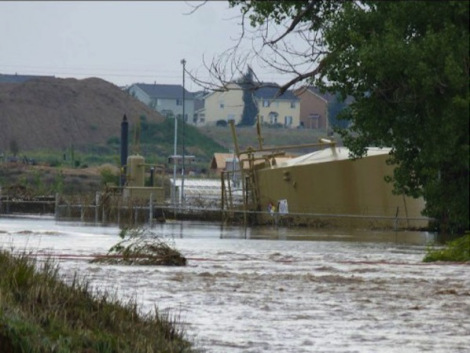
Fracking equipment damaged

Heavy rains returned to Colorado in the US on Sunday and hampered rescue efforts after last week’s flash floods. The confirmed death toll has risen to seven, and hundreds are still unaccounted for. An estimated 1,500 homes are destroyed. Some 1,000 people in Larimer County, north of Boulder, were awaiting airlifts that never came on Sunday — they were called off because of the foul weather.

The floods have also triggered other problems that have gotten a lot less media attention: Fracking infrastructure has been inundated and its toxic contents have spilled out. Pipelines that transport fossil fuels are sagging and snapping under pressure. Tanks that store chemicals and polluted water are being overwhelmed and toppling over. Oil and gas wells are flooding.

The Boulder Daily Camera reports:

Lafayette-based anti-fracking activist Cliff Willmeng said he spent two days “zig-zagging” across Weld and Boulder counties documenting flooded drilling sites, mostly along the drainageway of the St. Vrain River. He observed “hundreds” of wells that were inundated. He also saw many condensate tanks that hold waste material from fracking at odd angles or even overturned.

“It’s clear that the density of the oil and gas activity there did not respect where the water would go,” Willmeng said. “What we immediately need to know is what is leaking and we need a full detailed report of what that is. This is washing across agricultural land and into the waterways. Now we have to discuss what type of exposure the human population is going to have to suffer through.” …

A spokesman for the Colorado Oil and Gas Conservation Commission said the agency is aware of the potential for contamination from flooded drilling sites, but there simply is no way to get to those sites while flooding is ongoing and while resources are concentrated on saving lives.

The Denver Post interviewed a farmer who ignored evacuation orders and watched as floodwaters overwhelmed a drilling operation on his land and released some oil. The newspaper also reported that at least one oil pipeline was confirmed to have been broken open by the floodwaters. From the article:

Oil drums, tanks and other industrial debris mixed into the swollen [South Platte River] flowing northeast. …

One pipeline has broken and is leaking, Weld County Emergency Manager Roy Rudisill. Other industry pipelines are sagging as saturated sediment erodes around the expanding river.

East Boulder County United, a group that fights fracking, has been posting photographs on its Facebook page of fracking tanks and other equipment toppled over or submerged by floodwaters. Blogger TXsharon has also been posting updates and photographs.

Meanwhile, experts are beginning to discuss the links between climate change and the floods. The flooding was worsened by drought and wildfires, both of which have been linked to global warming and which left the ground dry and hard. That reduced the amount of water that the soil could absorb from the unusual late-summer inundation.

“This was a totally new type of event: an early fall widespread event during one of the driest months of the year,” Brad Udall of the University of Colorado-Boulder told National Geographic News. “As the climate warms further, the hydrologic cycle is going to get more intense.”

Climate Central notes that it “will take climate scientists many months to complete studies into whether manmade global warming made the Boulder flood more likely.” But the wild weather hitting the state lately fits general climate change projections:

An increase in the frequency and intensity of extreme precipitation events is expected to take place even though annual precipitation amounts are projected to decrease in the Southwest. Colorado sits right along the dividing line between the areas where average annual precipitation is expected to increase, and the region that is expected to become drier as a result of climate change.

That may translate into more frequent, sharp swings between drought and flood, as has recently been the case. Last year, after all, was Colorado’s second-driest on record, with the warmest spring and warmest summer on record, leading to an intense drought that is only just easing.

Might the fracking industry have worsened Colorado’s floods by contributing to climate change, then spilled its toxic chemicals into those floodwaters? That would be a cruel double-punch. – grist.org

Belgium investigates suspected cyber spying by foreign state

belgacom_tvBelgium said on Monday it was investigating suspected foreign state espionage against its main telecoms company, which is the top carrier of voice traffic in Africa and the Middle East, and a newspaper pointed the finger at the United States.

Federal prosecutors said in a statement that the former state telecoms monopoly Belgacom had filed a complaint in July about the hacking of several servers and computers.

“The inquiry has shown that the hacking was only possible by an intruder with significant financial and logistic means,” they said.

“This fact, combined with the technical complexity of the hacking and the scale on which it occurred, points towards international state-sponsored cyber espionage.” The prosecutors declined to say which foreign state they suspected.

Documents leaked by the former U.S. intelligence contractor Edward Snowden have revealed a vast National Security Agency (NSA) electronic surveillance program that has tracked enormous quantities of both Americans’ and foreigners’ email and telephone data.

This has mostly been done by agreement with telecommunications or internet providers or foreign government intelligence agencies.

However, the Brazilian television network Globo this month alleged that the NSA had tapped into the computer systems of companies including Google Inc. and the Brazilian state oil firm Petroleo Brasileiro, as well as France’s Foreign Ministry and the Belgian-based international banking cooperative SWIFT, which handles international financial transactions.

The Belgian daily De Standaard said the NSA had been monitoring international telephone traffic through Belgacom for two years. It said the hackers had been primarily interested in Belgacom’s subsidiary BICS, a wholesale provider of international phone lines and biggest voice carrier in Africa and the Middle East.

The government of Belgium, which has a majority stake in Belgacom, condemned the intrusion and the violation of a public company.

Prosecutors said the intruder had used malicious software and advanced encryption techniques with the aim of gathering strategic information, and had not sabotaged Belgacom’s data or sought to cause direct economic damage.

Belgacom itself said it had carried out work over the weekend to improve security and remove an unknown virus from its internal systems, adding that at the moment there was no indication of any impact on customers or their data. It said it had filed a complaint against an unknown third party.

Globo’s revelations were based on leaked U.S. documents provided by Guardian journalist Glenn Greenwald, who has worked with Snowden to expose the extent of U.S. spying.

James Clapper, the U.S. Director of National Intelligence, responded last week by saying U.S. agencies did collect information about economic and financial matters, which was used to combat terrorist financing and predict problems that could lead to financial crises or disrupt financial markets.

“What we do not do,” Clapper said in a statement, “is use our foreign intelligence capabilities to steal the trade secrets of foreign companies on behalf of – or give intelligence we collect to – U.S. companies to enhance their international competitiveness or increase their bottom line.” – Reuters