Fracking a disaster in drought-stricken regions

fracking2US states suffering a drought are facing a dire water crisis exacerbated by hydraulic fracturing. The procedure consumes vast amounts of water, which has driven up prices and depleted certain aquifers and rivers.

In drought-stricken regions, fracking is taking a serious toll on the water availability of local communities, in some cases turning water into a scarce and expensive resource. The procedure powerfully blasts water, fine sand and chemicals into the ground to shatter rock formations and release oil or gas.

Fracking is occurring in several counties in Arkansas, Colorado, New Mexico, Oklahoma, Texas, Utah and Wyoming, which are currently suffering a severe drought, the Associated Press reports. Although the procedure requires less water than farming or overall residential uses, it contributes to the depletion of an already-scare resource.

Some oil and gas companies manage to drain states of their water supply without spending any money, by depleting underground aquifers or rivers. But when unable to acquire the resource for free, the corporations can purchase large quantities at hefty prices.

“There is a new player for water, which is oil and gas,” Colorado farmer Kent Peppler told AP, noting that he is fallowing some of his corn fields because he can’t afford to irritate them. “And certainly they are in a position to pay a whole lot more than we are.”

Peppler, president of the Rocky Mountain Farmers Union, said that the price of water has skyrocketed since oil companies have moved in. The Meade, Colo. Farmer said he used to pay $9 to $100 per acre-foot of water at city-held auctions, but that energy companies are now buying the excess supplies for $1,200 to $2,900 per acre-foot.

Last year, the city of Aurora sold 2.4 billion gallons of sewer water to the oil company Anadarko for $9.5 billion, AP reports.

With oil and gas companies willing to spend large sums of money on excess sewer water, the cost of this valuable resource has risen across several drought-stricken states. Some local farmers, unable to afford crucial irrigation for their fields, say they are praying for rain.

“I was going to bed every night and praying to the good Lord that we would get just one rain on the crop,” West Texas cotton farmer Charlie Smith told AP, noting that he is selling some of his groundwater to drillers, since it is not enough to irrigate his crops. “I realized we’re not making any money farming, so why not sell the water to the oil companies? Every little bit helps.”

Environmental activists are calling for limitations on drilling in drought-stricken regions.

“We don’t want to look up 20 years from now and say, ‘Oops, we used up all our water,” said Jason Bane of the Western Resources Advocates.

Last summer’s record-breaking drought, which was the worst since the 1930’s Dust Bowl, resulted in a crop shortages that raised prices in US grocery stores. With a lack of water to irrigate crops across the US this year, Americans may once again find rising prices of both water and food.  – RT

Tech giants deny knowledge of PRISM spy operation

techgiantsAs the dust settles on the revelation that the U.S. government has been mining data from most of Silicon Valley’s largest companies in a program called “PRISM,” one question stands out: How did the NSA get access?

Apple, Google, Yahoo! and Microsoft, the largest companies involved in PRISM, the existence of which was revealed last night in a simultaneous Washington Post and Guardian scoop, have categorically denied knowledge of or participation in the program in a series of statements, while acknowledging that they do provide targeted access to the government when required to do so by law, generally according to court orders.

“We have never heard of PRISM,” says Apple’s spokesman. “If the government has a broader voluntary national security program to gather customer data we don’t participate in it,” says Microsoft’s. “We do not provide the government with direct access to our servers, systems, or network,” says Yahoo!’s. “Google does not have a ‘back door’ for the government to access private user data,” says Google’s.

Even unofficially, the tech companies seemed baffled by the allegations. The Guardian spoke with tech executives off the record, all of whom were “confused” by the documents published in the paper. None had ever heard of PRISM.

So what gives? Does the government have backdoor access so secret that not even their targets are aware? Are the tech companies lying? Or are they forbidden—as Verizon allegedly is with its NSA arrangement—from acknowledging its existence to an absurd extent? – gawker.com

China, Germany press US to explain NSA-spying allegations

South China Morning PostChina on Monday joined calls for Washington to provide explanations following disclosures of National Security Agency (NSA) programmes, which collect millions of telephone records and track foreign internet activity on US networks.

Foreign Ministry spokesperson Hua Chunying told reporters that Washington needs to heed international concerns expressed since the programmes were made public earlier this month by former NSA contractor Edward Snowden.

Officials and lawmakers in Germany and other countries are already pressing Washington for information about the collection of information that might affect their citizens’ privacy.

“We think that the United States should regard seriously the concerns and demands of the global community and people from all countries and furnish the global community with a necessary explanation,” Hua said at a regularly scheduled briefing.

Snowden flew to the Chinese autonomous region of Hong Kong on May 20 and is believed to still be there, though in hiding at an unknown location. China hasn’t said whether it would cooperate with any US demands for his extradition, and Hong Kong’s Western-style legal system that is distinct from that on the Chinese mainland allows opportunities for him to appeal.

US officials have defended the surveillance programmes as essential to disrupting terrorist plots.

Former vice-president Dick Cheney said on Sunday that he was “very, very worried” that Snowden would pass on sensitive information to China in return for immunity or sanctuary.

Asked whether Snowden was a Chinese spy or co-operating with Beijing, Hua answered, “This is complete nonsense.”

Max Keiser called Cheney out for being duplicitous as he was instrumental in selling American military equipment to China.

Addressing the backlash against him in the US, Snowden said much of it was predictable. He said: “It’s important to bear in mind I’m being called a traitor by men like former vice president Dick Cheney. This is a man who gave us the warrantless wiretapping scheme as a kind of atrocity warm-up on the way to deceitfully engineering a conflict that has killed over 4,400 and maimed nearly 32,000 Americans, as well as leaving over 100,000 Iraqis dead. Being called a traitor by Dick Cheney is the highest honor you can give an American.”– Sapa-AP

Snowden regards it as an “honor” to be called a traitor by Cheney

Edward Snowden
Edward Snowden

US intelligence leaker Edward Snowden said on Monday that he was honored to have been branded a traitor by former vice president Dick Cheney and other senior politicians.

“Being called a traitor by Dick Cheney is the highest honor you can give an American,” he said, in an online interview hosted by the Guardian newspaper.

The 29-year-old said Cheney had helped put in place the huge secret program to monitor telephone calls and Internet traffic that Snowden revealed last month when he fled to Hong Kong and began leaking secret US documents.

He accused former president George W. Bush’s conservative right-hand man of “deceitfully engineering” the Iraq war.

“If they had taught a class on how to be the kind of citizen Dick Cheney worries about, I would have finished high school,” Snowden said, poking fun at his own relative lack of formal qualifications. – AFP

Britain, not US, prepared for war in Syria two years before the crisis

Roland Dumas
Roland Dumas

Former French Foreign Minister Roland Dumas said that Britain had been preparing gunmen to invade Syria two years before the crisis there flared up in 2011

During a TV show, Dumas said ”I was in Britain two years ago, and I met British officials, some my friends…they admitted that they were up to something in Syria.”

”They even asked me to join them in my capacity as a foreign minister, but I declined,” he added.

He indicated that the plan of striking Syria had been prepared in advance long before the 2011 events, adding that the goal was to overthrow the Syrian government that considers Israel an enemy.

The TV show was dedicated to discussing the war in Syria.

French magazine: ‘Jihadists’ involvement in Syria much bigger than Afghanistan

The French magazine “Le Nouvel Observateur” quoted a senior French official as saying that the participation of French Jihadists in Syria is bigger that their involvement in Afghanistan war.

The French magazine said that the French intelligence verified the identities of 270 French nationals who are fighting in Syria, indicating that their return has become a major concern for the French interior ministry.

The magazine said that the number of European ‘Jihadists’ fighting in Syria ranges between 1,500 and 2,000, in addition to hundreds of Tunisians. – SANA

McDonald’s closes down in Bolivia

With over 31,000 restaurants serving 58 million people throughout the world every day, McDonald’s pretty much wrote the book on how a corporation can conquer the world. But despite its global domination as a cheap and easy burger joint, the fast-food monolith proved no match against the people of Bolivia and its cultural standards of culinary decency. For 14 years, McDonald’s attempted to court Bolivians into making a habit out of eating their processed menu items — only to experience an overwhelming, nation-wide rejection. And as a result, for the first time ever, the cogs of McDonald’s international burger-slinging machine have ground to a halt, forcing the company to close its doors in Bolivia in 2002. Bolivians, its seems, are happy enough without the Happy Meal — but why?

As the Hispanically Speaking News reports, for well over a decade McDonald’s, with eight locations in the South American nation of 10 million people, worked to win over the Bolivian public with its Big Macs and McNuggets, but consistently found itself losing money. So, in light of the loss of revenue, McDonald’s Corporation made an unprecedented announcement: that it would close its restaurants in Bolivia — making it the only country in the Americas without a McDonald’s.

But what makes Bolivia different from nearly every other country in its apparent distaste for McDonald’s fare? A group of filmakers have attempted to answer that question in the documentary Why did McDonald’s Bolivia go Bankrupt? According to a review from Hispanically Speaking News, the McDonald’s failure in Bolivia lies in the very marketing strategy that made it so popular elsewhere: The documentary includes interviews with cooks, sociologists, nutritionists and educators who all seem to agree, Bolivians are not against hamburgers per sé, just against ‘fast food,’ a concept widely unaccepted in the Bolivian community.

Fast-food represents the complete opposite of what Bolivians consider a meal should be. To be a good meal, food has to have be prepared with love, dedication, certain hygiene standards and proper cook time.

One might be hard-pressed to find consumers even outside of Bolivia who wouldn’t agree with that definition of ‘a good meal’, yet none have expressed it so profoundly by simply choosing not to eat at McDonalds. There may be something a bit snarky about celebrating a corporate failure, even if it hardly dents the fast-food giant’s bottom line, but it’s difficult not to judge Bolivia better off for having rejected a restaurant so often associated with a menu of dubious nutritional value and less-than eco-friendly business practices.

Perhaps if we all valued our meals as much as Bolivians, McDonald’s corporate health would suffer at a rate inverse to improvements in our physical health and the health of our planet, which is already so full of people too removed from the food they put inside them. – treehugger.com

Obama hopes for big bucks from African visit

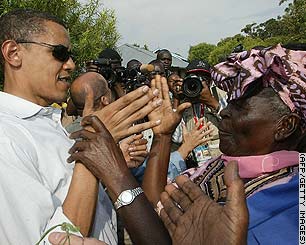
Obama does local

The White House has insisted President Barack Obama’s looming trip to Africa is long overdue and it will be a great ‘bang for the buck’.

The White House was, on Friday pushing back at concerns over the journey’s cost.

Ben Rhodes, a top foreign policy aide to Obama, admitted that the president, despite his Kenyan heritage, had focused far more on other regions, including Asia and Europe, than Africa, despite crucial US interests there.

“For the United States to say we’re a world leader except in this continent doesn’t make any sense,” said Rhodes, a deputy national security advisor.

“The US would be ceding its leadership position in the world if the president of the United States was not deeply engaged in Africa,” Rhodes said.

Obama is due to travel to Senegal, South Africa and Tanzania on a trip beginning at the end of this month for his first prolonged stay on the continent since taking office.

He has previously visited sub-Saharan Africa only once as president, with a short stay in Ghana in 2009.

Rebalancing
Rhodes noted that Obama had travelled multiple times to the Asia-Pacific region, as part of a rebalancing of US foreign policy there and had made many trips to Europe, so Africa needed some attention.

“Africa’s a critically important region of the world. We have huge interests there. You’ve got some of the fastest growing economies in Africa. You’ve got a massively growing youth population.

“You’ve got key security and counterterrorism issues that we work on with African countries,” he said, adding that key US interests in combating HIV/AIDS, and in supporting global health were also rooted in the continent.

“This is a deeply substantive trip and one that has been highly anticipated on the continent. Frankly, there’s been great disappointment that the president hasn’t travelled to Africa until this point other than a brief stop in Ghana.”

“The president is not going to retreat from an entire continent.”

The Washington Post reported on Thursday that plans for Obama to take a safari with his family in Tanzania had been cancelled due to budgetary concerns.

The newspaper, citing a Secret Service planning document, said the excursion would have required Obama’s counter-assault team to carry sniper rifles with high-caliber rounds that could neutralise cheetahs, lions or other animals.

Budget cuts
The paper said Obama’s Africa tour, his first since taking office in January 2009, could cost the US government between $60-million and $100-million, based on cost of similar trips in recent years.

The report comes as many government agencies struggle with mandatory budget cuts that took effect in March because US lawmakers failed to strike a wider budget deal.

Hundreds of Secret Service agents are dispatched for the president’s overseas visits along with dozens of vehicles, planes and other military and security assets.

The White House said that it was up to the Secret Service to determine costs and security needs for the US leader abroad – as was the case under former presidents George W. Bush and Clinton for instance.

Both Bush and Clinton undertook significant tours of Africa as president, requiring the vast security and logistical infrastructure that follows the US leader wherever he goes.

Rhodes, noting that other powers, including China, were seeking to increase their influence in Africa, portrayed Obama’s upcoming visit as a smart investment.

“There will be a great bang for our buck for being in Africa.

“When you travel to regions like Africa that don’t get a lot of presidential attention, you tend to have very long-standing and long-running impact from the visit.” – Sapa-AFP

‘American-style Stasi methods’

Markus Ferber

Germans are expressing outrage as details of a US internet spy program – revealed by a former CIA employee-turned-whistleblower – are prompting comparisons with that of former communist East Germany’s Ministry for State Security.

Unfortunately for Obama’s upcoming trip to Berlin, it was revealed that Germany ranks as the most-spied-on EU country by the US, a map of secret surveillance activities by the National Security Agency (NSA) shows.

German ministers are expressing their outrage over America’s sweeping intelligence-gathering leviathan, with one parliamentarian comparing US spying methods to that of the communist East Germany’s much-dreaded Ministry for State Security (Stasi).

Washington is using “American-style Stasi methods,” said Markus Ferber, a member of Chancellor Angela Merkel’s Bavarian sister party and member of the European Parliament.

“I thought this era had ended when the DDR fell,” he said, using the German acronym for the disposed German Democratic Republic.

Clearly, enthusiasm for the American leader’s upcoming visit will be much more tempered than it was in 2008 when 200,000 people packed around the Victory Column in central Berlin to hear Obama speak of a world that would be dramatically different from that of his hawkish Republican predecessor, George W. Bush.

Merkel will question Obama about the NSA program when he visits in Berlin on June 18, government spokesman Steffen Seibert told reporters on Monday. Some political analysts fear the issue will dampen a visit that was intended to commemorate US-German relations on the 50th anniversary of John F. Kennedy’s famous “Ich bin ein Berliner” speech.

One year into his second term, Barack Obama seems powerless to roll back the military and security apparatus bolted down by the Bush administration in the ‘War on Terror.’

One consequence of this failure of the Obama administration to reign in Bush-era excesses emerged last week when former National Security Agency employee Edward Snowden, 29, blew the whistle on a top-secret intelligence system named Prism, which collects data on individuals directly from the servers of the largest US telecommunications companies.

According to documents leaked to the Washington Post and Guardian newspapers, PRISM gave US intelligence agencies access to emails, internet chats and photographs from companies like Google, Facebook, Twitter, Verizon and Skype.

Justice Minister Sabine Leutheusser-Schnarrenberger said leaked reports that US intelligence services are able to track virtually all forms of Internet communication demanded an explanation.

“The more a society monitors, controls and observes its citizens, the less free it is,” she wrote in a guest editorial for Spiegel Online on Tuesday. “The suspicion of excessive surveillance of communication is so alarming that it cannot be ignored. For that reason, openness and clarification by the US administration itself is paramount at this point.” 

She has sent a letter to her “US counterpart Eric Holder” seeking clarification on the legal foundation of the PRISM program.

“I’ve observed with great concern reports about a possible program,”
Leutheusser-Schnarrenberger said in a statement emailed by her ministry in Berlin. “This may constitute massive access to telecommunications data without permission on a huge scale.”

All of the facts must be put on the table, the minister added.

Obama has defended the intelligence-gathering system as a “modest encroachment” that Americans should be willing to accept on behalf of security.

“You can’t have 100 per cent security and also then have 100 per cent privacy and zero inconvenience,” he said. “We’re going to have to make some choices as a society. There are trade-offs involved.”

The United States, however, is not legally restricted from eavesdropping on the communications of foreigners, meaning in theory that Washington could be listening to and collecting the private communications of individuals anywhere in the world.

Peter Schaar, Germany’s federal data protection commissioner, said the leaked intelligence was grounds for “massive concern” in Europe.

“The problem is that we Europeans are not protected from what appears to be a very comprehensive surveillance program,” he told the Handelsblatt newspaper. “Neither European nor German rules apply here, and American laws only protect Americans.”

Meanwhile, German opposition parties hope to gain from the scandal, especially with parliamentary elections approaching in September, and Merkel looking to win a third term.

“This looks to me like it could become one of the biggest data privacy scandals ever,” Greens leader Renate Kuenast told Reuters.

Obama is scheduled to hold talks and a news conference with Merkel on Wednesday followed by a speech in front of the Brandenburg Gate, the 18th triumphal arch that is one of Germany’s most recognizable landmarks. – RT

Ann Coulter: Republican Party ‘deserves to die’ if it backs immigration reform

Ann Coulter

The GOP (Republican Party) deserves to die if it backs immigration reform, allowing more Latinos to become citizens, right wing pundit Ann Coulter says in a new column, If the GOP is stupid, it deserves to die.

The article is the latest in a series since President Barack Obama’s November reelection in which Coulter paints Hispanics as lazy, poor and government-dependent, concluding that they could never vote for conservatives and immigration reform would destroy both the Republican Party and the country as a whole.

“Democrats terrify Hispanics into thinking they’ll be lynched if they vote for Republicans, and then turn around and taunt Republicans for not winning a majority of the Hispanic vote,” Coulter wrote in the column, published Wednesday.

Coulter went on to claim that Latinos don’t favor a path to citizenship.

“Hispanic voters are a small portion of the electorate,” the column says. “They don’t want amnesty, and they’re hopeless Democrats. So Republicans have decided the path to victory is to flood the country with lots more of them!”

It’s unclear what Coulter bases this on, as she does not cite a source. A Fox News Latino poll published last year found that 85 percent of Hispanics support offering a path to citizenship for the undocumented. A poll released this week by Latino Decisions found that 81 percent of Hispanic voters want Congress to address the pathway to citizenship and border security simultaneously, while only 13 percent favor the border security-first approach advocated by conservatives like Coulter.

Coulter reinforced the views presented in her column during an appearance on Fox News’ “Hannity” Wednesday evening that ran under the banner “Legalizing Illegals.”

“This bill has nothing in terms of enforcement,” Coulter said. “If you’re serious about enforcement, just say ‘we’re enforcing E-Verify.’”

In fact, the comprehensive immigration reform proposal under debate in the Senate pours $6.5 billion into border security and mandates the expansion of E-Verify.

During a disagreement over whether Coulter was directly responding to a question about the path to citizenship, she and the host called one another “liberal.”

“You’re not answering my question,” Hannity said, as Coulter continued speaking. “You’re like a liberal.”

“No, nothing… you, you… on the contrary, you are like a liberal,” Coulter stammered back as Hannity sniggered.

She said if “amnesty” happens, “America is over” and “the only thing left for people like you and me to do, Sean, is to punish the people who destroyed America.” – Huffington Post

Unusual delay in Supreme Court’s decision on Abigail Fisher and race-based admissions

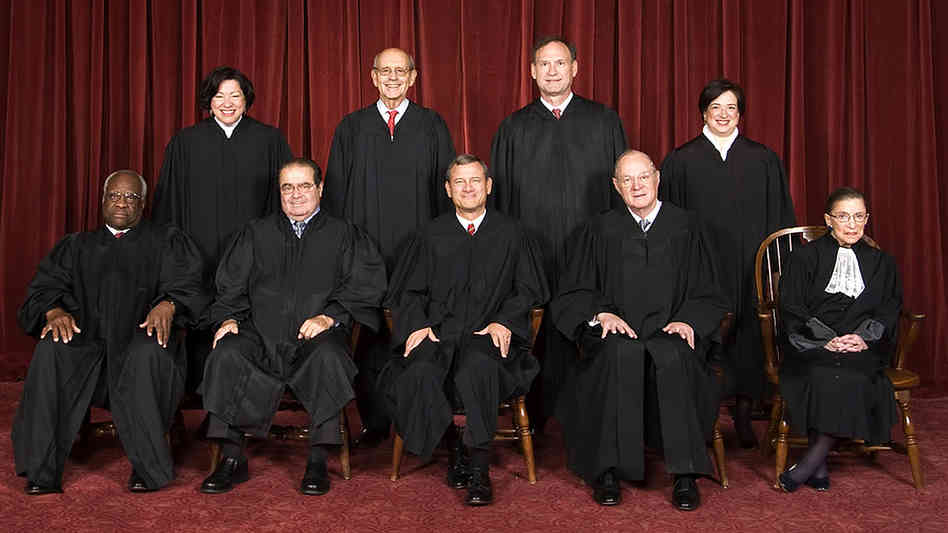
Justices of the Supreme Court

Eight months after attorneys for Abigail Fisher argued in front of the Supreme Court that the University of Texas’ affirmative action admissions policy discriminates against white students, the justices still have not handed down their decision in the potentially paradigm-shifting case.

The unusual delay has many court-watchers stumped, though as with everything Supreme Court-related, all explanations for the wait are, at best, educated guesswork.

Lyle Denniston, who has covered the Supreme Court for more than 50 years and now works for the legal website SCOTUSblog, said he couldn’t remember another case that had been argued in the fall yet still undecided by mid-June.

“I have absolutely no idea what is holding it up,” Denniston said.

One reason why the delay is so surprising: During oral arguments in October, it seemed fairly clear that the four conservative justices would band together with swing vote Justice Anthony Kennedy in striking down the use of race as a factor in undergraduate admissions. Kennedy has voted against affirmative action policies in the past and showed no willingness during questioning to reconsider his past position.

Additionally, the four liberal-leaning justices are short Elena Kagan, who had to recuse herself in this case due to her work on it while a part of the Obama administration. That seemed to clear the way for an easy 5-3 decision in favor of Fisher.

“It’s really surprising that it’s taken this long for the court to issue an opinion,” said Adam Winkler, a constitutional law professor at UCLA School of Law. “It’s almost unheard of for the court to take the entire term to decide what really is a straightforward case.”

Winkler said he believes the court will rule broadly against the University of Texas in a way that will outlaw affirmative action programs nationwide. He thinks that instead of ruling narrowly against this particular school, the court will overturn its own 2003 Grutter v. Bollinger decision that said affirmative action is allowable as long as it’s not a quota system as a way to ensure schools have a diverse student body. In that decision, the court ruled that eventually, in 25 years, the use of race would again becoming legally suspect, but that until then it’s needed to correct societal discrimination.

Winkler guesses the decision is taking so long because the liberal justices are writing lengthy dissents to the conservative judges’ sweeping decision.

“The dissenting justices are very upset about something,” Winkler predicted. “A narrow ruling only striking down Texas’ policy without significantly reshaping the law of affirmative action should be an easy opinion to write and shouldn’t inspire unusually long dissents.”

Long-time court reporter Linda Greenhouse, however, wrote in The New York Times that it’s possible Kennedy’s decision is considered “frustratingly narrow” by his conservative colleagues, since the court has already agreed to hear another affirmative action case in the fall. That suggests they may want another crack at the issue next year.

Another theory floating around legal circles is that the court may be waiting to release the Fisher case at the same time as it hands down Shelby County v. Holder, another landmark case this term (heard in February) that has the potential to significantly diminish the reach of the Voting Rights Act. Alabama sued the federal government, arguing that Southern and other states covered under the act are unfairly monitored by the federal government for discrimination in voting.

One theory is that the court will release the decisions together to make a broader statement about race in society today and how far government institutions may consider race as a way to correct past institutionalized discrimination. The justices could strike down the use of race in admissions as unconstitutional while upholding the Voting Rights Act, as a way to split the issue down the middle and avoid charges of overreach.

But other court watchers said it’s routine for the court to save its most controversial opinions for the last minute, and that it’s impossible to know why the supremes are dawdling.

“This means nothing,” Geoffrey Stone, the former dean of the University of Chicago Law School, said. “The court generally holds its most important decision for the end of the term. We can’t read anything at all into the fact that it hasn’t handed down Fisher yet.”

“I think the more likely explanation is simply that dealing with tough issues requires a lot of thought and care,” said Gail Heriot, a law professor at the University of San Diego. – Yahoo News

Colombia sees troops join Arab mercenary force

Erik Prince

Colombia’s defense ministry is alarmed about an exodus of top soldiers to the United Arab Emirates to join a highly paid U.S.-led mercenary force organized by Erik Prince, billionaire founder of the security firm Blackwater.

Prince, who sold Blackwater in 2010 after it was involved in killings and scandals in Iraq, went to Abu Dhabi, capital of the Persian Gulf federation, in 2011.

He signed on to form an 800-man battalion of mercenaries for what emirati officials termed “anti-terrorism operations” inside and outside the country.

But it’s widely believed in Gulf security circles the force, being assembled under considerable secrecy by Prince’s Reflex Responses registered in the emirates, will be used for undisclosed special operations for the seven desert emirates that make up the federation.

That’s expected to include putting down “internal unrest” that might challenge the ruling families, as happened in Egypt, Libya, Tunisia and Yemen, and which is growing in Kuwait and Bahrain.

The Reflex Responses force, which is officially described in a contract leaked to the New York Times in 2011 as “independent of formal command and support structures throughout the United Arab Emirates,” will have its own air wing, with fixed wing aircraft and helicopters, plus its own private navy.

The naval wing’s tasks will primarily be “small boat operations … maritime interdiction operations and securing oil delivery platforms.”

The mercenaries have a custom-built high-security base in the desert where troops live and train.

U.S. military analyst Spencer Ackerman says Prince’s new project “might run afoul of U.S. laws prohibiting citizens from training foreign militaries,” which requires a government license. The State Department has not said whether Reflex Responses has one.

But it’s unlikely that Prince, who sold off Blackwater amid a blizzard of adverse publicity over his men’s excesses in Iraq where the company was accused of wantonly killing civilians, would embark on this new project without making sure he wasn’t open to legal action, particularly if he found himself having to send troops to fight Muslims seeking sweeping democratic reform from rulers who are U.S. allies.

The Sunni Muslim Arab monarchies of the gulf are increasingly concerned about their future amid the political upheaval and conflict sweeping the Arab world, fueled, they claim, by Shiite Iran.

The emirates currently are trying 94 citizens for sedition and seeking to overthrow the political system. The defendants, including two prominent human rights lawyers, face a possible 15 years in prison.

But the over-riding security threat is widely perceived to be Iran, 100 miles across the gulf and which occupies several islands claimed by the Emirates.

Prince’s mercenary force is made up largely of Colombian soldiers, including senior officers and men with a Special Forces background

There are also many veterans of Executive Outcomes, a South African security firm that became notorious in the 1990s for suppressing rebellions in mineral-rich African dictatorships and staging coups to gain control of such assets.

EO personnel included many veterans of Britain’s Special Air Service and special operations units in South Africa’s apartheid-era military.

Prince, an ex-U.S. Navy SEAL, is setting up his new force under a reputed $529 million contract with the royal family of oil-rich Abu Dhabi, the emirates’ leader and economic powerhouse. The contract expires in 2015.

Analysts say soldiers from Colombia’s 450,000-strong U.S.-trained military are held in high regard in the emirates and other gulf states because of their combat experience fighting leftist guerrillas and because they’re not as expensive as Western veterans.

Colombian officials estimate 500 soldiers, including pilots of Black Hawk helicopters widely used in special operations, have gone to join Prince’s force, where they earn $3,000 a month against $600 back home.

Bogota has complained to Abu Dhabi to stop hiring its best soldiers, so far without any apparent result.

“These are soldiers with a lot of experience, and it took a great effort to train them,” Jorge Bedoya,Colombia’s deputy defense minister, told The Financial Times.

The gulf monarchies are used to paying foreigners to do their dirty work. They have traditionally hired foreigners, mainly Pakistanis and Baluchis, to stiffen their armed forces. – UPI

Spielberg predicts implosion of Hollywood

Steven Spielberg on Wednesday predicted an “implosion” in the film industry is inevitable, whereby a half dozen or so $250 million movies flop at the box office and alter the industry forever. What comes next — or even before then — will be price variances at movie theaters, where “you’re gonna have to pay $25 for the next Iron Man, you’re probably only going to have to pay $7 to see Lincoln.” He also said that Lincoln came “this close” to being an HBO movie instead of a theatrical release.

George Lucas agreed that massive changes are afoot, including film exhibition morphing somewhat into a Broadway play model, whereby fewer movies are released, they stay in theaters for a year and ticket prices are much higher. His prediction prompted Spielberg to recall that his 1982 film E.T. the Extra-Terrestrial stayed in theaters for a year and four months.

The two legendary filmmakers, along with CNBC anchor Julia Boorstin and Microsoft president of interactive entertainment business Don Mattrick, were speaking at the University of Southern California as part of the festivities surrounding the official opening of the Interactive Media Building, three stories high and part of the USC School of Cinematic Arts.

Lucas and Spielberg told USC students that they are learning about the industry at an extraordinary time of upheaval, where even proven talents find it difficult to get movies into theaters. Some ideas from young filmmakers “are too fringe-y for the movies,” Spielberg said. “That’s the big danger, and there’s eventually going to be an implosion — or a big meltdown. There’s going to be an implosion where three or four or maybe even a half-dozen megabudget movies are going to go crashing into the ground, and that’s going to change the paradigm.”

Lucas lamented the high cost of marketing movies and the urge to make them for the masses while ignoring niche audiences. He called cable television “much more adventurous” than film nowadays.

“I think eventually the Lincolns will go away and they’re going to be on television,” Lucas said. “As mine almost was,” Spielberg interjected. “This close — ask HBO — this close.”

“We’re talking Lincoln and Red Tails — we barely got them into theaters. You’re talking about Steven Spielberg and George Lucas can’t get their movie into a theater,” Lucas said. “I got more people into Lincoln than you got into Red Tails,” Spielberg joked.

Spielberg added that he had to co-own his own studio in order to get Lincoln into theaters.

“The pathway to get into theaters is really getting smaller and smaller,” Lucas said.

Mattrick and Spielberg also praised Netflix, prompting Boorstin to ask Spielberg if he planned to make original content for the Internet streamer. “I have nothing to announce,” said the director.

Lucas and Spielberg also spoke of vast differences between filmmaking and video games because the latter hasn’t been able to tell stories and make consumers care about the characters. Which isn’t to say the two worlds aren’t connected. Spielberg, in fact, has teamed with Microsoft to make a “TV” show for Xbox 360 based on the game Halo and he is making a movie based on the Electronic Arts game Need for Speed.

Did Ed Snowden get help?

Ed Snowden, NSA leaker. Honest man. Doing what was right. Bravo.

That still doesn’t preclude the possibility that, unknown to him, he was managed by people to put him the right place to expose NSA secrets.

Snowden’s exposure of NSA was a righteous act, because that agency is a RICO criminal. But that doesn’t mean we have the whole story.

How many people work in classified jobs for the NSA? And here is one man, Snowden, who is working for Booz Allen, an outside contractor, but is assigned to NSA, and he can get access to, and copy, documents that expose the spying collaboration between NSA and the biggest tech companies in the world—and he can get away with it.

If so, then NSA is a sieve leaking out of all holes. Because that means a whole lot of other, higher NSA employees can likewise steal these documents. Many, many other people can copy them and take them. Poof.

If the NSA is not a sieve, it’s quite correct to suspect Snowden, a relatively low-level man, was guided and helped.

Does that diminish what Snowden accomplished? No. But it casts it in a different light.

Or you can believe a scenario like this:

“Mr. Snowden, I’m closing up now for the day. Do you need anything before I go?”

“No thanks, Sarah, I’ll be staying late tonight.”

NSA isn’t a little community bank or a liquor store. We aren’t talking about an employee with a printer and a file folder to hold top-secret pieces of paper he carries in a briefcase out of the office on his way home.

If there are people who arranged Snowden’s access to NSA secrets, without him knowing it, they’ll be obscured by the maze of partisan political squabbling and Congressional idiots holding hearings.

Between these morons and the press, the public will be treated, night and day, to the following: Can Snowden be extradited back here? Is he a terrorist? Should those giant tech companies have agreed to supply the government with information on private citizens? If so, how much information? Etc., etc. Diversions. False trails.

To understand who might have been behind Snowden, we first need to understand the real reach of the Surveillance State.

The Surveillance State has created an apparatus whose implications are staggering. It’s a different world now. And sometimes it takes a writer of fiction to flesh out the larger landscape.

Brad Thor’s novel, Black List, posits the existence of a monster corporation, ATS, that stands along side the NSA in collecting information on every move we make. ATS’ intelligence-gathering capability is unmatched anywhere in the world.

At his site, www.BradThor.com, the author lists some of the open-source material he discovered that formed the basis for Black List. The material, as well as the novel, is worth reading.

On pages 117-118 of Black List, Thor makes a stunning inference that, on reflection, is as obvious as the fingers on your hand:

“For years ATS [substitute NSA] had been using its technological superiority to conduct massive insider trading. Since the early 1980s, the company had spied on anyone and everyone in the financial world. They listened in on phone calls, intercepted faxes, and evolved right along with the technology, hacking internal computer networks and e-mail accounts. They created mountains of ‘black dollars’ for themselves, which they washed through various programs they were running under secret contract, far from the prying eyes of financial regulators.

“Those black dollars were invested into hard assets around the world, as well as in the stock market, through sham, offshore corporations. They also funneled the money into reams of promising R&D projects, which eventually would be turned around and sold to the Pentagon or the CIA.

“In short, ATS had created its own license to print money and had assured itself a place beyond examination or reproach.”

In real life, whether the prime criminal source is one monster corporation or the NSA itself, the outcome would be the same.

Total surveillance has unlimited payoffs when it targets financial markets and the people who have intimate knowledge of them.

“Total security awareness” programs of surveillance are ideal spying ops in the financial arena, designed to grab millions of bits of inside information, and then utilize them to make investments and suck up billions (trillions?) of dollars.

It gives new meaning to “the rich get richer.”

Taking the overall scheme to another level, consider this: those same heavy hitters (NSA) who have unfettered access to financial information can also choose, at opportune moments, to expose certain scandals and crimes.

In this way, they can, at their whim, cripple governments, banks, and corporations. They can cripple investment houses, insurance companies, and hedge funds. Or, alternatively, they can merely blackmail these organizations.

It’s likely that the probe Ron Paul has been pushing—audit the Federal Reserve—has already been done by those who control unlimited global surveillance. They already know far more than any Congressional investigation will uncover. If they know the deepest truths, they can use them to blackmail, manipulate, and control the Fed itself.

Corruption on top of corruption.

In this global-surveillance world, we need to ask new questions and think along different lines now.

For example, how long before the mortgage-derivative crisis hit did the Masters of Surveillance know, from spying on bank records, that insupportable debt was accumulating at a lethal pace? What did they do with that information?

When did they know that at least a trillion dollars was missing from Pentagon accounting books (as Donald Rumsfeld eventually admitted), and what did they do with that information?

Did they discover precisely where the trillion dollars went? Did they discover where billions of dollars, in cash, shipped to post-war Iraq, disappeared to?

When did they know the details of the Libor rate-fixing scandal? Press reports indicate that Barclays was trying to rig interest rates as early as January 2005.

Have they tracked, in detail, the men responsible for recruiting hired mercenaries and terrorists, who eventually wound up in Syria pretending to be an authentic rebel force?

Have they discovered the truth about how close or how far away Iran is from producing a nuclear weapon?

Have they collected detailed accounts of the most private plans of Bilderberg, CFR, and Trilateral Commission leaders?

For global surveillance kings, what we think of as the future is, in many respects the present and the past.

It’s a new world. These overseers of universal information-detection can enter and probe the most secret caches of data, collect, collate, cross reference, and assemble them into vital bottom-lines. By comparison, an operation like Wikileaks is an old Model-T Ford puttering down a country road, and Julian Assange is a mere piker.

Previously, we thought we needed to look over the shoulders of the men who were committing major crimes out of public view. But now, if we want to be up to date, we also have to factor in the men who are spying on those criminals, who are gathering up those secrets and using them to commit their own brand of meta-crime.

And in the financial arena, that means we think of Goldman Sachs and JP Morgan as perpetrators, yes, but we also think about the men who already know everything about GS and Morgan, and are using this knowledge to steal sums that might make GS and Morgan blush with envy.

Therefore….when looking for who might have helped Ed Snowden punch a hole in NSA, we should think about who the NSA has been spying on. Not the little guy, not the medium-sized guy, but a very big guy. Perhaps a Goldman Sachs or a JP Morgan.

At the highest levels of criminal power, the players don’t always agree. It’s not always a smooth conspiracy. There is fierce in-fighting as well.

Goldman Sachs, Chase, and Morgan consider trillion-dollar trading markets their own private golden-egg farm. They run it, they own it, they manipulate it for their own ends.

If NSA has been looking over their shoulders for the past 30 years, discovering all their knowledge, and operating a meta invasion, siphoning off enormous profits, NSA would rate as Enemy Number One.

And would need to be torpedoed.

Enter Ed Snowden.

Looking elsewhere, consider this. Snowden worked for the CIA. He was pushed up the ranks quickly, from an IT position in the US to a posting in Geneva, under diplomatic cover, to run security on the CIA’s computer systems there.

Then, Snowden quit the CIA and eventually ended up at Booz Allen, a private contractor. He was assigned to NSA, where he stole the secrets and exposed the NSA.

The CIA and NSA have a long contentious relationship. The major issue is, who is king of US intelligence? We’re talking about an internal war.

Snowden could have been the CIA’s man at NSA, where certain CIA players helped him access files he wouldn’t have been able to tap otherwise.

You can bet your bottom dollar that NSA analysts are looking into this possibility right now. – naturalnews.com

Ed Snowden: How the spy story of our age leaked out

As he pulled a small black suitcase and carried a selection of laptop bags over his shoulders, no one would have paid much attention to Ed Snowden as he arrived at Hong Kong International Airport. But Snowden was not your average tourist or businessman. In all, he was carrying four computers that enabled him to gain access to some of the US government’s most highly-classified secrets.

Today, just over three weeks later, he is the world’s most famous spy, whistleblower and fugitive, responsible for the biggest intelligence breach in recent US history. News organisations around the globe have described him as “America’s Most Wanted”. Members of Congress have denounced him as a “defector” whose actions amount to treason and have demanded he be punished to the fullest extent of the law.

His supporters argue that his actions have opened up a much-needed debate on the balance between security and privacy in the modern world.

So is he whistleblower or traitor? That debate is still raging.

Snowden, aged 29, had flown to Hong Kong from Hawaii, where he had been working for the defence contractor Booz Allen Hamilton at the National Security Agency, the biggest spy surveillance organisation in the world. Since Monday morning, he has gone underground. Hong Kong-based journalists, joined by the international press, have been hunting for him. At the height of the search, reporters recruited Twitter followers to see if they could successfully identify the lighting and other hotel furnishings shown in the video in which he went public. They did: the $330-a-night Mira Hotel, on Nathan Road, the busy main shopping drag in Kowloon district.

Knowing it was only a matter of time before he was found, Snowden checked out at lunchtime on Monday. It is thought he is now in a safe house.

What happens now? The US is on the verge of pressing criminal charges against him and that would lead to extradition proceedings, with a view to bringing him back to the US for trial and eventually jail.

If America is planning to jail for life Bradley Manning, who was behind the 2010 WikiLeaks release of tens of thousands of state department memos, what retribution lies in store for Snowden, who is guilty of leaking on a much bigger scale? The documents Manning released were merely “classified”. Snowden’s were not only “Top Secret”, but circulation was extremely limited.

For an American, the traditional home for the kind of story Snowden was planning to reveal would have been the New York Times. But during extensive interviews last week with a Guardian team, he recalled how dismayed he had been to discover the Times had a great scoop in election year 2004 – that the Bush administration, post 9/11, allowed the NSA to snoop on US citizens without warrants – but had sat on it for a year before publishing.

Snowden said this was a turning point for him, confirming his belief that traditional media outlets could not be trusted. He looked around for alternative journalists, those who were both anti-establishment and at home with blogging and other social media. The member of this generation that he most trusted was the Guardian commentator Glenn Greenwald.

In January, Snowden reached out to a documentary filmmaker and journalist, Laura Poitras, and they began to correspond. In mid-February, he sent an email to Greenwald, who lives in Brazil, suggesting he might want to set up a method for receiving and sending encrypted emails. He even made a YouTube video for Greenwald, to take him step-by-step through the process of encryption. Greenwald did not know the identity of the person offering the leaks and was unsure if they were genuine. He took no action. In March, in New York, he received a call from Poitras, who convinced him that he needed to take this more seriously.

Greenwald and Snowden set up a secure communications system and the first of the documents arrived, dealing with the NSA’s secret Prism programme, which gathers up information from the world’s leading technology companies.

Greenwald flew to New York to talk to Guardian editors on 31 May; the next day, he and Poitras flew to Hong Kong. (I met the two for the first time in the New York office, accompanied them to Hong Kong and joined them in interviewing Snowden over the best part of a week, and writing articles based on the leaked documents and the interviews).

Neither Greenwald nor Poitras even knew what Snowden looked like. “He had some elaborate scheme to meet,” Greenwald said. Snowden told him to go to a specific location on the third floor of the hotel and ask loudly for directions to a restaurant. Greenwald assumed Snowden was lurking in the background, listening in.

They went to a room that, Greenwald recalled, contained a large fake alligator. Snowden made himself known. He had told Greenwald that “I would know it was him because he would be carrying a Rubik’s Cube”.

Both Greenwald and Poitras were shocked the first time they saw the 29-year-old. Greenwald said:

I had expected a 60-year-old grizzled veteran, someone in the higher echelons of the intelligence service. I thought: ‘This is going to be a wasted trip.’

After an hour of listening to Snowden, Greenwald changed his mind. “I completely believed him,” he said.

The interviews were conducted in Snowden’s room, which overlooked Kowloon Park. Snowden and the journalists, complete with camera equipment, crammed into the tiny space. He had been there for two weeks, having meals sent up. He did not have much with him: some clothes, a book, four computers, that Rubik’s Cube. He was becoming worried about the costs and especially the chance that his credit cards would be blocked.

Even though he was well-versed in surveillance techniques, he would not have been hard to find – having signed in under his own name, using his own credit cards.

The interviews, combined with the leaked documents, provided the Guardian with four scoops in quick succession, from the court order showing that the US government had forced the telecoms giant Verizon to hand over the phone records of millions of Americans, to the previously undisclosed programme, Prism.

The Prism story was also published independently by the Washington Post after Poitras, a freelance journalist, had earlier approached the investigative reporter Barton Gellman, who took the story to the paper. Once on the ground working in Hong Kong, Poitras began worked with the Guardian team.

On Sunday, the story shifted from the leaks to the leaker. Snowden had from the start decided against anonymity and Poitras filmed him being interviewed by Greenwald for a video that would announce his outing.

Snowden’s decision to go public has mystified many. Why come out? He had, he said, seen at first hand the impact on colleagues of leak inquiries involving anonymous sources and he did not want to put his colleagues through another ordeal.

So what are the options available to him now? In the interviews, he praised Hong Kong as a place with a strong tradition of free speech and a working judicial system, in spite of having been returned to Chinese sovereignty. But these courts, judging by examples of past extradition cases, tend to lean towards being helpful towards the US.

Snowden would likely argue he is not guilty of a crime and claim the charges are politically motivated.

He has been hailed as a hero by some and a criminal by others. He was denigrated in columns in the New York Times and Washington Post. The Post columnist Richard Cohen, though he has never met Snowden, wrote: “He is not paranoiac; he is merely narcissistic.” In the New York Times, David Brooks offered up psychological analysis, writing:

Though thoughtful, morally engaged and deeply committed to his beliefs, he appears to be a product of one of the more unfortunate trends of the age: the atomization of society, the loosening of social bonds, the apparently growing share of young men in their 20s who are living technological existences in the fuzzy land between their childhood institutions and adult family commitments.

On Sunday night, Snowden gave the last of what had been almost a week’s worth of interviews. It was his final night in that hotel room: the final night before his old life gave way to a new and uncertain one. He sat on his bed, arms folded, television news on without the sound, and spoke about the debate he had started, homing in on a comment Obama had made on Friday, in response to the leaks.

“You can’t have 100% security and then also have 100% privacy and zero inconvenience,” the president said. Society had to make choices, he added.

Snowden challenged this, saying the problem was that the Obama administration had denied society the chance to have that discussion. He disputed that there had to be a trade-off between security and privacy, describing the very idea of a trade-off as a fundamental assault on the US constitution.

In what were to be the last words of the interview, he quoted Benjamin Franklin: “Those who surrender freedom for security will not have, nor do they deserve, either one.”

Snowden recited it slowly. For him, it had a special resonance.

He has gone underground for now. But this saga is far from over. – The Guardian