Ban Ki-Moon condemns Israeli attack on UN school in Gaza

UN Secretary General Ban Ki-moon condemned Israeli attack on one of the UN-run schools in Beit Hanoun, serving as a shelter to Palestinian refugees.

“I am appalled by the news of an attack on an UNRWA school in Northern Gaza where hundreds of people had taken refuge,” Ban Ki-moon said Thursday.

Speaking from Erbil, Ban stated that “many have been killed – including women and children, as well as UN staff. Circumstances are still unclear. I strongly condemn this act.”

UN Secretary General noted that “more than 100,000 Gazans – that’s five percent of the total population – have sought refuge in UNRWA facilities. I once again stress to all sides that they must abide by their obligations under international humanitarian law to respect the sanctity of civilian life, the inviolability of UN premises and to honor their obligations to humanitarian workers.”

The deaths increased to 788 killed in total in Gaza and more than 5 000 wounded. The numbers do not include more than a dozen Palestins killed in southern Israel since the conflict began on 8 July.

Twitter: White, male and Asian

Succumbing to growing public pressure, Twitter released the gender and ethnic breakdown of its work force Wednesday, showing that it looks like most other major technology companies: overwhelming male, white and Asian.

In the U.S., nearly 90% of Twitter’s workers are white or Asian. And more than 90% of technology jobs in the U.S. are held by whites or Asians.

Men make up 70% of all staff but 90% of technology staff, according to figures released by the company’s vice president for diversity and inclusion, Janet Van Huysse.

Twitter pledged to take steps to diversify its staff.

“We want to be more than a good business; we want to be a business that we are proud of,” Huysse said.

Diversity has become a hotly debated issue as some of Silicon Valley’s most powerful companies have begun revealing the makeup of their work forces.

These companies say they are intent on diversifying their ranks to stay in touch and in tune with their customers around the world.

Over the past two months, Yahoo, Google, Facebook and LinkedIn have reported that their staffs are between 62% and 70% male. Whites and Asians make up between 88% and 91%.

Britain’s Prince Harry meanwhile has spoken of his hatred for Twitter due to its role in the “invasion of his privacy”, according to media report.

Harry was speaking to students at a seperate event promoting a Paralympics-style multi-sports event for British service personnel wounded in Iraq.

The dull prince, fourth in line to the throne, belongs to a class of people who live it up on taxpayers money while promoting racial mixing and “diversity” for the rest of humanity but not themselves.

“I really quite hate Twitter (due to) the invasion of privacy. I think you all know what I’m talking about.”

Harry, who proudly took part in the invasion and destruction of Iraq, was later pictured frolicking naked with hired entertainment at a party in Las Vegas.

Air Algeria flight missing, Air Taiwan crashes

Algeria’s flagship air carrier, Air Algerie, said Thursday it had lost contact with one of its planes in Burkina Faso, Agence France-Presse reported.

“Air navigation services have lost contact with an Air Algerie plane Thursday flying from Ouagadougou to Algiers, 50 minutes after takeoff,” the agency quoted the company as saying.

It is reported that at least 112 passengers were on board of the missing plane.

Air Algerie, founded 1947, is a state-owned airline that flies to 39 destinations in 28 countries.

In Taiwan victims of another plane crash on the small Taiwanese island, Thursday counted 48 dead. There were 10 survivors, and authorities were searching for one person who might have been in a wrecked house on the ground.

The ATR-72 operated by Taiwan’s TransAsia Airways was carrying 58 passengers and crew when it crashed into a residential neighborhood on Penghu in the Taiwan Strait between Taiwan and China late Wednesday, authorities said. The plane was on a flight from the city of Kaohsiung in southern Taiwan.

Two people aboard the plane were French citizens and the rest Taiwanese, Transport Minister Yeh Kuang-shih told reporters. The government’s Central News Agency identified the French passengers Thursday as Jeromine Deramond and Penelope Luternauer.

China seals off city with bubonic plague

A city in China has reportedly been sealed off after one resident died from bubonic plague, but this way of trying to contain the disease is puzzling to infectious disease experts, who say the response seems extreme given the information released about the case.

According to news reports, Chinese officials have blocked off parts of Yumen, a city in northwest China, preventing about 30,000 of the city’s people from leaving.

A man in the city became ill after he handled a dead marmot (a large wild rodent), and died last week from bubonic plague. No other cases of the plague have been reported, according to the Guardian. About 150 people who had contact with the plague victim have been placed under quarantine.

Plague is an infectious disease caused by the bacteria Yersinia pestis that is carried by rodents, and can be transmitted to people through flea bites or by direct contact with the tissues or fluids of an animal with plague, according to the Centers for Disease Control and Prevention. The disease is known for killing millions of people in Europe in the 1300s, in a pandemic called the Black Death.

Today the illness is treatable with antibiotics, the CDC says. Now there are fewer than 5,000 cases of plague per year worldwide, with most cases occurring in Africa, according to the Mayo Clinic.

Source: Yahoo

Chief Ebola doctor contracts the virus

The head doctor fighting the deadly tropical virus Ebola in Sierra Leone has himself caught the disease, the government said.

The 39-year-old Sheik Umar Khan, hailed as a “national hero” by the health ministry, was leading the fight to control an outbreak that has killed 206 people in the West African country. Ebola kills up to 90 percent of those infected and there is no cure or vaccine.

Across Guinea, Liberia and Sierra Leone, more than 600 people have died from the illness, according to the World Health Organisation, placing great strain on the health systems of some of Africa’s poorest countries.

Khan, a Sierra Leonean virologist credited with treating more than 100 Ebola victims, has been transferred to a treatment ward run by medical charity Medecins Sans Frontieres, according to the statement released late on Tuesday by the president’s office.

“Health workers are prone to the disease because we are the first port of call for somebody who is sickened by disease. Even with the full protective clothing you put on, you are at risk,” Khan said earlier.

Three days ago, three nurses working in the same Ebola treatment centre alongside Khan died from the disease.

The Ebola outbreak started in Guinea’s remote southeast in February and has since spread across the region.

Source: Reuters

African population will soon rise to 2,5 billion or even higher

Africa’s population is set to double to more than 2.4 billion over the next few decades due to improved health care and medicines, a new study found.

Sub-Saharan Africa – the world’s poorest region – will record the largest amount of population growth of any area in the world between now and 2050, according to the Population Reference Bureau (PRB).

But the massive baby boom could put huge strain on resources and fledgling economies in some of the world’s most deprived areas, the PRB warned.

And the projected growth in population assumes that family planning will become more widespread in regions where, for religious or cultural reasons, contraception has not been widely adopted.

The 10 countries worldwide with the highest fertility are all in sub-Saharan Africa.

Today, women in sub-Saharan Africa average 5.2 children, a rate that rises as high as 7.6 in Niger.

And improved access to medicine and health care mean millions more of these children will now survive to adulthood.

Wendy Baldwin, the organisation’s president and CEO, said: “Nearly all of that growth will be in the 51 countries of sub-Saharan Africa, the region’s poorest.

“Rapid population growth makes it difficult for economies to create enough jobs to lift large numbers of people out of poverty.”

In addition to high birth rates, the region’s population is also quite young, with 43 percent of the population below age 15.

Carl Haub, senior demographer and co-author of the data sheet, said: “Given its youthful population, future population growth in Africa will depend upon the degree to which the parents of tomorrow use family planning.

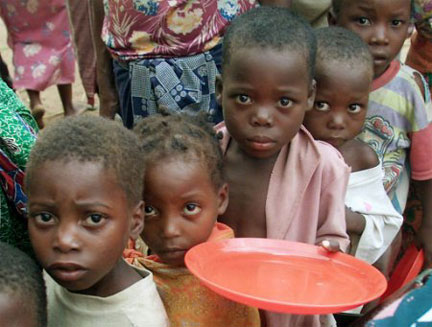
African_children_in_poverty“The projections that we cite assume that family planning will become more widespread. If not, Africa’s population will grow more rapidly, further constraining efforts to address poverty, create jobs, and protect the environment.”

This year’s Data Sheet provides detailed information on 20 population, health, and environment indicators for more than 200 countries, and has a special focus on wealth and income inequality.

Developing countries tend to have wide income gaps between rich and poor that are associated with dramatic differences in fertility and health.

In Uganda, women from the poorest fifth of families have twice as many children as those from the wealthiest fifth.

And children from the poorest families are much more likely to die before turning 5 than their counterparts in the wealthiest families.

PRB’s 2013 World Population Data Sheet shows the stark contrasts between rich and poor countries, illustrated by comparing Niger and the Netherlands.

The demographic divide: Niger and Netherlands

                     Niger                       Netherlands

Population (2013): 16.9 million                                 16.8 million
Projected Population (2050): 65.8 million                17.9 million
2050 Projected Population as a Multiple of 2013: 3.9      1.1
Lifetime Births per Woman: 7.6                                          1.7
Annual Births: 845,000                                                 176,000
Annual Deaths: 195,000                                               141,000
% of Population Below Age 15: 50%                             17%
% of Population Ages 65+ (2013): 3%                          16%
% of Population Ages 65+ (projected 2050): 3%         27%
Life Expectancy at Birth (all): 57 years                        81 years
Infant Mortality Rate (per 1,000 live births): 51          3.7
Annual Number of Infant Deaths: 43,000                     650

Even though the two countries have almost the same population size today, Niger is projected to nearly quadruple its population from about 17 million today to 66 million in 2050. The Netherlands’ population will likely grow very slowly from 17 million to 18 million over that same time.

At the root of this “demographic divide” are differences in the average number of births per woman and the share of the population in their childbearing years.

Niger’s total fertility rate of 7.6 lifetime births per woman is more than four times the Netherlands’ rate of 1.7 per woman.

One-half of Niger’s population is younger than age 15, compared with 17 percent of the Netherlands’ population. – Daily Mail

Most US flights to Israel halted

About two hours ago, and in the aftermath of the public outcry regarding flights in conflict zones, first Delta then most other major international carriers announced they would suspend flights to Israel “until further notice” amid concerns that a rocket landed near Ben Gurion International Airport in Tel Aviv. The list of confirmed airlines that have halted such flights is shown below.

US Airways also said it has canceled two flights to and from Tel Aviv from Philadelphia.
United Airlines canceled two flights from Newark to Tel Aviv, according to FlightAware.com.
American Airlines told NBC News that it is meeting to discuss the situation.
Lufthansa said there are no changes to its Tel Aviv flight schedules for now.
British Airways said it continued to operate as normal but is monitoring the situation.
KLM said it was meeting to discuss the issue.

According to NBC, “the move comes amid heightened concerns over the safety of passenger aircraft flying over war zones. A Malaysian Air Lines jet with 298 aboard was brought down as it was flying over contested Ukrainian territory. The White House said the Federal Aviation Administration has not issued any notices about flights over the Middle East. Israeli police spokesman Micky Rosenfeld told NBC News there is no event to the best of his knowledge taking place now at Ben Gurion. He said he believes the Delta cancellation probably came after a rocket fell 3 miles from the airport earlier Tuesday.”

The flight redirection is shown most vividly in the following flight pattern of Delta flight 468 from New York to Tel Aviv (via Flightradar24) which was rerouted shortly before arrival and landed in Paris instead.

Israel using flechette shells in Gaza

The Israeli military is using flechette shells, which spray out thousands of tiny and potentially lethal metal darts, in its military operation in Gaza.

Six flechette shells were fired towards the village of Khuzaa, east of Khan Younis, on 17 July, according to the Palestinian Centre for Human Rights. Nahla Khalil Najjar, 37, suffered injuries to her chest, it said. PCHR provided a picture of flechettes taken by a fieldworker last week.

The Israel Defence Forces (IDF) did not deny using the shells in the conflict. “As a rule, the IDF only employs weapons that have been determined lawful under international law, and in a manner which fully conforms with the laws of armed conflict,” a spokesperson said in response to a request for specific comment on the deployment of flechettes.

B’Tselem, an Israeli human rights organisation, describes a flechette shell as “an anti-personnel weapon that is generally fired from a tank. The shell explodes in the air and releases thousands of metal darts 37.5mm in length, which disperse in a conical arch 300 metres long and about 90 metres wide”.

The munitions are not prohibited under international humanitarian law, but according to B’Tselem, “other rules of humanitarian law render their use in the Gaza Strip illegal. One of the most fundamental principles is the obligation to distinguish between those who are involved and those who are not involved in the fighting, and to avoid to the extent possible injury to those who are not involved. Deriving from this principle is the prohibition of the use of an imprecise weapon which is likely to result in civilian injuries.”

The legality of flechette munitions was upheld by the Israeli supreme court in 2002, and according to an Israeli military source, they are particularly effective against enemy fighters operating in areas covered by vegetation.

The source said a number of armies around the world deploy flechette shells, and that they were intended solely for use against legitimate military targets in accordance with international law.

The IDF has deployed flechette shells in Gaza and Lebanon before. B’Tselem has documented the deaths of nine Palestinians in Gaza from flechettes in 2001 and 2002. Flechettes have also killed and wounded dozens of civilians, including women and children, in conflicts between Israel and Hezbollah in Lebanon.

Source: The Guardian

Hundreds of Japanese hold silent protest on Gaza

Hundreds staged a silent protest in Tokyo against the bloodshed in Gaza on Monday, the biggest such gathering in the Japanese capital since the violence began early this month, organizers said.

As night fell demonstrators holding candles formed huge letters spelling “Gaza” in a city park, and offered a one-minute prayer for victims of the violence in the Palestinian territory.

Some waved Palestinian flags while others carried signs reading: “Stop the killing in Gaza. Japan cares.”

“We want people in Gaza to know that they are not isolated from the world,” said Sonoko Kawakami, one of the organizers.

“Gaza is far from Japan, but we are going to continue to do whatever we can do here.”

Leading members of the Muslim, Christian, Buddhist and Jewish faiths delivered brief messages calling for an end to the violence.

The Palestinian death toll in Gaza has now topped 500, the overwhelming majority of them civilians. Israel said 18 of its soldiers had been killed, its heaviest losses in eight years, along with two civilians.

Pro-Palestinian demonstrations have been held in recent weeks in cities across Europe, along with smaller protests in Asia.

In France they have spiraled into violent clashes with riot police, leading to dozens of arrests.

Nobel Peace Prize winners call for arms embargo on Israel

Seven Nobel Peace Prize winners were amongst the 64 public figures calling for an international arms embargo on Israel for its “war crimes and possible crimes against humanity” in Gaza. The statement came in a letter published in Britain’s The Guardian on Friday.

“Israel has once again unleashed the full force of its military against the captive Palestinian population, particularly in the besieged Gaza Strip, in an inhumane and illegal act of military aggression. Israel’s ability to launch such devastating attacks with impunity largely stems from the vast international military cooperation and trade that it maintains with complicit governments across the world,” read the statement.

“We call on the UN and governments across the world to take immediate steps to implement a comprehensive and legally binding military embargo on Israel, similar to that imposed on South Africa during apartheid,” the letter concluded.

Among the signators were Nobel peace laureates Desmond Tutu, Betty Williams, Federico Mayor Zaragoza, Jody Williams, Adolfo Peres Esquivel, Mairead Maguire and Rigoberto Menchu.

Also signing were academics Noam Chomsky and Rashid Khalidi, filmmakers Mike Leigh and Ken Loach, musicians Roger Waters and Brian Eno, writers Alice Walker and Caryl Churchill, and journalists John Pilger and Chris Hedges. Two Israelis, academics Ilan Pappe and Nurit Peled, signed the letter as well.

Zim government can’t pay salaries

Zimbabwe’s economy is ‘regressing with deindustrialisation or informalisation; 84% of the economy is now informal’.

While liberal media in the West, such as the New York Times, have been lauding Zimbabwe’s antiwhite “land reform” and confiscation of white assets as a “success”, its government is currently unable to pay salaries.

According to reports, the Zimbabwean government “may be heading for a shutdown after it announced that it cannot guarantee pay dates for the civil service as the cash crunch bites deeper and with no solution in sight”.

Like many African countries, Zimbabwe has a vast army of government bureacrats constituting the “growing middle class” of the country who produce very little but receive 90% of the government budget. Since the ANC takeover of South Africa, government’s salary bill has also skyrocketed, with investment in infrastructure or maintenance of state assets slumping.

Zimbabwe’s Deputy Minister of Public Service, Labour and Social Welfare Tongai Muzenda told Senate last week that government “won’t guarantee any fixed pay dates”.

“We do not want to make false promises as the (Civil Service) Commission does not put the dates on the pay slips and that is going to be the case for some time until our economy has stabilised,” he said.

Analysts yesterday said that the admission by government poses a serious threat to the economy considering that salaries take a huge chunk of the recurrent expenditure.

“We are in shutdown,” an analyst said. “The budget is 90% recurrent and the bulk of that is in salaries”.

The last country to experience a government shutdown was the United States after Congress failed to enact legislation appropriating funds for fiscal year 2014. It lasted for 16 days.

During the US shutdown at least 800 000 federal employees were indefinitely furloughed (leave of absence) and 1,3 million reported for work without known payment dates.

Analysts say the civil service was the most secure borrower through Salaries Services Bureau and a payslip was a blank cheque to micro credit, which is driving the informal economy.

“That has been decimated. Once that is not there, banks won’t be able to lend. It means the lending platform has come to a halt,” an analyst said.

The civil service enjoys salary-based loans on the basis that government pays salaries on time.

Banks have stopped lending to companies due to rising defaults with statistics from the central bank showing that the ratio of non-performing loans to total loans had increased to 16,96% as at March 31 2014, up from 15,92%.

An NPL is when payments of interest and principal are past due by 90 days or more, or at least 90 days of interest payments have been capitalised, refinanced or delayed by agreement.

An executive with a commercial bank said measurement of economic policies was not on the basis of its nobility or objective but on the consequences.

“The consequence of announcing that there is no fixed date [for civil servants’ salaries] is that the economy has shut down,” he said.

Analysts say the only symbolism which was giving the economy a semblance of life was the fact that civil servants were being paid.

Government is the largest single employer and had until now provided fixed pay dates for its workers while other companies were defaulting.

“That symbolism has now come to an end by the removal of fixed dates and signifies government’s acceptance of default,” he said.

American actor and comedian Larry Fine once remarked that “the pain goes away on payday”, a feat that was only enjoyed by the civil service because the money was coming on time.

For the majority of Zimbabwean workforce that pain has become a permanent feature as payday becomes a moving target. For the unlucky ones, it has appeared only in dreams as companies took a battering from the harsh prevailing economic environment.

Statistics from the Zimbabwe Congress of Trade Unions (ZCTU) shows that 15 companies retrenched 2 491 in the first half of the year.

The Employers’ Confederation of Zimbabwe (EMCOZ) attributed the challenges in paying salaries on time to “a shortage of cash in the economy for various reasons which include minimum injection of new cash into the economy to grow the formal sector and inefficiencies inherent in an economic environment that is growing very slowly with some companies closing”.

“What is then happening is that producers of goods are having difficulties collecting cash from their sales and their suppliers are always sitting at their gates wanting to be paid for services rendered,” EMCOZ president Jack Murehwa said.

“When the company eventually gets a bit of cash from the overdue debtors, it then has to prioritise and decide how much goes to service providers, inputs, maintenance, salaries and many other costs.”

He said as a result of the limited cash, the company has to decide where to apply the cash — net salaries, pension, PAYE and other levies to be paid.

“As would be expected, in most cases, one or more of the commitments will suffer and obviously in instances where the extent of the unfunded commitments continues to grow, the formal business winds up,” he said.

Murehwa said under the current circumstances, employees who are still getting their salaries, although delayed, are in fact “in a better shape compared to those who have stopped thinking of ever getting a salary because the operation wound up or is as good as non-existent”.

Labour and Economic Development Research Institute of Zimbabwe director Godfrey Kanyenze said the private sector was a victim of the environment and government has to address the doing business aspect to help companies.

“How do you compete when you don’t have electricity? Government should address the cost of capital through re-engagement with multilaterals because no one will bring the money cheap, they demand a premium,” Kanyenze said.

Kanyenze said the economy was regressing with deindustrialisation or informalisation. He said 84% of the economy was now informal.

In his 2014 national budget presentation, Finance minister Patrick Chinamasa said the old economy was dead and a new one, based on the informal sector, had been born, urging financial institutions to cater for the small to medium sized enterprises.

But Kanyenze said informality was problematic as it did not contribute to taxes.

“You can’t celebrate informality. Everything informal is hidden. Much of the work is organised around sustenance,” Kanyenze said.

“There is nothing to celebrate unless there is a transition to formality.”

Kanyenze said the situation was dire and government alone could not resolve the crisis. He said it was now necessary to have a convergence of minds among all stakeholders so that everybody could put their hands on the plough.

Figures from the national statistical agency, Zimstat, show that imports in the first half of the year have been reduced to US$2,99 billion from US$3,92 billion in the comparable period last year. Exports went down to US$1,22 billion from US$1,54 billion.

A large portion of Zimbabwe’s foreign currency receipts come from migrant workers who have crossed the border to South Africa, mostly illegally. In Johannesburg the majority of restaurant and café waiters, maids and gardeners now come from Zimbabwe.

Western, mostly British, aid agencies are also active in Zimbabwe, propping up Mugabe’s regime which was installed by Britain in 1980 when Fleet Street gushed about “that brilliant Marxist-intellectual leader, Robert Mugabe”.

In the wake of collapsing companies, analysts say the low imports signify that the liquidity crunch is biting.

62 Palestinians killed in Gaza ‘massacre’ as death toll exceeds 400

At least 62 Palestinians were killed on Sunday in Israeli shelling of a Gaza neighborhood that left bodies strewn in the streets and thousands fleeing for shelter to a hospital packed with wounded, Palestinian witnesses and officials said.

The Israeli military said militants from Gaza’s dominant Hamas group responded with anti-tank missiles and heavy weapon fire in some of the bloodiest fighting since Israel launched its Gaza offensive 13 days ago.

A two-hour “humanitarian ceasefire” in the area, agreed by both sides at the request of the International Committee of the Red Cross, broke down in minutes with each side blaming the other.

Palestinian President Mahmoud Abbas accused Israel of carrying out a massacre and declared three days of mourning. The Israeli military said Hamas had fired rockets and built tunnels and command centers in Sheja and that it had warned locals to evacuate two days earlier. Its ground forces were backed up by air strikes and artillery, the army added.

Anguished cries of “Did you see Ahmed?” “Did you see my wife?” echoed through the courtyard of Gaza’s Shifa hospital, where panicked residents of Shejaia gathered in family groups. Inside, bodies and wounded lay on blood-stained floors.

Elderly men there said the Israeli attack was the fiercest they had seen since the 1967 Middle East war, when Israel captured Gaza.

Shifa hospital’s director, Naser Tattar, said 17 children, 14 women and four elderly were among the 62 dead, and about 400 people were wounded in the Israeli assault.

Death toll exceeds 400

Gaza’s Health Ministry officials said at least 403 Palestinians, many of them civilians, have been killed and about 2,600 wounded in the 13-day offensive, that Israel says it launched to halt mounting cross-border rocket fire by militants.

On Israel’s side, two civilians have been killed by cross-border fire and five soldiers have died in fighting. More than 50 Israeli troops have been wounded, hospital officials said.

Thousands fled Shejaia, some by foot and others piling into the backs of trucks and sitting on the hoods of cars filled with families trying to get away. Several people rode out of the neighborhood of 100,000 in the shovel of a bulldozer.

Video given to Reuters by a local showed at least a dozen corpses, including three children, lying in rubble-filled streets, though the footage could not be verified independently.

As the tank shells began to land, Shejaia residents called radio stations pleading for evacuation. An air strike on the Shejaia home of Khalil al-Hayya, a senior Hamas official, killed his son, daughter-in-law and two grandchildren, hospital officials said.

Israel, which has accused Hamas of using civilians as human shields by launching rockets from residential areas, sent ground forces into the Gaza Strip on Thursday after 10 days of air, naval and artillery barrages failed to stop the salvoes.

The military said it beefed up its presence on Sunday, with a focus on destroying missile stockpiles and a vast tunnel system Hamas built along the frontier with Israel.

“It has been a tough day of combat, but it won’t deter us,” Israeli Finance Minister Yair Lapid said, without referring to events in Shejaia.

“The operation is necessary and, if needed, we will broaden it,” he told reporters while visiting wounded Israeli soldiers in a hospital in the southern city of Beersheba. – Reuters

Singapore Airlines criticised over MH17 tweet

‘Customers may wish to note that Singapore Airlines flights are not using Ukraine airspace.’

Singapore Airlines (SIA) has apologised for posting an “insensitive” comment on social media about the Malaysia Airlines Flight MH17 crash in crisis-stricken eastern Ukraine.

Hours after the Boeing 777-200 passenger jet with 298 people on board went down on Thursday, believed shot by a surface-to-air missile, SIA posted a one-line statement on Facebook and Twitter.

It read: “Customers may wish to note that Singapore Airlines flights are not using Ukraine airspace.”

The comment sparked anger among users of social media.

“How about at least acknowledging the terrible event and sending condolences to those families and friends involved instead of this cold, classless update?,” wrote a Michael Reif in response.

Hundreds of others joined in the condemnation but some defended the airline, saying it was trying to reassure customers concerned about the safety of their flight route.

“We are aware that our Facebook and Twitter update on Friday morning may have come across as insensitive to some,” SIA said in a Facebook posting late Saturday.

“We recognise that the information could have been better communicated and we sincerely apologise if it had offended our customers and anyone else in the online community,” it added.

“The post was in response to many requests from our customers who had asked for information about our flight routes for their upcoming flights with us.”

SIA acknowledged that prior to the crash it was flying the route taken by MH17 but has since re-routed flights.

World leaders are in agreement that MH17 was blown out of the sky by a surface-to-air missile fired from rebel-controlled eastern Ukraine.

Kiev has gone a step further, saying militias using a Russian-supplied anti-aircraft system were responsible.

Ebola 2014: Outbreak tops 1000 cases

The Ebola Virus Disease (EVD) outbreak in West Africa has hit a new “milestone” as the World Health Organization reports in an update today than the number of cases have exceeded 1,000. The global health agency says the current epidemic trend of EVD outbreak in Sierra Leone and Liberia remains serious, with 67 new cases and 19 deaths reported from 15 – 17 July 2014.

While no new cases were reported from Guinea, 22 new cases with 10 deaths were reported from Liberia; and in Sierra Leone, 45 new cases and 9 deaths were tallied. These numbers include laboratory-confirmed, probable, and suspect cases and deaths of EVD.

The WHO says as of 17 July 2014, the cumulative number of cases attributed to EVD in the three countries stands at 1,048, including 632 deaths. The breakdown by country is as follows:

Guinea, 410 cases (301 confirmed, 95 probable, and 14 suspected) and 310 deaths (203 confirmed, 95 probable, and 12 suspected); Liberia, 196 cases (76 confirmed, 56 probable, and 64 suspected) and 116 deaths (54 confirmed, 40 probable, and 22 suspected); and Sierra Leone, 442 cases (368 confirmed, 48 probable, and 26 suspected) and 206 deaths (165 confirmed, 35 probable, and 6 suspected).

The EVD outbreak, the largest in history, began six months ago in Guinea.

Source: theglobaldispatch.com