The eldest daughter of Nelson Mandela summoned the clan to Qunu to discuss ‘sensitive matters’.
In African tradition it means the end is near and relatives have to discuss if the ailing patient is ready to be “released”.
Yesterday, for the first time since Mandela was admitted to hospital, the pool of visitors went beyond just family members with senior politicians and government ministers visiting.
Among them were Defence and Military Veterans Minister Nosiviwe Mapisa-Nqakula and United Democratic Movement leader Bantu Holomisa, who is a family friend. Holomisa arrived and left the hospital with Makaziwe.
Madiba’s grandson Ndaba, granddaughters Zoleka and Zaziwe and her husband David Manaway also spent time with him.
Security remained tight at the Mediclinic Heart Hospital. Handmade cards with get well messages, balloons and flowers continued to fill the security wall at one of the hospital.
This came as Mandela, whose condition was described as critical by the presidency on Sunday night, spent his 16th night in hospital.
Activity in Mthatha was also starting to grow, and yesterday two airlines, one which does not fly even to East London, expressed interest in flying to the newly refurbished Mthatha Airport.
Some residents were preparing to turn their homes into home-stay accommodation, as they said there might not be enough place in the village should the ailing icon die, according to the report.
Villagers, who did not want to be named, told the newspaper there were only three bed and breakfasts (B&B) in the village.
An employee at one of the residences said the house had been converted into a 10-room B&B and had previously accommodated many foreigners who came to the village to see Mandela’s home.
Nowinothi Geledwana, 63, told the newspaper she had previously rented out some rooms in her house and expected to do so again, should there be a demand.
“I have about three to four rooms that are available and can be rented out should people prefer home-stay accommodation in Qunu,” Geledwana was quoted as saying.
“I really don’t know how much I will charge for them, but I’m sure I will make some profit.”
Apart from accommodation provided by residents, the Nelson Mandela Museum in the village also had accommodation for 60 people, while there was a plush guesthouse less than 10km from Qunu. – The Sowetan
The U.S. assumes National Security Agency leaker Edward Snowden remains in Russia, and officials are working with Moscow in hopes he will be expelled and returned to America to face criminal charges, President Barack Obama’s spokesman said Monday. He declared that a decision by Hong Kong not to detain Snowden has “unquestionably” hurt relations between the United States and China.
Snowden left Hong Kong, where he has been in hiding, and flew to Moscow but then apparently did not board a plane bound for Cuba as had been expected. His whereabouts were a mystery. The founder of the WikiLeaks secret-spilling organization, Julian Assange, said he wouldn’t go into details about where Snowden was but said he was safe.
Snowden has applied for asylum in Ecuador, Iceland and possibly other countries, Assange said.
At the White House, spokesman Jay Carney said the U.S. was expecting the Russians “to look at the options available to them to expel Mr. Snowden back to the United States to face justice for the crimes with which he is charged.”
“The Chinese have emphasized the importance of building mutual trust,” he added. “And we think that they have dealt that effort a serious setback. If we cannot count on them to honor their legal extradition obligations, then there is a problem. And that is a point we are making to them very directly.”
Snowden has given highly classified documents to The Guardian and The Washington Post newspapers disclosing U.S. surveillance programs that collect vast amounts of phone records and online data in the name of foreign intelligence, often sweeping up information on American citizens. He also told the South China Morning Post that “the NSA does all kinds of things like hack Chinese cellphone companies to steal all of your SMS data.”
Snowden still has perhaps more than 200 sensitive documents, Sen. Dianne Feinstein, chairwoman of the Senate Intelligence Committee, said over the weekend.
He had been in hiding in Hong Kong, a former British colony with a degree of autonomy from mainland China. The United States formally sought Snowden’s extradition but was rebuffed by Hong Kong officials who said the U.S. request did not fully comply with their laws. The Justice Department rejected that claim, saying its request met all of the requirements of the extradition treaty between the U.S. and Hong Kong.
Said Carney: “We are just not buying that this was a technical decision by a Hong Kong immigration official. This was a deliberate choice by the government to release a fugitive despite a valid arrest warrant, and that decision unquestionably has a negative impact on the U.S.-China relationship.”
The dual lines of diplomacy — harsh with China, hopeful with the Russians — came just days after Obama met separately with leaders of both countries in an effort to close gaps on some of the major disputes facing them.
Snowden arrived in Moscow on Sunday, but his whereabouts were thrown into question Monday when a plane took off from Moscow for Cuba with an empty seat booked in his name. The U.S. has revoked his passport.
In Washington, U.S. Secretary of State John Kerry said it would be “deeply troubling” if Russia or Hong Kong had adequate notice about Snowden’s plans to flee to a country that would grant him asylum and still allowed him leave.
“We don’t know, specifically, where he may head, or what his intended destination may be,” Kerry said, responding to a question during a news conference in New Delhi where he was discussing bilateral issues between the U.S. and India.
U.S. officials pointed to improved cooperation with the Russians in the aftermath of the Boston Marathon bombing and to assistance the U.S. has given Russia on law enforcement cases.
“We continue to hope that the Russians will do the right thing,” Kerry told NBC News. “We think it’s very important in terms of our relationship. We think it’s very important in terms of rule of law. These are important standards. We have returned seven criminals that they requested for extradition from the United States over the last two years. So we really hope that the right choice will be made here.”
“We don’t know, specifically, where he may head, or what his intended destination may be,” Kerry said during a news conference in New Delhi.
Carney said the U.S. was in touch through diplomatic and law enforcement channels with countries through which Snowden might travel or where he might end up.
“The U.S. is advising these governments that Mr. Snowden is wanted on felony charges and as such should not be allowed to proceed in any further international travel, other than is necessary to return him here to the United States,” Carney said.
An Aeroflot representative who wouldn’t give her name told The Associated Press that Snowden wasn’t on flight SU150 to Havana, which was filled with journalists trying to track him down.
In Moscow, security around the aircraft was heavy prior to boarding and guards tried to prevent the scrum of photographers and cameramen from taking pictures of the plane, heightening the speculation that Snowden might have been secretly escorted on board.
After spending a night in Moscow’s Sheremetyevo Airport, Snowden had been expected to fly to Cuba and Venezuela en route to possible asylum in Ecuador.
Some analysts said it was likely that the Russians were questioning Snowden, interested in what he knew about U.S. electronic espionage against Moscow.
“If Russian special services hadn’t shown interest in Snowden, they would have been utterly unprofessional,” Igor Korotchenko, a former colonel in Russia’s top military command turned security analyst, said on state Rossiya 24 television.
The White House’s tough response to Hong Kong’s decision to let Snowden leave came just two weeks after Obama met with Chinese President Xi Jinping for two days of personal diplomacy in a desert retreat in California.
Carney said that after the U.S. sought Snowden’s extradition from Hong Kong, authorities there requested additional information from the U.S.
“The U.S. had been in communication with Hong Kong about these inquiries and we were in the process of responding to the request when we learned that Hong Kong authorities had allowed the fugitive to leave Hong Kong,” Carney said.
Ecuador’s foreign minister, Ricardo Patino, said his government had received an asylum request, adding Monday that the decision “has to do with freedom of expression and with the security of citizens around the world.”
Ecuador has rejected some previous U.S. efforts at cooperation and has been helping Assange avoid prosecution by allowing him to stay at its embassy in London.
But Assange’s comments that Snowden had applied in multiple places opened other possibilities of where he might try to go.
WikiLeaks has said it is providing legal help to Snowden at his request and that he was being escorted by diplomats and legal advisers from the group.
Icelandic officials have confirmed receiving an informal request for asylum conveyed by WikiLeaks, which has strong links to the tiny North Atlantic nation. But authorities there have insisted that Snowden must be on Icelandic soil before making a formal request. – AP
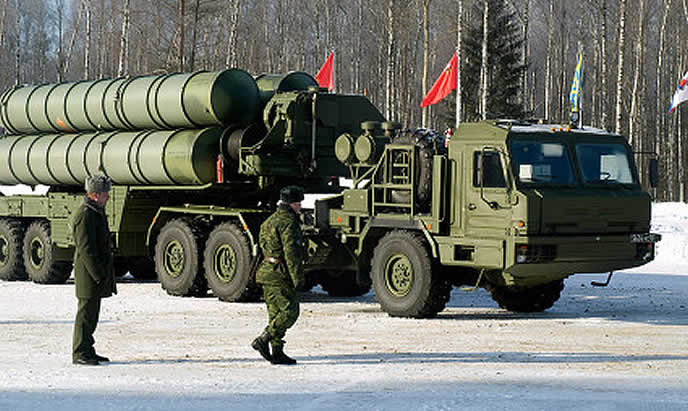
Russian S400 missile system photographed near Moscow
During his recent visit to London and meeting with British Prime Minister Cameron, President Putin passed on a message to the US and France in response to their recent announcement that they
will arm the [Al Nusrah] fighters in Syria.
As Russia is a sovereign nation dealing with the sovereign, legitimate government of Syria, some new arms which have never left Russia before [never previously deployed in Syria] will be delivered to the Syrian military.
The Patriot Missiles will be hit and repealed with S300 SAM [already installed in Syria]. Putin also threatened to deliver the more advanced S400 anti-aircraft missiles (see image above) far superior to the Patriot missiles and ranked as the World’s most advanced air defense system.
He added that Russia will also supply Syria with state-of –the-art 24-Barrell rocket launchers which have a range of 60 km ranked as the most developed artillery weapon of its kind.
He added that Russia will supply 400 of these launchers which will be able to destroy all targets around Syria’s borders.
Barrel 24 Launchers
A British intelligence report stated that Putin went to London bringing his own Russian cooked food and did not consume anything from Britain including water as he even brought his own water with him reportedly because he had concerns of being poisoned.
The British intelligence site stated that Putin threatened to send other secret Russian made weapons to Syria which would tip the balance of power even further in favour of Syria and re-iterated that these weapons will not be used against Israel on condition that Israel will not participate in the war within Syria and neighbouring countries.
{Lebanon, Jordan]
Reportedly, the British PM’s response was very weak in relation to Putin’s threats.
Putin’s response came just over 24 hours after Obama’s statement on Saturday that he was going to arm the Syrian resistance.
Putin clearly stated that the Middle East is going to witness a significant change. Syria will be armed with weapons that have never been seen before [in the Middle East] including computer guided smart missiles that never miss their target.
He also added that Russia will supply Syria with Skean 5 ground -to-sea missiles that are capable of hitting and sinking any target up to 250 km off the Syrian coast.
This article was originally published at Global Research
The decision by the United States and its allies to arm rebel groups in Syria is “very dangerous” and will prolong the violence and killing on the ground, Syria’s foreign minister said Monday.
Walid al-Moallem said sending more weapons to the opposition will also hinder efforts to bring both sides to the table in a planned peace conference in Geneva. He said his country remains ready and willing to take part but added President Bashar Assad will not step down.
Al-Moallem’s comments came two days after an 11-nation group that includes the U.S. met in the Qatari capital of Doha and agreed to step up military and other assistance to the Syrian rebels. He said all those who met in Doha “have Syrian blood on their hands.”
U.S. Secretary of States John Kerry, who took part in the conference, would not disclose details of the aid, saying only that it would re-balance the fight between the rebels and the government. Assad’s better-equipped forces are increasingly backed by fighters from Lebanon’s Hezbollah militant group.
“We are not scared,” al-Moallem said of the decision. “If they dream or are delusional about achieving a balance with the Syrian Arab Army, I think they need to wait years and this won’t be achieved.”
“They will not be victorious no matter how much they conspire,” al-Moallem added. He said arming the rebels “is a dangerous decision because it aims at prolonging the crisis, prolonging the violence and killing and encouraging terrorism.”
The Friends of Syria gathering in Doha was Kerry’s first meeting with his counterparts on the practicalities of assisting the Syrian rebels since President Barack Obama announced that the U.S. would send lethal aid to the opposition. The decision came despite concerns that the weapons could fall into the hands of Islamic extremists in the rebel coalition.
Obama’s change of policy was partly based on a U.S. intelligence assessment that Assad had used chemical weapons, but Kerry expressed deeper concern about Damascus’ foreign support. He said that Iranian as well as Hezbollah fighters had joined the war.
Al-Moallem denied categorically that any Iranian fighters were in Syria. Damascus admits that Hezbollah is assisting government troops.
The foreign minister said his regime was willing to take part in any peace conference, but will go to Geneva not to hand over power to the other side but rather to establish “a real partnership” and a national unity government that includes representatives of all Syrian society.
“President Bashar Assad will not step down,” he said. “If anyone has such illusions on the other side, my advice to them is not to go to Geneva,” he said. He nonetheless called the conference an “opportunity that should not be missed.”
He defiantly said Syria will not accept any solutions or even ideas dictates from the outside.
More than 93,000 people have been killed in Syrian conflict that started in March 2011 as largely peaceful protest against Assad’s rule. The uprising turned into a bloody insurgency in response to a military crackdown by regime forces on the protest movement. In the past year, the war has taken on increasingly sectarian overtones. – AP
Roughly 80 percent of all the packaged foods sold within the United States contain chemicals outlawed in other parts of the world, Britain’s Daily Mail reports.
Six common food additives found in an estimated 8-out-of-10 products sold in American stores are banned outside of the US, the Mail claims, putting millions of Americans at risk of consuming chemicals considered too dangerous for humans in other countries.
Grocery shop items including best-selling soft-drinks and cereal sold in the US contain additives such as brominated vegetable oil, olestra and others that have been banned in the European Union and elsewhere.
The Daily Mail cites ‘Rich Food, Poor Food,’ a recently published book by Jayson Calton and Mira Calton, as the source for their claim that the majority of American groceries contain the additives.
Among the common items containing the chemicals are Mountain Dew, Chex Mix and Hungry Man frozen dinners, which are made with additives outlawed overseas due to health risks. The Caltons say these products are filled with some of the six “Banned Bad Boys” that are used in America but absent in supermarkets overseas.
“One of the most common ‘Bad Boys’ is different variations of food coloring, which actually is made from petroleum and is found in everyday items like soda, sports drinks, mac and cheese, cake, candy and several other common, American products,” reports the Daily Mail. One of the chemicals in that food coloring, they add, has been proven to cause various different cancers. Those artificial dyes have been outlawed in Norway, Finland, Austria, France and the United Kingdom
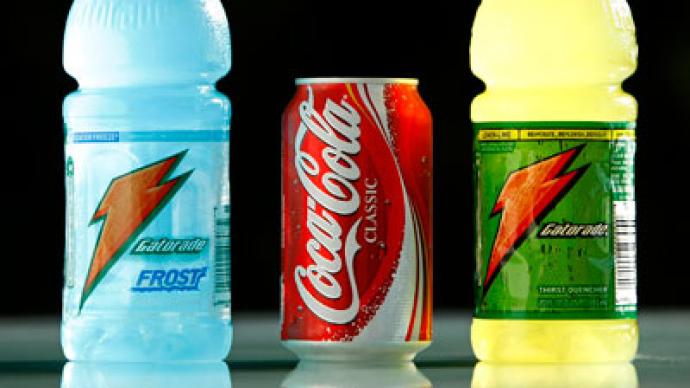
Another additive, brominated vegetable oil, has been banned in over 100 countries because it’s been linked to causing major organ damage, birth defects and hearing loss, among other side effects. Brominated vegetable oil, or BVO, is used in Mountain Dew, Gatorade, Powerade and Squirt — and around 10 percent of all drinks sold in the US.
A petition started earlier this year to get BVOs out of beverages sold in the US received over 206,000 signatures on the website Change.org.
“BVO is banned other places in the world, so these companies already have a replacement for it,” the petition’s author, Sarah Kavanagh, told The New York Times. “I don’t see why they don’t just make the switch.”
Another additive, potassium bromate, is used in American bakeries to speed up the process of preparing wraps, rolls and other bread products. It’s derived from the same chemical as BVO, though, and has been tied to causing kidney damage and cancer. That’s why it’s been outlawed in Europe, Canada and China, but not in the US.
Also on the Calton’s list is azodicarbonamide, a chemical the Daily Mail notes is used to make things like bleach and rubber yoga mats.
Azodicarbonamide is “approved to be a bleaching agent in cereal flour” and is “permitted for direct addition to food for human consumption,” according to the Food and Drug Administration. Along with waxy preservatives called butylated hydroxyanisole (BHA) and butylated hydroxytoluene (BHT) used in bubble gums, though, the additive has been banned in parts of Europe for potential health risks.
Rounding out the authors’ ‘Bad Boys’ list are Synthetic growth hormones rBGH and rBST and the chemical arsenic. They’ve both been banned in the EU for a variety of reasons, and perhaps for good reason: the arsenic put in American poultry can kill a human being if consumed in a high enough dosage.- RT
Ex-CIA contractor, Edward Snowden’s plane to Cuba will pass through US airspace, an Interfax source reports. Washington has an extradition notice against Snowden on charges of espionage and could intervene if the plane enters US jurisdiction.
Aeroflot flight SU150, leaves Moscow at 14:04 local time (11:04 GMT) and will fly through US airspace a couple of kilometers from the coast of New York on its way to Havana, reported Russian news agency Interfax, citing a source in Sheremetevo airport air traffic control. Snowden is checked into the flight to Havana in seat number 17A, reports the Associated Press, citing Aeroflot.
The source added that US air traffic control can legally ground the plane and take Snowden into custody on charges of espionage, theft and conversion of government property. However, the pilot may change the course of the flight so as not to pass through American airspace.
“The pilot of the plane is within his rights to change the course of the flight and there should be enough fuel to do so,” said the source to Interfax.
The Ecuadorian government has confirmed that Snowden filed for asylum and is processing the request.
WikiLeaks has actively assisted Snowden in eluding the US extradition order, has confirmed the fugitive’s final destination will be Ecuador.
Mr Snowden is “bound for the Republic of Ecuador via a safe route for the purposes of asylum, and is being escorted by diplomats and legal advisers from Wikileaks.”
The news that former CIA contractor Edward Snowden had left Hong Kong emerged on Sunday. The city’s authorities published a statement saying that Snowden had legally and voluntarily left Hong Kong on Sunday on a flight to a “third country” with a stopover in Moscow. The statement also said that the documents for Snowden’s extradition submitted to the Hong Kong authorities by Washington were not sufficient to be able to “process the request.”
The White House said it was “disappointed” with Hong Kong’s move to let Snowden go and has urged Russia to consider every option to expel the fugitive.
“The US is advising these governments that Snowden is wanted on felony charges, and as such should not be allowed to proceed in any further international travel, other than is necessary to return him to the United States,” a state department official said.
Washington has stressed they will seek cooperation from whichever country Snowden arrives in.
Snowden initially fled to Hong Kong after leaking troves of classified data to UK newspaper the Guardian, including information of the US spy program Prism.- RT
The German Justice Minister has called the British spy agency’s massive eavesdropping of international fiber-optic cables ‘a catastrophe’. Sabine Leuthesser-Scharrenberger insisted European institutions should seek clarification “straight away”.
The exposure by former US National Security Agency contractor Edward Snowden of the global eavesdropping capabilities of the British Government Communications Headquarters (GCHQ) have sent European capitals into a stupor.
Having revealed the NSA’s PRISM global surveillance program, Snowden told the UK’s Guardian newspaper information about Britain’s top secret Tempora surveillance project under which the UK’s GCHQ spying agency intercepts and stores for 30 days huge volumes of data, like emails, social network posts, phone calls and much more, culled from international fiber-optic cables.
The most vociferous reaction has come from Berlin where politicians have demanded a thorough investigation of the activities of the British intelligence-gathering community.
“If these accusations are correct, this would be a catastrophe,” German Justice Minister Sabine Leutheusser-Schnarrenberger said in an email to the Reuters. She compared the news with a “Hollywood nightmare” and called on to the European institutions “to seek straight away to clarify the situation.”
“The accusations make it sound as if George Orwell’s surveillance society has become reality in Great Britain,” Thomas Oppermann, the leader of the opposition Social Democrats in the Bundestag told Reuters. German politicians called the situation ‘unbearable’ and demanded the government “act against a total surveillance of German citizens”.
A report in Britain’s Guardian newspaper has exposed that UK’s GCHQ has been spying on European capitals for at least 18 months intercepting data from over 200 fiber-optic cables.
Begun in 2008, by 2010 the Tempora project made GCHQ a true intelligence superpower, “’the biggest internet access’ of any member of the Five Eyes electronic eavesdropping alliance, comprising the US, UK, Canada, Australia and New Zealand,” The Guardian’s report claims.
By the end of 2012 the GCHQ agency reportedly had enough computational capacity to process information from 46 fibre-optic cables at a time, which amounted to 600 million international phone calls and internet messages daily.
While it was reported earlier that NSA shared classified information obtained through its tapping of the world’s largest internet providers with GCHQ, it became known that these were tit for tat relations and GCHQ shared the info it obtained with the NSA, too. The Guardian believes that the 850,000 NSA employees and US private contractors, like Edward Snowden, had access to GCHQ databases.
“The UK has a huge dog in this fight,” Snowden confirmed to the Guardian. “They [GCHQ] are worse than the US,” he stressed. – RT
The British spy agency GCHQ has access to the global network of communications, storing calls, Facebook posts and internet histories – and shares this data with the NSA, Edward Snowden has revealed to the Guardian in a new leak.
GCHQ’s network of cables is able to process massive quantities of information from both specific targets and completely innocent people, including recording phone calls and reading email messages, it was revealed on Friday.
“It’s not just a US problem. The UK has a huge dog in this fight,” Snowden told the Guardian. “They [GCHQ] are worse than the US.”
The Government Communications Headquarters agency has two different programs, aimed at carrying out this online and telephone monitoring – categorized under ‘Mastering the Internet’ and ‘Global Telecoms Exploitation.’ Both have been conducted in the absence of any public knowledge, reports the Guardian.
“If you remember, even the NSA said that they did not record phone calls, but according to these latest revelations by Edward Snowden, that up to ‘600 million’ telephone events last year were recorded a day by the GCHQ,” said RT’s Tesa Arcilla from London.
“There’s no doubt as to what the objectives of these programs were, having put them in place,” she said, emphasizing the titles.
The agency is able to store the volumes of data it amasses from fiber-optic cables for up to 30 days in an operation codenamed Tempora. The practice has been going on for around 18 months.
GCHQ which was handling 600m telephone ‘events’ a day, according to the documents, had tapped into over 200 fiber-optic cables and had the capacity to analyze data from over 46 of them at a time.
The cables used by GCHQ can carry data at 10 gigabits per second, which in theory, means they could deliver up to 21petabytes of information per day. The program is continuing to develop on a daily basis with the agency aiming to expand to the point it is able to process terabits (thousands of gigabits) of data at once.
“This appears to be dangerously close to, if not exactly, the centralised database of all our internet communications, including some content, that successive Governments have ruled out and Parliament has never legislated for,” said Nick Pickles of UK privacy campaign group Big Brother Watch.
“If GCHQ have been intercepting huge numbers of innocent people’s communications as part of a massive sweeping exercise then I struggle to see how that squares with a process that requires a warrant for each individual intercept. This question must be urgently be addressed in Parliament,” he stated.
By May last year, some 300 GCHQ-assigned analysts and 250 from the NSA had been specially allocated large quantities of data to trawl through as a result of the operations.
The Guardian reports that 850,000 NSA and outside contractors had potential access to the databases. However, the paper does not explain how it came to such an enormous figure
“These revelations reveal the scale of and the scope of cooperation between UK and US intelligence services,” said RT’s Gayane Chichakyan from Washington. “From these revelations we learned how dramatically it has expanded over the years.”
“The document shows the FISA court lets the NSA use data snagged ‘inadvertently.’ They basically give a warrant to target suspects,” she said, recalling Lieutenant General Keith Alexander’s quote after a 2008 visit to the Menwith RAF base in England: “Why can’t we collect all the signals all the time? Sounds like a good summer project for Menwith,” he had said.
The GCHQ project was first trialed in 2008. The intelligence organization has been labeled an ‘intelligence superpower’ on account of its technical capabilities, which by 2010 gave it the strongest access to internet communications out of the ‘Five Eyes’ – an international intelligence sharing alliance, including Australia, Canada, New Zealand, the UK and US, brought into existence in 1946.
The mass-surveillance has seen the interception of data from transatlantic cables that also carry data to western Europe through ‘intercept partners’ commercial companies that had entered into private agreements with GCHQ. Many have been paid off for their cooperation.
GCHQ feared that exposure of the names of the companies involved could lead to “high-level political fallout,” and took measures to ensure names were kept secret. Warrants had reportedly been issued to compel the companies to cooperate so that GCHQ could engage in spying through them.
“They have no choice,” said a Guardian intelligence source.
Human rights groups have spoken out against the mass data collection: “They are exploiting the fact that the internet is so international in nature,” Shami Chakrabarti, director of Liberty, told BBC Radio 4’s ‘Today’ program. “I’m pretty sad in a democracy when all that appears to be holding back the secret state is its physical and technological capability and not its ethics or a tight interpretation and application of the law,” she added.
Snowden previously warned that he would be releasing further information pertaining to mass security operations carried out on the unwary public, stating in a previous Q & A with the Guardian that the “truth is coming, and it cannot be stopped.” – RT
Fugitive former U.S. spy agency contractor Edward Snowden was seeking asylum in Ecuador on Sunday after Hong Kong allowed his departure for Russia in a slap to Washington’s efforts to extradite him on espionage charges.
In a major embarrassment for President Barack Obama, an aircraft thought to have carried Snowden landed in Moscow on Sunday, and the anti-secrecy group WikiLeaks said he was “bound for the Republic of Ecuador via a safe route for the purposes of asylum.”
Earlier, Ecuadorean Foreign Minister Ricardo Patino, visiting Vietnam, tweeted: “The Government of Ecuador has received an asylum request from Edward J. #Snowden.”
It was a blow to Obama’s foreign policy goals of resetting ties with Russia and building a partnership with China. The leaders of both countries were willing to snub the American president in a month when each had held talks with Obama.
The United States continued efforts to prevent Snowden from gaining asylum. It warned Western Hemisphere nations that Snowden “should not be allowed to proceed in any further international travel, other than is necessary to return him to the United States,” a State Department official said.
U.S. Senator Charles Schumer charged that Russian President Vladimir Putin likely knew and approved of Snowden’s flight to Russia and predicted “serious consequences” for a U.S.-Russian relationship already strained over Syria and human rights.
“Putin always seems almost eager to stick a finger in the eye of the United States – whether it is Syria, Iran and now of course with Snowden,” Schumer, a New York Democrat, told CNN’s “State of the Union” program. He also saw “the hand of Beijing” in Hong Kong’s decision to let Snowden leave the Chinese territory despite the U.S. extradition request.
Ecuador, which has been sheltering WikiLeaks‘ founder Julian Assange at its London embassy for the past year, once again took center stage in an international diplomatic saga over U.S. data secrecy.
Ecuador’s ambassador to Russia, Patricio Alberto Chavez Zavala, told reporters at a Moscow airport hotel he would hold talks with Snowden and Sarah Harrison, a WikiLeaks representative.
Hours later, shortly after midnight (2000 GMT Sunday), the ambassador emerged from a business-class lounge near the hotel and refused to say whether he had met Snowden or make any other comment. Shortly before he appeared, a cart with three plates of salmon and a Starbucks bag were rolled into the lounge.
Snowden, who had worked at a U.S. National Security Agency facility in Hawaii, had been hiding in Hong Kong, the former British colony that returned to China in 1997, since leaking details about secret U.S. surveillance programs to news media.
U.S. authorities had said on Saturday they were optimistic Hong Kong would cooperate over Snowden.
U.S. authorities have charged Snowden with theft of federal government property, unauthorized communication of national defense information and wilful communication of classified communications intelligence to an unauthorized person, with the latter two charges falling under the U.S. Espionage Act.
A source at Russian airline Aeroflot said on Sunday that Snowden was booked on a flight scheduled to depart for Havana on Monday at 2:05 p.m. (1005 GMT) from the same Moscow airport where the flight from Hong Kong arrived, Sheremetyevo.
The chief of Cuba’s International Press Center, Gustavo Machin, said he had no such information though pro-government bloggers heaped praise on Snowden and condemned U.S. spying activity.
Venezuela, Cuba and Ecuador are all members of the ALBA bloc, an alliance of leftist governments in Latin America that pride themselves on their “anti-imperialist” credentials.
In their statement announcing Snowden’s departure, the Hong Kong authorities said they were seeking clarification from Washington about reports of U.S. spying on government computers in the territory.
The Obama administration has previously painted the United States as a victim of Chinese government computer hacking.
At a summit this month, Obama called on his Chinese counterpart Xi Jinping to acknowledge the threat posed by “cyber-enabled espionage” against the United States and to investigate the problem. Obama also met Putin in Northern Ireland last week.
A spokesman for the Hong Kong government said it had allowed the departure of Snowden – considered a whistleblower by his supporters and a criminal or even a traitor by his critics – as the U.S. request for his arrest did not comply with the law.
However, a U.S. Justice Department official said at no point in discussions through Friday did Hong Kong raise issues about the sufficiency of the U.S. arrest request.
“In light of this, we find their decision to be particularly troubling,” the official said.
U.S. sources familiar with the issue said Washington had revoked Snowden’s U.S. passport. State Department spokeswoman Jen Psaki said revoking the passport of someone under a felony arrest warrant was routine and does not affect citizenship status.
“It’s a shocker,” Simon Young, a law professor with Hong Kong University said. “I thought he was going to stay and fight it out. The U.S. government will be irate.”
The issue has been a major problem for Obama, who has found his domestic and international policy agenda sidelined as he has scrambled to deflect accusations that U.S. surveillance practices violate privacy protections and civil rights. The president has maintained that the measures have been necessary to thwart attacks on the United States.
The White House had no comment on Sunday’s developments. – Reuters
The US decision to arm the Syrian rebels fighting government troops has sparked feuds among various rebel factions dominated by radical Islamist fighters. As internal schisms among the rebels deepen, fighters from the Al-Qaeda-linked Al-Nusra Front have reportedly assassinated a large number of officers of the Free Syrian Army.
The Al-Qaeda-linked Al-Nusra Front is now said to be targeting Free Syrian Army (FSA), but these two share a common goal – to oust Syrian President Bashar Assad.
The rebel ranks met in Istanbul recently, where they could make no type of agreement between themselves. By all accounts this power struggle has been going on for months.
The decision by President Obama and the NATO powers that they will give weapons to the Free Syrian Army probably mean some of those arms will be used to attack Kurds in the northern part of Syria.
Reports say that many FSA fighters are leaving more modern brigades for hard-line groups.
In neighboring Iraq and Lebanon, the Al-Nusra Front has become the lead faction in the opposition. The so-called ‘moderate rebels’ has no clout against the hundreds or thousands, millions or billions – we don’t know – coming from Qatar and Saudi Arabia, the American allies in the Persian Gulf.
The Free Syrian army seems to have deposed some of the initial leaders, but rather like the pre-Iraq-War time, we don’t really know. It isn’t stopping the Americans. They seem to know exactly who the Free Syrian Army is, and they have 2,000 marines over the Jordanian border putting in Patriot missiles and getting ready for war. They were flying F-16s over the past 48 hours.
France does not seem to know who the FSA is either, as Paris is saying “no more arms, no more weapons, until we find out who the personnel really are in this rebel movement.”
The US should be bombing Syria not with weapons, but with airlifts of medicine and urgent medical care for all of these millions of refugees.
Syria already had a refugee crisis in the fallout of the Iraq war, and it has its own one now. have reportedly assassinated a large number of officers of the Free Syrian Army. – RT
Substantial military support for opposition Syrian forces remains necessary, urged advocates Saturday during a meeting of the Friends of Syria group, a day after rebels disclosed receipt of advanced weapons they said could change the course of the war.
In the meantime, the BBC has reported that “Foreign ministers of the Friends of Syria group, who are meeting in Qatar, have agreed to provide urgent support to rebels who are fighting President Bashar al-Assad.”
The British broadcaster quoted Qatar’s Prime Minister Sheikh Hamad bin Jassim bin Jaber al-Thani as saying that “providing arms may be the only means of achieving peace”.
US Secretary of State John Kerry told a meeting of the 11-country grouping in the Qatari capital Doha that support for Syrian rebels was not aimed at ensuring a military victory for them, but to strengthen them at proposed peace talks with Damascus.
He added that the Friends of Syria believe the talks, expected to be in Geneva this summer, represents an opportunity to negotiate an end to Syria’s 27-month conflict.
Kerry accused Syrian President Bashar al-Assad’s regime of “internationalizing” the conflict by seeking assistance from Iran and the Lebanese Shiite movement Hezbollah.
“The United States and other countries here … will increase the scope and scale of assistance to the political and military opposition.”
Qatar, a staunch backer of the Syrian opposition, called on other countries represented in the Doha gathering to offer military aid to rebels fighting to oust al-Assad.
“Moral backing is not enough. We have to offer support to help Syrians face the regime troops,” said Qatari Prime Minister and Foreign Minister Hamd bin Jassim.
“A balance must be achieved on the ground so that the regime can accept negotiations.”
Al-Assad’s troops have, in recent weeks, regained several rebel-held areas, raising concerns among the opposition’s allies.
The rebel Free Syrian Army (FSA) has said it would demand more sophisticated weapons at the Doha meeting.
“From our part, the meeting will highlight the importance of sending more weapons and ammunition to the revolutionaries to help them confront attacks by the Syrian regime and their Hezbollah allies,” Samir al-Nashar, a member of the Syrian opposition, told dpa.
Earlier this month, the US, citing the use of chemical weapons by the al-Assad regime, announced it would give arms directly to the opposition forces.
The European Union’s arms embargo on Syria is to be lifted, but not until August.
Russia, Syria’s key arms supplier, this week warned the West that arms to Syrian rebels could end up in extremists’ hands.
The Friends of Syria group comprises Britain, France, the US, Germany, Italy, Jordan, Qatar, Saudi Arabia, Turkey, Egypt and the United Arab Emirates.
Jordanian military officials, meanwhile, confirmed Saturday that Amman and Washington have expanded a year-old training programme for Syrian rebels.
The programme, once restricted to the detection and securing of chemical weapons, has been broadened to include the use of anti-aircraft and anti-tank missiles – the very arms the rebels say are needed to turn the tide of the conflict.
Washington dispatched some 2,000 additional military trainers and advisors to Jordan last week, military officials said, to train 5,000 FSA commanders and officers over the next month.
“Due to changes on the battlefield, a decision has been made on both sides to train more fighters, faster before it is too late,” a Jordanian military officer involved in the training said on condition of anonymity.
Abu Mohammed al-Darawi, an FSA commander, who sent 100 of his 800-strong battalion to take part in the training in the eastern Jordanian desert, claims the revamped drills included, for the first time, the use of heavy artillery such as anti-aircraft and anti-tank missiles.
“For the first time we are using the very weapons that can defend ourselves against the regime’s arsenal,” al-Darawi told dpa. In Syria, opposition activists said government forces Saturday intensified attacks on pro-rebel areas around the capital Damascus.
The Britain-based Syrian Observatory for Human Rights said several buildings were damaged or gutted in a shelling attack by regime troops on the area of al-Qaboon north-east of Damascus.
The Observatory added that four government soldiers were killed when a shell landed in the district of al-Qadam south of Damascus.
At least 93,000 people have been killed in Syria since March 2011, according to the United Nations.Authors: Weedah Hamzah, Taylor Luck, Ramadan Al-Fatash – dpa
It’s not often that Africa sees a visiting American president, much less two. But as President Obama travels across the continent next week, so will his predecessor, George W. Bush.
Mr. Bush, who made fighting AIDS in Africa a top goal of his administration, will take a trip there — his third since leaving office — as part of a program to combat cervical cancer. He will leave late next week for Zambia, where he will help refurbish a clinic, and then head to Tanzania, where his wife, Laura Bush, is organizing a forum for African first ladies.
Mr. Bush will overlap briefly on July 2 with Mr. Obama in Tanzania, the last stop on the current president’s itinerary after Senegal and South Africa. There are no plans for the two to see each other, but Michelle Obama has agreed to attend the first ladies’ forum with Mrs. Bush in Dar es Salaam, Tanzania’s largest city, to promote women’s education, health and economic empowerment.
“It’s coincidental that we have two American presidents on the continent at the same time – in the same country at the same time – but it’s indicative of a continued commitment, which is great news,” said Hannah Abney, communications director for the George W. Bush Presidential Center. “It wasn’t planned. It really was coincidental. But we’re really excited about it.”
Africa was a personal priority for Mr. Bush during his presidency, overshadowed by Iraq, terrorism and other issues but one of the few areas where he drew praise across party lines. His Millennium Challenge program steered billions of dollars in development aid to countries that committed to reform. His President’s Emergency Plan for AIDS Relief, or Pepfar, directed lifesaving drugs and other care to millions with H.I.V. and was called the largest humanitarian health effort ever undertaken by any country.
As a result, Mr. Bush remains more popular in Africa than at home, and he has taken pride in his efforts there. He devoted a substantial part of his newly opened presidential museum, outside Dallas at Southern Methodist University, to an exhibit about Pepfar. And global health has been a top focus of the former president’s public policy institute.
Teaming up with Pepfar, the United Nations and pharmaceutical companies, Mr. Bush helped form Pink Ribbon Red Ribbon, which is devoted to curbing cervical cancer and breast cancer. It started in Zambia in 2011 and expanded to Botswana in 2012.
Last year, Mr. and Mrs. Bush helped refurbish a clinic in Kabwe, Zambia, where nearly 30,000 women have been treated since, according to his presidential center. They will help renovate and reopen another clinic on July 1, this time in Livingstone, Zambia; a team of four Southern Methodist University students left Friday to work on the reconstruction.
Mr. Bush’s interest in Africa coincides with that of his own predecessor, Bill Clinton, who has spent much of his own time since office on programs to provide help there. “It was a critical part of his administration,” Ms. Abney said of Mr. Bush. “It’s also something he and Mrs. Bush feel personally about. They feel a commitment to the people there.” – NYT
President Obama’s visit to the Group of Eight summit has created a political row in Ireland after an outspoken liberal lawmaker on Wednesday denounced the U.S. president as a “war criminal” for his drone use and his decision to arm the Syrian rebels.
Parliamentarian Clare Daly said her country’s government had showcased the country “as a nation of pimps, prostituting ourselves in return for a pat on the head,” The Irish Times reports.
The “unprecedented slobbering” during Obama’s two-day visit to Northern Ireland, she said, had even led to speculation that “you were going to deck the Cabinet out in leprechaun hats decorated with a bit of stars and stripes to really mark abject humiliation.”
The Irish head of government, Enda Kenny, called the remarks “disgraceful.”
“I think they do down the pride of Irish people all over the world who are more than happy to see this island being host to the G-8,” he said.
“And for you to stand up and criticize the American president for giving a continuation of support for a fragile peace process in Northern Ireland, where over 3,000 people lost their lives in 30 years, is a disgraceful do-down.”
Daly’s pique appears to have been provoked by the White House’s announcement last week that it will provide “military support” for the Syrian rebels after accusing Bashar Assad’s forces of using chemical weapons.
Ireland has remained neutral since shortly after its independence from Great Britain in 1922, and was one of the most vocal critics of the 2003 invasion of Iraq.
“This is the man who is in essence stalling the Geneva peace talks [scheduled for next month] by trying to broker enhanced leverage for the Syrian opposition by giving them arms — and to hell with the thousands more who’ll lose their lives, or the tens of thousands who will be displaced,” Daly said.
“This is the man who has facilitated a 200 percent increase in the use of drones which have killed thousands of people, including hundreds of children.” – The Hill
WikiLeaks just threw some gasoline onto the conspiracy fire. On Wednesday night, they Tweeted: “Michael Hastings contacted WikiLeaks lawyer Jennifer Robinson just a few hours before he died, saying that the FBI was investigating him.”
What exactly are they trying to say?
Michael Hastings was a much admired freelance journalist who covered the wars in Iraq and Afghanistan and helped to bring down General Stanley McChrystal. He was tragically killed this week in a car crash in Los Angeles, after his car hit a tree. Hastings is believed to have been alone in the vehicle.
Hastings has certainly been in contact with WikiLeaks before. In 2012 he wrote a profile of Julian Assange for Rolling Stone in which he asked tough questions – but the overall tone is sympathetic. Hastings appeared willing to accept that the US government might have targeted Assange in an effort to discredit him; the interview also highlights the failure of mainstream media outlets to expose mistakes made by the US military and generally permits Assange to push his side of the story. Hastings’ empathy for WikiLeaks ties together the deceased journalist, Julian Assange and (through Assange) the leaker Bradley Manning. You can throw Edward Snowden into that mix because he, too, is an admirer of WikiLeaks. And Hastings’ last article was about the evils of the NSA – which ended with the tantalising line, “Perhaps more information will soon be forthcoming.” Glenn Greenwald Tweeted a link to the piece after Hastings’ death. Of such connections are conspiracy theories made. In the minds of the highly imaginative, that is.
So what is WikiLeaks trying to say with this Tweet? Is it simply priming us for a revelation about why Hastings was being investigated? Or is it trying to imply that there’s some link between Hastings contacting Jennifer Robinson and the journalist’s death? If so, we might have – in the words of Michael Moynihan – a peg for yet another kind of truther. – The Telegraph
Tags:
This website uses cookies to improve your experience. We'll assume you're ok with this, but you can opt-out if you wish. Cookie settingsACCEPT
Privacy & Cookies Policy
Privacy Overview
This website uses cookies to improve your experience while you navigate through the website. Out of these cookies, the cookies that are categorized as necessary are stored on your browser as they are essential for the working of basic functionalities of the website. We also use third-party cookies that help us analyze and understand how you use this website. These cookies will be stored in your browser only with your consent. You also have the option to opt-out of these cookies. But opting out of some of these cookies may have an effect on your browsing experience.
Necessary cookies are absolutely essential for the website to function properly. This category only includes cookies that ensures basic functionalities and security features of the website. These cookies do not store any personal information.
Any cookies that may not be particularly necessary for the website to function and is used specifically to collect user personal data via analytics, ads, other embedded contents are termed as non-necessary cookies. It is mandatory to procure user consent prior to running these cookies on your website.