‘Arrest Obama for war crimes when he visits SA’

The Muslim Lawyers Association in Johannesburg wants US President Barack Obama arrested and tried for war crimes when he arrives in South Africa on June 29.

Group spokesman Yousha Tayob said Obama ordered drone strikes that killed innocent civilians.

In terms of the Rome Statute, South Africa has the right to prosecute a war criminal on its territory, said Tayob.

Researchers from New York University School of Law and Stanford University Law School recently released a report entitled “Living Under Drones: Death, Injury and Trauma to Civilians From US Drone Practices in Pakistan”.

They found that in four years Obama commissioned five times more drone attacks than former president George W Bush did in his two terms in the White House .

The report estimates drones have killed between 474 and 881 civilians, including 176 children.

The US Embassy in South Africa’s spokesman Jack Hillmeyer said it had “no comment”.

National Prosecuting Authority spokesman Bulelwa Makeke said the office had received the docket and was studying it. – timeslive.co.za

Meet Edward Snowden, whistleblower behind the NSA surveillance revelations

The 29-year-old source behind the biggest intelligence leak in the NSA’s history explains his motives, his uncertain future and why he never intended on hiding in the shadows

The individual responsible for one of the most significant leaks in US political history is Edward Snowden, a 29-year-old former technical assistant for the CIA and current employee of the defence contractor Booz Allen Hamilton. Snowden has been working at the National Security Agency for the last four years as an employee of various outside contractors, including Booz Allen and Dell.

The Guardian, after several days of interviews, is revealing his identity at his request. From the moment he decided to disclose numerous top-secret documents to the public, he was determined not to opt for the protection of anonymity. “I have no intention of hiding who I am because I know I have done nothing wrong,” he said.

Snowden will go down in history as one of America’s most consequential whistleblowers, alongside Daniel Ellsberg and Bradley Manning. He is responsible for handing over material from one of the world’s most secretive organisations – the NSA.

In a note accompanying the first set of documents he provided, he wrote: “I understand that I will be made to suffer for my actions,” but “I will be satisfied if the federation of secret law, unequal pardon and irresistible executive powers that rule the world that I love are revealed even for an instant.”

Despite his determination to be publicly unveiled, he repeatedly insisted that he wants to avoid the media spotlight. “I don’t want public attention because I don’t want the story to be about me. I want it to be about what the US government is doing.”

He does not fear the consequences of going public, he said, only that doing so will distract attention from the issues raised by his disclosures. “I know the media likes to personalise political debates, and I know the government will demonise me.”

Despite these fears, he remained hopeful his outing will not divert attention from the substance of his disclosures. “I really want the focus to be on these documents and the debate which I hope this will trigger among citizens around the globe about what kind of world we want to live in.” He added: “My sole motive is to inform the public as to that which is done in their name and that which is done against them.”

He has had “a very comfortable life” that included a salary of roughly $200,000, a girlfriend with whom he shared a home in Hawaii, a stable career, and a family he loves. “I’m willing to sacrifice all of that because I can’t in good conscience allow the US government to destroy privacy, internet freedom and basic liberties for people around the world with this massive surveillance machine they’re secretly building.”

Three weeks ago, Snowden made final preparations that resulted in last week’s series of blockbuster news stories. At the NSA office in Hawaii where he was working, he copied the last set of documents he intended to disclose.

He then advised his NSA supervisor that he needed to be away from work for “a couple of weeks” in order to receive treatment for epilepsy, a condition he learned he suffers from after a series of seizures last year.

As he packed his bags, he told his girlfriend that he had to be away for a few weeks, though he said he was vague about the reason. “That is not an uncommon occurrence for someone who has spent the last decade working in the intelligence world.”

On May 20, he boarded a flight to Hong Kong, where he has remained ever since. He chose the city because “they have a spirited commitment to free speech and the right of political dissent”, and because he believed that it was one of the few places in the world that both could and would resist the dictates of the US government.

In the three weeks since he arrived, he has been ensconced in a hotel room. “I’ve left the room maybe a total of three times during my entire stay,” he said. It is a plush hotel and, what with eating meals in his room too, he has run up big bills.

He is deeply worried about being spied on. He lines the door of his hotel room with pillows to prevent eavesdropping. He puts a large red hood over his head and laptop when entering his passwords to prevent any hidden cameras from detecting them.

Though that may sound like paranoia to some, Snowden has good reason for such fears. He worked in the US intelligence world for almost a decade. He knows that the biggest and most secretive surveillance organisation in America, the NSA, along with the most powerful government on the planet, is looking for him.

As for his future, he is vague. He hoped the publicity the leaks have generated will offer him some protection, making it “harder for them to get dirty”.He views his best hope as the possibility of asylum, with Iceland – with its reputation of a champion of internet freedom – at the top of his list. He knows that may prove a wish unfulfilled.

But after the intense political controversy he has already created with just the first week’s haul of stories, “I feel satisfied that this was all worth it. I have no regrets.” – The Guardian

Water wars: ‘No Nile, no Egypt’

Egypt’s foreign minister, vowing not to give up “a single drop of water from the Nile”, said on Sunday he would go to Addis Ababa to discuss a giant dam that Ethiopia has begun building in defiance of Cairo’s objections.

Speaking to Egypt’s state news agency MENA two days after the Ethiopian government flatly rejected a request from Cairo to halt the project, Mohamed Kamel Amr said Egyptians view any obstacle to the river’s flow as a threat to national survival.

“No Nile – no Egypt,” he said, highlighting the pressure on the Egyptian government, whose popularity is wilting in the face of economic troubles, to prevent the hydro power plant cutting already stretched water supplies for its 84 million people.

Last week, Ethiopia summoned the Egyptian ambassador after politicians in Cairo were shown on television suggesting military action or supporting Ethiopian rebels – a mark of the threat felt in Cairo from the plan to dam the Blue Nile, the tributary that supplies the bulk of water downstream in Egypt.

“Egypt won’t give up on a single drop of water from the Nile or any part of what arrives into Egypt from this water in terms of quantity and quality,” Amr told MENA, noting that Egypt has little rain and is effectively desert without its great river.

Speaking at a news conference, he declined to detail the action Egypt might take next but noted Ethiopian assurances that Africa’s biggest hydro station would not cut water supplies.

“We have a plan for action, which will start soon,” Amr said. “We’ll talk to Ethiopia and we’ll see what comes of it.

“Ethiopia has said it will not harm Egypt, not even by a liter of water. We are looking at … this being implemented.”

Countries that share the Nile have long argued over the use of its waters, repeatedly raising fears that the disputes could eventually boil over into war. Egypt, struggling with a shortage of cash and bitter internal political divisions following a 2011 revolution, called on Ethiopia to stop work after engineers began diverting the course of the Blue Nile late last month.

In Addis Ababa, a government spokesman called that request a “non-starter” and dismissed threats from Cairo of “sabotage” and “destabilization”, saying attempts by Egypt under its previous military rulers to undermine Ethiopian leaders had failed.

The possible downstream effects of the $4.7-billion Grand Renaissance Dam, some 40 km (25 miles) from Ethiopia’s border with Sudan, have been disputed and full details are unclear.

While letting water through such dams – of which Egypt, Sudan and Ethiopia already have several – may not reduce its flow greatly, the filling of the reservoir behind any new dam means cutting the river’s flow for a time. Evaporation from reservoirs can also permanently reduce water flowing downstream.

Now 21 percent complete, the new dam on the Blue Nile will eventually have capacity of 6,000 megawatts and is central to Ethiopia’s plans to become Africa’s leading exporter of power.

Sudan, which borders Egypt and Ethiopia and also gets much of its water from the Nile, said it supported the project.

“The Grand Renaissance Dam brings many benefits and blessings for us,” Information Minister Ahmed Belal Osman told reporters in Khartoum.

He gave no details, but Sudanese officials have said the dam will enable Ethiopia to export power to Sudan, a country with frequent outages and one of its closest allies in Africa. – Reuters

Turkey: Police deploys tear gas on thousands

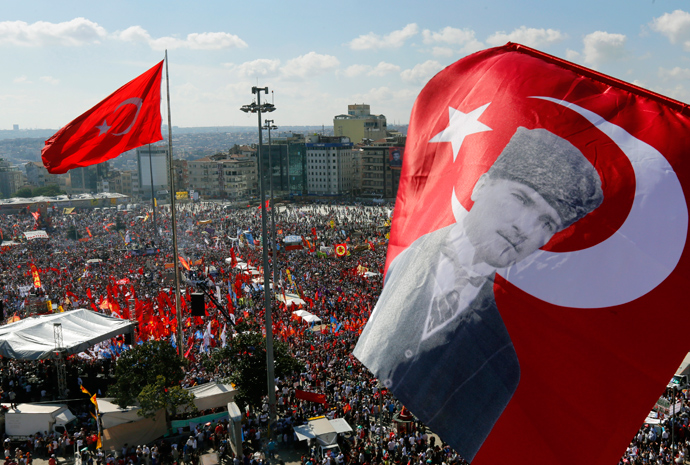
Turkish flag depicting Mustafa Kemal Ataturk as thousands gather in Istanbul's Taksim square June 9, 2013

Police again deployed tear gas and water cannons to quell more than thousands protesters that gathered in downtown Ankara. Just a few kilometers away, the Turkish PM was addressing his supporters after warning his patience with the demos “has a limit”.

At least two people were injured in fresh clashes in downtown Kizilay square in the Turkish capital, AFP reported.

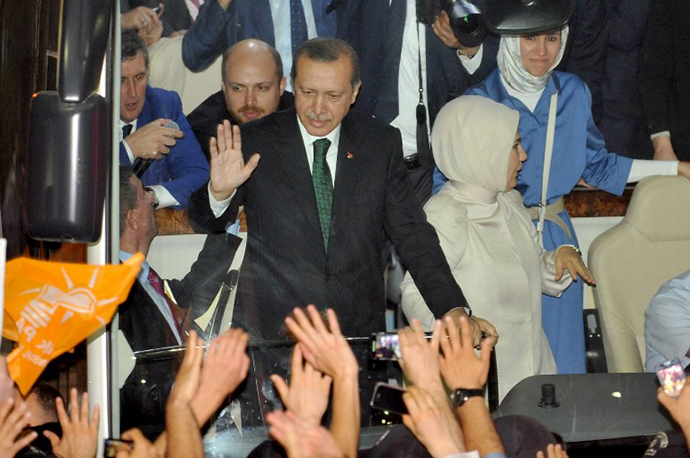
Turkish Prime Minister Tayyip Erdogan, was meanwhile addressing supporters elsewhere in the city, calling on them to prepare for pro-government rallies next weekend in Istanbul and Ankara.

“On Saturday, are you ready for a big Ankara meeting? … The next day we will have the Istanbul meeting,” Erdogan said to cheering crowds in Ankara, as riot police moved in against protesters.

On Sunday, Erdogan held a string of pro-government rallies across the country.

Erdogan remained defiant over the ongoing protests, again calling the protesters “marauders” and urging the supporters of his Justice and Development Party (AKP) to “teach them a lesson” at the next local polls as he spoke in the southern Turkish city of Adana.

“Those now at Taksim, those who burn and destroy, those at various places across the country, I ask them, in the name of which freedom are you doing this?” Erdogan said in a speech at the Mediterranean Games in Mersin.

“There is an end to our patience,” Erdogan warned in Ankara airport, as the massive crowd of his supporters chanted slogans like “We are ready die for you, Tayyip!”

The Taksim protesters do not represent all the people of Turkey, the prime minister argued.

“Are the people only those at Gezi Park? Aren’t those who came to meet us at Istanbul airport people too? Those who are gathered now in Ankara; aren’t they people, too?” he exclaimed.

On Saturday night, a rally in the Turkish capital which started peacefully was also dispersed with tear gas and water cannons. According to witness reports on Twitter police were targeting and detaining “random” youths in the crowd. At least three arrests were reportedly made.

Authorities deployed over 4,000 riot police to quell the unrest, witnesses claim.

In Istanbul, a massive crowd packed the whole of Taksim Square was joined by the fans from rival football teams Fenerbahce, Besiktas and Galatasaray, AFP reports. Police kept away from the scene. In the city’s western Gazi neighborhood things did not go so peacefully as protesters hurled incendiary devices and taunted police, which resulted in fresh clashes.

Earlier, parliamentary Speaker Cemil Cicek said the mass protests that have been gripping the country are now “under control” and the process “is becoming normalized and increasingly in line with common sense.”

“We are ready to listen to all reasonable, legal and democratic demands,” he added.

At the same time, Istanbul’s mayor declared that Gezi Park would not be used as a venue to build a shopping mall, but the project to create a replica of Ottoman-era military barracks there would continue.

“We are definitely not thinking of building a shopping mall there, no hotel or residence either. It can be… a city museum or an exhibition center,” Istanbul mayor Kadir Topbas said as quoted by AFP. “The plan for the barracks was part of our election promises, the people gave us the authority to do it.”

The Turkish government dismissed press rumors of an early election on Saturday following the party meeting on the grounds it was unnecessary. Prime Minister Erdogan, who has been criticized by protesters for his overly authoritarian ruling style, returned to Turkey on Thursday night to a throng of supporters at Istanbul airport. A number of counter-demonstrations are said to be planned next week, as anti-government protests enter their 10th day.

Social upheaval began in Turkey last week when a demonstration against the demolition of a central park in Istanbul was brutally dispersed by police. In response, protesters occupied Istanbul’s Taksim Square and clashed with police repeatedly during the subsequent days. Many are calling for Prime Minister Erdogan’s resignation.

Mandela: The Waiting Game

No one knows for sure which hospital Nelson Mandela is in, but many journalists suspect it’s the Mediclinic Heart Hospital in Pretoria.

Mandela was taken to hospital for a recurring lung infection on Saturday.

The street outside the health facility is lined with reporters. We have done this many times before. Every time there is a Mandela health scare we park our satellite trucks outside the hospital. Cameras point at the entrance and we wait.

I honestly can’t tell you what we are expecting to see. After the third car goes in and out of the hospital there is nothing else to really talk about. All the cars have tinted windows so we can’t see who is inside. Inevitably, some people speculate it could be Mandela family members.

Then around 3.30pm Makaziwe Mandela, Ndileka Mandela (daughters of Mandela) and Tukwini Mandela (granddaughter) walk into the hospital.

It’s the second time on Sunday they have been here, even though there has been no official government statement on where Nelson Mandela is getting treatment.

Actual official updates from the government come every so often, and so far they haven’t been drastically different from the first one.

This time the presidency says “Nelson Mandela is serious but stable”.

People who live in the area seem fascinated by our presence. It’s mainly apartment buildings. Families are walking their dogs and children are playing on the street. We the journalists have invaded their usually quiet neighbourhood.

There is a lot of foreign media here, so different accents can be heard and different languages.

Some neighbours are curious, asking us questions about Mandela’s condition and whether we have seen him.

But some people are angry we are camping outside the hospital.

Motorists drive past calling us “vultures”, “unAfrican” and calling our behaviour “disgraceful”.

I wonder how many of these people will go home, turn on the TV or radio to find out how Madiba is doing?

The truth is, love him or hate him, people around the world want to know how he is doing.

So, the long line of media on the street in Pretoria won’t be going anywhere anytime soon….unless Tata Madiba is released and goes home. – Haru Mutasa is a South Africa-based correspondent for Al Jazeera English

Ban on Mandela’s visitors

The seriousness of Nelson Mandela’s health status was driven home on Sunday when his family took charge of his hospital stay.

The Star understands that the family have barred everyone – including government leaders and senior party officials – from visiting the ailing icon, who was rushed to Pretoria’s Mediclinic Heart Hospital around 1.30am on Saturday.

Deputy President Kgalema Motlanthe visited the same hospital on Saturday, but left without seeing Madiba.

His spokesman, Thabo Masebe, said, however, that Motlanthe was there for a scheduled appointment with his own doctor. “He never had plans to visit Mandela.”

Mandela’s family were refusing to issue any statement on Madiba’s health. Spokesman Mandla Mandela was unavailable throughout the weekend.

President Jacob Zuma’s spokesman, Mac Maharaj, announced for the first time that Mandela’s condition was serious. In all of Mandela’s previous hospitalisations – six times alone in the past six months – the presidency had resolutely tried to put a positive spin on statements to what it has described as routine procedures or

Nelson Mandelas granddaughters Ndileka and Tukwini, and daughter Makaziwe arrive at Mediclinic Heart Hospital in Pretoria on Sunday. Picture: Phill Magakoe

THE STAR

By the time The Star was published on Sunday night, Maharaj had still not issued an updated statement on Madiba’s health and could not be reached for comment.

The hospitalisation has puzzled observers, given the sizeable investment in resources and highly trained military medical service personnel at his Houghton, Joburg, residence after his last discharge from hospital.

The Star has learnt that Mandela’s family issued the ban once his health deteriorated at the weekend because they believe visitors are at best a distraction to efforts to keep him comfortable or at worst leak information to the media.

Three highly placed government sources told The Star on Sunday that Mandela’s condition was “scary”, but he was still holding on to life.

Well-placed sources confirmed that the so-called M-Plan, the government’s blueprint for handling every aspect of Mandela’s death – from his funeral to interment – was reactivated at the weekend following his readmission to hospital.

A senior government official said on Sunday: “The old man is not well. It’s scary. He’s still holding on to his life, but it’s bad. The family don’t want visitors because of his condition. They told the hospital not to allow anyone in because they are a distraction.”

ANC national spokesman Keith Khoza said the ruling party was watching Mandela’s condition closely.

Asked if the ANC was aware of the Mandela family’s decision to bar visitors to the hospital, Khoza replied: “No we are not. It’s only the office of the president that can comment. We don’t talk to the medical staff.”

Political parties and politicians, meanwhile, continued to wish Mandela a quick recovery on Sunday.

While Azapo wished Mandela a speedy recovery, it said he should pass on “if God is willing” because South Africans “do not wish to see images of their heroes frail”. – IOL

Key affirmative action case to be decided this month

The controversial issue of affirmative action will be decided this month by the US Supreme Court and will set a precedent in how colleges and universities accept students. It is not expected to have significant impact on the current admissions policies of Utah’s colleges and universities, however.

The case, Fisher v. University of Texas, which has been on a legal track toward the top court since 2008, centers on a woman who claims she was denied admission to the University of Texas at Austin despite being equally or more qualified than minority students who were admitted under the university’s policy of considering family circumstance and race in its application process.

University officials claim Abigail Fisher, a white student from the Houston area with a 3.59 grade-point average, the plaintiff in the case, was not qualified to attend the school and said her race was not the reason she was not accepted into the school. Officials at the school also argued that schools have the right to assemble a diverse student body, a position upheld by the court in a 2003 case (Grutter v. Bollinger) focused on affirmative action admissions decisions at the University of Michigan.

Prior to reaching the U.S. Supreme Court, a district court in 2009 ruled in favor of the University of Texas at Austin. The case was then appealed to a three-judge panel from the 5th Circuit Court of Appeals, which also ruled in favor of the university.

Supreme Court Justice Elena Kagan has recused herself from hearing the case. Five of the remaining eight judges would need to rule against the university’s policy, as a tie would uphold the lower courts’ decisions. A decision is expected by the end of June, possibly as early as Monday.

A ruling in favor of Fisher would give legal precedent to individuals challenging affirmative action admission policies, which are sometimes cited as perpetuating racial divisions, and the dispute has been among the key cases the court is ruling on this month.

Utah’s standards

Pamela Silberman, spokeswoman for the Utah System of Higher Education, said the court’s decision, while impactful nationally and precedent-setting, will have little immediate impact either way on Utah’s public colleges and universities. It could certainly impact Utah students seeking education out of state, particularly in hard-to-get-into programs making use of affirmative action policies.

Of the eight schools in the Utah public system, five are open enrollment, meaning all applicants are accepted based on a basic entrance requirement. The remaining three schools — the University of Utah, Utah State University and Southern Utah University — determine enrollment by a minimum index score combining high school grade-point averages and ACT or SAT exam scores.

“There’s really not any sort of consideration of race or ethnicity or other demographic standards there,” Silberman said. “It’s going to have almost no impact in the state of Utah because there hasn’t been a strong history of those kinds of policies anyway.”

Because Utah’s schools determine admission based on academic criteria, it is not likely that a decision against the University of Texas would lead to Utah students challenging their denied admission applications, she said.

“I think that if the criteria for entrance are really clear, then you’re going to avoid that,” Silberman said. “We want all students to be prepared so they can meet those criteria, and I think that’s the focus we have.”

The U. recently transitioned to a holistic application process, which considers extracurricular factors like creative endeavors and community service in addition to GPA and test scores.

Octavio Villalpando, associate vice president for equity and diversity at the U., said the policy is still being fine-tuned, but because it does not give special consideration to race or demographics, he does not foresee it running into conflict with the court’s decision on Fisher.

Villalpando said U. officials have studied the effects of anti-affirmative action laws in other states to avoid conflict.

“We don’t anticipate any significant changes here at the campus,” he said. “Looking across the country in states where a version of this law passed, the flagship campuses didn’t have to change much of their admissions process.”

Of the 33,291 students enrolled at the University of Utah in the fall of 2012, about 70 percent were white, 7 percent were Hispanic and 4 percent were Asian, according to data from the Utah System of Higher Education. Statewide, 14 percent of public college and university students in Utah were minority students in 2012.

Villalpando said the University of Utah, as well as other institutions in the Utah System of Higher Education, have focused on collaborating with K-12 education to prepare students for college, rather than implementing admissions policies to address perceived racial imbalances.

He also said the relatively recent diversification of Utah’s student body has allowed educators to observe the best practices of areas in the country with larger minority populations.

“I think the fact that Utah is just now beginning to see this large demographic change is really helping higher ed in many ways,” Villalpando said. “It’s allowing us to learn from other strategies states have adopted.”

Political action

But the controversy surrounding affirmative action is not unknown to the state. In 2010, Utah lawmakers considered a resolution calling for a constitutional amendment prohibiting affirmative action in state agencies and higher education.

The pre-emptive resolution, sponsored by Rep. Curt Oda, R-Clearfied, stated that public entities could not “grant preferential treatment to any individual or group on the basis of race, sex, color, ethnicity or national origin.”

The resolution received a favorable recommendation during its House committee hearing but was moved by the House Rules Committee, where it languished until the session expired without coming up for a vote.

David Jones, education division chief for the Utah Attorney General’s Office, said affirmative action is not a pervasive issue in Utah’s courts. Historically, the number of cases on the issue has been minimal, Jones said, and he does not expect the Supreme Court’s decision on Fisher v. University of Texas to change that.

He also agreed with Silberman and Villalpando’s assessment that the index score admission process of Utah’s schools would be largely unaffected by the outcome of the case.

“The ACT scores and the grade-point averages aren’t going to be affected by the Supreme Court decision,” Jones said. – Salt Lake City, Deseret News

UK ‘very reluctant’ to arm Syrian rebels

William Hague, British Foreign Secretary

Britain said on Sunday it and other countries were “very reluctant” to arm rebels in Syria even as it warned that success on the battlefield by forces loyal to President Bashar al-Assad was undermining chances of a Geneva peace conference.

Britain and France worked together last month to lift a European Union embargo on arms shipments to Syrian rebels, giving them the flexibility to send weapons to forces who complain they are dramatically outgunned.

But Foreign Secretary William Hague said on Sunday that no such decision had yet been taken and promised for the first time to give MPs a vote in parliament if and when it was.

“There would be a vote one way or the other,” he told BBC TV, saying Britain and the world were faced with an agonising foreign policy and ethical dilemma.

“People have understandable concerns about the idea of sending arms to anybody in Syria and we’d all be very reluctant to do that,” he said.

“On the other hand, at the moment, people are being killed in huge numbers while the world denies them the right to defend themselves.”

Hague’s intervention comes as U.S.-Russian efforts to convene a peace conference in Geneva are faltering after the rebels lost control of the strategic border town of Qusair last week, weakening their negotiating hand.

One rebel commander has since been quoted as saying the opposition will boycott a peace conference unless it receives arms.

But Prime Minister David Cameron’s government is split on the issue with some ministers fearing such a move could worsen the bloodshed and drag Britain into a protracted conflict.

Hague said he was gloomy about the prospect of a Geneva peace conference.

“The regime has gained ground. That makes the Geneva conference harder to bring about and to make a success. It makes it less likely that the regime will make enough concessions in such negotiations, and it makes it harder to get the opposition to come to the negotiations.

“They’re not coming together in the next couple of weeks. I find that worrying and depressing,” he added.

The United Nations estimates at least 80,000 people have died in the Syrian conflict.

U.N. humanitarian agencies launched a $5 billion (3.2 billion pounds) appeal on Friday, the biggest in their history, to cope with the fallout from the fighting that has sent some 1.6 million refugees fleeing to neighbouring countries. – Reuters

(Reporting By Andrew Osborn; Editing by Andrew Heavens)

Cambodia passes bill criminalising genocide denial

Khmer Rouge victims

Cambodia’s National Assembly has approved a bill making it a crime to deny that atrocities were committed by the genocidal 1970s communist Khmer Rouge regime. Critics say the law will be used as a weapon against the political opposition.

The assembly passed the bill unanimously in the absence of opposition lawmakers, who were expelled from the legislature this week. A committee controlled by the ruling Cambodian People’s Party said the lawmakers must relinquish their seats under the law because they had joined a new party to contest this July’s general election.

Prime Minister Hun Sen called for the law after a leading opposition lawmaker reportedly suggested that some of the evidence of Khmer Rouge atrocities was fabricated by Vietnam, whose army invaded to oust the Khmer Rouge in 1979. – AP

Turkey’s PM sees Twitter as problem

Turkey’s PM has vowed that development of Taksim Square will go ahead, despite ongoing protests. Tayyip Erdogan made the remark in Tunisia on his way back to Turkey. Erdogan is also under scrutiny, with opponents blasting him as authoritarian.

As the protests entered their seventh day, casualties have risen, with three people dead and more than 4,000 injured. What began as an environmental protest against the demolition of Taksim Gezi Park in Istanbul to build a mall has turned into Turkey’s biggest wave of anti-government protest in years.

“There is a problem called Twitter right now and you can find every kind of lie there. The thing that is called social media is the biggest trouble for society right now,” Erdogan said before leaving for North Africa. The Turkish prime minister also slammed the protests as undemocratic, and dismissed them as being organized by extremists.

In their list of demands issued to Erdogan, activists are calling for the firing of the chiefs responsible for the violent police crackdown, the release of protesters detained by police, and for a ban on the use of teargas. If these demands are fulfilled, protesters said they would end the riots.

The period of time after Erdogan returns Thursday from his three-day tour of North Africa is vital for Turkey, as public pressure may force the prime minister to reverse several of his own policies.

So far, Erdogan has only singled out scapegoats in the unrest, RT’s Irina Galushko reported from Istanbul.

He assailed the social networks used by demonstrators to organize protests and post updates; many demonstrators turned to Twitter and Facebook as a mobilization tool, as local media were largely silent during the initial stages of the protests.

However, Deputy Prime Minister Bulent Arinc, who is formally in charge while Erdogan is abroad, apologized on Tuesday for the police brutality against demonstrators. Turkish police have been roundly criticized for their widespread use of teargas and water cannons to disperse crowds of protesters.

Erdogan has been described as a man who rarely bows to opposition, and cannot handle criticism.

“He completely dislikes opposition to his ideas. He takes it as a personal offense. He’s used to having agreement from the country after having gained 50 percent of the votes. This time he didn’t assume the protest would be so big”, columnist and TV host Mutlu Tonbekci told RT.

Journalists Cengiz Candar told Reuters that “Erdogan takes things very personally and has developed a very authoritarian style.”

“Everybody here was being gassed, and people here were trying to resist and trying to keep this park, and he was telling that we are looters and there’s no project going on, and then he changed his mind, saying there’s of course a project and I will do what I want to do,” activist Nazan Ustundag said to RT.

“Our intelligence work is ongoing [to determine the foreign actors behind the protests],” Erdogan said on Monday. “It’s not possible to reveal their names. But we will have meetings with their bosses.”

Conservative Turkish newspaper Yeni Safak reported that foreign mercenaries were among the protesters, according to authorities: “750 to 1,000 people, agents, many of whom are foreign nationals, infiltrated the ranks of the demonstrators, and who are being paid by foreign intelligence.”

As clashes continue, some believe that Erdogan will go to great lengths to avoid embarrassment, as any sign of weakness could break up his party. “Erdogan cannot backtrack now. It would mean defeat,” car dealer Ali Aydin told Reuters. “Weakness would destroy the party.”

The prime minister may also be ill-equipped to dealing with the recent developments. “This is an unprecedented situation for Erdogan. Some people in [the ruling AKP party] think that his policies have to soften, but they remain loyal to party discipline and to Erdogan himself,” Reuters quoted a source close to the AKP as saying.

Many protesters believe that the prime minister has lost touched with reality, and is inflexible and unwilling to compromise.

Erdogan has alleged that hundreds of foreign agents are working to create unrest in the country. He maintains that these agents instigated the protests and are continuing to lurk among the crowds, encouraging dissent and turmoil.

Authorities have arrested some 15 foreign nationals across the country in connection with the protests, Today’s Zamaan newspaper quoted an unnamed governmental source as saying. Many were reportedly Iranian nationals, a country on Erdogan’s blacklist.

Despite the widespread protests, Erdogan remains a popular politician. He is known for his assertive leadership style, and his AK Party holds around two-thirds of the seats in parliament. But a key question remains: How will he handle the protests that are continuing to rock Turkey?

Erdogan is famous for his concrete human rights reforms, including granting rights to the country’s Kurdish minority, the opening of European Union entry talks, and a separation of the government and military. He has lately faced criticism for pressuring the media and for restrictions on alcohol sales.- RT

‘They can watch your ideas form as you type’

The National Security Agency and the FBI in the US are tapping directly into the central servers of nine leading U.S. Internet companies, extracting audio and video chats, photographs, e-mails, documents, and connection logs that enable analysts to track foreign targets, according to a top-secret document obtained by The Washington Post.

The program, code-named PRISM, has not been made public until now. It may be the first of its kind. The NSA prides itself on stealing secrets and breaking codes, and it is accustomed to corporate partnerships that help it divert data traffic or sidestep barriers. But there has never been a Google or Facebook before, and it is unlikely that there are richer troves of valuable intelligence than the ones in Silicon Valley.

Equally unusual is the way the NSA extracts what it wants, according to the document: “Collection directly from the servers of these U.S. Service Providers: Microsoft, Yahoo, Google, Facebook, PalTalk, AOL, Skype, YouTube, Apple.”

PRISM was launched from the ashes of President George W. Bush’s secret program of warrantless domestic surveillance in 2007, after news media disclosures, lawsuits and the Foreign Intelligence Surveillance Court forced the president to look for new authority.

Congress obliged with the Protect America Act in 2007 and the FISA Amendments Act of 2008, which immunized private companies that cooperated voluntarily with U.S. intelligence collection. PRISM recruited its first partner, Microsoft, and began six years of rapidly growing data collection beneath the surface of a roiling national debate on surveillance and privacy. Late last year, when critics in Congress sought changes in the FISA Amendments Act, the only lawmakers who knew about PRISM were bound by oaths of office to hold their tongues.

The court-approved program is focused on foreign communications traffic, which often flows through U.S. servers even when sent from one overseas location to another. Between 2004 and 2007, Bush administration lawyers persuaded federal FISA judges to issue surveillance orders in a fundamentally new form. Until then the government had to show probable cause that a particular “target” and “facility” were both connected to terrorism or espionage.

In four new orders, which remain classified, the court defined massive data sets as “facilities” and agreed to certify periodically that the government had reasonable procedures in place to minimize collection of “U.S. persons” data without a warrant.

In a statement issue late Thursday, Director of National Intelligence James R. Clapper said “information collected under this program is among the most important and valuable foreign intelligence information we collect, and is used to protect our nation from a wide variety of threats. The unauthorized disclosure of information about this important and entirely legal program is reprehensible and risks important protections for the security of Americans.”

Clapper added that there were numerous inaccuracies in reports about PRISM by The Post and the Guardian newspaper, but he did not specify any.

Jameel Jaffer, deputy legal director of the American Civil Liberties Union, said: “I would just push back on the idea that the court has signed off on it, so why worry? This is a court that meets in secret, allows only the government to appear before it, and publishes almost none of its opinions. It has never been an effective check on government.”

Several companies contacted by The Post said they had no knowledge of the program, did not allow direct government access to their servers and asserted that they responded only to targeted requests for information.

“We do not provide any government organization with direct access to Facebook servers,” said Joe Sullivan, chief security officer for Facebook. “When Facebook is asked for data or information about specific individuals, we carefully scrutinize any such request for compliance with all applicable laws, and provide information only to the extent required by law.”

“We have never heard of PRISM,” said Steve Dowling, a spokesman for Apple. “We do not provide any government agency with direct access to our servers, and any government agency requesting customer data must get a court order.”

It is possible that the conflict between the PRISM slides and the company spokesmen is the result of imprecision on the part of the NSA author. In another classified report obtained by The Post, the arrangement is described as allowing “collection managers [to send] content tasking instructions directly to equipment installed at company-controlled locations,” rather than directly to company servers.

Government officials and the document itself made clear that the NSA regarded the identities of its private partners as PRISM’s most sensitive secret, fearing that the companies would withdraw from the program if exposed. “98 percent of PRISM production is based on Yahoo, Google and Microsoft; we need to make sure we don’t harm these sources,” the briefing’s author wrote in his speaker’s notes.

An internal presentation of 41 briefing slides on PRISM, dated April 2013 and intended for senior analysts in the NSA’s Signals Intelligence Directorate, described the new tool as the most prolific contributor to the President’s Daily Brief, which cited PRISM data in 1,477 items last year. According to the slides and other supporting materials obtained by The Post, “NSA reporting increasingly relies on PRISM” as its leading source of raw material, accounting for nearly 1 in 7 intelligence reports.

That is a remarkable figure in an agency that measures annual intake in the trillions of communications. It is all the more striking because the NSA, whose lawful mission is foreign intelligence, is reaching deep inside the machinery of American companies that host hundreds of millions of American-held accounts on American soil.

The technology companies, whose cooperation is essential to PRISM operations, include most of the dominant global players of Silicon Valley, according to the document. They are listed on a roster that bears their logos in order of entry into the program: “Microsoft, Yahoo, Google, Facebook, PalTalk, AOL, Skype, YouTube, Apple.” PalTalk, although much smaller, has hosted traffic of substantial intelligence interest during the Arab Spring and in the ongoing Syrian civil war.

Dropbox, the cloud storage and synchronization service, is described as “coming soon.”

Sens. Ron Wyden (D-Ore.) and Mark Udall (D-Colo.), who had classified knowledge of the program as members of the Senate Intelligence Committee, were unable to speak of it when they warned in a Dec. 27, 2012, floor debate that the FISA Amendments Act had what both of them called a “back-door search loophole” for the content of innocent Americans who were swept up in a search for someone else.

“As it is written, there is nothing to prohibit the intelligence community from searching through a pile of communications, which may have been incidentally or accidentally been collected without a warrant, to deliberately search for the phone calls or e-mails of specific Americans,” Udall said.

Wyden repeatedly asked the NSA to estimate the number of Americans whose communications had been incidentally collected, and the agency’s director, Lt. Gen. Keith B. Alexander, insisted there was no way to find out. Eventually Inspector General I. Charles McCullough III wrote Wyden a letter stating that it would violate the privacy of Americans in NSA data banks to try to estimate their number.

Roots in the ’70s

PRISM is an heir, in one sense, to a history of intelligence alliances with as many as 100 trusted U.S. companies since the 1970s. The NSA calls these Special Source Operations, and PRISM falls under that rubric.

The Silicon Valley operation works alongside a parallel program, code-named BLARNEY, that gathers up “metadata” — technical information about communications traffic and network devices — as it streams past choke points along the backbone of the Internet. BLARNEY’s top-secret program summary, set down in the slides alongside a cartoon insignia of a shamrock and a leprechaun hat, describes it as “an ongoing collection program that leverages IC [intelligence community] and commercial partnerships to gain access and exploit foreign intelligence obtained from global networks.”

But the PRISM program appears to more nearly resemble the most controversial of the warrantless surveillance orders issued by President George W. Bush after the al-Qaeda attacks of Sept. 11, 2001. Its history, in which President Obama presided over exponential growth in a program that candidate Obama criticized, shows how fundamentally surveillance law and practice have shifted away from individual suspicion in favor of systematic, mass collection techniques.

The Obama administration points to ongoing safeguards in the form of “extensive procedures, specifically approved by the court, to ensure that only non-U.S. persons outside the U.S. are targeted, and that minimize the acquisition, retention and dissemination of incidentally acquired information about U.S. persons.”

And it is true that the PRISM program is not a dragnet, exactly. From inside a company’s data stream the NSA is capable of pulling out anything it likes, but under current rules the agency does not try to collect it all.

Analysts who use the system from a Web portal at Fort Meade, Md., key in “selectors,” or search terms, that are designed to produce at least 51 percent confidence in a target’s “foreignness.” That is not a very stringent test. Training materials obtained by The Post instruct new analysts to make quarterly reports of any accidental collection of U.S. content, but add that “it’s nothing to worry about.”

Even when the system works just as advertised, with no American singled out for targeting, the NSA routinely collects a great deal of American content. That is described as “incidental,” and it is inherent in contact chaining, one of the basic tools of the trade. To collect on a suspected spy or foreign terrorist means, at minimum, that everyone in the suspect’s inbox or outbox is swept in. Intelligence analysts are typically taught to chain through contacts two “hops” out from their target, which increases “incidental collection” exponentially. The same math explains the aphorism, from the John Guare play, that no one is more than “six degrees of separation” from any other person.

A ‘directive’

In exchange for immunity from lawsuits, companies such as Yahoo and AOL are obliged to accept a “directive” from the attorney general and the director of national intelligence to open their servers to the FBI’s Data Intercept Technology Unit, which handles liaison to U.S. companies from the NSA. In 2008, Congress gave the Justice Department authority for a secret order from the Foreign Surveillance Intelligence Court to compel a reluctant company “to comply.”

In practice, there is room for a company to maneuver, delay or resist. When a clandestine intelligence program meets a highly regulated industry, said a lawyer with experience in bridging the gaps, neither side wants to risk a public fight. The engineering problems are so immense, in systems of such complexity and frequent change, that the FBI and NSA would be hard pressed to build in back doors without active help from each company.

Apple demonstrated that resistance is possible when it held out for more than five years, for reasons unknown, after Microsoft became PRISM’s first corporate partner in May 2007. Twitter, which has cultivated a reputation for aggressive defense of its users’ privacy, is still conspicuous by its absence from the list of “private sector partners.”

Google, like the other companies, denied that it permitted direct government access to its servers.

“Google cares deeply about the security of our users’ data,” a company spokesman said. “We disclose user data to government in accordance with the law, and we review all such requests carefully. From time to time, people allege that we have created a government ‘back door’ into our systems, but Google does not have a ‘back door’ for the government to access private user data.”

Microsoft also provided a statement: “We provide customer data only when we receive a legally binding order or subpoena to do so, and never on a voluntary basis. In addition we only ever comply with orders for requests about specific accounts or identifiers. If the government has a broader voluntary national security program to gather customer data we don’t participate in it.”

Yahoo also issued a denial.

“Yahoo! takes users’ privacy very seriously,” the company said in a statement. “We do not provide the government with direct access to our servers, systems, or network.”

Like market researchers, but with far more privileged access, collection managers in the NSA’s Special Source Operations group, which oversees the PRISM program, are drawn to the wealth of information about their subjects in online accounts. For much the same reason, civil libertarians and some ordinary users may be troubled by the menu available to analysts who hold the required clearances to “task” the PRISM system.

There has been “continued exponential growth in tasking to Facebook and Skype,” according to the PRISM slides. With a few clicks and an affirmation that the subject is believed to be engaged in terrorism, espionage or nuclear proliferation, an analyst obtains full access to Facebook’s “extensive search and surveillance capabilities against the variety of online social networking services.”

According to a separate “User’s Guide for PRISM Skype Collection,” that service can be monitored for audio when one end of the call is a conventional telephone and for any combination of “audio, video, chat, and file transfers” when Skype users connect by computer alone. Google’s offerings include Gmail, voice and video chat, Google Drive files, photo libraries, and live surveillance of search terms.

Firsthand experience with these systems, and horror at their capabilities, is what drove a career intelligence officer to provide PowerPoint slides about PRISM and supporting materials to The Washington Post in order to expose what he believes to be a gross intrusion on privacy. “They quite literally can watch your ideas form as you type,” the officer said. – Washington Post

Queers Against Israeli Apartheid ‘do not violate hate laws in Toronto’

The Toronto city council has no legal grounds to deny grant money to Pride over the gay festival’s refusal to ban the group Queers Against Israeli Apartheid, Toronto’s chief lawyer has told Mayor Rob Ford’s executive committee.

In a confidential and frank April report obtained by the Star, city solicitor Anna Kinastowski says she “cannot recommend” that council require Pride to ban the phrase “Israeli apartheid” as a condition of receiving taxpayer funds.

Kinastowski writes: “The term ‘Israeli Apartheid’ does not violate the city’s human rights policy, does not appear to violate the Ontario Human Rights Code, and does not appear to constitute ‘hate’ as the (Supreme) Court has interpreted it and would therefore appear to fall within the realm of potentially ‘offensive’ yet protected speech.”

The committee will again discuss Queers Against Israeli Apartheid (QuAIA) on Tuesday during a debate on the city’s anti-discrimination policy for grant recipients. Pride’s annual grant — about $124,000 last year — will be debated by council in June, only 10 days before the festival begins.

Pro-Israel councillors have repeatedly and unsuccessfully sought to find a way to tweak city rules in a way that might prevent the activist group from marching in the annual Pride parade. Councillor James Pasternak, who does not sit on the executive, has even floated the idea of offering Pride a “diversity bonus” for excluding QuAIA.

Citing a February Supreme Court decision, Kinastowski also warns against a 2012 suggestion from the executive to change the anti-discrimination policy to prohibit “anything which shows a lack of respect for all persons.”

Kinastowski, cautioning against imposing “an overbroad standard for ‘discrimination,’ ” says such a policy would be “unlikely to withstand a court challenge” on freedom-of-speech grounds.

“That’s what we know. I mean, it’s not a secret. Every single report that comes out says we don’t violate any hate laws or anything like that,” said QuAIA member Tony Souza. “We’re not breaking any laws, and we certainly don’t ‘hate’ anybody. We just want justice in Palestine.”

“I don’t think the question is a legal question — I think the question is one of morality and divisiveness,” said Avi Benlolo, chief executive of the pro-Israel Friends of Simon Wiesenthal Center for Holocaust Studies. “And if we want to live in a pluralistic society where we demonstrate respect for one another, then there’s just morality. . . . We’re just saying to the city we don’t think this is socially acceptable.” – Toronto Star

We’ll spy on you through your dishwasher

More and more personal and household devices are connecting to the internet, from your television to your car navigation systems to your light switches.

Gen. Petraeus former CIA chief mused about the emergence of an “Internet of Things” — that is, wired devices — at a summit for In-Q-Tel, the CIA’s venture capital firm. “‘Transformational’ is an overused word, but I do believe it properly applies to these technologies,” Petraeus enthused, “particularly to their effect on clandestine tradecraft.”

All those new online devices are a treasure trove of data if you’re a “person of interest” to the spy community. Once upon a time, spies had to place a bug in your chandelier to hear your conversation. With the rise of the “smart home,” you’d be sending tagged, geolocated data that a spy agency can intercept in real time when you use the lighting app on your phone to adjust your living room’s ambiance.

“Items of interest will be located, identified, monitored, and remotely controlled through technologies such as radio-frequency identification, sensor networks, tiny embedded servers, and energy harvesters — all connected to the next-generation internet using abundant, low-cost, and high-power computing,” Petraeus said, “the latter now going to cloud computing, in many areas greater and greater supercomputing, and, ultimately, heading to quantum computing.”

Petraeus allowed that these household spy devices “change our notions of secrecy” and prompt a rethink of “our notions of identity and secrecy.” All of which is true — if convenient for a CIA director.

The CIA has a lot of legal restrictions against spying on American citizens. But collecting ambient geolocation data from devices is a grayer area, especially after the 2008 carve-outs to the Foreign Intelligence Surveillance Act. Hardware manufacturers, it turns out, store a trove of geolocation data; and some legislators have grown alarmed at how easy it is for the government to track you through your phone or PlayStation.

That’s not the only data exploit intriguing Petraeus. He’s interested in creating new online identities for his undercover spies — and sweeping away the “digital footprints” of agents who suddenly need to vanish.

“Proud parents document the arrival and growth of their future CIA officer in all forms of social media that the world can access for decades to come,” Petraeus observed. “Moreover, we have to figure out how to create the digital footprint for new identities for some officers.”

It’s hard to argue with that. Online cache is not a spy’s friend. But Petraeus has an inadvertent pal in Facebook.

Why? With the arrival of Timeline, Facebook made it super-easy to backdate your online history. Barack Obama, for instance, hasn’t been on Facebook since his birth in 1961. Creating new identities for CIA non-official cover operatives has arguably never been easier. Thank Zuck, spies. Thank Zuck. – Wired

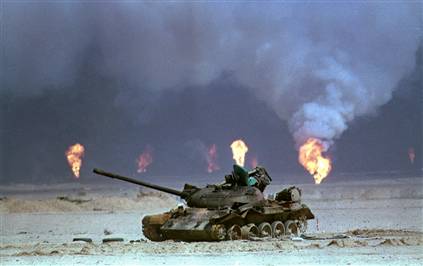
China benefits most from Iraq oil

China already buys nearly half the oil that Iraq produces, nearly 1.5 million barrels a day, and is angling for an even bigger share, bidding for a stake now owned by Exxon Mobil in one of Iraq’s largest oil fields.

“The Chinese are the biggest beneficiary of this post-Saddam oil boom in Iraq,” said Denise Natali, a Middle East expert at the National Defense University in Washington. “They need energy, and they want to get into the market.”

Before the invasion, Iraq’s oil industry was sputtering, largely walled off from world markets by international sanctions against the government of Saddam Hussein, so his overthrow always carried the promise of renewed access to the country’s immense reserves. Chinese state-owned companies seized the opportunity, pouring more than $2 billion a year and hundreds of workers into Iraq, and just as important, showing a willingness to play by the new Iraqi government’s rules and to accept lower profits to win contracts.

“We lost out,” said Michael Makovsky, a former Defense Department official in the Bush administration who worked on Iraq oil policy. “The Chinese had nothing to do with the war, but from an economic standpoint they are benefiting from it, and our Fifth Fleet and air forces are helping to assure their supply.”

The depth of China’s commitment here is evident in details large and small.

In the desert near the Iranian border, China recently built its own airport to ferry workers to Iraq’s southern oil fields, and there are plans to begin direct flights from Beijing and Shanghai to Baghdad soon. In fancy hotels in the port city of Basra, Chinese executives impress their hosts not just by speaking Arabic, but Iraqi-accented Arabic.

Notably, what the Chinese are not doing is complaining. Unlike the executives of Western oil giants like Exxon Mobil, the Chinese happily accept the strict terms of Iraq’s oil contracts, which yield only minimal profits. China is more interested in energy to fuel its economy than profits to enrich its oil giants.

Chinese companies do not have to answer to shareholders, pay dividends or even generate profits. They are tools of Beijing’s foreign policy of securing a supply of energy for its increasingly prosperous and energy hungry population. “We don’t have any problems with them,” said Abdul Mahdi al-Meedi, an Iraqi Oil Ministry official who handles contracts with foreign oil companies. “They are very cooperative. There’s a big difference, the Chinese companies are state companies, while Exxon or BP or Shell are different.”

China is now making aggressive moves to expand its role, as Iraq is increasingly at odds with oil companies that have cut separate deals with Iraq’s semiautonomous Kurdish region. The Kurds offer more generous terms than the central government, but Iraq and the United States consider such deals illegal.

Late last year, the China National Petroleum Corporation bid for a 60 percent stake in the lucrative West Qurna I oil field, a stake that Exxon Mobil may be forced to divest because of its oil interests in Iraqi Kurdistan. Exxon Mobil, however, has so far resisted pressure to sell, and in March the Chinese company said it would be interested in forming a partnership with the American company for the oil field.

If the United States invasion and occupation of Iraq ended up benefiting China, American energy experts say the unforeseen turn of events is not necessarily bad for United States interests. The increased Iraqi production, much of it pumped by Chinese workers, has also shielded the world economy from a spike in oil prices resulting from Western sanctions on Iranian oil exports. And with the boom in American domestic oil production in new shale fields surpassing all expectations over the last four years, dependence on Middle Eastern oil has declined, making access to the Iraqi fields less vital for the United States.

At the same time, China’s interest in Iraq could also help stabilize the country as it faces a growing sectarian conflict.- NYT