Japan burning ice

A flame ripples from a burner on the back of a deepwater drilling rig in the Pacific Ocean off the southern coast of Japan, heralding an energy breakthrough for a power-starved nation.

Japan announced on March 12 that it had extracted natural gas at a depth of 3,280 feet (1,000 meters) from one of the most mysterious and vast reservoirs of fuel on Earth—methane hydrates, which are methane molecules trapped in ice crystals. The successful foray by the drill ship Chikyu marked the first time ever that natural gas had been produced from offshore methane hydrates, known as the “ice that burns.” Japan hopes that the test extraction is just the first step in an effort aimed at bringing the fuel into commercial production within the next six years.

That’s a far faster timetable than most researchers have foreseen, even though there is wide agreement that the methane hydrates buried beneath the seafloor on continental shelves and under the Arctic permafrost are likely the world’s largest store of carbon-based fuel. The figure often cited, 700,000 trillion cubic feet of methane trapped in hydrates, is a staggering sum that would exceed the energy content of all oil, coal, and other natural gas reserves known on Earth. (See the U.S. Department of Energy’s primer on methane hydrates.) But under high pressure and at low temperatures, the methane molecules are locked in lattice-like cages of frozen water—a kind of host/guest relationship called a “clathrate.”

Because methane is a gas with high global-warming potential—25 times more potent than carbon dioxide in trapping heat in the atmosphere—there is great concern over uncontrolled release of the methane from hydrate formations. Yet methane also can help cut carbon emissions when it is burned instead of coal for electricity. The U.S. government, which has a major methane hydrate research program, last year even sought to test a method for extracting methane and sequestering carbon dioxide at the same time.

But perhaps no nation has conducted as much methane hydrate research as Japan, which until now has had virtually no exploitable domestic fossil fuel resources. The nation’s reliance on foreign gas imports has surged since the 2011 Fukushima Daiichi disaster, which has led to the idling of nearly all 54 nuclear power plants that once provided 30 percent of Japan’s energy. In light of the nation’s energy woes, the methane hydrate milestone 50 miles (80 kilometers) off the coast of Aichi Prefecture in central Japan was especially significant. “Japan could finally have an energy source to call its own, ” said Takami Kawamoto, spokesman for the Japan Oil, Gas and Metals National Corporation (JOGMEC). – National Geographic

Bird flu or the American flu? Chinese allege ‘biological warfare attack’

A Chinese Air Force officer on Saturday accused the U.S. government of creating the new strain of bird flu now afflicting parts of China as a biological warfare attack.

People’s Liberation Army Sr. Col. Dai Xu said the United States released the H7N9 bird flu virus into China in an act of biological warfare, according to a posting on his blog on Saturday.

The charge was first reported in the state-run Guangzhou newspaper Southern Metropolis Daily and then picked up by several news outlets in Asia.

State Department spokesman Jason Rebholz dismissed the claim. “There is absolutely no truth to these allegations,” he told the Washington Free Beacon.

Seven deaths from the bird flu outbreak were reported as of Tuesday in state-run Chinese media. As many as 24 people reportedly were infected by the disease in Shanghai, Jiangsu, Zhejiang, and Anhui.

Chinese authorities are trying to calm public fears of a major epidemic, claiming there is no evidence the virus can be transmitted between humans.

The government also is claiming that the outbreak is not related to the recent discovery of thousands of dead pigs floating in a river in China.

The accusation of U.S. biological warfare against China comes as the Pentagon is seeking closer military relations with China. Army Gen. Martin Dempsey, chairman of the Joint Chiefs of Staff, is set to travel to China for talks with Chinese military leaders later this month.

Dai is a military strategist who in the past has been outspoken in seeking to foment conflict between China and the United States. He told the Global Times in August that China should go to war over U.S. support for Japan’s claims to the disputed Senkaku Islands.

Writing on Sina Weibo, a Chinese microblogging site akin to Twitter, Dai stated that the new bird flu strain was designed as a biological weapon similar to severe acute respiratory syndrome (SARS), which he also claimed was developed as a U.S. bio-weapon, that affected the country in 2003.

According to Dai’s posting, the new flu outbreak should not be a cause for concern. “The national leadership should not pay too much attention to it,” the PLA lecturer at the National Defense University wrote. “Or else, it’ll be like in 2003 with SARS!”

“At that time, America was fighting in Iraq and feared that China would take advantage of the opportunity to take other actions,” he said. “This is why they used bio-psychological weapons against China. All of China fell into turmoil and that was exactly what the United States wanted. Now, the United States is using the same old trick. China should have learned its lesson and should calmly deal with the problem.”

Dai said that even if “a few may die” from the flu outbreak, it will not equal one-thousandth of the deaths caused by vehicle accidents in China.

Dai in the past has called for China to punish the United States for U.S. arms sales to rival Taiwan, by selling arms to U.S. enemies. “China recognizes that a few perfunctory protests will not have any effect,” Dai said in 2010. “China can’t directly sanction American arms companies since they did not do business with China … but China can sanction companies that are doing business with China directly, like Boeing or General Electric.”

Dai also has said the United States has used crises with North Korea and offers of cooperation on the issue as a plot to drive a wedge between Beijing and its fraternal communist ally.

Dai also has said U.S. efforts to counter Chinese espionage and intelligence-gathering were part of a U.S. “plot theory” of “western countries threatening others by [releasing] information gained through spying in order to damage the reputations of other countries.”

A State Department official said China notified the World Health Organization (WHO) on March 31 about its first detected human cases of H7N9 infection. Fourteen cases were confirmed by the WHO by April 5, of which six were fatal. The organization said there is no evidence of human-to-human transmission.

“U.S. Embassy Beijing and U.S. Consulate Shanghai are monitoring the situation, working closely with counterparts at the U.S. Centers for Disease Control, and the Beijing and Shanghai municipal governments,” the official said.

The colonel’s accusation provoked a widespread response on Chinese websites. One post in reaction joked that Dai’s comment about auto deaths must mean that the United States and Germany are responsible for a conspiracy to produce cars, according to a report in Hong Kong’s South China Morning Post.

Luo Changping, deputy editor of Caijing, said most PLA soldiers would not support Dai’s comments and he urged the colonel to resign and apologize to those who have died from the current bird flu outbreak.

A defiant Dai then said in a new posting Sunday that “it is common knowledge that a group of people in China have been injected with mental toxin by the United States.”

“Now, a group of fake American devils are attacking me,” he wrote in another post. “I will not retreat even half a step.”

Analysts say the colonel’s remarks are a reflection of the growing xenophobic atmosphere within the Chinese military that views the United States as its main enemy.

Former State Department intelligence analyst John Tkacik said China’s military was largely to blame for mishandling the 2003 outbreak of SARS. Tkacik said there was speculation when the epidemic began that “the PLA suspects SARS had emanated from its own biological laboratories and was all the more eager to keep it secret.” China is known to have a covert biological arms program.

“Col. Dai Xu is a shameless liar when he accuses the United States of using bio weapons,” Tkacik told the Free Beacon. “He’s probably motivated by a desire to exculpate the PLA for their mishandling of the epidemic—no doubt most Chinese have happily forgotten the episode—as much as by a cynical xenophobia. But, that’s what passes for deep strategic thought at China’s National Defense University these days.”

The Pentagon has been trying with varying success to develop closer ties to the Chinese military as part of a strategy aimed at building trust. However, China’s military leaders believe the U.S. offers of closer ties are a ruse designed to contain China’s growing military buildup.

Defense Secretary Chuck Hagel spoke by phone with China’s Defense Minister Gen. Chang Wanquan on April 2. Chang is the No. 4 defense official after Chinese President Xi Jinping and two other generals who run the Central Military Commission, the Communist Party’s ultimate power organ.

“The leaders both expressed their intention to work together to continue to build a military-to-military relationship that serves the vision of both President Obama and President Xi,” Pentagon press secretary George Little said in a statement after the call.

“The secretary discussed the importance of focusing on areas of sustained dialogue, practical areas of cooperation, and risk reducing measures,” he said.

U.S. ties with China are strained due to China’s reluctance to rein in neighboring North Korea.

China provides North Korea with large amounts of fuel oil and other goods. However, Beijing has not taken steps to pressure Pyongyang using its economic leverage during the ongoing crisis.

The flu has lit up China’s thriving Internet, according to analysts. Over 945,600 microblog postings addressed the flu between April 8 and 9. Since the outbreak began some seven days ago, between 1.3 million and 3 million postings were put online on outlets including Sina Weibo and QQ Weibo.

Tens of thousands of users expressed doubts about the official Shanghai municipal government’s denial of any link between the dead pigs found floating last month in the region’s Huangpu River.

The proximity to the initial outbreak in Shanghai and the river has led to speculation that the pig deaths may have been linked to the flu virus jumping from animals to humans.

That speculation was fueled by reports that one of the victims of the flu was a pig butcher.

The avian flu strain is similar to an earlier outbreak with a significant difference: The current strain does not kill the birds it infects, making it more difficult to identify infected poultry.

The Shanghai government waited 20 days before announcing the first H7N9 infection on March 31. – The Washington Free Beacon

Looters dancing on Thatcher’s grave

Revellers in Brixton staged a street party to celebrate Margaret Thatcher’s death, culminating in arrests and an attack on a local charity shop.

Around 100 hundred people were out on the streets to celebrate the death of former the former prime minister, whose death from a stroke was announced on Monday.

A board at the famous Ritzy cinema in Windrush Square was hijacked by partygoers who swapped the letters to read ‘Margaret Thatcher’s Dead.’

Smashed glass was strewn on the street after the window of charity shop Barnardos was kicked in during ugly scenes.

Police officers trying to keep order were attacked, with extra numbers drafted in to stop revellers spilling out on to the roads and causing traffic delays.

Two women were arrested on suspicion of burglary and spent the night in cells after Barnardos was targeted during celebrations.

Reporter Ewan Palmer was at the scene. He said: “There was the notion that this morbid celebration has been planned in thousands of people’s heads for more than 30 years.

“Police stood by and watched as more and more people arrived with their drink and banners mocking her death. Shouts of ‘Maggie, Maggie, Maggie! dead, dead, dead!” rang around gleefully.

“Chalk was handed out so people could graffiti their own message on the ground and surrounding walls.

“There were even two guys playing double bass and acoustic guitar in the crowd for a singalong. At the start of the evening, the whole thing resembled a middle-class music festival more than a raucous demo.

“Almost inevitably after a few hours of people drinking in the streets, this escalated into scenes of unrest between people and riot police, resulting in arrests and even serious injury.”

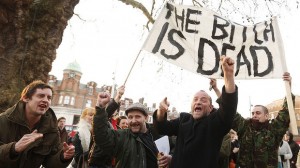
The revellers downed alcohol and brandished placards reading “The bitch is dead” and ‘Rejoice Thatcher is dead.’ Many revellers appeared younger than the 23 years which have passed since Thatcher left office.

A Scotland Yard spokesman said: “Police dealt with a group of approximately 100 people in Brixton who caused low-level disorder including throwing missiles at officers.

“In order to protect the community and to ensure the highways remained clear, extra officers were deployed.

“Two women were arrested after being found inside a shop in Brixton. They remain in custody.” – IBT

Thatcher’s death divides

Former British Prime Minister Margaret Thatcher was an “attractive” woman, who did more to help South Africa to “get rid of apartheid” than any other leader in her time, former foreign affairs minister Pik Botha said yesterday.

Thatcher died yesterday following a stroke. She was 87.

Botha, who served as the last foreign minister of the apartheid government, said while Thatcher was a staunch opponent of apartheid, she “listened”, and “understood” the issues that South Africa faced in abolishing it.

“She and [US President] Ronald Reagan did more to move South Africa to get rid of apartheid and towards a new constitution than any other leader outside the country,” said Botha, who served in the first post-apartheid government from 1994 to 1996 under President Nelson Mandela. He joined the ANC in 2000, but later criticised some of its policies.

The ANC’s tribute to Thatcher differed sharply from Botha’s in its assessment of her role in the dismantling of apartheid.

Though acknowledging that she was a major leader on the world stage, the ruling party said: “The ANC was on the receiving end of her policy in terms of refusing to recognise the ANC as the representatives of South Africans and her failure to isolate apartheid after it had been described as a crime against humanity.”

Botha met Thatcher in the early 1970s when he and other officials were invited to the UK. He later had several run-ins with her, when the two countries clashed on issues such as the Falklands war and the deportation of the “Coventry Four”, a group of South Africans arrested in London while attempting to smuggle arms to South Africa.

But, said Botha, “she helped me in so many ways to keep South Africa going internationally”.

He remembers a “historically critical moment”, on April 1 1989 – the day UN Resolution 435 was to have been implemented in then South West Africa (Namibia). The resolution was a UN-adopted proposal for a ceasefire between the South African Defence Force and the People’s Liberation Army of Namibia, and a UN-supervised election in the country.

“[Thatcher and I] met at Windhoek Airport and we heard that Swapo had come over the [Namibia/Angola] border in their thousands, heavily armed,” said Botha.

“Our troops were contained in their barracks, and she said [that] under no circumstances were we allowed to release them to fight the incursion. But she then helped me persuade UN Secretary-General Pérez de Cuéllar to allow the SADF troops to fight the incursion. If our troops weren’t freed to repel them then South West Africa would not have gone to elections peacefully,” said Botha. “Her death saddens me tremendously,” he added.

ANC spokesman Jackson Mthembu said: “Her tenure as prime minister redefined British politics and public administration and these impacted greatly on European politics and governance. Long after her passing on, her impact will still be felt and her views [will be] a subject of discussion.”

Former president FW de Klerk said Thatcher was a steadfast critic of apartheid. But, he added: “She consistently, and correctly, believed that much more could be achieved through constructive engagement with the South African government than through draconian sanctions and isolation.”

Social media was overflowing with people writing “Ding Dong!” in reference to the Wizard of Oz song, and posting pictures of themselves drinking in celebration of “Margaret Thatcher Death Day”.

Hundreds of people took to the streets in Brixton, an area of south London in Britain which suffered serious rioting in the 1980s, to celebrate Lady Thatcher’s death. Holding notices saying ‘‘Rejoice – Thatcher is dead’’, about 200 people gathered in the neighbourhood, a hotspot of alternative culture, and toasted her passing by drinking and dancing to hip-hop and reggae songs blaring from sound systems.

‘‘I’m very, very pleased. She did so much damage to this country,’’ said one man brandishing an original newspaper billboard from 1990 announcing Thatcher’s resignation. Others scrawled ‘‘Good Riddance’’ on the pavement.

‘‘We’ve got the bunting out at home,’’ said Clare Truscott, a woman in her 50s wearing a sparkly beret and holding a homemade sign reading ‘‘Ding dong, the witch is dead’’.

‘‘I’m from the north, where there were no jobs, where the industry was rapidly disappearing, and her policies ensured it went more quickly.’’

Brixton was the scene of fierce riots in 1981, two years after Lady Thatcher became prime minister. Carole Roper, a full-time carer in her 50s from north London, said: ‘‘We’re here to celebrate her death.’’

Sipping from a can of beer, she insisted: ‘‘I don’t think it’s vindictive. It’s not so much about the death of Thatcher but what she has done, the policies she introduced to this country.‘‘

Compare the coverage to that when Chavez died – she’s being eulogised. It’s been wall to wall coverage on the BBC, but she did nothing to help the poor people of this country.’’

In the Scottish city of Glasgow more than 300 people gathered to hold their own impromptu ‘‘party’’. Anti-capitalist campaigners shouted, ‘‘Maggie, Maggie, Maggie’’ while the crowd replied ‘‘dead, dead, dead’’.

Among her old foes many – at least temporarily – laid aside old grudges and paid public tribute to her achievements as Britain’s first female prime minister.

But others did not hesitate to express their continuing disgust and anger at Lady Thatcher’s policies and her (in their words) disastrous, divisive impact on Britain’s industry and people.

George Galloway, the Respect member of parliament for Bradford West and former Labour firebrand, led the charge with a simple Tweet: “Tramp the dirt down”.

It was a reference to a 1988 Elvis Costello song of the same name, a virulent attack on the then prime minister that contains the lines “when they finally put you in the ground / I’ll stand on your grave and tramp the dirt down.”

Mr Galloway added on Twitter: “Thatcher described Nelson Mandela as a ‘terrorist’. I was there. I saw her lips move. May she burn in the hellfires.”

His Twitter feed quickly became an echo chamber for criticism of Thatcherite policies, which one commenter said were “selling off public utilities, encouraging personal greed and befriending murderous dictators”.

On Facebook, a campaign was launched to take the Wizard of Oz song ‘Ding Dong! The Witch is Dead‘ to No. 1. – AFP, additional reporting by Sapa

IN HER OWN WORDS

“I don’t think there will be a woman prime minister in my lifetime.” – as Education Secretary in 1973. She became Britain’s first woman prime minister in 1979.

Where there is discord, may we bring harmony. Where there is error, may we bring truth. Where there is doubt, may we bring faith. And where there is despair, may we bring hope.” – Quoting St Francis of Assisi, on her 1979 election victory.

“I am not a consensus politician. I’m a conviction politician.” – 1979

“I don’t mind how much my ministers talk, as long as they do what I say.” – 1980

“We had to fight the enemy without in the Falklands. We always have to be aware of the enemy within, which is much more difficult to fight and more dangerous to liberty.” – On the 1984-85 miners’ strike, which provoked some of the fiercest union opposition to her policies.

“To those waiting with bated breath for that favourite media catch phrase, the U-turn, I have only one thing to say: You turn if you want to. The lady’s not for turning.” – At the 1980 Conservative Party conference to colleagues urging her to soften her economic policies which were raising unemployment.

“This is a day I was not meant to see.” – To reporters the day after surviving a deadly 1984 Irish Republican Army bomb attack on the Conservative Party conference.

“We have become a grandmother.” – On the birth of her first grandchild, 1989.

“No! No! No!” At the House of Commons in 1990, the climax of an anti-European outburst that moved Geoffrey Howe to quit as deputy prime minister and deliver a resignation speech which called for her to be challenged for her job.

“I fight on, I fight to win.” – In November 1990, after failing to win enough votes to avoid a second round in the Conservative leadership contest. She resigned the next day.

“It’s a funny old world.” – On her decision to quit in 1990. – Reuters

WikiLeaks exposes Kissinger era

The whistleblowing website WikiLeaks was on Monday to publish more than 1.7 million United States diplomatic and intelligence documents from the 1970s, founder Julian Assange revealed.

The website has collated a variety of records including cables, intelligence reports and congressional correspondence and is releasing them in a searchable form.

Assange has carried out much of the work from his refuge in Ecuador’s embassy in London and told the domestic Press Association that the records highlighted the “vast range and scope” of US influence around the world.

Assange has been holed up in the tiny diplomatic mission for nine months as he seeks to avoid extradition to Sweden over allegations of rape and sexual assault, which he denies.

WikiLeaks sent shockwaves around the diplomatic world in 2010 when it released a set of more than 250 000 leaked US cables.

The new records, dating from the beginning of 1973 to the end of 1976, have not been leaked and are available to view at the US national archives. They include many communications which were sent by – or to – then-secretary of state Henry Kissinger.

Many of the documents, which WikiLeaks has called the Public Library of US Diplomacy (PlusD), are marked NODIS (no distribution) or Eyes Only, while others were originally marked as secret.

Assange fled to the Ecuadorian embassy in June after losing his battle in the British courts against extradition to Sweden.

Ecuador granted him asylum in August, but Britain has refused to allow him safe passage out of the country, sparking a diplomatic stalemate.

Assange founded the WikiLeaks website that enraged Washington by releasing cables and war logs relating to the wars in Iraq and Afghanistan in one of the biggest security breach in US history. – Sapa-AFP

Tutu wins $1.7 million prize

Anti-apartheid icon Desmond Tutu, the former archbishop of Cape Town, was awarded the $1.7-million Templeton Prize for his lifelong work to promote “love and forgiveness”.

The 81-year-old Nobel peace laureate, who rose to fame in the 1980s as a vocal opponent of South Africa’s white-minority apartheid regime, will be presented with the award at a ceremony in London on May 21.

The Templeton Prize, one of the world’s largest annual awards, is given each year to a living person who has made “an exceptional contribution to affirming life’s spiritual dimension”.

Last year’s winner was the Dalai Lama, Tibet’s spiritual leader, who gave the money to charity.

Tutu thanked “all the wonderful people who accepted me as their leader at home” for the prize, which is administered by the US-based Templeton Foundation.

“When you are in a crowd and you stand out from the crowd it’s usually because you are being carried on the shoulders of others,” he said.

The Templeton Foundation hailed Tutu’s “deep faith and commitment to prayer and worship”.

The prize was set up in 1972 by the late investor and philanthropist John Templeton. Its first winner, in 1973, was Mother Teresa.

Tutu spoke out vigorously against apartheid during the years when Nelson Mandela was in prison. He won the 1984 Nobel Peace Prize for his work, which he said has always been motivated by religion.

When Mandela became president he chose Tutu to chair South Africa’s Truth and Reconciliation Commission, which investigated crimes committed by all sides during apartheid.

Tutu has since given advice to communities elsewhere seeking reconciliation in the wake of conflict, including Northern Ireland and the Solomon Islands.

Cape Town’s St George’s Cathedral, where Tutu served as archbishop from 1986 to 1996, will host its own celebration of the prize on April 11. – France24

US, UK: Historic strategy meeting

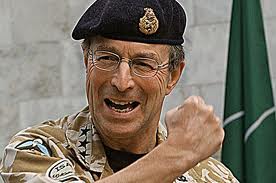
British Chief of Defence Staff Gen. Sir David Richards

In what is believed to be the first time since the 1940s, the entire British defense staff will be here March 25 to discuss long-range strategy and the impact of budget cuts with their U.S. counterparts, according to U.S. and British sources.

The meeting is reminiscent of the Combined Chiefs of Staff, when British and American military leaders joined forces during World War II. Both nations are undergoing significant budgetary reductions and will continue to rely on each other in future years for support. Understanding what capabilities will survive and won’t is essential to long-term strategic planning.

“The relationship military to military is very strong. We have common interest in how we meet the financial constraints placed on both nations, but also on issues like how we manage the drawdown in Afghanistan and also how we reconfigure post Afghanistan,” said Sir Gerald Howarth, a member of parliament and the ex-defense minister responsible for international security affairs from 2010 to 2012.

“We have a huge amount of strategic issues to discuss where we have a very large level of common interest,” he said.

A Defence Ministry spokesman characterized the meeting as private and declined further comment.

In the U.S., spokesmen for the Office of the Secretary of Defense and the Joint Chiefs of Staff did not respond to questions.

U.S. and British military leaders regularly discuss ongoing issues. What’s different about this series of meetings is they will focus not on immediate budget, program or operational issues, but the strategic future of the Anglo-American alliance, including deepening cooperation.

In addition to the U.S. Joint Chiefs, British attendees are expected to include Gen. Sir David Richards, chief of the Defence Staff; Gen. Sir Nicholas Houghton, vice chief of the Defence Staff, who will take over as chief when Richards retires later this year; Air Chief Marshal Sir Stephen Dalton, chief of the Air Staff; Adm. Sir George Zambellas, incoming Navy first sea lord; Gen. Sir Peter Wall, chief of the General Staff; and Air Chief Marshal Sir Stuart Peach, commander of Joint Forces Command, sources said.

The U.S. and U.K. regularly share the most sensitive military intelligence, technology and equipment, including submarine-launched nuclear ballistic missiles. Britain over the past decade in particular has shaped its capabilities to dovetail with U.S. forces.

The British are the leading developmental partner on the U.S.-led F-35 fighter program with Lockheed Martin and have in their inventory Boeing C-17 transports, Chinook and Apache helicopters and Lockheed C-130 cargo aircraft. In addition, the Royal Air Force is buying highly sensitive RC-135 Rivet Joint intelligence planes produced by L-3 Communications in the U.S., making London the only international customer for that program.

The meeting comes as the Pentagon faces $500 billion in spending cuts over the coming decade, which will force senior leaders to make difficult choices. The British delegation arrives with particular experience in that area, having faced even deeper budget cuts — in percentage terms — over the past several years, forcing major reforms to force structure, organization and acquisition programs in that time.

U.S. and British forces routinely train together and have fought side-by-side over the past decade in Afghanistan and Iraq. In Afghanistan, British Lt. Gen. Nick Carter serves as the deputy commander to U.S. Marine Gen. Joseph Dunford, commander of NATO forces.

“On the day-to-day business of military cooperation, the relationship between the U.S. [NATO] commander and the British second in command is another good example of working in partnership,” Howarth said.

The two militaries regularly participate in personnel exchanges. – Defence News

Kim Kardashian denies racist tweet about Nigerians

American reality TV star, Kim Kardashian, has denied tweeting hate words about Nigeria and her women.

A “photoshopped” image of a parody twitter handle had shown how Kardashian tweeted about Nigeria being such a disgusting country with women who look like apes.

“I see there is a photo shopped tweet floating around, supposedly something I said about Nigeria. That was not me or my feelings,” she said.

“The fake tweet is very disturbing and I will never ever tweet something like that,” she added.

Kim Kardashian recently visited Nigeria for a valentine show and left a love-hate relationship with her Nigerian fans after reports went round she was paid half a million dollars to show up at the event and hardly stayed or made any significant contribution to the show. – WENN.com

Curvy or slender?

A war of words has broken out between admirers of voluptuous female figures and those who plump for a more streamlined, traditionally Western, shape.

“African” curves or an “international” silhouette? On the airwaves and the catwalks of Côte d’Ivoire, a war of words has broken out between admirers of voluptuous female figures and those who plump for a more streamlined, traditionally Western, shape.

The young Ivorian singer Princesse Amour is hoping for a hit with her song celebrating “lalas”, the name she has given to slender, small-breasted women.

Dressed in ultra-tight skinny jeans, she sings over a pounding beat, her lyrics encouraging women to embrace their “little lemons”.

“I noticed that some girls were embarrassed to have small breasts” and “felt like they had to fake it by stuffing their bras,” she told AFP.

Her use of the term “lala” is no accident. It’s a reference to “lolo”, the word used to describe voluptuous women by Ivorian musical heavyweight Meiway in his 2000 hit Miss Lolo. His latest smash, Wiggle Your Bottom, a celebration of big booties, has had the whole of Abidjan shaking their stuff in recent months.

More “lala” than “lolo”
At a concert last year, Meiway told a handful of Europeans in the crowd: “You white people, you like your women flat and thin. Here, we like them big, with curves.”

But the aesthetic at the Miss Côte d’Ivoire beauty pageant is infinitely more “lala” than “lolo”.

Victor Yapobi, president of the organising committee, says: “Our beauties comply to international standards: minimum height 1.68m, 90cm around the hips.”

In Africa, “young women are becoming more and more slender”, he says, pointing out that a slim woman is still considered a marketing plus for brands.

But away from the podium, old habits die hard.

“Being thin is synonymous with being sickly and malnourished in African society,” laments Micheline Gueu, a candidate for Miss Côte d’Ivoire in a regional heat in the southeastern town of Aboisso.

Honour the real African woman
At the other end of the scale, however, the “awoulaba” (voluptuous women in the local Baoule language) also complain that their beauty is underrated.

On International Women’s Day on March 8, the “Awoulaba” beauty contest celebrating curvy women was reinstated after a seven-year lull.

The crown was taken by Esteve Alexandrine N’Goran, who told the audience of a thousand that she was there to “honour the real African woman”.

Emotional after her victory, the 38-year-old business woman and mother-of-three said that she wanted to show that women like her were both “beautiful” and “comfortable with themselves”.

“Roundly Beautiful”, an organisation set up in Abidjan in 2009 to support plus-sized women, lent its backing to the event. The group aims to “rid big women of their complexes” according to its president, Djeneba Dosso.

But Dosso admits that curves are not just a question of aesthetics. Ivorian women “don’t exercise and eat badly” she said, so her group encourages larger women to break bad habits.

Celebrated Ivorian artist Augustin Kassi is an inspiration to many. Since 1985 he’s been painting “fat women” as he describes them, in bright, joyful works of art.

A consistent opponent of what he sees as “cultural alienation”, for him Miss Côte d’Ivoire is a symbol of the “voluntary denigration of African beauty”.

He advocates diversity.

“The world is made up of different things” he says, paintbrush in hand. “It’s a rainbow.”  – Sapa-AFP

Russia seals energy, military cooperation with South Africa

The Russian-South African talks on the sidelines of the BRICS summit produced a wide range of agreements, including a joint declaration on strategic partnership, cooperation in communications and joint construction of nuclear power plants.

Russia is ready to provide credit support for South Africa to build nuclear power plants using Russian specialists. Development of cooperation with South Africa in the energy sector has a huge potential, according to the Russian leader.

“Russia is offering South Africa not only to help with construction of nuclear power reactors, but also with the creation of an advanced nuclear power industry, including the extraction of raw materials, construction of NPPs and research reactors, design and domestic production of nuclear power equipment with Russian credit support,”  RIA Novosti has quoted Putin as saying.

Besides the nuclear sphere, Putin and his counterpart Jacob Zuma also agreed on cooperation in the field of communication. In particular, South Africa will help Russia maintain the Global Navigation Satellite System (GLONASS).

“A quantum-optical system will be established in South Africa to increase the accuracy of GLONASS signal reception in the Southern Hemisphere,” Putin told journalists at the press-conference.

The Russian leader also added that the Space center in South Africa will be used to retrieve data from Russian satellites according to the “Radioastron” Project. The sides signed the essential document on Tuesday after the high-level talks.

Putin set a target to increase the trade turnover between the two states.

“Our countries have a good basis for increasing cooperation. In 2012, the turnover grew by a record 66.3 per cent, almost reaching $ 1 billion, which is almost twice more than in 2011. In the medium term we plan to increase the volume of bilateral trade by several times,” Putin said, adding that Russian companies “raised more than $ 1 billion in mutually beneficial projects in South Africa, invested this money in its economy.”

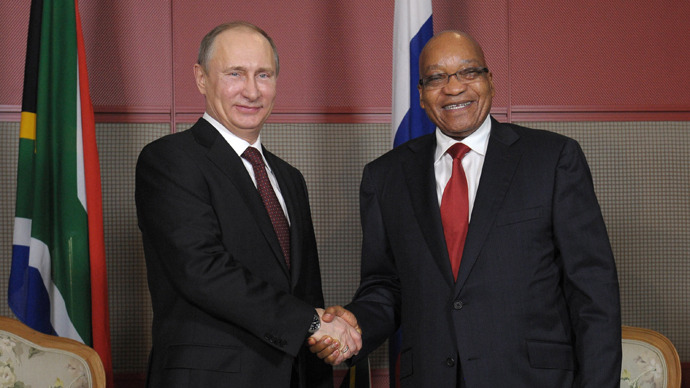
Russian President Vladimir Putin and President of South Africa Jacob Zuma (from right, background) during the signing of joint documents at a meeting in Durban. Foreground left – Russian Foreign Minister Sergei Lavrov on March 26, 2013. (RIA Novosti / Alexsey Druginyn)

Russia and South Africa have agreed to coordinate their actions for key global problems, including the current situation in Syria.

“Russia and South Africa share common approaches to key global issues. We cooperate in the UN, the BRICS and other international organizations. We agreed to further coordinate our actions, including for peaceful solutions to the Syrian crisis,” said Putin.

The Russian President also promised to think about the possibility of Russia’s support for a UN Security Council resolution on the cross-border provision of humanitarian assistance to Syria.

Russia and South Africa signed a declaration on a strategic partnership.

In particular, the document states the need to “enhance military cooperation, including military and military-technical cooperation on a long term basis and other forms of interaction between the armed forces of the two countries.”

The sides also agreed to cooperate in the fight against international terrorism, separatism, organized crime and drug trafficking. – RT

Are Babies Bigoted?

In one of the fastest-growing areas in psychology, researchers are gaining insight into the mental processes of subjects that are barely able to communicate: babies. In recent years, innovative and playful experimental setups have suggested that infants as young as six months old have a sense of morality and fairness, and that 18-month-olds are capable of altruistically helping others.

Some of this research, though, has also shed light on racial preferences. A new study published in Psychological Science suggests that 9- to 14-month-olds exhibit a preference for their own — in watching a puppet show, at least, they seem to prefer their own kind, and support puppets that pick on those who are different from them.

Because babies can’t communicate verbally, J. Kiley Hamlin of the University of British Columbia has pioneered the use of puppet shows to probe their psychology and better understand how they see the world. In this study, her research team put on an show in which 52 infant participants were led to identify themselves as similar to one of the characters in the show and different from the other.

To accomplish this, the researchers started off by asking the infants to pick a food, either graham crackers or green beans (a little surprisingly, a full 42 percent chose the vegetables). Then, the infants were shown a pair of rabbit puppets, one who liked graham crackers and one who liked green beans:

Once they’d solidly demonstrated each rabbit’s choice, one of them — either the one with the same preference as the infant observer, or the one with an opposite preference — would be randomly chosen to encounter a pair of new characters: one dog, termed a “helper,” and another, called a “harmer.” As the rabbit played with a ball and dropped it, the nice “helper” dog threw it back, but the mean “harmer” dog (below) held onto the ball:

After both of the scenes were over, both dogs were presented to the infant, and the particular dog that the baby first reached for was interpreted as the character it preferred.

The results were a bit startling: When the infants had watched a play involving a rabbit with a food choice that matched theirs, 83 percent preferred the “helper” dog. When they’d watched a play with a rabbit who liked a different food, 88 percent chose the “harmer” dog. This held true regardless of the  babies’ original food choices — the only thing that mattered was whether the rabbit’s identity, it terms of food choice, matched their own.

To further parse the motivations underlying the infants’ choices, the  researchers conducted a similar experiment that involved a neutral dog that neither help nor harmed the rabbit.

In this part of the study, the older infants’ preferences revealed that when watching rabbits who had different favorite foods than them, they not only liked “harmer” dogs more than neutral dogs, but strongly preferred even neutral dogs when compared to “helpers” (this was true among the 14-month-olds, but not the  9-month-olds). In other words, it seemed that they not only wanted to see the rabbit treated poorly, but also would rather see it treated neutrally than get some help.

Of course, when designing experiments for subjects that can’t use words to communicate, the simplest of variables could potentially throw off the results. It’s unclear, for example, if the researchers alternated which side the “helper” and “harmer” puppets appeared on, so the babies could have been influenced by their emerging sense of handedness.

In the past, critics of such puppet show experiments have also charged that a baby merely reaching for one puppet or another might be an impulsive reflex, rather than reflecting an underlying moral judgment.

What’s clear, though, is that this experiment demonstrated a consistent reflex across the babies tested. While extrapolating this to mean that the babies are racist or bigoted is probably a step too far — for one, they were  merely considering individual puppets, not groups of puppets with similar  characteristics — it does raise interesting questions about the origins of xenophobia in an individual’s lifetime. – Smithsonian.com

China’s drone fleets

China is building one of the world’s largest drone fleets aimed at expanding its military reach in the Pacific and swarming U.S. Navy carriers in the unlikely event of a war, according to a new report.

The Chinese military — known as the People’s Liberation Army (PLA) — envisions its drone swarms scouting out battlefields, guiding missile strikes and overwhelming opponents through sheer numbers. China’s military-industrial complex has created a wide array of homegrown drones to accomplish those goals over the past decade, according to the report released by the Project 2049 Institute on March 11.

“The PLA now fields one of the world’s most expansive UAV [unmanned aerial vehicle] fleets,” said Ian Easton and L.C. Russell Hsiao, researchers at the Project 2049 Institute and authors of the new report.

U.S. military forces still operate the largest drone fleet, with at least 679 drones in 2012, according to data from the International Institute for Strategic Studies reported by the Guardian. But the new Project 2049 Institute report estimates that China had 280 military drones as of mid-2011 — a number that has likely grown since then.

Chinese military drones have already entered the frontlines of China’s territorial disputes with neighboring countries such as Japan by flying maritime patrols over disputed areas. The Project 2049 Institute report warned that China could be tempted to use drones more aggressively without risking human lives, or even consider “plausibly deniable” drone attacks blamed upon mechanical failure or cyberhackers.

Chinese strategists have also discussed using swarms of drones to overwhelm the U.S. Navy’s carrier groups in the unlikely possibility of a shooting war. The drones could act as decoys, use electronic warfare to jam communications and radar, guide missile strikes on carriers, fire missiles at U.S. Navy ships or dive into ships like kamikaze robots.

“In particular, numerous authoritative studies indicate a strong emphasis on developing UAVs for locating, tracking and targeting U.S. aircraft carriers in support of long range anti-ship cruise and ballistic missile strikes,” the Project 2049 Institute report says.

All the main branches of the Chinese military field operational drone units. The new report identifies those military units along with major academic, industry and military organizations involved in building Chinese drones.

The report goes on to examine the state of Chinese drone technology. China is developing drones such as the rumored “Dark Sword” stealth drone that have low radar profiles to escape radar detection. It also wants to build “space” drones that could loiter at heights of 31 miles (50 kilometers) above the Earth to provide constant surveillance. (Scientists typically consider 62 miles (100 km) to mark the boundary for the edge of space.)

Chinese engineers have even begun working on drones that have the software brains to fly in formation, do aerial refueling and takeoff and land autonomously — capabilities that the U.S. military has also developed or begun testing for its own drones.

The risk of war between the U.S. and China remains low. But the report cautions that the U.S. military could prepare for the worst-case scenario by hardening its existing air bases in Asia and developing energy weapons (such as lasers) for better air and missile defense. – TechNewsDaily

Mandela’s memory ‘fading’

Nelson Mandela is doing well but has memory lapses, a close friend said on Monday.

Mandela spent a night in hospital at the weekend for a medical checkup, AFP reported.

The 94-year-old is aware of current political events, but he forgets at times that his fellow anti-apartheid activists are dead, said human rights lawyer George Bizos, who defended Mandela during his 1960s treason trial.

Bizos paid a visit to the Nobel Peace Prize-winner at his Johannesburg home 10 days ago and said Mandela “looked OK.”

Solidarity hero shocks world with anti-gay words

Lech Walesa, the Polish democracy icon from Solidarity and Nobel peace prize winner, has sparked outrage in Poland by saying that gays have no right to a prominent role in politics and that as a minority they need to “adjust to smaller things.”

Some commentators are now suggesting that Walesa, the leading figure in Poland’s successful democracy struggle against communism, has irreparably harmed his legacy.

Walesa said in a television interview on Friday that he believes gays have no right to sit on the front benches in Parliament and, if represented at all, should sit in the back, “and even behind a wall.”

“They have to know that they are a minority and must adjust to smaller things. And not rise to the greatest heights, the greatest hours, the greatest provocations, spoiling things for the others and taking (what they want) from the majority,” he told the private broadcaster TVN during a discussion of gay rights. “I don’t agree to this and I will never agree to it.”

“A minority should not impose itself on the majority,” Walesa said.

The words have enraged many.

“From a human point of view his language was appalling. It was the statement of a troglodyte,” said Jerzy Wenderlich, a deputy speaker of Parliament with the Democratic Left Alliance.

Walesa, Poland’s first democratic-era president, is a deeply conservative Roman Catholic and a father of eight. But, the democracy he helped create in 1989 from the turmoil of strikes and other protests has had a profound social transformation in recent years.

Poland is a traditionally conservative and Catholic society that long suppressed discussions of gay rights. The topic was essentially taboo under communism, and in the early years of democracy. The Polish church, which has a strong role in political life, still holds that homosexuality is deviant, while gays and lesbians say they face discrimination and even violence.

However, much has changed. A watershed moment came in 2011 when a new progressive and anti-clerical party – Palikot’s Movement – entered Parliament for the first time. Taking seats for the party were Anna Grodzka, a transsexual, and Robert Biedron, who is openly gay. These were all historic firsts.

Some predicted the consequences for Walesa could be serious.

“Now nobody in their right mind will invite Lech Walesa as a moral authority, knowing what he said,” Wenderlich said.

Monika Olejnik, a leading television journalist, said Walesa “disgraced the Nobel prize.”