France said Thursday it was closing down a 1,000-strong infantry regiment based in Germany that is part of a highly symbolic Franco-German brigade, a move Berlin reacted to with “regret”.
The brigade was set up in 1989 by then French president Francois Mitterrand and German chancellor Helmut Kohl to increase military cooperation between the two former World War II-era foes.
The French defence ministry said in a statement that it would be shutting down the 110th Infantry Regiment based in the southwestern German town of Donaueschingen in 2014.
The regiment groups together 850 soldiers and 150 civilians, and the ministry said the decision was part of “difficult choices” needed as France cuts its military budget to reduce its state deficit.
But it reaffirmed “France’s full commitment” to the brigade, which will be left with around 4,000 soldiers based in both countries after the regiment closure.
German Defence Minister Thomas de Maiziere expressed “regret” at the decision, saying in a statement that the regiment “contributed with success for many years to Franco-German friendship”.
After the dissolution, France will still have 500 troops in Germany, about the same number of German troops that are stationed in France.
The rest of the brigade is made up of French soldiers based in France and German military based in Germany.
The brigade is highly symbolic in nature as it is difficult for both countries to jointly deploy soldiers to hotspots, given the different rules of engagement that govern both armies.
Soldiers from the brigade have nevertheless been sent to Afghanistan and Kosovo in the past. – AFP
Having outfoxed him on Syria, Russian President Vladimir Putin has pipped Barack Obama to the title of the world’s most powerful leader as ranked by Forbes on Wednesday.
It was the first time in three years that the US president has dropped to second place on the magazine’s list and came as US-Russia relations slid to a new low.
Putin, who has enjoyed 13 years of dominant rule over Russia, was again elected president in March 2012.
Obama, on the other hand, has just emerged scathed from an embarrassing 16-day US government shutdown caused by a budget and debt crisis in Washington.
“Putin has solidified his control over Russia, while Obama’s lame duck period has seemingly set in earlier than usual for a two-term president — latest example: the government shutdown mess,” wrote Forbes.
In August, Russia granted asylum to former National Security Agency contractor Edward Snowden, wanted in the United States over a mammoth intelligence leak.
A month later, Putin played the trump card again by averting Obama’s threatened missile strikes on Syria with a plan for Damascus to hand over chemical weapons.
“Anyone watching this year?s chess match over Syria and NSA leaks has a clear idea of the shifting individual power dynamics,” Forbes wrote.
The 2013 list of 72 powerbrokers was chosen to reflect one for every 100 million lesser mortals on Earth.
Third prize went to Chinese President Xi Jinping, who is expected to rule for a decade in which China is set to eclipse the US as the world’s largest economy.
Pope Francis made his debut at number four and German Chancellor Angela Merkel rounded out the top five.
Among 13 newcomers were Samsung Chairman Lee Kun-Hee at number 41 and Nigerian billionaire Aliko Dangote, the richest man in Africa, in at number 64.
There were 17 heads of state who run nations with a combined GDP of $48 trillion and 27 CEOs and chairs who control over $3 trillion in annual revenues.
Only nine women made the cut despite representing half the world’s population. – breitbart.com
Rescue workers in Niger say they have found the bodies of 87 people who died of thirst after their vehicles broke down as they tried to cross the Sahara.
Rescue worker Almoustapha Alhacen said the corpses were in a severe state of decomposition and had been partly eaten, probably by jackals.
Those found are thought to be migrant workers and their families. Most were women and children.
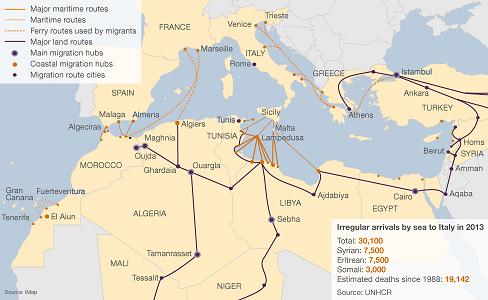
Niger lies on a major migrant route between sub-Saharan Africa and Europe.
But among those who make it across the desert, many end up working in North African countries.
According to Mr Alhacen, one of the vehicles that the migrants were travelling in broke down some time after they left Arlit at the end of September or beginning of October.
Continue reading the main story
Analysis
image of Thomas Fessy
Thomas Fessy
BBC West Africa correspondent
Thousands attempt to cross this stretch of Sahara desert to reach the coasts of North Africa, and from there Europe. I remember the exhaustion of migrants whom I met in Agadez in 2011.
Most were in their 20s and determined to continue their journey – despite the war in Libya at the time. “In our country, our talent is useless,” one young Nigerian said. “But in Europe, we’ll be able to thrive on it,” he added.
Agadez is still several hundred kilometres from either Libya or Algeria. There is nothing in between but sand – a perilous desert where the extreme heat can kill. Traffickers extort large sums of money from migrants seeking a one-way ticket for a better life. They all know that death may be on the way, but they’re ready to risk it, clinging onto hope.
Security officials have said the second vehicle broke down as it was on its way back to Arlit to get spare parts.
It appears that some of the group set out on foot, including up to 10 people who made it back to Arlit and raised the alarm, he said.
It was reported on Monday that five bodies had been found.
On Wednesday, volunteers and soldiers working in searing heat found other corpses about 10km (six miles) from the Algerian border.
Speaking from Arlit, a centre for uranium mining north of Agadez, Mr Alhacen said he had experienced the worst day of his life when he found the bodies.
“The corpses were decomposed; it was horrible,” he said.
“We found them in different locations in a 20km (12mile) radius and in small groups, often under trees, or under the sun. Sometimes a mother and children, but some lone children too,” AFP news agency quoted him as saying.
They were given Muslim burials where they were found, he added.
Given that at least 48 of those found were children or teenagers, Mr Alhacen said it was possible they were on their way to low paid jobs in neighbouring Algeria.
It is not clear which countries the migrants came from.
About 80,000 migrants cross the Sahara desert through Niger, according to John Ging, director of the UN Office for the Coordination of Humanitarian Affairs.
“They are basically economic migrants. They are in search of work. They are so impoverished that they have to make these hazardous journeys,” he told the BBC’s Newsday programme.
Niger is one of the world’s poorest countries and frequently suffers from drought and food crises.
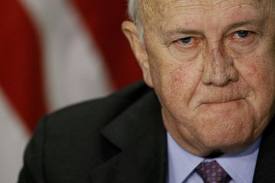
Former president FW de Klerk put his own spin on former president Thabo Mbeki’s ‘I am an African’ speech, at the 12th Europe lecture in The Hague on Friday.
“My ancestors were Huguenots from France who came to South Africa via Holland in 1688,” he said in a speech prepared for delivery.
“… My culture, like the cultures of so many peoples throughout the world, is suffused with the unparalleled literature, art and music of Europe. And yet, I am an African,” he said.
De Klerk said that even though he had deep roots in European culture, he identified with Africa and regarded himself as an African.
“… I strive to promote its interests in its relationship with other parts of the world, and I support its sports teams when they are playing teams from other continents.”
European imperialism deeply affected Southern Africa, and was indelibly changed though the British conquest wars with the Xhosa, the Zulus and the Afrikaners.
“The withdrawing tide of Europe an rule left country after country floundering on the beach of independence, surrounded by the flotsam and jetsam of empire.
“Constitutions that were not rooted in African traditions and ideas of government were hastily written and just as hastily torn up.”
Many African countries were left with a “love, hate relationship” with Europe, criticising them at the United Nations, but enjoying the shopping and culture of European capitals.
In recent years, Africa’s rapidly growing economy and Europe’s waning global prestige had changed the dynamic between the two continents.
“The reality is that the European single market just is not functioning as effectively as it should,” De Klerk said.
Declining birth rates were also contributing to Europe’s problems, but large-scale immigration from other parts of the world would fundamentally change the continent’s character.
Europe needed Africa to be prosperous, because political and economic problems in Africa would result in an “unstoppable torrent” of African refugees.
“But Africa also needs a strong Europe that will be able to play its proper role in the world.”
De Klerk said that Europe needed to give Africa greater attention in its strategic world view. – Sapa
by John-Thor Dahlburg and Geir Mouson, Associated Press
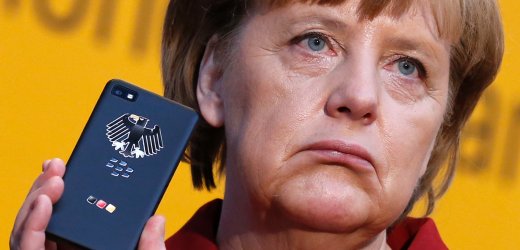
European leaders united in anger Thursday as they attended a summit overshadowed by reports of widespread U.S. spying on its allies -allegations German Chancellor Angela Merkel said had shattered trust in the Obama administration and undermined the crucial trans-Atlantic relationship.
The latest revelations that the U.S. National Security Agency swept up more than 70 million phone records in France and may have tapped Merkel’s own cellphone brought denunciations from the French and German governments.
Merkel’s unusually stern remarks as she arrived at the European Union gathering indicated she wasn’t placated by a phone conversation she had Wednesday with President Barack Obama, or his personal assurances that the U.S. is not listening in on her calls now.
“We need trust among allies and partners,” Merkel told reporters in Brussels. “Such trust now has to be built anew. This is what we have to think about.”
“The United States of America and Europe face common challenges. We are allies,” the German leader said. “But such an alliance can only be built on trust. That’s why I repeat again: spying among friends, that cannot be.”
The White House may soon face other irked heads of state and government. The British newspaper The Guardian said Thursday it obtained a confidential memo suggesting the NSA was able to monitor 35 world leaders’ communications in 2006. The memo said the NSA encouraged senior officials at the White House, Pentagon and other agencies to share their contacts so the spy agency could add foreign leaders’ phone numbers to its surveillance systems, the report said.
The Guardian did not identify who reportedly was eavesdropped on, but said the memo termed the payoff very meager: “Little reportable intelligence” was obtained, it said.
Other European leaders arriving for the 28-nation meeting echoed Merkel’s displeasure. Swedish Prime Minister Fredrik Reinfeldt called it “completely unacceptable” for a country to eavesdrop on an allied leader.
If reports that Merkel’s cellphone had been tapped are true, “it is exceptionally serious,” Dutch Prime Minister Mark Rutte told national broadcaster NOS.
“We want the truth,” Italian Premier Enrico Letta told reporters. “It is not in the least bit conceivable that activity of this type could be acceptable.”
Echoing Merkel, Austria’s foreign minister, Michael Spindelegger, said, “We need to re-establish with the U.S. a relationship of trust, which has certainly suffered from this.”
France, which also vocally objected to allies spying on each other, asked that the issue of reinforcing Europeans’ privacy in the digital age be added to the agenda of the two-day summit. Before official proceedings got underway, Merkel held a brief one-on-one with French President Francois Hollande, and discussed the spying controversy.
The Europeans’ statements and actions indicated that they hadn’t been satisfied with assurances from Washington. On Wednesday, White House spokesman Jay Carney said Obama personally assured Merkel that her phone is not being listened to now and won’t be in the future.
“I think we are all outraged, across party lines,” Wolfgang Bosbach, a prominent German lawmaker from Merkel’s party, told Deutschlandfunk radio. “And that also goes for the response that the chancellor’s cellphone is not being monitored – because this sentence says nothing about whether the chancellor was monitored in the past.”
“This cannot be justified from any point of view by the fight against international terrorism or by averting danger,” Bosbach said.
Asked Thursday whether the Americans had monitored Merkel’s previous communications, White House spokesman Carney wouldn’t rule it out.
“We are not going to comment publicly on every specified alleged intelligence activity,” he said.
But while the White House was staying publicly mum, Carney said the Obama administration was discussing Germany’s concerns “through diplomatic channels at the highest level,” as it was with other U.S. allies worried about the alleged spying.
In the past, much of the official outrage in Europe about revelations of U.S. communications intercepts leaked by former NSA contract worker Edward Snowden seemed designed for internal political consumption in countries that readily acknowledge conducting major spying operations themselves. But there has been a new discernible vein of anger in Europe as the scale of the NSA’s reported operations became known, as well as the possible targeting of a prominent leader like Merkel, presumably for inside political or economic information.
“Nobody in Germany will be able to say any longer that NSA surveillance – which is apparently happening worldwide and millions of times – is serving solely intelligence-gathering or defense against Islamic terror or weapons proliferation,” said Hans-Christian Strobele, a member of the German parliamentary oversight committee.
“Because, if you tap the cellphone or the phone connection of the presidents of France or Brazil, or the cellphone of the chancellor, then this is no longer about collecting intelligence about international terrorism, but then that is about competition, about getting advantages in this competition and winning. That’s why today is a watershed moment.”
Martin Schulz, president of the European Parliament, said Europe’s undermined confidence in the U.S. meant it should suspend negotiations for a two-way free-trade agreement that would account for almost half of the global economy. The Americans, Schulz said, now must prove they can be trusted.
“Let’s be honest. If we go to the negotiations and we have the feeling those people with whom we negotiate know everything that we want to deal with in advance, how can we trust each other?” Schulz said.
European Union Commission President Jose Manuel Barroso said for many Europeans, eavesdropping on their phone calls or reading their emails is particularly objectionable because it raises the specter of totalitarian regimes of the recent past.
“At least in Europe, we consider the right to privacy a fundamental right and it is a very serious matter. We cannot, let’s say, pretend it is just something accessory,” Barroso told a presummit news conference.
Referring to the East German Communist secret police, the feared Stasi, Barroso said, “to speak about Chancellor Merkel, in Germany there was a part of Germany where there was a political police that was spying on people’s lives every day. So we know very recently what totalitarianism means. And we know very well what comes, what happens when the state uses powers that intrude in people’s lives. So it is a very important issue, not only for Germany but for Europe in general.”
In Berlin, the German Foreign Ministry summoned the U.S. ambassador to stress how seriously it takes the reported spying on Merkel. Germany’s defense minister said his country and Europe can’t return “to business as usual” with Washington, given the number of reports that the United States has eavesdropped on allied nations.
“The Americans are and remain our best friends, but this is absolutely not right,” Thomas de Maiziere, who served as Merkel’s chief of staff, told ARD television. “I have reckoned for years with my cellphone being monitored, but I wasn’t reckoning with the Americans.”
A German parliamentary committee that oversees the country’s intelligence service met to discuss the spying allegations. Its head, Thomas Oppermann, recalled previous reports to the panel that U.S. authorities had denied violating German interests, and said, “we were apparently deceived by the American side.” – AP
The European Parliament voted Wednesday for US access to the global financial database held by a Belgian company to be suspended because of concerns that the US is snooping on the database for financial gain rather than just to combat terrorism.
The Strasbourg based parliament voted 280 in favor, with 254 against, with 30 abstentions, and called for a suspension of US access until a full enquiry clarifies the situation.
“We need full transparency, especially with all the NSA revelations. Europe cannot accept that the data of private citizens is being accessed without anyone knowing about it”, Guy Verhofstadt, the leader of the Liberals in the European Parliament, told Reuters.
EU lawmakers are concerned that the US is covertly using information from the SWIFT database following leaked US documents aired by Brazil’s biggest television network Globo, which indicated that the US has secretly tapped into SWIFT.
Under current agreements the US has limited access to the SWIFT database. The deal is part of transatlantic cooperation following the September 2001 attacks, and allows certain data from SWIFT to be shared with the US treasury.
The idea was that by sharing on a limited basis the millions of financial messages that take place across the world every day, it would help combat terrorism.
However, the parliament’s vote is symbolic, not binding, and rather reflects EU wide public anger at the NSA spying allegations. The European Commission and the various EU governments will still need to approve a suspension of US access to SWIFT.
The European Commission has said in a statement that it had no immediate plans to propose a suspension of SWIFT to its member states and that it was “still waiting for additional written assurances”that the US was respecting its prior written agreement with the EU.
For its part the US has denied it is doing anything wrong. According to the EU Home Affairs Commissioner Cecilia Malmstrom, the US Treasury undersecretary for terrorism, David Cohen, has told her that the US government has respected the 2010 agreement on SWIFT.
But there is undoubtedly a firm belief within certain sections of the EU parliament that the EU should be more careful about what it shares with the US.
“The EU cannot continue to remain silent in the face of these ongoing revelations: It gives the impression we are little more than a lapdog of the United States,” said Jan Albrecht, a German Green in the EU parliament.
The vote comes on the back of allegations by the Le Monde newspaper that the NSA has spied on the agency records of millions of phone calls of top French politicians and business people.
The claims were taken seriously by the French government and on Monday morning the US ambassador to France Charles Rivkin was summoned to the French Foreign Ministry to give an explanation.
It was also reported earlier this week that years of spying on Mexico by the NSA had helped Americans get the upper hand in business talks and get investment opportunities that were more favorable to them. – RT
The lives of hundreds of black orphans might soon change for the better because of inter-country adoption.
The SA Central Authority, which oversees adoptions in this country, has given adoption agency Wandisa permission to cooperate in inter-country adoptions with the Nederlandse Adoptie Stichting, a Dutch agency.
A director of the Dutch agency, Macky Hupkes, said his organisation was waiting for the authorities of both countries to conclude a state-to-state adoptions agreement.
The founder and president of Wandisa, Debbie Wybrow, said: ” Many Dutch families have indicated their willingness to adopt older children and those who have special needs,” she said.
Census 2011 estimated that there were 3.3million orphans in South Africa. Between 1.5million and 2million of them could benefit from inter-country adoption.
A Dutch adoptive mother said the new South African-Netherlands agreement was a relief to her and her husband.
“We have been trying to adopt for four years . and are overwhelmed that children who need parents can finally get them,” she said.
“It was painful being told that you may be good parents, but you are not Christian and therefore are not allowed to be parents.”
Adoptions made headlines last month when the SA Human Rights Commission launched an investigation into allegations of discrimination against three adoption agencies.
The agencies were accused of discriminating against homosexual and non-Christian would-be adoptive parents, contravening the constitution and the Children’s Act.
Wandisa is waiting for the approval of adoption agreements with Canada and Ireland, which were submitted in 2009 and 2010 respectively. – timeslive.co.za
A plan to use vans as mobile billboards telling illegal immigrants to leave is being dropped, British Home Secretary Teresa May said Tuesday.
The signs advising illegal immigrants to go home were criticized by both the Labor Party and the Liberal Democrats, the Conservatives’ partner in the coalition, The Independent reported. May conceded a 10,000 pound ($16,000) pilot project was disappointing, although she disputed the Labor Party’s charge that only one person decided to leave as a result of the campaign.
“Politicians should be willing to step up to the plate and say when they think something actually hasn’t been as good an idea, and I think they were too blunt an instrument,” May said.
Complaints were made to the Advertising Standards Authority that the signs were both inaccurate and racist. The authority did not find racism but said the arrest statistics on the signs were inaccurate. – Breitbart
German Chancellor Angela Merkel complained to President Barack Obama on Wednesday after learning that U.S. intelligence may have targeted her mobile phone, and said that would be “a serious breach of trust” if confirmed, her government announced.
The White House denied that the U.S. is listening in on Merkel’s phone calls.
The German government said it responded after receiving “information that the chancellor’s cellphone may be monitored” by U.S. intelligence. It wouldn’t elaborate but German news magazine Der Spiegel, which has published material from NSA leaker Edward Snowden, said its research triggered the response.
Merkel spokesman Steffen Seibert said in a statement the chancellor made clear to Obama in a phone call that “she views such practices, if the indications are confirmed … as completely unacceptable.”
Merkel said among close partners such as Germany and the U.S., “there must not be such surveillance of a head of government’s communication,” Seibert added. “That would be a serious breach of trust. Such practices must be stopped immediately.”
In Washington, White House spokesman Jay Carney said “the United States is not monitoring and will not monitor the communications of the chancellor.”
Merkel raised concerns over electronic eavesdropping issue when Obama visited Germany in June, has demanded answers from the U.S. government and backed calls for greater European data protection. However, Wednesday’s statement was much more sharply worded and appeared to reflect frustration over the answers provided so far by the U.S. government.
Merkel called for U.S. authorities to clarify the extent of surveillance in Germany and to provide answers to “questions that the German government asked months ago,” Seibert said. – Breitbart
by Marianne Barriaux and Michael Mainville BARRIAUX, Michael MAINVILLE
The United States has become embroiled in a new row over its controversial spying programme as allies France and Mexico condemned revelations Washington tapped millions of phonecalls and hacked into leaders’ emails.
French President Francois Hollande on Monday expressed his “deep disapproval” of reports of US spying in a phone call with President Barack Obama.
France’s Le Monde newspaper reported that the US National Security Agency had secretly monitored 70.3 million phone communications in France over 30 days from December 10, 2012, to January 8 this year.
The allegations, the latest from leaks by former NSA contractor Edward Snowden, also marred a visit to Paris by US Secretary of State John Kerry, where he discussed moves to try to end the war in Syria.
At the same time, German weekly Der Spiegel reported the NSA had also hacked into former Mexican president Felipe Calderon’s email account.
Calderon, on Twitter, described the revelations as an “affront to the institutions of the country, given that it took place when I was president”.
Hollande told Obama that the alleged practices were “unacceptable between friends and allies because they infringe on the privacy of French citizens”, the French leader’s office said in a statement.
The allegations come on top of previous revelations by Snowden — who has sought safety in Russia as US authorities pursue him for leaking classified information — that the United States had a vast, secret programme called PRISM to monitor Internet users.
French prosecutors are already investigating the programme, and French Prime Minister Jean-Marc Ayrault said he was “deeply shocked” by the new revelations.
“It’s incredible that an allied country like the United States at this point goes as far as spying on private communications that have no strategic justification, no justification on the basis of national defence,” he told journalists.
French Foreign Minister Laurent Fabius, on a visit to Luxembourg, said US ambassador Charles Rivkin was summoned to his ministry early Monday.
“These kinds of practices between partners that harm privacy are totally unacceptable,” he told reporters, adding France needed assurances that the United States was no longer monitoring its communications.
His comments were relayed to the US ambassador during the meeting, a ministry spokesman said — the second time in less than four months that America’s top representative in France has been hauled in over revelations about US snooping.
Kerry refused to comment on the specific accusations, but noted that Washington was reviewing its intelligence gathering operations following protests from allied governments.
He also sought to defend the US position.
“Protecting the security of our citizens in today’s world is a very complicated, very challenging task… because there are lots of people out there seeking to do harm to other people,” Kerry said at a press conference after meeting Arab League officials.
“Lots of countries are engaged in the activity of trying to protect their citizens in the world,” he said. “Our goal is always to try to find the right balance between protecting the privacy and security of our citizens.”
According to Le Monde, the spy agency automatically picked up communications from certain phone numbers in France and recorded certain text messages under a programme code-named “US-985D”.
The French daily said the documents gave grounds to believe that the NSA targeted not only people suspected of being involved in terrorism but also high-profile individuals in business and politics.
Hollande’s office said the French president and Obama had agreed “to work together to determine the facts and the exact scope of surveillance activities” revealed by Le Monde.
Der Spiegel also revealed that US agents had hacked into the Mexican presidency’s network, gaining access to Calderon’s account.
According to the report, the NSA said this contained “diplomatic, economic and leadership communications which continue to provide insight into Mexico’s political system and internal stability”.
The agency reportedly said the president’s office was now “a lucrative source”.
Mexican authorities said they would be seeking answers from US officials “as soon as possible”.
“This practice is unacceptable, illegitimate and contrary to Mexican law and international law,” the foreign ministry said.
Glenn Greenwald, an American journalist now living in Brazil who has broken many of the recent stories about secret US surveillance programmes, says Washington has spied on all Latin American countries.
Speaking to a press association in Miami, Greenwald said he would report about each case in the region and warned that more spying within the United States would also be revealed.
He also said the disclosures published by Le Monde Monday had been in the hands of the French daily for some time.
This is not the first time there have been reports that France and Mexico have been targeted in relation to NSA spying allegations since information leaked by Snowden first emerged in June.
Mexico’s current President Enrique Pena Nieto has already complained to Obama over reports US spies have gone through his emails.
And Der Spiegel reported last month that in 2010 the NSA monitored the internal computer network of France’s diplomats and that of the foreign ministry.
But France itself has also been accused of spying. Le Monde reported in recent months that intelligence services intercepted all communications in the country, stocking telephone and computer data for years –accusations denied by the government. – AFP
Unidentified assailants on Sunday attacked a Roma schoolgirl, whose deportation from France sparked controversy, along with her family in Kosovo where they have been living since their eviction, police said.
“The Dibrani (family) were walking in Mitrovica with their children when they were attacked by unknown” people, a police officer, who requested to remain anonymous, told AFP.
The mother of 15-year-old Leonarda, Xhemaili, was “beaten and is in hospital while the children, who are traumatised, are at a police station”, the officer said.
Meanwhile, another police officer told reporters that four people were detained over the incident which, according to first findings, may have been caused by some previous private affairs.
“The incident occurred between two families, the Dibranis and the Bislimis,” police captain Ahmet Gjosha said.
“It turned out that Mr Bislimi was Xhemaili Dibrani’s husband 25 years ago and we assume that this fact sparked the incident.”
The Beslimi family was repatriated from Switzerland four months ago, he said.
Police said they were taking the incident very seriously and a probe was launched.
Shortly after the incident a police officer had told AFP that “it shows that the Dibranis are not safe here”.
Leonarda’s father Resat Dibrani, 47, was at the hospital by his wife’s side.
On Saturday, French President Francois Hollande offered Leonarda the chance to go back to France, but without her family.
Hollande’s offer was immediately rejected by the girl while her father said that the family, deported on October 9, would not be divided and would return to France by any means.
Her parents and five brothers and sisters had lived in France for four years while their asylum bid was processed. It was eventually rejected in the summer.
Leonarda Dibrani’s eviction caused an outcry in France because she was detained during a school trip before being deported with her family, and students took to the streets demanding she return and Interior Minister Manuel Valls resign.
In an interview with AFP Thursday, Resat Dibrani said he was born in Kosovo and that his wife and five of his six children, including Leonarda, were born in Italy.
He said he had lied about his family’s Kosovo origins to have a better chance of obtaining asylum.
Earlier on Sunday, the father told AFP that his “children are afraid to go out”.
“I cannot adapt myself, I left 35 years ago. I do not recognise the town any more,” he said stressing that he had only 200 euros ($275) left to feed his family.
The father, who wants to return to France, said: “The problem is to get into (EU member) Croatia and afterwards the way is open.”
“I would have to get 20,000 euros” for people who would take us into Croatia, he added.
The results of a formal probe published in France on Saturday found that the deportation was lawful but that police could have used better judgement in the way they handled it.
They also found that Leonarda and her sister were taken in by French social services after having accused their father of violence — a claim they later retracted.
Last year, 36,822 immigrants, many of them Roma, were deported from France, a nearly 12 percent rise from 2011. – AFP
France’s Interior Minister Manuel Valls has defended the treatment of a 15-year-old Roma girl who was detained by police during a school trip and deported to Kosovo, amid an outcry within the ruling party.
Valls on Wednesday defended the deportation of Leonarda Dibrani, her parents and five siblings aged between one and 17 as legal, but ordered officials to review the handling of the case.
Confronted with an angry backlash from the left of the ruling Socialist party, Prime Minister Jean-Marc Ayrault promised the family would be brought back to France if the girl’s rights were found to have been infringed.
“If there is a God we will be aboard the first plane back to France,” Leonarda told AFP in an interview in the Kosovan town of Mitrovica, where the family have been given temporary housing by the local authorities.
“I’m frightened, I don’t speak Albanian. My life is in France. I don’t want to go to school here because I don’t speak any of the local languages. I had freedom there. I do not want to stay here.”
Opposition lawmakers backed Valls and warned that a decision to reverse the deportation would send out a damaging message that illegal immigrants were welcome in France.
“The law has to be applied and in this case an expulsion order had twice been upheld by the judicial system,” said Christian Jacob, leader of the parliamentary group of the centre-right UMP.
The fresh row over France’s treatment of Roma migrants erupted Wednesday when an NGO that campaigns against the expulsion of school-age children highlighted the incident, which happened on October 9 in the eastern town of Levier.
Claude Bartolone, the speaker of the National Assembly, underlined the extent of the disquiet in the Socialist camp over the case.
“There is the law but there are also values on which the left must never compromise,” he said in a tweet.
Education Minister Vincent Peillon said: “School has to be a sanctuary, we have to retain our principles based on rights and humanity.”
The controversy follows an outcry last month over remarks by Valls in which he said most of the 20,000 Roma in France had no intention of integrating and should be sent back to their countries of origin.
Polls have suggested as many as three in four French voters support that stance and Valls, who was already France’s most popular politician, has enjoyed a surge in his standing as a result of comments regarded as racist by his critics.
Leonarda’s father, Reshat, 47, who was deported a day before the rest of the family, said the family had been victimised because of their ethnicity.
“There are bad refugees in France who get papers easily — we didn’t do anything bad. They did it to us because we are Roma. We would be treated differently if our skin was a different colour.”
Valls insisted that the deportation of Leonarda and the rest of her family had been carried out in line with established procedure following the rejection of their application for asylum.
“Everyone should keep a cool head. Do not for one single moment doubt that the rules, based on the law, are applied by my services with intelligence, discretion and humanity,” the minister said.
“We have to carry out these deportations,” he added. “It is of course a difficult subject but any immigration policy requires respect for the law, respect for individuals and great firmness. I am accountable for that to the French people.”
Speaking later upon his arrival at the French Caribbean island of Martinique, Valls stressed that he backed “a policy of integration”.
The exact circumstances in which the girl was taken off the school bus remained unclear but both the interior ministry’s version and the account of a teacher agree that her arrest did not take place in view of other pupils.
The teacher, who gave her account via the Network for Education without Borders (RESF), however, claimed that the other children were fully aware of what was happening and were deeply distressed by the incident.
Leonarda herself said: “All my friends and my teacher were crying, some of them asked me if I had killed someone or stolen something as the police were looking for me. When the police reached the bus they told me to get out and that I had to go back to Kosovo.”
President Francois Hollande did not make any public statement on the row, prompting opposition accusations the government was in chaos. – AFP
Germany’s largest telecom provider, Deutsche Telekom, is looking to introduce a “national routing” service which would keep German internet traffic out of the hands of foreign spies.
The former state-owned communications giant outlined the plans at a secret meeting in the Economy Ministry, business weekly Wirtschaftswoche reported.
Currently, email data is exchanged between users worldwide via international Internet exchange points; physical structures through which Internet service providers (ISPs) exchange Internet traffic between their networks.
The company hopes to hammer out an agreement with other national Internet providers which would guarantee that “while being transported from the sender to the receiver in Germany… no single byte leaves Germany,” Thomas Kremer, a board member of Telekom’s data privacy, legal affairs and compliance, told the magazine.
To put the plan into effect, Deutsche Telekom must secure the support of all its competitors, including Telefonica and Vodafone.
While Vodafone and Telefonica are currently mulling the initiative, another competitor – Internet service provider QSC – has questioned the efficacy of the plan, saying it was not possible to determine with certainty whether data is being routed nationally or internationally.
“In a next step, this initiative could be expanded to the Schengen area,” the spokesman said, referring to the group of 26 European countries – excluding Britain – that have removed border controls for participating countries.
Deutsche Telekom first began leading the charge for to protect its users’ privacy from foreign intelligence agencies in August when they rolled out ‘Email Made in Germany’, an encrypted email service that only uses German servers to process and store all domestic email traffic.
The move followed revelations that the US National Security Agency (NSA) collects 500 million pieces of phone and email metadata from Germany each month — more than in any other EU country.
“Germans are deeply unsettled by the latest reports on the potential interception of communication data,” said Rene Obermann, head of Deutsche Telekom.
“Now, they can bank on the fact that their personal data online is as secure as it possibly can be.”
Experts do not believe the move will stop governments from getting their hands on information, although it might complicate efforts to do so.
“Of course the NSA could still break in if they wanted to, but the mass encryption of emails would make it harder and more expensive for them to do so,” Sandro Gaycken, a professor of cyber security at Berlin’s Free University, said when the idea was first proposed. – RT
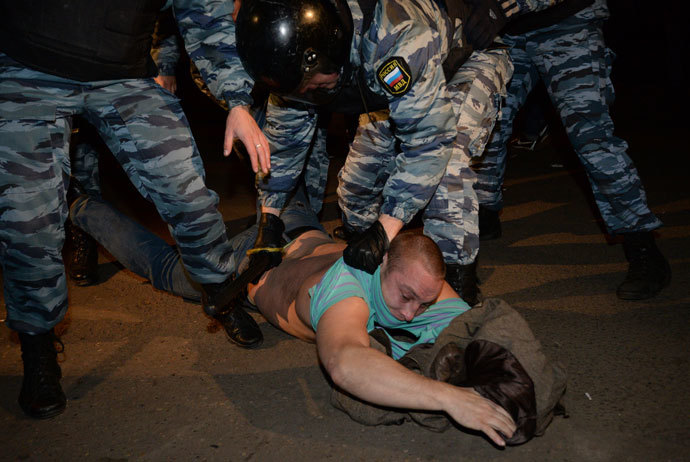
Moscow police detained some 380 people during the mass rioting in a southern district of the city. A mixed crowd of nationalists and locals attacked a warehouse run by natives of the Caucasus, blaming a migrant for the fatal stabbing of a local.
Authorities lifted the emergency plan codenamed “Volcano” after midnight, several hours after public order had been restored. The plan, put into effect in the afternoon, involved sending scores of riot police to the scene of the clashes, and placing police officers across the city on high alert.
By midnight the streets were practically deserted, except for police officers and a couple of bystanders discussing the day’s events. Meanwhile the 380 detained during the unrest were being interrogated in a criminal case over hooliganism – thus far as witnesses, police said.
Residents of the Biryulyovo district in southern Moscow took to the streets following the fatal stabbing of Egor Shcherbakov, a Muscovite, earlier in the week. Late on Thursday evening, when Shcherbakov and his girlfriend were on their way home, the young couple were attacked by an unidentified man who stabbed Shcherbakov with a knife.
Shcherbakov’s girlfriend described the attacker as a male native of the Caucasus and said that he had assaulted her boyfriend after trying to harass her.
On Saturday a group of about 40 people gathered for a protest in the area, urging the police to find and punish the attacker. They demanded that the district’s police chief resign, and that a local vegetable warehouse, where many migrants work, be closed.
The locals also lashed at the the authorities, accusing them of covering the wave of migrant crime and the illegal immigration in the area. The protest was followed by an unsanctioned rally on Sunday, which turned violent as hundreds of angry protesters attacked a shopping mall – attempting to set it on fire and breaking windows. A group of people among the crowd reportedly broke into stores, ransacking them and looting goods.
Ethnic tensions in Moscow have been high on politicians’ agenda in recent months, with the issue of illegal migration a key theme in the city’s mayoral election last month. Some 3 million migrants from former Soviet republics in Central Asia and the Caucasus are estimated to live in the city, many working in low-paid jobs in food markets without legal residency permits.
The city’s ethnic dividing lines are also overlaid with religious ones, as the Russian Orthodox majority is challenged in many neighborhoods by a growing Muslim population – both from Russia’s North Caucasus and from outside Russia’s borders.
Meanwhile, authorities in Moscow’s Southern Administrative district have decided to set up an operation headquarters to counter illegal migration. The body – comprised of police, federal migration service representatives and voluntary people’s guard – will gather daily. The new foundation will focus on identifying flats rented to illegal migrants, patrolling streets and organizing sweeps on reports from citizens, the prefecture’s press service told Interfax.
Egor’s girlfriend said she was against such protests, since she did not want “interethnic conflicts” to be inflamed. “I know this crime won’t remain unpunished,” she told Moskva 24 TV channel.
According to statistics announced in spring by the Federal Migration Service, there are over 3 million illegal immigrants in Russia and 11 million legal visitors. However, unofficial estimates put the number of illegal immigrants at 10-12 million. – RT
This website uses cookies to improve your experience. We'll assume you're ok with this, but you can opt-out if you wish. Cookie settingsACCEPT
Privacy & Cookies Policy
Privacy Overview
This website uses cookies to improve your experience while you navigate through the website. Out of these cookies, the cookies that are categorized as necessary are stored on your browser as they are essential for the working of basic functionalities of the website. We also use third-party cookies that help us analyze and understand how you use this website. These cookies will be stored in your browser only with your consent. You also have the option to opt-out of these cookies. But opting out of some of these cookies may have an effect on your browsing experience.
Necessary cookies are absolutely essential for the website to function properly. This category only includes cookies that ensures basic functionalities and security features of the website. These cookies do not store any personal information.
Any cookies that may not be particularly necessary for the website to function and is used specifically to collect user personal data via analytics, ads, other embedded contents are termed as non-necessary cookies. It is mandatory to procure user consent prior to running these cookies on your website.