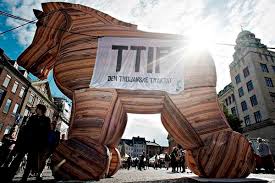
Le Pen – US no ‘ally or friend’ to France

The leader of France’s far right Front National party, Marine Le Pen, has declared that the United States is not “an ally or a friend” to the French, in light of Wikileaks reports that the National Security Agency (NSA) spied on three French presidents.

“France should react with firmness and send out a strong signal today by pulling out of discussions over the Transatlantic Trade and Investment Partnership (TTIP) treaty,” Le Pen wrote in a statement, referring to the deal being discussed by the European Parliament to revise corporate rights in dealings with governments. She and other eurosceptics have opposed the TTIP plan.

“The US are a hegemonic power, prepared to do anything in order to increase its grip on our country” Le Pen said. “The French must recognize that the United States, which is to say its government that we clearly distinguish from its people, are not a country that is an ally or a friend.”…

Le Pen also dismissed Sarkozy’s decision to restore France to Nato’s integrated military command in 2009 as a “strategic mistake”. Former leader Charles de Gaulle removed France from the role in 1966, fearing it harmed France’s sovereignty.

In the conversation the two negotiate the possibility of Le Pen endorsing the Russian annexation of Crimea and visiting the peninsula as “an observer”.

Source: Newsweek

Trump for President?

Perhaps it has occurred to you as it has to me that the United States is no longer capable of producing political leadership. In the current issue of Trends Journal, Gerald Celente describes the eight candidates (at the time he went to press) for the US presidential nomination as “Liars, cowards, freaks & fools.”

Celente put it well. If you look at the sorry collection that aspires to be the CEO of what continues to be described as the “exceptional, indispensable, most important country with the largest economy and military, the world’s only Superpower, the Uni-power,” you see a collection of nobodies. America is like the last days of Rome when contenting factions fought to put their puppet on the throne.

There is no known politician in America who measures up to Vladimir Putin’s ankle, or to the knee of China’s leaders, or to the waist of Ecuador’s, Bolivia’s, Venezuela’s, Argentina’s, Brazil’s, or to the chests of India’s and South Africa’s.

In Europe, the UK, Australia, and Canada, the natural leaders are also frozen out of the corrupt system.

In the US, “leadership” positions depend on financial support from the ruling economic interests. American presidents and politicians represent about six powerful private interest groups and no one else.

After Celente went to press, Donald Trump announced to much mirth. A “con man” they say, but what else is the President of the United States? Do you think you weren’t conned by Clinton, George W. Bush, and Obama? What universe do you live in?

In actual fact, Trump might be our best candidate to date. By all accounts, he is very rich. Thus, he doesn’t need the office in order to become rich by selling out America to interest groups.

By all accounts, Trump has a healthy ego. Thus, he could be capable of standing up to the powerful interest groups that generally determine the governance of the American serfs.

Trump’s ego might even be strong enough for him to stand up to the Israel Lobby, something my former colleague, Admiral Thomas Moorer, Chairman of the Joint Chiefs of Staff, said publicly that no American President was capable of doing.

As Celente makes clear in the current Trends Journal, all politicians are con men or con women. We are going to have them regardless, so why not try a rich one who might decide to break with tradition and serve the interests of the citizenry. This would be a unique accomplishment, affording Trump the elevation in history books that would satisfy his ego. When a person reaches Trump’s state, does he need another couple of billion dollars or is historical recognition as the savior, however temporary, more valuable?

This is not my endorsement of Trump for President. It is merely my speculations on how we might think of how large egos might be brought into our service. When we put the Clintons in office, they decided to make money so that they could outdo Hollywood and show their arrival with the $3 million they spent on their daughter’s wedding.

For Trump, $3 million is pocket change.

The rich are everywhere demonized, but no action follows. So, let’s consider voting for Trump. Some of the better Roman emperors were rich. Their riches allowed them to maintain the stability of the state and to think about its long-run survival. They could outbid the private interests that wished to overthrow them for their own purposes of immediate and highly selective gain.

It would take a lot of money to outbid Trump, although if he neglects the Secret Service and the CIA, he could go the way of John F. and Bobby Kennedy. He would have to make certain he was well protected if he cuts the budget of the military/security complex.

Money, lots of it, has one great virtue. Money in sufficient amounts conveys INDEPENDENCE. Trump, if press reports are correct, has money. This means, if correct, that Trump, unlike every other candidate, has independence from the ruling handful of private interest groups.

If Trump can assemble independent thinkers as his advisers, thus keeping himself out of the hands of the usual interest groups, should he be able to get elected, his administration could succeed in taking America in a more promising direction.

An important question is: can a really rich person find and be comfortable with peers who are not themselves really rich? If not, then Trump is not our man. But if Trump wants to save our country, he has the money and the ego, and he can find enough people to help him.

This opportunity doesn’t mean that it will be seized or that it would pan out. If Trump is our best choice, imagine how deplorable our situation is.

Dr. Paul Craig Roberts was Assistant Secretary of the Treasury for Economic Policy and associate editor of the Wall Street Journal. He was columnist for Business Week, Scripps Howard News Service, and Creators Syndicate. He has had many university appointments. His internet columns have attracted a worldwide following. Roberts’ latest books are The Failure of Laissez Faire Capitalism and Economic Dissolution of the West and How America Was Lost.


‘US drawing Europe into crusade against Russia, against our interests’

The US is drawing European states into a “crusade” against Russia, which goes against Europe’s interests, former French Prime Minister Francois Fillon has said. Speaking to French media, he stressed that Europe now is dependent on Washington.

“Today, Europe is not independent… The US is drawing us [the EU] into a crusade against Russia, which contradicts the interests of Europe,” Fillon told the BFMTV channel.

The ex-French prime minister, who served in Nicolas Sarkozy’s government from 2007 till 2012, lashed out at Washington and its policies.

Washington, Fillon said, pursues “extremely dangerous” policies in the Middle East that the EU and European states have to agree with.

He accused German intelligence of spying on France “not in the interests of Germany but in the interests of the United States.”

Fillon pointed out that Washington is pressurizing Germany to concede to Greece and find a compromise.

He noted the “American justice system” often interferes with the work of “European justice systems.”

“Europe is not independent,” the ex-PM said, calling for “a broad debate on how Europe can regain its independence.”

This, however, would not be possible if Europe goes ahead and signs the Transatlantic Trade and Investment Partnership (TTIP), a proposed EU-US treaty, which has drawn much criticism for its secretiveness and lack of accountability.

“I am definitely against signing this agreement [TTIP] in the form in which it is now,” he added.

The TTIP agreement seeks to formalize the economic relationship between the EU and US economies across the board. The two partners trade nearly €1 billion (US$1.1 billion) worth of goods and services annually.

Its supporters promise €100 billion in GDP growth for the EU and almost $90-billion growth for the US, as well as the creation of over 700,000 extra jobs in the US. However, TTIP critics warn the deal would create environmental problems, a loss of economic sovereignty, bring in torrents of genetically modified food and cause unemployment.

EU in chaos on TTIP vote

An historic vote on the biggest trade deal ever negotiated between the EU and the US has had to be postponed after the European Parliament descended into chaos.

European MPs were due to vote on the Transatlantic Trade and Investment Partnership on Wednesday. But the vote had to be delayed because there were too many proposed amendments.

“It’s panic in parliament,” Yannick Jadot, a Green MEP from France, told AFP.

David Cameron has claimed that signing the deal would add £2 billion to the UK economy every year.

But the plan has been violently opposed by campaign groups across Europe that fear it would be at the expense of national services and social and environmental welfare.

Source: The Independent

Rule By The Corporations

TTIP: The Corporate Empowerment Act

The Transatlantic and Transpacific Trade and Investment Partnerships have nothing to do with free trade. “Free trade” is used as a disguise to hide the power these agreements give to corporations to use law suits to overturn sovereign laws of nations that regulate pollution, food safety, GMOs, and minimum wages.

The first thing to understand is that these so-called “partnerships” are not laws written by Congress. The US Constitution gives Congress the authority to legislate, but these laws are being written without the participation of Congress. The laws are being written by corporations solely in the interest of their power and profit. The office of US Trade Representative was created in order to permit corporations to write law that serves only their interests. This fraud on the Constitution and the people is covered up by calling trade laws “treaties.”

Indeed, Congress is not even permitted to know what is in the laws and is limited to the ability to accept or refuse what is handed to Congress for a vote. Normally, Congress accepts, because “so much work has been done” and “free trade will benefit us all.”

The presstitutes have diverted attention from the content of the laws to “fast track.” When Congress votes “fast track,” it means Congress accepts that corporations can write the trade laws without the participation of Congress. Even criticisms of the “partnerships” are a smoke screen. Countries accused of slave labor could be excluded but won’t be. Super patriots complain that US sovereignty is violated by “foreign interests,” but US sovereignty is violated by US corporations. Others claim yet more US jobs will be offshored. In actual fact, the “partnerships” are unnecessary to advance the loss of American jobs as there is nothing that inhibits jobs offshoring now.

What the “partnerships” do is to make private corporations immune to the laws of sovereign countries on the grounds that laws of countries adversely impact corporate profits and constitute “restraint of trade.”

For example, under the Transatlantic Partnership, French laws against GMOs would be overturned as “restraints on trade” by law suits filed by Monsanto.

Countries that require testing of imported food, such as pork for trichnosis, and fumigation would be subject to lawsuits from corporations, because these regulations increase the cost of imports.

Countries that do not provide monopoly protection for brand name pharmaceuticals and chemical products, and allow generics in their place, can be sued for damages by corporations.

Obama himself has no input into the process. Here is what is going on: The Trade Representative is a corporate stooge. He serves the private corporations and will go on to a million dollar annual salary. The corporations have bribed the political leaders in every country to sign away their sovereignty and the general welfare of their people to private corporations. Corporations have paid US senators large sums for transferring Congress’ law-making powers to corporations. When these “partnerships” pass, no country that signed will have any legislative authority to legislate or enforce any law that any corporation regards as inimical to its bottom line.

Yes, the great promiser of change is bringing change. He is turning Asia, Europe, and the US over to rule by the corporations.

Only those who have sold their integrity for money sign these agreements. Apparently Merkel, a Washington vassal, is one of them.

According to news reports, both of France’s main political parties have sold out to the corporations, but not Marine Le Pen’s National Front Party. In the last EU elections, the dissident parties, such as Le Pen and Farage’s, prevailed over the traditional parties, but the dissidents are yet to prevail in their own countries.

Marine Le Pen objects to the secrecy of the agreements that establishes corporate rule. As Europe’s only leader, she speaks:

“It is vital that the French people know about TTIP’s content and its motivations in order to be able to fight it. Because our fellow countrymen must have the choice of their future, because they should impose a model for society that suits them, and not one forced by multinational companies eager for profits, Brussels technocrats bought by the lobbies, and politicians from the UMP [party of former president Nicolas Sarkozy] who are subservient to these technocrats.”

It is vital that the American public also know, but not even Congress is permitted to know.

How does it work, this “freedom and democracy” that we Americans allegedly have, when neither the people nor their elected representatives are permitted to participate in the making of laws that enable private corporations to negate the law-making functions of governments and place corporate profit above the general welfare?

Dr. Paul Craig Roberts was Assistant Secretary of the Treasury for Economic Policy and associate editor of the Wall Street Journal. He was columnist for Business Week, Scripps Howard News Service, and Creators Syndicate. He has had many university appointments. His internet columns have attracted a worldwide following. Roberts’ latest books are The Failure of Laissez Faire Capitalism and Economic Dissolution of the West and How America Was Lost.
Baltimore gets even bloodier

A 31-year-old woman and a young boy were shot in the head Thursday, becoming Baltimore’s 37th and 38th homicide victims so far this month, the city’s deadliest in 15 years.

The most recent killings claimed the lives of Jennifer Jeffrey and her seven-year-old son, Kester Anthony Browne. They were identified by Jeffrey’s sister, Danielle Wilder.

Jeffrey and her son were found dead early Thursday, each from gunshot wounds to the head.

As family members cried and held each other on the quiet, leafy block in Southwest Baltimore where they lived, Wilder said she felt as if “my heart has been ripped out.”

Wilder said a neighbor called their other sister early Thursday, concerned that she hadn’t hear any noise coming from Jeffrey’s house: no footsteps, Wilder said, no voices, and no gunshots. But when her brother let himself into the house to check on the mother and son, he discovered their bodies.

“She was in the living room,” Wilder said. “The baby was upstairs, in the bed.”

Wilder said police told her there were no signs of forced entry, and that whoever killed Jeffrey and Browne were let into the house sometime yesterday. Wilder said she thinks whoever killed Jeffrey, who also lived with her niece and grand-niece, wanted to catch her alone, and that the boy was collateral damage.

Thursday’s deaths continue a grisly and dramatic uptick in murders across Baltimore that has so far claimed the lives of 38 people. Meanwhile, arrests have plunged: Police are booking fewer than half the number of people they pulled off the streets last year.

Arrests were already declining before Freddie Gray died on April 19 of injuries he suffered in police custody, but they dropped sharply thereafter, as his death unleashed protests, riots, the criminal indictment of six officers and a full-on civil rights investigation by the U.S. Justice Department that has officers working under close scrutiny.

“I’m afraid to go outside,” said Antoinette Perrine, whose brother was shot down three weeks ago on a basketball court near her home in the Harlem Park neighborhood of West Baltimore. Ever since, she has barricaded her door and added metal slabs inside her windows to deflect gunfire.

“It’s so bad, people are afraid to let their kids outside,” Perrine said. “People wake up with shots through their windows. Police used to sit on every corner, on the top of the block. These days? They’re nowhere.”

West Baltimore residents worry they’ve been abandoned by the officers they once accused of harassing them, leaving some neighborhoods like the Wild West without a lawman around.

“Before it was over-policing. Now there’s no police,” said Donnail “Dreads” Lee, 34, who lives in the Gilmor Homes, the public housing complex where Gray, 25, was chased down. “People feel as though they can do things and get away with it. I see people walking with guns almost every single day, because they know the police aren’t pulling them up like they used to.”

The Baltimore Fraternal Order of Police Lodge 3 on Thursday posted a statement from President Gene Ryan on social media saying that the police are “under siege.”

“The criminals are taking advantage of the situation in Baltimore since the unrest,” Ryan wrote. “(Police) are more afraid of going to jail for doing their jobs properly than they are of getting shot on duty.”

Protesters said Gray’s death is emblematic of a pattern of police violence and brutality against impoverished African-Americans in Baltimore.

The 38 homicides so far in May is a major spike, after 22 in April, 15 in March, 13 in February and 23 in January.

With one weekend still to go, May 2015 is already the deadliest month in 15 years, surpassing the November 1999 total of 36.

Ten of May’s homicides happened in the Western District, which has had as many homicides in the first five months of this year as it did all of last year.

Non-fatal shootings are spiking as well — 91 so far in May, 58 of them in the Western District.

The mayor said her office is “examining” the relationship between the homicide spike and the dwindling arrest rate.

Source: AP

Getting rid of whites the Disney way

Republican senator and presidential candidate Marco Rubio is backing a bill that would triple the number of guest workers businesses could hire every year, after hundreds of workers in his state were fired and literally replaced by foreign guest workers.

Disney, Southern California Edison and most recently Fossil Group have together fired hundreds of American tech workers and forced them to train their foreign replacements, many of whom were flown in specifically to take their job.

“You had me here one day, and the next day you had an Indian worker at a lower skill level sitting at my desk,” one of the hundreds of tech workers who Disney recently fired told The Daily Caller News Foundation.

He and hundreds of his fellow “Cast Members” were informed last October they were being replaced by a foreign work force, and they could either stick around for 90 days and train their replacements — with a good attitude — or leave immediately and forego their severance packages.

About a month before Disney broke the news, this white worker got the very highest rating you can get from management in a performance review, received a raise and was told to expect a promotion. And just a week or two before the announcement, Disney announced record-breaking profits for the company.

So when he was called in to that October meeting he was expecting some sort of promotion or pat on the back.

Instead, he and the few dozen other highly regarded, knowledgable and experienced employees called into the meeting were told they had 90 days to find employment elsewhere.

“Twenty years of hard work, technical skill building, fostering relationships, a bachelor’s degree in IT, guided me to a coveted position as an IT engineer at Disney,” he told The DCNF, speaking on condition of anonymity, because he’s waiting on legal advice. “And that was just wiped out.”

The office was soon flooded with the foreign workers, most of whom were fresh out of college. In the first phase, the foreign worker sat next to the American worker in “knowledge transfer sessions,” and videotaped everything they said and did, and then reviewed the tapes with the American worker to ensure accuracy.

Source: The Daily Caller

China warns US surveillance plane

The Chinese navy issued warnings eight times as a U.S. surveillance plane on Wednesday swooped over islands that Beijing is using to extend its zone of influence.

The series of man-made islands and the massive Chinese military build-up on them have alarmed the Pentagon, which is carrying out the surveillance flights in order to make clear the U.S. does not recognize China’s territorial claims. The militarized islands have also alarmed America’s regional allies.

Former CIA Deputy Director Michael Morell told CNN’s Erin Burnett Wednesday night that the confrontation indicates there is “absolutely” a risk of the U.S. and China going to war sometime in the future.

A CNN team was given exclusive access to join in the surveillance flights over the contested waters, which the Pentagon allowed for the first time in order to raise awareness about the challenge posed by the islands and the growing U.S. response.

CNN was aboard the P8-A Poseidon, America’s most advanced surveillance and submarine-hunting aircraft, and quickly learned that the Chinese are themselves displeased by the U.S. pushback.

“This is the Chinese navy … This is the Chinese navy … Please go away … to avoid misunderstanding,” a voice in English crackled through the radio of the aircraft in which CNN was present.

This is the first time the Pentagon has declassified video of China’s building activity and audio of Chinese challenges of a U.S. aircraft.

Source: CNN

Oz misled by fake evidence about MH-17?

Pointing the finger of blame at Russian President Putin for the Malaysia Airlines shoot-down last July, an Australian news show claims to have found the spot where the Russian BUK missile battery made its getaway, but the images don’t match, raising questions of journalistic fakery, writes Robert Parry.

An Australian television show claims to have solved the Malaysia Airlines Flight 17 shoot-down mystery – the Russians did it! – but the program appears to have faked a key piece of evidence and there remain many of the same doubts as before, along with the dog-not-barking question of why the U.S. government has withheld its intelligence data.

The basic point of the Australian “60 Minutes” program was that photographs on social media show what some believe to be a BUK anti-aircraft launcher aboard a truck traveling eastward on July 17, 2014, the day of the shoot-down, into what was generally considered rebel-controlled territory of eastern Ukraine, south and east of Donetsk, the capital of one of the ethnic Russian rebellious provinces.

Citing one image, the program’s narrator says the “launcher is heading east further into rebel territory,” south and east of Donetsk.

However, in mid-July, the ethnic Russian rebels were reeling under a Ukrainian military offensive to the north of Donetsk. Despite shifting their forces into the battle zone, they had lost Sloviansk, Druzhkivka, Kostyantynivka and Kramatorsk. In other words, the lines of control were fluid and chaotic in mid-July 2014 with the possibility that an unmarked Ukrainian government truck, maybe carrying a concealed anti-aircraft battery, could have moved into the titular rebel zone, especially in the lightly defended south.

Another problem with the Australian TV account is that the video and photographic images show the truck heading eastward toward Russia, but there are no earlier images of the truck moving westward from Russia into eastern Ukraine. If the mysterious truck was supposedly so obvious on the day of the shoot-down, why wasn’t it obvious earlier?

For the Australian TV account to be true – blaming the Russians – the launcher would have to have crossed from Russia into Ukraine, traveled somewhere west of Donetsk, before turning around and heading eastward back toward Russia, yet the trail seems to begin only with photos on July 17 showing the truck headed east.

Indeed, I was told shortly after the MH-17 crash, which killed 298 people including Australians, that one of the problems that U.S. intelligence analysts were having in pinning the blame on the Russians was that they could not find evidence that the Russians had delivered a BUK missile system to the rebels who – until then – were known only to have short-range Manpads incapable of reaching MH-17 flying at around 33,000 feet.

Another part of the Australian TV narrative stretched credulity. If the Russians had somehow snuck a BUK missile system into eastern Ukraine without U.S. intelligence knowing and were moving it back toward Russia, why would the crew stop en route to shoot down a civilian airliner before continuing on the way? There was no military value in destroying a civilian airliner and it was obvious – in the Western media hysteria then surrounding Ukraine – that Russia and its president, Vladimir Putin, would be blamed.

What I was told by a source briefed by U.S. intelligence analysts was that at least some of them – after reviewing electronic intercepts, overhead satellite images and other intelligence – had reached the conclusion that the shoot-down was a provocation, or a false-flag operation, carried out by a rogue element of the Ukrainian military operating under one of the hard-line oligarchs.

However, it was not clear to me whether that was the opinion of just a few U.S. analysts or whether that had become the consensus. When I sought an updated briefing from the Office of the Director of National Intelligence in March, I was told that the U.S. intelligence community had not updated or refined its analysis of the shoot-down since five days after the event, a claim that was not credible given the significance of the MH-17 case to tensions between nuclear powers, United States and Russia.

In reality, Western intelligence services have been hard at work trying to determine who was responsible for the shoot-down. Last October, Der Spiegel reported that the German intelligence service, the BND, had concluded that Russia was not the source of the missile battery – that it had been captured from a Ukrainian military base – but the BND still blamed the rebels for firing it. The BND also concluded that photos supplied by the Ukrainian government about the MH-17 tragedy “have been manipulated,” Der Spiegel reported.

And, the BND disputed Russian government claims that a Ukrainian fighter jet had been flying close to MH-17, the magazine said, reporting on the BND’s briefing to a parliamentary committee on Oct. 8, 2014. But none of the BND’s evidence was made public — and I was subsequently told by a European official that the evidence was not as conclusive as the magazine article depicted. [See Consortiumnews.com’s “Germans Clear Russia in MH-17 Case.”]

Possible TV Fakery

There also appears to have been some fakery involved in the Australian documentary. In several instances, as the film crew traveled to eastern Ukraine to seek out scenes from July 17 video showing the truck possibly carrying BUK missiles, images of those sites – then and now – were overlaid to show how closely the scenes matched.

However, for one crucial scene – the image of an alleged “getaway” BUK launcher lacking one missile and supposedly heading back to Russia after the shoot-down – the documentary broke with that pattern. The program showed the earlier video of the truck moving past a billboard and then claiming – based on information from blogger Eliot Higgins – that the TV crew had located the same billboard in Luhansk, a rebel-held city near the Russian border.

This was the documentary’s slam-dunk moment, the final proof that the Russians and particular Vladimir Putin were guilty in the deaths of 298 innocent people. However, in this case, there was no overlay of the two scenes, just Australian correspondent Michael Usher pointing to a billboard and saying it was the same one as in the video.

But the scenes look nothing at all alike if you put them side by side. While Usher is standing in an open field, the earlier video shows an overgrown area. Indeed, almost nothing looks the same, which might explain why the film crew didn’t try to do an overlay this time.

A screen shot of the roadway where the suspected BUK missile battery passes after the shoot-down of Malaysia Airlines Flight 17 on July 17, 2014. (Image from Australian “60 Minutes” program)

A screen shot of the roadway where the suspected BUK missile battery passes after the shoot-down of Malaysia Airlines Flight 17 on July 17, 2014. (Image from Australian “60 Minutes” program)

Correspondent Michael Unger of Australia’s “60 Minutes” claims to have found the billboard visible in a video of a BUK missile launcher after the shoot-down of Malaysia Airlines Flight 17 on July 17, 2014. (Screen shot from Australia’s “60 Minutes”)

Correspondent Michael Usher of Australia’s “60 Minutes” claims to have found the billboard visible in a video of a BUK missile launcher after the shoot-down of Malaysia Airlines Flight 17 on July 17, 2014. (Screen shot from Australia’s “60 Minutes”)

This discrepancy is important because the Russian government placed the scene of the “getaway” BUK launcher in the town of Krasnoarmiis’k, northwest of Donetsk and then under Ukrainian government control. Usher dismissed that Russian claim as a lie before asserting that his team had located the scene with the billboard in Luhansk.

The significance of the Australian news show’s sleight of hand is that if the BUK launcher was making its “getaway” through government-controlled territory, not through Luhansk on its way back to Russia, much of the Russia-did-it scenario collapses. It also means the Australian audience was grossly misled.

Source: Consortium News

Events in Macedonia orchestrated from outside

Moscow believes the events in Macedonia are being orchestrated from outside, Russian Foreign Minister Sergei Lavrov said Wednesday.

Lavrov said that outside pressure is being put on current Macedonian Prime Minister Nikola Gruevski for not agreeing to follow Western-backed sanctions against Russia and is being blamed for incompetency.

Moscow is concerned over the situation in Macedonia, Lavrov said during a speech before the Russian upper house of parliament.

Late in April, a group of some 40 Albanian-speaking gunmen briefly seized a police station in the northern Macedonian village of Gosince calling for the establishment of an Albanian state.

Less than three weeks after the incident, on May 9, Macedonia witnessed deadly clashes between police and an armed group of Albanians in Kumanovo, a city bordering Serbia and Kosovo.

Following the deadly clashes, the country was hit by a wave of protests staged by the Social Democratic Union of Macedonia (SDSM) that accuses the country’s government of corruption and demands its resignation.

Gruevski said that the opposition is trying to exploit the tragedy in Kumanovo to gain power.

Source: Sputnik News

Marine le Pen: We must resist corporations

Leader of France’s National Front party, Marine Le Pen, has launched a month-long blitz against the Transatlantic Trade and Investment Partnership (TTIP) – a proposed EU-US treaty, which has been criticized for secretiveness and lack of accountability.

“It is vital that the French people know about TTIP’s content and its motivations in order to be able to fight it. Because our fellow countrymen must have the choice of their future, because they should impose a model for society that suits them, and not forced by multinational companies eager for profits, Brussels technocrats sold to the lobbies, politicians from the UMP [party of former president Nicolas Sarkozy], who are subservient to these technocrats,” Le Pen said during a press conference in Paris.

Since 2013, open-ended negotiations between Washington and Brussels have drawn up the framework for the agreement, intended to standardize legislation and bring down trade barriers between them.

As per US practice, the contents of all economic treaties are classified. The EU has recently set up reading rooms throughout Europe for officials with clearance – but only a few thousand people have had access to the working documents.

Le Pen hit out at the secrecy of the negotiations, which have featured mostly bureaucrats from the European Commission, the EU’s executive body, and nebulous “stakeholders” from businesses and public organizations. As a member of the European parliament, she forwarded a motion for greater transparency in negotiations last year. Le Pen’s motion was defeated.

She is now hoping for grassroots support.

“I am convinced that we can push back the TTIP if the peoples are informed of its content, and if they decide themselves to join us in order to express their disagreement concerning this treaty,” Le Pen told journalists.

Both of France’s leading parties have endorsed the treaty, but Le Pen is relying on strong the anti-European sentiment that propelled her party to first place in last year’s elections for the European parliament.

While TTIP’s authors promise that the treaty will bring an extra 0.5 percent GDP to Europe and the US, figures across the political spectrum have expressed concern.

US President Barack Obama, who is also negotiating a similar treaty with Asia, was defeated by his own party in the Senate last week when he asked for fast-track approval to handle negotiations. Additional votes will be required if the proposed legislation is not to be bogged down in the US chambers of Congress.

Meanwhile, European legislators have raised a host of issues, in particular concerning the investor-state dispute settlement (ISDS) mechanism outlined in the treaty. The controversy centers on the proposed special economic tribunal, which would operate outside the traditional legal system and allow corporations to challenge governments.

In April, thousands took to the streets of Brussels, Madrid, Berlin and Helsinki to protest against the secretive deal.

Thousands march against US military presence in Japan

Thousands have been marching in Okinawa and across Japan in protest against the planned relocation of a US military base in Okinawa. The protesters criticized the Japanese government, who appear to be turning a deaf ear to the locals.

The protests began on Friday with about 1,200 people in Okinawa, as the island marked the 43rd anniversary of its reversion to Japanese sovereignty, and continued into Sunday gathering thousands of people.

“Even after our reversion, the problems of the bases remain unchanged,” Okinawa Governor Takeshi Onaga said at the protest, adding reversion of sovereignty had failed to bring Okinawans what they wanted.

“We’ve long suffered from the bases, and I’m angered by the outrageousness of both the US and Japanese governments in insisting a new base be built in Henoko,” Fujiko Matsuda, who heads a local citizens’ group, told the Japan Times.

“It is wrong to proceed with the Henoko relocation without listening to the voices of the Okinawans,” said another Okinawa resident, Atsuko Ikeda. “If we don’t prevent it, there is no future for Japan as a democratic nation.”

On Saturday, protestors marched around the US Futenma airbase in Ginowan city in Okinawa. About 2,600 people across Japan from Hokkaido to Nagasaki also took to the streets to voice their disapproval.

The activists shouted slogans, such as: “Oppose enhanced Japan-US defense ties”, “Bring back an Okinawa without US bases”, “The United States has to respect Okinawa people’s will”.

In the northeastern town of Henoko, hundreds of protesters scuffled with police outside new ‘Camp Schwab’. Several demonstrators were detained following the clashes.

On Sunday, about 35,000 people turned out to protest in the prefecture.

“No matter how long it might take, we will never give up our fight until the government gives it up,” said Keiichi Takara, director of the Confederation of Trade Unions Okinawa. “Through the rally, we will reaffirm our resolved commitment.”

According to mayor of Nago, Susumu Inamine, who opposes US military bases in Okinawa, “the government is thrusting their responsibility on us.”

“The government says we are to blame that the issue has stalled for 19 years and they tell us to find an alternative place (for the base). That’s outrageous,” he shouted into the crowd of protesters.

Marine biologist Katherine Musik said the rally “is absolutely tremendous.”

“Tens of thousands of voices, right now, shouting together, ‘NO’, in perfect harmony! ‘NO’ to the US military presence, how powerful! Let’s all shout, ‘Yes’ to the blue corals, red sea fans, orange clownfish, ‘Yes’ to the endangered dugongs in the sea, the endangered birds in the forest!”

There is a long history of incidents and alleged crimes committed by US soldiers in Okinawa. The current wave of anti-base sentiment on the island was sparked by a 1995 case, when three US marines were reported to have kidnapped and brutally raped a 12-year-old schoolgirl.

There were also less-publicized sex crime cases involving underage victims reported in 2001 and 2005, the fatal running over of a female high school student by a drunken US marine in 1998, and other crimes.

US Internet control ending

The head of the nonprofit group that oversees the world’s Internet addresses expressed confidence Thursday that it would be privatized and out of US government control by year’s end.

Fadi Chehade’s comments came despite criticism in the US Congress, where some lawmakers have resisted the plan to end Washington’s key management role in the Internet Corporation for Assigned Names and Numbers (ICANN).

Chehade said all the necessary components for a new stewardship scheme are accounted for and there will be “major legitimizing endorsements” from several countries in coming weeks.

“It is now up to the community to wrap them up, put them in a nice little box with a bow and ship them to Washington,” Chehade said, of the pieces of a plan to supplant a contract ICANN has with the US Department of Commerce.

The comments come a year after the US government said it would end its technical oversight role for the Internet domain system, with the stipulation that it be managed without direct control by governments or intergovernmental bodies like the United Nations.

The US plan seeks to turn over this function to what Chehade calls a “global multistakeholder community.”

Chehade said a growing number of countries, including China and Brazil, have voiced support for this new system.

“When we started we heard things like the UN would take over or China will fragment the Internet. Everyone was in threat and defense mode,” he said.

View galleryICANN is in charge of assigning Internet domain names …
ICANN is in charge of assigning Internet domain names and the numbering codes that lie behind online …
“Now that China has come to the table, and Brazil has done the same, government after government is showing support.”

Chehade said some 150 countries now support the shift of ICANN oversight away from the US government to a globally representative group of governments, civil society and businesses.

– ‘Neutral, well-governed’ –

ICANN is in charge of assigning Internet domain names and the numbering codes that lie behind online addresses. The California-based nonprofit has been overseen by the US government since its inception in 1998, under a contract that expires on September 30.

“I feel the proposal will lead us to a global, independent, neutral, well-governed organization,” Chehade said.

He was optimistic the shift from US oversight would take place by the end of this year, but cautioned that political timetables tend to be elastic.

Chehade dismissed concerns brought up at a House hearing on Wednesday that ICANN was not transparent or accountable enough, saying the organization is open to anyone with ideas regarding how it could be better.

“I welcome the fact that Congress is constantly scrutinizing us; that everyone in the world is constantly scrutinizing us,” Chehade said. “We should always be on top of our game.”

Representative Bob Goodlatte said there had been “concerns routinely expressed by a wide array of stakeholders about ICANN’s trustworthiness, accountability, execution and transparency of its current and existing duties and initiatives.”

The lawmaker also lamented ICANN’s “refusal to deal responsibly with registries that profit from the trafficking of counterfeit drugs and even controlled substances like heroin.”

Last year, some critics in Congress argued that Washington was “giving away” the Internet, posing long-term threats to online freedom and commerce.

Some in Washington have complained that ICANN has failed to crack down on groups that abuse the system, citing domains such as .sucks, which according to critics encourages celebrities and companies to pay out large sums to keep certain websites from going public.

ICANN says it lacks the authority to look into questions of specific abuses but has passed the matter to government regulators.

“I am not a regulator,” Chehade said.

Source: AFP

EU to set up global court for investor disputes

The EU’s trade chief has unveiled plans to set up a global court to decide on disputes between investors and governments in a bid to defuse one of the main controversies in the ongoing EU-US trade talks.

A “concept paper” published on Tuesday (May 5), drafted for trade commissioner Cecilia Malmstrom, stated that the EU should “pursue the creation of one permanent court,” to rule on so-called investor state dispute settlement (ISDS).

The EU executive is keen to make clear that investor protection rules offer no guarantees to businesses that the legal regime in which they invested will remain the same. It also wants to include an article in the transatlantic trade and investment partnership (TTIP) stating that governments are free to pursue public policy objectives without fear of being sued.

Meanwhile, it also calls on arbitration panels to be more like the traditional court system, with permanent litigators and tenured judges ruling on cases.

The EU proposal is similar to that advocated by Germany’s economy minister Sigmar Gabriel, one of the strongest critics of ISDS.

Gabriel has called for a public trade and investment court to replace the current system of private arbitration, and to enable appeals against arbitration rulings.

Speaking at a hearing with MEPs in March, Malmstrom commented that, in the future, governments should be expected to nominate “a limited list of trustworthy arbiters who would decide on all TTIP investment cases”.

A multilateral court would “be a more efficient use of resources and have more legitimacy,” she added.

In a blog post on Tuesday, Malmstrom described the ‘traditional ISDS system’ as being “not fit for purpose in the 21st century”.

“Our new approach ensures that a state can never be forced to change legislation, only to pay fair compensation in cases where the investor is deemed to have been treated unfairly,” she added.

Malmstrom will present her proposals to MEPs on the International Trade committee on Wednesday and to trade ministers the following day. If approved, they could form the basis of negotiations with the US.

ISDS has become one of the most hotly-disputed elements in the EU-US trade talks, which have now completed their ninth round. Critics of the process say that arbitrations are carried out in secret by trade lawyers, and that it allows companies to sue governments that pass social protection legislation that could harm their investments.

Campaigners frequently point to a ongoing case brought by tobacco giant Philip Morris against the Australian government over new legislation requiring plain packaging for cigarettes sold in the country.

Following rising concern about the regime, the commission opened the three-month online consultation last March and suspended discussions on ISDS with US trade officials.

In January, the commission published a 140-page report from the consultation, to which 97 percent of submissions were opposed to the inclusion of ISDS.

However, EU governments are parties to around 1,400 of the 3,000 international investment agreements that are currently in force across the world, and the commission is under pressure from the US government to include investor protection in any agreement.

Source: EU Observer