UN: Lifting Zim sanctions a matter for individual states

Ban Ki-moon
Ban Ki-moon

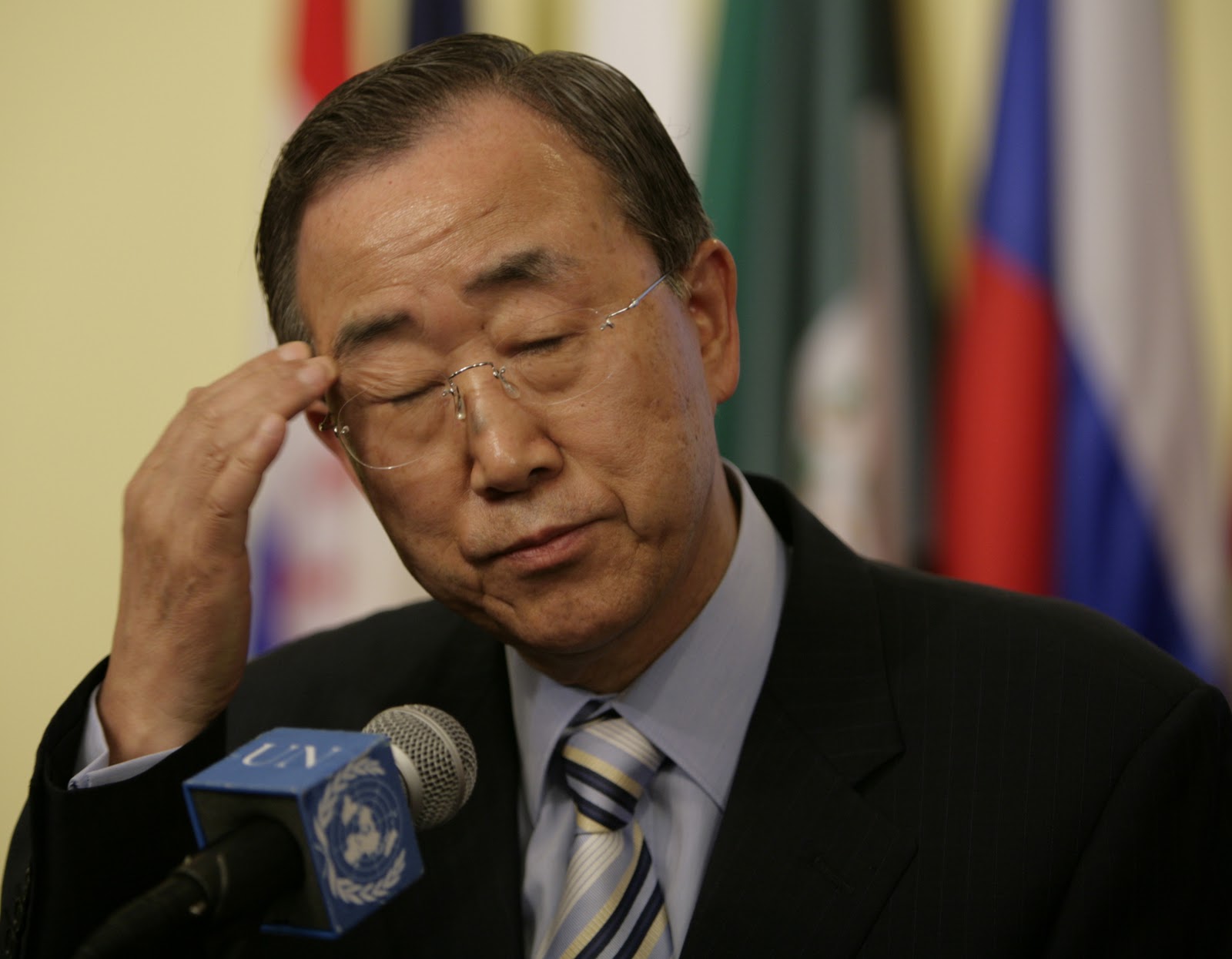
United Nations (UN) Secretary General Ban Ki-moon says the lifting of targeted sanctions against Zimbabwe is a matter for individual member states.

He was responding to a question during a brief press encounter with journalists at the UN Headquarters in New York.

“Any sanctions imposed on Zimbabwe need to be discussed and done by the member states and intergovernmental bodies. I have been urging the government of Zimbabwe and President Robert Mugabe himself, on many occasions, that there should be fair and credible elections and for a democratic process in Zimbabwe,” says Ban.

He says that there should be full respect for human rights and they should work on improving the well-being of the people.

Earlier, statements by the UN called for the country’s leadership to govern responsibly and inclusively.

“I have taken note of elections which were held recently. I know that there have been some assessments by different groups of monitors and I hope that all these controversies or current assessment should fully reflect the will of the people in line with international democratic principles,” he added.

Both the European Union (EU) and the United States have called for credible elections as a precursor to lifting sanctions.

Meanwhile, the United States says it will only lift sanctions on Zimbabwe’s newly re-elected President Robert Mugabe if he implements political reforms.

On Sunday, southern African leaders called for the West to lift sanctions against Harare as they gave their seal of approval to Mugabe’s victory in disputed elections. However, Washington was unimpressed.

In March 2003, the United States imposed sanctions on Mugabe and his relatives. – SABC

‘Kidnapped by imperialism’

Morales in Russia
Morales in Russia

Bolivia has accused Austria of “kidnapping” its president, Evo Morales.

After a 12-hour interruption during which the president’s plane was stopped and searched by Austrian authorities for US fugitive Edward Snowden, Morales was allowed to fly home. Bolivia’s vice-president, Alvaro Garcia Linera, described Morales as being “kidnapped by imperialism” in Europe. Authorities had suspected Morales was taking Snowden to Latin America.

The unusual treatment of the Bolivian leader touched a sensitive nerve in the region, which has a history of US-backed coups, and presidents rallied in support of Morales.

“Definitively, they’re all crazy,” Argentine President Cristina Fernandez tweeted after a phone call to Morales. Fernandez described Morales as defiant.

” ‘I’m not a thief’,” she quoted him as saying.

Nicaraguan and Cuban officials also decried the incident.

A senior Bolivian diplomat said the Austrians had acted at the bidding of the US, which has been trying to get its hands on Snowden since he revealed details of its secret surveillance programmes.

“We’re talking about the president on an official trip after an official summit being kidnapped,” Bolivia’s ambassador to the UN, Sacha Llorenti Soliz, said.

The plane, which was taking Morales home from an energy conference in Moscow, was stranded at Vienna airport after Portugal and France refused to allow it to fly through their airspace.

The search found that Snowden was not on board.

Bolivia has filed a complaint at the United Nations on Wednesday over what it called the kidnapping of its president.

The country’s ambassador to the UN, Sacha Llorenti, said the enforced rerouting to Austria was an act of aggression and a violation of international law. The US admitted that it had been in contact with other nations over potential flights by Snowden.

“We will demand appropriate explanations from those countries that submitted to North American imperialism and briefly put President Morales in such a helpless situation,” Llorenti told the state radio Patria Nueva. Bolivia’s vice-president, Alvaro García Linera, said Morales was “kidnapped by imperialism”.

South American nations accused the United States of being behind the extraordinary manoeuvring, furious at what they regarded as the humiliation of Morales. In Washington, the state department would not comment on the Morales flight but conceded that it discussed the issue of flights by Snowden with other nations.

“We have been in contact with a range of countries that had a chance of having Snowden land or travel through their country but I am not going to outline what those countries were or when this [contact] happened,” said spokeswoman Jan Psaki.

The diplomatic crisis may have been set off by a remark by Morales during a television interview in Russia, where he had been attending an energy conference. Morales said that he sympathised with Snowden, who is believed to be holed up in the transit area of Sheremetyevo airport, and hinted that Bolivia might accept an asylum petition. “If there were a request, of course we would be willing to debate and consider the idea,” Morales told RT Actualidad, the Spanish-language service of the Russian broadcaster RT.

Later that day, soon after Morales was bound for La Paz, Spain, Italy, France and Portugal refused to allow the presidential jet to fly through their airspace over suspicions that Snowden was on board, according to the Bolivian government’s account.

The Bolivian foreign minister, David Choquehuanca, said France and Portugal were the first to cancel air permits. “They say it was due to technical issues, but after getting explanations from some authorities we found that there appeared to be some unfounded suspicions that Mr Snowden was on the plane. We don’t know who invented this lie. We want to denounce to the international community this injustice with the plane of Evo Morales,” Choquehuanca said.

Diverted from their planned route, pilots feared they would not be able to complete their journey. The plane was eventually cleared to land in Vienna, where Morales was forced to spend 13 hours in humiliating limbo while officials worked to resolve the dispute.

It later took off after Austrian officials said Snowden was not on board. But it was unclear whether any officials in Vienna had searched the plane. Austria’s deputy chancellor, Michael Spindelegger, said Morales “agreed to a voluntary inspection”. But the Bolivian defence minister, Ruben Saavedra, later said Morales had refused entry to the inspectors, and that they had only got as far as the door of the aircraft.

In Bolivia, the treatment of the president stirred up patriotic and anti-imperialist sentiment. Several labour and indigenous organisations planned a welcome rally for the president on his arrival in La Paz on Wednesday evening.

The Argentinian president, Cristina Fernández de Kirchner, attacked the “vestiges of colonialism” in a speech in Buenos Aires. “We believe this constitutes not only the humiliation of a sister nation but of all South America,” she said. An emergency meeting of the Union of South American Nations was expected to be convened on Thursday.

It was widely assumed in South America that Washington was responsible for the presidential plane being refused air permissions. Earlier in the week, the state department said it hoped Snowden would be returned to the US to face charges of espionage and theft after a string of other countries said they would not accept his applications for asylum.

Speaking before the developments in Vienna, the state department rejected claims made by Snowden on Monday that the US had bullied other potential hosts, such as Ecuador, into withdrawing their offer of asylum. The US says it has only impressed upon possible host countries the seriousness of the crimes with which Snowden had been charged. – Reuters/The Guardian

Ban Ki-moon says ‘whole world praying for Mandela’

Ban ki-moon
Ban ki-moon

UN leader Ban Ki-moon said Wednesday that the whole world is praying for Nelson Mandela as the legendary South African leader fights for his life.

Ban called Mandela “one of the giants of the 20th century” at a New York reception for the 50th anniversary of the Organization of African Unity which played a leading international role in fighting apartheid in South Africa.

“I know our thoughts and prayers are with Nelson Mandela, his family and loved ones, all South Africans and people across the world who have been inspired by his remarkable life and example,” Ban said.

“Let us all show similar conviction and sense of purpose today in working to improve well-being and opportunity for all Africans,” the UN secretary general added.

Mandela, 94, is on life support in hospital in Pretoria. – AFP

Rice leaves UN with final blast over Syrian ‘disgrace’

Susan Rice
Susan Rice

US ambassador Susan Rice left the United Nations on Tuesday slamming the Security Council’s failure to act over the worsening Syria conflict as a “moral and strategic disgrace.”

But while Rice criticized Russia and China for their veto of resolutions on the Syria war, she said it was not inevitable that relations with Russia would continue to sour.

Rice, who moves to become President Barack Obama’s national security advisor, said: “The repeated failure of the Security Council to unify on the crucial issue of Syria I think is a stain on this body and something that I will forever regret.”

“The council’s inaction on Syria is a moral and strategic disgrace that history will judge harshly,” Rice told reporters after making her farewells to other UN envoys after four and a half years as US ambassador.

Russia and China have three times used their vetoes as permanent members of the Security Council to block western-proposed resolutions that would have increased pressure on President Bashar al-Assad.

Rice stressed that there were no sanctions or threats of force in the proposed resolutions which she called “very mild.”

“Yet we have been paralyzed, and I don’t know how in any circumstance one could ascribe that to a failure of US policy or US leadership, when the vast majority of the council was ready and willing to move ahead.”

Russia and China accused the United States, France and Britain of only seeking regime change in Syria, where the United Nations says more than 93,000 people have been killed in the past 27 months.

Rice said tougher sanctions against Iran and North Korea had been a Security Council success and showed it was possible to work with Russia, which could become a key dossier in her new White House job.

At Rice’s final closed consultations, Russia’s UN ambassador Vitaly Churkin read out a mock council statement which “expressed relief” at Rice’s departure, according to diplomats at the meeting.

Russia is a “complex” relationship, Rice acknowledged to reporters after the good natured farewell from her rival envoy.

“While there are certainly important points of divergence, and there have been points of friction and there undoubtedly will be in the future, I am not prepared to predict that that is inevitable,” she said.

“On issues as important as Iran and North Korea, and many others, we have been able to find common ground and effect outcomes that have been beneficial,” Rice said.

Samantha Power, a White House advisor, has been named as the new UN ambassador and is awaiting Congress confirmation. – AFP

White South Africans killed in Somalia named

Somalia Al Shabab
Somalia Al Shabab

Denel has released the names of two of three employees who were killed after an attack on a United Nations facility in Somalia on Wednesday.

They were Morne Lotter, 42, of Oudtshoorn and Alan Simpson, 35, of Port Elizabeth, spokeswoman Vuyelwa Qinga said on Thursday.

The name of the third employee, a Somali, would be released soon.

On Wednesday morning at around 11am the UN Development Programme camp in Mogadishu came under attack and at least 16 people were killed, Denel said.

Denel group chief executive Riaz Saloojee said the company would do everything possible to help the families of the deceased, and would repatriate their bodies at the earliest opportunity.

“We further extend our deepest condolences to the families and friends of the UN employees who lost their lives,” he said.

The Denel staff in Somalia belonged to a contingent of personnel in the company’s humanitarian demining operations, Mechem, and were providing camp management services to the UN operations in the region.

These included managing and providing catering, cleaning and logistical support, as well as mine protected vehicles in the region.

The company would continue with its work towards the UN’s peace-keeping efforts.

“This is a very unfortunate incident, but Denel will continue to support all peace-keeping efforts carried out under the auspices of the United Nations and the African Union.

“In this instance our employees lost their lives while they were providing services to the UN’s peace-keeping efforts in the region,” said Saloojee.

The remaining Denel employees in Somalia were moved to facilities under the protection of the UN Office for Project Services (UNOPS) where they were reported to be safe.

UNDP administrator Helen Clark strongly condemned the attack.

“We are all appalled and deeply saddened by this cowardly attack.”

She said on Wednesday that among the UN fatalities were one international staff member, three contractors, and four Somali security guards.

A number of Somali civilians were also killed.

“We grieve with the Somali people, the African Union Mission in Somalia (AMISOM), and the entire UN family today,” said Clark.

The security forces arrived at the scene soon after the explosion. The UNDP compound is next to the airport where the AU forces have a base.


SA will ‘enforce’ peace in DRC

On the ready to enforce peace

Tight security has been thrown around the deployment of more than 1000 heavily armed South African troops to the Democratic Republic of Congo.

In the past 72 hours, 1300 soldiers from 6 SA Infantry Battalion, including paratroops, special forces and engineers, have left for the eastern DRC as part of a UN peace enforcement mission.

 The troops are part of a brigade deployed to target the M23 rebel group waging war on the DRC government.

Defence Ministry spokesman Siphiwe Dlamini dismissed the issue of troop movements as “speculative” and refused to comment further.

But defence analyst Helmoed Heitman said: “There has been a lot of activity [at the weekend]. Not only at Bloemspruit, in the Free State, where the troops are deploying from, but also in Pretoria, where Waterkloof air force base has been a hive of activity.

“After the Central African Republic situation, South Africa is taking this far more seriously than the UN. There is a big concern that the UN sees this as a peacekeeping, and not a peace enforcement, mission.” – timeslive.co.za

Israel ignores UN human rights review

Israel has boycotted the UN human rights forum over fears of scrutiny of its treatment of residents of the occupied territories. Israel is now the first state in history to win a deferment of the periodical review of its human rights record.

Tel Aviv has refused to send a delegation on Tuesday to the United Nations Human Rights Council in Geneva for the Universal Periodic Review procedure where UN member states have their human rights record evaluated every four years.

Israel’s cooperation with the council stopped last March after the UN set up a committee to inspect the effects of the Israeli settlements on Palestinians.

Israel which earlier accused the United Nations of anti-Israel bias reiterated its stance, recalling that the council has passed more resolutions against Israel than all other countries combined.

“After a series of votes and statements and incidents we have decided to suspend our working relations with that body,” Yigal Palmor, Israeli foreign ministry spokesman, told the Financial Times. “I can confirm that there is no change in that policy.”

“There have been more resolutions condemning Israel than the rest of the world put together,” an Israeli government official said on Tuesday. “It’s not a fair game – it’s not even a game.”

Following the Israeli decision, the council has decided to postpone its review until no later than November.

The Council president has also called on the body to adopt a draft response to an unprecedented move by Israel.

Egypt’s representative meanwhile has warned that a “soft” approach would create a dangerous precedent and leave “a wide-open door for more cases of non-cooperation,” the AFP quoted.

Activist groups lash out against Israel’s disregard for international law.

“By not participating in its own review, Israel is setting a dangerous precedent,” Eilis Ni Chaithnia, an advocacy officer with al-Haq, a human rights organisation based in Ramallah has told the FT. “This is the first time any country has made a determined effort not to attend.”

Others thought that the council’s decision to delay gives Tel Aviv the opportunity to make amends. Eight Israeli human rights organizations issued a statement saying, “Israel now has a golden opportunity to reverse its decision not to participate,” adding “it is legitimate for Israel to express criticism of the work of the Council and its recommendations, but Israel should do so through engagement with the Universal Periodic Review, as it has done in previous sessions,” JTA quotes.

The investigation into Israel’s Human Rights record began in 2007, but last year the UN started to pay particular attention to Israel’s activities in the West Bank.

The probe at the time prompted an angry response from the country’s leader.

“This is a hypocritical council with an automatic majority against Israel,” Prime Minister Benjamin Netanyahu said.

Senior Israeli officials announced last month that Israel does not intend to cancel plans to accelerate settlement construction.

Netanyahu himself said in an interview with Israeli Channel 2 last month that the disputed area “is not occupied territory” and that he “does not care” what the UN thinks about it.

Around 500,000 Israelis and 2.4 million Palestinians live in the West Bank and in East Jerusalem, areas that, along with Gaza, the Palestinians want for a future state.

The United Nations regards all Israeli settlements in the West Bank as illegal. Tel Aviv last attended the human rights review in 2008. Israel is not a member of the Council, which is comprised of 47 UN member states. – RT

France backs Palestinians

Hillary kisses French foreign minister Fabius

France has announced it will vote in favor of recognition of Palestine as a non-member observer state at the UN General Assembly later this week.

­The French Foreign Minister Laurent Fabius told parliament that France “will respond ‘yes’” when the issue is put on a vote at the UN General Assembly.

France, a permanent UN Security Council member, is the first European country to speak in favor of elevating Palestinian status from an observer to a nonmember observer state.

The United States, which opposes the Palestinian bid for statehood, publicly disagreed with France’s move. State Department spokeswoman Victoria Nuland said Paris’s decision would not change the US assessment of the Palestinian action as a “mistake.”

“With regard to France and any other countries, we obviously disagree with our oldest ally on this issue,” she told reporters. “They know that we disagree with them. But it’s their sovereign decision.”

The Austrian foreign ministry also said Tuesday it would back the Palestinian bid and claimed that more than half of the European Union’s 27 member states would vote for the proposal, AFP reported.

Meanwhile, the UK says it is ready to support the PA in their current bid to become a non-member observer state if the Palestinians comply with three conditions, The Telegraph reports.

British Foreign Secretary William Hague allegedly requested Palestinian President Mahmoud Abbas, pledge not to join the International Criminal Court after its UN status is upgraded, not to apply for full membership at the UN and to resume peace negotiations with Israel without any preconditions.

At the moment the PA refuses to negotiate with Israel until it halts the expansion of Jewish settlements in the occupied West Bank and East Jerusalem territories.

On Thursday, the Palestinians will officially ask the assembly to upgrade their status.  Earlier the Palestinian Authority said it expected the assembly to vote two-thirds in favor of granting the PA non-member status, seeing the move as an important step toward a two-state solution with Israel.

Israel strongly opposes the bid. Previously Tel Aviv said it objects to any wording the PA would bring for a vote at the assembly.

But as Israeli authorities were unable to block the bid they have changed their stance and now are trying to soften the wording, Haaretz reported on Tuesday citing a senior Israeli official.

The article states Tel Aviv and Washington are working together to change the document.

Last year, Washington used its veto power to block a Palestinian bid for statehood at the UN Security Council. A similar move is unlikely in this case as there are no vetoes in the General Assembly. – RT

Zuma: More Africa seats at UN

UN - involved?

Africa needs to be better represented in the United Nations security council, President Jacob Zuma said on Friday.

“About 70% of the agenda of the UN security council is taken up by issues from the African continent,” Zuma said in a statement.

“The security council has to be expanded in both categories, with at least two seats for Africa in the permanent category and five in the non-permanent category.”

The presidency said on Friday Zuma had returned from New York, where he was attending the 67th session of the UN general assembly.

He was accompanied by International Relations Minister Maite Nkoana-Mashabane, Justice Minister Jeff Radebe and Defence Minister Nosiviwe Mapisa-Nqakula.

Zuma was appointed to serve in UN secretary general Ban ki Moon’s Education First initiative, which was launched on Wednesday.

While in the United States the president also attended meetings on the side-lines on the general assembly.

These included meetings on Somalia and the Sahel region.

[ad 1]

Zuma said: “The Somali leadership is expected to play a very critical role in developing a vision that will serve to rally Somali stakeholders and international partners in our efforts at post-transition development.”

South Africa was committed to working with Somalia to strengthen relations between the two countries, he said.

Zuma encouraged the international community to assist the people and government in the Sahel region in dealing with the challenges of drug trading, terrorism and the deteriorating humanitarian situation.

– SAPA

Blair could have stopped Iraq war

Tony Blair

Former British prime minister Tony Blair was the only person capable of turning George W Bush against the 2003 Iraq invasion, ex-United Nations chief Kofi Annan claimed in an interview published on Saturday.

Annan argued in an interview published in the Times newspaper that Blair could have changed Bush’s mind because of the special relationship between the two nations and the two leaders.

Annan said he often had contemplated what might have happened if “Blair had said ‘George, this is where we part company. You’re on your own’,” following the failure to secure a second UN resolution.

“I really think it could have stopped the war,” added the Nobel peace laureate.

Annan was UN secretary general at the time of the crisis.

A first Security Council resolution, which offered Iraq a final opportunity to comply with its disarmament obligations passed unanimously in November 2002.

But a second resolution proposed by the US, Britain, and Spain in 2003 that called for action to be taken against Saddam Hussain’s regime was withdrawn when it became clear it would be vetoed.

The US decided that the resolution was not needed before military action could lawfully take place, and the invasion commenced on March 20.

The invasion triggered eight years of sectarian conflict in Iraq, resulting in more than 100 000 civilian deaths.

Annan rejected suggestions that his resignation, or that of then US secretary of state Colin Powell, would have altered the course of history.

And he dismissed Archbishop Desmond Tutu’s call for Bush and Blair to be put on trial at the International Criminal Court. Both had been democratically elected, he said, and were only acting in their national interests.

[ad 1]

Annan was the UN Arab League envoy to Syria from February until August, but resigned after his peace plan failed to prevent further fighting between rebels and forces loyal to President Bashar Assad.

The diplomat told the Times that Assad had to go, arguing that the leader had lost all legitimacy.

Annan gave the interview to mark the launch of his memoirs: Interventions – a Life in War and Peace. – Sapa

Israel, Iran square off at UN

Israeli Prime Minister Benjamin Netanyahu demanded Thursday that the international community impose a red line on Iran to prevent it from enriching enough uranium for a nuclear bomb.

“The hour is late, very late,” Netanyahu said, alleging Iran was already 70% of the way through the process of enriching enough uranium to fuel a bomb, and must be prevented from reaching the 90% level.

The Israeli leader even used the world stage at the UN to present a cardboard diagram of a bomb with different levels on it, drawing a thick red line across it with a marker pen for dramatic effect.

“Faced with a clear red line Iran will back down,” he said, insisting in a address to the United Nations General Assembly that imposing an ultimatum on Tehran would not provoke war but help prevent it.

Israel has warned that it could launch military action against Iran in order to prevent it reaching a certain nuclear threshold, and has urged the international community to force Tehran to abandon its atomic quest.

Iran denies it is building a nuclear weapon and has dismissed the Israeli threat.

US President Barack Obama vowed in his address to the United Nations on Tuesday that he would prevent Iran from getting the bomb but his administration has repeatedly rejected imposing a red line on Tehran.

With relations between Netanyahu and Obama already viewed as frosty, US Defence Secretary Leon Panetta earlier this month highlighted the policy split further when he rejected Israel’s “red lines” outright.

“The fact is, look, presidents of the United States, prime ministers of Israel or any other country – leaders of these countries don’t have, you know, a bunch of little red lines that determine their decisions,” Panetta said.

“What they have are facts that are presented to them about what a country is up to, and then they weigh what kind of action is needed to be taken in order to deal with that situation,” he told Foreign Policy magazine.

“I mean, that’s the real world. Red lines are kind of political arguments that are used to try to put people in a corner.”

The Iranian government, reacting to Israeli Prime Minister Benjamin Netanyahu at the United Nations, demanded that Jerusalem open its own nuclear installations to inspection before telling Tehran do so.

Using the U.N.’s “right of reply,” Iran’s deputy U.N. ambassador, Eshagh al Habib, told the General Assembly the Israeli prime minister “has admitted to the possession of nuclear weapons which has been repeatedly stated by the 120 members of the Non-Aligned Movement ‘poses a serious and continuing threat to the security of states in the region.

“Instead of making baseless allegations,” he said, “this regime has ignored repeated calls by the international community to accede promptly and without any conditions to the Non-Proliferation Treaty as a non-nuclear weapons party and place all its nuclear-related facilities under the International Atomic Energy Agency verification system. … The international community should continue to exert the utmost pressure on this regime.”

The Iranians have long claimed to be sponsoring a movement to free the Middle East of any atomic weapons.

Israel, its conventional forces vastly outnumbered by neighboring Arabs, has long seen its nuclear stockpile as an equalizer should a new war erupt in the region.

Published reports claim Jerusalem has manufactured more than 200 low-yield nuclear warheads that have been stockpiled in a desert facility in the Negev.

The nuclear facility, near the hamlet of Dimona, has had sporadic visits by U.N. inspectors, but nothing unusual has ever been uncovered.

Late Iraqi President Saddam Hussein tried unsuccessfully to rocket bomb the Dimona facility in the 1991 Gulf War.

Today, the Dimona base is protected by the Israeli Iron Dome anti-missile system.

A group of Israeli diplomats sat stone-faced throughout the Iranian rebuttal, deciding not to challenge it.

The U.S.-U.N. mission did not attend the late-night General Assembly session. – AFP/WND

Zuma’s speech on Somalia at UN mini-summit

I wish at the outset to congratulate my dear brother, H.E. Hassan Sheik Mohamoud on being elected President of Somalia.

I look forward to working with you President Hassan, in both bilateral and in multilateral settings as we strengthen the South Africa-Somalia relationship and collaborate within the multilateral fora on matters of mutual interest.

I commend the people of Somalia on this historical step of starting a post transition government that shall chart a path towards governance, reconciliation, stability and development.

The Mini-Summit Summit on Somalia comes at an opportune time.

The resolve and desire for peace shown by Somalis from all walks of life must be supported by the international community.

The lessons we have learnt from all governments that emerge from instability is that the population must see benefit in democratic governance lest they be swayed by those who thrive in chaos.

The new Somali government has a challenging task of delivering the fruits of governance in a still violently contested atmosphere.

The crucial support that the international community continues to provide to Somalia, through maintaining AMISOM, supporting social and economic projects will determine the success of this new government.

However, no amount of support can replace the important role of Somali leadership in building their country.

The Somali leadership is expected to play a very critical role in developing a vision that will serve to rally Somali stakeholders and international partners in our efforts at post-transition development.

If we agree on the importance of these foundational elements, it would then be imperative for us all to collaborate in extricating Somalia out of the ashes of desolation to a developmental path.

As we celebrate the dawn of this new beginning for Somalia we remain conscious that there remain those in Somalia, who although they are sons and daughters of Somalia, remain violently opposed to this new government.

To brandish them as terrorists and respond to them consistent with the brand we attach to them, has had persistent costs.

If Somalia is to move forward, its people cannot continue to be at war.

There is therefore a need to consider increasing our effort to encourage and provide incentives to those that remain outside the political spectrum for them to consider peaceful co-existence with the new Somalia government.

In this regard, a strategy for dialogue between all Somali stakeholders is imperative.

This, if managed properly, could help lead to reconciliation and tolerance in Somalia.

South Africa is committed to availing its expertise on the area of national reconciliation.

We had already agreed with the previous Transitional Federal Government that my country would work closely with Somalis in their reconciliation strategy and we renew our commitment to the new Somali government.

Sustainable peace is possible in Somalia.

The adoption of the provisional Constitution has set in place the foundation for building the pillars on which peace will thrive.

We need to direct our focus on providing support as Somalis implement the political and social compact reached by adopting their constitution.

Important work has already been done by Somalis and international partners in this regard.

South Africa believes that it is imperative that Somalia has adequate institutions of governance that will be able to focus on the immediate and long term priorities of the new government.

It is however also necessary that Somali institutions be strengthened to enable them to play their role also in the prevention and prosecution of piracy.

South Africa shall work with Somalia in rendering assistance in capacity building for Somalis to be able to manage the piracy situation.

South Africa will also work closely with local and international partners to ensure that Somalis are equipped to govern themselves.

I commend the Secretary-General of the United Nations, H.E. Ban Ki- Moon for convening this Mini-Summit on Somalia.

We applaud the tireless efforts of the UN Special Envoy for Somalia, His Excellency Augustine Mahiga.

This is a new dawn for Somalia. May it usher in peace, development and reconciliation for the benefit of the people of Somalia.

I Thank You.