‘Save our Swiss gold’

‘Gold wars’ are intensifying ahead of the polling day in the Swiss Gold Initiative.

The Swiss National Bank (SNB) and establishment parties went “all in” during the week and intensified their campaign. They suggested that passing the Swiss Gold Initiative would be a ‘fatal’ for Switzerland and would be positive only for speculators.

The ‘yes’ side countered by saying the SNB’s assertions were alarmist and over the top. They say that it is not an invitation to speculators as there would be a five year transition to gold being 20% of Swiss reserves. They warned that there is a real risk of another debt crisis and a global currency crisis and that gold reserves would protect the Swiss franc and the Swiss economy.

Because if Germany failed miserably to obtain 674 tons of gold from the US Federal Reserve in 2013, it is assured that Switzerland will find absolutely nothing in its quest to obtain more than double, or 1,500 tons, of gold as a successful November 30 referendum outcome would require.

Then again, considering it was Obama’s action that destroyed the Swiss banking sector after the US crushed the centuries-long tradition of “Swiss banking anonymity”, this could be just the right action with which “neutral” Switzerland could finally take its revenge on the regime that cost it what was for centuries the primary source of capital inflow.

In 1992, after a concerted political campaign spearheaded by some of the country’s political parties, Switzerland joined the International Monetary Fund following a national referendum.

Under IMF rules, adopted in the latter part of the 1970s, IMF member countries cannot link their currencies to gold. After joining the IMF, Switzerland was therefore constrained in how it could subsequently revalue its gold reserves since IMF Articles of Association prohibited IMF member countries from linking their currencies to gold.

Well known Swiss banker, financial adviser and author of ‘Gold Wars’ Ferdinand Lips believed that Switzerland had been put under enormous foreign pressure and duress to sell half of its gold reserves, and he wrote in 2002 questioning “Is the SNB on New York’s leash?”, saying that “In my opinion, the once strong, proud and independent SNB has been degraded to an ‘Off-shore Branch’ of the U.S. central bank (the Federal Reserve) and reports directly to Alan Greenspan and his cohorts in New York.”

Lips added that “It is a given that the Swiss gold sales will help New York money center banks to survive a bit longer. It will help them manipulate the gold market. But, gold’s time is still to come. If the SNB does not stop its sales, Switzerland will have to buy back its gold one day but at a higher price. The question is: With what?”

With the SNB now in full media mode arguing against a 20% gold holding in the reserves however, perhaps some of the Swiss media might care to interview Dr. Jean-Pierre Roth who can now be found sitting on the boards of Nestlé, Swiss Re and Swatch.

German business leaders abandoning Merkel

German chancellor, Angela Merkel, is under pressure from leading industrialists to roll back sanctions against Russia, as some of her backers switch their support to her party’s Eurosceptic rival, the Alternative for Germany (AfD).

Merkel’s aides say she has been “annoyed” by phone calls from chief executives of large companies, demanding a relaxation of Germany’s stance towards the Kremlin in order to preserve £59bn a year in trade with Russia.

However, senior business figures, including Heinrich Weiss, head of the supervisory board of SMS, an engineering company with 13,000 employees, have switched their support from Merkel’s Christian Democrats to the AfD, which opposes sanctions.

SMS is heavily involved in both Russia and Ukraine, where a deal worth up to £118m was jeopardised by as US-led putsch.

Weiss, 72, was chairman of the Christian Democrats’ economic advisory council under Merkel’s predecessor Helmut Kohl.

“The sanctions policy is irrational because it will never influence Russian actions in Ukraine, but it is doing lasting damage to German businesses and jobs,” a senior SMS executive told The Sunday Times.

Another prominent businessman to join the AfD is Hans Wall, founder of a street furniture and outdoor advertising company, who has various business interests in Russia. He was formerly a supporter of the Free Democrats, Merkel’s junior coalition partners.

Merkel faced another setback last month when the heads of several German multinationals — including the pharmaceuticals group Bayer, BASF chemicals and the energy giant Eon — travelled to Moscow with other western businessmen to meet Dmitry Medvedev, the prime minister.

That was seen as a slap in the face for Merkel’s policy. “The last thing we need is a parallel foreign policy by industry,” one of her aides told Der Spiegel magazine.

About 300,000 jobs in Germany are believed to depend on trade with Russia.

Merkel last week rejected any lifting of sanctions and called for them to be extended.

But some of her neighbours are wavering: Austria, Hungary, Slovakia, Bulgaria, Greece and Cyprus have all indicated they would not support further sanctions because of trade with Moscow or dependence on Russian gas.

German Foreign Ministry blasts media reports on MH17

The German Foreign Ministry says the media interpretation of an October statement by the president of national intelligence agency on the MH17 disaster in Ukraine was incomplete and taken out of context.

The Russian embassy in Berlin received an official response to note #3693 from October 27 regarding Germany’s Bundesnachrichtendienst (BND intelligence agency) President Gerhard Schindler’s allegations that local militia in eastern Ukraine shot down the Malaysia Airlines flight in July.

“The media interpretation of the report of the Federal Intelligence Service (BND) president delivered to the Bundestag Committee overseeing intelligence activities on October 8 is incomplete and arbitrarily taken out of context,” the note says.

The ministry stressed that according to the decision of the International Civil Aviation Association (ICAA), investigation of the MH17 flight crash was handed over to Dutch authorities, authorized to exclusively deliver all information on the issue.

According to information made public by Germany’s Der Spiegel daily on October 19, Schindler delivered a statement in Bundestag on October 8 in which he claimed the militia in Ukraine’s Donetsk Region fired a rocket from a BUK defense missile system which it had captured from a Ukrainian base. It shot down the Malaysian Boeing as it was flying from Amsterdam to Kuala Lumpur, killing all 298 passengers and crew aboard.

Russian President Vladimir Putin, who met on Monday with Malaysian Prime Minister Najib Razak on the sidelines of an APEC summit in China, has also spoken on the issue of flight MH17.

Having expressed condolences to the families of the perished passengers and Malaysian state, Vladimir Putin confirmed that Moscow insists on a complete and objective international investigation of the MH17 catastrophe in accordance with the corresponding UN resolution.

At the same time Putin disagreed with the Malaysian PM, who demanded greater access to the crash site “fully controlled by the local militia.”

“The reference that the crash site is fully controlled by so-called pro-Russian separatists is absolutely inconsistent, because it is not them, but the opposite side that is constantly shelling that territory,” Putin said. He noted that it is this shelling that prevents investigators from working properly at the crash site.

He welcomed the fact that Malaysian experts have finally got access to fully-fledged participation in the investigation.

“I’m sure your experts will contribute the necessary to the adequate investigation off this tragedy,” Putin told Razak.

An international team of investigators managed to recover more human remains from the MH17 crash site in eastern Ukraine, the Dutch prime minister announced in late October.

Still, investigators are intending to continue with the search operation and hire local contractors to collect plane debris beyond their reach, Reuters reported last week.

Germans abandon major news sites in anger over manipulation

Triggered by reader disaffection, internet traffic has collapsed for half a dozen major German media websites

What’s going on in the German media is huge. The US and UK media have been hugely biased in their coverage of Russia, but German media has been far, far, worse, to the point which strains credulity.

Now it turns out that part of the reason is CIA fiddling with German media outlets. Coming on the heels of the Snowden revelations, this has Germans seriously ticked-off.

They call it the Ulfkotte-effect. And it’s beginning to resemble an avalanche.

Since the publication of Udo Ulfkotte’s “Gekaufte Journalisten“ in September – now a #1 Amazon bestseller, in which he charges that the CIA regularly bribes top German journalists, himself included, – German readers’ disaffection towards their mainstream media appears to have crossed a point of no return.

Granted, sales of newspapers and magazines have fallen everywhere, not just in Germany. But this is different. This is a boycott that is affecting web traffic. Germans are steering clear of mainstream media websites.

Many Germans have not been too shy to announce their intention on social networks. Some have uploaded videos calling for a boycott on YouTube. Others have created groups calling for the same on Facebook.

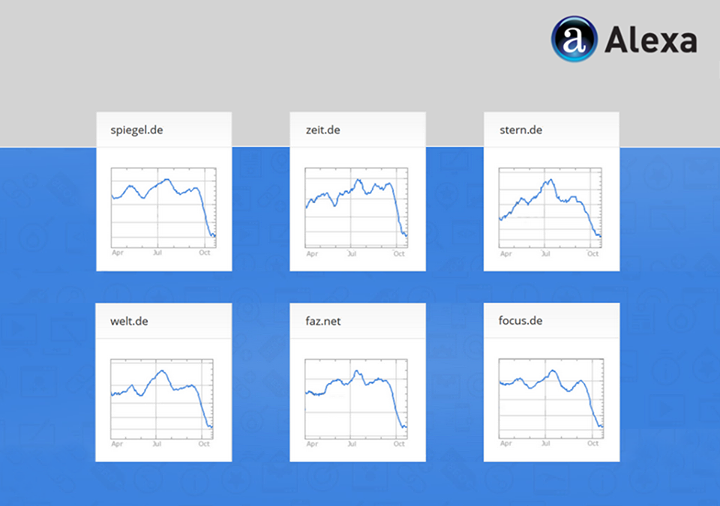
The other visible result of reader disaffection has been that throughout September the number of unique visitors to six major German newspapers and magazines was falling steadily.

In October, it simply sank.

Yet up until early summer these same websites had been generating a large and stable amount of traffic. This is an unprecedented trend, and one that is wholly distinct from the fall in newspaper sales generally.

The graphs below show Google analytics provided by Alexa, a company that specializes in actionable analytics for the web.
alexa_0


Six different media sites – and they are all going down

The Spiegel’s infamous “Stoppt Putin Jetzt” July 29 cover apparently played a key role in incensing public opinion. An official readers’ complaint against Der Spiegel’s cover was upheld in August by the German Press Council. The latter ruled that the pictures of MH17 victims on the cover had been “instrumentalized in the context of a political statement.”

Germany’s print media was warned even before that, on April 28, when Cicero, a leading German monthly, published a column titled: “Pride after the Fall”. The captions read: “Newspapers die. The reason: they go against their readers. The current Russia reporting is an example. That’s not the way to engage with readers.“

The author, Alexander Kissler wrote: “Every quarter the newspapers sector grieves. This is when plummeting circulation figures are released. The curve travels from top left to bottom right, in fact it is not a curve anymore, but a straight line, unstoppable on its way to Zero.“

German media was quick to go on an offensive against Russia over the Ukraine crisis, but just as quickly found itself on the defensive against its readers.

Now, after a further worsening of circulation figures during the spring, web traffic has declined as well.

And it still looks like just the beginning. Has the time come to print a book titled: “2019: The Last Copy of Der Spiegel?” – if the German print media will survive even until then, that is.

Source: RI

The ECB holding Europe hostage

The European Central Bank – ECB – invented yet another tool to hold Europe hostage vis-à-vis Russia

The ECB has just launched – effective 4 November 2014 – a new watchdog to control and regulate the European banking system. It is called the Single Supervisory Mechanism – SSM. It is supposed to monitor and reign in European banks that do not ‘behave’ in terms of overstretching their investment and risk lending as compared to their capital base.

In fact, the SSM is one pillar of the three pillar ‘security’ system put in place by the ECB and the European Commission – EC.

The Single Resolution Mechanism – SRM – is ECB’s strong arm to save or liquidate ‘troubled’ banks. In other words, it will administer ‘bail-ins’ to ‘too-big-to-fail’ banks in distress; meaning – over-indebted banks will rescue themselves from depositors’ money, or from shareholders. This practice was tested in Cyprus in 2013. As reported by Reuters on 30 July 2013 – According to Cyprus’s central bank, “47.5 percent of deposits exceeding 100,000 euros in Bank of Cyprus would be converted into equity to recapitalize the troubled lender as part of an international financial bailout for the island”.

This confiscating or stealing of depositors’ funds, also called the ‘haircut’ in the denigrating jargon of the Occident, is better known as a ‘bail-in’ – since it avoids the taxpayer, those who have been bearing the brunt in previous US and European ‘bail-outs’.

This atrocious predatory and outright criminal imposition by the infamous troika (ECB, EC, IMF), with no legal backing whatsoever, went largely without protests in the rest of Europe, it was shortly thereafter accepted by the EC as the new ‘norm’.

In one of his last proud statements before handing his job as European Commissioner to Jean-Claude Juncker, Manuel Barroso exclaimed – “The European Union intends to break the vicious link between sovereigns and their banks. In the future bankers’ losses should no longer become the people’s debt, putting into doubt the financial stability of whole countries.”

There it is. The ratification of the new ‘bail-in’ rule. It is surprising that there is no run of the European banks, as many of them are less stable than they were in 2008, at the onset of the man-made ‘crisis’. Bail-ins might be imminent.

The third pillar will be the Single Resolution Fund – SRF – a stabilization and rescue mechanism for banks facing bankruptcy. It is planned to become effective on 1 January 2016 – if – and that is a big IF – the necessary funding will be put in place by the member countries.

Pillars one and two are compulsory for the Eurozone countries and banks, some 6000 – which is a lot to supervise. The ECB has quickly declared that it – i.e. SSM – will directly monitor the 150 most important ones. The others will continue to be controlled by national mechanisms, whatever these are. They will be given strict regulations to follow by SSM with sanctions or fines if the rules are not followed – to make sure they will not stray.

Membership for non-Eurozone countries is voluntary. Remarkably, the UK has not (yet) volunteered for membership.

This is the biggest boost in ECB’s power since its creation some 16 years ago. ECB now sets all banking standards throughout Europe, according to which a bank may fall or rise. This is a clear infringement on the Eurozone countries sovereignty – one of the key principles to be maintained according to the Lisbon Treaty. There is no covenant in ECB’s regulations that would give it this power leverage. It is all self-serving – and the neoliberal leaders of the Eurozone countries go along with it –to the detriment of their constituency.

And let’s not forget, ECB is intimately linked to Wall Street, the FED and the IMF – Mario Draghi, the ECB President, is a former Goldman Sachs executive.

The SSM is a flagrant conflict of interest – and it looks like the financial czars of this western greed economy are getting away with it. For now.

An independent audit of all European banks, especially those 100 or 150 considered “too big to fail” – and including the ECB itself – would indeed be in order. – Independent means – the auditors would report to a special council of Eurozone countries – but independent of the European Commission. The special council would include representation from member countries parliaments, the banking, industry and service sectors, as well as civil society.

Of course – this is unlikely to happen, equally unlikely as an independent audit of the FED. That would mean transferring power to the people, to those whose money is at play, those who are really interested in a well-functioning banking system – not a predatory one as we know it today.

According to The Guardian, a recent stress test carried out by the ECB on some 100 of the largest European banks, 24, or one of five, failed (including 9 Italian and 3 Greek banks), leaving a hole of 25 billion euros in banking capital – which eventually may need to be bailed-in — if there are no bail-outs and the SRF is not yet functional.

Implementation of the SSM will be a point of no return for European banks, including for individual countries sovereign central banks. Until now, they were nominally free to print their own money. For example, Greece could have rescued them-selves by printing its own euros, instead of submitting to the draconian, literally killer conditions, imposed by the troika. But it didn’t, since the ruling elite in Greece was and is part of the scheme. As of now, there is no ECB rule that forbids a local central bank to print its own money – which in the Eurozone is the euro.

Europeans will be at the mercy of the ECB and through it, of Wall Street and the FED – the defunct greedy dollar based monetary system.

And why do the people not react? – Because they are on purpose misinformed, kept in the dark by the media. The new SSM is presented as a system that would protect them from future crises – when the contrary is true.

However, at least equally important and highly suspicious, is the timing of this new delegation of power for the ECB. The abrogation of Eurozone countries and their banks sovereignty is not coincidental. It comes at a time when a new west-east conflict, a new Cold War with Russia is being instigated by Washington and its European vassals.

ECB’s new strong arm, the Single Supervisory Mechanism, with its transboundary powers and disregard for national sovereignty is intent to hold the Euro system and its countries hostage against Russia, or the new Russia-China alliance. The new watchdog watches that none of them will stray – perhaps into the eastern camp of honest trading, into a new realm of economic prosperity and equality, where banking may serve the peoples development, instead of the accumulation of wealth for a few.

Remember, Mr. Xi Jinping, President of China, visited Germany in March 2014, to offer Madame Merkel participation in the New Silk Road – a new trading alliance from Germany, the western most borders, all the way to Shanghai, covering Russia, the former Soviet Republics, north-western and central China. An incredible potential for trade and development that can hardly be ignored. If Germany accepts, the strongest nation of the Eurozone, the rest of Europe will follow – follow a path of more security and independence than the current alliance with threats and sanctions from a warmongering White House will offer.

Washington is aware of this. They will hold no barrels to sow unrest and destabilize Europe to eventually justify a US intervention, more NATO, more CIA surveillance, more profit-yielding armament – and moving ever a step closer to Moscow. The new banking control mechanism is just an additional – but extremely powerful tool in this direction.

An alternative monetary system, detached from the predatory dollar scheme, will be a welcome means to peacefully counter this latest financial aggression.

Peter Koenig is an economist and former World Bank staff. He worked extensively around the world in the fields of environment and water resources. He is the author of Implosion – An Economic Thriller about War, Environmental Destruction and Corporate Greed – fiction based on facts and on 30 years of World Bank experience around the globe.

Thieves steal ‘Arbeit macht frei’ gate

Thieves have stolen the iron gate to Dachau concentration camp bearing the slogan “Arbeit macht frei” (work sets you free), the director of the memorial site in southern Germany and local police said on Monday.

The cast iron gate measures 190 cm by 95 cm and police said the thieves probably used a vehicle to take off with it on Saturday night.

“It is the central symbol of the prisoners’ suffering at Dachau concentration camp and therefore has hit the memorial at its heart,” said Gabriele Hammermann, director of the memorial. Prisoners passed it every day, she said.

The Nazis set up the camp in Dachau, near Munich, in 1933, after Adolf Hitler took power.

It was initially meant to detain political rivals and more than 200,000 people had been detained in the camp by the time US troops liberated it in 1945.

In December 2009 the “Arbeit macht frei” sign was stolen from the entry gate of the former Nazi death camp of Auschwitz in Poland by a Swede.

He was sentenced a year later by a Polish court to nearly three years for masterminding the theft, while two Poles were jailed for up to two-and-a-half years for snatching it and cutting it into pieces to fit into their car.

Germany struggling to contain discontented business leaders

The German Chancellery is struggling to contain discontent by leaders of key German concerns.

Business heavyweights are making attempts to influence the government’s policy towards Russia, Der Spiegel weekly reported on Sunday.

Bavaria’s Chamber of Commerce and Industry urged the the powers that be to lift sanctions against Russia.

Dr. Eberhard Sasse, President of the Chamber of Commerce and Industry for Munich and Upper Bavaria, said in early October Bavaria’s entrepreneurs want Western sanctions against Russia to be lifted.

“We have about 9,000 members in the Chamber of Commerce and Industry, and we all want the sanctions against Russia to be lifted, enabling business relations between our countries to develop further,” he pleaded.

Sanctions as a foreign policy tool do not always produce the desired effect, Sasse said. “Sanctions create uncertainty in business prospects. This is a political tool and not a business tool,” he warned.

Chancellor Angela Merkel however “is angry over numerous calls by leaders of the DAX companies [Germany’s index] that insist the EU sanctions against Moscow be eased”, the pro-American weekly stated.

“The meeting between businessmen and Russian Prime Minister Dmitry Medvedev in early week aroused less delight,” Der Spiegel said with regards to the session of the Foreign Investment Advisory Council in Russia.

“The last thing we need is companies’ parallel foreign policy,” the weekly lamented.

German officials, who took part in the meeting in Moscow, informed the German Chancellery but not the German Foreign Ministry about their trip to Russia, Der Spiegel said.


German sanctions against Russia voted on pure speculation

A German parliamentarian, who is also chairman of the German Defense Committee and former member of the Yugoslavian OCSE, says the German government had no idea whether MH17 was actually shot down.

Alexander Neu, during an interview for Rossiya Segodnya, also spoke about Germany’s proclaimed neutrality in its involvement in Ukraine.

Neu requested a deputy’s inquest from the German government concerning the Boeing which was shot down over Ukraine on September 6.

The reply has now been released to the public.

It was clear from the reply that, firstly,  the German government had no idea whether MH17 was actually shot down. Secondly, if it had been shot down, the government couldn’t answer who the responsible party was.

The Hague published its first interim report from the Dutch Safety Board two days later and it was announced that the plane was hit by a missile, but again it was not said by whom.

The territory where the plane’s debris fell was hit by mass shelling from Kiev’s artillery, rendering it highly unlikely that any new evidence would be found.

The conversations between the pilots and the dispatchers has also still not been released.

The German media however unanimously blamed Russia and, incredibly, it was on the basis of pure speculation that sanctions were leveled against the Russian Federation, since it is now certain that the Germans had no knowledge of who might have been responsible.

Neu also wonders why crucial information is not being released from the black boxes.

Andrej Hunko, another German member of parliament, asked the OSCE in Vienna recently whether the organization had appealed to the German government for German drone support.

The OSCE replied stating that they asked neither the German nor the French government for support via drones. In fact, they wanted no military support from these countries whatsoever.

When the German Defense Minister Von der Leien was confronted with these lies at a meeting of the parliamentary defense committee, Ms. Von der Leien repeated that the OSCE had asked for support, but she would give no specifics.

In other words, von der Leien is pushing the drones, even though the OSCE had not specifically asked for them.

Germany, France and the European Union, as well as the members of NATO are a part of the conflict, supporting the Kiev regime with instructors and intelligence assistance, and are not neutral observers.

Switzerland, the chairman of the OSCE, provides drones and so does Austria, since these countries are neutral.

Ebola patient in Germany dies

A United Nations medical worker who was infected with Ebola in Liberia has died despite “intensive medical procedures,” a German hospital said Tuesday, AP reported.

The St. Georg hospital in Leipzig said the 56-year-old man, whose name has not been released, died overnight of the infection. It released no further details and did not answer telephone calls.

The man tested positive for Ebola on Oct. 6, prompting Liberia’s UN peacekeeping mission to place 41 staff members who had possibly been in contact with him under “close medical observation.”

He arrived in Leipzig for treatment on Oct. 9. The hospital’s chief executive, Dr. Iris Minde, said at the time that there was no risk of infection for other patients, relatives, visitors or the public.

The man was kept in a secure isolation ward specially equipped with negative pressure rooms that are hermetically sealed and can only be accessed through a number of airlocks. All air and fluids are filtered and all equipment is decontaminated after use, Minde said.

The Ebola patient was the third to be flown to Germany for treatment.

The first, a Senegalese man infected with Ebola while working for the World Health Organization in Sierra Leone was brought to a Hamburg hospital in late August for treatment. The man was released Oct. 3 after recovering and returned to his home country, the hospital said.

Another patient, a Ugandan man who worked for an Italian aid group in West Africa, is undergoing treatment in a Frankfurt hospital.

Shares fall and gold rises as global worries mount

Shares across the world fell sharply on Friday, pushing a global index to a six-month low, as investors worried about the prospect of a widespread economic slowdown while U.S. monetary stimulus nears its end.

Assets which depend on economic growth, such as shares and oil, have been hit by a raft of weak indicators from Europe at a time when other big economies, including China, Japan and Brazil face their own hardships.

Meanwhile, the U.S. Federal Reserve is set to wind down later this month the asset purchase programme which has boosted markets over the past two years. Many observers doubt the recent stimulus measures unveiled by the European Central Bank will make up for it.

Brent crude futures tumbled to their lowest since 2010 while gold, seen as a safe asset at times of uncertainty, was headed for its best week in nearly four months.

“There has been a barrage of negative thoughts on growth and growth assets,” Stewart Richardson, a partner of macro hedge fund, RMG Wealth Management, said.

“I believe we’re entering a bear market. We’ve been trying to be short equities and we’ve been focusing our shorts in Europe and small caps,” he said, referring to bets that shares in those markets will keep falling.

The MSCI All-Country World index .MIWD00000PUS fell 0.6 percent to its lowest level since April 18 at 404.50 points, taking its loss since the start of the week to 1.6 percent.

The index, which is eyeing its third consecutive weekly fall, has retreated by nearly 7 percent since testing an all-time high last month.

A string of dismal data from Germany and other large euro zone economies in recent weeks has fed anxieties about a possible recession in the region while the jury is still out on the European Central Bank’s proposed policy response.

The ECB’s covered bond buying programme, a key part of the bank’s latest package, has yet to kick in and some investors remain doubtful it will be sufficient to shore up growth and inflation in the currency bloc while the Fed reins in its own stimulus.

Adding to jitters about monetary policy expectations, St. Louis Federal Reserve Bank President James Bullard said he was concerned by a disconnect between the market’s view of the Fed’s rate-increase path and the central bank’s own view.

Financial markets have constantly expected much slower tightening by the Fed than U.S. central bank policymakers’ own projections.

The concerns on global growth hit oil prices hard. European benchmark Brent crude oil fell 1.1 percent at $89.08, having hit its lowest level since December 2010 at $88.11.

Gold, steady at $1,223.20, retained gains from a four-day rally and was headed for its best week in nearly four months.

Wall Street stocks had slumped 2 percent on Thursday, with the S&P 500 index .SPX hitting a two-month closing low. The CBOE volatility index .VIX, a measure of investor anxiety, rose to highs not seen since early February.

“If U.S. stocks jumped back today, then the market could go back to the same habit of assuming everything will be alright. But if they fall big for two days in a row, markets will be clearly entering a whole new phase,” said Daisuke Uno, chief strategist at Sumitomo Mitsui Banking Corp. – Reuters


Germans want investigation of crimes in Ukraine

More than half of the German population thinks that the European Union should investigate crimes committed during the Ukrainian crisis, with most respondents pointing out the crimes against humanity, an ICM poll commissioned by Rossiya Segodnya International Information Agency revealed.

According to the poll, 54 percent of Germans say crimes that occurred during the conflict need to be investigated, while 41 percent stated that the union should not do so, with 5 percent remaining uncertain on the issue.

As much as 94 percent of the German respondents believe that it is crimes against humanity that should be investigated first and foremost. Almost everyone aged between 35 and 44, or 99 percent, support this idea.

Among those polled, 90 percent believe that cases of abduction and murder of media workers should also be investigated, with 94 percent of those between 35 and 44 years old, and 93 percent of those aged between 24 and 35 supporting such an investigation.

The reasons behind the Malaysia Airlines aircraft crash in eastern Ukraine in July should be investigated as well, 89 percent said. Such an opinion is common for Germans aged between 55 and 64, with 95 percent of respondents agreeing.

ICM conducted a survey among 3,006 randomly selected respondents from September 17 to 28 in the United Kingdom, France and Germany.

In mid-April, the Ukrainian government launched a military operation in eastern Ukraine in an attempt to suppress independence supporters of the eastern regions, leading to thousands of casualties among civilians.

On September 23, several mass graves with more than 400 bodies of civilians and independence supporters were found near the eastern Ukrainian city of Donetsk. Russia’s Investigative Committee has launched a criminal case against several Ukraine’s officials accusing them of genocide of the Russian-speaking population in eastern Ukraine.

Washington is destroying the world

The aggressive and mindless stance that Washington’s warmongers have taken toward Russia and China have shattered the accomplishment of Reagan and Gorbachev.

Reagan and Gorbachev ended the cold war and removed the threat of nuclear armageddon. Now the neocons, the US budget-dependent (taxpayer dependent) US military/security complex, and the US politicians dependent on campaign funds from the military/security complex have resurrected the nuclear threat.

The corrupt and duplicitous Clinton regime broke the agreement that the George H.W. Bush administration gave Moscow in 1990. In exchange for Moscow permitting a reunified Germany to be a NATO member, Washington agreed that there would be no expansion of NATO to the east. Gorbachev, US Secretary of State James Baker, US ambassador to Moscow Jack Matlock, and declassified documents all testify to the fact that Moscow was assured that there would be no expansion of NATO into Eastern Europe.

In 1999 President Bill Clinton made a liar of the administration of President George H.W. Bush. The corrupt Clinton brought Poland, Hungary, and the newly formed Czech Republic into NATO.

President George W. Bush also made a liar out of his father, George H.W. Bush, and his father’s trusted Secretary of State, James Baker. “Dubya,” as the fool and drunkard is known, brought Estonia, Latvia, Lithuania, Slovenia, Slovakia, Bulgaria, and Romania into NATO in 2004. The corrupt and hopeless Obama regime added Albania and Croatia in 2009.

In other words, over the past 21 years three two-term US presidents have taught Moscow that the word of the US government is worthless.

Today Russia is surrounded by US and NATO military bases, with more to come in Ukraine (part of Russia for centuries), Georgia (part of Russia for centuries and the birthplace of Joseph Stalin), Montenegro, Macedonia, Bosnia-Herzegovina, and perhaps also Azerbaijan.

A large land expanse that was formerly part of the Soviet Empire is now part of Washington’s Empire. The “coming of democracy” simply meant the changing of masters.

Washington always picks the puppet who serves as Secretary General of NATO. The latest is a former Norwegian politician and prime minister, Jens Stoltenberg. On Washington’s orders, the puppet quickly antagonized Moscow with the statement that NATO has a powerful army that has a global policing role and can be deployed wherever Washington wishes. This claim is a total contradiction of NATO’s purpose and charter.

Igor Korochenko, a member of the Russian Defense Ministry Public Council replied to Washington’s puppet Stoltenberg: “Such statements run counter to the system of international security, as the NATO alliance poses a threat to Russia. Therefore, it will cause responsive measures.”

The responsive measures are what you would expect: enough nuclear capability to wipe out the United States and Europe many times over.

The arrogant fools in Washington, wallowing in their hubris as “the indispensable nation,” have provoked Moscow to the point that Russia now has more deployed nuclear weapons than the US. As a result of Washington breaking its word and putting ABM missile bases on Russia’s border, Russia has developed supersonic ICBMs that can rapidly change their trajectory and cannot be shot down by any missile defense system. Of course, the US corporations making billions of dollars selling Washington a useless ABM system will deny this.

Moreover, those countries, such as Poland, whose governments are sufficiently stupid to accept US ABM bases, would be obliterated before the bases could function. The utter stupidity of Eastern Europe’s bought-and-paid-for governments to put trust in Washington is likely to be the main cause of WW III.

The happy participant in the new Armageddon is the American military/security complex. These greedy bastards–”private corporations” whose revenues are entirely public funds– are guaranteed more money regardless of the potential cost in human life. Their US Senate spokesperson, Jim Inhofe, a member of the Senate Armed Services Subcommittee on Strategic Forces, has resurrected the argument from 60 years ago that America is falling behind in the arms race. Restarting the arms race is essential to the profits of the US military/security complex and to the campaign contributions of senators.

It is not only Russia’s strategic nuclear forces that the fools in Washington have revived and activated, but China’s as well. Last year China released a pictorial description of how China’s nuclear forces could destroy the US. This was China’s response to Washington’s insane plan of building new air and naval bases from the Philippines to Vietnam in order to control the flow of resources in the South China Sea. What kind of idiotic government does America have that thinks China is going to put up with this kind of interference in China’s sphere of influence?

China has now added to its nuclear arsenal a new variant of one of its mobile ICBMs. Washington does not know much about this new missile, because the CIA is too busy arranging protests in Hong Kong.

Both Russia and China were content to be part of the world economy and to improve the economic situation of their citizens by developing their economies. But along comes the neocon Unipower, a collection of arrogant psychopaths who declare that Washington will not permit any other country, not even Russia and China, to rise to a capability of exercising a foreign policy independent of Washington’s purposes.

Nuclear war is back into the picture. First Washington threatens those it perceives as rivals. When the perceived rivals don’t submit, Washington demonizes them.

In the histories written by Washington’s court historians, the greatest demons of modern times are the WW II governments of Japan and Germany along with the post-WW II Soviet government of Joseph Stalin. These American court historians ignore the facts.

Japan was forced into war by Washington, which cut off Japan’s access to resources. Japan was then nuked twice while the Japanese government was trying to surrender.

All of US president Woodrow Wilson’s promises made to Germany in order to end WW I, such as no territorial loses and no reparations, were broken. Germany was torn apart and German territory was handed over to Poland, France, and Czechoslovakia. Despite US president Woodrow Wilson’s promise to the contrary, impossible reparations were imposed on Germany by the Treaty of Versailles. The prescient John Maynard Keynes declared that the reparations would result in a second world war. If memory serves, portions of Germany were also given to Belgium, Lithuania, and Denmark.

This humiliation of an industrious and powerful people, whose armies occupied foreign territories when WW I ended, demonstrated the mendacity of the so-called “Western powers.” The French, British, and Americans paved the way for Adolph Hitler. By 1935 Hitler was sufficiently ensconced to denounce the Versailles Treaty. If Hitler had not succumbed to hubris and sent the German armies marching off into Russia where they were destroyed, he, or his successors, would still be ruling Europe today.

The true history is so different from what Washington pretends and Americans are taught. The majority of Americans are blind enablers of Washington’s war on the world. If ebola and global warming don’t destroy humanity, the ignorance of the American people and Washington’s war for world hegemony surely will.

Will ECB test case in European Court of Justice be EU’s downfall?

The European Central Bank, or ECB’s mandate is to keep the euro stable and keep inflation low. But critics claim it has since strayed into policy making.

Germany’s Constitutional Court referred a decision on the question to the Luxembourg court which also has jurisdiction over the ECB.

On 14 January 2014, Germany’s Federal Constitutional Court made news when it determined that OMT or Outright Monetary Transactions is prima facie incompatible with the Treaty on the Functioning of the European Union (TFEU), the legal basis for the European Union.

However, before delivering its final judgment, the German Court chose – for the first time – to seek the opinion of the European Court of Justice (the ECJ). The eventual resolution of the questions raised will have wide-ranging implications for the economics and politics of the euro.

The European Court of Justice announced at the end of September that hearings in the case against the European Central Bank’s (ECB) bond-buying scheme known as Outright Monetary Transactions will begin in mid-October.

In highlighting the tensions between the TFEU and the OMT, the German Court is basically concerned that the OMT is a fiscal union by the backdoor.

The ECJ could validate the current design of the OMT, thereby locating the fiscal union in the central bank.

In such a case, the nature of the euro area will be fundamentally altered and the ECB will become a political institution.

Alternatively, if the ECJ were to determine that the German Court’s concerns need to be addressed by changes to the OMT – by imposing serious limits on purchases of sovereign bonds and requiring the ECB to claim seniority to private creditors – the OMT will be rendered ineffective.

With judgment due in mid-2015, the ruling will have serious implications for Germany and the rest of Europe.

An anti-euro party has meanwhile been making strides in the German political scene, limiting the government’s room for maneuver.

ECB President Mario Draghi has never actually had to step in to intervene in bond markets, but his promises to do so have convinced investors that eurozone countries would not be allowed to default.

Jens Weidmann, president of the German Bundesbank is a vocal critic of the plan to use the German taxpayer’s money to fund slow countries. His criticism has met with clear approval from voters too.

The Alternative for Germany (AfD), is a party founded in February 2013 by economics professor Bernd Lucke. It has made significant gains in elections across Germany. Founded as an anti-euro party, the party came very close to winning a seat in the Bundestag in the September 2013 general elections, a remarkable feat for a party founded just six months before.

It made even larger gains in 2014, winning 7.1 percent of the vote in European Parliament elections in May and between 9.7 and 12.2 percent in three regional elections in August and September.

Along with many Germans Weidmann thus believes the ECB is overstepping its jurisdictional boundaries, since EU treaties bar the bank from financing member states.

Worse, were OMT ever actually used, it essentially would be spending German money to bail out what many Germans considered profligate Southern Europeans.

In early 2013, a group of economics and constitutional law professors from German universities collected around 35 000 signatures and brought OMT before the German Constitutional Court.

In February 2014, the court delivered an unexpected verdict, ruling 6-2 that the central bank had in fact overstepped its boundaries, though it also referred the matter to the European Court of Justice. Recognizing the profound importance of this issue, the court acknowledged that a more restrictive interpretation of OMT by the European Court of Justice could make it legal.

The German judgment suggested that alterations to OMT would satisfy the Constitutional Court that the mechanism was lawful.

One alteration would limit the ECB to senior debt, a change that would protect it against the default of the sovereign in question. The second alteration would make bond buying no longer “unlimited”.

Center parties across Europe have seen Euroskeptics emerge to their right, gnawing into their traditional voter platforms with popular anti-immigration and pro-sovereignty issues on the political menu.

The anti-ECB sentiment in Germany has swelled noticably during 2014, as German conservatives have greeted each new policy with utmost displeasure.

The German media has called negative interest rates “penalty rates,” clearly not liking the fact that they redistribute billions of euros from German savers to Southern European spenders.

German Finance Minister Wolfgang Schauble spoke in the Bundestag of his horror with Draghi’s program to buy asset-backed securities.

Judging from the German hostility to “quantitative easing-lite” measures, the ECB’s attempts to rope Germany into American style money printing economic policy could prove to be a disaster.

Financial markets love quantitative easing, a broad-based program of buying sovereign bonds in order to inject a large quantity of money into the market, slurping up taxpayers’ money in peripheral economies.

Any declaration that OMT is illegal would severely inhibit Draghi’s room for undertaking full quantitative easing and thus joining the American banking team.

If the European Court of Justice rules that OMT is legal, a sizable inhibitor to quantitative easing will have been removed, and the possibility of a fully fledged bond-buying campaign will enthuse the German voter to turn against Merkel and her pro-American policies.

The contrast between Germany, which has low unemployment and modest economic growth, and France, which has high unemployment will continue to grow. Pro-Atlanticist politicians like Nicolas Sarkozy in France will furthermore try to exploit the growing division.

German military, Austrian drones to Ukraine on OSCE mission

German Defense Ministry sent a team of 14 German military men to Ukraine to observe, in cooperation with French experts, the use of Austrian drones in the eastern part of the country. It goes about the use of unarmed drones for intelligence purposes. The team will also analyze collected information, The Local said.

The team is a mission of OSCE observers to monitor the implementation of the cease-fire agreement.

Reconnaissance drones Luna can fly at altitudes of up to 5,000 meters for six hours non-stop. The UAVs will track the movement of troops in the south-eastern region of Ukraine and receive information on the implementation of the ceasefire agreement by the militia.

“Emphasis will be put on airborne surveillance resources,” a German military man said.

The German mission to establish facts of maintenance of truce will be located in an uncontested area near the People’s Republic of Luhansk, some 30 kilometers far from the border with Russia, for three to five days. The unarmed team will wear OSCE uniforms.

After six hours of nighttime talks on Friday in the Belarussian capital Minsk the Contact Group on Ukraine has signed a memorandum on measures to implement the ceasefire agreement, concluded in principle on September 5.

As Ukraine’s former president, Leonid Kuchma, said after the talks the memorandum implied “the termination of the use of weapons is considered comprehensive.”

Also, he said that under the document the conflicting parties’ forces should be left at their positions they were holding as at September 19, and a ban on the use of all weapons and offensive operations effected within 24 hours.

“The memorandum also requires the pullout of all weapons with a calibre of more than 100 millimeters to a distance of no less than 15 kilometres on each side,” Kuchma said.

The memorandum also imposes a ban on planting mines, flights by combat aviation and drones except for OSCE aircraft.

Meanwhile the Ukrainian military carried out an attack on a military plant in Donetsk. Smoke hangs over the 107th military factory and explosions are still heard. The locals said that there were ammunition supplies stored in the factory.

The Ukrainian forces conducted a round of shelling on Donetsk early on Saturday. The Ukrainian Army is said to be carrying out attacks from the village of Khanzhonkovo. According to several witness reports, many residential buildings were destroyed.