A chemist and an actor — both with family roots in Senegal — have become Germany’s first black federal lawmakers, according to official election results released Monday.
They were among 34 lawmakers with immigrant backgrounds to win seats in Sunday’s election, up from 21 in the previous term, said the Migration Media Service, a group that provides facts and figures on immigration in Germany.
Although nearly one in five of Germany’s 80 million people are immigrants, or the children or grandchildren of immigrants, relatively few have made it into the federal legislature. Until now there were no black lawmakers in Parliament, despite more than 500,000 people of recent African origin believed to be living in Germany.
“My election into the German Parliament is of historical importance,” said Karamba Diaby, a Senegalese-born chemist who moved to the city of Halle in 1986 after receiving a scholarship to study in communist East Germany.
The 51-year-old, who gained German citizenship in 2001, said his priority would be to promote equal opportunities in education. “Every child born in Germany should have the chance to be successful in school regardless of their social background or the income of their parents,” he said.
The other black lawmaker elected Sunday was Charles M. Huber, a 56-year-old actor born in Munich to a Senegalese father and a German mother. Huber is a member of Chancellor Angela Merkel’s Christian Democratic Union, which won the election with 41.5 percent of the vote.
Merkel’s party also now has its first Muslim lawmaker in the Bundestag. Cemile Giousouf was elected in the western town of Hagen. The 35-year-old was born in Germany to Turkish immigrant parents.
Several lawmakers of Turkish origin have previously been elected to the lower house, but most were with the Social Democratic Party, which Diaby represents, the environmentalist Green Party or the Left Party.
“Measured against the 630 seats in Parliament, some 5.4 percent of deputies now come from immigrant families,” the Migration Media Service noted. “In the population as a whole their share is more than three times as high, with about 19 percent. – AP
Lodewijk Asscher, deputy prime minister of the Netherlands, this month warned that migration from eastern Europe threatened his country’s wages and social welfare policies.
In his home country Bulgaria, Viktor, a logistical engineer, earned €350 a month as head of an emergency response unit at the national railway company. In the Netherlands, he works as a handyman, making up to €100 cash a day – less than his Dutch counterparts – and paying no taxes or social insurance.
The Netherlands, Britain and several other western European countries have maintained work permit requirements for Bulgarians and Romanians since they joined the EU in 2007. But even with that restriction, there has been a steady rise in immigration from those countries. Those requirements will expire on January 1, intensifying fears about a further rise in immigration and what this could mean for wages and services.
Mr Asscher compared the situation with a “Code Orange”, the warning Dutch authorities issue when high water levels threaten to overwhelm the dikes.
Sitting in his sister Maria’s smoky kitchen in a heavily eastern European neighbourhood near Amsterdam, an immigrant Viktor however said such concerns are overblown. “There are only seven million people in Bulgaria, and two million have emigrated since the fall of communism. Most of the people who want to leave have left already,” he said.
The Netherlands once boasted of its history as an asylum for immigrants, such as the refugee Jews and Protestants who flocked there in the 16th century.
But over the past decade, it has been wracked by debates over assimilation, with the rightwing populist Geert Wilders denouncing the country’s Muslim immigrants, mainly ethnic Moroccans and Turks. More recently he has turned his fire on immigrants from eastern and central Europe, setting up a controversial website last year to solicit complaints about their behaviour.
Such attacks play on fears that eastern Europeans are prone to crime and compete for Dutch jobs, driving down wages, particularly for unskilled labour.
With the Netherlands in the midst of a year-long recession and unemployment up from 4.4 per cent in 2010 to 7 per cent, such concerns have sharpened.
The government, a coalition between the centre-right Liberals of Prime Minister Mark Rutte and Mr Asscher’s centre-left Labour party, has mainly played down the immigration issue. But with polls showing the Socialists and the Freedom party pulling ahead, they are starting to feel the pressure.
The numbers of eastern Europeans in the Netherlands have indeed grown rapidly since EU expansion. Since 2005, the official Polish-born population in this country of 17m has more than doubled to 110,000, while the Bulgarian and Romanian communities have quadrupled to a combined 30,000.
Such figures count only those immigrants who have officially registered as residents; unofficial residents may add another 50 per cent to those figures.
Most economists think such immigration is a boon to the economy. A recent study by the Dutch think-tank SEO Economic Research found that labour migration from eastern Europe was mainly temporary, and that it had little or no effect on local employment or wages while contributing a net €1,800 a head to the government treasury.
But that study assumed that employers who hire foreign workers observe Dutch labour law, including the national sector-wide wage agreements between employers and unions.
“On the big energy plant construction projects we researched in the north, we found that scarcely any firms were sticking to the wage agreements,” said Herman Pol, an organiser for the main Dutch metalworkers’ union. Contractors, he said, typically won bids with offers that required them to undercut wage norms by several euros an hour.
Europeans are braced for a new age of austerity as governments across the region take action to eliminate unsustainable budget deficits
There is no realistic chance that the government will maintain work permits for Bulgaria and Romania after January 1, as it would explicitly violate EU law.
“The end of the work permission won’t be a big difference,” said one immigrant, who plans to return to Bulgaria in a year or two anyway. “Whether you have a permit or not, the main question is, where can I work?” – FT
The Botswana government on Thursday defended its decision to deport an ailing 96-year-old Zimbabwean man who is believed to have lived in the country for seven decades.
Facing public outcry over the deportation, Labour and Home Affairs Minister Edwin Batshu told parliament that illegal immigrant Alfred Khumalo had asked to be sent home because he was “sleeping rough”.
Immigration officials found Khumalo earlier this month at a hospital in Botswana’s central region, where he was receiving treatment, reportedly for a stroke.
The minister said the nonagenarian told officials that he was from Kevi village in Zimbabwe and had relatives in Botswana.
“He had a clear mind of his birth place and lineage. He had no means of support and was sleeping rough and living hard,” said Batshu.
But eyewitnesses told local media that the frail old man put up resistance as he was bundled into a deportation van.
The authorities said they had no evidence how long Khumalo had been in the country and that there were no records of any application for citizenship.
Diamond-rich Botswana has seen an influx of immigrants, most recently in the wake of Zimbabwe’s political crisis, which began a decade ago.
Botswana has some of the strictest immigration regulations in southern Africa.
President Barack Obama says he is “absolutely certain” that the Senate’s comprehensive immigration bill would pass the House if majority Republicans brought it up for a vote. But Republicans say they’ll bring up a series of narrow bills instead.
Speaking Friday at the White House, Obama said he would like to see the House act on the Senate bill in September, as soon as they return from summer recess. He urged the House to put forward a bill that could pass, even if does not match the Senate bill. The versions could be reconciled later. Obama says no bill would solve the nation’s immigration problem 100 percent.
The Senate-passed bill would include billions for border security and a path to citizenship for 11 million immigrants in the country illegally. – Breitbart
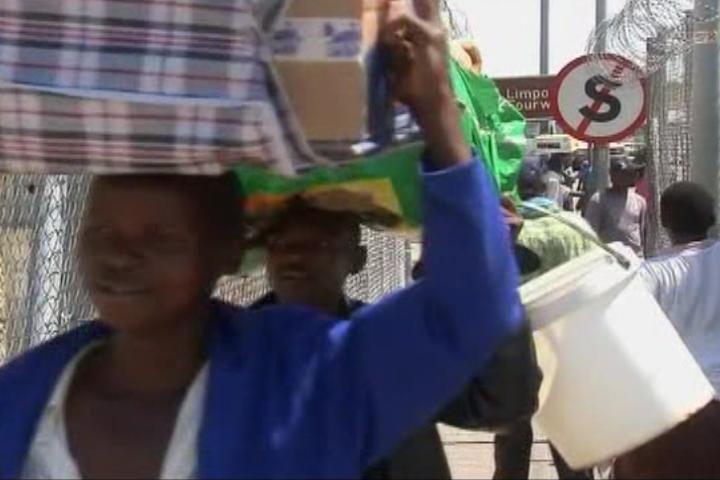
The latest figures of Zimbabwean deportees from South Africa have been released, showing the country has deported nearly 60 percent more so far this year than over the same period last year.
Reports said that more than 28 000 people were deported to Zimbabwe since January.
The Chronicle said that those deported were mainly people working illegally on farms in Limpopo.
Zimbabwe’s immigration manager in Beitbridge, Charles Gwede, told the paper that 28 315 people were deported between January and June 2013, far higher than the approximate 17 000 over the same period last year.
Zimbabwe’s Home Affairs Minister Kembo Mohadi recently issued a statement denying that South Africa had changed its immigration requirements for Zimbabweans since the elections. – EWN
This is nonsense on stilts—true only if an expansion in the size and power of the federal government is a net positive.
If you’ve enjoyed the “work” of Department of Homeland Security Director Janet Napolitano, you’ll love her successor (rumored to be the New York Police Department’s stop-and-frisk Ray Kelly). The Marco Rubio immigration Bill concentrates even more power in the office Kelly might inherit. Such power includes the ability to adjust the status of a “registered provisional immigrant” (RPI) to that of “an alien lawfully admitted for permanent residence,” on satisfying a few ridiculous conditions, one of which is the RPI’s “continuous physical presence.” In other words, for being in the country illegally, the RPI may get his illegal status reversed at the pleasure of the secretary.
Is this not Kafkaesque? It is for any American who imagines that government ought to, at the very least, stand sentinel against unsolicited and unjustified trespass.
Almost all powers specified in the Bill are the prerogative of the Secretary of DOHS, although DOJ will get a chance to bolster its banana-republic credentials. Eric Holder’s Department of Justice gets bigger and badder under the Gang of Eight’s plot to reel-in more “undocumented Democrats.”
For instance, were an employer to hire, fire or verify an RPI’s employment eligibility in a manner that might be construed as a discriminating “immigration-related employment practice,” the proprietor is in hot water. In defending their rights of private property, “foreign labor contractors” will be, moreover, going up against tax-paid litigators, to whom the amnestied will have access.
You’d think that an expansion of the frivolous and counter-intuitive grounds upon which private-property owners may be prosecuted goes against libertarian sensibilities.
Another burden business will bear is the harvesting of data for the government. On exiting the country, departing globe-trotting RPIs will have their biometrical data collected and stored. The onus will be on the country’s carriers to do the job. The airlines will be compelled to help government track these departing Democrats.
Open-border libertarians must also like the idea of helping Barack Obama to keep the student-loan bubble afloat. Trust Sen. Chuck Schumer’s immigration bill to make it much harder to deny an “unlawful alien’s eligibility for higher education benefits.”
The monk-like devotion of the “small government” types at the Wall Street Journal and the Independent Institute to government growth mandated by John McCain’s Bill is no minor flaw. For example, the “Border Security, Economic Opportunity, and Immigration Modernization Act of 2013″ establishes in the Treasury the Comprehensive Immigration Reform Trust Fund.” As well as a “Department of Homeland Security Border Oversight Task Force.” Not to mention an “Ombudsman for Immigration Related Concerns.” As does the Bill authorize the appointment of many additional magistrate judges and district judges.
More litigators mean fewer rights for locals; more state functionaries spells additional pensions and unaffordable promises in perpetuity.
Yes, these privileges and perks are carved out of the hides of taxpaying Americans, immigrants included.
Did I mention that the same taxpayers will be liberated of funds which will go to nonprofit organizations that assist registered provisional immigrant applicants? Ask Gangster Jeff Flake, a Republican supporter—although he, like the other sorts aforementioned, all claiming to stand sentinel against state incursion, has likely not read the Bill.
Needless to say, S.744 galvanizes armies of child and family protective civil servants so as to ensure that in the stampede for stuff, no feelings are hurt and no faux rights trampled.
Free-for-all fools are right about one thing. Americans who worry incessantly about the status of the Northern Mariana Islands can relax. The islanders’ representatives in the US Senate have decided that, with respect to immigration, the Northern Mariana Islands are part of the commonwealth. This no doubt is a giant leap for proponents of the night-watchman, minimal state (NOT).
Britain’s government on Monday defended a controversial campaign featuring vans with billboards urging illegal immigrants to “go home or face arrest”, after criticism from a senior minister.
Two trucks, each displaying a huge poster with a number for migrants to text if they wish to return to their country of origin, were driven around six London boroughs for a week in a pilot scheme by the interior ministry.
Posters, leaflets and advertisements in local newspapers will run for a further month.
Business Secretary Vince Cable, a member of the Liberal Democrat party which is the junior partner in the coalition government with Prime Minister David Cameron’s Conservatives, called the campaign “stupid and offensive”.
But Cameron’s spokesman defended the vans, saying it was “clear that this is already working” and that getting illegal immigrants to leave voluntarily was the most cost-effective solution.
The interior ministry had already received a “great deal of interest” as a result of the campaign, the spokesman added.
The government will decide whether or not to roll out the vans nationwide after the ministry has collected all the necessary information, he added.
Immigration is a key issue with less than two years until Britain’s next general election, as the centre-right Conservatives fear a growing threat from the UK Independence Party, which campaigns for migration curbs and an exit from the European Union.
But the “go home” campaign has revived tensions in the coalition government, with the office of Liberal Democrat Deputy Prime Minister Nick Clegg reportedly saying he had not been told about the van plan in advance.
The posters feature a huge picture of a pair of handcuffs together with a number said to represent the number of arrests in the local area and the words: “In the UK illegally? Go home or face arrest.”
It tells people to text the word “HOME” to the displayed number to get help.
The trucks were driven through several areas of London with large ethnic minority populations.
A Home Office spokesman said the cost of the entire campaign, £10,000 ($15,000, 11,500 euros), was less than the £15,000 cost to forcibly remove one illegal immigrant from Britain.
The opposition Labour Party’s home affairs spokeswoman, Yvette Cooper, said the scheme was “ludicrous”.
UKIP leader Nigel Farage said ethnic communities would take the billboards as a “sign of open warfare”.
“I think it’s very Big Brother, very state-ish, very sort of East Germany circa the 1980s, it’s just a horrid way of doing it,” the member of the European parliament told LBC radio.
There was also a backlash from British commentators and on social media.
In a commentary on the Guardian newspaper website, user “Pukkah Punjabi”, a graphic designer from London, described how she had called the Home Office and asked them to help her go “home” — to her house in the suburb of Willesden Green.
She said “go home” had been a racist slogan of abuse against migrants when she was growing up in the 1970s.
The Twitter hashtag #racistvan drew a series of other users saying they had texted the ministry to ask for train times and lost keys, while there was even a spoof Twitter account @theracistvan, with the sole message “RT (retweet) if you’re in the UK illegally.”
The Conservatives in particular have been trying to shore up their right-wing credentials on the immigration issue in recent months, with centre-left Labour being seen as weaker on the issue.
In June Britain said it would charge “high-risk” adult visitors from Nigeria, India, Pakistan, Bangladesh, Sri Lanka and Ghana a refundable bond of £3,000 for a six-month visa. – AFP
The success of British Prime Minister David Cameron’s flagship immigration policy was called into serious question on Sunday, dealing him a potential blow ahead of 2015 elections by playing into the hands of a populist anti-immigration party.
A report by lawmakers from across the political spectrum concluded that Britain’s migration statistics were grossly unreliable and “not fit” for purpose, undermining the credibility of Cameron’s assertions about the issue.
Immigration is a hot button issue in Britain, where Cameron is trying to stop an exodus of voters to the UK Independence Party (UKIP) before a parliamentary election in two years’ time, and polls show the issue is one that worries voters the most.
Concerns have been fuelled by warnings in the right-leaning press about “hordes” of Romanians and Bulgarians moving to Britain next year when EU freedom of movement restrictions lapse, at a time when Britons face rising competition for jobs.
To compound Cameron’s problems on immigration, a government pilot scheme that involves vans driving around London with billboards telling illegal immigrants to “go home or face arrest” has angered his junior coalition partner, the Liberal Democrats, and prompted allegations of racism.
Questioning immigration was for years regarded as racist in Britain, but all three main parties have started to talk tough about the subject in response to rising public anxiety, campaigns in the country’s popular tabloid press, and the popularity of the anti-immigration UKIP.
Cameron’s ruling Conservatives, who are trailing the opposition Labour party in the polls, have promised a far-reaching immigration crackdown and say they have cut net migration – the numerical difference between people coming in and out of the country – by a third.
They have also pledged to cut that figure to tens of thousands of people a year from over 100,000 now.
Data ‘too uncertain’
But the report, by the lower house of parliament’s Public Administration Committee, said that government migration data was neither systematically nor rigorously collected.
“We are struck by the advice of the Migration Advisory Committee to the Government that it should aim for net migration of only 50,000 as the only means of being certain that net migration is in fact below 100,000,” it said.
Bernard Jenkin, a Conservative lawmaker who oversaw the report, told local media government statistics were “little better than a best guess and could be out by tens of thousands.”
Chris Bryant, a Labour lawmaker, said the report showed the government’s assertions on immigration could not be trusted.
“We should be able to count people in and out of this country,” he told Sky TV. “If the government is going to boast about having cut net migration then you would think that the statistics would be reliable ones. The truth is they’re not.”
Cameron’s Conservatives are trailing Labour in the polls, but several surveys show Labour’s lead, which until recently had been fairly steady at ten percentage points, is narrowing.
One opinion poll published earlier this month put the Conservatives in joint first place with Labour for the first time in over a year.
UKIP, which campaigns for Britain to leave the European Union and for a halt to “open door immigration,” made sweeping gains in May local elections, winning almost one in four votes.
But its poll rating has since fallen from a high of 22 percent. Some polls suggest it has lost one or two percentage points. Others suggest its fall in support may be more serious.
A spokesman for Britain’s Home Office (interior ministry) said the government was confident it was on the right track.
“We disagree with the report’s conclusions,” he said. “Government reforms on immigration are working and the statistics do show that net migration is at its lowest level for a decade.” – Reuters
Australian Prime Minister Kevin Rudd on Sunday said he made “absolutely no apology” for his hardline new policy on asylum-seekers under which they are sent to Papua New Guinea.
Rudd quickly moved to announce a radically reshaped immigration plan under which boatpeople could be resettled in PNG, sent home, or to a third country but not Australia. His new stance reinforces the notion that Australia wants to remain a white country.
Not white enough for Oz
Under the directive, those who pay people-smugglers to arrive on unauthorised boats will be sent to the poor Pacific nation for processing and resettled there even if found to be genuine refugees.
“On the question of asylum-seekers… we’ve had to adjust our policy over time and I make absolutely no apology whatsoever for our current policy settings because the world around us has changed,” Rudd told Channel Ten.
Rudd, who was last month reinstalled as prime minister by his Labour colleagues to help turn around dire polls in an election year, had previously softened some of the former conservative government’s policies.
The plan has worried the United Nations refugee agency which said on Friday that conditions at Papua New Guinea’s Manus Island facility currently failed to adequately protect refugees.
“UNHCR is troubled by the current absence of adequate protection standards and safeguards for asylum-seekers and refugees in Papua New Guinea,” it said in its first assessment of the policy.
Australia resumed sending asylum-seekers to Manus Island and the Pacific state of Nauru in 2012 in a bid to deter record numbers of migrants arriving by boat, hundreds of whom drowned en route.
Rudd has said the new PNG policy will take some time to deter asylum-seekers, but since he announced the change just over a week ago more than 1 300 have arrived on boats.
‘You will not be settled in Australia’
“It is the implementation of that policy direction over time, resolutely, which will yield results,” he told Network Ten’s Bolt Report.
“In the interim, people smugglers will test your resolve.”
Asylum-seekers are a sensitive issue in Australia, and one set to feature prominently in the election due this year.
Rudd said while people-smugglers, who make thousands of dollars bringing asylum-seekers to Australia, would test the government’s resolve “we are not for turning”.
“Our policy is very clear… you will not be settled in Australia,” Rudd said. AFP
Omar Diallo’s head is still swollen after a recent assault on the streets of Athens which left him with several stitches.
Having fled his troubled homeland of Guinea, the 28-year-old is no stranger to violence, but the virulent racism he says he has experienced in crisis-hit Greece has come as a shock.
In the Athens neighbourhood where he lives — an area full of empty, graffiti-covered shops with “for rent” and “for sale” signs on the windows. “There are zones where we no longer have the right to go, or where we can only go in groups.”
He was on his own when he was assaulted. The attack was swift and silent, unaccompanied by racist taunts or demands.
“Four people got hold of me on the street, one of them hit me with some object on the head. I fell down and they hit me. When they finished, they left.”
Omar fled his west African home after a September 2009 stadium massacre during an opposition rally. His father was among the 157 killed, while he was thrown in jail.
After being released he decided to leave his country where he said he feared for his life.
But just a few years after coming to Athens in search of a better future, he found himself lying in the street, blood dripping from his head, until police officers found him and took him to the hospital.
His story is not unique.
“I saw a young Pakistani being beaten right in front of me, by two giants, who ran through the whole bus to get to him and then kicked him violently out on the street. I did not interfere because I was scared,” a mortified retired Frenchman, who has been living in Athens for a year, told AFP.
A watchdog recording racial violence counted 154 victims in 2012, 107 of whom were assaulted in Athens. In at least eight cases, victims or witnesses said they recognised people associated with neo-Nazi party Golden Dawn.
Omar, who used to study international relations in Conakry, feels that racial attacks have surged since conservative Prime Minister Antonis Samaras came to power in June 2012.
That is when Golden Dawn was elected into parliament for the first time, winning 18 seats out of an overall 300.
“They felt politically fortified,” Omar said.
Racist attacks ‘almost every day’
According to the report on racial violence, only 24 of the victims made a formal complaint to the police in 2012.
“In my understanding, they (perpetrators) try not to kill, but to make visible injuries, so as to spread the fear to the communities,” said Doctor Nikitas Kanakis, secretary general of the Greek branch of the non-governmental group Doctors of the World.
Kanakis has long tried to highlight the problem, and victims of racial attacks often turn to him instead of going to a hospital.
He has brought attention to several attacks such as the case of a 14-year-old Afghan boy, whose face was slashed by a broken bottle in an Athens neighbourhood dominated by neo-Nazis.
“Almost every day in various parts of the country, particularly in Athens, racist attacks occur,” said Giorgos Tsabropoulos, head of the UNHCR’s Athens office.
The government’s response to the problem has been ambiguous.
It has condemned Golden Dawn’s attacks as unacceptable, and Public Order Minister Nikos Dendias recently told the BBC that “Golden Dawn… is clearly a neo-Nazi party.”
He said a special police unit had been created to deal with racist crimes and “that the people who act unlawfully should end up in prison.”
But in the same interview he said “creating new legislation won’t help” , despite being under pressure from the Council of Europe to do so.
Dendias said the rise of Golden Dawn and its xenophobic and racist doctrine was linked to a surge in undocumented migrants arriving in Greece, which he said were “are a huge burden to our society.”
Dendias has appealed to the EU for financial aid to deal with the increasing number of migrants.
The premier recently made a big show of his meeting with Greek star basketball player of Nigerian origin Giannis Adetokunbo, who was drafted into the NBA, to counter accusations of racism.
Eva Cosse from Human Rights Watch admits that there has been some progress, notably the appointment of a special prosecutor in Athens, but “there is still a lot of work to do.”
“They need to assure that every migrant and asylum seeker, even undocumented, has the right to access the judicial system,” she told AFP.
Meanwhile, the US Embassy in Greece has warned US citizens travelling to Greece to be wary of “a rise in unprovoked harassment and violent attacks against persons who, because of their complexion, are perceived as foreign migrants.”
“US citizens most at risk are those of African, Asian, Hispanic or Middle Eastern descent in Athens and other major cities,” the statement on the embassy’s website, first posted last November, reads. – SAPA/AFP
ident Barack Obama, the Senate on Thursday passed comprehensive immigration reform that would put 11 million undocumented people on a path to earning citizenship.
Chants of “Yes we did!” erupted from the public galleries after senators voted 68-32 to approve the landmark legislation, which pours unprecedented resources into border security, revamps legal immigration and requires a 13-year wait before those without papers can apply to become US citizens.
Fourteen Republicans joined a unanimous Democratic side in what Senate Majority Leader Harry Reid deemed a historic vote.
As Vice President Joe Biden presided over the chamber, Reid took the rare move of calling on members to cast votes from their Senate desks.
“We’ve taken giant steps forward towards solving our immigration problem today,” an elated Senator Chuck Schumer, one of the four Democrats who crafted the bill with four Republicans in the so-called “Gang of 8,” told reporters.
The measure now faces a rocky road in the Republican-led House of Representatives, but Schumer and Republican Gang of 8 Senator John McCain made a direct appeal to their colleagues on the other side of the US Capitol: work with us to achieve the most important immigration reform in a quarter century.
“To our friends in the House, we ask for your consideration, and we stand ready to sit down and negotiate with you,” McCain said.
“We may have different views on different aspects of this issue but we should all of us here have the same goal, and that is to take 11 million people out of the shadows, secure our borders, and make sure this is a nation of opportunity and freedom.”
Obama welcomed the Senate vote and urged the House to follow suit.
“Today, with a strong bipartisan vote, the United States Senate delivered for the American people, bringing us a critical step closer to fixing our broken immigration system once and for all,” Obama said.
But the president warned the bill’s supporters to “keep a watchful eye” on efforts to scupper reform, saying “now is the time when opponents will try their hardest to pull this bipartisan effort apart.”
The bill’s authors spent months crafting the 1,000-plus-page document, which pours $46 billion into border security and other efforts, including electronic employment verification and a modernized entry-exit system.
It requires immigrants to pass background checks, pay fees, fines and back taxes, learn English, gain employment, and as Reid said, “stay out of trouble.”
The bill was debated for three weeks on the Senate floor and dozens of amendments were added as Republicans squared off against one another over the merits of the legislation.
Obama hopes to sign immigration reform into law this year, but several House Republicans have said the bill will be dead in the water without significant changes, particularly on border security.
“The House is not going to take up and vote on whatever the Senate passes,” Republican House Speaker John Boehner told reporters.
“We’re going to do our own bill, through regular order, and it’ll be legislation that reflects the will of our majority and the will of the American people.”
Opponents have said the bill is too costly, or argue that loopholes will prevent authorities from gaining full operational control of the border before the citizenship process begins.
“The one thing people are going to be very unhappy with is if they vote for this bill, we document all of these undocumented workers, but then we get 10 million more come into the country,” Senator Rand Paul told AFP.
Shortly before the vote, Senator Marco Rubio, perhaps the legislation’s most forceful advocate and a potential 2016 presidential candidate, made the closing arguments.
Rubio cited his own parents’ flight from Cuba to Florida as reflective of a journey millions of immigrants have taken to a new life in a country whose work ethic, rule of law and opportunity quickly changes them for the better.
“Because well before they became citizens, in their hearts they had already become Americans,” Rubio said.
Mexico welcomed passage of the bill, with the foreign ministry saying in a statement that it had the potential to improve the lives of millions of Mexicans living in the United States.
Earlier this week however Foreign Minister Jose Antonio Meade criticized provisions that would tighten security along the US-Mexico border.
Building more “walls” would not solve the immigration issue, he argued. – AFP
Italy’s first black Cabinet minister is facing Internet death threats before a visit to a region known for its anti-immigrant political base.
But Cecile Kyenge says she’s not afraid and challenged Italians to respond to such intimidation themselves to prove that Italy isn’t racist.
Kyenge, a Congolese-born doctor who has lived in Italy since 1983, has been the target of racist diatribes ever since she was named integration minister in April. She has been called “Congolese monkey,” and a member of a “bonga bonga government.”
Last week, a local politician from the xenophobic Northern League party was expelled from the party after she suggested on Facebook: “Why doesn’t someone rape her (Kyenge), so she can understand what victims of atrocious crimes feel?” The official, Dolores Valandro, was implying that immigrants were responsible for violent crime in Italy.
Kyenge on Wednesday acknowledged “racist episodes,” but declined to brand the country as a whole racist. She has offered a muted response to the attacks against her, saying it’s more for Italy as a nation to respond.
“These actions are directed against all of us, not just me,” Kyenge told reporters. “Surely it hasn’t left me indifferent. But I think the response that the country gives is important.”
Unlike France, Germany or Britain, where second and third generations of immigrants have settled, albeit uneasily, Italy is a relative newcomer to the phenomenon, with the first waves of immigrants coming to Italy’s shores only in the 1980s. The country’s race problem was then largely seen at soccer stadiums, where even today black stars like Mario Balotelli are routinely subjected to racists taunts.
But Kyenge’s emergence onto the political stage has brought the issue to the fore, spurred on in part by her call for Italy to change its citizenship law to allow children born in Italy of legal immigrants to obtain citizenship more easily.
Currently, such children can only apply once they turn 18, and can be denied citizenship for a host of bureaucratic mistakes or omissions. Kyenge says changing the law is a key part of changing Italians’ very concept of citizenship, to take into account the country’s changing demographics.
Foreigners made up about 2 percent of Italy’s population in 1990; currently the figure stands at 7.5 percent.
“It’s a new citizenship that comes about by the meeting of different cultures,” she said.
Her call, however, has been met with stiff resistance by the anti-immigrant Northern League, which isn’t taking part in a parliamentary committee drafting the new citizenship law. Kyenge’s spokesman, Cosimo Torlo, said it’s unclear at what age citizenship could be obtained under the proposed legislation – at age 3, 5 or 10 – but that “Whatever it is, it will be better than the current law.”
The threats against Kyenge are real. She arrived at the Foreign Press Association with a phalanx of bodyguards, two of whom flanked the dais where Kyenge spoke, talking into their shirt cuffs and sending signals to two other colleagues at the back of the room.
Asked about the unusually high security detail, Kyenge noted that all ministers have bodyguards. “But it’s clear that for me, because of the threats I have received, there’s a greater attention on protection.”
This weekend, Kyenge will give the opening address to a multicultural festival in the northern region of Veneto, the political home base of the Northern League. Far-right groups are planning a protest. Isabella Zuliani, vice mayor of the town hosting the event, told newspaper Il Gazzettino that police have already been informed about a new round of Internet death threats directed at Kyenge, including one that exhorted simply: “Kill her.”
“Racist episodes exist, but you can’t say that a country is racist because there are certain episodes in the territory,” Kyenge said.
That said, Kyenge appeared more ready to acknowledge such “racist episodes” than in her first meeting with the media, soon after she was nominated. Then, she said Italy’s problem wasn’t so much racism as ignorance of “the other.”
After two months of taunts directed against her, Kyenge said, “Maybe what is missing in Italy is a culture of immigration: We have to try to know, understand the ‘other,’ and that diversity is a richness.
“As soon as we understand that, we can evaluate whether Italy is racist,” she added. – AP
Sen. Tim Kaine, a Virginia Democrat, delivered a speech on the Senate floor in Spanish on Tuesday as he made his push for the chamber to pass his immigration bill.
Mr. Kaine said he would deliver his remarks in Spanish but said he would put an English translation into the Congressional Record.
The move highlighted the growing power of Spanish-language speakers in the U.S. Mr. Kaine, whose Spanish is outstanding after spending time as a Catholic missionary in Honduras, has used the language in his outreach to Hispanic voters.
Speaking Spanish in floor speeches is rare, but not unprecedented.
To use another language on the floor requires unanimous consent of the other senators, which Mr. Kaine sought and was granted. – Washington Times
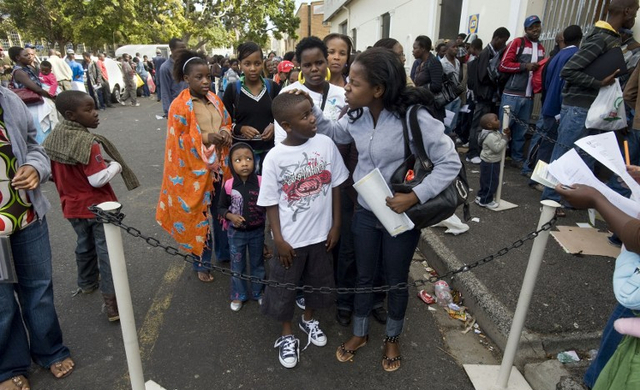
Asylum seekers queuing in front of a Home Affairs office in Pretoria
Government should take measures to assimilate foreigners into the diversified South African community, an asylum-seeker rights group said on Wednesday.
Foreigners in South Africa lived on a knife’s edge, International West Africa Asylum Seekers Foundation managing director Victoria Philips-Olaboye said.
“You need to see the multitude of people which gathers at Marabastad [home affairs offices]. They come from all over to get asylum papers in Pretoria and it is not easy.
“Some have to sleep on the ground through the night. We have a lot of rape victims there and the people are being robbed. Some of the people are pregnant, some have small children.”
She said the influx of immigrants to South Africa, particularly from West Africa, was influenced by political upheavals, economic hardship, and family disputes.
“The belief is that South Africa is better than any country in West Africa so they think they can make it here. Some have sex-related issues, they are not accepted because they are gay.”
She said her organisation wanted to engage South African authorities to help provide housing for asylum seekers.
“We have not seen much from the government. We would like to see more being done regarding the welfare of asylum seekers,” said Philips-Olaboye.
“Around 90 percent of asylum seekers are not working. They tell us that even though they are qualified, South Africans are preferred for job opportunities.”
According to Philips-Olaboye, the organisation had more than 700 members who were constantly exposed to xenophobia, discrimination, and crime.
Providing jobs for immigrants would also discourage them from venturing into crime, she said.
Nigerian immigrant Omokhagbor Michael said he arrived in South Africa two months ago in the hope of finding better economic opportunities in the entertainment sector. He said his stay so far had been horrific.
“Most of the language used in addressing us [foreigners] is vulgar; we just have to bear it. Being Africans, I think we should be treated politely,” he said.
“We had a number of challenges, including riots and [a] political crisis [in Nigeria]. In these days you find yourself in a situation where you have to go and seek shelter. In running for your life, you find yourself anywhere.”
Michael’s renewable asylum-seeker permit had since expired and he said he had not been able to renew it.
“The South African government has been wonderful to us. Somebody who gives you a house definitely wants you to be there. We face the problem of individuals who want to satisfy their pride.
“I have been trying to renew my asylum-seeker permit for two weeks. I was initially given one month to stay. One becomes scared and you keep turning left and right,” he said.
On Monday, the Somali government called on South Africa to protect Somali nationals living in the country after a spate of attacks on foreigners.
Residents in a township near Johannesburg rioted against the Somali community last week. Tensions also flared in Port Elizabeth and other parts of the country.
Scores of people were arrested following the attacks, which were reminiscent of the wave of xenophobic violence that left at least 60 foreigners dead in 2008. – Sapa
This website uses cookies to improve your experience. We'll assume you're ok with this, but you can opt-out if you wish. Cookie settingsACCEPT
Privacy & Cookies Policy
Privacy Overview
This website uses cookies to improve your experience while you navigate through the website. Out of these cookies, the cookies that are categorized as necessary are stored on your browser as they are essential for the working of basic functionalities of the website. We also use third-party cookies that help us analyze and understand how you use this website. These cookies will be stored in your browser only with your consent. You also have the option to opt-out of these cookies. But opting out of some of these cookies may have an effect on your browsing experience.
Necessary cookies are absolutely essential for the website to function properly. This category only includes cookies that ensures basic functionalities and security features of the website. These cookies do not store any personal information.
Any cookies that may not be particularly necessary for the website to function and is used specifically to collect user personal data via analytics, ads, other embedded contents are termed as non-necessary cookies. It is mandatory to procure user consent prior to running these cookies on your website.