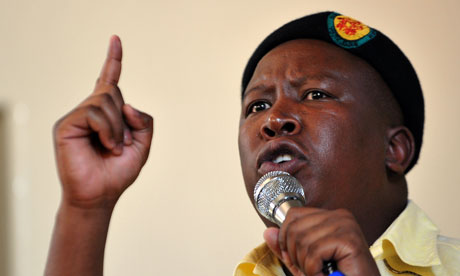
Black people are worse off than they were during the apartheid years, expelled ANC Youth League leader Julius Malema said on Thursday.
“We are worse [off] than during the times of apartheid. We are being killed by our own people. We are being oppressed by our own government,” he told mineworkers at the Aurora mine in Grootvlei, Springs.
More than 1000 mineworkers from the liquidated Aurora Empowerment Systems and the neighbouring Gold One arrived to hear Malema speak.
He said politicians could not help the workers because they benefited from the mines and had shares in them.
“Every mine has a politician inside. They give them money every month, they call it shares. But it is protection fee to protect whites against the workers.”
He said the fact the Aurora crisis had lasted for four years showed there was no leadership in the country. Aurora Empowerment Systems bought the mines when the previous owner, Pamodzi Gold, went into liquidation. Since then workers have not been paid and the mines have been stripped of assets.
“If there was leadership in this country it can’t take four years. Four years shows that there is not leadership. When they (politicians) arrive to represent you, they give them money and they forget you.”
Malema told the workers they should form a committee to speak to the lawyers and present their complaints to the liquidators of Aurora.
He announced what he labelled the start of a revolution in the mining sector.
“We are going to lead a mining revolution in this country. We are going to each mine. We will run these mines ungovernable until the boers come to the table,” he said.
“We want them to give you a minimum wage of R12,500. These people can afford R12,500. Mining in South Africa amounts to trillions of rands.”
About 5000 people had been left jobless at Aurora. It was currently under liquidation.
The prospective buyers of Aurora mines, Gold One, have allegedly fired over 1500 workers who went on strike demanding a minimum wage of R6500.
The miners claimed management then replaced them with contract workers. – Sapa
Ululation, whistles and jubilation greeted expelled ANCYL leader Julius Malema’s arrival at the Aurora mine in Grootvlei, Springs, on Thursday.
Workers sang “Ngisebenzela izingane zami emgodini” (I’m working for my children in the mine).
Malema arrived in a Mercedes-Benz Viano minibus dressed in a white shirt, black pants and his trademark beret.
Workers at the mine told Malema how President Jacob Zuma promised to help them, but never honoured his words.
“Zuma was here… took payslips and promised to attend to our problems. He then disappeared and then brought his kids to run the mine,” said one of the workers.
Aurora’s directors include Zuma’s nephew Khulubuse Zuma and former president Nelson Mandela’s grandson, Zondwa Mandela.
Workers told Malema how the liquidators of Aurora Empowerment Systems demolished their hostel, leaving them on the street.
“We were paid R500 and told that was 40 percent of our provident fund,” one of the workers claimed. – Sapa
Malema was expected to address the workers, left without wages for months after Aurora took over the liquidated Pamodzi Gold mines. Aurora’s directors have been accused of stripping the mine’s assets and not paying workers their salaries. An inquiry into the matter is underway.
Expelled ANC Youth League president Julius Malema will return to the organisation, league deputy president Ronald Lamola said on Monday.
“We still believe he is going to come back and we will raise this at conference,” Lamola told reporters in Johannesburg.
He was referring to the ANC’s elective conference, to be held in December.
Last month during an interview on the BBC’s World Service in London, Malema said his expulsion from the ANC would be automatically overturned when President Jacob Zuma was voted out of office in December.
He said his expulsion was being contested by African National Congress structures.
A group calling itself Friends of the Youth League was established shortly after Malema was expelled from the ruling party. It organises events around the country at which Malema can address his supporters.
ANCYL head of policy Abner Mosase distanced the ANCYL from the group.
“They are not our friends and we don’t take responsibility for them,” he said.
“We have no association with Friends of the Youth League.”
ANCYL spokeswoman Khusela Sangoni-Khawe said the league did not have regular contact with Malema.
“Comrade Julius speaks in his own capacity, but we do listen to what he says like we would listen to any citizen. [But] we won’t take accountability for him.” – SAPA
The scene at Marikana, north west of Johannesburg, last week
Over the past few days PRAAG obtained new information about the Marikana massacre that is currently still making frontpage news in South Africa. It appears as if the miners of the Association of Mineworkers and Construction Union (AMCU) were deliberately murdered by the police as part of a campaign to get rid of the bothersome union.
AMCU was busy replacing the NUM (National Union of Mineworkers) as the majority union at the mine. The NUM is affiliated with COSATU, which is a member of the ANC regime’s so-called “tripartite alliance”. Before the shooting started, police ordered the media to leave the area.
Lauren Clifford-Holmes, the multimedia editor for the Johannesburg Mail & Guardian, was prevented last Thursday night from speaking to injured mineworkers. However, she stumbled upon two workers at Lonmin who confirmed that strife between the two trade unions was responsible for the problems, as NUM representatives were not re-elected by dissatisfied miners.
Cyril Ramaphosa
Black businessman and high-ranking ANC politician, Cyril Ramaphosa, apparently owns a contract to supply labour to the Lonmin mine at Marikana via his company Shanduka. “Ramaphosa and the NUM is practising a form of slave labour at the mine,” a source said at Marikana. “He is supplying labour at about R12 000 ($1500) per worker per month, but only pay his workers R4000 ($500) per month, thereby pocketing the difference. As a former NUM chief, he is able to control the union leaders and sees to it that he maintains this grotesque form of exploitation.”
However, NUM’s rival, AMCU, demands that the R12 000 received by Shanduka as labour broker in terms of the contract, should be paid directly to workers. Particularly the rock drillers, who perform the most difficult and dangerous work, felt that they were entitled to this wage, given that this was the tariff already received by Cyril Ramaphosa’s company for work at the mine.
An ex-policeman that PRAAG spoke to, but who prefers to remain anonymous, said that judging from the photographs he had seen, the workers were not attacking the police, but were fleeing from an area where a second police contingent was throwing tear gas at them. “One could see how some of them were trying to protect their eyes and faces. They thought they were fleeing to a safe place, where the heavily armed policemen mowed them down with automatic weapons, however,” said the ex-policeman.
The motive for the mass murder at the Lonmin mine at Marikana was apparently the protection of Shanduka’s lucrative service contract for supplying labour to the mine. Shanduka has already annouced that it will donate R2 million for the funeral of the 34 workers.
The workers are mostly from Lesotho, an independent country, and areas in the Eastern Cape. It would therefore be difficult for them to defend their rights and lives against the ANC-controlled state, cooperating closely with the British-controlled mining company. Until now, the only questions abut the massacre have come from black politicians and activists from outside governing ANC circles.
A group known as the September National Imbizi did a local investitagion and talked to an eyewitness alleging that the mineworkers were “drawn into an ambush” and that they were first bombarded with a “blue substance”, after which they were shot dead during the confusion. Many were executed while trying to hide among rocks and under bushes. On the websit of September National Imbizo, the eyewitness is referred to as “our friend”:
“…our friend shows us how several people were shot while they were hiding between the rocks and under bushes. We see for ourselves splatters of blood that indicate the determination to dig workers out of their hiding holes and shoot them dead. All sorts of items of clothing and shoes, soiled with blood lie all around the scene.”
The website also claims:
“What is clear from what we are told is that this was an ambush. The video material in mainstream media showing workers charging at the police was in fact workers running away from bullets being hurled from behind. Why would workers, armed with knobkierries [African-style clubs – ed.] charge at armed police? The workers were completely surrounded and what we’ve been seeing in the media is only half the story. There was clearly a mission: shoot to kill, thus the deployment of the army.”
Other strange incidents took place.
The media were kept away from the scene for hours so that it would be difficult to reconstruct the exact events. A contact of The Star newspaper was shot dead during the massacre. The police also forced a photographer from the Johannesburg Mail & Guardian to delete his photographs. Why were the police so scared that particular evidence regarding the shooting would leak out?
A video shown in the Netherlands, contained a Vodafone ambulance on the scene. The same vido was later shown in South Africa on News24.com, but without the ambulance, indicating that the video must have been edited.
Beforehand SAPA reported the following statement by the leader of the AMCU:
“We are not safe. Our phones have been tapped,” the Association of Mineworkers and Construction Union president Joseph Mathenjwa told a crowd in the Wonderkop informal settlement at Lonmin.
“We have been democratically colonised – workers work under very harsh conditions.”
After the massacre Mathenjwa demanded a really independent investigation, but the ANC simply appointed one of its own ministers, Collins Chabane, to lead the commission of enquiry. Under the previous, so-called “apartheid government” judges were always appointed to commissions of enquiry.
What Mathenjwa is probably referring to when he talks of “democratic colonisation”, is that workers are paid R4000 per month while Cyril Ramphosa is receiving three times as much per worker.
A Johannesburg businessman PRAAG spoke to and who is also in the services sector, confirmed that the ANC’s cadres have virtually instituted a system of “slave labour” in the country. The former officers of their militia, Umkhonto we Sizwe, is currently providing labour to the mines by recruting foreigners. Few, if any, mines still employ workers directly.
“Everything which the ANC described as apartheid, including the system of migrant labour, now applies, except in a far worse degree,” said the businessman. “The ANC’s cadres control everything. They have dug themselves into all sectors of the economy. They do not rule, they are in business. The state is for them just another business, with resources that they may use to enrich themselves. That is what BEE stands for, Black Elite Enrichment.”
Among those state resources controlled by the ANC, is the police force. Was it used to punish the AMCU and “make an example” of the rival union? In the run-up to the 1994 elections the ANC committed necklace murders against so-called “sell-outs”. Where tens of millions of rand are at issue in the provision of labour to a mine, one may therefore expect that an organisation as ruthless as the ANC will use all means at its disposal to eliminate a rival.
During the shooting a journalist from The Star, Poloko Tau, tweeted from the scene: “Auto guns creacking [sic] and cocked like 100 at a time, scary … warzone down here, 1st shot fired … journalist running, diving and hiding amid shots, water canon spewing water at the strikers … my contact has just been shot dead …”
After the Marikana massacre, some people simply “disappeared”. SAPA reported the following:
“Around 100 women arrived at the Ga-Rankuwa Magistrate’s Court outside Pretoria today where more than 250 protesters were expected to appear for public violence.
One woman, Nombulelo Jali, 37, wept hysterically. She said police did not know what happened to her husband Themba Khalo Jali, 40, who she says was arrested on Thursday.
‘I have come all the way from Harding in KwaZulu-Natal but we can’t find him. We have frantically searched everywhere and we can’t locate him. Police took him,’ said Jali.”
Julius Malema alleges that many of the striking workers are currently detained “irregularly in a private prison”. His friend and ex-colleague from the ANC Youth League, Floyd Shivambu, also said that many of the workers were shot in the back, which would indicate that they were running away from the police when they were shot.
This could not be verified, as a security blanket has been pulled over the area and journalists are not allowed at the mine hospital.
The narrow links between the British-controlled mining houses and the ANC may be traced back many decades. The first contact between the Afrikaner establishment and the exiled ANC was arranged by the mining company Consolidated Goldfields in England during the eighties. On that occasion Thabo Mbeki and Willie Esterhuyse met each other. Their relationship later played a crucial role in the capitulation of the Afrikaner government as Esterhuyse had persuaded several cabinet ministers that the ANC could be “trusted”.
The mining houses also played a leading role in portraying the ANC as the new government for South Africa and probably entered into private agreements with the so-called “liberation movement”.
Yesterday the chairman of Lonmin, Roger Phillimore, blamed “apartheid” for the poor conditions in which his mineworkers have to live, knowing that Shanduka and Lonmin are pocketing the greater share of the mine’s income for themselves.
Riah Phiyega
Julius Malema held Jacob Zuma and Cyril Ramaphosa responsible for the mass murder: “They presided over the massacre of our people… Not even the apartheid government killed as many.”
It is unclear whether the police’s actions will be investigated internally, as the executive director of South Africa’s Independent Police Investigative Directorate, Mr. Francois Beukman, has recently resigned “to pursue other interests”. He is leaving the service at the end of the month. His contract would only have expired in August 2014. At any rate, the new national police commissioner, Riah Phiyega, does not consider the shooting of 34 people “to be a massacre”.
Former ANC Youth League president Julius Malema asked police on Saturday to distance themselves from the crowds at the Wonderkop village near Rustenburg.
The negotiations between Malema and the police came after complaints from Lonmin workers and residents that they felt uncomfortable engaging with Malema with the police there.
Around three police nyalas were parked in the area.
Police heeded Malema’s call and moved their vehicles about a kilometre away from the gathering.
Malema arrived in Wonderkop a short while ago.
He was given a warm welcome by the residents and mineworkers when he arrived.
‘Malema, stand up’
Women ululated while men who had been seated stood up and clapped their hands.
Some of the women were waving placards reading: “Julius Malema, Boeremag, please stand up.”
The woman holding up that placard explained that she meant to send a message to Malema that the boer (white men) have killed their husbands.
She said they wanted Malema to help them.
Another woman carried a placard reading “R500 reward for killing police, Musina to Cape Town do your best.”
She explained that her placard meant that anyone who could kill police officers from the Limpopo end of the country to the tip of it in the Western Cape would receive a R500 reward.
For the first time, women and men were seated in one gathering since the start of the unrest.
The women were still however, separated from the men by a fence.
Former ANC Youth League spokesperson, Floyd Shivambu, and suspended league secretary, Sindiso Magaqa were also present.
‘Most people shot in the back’
Earlier, Shivambu said he understood the pleas of the miners and said the police were wrong to utilise maximum force to disperse them.
“Most of the people were shot at the back, indicating that they were running away so police actions were not justified,” he said.
A total of 34 people were killed in a shootout that erupted near the mine on Thursday when police tried to disperse striking miners.
More than 78 people were injured. Another 10 people had by then been killed in the violent protests at the mine over the past week.
President Jacob Zuma visited Lonmin on Friday where he condemned the violence. He called for an inquiry into the incident. – SAPA
According to the Daily Maverick, a Johannesburg website, expelled ANC Youth leader Julius Malema is still campaigning hard in his home province of Limpopo.
Greg Nicolson writes that Malema gave whites a lashing over their continued ownership of farmland. “We don’t owe them fuck,” Malema added, assumingly referring to expropriating land from white people without compensation. “We don’t want to kill you… not because we are scared (but) because we like peace.”
After the delegates at the ANC’s national policy conference returned to their respective provinces, Mondli Makhanya, editor-in-chief at Avusa, noted a change in the president Jacob Zuma’s demeanor.
“Defeat in the second transition debate was no small loss for the president. It was a very clear indicator of his precarious hold on power. That is why the president is mimicking Julius Malema and trying to occupy the militant space that the former youth league leader once occupied,” wrote Makhanya.
“And the more unsure he becomes of his sway in the ANC, the more populist he will sound. Julius Malema will have returned. Older, but not wiser.”
Zuma’s legacy is corruption and immoral leadership that lacks personal respect, said Malema last night. He called on the crowded hall to “save the ANC” from the “crisis” that would engulf the party if Zuma led until 2019.
Under Zuma the ANC will take less than 50% of the vote in 2014, said Malema. He referred to Zuma’s dictum that the ANC “would rule until Jesus came”, while the Democratic Alliance already governs the Western Cape. “This is an example of misleading leadership,” he said.
He gave the president a lesson in populist rhetoric. “You will never know what land is until you own it… There are no rich people without land. Land is everything. Land is the purpose the ANC was formed. It wasn’t for VIPs,” proclaimed Juju.
Malema was riding on the confidence that followed last week’s conference. Zuma was dealt a psychological blow when the title of the second transition document was rejected, supporters sung for Kgalema Motlanthe and ANC delegates reportedly came to blows over nationalisation.
But the expelled youth league radical didn’t stop at leadership or policy issues. He engaged in a personal tirade against Zuma and ANC spokesman Jackson Mthembu.
Malema asked what right Zuma had to discipline the Youth League while it’s public knowledge that the president slept with a friend’s daughter. He suggested that when Zuma looked at the children of his friends, he didn’t see children, but different opportunities.
In front of the enthusiastic crowd, he said Zuma’s second transition document was rejected at the policy conference, but that he wouldn’t know, because he’s always sleeping.
Malema also launched an attack on Jackson Mthembu, the ANC’s spokesman. He referred to him as a drunk and his son as a drug addict. Mthembu has publicly spoken about his son’s addiction.
Why does Malema still get so much publicity if he is no longer a member of the ruling party? “So Julius had views, how did they get in the paper? Whether he is relevant or not, it appears the media decided that they want to make him relevant,” said political analyst Ebrahim Fakir on Tuesday.
Greg Nicolson of Daily Maverick is of the opinion that last night’s speech was “Julius… unchained. By expelling the ANCYL leader the party let him loose, took away any control it had over him. If he were suspended he would need to toe the line for five years. But his only hope of returning to the party is through helping to topple Zuma and hoping for a reprieve post-Mangaung.”
Manguang, outside Bloemfontein, will host the party’s major conference in December this year, with the leadership struggle heating up in the run-up to it.
The appeal hearing of three ANC Youth League leaders was postponed on Thursday, ANC national disciplinary committee of appeals (NDCA) chairman Cyril Ramaphosa said.
League president Julius Malema, spokesman Floyd Shivambu and secretary general Sindiso Magaqa were scheduled to submit their appeal presentations to the NDCA at the African National Congress headquarters at Luthuli House, Johannesburg.
Ramaphosa said the three asked for the hearing to be postponed because their lawyer was not available.
“The NDCA turned down the request and insisted on the continuation of the hearing.”
The appellants then asked for a new legal representative, and the committee agreed to this, on the condition that the new lawyer be available within an hour. Advocate Muzi Sikhakhane arrived soon afterwards, but asked for time to familiarise himself with the heads of argument, Ramaphosa said.
“The NDCA agreed to postpone the hearing with a proviso that the new legal representative will submit the appellants’ heads of argument by the 18th April 2012 in writing.”
He said the ANC would need to submit its heads of argument two days later.
“The parties have agreed that the appeal will proceed through written submissions rather than oral hearing.”
Unnamed sources told the SABC that Malema’s lawyers had not arrived for the hearing because they had not received key documents relating to the national disciplinary committee’s previous sitting, which expelled Malema.
Malema was expelled from the ANC in November 2011 for sowing division in the party and for bringing it into disrepute. He was found to have done so by unfavourably comparing the leadership style of President Jacob Zuma to that of former president Thabo Mbeki and for remarks about bringing about regime change in Botswana. He remains ANCYL president until all options to overturn his sentence have been exhausted.
Shivambu was also found guilty of sowing division and bringing the ANC into disrepute. He was suspended from the ANC for three years for swearing at a journalist and for issuing a statement calling for a change of government in Botswana.
Magaqa was suspended for three years for making derogatory remarks about Public Enterprises Minister Malusi Gigaba. This was suspended for three years on condition that he apologise to Gigaba within 15 days. Magaqa apologised to Gigaba, in a statement sent to the media, on March 10.
Last week when the ANC’s national disciplinary committee suspended Malema from the party for calling Zuma a dictator. The conditions of the suspension prohibit him from exercising any duty as an ANC member, president of the ANCYL or member of the Limpopo provincial executive committee. He would face fresh disciplinary proceedings in this matter.
The two disciplinary proceedings were separate.
The ANCYL remained defiant, with provincial leaders insisting Malema remained its president. Should Malema’s appeal fail, he could ask the ANC’s national executive committee to review the matter. Failing this, he could attempt to raise his concerns at the ANC’s elective conference in Bloemfontein later this year.
Last month, Malema said he would seek redress in the courts if he was expelled. Until then he had consistently rejected the idea of taking legal action against the ANC.
ANC spokesman Jackson Mthembu said the party frowned on its members taking it to court.
“We are against anyone who takes the ANC to court because we do have a constitution in the ANC and we abide by the constitution,” he said. – SAPA
No ANC member is bigger than the organisation’s constitution, the party said on Wednesday in welcoming Julius Malema’s latest suspension.
“We welcome and respect the decision as we do with all decisions arrived at by constitutional structures of the ANC,” spokesman Jackson Mthembu said in a statement.
On Wednesday the African National Congress’s national disciplinary committee (NDC) announced it had temporarily suspended ANC Youth League president Julius Malema from the party, to investigate charges relating to comments he made on Friday.
“The decision of the NDC derives from the constitution of the ANC, section 25.12 (c), which empowers the NDC and the national working committee under extraordinary circumstances, to temporarily suspend any member of the ANC with a view to investigate possible charges,” Mthembu said.
Malema’s ANC membership was suspended with immediate effect.
On Friday Malema called Zuma a dictator and accused him of suppressing the ANCYL.
“After due consideration, the NDC was satisfied that this utterance constitutes a very serious violation of the ANC constitution and that the institution of disciplinary action… as outlined in the ANC constitution is warranted,” NDC chairman Derek Hanekom said in a statement.
“[The NDC] concluded that such utterance could bring the ANC into disrepute.”
Malema was informed on Wednesday morning of his immediate temporary suspension and that disciplinary proceedings would be instituted against him.
Consequently Malema would not be allowed to exercise his duties as an ANC member, as president of the ANCYL, or member of the Limpopo ANC’s provincial executive committee, said Hanekom.
“He will not attend any meeting of the ANC or any of its structures, including the leagues, except for the purpose of the NDCA [national disciplinary committee of appeal] hearing and the pending disciplinary proceedings to be instituted against him.”
Malema would also not be allowed to address any ANC or ANCYL meeting.
“He will not make any public statement on any matter pertaining to the ANC,” said Hanekom.
Malema is appealing his expulsion from the ANC for sowing division in the party and for bringing it into disrepute. The appeal hearing is scheduled to take place on April 12.
SABC news reported on Wednesday evening that Malema had given the ANC an ultimatum to allow him to speak in public again.
ANC Youth League president Julius Malema will not be removed from his position by anyone but the structures of the league, his deputy Ronald Lamola said on Thursday.
“It is only the internal process of the ANCYL that can decide to elect or un-elect leadership of the ANCYL,” Lamola told reporters at Luthuli House in Johannesburg.
“The ANCYL will never agree that its leadership be subjected to unfair and unjust treatment or banished for narrow political purposes.”
At the ANCYL’s lekgotla last week, Malema said he would resign as the organisation’s president if the structures of league said he should.
“All leaders of regional, provincial and national executive committees… across the country rejected the offer of the ANCYL president to resign his position.”
Lamola said the ANCYL’s leaders would remain in place until June 2014, when its next elective conference would be held, because there was no constitutional basis on which to remove them.
He said the “foreign tradition” of trying to remove leaders of elected league structures without consent had to be “nipped in the bud”.
“If committees remove leaders of the ANCYL, they will one day appoint leaders of the ANCYL. That will be a complete undermining of the will of the people,” said Lamola.
Malema, his spokesman Floyd Shivambu and league secretary general Sandiso Magaqa did not attend the media briefing.
They were attending a hearing, also at Luthuli House, in mitigation of their suspensions.
They were found guilty, in November, of bringing the ANC into disrepute and of sowing division in the party, partly for making comments about regime change in Botswana.
Malema, who was found to have compared President Jacob Zuma unfavourably to his predecessor, Thabo Mbeki, was suspended for five years. Shivambu, who insulted a journalist, was suspended for three years.
Magaqa, who was found to have made derogatory and potentially defamatory statements about Public Enterprises Minister Malusi Gigaba, received an 18-month suspension, suspended for three years, on condition he apologise within five days of receiving the penalty or appealing against it.
Also suspended were Lamola, ANCYL treasurer general Pule Mabe and deputy secretary general Kenetswe Mosenogi.
On February 4, the ANC’s appeals committee announced it had dismissed attempts by Malema, Shivambu, Magaqa and the others to have the guilty verdicts against them overturned.
Asked whether the ANCYL was distancing itself from the ANC by not complying with its sanctions, Lamola said it was not.
“There will never be a time when the ANCYL will operate outside of the ANC. We will always be an organisation within the ANC.”
He said the ANCYL had subjected itself to the ANC’s internal processes.
It was upset that its structures, like the rest of the country, had to hear from the media about its leadership’s suspensions.
The ANC should have spoken to these structures before the announcement was made.
Lamola said all ANCYL national executive committee members had accepted at the lekgotla that the disciplinary proceedings had been politically motivated.
“There is no consistency of discipline in the ANC… there has been disrepute brought to the ANC by many amongst its leadership and there was no action that was taken,” he said.
“We believe that the ANC carries an obligation to educate and guide the ANCYL on all critical policy issues and not persecute the leadership for articulating the policy of the ANCYL.”
Arguments in mitigation of ANC Youth League leader Julius Malema’s suspension from the ruling party begin on Monday.
ANC spokesman Keith Khoza said proceedings would start on Monday, but could not confirm if they would be held at the party’s headquarters, Luthuli House in Johannesburg.
On Sunday, during a closed session of the ANCYL’s lekgotla, Malema told delegates he had received a letter from the committee informing him, league spokesman Floyd Shivambu and the league’s secretary general Sindiso Magaqa, that they had be at the mitigation proceedings on Monday at 8am. They were informed they would each have two hours to argue in mitigation of their sentences.
Last Saturday, the ANC’s disciplinary committee of appeals announced that attempts by Malema, Shivambu, Magaqa and three other ANCYL officials to have the guilty verdicts against them overturned were dismissed.
They were found guilty in November last year of bringing the ANC into disrepute and of sowing division in the party. – Sapa
After many letters and three overseas visits to bring violent attacks on Afrikaner farmers to the attention of the international community, PRAAG welcomes the imminent visit of a UN delegation to investigate the possibility of genocide in South Africa.
The Pro-Afrikaans Action Group’s leader, Dr. Dan Roodt, said: “The announcement (video link to E-TV news bulletin underneath) by Mr. Castro Wesamba that the United Nations is sending an expert delegation to investigate farm murders and other forms of ethnic violence in our country shows that the international community has not forgotten us. But it had also been necessary for PRAAG and an anonymous farmer from Rustenburg to wage an international campaign around the issue before we got the necessary response.”
Within the context of the Malema trial currently taking place in the Johannesburg High Court, South Africa finds itself already, according to Roodt, “in the midst of what the United Nations has been calling in their most recent terminology an identity conflict. For considerable time now, we have been maitaining that the level of violence, dehumanisation, hate speech and open incitement to ethnic conflict and even genocide is not normal, not at all. However, the South African public and Afrikaners in particular have been conditioned to accept these extreme conditions as normal with some attempting to protect themselves against these by means of ad hoc and individual measures.”
PRAAG is planning to step up its communication with the UN, as well as the American and other foreign governments in the run-up to the UN visit. “We feel that there should be a national and international debate and concern about the identity conflict in South Africa. We blame the South African media and academics for not addressing the issue with greater insight and seriousness. Thousands of murders and tens of thousands of attacks could have been prevented.”
Roodt was also of the opinion that “the duty of every government to protect its citizens, which is also a principle of international law, is not being applied in our country. We should demand the right to protection. Otherwise, there should be tax incentives and funding for more private security, if the state and the police cannot perform its duties.”
This website uses cookies to improve your experience. We'll assume you're ok with this, but you can opt-out if you wish. Cookie settingsACCEPT
Privacy & Cookies Policy
Privacy Overview
This website uses cookies to improve your experience while you navigate through the website. Out of these cookies, the cookies that are categorized as necessary are stored on your browser as they are essential for the working of basic functionalities of the website. We also use third-party cookies that help us analyze and understand how you use this website. These cookies will be stored in your browser only with your consent. You also have the option to opt-out of these cookies. But opting out of some of these cookies may have an effect on your browsing experience.
Necessary cookies are absolutely essential for the website to function properly. This category only includes cookies that ensures basic functionalities and security features of the website. These cookies do not store any personal information.
Any cookies that may not be particularly necessary for the website to function and is used specifically to collect user personal data via analytics, ads, other embedded contents are termed as non-necessary cookies. It is mandatory to procure user consent prior to running these cookies on your website.