Black French singer loses appeal against Marine Le Pen

Black French singer and celebrity Yannick Noah lost his diffamation case against Marine Le Pen, leader of the Front National. Noah sued Le Pen because she had called him a “tax fugitive” on television. According to Marine Le Pen, he had “stashed” his money abroad. She made that allegedly defamatory statement on 9 March 2012 during a discussion programme on the pay TV channel Canal+. The talk show was on the contribution made by French immigrants such as Yannick Noah, Zinedine Zidane and Omar Sy.

yannick_noah
Yannick Noah during his days as tennis player

Answering the question whether immigration was an opportunity for France, Marine Le Pen responded: “Two tax fugitives out of three, that’s not bad,” before referring specifically to Yannick Noah. “That means, instead of paying his taxes in France, well, this gentleman sees fit to give us moral lessons… giving us lessons on charity and sharing while he shares nothing, his money is stashed abroad and does not benefit the unfortunate French,” she declared. At the time she was a French presidential candidate.

As opposed to the argument advanced by the singer, “the statement does not imply any punishable fiscal fraud committed by him”, according to the judges of the 17th chamber of the correctional tribunal of Paris in their judgement delivered on 25 June 2013. Yannick Noah then appealed against the judgement.

After participating in a political gathering with François Hollande, the current French president, Yannick Noah was criticised by Valérie Rosso-Debord and Pierre Charon of the UMP party, then by Marine Le Pen, for his tax evasion. From 1992 to 1994 he was a Swiss resident and is still involved in litigation with the French authorities in a case pending before the Constitutional Court of France.

The ex-tennis champion has also sued the UMP senator Pierre Charon for defamation for calling him a “tax criminal”. During the first hearing the politician was fined 1 000 euros, but suspended, as well as a symbolic one euro of damages and interest, including judicial publication. The case on appeal will be heard on 16 October.

Marine Le Pen fails to form conservative group in EU parliament

Marine Le Pen has failed to find support in the minimum of seven European Union countries for her conservative group, the European Alliance for Freedom.

Le Pen and Geert Wilders of the Dutch Freedom Party did not gain enough allies to qualify as a single caucus in the new European parliament, which now denies them access to funding and extra speaking time. They would also not be able to serve on committees.

Following European parliamentary elections last month, won by Le Pen’s Front National, the various parties had until Monday midnights to form a group comprising at least 25 MEPs from at least seven countries.

The Le Pen-led grouping includes Wilders’ Freedom party, the Austrian Freedom Party, Italy’s Liga Nord and Belgium’s Vlaams Belang. Le Pen and Wilders easily easily exceeded the minimum seats required, the European Alliance for Freedom was two countries short of the required seven.

Wilders and Le Pen said they refused to collaborate with a new party of the extreme right in Poland, viewed as antisemitic but also certain to clash with Wilders’ and Le Pen’s views on immigration to their countries from eastern Europe.

The Polish New Right Congress – which advocates abolishing women’s voting rights – and the Lithuanian Order and Justice parties said they refused to join the Le Pen group.

The Lithuanian party preferred to join British Ukip leader Nigel Farage’s Europe of Freedom and Democracy parliamentary group.

Yesterday, the Front National declared that it failed to muster a full-sized European parliamentary group as it had not wanted to ally itself with parties demonstrating incompatible values.

Florian Philippot, the party’s vice-president, told the French radio station Europe 1: “We were several parties, but we needed to come from seven countries and this time it didn’t work.”

Philippot also said to Reuters: “We have no group, for the time being at least. But our deputies, who are more numerous than any other party in the French delegation, will be there to defend France under any circumstances, with or without a group.”

Ludovic de Danne, Le Pen’s European spokesman, tweeted: “Never mind the betrayals and media agitation. We and our allies will build a solid and coherent political group later.”

The new 751-seat European assembly sits for the first time next week.

Subsidies for political groups in the European parliament are substantial. The European Alliance for Freedom could have received up to €22m for operational expenses.

In its media release yesterday, the Front National stated:

“We regret it in the short term, but we take responsibility for our moral and political choice in the long term.

Convinced that it will be possible for us to form this group shortly, we are committed from the very first session in Strasbourg on 1 July to our struggle as patriots for our sovereignty, our identity and our liberty. We shall continue in parallel and with the greatest determination, our negotiations with several parties in Europe so as to constitute this greater formation in favour of sovereignty in the European parliament.”

French arms sales rise by 42%

Defence Minister Jean-Yves Lodrian said on Monday that French arms sales increased by 42 per cent or €6.7 billion in 2013 compared to 2012 and are expected to exceed seven billion Euros this year. Lodrian was speaking during the opening of the Eurosatory 2014 arms fair in the Paris suburb of Villepinte.

France recorded a strong comeback in the Middle East market, said Lodrian. The region is responsible for generating 40 per cent of France’s total exports and it has also increased its presence in the Asia and Latin America markets.

In 2013, France’s biggest contract was an agreement to renew the Saudi Arabian navy’s fleet of ships, worth €500 million; a contract to sell a communication satellite to Brazil is worth €300 million.

Source: MEMO

French politicians have ‘organised their own impotence’: Marion Maréchal-Le Pen

Young French politician and Front National parliamentarian, Marion Maréchal-Le Pen, said that her colleagues from the centre-right UMP and Socialist Party “have organised French political impotence”. She was participating last night in a debate on the “War of the right-wing parties” on the talkshow “Les mots croisés” on France 2, the state-owned channel.

marion_marechal-lepen
Marion Maréchal-Le Pen on last night’s programme

Maréchal-Le Pen went further and claimed, in a rare statement for a sitting parliamentarian and member of the National Assembly in her country, that “one may well ask oneself the question, whether politics still has the capacity to change things”. She blamed “successive transfers of sovereignty to Europe, as well as government by the judges of the European Court of Human Rights whose ultra-extensive jurisdiction takes precedence over internal law” for this state of affairs. Circulars from Brussels to governments constitute another source of power abuse as bureacrats dictate to politicians what to do in their home countries.

According to Marion Maréchal Le Pen, the centre-right UMP “has been an accomplice to all of that”, and regardless of their sympathies for the Gaullist tradition in France, she feels that the European issue has to be confronted as it affects “the power of politics and the maintenance of politics in France”.

The euro will remain the world’s favourite tradeable currency

With the rise of Bitcoin and general hostility towards so-called fiat currencies, notwithstanding the euroskeptic animosity towards the euro, many people are speculating about the ultimate demise of the euro. However, as French politician Marine Le Pen recently intimated to Der Spiegel, the euro is something of a German creation.

In essence, the euro represents a reincarnated Deutschemark, with bits of Dutch guilders and Belgian francs thrown in. Ever since French Finance Minister Pierre Bérégovoy decided to start fighting inflation in the German style during the 1980s, France also acquired a hard currency hitched to the Deutschemark, leading to the equation Germany + Benelux + France = one European currency. The French almost succeeded in smuggling a very old Gallic monetary unit, the écu, in as the ECU (European Currency Unit) but somehow the ploy did not succeed and today we know it as the euro, officially known to fx traders as the EUR. The public at large have got used to the symbol €.

And let’s not forget about Austria which also joined the monetary Anschluss with aplomb, ditching the Austrian schilling on 1 January 2002 when the euro started to circulate officially in the so-called eurozone.

Even if all the countries in Southern Europe had to go back to trading in their national currencies, the biggest part of the European Union, economically speaking, would still be using a unitary currency. The combined GDP of Germany, Austria, France and the Benelux countries is $7,75 trillion, whereas the total eurozone GDP equals $12,7 trillion. So we see that the original European currency club whose currencies first started to converge in the 1980s constitutes 61 percent of the eurozone’s GDP. If Italy is thrown in, it goes up to almost 77%. Italy has a large economy worth just over $2 trillion of annual GDP. During the dying days of the lira, Italy too started to seriously converge toward hard-currency status, similar to its transalpine neighbours. Parts of Northern Italy are really no different to Germany, with medium-sized businesses being heavily oriented towards exports of specialised machinery and consumer goods, including gold jewellery.

Talk in the British financial press of the “Club Med” countries who are out of sync with Germany and neighbours to the north-west is therefore of no real consequence, as any currency trader knows. Betting against the euro has been, for the most part, like going short the old Deutschemark or Swissie against the dollar, a long-term losing trade if ever there was one.

There are only two really liquid currencies in the world today: the dollar (USD) and the euro (EUR). Traders at the major currency banks like Citi, Deutsche, HSBC, JP MorganChase, UBS and others usually make a market in the EUR-USD pair in “half a yard”, i.e. half a billion euros that may be traded in a split second.

The recent hostility of the USA towards French and Swiss banks like BNP Paribas or Crédit Suisse has probably not been lost on Europeans in general. If ever the world had to go back to a dollar-only system, America could dictate terms (and gargantuan fines!) to everyone else.

So, love it or hate it, the euro is here to stay. If there had been another strong currency in the world, perhaps its future would have been less certain, but given long-term dollar weakness, it is the US currency that may unravel some day in the not too distant future. America has simply accumulated too many huge deficits, including budget and trade deficits, for the dollar not to depreciate over the long haul.

Probably the most stable currency in the world is the Swiss franc (CHF). However, despite Switzerland’s economic prowess and major role in banking, a country of 7 million people will never provide us with a global, tradeable currency.

The size of the global foreign exchange or FX market is $5,3 trillion per day. That is according to the Bank for International Settlements and the global results from the 2013 Triennial Central Bank Survey of Foreign Exchange and OTC Derivatives Markets Activity.

The EUR/USD (about 33% of all trade by volume) is the most actively traded currency pair by far, followed by the GBP/USD (13%) and USD/JPY (12%). Together these pairs alone account for 58% of all forex trade by volume. In their other possible combinations, EUR/GBP (4%), EUR/JPY 2%, GBP/JPY (1%), they account for about 65% of all forex trade.

Taken individually and looking at all the estimated trading volume of all the pairs these typically trade in, the USD is involved in over 71% of all forex trade, the EUR in about 41%, the GBP in about 18%, and the JPY about 16%.

We see then that the euro, while not having the privileged position of the dollar as a reserve currency, is nonetheless the only currency that may rival the dollar in the global currency market. If ever US military adventures in the world could turn a sizeable number of nations against it, the dollar could start to suffer as the preferred medium for oil and other commodity transactions. The only other currency that could remotely replace it as the world’s leading currency would be the euro.

Long-term dollar weakness driven US deficits represent the prime reasons why investors and foreign central banks may eventually lose their appetite for the greenback.

Spying on rivals with drones hits the World Cup

Spying on rivals has hit the World Cup on the tournament’s first day of matches.

After spotting a drone hovering over its practice yesterday, France’s team manager Didier Deschamps has called for an investigation into the possibility that the team was spied on, according to Yahoo Sports.

Deschamps told Football Italia the drone’s operator was likely one of France’s potential opponents, or a French news agency. France is in Group E with Switzerland, Honduras, and Ecuador.

The story is gaining traction in the French media.

The tweet translates to: “A drone flies over the Blues during training,” referring to a colloquial name for the French soccer team. It also alludes to an investigation.

BFMTV has reported that the drone wasn’t Honduran. The article says the drone’s pilot, who was apprehended by local police “wanted to have fun watching training since he could not be at the stadium.” The article doesn’t give the nationality of the pilot, though if BFMTV is right, it was probably a fan using it rather than a journalist or sports operative.

Regardless, the presence of a drone at the World Cup says a lot about how popular and relatively affordable drones have become.

Source: Business Insider


BNP Paribas fine: are $10 billion too much?

bnp-paribas2Forget the 70th anniversary of the Normandy landings and the elaborate preparations to celebrate later this week the liberation of France by its allies. Forget “Lafayette, nous sommes ici”, which General John Pershing is supposed to have said when the American Expeditionary Force showed up for what remained of the first world war, saluting the Frenchman who fought at George Washington’s side. Relations between France and America are bad and getting worse.

For that thank the whopping fine that American authorities are thought to be about to levy on BNP Paribas’s American arm for allegedly processing transactions with countries on America’s black list, such as Sudan and Iran. The precise amount of the fines, and the conditions attached to them, is still a matter of conjecture and probably negotiation. But whether or not the total fine tops $10 billion, as the Wall Street Journal reported possible last week, it will greatly exceed the €1.1 billion ($1.5 billion) that the bank said in February it had set aside to manage the sanctions-busting fall-out. Worse, it threatens to drive a coach and horses through its balance-sheet, just as the European Central Bank is about to assess eurozone banks’ robustness in an effort to flush out the bad news and boost bank lending to the “real” economy. BNP Paribas is France’s largest and Europe’s second-largest bank.

Unsurprisingly, the va et vient of top French financial figures crossing the Atlantic has been frenetic in recent weeks. Now the matter has become overtly political. Laurent Fabius, France’s foreign minister, did not hide his irritation when he said on France 2 television today that the fine was “unreasonable”. On Thursday evening the D-Day festivities will provide an opportunity for men with whom bucks are supposed to stop to speak about the matter face to face. Presidents Barack Obama and François Hollande are to have dinner together on Thursday, though other acrimonious subjects—France’s determination to carry on with defence sales to Russia, America’s still-remembered reluctance to intervene in Syria—will not be lacking.

Many in France, and probably elsewhere in Europe, are beginning to think that America lets its own banks off rather lightly (though JPMorgan Chase might disagree) and cracks down on foreign ones instead to appease voters’ visceral dislike of finance. American rules often differ from European ones (they do on sanctions), criminalising behaviour that would be legal in a bank’s home country. The Front National, for one, has publicly backed BNP Paribas, urging the government to “defend and protect the interests of millions of French depositors”. Such views are not confined to the far-right.

Calmer heads, Mr Fabius among them, agree that banks doing business in America should abide by American laws. But punishment for infringing them cannot be capricious: it should be roughly proportionate to the harm caused, plus an extra slug for deterrence.

The most handed over by any of the clutch of non-US banks already fined for sanctions-busting was HSBC’s $1.9 billion in 2012. BNP is looking at paying a fine several times that amount, as well as pleading guilty to a felony (as Crédit Suisse had to do when it paid a $2.6 billion fine in May for helping Americans escape US taxes) and losing, presumably temporarily, the ability to clear dollar transactions for its customers, which means losing the customers. Against all that the heads that will have to roll in New York and the official gumshoe sitting watchfully at the heart of the bank’s operations there are mere bagatelles. – The Economist

Russia needs Marine Le Pen

marine3A hundred years ago, France was one of major world powers. Today, this is a country, to which one can dictate their conditions, on how, for instance, to build relations with Russia. The French can not agree with it – they vote for Marine Le Pen. The leader of the National Front (NF) supports the actions of the Russian Federation in Ukraine, but her reputation in Europe is the one of a “fascist.”

Today, Europe is ruled by Angela Merkel and the man in charge of the euro printing press – ECB President Mario Draghi. They turned national governments into the “puppets manipulated by the ECB, acting on the basis of a strange mixture of ideological dogmatism and interests of creditors,” Spanish sociologist Ignacio Sánchez-Cuenca said. It is unlikely that the role of Merkel and Draghi would become different, the analyst said. In Europe, though, there are real forces that do not like the transformation of their countries into the Fourth Reich. One of such countries is France, where the population lives to see centrist governments – right and left ones – replacing each other, but nothing changes in their life.

Against this background, the right party National Front chaired by Marine Le Pen won the elections to the European Parliament, having gained 25 percent of the vote which was twice the vote of the ruling Socialist Party. Today, Le Pen attracts a lot of media attention in the world, because she speaks for millions of French and could only care less about the rules of tolerance and political correctness. In a Sunday interview with Der Spiegel, Marine Le Pen dared to warn German Chancellor Angela Merkel that her short-sighted policy could lead to an explosion in the European Union, which Le Pen calls “the European Soviet Union.”

The policy of the chancellor is “positive for Germany, but, unfortunately, it causes damage to other countries,” said Marine Le Pen. “I am warning you: be careful, Mrs. Merkel. If you do not notice the suffering of the peoples of Europe, soon they will hate Germany.” “The EU is a natural disaster, an anti-democratic monster. It is in a state of economic war, and hostilities between the countries grow.” From the point of view of Marine Le Pen, the introduction of the joint European currency put an end to the sovereignty of countries. “Germany is the economic heart of the EU, but Germany must never forget that France remains its political heart,” said the politician. Obviously, there is a warning message that the collapse of the EU, from within, so to speak, may come from France.

In the same interview, Marine Le Pen accused the United States and the European Union of being involved in the crisis and bloodshed in Ukraine. The EU, on American orders, paint Russia in very unpleasant colors. “I stand for the immediate federalization of Ukraine. The European Union added its own fuel to the fire, when it decided to offer closer economic partnership to the state, where about a half of the population still looks to the East.” The leader of the National Front noted that “European politicians need to realize that the United States primarily pursues its own interests in Europe to expand its own presence in the world.”

“Putin was right when, in his speech on the accession of the Crimean peninsula, he said that the land, in terms of culture and history, was closer to Russia. He was right when he called the Russians and the Ukrainians brothers. The history of Ukraine and Russia is closely intertwined, but Kiev is closer to Western Europe,” summarized the NF leader.

Western analysts were puzzled by Marine’s arrogance, they even began to analyze the prospect of her victory at the next presidential election in France. The forecasts are not in her favor yet, but the key word here is “yet.”

Le Pen said that she would try to form a eurosceptic faction at the European Parliament. It will be a faction once it collects parties from seven different countries. They can be the British UKIP of Nigel Farage, right-wing parties from the Netherlands, Denmark, Italy, Austria, Finland and Hungary. Center-left parties can join the bloc too, for example, the German party Alternative for Germany (AFD), which sensationally won seven percent of the German electorate.

Frightened by the prospect of losing control, European bureaucrats launched persecution against Marine Le Pen. Last week, German Finance Minister Wolfgang Schaeuble called the National Front a fascist party. The West accuses Le Pen of anti-Semitism and racial hatred for her remarks about Muslims. The invasion of Muslims in France reminds her of the Nazi occupation of Germany, she said.

Noteworthy, France does not have Muslim historical roots, and the country must somehow defend itself against the loss of Christian cultural values. This sentiment is strong among the youth. According to a survey by Ipsos-Steria, not less than 30 percent of voters under the age of 35 supported the NF in the European vote; 37 unemployed individuals voted for the NF; the percentage among workers was 45.

Criticism comes not only on the line of the renunciation of European values, but also on the line of support to “Putin’s corrupt regime.” Farage of the UK joined Le Pen in calling Putin one of the world leaders, whom he “admires most.” “They (Marin and Farage) try to impose something on Europe, from which Ukraine is trying to escape,” wrote, for example, Anne Applebaum. Namely, it goes about corruption, media manipulation, ignoring boundaries and order. “Those, who do not have democracy, stability and European values, they want them desperately. And those, who do not appreciate them and perhaps are unable to assess them, they start to reach out to arsenic. The question is whether the rest can prevent them from swallowing a deadly dose,” concludes the author.

The elections to the European Parliament are a court of higher instance. “The whole of Europe is taking a step to the right in connection with two events – the economic crisis and changes in the ethnic composition, – Nikolai Mezhevich, Professor at the Faculty of International Relations of the St. Petersburg State University told Pravda.Ru. – The right become ultra, centrist forces – center-right, leftist – center-left and so on, because the European project is not experiencing its best times from an economic point of view and from the point of view of the changing ethnic composition.”

France is rapidly losing its ethnic solidity, which creates grounds for the popularity of ultra-right movements to grow. The same happens in other countries. The victory of the National Front is a third call to European political elites. They should adjust their policies, the expert said.

According to him, “ascribing Marine Le Pen to fascists is an exaggeration and distortion.” Extreme right forces are political realists in Europe. Le Pen supports Putin because she makes French national interests her first priority, just like Putin makes Russian national interests his first priority. “They are not some abstract postmodern trends of global peace, prosperity and disarmament. Le Pen also reasonably believes that the strong France must have strong friends, among which there was the Russian Empire and the Soviet Union in the 20th century,” said the expert.

“The National Front of Marine Le Pen is neither a fascist, nor a far-right party. This is just a right party,” historian and publicist Andrei Fursov told Pravda.Ru. “In today’s world, it is rather left-wing socialists that could be referred to as Nazis – they became velvet supporters of the genocide of humanity, working for transnational corporations. Those, who are referred to as rightist forces, are realists. They do not want Europe to lay down under the United States or the EU bureaucrats. Marine Le Pen and others of rightist beliefs express the point of view of those who are fed up with the artificial creation of the European Union. Moreover, Le Pen clearly points at those, who can be her ally against the backdrop of weakening Europe. Russia needs this support, and the number of such leaders will grow as the Europeans continue to show more and more indignation about the American course,” Fursov said.

Lyuba Lulko
Pravda.Ru

Marine Le Pen stuns EU political elite with historic victory

Marine Le Pen
Marine Le Pen

Marine Le Pen’s National Front stunned France’s political elite on Sunday by taking first place in European Parliament elections, with President Francois Hollande’s Socialists beaten into a poor third, provisional results showed.

It was the first time the anti-immigrant, anti-EU party had won a nationwide election in its four-decade history. If the results are confirmed, it could secure as many as 25 seats in the new European Parliament, more than eight times the three it won in 2009.

“The people have spoken loud and clear,” a triumphant Le Pen told cheering supporters at party headquarters in a northwestern suburb of Paris.

“They no longer want to be led by those outside our borders, by EU commissioners and technocrats who are unelected. They want to be protected from globalization and take back the reins of their destiny,” she said.

France was a founding member of the European Union but voters have grown increasingly disenchanted with its free-market and open-border policies in recent years, rejecting a proposed EU constitution in a 2005 referendum.

Partial results released by the Interior Ministry gave the FN 26 percent, even higher than expected in pre-vote polls.

The party has carved out a niche in French politics, notably among disaffected working class voters who believe the mainstream elite does not understand their concerns about crime, immigration, job losses and stagnant living standards.

The mainstream UMP conservative opposition came second with 20.66 percent. Hollande’s Socialists took just 13.88 percent, well down from the 16.5 percent they won last time in 2009 and worse than their previous low of 14.5 percent in 1994.

The FN, which Le Pen has sought to rid of its racist reputation since she took the reins from her father in 2011, campaigned on a platform of tighter borders, hostility to the euro currency and rejection of a planned EU-US trade pact.

“It’s an earthquake,” said Prime Minister Manuel Valls, brought in by Hollande barely two months ago after the Socialists suffered a similar rout in local elections.

“We are in a crisis of confidence … Europe has disappointed – that’s a fact,” Valls said.

He urged the 28-member bloc to give more priority to social justice and pledged his government would pursue efforts to revive the euro zone’s number two economy, which saw zero growth in the first quarter, by easing the tax burden on business.

Le Pen called for the dissolution of parliament, insisting it was no longer representative of the French people’s will. The FN holds only two of 577 seats in the National Assembly.

The Socialists quickly dismissed such a move which, given Hollande’s record unpopularity, would almost certainly mean that his allies would lose their majority. The next presidential and parliamentary elections are not due until 2017.

The score was also a blow to the conservative UMP, whose chairman Jean-Francois Cope is expected to face challenges to his leadership.

“It’s a big disappointment for us, but mostly an expression of anger from the French people,” Cope said.

The Interior Ministry put turnout at just over 43 percent, a few points higher than it was at the last EU election in 2009.

In March the FN won control of 11 town halls – a tiny minority of France’s thousands of municipalities but still a slap in the face for the mainstream left and right which have always ruled.

Le Pen told Reuters in the run-up to the vote that a major priority for the FN and other Eurosceptic parties across Europe would be to form a political caucus in the European Parliament and to block a planned transatlantic trade pact.

The National Democratic Party of Germany (NPD), won 300,000 votes, 1.0 percent of the total, and so wins its first seat in the 751-member European parliament, according to AFP.

The far-right party profited from a reform of Germany’s electoral system, which removed a three percent threshold to gain seats.

Source: Reuters


Le Pen causes stir with Ebola and migration comments

Dutch politician Geert Wilders on Thursday dismissed a comment by his political ally Jean-Marie Le Pen that the ebola virus could address Europe’s immigration problem.

ebolalepen
Jean-Marie Le Pen

At a cocktail party before an election rally in Marseille on Tuesday evening in which the FN is leading the polls in France, Le Pen spoke of the “demographic explosion” in the world.

“Monseigneur Ebola could sort that out in three months,” he said in front of journalists.

“I think it was a silly remark,” the platinum-haired Dutch anti-immigration politician said shortly after casting his ballot in European parliamentary elections in a Hague suburb.

The quote was widely picked up by French media to embarrass Marine Le Pen, the current head of the FN.

Wilders reminded journalists that Marine Le Pen was in charge of the FN.

Jean-Marie Le Pen on Wednesday downplayed the comment. He is the honorary president of the National Front and is standing in this week’s European parliamentary elections.

Mr Le Pen, who will celebrate his 86th birthday on 20 June, said he did not see “how it is possible to argue about this.” “I say France must prepare itself for a shock, for a flood of migration caused by the ongoing growth of the world’s population,” the politician said.

Le Pen said later he wasn’t calling for an epidemic; his daughter’s chief of staff said his words had been misinterpreted.

Wilders and Le Pen late last year announced a historic alliance to fight the European elections and form a bloc in Brussels.

In developing her anti-euro platform, Marine Le Pen has also exchanged notes with Matteo Salvini of Italy’s Northern League.

British anti-EU and anti-immigration leader Nigel Farage, who leads the United Kingdom Independence Party (UKIP) has ruled out joining the group though, saying the FN was too tainted by “anti-Semitism”.

In the Czech Republic the Workers’ Party (DS) and National Party (NS) have stood up for Mr Le Pen on their official websites. Czech voters will be electing new MEPs this coming Friday and Saturday.

Voters among the more than 380 million Europeans in 28 countries will choose a total of 751 new MEPs.

Le Pen unknowingly joins Paul Ehrlich’s predictions. Ehrlich, a Stanford University biologist famous for his book “The Population Bomb,” doubled down on his climate change and overpopulation fears with HuffPost Live on May 21.

Ehrlich’s co-author Michael Tobias praised Ehrlich’s older predictions and said they underestimated the problem.

Ehrlich told the interviewer humans must soon begin contemplating “eat[ing] the bodies of your dead” after resources are depleted.

Ehrlich claimed that scarcity of resources will get so bad that humans will need to drastically change our eating habits and agriculture. Instead, we will soon begin asking “is it perfectly okay to eat the bodies of your dead because we’re all so hungry?” He added that humanity is “moving in that direction with a ridiculous speed.”


Hollywood: The No-Good, The Bad And The Beastly

mercer_ilanaby Ilana Mercer

[followbutton username=’IlanaMercer’ count=’true’ lang=’en’ theme=’light’]

Like Ilana Mercer’s Facebook page

Glenn Close’s remarks, In Memoriam, at the 86th Academy Awards ceremony, captured the delusions of grandeur held by the “tarts and tards of Hollywood,” and helped by their fans.

The actress (or is it “actor”?) did not thank the dearly departed for merely entertaining the masses, which is all actors and directors are capable of doing. Oh no. Her deities were, instead, acknowledged for “mentoring us, challenging us, elevating us”; “they made us want to be better, and gave us a greater understanding of the human condition and the human heart,” language that should be reserved for the likes of Ayn Rand and Aristotle.

Where a motion picture has indeed transported anyone—it is because it cleaved to a decent script, usually a good book. “Gone With the Wind,” “Doctor Zhivago,” “Midnight Express,” and “Papillon,” are examples.

Still, Hollywood is quite capable of reducing great literature to schmaltzy jingles, belted out by shrill starlets. This was the fate of “Les Misérables,” last year. Lost in the din were a lot of lessons about “the human condition.” The Victor-Hugo masterpiece I read as a kid was about France’s unfathomably cruel and unjust penal system, and the prototypical obedient functionary who worked a lifetime to enforce the system’s depredations—a lot like the powers that hounded Aaron Swartz, the co-founder of Reddit.com, to death, in 2013, and are intent on doing the same to the heroic Edward Snowden.

The dead were deified, but what of the walking dead?

To the Chinese, who appreciate the value of experience, the greater the ratio in a team of “grey hairs and no-hairs” to “black hairs”—the faster and better a task will be completed. The opposite assumption obtains in the youth-obsessed U.S.

On the old, Hollywood performs professional geronticide.

Aging actors are put out to pasture, retired into buffoonish, badly scripted roles (“Nebraska”). The annual Oscar Awards will see at least one old actor trotted out (in 2011, the “distinction” went to Kirk Douglas) from retirement. From the sympathetic thunder clap received by Harrison Ford, 71, this year, I’d say he’s ready to be retired.

Yes, a silly society is a youth-obsessed society. Duly, a precocious kid actor will typically cameo. This year, viewers were spared the spectacle. Tykes did, however, twerk and twirl with the adults in a Pharrell Williams routine, conjuring the current crop of Walt Disney cartoon characters (“Rio 1”). Once-upon-a-time, our beloved cartoons were cute, innocent and mischievous. Think Disney’s Donald Duck, Warner Brothers’ Bugs-Bunny and Amblimation’s Fievel of “An American Tail” fame.

Alas, like The Kids, the animated characters that festoon film nowadays sound and act as if created by another Victor (Frankenstein), combining pixelated bits of the putrefying Bethenny Frankel, and some “Mob Wives,” “Real Housewives,” and “Dance Moms,” for good measure.

On the topic of body parts. Dance, in general, has also become more atavistic than artistic. Dance moves most energetically engage the rump and the reproductive region, as though choreographed to the rhythm of mating primates.

As for music, here too pimp culture has prevailed. Remember when the Obamas spiritual guide, Rev. Jeremiah Wright, attempted to illustrate how “African” music differed from “European” music? His voice dripping with envy, Wright mocked the cantata in an address before the National Association for the Advancement of Colored People. “Black music,” hissed Obama’s holy man, may be different to “white music,” but in no way was it deficient.

Wright needn’t torture himself over the fact that B.B. King is no match for Johann Sebastian Bach. Honky style harmonization—the controlled use of the human voice—that’s all dead, replaced with tribal primal screams, the kind emitted by one Idina Menzel, who ululated her way through a frightful number from “Frozen.”

Into the Cannibal's Pot

Camelot culture has long since been usurped by pimp culture, because the latter is as easy as an American Girl Gone Wild on spring break. For her state dinners, Jackie Kennedy sought out the likes of the sublime mezzo-soprano Grace Bumbry and cellist Pablo Casals; the current White House promotes Mary J. Blige and squat-and-thrust Beyoncé.

The annual Academy Awards will invariably showcase some unfunny standup—almost, but not quite, as bad as the tomfoolery of Jimmy Fallon. Forgive another bloated digression, but what does the popularity of this whiteface minstrel show, starring the almost desperate, dancing, prancing, androgynous Fallon, say about America?

I’d venture that Fallon has been groomed to provide bread and circuses for Booboisie. Replacing Jay Leno’s hardly demanding political satire with a vaudeville of giggles, goofiness, mind-numbing banter and God-awful “music” comes with the “responsibility” to propagandize the same population.

And so it was that during Michelle Obama’s appearance on the Tonight Show set, as if on cue, one minute and fifty nine seconds in, dumb dweeb Fallon segues into an Obamacare promotional segment. Fallon’s lead was a signal to Sister Act. FLOTUS launched her own agitprop for her husband’s healthcare juggernaut.

Other than “Prisoners” (thrillers are my thing), there is not one film gushed over at the 86th Academy Awards that I’d watch. I was unable to endure more than 15 minutes of the first, much-ballyhooed “Hunger Games.” Allegories—libertarian, left or right—are cumbersome, inorganic and artificial, all the more so when dreamt-up by Hollywood dumb-asses.

As a kid, I recall trying to divine (while reading subtitles) the agonized themes and symbolism in the work of the Nordic Chekhov, Ingmar Bergman. Like director Quentin Tarantino’s fetish with actress Uma Thurman, Bergman’s muse was the lovely Liv Ullmann. The duo tortured their viewers, but this director’s work was never labored; the plot was not beyond the ken of a curious kid. More in the league of Federico Fellini, Bergman was way too sophisticated to be compared to the creator of “Hunger Games,” whoever he is.

Prequels and sequels, Steve Sailer has settled the score on “Hunger Games”: “Like the Twilight series, Suzanne Collins’s ‘The Hunger Games’ young-adult novels are aimed at 12-year-old female readers. This puts the movies squarely in the intellectual wheelhouse of average Americans, a sizable fraction of whom don’t read much at all.”

Oddly enough, the most marked artistic deterioration in celluloid is due to computer-generated imagery, used in most all genres: action, adventure and event films. When compared to the on-set props of yesteryear’s films, computerized special effects appear cheap and fake.

The computer-generated presentation transports this viewer no further than her local video-game arcade.

The best special effects were achieved in the old disaster-film productions: “Towering Inferno,” “Earthquake,” the “Airport” movies, and the original “Poseidon Adventure”, where a real model ship was recreated. (Just imagine: Poseidon’s original hero, played by Gene Hackman, was a priest who struggled with his faith!)

The authentic experience afforded in these films was owed not to a computer program, but to real props built on set and to the stuntmen who manned them. (And who can forget the on-camera war-paint wizardry of Dick Smith, in “The Exorcist” and “Taxi Driver”?)

Finally, please stand up and be counted if you flocked to see Lupita Nyong perform reruns of “Roots.”

She was a sartorial dream-come-true, in pale blue, but I’m no more inclined to turn to Lupita, in “12 Years A Slave,” for entertainment, than I am to subject myself to Oprah Winfrey and her M.O.P.E. (Most Oppressed Person Ever) “Butler.”

© 2014 by Ilana Mercer

[followbutton username=’IlanaMercer’ count=’true’ lang=’en’ theme=’light’]

Like Ilana Mercer’s Facebook page

UK boasts most jihadis

One man's terrorist is another man's freedom fighter
One man’s terrorist is another man’s freedom fighter

We mapped the Facebook fans of some of the most violent jihadi organizations in the world.

Pop stars, sports teams and Hollywood actors aren’t the only ones with global followings on Facebook. Jihadis, too, have lots of rabid fans from around the world.

This global fandom to some degree mirrors the diversity of fighters on the ground in Syria, where the combatants have come from more than 80 countries, including Western nations like the U.K., France and the Netherlands.

Of those Facebook jihadi fans we were able to identify via their publicly available data, many express a strong religious affiliation, citing the likes of Al Qaeda or U.K., France and the Netherlandsas their employer. But despite a growing concern for privacy, and a near-ubiquitous trend for Western employers using social media profiles to screen employees, a large percentage of people who had liked extreme jihadi groups on Facebook did so side-by-side with listings for their actual places of work and study in Western countries. They list themselves as attending well-to-do high schools, Ivy League universities and military academies in the U.K., U.S. and elsewhere. They work at Google, Microsoft, Pizza Hut, JCPenney, Aeropostale and other globally recognized businesses.

Where in the West are the biggest pockets of radical Islam fandom? To find out, we picked 10 outspoken jihadis on Facebook and identified some of the groups they follow. We chose a total seven groups, covering a range of different countries, and then looked at where the people who follow those groups’ Facebook pages said they live. We also sorted the results to get rid of duplications among the people doing the liking.

As more jihadi groups use social networks to proselytize and even communicate with one another, governments and law-enforcement agencies halfway around the world are eager to know where the receptive audiences are located.

Turns out, Europe has way more jihadi fans than the U.S. does. Of the total 49,631 members in the groups we selected, 1,463 identify themselves as coming from European countries, while about 325 say they’re in the United States.

In Europe, the U.K. boasts 548 fans of the same pages—and London, with 260 fans, is far and away the most well-represented city in the data. Paris a distant second. Three of the four most well-represented cities in Europe are in the United Kingdom, with Birmingham and Manchester joining the capital on the list.

The U.S. numbers are much smaller, with New York City topping the city scales, and California taking the title for the state where most people are active on the jihadi Facebook pages we identified.

This ISIS page was deleted soon after we concluded our analysis.

Judging by their profiles, it’s clear that some are most likely expressing a passing interest or curiosity, while others may be monitoring the pages for work (journalists and academics). But others express consistently extreme views on their own page and also like a broad network of jihadi pages.

And some of these fans may be doing more than just liking the jihadi pages. While studies suggest that larger jihadi networks still rely on their own trusted forums, some rebel groups are using Facebook as a supplementary mechanism for contacting potential fighters.

Indeed, a large population of web-savvy European fighters have already made the trip to Syria, and they circulate that intelligence back to would-be jihadis. You can find long online conversations on social media that delve into the specifics of how to cross borders, how much money to bring, and what to expect upon arriving in the war zone.

So it stands to reason that the first contact a jihadi-curious teen or young adult may have with someone on the front line could be through Facebook.

Source: vocative.com

France’s sinking leftist newspaper to become ‘social network’

Nicolas Demorand, the editor
Nicolas Demorand, the struggling editor

Started by French philosopher Jean-Paul Sartre in 1973 as a leftwing title, Liberation has been a mainstay on newsstands, especially in left-leaning anti-Catholic circles.

The militant journalists at France’s third-biggest  and struggling national newspaper are reacting with fury at a surprise plan by the owners to try to turn around the struggling daily by transforming it into a “social network”.

The three main owners of Liberation, businessman Edouard de Rothschild (of the famed banking family), real estate developer Bruno Ledoux, and the Italian wealth management group Ersel, say they hope their “innovative” plan will turn around its fortunes.

The owners also want to convert the multi-million-euro building currently rented by the newsroom in central Paris into an all-day cultural centre featuring a cafe, TV studio and business area to help start-ups.

Outraged Liberation journalists vented their opposition to the plan on the cover of the weekend edition, which had the frontpage headline: “We are a newspaper, not a restaurant, not a social network, not a cultural space, not a TV studio, not a bar, not a start-up incubator.”

The staff voted Sunday not to repeat a 24-hour strike they staged Thursday upon learning of what the owners had in mind. Instead they vowed to fight against the “illegal” project in their newspaper’s pages.

But it has long trailed the more prestigious Le Monde and Le Figaro dailies, and, with a circulation of just 100,000, it has been a loss-making enterprise for shareholders.

In 2013, Liberation lost more than a million euros ($1.3 million) as sales plummeted 15 percent — the biggest slide among French newspapers.

“Our project is the only viable solution for Liberation,” Ledoux told AFP on Saturday.

He criticised what he said was a “symptomatic” reflex to reject innovation among the paper’s journalists, and warned: “If the staff refuse, Liberation won’t have a future. What’s at stake is its death.”

The paper’s staff, though, are sceptical of Ledoux’s claims, pointing out that he is the owner of the building rented by Liberation, and therefore in a position to make millions if he turfs the daily out after making it bankrupt.

“The newspaper is our weapon,” said one of its journalists who spoke on condition of anonymity. “We might also do an investigation into our shareholder Bruno Ledoux.”

Source: Yahoo

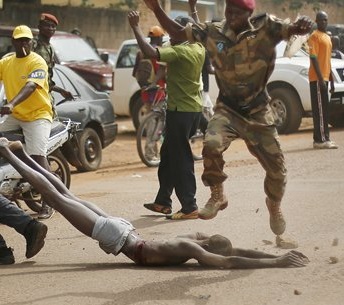
Grisly lynching just minutes after CAR peace promise

car2
Army recruits stomp on a suspected rebel

A group of soldiers in the turbulent Central African Republic capital of Bangui lynched a suspected rebel on Wednesday, minutes after hearing CAR’s new president promise to restore peace at a ceremony reinstating the divided country’s army.

A Reuters witness saw about 20 uniformed soldiers accuse a member of the crowd at a training centre in the capital Bangui of having belonged to Seleka, the mostly Muslim rebel group that seized power in a coup last March.

They then stabbed him repeatedly until he was dead. A soldier stamped on the lifeless body, which was then dragged through the streets, dismembered and set alight as residents looked on and took photographs.

Ten minutes earlier, about 20 metres away, the new interim president, Catherine Samba-Panza, had addressed the crowd of at least 1,000 soldiers at a ceremony meant to re-introduce the army to the nation after it effectively disappeared from view during Seleka’s rule.

“Within a month, I would like to fully secure the greater part of the country, and I aim to stick to my word,” she said.

Samba-Panza was appointed two weeks ago to lead the country until elections are held next February, after coup leader Michel Djotodia stepped down under intense international pressure. She made clear it would take time to restore order.

“At a certain point, everyone will be held responsible for their acts. I am warning troublemakers who continue to sow disorder in the country,” she said.

Seleka’s 10-month occupation of cities and towns across the country has been marked by rampant looting, torture and murder.

The deep resentment they spawned among the Christian majority led to the formation of Christian “anti-balaka” militias, meaning “anti-machete” in the local Sango language, further fanning the flames of inter-religious bloodshed.

About 1 million people, a quarter of the former French colony’s population, have fled their homes. Even the presence of 1,600 French soldiers and 5,000 African troops has so far failed to stop the tit-for-tat violence, which the UN says has already killed more than 2,000 people.

At least 22 people, including 16 women, were killed on Wednesday when Seleka fighters attacked the northwestern city of Nzakone, according to a resident of the village contacted by Reuters.

Chadian peacekeepers have been accused of facilitating the movements of Seleka leaders responsible for a new wave of atrocities.

Many of Seleka’s fighters come from Chad and Sudan, but Chadian officials deny supporting the rebels.

Chadian military officials said on Wednesday they had detained and disarmed 262 fleeing Seleka fighters that had entered Chad, seizing more than 300 weapons, ammunition and a dozen vehicles.

“We didn’t want to give our weapons to the French, so we crossed over to give them to the Chadians,” Seleka’s Colonel Ahmat Abdelkérim Bahar told a Reuters journalist in the town of Doba.

France’s defense minister says the military is likely to extend its mission in Central African Republic.

Jean-Yves Le Drian told RTL radio Thursday that extending the UN-mandated six-month mission was probably the best way to ensure a peaceful political transition.

Source: France24