Republicans are throwing their conservative white base under the bus

Ted Kennedy masterminded America's ethnic transformation

by Georgina Lee

Propaganda is only effective if it tells people what they want to believe, or what they know to be true from their lives’ experiences.

During the 1960s liberal Democrats told white blue-collar workers that the real problem was not crime in the streets but white racism. White blue-collar workers were often the victims of black crime, as were their friends and relatives. They knew what the problem was. They rejected the liberal message, and began voting Republican.

In the 60’s when America was still 90% white and crime was almost non-existent, we were told not to have too many kids that we could not afford. To thinking whites, this made perfect sense as we are an independent lot.

Shortly after that the drunken, belligerent, loudmouth Ted Kennedy told us our demographics would not be affected by immigration.

Now, American politics sits at the side of the cliff with Republicans scrambling and scrounging for any colored vote they can get… all the while throwing their conservative white base under the bus over and over again. Makes no sense to me because to pander to the Latino vote (which they will never get) is political suicide. I see America being run under a Democrat dictatorship for decades to come with only small pockets of Republican rule in the “white flight” areas. I have lived in Southern California my whole life and have seen city after city get taken to ruins by mass influxes of immigrants from third-world cesspools.

Others can have Chinatown and Little Saigon and other sef- imposed “Apartheids” but Damn to Hell the Blue-Eyed Devil for wanting to live among his own kind! Humans are tribal creatures. Perceived “racism” is only a matter of self-preservation – something even animals have a right to.

So yes, to make a long story short – there is massive, massive anger out there, world-wide, at the third-world colonization of Western countries. At first I thought, it was just my being more aware, but there is too much proof that this is real and growing. There is a trends forecaster by the name of Gerald Celente. Back in about 2007, he predicted the riots and anti-immigrant sentiment the world over that is now happening. He ties it in to global financial meltdown (creating more poverty) and the obvious mass influx of immigrants who are a blight to civilized society. This was obviously planned!

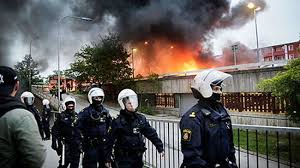
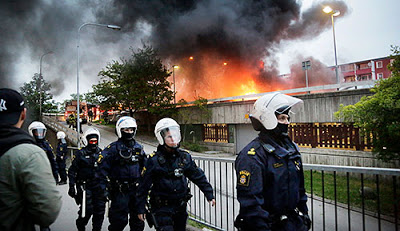
Night 7 in Sweden: Cars ablaze, police attacked

Automobiles were torched and police confronted stone-wielding youths in Stockholm’s suburbs early Sunday as riots, which erupted following reports that police had killed an elderly immigrant, enter their first week.


Pockets of violence and vandalism continue to pose a challenge to police in Stockholm, the Swedish capital that is home to an increasingly diverse 2 million residents. “When it comes to car fires, there have been a few, spread out in various locations, but not as many as in recent days,” Stockholm police spokesperson Lars Bystroem told Swedish Radio.

In Vaarberg, a suburb south of Stockholm, police were attacked by stone-throwing youths, while in Jordbro, another southern neighborhood, police resorted to teargas as they met resistance while attempting to arrest several individuals, AFP reported.

Violence has broken out in other parts of the country as well. In Orebro, a town in central Sweden, some two dozen masked youths set fire to three cars and a school and attempted to torch a police station, Reuters reported, citing police. About 200 km (124 miles) to the southwest in the city of Linkoping, several vehicles were set alight and youths tried to torch a school and a kindergarten.“With the strong presence on the streets of the good forces, and the police reinforcements, I think we are well on our way towards calmer times in the coming days.” The riots began one week ago in Husby, a predominantly immigrant suburb of Stockholm, following the fatal police shooting of an elderly man who police said was brandishing a machete in his home.

Analysts believe the shooting ignited deep-seated frustration among disenfranchised youths – many of whom have not assimilated into Swedish society and are unemployed – who claim to have suffered from police brutality and racism to the country due to its attractive social programs.

The Scandinavian country is ranked as one of Europe’s most popular destinations for immigrants, both in absolute numbers and relative to its size, but critics say the new arrivals are failing to learn even the basic language skills necessary to find employment, and despite free government assistance programs.

Ingrid Carlqvist, editor-in-chief of Dispatch International, told RT that Sweden is an attractive destination for immigrants because the government gives them “money for nothing.”

“For the last 20 years or so, we have seen so many immigrants coming to Sweden [who] really don’t like Sweden,” Carlqvist said. “They don’t want to integrate, they don’t want to live in this society – working and paying taxes, and so on – they come here because they know Sweden will give them money for nothing.

“[The police] could use water cannons, they could [enforce curfews]; there are so many things they could do within the law, but they don’t do it.” The change in Sweden’s domestic dynamics comes at a time when far-right groups are commanding attention across the EU, with many residents furious over austerity measures, high unemployment and the general consensus that the individuals most responsible for triggering the collapse of the global economy have escaped responsibility.

“We have tried harder than any other European country to integrate, spending billions on a welfare system that is designed to help jobless immigrants and guarantee them a good quality of life,” Marc Abramsson, leader of the National Democrats Party, told the Telegraph.

“Yet we have areas where there are ethnic groups that just don’t identify with Swedish society. They see the police and even the fire brigade as part of the state, and they attack them. Multiculturalism does not recognize how humans actually function, Abramsson added, emphasizing that such a stance should not be confused with racism.

According to the OECD, Sweden still ranks among the nine most equal member-states of the organization, but inequality rates surged by one-third between 1985 and 2008 – the largest increase among OECD countries, the organization said in a report released earlier this year. – RT

Sweden struggles with 15% immigrants

Riot police in Husby

The scene of Sweden’s worst riots in years, Husby is on the surface at least a typically neat suburb of colorful playgrounds, manicured parks and low rise apartment buildings.

Conversations with residents of this immigrant neighborhood soon bring tales of fruitless job hunts, police harassment, racial taunts and a feeling of living at the margins that are at odds with Sweden’s reputation for openness and tolerance.

Riots that began in Husby have spread across Stockholm over the last four nights in scenes reminiscent of London in 2011 and Paris in 2005 – outbursts with their roots in segregation, neglect and poverty. The Swedish model of welfare – such as its 480 days of parental leave for each child – hides another side.

Some 15 percent of the population is foreign born, the highest in the Nordic region. The rise of the anti-immigrant Sweden Democrats party, which has called for a curfew in response to the violence, has polarized Swedes.

Metros and trains out of Stockholm center late at night are full of exhausted-looking Arabic or Spanish speaking immigrants returning home from menial jobs. Even second generation immigrants struggle to find white collar employment.

As one Asian diplomat puts it: “On the one hand Sweden has all these immigrants. On the other hand, where are they? It sometimes seems they are mostly selling hotdogs.”

In a further illustration of two very different worlds, the first riot happened as many Swedes celebrated winning the world ice hockey championship. Most immigrants play football – it is a common refrain that ice hockey kits are too expensive.

“The worst vandalism is not what we’ve experienced in recent days,” said community leader Arne Johansson at a protest rally in Husby. “It is the creeping, slow vandalism that this rightist government has exposed us to over the past seven years.”

Seven years of center-right Prime Minister Fredrik Reinfeldt – who has labeled the rioters hooligans – have lowered taxes and reduced state benefits. That has helped economic growth outpace most of Europe but Sweden also has the fastest growing inequality of any OECD nation.

Professor of criminology at Stockholm University Jerzy Sarnecki said society has become much more segregated, with a large, poor immigrant population living in areas of major cities where unemployment is dramatically higher than elsewhere.

Polls show a majority of Swedes still welcome immigration. Sweden has a reputation for treating new arrivals well – providing housing, Swedish lessons and allowing asylum seekers to live with relatives.

But the consensus is increasingly frayed.

“Those who, for whatever reason, don’t have work have not taken part in the general rise in prosperity,” said Ulf Bjereld, political science professor at Gothenburg University.

One recent government study showed up to a third of young people between 16-29 in some of the most deprived areas of Sweden’s big cities neither study nor have a job.

Sweden received 43,900 asylum seekers in 2012, a nearly 50 percent jump from 2011 and the second highest on record. Nearly half were from Syria, Afghanistan and Somalia. Many native Swedes worry welfare could become unaffordable if the trend continues.

Asylum seekers, in the short term, add a fiscal burden on the welfare state. OECD data show foreign-born unemployed rates, at 16 percent, compared with 6 percent for native Swedes. Sweden needs high employment levels to pay for its extensive welfare.

ANGRY, YOUNG MEN

The riots appeared organized. Cars were set alight near pedestrian bridges and youths hurled stones when police and emergency services arrived at the scene.

Witnesses said heavy handed policing made the situation worse. Locals in Husby said they were taunted by police who shouted “ape”.

“In the beginning it was just a bit of fun,” said one young man in his early 20s who did not wish to be named. He was one of a Husby group of 30-40 youths that battled with police.

“But then when I saw the police charging through here with batons, pushing women and children out of the way and swinging their batons, I got so damned angry.”

Police, who have called the rioters youth gangs and criminals, said accusations against the police were being investigated.

In interviews with youths in Husby, most were unemployed or interns. Many said they were bounced around intern schemes, seldom being offered full-time work, fostering resentment.

Local youths believe their Husby address is in part to blame for their lack of success. If they are lucky enough to be called to a job interview, many say they come from neighboring Kista – an IT hub symbolizing Sweden’s more modern, global image.

Many complained a conviction for a small amount of cannabis might stay on a teenager’s record for ten years, ruining job chances.

Stockholm has suffered riots and burning of cars before in recent years, although most fizzle out after one night. Other cities in the Nordic country have also experienced unrest.

Five years ago in Malmo, which has one of Sweden’s biggest immigrant populations, local youths threw home-made bombs and attacked emergency services to protest a police eviction.

In Husby, the shooting of a suspected machete wielding man by police earlier in the month was the spark. Local people – around 80 pct of whom have immigrant backgrounds – organized a peaceful protest for which more than 100 people turned up.

But their call for an inquiry into the death of the 69-year-old fell on deaf ears. Plugged in young locals complained about racist insults on Twitter, feeding anger.

“Young people wound each other up and started a small fire,” said Nefel, a beautician in her 20s. “I saw how the police came and treated them. I was in shock.”

“I was there and saw it happen. I wasn’t struck, but I did have a dog come at me. A police dog isn’t a nice little puppy.”

On the streets, resentment shows no signs of ebbing.

“My daughter comes home from school and says the kids say they can’t play with her because she’s dark,” said Maria Petersson, a 39 year old Ethiopan-born nurse. “I am both Ethiopian and Swedish but I will never be considered Swedish by the Swedes. To them, I am just another immigrant.” – Reuters

Race riots in Stockholm

Gangs of youth angered by the police shooting death of an elderly man in a mainly immigrant neighborhood hurled rocks at police and set cars and buildings on fire in a Stockholm suburb early Monday, forcing the evacuation of an apartment block.

Around 50 youths were involved in the riots in the suburb of Husby, police spokesman Lars Bystrom said.

The youths set light to a parking garage, compelling police to evacuate residents from an adjacent apartment block, Bystrom said. Residents were allowed to return home after a couple of hours.

Around 80 percent of the roughly 11,000 people living in Husby – a drab, low-income neighborhood of apartment blocks west of Stockholm – are first or second generation immigrants.

“Youth” in European news stories is a euphemism for black hooligans. The euphemism “Asian” wasn’t used and is an indication that they are black Africans, probably Somalis. The area where this occurred is 80% non-Swedish.

Bystrom said police responded to calls of burning cars and were met by masked youths hurling rocks at them.

One policeman was attacked by youths kicking him and two others were injured by rocks, local police officer Jorgen Karlsson said. He added around 10 cars were set ablaze, and windows were smashed at two schools and several local businesses.

Karlsson said the dead man was “European,” but couldn’t specify his nationality.

Residents said they had gathered to protest against the shooting death and that police responded by sending in SWAT teams that cordoned off the area.

“I understand that people react like this,” said Rami Al-Khamisi from the organization Megafonen, which represents citizens in Stockholm’s suburbs.

The organization said police had used excessive violence against the youths and also attacked passers-by with batons and dogs.

Police have launched an internal probe to investigate the shooting death on May 13 of a 69-year-old man in Husby. They say they shot the man in self-defense because he had attacked police with a knife when they broke down the door to an apartment, where he had locked himself up with a woman.

However, Megafonen has criticized police for initially releasing a faulty report saying the man was taken to a hospital. The group said residents had seen his dead body being transported from the scene hours after the shooting in a hearse, which police later admitted was correct. SAPA/AP

Neighbours, not brothers

No sooner did President Barack Obama and a group of senators separately outline proposals to revamp the nation’s immigration system than the phone lines on several African-American-oriented talk radio shows heated up with callers blasting the plans.

“Amnesty,” complained Frankie from Maryland recently on the nationally syndicated “Keeping it Real with Al Sharpton.”

A political payback to Hispanic voters that does little or nothing for African-Americans, reasoned Sam from Milwaukee on Wisconsin’s 1290 WMCS AM’s “Earl Ingram Show.”

“Our issues are not being highlighted and pushed, and things like gay marriage and (immigration) are being pushed to the forefront,” the caller said. “Hispanics are effectively organized. For us not to be organized and for us not to hold our leadership accountable is disheartening.”

Although the civil rights establishment, from the National Association for the Advancement of Colored People to the Urban League and Sharpton, squarely back Obama’s desire to tackle immigration, the president’s call has reignited complaints within the African-American community that he is addressing the specific needs of almost all major voting blocs – Hispanics, women, gays – except for the African-Americans who gave him 93 percent of their vote.

Obama is expected to address the immigration issue again Tuesday in his State of the Union address and when he travels to Asheville, N.C., on Wednesday and visits Chicago and suburban Atlanta on Thursday to sell his second-term agenda.

“There (are) clearly different views in the African-American community around immigration,” Sharpton said on his radio show last month. “Some have said they’re (illegal immigrants) taking our jobs, they dilute our strength. Others have said we’ve got to have rights for everybody or we don’t have it for anybody, and this is not just a Latino issue because immigration laws cover the Caribbean, cover Africans, cover South Americans.”

Some angst over Obama addressing immigration and other issues so soon in his second term has boiled over into public criticism of the nation’s first African-American president by many African-Americans, from the grassroots to the political levels.

Bernard Anderson, an Obama supporter and a former assistant labor secretary during Bill Clinton’s presidency, recently told an African-American economic summit at Washington’s Howard University that African-Americans should no longer give Obama “a pass” on dealing with issues that directly impact their community.

“He is not going to run again for anything. He does not deserve a pass anymore,” Anderson said. “Let him not only find his voice but summon his courage and use his political capital to address racial inequality. He owes that to the African-American.”

Some members of the Congressional Black Caucus are quietly seething because Obama hasn’t met with the 42-member group since May 13, 2011. Rep. Alcee Hastings, D-Fla., vented to the National Newspaper Publishers Association last month. He said the black caucus sent the White House the names of 61 potential candidates for positions in a second-term administration that already is coming under fire for being heavy on white males.

“Not one of that 61 was selected – not one,” Hastings told the African-American newspaper publishers at a Fort Lauderdale, Fla., conference.

Obama administration officials reject assertions that the president is race-adverse. Obama has consistently said he takes a “rising tide lifts all boats” approach to governing and that his policies benefit all Americans, not just one group.

“I think comprehensive immigration reform is not about a specific community, it’s about a problem that we need to address as a whole,” White House Press Secretary Jay Carney said last week.

But some African-Americans view Obama’s immigration drive as an overture to Hispanics who helped power his re-election in November with 71 percent of their vote.

“The amount of blacks who are impacted by this legislation is so small it’s infinitesimal,” talk show host Earl Ingram said. “Minuscule.”

A 2009 report by the Migration Policy Institute found that black immigrants from all regions of the world accounted for just 9 percent of the overall immigrant population in the United States.

However, a 2011 report by the same group discovered that blacks from Africa, though just 3 percent of the U.S. foreign-born population, are among the fastest-growing immigrant groups in this country.

From 1980 to 2009, the number of African blacks in the United States has swelled from 64,000 to 1.1 million, according to the 2011 report.

If that growth trend continues, Africa will supplant the Caribbean as the major source region for the U.S. black immigrant population by 2020, the Migration Policy Institute study concludes.

Still, Ingram says many of his listeners see Obama’s attempt to push forward on immigration as a reminder of what the president hasn’t done to improve economic conditions for African-Americans.

“I would say a bulk of my listenership is anti-immigration,” he said. “You have to understand that in the community in which I live the percentage of African-Americans who are unemployed. They look at what’s going on with immigration as an affront to African-Americans who can’t pay their mortgages because many of the immigrants come here, they are hired at less than minimum wage.”

The African-American unemployment rate is at 13.8 percent, according to recently released government figures, nearly twice the 7 percent jobless rate for whites. The nation’s overall unemployment rate is 7.9 percent. For Hispanics, the rate is 9.7 percent.

A 2009 study by George Borjas of Harvard University, Jeffrey Grogger of the University of Chicago and George Hanson of the University of California, San Diego, looked at 1960-2000 Census data and found that as immigrants disproportionately increased the supply of workers in a particular area, wages of African-American workers in that area fell, the employment rate declined and the incarceration rate rose.

“Our analysis suggests that a 10 percent immigration-induced increase in the supply of a particular skill group reduced the black wage by 2.5 percent, lowered the employment rate of black men by 5.9 percentage points, and increased the incarceration rate of blacks by 1.3 percentage points,” the professors wrote in the study.

Todd Shaw, a political science and African-American studies professor at the University of South Carolina, believes “the concern that African Americans are hostile to immigrant workers is a bit overplayed.”

“It’s more a concern about the opportunity ladder than it is the perception that African-Americans don’t think there should be economic fairness to other groups,” Shaw added.

Many civil rights leaders also believe that African-American concerns about the White House and Congress pushing for new immigration laws are overhyped. NAACP President Benjamin Jealous said, “Four out of five black voters are in support of immigration reform.”

But some polls tell a different story. A Pew Research poll released in January found that 56 percent of African-Americans feel there are “very strong” or “strong” conflicts between immigrants and people born in the United States. But perceptions may be improving –January’s figure is a drop from 61 percent in 2009.

A different Pew Hispanic poll found that while all groups of workers have seen gains in employment, Hispanics and Asians have experienced a faster rate of growth than African-Americans and whites.

Hispanic employment increased 6.5 percent between 2009 and 2011, compared with a 2.2 percent increase for African Americans and just 1.1 percent for whites.

The sensitivity of the immigration issue within the African-American community isn’t lost on African-American and Hispanic leaders who are striving for a unified front.

Sharpton and Janet Murguia, president of the National Council of La Raza, an immigration advocacy coalition, walked together to their seats at Obama’s second inauguration ceremony last month.

Murguia has made strengthening ties with the African-American community a key component of her leadership. She was the first Hispanic leader to give the keynote speech at the annual Dr. Martin Luther King Jr. Unity Breakfast in Birmingham, Ala. She marched arm in arm with Sharpton, Jealous and Rep. John Lewis, D-Ga., at last year’s Selma-to-Montgomery march, which focused on voter rights and anti-illegal immigrant laws like those in Alabama.

“I think they see echoes of their own civil rights movement in the struggle to bring equity and dignity to people who are in the shadows,” Murguia said of the black leaders.

They also see political opportunity, said Rep. William Lacy Clay, D-Mo.

“African-American leadership understands, and I understand this clearly, that we must come together with the Latino community and help them address some of their issues so that down the road they help us address ours.”

In poor areas, closeness often means conflict. Los Angeles tallied more than 400 racial hate crimes in 2006—the most, as a proportion of all hate crimes, for at least a decade (see chart). Blacks fared worst: they comprise just 9% of the population of Los Angeles County but were the victims of 59% of all race-hate crimes. Seven times out of ten, their persecutors were Latino. Hispanics, who make up almost half the population, were victimised by blacks eight-tenths of the time. These numbers greatly understate the violence. They do not, for example, include the victims of a dozen interracial prison riots last year, which left two dead.

“We’re being overrun,” says Ted Hayes of Choose Black America, which has led anti-immigration marches in south-central Los Angeles. “The compañeros have taken all the housing. If you don’t speak Spanish they turn you down for jobs. Our children are jumped upon in the schools. They are trying to drive us out.” Not, Mr Hayes emphasises, that he has anything against illegal immigrants personally, or against Mexicans who are in America legally. Indeed, he says, in that useful old phrase, he is friendly with many of them.

Pew, a pollster, found earlier that one-third of blacks believe immigrants take jobs from Americans—more than any other group.

Read more here and here

Native American confronts ‘anti-illegal immigration’

A Native American man criticized protesters at an Arizona rally against illegal immigration, calling them the real “illegals” for invading his country and killing Native Americans when Europeans first settled on US soil.

“You’re all f*cking illegal. You’re all illegal,” the Native American man yelled at the protesters, who had gathered in Tucson, Arizona to demonstrate their opposition to illegal immigration by Central and South Americans. “We didn’t invite none of you here. We’re the only native Americans here.”

Some have applauded the man for pointing out the protesters’ hypocrisy, who at one point immigrated to the US themselves or are descendants of immigrants. The Native American man, who was pushing his baby through town in a stroller, staged his own protest when he came across the rally.

“Get on with your bogus arguments. We’re the only legal ones here,” he yelled.

One protester was caught standing near the angry Native American and became the target of his criticism. The man was carrying a small American flag and a sign that read, “We should have put that sign up when you sons-of-bitches came.”

Pointing towards the American flag held by the protester, the Native American said that it “represents blood spilled by Native Americans, protecting this land from the invaders.”

“You don’t want to hear the God damn truth!” he yelled. “Get on, bitch! All the Native Americans you killed, you plant your houses here. That’s the truth.”

With Arizona’s proximity to the Mexican border, it has long been a hub for anti-immigration protests and initiatives. The state passed the “Support Our Law Enforcement and Safe Neighborhoods Act” in 2010, which is a strict anti-illegal immigration measure that has stimulated significant controversy. The law made it a misdemeanor crime for an “alien” to be in the state of Arizona without carrying registration documents. It also allows law enforcement officers to stop any individual that they suspect of being an illegal immigrant, thereby promoting racial profiling. It also imposes heavy penalties on those involved in sheltering or hiring unregistered aliens.

The law’s controversial provisions were blocked by the US Department of Justice, but the Supreme Court in 2012 ruled to uphold the “show me your papers” provision allowing law enforcement to stop anyone who looks like an illegal immigrant.

But the Native American man who staged his own protest at the rally considers it hypocritical for Americans to criticize others for immigrating into the US when everyone but Native Americans at one point did so themselves.

“That’s what [the American] flag stands for – all the Native Americans you killed to plant your houses here,” he said. “That’s the truth.” – RT

Immigration UK’s ‘biggest challenge’

The British public views immigration as the biggest issue facing society, but UK citizens are basically tolerant to immigration, as long as new arrivals are in work and integrate into society, it was revealed in a poll reported in The Observer.

The poll found that one in three people believes tension between immigrants and UK citizens is a major cause of division, while over half those questioned believe it is one of the top three causes, a major new survey entitled ‘State of the Nation: Where is Bittersweet Britain Heading?’ found out, the British Sunday paper wrote.

Over the past two decades immigration has increased to historically high levels, with 100,000 more people entering than leaving the country every year since 1998.

Sunder Katwala, the director of British Future, the think tank which carried out the survey, said it showed that there was a national anxiety about immigration which politicians needed to address.

However, he pointed out that the results suggested that there was very little relation between the geographical distribution of immigrants and the levels of people’s concern. For example, immigration was regarded as a divisive issue by 19 per cent of people in the north-east of England and 20 per cent of people in Wales. In both areas a 2011 census showed that one in 20 people were born abroad. But in London, where one in three people are immigrants, the number of people who regarded immigration as divisive, still stood at 20 per cent.

“People are obviously very anxious about immigration. But I was struck by how much it was driven by a national rather than a local tension. And I don’t think anyone has any confidence in how it is managed as a system. Also there is concern around national cohesion, identity and ability to cope with the scale of change,” said Katwala.

Other issues considered the three essential traits of a Briton were respect for the law, freedom of speech of others, and an ability to speak English. These came out as the top criteria among all ages and social classes in the survey, which polled 2,515 people aged between 16 and 75. Treating women and men equally and respect for people of all ethnic backgrounds and faiths came fourth, fifth and sixth on the list respectively.

The release of the poll’s results coincides with an upcoming speech by Eric Pickles, the communities secretary, in which he hopes to aid efforts of integration into society. He is expected to stress that knowledge of English is vital to social mobility and for the economy as a whole.

The survey also found that three in four people think that the UK is in a housing crisis, an issue that has been on the political agenda of all parties for a number of years. Current Housing Minister Nick Boles is proposing that green field sites, currently protected by planning law, should be built upon in order to provide much needed new housing stock. All age groups surveyed said that owning your own property is better than renting.

When asked what made people proud to be British, the NHS came top, with 45 per cent of people saying it was the institution they were most proud of. The armed forces came second, with 40 per cent of people saying they made them feel proud to be British, while in light of the Olympics and the Paralympics, 38 per cent said ‘Team GB’.

When people were asked if being born in Britain was important to being British, two thirds said as long as someone has worked here for up to 15 years, they should be allowed access to the welfare state, regardless of where they were born.

Finally, roughly two thirds said they would rather be British than any other nationality in the world, while around 15 per cent said they would rather not be British and 20 per cent neither agreed nor disagreed.

Belgium on high alert ahead of anti-Muslim film’s release

Belgium has heightened its terror alert level ahead of the release of another highly provocative film exploring Islam, reportedly made in cooperation with the notorious Koran-burning US pastor Terry Jones.

­The film’s creator is Pakistan national Imran Firasat, a former Muslim who now lives in Spain. Firasat said he aims to expose the truth of the life of the Prophet Muhammad with ‘The Innocent Prophet: Life of Muhammad from the Point of View of an Ex-Muslim.’

“If we want to know the truth of Islam, we must go deep into the life of Muhammad to find out whether he was a genuine profit sent by God or was he simply a child molester, assassin and a self-proclaimed prophet,” he said in the film’s trailer.

Firasat also hailed pastor Terry Jones as his inspiration. Jones wrote on his website, “It is our hope and desire that we can present a picture of Muhammad that has possibly not been revealed in the past, that will help people in the Western world, and even Muslims, to better understand this person called Muhammad, his life and teachings.”

Jones is infamous for his incendiary anti-Islam speeches, and for staging a ‘Koran-burning day’ on the 10th anniversary of 9/11.

­’The Innocent Prophet’ is expected to be a highly provocative film; Belgian police have raised the country’s ‘terrorism alarm’ level from 2 to 3, the second-highest, ahead of the film’s online release on December 14.

The Belgian Interior Ministry said it was increasing the level to ‘serious threat’ as a precautionary measure, Flanders News reported.

Police units in areas with large numbers of Middle Eastern and North African immigrants are reportedly on alert. Technical divisions of the Belgian police force have also been ordered to closely monitor Islamist websites and mass text messages.

­In response to Belgium’s heightened terror allert, Firasat said he might postpone the release of the film so it could be previewed by authorities to ensure “there is nothing in this movie which doesn’t fall under the right of freedom of expression and that my movie will not cause any kind of loss to humanity.”

“The necessary modification will be also made if requested by the authorities,” he wrote on trailer’s YouTube page. Still, Firasat insisted he is not afraid of “Islamic violence,” and that postponing the release is a token of respect “towards Europe, which is my family.”

Earlier this year, riots broke out in Belgium after the notorious American-made video ‘Innocence of Muslims’ went viral on the web, sparking violent anti-US protests throughout the Arab world.

Why Canada is richer than the US

On July 1, Canada Day, this year, Canadians awoke to a startling, if pleasant, piece of news: For the first time in recent history, the average Canadian is richer than the average American.

According to data from Environics Analytics WealthScapes published in the Globe and Mail, the net worth of the average Canadian household in 2011 was $363,202, while the average American household’s net worth was $319,970.

A few days later, Canada and the U.S. both released the latest job figures. Canada’s unemployment rate fell, again, to 7.2 percent, and America’s was a stagnant 8.2 percent. Canada continues to thrive while the U.S. struggles to find its way out of an intractable economic crisis and a political sine curve of hope and despair.

The difference grows starker by the month: The Canadian system is working; the American system is not. And it’s not just Canadians who are noticing. As Iceland considers switching to a currency other than the krona, its leaders’ primary focus of interest is the loonie — the Canadian dollar.

As a study recently published in the New York University Law Review pointed out, national constitutions based on the American model are quickly disappearing. Justice Ruth Bader Ginsburg, in an interview on Egyptian television, admitted, “I would not look to the United States Constitution if I were drafting a constitution in the year 2012.” The natural replacement? The Canadian Charter of Rights and Freedoms, achieving the status of legal superstar as it reaches its 30th birthday.

Good politics do not account entirely for recent economic triumphs. Luck has played a major part. The Alberta tar sands — an environmental catastrophe in waiting — are the third-largest oil reserves in the world, and if America is too squeamish to buy our filthy energy, there’s always China. We also have softwood lumber, potash and other natural resources in abundance.

Policy has played a significant part as well, though. Both liberals and conservatives in the U.S. have tried to use the Canadian example to promote their arguments: The left says Canada shows the rewards of financial regulation and socialism, while the right likes to vaunt the brutal cuts made to Canadian social programs in the 1990s, which set the stage for economic recovery.

The truth is that both sides are right. Since the 1990s, Canada has pursued a hardheaded (even ruthless), fiscally conservative form of socialism. Its originator was Paul Martin, who was finance minister for most of the ’90s, and served a stint as prime minister from 2003 to 2006. Alone among finance ministers in the Group of Eight nations, he “resisted the siren call of deregulation,” in his words, and insisted that the banks tighten their loan-loss and reserve requirements. He also made a courageous decision not to allow Canadian banks to merge, even though their chief executives claimed they would never be globally competitive unless they did. The stability of Canadian banks and the concomitant stability in the housing market provide the clearest explanation for why Canadians are richer than Americans today.

Martin also slashed funding to social programs. He foresaw that crippling deficits imperiled Canada’s education and health- care systems, which even his Conservative predecessor, Brian Mulroney, described as a “sacred trust.” He cut corporate taxes, too. Growth is required to pay for social programs, and social programs that increase opportunity and social integration are the best way to ensure growth over the long term. Social programs and robust capitalism are not, as so many would have you believe, inherently opposed propositions. Both are required for meaningful national prosperity.

Martin’s balanced policies emerged organically out of Canadian culture, which is fair-minded and rule-following to a fault. The Canadian obsession with order can make for strange politics, at least in an American context. For example, of all the world’s societies, Canada’s is one of the most open to immigrants, as anyone who has been to Toronto or Vancouver will have seen. Yet Canada also imposes a mandatory one-year prison sentence on illegal immigrants, and the majority of Canadians favor deportation. Canadians insist that their compassion be orderly, too.

This immigration policy is neither “liberal” nor “conservative” in the American political sense. It just works. You could say exactly the same thing about Canada’s economic policies.

Canada has been, and always will be, overshadowed by its neighbor, by America’s vastness and its incredible versatility and capacity for reinvention. But occasionally, at key moments, the northern wasteland can surprise. Two hundred years ago last month, the War of 1812 began. Thomas Jefferson declared, “The acquisition of Canada, this year, as far as the neighborhood of Quebec, will be a mere matter of marching.” The U.S. was comparatively enormous — with almost 8 million people, compared with Canada’s 300,000. The Canadians nonetheless turned back the assault.

Through good luck, excellent policy and even some heroism, Canada survived the war. But it has taken 200 years for Canada to become winners.

(Stephen Marche is a novelist and columnist for Esquire Magazine. His most recent book is “How Shakespeare Changed Everything.” The opinions expressed are his own.)

Swiss Ecopop group forces immigration referendum

A group of Swiss environmentalists has collected enough signatures to force a national referendum on immigration.

The Ecopop group says natural resources are under increasing pressure from overpopulation.

It wants annual population growth through immigration capped at 0.2% and a tenth of foreign aid to be used for birth control measures abroad.

Switzerland now has a population of eight million people – almost a quarter of them foreigners.

Ecopop gathered a petition with 120,700 certified signatures – easily passing the 100,000 threshold needed for a referendum on the proposed new law.

“The pressure on land, nature and the countryside is considerable, and quality of life is continuously deteriorating due to a lack of living space,” said Ecopop member Philippe Roch, a former director of the Swiss environment department.

The group insists it is opposed to all forms of xenophobia and racism but says Switzerland must limit immigration to avoid urbanisation and to preserve agricultural land.

Under the Swiss system of direct democracy, referenda take place up to four times a year.

Correspondents say the initiative reflects growing concern in Switzerland about overcrowding. The population has risen by some 15% since 1990.

In April, the Swiss government agreed to re-impose immigration quotas on workers from central and eastern EU countries – a decision criticised by EU officials.

Until 2011, Switzerland had a quota of 2,000 residency permits per year for citizens of the so-called “A8″ nations, which joined the EU in 2004.

The right-wing Swiss People’s Party (SVP), which blames rising rents and crowded transport on immigration, has also gathered enough signatures to force a referendum on tougher immigration quotas. – BBC

Good fences

One of the less heralded, but more successful, projects that have been undertaken recently in Israel is the security fence on the country’s southern border. In October, only 54 illegal African refugees entered Israel—one of the lowest numbers in many years, and a far cry from the 1,000 to 2,000 and more that entered the country each month over the past few years.

Last October, for example, 2,100 illegals were estimated to have entered Israel. Only a few were caught as they crossed the then-wide open border. Since then, the security fence on the border with Sinai has rapidly been built, and currently some 80% of the border is protected. In areas where construction is going on, the IDF has sharply increased patrols. At this point, the vast majority of illegals are caught before they enter Israel, and are immediately taken into custody for deportation to their homelands. Word that Israel’s gates are closing tight has apparently seeped back to Sudan, Eritrea, and other African countries, and now there are far fewer attempts to cross the border.

In addition to the increased protection, the Interior Ministry, led by Eli Yishai, has conducted a strong campaign to deport illegals, or at least persuade them to go home voluntarily. Using a mixture of carrots and sticks, with payments to illegals who leave for good and months-long detention at camps in the Negev, the illegal alien population has been slowly but surely dwindling. Yishai has been quoted as saying that if the current pace of enforcement is kept up, Israel could be free of illegal African aliens within just a few years. However, that could take some time—as the Population Registry estimates that there are still over 10,000 illegal Africans in the country.

Besides holding back the tide of illegals, the security fence has helped limit smuggling of drugs and other illegal items by Bedouin. In August, a terror cell killed 16 Egyptian soldiers as they attempted to blow up a portion of the security fence and enter Israel. IDF forces destroyed a jeep that managed to get through, on its way to carry out a terror attack at a border area community. – Israel National News

Landslide victory for Flemish nationalists

Bart de Wever

Flemish nationalists made sweeping gains across northern Belgium in local elections on Sunday, a success that will bolster separatists’ hopes for a break-up of the country.

Bart de Wever, leader of the New Flemish Alliance (NVA), is set to become mayor of the northern city of Antwerp, Belgium’s economic heartland, after his party emerged as the largest one ending about 90 years of socialist rule.

Soon after the ballot results emerged, Mr De Wever, who had turned the tough mayoral race into a referendum on Flander’s independence for Belgium, demanded that the country’s prime minister give greater independence to the Dutch-speaking north.

“De Wever sent a strong signal to Brussels and he has put his party on course to send an even clearer one in 2014 … they will try to go for an even bigger win in the federal elections,” said a veteran political analyst for the Gazet Van Antwerpen.

“We want to give Flemish people the government they want at all levels. That is why I call on Elio Di Rupo and the francophone politicians. Take up your responsibility,” said De Wever.

The strong result recorded by the Flemish nationalists is likely to have an impact across Europe, where the sovereign debt crisis, which has seen rich countries bail out poor ones, has revived separatist sentiment throughout the continent.

Flanders, which is the most economically prosperous region of Belgium, has long resented financing the ailing economy of French-speaking Wallonia, and Sunday’s victory will strengthen their demand for self-rule.

Lieven De Winter, a political scientist at Université Catholique de Louvain, said that Mr De Wever’s victory was a clear step forward for separatist who had long been campaigning for secession from the southern part of the country. However, he warned that the process towards accomplishing a break-up would be wrath of problems.

“There is no doubt that tonight De Wever made a small step towards completing his dream of a break-up but there are many obstacles ahead … at the end of the day you need two to tango,” Mr De Winter said.

NVA won about 38 per cent of votes in Antwerp against about 28 per cent secured by the Socialists, according to provisional Flanders government data. Meanwhile, in the rest of the northern region the Flemish nationalists won more than 30 per cent of support.

NVA is expected to seek the support of the Socialists to run Antwerp – in Belgium it is common for opposing parties to form a coalition after elections as no one party enjoys an outright majority throughout the country.

Belgium consists of Dutch-speaking Flanders, francophone Wallonia and Brussels, its bilingual capital. The Socialists have tried to keep Brussels French through Arab immigration. Political powers have already been devolved to regional governments, Flanders, in more populous with about 6m people compared with 3.5m in Wallonia.

NVA’s victory in Antwerp and strong result across the north of Belgium will give good momentum to the separatists in the run-up to the key federal elections in 2014, said analysts. – FT


Breivik’s mother ‘sexualised’ him at four

Breivik with half-sister and mother

“The mother and Anders sleep in the same bed at night with very close bodily contact,” psychologists from Norway’s centre for child and youth psychiatry (SSBU), reported after Breivik and his mother spent several weeks there in 1983.

The reports also show that when Breivik was just four-years-old, his mother became preoccupied with fears that her son would violently assault someone. By the time he was four years old, she “sexualised” the young Breivik, hit him, and frequently told him that she wished that he were dead.

“She saw him as an adult violent person, even though he was only a small boy,” said Aage Borchgrevink, author of A Norwegian tragedy. “She was afraid that he would assault people.”

The psychologist reports show that Wenche Behring already felt her son was “aggressive, hyperactive and clingy,” when she was breastfeeding him.

The family’s neighbours at the time became worried about her inappropriate sexual behaviour.

“During the police investigation, the neighbours also said that they had been shocked by the mother’s sexualised language,” Borchgrevink writes. “There was a lot of fighting in the apartment and they remembered sexual activity taking place while the children were in there.”

The SSBU report described Ms Behring as “a woman with an extremely difficult upbringing, borderline personality structure and an all-encompassing if only partially visible depression” who “projects her primitive aggressive and sexual fantasies onto him [Breivik]”.

The psychologists reported that she would frequently tell her son that she wished he would die.

“She shifts very quickly between speaking to him with a sugary voice and openly expressing a death wish,” they wrote.

When she smacked him in an attempt to exert control, the four-year-old would taunt her that the blows did not hurt, smiling in a way she found “condescending, inappropriate and derisive”.

Borchgrevink, a novelist, has faced criticism in Norway for his decision to publish excerpts from the reports, with some accusing him of violating the privacy of Ms Behring, who was admitted to a psychiatric ward the day after her son killed 77 people in his bomb and gun rampage in July 2011.

Ms Behring was excused from testifying in the trial this summer on health grounds, and refused to give permission for the psychologist who examined the family in 1983 and 1984 to give evidence, preventing the information published last week from being heard in court.

After Breivik’s father Jens Breivik lost a child custody case with Ms Behring, social workers recommended that the boy nonetheless be removed from his mother to prevent “more severe psychopathology” from developing, a request that was ignored.

Borchgrevink said it was this that had convinced him that he was right to publish.

“I’ve given more weight to the public interest. The fact is that he was actually caught by the system before the action, not by the security police, but in his childhood. He was within the system, but the system let him go.”

Breivik was sentenced to 21 years in jail for his attack in August, which he claimed was “necessary” to alert Norway to the threat posed by Islamic immigration. – Richard Orange

The Great California Exodus

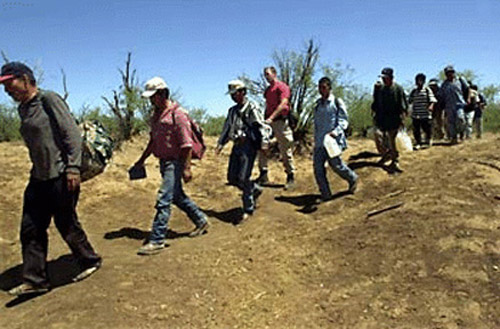
Mexicans heading for the Golden State

For decades after World War II, California was a destination for Americans in search of a better life. In many people’s minds, it was the state with more jobs, more space, more sunlight, and more opportunity. They voted with their feet, and California grew spectacularly (its population increased by 137 percent between 1960 and 2010). However, this golden age of migration into the state is over. For the past two decades, California has been sending more people to other American states than it receives from them. Since 1990, the state has lost nearly 3.4 million residents through this migration.

This study describes the great ongoing California exodus, using data from the Census, the Internal Revenue Service, the state’s Department of Finance, the Bureau of Labor Statistics, the Federal Housing Finance Agency, and other sources. We map in detail where in California the migrants come from, and where they go when they leave the state. We then analyze the data to determine the likely causes of California’s decline and the lessons that its decline holds for other states.

The data show a pattern of movement over the past decade from California mainly to states in the western and southern U.S.: Texas, Nevada, and Arizona, in that order, are the top magnet states. Oregon, Washington, Colorado, Idaho, and Utah follow. Rounding out the top ten are two southern states: Georgia and South Carolina.

A finer-grained regional analysis reveals that the main current of migration out of California in the past decade has flowed eastward across the Colorado River, reversing the storied passages of the Dust Bowl era. Southern California had about 55 percent of the state’s population in 2000 but accounted for about 65 percent of the net out-migration in the decade that followed. More than 70 percent of the state’s net migration to Texas came from California’s south.

What has caused California’s transformation from a “pull in” to a “push out” state? The data have revealed several crucial drivers. One is chronic economic adversity (in most years, California unemployment is above the national average). Another is density: the Los Angeles and Orange County region now has a population density of 6,999.3 per square mile—well ahead of New York or Chicago. Dense coastal areas are a source of internal migration, as people seek more space in California’s interior, as well as migration to other states. A third factor is state and local governments’ constant fiscal instability, which sends at least two discouraging messages to businesses and individuals. One is that they cannot count on state and local governments to provide essential services—much less, tax breaks or other incentives. Second, chronically out-of-balance budgets can be seen as tax hikes waiting to happen.

[ad 1]

The data also reveal the motives that drive individuals and businesses to leave California. One of these, of course, is work. States with low unemployment rates, such as Texas, are drawing people from California, whose rate is above the national average. Taxation also appears to be a factor, especially as it contributes to the business climate and, in turn, jobs. Most of the destination states favored by Californians have lower taxes. States that have gained the most at California’s expense are rated as having better business climates. The data suggest that many cost drivers—taxes, regulations, the high price of housing and commercial real estate, costly electricity, union power, and high labor costs—are prompting businesses to locate outside California, thus helping to drive the exodus.

Population change, along with the migration patterns that shape it, are important indicators of fiscal and political health. Migration choices reveal an important truth: some states understand how to get richer, while others seem to have lost the touch. California is a state in the latter group, but it can be put back on track. All it takes is the political will.