The West on the wrong path

The politics of escalation does not have a realistic goal

By Gabor Steingart.

Every war is accompanied by a kind of mental mobilization: war fever. Even smart people are not immune to controlled bouts of this fever. “This war in all its atrociousness is still a great and wonderful thing. It is an experience worth having“ rejoiced Max Weber in 1914 when the lights went out in Europe. Thomas Mann felt a “cleansing, liberation, and a tremendous amount of hope“.

Even when thousands already lay dead on the Belgian battle fields, the war fever did not subside. Exactly 100 years ago, 93 painters, writers, and scientists composed the “Call to the world of culture.“ Max Liebermann, Gerhart Hauptmann, Max Planck, Wilhelm Röntgen, and others encouraged their countrymen to engage in cruelty towards their neighbor: “Without German militarism, German culture would have been swept from the face of the earth a long time ago. The German armed forces and the German people are one. This awareness makes 70 million Germans brothers without prejudice to education, status, or party.“

We interrupt our own train of thought: “History is not repeating itself!” But can we be so sure about that these days? In view of the war events in the Crimean and eastern Ukraine, the heads of states and governments of the West suddenly have no more questions and all the answers. The US Congress is openly discussing arming Ukraine. The former security advisor Zbigniew Brzezinski recommends arming the citizens there for house-to-house and street combat. The German Chancellor, as it is her habit, is much less clear but no less ominous: “We are ready to take severe measures.“

German journalism has switched from level-headed to agitated in a matter of weeks. The spectrum of opinions has been narrowed to the field of vision of a sniper scope.

Newspapers we thought to be all about thoughts and ideas now march in lock-step with politicians in their calls for sanctions against Russia’s President Putin. Even the headlines betray an aggressive tension as is usually characteristic of hooligans when they ‘support’ their respective teams.

The Tagesspiegel: “Enough talk!“ The FAZ: “Show strength“. The Süddeutsche Zeitung: “Now or never.“ The Spiegel calls for an “End to cowardice“: “Putin’s web of lies, propaganda, and deception has been exposed. The wreckage of MH 17 is also the result of a crashed diplomacy.“

Every reflexive string of accusations results in the same outcome: in no time allegations and counter-allegations become so entangled that the facts become almost completely obscured.

Who deceived who first?

Did it all start with the Russian invasion of the Crimean or did the West first promote the destabilization of the Ukraine? Does Russia want to expand into the West or NATO into the East? Or did maybe two world-powers meet at the same door in the middle of the night, driven by very similar intentions towards a defenseless third that now pays for the resulting quagmire with the first phases of a civil war?

If at this point you are still waiting for an answer as to whose fault it is, you might as well just stop reading. You will not miss anything. We are not trying to unearth this hidden truth. We don’t know how it started. We don’t know how it will end. And we are sitting right here, in the middle of it. At least Peter Sloterdijk has a few words of consolation for us: “To live in the world means to live in uncertainty.“

Our purpose is to wipe off some of the foam that has formed on the debating mouths, to steal words from the mouths of both the rabble-rousers and the roused, and put new words there instead. One word that has become disused of late is this: realism.

The politics of escalation show that Europe sorely misses a realistic goal. It’s a different thing in the US. Threats and posturing are simply part of the election preparations. When Hillary Clinton compares Putin with Hitler, she does so only to appeal to the Republican vote, i.e. people who do not own a passport. For many of them, Hitler is the only foreigner they know, which is why Adolf Putin is a very welcome fictitious campaign effigy. In this respect, Clinton and Obama have a realistic goal: to appeal to the people, to win elections, to win another Democratic presidency.

Angela Merkel can hardly claim these mitigating circumstances for herself. Geography forces every German Chancellor to be a bit more serious. As neighbors of Russia, as part of the European community bound in destiny, as recipient of energy and supplier of this and that, we Germans have a clearly more vital interest in stability and communication. We cannot afford to look at Russia through the eyes of the American Tea Party.

Every mistake starts with a mistake in thinking. And we are making this mistake if we believe that only the other party profits from our economic relationship and thus will suffer when this relationship stops. If economic ties were maintained for mutual profit, then severing them will lead to mutual loss. Punishment and self-punishment are the same thing in this case.

Even the idea that economic pressure and political isolation would bring Russia to its knees was not really thought all the way through. Even if we could succeed: what good would Russia be on its knees? How can you want to live together in the European house with a humiliated people whose elected leadership is treated like a pariah and whose citizens you might have to support in the coming winter.

Of course, the current situation requires a strong stance, but more than anything a strong stance against ourselves. Germans have neither wanted nor caused these realities, but they are now our realities. Just consider what Willy Brandt had to listen to when his fate as mayor of Berlin placed him in the shadow of the wall. What sanctions and punishments were suggested to him. But he decided to forgo this festival of outrage. He never turned the screw of retribution.

When he was awarded the Noble Prize for Peace he shed light on what went on around him in the hectic days when the wall was built: “There is still another aspect – that of impotence disguised by verbalism: taking a stand on legal positions which cannot become a reality and planning counter-measures for contingencies that always differ from the one at hand. At critical times we were left to our own devices; the verbalists had nothing to offer.“

The verbalists are back and their headquarters are in Washington D.C. But nobody is forcing us to kowtow to their orders. Following this lead – even if calculatingly and somewhat reluctantly as in the case of Merkel – does not protect the German people, but may well endanger it. This fact remains a fact even if it was not the American but the Russians who were responsible for the original damage in the Crimean and in eastern Ukraine.

Willy Brandt decided clearly differently than Merkel in the present, and that in a clearly more intense situation. As he recalls, he had awoken on the morning of August 13, 1961 “wide awake and at the same time numb“. He had stopped over in Hanover on a trip when he received reports from Berlin about work being done on the large wall separating the city. It was a Sunday morning and the humiliation could hardly be greater for a sitting mayor.

The Soviets had presented him with a fait accompli. The Americans had not informed him even though they had probably received some information from Moscow. Brandt remembers that an “impotent rage“ had risen in him. But what did he do? He reined in his feelings of impotence and displayed his great talent as reality-based politician which would garner him a stint as Chancellor and finally also the Nobel Prize for Peace.

With the advice from Egon Bahr, he accepted the new situation, knowing that no amount of outrage from the rest of the world would bring this wall down again for a while. He even ordered the West-Berlin police to use batons and water cannons against demonstrators at the wall in order not to slip from the catastrophe of division into the much greater catastrophe of war. He strove for the paradox which Bahr put as follows later: “We acknowledged the Status Quo in order to change it.“

And they managed to accomplish this change. Brandt and Bahr made the specific interests of the West Berlin population for who they were now responsible (from June 1962 onwards this also included this author) into the measure of their politics.

In Bonn they negotiated the Berlin subvention, an eight-percent tax-free subvention on payroll and income tax. In the vernacular it was called the “fear premium“. They also negotiated a travel permit treaty with East Berlin which made the wall permeable again two years after it was put up. Between Christmas 1963 and New Year’s 1964, 700 000 inhabitants of Berlin visited their relatives in the east of the city. Every tear of joy turned into a vote for Brandt a short while later.

The voters realized that here was someone who wanted to affect the way they lived every day, not just generate a headline for the next morning. In an almost completely hopeless situation, this SPD man fought for western values – in this case the values of freedom of movement – without bullhorns, without sanctions, without the threat of violence. The elite in Washington started hearing words that had never been heard in politics before: Compassion. Change through rapprochement. Dialog. Reconciliation of interests. And this in the middle of the Cold War, when the world powers were supposed to attack each other with venom, when the script contained only threats and protestations; set ultimatums, enforce sea blockades, conduct representative wars, this is how the Cold War was supposed to be run.

A German foreign policy striving for reconciliation – in the beginning only the foreign policy of Berlin – not only appeared courageous but also very strange.

The Americans – Kennedy, Johnson, then Nixon – followed the German; it kicked off a process which is unparalleled in the history of enemy nations. Finally, there was a meeting in Helsinki in order to set down the rules. The Soviet Union was guaranteed “non-interference into their internal affairs“ which filled party boss Leonid Brezhnev with satisfaction and made Franz Josef Strauß’s blood boil. In return, the Moscow Communist Party leadership had to guarantee the West (and thus their own civil societies) “respect of human rights and fundamental freedoms, including that of thought, conscience, religion or belief“.

In this way “non-interference“ was bought through “involvement“. Communism had received an eternal guarantee for its territory, but within its borders universal human rights suddenly began to brew. Joachim Gauck remembers: “The word that allowed my generation to go on was Helsinki.“

It is not too late for the duo Merkel/Steinmeier to use the concepts and ideas of this time. It does not make sense to just follow the strategically idea-less Obama. Everyone can see how he and Putin are driving like in a dream directly towards a sign which reads: Dead End.

“The test for politics is not how something starts but how it ends“, so Henry Kissinger, also a Peace Nobel Prize winner. After the occupation of the Crimean by Russia he stated: we should want reconciliation, not dominance. Demonizing Putin is not a policy. It is an alibi for the lack thereof. He advises condensing conflicts, i.e. to make them smaller, shrink them, and then distill them into a solution.

At the moment (and for a long time before that) America is doing the opposite. All conflicts are escalated. The attack of a terror group named Al Qaida is turned into a global campaign against Islam. Iraq is bombed using dubious justifications. Then the US Air Force flies on to Afghanistan and Pakistan. The relationship to the Islamic world can safely be considered damaged.

If the West had judged the then US government which marched into Iraq without a resolution by the UN and without proof of the existence of “WMDs“ by the same standards as today Putin, then George W. Bush would have immediately been banned from entering the EU. The foreign investments of Warren Buffett should have been frozen, the export of vehicles of the brands GM, Ford, and Chrysler banned.

The American tendency to verbal and then also military escalation, the isolation, demonization, and attacking of enemies has not proven effective. The last successful major military action the US conducted was the Normandy landing. Everything else – Korea, Vietnam, Iraq, and Afghanistan – was a clear failure. Moving NATO units towards the Polish border and thinking about arming Ukraine is a continuation of a lack of diplomacy by the military means.

This policy of running your head against the wall – and doing so exactly where the wall is the thickest – just gives you a head ache and not much else. And this considering that the wall has a huge door in the relationship of Europe to Russia. And the key to this door is labeled “reconciliation of interests“.

The first step is what Brandt called “compassion“, i.e. the ability to see the world through the eyes of the others. We should stop accusing the 143 million Russian that they look at the world differently than John McCain.

What is needed is help in modernizing the country, no sanctions which will further decrease the dearth of wealth and damage the bond of relationships. Economic relationships are also relationships. International cooperation is akin to tenderness between nations because everyone feels better afterwards.

It is well-known that Russia is an energy super-power and at the same time a developing industrial nation. The policy of reconciliation and mutual interests should attack here. Development aid in return for territorial guarantees; Foreign Minister Frank-Walter Steinmeier even had the right words to describe this: modernization partnership. He just has to dust it off and use it as an aspirational word. Russia should be integrated, not isolated. Small steps in that direction are better than the great nonsense of exclusionary politics.

Brandt and Bahr have never reached for the tool of economic sanctions. They knew why: there are no recorded cases in which countries under sanctions apologized for their behavior and were obedient ever after. On the contrary: collective movements start in support of the sanctioned, as is the case today in Russia. The country was hardly ever more unified behind their president than now. This could almost lead you to think that the rabble-rousers of the West are on the payroll of the Russian secret service.

One more comment about the tone of the debate. The annexation of the Crimean was in violation of international law. The support of separatists in eastern Ukraine also does not mesh with our ideas of the state sovereignty. The boundaries of states are inviolable.

But every act requires context. And the German context is that we are a society on probation which may not act as if violations of international law started with the events in the Crimean.

Germany has waged war against its eastern neighbor twice in the past 100 years. The German soul, which we generally claim to be on the romantic side, showed its cruel side.

Of course, we who came later can continue to proclaim our outrage against the ruthless Putin and appeal to international law against him, but the way things are this outrage should come with a slight blush of embarrassment. Or to use the words of Willy Brandt: “Claims to absolutes threaten man.“

In the end, even the men who had succumbed to war fever in 1914 had to realize this. After the end of the war, the penitent issued a second call, this time to understanding between nations: “The civilized world became a war camp and battle field. It is time that a great tide of love replaces the devastating wave of hatred.“

We should try to avoid the detour via the battle fields in the 21st century. History does not have to repeat itself. Maybe we can find a shortcut.

Gabor Steingart is the publisher of Germany’s leading financial newspaper Handelsblatt.
Many more injured in German train collision

At least 35 people were reported hurt, four of them sustaining grave injuries, as two cars of a passenger train tipped over following its collision with a freight train on Friday night near the city of Mannheim in the southwest of Germany, AFP news agency reported on Saturday.

At least 12 reported hurt after two trains collide in Germany’s southwest

Previous reports assessed the number of injured in the accident at 12.

The two tipped-over cars of the Eurocity speed train en route from Austria’s Graz to Germany’s destination of Saarbruecken on border with France carried a total of 110 passengers at the time of the accident, which took place at around 19:00 GMT near Mannheim’s main station.

According to various reports, the accident did not result in graver consequences, in terms of human casualties, as the trains moved slowly at the time of their collision near Mannheim’s station, which is also one of the country’s major railway junctions.

AP news agency reported citing Germany’s national railway, Deutsche Bahn, that a total of five cars of the passenger train derailed with two of them tipping over and the emergency services evacuated approximately 250 people from the train following its collision with the freight train.

German officer to serve as US Army Europe’s chief of staff

A German Army brigadier general who recently served with NATO forces in Afghanistan is assuming duties as the chief of staff of U. S. Army Europe, the first time a non-American officer has held that position.

Brig. Gen. Markus Laubenthal, most recently the commander of Germany’s 12th Panzer Brigade in Amberg, and chief of staff of Regional Command North, International Security Assistance Force Afghanistan, will be stationed at USAREUR headquarters, Wiesbaden, Germany. He could report to duty as early as Monday.

Laubenthal also has served as military assistant to the deputy commander of operations and assistant chief of staff of operations for NATO forces in Kosovo.

As the major staff assistant to USAREUR commander Lt. Gen. Donald Campbell, Laubenthal will synchronize the command’s staff activities much as American predecessors have in the past.

“This is a bold and major step forward in USAREUR’s commitment to operating in a multinational environment with our German allies,” said Campbell.

“U.S. and German senior military leaders have been serving together in NATO’s International Security Assistance Force in Afghanistan for years. Sustaining the shared capability from this experience will benefit both the U. S. and German armies,” said Campbell who has headed the Army’s largest and oldest overseas command since 2012.

Source: Armytimes

Merkel, Putin in secret deal to end Ukraine tensions

Germany and Russia have been working on a secret plan to broker a peaceful solution to end international tensions over the Ukraine.

The Independent can reveal that the peace plan, being worked on by both Angela Merkel and Vladimir Putin, hinges on two main ambitions: stabilising the borders of Ukraine and providing the financially troubled country with a strong economic boost, particularly a new energy agreement ensuring security of gas supplies.

More controversially, if Ms Merkel’s deal were to be acceptable to the Russians, the international community would need to recognise Crimea’s independence and its annexation by Russia, a move that some members of the United Nations might find difficult to stomach.

Sources close to the secret negotiations claim that the first part of the stabilisation plan requires Russia to withdraw its financial and military support for the various pro-separatist groups operating in eastern Ukraine. As part of any such agreement, the region would be allowed some devolved powers.

At the same time, the Ukrainian President would agree not to apply to join Nato. In return, President Putin would not seek to block or interfere with the Ukraine’s new trade relations with the European Union under a pact signed a few weeks ago.

Second, the Ukraine would be offered a new long-term agreement with Russia’s Gazprom, the giant gas supplier, for future gas supplies and pricing. At present, there is no gas deal in place; Ukraine’s gas supplies are running low and are likely to run out before this winter, which would spell economic and social ruin for the country.

Vladimir Putin at a natural gas pipeline in Vladivostok in Russia’s far east in 2011 (Getty) Vladimir Putin at a natural gas pipeline in Vladivostok in Russia’s far east in 2011 (Getty)
As part of the deal, Russia would compensate Ukraine with a billion-dollar financial package for the loss of the rent it used to pay for stationing its fleets in the Crimea and at the port of Sevastopol on the Black Sea until Crimea voted for independence in March.

However, these attempts by Ms Merkel to act as a broker between President Putin and the Ukraine’s President, Petro Poroshenko, were put on the back-burner following the shooting down of the MH17 plane in eastern Ukraine.

But insiders who are party to the discussions said yesterday that the “German peace plan is still on the table and the only deal around. Negotiations have stalled because of the MH17 disaster but they are expected to restart once the investigation has taken place.”

Source: The Independent

BP, Siemens, Renault face downturn on EU sanctions

BP Plc (BP/), Siemens AG (SIE) and Renault SA (RNO) are among European companies preparing for a downward turn in their Russian business following the European Union’s decision to impose its widest-ranging sanctions yet over President Vladimir Putin’s involvement in eastern Ukraine.

EU leaders announced plans yesterday to restrict the export to Russia of equipment to modernize the oil industry and forbid the sale of machinery, electronics and other civilian products with potential military uses. New arms contracts with Russia are also not allowed.

The sanctions will have a direct impact on companies like Siemens, which may no longer be able to sell oil equipment to Russia, and an indirect effect on many others like Renault, which expects the country’s auto market to contract more than 10 percent in 2014 as consumers hold back purchases. BP, owner of 20 percent of state-backed OAO Rosneft (ROSN), yesterday warned of risks to its profit and production due to the crisis.

“In Europe, for some companies this is becoming a major problem, and they can see it becoming an even bigger one,” said Andrew Kenningham, an economist at research firm Capital Economics. “The long-term impact of a standoff, if it continues, is clearly very bad for business confidence and future investment in Russia.”

Despite targeting oil production, the EU sanctions have steered clear of the natural-gas sector — leaving unscathed so far companies like BASF SE, the world’s biggest chemical producer, which gets about half its natural gas from state-controlled Gazprom, and other utilities like E.ON AG (TAG1Y) and RWE AG. On average, EU countries get 24 percent of their gas from Russia, according to Deutsche Bank — meaning that confronting Gazprom could result in supply cut-offs.

Source: Bloomberg

Berlin fingers NATO for ATC blackouts

The German government has indicated that NATO electronic warfare (EW) training exercises were responsible for civilian ATC radar display blackouts in central Europe on 5 June and 10 June 2014.

IHS Jane’s has obtained the government’s answer to a parliamentary question on 17 July, in which it noted that: “In the relevant time period two separate exercises by NATO forces with EW assets were conducted, in the first case by the Hungarian Air Force and in the second by the Italian Army and [undisclosed] partners.”

Both exercises involved ground-based air defence radar assets and were held under the NATO Electronic Warfare Integration Period programme. The German government statement said this is “especially dedicated to test and train EW in the airspace. Further details at the moment cannot be given, as investigations by EASA and NATO are ongoing”.

Informed by IHS Jane’s about the German information, an Austrian Air Force official would not disclose if Austria was informed about NATO EW activities in its airspace. The official emphasised that during the June incidents, the Air Force retained full coverage of Austrian airspace with its Kreidfeuer situational awareness picture, which is provided by three fixed Selex ES RAT-31L primary radars.

Source: IHS Jane’s

Merkel orders surveillance of US and UK

Chancellor Angela Merkel has ordered her counter-espionage services to begin surveillance of British and American intelligence gathering in Germany for the first time since 1945 in response to a series of US spy scandals which have badly soured relations between Berlin and Washington.

The Süddeutsche Zeitung and two-state funded German TV channels, WDR and NDR, quoted an unnamed Berlin government source who said Ms Merkel’s Chancellery and her interior and foreign ministries had agreed to launch counter-espionage measures against Britain and the US for the first time.

“Right now we need to send a strong signal,” the Süddeutsche Zeitung quoted the source as saying. The extraordinary measures are a direct response to a series of embarrassing US and British spying scandals in Germany which began last year with revelations that the US National Security Agency had bugged Ms Merkel’s mobile phone.

The Chancellor protested on several occasions that she was “not amused” by the disclosures

The Independent subsequently revealed that like the Americans, Britain was operating a secret GCHQ listening post from the top of its Berlin embassy. A similar listening post on the roof of the US embassy in Berlin was almost certainly used to eavesdrop on Ms Merkel’s phone.

Source: The Independent

Faith in Obama drops sharply in South Africa, Russia, Germany due to US spying, Ukraine crisis

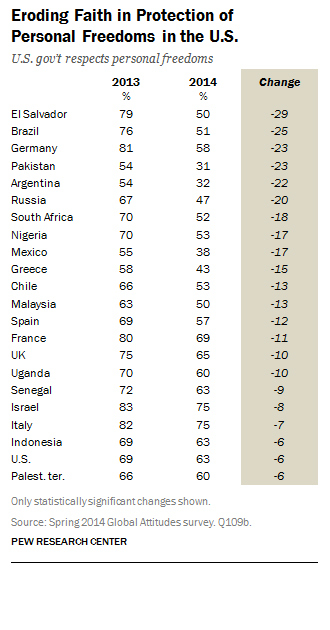
Only 52% of South Africans believe that the USA take the protection of personal freedoms seriously. Overt the past year, the percentage of South Africans who still believe in the American president Barack Obama has dropped by 18 percentage points.

Citizens of other BRICS countries, such as Russians and Brazilians have also become suspicious of US motives, following upon revelations of the National Security Agency’s global spy program, together with civil strife in Ukraine. In Germany, faith in the USA has slumped by a whopping 23 percentage points.

Thanks to a series of global scandals, the United States in general, and its commander-in-chief in particular, have suffered a drop in favorability among the majority of countries polled by Pew Research.

“In 22 of 36 countries surveyed in both 2013 and 2014, people are significantly less likely to believe the US government respects the personal freedoms of its citizens,” the report said.

pew_table1
Spring 2014 Global Attitudes Survey, Pew Research

Among privacy-loving Germans – many of whom have even refused to allow the Google Maps car to film their homes – Obama’s reputation nosedived when it was revealed that the NSA was collecting communication metadata not only on average Germans, but also on Chancellor Angela Merkel, whose personal mobile phone had been hacked by US intelligence.

Germans’ confidence in Obama sunk to 71 percent, 17 points down from 2013.

Tensions between NATO’s two biggest members escalated this month German authorities arrested a Defense Ministry official suspected of passing secrets to the US. This shocking incident came just one week after the arrest of a German intelligence officer who worked as a double agent for the Americans.

German authorities took the unprecedented step of ordering the expulsion of the Berlin CIA station chief.

“Revelations that Washington systematically reads both Americans’ and some foreigners’ emails and listens in on their telephone conversations appears to have significantly damaged Obama’s approval in only one European Union country: Germany,” Pew reported.

Brazilians’ confidence in the first black American leader dropped from 69 percent in 2013 to 52 percent presently.

Brazilian President Dilma Rousseff, who was also the victim of NSA snooping on her personal communications, expressed her anger at those revelations by canceling an official visit to Washington in October.

Finally, Russia, which is watching neighboring Ukraine teeter on the edge of full-blown civil war, sees an American hand provoking the situation behind the scenes, especially after former Ukrainian President Viktor Yanukovich decided against signing as association agreement with the European Union in favor of stronger ties with Moscow.

The decision by sparked a violent showdown in the capital Kiev, which has led to nationwide civil strife that continues today.

“Russian faith in Obama, already quite low in 2013, is down 14 points (to 15 percent), a likely casualty of the Ukraine confrontation,” Pew said.

Meanwhile, America’s once invincible reputation for protecting individual liberties has suffered a major reality check following damning revelations about the extent of NSA surveillance from whistleblower Edward Snowden, presently living in Russia, where he has been granted asylum.

Belief that the US government respects personal freedoms plummeted 25 points in Brazil to 50 percent over the last year; 23 points in Germany to 58 percent; 20 points to 40 percent in Russia; and 11 points to 69 percent in France. Meanwhile, even the United Kingdom, a trusted ally, appears to have experienced a chilling effect by America’s recent naughtiness, dropping 10 points to 65 percent.

US drone strikes have also struck a negative chord among allies and enemies alike, including in NATO member states like Britain, France and Spain. In 37 of 44 surveyed countries, half or more of the public expressed disapproval of drone attacks.

France, Germany, Italy block US sanctions on Russia

France, Germany, and Italy are among EU members who don’t want to follow the US lead and impose trade sanctions on Russia. US sanctions are seen as a push to promote its own multibillion free-trade pact with Europe.

“France, Germany, Luxembourg, Austria, Bulgaria, Greece, Cyprus, Slovenia, and EU President Italy see no reason in the current environment for the introduction of sectorial trade and economic sanctions against Russia and at the summit, will block the measure,” a diplomatic source told ITAR-TASS.

In order for a new wave of sanctions to pass, all 28 EU members must unanimously vote in favor. EU ministers plan to discuss new sanctions against Russia at their summit in Brussels on Wednesday, July 16. Even if only one country vetoed, sanctions would not be imposed. With heavyweights like France and Germany opposed to more sanctions the measure will likely again be stalled, the source said.

According to the source, the US sees slapping Russia with sanctions as a way to promote its own trade agenda with Europe, a side rarely explored in mainstream media. The Transatlantic Trade and Investment Partnership (TTIP) between the US and Europe would create the world’s largest free trade zone, but some worry it could balloon into an “economic NATO” or could end up putting corporate interests above national.

“Last year the EU and the US started difficult negotiations on a free trade agreement, which would force the EU into serious concessions, in particular, agricultural quality standards and regulation on genetically modified products. In this circumstance, restrictions against Russia will force EU countries to expand trade with the US,” the source said, citing shale gas as an example.

On June 20, Czech President Milos Zeman came out against sanctioning Russia, saying there is “no reason” to further “isolate” the country.

America was successful in getting Europe to toe its sanctions agenda at the height of the Ukraine crisis, but now Russia has removed its troops from the Ukraine border and promised peace in the region, Europe isn’t interested in further sanctions.

The EU initially followed the US cue when it imposed sanctions on Russia after the reunification of Crimea in March, but these measures were limited to politicians and businessmen. The EU unleashed a second round which expanded the list to over 72 individuals, who cannot enter the EU or access any assets there.

Russian officials maintain that sanctions are counterproductive, and will end up hurting the West more than they will Russia.

Another reason EU countries are wary of slapping Russia with economic sanctions is the possible spillover effect. Unlike the US, European countries rely heavily on Russia as a trading partner, especially for natural gas. The World Bank estimates that if sanctions escalate European gas prices could jump 50 percent.

Europe clearly has much more to lose by punishing its neighbor, with annual trade in goods and services worth $330 billion. American trade with Russia, by contrast is just a tenth of that at $38.1 billion.

Deals with UK-based BP, US-based Weatherford International, and ExxonMobil, continue to show that most countries continue to do business with Russia, politics aside.

Typewriters, classical music to end US spying

Politicians in Germany have devised an ingenious solution to combat the threat of eavesdropping by American spies: playing classical music during their meetings.

MPs who sit on the spying committee had become so concerned that US agents might listen in to their discussions that they had ordered classical music to be played, to drown out the discussions.

On arrival at the meeting, The Suddetusche Zeitung reported that for “security reasons” MPs had to put their mobile phones and computers into a large metal box to ensure that they were not subjected to outside surveillance. “Then the committee chairman, Patrick Sensburg switched the music on,” a source told the paper.

Germany’s Bild am Sonntag newspaper reported at the weekend that German intelligence suspected that a further 10 CIA agents were working undercover in various Berlin government ministries.

Patririck Sensburg, head of a parliamentary inquiry investigating US National Security Agency spying in Germany, said MPs were seriously thinking about ending the use of computers.

The awesome (and chilling) genius of the Germans

By Max Hastings.

The British knew the feeling. One minute there you are, like Brazil’s football team on Tuesday, settling down to start a long campaign. The next minute, bewilderingly, it is all over: Germany is master of the field, counting prisoners or — in this case — an unprecedented 7-1 triumph in the World Cup semi-final, executed with chilling discipline and precision.

What is it about the Germans? Yes, yes, I know we are not meant to mention the war, or rather wars. But how can we not do so, when for centuries the world paid tribute to Germany’s prowess on the battlefield? The Roman writer Tacitus and the French revolutionary Mirabeau alike marvelled at the Germans as a society of supremely disciplined warriors.

Field-Marshal Sir Harold Alexander wrote ruefully from Italy in 1944, lamenting the difficulties of the Allied armies, struggling to make headway in mountainous terrain. ‘Unfortunately,’ he said, ‘we are fighting the best soldiers in the world. What men!’

Today, even if the warriors are gone, the national genius for disciplined pursuit of purpose persists. In the seven decades since Germany abandoned militarism and espoused democracy, it has brilliantly translated the skills that made its armies so often supreme on the battlefield into economic, industrial and indeed social success on an equally awesome scale.

Germany is today the most effective society in Europe, even extending its achievement to the football pitch, in an era when, if there was a World XI, it is unlikely any England player would be picked for it.

I have been studying the Germans and their history for most of my life. For centuries, foreign admiration focused on just one state — Prussia. Frederick the Great in the mid-18th century made its army the most formidable in Europe, and its Field-Marshal, Blucher, famously fought alongside Wellington at Waterloo.

But until the late 19th century, the British condescended to Prussia: it might be formidable, but it was scarcely a country in the same league as Britain, France and Russia. When Princess Victoria, the Queen and Prince Albert’s daughter, became engaged to the heir to the Prussian throne, The Times complained bitterly that the most eligible royal bride in Europe was attaching herself to ‘a paltry German dynasty’.

Such a patronising spirit did not survive for long. In 1871, Otto von Bismarck swept up Prussia’s neighbouring princely states into a new German empire. In the decades that followed, Germany became the most formidable industrial nation in Europe, overtaking Britain by the most important yardsticks, above all in the production of machine tools.

The magazine John Bull grudgingly praised its expatriate workers in Britain: ‘These Germans have earned for themselves a good character. They are steady, regular, not so much given to drink as their English fellow-workers . . . often very much superior to the Englishmen who may apply for the same post. They are much better educated, more respectful, and, in a word “do not give themselves airs”.’

In 1896, the ex-prime minister Lord Rosebery said in a speech: ‘I am afraid of Germany. Why am I afraid of the Germans? Because I admire and esteem them so much. They are an industrious nation; they are, above all, a systematic nation, they are a scientific nation, and whatever they take up, whether it be the arts of peace or the arts of war, they push them forward to the utmost possible perfection with that industry, that system, that science which is part of their character.’

To me, the supreme irony of 1914 is that if Germany had not gone to war, almost nothing could have prevented it from dominating Europe within a generation by entirely peaceful means — primacy in industry, science, technology.
It was the most advanced society on the Continent, save in one critical respect: it was cursed by an archaic system of government in which a half-mad emperor, together with generals and ministers whom he personally appointed, held power over peace and war, and used it with disastrous consequences for mankind.

What is extraordinary about both world wars is not that Germany lost them, but that this one nation — with marginal assistance from a few feeble allies — held most of the world at bay for four years between 1914 and 1918, then again for six between 1939 and 1945. I have scarcely met a man who fought against the Germans who did not emerge with a profound respect for their gifts as soldiers, sailors, airmen.

We can admire what German servicemen achieved on the battlefield, especially in 1944-45, when they were hopelessly outgunned.

‘How could one not admire them?’, said a British officer whom I interviewed about the 1944 campaign in Normandy. ‘They were very, very good. They almost never gave up until the bitter end.’

And what of relations today? David Cameron thinks he has forged a close relationship and understanding with Chancellor Angela Merkel — then painfully discovers that this is not the case.

German politicians tell us they passionately want us to stay in Europe; that they share many of our hopes for reform of the EU.

But then we find, to our frustration and anger, that matters are not so simple; that for all their professions of enthusiasm for a partnership with Britain, they are pursuing a vision for the EU’s future totally at odds with that of most British people. They seem irredeemably committed to ‘ever-closer union’.

I am often asked if I see any parallels between 1914 and today. Not quite, I answer; there is mercifully no prospect of another Great War.

But Europe has faced the same problem since 1871, and still does today: how to co-exist with one state mightier and more effective than any other, without becoming effectively subjects of a German empire.

It is not that Germany in 2014 is doing anything malevolent: it simply manages its affairs, and especially its commercial affairs, vastly better than the rest of us. Mercedes, VW and BMW (which now owns Mini and Rolls-Royce) make the finest cars money can buy, outside niche markets.

The German pharmaceutical industry is among the most dynamic in the world. The German cut-price supermarkets Aldi and Lidl threaten to undo our own traditional High Street giants with a combination of low costs and shrewd offers of surprisingly good produce. The world queues to buy Germany’s industrial output.

German regional banks set an example to our own through their identification with local businesses and support for industrial investment. Angela Merkel effortlessly dominates the EU, appearing a giant among the pygmies who lead partner states.

Germany is so rich that it can afford — in effect — to pay the Greeks and Spanish to buy its motor cars.

Finally, look again at that football squad: no ludicrously ecstatic celebrations when its players score, even time and again in a World Cup semi-final; no visible tattoos; a supreme understanding of what teamwork means, rather than rampant egotism.

This is a footballing nation now flourishing in a league where ticket prices are low because club members must hold a majority stake in each team.

They are worthy champions, exemplars of the qualities that have made their country great in peace, the terror of the world in war.

Could anybody in modern times say the same about an England national team?

It is some consolation that we, as a nation, have more fun and, indeed, are more fun than the Germans. Because when it comes to the serious stuff, they leave us gaping.

Source: Daily Mail

Diplomatic earthquake as Germany halts US cooperation

US has nothing to contribute other than clichés about transatlantic ties

The German government’s decision to recommend the CIA station chief’s removal was reportedly made at a senior governmental level, following a “fruitless” telephone exchange between CIA Director John Brennan and Klaus-Dieter Fritsche, the coordinator between the German Chancellery and the BND.

According to German newsmagazine Der Spiegel, Brennan offered Fritsche no apology and had “nothing to contribute other than clichés about transatlantic ties”, as well as his expressed irritation about the way the media were handling the incident.

Berlin is also irritated by the fact that US President Barack Obama did not raise the issue during a telephone conversation with German Chancellor Angela Merkel on July 3, even though the CIA’s BND recruit had been arrested the day before.

German government sources believe the President either had not been notified by the CIA of the agent’s arrest, or was too embarrassed to mention it.

Meanwhile, Washington has so far remained silent on the matter. National Security Council spokeswoman Caitlin Hayden told reporters on Thursday: “we’re certainly not going to discuss who knew what and when in regards to the allegations”.

Germany has instructed its intelligence agencies to limit their cooperation with their American counterparts “to the bare essentials” until further notice, according to media reports.

The move follows news that Berlin requested on Thursday the immediate removal from Germany of the United States Central Intelligence Agency chief of station —essentially the top American official in the country.

The request came after two German citizens, one working for the BND, Germany’s main external intelligence organization, and one working for the country’s Federal Ministry of Defense, were allegedly found to have been secretly spying for the US.

German media reported on Thursday that the temporary halt in Berlin’s intelligence collaboration with Washington applies across the spectrum, with the exception of areas directly affecting tactical security concerns for Germany, such as the protection of its troops in Afghanistan, or defending against immediate terrorist threats.

Sources in the German capital claimed that the removal of the CIA station chief was technically a “recommendation for his departure”, and did not constitute an official diplomatic expulsion.

However, German observers described the incident as a “diplomatic earthquake”, which would have been unthinkable as a policy option for the German government, barring actions against “pariah states like North Korea or Iran”.

This is not the first time an American intelligence officer has been asked to leave Germany. Berlin expelled another CIA officer in the 1990s, after it emerged that the American intelligence Agency had tried to recruit a German official at the Federal Ministry for Economic Affairs.

Unlike the current imbroglio, the previous spy affair was handled discreetly and with almost no media fanfare, as is customary among allies.

Germany expels CIA chief in Berlin

Germany is expelling the CIA chief in Berlin in retaliation for the latest espionage scandal.

The expulsion comes shortly after two alleged US agents were unmasked, suspected of acting as double agents within the state security apparatus, and passing secrets to US intelligence contacts.

The move was “a reaction to persistent failure to work together in efforts towards clarification,” according to the chief of the Parliamentary Control Panel.

The two new cases, which came in quick succession of one another, increase the strain on already tense relations after the revelations made about the extent of global NSA espionage in June, 2013.

Chancellor Angela Merkel criticized the spy’s presence in Germany, stating that when common sense is switched on, “spying is ultimately a waste of force,” reported Der Spiegle.

She added that in 21st century intelligence work, there should be a strong focus on the essentials rather than that which is just technically possible – to the point that “one can’t see the wood because of all the trees,” Merkel said.

“The order arose against the backdrop of the ongoing investigation by the General Prosecutor’s Office, in addition to existing issues in recent months surrounding the actions of US intelligence agencies in Germany,” said the document.

The US stated on Thursday that it was imperative that the two nations continued to cooperate on intelligence and security matters.

“We have seen these reports and have no comment on a purported intelligence matter. However, our security and intelligence relationship with Germany is a very important one and it keeps Germans and Americans safe,” White House spokeswoman Caitlin Hayden told Reuters.

“It is essential that cooperation continue in all areas and we will continue to be in touch with the German government in appropriate channels,” she added.

A 31-year-old intelligence officer was arrested last week, and further reports on Wednesday indicated that a German soldier was also being investigated.

According to German newspaper Die Welt, the soldier was said to have made “intensive contacts” with alleged US intelligence officials, and had been under surveillance by Military Intelligence (MAD) for some time.

The US has not yet denied allegations that the German intelligence official was passing classified information to the NSA.

In a report published on Monday, two unidentified government officials told Reuters of the CIA’s involvement in the operation, which led to the recruitment of the 31-year-old suspected spy, who is now in the custody of German officials.

The man was alleged to have passed the Americans 218 secret documents in exchange for € 25,000 ($34,100), and having been a double agent for them for two years through meetings with his contact in Austria and passing on secret documents on a USB stick.

Last October, Merkel was enraged to learn she was allegedly on the NSA’s tapping list since 2002. The Chancellor called the alleged spying, which became known thanks to Edward Snowden’s leaks, “unacceptable.”

A German parliamentary committee has since been holding hearings on the NSA’s spying activities in Germany.

Source: RT

New biography shows Merkel close to communists

The pro-American publication Der Spiegel says a new biography on Angela Merkel’s life in East Germany shows she was closer to the communist apparatus and its ideology than previously thought.

Published this week and written by journalists Günther Lachmann and Ralf Georg Reuth, the book quotes Gunter Walther, a former colleague of hers at the Academy of Sciences in East Berlin, as saying she had been secretary for “Agitation and Propaganda” in the Freie Deutsche Jugend (FDJ) youth organization at the institute. Merkel, a trained physicist, worked at the academy from 1978 until 1989.

Excerpts from the book, “The First Life of Angela M.,” were published in the newsmagazine Focus on Monday. The mass-circulation Bild newspaper has also given the book prominent coverage in recent days.

The book explores Merkel’s life growing up in German Democratic Republic (GDR), where her father Horst Kasner was a Protestant pastor and a committed socialist. He moved to East Germany from West Germany in 1954.

Merkel has said in the past that her FDJ role at the academy was more that of a cultural secretary and that her duties included buying theater tickets and organizing book readings.

But former German Transport Minister Günther Krause — an eastern German politician who worked with her in the final months of the GDR and as a fellow minister in the government ex-chancellor Helmut Kohl in the early 1990s — contradicts her in the book and says she propagated Marxism-Leninism.

“With Agitation and Propaganda you’re responsible for brainwashing in the sense of Marxism,” he said. “That was her task and that wasn’t cultural work. Agitation and Propaganda, that was the group that was meant to fill people’s brains with everything you were supposed to believe in the GDR, with all the ideological tricks. And what annoys me about this woman is simply the fact that she doesn’t admit to a closeness to the system in the GDR. From a scientific standpoint she wasn’t indispensable at the Academy of Sciences. But she was useful as a pastor’s daughter in terms of Marxism-Leninism. And she’s denying that. But it’s the truth.”

On Sunday evening, Merkel said she hadn’t covered up anything about her past. “I can only rely on my memory,” she said at a public screening of her favorite movie, a popular love film made in East Germany, on Sunday night. “If something turns out to be different, I can live with that.”

Her past may have contributed to making her inscrutable. Focus quotes Werner Schulz, a member of the European Parliament for the Greens who grew up in East Germany, as saying: “Her secrecy is a legacy of the GDR, I think. At the time you had to be careful about blurting out your opinions without thinking first. (…) Even today not many people know what she’s really thinking.”

According to journalist Stefan Berg, the book hasn’t really shed any new light on the first 35 years of Merkel’s life. Instead, he writes, it has thrown a fresh veil over it — a veil of supposed conspiracy. “A disproportionate amount of mistrust runs through this book,” writes Berg, who was born in East Berlin in 1964. “While Merkel’s own declarations are eagerly called into question, intelligence reports are taken at face value and Socialist phrases are taken more seriously than they were in GDR times.”

The book makes the “perfidious” suggestion that secret powers aided Merkel’s path into politics, that she is some kind of Soviet plant, writes Berg.

Source: Der Spiegel