Lady Gaga sang the American national anthem at Pier 26 to kick off New York City’s gay pride celebration Friday night, changing some of its words to fit the occasion, The Blaze first reported.
Holding a rainbow flag, the performer sang, “O say does that star-spangled flag of pride yet wave,” then substituted “land of the free, and the home for the gay.”
On Wednesday, the U.S. Supreme Court struck down a federal provision that denied benefits to legally married same-sex couples and, in a separate case, cleared the way for California to resume offering marriage licenses to same-sex couples.
Lady Gaga posted a photo of herself in a wedding gown to her Twitter account Wednesday.
“We stand tall today.#DomaStruckDown So many fought for so long. Be proud, the prejudice are now the minority,” the singer tweeted. – Washington Times
President Obama was with Archbishop Desmond Tutu at the HIV Foundation Center in South Africa, where a 15-year-old “rapper” performed “Hell on Earth”.
Potus entered a classroom type building with Archbishop Desmond Tutu, who was wearing a pink cassock and a large silver cross. About six young boys sat in front of screens.
The program offers after school support, which includes English conversation, and computer learning.
Tutu said “We have a staff that is very, very dedicated.”
After shaking hands with everyone, Potus squatted down on his haunches between two boys looking at computer screens.
“What are we working on right now?” he said.
Tutu said “The other guys will be jealous.”
Potus then went to the back row of the class and saw someone had his book for children “Of Thee I Sing.”
“They were wise to buy my book,” he joked and said he would sign it.
“You can go and sell it,” Tutu told the boy with a cackle.
Then another guy said he was a rapper. And Potus persuaded him to perform.
His name was Aviwe Mtongana, aka Katmeister, 15.
Potus looked on with a smile as he rapped away with a rap entitled “Hell on Earth.”
Here it is transcribed as best as I can understand it.
“What you gonna do
Watching TV, you watching Scooby Doo.
Saying the punch line, he’s not cool.
Having the party with the funny (koo)
Until you realize that …. Doom
Now come and smile with the puma system
Until you check again the work is missing
………………….
That’s the spirit ……
Heading to the goal with something failing
Now you face the hardest living
Getting out there is not pimping
The real way is through rapping.”
Then it ended with some language I couldn’t understand.
Asked what it was like to rap for the president, the boy said “cool.”
“It is a big thing and I am really proud I have met him and to do my song for him”
Then Potus called for a picture and left the room with Tutu. – The Weekly Standard
Quoting the poet Jean Paul, German philosopher Peter Sloterdijk remarks at the beginning of his controversial essay “Rules for the Human Zoo” that books are like “thick letters to friends.” Weighing in at over six hundred pages, Sloterdijk’s Bubbles, published in the original German in 1998 and finally translated into English late last year by Wieland Hoban for Semiotext(e), is a very thick letter to a friend indeed. And it is only the first volume to be translated of Sloterdijk’s Spheres trilogy: the other two are due for an English release over the next year or two. Each volume uses the motif of the ‘sphere’ in different yet complementary ways to refer to “spaces of coexistence” between and among human beings. Bubbles is devoted to micro-spheres, the most intimate of originary spaces: the womb; the relationship between lovers; and that between God and the human subject. The second and third volumes deal with other kinds of spheres: the world considered as a single cosmopolitan macro-sphere, and then our contemporary decentralized network of social and cultural spheres, in which the concept of a central, self-structuring totality — religion, myth, science, enlightenment — has collapsed, and we find ourselves living in a complex sea of fragmentary yet contiguous spheres, which Sloterdijk likens to a “foam.”
This last appears to have some affinity with other accounts of the so-called postmodern condition. But Sloterdijk violates the postmodernist contention that, as Jean-François Lyotard famously put it, we are past the age of “grand narratives,” and that overarching, totalizing structures of ideas have lost their explanatory power under the skeptical gaze of the postmodern subject. In his little book Im selben Boot [In the same boat], Sloterdijk refers scornfully to the “relief” of those who believe that grand narratives are no longer possible. Although those who don’t read German will have to wait a little longer to assess Sloterdijk’s grand sphereological narrative, Bubbles leads one to expect that Sloterdijk’s trilogy is nothing if not a giant meta-narrative, wheels within wheels, an heroically immodest exercise in universal history of the most defiantly, monstrously unfashionable kind.
¤
Peter Sloterdijk
In his native Germany, Peter Sloterdijk needs no introduction. Since 2002 until May of this year, he hosted the TV show Das Philosophische Quartett [The Philosophical Quartet], the popularity of which points, perhaps, to the more prominent role that the world of ideas enjoys on the Continent. He is, however, no mere popularizer: in 1983, his first major work, Critique of Cynical Reason, gained him both fame and critical respect, selling more copies than any other philosophy book since the war, while also provoking a serious debate with its attack on what Sloterdijk dubbed “enlightened false consciousness,” or the state of cynical bad faith brought about by our long tradition of unmasking and demystification, beginning with the Enlightenment and reaching its apogee with the critical theory of the Frankfurt School. His prolific writing on religion, culture, politics, media, the psyche, and globalization has drawn both admiration for its cross-pollinating originality, and accusations of dilettantism and lack of rigour.
Sloterdijk has not been shy of controversy. In “Rules for the Human Zoo,” he declares that literature cannot play the civilizing role that it once did; literary texts have become mere “archived things,” no longer “letters to possible friends.” The humanist project has failed, Sloterdijk contends, and he posits biotechnology as a substitute. We should embrace what he calls “anthropotechnics” for the future good of humanity, not shrink away from the bioethical implications. The taboos surrounding anything smacking of eugenics are understandably strong, given Germany’s history, and so Sloterdijk’s suggestion that genetic manipulation and selection were in the human interest caused an uproar not confined to academic journals, but spilling onto the front pages of broadsheets and magazines. A fierce spat ensued between Sloterdijk and Jürgen Habermas, an even more significant figure in contemporary German philosophy, amidst shock, opprobrium, and accusations of crypto-fascism.
More recently, his attack on the welfare state as “state kleptocracy” — which may seem an unremarkable piece of right-wing capitalo-libertarian rhetoric in the ears of post-Reagan America or post-Thatcher Britain — stirred up controversy in Germany, where a broadly social-democratic consensus encompasses the center-right as well as the left. Sloterdijk called for the abolition of income tax in favor of voluntary contributions. We might associate that kind of libertarian stance with a certain ethos of rugged individualism; but that would be a mistake. Sloterdijk begins Bubbles with an explicit rejection of individualism. Before considering the startling ideas he posits in its place, it’s worth briefly considering the radicalism of this move, and why anyone might think it necessary to make.
The conception of the human subject as an individual whose fundamental and essential state is solitude, who is born alone and dies alone (a phrase attributed both to Orson Welles and to Hunter S. Thompson), is pervasive in contemporary thought. In a process beginning with Cervantes — analyzed at length in György Lukács’ Theory of the Novel — the heroic subject of the epic is replaced, in the novel, by the anti-hero, the buffoon, and the loner. This development is most eloquently articulated in the work of Italian scholar Franco Moretti, for whom the ascendance of the novel form in literature is coterminous with the rise of the self-sufficient ideology of the bourgeois citizen. Contemporary ideology has such a strongly individualist outlook that the word ‘individual’ has come to be used almost interchangeably with ‘person.’ This conflation posits our separation from others as an essential quality of being human; it precludes other notions of personhood, in which togetherness, not individuation, are foundational to our humanity. It is therefore difficult to contemplate individualism, as such, when our thinking is so thoroughly steeped in it.
Yet the ground on which individualism stands — the idea of the coherent self, armed with autonomous agency — has been severely eroded on all sides over the last century. Critical theory warns that false consciousness and ideological conditioning blind us to reality; our genes determine our behaviour, according to evolutionary biologists; psychoanalysis has pulled back the curtain on the dark libidinal drives that underlie our ostensibly rational acts; neuroscience tells us that the unity of the mind is an illusion; according to post-structuralists, we are mere ripples in a sea of social and linguistic trends that speak through us. The net result is that we are alienated from our fellows by modern individualism, and alienated from ourselves. Accompanying these ideas is an urgent need to find a way out of this state: for the radical left, the solution is in the future (post-revolutionary collective subjectivity); for the radical right, in the past (nostalgia for simple verities and feudal holism); while centrists of both liberal and right-libertarian persuasions tend to double down and remain enthusiastic about, or at least tacit followers of, the increasingly untenable terrain of individualism.
In BubblesSloterdijk begins his attempt to think beyond individualism with a rejection of the idea of essential loneliness: it is not, he says, an inherent characteristic of the human condition. “In nascent individualism the individuals, as living observers — as inner witnesses of their own lives, one could say — adopt the perspective of an outside view on themselves, and thus augment their interfacial spheric opening with a second pair of eyes that, strangely enough, is not even their own.” In other words, individualism requires a kind of paradoxical self-objectification. The individual is created by a division of the self into subject and its own object. The individual’s indivisibility is only made possible by a prior division, a division into the self who sees and the self that is seen. The coherence of the modern individualist mind depends on a foundational schizophrenia.
¤
The assumption of foundational aloneness, according to Sloterdijk, is a grave mistake, one that prevents us from understanding the true conditions of our existence. Our actual state is one of being together in the world, an “ecstatic entwinement of the subject in the shared interior.” Against the notion of the isolated intellect, thinking its way out into the world — we might think of Descartes’s famously disembodied cogito proving its own existence with nothing but thought — Sloterdijk’s contention is that, as sociologist Bruno Latour paraphrases it, “to define humans is to define the envelopes, the life support systems, the Umwelt that makes it possible for them to breathe.”
That may seem a trivial point to make: who doesn’t think context is all? But, as Sloterdijk is aware, thinking outside of the liberal-individualist paradigm at an ontological level is not without its dangers. Sloterdijk conceives of the Spheres trilogy as companion and continuation of Martin Heidegger’s Being and Time, and a corrective to what he sees as its faults. Heidegger’s wrong turn is precisely his insistence on essential loneliness, and his abandonment of “existential spaciousness.” Heidegger’s mistake, according to Sloterdijk, is to try to answer the question of ‘who’ before fully exploring the question of ‘where’. Sloterdijk contends that, by neglecting the spatial dimension of ‘being in the world’ in favor of questions of authenticity, Heidegger gave himself a blind spot that not only left his own philosophically project unbalanced, but himself vulnerable to the political blindness of radical nationalism. Bubbles attempts to remedy that neglect: to think through the implications of existence as ‘being-with’ — that is, as part of a containing sphere.
For Sloterdijk, to speak of the human being’s essential loneliness is nonsensical. We are not born alone; anyone who has given birth, or witnessed that noisy, intensely corporeal event, knows that it could not be further from solitude. The primary loneliness of the human condition is a modern fiction: relationships with others are not “posterior and fortuitous, but rather fundamental and immemorial.” Prior to birth, we are in a “biune” state of total intermingling: the foetus is encased in the mother’s body, sharing her blood, in what Sloterdijk calls a “pre-subjective” consciousness. Criticizing anatomical and psychoanalytic descriptions of this primeval state as objectifying it, Sloterdijk investigates an eclectic range of attempts to name the unnameable — the writings of religious mystics, prehistoric iconography, avant-garde poetry — for insights into what such a state must be like.
There is, of course, a certain pathos that surrounds a man writing on the “womb-immanence of all being.” This is clearest in the lines that Sloterdijk devotes to the mother-child relationship. Women (at least those who become mothers) are links in an intergenerational web of unbroken physical continuity, an unbroken chain of motherhood stretching back beyond the first humans and our distant mammalian forebears into the oceans. While all children are nodes of their ancestors, material avatars of this umbilical bloodline, they do not share in it equally: men are all ends of the line. Fathers or not, they can never be a link in that umbilical chain. Perhaps this is what gives the ethos of rugged individualism its masculine overtone. Despite our heavier, coarser bodies, it is men who are the flowers, springing from the great matrilineal banyan of our species. Attention-seeking, necessary for reproduction but effervescent, impermanent.
The manner in which the newly-born child is detached from the placenta, the most intimate companion of its life thus far, is, according to Sloterdijk, strongly determinative of the child’s future relationship to the world. In a bizarre yet compelling passage, Sloterdijk argues at length that the rise of modern individualism coincides with a “radical devaluation of the placenta” beginning in the eighteenth century. A brief anthropological survey of traditional ritual care for the placenta — burying, drying, burning, hanging on the branches of a tree — is contrasted with the modern disposal of the ‘afterbirth’ as mere mess or garbage. Eschewing anatomical language and the objectification it implies, Sloterdijk repurposes the preposition ‘With’ as a name for the placenta, and suggests that the navel, which once pointed out to a symbolic ‘With-space’ of interpersonal mingling, has lost its meaning; it is to this phenomenon that Sloterdijk ascribes, with disapproval, the modern assumption that navel-gazing is a useless and isolating activity: “the individualism of the modern age is a placental nihilism.” By denying the significance of the placenta, Sloterdijk argues, we deny our fundamental connection to the world around us.
¤
Those who prefer their philosophy neat and dry will find this level of hyperbole bewildering, at best. Sloterdijk, more bricoleur than logician, weaves his arguments from such diverse strands as the late eighteenth century theory of animal magnetism, the psychoanalysis of Freud and Lacan, Genesis, painters of the Renaissance (Giotto de Bondone) and modernity (René Margitte), the theology of the church fathers, the story of Orpheus and Eurydice. Even for readers who enjoy the excursive style of Bubbles, and find its ideas powerful and resonant, the book is not a pot of unalloyed gold, but rather a mine: there’s plenty of slag to dig through. The volume of neologisms per page cannot be blamed entirely on the Germanic language’s predilection for inventing new compound words. When one follows Sloterdijk on his idiosyncratic path, there are indeed moments of the sublime; at other times, he charges down alleys that lead only to the absurd, such as his claim that rather than language, it is song — the act of singing together in choirs and in groups — that differentiates humans from animals. This manages to be at once both excessively anthropocentric (ignoring the communion of dolphins and whales through song) and demeaning to humankind: since language structures thought as well as communication, a non-linguistic community of humans is literally unthinkable.
Some degree of danger is inherent to a work of such bold interdisciplinarity in an age that has littered the map of human knowledge with booby-traps for the generalist. For instance, when Sloterdijk breezily categorizes the European Neolithic as a shift from nomadic to sedentary life after which “the fascination with the womb could develop into a world power” — whatever we make of this last point, he paints the complex and contested prehistoric record with too broad a brush: the so-called Neolithic revolution was not a single event within an homogeneous cultural landscape, but a series of locally differentiated processes taking place over many centuries, arising out of contact and conflict between societies of radically contrasting culture, technology and ideology. Later, he describes the evolution of the Trinity church doctrine as “inevitable and explosive,” a journey from which “early Christianity…could not retreat even a single step.” Unless one assumes a mechanically determinist view of causality, this account seems to drift towards teleology, or at least, to confer on a contingent process the dignity of an inevitable unfolding. Early Christianity did indeed ‘retreat’ from many positions retrospectively deemed heretical but, as a result of argument, splits and purges among the church fathers, the process of imperial institutionalization under which the Council of Nicaea hardened belief into doctrine, and perhaps (as Edward C. Hobbs and others have argued), the subterranean influence of the tripartite conceptual structure inherited by both Greek and Roman cultural tradition. Not, in other words, as the inexorable unfolding of internal logic.
Yet in the face of Bubbles’s expansiveness, such quibbles seem petty and churlish. When Sloterdijk refers to history it is not as an empiricist does, to test a theory, but as a staging of ideas; if the facts do not fit the theory, as he approvingly quotes Hegel in Im selben Boot, too bad for the facts. Such an attitude may not find a sympathetic reception in a readership more used to the pedestrian logic of analytic philosophy, but to dismiss it in its entirety would be to miss an opportunity. This is a remarkable and valuable book. Even where it does not convince, it provokes; it does not try to get the last word in, but to generate new ideas for discussion. Like the best works of phenomenology, it startles us into recognizing things that we had taken for granted as if we were seeing them for the first time. – Los Angeles Review of Books
US President Barack Obama warned Sunday that Africa could only fulfill its rising potential with leaders who serve their people, not tyrants who enrich themselves.
In a strident call for democratic change and good governance, Obama used the political legacy of ailing Nelson Mandela and South Africa’s emergence from years of Afrikaner rule as proof that freedom will ultimately prevail.
“In too many countries, the actions of thugs and warlords and human traffickers hold back the promise of Africa,” Obama said at a speech at Cape Town University.
“America cannot put a stop to these tragedies alone, and you don’t expect us to. That is a job for Africans. But we can help you and we will help you,” he said, announcing major new US programs to boost electricity and health care.
“History shows us that progress is only possible where governments exist to serve their people and not the other way around,” said Obama, in a line that drew loud and prolonged cheers from his audience of more than 1,000 people.
The speech was delivered from the same spot where American political icon Robert Kennedy delivered his famous “ripple of hope” speech in 1966, which called on students to decry the “racial inequality of apartheid”.
Obama’s goal was to inspire a new generation of Africans with the belief that they could ignite political change and the potential of their continent.
He slammed leaders who “steal or kill or disenfranchise voters,” saying that the ultimate lesson of South Africa was that such brutal tactics will not work.
“So long as parts of Africa continue to be ravaged by war and mayhem, opportunity and democracy cannot take root,” said Obama.
“Across the continent, there are places where still, fear often prevails,” Obama said, warning of “senseless terrorism” from Mali to Mogadishu.
“From Congo to Sudan, conflicts fester,” Obama said, hitting out at those who argue that American calls for democracy and freedom are “intrusive” or “meddling”.
He also condemned the rule of Robert Mugabe in neighbouring Zimbabwe, where he said the “promise of liberation gave way to the corruption of power and the collapse of the economy”.
Like the rest of Obama’s trip to South Africa, the speech was rich in emotion when he mentioned his hero Mandela, who lies critically ill in a Pretoria hospital.
“You have shown us how a prisoner can become president,” Obama said. – AFP
The European Union flag, left, and Croatian national flag fly from the Croatian state parliament building in Zagreb, Croatia.
Tens of thousands of Croatians cheered the country’s entry into the European Union at midnight Sunday as fireworks lit up the skies above Zagreb.
It was a historic moment for the former Yugoslav republic, coming nearly two decades after it emerged from a bloody independence war in the 1990s.
Some 20,000 people gathered at Zagreb main square, joining more than 100 European dignitaries to mark event on the stroke of midnight (2200 GMT) when Croatia officially became the bloc’s 28th member.
“Welcome to the European Union!” European Commission President Jose Manuel Barroso told the crowd.
Countdown celebrations were held in towns throughout the country as crowds cheered to the EU anthem, Beethoven’s “Ode to Joy”, waving EU and Croatia’s flags in joy.
Welcoming Croatia into the bloc, European President Herman Van Rompuy said the country had “crossed an important threshold.
“It will change the life of this nation for good,” Van Rompuy told the festive crowd in Zagreb.
As thousands of Croatians took to the city squares to celebrate, officials removed the “Customs” sign at a border crossing with fellow EU member Slovenia.
At the same time, the “EU” sign appeared at the land border with Serbia, another ex-Yugoslav republic which on Friday got a green light from Brussels to open membership talks by January 2014.
But the celebrations were overshadowed by economic worries that the membership would only burden already recession-hit Croatia’s economy.
“There is nothing to celebrate, it will not get better, prices will jump and we will become a cheap workforce,” said 30-year old Zagreb administrator Branka Horvat.
The centre-left government hopes that EU entry will attract badly needed foreign investment and boost the economy with 11.7 billion euros ($15 billion) of potential financial aid.
Croatia’s tourism-oriented economy has been either in recession or stagnant for the past four years, while unemployment stands at around 20 percent.
The country’s per capita gross domestic product is 39 percent below the EU average, with only Romania and Bulgaria lagging behind, the bloc’s figures show.
But Croatian President Ivo Josipovic vowed not to “let the cloud of the economic crisis overshadow our vision and optimism.”
“The crisis is a challenge, an invitation to make tomorrow better than today,” Josipovic said in his celebratory speech in Zagreb.
A lavish EU entry celebration in Zagreb included performances by some 700 singers, musicians and dancers at three stages decked out in the EU’s trademark blue colour.
Nik Kolveshi, 23-year-old student from Zagreb, said Croatia was “finally joining its family.”
“Many opportunities will open as we will be officially linked with Europe,” he said.
“I am satisfied that we are finally there where we belong, but we are not ecstatic as we have a pile of problems to deal with,” said psychiatrist Lukrecija Pavicevic.
But Croatia’s branch of global Occupy movement declared: “EU entry is an economic genocide against our citizens.”
Prime Minister Zoran Milanovic earlier dismissed fears that Croatia, with a population of 4.2 million, would be an economic burden on the EU.
“At the end of the day we are not a part of the eurozone,” he said referring to the crisis-ridden single currency bloc.
In a toast at the official dinner on Sunday, Josipovic described the EU accession as the “end of one stage in Croatia’s history and the beginning of a new, European age for us.
“The moment of Croatia’s accession to the EU is a time of many doubts and questioning. In Croatia also there are similar dilemmas,” Josipovic added, in a reference to the eurozone debt crisis.
Zagreb has aspired to join the EU club ever since it proclaimed independence from the former Yugoslavia, a move that sparked the bloody 1991-1995 war against rebel Serbs backed by Belgrade.
Croatia becomes only the second former Yugoslav republic to join the bloc, after Slovenia, following the bloody breakup of the ex-communist federation in the 1990s.
Heads of state from all six ex-Yugoslav republics were among the guests, but the leaders of many EU member states including Britain, France and notably Germany did not attend.
German Chancellor Angela Merkel cited a full workload to excuse herself from the event, but both Croatian media and the opposition labelled her decision a “diplomatic slap”.
Chancellor Angela Merkel on Wednesday hosts EU talks on felling sky-high youth unemployment less than three months before German elections after coming under fire for championing austere spending cuts and helping to create a “lost generation”.
Days after EU leaders okayed up to eight billion euros ($10.4 billion) for initiatives to help get the region’s 5.6 million jobless under 25-year-olds into work, Merkel will gather leaders and labour ministers in Berlin to thrash out the ways and means.
Merkel, whose conservatives have been cruising high in the polls, has shifted tone on fighting Europe’s financial woes in recent months, tempering her earlier insistence on budgetary rigour with an emphasis on growth.
And while she began co-opting major social policies from the main opposition Social Democratic Party (SPD) years ago, she has hardly missed a chance of late to warn that if Europe fails to foster more growth, it faces losing a whole generation.
Hard on the heels of a warning by US President Barack Obama on his Berlin visit this month that a change of tack was needed to avoid just that, Merkel said last week that Europe’s young people were “owed” chances for the future.
“And we particularly owe them it because they, the youth, are in no way to blame for the failures which have arisen in recent years,” she said in the Bundestag lower house of parliament.
French President Francois Hollande and EU Commission head Jose Manuel Barroso are due at the talks, which, according to a German government spokesman, will focus on “concrete measures” and “an exchange of best practices”.
“We want to share particular national experiences with each other — and Germany has broad experience from the time of German reunification — on advancing youth employment, and identify the most promising measures,” Merkel said.
Germany, Austria, the Netherlands and Denmark have experience to share on their systems of offering youngsters an apprenticeship at a company that combines vocational education, she added.
EU leaders agreed in Brussels Friday that the funding could be used from January to promote work placement programmes and help job seekers find work in other parts of the EU, although critics have called the amount a mere “drop in the ocean”.
The EU executive had announced in February its seven-year plan to ensure that young people are guaranteed either training, further education or employment within four months of leaving school.
Twice bailed-out Greece leads the way, with youth unemployment having reached more than 62 percent in April, but young adults in Spain, Portugal and Italy are also badly affected, while Germany struggles with a skilled labour shortage.
In Germany, some 34,000 apprenticeships in industry and trade were still unfilled shortly before programmes were due to begin, the Association of German Chambers of Commerce and Industry (DIHK), announced earlier this month.
DIHK Vice President Achim Drecks warned against too-high expectations. “When you speak of a ‘guarantee’ (of training, jobs or education), you hamper the acceptance of Europe” if it is not met, he told reporters.
But he said the jobs conference showed concern, after Germany and in particular Merkel have been skewered over their anti-crisis policies by angry protesters in the likes of Greece and Spain.
Gero Neugebauer, political scientist at Berlin’s Free University, said the conference had no bearing on the campaign for September 22 elections in which Merkel is seeking a third term — but also did her no harm.
“Germans are basically interested in what is happening here. They would like to be protected from the effects of the crisis.
“When Mrs Merkel then says ‘we’re giving money to fight youth unemployment in poor or economically weak countries…’ then they’ll say ‘as long as I don’t pay individually, that’s OK’ and Mrs Merkel is seen as a woman who only wants to do good.
“And who can have anything against that?” he said.
Her chief SPD rival Peer Steinbrueck heaped some of the blame for Europe’s high youth unemployment on what he called Merkel’s “one-sided” focus on austerity, criticising a “vicious circle of savings and growth setbacks”.
But labour market expert Karl Brenke, of the German Institute for Economic Research, cautioned against “disproportionately high” expectations over the migration of jobless youngsters to regions where labour is needed.
“The first thing to do isn’t to carry out action at the European level but to think about how at national level one can organise more solid training,” he said. – AFP
The ANC was unaware that the family of former statesman Nelson Mandela was unhappy about a publicised visit President Jacob Zuma made to Mandela’s house shortly after he was released from hospital in April, the party said in a statement on Sunday.
ANC spokesman Jackson Mthembu said comments made by Mandela’s ex-wife Winnie Madikizela-Mandela about the visit were regrettable.
“As the ANC we are in contact on a daily basis with the Mandela family and these issues that have been publicly aired by Winnie Madikizela-Mandela have not been raised in any of these occasions,” said Mthembu.
The AFP reported on Sunday that Madikizela-Mandela told Britain’s ITV News television that the visit by Zuma and other ANC delegates was insensitive.
“I honestly cannot put in words how hurt the family was. It was one of the most insensitive things for anyone to have done,” she was quoted as saying.
Zuma said at the time Mandela was “up and about”, a description that was clearly at odds with televised footage that showed the revered ex-leader frail and dazed, sitting frozen in an armchair, said the AFP.
Prior to the visit, Mandela had been out of the public eye for some time.
In excerpts published on the ITV website, Madikizela-Mandela added: “It compromised the family, compromised his dignity and it should have never been done.”
Mthembu said the visit was one of many that the ANC had made to Mandela to continue to show support to him and his family.
“We have to demonstrate [an] active interest in the life of [former] President Mandela who remains our leader and our icon,” said Mthembu.
He said the ANC would continue to pray for Madiba who was in a critical but stable condition at the Medi-Clinic Heart Hospital in Pretoria.
Mandela has been in hospital since June 8 and is being treated for a recurring lung infection. – Sapa
President Barack Obama was “deeply humbled” by a visit Sunday to the cell where a now critically ill Nelson Mandela spent years as a prisoner, as he urged a young generation of Africans to take up his hero’s mantle.
The US leader lauded Mandela and other inmates of Robben Island who “refused to yield” in the face of white minority rule, as he paid homage to the ailing icon he was unable to see in hospital.
Obama, accompanied by his wife Michelle and young daughters Sasha and Malia, visited the bleak lime quarry where 34 communist and radical leaders –including Mandela — endured hours of backbreaking work on the rocky outcrop in the Atlantic Ocean.
After staring out the barred window of the small damp cell where Mandela spent two thirds of his 27 years in prison, and contracted tuberculosis, Obama took a few minutes to write a note in the visitors book.
“On behalf of our family we’re deeply humbled to stand where men of such courage faced down injustice and refused to yield,” he wrote.
“The world is grateful for the heroes of Robben Island, who remind us that no shackles or cells can match the strength of the human spirit.”
Obama later made Mandela the keystone of an address urging students at the University of Cape Town and elsewhere across the vast continent to make a difference.
“I took my first step in politics because of South Africa,” he said, recalling his attachment to the anti-apartheid movement in the 1970s as a student in California.
Echoing Robert Kennedy’s call for non-violent change that was made in the same wood panelled hall half a century ago, Obama urged the students to help shape a continent that is moving forward apace.
He recounted Kennedy’s electrifying words that June day in 1966.
“Each time a man stands up for an ideal, or acts to improve the lot of others, or strikes out against injustice, he sends forth a tiny ripple of hope.”
“And crossing each other from a million different centres of energy and daring, those ripples build a current which can sweep down the mightiest walls of oppression and resistance.”
Obama said leaders like Mandela and Kennedy were a challenge to him “but more importantly they stand as a challenge to your generation.”
“They tell you that your voice matters, your ideas, your willingness to act on those ideas, your choices can make a difference.”
“If there is any country in the world that shows the power of human beings to affect change, this is the one.
“You have shown us how a prisoner can become a president.”
While Obama acknowledged that Africa is moving forward, he said more work needed to be done.
“There is no question that Africa is on the move, but it is not moving fast enough for the child still languishing in poverty… It’s not moving fast enough for the protester who is beaten in Harare, for the woman who is raped in eastern Congo,” he said to a warm reception from the packed auditorium.
Obama’s warm welcome however was not universal. Riot police fired rubber bullets and stun grenades at around 300 hundred anti-Obama protesters on Saturday in the township of Soweto, once a flashpoint in the anti-apartheid struggle.
His tour of Senegal, South Africa and Tanzania is aimed at changing perceptions that he has neglected Africa since his election in 2008, while also countering China’s growing economic influence in the resource-rich continent.
Mandela’s illness placed Obama in a tricky political spot, forcing him to balance his desire to push for a new economic relationship with Africa, with the need to properly honour his hero, who has been in intensive care for more than three weeks.
On Saturday, Obama and his wife Michelle called Mandela’s wife Graca Machel, and the president then privately visited several daughters and grandchildren of Mandela, to offer support and prayers.
But he decided against rolling up in his massive entourage at the Pretoria hospital where the 94-year-old Mandela lies, worried that he would disturb his peace.
“I expressed my hope that Madiba draws peace and comfort from the time that he is spending with loved ones,” Obama said in a statement using Mandela’s clan name.
Machel said she drew “strength from the support” of the Obama family.
Mandela, once branded a terrorist by the United States and Britain, was freed in 1990 and became president after the first fully democratic elections in 1994. – AFP
A top German official accused the United States on Sunday of using “Cold War” methods against its allies, after a German magazine cited secret intelligence documents to claim that U.S. spies bugged European Union offices.
Justice Minister Sabine Leutheusser-Schnarrenberger was responding to a report by German news weekly Der Spiegel, which claimed that the U.S. National Security Agency eavesdropped on EU offices in Washington, New York and Brussels. The magazine cited classified U.S. documents taken by former NSA contractor Edward Snowden that it said it had partly seen.
“If the media reports are accurate, then this recalls the methods used by enemies during the Cold War,” Leutheusser-Schnarrenberger said in a statement to The Associated Press.
“It is beyond comprehension that our friends in the United States see Europeans as enemies,” she said, calling for an “immediate and comprehensive” response from the U.S. government to the claims.
Other European officials demanded an explanation from the U.S.
“I am deeply worried and shocked about the allegations,” European Parliament President Martin Schulz said in a statement, according to CNN. “If the allegations prove to be true, it would be an extremely serious matter which will have a severe impact on EU-US relations. On behalf of the European Parliament, I demand full clarification and require further information speedily from the U.S. authorities with regard to these allegations.”
The revelations come at a particularly sensitive time for U.S.-E.U. relations, as long-awaited talks about a new trade pact are scheduled to begin next week. It is unclear how the latest report on NSA spying are going to affect them, but the trade pact has been a centerpiece of the Obama administrations diplomatic efforts in Europe for some time.
According to Der Spiegel, the NSA planted bugs in the EU’s diplomatic offices in Washington and infiltrated the building’s computer network. Similar measures were taken at the EU’s mission to the United Nations in New York, the magazine said.
Der Spiegel didn’t publish the alleged NSA documents it cited or say how it obtained access to them. But one of the report’s authors is Laura Poitras, an award-winning documentary filmmaker who interviewed Snowden while he was holed up in Hong Kong.
The magazine also didn’t specify how it learned of the NSA’s alleged eavesdropping efforts at a key EU office in Brussels. There, the NSA used secure facilities at NATO headquarters nearby to dial into telephone maintenance systems that would have allowed it to intercept senior EU officials’ calls and Internet traffic, Der Spiegel report said.
Germany was allegedly the focus of the European spying, according to The Guardian, categorising Washington’s key European ally alongside China, Iraq or Saudi Arabia in the intensity of the electronic snooping.
During a trip through Europe two weeks ago, President Obama assured an audience in Germany that America is not indiscriminately “rifling” through the emails of ordinary European citizens, describing the National Security Agency’s surveillance programs as a “circumscribed” system that has averted threats in America, Germany, and elsewhere.
Leutheusser-Schnarrenberger urged EU Commission President Jose Manuel Barroso to take personal responsibility for investigating the allegations.
The United States has defended its efforts to intercept electronic communications overseas by arguing that this has helped prevent terror attacks at home and abroad. – CBS
The horror started just before midnight on Wednesday this week.
After listening to the latest television news about the health of Nelson Mandela, a South African family living not far from the former President’s hospital unit turned in for the night.
But Roelof and Laura du Plessis, a married couple with four children who live on a heavily fortified farm outside Pretoria, did not have a peaceful night’s rest.
In fact they were about to become the latest victims of what white pressure groups in this troubled nation say is nothing less than a savage war against them.
Hearing noises outside their home, Mr du Plessis, 46, got out of bed and ran outside.
To his horror, he found his 19-year-old son being held with a gun to his head by a gang of five armed black attackers.
Father and son were ordered to lie on the ground. The invaders did not ask for money or the keys to the expensive vehicles in the drive. They were there only to terrorise and kill.
Hearing voices outside, Laura, 44, came out of her bedroom to investigate — and her torch illuminated an awful scene as the gang pointed guns at her husband.
Her son managed to get up and sprint off into the darkness when the men were confused by the flashlight. But Du Plessis was not so lucky.
The intruders opened fire at once, shooting him six times through the throat, lungs and abdomen.
As he writhed on the ground in agony, the men ran off into the night leaving empty bullet cartridges littering the yard.
In the darkness, Laura attempted heart massage on her husband, who could still talk despite his appalling injuries, but to no avail.
When I arrived at the farm on Thursday and was invited in by Mrs du Plessis, I found her with blood still caked under her fingernails after she’d cradled her dying husband.
‘He was shot through the lungs and I was doing CPR,’ she told me, between huge sobs. ‘He said “please go and fetch the car and take me to hospital”. But he was too badly hurt and he died in my arms.’
In the morning, when white friends from neighbouring farms followed the trail of the raiders, they discovered the men had carefully cut through fences and skirted areas with security patrols — suggesting how closely they had planned their route of attack.
‘It is definitely coming down to a race thing,’ Laura du Plessis told me as she was comforted by her family. ‘They hate white people. We have never had a fight with any black people. I always stop and give others a lift. We employ black people.
‘My husband fought for me. I am grateful that he wasn’t tied up and forced to watch me being raped before he was killed. He was an amazing man. He was my life.’
A friend of the family, who asked not to be named, told me he was certain that the killings are part of a sinister, systematic bid to drive white people — and, in particular, farmers — out of South Africa.
‘If this was happening in any other country, the military would be deployed to protect us,’ said the friend. ‘There are gangs moving around the country targeting white people.’
Of course the violence and privations South Africa’s blacks faced under apartheid were just as unforgiveable. Certainly, there would have been more bloodletting after the white government fell in the Nineties were it not for Mandela’s message of reconciliation.
But now, as he nears death, fears are growing that a wave of violence will be unleashed against the white population.
The statistics — and the savagery of the killings — appear to support claims by these residents that white people, and farmers in particular, are being targeted by black criminals.
Little wonder that what unfolded on the Du Plessis homestead has sent tremors of fear through the three-million-strong white community.
Last month alone there were 25 murders of white landowners, and more than 100 attacks, while Afrikaner protest groups claim that more than 4,000 have been killed since Mandela came to power — twice as many as the number of policemen who have died.
It is not just the death toll, but the extreme violence that is often brought to bear, that causes the greatest fear in the white community.
Documented cases of farm killings make for gruesome reading, with children murdered along with their parents, one family suffocated with plastic bags and countless brutal rapes of elderly women and young children.
These horrors have prompted Genocide Watch — a respected American organisation which monitors violence around the world — to claim that the murders of ‘Afrikaner farmers and other whites is organised by racist communists determined to drive whites out of South Africa, nationalise farms and mines, and bring on all the horrors of a communist state’.
Indeed, a disturbing number of whites are terrified that Mandela’s passing will lead to an outpouring of violence from black South Africans, no longer contained by the sheer power of the great man’s presence, which endures today even though he stood down as president in 1999.
For its part, the ruling ANC party dismisses claims that such murders are part of any sinister agenda, pointing out that South Africans of all colours suffer violent crime, and that wealthy whites are simply more likely to be targeted.
Perhaps. But white nerves have not been soothed by the disturbing behaviour of Jacob Zuma, the ANC’s leader and the country’s third black president since Mandela.
There has been an increase in murders of white farmers in a country where there are already 60 murders each day
At a centenary gathering of the African National Congress last year, Zuma was filmed singing a so-called ‘struggle song’ called Kill The Boer (the old name for much of the white Afrikaner population).
As fellow senior ANC members clapped along, Zuma sang: ‘We are going to shoot them, they are going to run, Shoot the Boer, shoot them, they are going to run, Shoot the Boer, we are going to hit them, they are going to run, the Cabinet will shoot them, with the machine-gun, the Cabinet will shoot them, with the machine-gun . . .’
Alongside him was a notorious character called Julius ‘Juju’ Malema, a former leader of the ANC youth league, who is now Zuma’s bitter enemy and is reportedly planning to launch a new political party after Mandela’s death.
A bogeyman to white South Africans, Malema is popular among young blacks, and has also been an enthusiastic singer of Kill The Boer and another song called Bring Me My Machine-Gun.
Polls this week showed a huge surge in support among young black South Africans for his policies, which he says will ignore reconciliation, and fight for social justice in an ‘onslaught against [the] white male monopoly’.
With chilling echoes of neighbouring Zimbabwe, where dictator Robert Mugabe launched a murderous campaign to drive white farmers off the land in 2000, Malema wants all white-owned land to be seized without compensation, along with nationalisation of the country’s lucrative mines.
Ominously, Malema, 32, who wears a trademark beret and has a fondness for Rolex watches, this month promised his new party will take the land from white people without recompense and give it to blacks.
‘We need the land that was taken from our people, and we are not going to pay for it,’ he said. ‘We need a party that will say those who were victims of apartheid stand to benefit unashamedly, and those who perpetuated apartheid must show remorse and behave in a manner that says they regret their conduct.’
Enthusiastically backed by Winnie Mandela, Nelson’s second wife — who is still hugely popular in South Africa despite her suspected role in several murders — Malema is a charismatic figure who once threw a BBC correspondent out of a press conference for asking about his wealthy lifestyle.
His words have done nothing to allay the fears of white communities, some of which have taken extreme measures to protect themselves.
This week I visited Kleinfontein in Pretoria, a white-only community of 1,000 men, women and children who live behind high fences, with a gatehouse manned by men in military fatigues, who also carry out regular patrols of the grounds to prevent black intruders entering.
Anyone without an appointment with an official resident is refused entry. If they are black, they will not get in at all.
Inside, there is a shopping mall, while the town has its own water supply and sewage system. All manual work is carried out by white residents.
There is a rugby pitch, opulent homes overlooking miles of open countryside where antelope and zebra roam, and a hospital for the elderly residents.
Most crucially of all, in a country with 60 murders a day, there is no armed robbery, murder or rape in Kleinfontein. ‘An old lady can draw money here without any fear,’ says Marisa Haasbroek, a resident, mother of two teenage girls, and my guide for the morning.
‘It’s safe, quiet and peaceful. It’s not racist — it is about protecting our Afrikaner cultural identity.’
Like all the residents, she is descended from the first Afrikaners, the Dutch settlers who came to South Africa and were driven into the African interior on the famous Great Trek during the war with the British from 1899 to 1902.
Kleinfontein has been in existence since Mandela’s first presidency in 1994 — but its existence remained largely unknown until reports last year that black police officers had been barred from entry to the property.
To get round race laws, Kleinfontein insists its criteria for entry are not based on skin colour. It claims to exist to protect distinct Afrikaans-speaking people and culture, and that English-speaking white people are also banned, so the community is non-racist.
The Afrikaners, of course, were those who devised and presided over apartheid, a gruesome social experiment that did so much to divide the nation and subjugate the black population.
With Mandela on a life support machine, the founders of this community in the so-called ‘Rainbow Nation’ were this week being inundated with requests by other whites to join them.
‘I think there will be trouble,’ Anna, an elderly lady tending her garden inside the all-white compound, tells me.
‘There may be tribal warfare first between the black races. Then they might turn on us.’
Standing near a sign written in Afrikaans stating ‘ons is hier om te bly’ (we are here to stay), Marike, another resident, was convinced that there is a sinister plot to kill all whites.
‘You don’t attack farms and rape 80-year-old women with broken bottles and kill their husbands for a mobile phone,’ Marike says. ‘People say it’s not genocide — but it is.’ – Daily Mail
US President Barack Obama was met Saturday with songs, cheers and laughter from young South Africans at a university in the Soweto area of Johannesburg.
Before he entered the room, the crowd sang songs from the struggle against apartheid and burst into a lively round of Shosholoza, an old miners song from southern Africa with a call and response format that became more lively with each chorus.
As he appeared, Obama shouted out, “Yebo Mzanzi!” or “Yes, South Africa!” to jubilation from the crowd.
The president used the town-hall-style meeting, which was hooked up via video link to several other African nations, to encourage young people to innovate and act on their imaginations.
While Nelson Mandela, the ailing anti-apartheid leader who Obama said was a personal hero and “one of the greatest people in history,” was still in hospital in critical condition, his spirit was felt in the room.
“Building the future you see, realizing the vision you have not only for your own country but for the world – it will not be easy,” Obama told the hundreds of young people in attendance at the University of Johannesburg’s Soweto campus.
“But as you go forward, think of the man who is in our prayers today. Think of 27 years in prison. Think of the hardship and struggles and being away from family and friends,” Obama said, referring to Mandela’s time in jail for opposing white minority rule.
Obama was quick to stress the importance of education, as Mandela had always done, saying it was the “best investment” any country could make in its youth.
Or, indeed, for its politicians. “I don’t want to reinforce for the American press here that Africa is just one big piece of land on the map,” Obama, a Democrat, said in an apparent reference to widely reported claims that former US Republican vice presidential candidate Sarah Palin believed Africa was a country, not a continent.
He was met by loud cheers from the crowd and laughter from his travelling press corps.
The questions he received were often tough, focussing on trade, the environment, women’s rights and even a promise he made to travel to Kenya, his father’s home, during his presidency.
“I’m going to be president for another three and a half years,” he said when asked via a video link from Nairobi why he had not visited the country. “You learn as president that people not only want you to fulfil your promises but want you to fulfil your promises yesterday.”
But Obama admitted that the International Criminal Court warrant out for that country’s new president and vice president had influenced his decision.
“I did not think it was an optimal time for me to visit,” he said but pledged he would still make a trip to Kenya before his time in office ends, which would be 2017.
For many in the crowd, however, the key concerns they had were jobs and economic opportunities. They wanted clear words from the president that he envisioned an economic partnership between the United States and Africa.
“Everywhere I go in Africa, people want to break out of the dependency trap,” Obama said.
“What we need is an Africa that is building, manufacturing, creating value, inventing and then sending those products around the world and receiving products in return under fair terms of trade,” the president said. “If we do that, there is no reason Africa cannot succeed.”
Obama insisted the US was not interested in global domination, a concern often felt strongest in countries once subjected to colonial rule, which milked resources while oppressing their people.
“I was elected to end the wars,” he said, adding that he regularly visits young US soldiers who have been gravely injured in Iraq and Afghanistan.
“This idea that we want to get more involved militarily around the world is not true,” he said.
Obama said the US would rather be “selling iPads and planes” rather than using its military abroad, drawing applause from the crowd, many of whom snapped photos of the president and his large entourage on their smartphones and tablets. – dpa
Former president FW de Klerk has cut short his Europe trip because of former president Nelson’s Mandela’s ill-health, De Klerk’s foundation said on its website on Saturday.
“Mr FW de Klerk and his wife Elita have decided to suspend their current working visit and holiday in Europe because of Mr Mandela’s medical condition,” it said.
“They will arrive back in Cape Town tomorrow. Their thoughts are with the Mandela family during this difficult time and they join in the prayers for an improvement in Mr Mandela’s health.”
There was no further information on whether De Klerk would be visiting Mandela.
It has been three weeks since Mandela was admitted to the Medi-Clinic Heart Hospital in Pretoria.
On Saturday, President Jacob Zuma said his condition was still critical but stable.
“We’re hoping that it [Mandela’s health] is going to improve,” Zuma said at a press briefing on Saturday.
“I think with all the prayers and good wishes that are being made, certainly it would do something.” – Sapa
I miss journalist Andrew Breitbart. Although he was not a libertarian, he was at least interesting, and certainly courageous. “Go to hell” was the late Mr. Breitbart’s message to the National Association for the Advancement of Colored People, as its bullies prepared to cow the tea party into racial submission by accusing its members of, what else but, racism.
Interesting or courageous is not something your average conservative commentator can be accused of. (Settle down: Using a preposition at the end of a sentence is perfectly fine, not that debates about grammar matter any longer. They’re so white.) This a senior editor at a conservative magazine proved in spades. (No apologies will be forthcoming in the event that the reader construes the last turn-of-phrase to be racially unkosher.)
Celebrity chef Paula Deen has transgressed against America’s many Orwellian Ministries of Truth. While being deposed by a disgruntled employee, in May of 2013, Deen was forced to confess to using the “N-word” decades ago, upon which the Paula Deen Enterprises began to lose revenue.
Now the poor woman is on that familiar, modern-day Via Dolorosa: the apology tour.
To the typical invertebrate conservative pundit, Deen’s sins are self-evident and indisputable. Thus does the aforementioned editor – who simply typifies conservatism’s rigor mortis – noodle on, not about the abject folly, if not sheer wickedness, of waging economic warfare against an upright individual for her infelicitous speech. No! Marching with the media Mafiosi, our editor’s mission here is to contextualize Deen’s transgressions, rather than to dispute their gravity.
Contextualizing Deen’s sins is achieved by alluding to her age, as racism trumps ageism on the pyramid of politically dictated Thou shalt Nots. Deen’s tainted upbringing in the Deep South forms another context. You see, Deen is a 66-year-old white woman who “grew up in a small Georgia town in the Jim Crow South.” Says our author: “If a Southern white person of Deen’s age told me they had never used the N-word, I wouldn’t believe them. The word had not the slightest element of taboo at the time.”
In belaboring the context of Deen’s use of naughty words, the writer has implicitly and unintentionally justified the histrionic reaction to such speech. It is part of “the daintiness of our popular culture in some areas,” a “depressing aspect of modern life,” he demurs meekly.
There is nothing dainty or merely depressing about tyrannical speech codes, whose enforcement by the centrifugal forces in our culture and politics is meant to make malleable clones of each one of us, on pain of boycotts, bankruptcy and excommunication.
Political authority depends on this sort of ritual sacrifice, reflexively coordinated by the country’s Ministries of Truth – the self-anointed “intellectuals” (who aren’t intelligent) in education, academia, the entertainment industry and the churches; among the ruling duopoly and everywhere in the malpracticing media.
A national, media-fanned contagion over bad words is perverse. It must be resisted, not contextualized.
Blaming Old-South culture – as the prototypical knaves of conservatism are doing – is, moreover, unlikely to help exculpate Ms. Deen in the minds of the morons who judge her for her words, rather than for her deeds. The bad Old South macro-narrative is as ineffective in mitigation as is pointing out that Deen misspoke because of a near-death experience. “A black man [once] burst into the bank that I was working at and put a gun to my head,” recounted Deen. “I didn’t feel real favorable towards him.”
It is for the same reason that the young mother, seen here in a video gone viral being kicked and punched repetitively and mercilessly by a burly black man, should watch her words in the future. The home of the mom was invaded by the man, who delighted in brutalizing her in front of her toddler.
Instead of sticks and stones that break bones, there can be no doubt that the mother from Millburn, N.J., would have settled during that terrifying attack for the kind of cuss words that “will never hurt me” – “cracker,” to quote Trayvon Martin, RIP.
But those who watched the persecution of the mom from Millburn and the tycoon from Georgia took away a different lesson than the one implied by that wise old adage.
Mind your mouth, mom! The hate crime you endured will not mitigate or explain any future slip-of-the-tongue. You may stereotype an elderly, highly successful white woman, based on her tribe’s past wrongdoing; but you dare not attach statistical significance to the misdeeds of a black man, because of his group’s considerable contribution to crime.
Ms. Deen appears to be a productive person who works hard and leads a good life. The Food Network, Wal-Mart and Caesars Entertainment have purged Paula, but her fans – hungry for the treacle of her voice and cooking – are packing into the “Paula Deen Cruise” liner and buying up her latest cookbook from Amazon.
“Go to hell” is what Ms. Deen should tell her detractors and wishy-washy, condescending defenders alike. The latter, it would seem, are offering up in her defense nothing but mitigating circumstances, the kind that attach to a crime.
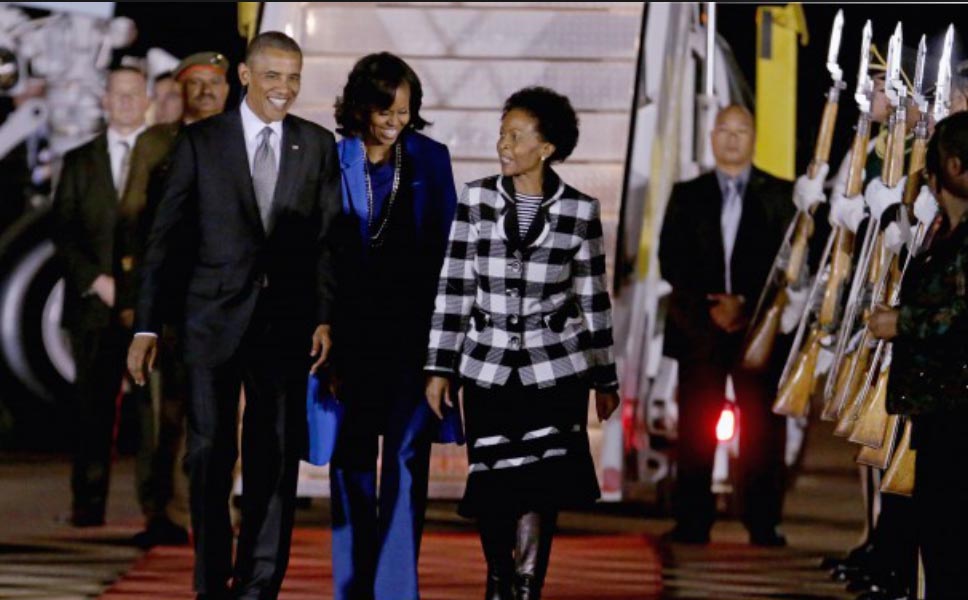
Obama upon his arrival at Waterkloof Air Force Base, with wife Michelle and Maite Nkoana-Mashabane, the SA foreign minister
US President Barack Obama told Africa’s youth Saturday that the future of the continent was in their hands and urged them to use Nelson Mandela as a model for political leadership.
Obama got a rowdy welcome as he used a town hall style meeting in South Africa to announce a new fellowship that will initially take 500 young African leaders to the United States every year for academic and leadership training.
As Obama spoke at a university in the sprawling township of Soweto where opposition to apartheid sprung into life, police nearby fired stun grenades to disperse hundreds of people critical of his anti-terror policies.
The US leader, on the second leg of an African tour, spoke at a University of Johannesburg not far from the simple homes in Soweto where Mandela, now 94 and in a critical condition in hospital, spent several years of his life.
“The future of this continent is in your hands,” Obama said.
He urged young people in Soweto and those watching the town hall meeting in Kenya, Nigeria and Uganda to take inspiration from Mandela’s refusal to be cowed by 27 years in jail.
“Think about 27 years in prison. Think about hardships and the struggles and being away from family and friends,” Obama said.
“There were dark moments that tested his faith in humanity, but he refused to give up.
“In your lives there will be times to test your faith.”
Obama was greeted with wild enthusiasm by the crowd in Soweto, who sang South African protest songs before he arrived and chanted his “Yes We Can” campaign slogan when he took the stage.
However, protesters set fire to US flags and portraits of Obama and at least three bangs from stun grenades were heard as armed police tried to move demonstrators away from the university.
“The message is clear. We want him to honour the promises he made when he became president, including things like the closing of Guantanamo Bay,” 30-year-old Firoz Osman told AFP. – AFP
This website uses cookies to improve your experience. We'll assume you're ok with this, but you can opt-out if you wish. Cookie settingsACCEPT
Privacy & Cookies Policy
Privacy Overview
This website uses cookies to improve your experience while you navigate through the website. Out of these cookies, the cookies that are categorized as necessary are stored on your browser as they are essential for the working of basic functionalities of the website. We also use third-party cookies that help us analyze and understand how you use this website. These cookies will be stored in your browser only with your consent. You also have the option to opt-out of these cookies. But opting out of some of these cookies may have an effect on your browsing experience.
Necessary cookies are absolutely essential for the website to function properly. This category only includes cookies that ensures basic functionalities and security features of the website. These cookies do not store any personal information.
Any cookies that may not be particularly necessary for the website to function and is used specifically to collect user personal data via analytics, ads, other embedded contents are termed as non-necessary cookies. It is mandatory to procure user consent prior to running these cookies on your website.


 Lady Gaga sang the American national anthem at Pier 26 to kick off New York City’s gay pride celebration Friday night, changing some of its words to fit the occasion, The Blaze first reported.