Britain heading for ‘triple-dip recession’?

Recession may just be a word. But in Britain it may become a habit – and a dangerous one at that.

It’s possible that official figures on first quarter economic growth, to be released Thursday, could show the country is back in recession, and tension is building.

Although economists on average expect growth of 0.1 percent on the quarter, they warn it would take the smallest statistical variation to put the figure in negative territory. That would place the country in recession, typically defined as two consecutive quarters of economic contraction.

Another recession – the third since the 2008 financial crisis – is already being referred to with foreboding in the media as a “Triple Dip.” Experts warn that its confirmation would create a wave of negative media attention that would scare consumers away from spending, feeding into a vicious cycle that has the economy flat-lining.

“It’s psychological – this is all psychological,” said Cary Cooper, a professor at Lancaster University Management School. “It’s about the message that those figures send to consumers and small businesses.”

The government desperately wants a strong number to justify its increasingly criticized policy of painful spending cuts. But recent indicators on Britain’s economy, the third-largest in the 27-country EU after Germany and France, have been disappointing.

Inflation is rising faster than wages, cutting into people’s standard of living. Unemployment is up at 7.9 percent. Two international ratings agencies have downgraded the country’s credit grade from the top level AAA, warning about the government’s fiscal policies.

The government, which has long played on its AAA rating as a sign of its economic might, has been pursuing a harsh program of spending cuts and tax increases to reduce the budget deficit, which at 7.4 percent of annual economic output is more than twice the EU’s 3 percent limit. Like many governments across Europe that have been scarred by the bond market turmoil that forced Greece and four other countries to need rescue loans, Britain is focusing on reducing debt quickly, even at the cost of short-term economic pain.

What some governments and economists are slowly realizing, however, is that they may have underestimated the damage such austerity would do.

There’s long been pressure domestically in Britain to ease off the budget cuts, but in the past few days the International Monetary Fund also chimed in. The fund, whose views carry weight as it is involved in all of Europe’s sovereign bailout programs, has pressured Treasury chief George Osborne to slow down the austerity measures in hopes of reviving the economy, whose output was worth 1.4 trillion pounds ($2.1 trillion) in 2012.

As the austerity debate rages on, no other person than the national spiritual leader – the Archbishop of Canterbury, Justin Welby – has waded in and used a word no want wants to hear: Depression.

Welby has unusual standing in the world of money because in a previous life he served as an oil industry executive and now sits on the parliamentary banking standards committee. He told an audience at the heart of government in Westminster on Monday that there was an issue of confidence and trust – and there is need to rebuild both.

“I would argue that what we are in at the moment is not a recession, but essentially some kind of depression and it therefore takes something very, very major to get out of it in the same way as it took something major for us to get into it,” he said.

The Bank of England has cut its interest rate to a record low 0.5 percent and pumped money into the financial system in the hope that will encourage banks to lend money more cheaply. But the results have been mixed and experts say there is only so much a central bank can do to create jobs.

On Wednesday, the Bank of England and the Treasury extended until January 2015 a program to boost lending and help the economy. The program offers funding at low interest rates to banks on condition that those rates are passed on to small businesses and households. Its results so far have been mixed, however.

Even if the economy dodges recession, the daily reality for many Britons remains tough.

The Trussell Trust, a food bank network, said it fed more than 350,000 people in the year ending in March – more than double the 128,000 served in the previous 12-month period. Tim Boyce, a retired investment banker who runs a south London branch, said he’s seeing the people behind those numbers. Inside a frosty church that’s opened its doors to the desperate, he watches as they come for emergency handouts of rice, pasta and beans.

“Most people don’t realize the extent of poverty,” he said as he sipped coffee to keep the edge off the chill. “It’s hiding in plain view.”

Take the cases of Kevin Bishenden, 50, and his wife, Nicola, 40. He’s an upholsterer who says that no one wants to hire someone his age. She says she just can’t find work. The only reason they aren’t homeless is that Britain’s welfare state manages to keep a roof over their heads.

But they’ve slowly been shedding all their possessions, together with memories of a past life. First a bike, then stuff from the kitchen. All the DVDs are going, though even Star Trek only gets you a few pennies. They’ve already sold their wedding rings.

He lamented a new council tax payment of 15 pounds ($22.80) that came into effect as part of government austerity plans. His exhaustion was plain as he tried to imagine paying for it.

“Where’s that supposed to come from?” – AP

BP to invest R5 billion in South African operation

A BP refinery

BP will invest nearly R5 billion in South Africa as a sign of its faith in the direction in which the country is heading, the energy company said on Tuesday.

“With the improving investment climate, especially policy stability… being presented in Southern Africa, BP has decided to invest significantly for the benefit of all of our stakeholders,” British Petroleum (BP) refining and marketing chief executive Iain Conn told reporters in Johannesburg.

“It gives me great pleasure to announce that BP will be investing in excess of R5bn in Mozambique and South Africa over the next five years, commencing in 2013, which will be new plant and infrastructure upgrades.”

It would be funded from BP cash reserves. Conn said R800 million would be invested in Mozambique and R4.7bn in South Africa.

“This investment is designed to improve safety, customer experience, operational efficiency, help with government to improve energy security, and enable the transition towards cleaner fuels.”

Conn said R2.5bn would be invested in upgrading refinery infrastructure at the SAPREF refinery, its joint venture with Shell in KwaZulu-Natal.

“Most of these funds in the refinery are to be utilised to promote South Africa’s clean fuels requirement,” he said.

In February, Finance Minister Pravin Gordhan announced a support mechanism for biofuels and an upgrade of refineries to encourage South Africa to produce cleaner fuels.

“We anticipate that the remuneration mechanism will be finalised shortly, as we have already started to invest in the project and our intent is to be ready to produce clean fuels in 2017,” Conn said.

Over R1bn would be invested in terminals in South Africa and Mozambique.

The balance of the investment would be in the “retail network”. Conn said BP had partnered with Pick ‘n Pay and 120 Pick ‘n Pay express stores would be opened in the next five years.

He said the investment was approaching five percent of all the capital which went into the marketing, refining, and chemical business of BP.

“We are in about 70 countries, and South Africa is going to end up with nearly five percent of the money. I think that tells you something.”

BP was encouraged by development in South Africa and Mozambique.

“In South Africa, I am conveying our appreciation to the government for adopting the National Development Plan as the blueprint for tackling the many challenges that continue to face this great nation.”

Conn said BP was committed to transformation and the need to create more jobs and build entrepreneurs in South Africa.

“This is part of our on-going efforts to be a good corporate citizen as we pursue our business objectives in all the markets in which we operate.”

Conn said BP was not considering fracking for shale oil and gas in South Africa.

“We have been fracking since the 1940s. BP is in shale, but not here,” he said.

“We are looking at shale in a number of places in the world, including China. We have not as yet prioritised shale in South Africa.”

He said fracking needed to be done safely and its impact on the environment needed to be considered.

Fracking, or hydraulic fracturing, is the process of extracting natural gas from shale rock layers deep within the earth.

Mineral Resources Minister Susan Shabangu said last year that five companies had applied in 2010 to explore for shale gas in the Karoo.

Energy department director general Nelisiwe Magubane said on Tuesday government “endorsed and welcomed” BP’s investment.

BP’s SAPREF refinery is co-owned with Royal Dutch Shell. South Africa’s oil refineries process 497,000 bpd, with SAPREF contributing 36 per cent of this total, according to the South African Petroleum Association’s website.- Sapa & Praag

Japan burning ice

A flame ripples from a burner on the back of a deepwater drilling rig in the Pacific Ocean off the southern coast of Japan, heralding an energy breakthrough for a power-starved nation.

Japan announced on March 12 that it had extracted natural gas at a depth of 3,280 feet (1,000 meters) from one of the most mysterious and vast reservoirs of fuel on Earth—methane hydrates, which are methane molecules trapped in ice crystals. The successful foray by the drill ship Chikyu marked the first time ever that natural gas had been produced from offshore methane hydrates, known as the “ice that burns.” Japan hopes that the test extraction is just the first step in an effort aimed at bringing the fuel into commercial production within the next six years.

That’s a far faster timetable than most researchers have foreseen, even though there is wide agreement that the methane hydrates buried beneath the seafloor on continental shelves and under the Arctic permafrost are likely the world’s largest store of carbon-based fuel. The figure often cited, 700,000 trillion cubic feet of methane trapped in hydrates, is a staggering sum that would exceed the energy content of all oil, coal, and other natural gas reserves known on Earth. (See the U.S. Department of Energy’s primer on methane hydrates.) But under high pressure and at low temperatures, the methane molecules are locked in lattice-like cages of frozen water—a kind of host/guest relationship called a “clathrate.”

Because methane is a gas with high global-warming potential—25 times more potent than carbon dioxide in trapping heat in the atmosphere—there is great concern over uncontrolled release of the methane from hydrate formations. Yet methane also can help cut carbon emissions when it is burned instead of coal for electricity. The U.S. government, which has a major methane hydrate research program, last year even sought to test a method for extracting methane and sequestering carbon dioxide at the same time.

But perhaps no nation has conducted as much methane hydrate research as Japan, which until now has had virtually no exploitable domestic fossil fuel resources. The nation’s reliance on foreign gas imports has surged since the 2011 Fukushima Daiichi disaster, which has led to the idling of nearly all 54 nuclear power plants that once provided 30 percent of Japan’s energy. In light of the nation’s energy woes, the methane hydrate milestone 50 miles (80 kilometers) off the coast of Aichi Prefecture in central Japan was especially significant. “Japan could finally have an energy source to call its own, ” said Takami Kawamoto, spokesman for the Japan Oil, Gas and Metals National Corporation (JOGMEC). – National Geographic

Marikana miners sprinkled muti against police

Police officers knew a substance thought to be muti was given to striking Marikana mineworkers, the Farlam commission of inquiry has heard.

Commission chairperson, retired judge Ian Farlam, questioned Major General Charl Annandale on whether they knew protesters believed the muti they had administered would make them invincible and invisible.

“They believed that the bullets would bounce off them. They had no fear and believed that the police’s R-5’s would have no effect on them,” Farlam said.

“Did you take that into consideration when you drafted your [dispersal and disarming] plan?” he asked.

Annandale, who headed the police special tactical operations team during the unrest in Marikana, was giving his evidence-in-chief at the commission in Rustenburg.

He said they were aware rituals had been performed on the miners, but did not get information about the supposed effect of the substances.

A white Toyota bakkie laden with buckets had been driven up to the koppie where miners were gathered in the days prior to August 16, when police fired on the strikers.

A traditional healer was seen sprinkling the substance in the buckets on a group of naked men, said Annandale. Police took pictures of this from a helicopter.

The commission is investigating the deaths of 44 people during the wage-related unrest in Marikana last year. Police shot dead 34 mineworkers on August 16. Another 10 people were killed in the preceding week. – Sapa

Wealthy South Africans are company employees

Though South Africa has provinces full of poor people, and cities teeming with middle-class consumers, we can at least fill a World Cup soccer venue with our wealthy compatriots.

If you take all the households that earn more than R100000 a month, you would just about fill Soccer City, according to the TopEnd 2013 Survey, released by Ramsay Media Research Solutions.

And of the country’s 80000 most- affluent individuals, more than a third have a household income upwards of R200000 a month, according to the survey.

The top 10% have a monthly household income of R500000 or more.

The data shows that there are almost seven white millionaires for every black one, according to Alan Todd, a partner at RMRS. But that, he said, is changing, with black millionaires gaining ground.

“The fact that 70% of millionaires feel they are much better off now than they were five years ago speaks volumes for the onward and upward march of South Africa’s most affluent consumers.”

The Bureau of Market Research last week released its household wealth index, which showed that the economic recession of 2008 was still ringing in the average household’s ears.

“Households have lost five years of wealth, which might force some of them to postpone their retirement and/or start saving more,” read the report.

The bureau said, with the high inequality in South Africa, “chances are good that some households possess high net wealth values, while the majority possess net wealth values significantly lower”.

The Top End Survey reveals that as many as 73% of the country’s wealthy are company employees, while 20% are self-employed.

Four out of 10 have some sort of sideline income to add to the spoils of their corporate jobs, with 59% earning a monthly income from their investments. – timeslive.co.za

Mandela, Obama and the end of democracy


One of the best means of enslaving an entire people is to weave them an illusion that they are free.

Significant cornerstones in achieving this grand illusion have already been set in the West, and regardless whether one believes in conspiracy theory or no, the outcome is undeniable. The only true difference is that under the incumbent US president Obama, the drive towards the extinction of the Free West has accelerated.

Even though this process has been in the making for many decades, South Africa’s fictional portrayal to the rest of the world has played a formidable part in all this.

The world was filled with a peculiar kind of absolution when Nelson Mandela was released from prison back in 1990, and even though he has continually threatened with violent sedition, he is hailed as one of the world’s most renowned peace makers. His “peaceful” motives were further cast in stone when he pocketed The Nobel Peace Prize in Oslo in 1993 alongside the last white president of South Africa FW de Klerk. We are now being misled that South Africa is a nation at peace, occasionally disturbed by some bigoted Boers. At least, this is the cover story we are supposed to believe. Yet almost everybody who experienced South Africa intimately knows that an overwhelming part of this fabrication is just that – a fabrication. The divide between rich and poor has widened, infrastructure is failing, taxes have increased rapidly and millions of people are forced to accept a life of humiliating subsistence. Not to mention the daily dose of extreme violence, rape and murder. Any desperate questions toward government regarding the rising tide of squalor is answered with the insincere negation that “the consequences of apartheid” are to blame, revealing in fact that the ANC is incapable of governing – all under the aegis of their British puppet masters of course, who are still secretly longing for those days when the Union Jack was hoisted over Pretoria in 1877.   

Important public figures such as Oprah Winfrey however, has swallowed the South African myth hook, line and sinker. In a misplaced show of philanthropy she had a smiley-face gulag (aka Leadership Academy) built for young black schoolgirls in the southern outskirts of Johannesburg, where the Frankensteinian pageant of multiculturalism is being indoctrinated with relish. While originally claiming that the blacks-only school was because she didn’t think the “whites needed appeasement”, Winfrey has in the meantime appointed a white Afrikaner woman as principal after a few scandals drove her to tears under the erstwhile black headmistress. Once again an Afrikaner is called to the rescue by none other than Ms. Aparthate herself. I don’t expect to see Kierkegaard’s The Concept of Irony in her Book Club very soon.     

Regardless of all these histrionic attempts at “healing South Africa’s wounds” extreme savagery still prevails and appears to be on the rise. The Afrikaners have been reduced to personae non gratae in the country that they had founded, with an estimate of 80 thousand of their kinsmen brutally murdered since their political demise. Many Afrikaners are in a state of abject poverty and are hurling insults at FW de Klerk for their fate, branding him the worst traitor their nation has ever had. The fact that De Klerk has thus far had ample time and opportunity to voice his concern for the state his people are in – as one would expect from a (former) statesman – he has chosen to turn a blind eye, once more reinforcing the notion that he has truly abandoned his people. Silence after all is consent.

The muffled voices of desperate Afrikaners seems to be a welcome gesture to political opportunists elsewhere, though. Was it not the knock-on effect of the feigned “South African miracle” that helped put Obama in the White House? A kind of yearning for a “Mandela Miracle” once again? On a similar note the coveted Nordic peace prize was awarded to America’s first non-white leader, but under his watch Guantanamo Bay is today markedly worse than ever under Bush. The overwhelming majority of inmates are held without any formal charge and the UN considers many practices to be legally defined as torture. 

Elsewhere, laws awarding citizens legal counsel have been watered down by presidential decree, and this disbarred lawyer-turned president now holds the right to arrest anybody anywhere he sees fit. Citizens are nowadays under scrutiny by drones in their own country and the legal protection of genetically modified food has been approved by Congress, regardless of potential health hazards that this food source could cause. By further exploiting heinous crimes such as shooting incidents at schools, the Administration is slowly denying citizens the right to own weapons and ipso facto grants freer licence to law enforcement officials to operate without warrant. The Second Amendment was after all instated solely for the purpose of preventing an elitist authority from reducing citizens to subjects.  

Yet all the while, similarly to the Mandela Miracle, the traditional founders of Puritan America are awfully quiet about these developments. Perhaps out of fear of being slandered as racists, they choose not to be too vocal. Not only was Mandela’s glory exported to America, but also the apathy of the conservative whites, who seem to be complacent with being airbrushed out of their own country. Both in South Africa and the US, the rant of Nikita Khrushchev that “We will bury you!” is starting to come about. Mandela, who took to the communists for support during his ordeal has indeed founded a younger incarnation in Obama – the latter who considered it prudent to adorn the White House Christmas tree with ornaments of Mao Zedong, the greatest mass murderer the world has ever known. 

Just as philosopher and historian Oswald Spengler had predicted, the once powerful West is on the decline. Similar to many great civilizations throughout history, the social fabric was torn apart by sectarianism and internal strife following mass emigration. Demographic shifts, the excessive demand for energy to sustain population growth and a disappearance of well internalized moral bearings had all assisted the collapse of once great civilizations. Democracy then becomes unworkable and a demand for a strong leader to help create order in the chaos becomes the new norm. In fact people will welcome the demise of democracy when the time is due. 

It appears as if the rise of the West has deliberately been sabotaged. Whereas Europe represents the older Western civilization, the Western emigration states such as the US, Canada, the former South Africa and Australasia formed its younger offspring. Being more flexible, energetic and imbued with youthful vigour, the emigration states have kept the spirit of the West alive while Europe was slowly starting to stiffen with age. Mass emigration of non-Western people to these younger lands has caused them to age faster and to prematurely nip their growth in the bud, sowing confusion, dissent and disillusionment in the once hailed ideal of liberal democracy.

It is an open question how long these nations could sustain themselves amidst growing dissent. The Marxist ideal of the universal human was after all no more a thought experiment than Rousseau’s Noble Savage; ostensibly universal but in reality just an artefact of the occidental soul.  

After a while, these nations are going to be driven back to their own traditional core values and beliefs, disillusioned with this unworkable quagmire they find themselves in. Under the candy-coated guise of freedom, emancipation and equality a grim hedonism is going to fill the void where a firm basis of traditional values ought to be. By robbing people of their higher freedoms and focusing attention on immediate gratification, people will be reduced to confused child-like states, justifying authoritarianism even further.

It would be wise if people of all backgrounds keep an eye on their traditional belief systems, for only in settings peculiar to their own could a nation grow towards democratic and mature systems while keeping demoralisation at a minimum.

And this new struggle has already begun.

Joseph Secreve


Buthelezi mistaken for Ray Charles at Thatcher’s funeral

Risen from the dead? Buthelezi as Ray Charles

Inkatha Freedom Party leader Mangosuthu Buthelezi was mistaken for the late singer Ray Charles at former Britain prime minister Margaret Thatcher’s funeral in Britain, it was reported on Thursday.

While the Bishop of London, Richard Chartres, gave his sermon, cameras suddenly turned to “a dapper-looking Ray Charles”, The Times newspaper reported.

Lady Thatcher died of stroke last week, aged 87, having governed Britain between 1979 and 1990.

Buthelezi was among the dignitaries who bade farewell to the “Iron Lady”.

Confused viewers took to the social media network Twitter about “Ray Charles” attending the funeral. Ray Charles passed away in 2004.

@Jlloydbutler: “Why are Netanyahu and Ray Charles sitting next to each other?”

@TheShottstepper: “Ray Charles?”

@bumface69: “Ray Charles at #thatcherfuneral; WTMF?”

@PaulStafford12: “Good of Ray Charles to show up all the same. What’d I say?” – Sapa

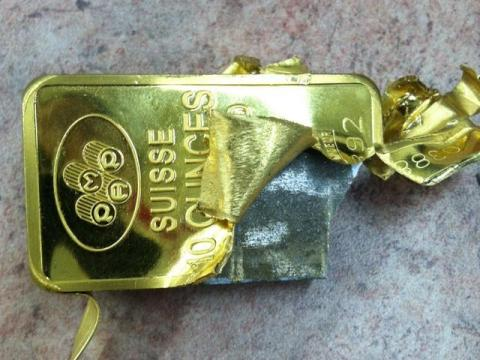
Attack on gold continues

The orchestrated attack on bullion in the paper gold market took the spot prices of gold and silver down on Friday and Monday, but actual physical purchases rose during this period. The sales were of paper claims, not of real metal.

The demand for physical possession of bullion rose so strongly that large wholesalers such as www.tulving.com and large retailers such as Gainesville Coins reported sold out items. Also, dealers raised the premiums above the spot price that is charged for coins. From Friday to Monday the premium on Silver Eagles at the large online retailer, Gainesville Coins, rose from $3.75 to $5.99 above the spot price of silver. The percentage increase in premium was larger than the percentage decline in the silver price. Thus, the price of a silver one Troy ounce coin did not drop despite the drop in the spot price. Today (April 16) the price of a silver eagle purchased with a credit card from retailer Gainesville Coins is $30.36. You would never know that the market had fallen out.

Today (Tuesday, April 16) Tulving reported 29% of its bar and coin bullion categories sold out and had almost no silver coin stock. The premium over spot on new gold eagles was $63.95. At large online retailers the premium was $71. Gainesville Coins has no silver Buffalos and lists shipment of orders to commence when coins are available, estimated to be May 10.

What I am reporting are facts, not a theory. We have just had two days of massive sales of paper claims on bullion, but during these days when the price of gold and silver collapsed under short sales, it was difficult to get your hands on the metal itself. On telephone orders you wait in long queues to place an order and are told that delivery awaits availability.

Listening to the media and to academic economists such as Paul Krugman, you would think no one any longer wants gold and silver. But try getting your hands on some.

The physical bullion market, gold especially, is dominated by Asians. Americans are a minor player. Most Americans still believe in the almighty dollar, but few Asians do. The Chinese tomorrow would dump their two trillion of US dollar-denominated assets and purchase gold, except that the action would drive down the dollar and drive up the gold price. So, unlike the orchestrated attack on gold, China plays a slow hand, using the orchestrated attack on gold to acquire the metal at lower prices.

As I understand it, the open interest or future contracts on COMEX greatly exceed the bullion available for delivery. This is a paper market mainly settled in cash, not by taking delivery. If the contracts had to be settled in bullion instead of cash, the COMEX would fail.

One advantage of growing old is that one gains perspective. I remember when gold was $35 an ounce and silver $1 an ounce. If memory serves, until sometimes in the 1960s, a person could still take a paper dollar to a bank and be given a silver dollar. There were $1 dollar and $5 dollar silver certificates (paper money) that circulated along with Federal Reserve currency. At that time banks did not differentiate. A dollar was a dollar. Silver certificates today have collectors’s value, but the Federal Reserve currency does not.

If memory serves, sometimes after 1966 if a person presented a silver certificate to a Federal Reserve Bank, he received one or five ounces or raw silver in return depending on the denomination of the certificate, which looked like a Federal Reserve note except it said Silver Certificate. I have some of these envelopes of little pieces of silver.

When silver was taken out of US coins in the 1960s and copper was taken out of the US penny in the early 1980s, despite my opposition as Assistant Secretary of the US Treasury for Economic Policy, all real constraints on fiat money were removed.

Today we see the Fed protecting its protection of “banks too big to fail” with low interest rates by creating enormous sums of money in order to purchase both Treasury bonds and mortgage backed derivatives.

These Fed purchasers are at the expense of savers and CD and bond purchasers who receive a negative real rate of interest.

Now, to protect its bank rescue policy, the Fed is attempting to drive down the price of bullion, thus depriving Americans of any way of protecting their life savings from the inflation that the Fed’s money printing will ultimately cause.

Save a handful of corrupt banks, screw the American public–that is the Fed’s policy.
Like almost every other American institution, the Fed represents the mega-rich.

Anyone with open eyes can see that it is impossible for the US dollar to maintain its current exchange value and role as world money when its supply is being increased by $1,000 billion per year while the world is ceasing to use the dollar for international payments.

The attack on gold is a desperate attempt to protect the US dollar from the Fed’s policy of quantitative easing. But the attack on bullion has apparently failed. The price was driven down, but the demand for physical possession has hit new highs.

What is it that we really know? What have we learned since the Clinton regime?

We have learned that integrity is rare in the US government, in the justice system, and in the financial sector. Whatever integrity one can find in these arenas wouldn’t amount to one ounce of gold.

Americans live in a rigged system in which propaganda determines the public’s awareness and consciousness. Americans, or most of them, live in the Matrix.

Since the end of WWII, most foreign governments have been in the habit of going along with Washington. Only in the aftermath of Washington’s phony wars based on lies and phony economy based on rigged statistics is the rest of the world beginning to realize that Washington is a destabilizing force.

Chavez, the recently deceased leader of Venezuela made the point most powerfully when he spoke at the UN. Standing at the podium in the General Assembly, he said that “Satan himself stood here yesterday speaking as if he owned the world. You can still smell the sulfur.” He was speaking of George W. Bush, and the entire assembly knew it.

The Russian leader, Putin, speaking of Washington, has declared that we know what comrade wolf is up to.

The Chinese can see the new military bases that stupid Washington is building in the Chinese area of influence.

A country whose currency is being abandoned as the means of international settlement, not only by the BRICS but also by puppet states such as Australia and Japan, has reached the point of absurdity when it tries to eliminate bullion as a refuge against the depreciating dollar.

The Federal Reserve and the US Treasury using their dependent bullion banks, every one of which would be busted if interest rates were not rigged by the Federal Reserve, have used leverage in the paper market to drive down the prices of gold and silver; yet, purchases of physical bullion are outrunning supplies.

What we are witnessing is the failure of a policy of financial corruption.

Integrity is a scarce commodity in the US government. Try to find much of it. Demonstrating a rare example of integrity, Brooksley Born resigned as head of the Federal Commodity Futures Trading Commission, because the Federal Reserve chairman, the US Treasury secretary, and the SEC chairman prevented her from during her statutory duty and regulating over the counter derivatives. The three morons who prevented her from doing her duty caused the financial collapse.

Integrity is almost non-existent in the US justice system.

Integrity is totally non-existent in the US financial system. As Michael Hudson has proven, the financialization of the economy has destroyed the economy.

With dollars, and now with Washington’s demand Japanese yen and European euros being printed in profusion, where can people put their money, at least those who still have some?

Can they put it in bonds when the Federal Reserve is monetizing debt at $1,000 billion annually and real interest rates are negative?

Can they put it in stocks that are pumped up by banks speculating with the Fed’s money while retail sales, labor force participation, and consumer incomes fall?

Safety can only be found in gold and silver, traditional, historical money that cannot be inflated.This is why bullion is under attack by Washington.

Readers ask me what they can do to protect themselves and where can they go to make gold and silver purchases.

I am not a registered financial advisor. I do not provide financial advice.

Every person must make their own decision. All I can do is to provide information, which is not guaranteed to be correct.

There are various simple options in contrast with the more demanding options of the professional trader. A person can accumulate gold and silver coins and keep them in a home safe or bury them on the property. A person can purchase shares of the Central Fund of Canada which convey ownership in a company that owns gold and silver bullion in a vault in Canada. A person can put money under management with companies that have a strong component of gold, such as Golden Returns Capital LLC whose gold depository is in the US.

Or you can decide to go with William S. Kaye (wskaye@pacgrp.com) whose depository is in Hong Kong.

There is GoldMoney, a Channel Islands based depository firm with storage vaults in London, Switzerland and Asia, and there is GoldSwitzerland, a Swiss company with its storage vault in Switzerland.

If you want a reading on whether physical gold is being sold or merely paper shorts, subscribe to John Brimelow brimelowgoldjottings@gmail.com

This list is not exhaustive. Protecting wealth can be harder than acquiring wealth. This is especially true for the middle class. The super rich can lose hundreds of millions of dollars and still be rich.

Gold and silver investments are not my speciality. I am an economist. I am aware that the US media is a propaganda organization, not a purveyor of truth. Currently the US is creating 1,000 billion dollars annually, but the demand for dollars is not growing with the supply.

Therefore, the exchange value of the dollar is at risk. A high and rising dollar price of bullion is an indication that the exchange value of the dollar with regard to other currencies is too high.

To protect the dollar from its money printing practice, the Fed has used naked shorts, its bullion bank dependents, and the presstitute media to drive down the gold price in the paper market, essentially an unreal market not inhabited by purchasers of physical metal. If the dollar’s exchange value takes a visible hit, import prices will rise, and the Fed will lose control over interest rates.

Meanwhile the demand for bullion possession rises.

The latest disinformation being put out is that bullion dealers, faced with the collapse of bullion prices, are afraid of the risk of purchasing bullion to sell to the public. They are going out of business and not replenishing their stocks. Gold and silver bullion is not available, because bullion dealers are afraid to stock the metals.

Little doubt that Americans who believe every fairy tale “their” government tells them will believe this one too. But those who don’t will observe the long lines waiting to purchase physical metal, not paper claims, and continue to load up on bullion. –  Paul Craig Roberts

Let’s hope the Boston Marathon bomber is a white American

As we now move into the official Political Aftermath period of the Boston bombing — the period that will determine the long-term legislative fallout of the atrocity — the dynamics of privilege will undoubtedly influence the nation’s collective reaction to the attacks. That’s because privilege tends to determine: 1) which groups are — and are not — collectively denigrated or targeted for the unlawful actions of individuals; and 2) how big and politically game-changing the overall reaction ends up being.

This has been most obvious in the context of recent mass shootings. In those awful episodes, a religious or ethnic minority group lacking such privilege would likely be collectively slandered and/or targeted with surveillance or profiling (or worse) if some of its individuals comprised most of the mass shooters. However, white male privilege means white men are not collectively denigrated/targeted for those shootings — even though most come at the hands of white dudes.

Likewise, in the context of terrorist attacks, such privilege means white non-Islamic terrorists are typically portrayed not as representative of whole groups or ideologies, but as “lone wolf” threats to be dealt with as isolated law enforcement matters. Meanwhile, non-white or developing-world terrorism suspects are often reflexively portrayed as representative of larger conspiracies, ideologies and religions that must be dealt with as systemic threats — the kind potentially requiring everything from law enforcement action to military operations to civil liberties legislation to foreign policy shifts.

“White privilege is knowing that even if the bomber turns out to be white, no one will call for your group to be profiled as terrorists as a result, subjected to special screening or threatened with deportation,” writes author Tim Wise. “White privilege is knowing that if this bomber turns out to be white, the United States government will not bomb whatever corn field or mountain town or stale suburb from which said bomber came, just to ensure that others like him or her don’t get any ideas. And if he turns out to be a member of the Irish Republican Army we won’t bomb Dublin. And if he’s an Italian-American Catholic we won’t bomb the Vatican.”

Because of these undeniable and pervasive double standards, the specific identity of the Boston Marathon bomber (or bombers) is not some minor detail — it will almost certainly dictate what kind of governmental, political and societal response we see in the coming weeks. That means regardless of your particular party affiliation, if you care about everything from stopping war to reducing the defense budget to protecting civil liberties to passing immigration reform, you should hope the bomber was a white domestic terrorist. Why? Because only in that case will privilege work to prevent the Boston attack from potentially undermining progress on those other issues.

To know that’s true is to simply consider how America reacts to different kinds of terrorism.

Though FBI data show fewer terrorist plots involving Muslims than terrorist plots involving non-Muslims, America has mobilized a full-on war effort exclusively against the prospect of Islamic terrorism. Indeed, the moniker “War on Terrorism” has come to specifically mean “War on Islamic Terrorism,” involving everything from new laws like the Patriot Act, to a new torture regime, to new federal agencies like the Transportation Security Administration and Department of Homeland Security, to wars in Iraq and Afghanistan to mass surveillance of Muslim communities.

By contrast, even though America has seen a consistent barrage of attacks from domestic non-Islamic terrorists, the privilege and double standards baked into our national security ideologies means those attacks have resulted in no systemic action of the scope marshaled against foreign terrorists. In fact, it has been quite the opposite — according to Darryl Johnson, the senior domestic terrorism analyst at the Department of Homeland Security, the conservative movement backlash to merely reporting the rising threat of such domestic terrorism resulted in DHS seriously curtailing its initiatives against that particular threat. (Irony alert: When it comes specifically to fighting white non-Muslim domestic terrorists, the right seems to now support the very doctrine it criticized Democratic presidential candidate John Kerry for articulating — the doctrine that sees fighting terrorism as primarily “an intelligence-gathering, law-enforcement, public-diplomacy effort” and not something more systemic.)

If recent history is any guide, if the bomber ends up being a white anti-government extremist, white privilege will likely mean the attack is portrayed as just an isolated incident — one that has no bearing on any larger policy debates. Put another way, white privilege will work to not only insulate whites from collective blame, but also to insulate the political debate from any fallout from the attack.

It will probably be much different if the bomber ends up being a Muslim and/or a foreigner from the developing world. As we know from our own history, when those kind of individuals break laws in such a high-profile way, America often cites them as both proof that entire demographic groups must be targeted, and that therefore a more systemic response is warranted. At that point, it’s easy to imagine conservatives citing Boston as a reason to block immigration reform defense spending cuts and the Afghan War withdrawal and to further expand surveillance and other encroachments on civil liberties.

If that sounds hard to believe, just look at yesterday’s comments by right-wing radio host Laura Ingraham, whose talking points often become Republican Party doctrine. Though authorities haven’t even identified a suspect in the Boston attack, she (like other conservatives) seems to already assume the assailant is foreign, and is consequently citing the attack as rationale to slam the immigration reform bill.

The same Laura Ingraham, of course, was one of the leading voices criticizing the Department of Homeland Security for daring to even report on right-wing domestic terrorism. In that sense, she perfectly embodies the double standard that, more than anything, will determine the long-term political impact of the Boston bombing.

David Sirota is a nationally syndicated newspaper columnist, magazine journalist and the best-selling author of the books “Hostile Takeover,” “The Uprising” and “Back to Our Future.”  He describes himself as “a Jew”

Second last in the world, SA’s maths and science

South Africa’s maths and science education has been ranked second last in the world, ahead of Yemen, according to a World Economic Forum report.

The quality of the country’s general education system ranked 140 out of 144 countries, while internet access in schools is ranked at 111 out of 143 countries, stated the World Economic Forum’s Global Information Technology Report 2013.

“Going up two positions, South Africa is in 70th place. Despite a sharp improvement in the development of its ICT infrastructure (59th) – notably in terms of international Internet bandwidth capacity (66th) – and a strong uptake by the business community (33rd), the ICT impacts (92nd), particularly the social ones (112th), remain limited.

“The perception of a lack of clear government vision (105th) to orchestrate and implement a holistic ICT strategy for the country, coupled with deficiencies in the educational system for some segments of the population (102nd), play negatively in this process and outweigh a rather positive political and regulatory framework for ICT development (21st) and pro-business environment (55th),” the report read.

It is the latest indictment on South Africa’s education system since the 2011 Progress in International Reading Literature Study (Pirls) which indicated that most South African grade five learners have not yet acquired basic literacy skills.

“Forty-three percent of South African grade five learners failed to reach the lowest international benchmark, in contrast to 5% of grade four learners internationally. This means that they have not yet mastered the basic reading skills required to access and retrieve information for reading comprehension purposes,” the Pirls report stated.

It further revealed that about 90% of the grade four learners tested attained the lowest international benchmark.

Learners tested in Sepedi and Tshivenda achieved the lowest results, according to the study. – M&G

Boston blank: No suspects, no motives

The FBI says they have no suspects nor anyone in custody over the deadly Boston blasts. Police are calling on witnesses to assist the investigation which has been called “the most complex crime scene” in the history of the Boston PD.

While the investigation has yielded no results, with no one claiming responsibility, more details have emerged on the nature of the explosives.

According to a person close to the Boston Marathon investigation, the explosives were in 6-liter pressure cookers and placed in black duffel bags. The person, who spoke on the condition of anonymity, said investigators have some of the bomb components but did not yet know what was used to set off the explosives.

The statement echoes the Massachusetts General surgeon’s words that given the injuries they treated, “most of [the metallic fragments in the patients] were in the bomb.”

The General surgeon addressed the media Tuesday. He said that the shrapnel was consistent in size, and included nail-like fragments.

“There were people who had 10, 20, 30 of them in their body,” he said.

Earlier, FBI and Boston city authorities declined to comment on the nature of the explosives that were triggered 12 seconds apart in the late hours of the race, when most of the top runners had finished and ordinary participants were completing the event.

Massachusetts Gov. Deval Patrick stressed that “only two explosive devices were found yesterday”, rejecting reports that earlier suggested five explosives were found.

Addressing the public the morning after the tragedy, FBI, Boston city authorities and police said that they are still seeking public assistance, calling for witnesses to come forward.

“We are processing the most complex crime scene in the history of our department,” Police Commissioner Edward Davis said.

People who captured amateur photos and videos are being asked to submit their footage as it might help with the investigation into the double blasts which have killed three and left more than 170 people injured.

“We have received voluminous tips over the last 18 hours since the incident,” FBI special agent in charge, Rick DesLauriers said.

The police gave no details on the going investigation.

Police called on citizens to be patient as they will see a “continued, heightened police presence”.

Police are searching the 26.2 mile route of the race. Currently the crime scene has been scaled down to12 blocks. FBI special agent in charge, Rick DesLauriers, said that there is currently “no known physical threat.”

US Homeland Security Secretary Janet Napolitano said Tuesday there was no indication that the bomb blasts in Boston were part of a broader plot.

“While there is no current indication to suggest that the events in Boston are indicative of a broader plot,” she said in a written statement. “Out of an abundance of caution, DHS continues to keep in place enhanced security measures at transportation hubs, utilizing measures both seen and unseen.”

The FBI special agent DesLauriers also declined to comment saying he is “not going to say who might or might not be in custody right now.”

Earlier on Tuesday reports said police are seeking a suspect in the deadly Boston blasts described as a “darker-skinned or black male” with a backpack, media reports. They are also looking for a yellow van.

The suspect, who is said to possibly have a foreign accent, was seen trying to enter a restricted area five minutes before the first explosion, CNN reported.

As he was not allowed to do so, the man reportedly walked away and pulled his sweatshirt hood over his head.

When asked about a bomb placed in a trash can, Police commissioner Ed Davis said there was no evidence of that. – RT

‘Apartheid’ as metonym for Afrikaners

In a multiethnic society like South Africa, groups will always blame each other for their lack of wealth, education, political power, and so on. In this respect, SA is no different to Malaysia, Sri Lanka, Northern Ireland, Belgium or anywhere else.

Apartheid is a national obessession. To some extent it has imparted some sort of inverse identity to the so-called New South Africa where people wonder whether we are really the 51st state of the USA, the southern province of Zimbabwe or part of the British Empire. Of course, one of the first steps after 27 April 1994 was to rejoin the Commonwealth so in a sense that made many people feel “whole” again.

Apartheid is, however, also a metonym. Being an Afrikaans word, sometimes the only Afrikaans word that many people know, it stands for “Afrikaners”. A statement like “apartheid destroyed black wealth” decodes as “Afrikaners destroyed black wealth”. The massive participation of Afrikaners in education between 1948 and 1994, mainly because the angelic English owned all the mines and industries, may therefore be seen as “de-educating South Africa”. At one point 50% of teachers in English-language white schools were also Afrikaners. Soon these “deprived” Engelse will be blaming Afrikaners for not having won more Nobel prizes for science, not having founded Google or Microsoft or not inventing the Ipod. Instead, they were “forced” to read Somer by CM van den Heever or some Afrikaans poetry in their second-language class, which “dehumanised” them.

Of course, Afrikaner teachers also taught millions of people science and mathematics, but as some minister once said: “Verwoerd made it too difficult, because he was a racist.” Fortunately Kader Asmal introduced “mathematical literacy” which is is the non-racist version.

As Paul Berkowitz so eloquently argues in How do you solve a problem like Apartheid?: “In the end, perception usually trumps truth.” Someone will have to be blamed for the fact that the average black South African does not enjoy the same standard of living as the average citizen of Luxembourg or Norway. Nor does the average white, of course, but that is besides the point.

Apartheid, like Satan, still lurks within dark corners of South Africa, usually on farms or in Afrikaans schools or within the homes of poorer Afrikaners living on smallholdings such as in Muldersdrift or Kameeldrif.

Within the metonymic logic of South African ethnic discourse, eliminating apartheid is easy: you have just have to eliminate Afrikaners. This can be done in three ways: putting them all on a boat to Australia, assimilating them completely, or by killing them en masse. Or maybe one by one, family by family.

In Muldersdrift, Kameeldrif, on farms and even in the cities, the clarion call to “eliminate the last vestiges of apartheid” is being responded to with vicious enthusiasm. Remember that Lord Milner or one of his contemporaries also used those terms on the eve of the Anglo-Boer War: “eliminating the last vestiges of Afrikanerism from South Africa”. Afterwards 500 000 British soldiers and 100 000 armed blacks put the Boer women and children in concentration camps and burned everything to the ground, homes, barns, even churches. In fact, the British were the only Western people to have burnt churches in the modern era.

According to historians, it took Germany 120 years to recover from the Thirty Years War (1618-1648) when a similar “scorched earth policy” had been followed on its soil. However, no-one – least of all the omniscient apartheid theorists of today – has ever argued that the Anglo-Boer had any economic effect whatsoever. On the contrary, the economic effect is generally seen as positive, in having put control of the economy firmly in English hands. Confiscated Boer livestock and grain were sold to the British army by English companies whose names have changed since, some of which are today listed on the JSE. “Apartheid capital” therefore metamorphosed into “English entrepreneurial flair”. This was the first form of BEE, or British Economic Empowerment. Arguably, the current form of BEE still benefits bankers and stockbrokers more than it does blacks, because these rake in huge fees for enriching a few high-profile blacks.

After the war, irate letter writers from Natal castigated Milner and others for not having killed all the Boers and “cleansing the country for England”. That would have been one way of nipping apartheid in the bud, as it were.

But it is never too late and we can all agree that apartheid is being eliminated every day, whether metaphorically by erasing Afrikaans names of towns or streets, or physically by terminating the bearers of the disease. There is an uncanny resemblance between the gentlemanly style of the British in 1900-1902 and the methods of the current crop of freedom fighters, who appreciate that children, especially girl children, represent the next generation and it therefore makes sense to eliminate them first. The names of Alyssa Botha and Danielle Esterhuizen come to mind, but there are many others too.

The assault on gold

I was the first to point out that the Federal Reserve was rigging all markets, not merely bond prices and interest rates, and that the Fed is rigging the bullion market in order to protect the US dollar’s exchange value, which is threatened by the Fed’s quantitative easing. With the Fed adding to the supply of dollars faster than the demand for dollars is increasing, the price or exchange value of the dollar is set up to fall.

A fall in the dollar’s exchange rate would push up import prices and, thereby, domestic inflation, and the Fed would lose control over interest rates. The bond market would collapse and with it the values of debt-related derivatives on the “banks too big too fail” balance sheets. The financial system would be in turmoil, and panic would reign.

Rapidly rising bullion prices were an indication of loss of confidence in the dollar and were signaling a drop in the dollar’s exchange rate. The Fed used naked shorts in the paper gold market to offset the price effect of a rising demand for bullion possession. Short sales that drive down the price trigger stop-loss orders that automatically lead to individual sales of bullion holdings once their loss limits are reached.

According to Andrew Maguire, on Friday, April 12, the Fed’s agents hit the market with 500 tons of naked shorts. Normally, a short is when an investor thinks the price of a stock or commodity is going to fall. He to sell the item in advance of the fall, pocket the money, and then buy the item back after it falls in price, thus making money on the short sale. If he doesn’t have the item, he borrows it from someone who does, putting up cash collateral equal to the current market price. Then he sells the item, waits for it to fall in price, buys it back at the lower price and returns it to the owner who returns his collateral. If enough shorts are sold, the result can be to drive down the market price.

A naked short is when the short seller does not have or borrow the item that he shorts, but sells shorts regardless. In the paper gold market, the participants are betting on gold prices and are content with the monetary payment. Therefore, generally, as participants are not interested in taking delivery of the gold, naked shorts do not need to be covered with the physical metal.

In other words, with naked shorts, no physical metal is actually sold.

People ask me how I know that the Fed is rigging the bullion price and seem surprised that anyone would think the Fed and its bullion bank agents would do such a thing, despite the public knowledge that the Fed is rigging the bond market and the banks with the Fed’s knowledge rigged the Libor rate. The answer is that the circumstantial evidence is powerful.

Consider the 500 tons of paper gold sold on Friday. Begin with the question, how many ounces is 500 tons? There are 2,000 pounds to one ton. 500 tons equal 1,000,000 pounds. There are 16 ounces to one pound, which comes to 16 million ounces of short sales on Friday.

Who has 16 million ounces of gold? At the beginning gold price that day of about $1,550, that comes to $24,800,000,000. Who has that kind of money?

What happens when 500 tons of gold sales are dumped on the market at one time or on one day? Correct, it drives the price down. Investors who want to get out of large positions would spread sales out over time so as not to lower their sales proceeds. The sale took gold down by about $73 per ounce. That means the seller or sellers lost up to $73 dollars 16 million times, or $1,168,000,000.

Who can afford to lose that kind of money? Only a central bank that can print it.

I believe that the authorities would like to drive the gold price down further and will, if they can, hit the gold market twice more next week and put gold at $1,400 per ounce or lower. The successive declines could perhaps spook individual holders of physical gold and result in actual net sales of physical gold as people reduced their
holdings of the metal.

However, bullion dealer Bill Haynes told kingworldnews.com that last Friday bullion purchasers among the public outpaced sellers by 50 to 1, and that the premiums over the spot price on gold and silver coins are the highest in decades. I myself checked with Gainesville Coins and was told that far more buyers than sellers had responded to the price drop.

Unless the authorities have the actual metal with which to back up the short selling, they could be met with demands for deliveries. Unable to cover the shorts with real metal, the scheme would be exposed.

Do the authorities have the metal with which to cover shorts? I do not know. However, knowledgeable dealers are suspicious. Some think that US physical stocks of gold were used up in sales in efforts to disrupt the rise in the gold price from $272 in December 2000 to $1,900 in 2011. They point to Germany’s recent request that the US return the German gold stored in the US, and to the US government’s reply that it would return the gold piecemeal over seven years. If the US has the gold, why not return it to Germany?

The clear implication is that the US cannot deliver the gold.

Andrew Maguire also reports that foreign central banks, especially China, are loading up on physical gold at the low prices made possible by the short selling. If central banks are using their dollar holdings to purchase bullion at bargain prices, the likely results will be pressure on the dollar’s exchange value and a declining market supply of physical bullion. In other words, by trying to protect the dollar from its quantitative easing policy, the Fed might be hastening the dollar’s demise.

Possibly the Fed fears a dollar crisis or derivative blowup is nearing and is trying to reset the gold/dollar price prior to the outbreak of trouble. If ill winds are forecast, the Fed might feel it is better positioned to deal with crisis if the price of bullion is lower and confidence in bullion as a refuge has been shaken.

In addition to short selling that is clearly intended to drive down the gold price, orchestration is also indicated by the advance announcements this month first from brokerage houses and then from Goldman Sachs that hedge funds and institutional investors would be selling their gold positions. The purpose of these announcements was to encourage individual investors to get out of gold before the big boys did. Does anyone believe that hedge funds and Wall Street would announce their sales in advance so the small fry can get out of gold at a higher price than they do?

If these advanced announcements are not orchestration, what are they?

I see the orchestrated effort to suppress the price of gold and silver as a sign that the authorities are frightened that trouble is brewing that they cannot control unless there is strong confidence in the dollar. Otherwise, what is the point of the heavy short selling and orchestrated announcements of gold sales in advance of the sales?

Paul Craig Roberts is a  former Assistant Secretary of the Treasury for Economic Policy and associate editor of the Wall Street Journal. His latest book, The Failure of Laissez Faire Capitalism and  is now available. http://www.paulcraigroberts.org/

Woolworths and other supermarket chains ‘incorrectly labelled meat products’

Popular supermarkets including PicknPay, Shoprite, Fruit and Veg City, Woolworths and Spar have been identified as stocking incorrectly labelled meat products, City Press reported on Sunday.

The newspaper reported that the retailers had largely suggested that the findings could be blamed on cross-contamination, where one type of meat was transferred to another on chopping boards, saws, hands and utensils.

Shoprite CEO Whitey Basson told the newspaper there was not “intentional adulteration to mislead consumers”.

A University of Stellenbosch study found that nearly 60 percent of 139 products tested contained ingredients which were not listed on their labels, including donkey, water buffalo, goat and pork.

Of 32 Shoprite and Checkers products tested, 20 were wrongly labelled.

Basson said some of the findings did not make sense.

“No butcher in his right mind would intentionally add a small percentage of lamb, which costs more per kilogram, to a pure beef sausage, which is cheaper.”

PicknPay food director Peter Arnold said the quantities of undeclared animal products found in the Stellenbosch study were “minute”.

He said there was an international threshold that meat could contain one percent of an undeclared product to allow for cross-contamination.

Spar group merchandise executive Mike Prentice said labelling needed to be “tightened up” and the industry as a whole needed to “jack itself up”.

Louw Hoffman, the scientist behind the study, said the study had proved that the mislabelling of processed meats was “commonplace in South Africa.

“[The mislabelling] not only violates food-labelling regulations, but poses economic, religious, ethical and health impacts,” he told The City Press.

The study examined meat products sourced from shops across Gauteng, the Western Cape, the Eastern Cape and KwaZulu-Natal.

Trade and Industry department spokesman Sidwell Medupe said an investigation into meat labelling was underway. – Sapa