Saudi Arabia is buying an armed drone from South Africa after the Obama administration declined to sell the oil-rich kingdom U.S. Predator or Reaper missile-firing unmanned aircraft.
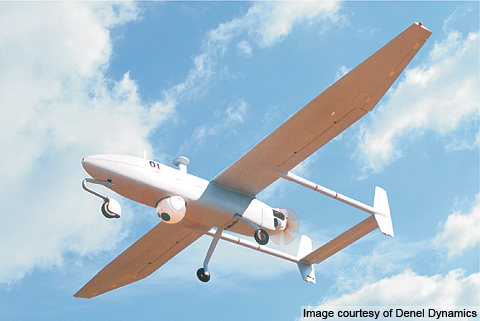
The state-owned South African company Denel Dynamics is working covertly with the Saudis to develop the Seeker 400 drone into an armed combat system for the Saudi military, the Paris-based newsletter Intelligence Online reported March 27.
The Seeker 400 is an advanced version of the company’s Seeker II unarmed surveillance aircraft.
The newsletter stated that the Saudi military would be the first customer to purchase the Seeker 400 armed drone and engineers from Denel are in the kingdom as part of the secret program.
If completed, the sale would allow Saudi Arabia to join the growing number of militaries that operate missile-firing drones—the most advanced weapon currently in use to launch precision strikes on terrorists.
Drone warfare has become the hallmark of the CIA, which is aggressively pursuing terrorists with drone missiles in Afghanistan, Pakistan’s frontier region, Yemen, the Horn of Africa, and elsewhere.
The new drone will be equipped with South Africa’s Mokopa air-to-ground missiles that are currently deployed on Algerian helicopters. The drone also can be outfitted with Impi laser-guided missiles with a range of 10 kilometers.
The drones are believed to be sought by the Saudis for use against the terrorist group al Qaeda in the Arabian Peninsula, which is currently operating in Yemen and has conducted international operations against the United States.
Riyadh has been trying to purchase missile-firing drones from the United States but so far the requests have been denied.
The United Arab Emirates is purchasing an unarmed export version of the Predator called the Predator XP, produced by General Atomics.
According to the newsletter, the Saudis have sought armed drones for several years and want the weapons to counter Iran’s unmanned combat vehicles known as the Karrar and the Shahed 129, which are fitted with Shahid-1 missiles.
“Because it could not procure drones from China, which is allied to Iran, nor from Israel, Riyadh turned to South Africa,” the newsletter stated.
However, Saudi Arabia lacks the infrastructure needed to operate drones. The systems require satellite communications that permit remote video and communications that allow drones to be piloted.
The Seeker 400 can fly for 16 hours and has a range of 250 kilometers with a 100-kilogram payload.
Saudi Arabia’s Prince Sultan Advanced Technologies Research Institute (PSATRI), a joint project of the Saudi air force and the King Fahd University, is also developing surveillance drones for use along the southern Saudi border, the newsletter stated.
Spokesmen for Denel and the Saudi Embassy could not be reached for comment.
News reports in February revealed that Saudi Arabia is hosting a U.S. attack drone base in the southern part of the country that was revealed in satellite imagery.
These satellite images show a remote airstrip deep in the desert of Saudi Arabia. It may or may not be the secret U.S. drone base revealed by reporters earlier this week.
However, the base’s hangars bear a remarkable resemblance to similar structures found on other American drone outposts. And its remote location—dozens of miles from the nearest highway, and farther still to the nearest town—suggests that this may be more than the average civilian airstrip.
The base had been kept secret for two years until disclosed in reports by the Washington Post and New York Times in February.
The base was used for the drone strike in September 2011 that killed American-born al Qaeda leader Anwar al-Awlaki. – Bill Gertz, freebeacon.com
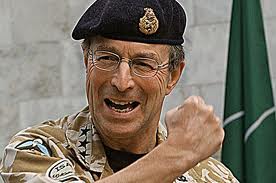
British Chief of Defence Staff Gen. Sir David Richards
In what is believed to be the first time since the 1940s, the entire British defense staff will be here March 25 to discuss long-range strategy and the impact of budget cuts with their U.S. counterparts, according to U.S. and British sources.
The meeting is reminiscent of the Combined Chiefs of Staff, when British and American military leaders joined forces during World War II. Both nations are undergoing significant budgetary reductions and will continue to rely on each other in future years for support. Understanding what capabilities will survive and won’t is essential to long-term strategic planning.
“The relationship military to military is very strong. We have common interest in how we meet the financial constraints placed on both nations, but also on issues like how we manage the drawdown in Afghanistan and also how we reconfigure post Afghanistan,” said Sir Gerald Howarth, a member of parliament and the ex-defense minister responsible for international security affairs from 2010 to 2012.
“We have a huge amount of strategic issues to discuss where we have a very large level of common interest,” he said.
A Defence Ministry spokesman characterized the meeting as private and declined further comment.
In the U.S., spokesmen for the Office of the Secretary of Defense and the Joint Chiefs of Staff did not respond to questions.
U.S. and British military leaders regularly discuss ongoing issues. What’s different about this series of meetings is they will focus not on immediate budget, program or operational issues, but the strategic future of the Anglo-American alliance, including deepening cooperation.
In addition to the U.S. Joint Chiefs, British attendees are expected to include Gen. Sir David Richards, chief of the Defence Staff; Gen. Sir Nicholas Houghton, vice chief of the Defence Staff, who will take over as chief when Richards retires later this year; Air Chief Marshal Sir Stephen Dalton, chief of the Air Staff; Adm. Sir George Zambellas, incoming Navy first sea lord; Gen. Sir Peter Wall, chief of the General Staff; and Air Chief Marshal Sir Stuart Peach, commander of Joint Forces Command, sources said.
The U.S. and U.K. regularly share the most sensitive military intelligence, technology and equipment, including submarine-launched nuclear ballistic missiles. Britain over the past decade in particular has shaped its capabilities to dovetail with U.S. forces.
The British are the leading developmental partner on the U.S.-led F-35 fighter program with Lockheed Martin and have in their inventory Boeing C-17 transports, Chinook and Apache helicopters and Lockheed C-130 cargo aircraft. In addition, the Royal Air Force is buying highly sensitive RC-135 Rivet Joint intelligence planes produced by L-3 Communications in the U.S., making London the only international customer for that program.
The meeting comes as the Pentagon faces $500 billion in spending cuts over the coming decade, which will force senior leaders to make difficult choices. The British delegation arrives with particular experience in that area, having faced even deeper budget cuts — in percentage terms — over the past several years, forcing major reforms to force structure, organization and acquisition programs in that time.
U.S. and British forces routinely train together and have fought side-by-side over the past decade in Afghanistan and Iraq. In Afghanistan, British Lt. Gen. Nick Carter serves as the deputy commander to U.S. Marine Gen. Joseph Dunford, commander of NATO forces.
“On the day-to-day business of military cooperation, the relationship between the U.S. [NATO] commander and the British second in command is another good example of working in partnership,” Howarth said.
The two militaries regularly participate in personnel exchanges. – Defence News
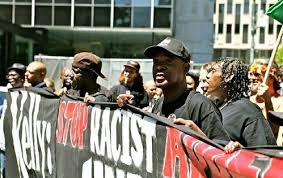
A New York State Senator testified in federal court Monday that New York City Police Commissioner Ray Kelly explained the city’s controversial stop-and-frisk program as a means of instilling fear in young African American and Hispanic men.
Twenty-two year NYPD veteran and State Senator Eric Adams told the court that in 2010 he traveled to Albany to voice his support to a bill that would forbid the NYPD from keeping a database of information pulled from stop-and-frisks that did not lead to an arrest. That bill would ultimately pass, but Adams testified on Monday that, upon telling Kelly the program disproportionately targeted young black and Latino men, the commissioner was far from concerned.
The new testimony follows evidence from more than one New York cop indicating that the department has set, officially or unofficially, quotas for stop-and-frisks. There has also been recent testimony from those officers that the program specifically targets people of color.
Kelly “stated that he targeted and focused on that group because he wanted to instill fear in them that every time they left their homes they could be targeted by police,” Adams said.
He said Kelly justified his reasoning by asking, “How else would we get rid of guns?”
“I was amazed,” Adams said in court. “I told him that was illegal.”
Under Kelly and New York Mayor Michael Bloomberg the NYPD has stopped an estimated 4.4 million people, most of whom have been in the demographic Kelly allegedly described to Adams. The policy allows officers to stop pedestrians on the street if they perceive that person is on the way to committing a crime, is in the process of committing a crime, or leaving the scene of a crime. Roughly 94 per cent of the stops result in no charges.
The program has come under attack in recent months as civil rights lawyers try to prove stop-and-frisk is a violation of the 4th and 14th amendments. Adams’ testimony comes after previous witnesses told the court that NYPD officers have acted with impunity since the program began in 2002.
Adams said stop-and-frisk is a “great tool” to stopping crime but mentioned that “nowhere” does it empower the NYPD to “use the tool to instill fear. Nowhere.”
City attorney Heidi Grossman questioned Adams’ recollection of the conversation while claiming Kelly meant officers should “instill belief” in young men of minority backgrounds, not “instill fear,” though she did not specify what such a belief would be in.
“I don’t think anyone in their right mind would believe the police commissioner would say the police department is targeting, just for targeting, blacks and Hispanics,” Grossman said.
She also tried to read from a written statement from Kelly denying the claim before being stopped by Manhattan Federal Judge Shira Scheindlin.
“If he’d like to come here, he’s welcome in this courtroom,” Scheindlin said, regarding Grossman’s attempted “backdoor” testimony from Kelly.
Outside the courthouse Adams told reporters that because his Brooklyn district has one of the highest crime rates in the city, it is also heavily policed. He said his constituents find themselves trying to stay away from crime as well as overbearing law enforcement.
“They feel trapped,” he said, adding that “Cops don’t want to do this. Cops are so frustrated they are wearing wires to roll call.” – RT
A month ago we pointed out that as a result of Australia’s unprecedented reliance on China as a target export market, accounting for nearly 30% of all Australian exports (with the flipside being just as true, as Australia now is the fifth-biggest source of Chinese imports), the two countries may as well be joined at the hip.
Over the weekend, Australia appears to have come to the same conclusion, with the Australian reporting that the land down under is set to say goodbye to the world’s “reserve currency” in its trade dealings with the world’s biggest marginal economic power, China, and will enable the direct convertibility of the Australian dollar into Chinese yuan, without US Dollar intermediation, in the process “slashing costs for thousands of business” and also confirming speculation that China is fully intent on, little by little, chipping away at the dollar’s reserve currency status until one day it no longer is.
That said, this latest development in global currency relations should come as no surprise to those who have followed our series on China’s slow but certain internationalization of its currency over the past two years. To wit: “World’s Second (China) And Third Largest (Japan) Economies To Bypass Dollar, Engage In Direct Currency Trade”, “China, Russia Drop Dollar In Bilateral Trade”, “China And Iran To Bypass Dollar, Plan Oil Barter System”, “India and Japan sign new $15bn currency swap agreement”, “Iran, Russia Replace Dollar With Rial, Ruble in Trade, Fars Says”, “India Joins Asian Dollar Exclusion Zone, Will Transact With Iran In Rupees”, and “The USD Trap Is Closing: Dollar Exclusion Zone Crosses The Pacific As Brazil Signs China Currency Swap.”
And while previously the focus was on Chinese currency swap arrangements, the uniqueness of this weekend’s news is that it promotes outright convertibility of the Yuan: something China has long said would happen but many were skeptical it ever would. That is no longer the case, and with Australia setting the precedent, expect many more Asian countries (at first) to follow in Australia’s footsteps, because while the developed world is far more engaged in diluting its currency as a means to spur “growth”, Asian and developing world nations are still engage in real, actual trade, where China is rapidly and aggressively becoming the world’s hub.
More from The Australian:
Former ambassador to China Geoff Raby, now a Beijing-based business figure, told The Weekend Australian: “The value of such a deal would be substantial for exporters to China, especially those that import a lot from China like mining companies, as it would remove business constraints including exchange-rate risks and transaction costs.”
Businesses, like individuals when travelling, have to pay extra to convert currency since there are different rates for buying and selling.
So removing one step also cuts out the cost of paying for such a “spread”.
Australia has undertaken significant lobbying for the deal and the direct conversion of the yuan, also referred to as the renminbi (RMB), is identified as a priority in the government’s Asian century white paper.
“We have held preliminary discussions with the Chinese government to explore how soon direct convertibility can be practicably achieved,” the white paper says.
“We are continuing these discussions, and also exploring other opportunities to work with China to support the internationalisation of the RMB.”
Australia’s banks increasingly arrange trade finance through Hong Kong, which has developed a special role as China’s chief international finance centre.
Needless to say, China is eagerly looking forward to taking yet another bite out of the USD’s reserve status.
New President Xi Jinping, a former Communist Party secretary of Shanghai, is a champion of that city’s development as China’s finance hub, and it is believed that the Prime Minister may fly there to sign the currency conversion deal.
Ms Gillard is expected to go on from Shanghai to Beijing, where she will open the third Australia China Economic and Trade Forum organised primarily by the Australia China Business Council, which will be bringing about 100 people from Australia for the event. Participants are likely to include Andrew Harding, Rio Tinto’s new chief executive for iron ore; Warwick Smith, ANZ Bank’s chairman for NSW and the ACT; Australian Trade Minister Craig Emerson and Financial Services Minister Bill Shorten; Gao Hucheng, China’s Commerce Minister; and Gao Xiqing, the acting head of China Investment Corporation, the country’s vast sovereign wealth fund.
The ANZ Bank has been a strong advocate of direct convertibility between the dollar and the yuan. Gilles Plante, the bank’s chief executive in Asia, said in a recent report that in the last financial year, China accounted for 29 per cent of all exports and 18 per cent of imports, but the value of that trade denominated in yuan was less than 0.3 per cent.
He forecast that cross-border flows of funds would be liberalised “to support Shanghai’s plan to build itself as a global financial centre. At the time the whole world is digging out opportunities from the rise of the yuan, Australia should not lag behind.”
It was significant the liberalising governor of the People’s Bank, Zhou Xiaochuan, kept his job during the reshuffle of China’s leadership. He said last year at a conference: “The next movement related to the yuan is going to be reform of convertibility. We are moving in this direction; we need to go further, we will have some deregulation.”
Most importantly, to China, Australia will serve as the Guniea Pig – should this experiment in FX liberalization work out to China’s satisfaction, expect Beijing to engage many more trade partners in direct currency conversion.
Beijing appears to have chosen Canberra as its partner in this next movement for straightforward economic reasons, as Australia has become China’s fifth-biggest source of imports and thus, the appropriate partner for the march of its currency.
Ms Gillard and President Xi Jinping may also during the visit establish a “strategic partnership” between the countries. This will enable Australia to catch up in status with a large range of nations.
Why is this so very critical? For the simple reason that the free lunch the US has enjoyed ever since the advent of the US dollar as world reserve currency, may be coming to an end as other, more aggressive alternatives – both fiat, and hard-asset based – to the USD appear. And since there is no such thing as a free lunch, all the deferred pain the US Treasury Department has been able to offset thanks to its global currency monopoly status will come crashing down the second the world starts getting doubts about the true nature of just who the real reserve currency will be in the future.– Zero Hedge
American reality TV star, Kim Kardashian, has denied tweeting hate words about Nigeria and her women.
A “photoshopped” image of a parody twitter handle had shown how Kardashian tweeted about Nigeria being such a disgusting country with women who look like apes.
“I see there is a photo shopped tweet floating around, supposedly something I said about Nigeria. That was not me or my feelings,” she said.
“The fake tweet is very disturbing and I will never ever tweet something like that,” she added.
Kim Kardashian recently visited Nigeria for a valentine show and left a love-hate relationship with her Nigerian fans after reports went round she was paid half a million dollars to show up at the event and hardly stayed or made any significant contribution to the show. – WENN.com
After four days of counting and recounting votes, Uhuru Kenyatta was declared the winner of Kenya’s presidential election. This is not what the British government had been hoping for.
The failed attempt by the UK to warn people off voting for Kenyatta has changed the former colonial power’s standing in Kenya, both with its leaders and its people. Bungled diplomacy and most of all hubris, have ruined a crucial friendship in Africa.
Western governments made clear their support for Kenyatta’s rival, Raila Odinga. If Kenyatta was to win the election, they would limit relations with Kenya to “essential contact only”.
Clearly, the British had relied on their usual haughty manner to impress the natives once more.
The ostensible reason is that Kenyatta is to stand trial at the International Criminal Court on charges of crimes against humanity. Robert Mugabe however, enjoys the benefits of Western aid after having confiscating white farmland and ethnically cleansed his country.
Kenyatta is accused of having planned the violence which followed Kenya’s disputed 2007 election. Dealing with an ICC indictee could be difficult, so foreign diplomats made it clear that Kenya risked being marginalised if it voted for Kenyatta.
So keeping contact with an ICC indictee to a minimum; was the piont that diplomats repeatedly stressed in the months running up to the election on March 4. Kenyatta’s rivals began telling of the disastrous economic impact this could have on Kenya. Former UN Secretary General Kofi Annan also weighed in, telling Kenyans that voting for an ICC suspect would complicate foreign relations.
But this tactic has backfired. Instead of scaring people into voting for Odinga, Kenyans have begun to question why they should listen to the West. This played into Kenyatta’s hands: he portrayed Odinga as a puppet of the West and the ICC case as an example of Western countries bullying Africans.
The UK has been a particular focus for Kenyatta’s attention. Any comments made by the British High Commissioner, Christian Turner, were seized upon as an example of modern colonialism. Kenyatta told how he would defend Kenya from such interference if he were elected president. Whilst votes were being counted, Christian Turner was once again drawn into the discussion, when Kenyatta’s Jubilee Coalition accused him of “shadowy, suspicious and rather animated involvement” in the election.
The bad feeling Kenyatta has shown towards the UK may partly be due to personal history. Uhuru Kenyatta’s father and Kenya’s first president, Jomo Kenyatta, was imprisoned during British rule. The current British government’s political and financial support of the ICC case involving Kenyatta does not help either, particularly now that the prosecution’s case is has weakened following the dropping of an unreliable key witness. But it is possible that much of it is down to simple opportunism. Kenyatta saw a way of using the ICC case to his advantage, turning Kenyans against foreigners who were “out to get Kenya”.
British diplomats failed be drawn into a debate, which was helping Kenyatta win the election.
Now that Kenyatta has been elected, the UK has a problem. Kenya is a hub for business and political interests in sub-Saharan Africa and is a close ally in security and counter-terrorism operations.
The importance of these ties is likely to override any desire to avoid contact with Kenyatta. Already the UK has started to backtrack. In a statement released by the Minister for Africa, Mark Simmonds, the UK reaffirmed its commitment to the “deep and historic partnership with Kenya”, although the statement avoided any mention of Kenyatta. The pre-election threats of very limited contact seem to have been forgotten, as the UK now tries to find a way of working closely with Kenya, but without much public contact with its president. However, it will take more than talk of deep and historic partnerships to mend the damage the UK has done.
Convincing Kenyatta that he still has something to gain from working with the UK will be difficult. – Source: Standpoint
A war of words has broken out between admirers of voluptuous female figures and those who plump for a more streamlined, traditionally Western, shape.
“African” curves or an “international” silhouette? On the airwaves and the catwalks of Côte d’Ivoire, a war of words has broken out between admirers of voluptuous female figures and those who plump for a more streamlined, traditionally Western, shape.
The young Ivorian singer Princesse Amour is hoping for a hit with her song celebrating “lalas”, the name she has given to slender, small-breasted women.
Dressed in ultra-tight skinny jeans, she sings over a pounding beat, her lyrics encouraging women to embrace their “little lemons”.
“I noticed that some girls were embarrassed to have small breasts” and “felt like they had to fake it by stuffing their bras,” she told AFP.
Her use of the term “lala” is no accident. It’s a reference to “lolo”, the word used to describe voluptuous women by Ivorian musical heavyweight Meiway in his 2000 hit Miss Lolo. His latest smash, Wiggle Your Bottom, a celebration of big booties, has had the whole of Abidjan shaking their stuff in recent months.
More “lala” than “lolo”
At a concert last year, Meiway told a handful of Europeans in the crowd: “You white people, you like your women flat and thin. Here, we like them big, with curves.”
But the aesthetic at the Miss Côte d’Ivoire beauty pageant is infinitely more “lala” than “lolo”.
Victor Yapobi, president of the organising committee, says: “Our beauties comply to international standards: minimum height 1.68m, 90cm around the hips.”
In Africa, “young women are becoming more and more slender”, he says, pointing out that a slim woman is still considered a marketing plus for brands.
But away from the podium, old habits die hard.
“Being thin is synonymous with being sickly and malnourished in African society,” laments Micheline Gueu, a candidate for Miss Côte d’Ivoire in a regional heat in the southeastern town of Aboisso.
Honour the real African woman
At the other end of the scale, however, the “awoulaba” (voluptuous women in the local Baoule language) also complain that their beauty is underrated.
On International Women’s Day on March 8, the “Awoulaba” beauty contest celebrating curvy women was reinstated after a seven-year lull.
The crown was taken by Esteve Alexandrine N’Goran, who told the audience of a thousand that she was there to “honour the real African woman”.
Emotional after her victory, the 38-year-old business woman and mother-of-three said that she wanted to show that women like her were both “beautiful” and “comfortable with themselves”.
“Roundly Beautiful”, an organisation set up in Abidjan in 2009 to support plus-sized women, lent its backing to the event. The group aims to “rid big women of their complexes” according to its president, Djeneba Dosso.
But Dosso admits that curves are not just a question of aesthetics. Ivorian women “don’t exercise and eat badly” she said, so her group encourages larger women to break bad habits.
Celebrated Ivorian artist Augustin Kassi is an inspiration to many. Since 1985 he’s been painting “fat women” as he describes them, in bright, joyful works of art.
A consistent opponent of what he sees as “cultural alienation”, for him Miss Côte d’Ivoire is a symbol of the “voluntary denigration of African beauty”.
He advocates diversity.
“The world is made up of different things” he says, paintbrush in hand. “It’s a rainbow.” – Sapa-AFP
Why are South African Indians concerned about equal rights in this country, but seem to care little about an evil system back home?
In a uniquely Indian version of Romeo and Juliette, a teenage girl and boy were publicly lynched earlier this month in rural Uttar Pradesh. The girl’s parents and hundreds of villagers watched and applauded.
The crime? The girl was a Brahmin, Hinduism’s highest caste; the boy, a Jat, a somewhat lower, though still respectable, farming caste. The girl’s family had been ‘defiled’ by their daughter crossing the ‘pollution barrier’ to consort with a lower caste boy. The appropriate punishment was death.
At the end of August, India, a self-professed champion of human rights, will attend the UN’s conference on racism in Durban, South Africa. While the US is frantically trying to shield its protégé, Israel, from charges of racism at Durban, India is just as frantically trying to prevent its caste system, which is often called ‘hidden apartheid,’ from being put onto the conference’s agenda.
For decades, India loudly denounced discrimination against blacks in the US and South Africa. But hidden from the world’s gaze, India, according to many human rights groups, continues to practice and condone the world’s largest, most pernicious system of institutionalized racism and discrimination, the caste system.
Of India’s 1 billion people, 160 million are untouchables, or ‘Dalits’(meaning: ‘broken people’). Untouchables are at the bottom of the Hindu caste system of segregation; light-skinned Brahmins at the top. In between are a myriad of castes and sub-castes. Untouchables, India’s poorest people, are forced to perform society’s most menial, degrading tasks.
Untouchables are barred from sections of villages inhabited by higher caste Hindus. A Dalit’s ‘unclean’ shadow must never fall upon that of a Brahmin, lest he be defiled. Dalits may not draw water from higher caste wells, nor touch food implements of their betters. They may not enter higher caste temples, nor own land. Their children sit in the back of classrooms, or are simply denied schooling.
The ancient Hindu caste system dates back to 1500 BC when fair-skinned Aryan tribes invaded northern India. The newcomers conquered India’s dark-skinned indigenous Dravidian inhabitants. Though occupation and rank originally determined caste, over centuries caste came to be associated with skin color. Even in overseas Indian communities, including Canada, caste still reigns. Marriage solicitations routinely request ‘light-skinned’ boys or girls.
Fair-skinned Brahmins, 3.5% of the population, are India’s ruling elite, holding 78% of judicial positions and half parliament’s seats. In recent tests, Indian scientists discovered that high-caste Hindus, particularly Brahmins, are genetically closer to Europeans than they are to dark-skinned, Dravidian Indians. Caste became a rigid system whereby India’s fair-skinned ruling class kept lower and swarthier orders in their places – as laborers, landless peasants, and servants – exploiting them in the name of religion.
The Sikh religion and Islam both reject the Hindu caste system. Millions of low caste Indians found refuge from racial oppression as Sikhs, Muslims, and, more recently, Christians. All three religions have been and remain subject to varying forms of persecution by India’s Hindu majority.
Dalits are forced to clean public toilettes and remove human feces, usually with their hands. They sweep up after Indians defecate in the streets and move dead animals. According to an extensive report on caste by the respected Human Rights Watch, large numbers of Dalit women are routinely raped and forced to become sex slaves for Hindu priests and land owners. Of India’s estimated 40 million indentured laborers – a modern form of slavery – most are Dalit children, often sold into lifelong servitude by starving parents.
When Dalits try to defend themselves from abuse and exploitation, they are attacked by higher-caste gangs and local police. Their shanties are burned and their women gang raped. Dalits, like Muslim Kashmiris, are frequently subjected to beatings, rape, torture and arson by India’s brutal police, says Human Rights Watch.
The recent case of India’s famed Bandit Queen, a Dalit woman who killed a score of higher caste men who had raped her, is but one dramatic example of the suffering inflicted by India’s cruel caste system, which makes South Africa’s former apartheid look benign by comparison.
Modern India’s father, the great Mohandas Gandhi, struggled against caste and called for liberation of Dalits. India outlawed discrimination against untouchables in the 1950′s, and has enacted affirmative action programs for Dalits in education, voting, and government jobs. Nepal just followed suit this summer. India’s president, a ceremonial post, is a Dalit, though most of its leaders, like PM Vajypee and Home Minster L.K. Advani, are high-caste, fair-skinned Hindus.
“The Indian government has been very successful at manufacturing an image as the world’s largest democracy,” says Smita Narula, author of the Human Rights Watch report,…”but none of its (anti-discrimination) laws are implemented and the Constitution is not enforced.”
Delhi simply winks at the widescale oppression of Dalits across India, remembering them only at election time. India appears unlikely to make a major national effort to root out the deeply ingrained caste system until worldwide outrage shames India’s elite into taking drastic action. Durban would be a good start. India won’t achieve the international respect and great power status it so craves until the evil of caste is ended for good. – Eric Margolis wrote this article before the start of the World Conference against Racism, Racial Discrimination, Xenophobia and Related Intolerance in August 2001. This conference was held under the auspices of the United Nations. Nothing much has changed since then.
China and Brazil agreed to trade in each other’s currencies just hours ahead of the BRICS summit in South Africa.
The deal, which extends over a three-year period and amounts to an exchange of about $30 billion in trade per year, marks the latest effort among two of the world’s largest emerging economies to shift the dynamics of international trade that have long favored the U.S. dollar.
“Our interest is not to establish new relations with China, but to expand relations to be used in the case of turbulence in financial markets,” Brazilian Central Bank Governor Alexandre Tombini said, Reuters reported.
By shifting some trade away from the U.S. dollar, the world’s primary reserve currency, the two countries aim to buffer their commercial ties against another financial crisis like the one that resulted from the collapse of the U.S. housing market bubble in 2008.
“Trade ties between China and Brazil are of great importance to the two countries’ economies amid global woes and the member states’ economic stability is vital for the BRICS mechanism,” said Zhou Zhiwei, a researcher with the Chinese Academy of Social Sciences, Xinhua reported.
Trade between China and Brazil has exploded in recent years from $6.68 billion in 2003 to over $75 billion in 2012, and in 2009, China replaced the U.S. as Brazil’s main trading partner.
The trade deal comes before a summit of the BRICS nations (Brazil, Russia, India, China and South Africa) in Durban, where the group of five is expected to discuss the establishment of an international development bank.
“BRICS Development Bank will make the global financial sector more democratic,” said Brazil’s Minister for Development, Industry and Foreign Trade Fernando Pimentel, according to Xinhua.
China and has touted the proposed bank as an alternative to international financial institutions like the World Bank, which funds infrastructure and development projects in emerging economies around the world.
With a combined GDP of over $14 trillion, the BRICS is looking to expand its economic influence throughout African countries in particular.
“We are creating new axis of global development,” Anand Sharma, India’s Minister of Commerce, Industry and Textiles, Xinhua reported. “The global economic order created several decades ago is now undergoing change and we believe for the better to make it more representative.” – IBT
The Russian-South African talks on the sidelines of the BRICS summit produced a wide range of agreements, including a joint declaration on strategic partnership, cooperation in communications and joint construction of nuclear power plants.
Russia is ready to provide credit support for South Africa to build nuclear power plants using Russian specialists. Development of cooperation with South Africa in the energy sector has a huge potential, according to the Russian leader.
“Russia is offering South Africa not only to help with construction of nuclear power reactors, but also with the creation of an advanced nuclear power industry, including the extraction of raw materials, construction of NPPs and research reactors, design and domestic production of nuclear power equipment with Russian credit support,” RIA Novosti has quoted Putin as saying.
Besides the nuclear sphere, Putin and his counterpart Jacob Zuma also agreed on cooperation in the field of communication. In particular, South Africa will help Russia maintain the Global Navigation Satellite System (GLONASS).
“A quantum-optical system will be established in South Africa to increase the accuracy of GLONASS signal reception in the Southern Hemisphere,” Putin told journalists at the press-conference.
The Russian leader also added that the Space center in South Africa will be used to retrieve data from Russian satellites according to the “Radioastron” Project. The sides signed the essential document on Tuesday after the high-level talks.
Putin set a target to increase the trade turnover between the two states.
“Our countries have a good basis for increasing cooperation. In 2012, the turnover grew by a record 66.3 per cent, almost reaching $ 1 billion, which is almost twice more than in 2011. In the medium term we plan to increase the volume of bilateral trade by several times,” Putin said, adding that Russian companies “raised more than $ 1 billion in mutually beneficial projects in South Africa, invested this money in its economy.”
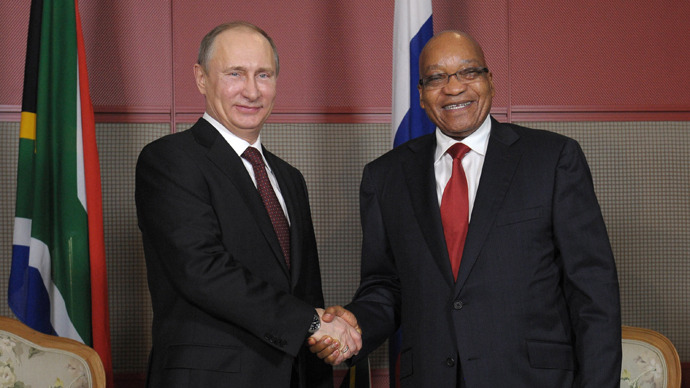
Russian President Vladimir Putin and President of South Africa Jacob Zuma (from right, background) during the signing of joint documents at a meeting in Durban. Foreground left – Russian Foreign Minister Sergei Lavrov on March 26, 2013. (RIA Novosti / Alexsey Druginyn)
Russia and South Africa have agreed to coordinate their actions for key global problems, including the current situation in Syria.
“Russia and South Africa share common approaches to key global issues. We cooperate in the UN, the BRICS and other international organizations. We agreed to further coordinate our actions, including for peaceful solutions to the Syrian crisis,” said Putin.
The Russian President also promised to think about the possibility of Russia’s support for a UN Security Council resolution on the cross-border provision of humanitarian assistance to Syria.
Russia and South Africa signed a declaration on a strategic partnership.
In particular, the document states the need to “enhance military cooperation, including military and military-technical cooperation on a long term basis and other forms of interaction between the armed forces of the two countries.”
The sides also agreed to cooperate in the fight against international terrorism, separatism, organized crime and drug trafficking. – RT
Four concrete deliverables are expected at the 5th BRICS Summit at Durban March 26-26, 2013, that will take the process of the five-nation bloc forward to the next level, Indian officials said on Monday.
Prime Minister Manmohan Singh, who arrived here on Monday evening, will join the leaders from Brazil, Russia, China and South Africa for the summit, being held in the African continent for the first time.
The four deliverables expected at the summit are:
– The eThekwini Declaration, named after the alternate name for Durban to set the future agenda for the bloc
– The launch up of the BRICS Business Council on Wednesday at the breakfast meeting among leaders.
– A consortium of five think tanks from each of the five countries, with India represented by the Observer Research Foundation.
– Two pacts on BRICS Multilateral Infrastructure Co-financing Agreement for Africa and BRICS Multilateral Cooperation and Co-financing Agreement for Sustainable Development where India is represented by its Exim Bank.
Ahead of the summit, the prime minister had said in a statement that he looked forward to engaging with the other BRICS leaders on ways to spur global growth, sustain macroeconomic stability and push investments.
“At a time when the world is facing multiple challenges, the Durban Summit provides a useful and timely opportunity to consult and coordinate on a broad range of issues with our BRICS partners,” he said.
“We will discuss ways to revive global growth and ensure macro-economic stability, as well as mechanisms and measures to promote investment in infrastructure and sustainable development,” he said.
“India will also urge faster movement on reform of institutions of global political and economic governance. It is important that BRICS continue to consult closely on developments affecting global peace and security.” – ibnlive.in.com
Andile Mngxitama has called for violence to be inflicted on a white journalist on social media.
Mngxitama, who holds an MA in Sociology from Wits, works at the Foundation for Human Rights as a policy advisor. The foundation’s director, Yasmin Sooka, hastily promised that the foundation did not condone violence or the incitement to violence and/or the expression of hate speech, and they intended to investigate the matter fully and to take “appropriate action”.
Jared Sacks – an independent journalist, social justice activist, and founder of the NGO Children of South Africa – apparently doesn’t want to get involved since his writing might invite more anti-white comments.
But the Facebook rant has hurt the feelings of other whites who like to befriend blacks. The likes of Zackie Achmat, Jane Duncan, Ayanda Kota and Nathan Geffen sent a letter conveying their hurt to the Mail & Guardian, accusing Mngxitama of “downright unethical” behaviour in threatening Sacks with violence on a public platform.
“To want to settle a political dispute through a physical fight, which is what Mngxitama calls for on his page [befriended by more than 5,000 people] is a terrible message for a public intellectual of Mngxitama’s stature to be communicating,” the letter read.
The fearless Xhosa has threatened Afrikaner farmers as well as author Dan Roodt on numerous occasions, but this only invited support by the same group now complaining.
Mngxitama previously called 5fm DJ Gareth Cliff “the poster boy of post-1994 racism”; accused the DA Students’ Organisation (Daso) of “selling the politics of racism as anti-racism”; and Jewish author Jonny Steinberg a “polite fascist”.
An opinion piece by Jared Sacks in the Mail & Guardian attracted Mngxitama’s ire. Headlined “Biko would not vote for Ramphele”, Sacks argues that Mamphela Ramphele’s political philosophies are far removed from Biko’s theories of Black Consciousness.
Stephen Bantu Biko was an anti-apartheid activist in South Africa in the 1960s and 1970s. A student leader, he later founded the Black Consciousness Movement which would empower and mobilize much of the urban black population.
“She has replaced Biko’s profound concept of Black Consciousness with an airy hope of a ‘South African Consciousness’, a nationalism predicated on the denial of the realities of race,” Sacks wrote. “[Biko] genuinely believed in the black masses and in their ability to lead the revolution and collectively build a wholly new society. The mineworkers, shack-dwellers and farmworkers of this country stand diametrically opposed to everything Ramphele believes in.”
Sacks thus expressed skepticism about the launch of Ramphele’s new political party platform, Agang. Another individual who voiced cynicism was Mngxitama himself, who wrote on Twitter shortly after Ramphele’s February announcement: “The tragedy of Agang is its ideological slant is its ideological slant. We don’t need another neo-liberal gang. The ANC and DA have done enough damage already.”
Mngxitama’s later comments to the Guardian voiced similar views to those of Sacks on Ramphele: “She’s linked to the white capital mining sector,” Mngxitama said. “She can’t claim to be part of black consciousness.”
Despite their similar views, Mngxitama nonetheless attacked Sacks. As the GroundUp website reported on Monday, Mngxitama used Facebook to vent his frustrations on the same day that the article by Sacks was published online.
“I don’t easily call for physical violence but I believe if there are any real Bikoists out there whenever we see that white little bastard called Jared Sacks we must beat the shit out of him,” Mngxitama wrote. “They are now pissing on Biko’s face. They can diss Mamphele all they want, but to insult us like this? When I see Jared he must beat me up. That’s the deal.”
In response to comments on his post, he added: “I know this white boy. He goes to the township, fucks up community organisations, and now he is fucking with Biko and BC. No! This is not a joke. He better be prepared. I’m black consciousness bruh and I know what white arrogance is. Jared will pay for this.”
Mngxitama makes it clear what his real issue with Sacks is: that the white journalist claims to understands black consciousness. “We don’t need Sacks to talk on our behalf, nor shall we allow him to insult Biko’s name and philosophy,” he wrote not long ago.
Mngxitama believes: “Each year, Biko’s memory is appropriated to serve anti-black agendas. His philosophy needs to be defended and elaborated by true Bikoists.”
He is probably dead right about that. South Africa has become the graveyard of white opportunists like Sacks who claim to speak for blacks. – Editor
South African President, Thabo Mbeki, Howard University President, H. Patrick Swygert, and Distinguished Professor Joseph E. Harris
President H. Patrick Swygert, President of Howard University; Mr. Frank Savage, Chairperson, Alliance Capital; Dr Joseph Harris, Committee Chairperson.
Ladies and Gentlemen.
It is an honour for me to receive the Doctor of Laws Degree from Howard University. This honour is not for me alone, but it is also a recognition of the people of South Africa, many of whom sacrificed their lives for the democracy we now enjoy.
John Berger in a poem titled “Dream” writes:
“In a pocket of earth
I buried all the accents
Of my mother tongue
There they lie
Like needles of pine
Assembled by ants.
One day the stumbling cry
Of another wanderer
May set them alight
Then warm and comforted
He will hear all night
The truth as lullaby.”
Buried in the pocket of South African soil a story of human evolution is unfolding as scientists assemble the remains of our ancestors.
South Africa has dolomite caves in which some of the most significant human fossils in our evolutionary history are found. These include Homo fossils, which are ancestors of humanity. This is one of the many indicators of the African origin of hominids and humans.
Furthermore, there is evidence of human existence in South Africa dating back to 250 000 years ago. We have recently found anatomically modern human remains belonging to an earlier period of human existence. This complete human form was found in the southern coast of the Cape in South Africa. We have bone tools, decorated ochre and ostrich eggshell at several sites in the country. There is, again in South Africa, evidence of the earliest systematic exploitation of marine foods including shellfish, and well-made stone tools that only appear in Europe many years later. Some of the earliest depictions of humankind are captured in the oldest and largest rock paintings, which are found in South Africa.
All of these demonstrate that Africa is indeed the cradle of humanity.
Recently, about a decade ago, the Sinologist Martin Bernal caused a huge stir in western academic circles by publishing a book, “Black Athena”, suggesting that the origins of Ancient Greek and, consequently, European civilisation lay in Africa and Asia.
It soon became evident from the academic heat generated by Bernal’s thesis that to most Europeans, even those schooled in the best universities, the notion that the Greeks owed anything to Africa was unpalatable. The chagrin he occasioned among some of his interlocutors betrayed that, what was really at stake, was not ancient history but 20th century politics. In their enthusiasm to refute him, many a reckless statement was uttered and published.
Despite the controversies, the question remains that if Africa occupies such a central place in the evolution of humanity, why is it that that which defines Africa seems to be war, conflict, power struggles, disease and even greed.
The history of Africa is one of slavery, colonialism, neo-colonialism and racism, which conditions have for many years impacted negatively on the development of the Continent. In addition, the cold war also contributed to the exploitation and underdevelopment of Africa.
Almost everyday in the media we see images of a continent at war with itself. There are stories about the collapse of civilian governments, life-threatening drought, famine, natural disasters, military coups – all of which might well give the unwary consumers the impression that ours is a continent teetering on the brink of total collapse.
This is often reinforced by the opinion that this continent has produced little of value.
Yet Africa produces hides and leather, even though the majority of Africans are bare-footed. Africa produces cocoa, yet African children do not eat chocolate. Africa produces some of the world’s most expensive diamonds and other precious stones, yet it is the poorest continent on earth. Africa’s natural wealth in gold, platinum and other strategic minerals is legendary, yet millions of Africans starve!
The end of the twentieth century should mark the end of that era. In the new century Africans are now making a new beginning. The commencement of the third millennium is witnessing the emergence of a new generation of African leaders, steeled in the harsh school of post-independence Africa.
It is a generation nurtured on the post-colonial experiences of Africa and the Caribbean. This is a generation, which has seen the end of the cold war; which has been witness to, and participants in Africa’s greatest success – political liberation – but has also been witness to her most tragic and disheartening failures. History has decreed that it will be this generation of leaders who lead our continent and the African peoples into the 21st century.
Already signs of Africa’s rebirth are there for us to see. More countries in Africa have embraced democratic governance than was the case ten years ago. In our own Region of Southern Africa, five countries have successfully held democratic elections in the past year alone.
There has been an unprecedented economic growth in many parts of Africa, including three countries which are amongst the fastest growing economies in the world.
Furthermore, for the first time in the history of our continent, Africans are beginning to tackle their own problems, seeking solutions to some of the seemingly intractable conflicts by addressing their root causes.
The movement for the renewal of Africa has from the beginning involved both the Africans living on the continent and those of the diaspora.
It is this diverse African humanity, with its vast untapped potential, that has to be harnessed for this movement. A Renaissance must entail Africa and the African peoples catching up with the rest of the world. One of the impediments towards the realisation of our renaissance is the question of racism.
As a response to this problem, South Africa will host the United Nations conference on racism and xenophobia next year. In preparation, South Africa will hold a national conference which will work on practical mechanisms which must translate into closing the chasm that still separates Black and White. The South African contribution will obviously be stilted if only a fraction of our population contributes to the resolution of the question of racism.
The international climate in which we are called upon to act is decisively different from that of Europe in the 15th century. An African renaissance will have to unfold in co-operation with sister countries, rather than at their expense. It is in that context that the African populations of the Caribbean and the Americas assume a special significance. To catch up, Africa needs the accumulated skills, talents and capacity of the Africans of the diaspora.
The African-American community in the USA constitutes the largest body of Africans living in the developed countries of the North. Provided it is mobilised, the political weight of this community could be a formidable factor in determining the direction of US African policy and in support of the renaissance.
When we factor in the African states themselves, the Caribbean states and these huge African minorities in the Americas, the potential of a focused programme of action becomes very real. Its voice in the fora of the world could not be stilled and its capacity for collective action seems almost infinite.
This will have to be accompanied by a great continent-wide cultural revival – based on the spreading of literacy, numeracy and knowledge of the sciences. In the age of the Internet, the mastery of modern technology is a must for success. The schools, adult education projects, colleges, the universities and other institutions of higher learning would have to assume a leading role in such a revival.
A meaningful cultural revival would necessarily entail a critical revisiting of indigenous African cultural institutions, customary practices and mores, in order to review, re-assess and where necessary, reform, restructure and modernise these so as to harmonise them with the larger cultural project.
It is clear, despite what the Afro-pessimists may say, that Africa’s contribution to humanity is at least equal to that of other continents. Africa can make an even greater mark during the next millennium provided we all join hands and refuse to be distracted by temporary setbacks.
A renewed sense of common purpose among Africans, centred on the as yet unrealised potential of African humanity is essential.
We need to ensure that we are no longer vulnerable to curable diseases and find appropriate and effective ways of reversing the debilitating trend of diseases such as TB, Malaria and AIDS.
We have to focus our energies on basic programmes that will ensure that we have infrastructure and programmes for clean water, proper roads, basic hygiene and sufficient clinics and hospitals.
We should do these things inspired by the words of Callisto Madavo, Vice-President for Africa at the World Bank:
“Africa is poised for transformation in both political and economic spheres, which even optimists would have been weary of predicting ten years ago.”
In this political and economic transformation of Africa, all of us will be able to ensure that “the accents of our mother tongue” shall never be buried, but that as we reclaim them, they shall bring us together as never before.
Mr President, ladies and gentlemen;
May I, on behalf of the entire South African nation, and on my own behalf, extend our sincerest appreciation for the role you played in our struggle against apartheid. I would like to assure you that our victory is also your victory. As we rebuild our country and continent, we urge you to continue to participate with us in the new partnership that must surely bring about a better life for all our people.
I know that I can count on your continued support in our new struggle for African renewal.
South Africans should brace themselves for what could be the most difficult winter as electricity supply remained constrained, the Public Enterprise Minister Malusi Gigaba said.
“We need to worry about how we are going to go through this winter,” Gigaba said.
He was speaking to residents in Kliptown, Soweto where he was encouraging community members to pay for their electricity and to report illegal connections.
This was part of the 49M energy saving campaign.
Gigaba urged the public to continue with basic electricity saving habits like switching off geysers between 5pm and 9pm.
“We need to change our behaviour… instead of using heaters people should rather use blankets.”
He told residents that with Eskom reaching 40 million new connections last year, it meant by 2017, South Africa would have to have more power stations to meet the growing demand.
“We are still confident that we will, in partnership with all South Africans and with more business joining the partnership, succeed to keep the lights on until we get out of this difficult situation,” said Gigaba.
He finally asked residents to observe Earth Hour on Saturday evening by switching off lights and appliances between 8.30pm and 9.30pm. – Sapa
This website uses cookies to improve your experience. We'll assume you're ok with this, but you can opt-out if you wish. Cookie settingsACCEPT
Privacy & Cookies Policy
Privacy Overview
This website uses cookies to improve your experience while you navigate through the website. Out of these cookies, the cookies that are categorized as necessary are stored on your browser as they are essential for the working of basic functionalities of the website. We also use third-party cookies that help us analyze and understand how you use this website. These cookies will be stored in your browser only with your consent. You also have the option to opt-out of these cookies. But opting out of some of these cookies may have an effect on your browsing experience.
Necessary cookies are absolutely essential for the website to function properly. This category only includes cookies that ensures basic functionalities and security features of the website. These cookies do not store any personal information.
Any cookies that may not be particularly necessary for the website to function and is used specifically to collect user personal data via analytics, ads, other embedded contents are termed as non-necessary cookies. It is mandatory to procure user consent prior to running these cookies on your website.