America’s Middle East policy is doomed

Over the past half century or so the United States has pursued two main but disconnected objectives in West Asia and North Africa: on the one hand, Americans have sought strategic and economic advantage in the Arabian Peninsula, Persian Gulf, and Egypt; on the other, support for the consolidation of the Jewish settler state in Palestine.  These two objectives of U.S. policy in the Middle East have consistently taken precedence over the frequently professed American preference for democracy.

These objectives are politically contradictory.  They also draw their rationales from distinct moral universes.  U.S. relations with the Arab countries and Iran have been grounded almost entirely in unsentimental calculations of interest.  The American relationship with Israel, by contrast, has rested almost entirely on religious and emotional bonds.  This disconnect has precluded any grand strategy.

Rather than seek an integrated policy framework, America has balanced the contradictions between the imperatives of its domestic politics and its interests. For many years, Washington succeeded in having its waffle in the Middle East and eating it too – avoiding having to choose between competing objectives. With wiser U.S. policies and more judicious responses to them by Arabs and Israelis, Arab-Israeli reconciliation might by now have obviated the ultimate necessity for America to prioritize its purposes in the region. But the situation has evolved to the point that choice is becoming almost impossible to avoid.The Middle East matters. It is where Africa, Asia, and Europe converge. In addition to harboring the greater part of the world’s conventionally recoverable energy supplies, it is a key passageway between Asia and Europe. No nation can hope to project its power throughout the globe without access to and through the Middle East. Nor can any ignore the role of the Persian Gulf countries in fueling the world’s armed forces, powering its economies, and setting its energy prices. This is why the United States has acted consistently to maintain a position of preeminent influence in the Middle East and to deny to any strategically hostile nation or coalition of nations the opportunity to contest its politico-military dominance of the region.The American pursuit of access, transit, and strategic denial has made the building of strategic partnerships with Iran, Saudi Arabia, and Egypt a major focus of U.S. policy. The partnership with Iran broke down over three decades ago. It has been succeeded by antagonism, low-intensity conflict, and the near constant threat of war. The U.S. relationships with Egypt and Saudi Arabia are now evolving in uncertain directions. Arab governments have learned the hard way that they must defer to public opinion. This opinion is increasingly Islamist. Meanwhile, popular antipathies to the widening American war on Islamism are deepening. These factors alone make it unlikely that relations with the United States can retain their centrality for Cairo and Riyadh much longer.

The definitive failure of the decades-long American-sponsored “peace process” between Israelis, Palestinians, and other Arabs adds greatly to the uncertainty. Whether it yielded peace or not, the “peace process” made the United States the apparently indispensable partner for both Israel and the Arabs. It served dual political purposes. It enabled Arab governments to persuade their publics that maintaining good relations with the United States did not imply selling out Arab or Islamic interests in Palestine, and it supported the U.S. strategic objective of achieving acceptance for a Jewish state by the other states and peoples of the Middle East. Washington’s abandonment of this diplomacy was a boon to Israeli territorial expansion but a disaster for American influence in the region, including in Israel.

Over the years, America protected Israel from international rebuke and punishment. Its stated purpose was the preservation of prospects for a negotiated “two-state solution” that could bring security and peace to Israelis and Palestinians alike. A decade ago, every member of both the Arab League and the Organization of Islamic Cooperation endorsed this objective and pledged normalization with Israel if Israeli-Palestinian negotiations succeeded. In response, Israel spun out its talks with the Palestinians while working hard to preclude their self-determination. It has now succeeded in doing so.

There has been no American-led peace process worthy of the name for nearly two decades. There is no prospect of such a process resuming. No one in the international community now accepts the pretense of a “peace process” as an excuse for American protection of Israel. Eleven years on, the Arab and Islamic peace offer has exceeded its shelf life. On the Israel-Palestine issue, American diplomacy has been running on fumes for some time. It is now totally out of gas and universally perceived to be going nowhere.

Sadly, barring fundamental changes in Israeli politics, policies, and behavior, the longstanding American strategic objective of achieving acceptance for the state of Israel to stabilize the region where British colonialism and Jewish nationalism implanted it is now infeasible. In practice, the United States has abandoned the effort. U.S. policy currently consists of ad hoc actions to fortify Israel against Palestinian resistance and military threats from its neighbors, while shielding it from increasingly adverse international reaction to its worsening deportment. In essence, the United States now has no objective with respect to Israel beyond sheltering it from the need to deal with the unpalatable realities its own choices have created.

The key to regional acknowledgment of Israel as a legitimate part of the Middle East was the “two-state solution.” The Camp David accords laid out a program for Palestinian self-determination and Israeli withdrawal from the territories it had seized and occupied in 1967. Israel has had more than forty-five years to trade land for peace, implementing its Camp David commitments and complying with international law. It has consistently demonstrated that it craves land more than peace, international reputation, good will, or legitimacy. As a result, Israel remains isolated from its neighbors, with no prospect of reversing this. It is now rapidly forfeiting international acceptability. There is nothing the United States can do to cure either situation despite the adverse consequences of both for American standing in the region and the world.

In the seventeenth century, English settlers in America found inspiration for a theology of ethnic cleansing and racism in the Old Testament. In the twentieth and twenty-first centuries, Jewish settlers in Palestine have invoked the same scripture to craft a parallel theology. The increasingly blatant racism and Islamophobia of Israeli politics, the kafkaesque tyranny of Israel’s checkpoint army in the occupied territories, and Israel’s cruel and unusual collective punishment of Gaza have bred hateful resentment of the Jewish state in its region and throughout the Muslim world. One has to look to north Korea to find another polity so detested and distrusted by its neighbors and with so few supporters among the world’s great powers.

The United States has affirmed that, regardless of how Israel behaves, it will allow no political distance between itself and the Jewish state. In the eyes of the world there is none. Israel’s ill repute corrodes U.S. prestige and credibility not just in the Middle East but in the world at large.

Israel does not seem to care what its neighbors or the world think of it. Despite its geographical location, it prefers to see itself as its neighbors do: as a Hebrew-speaking politico-economic extension of Europe rather than part of the Middle East. Nor does Israel appear concerned about the extent to which its policies have undermined America’s ability to protect it from concerted international punishment for its actions. The United States and Israel’s handful of other international supporters continue to have strong domestic political reasons to stand by it. Yet they are far less likely to be able to hold back the global movement to ostracize Israel than in the case of apartheid South Africa. America may “have Israel’s back,” but – on this – no one now has America’s back.

For a considerable time to come, Israel can rely on its US-provided “qualitative edge” to sustain its military hegemony over others in its region. But, as the “crusader states” established and sustained by previous Western interventions in the region illustrate, such supremacy – especially when dependent on external support – is inevitably ephemeral – and those who live exclusively by the sword are more likely than others to perish by it.  Meanwhile, as the struggle for Palestinian Arab rights becomes a struggle for human and civil rights within the single sovereignty that Israel has de facto imposed on Palestine, Israel’s internal evolution is rapidly alienating Jews of conscience both there and abroad. Israelis do not have to live in Palestine; they can and do increasingly withdraw from it to live in diaspora. Jews outside contemporary Israel are coming to see it less as a sanctuary or guarantor of Jewish security and well-being than as a menace to both.

The United States has made an enormous commitment to the success of the Jewish state. Yet it has no strategy to cope with the tragic existential challenges Zionist hubris and overweening territorial ambition have now forged for Israel. The hammerlock the Israeli right has on American discourse about the Middle East assures that, despite the huge U.S. political and economic investment in Israel, Washington will not discuss or develop effective policy options for sustaining the Jewish state over the long term. The outlook is therefore for continuing deterioration in Israel’s international moral standing and the concomitant isolation of the United States in the region and around the globe.

This brings me back to the other main objective of U.S. policy in the Middle East: the nurturing of strategic partnerships with the largest and most influential Muslim states in the region. Iran and Syria have proven to be lost causes in this regard. Iraq is now more aligned with them than with America. Turkey is still an important U.S. ally on many matters but, with the exception of some aspects of relations with Syria, Ankara is following policies toward the Middle East that are almost entirely uncoordinated with those of the United States. The two pillars of the U.S. position in the Middle East beyond Israel are Egypt and Saudi Arabia. Neither can now be taken for granted.

Egypt is in the midst of a transition from American-aligned autocracy to self-determination under Islamist populism. It is not clear what sort of domestic political order this populism will shape but it seems certain that future Egyptian governments will listen less to the United States and demand more of Israel. The diversion to Egypt of a portion of the U.S. government’s generous annual subsidies to Israel long sufficed to secure Cairo’s acquiescence in the Camp David framework. This enabled Israel to pretend that it had achieved a measure of acceptance among its Arab neighbors despite its default on its obligations to the Palestinians and its escalating mistreatment of them. More importantly, it gave Israel the strategic security from Egyptian attack it had been unable to obtain by force of arms.

Populist Egypt’s passivity is very unlikely to be procurable on similar terms. Enough has changed to put the Camp David framework at severe risk. (This is true for Jordan as well. Jordan made peace with Israel in response to the Oslo accords, which the ruling right-wing in Israel systematically undermined and finally undid.)

Since 1979, the U.S. relationship with Israel has been both a raison d’être and essential underpinning for U.S.-Egyptian cooperation. It is now reemerging as a point of division, irritation, and contention between Americans and Egyptians. Egypt is once again an independent Arab actor in the affairs of its region, including Israel and Iran. It is no longer a reliable agent of American influence. It reacts to Israeli actions and policies calculatedly, with much less deference to U.S. views than in the past.

Islamist parties now dominate Egyptian politics as they do politics in Tunisia and among Palestinians. It is very unlikely that post-Assad Syria will be democratic but it is virtually certain that it will be Salafist. The so-called Arab awakening has turned out really to be a Salafist awakening. There is a struggle for the soul of Islam underway between Takfiri Salafists and conservative modernizers. In the traditionally Islamist states of Saudi Arabia and Qatar, this struggle is being won by the forces of tolerance, reform, and opening up. Elsewhere, as in Egypt, the outcome remains in doubt, but nowhere are Muslim conservatives, still less Salafists, at ease with expansionist Zionism or the sort of aggressive anti-Islamism that the United States has institutionalized in its “drone wars.”

In the wake of Washington’s abandonment of the effort to broker peace between Israel and the Palestinians, the impact of 9//11, the U.S. invasion and occupation of Iraq, and the transformation of a punitive raid in Afghanistan into a long-term attempt to preclude an Islamist regime there, the U.S. – Saudi relationship, once an example of broad-based strategic partnership, has markedly weakened. American Islamophobia has erased much of the previous mutual regard between the two countries. The United States continues to be the ultimate guarantor of the Saudi state against intervention from foreign enemies other than Israel. There is no alternative to America in this role. Nor, even when it regains energy self-sufficiency, will the United States be able to ignore Saudi Arabia’s decisive influence on global energy supplies and prices. But U.S. – Saudi cooperation is no longer instinctual and automatic. It has become cynically transactional, with cooperation taking place on a case-by-case basis as specific interests dictate.

Policy convergence between Washington and Riyadh continues but sometimes conceals major differences. This is clearly the case with Iran, where Washington’s interest in non-proliferation and desire to preserve Israel’s nuclear monopoly in the Middle East overlap but do not coincide with Riyadh’s concerns. If Tehran does go nuclear, Saudi-American disharmony will be glaringly apparent in very short order . Similarly, in Syria, the common desire of Americans and Saudis to see Syrians overthrow the Assad government masks very different visions about what sort of regime should succeed it and what the stance of that regime should be toward Israel, Lebanon, or Iraq.

The bottom line is this. U.S. policies of unconditional support for Israel, opposition to Islamism, and the use of drones to slaughter suspected Islamist militants and their families and friends have created an atmosphere that precludes broad strategic partnerships with major Arab and Muslim countries, though it does not yet preclude limited cooperation for limited purposes.  The acceptance of Israel as a legitimate presence in the Middle East cannot now be achieved without basic changes in Israeli attitudes and behavior that are not in the offing.

U.S. policies designed, respectively, to pursue strategic partnerships with Arab and Muslim powers and to secure the state of Israel have each separately failed. The Middle East itself is in flux. America’s interests in the region now demand fundamental rethinking, not just of U.S. policies, but of the strategic objectives those policies should be designed to achieve.

Chas  Freeman, retired U.S. ambassador to Saudi Arabia, spokeat the Washington-based Middle East Policy Council 16 January 2013.


Stunning drop in US GDP

The U.S. economy posted a stunning drop of 0.1 percent in the fourth quarter, defying expectations for slow growth and possibly providing incentive for more Federal Reserve stimulus.

The economy shrank from October through December for the first time since the recession ended, hurt by the biggest cut in defense spending in 40 years, fewer exports and sluggish growth in company stockpiles.

The Commerce Department said Wednesday that the economy contracted at an annual rate of 0.1 percent in the fourth quarter. That’s a sharp slowdown from the 3.1 percent growth rate in the July-September quarter.

The surprise contraction could raise fears about the economy’s ability to handle tax increases that took effect in January and looming spending cuts.

Still, the weakness may be because of one-time factors. Government spending cuts and slower inventory growth subtracted a total of 2.6 percentage points from growth.

And those volatile categories offset faster growth in consumer spending, business investment and housing — the economy’s core drivers of growth.

Another positive aspect of the report: For all of 2012, the economy expanded 2.2 percent, better than 2011’s growth of 1.8 percent.

The economy may stay weak at the start of the year because Americans are coming to grips with an increase in Social Security taxes that has left them with less take-home pay.

Subpar growth has held back hiring. The economy has created about 150,000 jobs a month, on average, for the past two years. That’s barely enough to reduce the unemployment rate, which has been 7.8 percent for the past two months.

Economists forecast that unemployment stayed at the still-high rate again this month. The government releases the January jobs report Friday.

The slower growth in stockpiles comes after a big jump in the third quarter. Companies frequently cut back on inventories if they anticipate a slowdown in sales. Slower inventory growth means factories likely produced less.

Heavy equipment maker Caterpillar, Inc. said this week that it reduced its inventories by $2 billion in the fourth quarter as global sales declined from a year earlier.

The biggest question going forward is how consumers react to the expiration of a Social Security tax cut. Congress and the White House allowed the temporary tax cut to expire in January, but reached a deal to keep income taxes from rising on most Americans.

The tax increase will lower take home pay this year by about 2 percent. That means a household earning $50,000 a year will have about $1,000 less to spend. A household with two high-paid workers will have up to $4,500 less.

Already, a key measure of consumer confidence plummeted this month after Americans noticed the reduction in their paychecks, the Conference Board reported Tuesday.

Economists expected the first reading on gross domestic product to show growth of 1 percent, down from the third quarter’s reading of 3.1 percent. – AP

Israel ignores UN human rights review

Israel has boycotted the UN human rights forum over fears of scrutiny of its treatment of residents of the occupied territories. Israel is now the first state in history to win a deferment of the periodical review of its human rights record.

Tel Aviv has refused to send a delegation on Tuesday to the United Nations Human Rights Council in Geneva for the Universal Periodic Review procedure where UN member states have their human rights record evaluated every four years.

Israel’s cooperation with the council stopped last March after the UN set up a committee to inspect the effects of the Israeli settlements on Palestinians.

Israel which earlier accused the United Nations of anti-Israel bias reiterated its stance, recalling that the council has passed more resolutions against Israel than all other countries combined.

“After a series of votes and statements and incidents we have decided to suspend our working relations with that body,” Yigal Palmor, Israeli foreign ministry spokesman, told the Financial Times. “I can confirm that there is no change in that policy.”

“There have been more resolutions condemning Israel than the rest of the world put together,” an Israeli government official said on Tuesday. “It’s not a fair game – it’s not even a game.”

Following the Israeli decision, the council has decided to postpone its review until no later than November.

The Council president has also called on the body to adopt a draft response to an unprecedented move by Israel.

Egypt’s representative meanwhile has warned that a “soft” approach would create a dangerous precedent and leave “a wide-open door for more cases of non-cooperation,” the AFP quoted.

Activist groups lash out against Israel’s disregard for international law.

“By not participating in its own review, Israel is setting a dangerous precedent,” Eilis Ni Chaithnia, an advocacy officer with al-Haq, a human rights organisation based in Ramallah has told the FT. “This is the first time any country has made a determined effort not to attend.”

Others thought that the council’s decision to delay gives Tel Aviv the opportunity to make amends. Eight Israeli human rights organizations issued a statement saying, “Israel now has a golden opportunity to reverse its decision not to participate,” adding “it is legitimate for Israel to express criticism of the work of the Council and its recommendations, but Israel should do so through engagement with the Universal Periodic Review, as it has done in previous sessions,” JTA quotes.

The investigation into Israel’s Human Rights record began in 2007, but last year the UN started to pay particular attention to Israel’s activities in the West Bank.

The probe at the time prompted an angry response from the country’s leader.

“This is a hypocritical council with an automatic majority against Israel,” Prime Minister Benjamin Netanyahu said.

Senior Israeli officials announced last month that Israel does not intend to cancel plans to accelerate settlement construction.

Netanyahu himself said in an interview with Israeli Channel 2 last month that the disputed area “is not occupied territory” and that he “does not care” what the UN thinks about it.

Around 500,000 Israelis and 2.4 million Palestinians live in the West Bank and in East Jerusalem, areas that, along with Gaza, the Palestinians want for a future state.

The United Nations regards all Israeli settlements in the West Bank as illegal. Tel Aviv last attended the human rights review in 2008. Israel is not a member of the Council, which is comprised of 47 UN member states. – RT

White Power to the Rescue

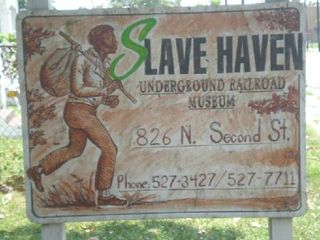
On a windy afternoon a few days ago I went to a depressed section of North Memphis to visit an old clapboard house that was once owned by a German immigrant named Jacob Burkle. Oral history—and oral history is all anyone has in this case since no written survive—holds that Burkle used his house as a stop on the underground railroad for escaped slaves in the decade before the Civil War. The house is now a small museum called Slave Haven. It has artifacts such as leg irons, iron collars and broadsheets advertising the sale of men, women and children. In the gray floor of the porch there is a trapdoor that leads to a long crawl space and a jagged hole in a brick cellar wall where fugitives could have pushed themselves down into the basement. Escaped slaves were purportedly guided by Burkle at night down a tunnel or trench toward the nearby Mississippi River and turned over to sympathetic river traders who took them north to Cairo, Ill., and on to freedom in Canada.

Burkle and his descendants had good reason to avoid written records and to keep their activities secret. Memphis, on the eve of the Civil War, was one of the biggest slave markets in the South. After the war the city was an epicenter for Ku Klux Klan terror that included lynching, the nighttime burning of black churches and schools and the killing of black leaders and their white supporters, atrocities that continued into the 20th century. Martin Luther King Jr. was assassinated in Memphis in 1968. If word had gotten out that Burkle used his home to help slaves escape, the structure would almost certainly have been burned and Burkle or his descendants, at the very least, driven out of the city. The story of Burkle’s aid to slaves fleeing bondage became public knowledge only a couple of decades ago.

The modest public profile of the Burkle house stands in stunning contrast with the monument in the center of Memphis to native son Nathan Bedford Forrest. Forrest, who is buried in Forrest Park under a statue of himself in his Confederate general’s uniform and mounted on a horse, is one of the most odious figures in American history. A moody, barely literate, violent man—he was not averse to shooting his own troops if he deemed them to be cowards—he became a millionaire before the war as a slave trader. As a Confederate general he was noted for moronic aphorisms such as “War means fighting and fighting means killing.” He was, even by the accounts of those who served under him, a butcher. He led a massacre at Fort Pillow in Henning, Tenn., of some 300 black Union troops—who had surrendered and put down their weapons—as well as women and children who had sheltered in the fort. Forrest was, after the war, the first grand wizard of the Ku Klux Klan. He used his skills as a former cavalry commander to lead armed night raids to terrorize blacks.

Forrest, like many other white racists of the antebellum South, is enjoying a disquieting renaissance. The Sons of Confederate Veterans and the West Tennessee Historical Commission last summer put up a 1,000-pound granite marker at the entrance to the park that read “Forrest Park.” The city, saying the groups had not obtained a permit, removed it with a crane. A dispute over the park name, now raging in the Memphis City Council, exposes the deep divide in Memphis and throughout much of the South between those who laud the Confederacy and those who detest it, a split that runs like a wide fault down racial lines.

A call last week by Memphis City Councilwoman Janis Fullilove, who is African-American, to strip Forrest’s name from the park and rename it after the crusading black journalist Ida B. Wells set off such an acrimonious debate between her and some white council members that Fullilove left a meeting in tears.

Wells was one of the nation’s most courageous and important journalists. She moved to Memphis as a young woman to live with her aunt. Her investigations revealed that lynching was fundamentally a mechanism to rid white businessmen of black competitors. When Thomas Moss of Memphis, a black man who ran the People’s Grocery Co., was murdered with his partners by a mob of whites and his store was looted and destroyed, Wells was incensed. “This is what opened my eyes to what lynching really was,” she wrote. She noted “that the Southerner had never gotten over this resentment that the Negro was no longer his plaything, his servant, and his source of income” and was using charges of rape against black business owners to mask this resentment. The lynching of Moss, she wrote, was “[a]n excuse to get rid of Negroes who were acquiring wealth and property and thus keep the race terrorized and ‘keep the nigger down.’ ”

Her newspaper, Free Speech, which railed against white mob violence, the inadequate black schools, segregation, discrimination and a corrupt legal system that denied justice to blacks, was destroyed by whites. Wells was forced to flee the city, becoming, as she wrote, “an exile from home for hinting at the truth.”

The split between those in Memphis who hold up authentic heroes—those who fought to protect, defend and preserve life, such as Wells and Burkle—and those who memorialize slave traders and bigots such as Forrest points up a disturbing rise of a neo-Confederate ideology in the South. Honoring figures like Forrest in Memphis while ignoring Wells would be like erecting a statue to the Nazi death camp commander Amon Goeth in the Czech Republic town of Svitavy, the birthplace of Oskar Schindler, who rescued 1,200 Jews.

The rewriting of history in the South is a retreat by beleaguered whites into a mythical self-glorification. I witnessed a similar retreat during the war in Yugoslavia in the 1990s. As Yugoslavia’s economy deteriorated, ethnic groups built fantasies of a glorious past that became a substitute for history. They sought to remove, through exclusion and finally violence, competing ethnicities to restore this mythological past. The embrace by nationalist groups of a nonreality-based belief system made communication with other ethnic groups impossible. They no longer spoke the same cultural language. There was no common historical narrative built around verifiable truth. A similar disconnect was illustrated last week in Memphis when the chairman of the city’s parks committee, William Boyd, informed the council that Forrest “promoted progress for black people in this country after the war.” Boyd argued that the KKK was “more of a social club” at its inception and didn’t begin carrying out “bad and horrific things” until it reconstituted itself with the rise of the modern civil rights movement.

“Lord, have mercy,” Fullilove muttered as she listened.

But Forrest is only one of numerous flashpoints. Fliers reading “Loyal White Knights of the Ku Klux Klan Wants You to Join” appeared in the mailboxes of white families in Memphis in early January. The Ku Klux Klan also distributed pamphlets a few days ago in an Atlanta suburb. The Tennessee Legislature last year officially declared July 13 as Nathan Bedford Forrest Day to honor his birthday. There are 32 historical markers honoring Forrest in Tennessee alone and several in other Southern states. Montgomery, Ala., which I visited last fall, has a gigantic Confederate flag on the outskirts of the city, planted there by the Sons of Confederate Veterans. Confederate monuments dot Montgomery’s city center. There are three Confederate state holidays in Alabama, including Martin Luther King/Robert E. Lee Day. Alabama, Florida, Georgia and Mississippi also honor Lee’s birthday. Jefferson Davis’ birthday is a state holiday in Alabama and Florida. And re-enactments of Confederate victories in the Civil War crowd Southern calendars.

The steady rise of ethnic nationalism over the past decade, the replacing of history with mendacious and sanitized versions of lost glory, is part of the moral decay that infects a dying culture. It is a frightening attempt, by those who are desperate and trapped, to escape through invented history their despair, impoverishment and hopelessness. It breeds intolerance and eventually violence. Violence becomes in this perverted belief system a cleansing agent, a way to restore a lost world. There are ample historical records that disprove the myths espoused by the neo-Confederates, who insist the Civil War was not about slavery but states’ rights and the protection of traditional Christianity. But these records are useless in puncturing their self-delusion, just as documentary evidence does nothing to blunt the self-delusion of Holocaust deniers. Those who retreat into fantasy cannot be engaged in rational discussion, for fantasy is all that is left of their tattered self-esteem. When their myths are attacked as untrue it triggers not a discussion of facts and evidence but a ferocious emotional backlash. The challenge of the myth threatens what is left of hope. And as the economy unravels, as the future looks bleaker and bleaker, this terrifying myth gains potency.

Achilles V. Clark, a soldier with the 20th Tennessee Cavalry under Forrest during the 1864 massacre at Fort Pillow, wrote to his sister after the attack: “The slaughter was awful. Words cannot describe the scene. The poor deluded negroes would run up to our men, fall upon their knees, and with uplifted hands scream for mercy but they were ordered to their feet and then shot down. … I, with several others, tried to stop the butchery, and at one time had partially succeeded, but General Forrest ordered them shot down like dogs and the carnage continued. Finally our men became sick of blood and the firing ceased.”

Chris Hedges, whose column is published Mondays on Truthdig, spent nearly two decades as a foreign correspondent in Central America, the Middle East, Africa and the Balkans. He has reported from more than 50 countries and has worked for The Christian Science Monitor, National Public Radio, The Dallas Morning News and The New York Times, for which he was a foreign correspondent for 15 years.

By Chris Hedges. This article was originally posted at TruthDig

Uncle Tom’s Cabin, with white slaves

When was the last time you saw Uncle Tom’s Cabin in a theater? The answer is probably never. As far as I can tell, a theatrical version of Harriet Beecher Stowe’s controversial novel hasn’t been performed in the Philadelphia area for many decades, and that also appears to be true for the rest of the country, with the exception of a couple of attempts in New York City over the years. But one Philadelphia theater company says that it’s time to bring the story back to the stage, but with a twist.

EgoPo Classic Theater, a company that describes itself as “edgy, innovative, and inspiring,” is set to debut Uncle Tom in May at Delancey Place’s Plays & Players Theater. Auditions begin this weekend. The show will mark the end of EgoPo’s vaudeville-themed season, which started with their excellent all-female Assassination of Jesse James and continues in March with The Life (and Death) of Harry Houdini.

Uncle Tom was quickly transformed into a theatrical work after the novel’s 1852 publication. And although the book was immensely popular (its sales in the 1800s were only surpassed by those of the Bible), the various theatrical versions were even more so.

Because copyright laws were not what they are today, the scripts strayed freely from the original text, and the show eventually became a centerpiece of minstrel performances, complete with blackface and the most exaggerated racial stereotypes possible. Plus, the book itself wound up on some “banned book” lists, and the NAACP objected to its language and characterizations. No wonder the progressive theater world sought to distance itself in later years.

For the May production, EgoPo artistic director Lane Savadove and Glenn Odom, a literary studies professor at Rowan University, are creating a new script. “We’re doing a realistic, naturalistic version that will be incredibly respectful of the novel,” promises Savadove. “We’re not writing anything. We’re using the book word-for-word, cutting it just so that it works in a theatrical format. I really want the novel to speak for itself on the stage. This is not going to be some post-modern version of Uncle Tom’s Cabin.”

I asked him why it was important to do Uncle Tom now, why he wants to pick it up after all these years.

“The play got tagged as racist not because of the book but because of the minstrel shows,” he explains. “The book was written as an anti-racist piece, and in the last 10 years, the top African American scholars like Henry Louis Gates and Cornel West have gone back to reclaim it as an important part of racial history. And so, we wanted to go back now that it’s seen in this new light and create a new theater version.”

One person who is not convinced that this is necessarily a good idea is Philadelphia actor James Ijames, who teaches the most prominent version of the Uncle Tom scripts in his “Race on the Stage” course at Temple University.

“The citing of Henry Louis Gates and Cornel West to somehow say, ‘See, the black guy said it’s OK!’ is problematic,” says Ijames. “Citing the elder statesmen is akin to the ‘some of my best friends are black’ argument. That notion and rebuttal and defense doesn’t have anything to do with anything.”

Further complicating the matter is Savadove’s decision to swap races in the casting process. In other words, white actors will play slaves while black actors will play their owners.

I talked to one white actor who plans to audition for the show, even though his concerns are “numerous.” The actor, who asked to remain anonymous, points out that many of the stereotypes commonly associated with black culture can be traced back to Uncle Tom, from the “Aunt Jemima” figure to the hyper-educated, very proper black man.

“Those stereotypes were built off of white characterizations of blacks,” he says. “I don’t know how having white actors playing black characters introduces anything new to this story. I sincerely hope that there is an artistic objective beyond being edgy for the sake of being edgy.”

But his biggest and “admittedly selfish” concern is the dialect and language that he’ll be expected to use.

“I have a hard time listening to myself delivering the language,” he notes. “It sounds like a blatantly racist caricature.” He says that he can’t even read his lines in public.

Savadove tries to explain his unusual casting decision: “Even though, by all accounts, the dialogue is incredibly historically accurate, it’s a loaded subject to have a black man speak in a Southern slave dialect. And so we’re switching the races. And we’re painting a picture of an America where it happens to be that the whites became enslaved and the blacks became the slave owners. We’re pointing out the randomness with which the blacks became enslaved and the whites became empowered.”

When I asked Savadove if staging the play was the subject of much debate within EgoPo, he told me it wasn’t. “We are clear in what we are doing,” he says. “And we articulated it clearly to our board.”

In light of Savadove’s justification for the racial switch and his comments regarding “randomness,” Ijames wondered about the racial makeup of that board, as did Ardmore-based playwright Quinn Eli, whose newest play will debut at Plays & Players in April alongside works by Suzan-Lori Parks and other African American playwrights.

And so I asked Savadove point blank if there were any black people on his board. He refused to answer directly. Then he pointed to EgoPo’s 2012 production of A Dybbuk, perhaps the most important play in Jewish history and one with its own controversies surrounding mysticism and Kabbalah. “You didn’t call me then and ask me if any of my board members were Jewish,” he said. No, I didn’t. But, then, A Dybbuk is no Uncle Tom’s Cabin.

In any event, both Eli and Ijames say that they intend to go see EgoPo’s Uncle Tom. And so do I.

“I’ll find it difficult to absorb the image of whites in place of blacks as slaves,” says Eli. ”And I question how effective it will be for white members of the audience who won’t have to take the horror of what happened to those who it actually happened to. It presupposes that a lot of our notions about race have changed more dramatically than I think they have. But that doesn’t mean it won’t make for interesting theater.” – The Philly Post

Man shot dead in Muldersdrift

Relatives and friends of the victims protesting against the wave of killings in Muldersdrift, including that of a young girl Alyssa Botha (13)

Muldersdrift, the killing field north of Johannesburg, continues to exact a harsh toll on lower middle class whites living in rental properties on smallholdings. They are being targeted by black gangs operating in the area.

Sapa reports that a Muldersdrift man was shot dead during an attempted robbery at his home on Friday, according to police.

The man walked into his house to find three men holding his wife at gunpoint on Thursday, said Inspector Solomon Sibiya.

“According to the wife, there was a struggle for the gun and one of the robbers was shot with their own firearm…. Her husband was then shot twice in the chest.” He later died. The woman was unharmed. The robbers fled.

“When we got to there, we found the gun which was used in the shooting, a crowbar and a flat screen TV that the robbers were trying to take,” said Sibiya.

Beeld newspaper reported that the robbery occurred while Gauteng police commissioner Mzwandile Petros was addressing Muldersdrift residents about crime in the area.

Muldersdrift has been hit by a string of killings, house and business robberies since July.

According to The Star, one street in particular had been targeted, with 93 percent of households hit in Clinic Road.

More back to apartheid education: teacher training colleges to reopen

Groenkloof teacher training college, one of many built by the Afrikaner government, but abolished by the ANC and their British Commonwealth education advisers, plunging South Africa into a teacher supply crisis

Plans to re-introduce teacher training colleges were underway with one former college scheduled to re-open next week, Minister of Higher Education Blade Nzimande said on Thursday.

Speaking at a New Age business briefing in Johannesburg, he said the first school to open would be the Ndebele College Campus in Siyabuswa, Mpumalanga.

Training at the college would be facilitated by the University of Johannesburg.

Three more colleges would be opened next year in KwaZulu-Natal, Limpopo and the Eastern Cape.

Between 1994 and 2000 the government shut down teacher training colleges and merged them with other institutions. The move was aimed at “overcoming the educational inequalities of apartheid and reducing an identified oversupply of primary [school] teachers”.

In 2012, Nzimande said the higher education department had noted an increase in the number of people enrolling for full-time education programmes. Almost 38,000 enrolled for teaching courses in 2009 and over 41,000 in 2010.

Nzimande said the new colleges needed to focus on the development of teachers for the foundation phase.

With scores of new tertiary entrants students failing to pass most of their first year subjects, Nzimande dismissed claims that the lowering of the matric pass mark had played a role.

He said those who qualified for university degrees had usually obtained very high marks.

Nzimande said the fact that South Africa had 12 years of lower education probably played a role in pupils’ lack of readiness for tertiary level.

“We are one of the few countries with 12 years of schooling and about three years needed for a degree… Other countries have 13 years of schooling and four-year degrees.”

More mentoring and tutoring programmes were needed to help first-year students deal with the pressure of tertiary education. He said some institutions offered a foundation year for students not quite ready to begin tertiary courses. – Sapa

Sierra Leone rebels helped by Charles Taylor ‘to kill, rape and mutilate thousands’

Charles Taylor during his trial at The Hague

Sierra Leone rebels depended on Charles Taylor’s logistics to kill, rape and mutilate thousands during the west African nation’s savage civil war, prosecutors said Wednesday at the end of the Liberian ex-president’s appeal.

The Revolutionary United Front “relied on Taylor’s logistical assistance”, Nicholas Koumjian told the west African nation’s UN-backed special court, where the former warlord is appealing a 50-year prison sentence.

“Without this support, thousands would not have been killed, would not have been amputated, would not have been taken as sex slaves,” he told the second and final day of the appeals hearing at the court’s headquarters in Leidschendam just outside The Hague.

Dressed in a grey suit, white shirt and dark tie, with rimless round glasses perched on his nose, Taylor frowned often as he listened intently to the prosecution’s arguments.

The former strongman who was given an opportunity to address judges at the end of the hearing and told the Special Court for Sierra Leone (SCSL) that he was “very appreciative of the handling of the proceedings so far”.

“I have the belief that the right thing will be done with the grace of Almighty God,” said Taylor, who once famously compared himself to Jesus.

The SCSL in April last year convicted Taylor, 64, of aiding and abetting the RUF and its allies who waged a terror campaign during a civil war that claimed 120,000 lives between 1991 and 2001.

His sentence in May for “some of the most heinous crimes in human history” was widely welcomed around the world and was the first handed down by an international court against a former head of state since the Nazi trials at Nuremberg in 1946.

As neighbouring Liberia’s president from 1997 to 2003, Taylor gave rebels guns and ammunition in their fight against Freetown during the conflict, know for its mutilations, drugged child soldiers and sex slaves, trial judges found.

In return, Taylor was paid in “blood diamonds” mined by slave labour in areas kept under the countrol of ruthless Sierra Leonean rebels.

Taylor’s defence again argued on Wednesday that there was no evidence linking him to crimes committed by Sierra Leone’s brutal rebel forces, nor did he provide logistics, guns and ammunition.

“There was no support from Charles Taylor,” said one of his lawyers, Christopher Gosnell.

The defence has argued that trial judges made legal mistakes in their findings against Taylor and are asking appeals judges to reverse the conviction and quash the sentence.

Prosecutors argued Taylor’s sentence was too light and asked, on appeal, for 80 years, with Koumjian telling judges: “Charles Taylor knew about these crimes.”

“He knew what was happening and how the RUF operated.”

Taylor’s trial, which ended in March 2011, saw a number of high-profile witnesses testify including British supermodel Naomi Campbell, who told the court she received a gift of “dirty diamonds”, said to be from the flamboyant Taylor.

Appeals judges are expected to have a decision by September at the earliest, with the Liberian ex-president remaining behind bars at the UN’s detention unit in The Hague until appeals proceedings are finalised.

If his appeal fails, Taylor will serve his sentence in a British jail.

Shale gas boom visible from space

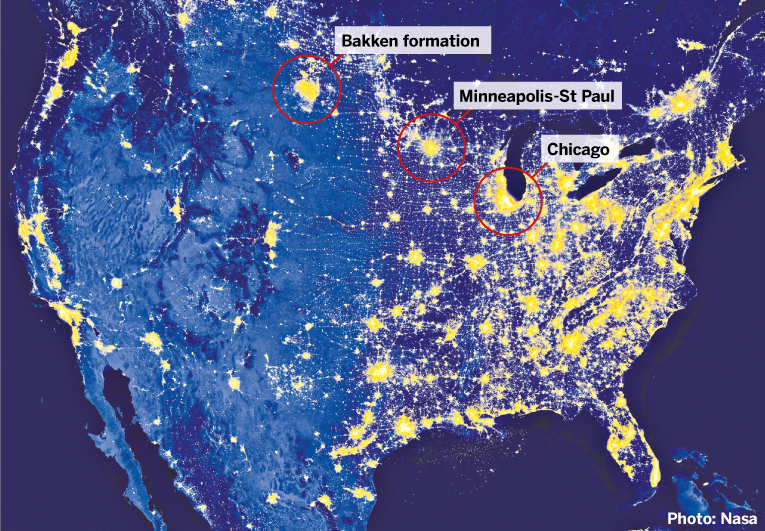
Oil companies at the heart of the US shale oil boom are burning off enough gas to power all the homes in Chicago and Washington combined in a practice causing growing concern about the waste of resources and damage to the environment.

The volume of unwanted gas being flared off in North Dakota, the state leading the shale revolution transforming the outlook for US energy, rose about 50 per cent last year. The surge at the state’s Bakken formation is being replicated in other shale regions with the Texas state regulator issuing 1,963 permits to flare in 2012, more than six times the number of 306 in 2010.

The rapid increase has made the US one of the world’s worst countries for gas flaring. The volume of gas flared in the US has tripled in just five years, according to World Bank estimates and is now fifth highest in the world, behind Russia, Nigeria, Iran and Iraq.

The flaring is a result, in large part, of the low price of natural gas in North America, which can make it uneconomic to build pipelines and tanks to handle the gas released by oil production. Flaring is often the safest way to dispose of it.

The lights of the flares burning in the Bakken and Texas’ Eagle Ford shale fields can clearly be seen in night-time satellite photography.

Flaring has been attracting attention from investors and environmental campaigners because of the waste of gas and its consequences for greenhouse gas emissions, local air pollution and disturbance to nearby communities.

Flaring in North Dakota increases by about 20 per cent the greenhouse gas emissions resulting from the state’s oil production, refining and transport, compared with the US average, according to Financial Times analysis of official data.

Investors managing a total of $500bn last year wrote to oil companies including ExxonMobil, Chevron, Statoiland US independents urging them to do more to cut their flaring. They warned that “excessive flaring, because of its impact on air quality and climate change, poses significant risks for the companies involved.”

Since then, flaring in the US and concerns over it have only increased.

The North Dakota legislature is considering a bill to encourage flaring reduction through tax breaks. The state is also pushing producers to use gas to power drilling rigs.

After child abuse, Americans have elder abuse

MASON, Ohio (AP) — She raises her hands to her snow-white hair in a gesture of frustrated bewilderment, then slowly lowers them to cover eyes filling with tears. The woman, in her 70s, is trying to explain how she wound up in a shelter that could well be where she spends the rest of her life.

While the woman was living with a close family member, officials at the Shalom Center say, her money was being drained away by people overcharging for her grocery shopping, while her body and spirit were sapped by physical neglect and emotional torment. She says she was usually ordered to “go to bed,” where she lay in a dark room, upset, unable to sleep.

“She just yelled at me all the time. Screamed at me, cussed me out,” the woman says of a family member. “I don’t know what happened. She just got tired of me, I guess.”

The Shalom Center offers shelter, along with medical, psychological and legal help, to elderly abuse victims in this northern Cincinnati suburb. It is among a handful in the country that provide sanctuary from such treatment, a problem experts say is growing along with the age of the nation’s population.

The number of Americans 65 and over is projected to nearly double by 2030 because of the 74 million baby boomers born in 1946-64, and the number of people 85 and over is increasing at an even faster rate. The number of seniors being abused, exploited or neglected every year is often estimated at about 2 million, judging by available statistics and surveys, but experts say the number could be much higher. Some research indicates that 1 in 10 seniors have suffered some form of abuse at least once.

“That’s a big number,” said Sharon Merriman-Nai, project director of the Clearinghouse on Abuse and Neglect of the Elderly, based at the University of Delaware. “It’s a huge issue, and it’s just going to get bigger.”

Recognition of and mechanisms for dealing with elder abuse are many years behind strides that have been made in child abuse awareness and protection, experts say.

Getting comprehensive numbers of the abused is complicated, experts say, because the vast majority of cases go unreported out of embarrassment, fear of being cut off from family — most abuse is at the hands of relatives — or confusion about what has happened.

Abuse sometimes comes to light only by chance. County-level adult protective services caseworkers can get anonymous tips. In one recent Ohio case, a hair stylist noticed her elderly client was wincing in pain and got her to acknowledge she had been hit in the ribs by a relative. Another Shalom Center patient was referred by sheriff’s detectives who said his son beat him.

“Are these older people going to be allowed to live their lives the way they deserve to?” said Carol Silver Elliott, CEO of the Cedar Village retirement community, of which the Shalom Center is a part. “We really are not addressing it as a society the way we should.”

The Obama administration has said it has increased its focus on protecting American seniors by establishing a national resource center and a consumer protection office, among other steps. But needs are growing at a time when government spending on social services is being cut on many levels or not keeping up with demand.

In Ohio, slowly recovering from the recession, budgets have been slashed in such areas as staffs that investigate elderly abuse cases.

Staff at the Job and Family Services agency in Hamilton County in Cincinnati is about half the size it was in 2009, spokesman Brian Gregg said. Even as national statistics indicate elder abuse is increasing, the number of elder abuse cases the agency can probe is lower, down from 574 cases in 2009 to 477 last year, he said.

There are no longer enough adult protective services investigators to routinely check on older adults unless there is a specific report of abuse or neglect.

“We do the best we can down here,” Gregg said, noting that the agency has a hotline to take anonymous reports and that it is seeing more financial scams targeting elderly people.

The price for not getting ahead of the problem and preventing abuse of people who would otherwise be healthy and financially stable will be high, warned Joy Solomon, a former Manhattan assistant prosecutor who helped pioneer elder abuse shelters with the Weinberg Center for Elder Abuse Prevention, which opened in 2005 at the Hebrew Home community in New York City.

“My argument always is, if all you do is come in when the crisis has occurred, it is much more costly than preventative care,” said Solomon, director of the shelter, which takes in about 15 people a year. “We’re going to have to pay for it anyway.”

She and others in the field say the first steps are to raise public awareness and train police, lawyers, criminal justice officials and others to recognize and respond to signs of abuse.

Prosecutors often have been reluctant to purse elder abuse cases, which can be complex because of medical and financial complications, the witness’ ability to testify or reluctance to testify against relatives, according to research for the National Institute of Justice.

In suburban Los Angeles, Orange County started an Elder Abuse Forensic Center nearly 10 years ago; it helps police, geriatrics specialists, lawyers and social services workers coordinate efforts to identify, investigate and prosecute abuse cases.

New York City started its Elder Abuse Center to 2009 to bring a multi-organization approach to the problem, saying nearly 100,000 older people are abused in their homes in the city alone. While he was Ohio’s attorney general, Richard Cordray, now director of the federal Consumer Financial Protection Bureau, initiated in 2009 the state Elder Abuse Commission, something current Attorney General Mike DeWine has continued.

The commission has focused on training and education and hopes to launch a public awareness campaign this year, said Ursel McElroy, the longtime adult protection services investigator who leads it. The commission also has been pushing for legislation to improve legal protection and abuse prevention, expand training, and improve statistical data.

In New York, part of the Weinberg Center’s mission is to help other communities replicate it. It has assisted shelter startups in upstate New York, Connecticut, Rhode Island and Minnesota along with the Shalom Center in Ohio.

The center marked its anniversary in January. While more than 40 people have been referred to the nonprofit, faith-based center, only three have gone through with admittance, signs of the reluctance of people who fear losing family relationships — even if they are bad — or the feeling of being at home.

Set up as a “virtual shelter” because victims are integrated into the full Cedar Village retirement community, it is meant to provide 60- to 90-day emergency stays while caseworkers provide help and seek out the best alternative, such as with a different caregiver or relative.

In the case of the woman who complained of abuse in a relative’s home, a call to adult protective services by someone familiar with her led to an investigation and her referral to the shelter.

She has little money, health problems and few alternatives, and after a while, she asked if she could stay at Cedar Village permanently. Caseworkers and officials at the nonprofit, faith-based home agreed that was the best place for her.

The center asked that her identity be protected for this story because the close relatives who allegedly abused her don’t know where she is.

She paints, plays in a residents’ bell choir, plays bingo with others regularly, and has her own room and TV to watch favorites such as “Ellen” and reruns of “I Love Lucy.”

The healthy diet the center keeps her on means she misses some of her favorite foods — beans and corn bread, fried pork chops. But she loves the tuna salad, the group activities and having a life with people who care about her.

“I’ve got quite a few friends,” she says. “They’re just nice people here. I have somebody to talk to, and I appreciate it.”

South Africans exercising their right to loot in Sasolburg (pictures)

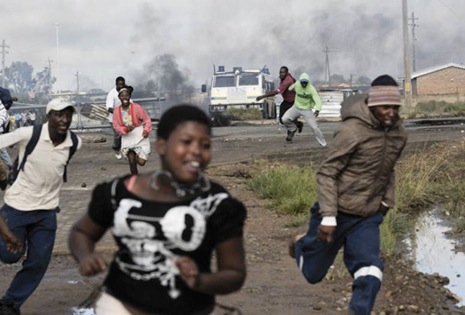
The following photographs will warm any white liberal’s heart: Liberated South African  exercising their right to loot in the town of Sasolburg, south of Johannesburg over the last two days.

Prior to 1994, such pictures were disseminated all over the world by the BBC and American network television, as being ineffable manifestations of a desire for democracy and “freedom”. The freedom to loot, among other things. Interestingly, looting in South Africa at present takes two forms: either it is done violently as in these pictures, or it is done in a more or less legal way through the so-called democratic process by pillaging national, provincial and municipal finances.

One could say that the right to loot is one of the New South Africa’s fundamental “human rights”.

Apparently a municipal vehicle was used to "crack open" this Standard Bank ATM


'Affirmative shopping' as theft is euphemistically called in South Africa, takes place openly in a liquor store in Sasolburg
More affirmative shopping, a scene outside the liquor store
Burn, baby burn! Heart-warming stuff for the politically correct who will no doubt find multifarious socio-psychological justifications for this kind of behaviour
A piece of conceptual art, freshly burnt out by cooperative "artists" and ready for analysis by liberal pundits and critics. To the right of the art work is a "symbol of oppression", probably built and purchased during the "apartheid era": a police armoured vehicle known as a Casspir.

Pimping the culture

by Ilana Mercer

The marketplace doesn’t adjudicate the quality of art or pop culture – it does no more than offer an aggregate snapshot of the trillions of subjective preferences acted upon by consumers. That snapshot, in 2013, tells us that when it comes to “Bread and Circuses,” Rome and its provinces wallow in the same lowbrow popular culture.

Incidentally, to judge the quality of a cultural product is not to begrudge the preferences of the people who purchase it. It is simply to apply timeless, objective standards in assessing these products.

In its salient features, the Commander In Chief’s Ball resembles the annual White House Correspondents’ Association Dinner. There, some of the most pretentious, worthless people in the country – in politics, journalism and entertainment – convene to revel in their ability to petition and curry favor with one another, usually to the detriment of the people, whether the latter know it or not.

By and large, when it comes to entertainment, the people and the elites are on the same empty page – most of the musicians whose products they patronize, or with whom they fraternize, can’t read music, much less play it.

“Grammy and Academy Award winner” Jennifer Hudson, to whose primal screams the president and first lady attempted to dance, doesn’t sing; she screams. Voice coaches once considered the Hudson brand of “vocal wobble” a deficiency in technique and talent. But then, “Why be a musician, when you can be a success?” Such cacophony currently plays to full houses. It is to their credit that the First Couple smoothed the noise over with some smooth moves.

“We all know Beyoncé can sing,” came the response from inaugural organizers to the rumors that the singing sensation lip-synched to “The Star Spangled Banner.” Beyoncé is another performer who distinguishes herself with an obscene bump-and-grind routine and a din of discordant, jarring yelps.

Order lIana Mercer’s brilliant polemical work, “Into the Cannibal’s Pot: Lessons for America from Post-Apartheid South Africa”

We know not definitively whether Beyoncé moved her mouth to a prerecorded version of the national anthem, but much like babies banging on a play-play piano, the nation is preoccupied with the matter.

We do know this: As a studio musician close to home has explained to me, the T&A line-up at the Inaugural and Commander In Chief’s Balls would be reduced to embarrassing grunts, out-of-tune yelling and bedroom whispers, if not for the magic of Auto-Tune, which is the “holy grail of recording.” Auto-Tune “corrects intonation problems in vocals or solo instruments, in real time, without distortion or artifacts.”

Auto-Tune technology is what makes a cast of vain ventriloquists like Katy Perry and Glee what it is.

More sounds that curdled the air were those of Alicia Keys pounding on the piano keys.

“Obama’s on Fire. Obama’s on Fire,” the smirking Ms. Keys chanted tunelessly over and over again. The tradition of a praise singer or a tribal poet laureate still flourishes in Africa. But the tribal poet, unlike Keys, is a splendid performing artist. I know. I’ve seen him in my native South Africa convey the glory of the African savanna – even bring to life moribund leaders – with mesmerizing words and movement.

To sing well, you need a finely tuned instrument and musicality. An example of such an instrument is Carly Simon’s voice in this live performance of “That’s The Way I Always Heard It Should Be – 1972.” Hers is an evocative and nuanced voice. As to the lyrics, you’d have to be both literate and complex to write as evocatively.

To counter the assault on the ears popularized even further by the current White House, do lend an ear to the opera group “Seven,” singing the National Anthem at the Republican National Convention in Tampa, Fla., Aug. 30, 2012.

However, the National Anthem – the words to which were written in the aftermath of the Battle against the British, at Fort McHenry, Sept. 14, 1814 – is not much of an antidote to the ugliness of the Inaugural soiree.

So here are the sounds of “Seven” singing “Joyful, Joyful We Adore Thee,” set to Ludwig van Beethoven’s “Ode to Joy.” Enjoy! (This rendition has garnered only 173 YouTube views.)

I’d rather listen to the dodecaphony of 12-tone music than sit through the guttural battle cries emitted by today’s performers.

Dotcom launches Mega

Kim Dotcom

Megaupload founder Kim Dotcom is upbeat about the investigation against his now-defunct file-storage site, his possible extradition to the US, the future of Internet freedoms.

The United States government says that Dotcom, a German millionaire formerly known as Kim Schmitz, masterminded a vast criminal conspiracy by operating the file-storage site Megaupload. Dotcom, on the other hand, begs to differ. One year after the high-profile raid of his home and the shut-down and seizure of one of the most popular sites on the Web, Dotcom hosted a launch party for his latest endeavor, simply called Mega.

Dotcom says president Obama and the Obama administration for colluding with movie companies in order to orchestrate this giant arrest in New Zealand.

The driving force, of course, is Chris Dodd, the chairman of the MPAA [Motion Picture Association of America]. And he was senator for a long time and he is — according to [US Vice President] Joe Biden — Joe Biden’s best friend. And the state attorney that is in charge of this case has been Joe Biden’s personal counsel, Neil MacBride, and [he] also worked as an anti-piracy manager for the BSA, the Business Software Association, which is basically like the MPAA but for software companies.

“The fundraisers in Hollywood had to have some sort of Plan B, an alternative for SOPA [the Stop Online Piracy Act], because the president certainly was aware — and his team at the White House was aware — that if they don’t have anything to give at those fundraisers, to those guys in Hollywood who are eager to have more control over the Internet, they wouldn’t have probably raised too much. And Hollywood is a very important contributor to Obama’s campaign. Not just with money, but also with media support. They control a lot of media: celebrity endorsements and all that,” says Dotcom.

“So I’m sure the election plays an important role. The relationships of the people that are in charge of this case play an important role and, of course, we have facts that we want to present at our extradition hearing that will show some more detail about this and that this is not just some conspiracy theory but that this actually happened.”

The US Justice Department wants to extradite the German citizen living in New Zealand operating a business in Hong Kong.

“It is a very interesting question because the extradition law, the extradition treaty in New Zealand, doesn’t really allow extradition for copyright. So what they did, they threw some extra charges on top and one of them is racketeering, where they basically say we are a mafia organization and we set up our Internet business to basically be an organized crime network that was set up and structured the way it was just to do criminal copyright infringement. And anyone who has every used Megaupload and has any idea about how that website worked knows immediately that it was total nonsense. But they needed to chop that on in order to have even a chance for extradition. But in our opinion, you see, all of that was secondary. The primary goal was to take down Megaupload and destroy it completely. That was their mission and that’s why the whole thing in Hong Kong, for example, they called it Operation Takedown. And I think everything that’s happening now, they are trying on the fly to doctor it around, and found a way to find a case. They probably came here and thought, “We will find something; that these guys have done something wrong.” In the indictment, if you actually read that, it’s more like a press release. There’s nothing in there that has any merits.”

Dotcom says his case is a crucial case for Internet freedom. “I think more and more people realize that and the government is quite exposed here because they really went in with completely prosecutorial abuse and overreach and ignoring due process, ignoring our rights, spying on us, illegal search warrants, illegal restraining orders, illegal spying. The whole picture, when you look at it, shows that this was an urgent mission, done on a rush. “Take them down, I want them to go.” And it was a political decision to do that. And the execution was extremely poor, and the case is extremely poor, because that is something they thought that they could worry about later. It was all about the takedown: ‘Let’s send a strong message to Hollywood that we are on their side.’”

The new program, Mega, is fully encrypted, but do people need more encryption on the Internet?

Says Dotcom: “I think it’s important for the Internet that there is more encryption. Because what I have learned since I got dragged into this case is a lot about privacy abuses, about the government spying on people. You know, the US government invests a lot of money in spy clouds: massive data centers with hundreds of thousands of hard drives storing data. And what they are storing is basically any communication that traverses through US networks. And what that means they are not spying on individuals based on a warrant anymore. They just spy on everybody, permanently, all the time. And what that means for you and for anybody is that if you are ever a target of any kind of investigation, or someone has a political agenda against you, or a prosecutor doesn’t like you, or the police wants to interpret something in a way to get you in trouble — they can use all that data, go through it with a comb and find things even though we think we have nothing to hide and have done nothing wrong. They will find something that they can nail you with and that’s why it’s wrong to have these kinds of privacy abuses, and I decided to create a solution that overtime will encrypt more and more of the internet. So we start with files, we will then move to emails, and then move to Voice-Over-IP communication. And our API [Application Programming Interface] is available to any third-party developer to also create their own tools. And my goal is, within the next five years, I want to encrypt half of the Internet. Just reestablish a balance between a person — an individual — and the state. Because right now, we are living very close to this vision of George Orwell and I think it’s not the right way. It’s the wrong path that the government is on, thinking that they can spy on everybody.”

After Megaupload was shut down by the FBI last year, hacktivists with the movement Anonymous retaliated, so to speak. In response, they went and took down the websites for the FBI, the Motion Picture Association of America, the Department of Justice, the Recording Industry Association of America.

Dotcom laughs. “t’s a kind of virtual protest, you know? I think it’s not a good idea to shut down websites. I’ve been a hacker myself. I understand why they are doing it and how they are doing it, but I think there are better ways to protest. Where you organize yourself in a group and do petitions and actually email congressmen, email your local politicians, let them know about what you don’t like. Organize your movement rather than attacking. I had a sense of understanding for them because everyone had stored so much data on Megaupload, and then all of a sudden a site like that disappears and billions of files are taken offline, the majority of them perfectly legitimate. You need to understand one thing: 50 percent of all files that were ever uploaded to Megaupload have not even been downloaded once. That clearly shows the non-infringing use. People just wanted to store their stuff on our site. And of course they were outraged when that disappeared and the government said, ‘We don’t give a care and we don’t give a damn about you people. We don’t care that you have your personal documents there because we have our agenda and we are going to take over the Internet.’ And you know the White House was supporting SOPA, and only when the masses came together — and Aaron Swartz: he stopped SOPA. With his efforts, he stopped SOPA. And he became a target. A political target, okay? And that’s why all these things happened to him. There is no reasonable cause behind going after a young genius like that in the fashion they did. It’s political. Because the White House wanted SOPA. They promised it to Hollywood and they failed and they couldn’t go ahead because the White House was afraid if they keep pushing hard and they keep pushing it forward, that the people who oppose it are not going to vote for Obama in the reelection campaign. So it’s all a game to them really and we are all the little puppets that they think they can kick around. So we need to organize. There needs to be a movement that identifies these things and fights that. Not with shutting down websites but with real protests. Going out on the streets, writing to politicians and especially, most importantly, don’t vote for the guys that are against Internet freedom. Anyone who voted for SOPA, you should have a close look at that guy. Do I want to give him my vote next time around? Because that’s the only language politicians understand is your vote. And if you can bring all these votes together, somehow pooled for Internet freedom, you will see all these efforts disappear. Because at the end of the day, they represent the public. Politicians represent the public. And when they have enough pressure they can’t move forward. And SOPA was the best example for that.”

Fatal attraction

Is it African symbolism, or just plain attraction?

The buzzing insect stole the show as the President announced two new members of his second administration, cutting wild loops around the leader of the free world before landing squarely on his forehead.

The official White House transcript simply reads: “This guy is bothering me here – (swatting at a fly.)”

Meanwhile, the pool report which describes the President’s movements throughout the day noted that “the president spoke for about five minutes while being menaced by a house fly”.

It wasn’t the first time Mr Obama has shared camera time with a fly. In June 2009, the newly-elected president dealt some tough justice to one which interrupted an interview.

And during a 2010 announcement on healthcare reform, Mr Obama cut off an emotional story about an American struggling without health insurance as a fly zipped around him.

In that instance, the fly did manage to land briefly on his face, providing an unsightly addition to the mole on the left side of his nose.