SA Electricity supply crunch looming

electricityThe announcement by national utility Eskom that the first unit of its disaster-prone 4,764MW Medupi coal power plant is now unlikely to be commissioned until the latter half of 2014 means South Africa could face 700MW gap in its 2014 electricity supply balance.

The plant’s first unit was initially expected to begin operating in April 2012. Eskom is blaming its contractors; consumers in South Africa and the region will again be concerned that they could lose out if power has to be rationed in Africa’s largest economy.

South Africa traditionally produced a power surplus and exported to its neighbours, but the balance started to swing from surplus into deficit in the mid 2000s and in 2008, the country suffered dramatic blackouts that underlined the under-invested electricity supply industry’s capacity to damage the economy.

The government and industry have few doubts about the extent of the problem. Public enterprises minister Malusi Nkanyezi Gigaba pulled no punches in April when he stressed the government’s commitment to bringing the first 800MW of power from Medupi Unit 6 of online by end-year.

Gigaba told reporters that “failure to meet these deadlines will result in tough penalties being imposed on any party responsible for such delay”.

Barely three months later it seems the minister and Eskom have admitted defeat, while project costs have spiralled – to over $14bn.

The innocuously titled Eskom Update on its New Build Programme delivered another blow to South Africa at a time when fears about declining mining output – an industry in which electricity can account for as much as 32% of total costs – and poor macroeconomic performance are weighing on investors’ minds.

In its update Eskom said the December target for commissioning Unit 6 was “unlikely to be met”. A “more realistic” target was H2 2014. However, full commissioning was still expected in 2017.

This is a View article from the African Energy newsletter, a respected source of independent analysis on the continent’s energy industries produced by Cross-border Information, a business intelligence company with a long established research focus on the politics, energy and financial sector trends of Africa and the Middle East.

Sudan army ready to battle Facebook imposter

sudanSudan’s military spokesman is ready to battle a Facebook imposter who has been making online comments about the country’s armed forces, official media say.

Somebody has been using an account on social networking site Facebook to impersonate army spokesman Sawarmi Khaled Saad, the state SUNA news agency reported late Saturday.

The pretender “makes dialogue with friends on issues including matters related to the work of the armed forces”, SUNA reported.

Saad will “take the necessary measures toward that criminal act”, it added.

“Al-Sawarmi affirmed that he has no account in Facebook and has nothing to do with the comments made by the person (who) impersonates him over the Internet,” SUNA said.

Sudan’s military is battling rebels in the far-west Darfur region as well as in South Kordofan and Blue Nile states, while tensions persist along the border with South Sudan.

Analysts say authorities were humiliated in April and May when insurgents widened their offensive, and the military took one month to retake an area in South Kordofan from the rebels. – AFP

Mugabe’s ban on Western poll observers

A younger Mugabe on the election poster

President Robert Mugabe on Thursday reiterated the Zimbabwe government’s position to bar Western observers from general elections set for Wednesday, insisting that only officials from friendly nations would be allowed to monitor the polls.

The veteran Zimbabwean leader said the United States, United Kingdom and other Western countries would never be invited to observe elections in Zimbabwe until they remove economic sanctions against top Harare officials.

“Our position is very clear. We will never allow the Americans and the British to come and observe our elections as long as their sanctions continue to burden our people,” he told supporters during a campaign rally in Chinhoyi farming town, about 100km northwest of Harare.

Zimbabwe has since 2002 refused to allow Western observers to witness the country’s general elections, accusing them of bias in favour of the opposition.

The Zimbabwe government however, said it has no problems welcoming election observers from the United Nations, Asia, the Southern African Development Community, the African Union and the BRICS group of countries comprising Brazil, Russia, India, China and South Africa.

Mugabe also said Thursday that the US and UK had no moral ground to lecture Zimbabwe on democracy when their own histories are tainted with cases of human rights abuses.

The US said earlier this week that it was concerned about the conditions prevailing in Zimbabwe ahead of general elections set for July 31.

A State Department spokesperson said Washington was wary about lack of transparency in electoral preparations and continued partisan behaviour by security organs, particularly the army and police. – APA

Van der Burgh, Zorzi qualify for 50m breaststroke final

Van der Burgh at the World Swimming Championships in Barcelona
Van der Burgh qualifies

Cameron van der Burgh and team-mate Giulio Zorzi have qualified for the men’s 50m breaststroke final at the World Swimming Championships in Barcelona.

Van der Burgh led the qualifiers into Wednesday’s final with a time of 26.81 seconds. Zorzi managed 27.44, keeping out Brazilian Felipe Lima, who won bronze in the 100m breaststroke.

The 25-year-old Van der Burgh was happy that two South African swimmers advanced to the final. “I’m very happy for Giulio who is swimming at his first world championships and I wish him well,” Van der Burgh said.

“I’ll pass on my experiences to help him pull through for tomorrow. Tomorrow anything can happen from any lane.”

Van der Burgh, who won the silver medal in the 100m breaststroke on Monday, said he was better equipped for the 50m breaststroke event.

“Sometimes you focus too much on the world record or a gold medal and then it doesn’t happen. I’ll just focus on what I can control which is the swim. The 50m is better suited to the skills I have and the training I have done.”

Zorzi, who would be swimming in his first final at a major championship, said he was happy with his performance.

“I felt really good in the warm-up and had a great start, but in the race there were one or two things that didn’t go well and I’ll correct them for tomorrow,” he said. – Sapa

Teachers armed at US district school

teachersarmedWhen classes at Clarksville High Connecticut resume, more than 20 teachers and other employees in the US school district will be carrying concealed weapons.

After a school shooting in Connecticut last December that left 20 children and six teachers dead, the idea of arming schoolhouses against gunmen was hotly debated across the country.

The National Rifle Association declared it the best response to serious threats. But even in the most conservative states, most proposals faltered in the face of resistance from educators or warnings from insurance companies that schools would face higher premiums.

Making use of a little-known Arkansas law that allows licensed, armed security guards on campus, assistant principal Cheyne Dougan and other teachers at the school will be considered guards.

“The plan we’ve been given in the past is, ‘Well, lock your doors, turn off your lights and hope for the best,'” Superintendent David Hopkins said. But as deadly incidents continued to happen in schools, he explained, the district decided, “That’s not a plan.”

In strongly conservative Arkansas, where gun ownership is common and gun laws are permissive, no school district had ever used the law to arm teachers on the job, according to the state’s department of education. The closest was the Lake Hamilton School, which for years has kept several guns locked up in case of emergency. Only a handful of trained administrators – not teachers – have access to the weapons.

Flood of calls from parents
Clarksville, a community of 9 200 people about 160km north-west of Little Rock, is going further.

The town isn’t known for having dangerous schools. But Hopkins said he faced a flood of calls from parents worried about safety after the attack last year at Sandy Hook Elementary School in Newtown, Connecticut.

Hopkins said he and other school leaders didn’t see why the district couldn’t rely on its own staff and teachers to protect students rather than hire someone.

State officials are not blocking Clarksville’s plan, but Arkansas Education Commissioner Tom Kimbrell is opposed to the idea of arming teachers and staff. He prefers to hire law enforcement officers as school resource officers.

There are other dissenters, too. Donna Morey, former president of the Arkansas Education Association, called the idea of arming teachers “awful”. The risk of a student accidentally getting shot or obtaining a gun outweighs any benefits, she said.

“We just think educators should be in the business of educating students, not carrying a weapon,” Morey said.

Gun stipends
Participants in the programme are given a one-time $1 100 stipend to purchase a handgun and holster. Hopkins said the district is paying about $50 000 for ammunition and for training that is narrowly tailored for teachers to respond to shooters on campus.

Sydney Whitkanack, who will enter seventh grade this fall, said she’s grown up around firearms and doesn’t mind if teachers or staff are armed at school.

“If they’re concealed, then it’s no big deal,” said Whitkanack. “It’s not like someone’s going to know ‘Oh, they have a firearm.'”

The district will post signs at each school about the armed guards, but the identities of faculty and staff carrying weapons will be kept secret, Hopkins said.

Those who participate in the programme will continue to receive regular training, he said.

Sherry Wommack said the programme is one reason she’s taking her son, an incoming eighth-grader, out of Clarksville’s schools before the school year begins. Wommack said she doesn’t believe teachers should make life-or-death choices involving students.

“I think police officers are trained to make those decisions, not teachers,” Wommack said. – Sapa-AP

Black killer-teen ate mother’s ear

daveytonA 19-year-old black Daveyton teenager, who allegedly ate his mother’s ear after killing her, is in a critical condition in hospital.

At around 3am, on Saturday, July 27, residents in Jumba Street in the black township east of Johannesburg, heard the woman scream.

“They went to the house and found the woman (44) lying with her son sucking blood from her wounds,” said police spokesman Capt Alfred Nakana.

She had been stabbed several times in the upper body, with a screwdriver.

“The woman’s ear had been mutilated and neighbours said they had seen the boy chewing it,” said Nakana.

He added that the woman’s lips were also badly damaged, which showed that the son had tried to remove them as well.

Neighbours overpowered the teen, who was severely beaten with stones and sticks.

Nakana said the 19-year-old is under police guard in hospital.

He will be charged with murder.

Police suspect this to be yet another “satanic ritual” murder.

In another incident, on May 23, at midnight, a 14-year-old teen hacked to death four members of his family with an axe, in what is also believed to be a satanic ritual, in the neighbouring Etwatwa.

He is currently facing four murder charges in the Benoni Magistrates Court. – looklocal.co.za

ACDP slams Tutu’s gay God

Meshoe
Meshoe

ACDP leader Rev Kenneth Meshoe has slammed Archbishop Emeritus Desmond Tutu for his “homophobic God” statement, according to a report on Wednesday.

“Archbishop Desmond Tutu is out of order when he alleged that God is a homophobic God, and that he finds fault with scriptures that teach that homosexual life style is a sin before God,” the African Christian Democratic Party leader was quoted as saying in The Star.

“We ask Archbishop Tutu not to confuse people who respect the scriptures, and advised him to keep his unbelief to himself if he does not believe in the teaching of the Holy Bible.”

He was reacting to Tutu’s comments on Friday, at the launch of a UN campaign to promote the fair treatment of lesbians and gays.

Tutu said he did not support a homophobic God.

“I would refuse to go to a homophobic heaven. No, I’d say sorry. I mean, I’d much rather go to that other place,” he told reporters in Cape Town. – Sapa

Mandela keeps improving

nelson_mandelaThe Presidency said Nelson Mandela’s condition continued to improve on Tuesday.

Former President Mandela still remains in a critical but stable condition in hospital in Pretoria, and continues to show improvement, the Presidency said on Tuesday.

Madiba was admitted to Medi-Clinic Heart Hospital in the early hours on June 8 with a recurring lung infection.

His ambulance broke down on the way to the hospital, and he has had two “scares” and minor surgery.

Earlier this month Madiba spent his 95th birthday in hospital while visitors and well-wishers continued to leave flowers, cards and candles at the tribute wall outside the hospital.

Sasco marches for free education

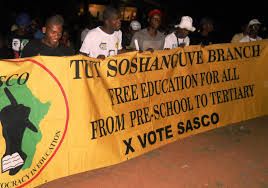
sascoStudents marched to Parliament on Wednesday, calling for free education.

SA Students’ Congress (Sasco) provincial secretary Sello Nkatho said the students marched from the Cape Peninsula University of Technology in Cape Town.

The group intended to hand over its memorandum to a representative of the education commission.

Nkatho said the students wanted education to be free for every young person who qualified as poor, according to a government means test.

He envisioned the education assistance taking the form of a bursary.

“There is a body of evidence gathered that shows where government has a political will and correct administration, education can be made free for the poor, the disenfranchised, and the destitute,” he said.

It was unacceptable that higher learning institutes increased their fees between eight and 12 percent every year, said Nkatho.

Sasco would continue with marches and “other alternatives” should government not respond to its call.

Marches were taking place on Wednesday in all provinces except the Free State, where a march had been postponed.

A national march was planned on Thursday and would start at the Tshwane City Hall in Pretoria. – Sapa


Zim’s Reserve Bank governer and the oil deal

Gono
Gono

Zimbabwean Reserve Bank governor Gideon Gono accepted £104000, paid into the accounts of his children, from a company that sold fuel to the Mugabe regime.

Six separate payments were made to three Gono children while they were studying in Australia, at the same time as the company concerned – which claimed to have an office in Britain – was helping to supply Zimbabwe with millions of litres of fuel.

Gono admitted the payments had been made to his twin daughters and a son, but denied having taken a bribe. He said the reserve bank had reimbursed the company on his behalf.

In almost a decade as Zimbabwe’s central banker, Gono, a close ally of President Robert Mugabe, has presided over hyperinflation, the demise of the Zimbabwe dollar and a desperate shortage of essentials, notably petrol.

Gono, who blames “illegal sanctions” imposed by the West for the country’s economic woes, became the crucial deal-maker charged with ensuring the survival of Mugabe’s regime, negotiating with private companies to raise funds for vital imports.

One such company was Ravenscourt Corporation, which sold 49million litres of fuel – almost 5% of Zimbabwe’s annual fuel consumption – to the reserve bank as part of a joint venture in 2006 and 2007.

At the same time, Ravenscourt paid money into the accounts of Gono’s children, according to bank statements obtained by Global Witness, a campaign group, following an investigation by the specialist newsletter Africa Confidential.

In particular, Ravenscourt paid £1300 into the Australian bank accounts of Gono’s twin daughters, Pride and Praise, and the same amount to his son, Passion, on May 30 2006.

On August 21 that year, Ravenscourt made another payment into each of the daughters’ accounts.

Gono said the funds had been used solely to move his children to Singapore and Malaysia after they were forced to leave Australia.

In order to conceal their new locations in Asia, it had been necessary to pay the funds from a “UK source”, he said.

The reserve bank had reimbursed Ravenscourt on his behalf.

“In my 36 years of working, I am yet to receive a bribe from anybody and I’m not about to do so now or in the future. The same applies to my family,” said Gono.

His terms of employment encompassed such financial support for his children, he said.

Mohamed Iqbal Mahmed, director and part owner of Ravenscourt, refused to say why the money was paid to the Gono children or whether it had been repaid by the reserve bank.

“I categorically and unequivocally state that they [the payments] were not bribes or inducements to obtain favours from anyone,” he said. – The Daily Telegraph

Minister wants answers about Khanyi Dhlomo’s loan

Kanyi and Mark, the 'Afronaut'
Khanyi and Mark, the ‘Afronaut’

Trade and Industry Minister Rob Davies has asked for a detailed report on how the National Empowerment Fund could have granted businesswoman Khanyi Dhlomo a R34-million loan.

Dhlomo, through Ndalo Luxury Venture, received the loan to establish a luxury fashion shop in Johannesburg.

The cash-strapped fund has defended its decision to fund Dhlomo’s Luminance luxury-brands store.

The Economic Freedom Fighters (EFF) has criticised the National Empowerment Fund’s (NEF) loan for luxury boutique Luminance, co-owned by Khanyi Dhlomo. The clothing store stocks brands that include, amongst others, Giorgio Armani, Tom Ford, Oscar de la Renta and Alexander McQueen

“It has come to the attention of Economic Freedom Fighters that the National Empowerment Fund has granted Khanyi Dhlomo R34-million to open an exclusive elite boutique of overpriced clothes in Hyde Park, Johannesburg,” said an EFF statement on Monday.

“The manner in which the R34-million was approved by the wife of Police Minister Nathi Mthethwa, who is the current [chief executive] of the NEF, is questionable.”

The fund’s CEO, Philisiwe Buthelezi-Mthethwa, praised Dhlomo for her entrepreneurial skills. She said it was “wonderful” that labels such as Oscar de la Renta would now be available in South Africa.

But it seems Davies is not convinced. He said he wanted to establish whether the transaction was in line with the public empowerment process.

“It is definitely our intention as a department that we want to see more public money which supports empowerment supporting actual people who are getting involved in the productive sector of the economy and also in local productivity.

“We are not particularly interested in businesses that are going to be importing luxury goods,” said Davies.

Moemise Motsepe, the fund’s spokesman, told Business Day on Monday that the retail sector was primarily white and foreign-owned but most consumers were black.

“With the Ndalo Luxury Venture transaction, the National Empowerment Fund is laying the building blocks of black participation in this sector.

“Though the fund has funded other black women entrepreneurs, the Ndalo transaction is the biggest by the fund in respect of black women entrepreneurs,” he said.

He said the investment was in line with the fund’s mandate and policies in that it supported a company owned and managed by black women in an untransformed sector.

Last week Dhlomo said her business had a broadly based shareholding. Ten percent of the company belongs to a staff trust and 10% is owned by rural women who will supply the shop.

Dhlomo is the founder of Ndalo Media, which publishes Destiny and Destiny Man magazines and Sawubona – SAA’s in-flight magazine. She is also CEO of Ndalo Luxury Ventures.

The empowerment fund is currently waiting for a cash injection from the state.

Khanyi’s father, Oscar, is a former Inkatha Freedom Party (IFP) secretary-general, who is now a casino tycoon.

His daughter and Mark Shuttleworth shared a “special relationship” earlier.

The billionaire “Afronaut” Shuttleworth’s “warm and special relationship” with Dhlomo ended when she married the Nigerian Chinezi Chijioke. – timeslive.co.za/mg.co.za/citypress.co.za

Talking with the Black Noise guys

sampson_linby Lin Sampson

[followbutton username=’hellschreiber’ count=’true’ lang=’en’ theme=’light’]

A man called Michael Blum turned up in our street, staying in the house opposite. He is a French-speaking Israeli who lives in Vienna. He said he was doing a “project” on the house and the area. He had a grant from somewhere and asked if he could come and talk to me. He was a short, energetic little mesomorph who arrived and immediately set up video equipment – something I was not expecting.

I remember thinking at what a disadvantage I was as I shrunk into the sofa like a small pile of sand and he asked me all the expected questions, slowly building to what he really wanted to ask. Would the people who live in the house have been able to live there during the years of apartheid? And what had I thought when they first moved in? I said, “noise”, which is always my horror. I explained that I had had meningitis and it had damaged cranial nerves that amplified sound in my head. Busy little Mr Blum video-ed away.

He then organised a sort of halfhearted party on a patch of lawn that abuts the street, which he importantly called “The Green Patch Party”. There were some breakdancers, some students, a few peripatetic vagrants whom we had never seen before – and of course Mr Blum batting about with a video camera. Mr Blum went away and our street returned to its normal old slightly low-rent atmosphere. However, searching through the Internet for something, I came across Michael Blum’s name again as being the author of something called “Very Real Time”, his project on 17 Aandbloem Street and there I was – as usual – the old colonial racially biased person.

He described the flaky party on the grass as becoming, “A milestone in Cape Town’s partying history”.

“It aimed,” wrote Blum, in his lefty join-the-numbers prose with its self-congratulatory subtext, at “squatting” the patch of grass in front of the house. Well thank you Mr Blum, we as residents in the area, have spent a long time trying to “unsquat” the grass in front of our houses.

He went on to say, “The appropriation of the small piece of land in front of the house can be seen as a natural extension of the private sphere”.

This sort of half-baked thinking, this lauding of the underdog, this scream of ecstasy over anything disadvantaged, ill, poor, mad or homeless and this thoughtless beating down of anyone who earns a living by actually going to work is big business in the art world of Europe. Grants can be got with a flick of the finger, if the projects come sashed with kneejerk words like Aids, apartheid, Robben Island.

Mr Blum is a true journeyman of this type of thinking; his other work is a “book specifically designed for waiting rooms”, which purports to be “following the visual paradigm of loss and exploring related issues through diverse imagery”.

In South Africa we have always been victims of a foreign eye, often attached to a camera, filtering across our lives with ease. Many of us have given up time to try to explain this country; few of us have been rewarded. And the harder we tried to explain, the more subtle the thought, the easier the whole thing was to misunderstand. When I said to Mr Blum that whenever I saw new neighbours I was worried about noise, he conveniently saw it as racial, because what would his principals think if he came back without some white bogeyman?

His report states, “Lin Sampson, despite her political opinions, sat with the Black Noise guys and talked with them”. Once in the thick of apartheid, a British TV station asked to interview me. They took me to someone else’s house and posed me beside a pool with a drink with a little umbrella in it. It appeared with a voice-over that went, “While Lin Sampson sits beside her pool sipping a drink, her maid lives less than 5km away in a cardboard box”.

I didn’t even have a maid. But the real irony of Mr Blum’s essay is that until he turned up we were all living together quite happily.

[followbutton username=’hellschreiber’ count=’true’ lang=’en’ theme=’light’]

Lin Sampson is the doyenne of South African columnists and the author of the collection Now You’ve Gone ‘n Killed Me (2005).

Post-apartheid SA not thirsting after education

Not in the classroom

Data from the Department of Basic Education has debunked the oft-repeated myth that black South Africans thirst after education.

Dropout rates in South African schools between grade 10 and grade 12 have more than doubled since 1995.

Some 22% of the grade 10 class of 1995 did not go on to sit their matric exam two years later.

By 2012 this dropout rate had increased to 50%. Data from the Department demonstrates that the grade 10 cohort of 1995 consisted of 719 190 pupils, 78% of whom became matric candidates in 1997.

By comparison, the grade 10 class of 2010 consisted of 1 006 381 pupils, with only 51% going on to become matric candidates in 2012.

Attrition rates at school are most pronounced in grades 10, 11, and 12 (also known as the further education and training band), with the majority of pupils who drop out of school never returning to
complete their education.

Census data from Statistics South Africa reveals that the proportion of young people attending an educational institution remains steady at approximately 95% for those aged 7 to 15 but declines to 90% and 74% for those aged between 16 and 18 respectively. – SAIRR

Task team to deal with SABC’s financial mess

SABC465_3dA task team has been established to sort out the financial problems at the SABC, Communications Minister Yunus Carrim said on Tuesday.

“We have decided to set up a high-level team made up of the SABC, the department of communications, National Treasury, and the auditor general of South Africa to set a firm foundation for financial stability of the public broadcaster,” Carrim said in a statement.

“The team will ensure that all the challenges emanating out of the government guarantee targets are addressed within reasonable means and that the SABC is appropriately skilled at the right levels.”

This was a resolution informed by the progress made by the joint task team (JTT) set up two weeks ago between the department and the SABC.

Carrim and his deputy Stella Ndabeni-Abrahams met the SABC board and management on Tuesday to take forward issues discussed at a meeting on July 17.

In April, President Jacob Zuma approved the interim board, which was installed after the resignations of most of the previous board’s members in March, and its eventual dissolution by Parliament.

Their departure came after a reported clash between previous chairman Ben Ngubane and the board about the tenure of previous acting chief operating officer Hlaudi Motsoeneng.

At the meeting earlier this month, Carrim said the board and management had agreed to settle problems relating to digital migration and to urgently fill senior management posts.

Carrim said Tuesday’s meeting also took note of the progress made on Digital Terrestrial Television (DTT) readiness.

The JTT would continue to work to ensure the launch of DTT.

The SABC would launch a 24-hour news channel on August 1.

Carrim said a degree of consensus had been reached about the launch and how to deal with the outstanding finances, and legal and other aspects of the launch.

“South Africans need to have access to a constant stream of news, information and entertainment.

“The SABC has a responsibility to ensure that,” he said.

SABC board chairwoman Ellen Tshabalala said the national broadcaster was using the launch to fine-tune its readiness for the DTT launch.

“I am satisfied with the progress made in addressing the issues at the SABC.

“We remain committed to playing our full role in turning the SABC around,” she said. – sapa