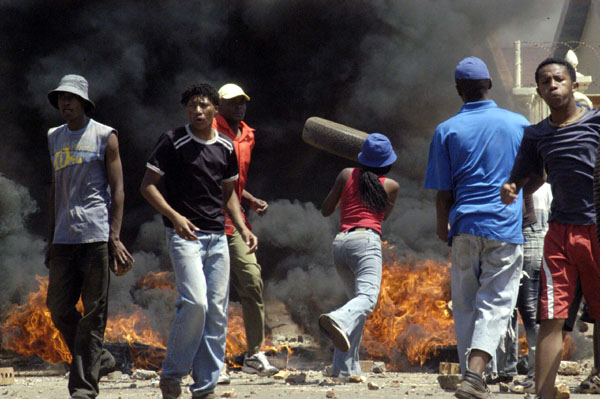
Several thousand Russian nationalists rallied Monday in Moscow, venting against the migrants they accuse of pushing up the crime rate and taking their jobs.
The protest took place on the national holiday of Unity Day, established in 2005 to replace commemorations of the Bolshevik Revolution.
Many demonstrators carried Russian imperial flags. One group displayed a banner reading “Young People Against Tolerance.” The protesters in a southern neighborhood of the Russian capital ranged from tough-looking youths to older people.
Animosity is strong among nationalists against migrants both from the former Soviet Central Asian republics and non-Slavs from the largely Muslim Russian Caucasus region.
Monday’s rally came three weeks after rioters targeted a vegetable warehouse where they believed the killer of an ethnic Russian man was working. Police later rounded up more than 1,000 migrants working at the warehouse.
Some demonstrators praised the riot and suggested it was backed by the state.
“People received a signal that if they engage in such pogroms, there will be progress,” said Yevgeny Morgunov, a 36-year-old researcher at the Russian National Academy of Sciences.
He said he didn’t support the radical exclusionary sentiment reflected in the nationalist slogan “Russia for Russians,” but said “if Russians feel good, the other people of Russia will feel it too.”
There were no immediate reports of trouble at the Moscow rally, but the Interfax news agency said police detained 12 participants in a similar rally in the Siberian city of Krasnoyarsk. Nationalist demonstrations were also reported in the cities of Irkutsk and Kazan.
A U.N. report in September said Russia has about 11 million migrants. The state news agency RIA-Novosti, however, cited the Federal Migration Service as saying only about 718,000 of them have residency permits. – AP
Schools need to take firm action against the perpetrators of racism, North West premier Thandi Modise said on Monday.
“Incidents of racism such as the one reported (at Potchefstroom Gimnasium) undermine efforts of nation building and social cohesion that seeks to unite all communities across racial, ethnic and gender lines,” she said in a statement.
Modise was responding to a report in The Star newspaper about two brothers who reportedly suffered constant harassment and racial slurs from fellow pupils at the Potchefstroom Gimnasium boarding school.
The twins, Kago and Kagiso Mangope, 14, were Grade Eight pupils at the school and were also the only blacks in the Grade Eight hostel.
Their brother Lebo told the newspaper they were constantly called “kaffir” and that two previous incidents had resulted in Kago quitting the rugby team.
A disciplinary hearing had been scheduled.
Modise said her administration would request a report from the school and would take action if necessary.
“Schools play a pivotal role in society…. Pupils coming from these institutions go on to occupy influential positions. It is therefore important that they are taught properly so that they become responsible citizens who will contribute towards building a free and fair society,” she said. – Sapa
A restaurant in Sweden has been reported to the police for racism after calling one of its dishes “Gypsy Soup”, claiming as a joke that all the ingredients were stolen.
The prank was the idea of the Lundavägens Grill restaurant, in Malmo, southern Sweden. It’s daily menu offered a “zigenarsoppa”, stating in brackets that it had got its name only because everything in it was a result of robbery.
But one female diner failed to get the joke and reported the grill’s owner to police.
“This is not acceptable. Veiled racism in Malmö is dangerous,” she told Sweden’s Metro newspaper.
Apologetic restaurant owner Slavko Rasic said he had not meant to offend, but accepted that some people might find it upsetting.
“I’ll take it like a man,” he said.
“I don’t think I am specifically pointing the finger at any race when I call it ‘gypsy soup’,” he added before claiming the whole thing was a private joke.
Rasic also said that he could have called the dish “Elvis soup”, as his choice of name was nothing more than a word.
“It would be a different story if the soup was disgusting,” he added. New York Daily News
A hearing has been scheduled at a top North West school following claims of racism against two brothers, The Star reported on Monday.
The twins, Kago and Kagiso Mangope, 14, are Grade 8 pupils at Potchefstroom Gimnasium school and are also the only two black boys who live in the Grade 8 hostel.
Their brother Lebo told the newspaper that the boys were constantly called “kaffir” and two previous incidents resulted in Kago quitting the rugby team.
Schoolboys would call him names as he would constantly report who would be racist towards him.
“The racial slurs were hurled in front of a teacher and the teacher acted as if nothing happened,” he told the publication.
The stress of the insults had resulted in their marks dropping.
Lebo contacted the school and was told that the complaint would be attended to as it was a serious and sensitive matter.
A hearing has been scheduled for Monday, the newspaper reported.
Education department spokesperson Brian Setswammung told the newspaper that the department would wait for the outcome of the hearing to determine the outcome.
“The department does not condone racial attacks and violence at schools. If a pattern of racism emerges, the department will ensure that urgent steps are taken to address the matter,” he said. – Sapa
A police officer rejected claims by a rightwing woman that she played a part in the Steenkamp murders on a farm near Griekwastad last year, the Northern Cape High Court heard on Monday.
“There is no truth in these allegations,” investigating officer Dick de Waal testified.
Northern Cape Judge President Frans Kgomo was hearing evidence in the trial of a 17-year-old boy accused of killing Northern Cape farmer Deon Steenkamp, 44, his wife Christelle, 43, and daughter Marthella, 14. They were shot on their farm Naauwhoek, near Griekwastad, on 6 April 2012.
De Waal told the court he had received information from three sources since the court last heard the matter.
The new information was received from a woman in Kuruman, a man who called a State witness, and a woman, Cornelia de Wet, who was in prison in Middelburg, Mpumalanga.
It was reported that De Wet, a member of the Afrikaner Weerstandsbeweging (AWB), had confessed to her alleged role in the murders of the Steenkamps.
The Diamond Fields Advertiser reported that 37-year-old De Wet, in custody for possession of explosives and ammunition, alleged the Steenkamp murders were part of a plan to attack white farmers in an attempt to instil fear and incite racial hatred.
Prosecutor Hannes Cloete questioned De Waal on how he had handled all the additional information in the case since the last court sitting. De Waal testified that all the information was followed up, statements were taken and added to the docket.
The boy’s defence team was given all the statements.
The court heard the State brought De Wet to Kimberley so that the boy’s defence team could consult with the woman. – Sapa
It is not yet certain if climate change is the result of anthropogenic-sourced carbon emissions or, on the contrary, is a Sun-influenced phenomenon. As the debate on global warming versus global cooling continues, results of recent research draw attention towards an equally worrying side-effect of industry greenhouse gas emissions – the fatal implications of air pollution on human health. Earlier this month, 24 experts from 11 countries met at the International Agency for Cancer Research (IARC) headquarters in Lyon to assess the correlation between cancer and air pollution. IARC is the cancer specialized agency of the World Health Organization (WHO), the coordinating authority for health within the United Nations.
Cancer and air pollution: two widespread phenomena
The scientists evaluated over 1000 papers analysing the carcinogenicity of particulate matter and transport-related pollutants, and the results of the study will be published as Volume 109 of the IARC Monographs. According to the study’s Press release published on 17th October 2013, “outdoor air pollution [is] a leading environmental cause of cancer deaths”. This conclusion is the first paper to officially link the two: both the worldwide rate of cancer and global air pollution have become alarmingly widespread phenomena in the past decades. Cancer has become so common, that the international medical industry was revolutionized in order to address the problem in evermore effective ways. As Licensed Prescriptions explain, it has become possible to diagnose, prevent and treat cancer quickly, in some cases even without the need of a biopsy. One of the reasons why cancer has become such a frequent problem may be that “the air we breathe has become polluted with a mixture of cancer-causing substances” as summarized by Dr. Kurt Straif, Head of IARC Monographs.
Sources and effects of air pollution
The IARC study reports that although air pollution comes from a mixture of natural and anthropogenic sources, “the predominant sources of outdoor air pollution are transportation, stationary power generation, industrial and agricultural emissions, and residential heating and cooking. Generally, the burning of fuels – oil, coal, gas or wood – release elements such as particulate matter, carbon monoxide, sulphur oxides, and metals (lead, in particular) into the air. Humans breathe in these particles, which get stuck in the lung tissue and produce breathing affections and cancer on the long term.
South Africa air pollution
The University of Western Cape’s Biodiversity and Conservation Biology Department (BCB) also discusses air pollution, stating that “pollution from exhaust gases of vehicles is responsible for 60% of all air pollution and in cities up to 80%”, with lead being one of the most dangerous chemicals emitted by the transport industry. Combustion of coal is also acknowledged as a major source of air pollution leading to possible fatal effects. For South Africa in particular, one of the dangerous side effects of burning coal is acid rain, affecting stone, metal and brick elements. Highly acid rain, snow, hail or fog is produced when sulphur and nitrogen dioxides combine with the atmospheric moisture. “Coal in South Africa is rich in sulphur and the power stations in the Mpumalanga Province could be responsible for acid rain over other areas of our country”, explains the BCB.
Indeed, as announced by Greenpeace in August 2013, Witbank, a town outside of Johannesburg, has “some of the world’s most polluted air”. This can be linked with the activity of the 11 coal-fired power stations situated across Mpumalanga. Witbank is also the place where 83% of South Africa’s coal is mined.
Improving the National Ambient Air Quality
South African air is polluted by the high sulphur dioxide and particulate matter concentrations resulted from power-generation and industrial burning of coal. This urgent matter was addressed by the most recent air quality governance approach, the Air Quality Act of 2004 and the recent National Ambient Air Quality Standards 2010. Key directions of the new approach include: Decentralisation of air quality management responsibilities; Requirements that all significant sources be identified, quantified and addressed; Setting of ambient air quality targets as goals to achieve emission reductions. The National Standards sets limits for the following airborne particles: Sulphur dioxide (SO2), Nitrogen dioxide (NO2), Particulate matter (PM 10 – 10 micrometre diameter), Ozone (O3), Benzene (C6H6), Lead (Pb) and Carbon monoxide (CO). The required date of compliance with the standards depends on each element, from “immediate” (2010) to January 1st 2015.
In this aerial video frame grab provided by CBS-LA, fire and rescue personnel gather at Los Angeles International Airport on Friday Nov. 1, 2013.
A gunman opened fire with an assault rifle at Los Angeles International Airport (LAX) Friday, killing a security agent and wounding seven people, officials said.
Panicked travelers scrambled to escape after the lone suspect, named as 23-year-old Paul Anthony Ciancia, pulled out the gun and shot his way through a security checkpoint before being stopped in an exchange of fire with police.
The motive for the shooting was unclear, but the Federal Bureau of Investigation said it could not rule out terrorism. The gunman was reported to be in critical condition in hospital.
The shooter “came into Terminal Three, pulled an assault rifle out of a bag and began to open fire… He proceeded up into the screening area… and continued shooting,” said LAX police chief Patrick Gannon.
He then entered the main terminal area and reached a Burger King restaurant before officers “engaged him in gunfire… and were able to successfully take him into custody.”
The Transportation Security Administration (TSA), which employs screeners and guards at airports, confirmed one of its employees had died.
“Multiple Transportation Security Officers (TSOs) were shot, one fatally,” said a TSA statement emailed to AFP.
The Los Angeles Times initially cited sources saying the shooter, who opened fire shortly after 9:00 am in the crowded terminal was also believed to be a TSA employee at the airport, which is the country’s third-biggest hub.
Gannon would not comment on that report, but said: “We believe at this point that there was a lone shooter,” and that he “was the only person who was armed in this incident.”
Later, the FBI named him as Ciancia, saying he was a LA resident but giving no further details.
An NBC television report suggested Ciancia may have had some link to the TSA, and targeted TSA agents as his victims.
Of the seven people injured, six were taken to hospital, said the head of the LA Fire Department James Featherstone, briefing reporters for the first time a couple of hours after the incident.
One eyewitness recounted the shooter dressed in greyish-green clothing with an assault rifle opening fire as he went up an escalator and through the security area.
Live television footage showed armed police on the top of parking structures, apparently still looking for a possible gunman, while multiple ambulances were parked outside a terminal building.
Flights were disrupted as the Federal Aviation Administration (FAA) issued a national ground-stop, or hold, for all LA-bound flights that had not yet departed from their originating airports.
Eyewitness Brian Adamick, 43, said he was preparing to board a flight when he saw people running through the terminal, away from a security area. He and others responded by going through an emergency exit onto the tarmac.
A short time later shuttle buses began helping passengers to leave and he saw a wounded airport worker, from the TSA, board one bus, with a bloodied ankle.
“It looked like it was straight out of the movies,” said Adamick.
Another non-US passenger, named only as Alex, said he was waiting in line on an upper terminal level when the shooter opened fire on the floor below.
“He shot one guy downstairs,” he told KTLA 5, adding that the gunman then went up some escalators toward a security area.
“He fired several shots when he went through the security check,” he said, adding: “He just went straight through the security check.”
Eyewitness Eric Williams described the gunman to ABC7 television.
“We were standing in the TSA line to get checked through and all of a sudden we heard a shotgun. I saw the shooter and he was a Caucasian probably 18 to 25 years old,” he said.
Although there was no indication of other people being involved in the attack, the FBI said it could not rule out terrorism.
“It would be premature to comment on a motivation at this time and joint investigators have neither ruled out terrorism, nor ruled it in,” it said.
In Washington, President Barack Obama was kept up to date on the shooting. “Obviously, we’ve been monitoring it and we’re concerned about it,” Obama said.
Five people, including a sangoma, were killed allegedly by community members in Khutsong near Carletonville on the West Rand on Sunday, Gauteng police said.
About 400 men, believed to be Khutsong residents, held a meeting to discuss gangsterism earlier in the day, Brigadier Neville Malila said.
Shortly after the meeting started, the crowd split up into smaller groups. One of the groups went to a house in Khutsong Extension Three, where they attacked a 61-year-old traditional healer, setting him and his house alight. The man died on the scene.
Other splinter groups from the meeting went to Extension Four Phase Two, where two young men, allegedly members of the Casanova gang, were assaulted and set alight. They also died at the scene.
Malila said that in Extension Five, Carletonville, the groups assaulted a number of people they accused of being gangsters.
“Two alleged gang members were stoned, one died on the scene and the other at the Carltonville Hospital.” No one had been arrested by early Sunday evening.
“Police vehicles who responded to the calls were stoned and damaged.”
No police were injured, and one resident who was assaulted by the group was in hospital in a stable condition.
Malila said the area remained volatile and there was increased police visibility and Public Order Policing Unit members were also called in to stabilise the area.
Acting provincial police commissioner Lt Gen Lesetja Mothiba urged anyone with information to come forward as such acts of violence could not be condoned.
Earlier, Constable Thembi Masango said that the sangoma was accused of working with gangsters in the area,.
She said the situation was “chaotic” just before 3pm.
Paul Ncwane, the chairman of the SA National Civic Organisation in the area said there were helicopters and police “Nyala” armoured vehicles, as well as police officers on foot in the area.
Angry people were moving around in groups and were splitting up to avoid the police and confuse them.
He said the community had had enough of young boys “terrorising them”.
“We are trying to stop gangsters. Women and children are living in fear because of these boys,” he said.
He said groups were also blocking the Potchefstroom road and throwing rocks at cars. – Sapa
Avigdor Lieberman, former Israeli minister of foreign affairs
Former Israeli foreign minister says ‘pogrom’ against Jews is just a matter of time
A senior Israeli politician on Sunday urged South Africa’s Jews to leave their homes and emigrate to Israel in the wake of critical comments against Israel by the interior minister there.
The South African government is creating an ant-Israeli and anti-Semitic atmosphere, which means that a pogrom against the country’s Jews is just a matter of time,” former foreign minister and Yisrael Beiteinu party leader Avigdor Lieberman wrote on his Facebook page. “I call on all the Jews still living there to immigrate to Israel without delay, before it’s too late.”
Lieberman’s fiery comments followed an announcement by South Africa’s International Relations Minister Maite Nkoana-Mashabane that South African ministers will no longer visit Israel out of solidarity with the Palestinian cause.
“Ministers of South Africa do not visit Israel currently. Even the Jewish Board of Deputies that we engage with here, they know why our ministers are not going to Israel,” she said Friday at a trade union meeting.
“Our Palestinian friends have never asked us to disengage with Israel [through severing diplomatic relations]. They had asked us in formal meetings to not engage with the regime. We have agreed to slow down and curtail senior leadership contact with that regime until things begin to look better,” she said.
Nkoana-Mashabane said she felt solidarity with the Palestinians, saying, “The struggle of the people of Palestine is our struggle.”
South Africa also slammed Israel’s plans to build new settler homes in east Jerusalem, as pro-Palestinian activists launched an international campaign for the release of political prisoners.
“That arrangement there in Palestine keeps us awake,” Nkoana-Mashabane said.
“The last time I looked at the map of Palestine, I could not go to sleep. It’s dots, smaller than those of the homelands,” she said referring to the former homelands in South Africa — which were also known as bantustans — created under apartheid to give blacks a sense of autonomy.
South Africa was chosen by pro-Palestinian activists for the launch of an international lobby seeking the release of 5,000 Palestinian political prisoners, including veteran leader Marwan Barghouti, who is currently in Israeli detention.
The campaign kicked off on Oct. 25 at Robben Island, the former prison where anti-apartheid hero Nelson Mandela served 18 of his 27 years in jail.
“The Palestinian quest for self-determination remains unfulfilled,” said South Africa’s top diplomat.
Since the fall of the whites-only apartheid regime in 1994, South Africa has been an outspoken critic of Israel, although it maintains diplomatic ties with the Jewish state.
There is a Jewish population of rougly 75,000 people in South Africa, mosltly in the large cities of Johanesburg, Cape Town and Durban.
Last week, vandals desecrated 32 graves in the Jewish cemetery of Krugersdorp. – i24news
The government’s biggest challenge is to make maths and science exciting and popular for school pupils, President Jacob Zuma said on Friday.
“Science offers students the ability to access a wealth of knowledge and information, which will contribute to an overall understanding of how and why things work the way they do,” he said in a speech prepared for delivery.
“Through science, you will be able to explain the mechanics and reasons behind the daily functioning of complex systems, which range from the human body to sophisticated modern methods of transport up to the workings of the Square Kilometre Array telescope that our country won the bid to construct.”
Zuma was speaking to finalists of the Eskom Expo for Young Scientists. He was hosting them as part of National Children’s Day at the Sefako Makgatho Presidential Guest House, IN Pretoria.
Zuma said that by producing more science and technology graduates, the country was assured of a bright future economically.
“It means our economy will have all the scientists, technologists, engineers, artisans and other skills that we need for economic development.
“It also means we will have all the expertise we need to prevent and cure diseases or to fight poverty through better agricultural methods,” he said. – Sapa
Veteran BBC TV and radio presenter Paul Gambaccini was arrested on suspicion of sexual offenses, the broadcaster said Friday.
Gambaccini, 64, has worked at the BBC for four decades and is one of Britain’s best-known music presenters. The BBC said he was held at his home and was questioned in police custody Tuesday. He was released on bail later that day.
Gambaccini’s spokesman said the presenter denies the allegations.
Police didn’t confirm the report, saying only that two men, aged 64 and 74, were arrested Tuesday as part of an operation probing historical sexual abuse. The investigation was triggered by the abuse scandal surrounding late BBC broadcaster Jimmy Savile, and has so far arrested more than a dozen people.
Police in Britain don’t name suspects until they are charged.
The BBC said Gambaccini wouldn’t be presenting his weekly radio show Saturday and would stay off-air in the next few weeks.
“Paul Gambaccini has decided that, in light of today’s media attention, he would rather not be on air at present and we respect that decision,” a BBC statement said. – AP
Media conservatives and liberals were agreed. The Republican brand, as National Review’s Jonah Goldberg put it, had been damaged by the debt-ceiling standoff.
Chuckie Krauthammer, another phony conservative, concurred. After badmouthing tea-party Republicans for attempting to leverage a partial government shut-down and debt-ceiling deadline to dilute ObamaCare, Krauthammer scolded “the media” for its biased coverage of the quixotic showdown.
Pot. Kettle. Krauthammer
No sooner had the Senate voted, on Wednesday Oct. 16, to unconditionally reopen the spending spigot—seconded in short succession by Congress and the president—than an unabashed Dana Bash, chief congressional correspondent for CNN, cornered Sen. Ted Cruz (R-Texas). Her angle, like every other media mouthpiece in the country, was the futility of the fight Cruz had spearheaded:
“As you well know, you have a lot of fellow Republicans really downright angry at you because, here we are, almost three weeks later, the strategy that you started out on to defund Obamacare as part of funding the government. They never thought it was going to work because the votes aren’t there. And here we are, reopening the government after a lot of bruising political warfare internally, and you got nothing for it.”
More a leading suggestion than a journalistic question, Bash’s crude calculus—that outcomes, rather than principle, should dictate the political action pursued—was what Americans had been force-fed by her ilk over the past two weeks.
Throughout the so-called shutdown (unnoticed by hardworking Americans), Americans were exposed, day in and day out, to asphyxiating agitprop. The Taliban-like tea party caucus, they were told, was criminally negligent for refusing to allow the government to keep borrowing. Damned they were as “aging, white bigots” for daring to demand changes to a despised law, at the expense of the temporary furlough of 800,000 non-essential oink-sector workers, whose salaries are, on average, double that of the average wage in the country, and whose hefty healthcare and bankrupting retirement benefits the rest of the country can only dream of, but must pay for.
What Cruz had to say throughout the ordeal was not what Americans—who get most of their news from cable television and the news networks—got to hear.
Repeated ad nauseam by these noisy, Democratic sleeper cells were the results of polls that reflected a media-manufactured consensus: “Republicans continue to get more blame than the Obama administration for Washington’s fiscal policy stalemate.”
Is there any wonder that infantile America mirrors its squandering government with respect to debt carried? “Like father, like son” goes a saying about the similarities between the behavior of parent and progeny. Like their government, Americans are debt-addled (the “fore horse for oppression and despotism,” forewarned Founding Father Thomas Jefferson). The total household debt in the U.S. stands at $13 trillion; student loans at $3.04 trillion.
If the media were moral, they’d have told Americans these truths.
If the media were moral, they’d have told Americans that the perennial debt crises are manufactured crises.
That the U.S. government’s receipts are more than sufficient to cover its debt payments by a factor of approximately 10.
That the 14th Amendment (Section 4) of the U.S. Constitution prohibits a default on the country’s debt.
That if the country were to default on the debt, it would be because President Barack Obama deliberately and maliciously chose to flout the Constitution (it’s the law of the land, unlike Obamacare), and not service the debt, so as to win a political battle.
If the media were moral, they’d tell America that it’s do or die. That capping the debt ceiling is perhaps the only way to compel a government that owes $17 trillion and carries “$70 trillion in off-balance-sheet liabilities” to make do with the loot it collects.
That the stock-market’s “confidence,” pursuant to lifting the cap on the debt, amounts to faith in confidence men; that soaring stocks in a debt-fueled, stagnant economy is a consequence of the confetti of funny-money raining down from the nation’s pantheon: the Federal Reserve Bank.
That non-stop monetary stimulus is the road to ruin—it results in a rise in prices, stocks included. Homes too. And that an increase in the price of an item is not the same as an appreciation in its value.
That the natural laws of economics dictate that Obamacare will increase both public and private debt.
That members of the media-monetary-military-congressional complex are immoral and have an allergy to the truth.
France’s presidential chef is retiring after four decades of culinary service, having fed five French presidents and peppered the steaks tartare of some of the world’s most powerful leaders.
Bernard Vaussion, 60, was filled with emotion while cooking his last lunch for the President Francois Hollande on Thursday at the Elysee Palace. The farewell meal included raspberry millefeuille, a rich pastry. Hollande has a well-known sweet tooth and has been mocked for his portly figure.
“It’s easy to work with Francois Hollande. There are not many things that he doesn’t like. He’s somebody who loves eating,” said Vaussion.
He said that over the years the most important skill for the job -besides cooking – was the ability to adapt to the tastes of each French leader.
Francois Mitterrand loved seafood. Jacques Chirac preferred snails and sauerkraut. More recently, Nicolas Sarkozy caused a stink by rejecting French gastronomy and asked Vaussion to serve him a healthier menu based on fish, vegetables and salad. Sarkozy also drinks no wine – a revelation that initially caused controversy and offended Gallic pride.
France is one country where food and drink get political.
Sarkozy also said “non” to cheese and only allowed it on the menu during visits to Paris from a well-known cheese fan, German Chancellor Angela Merkel.
Vaussion noted that Hollande, Sarkozy’s successor, was his polar opposite in food as well as in politics.
Hollande is a hearty eater who enjoys gastronomy as an art of living. Cheese is, of course, back on the table, which may be one reason Hollande has visibly gained weight since his May 2012 election.
But the leadership is not the only cause of change.
France’s economic crisis has taken its toll on the Palace menu, as the kitchen tries to cut expenses.
“Some luxury foods have disappeared from the menu, such as truffles and lobster,” said Vaussion.
But the Elysee kitchen remains a place of note.
Underground and the size of two tennis courts, the famed kitchen is home to hundreds of copper pots that hark back to the time of 19th-century King Louis Philippe, France’s last monarch. They’re still in use.
As Vaussion retires, he will take with him insider information about the tastes of the famous. An example? Queen Elizabeth II loves foie gras. – AP
France said Thursday it was closing down a 1,000-strong infantry regiment based in Germany that is part of a highly symbolic Franco-German brigade, a move Berlin reacted to with “regret”.
The brigade was set up in 1989 by then French president Francois Mitterrand and German chancellor Helmut Kohl to increase military cooperation between the two former World War II-era foes.
The French defence ministry said in a statement that it would be shutting down the 110th Infantry Regiment based in the southwestern German town of Donaueschingen in 2014.
The regiment groups together 850 soldiers and 150 civilians, and the ministry said the decision was part of “difficult choices” needed as France cuts its military budget to reduce its state deficit.
But it reaffirmed “France’s full commitment” to the brigade, which will be left with around 4,000 soldiers based in both countries after the regiment closure.
German Defence Minister Thomas de Maiziere expressed “regret” at the decision, saying in a statement that the regiment “contributed with success for many years to Franco-German friendship”.
After the dissolution, France will still have 500 troops in Germany, about the same number of German troops that are stationed in France.
The rest of the brigade is made up of French soldiers based in France and German military based in Germany.
The brigade is highly symbolic in nature as it is difficult for both countries to jointly deploy soldiers to hotspots, given the different rules of engagement that govern both armies.
Soldiers from the brigade have nevertheless been sent to Afghanistan and Kosovo in the past. – AFP
This website uses cookies to improve your experience. We'll assume you're ok with this, but you can opt-out if you wish. Cookie settingsACCEPT
Privacy & Cookies Policy
Privacy Overview
This website uses cookies to improve your experience while you navigate through the website. Out of these cookies, the cookies that are categorized as necessary are stored on your browser as they are essential for the working of basic functionalities of the website. We also use third-party cookies that help us analyze and understand how you use this website. These cookies will be stored in your browser only with your consent. You also have the option to opt-out of these cookies. But opting out of some of these cookies may have an effect on your browsing experience.
Necessary cookies are absolutely essential for the website to function properly. This category only includes cookies that ensures basic functionalities and security features of the website. These cookies do not store any personal information.
Any cookies that may not be particularly necessary for the website to function and is used specifically to collect user personal data via analytics, ads, other embedded contents are termed as non-necessary cookies. It is mandatory to procure user consent prior to running these cookies on your website.