Faith in Obama drops sharply in South Africa, Russia, Germany due to US spying, Ukraine crisis

Only 52% of South Africans believe that the USA take the protection of personal freedoms seriously. Overt the past year, the percentage of South Africans who still believe in the American president Barack Obama has dropped by 18 percentage points.

Citizens of other BRICS countries, such as Russians and Brazilians have also become suspicious of US motives, following upon revelations of the National Security Agency’s global spy program, together with civil strife in Ukraine. In Germany, faith in the USA has slumped by a whopping 23 percentage points.

Thanks to a series of global scandals, the United States in general, and its commander-in-chief in particular, have suffered a drop in favorability among the majority of countries polled by Pew Research.

“In 22 of 36 countries surveyed in both 2013 and 2014, people are significantly less likely to believe the US government respects the personal freedoms of its citizens,” the report said.
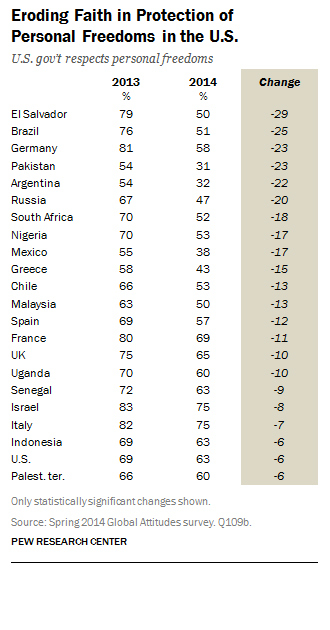
pew_table1
Spring 2014 Global Attitudes Survey, Pew Research

Among privacy-loving Germans – many of whom have even refused to allow the Google Maps car to film their homes – Obama’s reputation nosedived when it was revealed that the NSA was collecting communication metadata not only on average Germans, but also on Chancellor Angela Merkel, whose personal mobile phone had been hacked by US intelligence.

Germans’ confidence in Obama sunk to 71 percent, 17 points down from 2013.

Tensions between NATO’s two biggest members escalated this month German authorities arrested a Defense Ministry official suspected of passing secrets to the US. This shocking incident came just one week after the arrest of a German intelligence officer who worked as a double agent for the Americans.

German authorities took the unprecedented step of ordering the expulsion of the Berlin CIA station chief.

“Revelations that Washington systematically reads both Americans’ and some foreigners’ emails and listens in on their telephone conversations appears to have significantly damaged Obama’s approval in only one European Union country: Germany,” Pew reported.

Brazilians’ confidence in the first black American leader dropped from 69 percent in 2013 to 52 percent presently.

Brazilian President Dilma Rousseff, who was also the victim of NSA snooping on her personal communications, expressed her anger at those revelations by canceling an official visit to Washington in October.

Finally, Russia, which is watching neighboring Ukraine teeter on the edge of full-blown civil war, sees an American hand provoking the situation behind the scenes, especially after former Ukrainian President Viktor Yanukovich decided against signing as association agreement with the European Union in favor of stronger ties with Moscow.

The decision by sparked a violent showdown in the capital Kiev, which has led to nationwide civil strife that continues today.

“Russian faith in Obama, already quite low in 2013, is down 14 points (to 15 percent), a likely casualty of the Ukraine confrontation,” Pew said.

Meanwhile, America’s once invincible reputation for protecting individual liberties has suffered a major reality check following damning revelations about the extent of NSA surveillance from whistleblower Edward Snowden, presently living in Russia, where he has been granted asylum.

Belief that the US government respects personal freedoms plummeted 25 points in Brazil to 50 percent over the last year; 23 points in Germany to 58 percent; 20 points to 40 percent in Russia; and 11 points to 69 percent in France. Meanwhile, even the United Kingdom, a trusted ally, appears to have experienced a chilling effect by America’s recent naughtiness, dropping 10 points to 65 percent.

US drone strikes have also struck a negative chord among allies and enemies alike, including in NATO member states like Britain, France and Spain. In 37 of 44 surveyed countries, half or more of the public expressed disapproval of drone attacks.

Putin calls for peace after aeroplane disaster

Russian President Vladimir Putin says all parties in the conflict in eastern Ukraine should lay down the arms and engage in talks as soon as possible after a commercial airliner was shot down.

Putin said on Friday in comments carried by Russian news agencies that “peace in Ukraine must prevail as soon as possible” and called for direct talks between Kiev and pro-Russian insurgents.

Separatist rebels and Ukrainian government forces have been fighting each other for three months now, killing more than 400 people and displacing tens of thousands.

Airlines avoid Ukraine airspace after MH17 Boeing crashes

A number of airlines around the world have announced they are going to reroute flights to avoid Ukrainian airspace. The list of companies includes Russian Aeroflot, UTair and Transaero, German Lufthansa and Turkish airlines.

“After the incident we have decided to avoid Ukrainian airspace,” a Turkish Airlines spokesman said.

American airlines have also agreed to avoid airspace near the Russian-Ukrainian border, the Federal Aviation Administration (FAA) said on Thursday. The US Federal Aviation Administration issued a Notice to Airman (NOTAM)“prohibiting US flight operations until further notice” over eastern Ukraine.

The restricted area includes the “entire Simferopol and Dnepropetrovsk flight information regions (FIRs).” No scheduled US airlines are currently flying routes through this airspace, the watchdog added.

Air France and Virgin have decided to temporarily re-route flights to bypass Ukraine.Italy’s Alitalia has also announced it is diverting flights away from eastern Ukraine joining the growing list of companies re-routing flights.

The UK department of transport has ordered “flights already airborne” to bypass south-eastern regions of the country.

Pilots around the world are being advised to plan routes that avoid the area, the statement said. China’s aviation administration has ordered all Chinese airliners to avoid eastern Ukrainian airspace where flight MH17 has crashed, CCTV reports.

Dubai-based Emirates Airline has turned around its Kiev-bound Flight EK171 which has returned to it airport of departure in United Arab Emirates.

“The safety of our customers and crew is paramount, and we will continue to monitor the situation carefully,” the company said in a statement.

In addition Belorussian Belavia, Eva Air, Korean Air Lines, Asiana Airlines, and Swedish SCA, have all announced rerouting their flight patterns to avoid Ukraine.

Flight MH17 crashed in Ukraine on a flight from Amsterdam to Kuala Lumpar, and was carrying 298 people.

The flight was due to enter Russian airspace when contact was lost.

The EU air traffic control regulator – Eurocontrol – has closed the airspace over eastern Ukraine and has already started working on routes that would bypass the country.

“Since the crash, the Ukrainian authorities have informed EUROCONTROL of the closure of routes from the ground to unlimited in Eastern Ukraine (Dnipropetrovsk Flight Information Region). All flight plans that are filed using these routes are now being rejected by EUROCONTROL. The routes will remain closed until further notice,” it said in a statement.

Both Ukrainian government and anti-Kiev fighters have denied shooting the plane down.

A source in Russia’s federal air traffic agency Rosaviatsia has said that three days ago Ukraine’s National Security and Defense Council closed the airspace over eastern Ukraine because of the so-called “anti-terrorist operation” that Kiev conducts in the region.

Earlier a representative of Donetsk People’s Republic said that civil aviation planes could not fly over Donetsk and Lugansk regions. He added that all necessary traffic control and navigation equipment was damaged.

“Dispatching support of all passenger flights is being conducted from Kiev. How this plane could be there – is not clear,” a representative of Donetsk People’s Republic said.

The US Federal Aviation Administration has issued a Notice to Airmen (NOTAM) prohibiting US Airlines from flying in the area in Ukraine in April.

‘Only professional military could take down Malaysian Boeing’

If the plane was taken down then it was done by a professional military force

A Malaysia Airlines’ Boeing-777 with over 290 people on board has crashed in Ukraine, close to the border with Russia. Both Kiev and the opposition deny involvement in the incident.

Reports in the Western media hurried to blame the self-defense forces of the People’s Republic of Donetsk for bringing the plane down.

The claims were denied by the representatives of the Donetsk People’s Republic, saying that it’s the Ukrainian military, which destroyed the aircraft.

“We simply don’t have such air defense systems. Our man-portable air defense systems have a firing range 3,000 – 4,000 meters. The Boeing was flying at a much higher altitude,” Sergey Kavtaradze, special representative for the prime minister of the Donetsk People’s Republic, explained.

Kavtaradze also expressed condolences to the relatives of all of those who lost their lives in the tragedy.

IHS Jane’s Defense analyst, Nick de Larrinaga, also shared the belief that the self-defense forces lack the capability to bring the Malaysian plane down.

“At normal cruising altitude a civilian passenger aircraft would be out of the range of the sort of manned portable air (defense) systems that we have seen proliferate in rebel hands in east Ukraine,” he said in a statement.

But the aircraft would be within range of Buk or other medium-range surface-to-air missile systems, he stressed.

“Both Russia and Ukraine have such SAM systems in their inventories,” the expert added.

It seems unlikely that the self-defense forces could’ve used Buk surface-to-air missile systems to down the Malaysian plane, retired Brig. Gen. Kevin Ryan, the director of the Defense and Intelligence Project at the Belfer Center for Science and International Affairs, said.

“It takes a lot of training and a lot of coordination to fire one of these and hit something,” he told CNN. “This is not the kind of weapon a couple of guys are going to pull out of a garage and fire.”

According to Ryan, if the plane was really taken down then it was done by a professional military force.

France, Germany, Italy block US sanctions on Russia

France, Germany, and Italy are among EU members who don’t want to follow the US lead and impose trade sanctions on Russia. US sanctions are seen as a push to promote its own multibillion free-trade pact with Europe.

“France, Germany, Luxembourg, Austria, Bulgaria, Greece, Cyprus, Slovenia, and EU President Italy see no reason in the current environment for the introduction of sectorial trade and economic sanctions against Russia and at the summit, will block the measure,” a diplomatic source told ITAR-TASS.

In order for a new wave of sanctions to pass, all 28 EU members must unanimously vote in favor. EU ministers plan to discuss new sanctions against Russia at their summit in Brussels on Wednesday, July 16. Even if only one country vetoed, sanctions would not be imposed. With heavyweights like France and Germany opposed to more sanctions the measure will likely again be stalled, the source said.

According to the source, the US sees slapping Russia with sanctions as a way to promote its own trade agenda with Europe, a side rarely explored in mainstream media. The Transatlantic Trade and Investment Partnership (TTIP) between the US and Europe would create the world’s largest free trade zone, but some worry it could balloon into an “economic NATO” or could end up putting corporate interests above national.

“Last year the EU and the US started difficult negotiations on a free trade agreement, which would force the EU into serious concessions, in particular, agricultural quality standards and regulation on genetically modified products. In this circumstance, restrictions against Russia will force EU countries to expand trade with the US,” the source said, citing shale gas as an example.

On June 20, Czech President Milos Zeman came out against sanctioning Russia, saying there is “no reason” to further “isolate” the country.

America was successful in getting Europe to toe its sanctions agenda at the height of the Ukraine crisis, but now Russia has removed its troops from the Ukraine border and promised peace in the region, Europe isn’t interested in further sanctions.

The EU initially followed the US cue when it imposed sanctions on Russia after the reunification of Crimea in March, but these measures were limited to politicians and businessmen. The EU unleashed a second round which expanded the list to over 72 individuals, who cannot enter the EU or access any assets there.

Russian officials maintain that sanctions are counterproductive, and will end up hurting the West more than they will Russia.

Another reason EU countries are wary of slapping Russia with economic sanctions is the possible spillover effect. Unlike the US, European countries rely heavily on Russia as a trading partner, especially for natural gas. The World Bank estimates that if sanctions escalate European gas prices could jump 50 percent.

Europe clearly has much more to lose by punishing its neighbor, with annual trade in goods and services worth $330 billion. American trade with Russia, by contrast is just a tenth of that at $38.1 billion.

Deals with UK-based BP, US-based Weatherford International, and ExxonMobil, continue to show that most countries continue to do business with Russia, politics aside.

The awesome (and chilling) genius of the Germans

By Max Hastings.

The British knew the feeling. One minute there you are, like Brazil’s football team on Tuesday, settling down to start a long campaign. The next minute, bewilderingly, it is all over: Germany is master of the field, counting prisoners or — in this case — an unprecedented 7-1 triumph in the World Cup semi-final, executed with chilling discipline and precision.

What is it about the Germans? Yes, yes, I know we are not meant to mention the war, or rather wars. But how can we not do so, when for centuries the world paid tribute to Germany’s prowess on the battlefield? The Roman writer Tacitus and the French revolutionary Mirabeau alike marvelled at the Germans as a society of supremely disciplined warriors.

Field-Marshal Sir Harold Alexander wrote ruefully from Italy in 1944, lamenting the difficulties of the Allied armies, struggling to make headway in mountainous terrain. ‘Unfortunately,’ he said, ‘we are fighting the best soldiers in the world. What men!’

Today, even if the warriors are gone, the national genius for disciplined pursuit of purpose persists. In the seven decades since Germany abandoned militarism and espoused democracy, it has brilliantly translated the skills that made its armies so often supreme on the battlefield into economic, industrial and indeed social success on an equally awesome scale.

Germany is today the most effective society in Europe, even extending its achievement to the football pitch, in an era when, if there was a World XI, it is unlikely any England player would be picked for it.

I have been studying the Germans and their history for most of my life. For centuries, foreign admiration focused on just one state — Prussia. Frederick the Great in the mid-18th century made its army the most formidable in Europe, and its Field-Marshal, Blucher, famously fought alongside Wellington at Waterloo.

But until the late 19th century, the British condescended to Prussia: it might be formidable, but it was scarcely a country in the same league as Britain, France and Russia. When Princess Victoria, the Queen and Prince Albert’s daughter, became engaged to the heir to the Prussian throne, The Times complained bitterly that the most eligible royal bride in Europe was attaching herself to ‘a paltry German dynasty’.

Such a patronising spirit did not survive for long. In 1871, Otto von Bismarck swept up Prussia’s neighbouring princely states into a new German empire. In the decades that followed, Germany became the most formidable industrial nation in Europe, overtaking Britain by the most important yardsticks, above all in the production of machine tools.

The magazine John Bull grudgingly praised its expatriate workers in Britain: ‘These Germans have earned for themselves a good character. They are steady, regular, not so much given to drink as their English fellow-workers . . . often very much superior to the Englishmen who may apply for the same post. They are much better educated, more respectful, and, in a word “do not give themselves airs”.’

In 1896, the ex-prime minister Lord Rosebery said in a speech: ‘I am afraid of Germany. Why am I afraid of the Germans? Because I admire and esteem them so much. They are an industrious nation; they are, above all, a systematic nation, they are a scientific nation, and whatever they take up, whether it be the arts of peace or the arts of war, they push them forward to the utmost possible perfection with that industry, that system, that science which is part of their character.’

To me, the supreme irony of 1914 is that if Germany had not gone to war, almost nothing could have prevented it from dominating Europe within a generation by entirely peaceful means — primacy in industry, science, technology.
It was the most advanced society on the Continent, save in one critical respect: it was cursed by an archaic system of government in which a half-mad emperor, together with generals and ministers whom he personally appointed, held power over peace and war, and used it with disastrous consequences for mankind.

What is extraordinary about both world wars is not that Germany lost them, but that this one nation — with marginal assistance from a few feeble allies — held most of the world at bay for four years between 1914 and 1918, then again for six between 1939 and 1945. I have scarcely met a man who fought against the Germans who did not emerge with a profound respect for their gifts as soldiers, sailors, airmen.

We can admire what German servicemen achieved on the battlefield, especially in 1944-45, when they were hopelessly outgunned.

‘How could one not admire them?’, said a British officer whom I interviewed about the 1944 campaign in Normandy. ‘They were very, very good. They almost never gave up until the bitter end.’

And what of relations today? David Cameron thinks he has forged a close relationship and understanding with Chancellor Angela Merkel — then painfully discovers that this is not the case.

German politicians tell us they passionately want us to stay in Europe; that they share many of our hopes for reform of the EU.

But then we find, to our frustration and anger, that matters are not so simple; that for all their professions of enthusiasm for a partnership with Britain, they are pursuing a vision for the EU’s future totally at odds with that of most British people. They seem irredeemably committed to ‘ever-closer union’.

I am often asked if I see any parallels between 1914 and today. Not quite, I answer; there is mercifully no prospect of another Great War.

But Europe has faced the same problem since 1871, and still does today: how to co-exist with one state mightier and more effective than any other, without becoming effectively subjects of a German empire.

It is not that Germany in 2014 is doing anything malevolent: it simply manages its affairs, and especially its commercial affairs, vastly better than the rest of us. Mercedes, VW and BMW (which now owns Mini and Rolls-Royce) make the finest cars money can buy, outside niche markets.

The German pharmaceutical industry is among the most dynamic in the world. The German cut-price supermarkets Aldi and Lidl threaten to undo our own traditional High Street giants with a combination of low costs and shrewd offers of surprisingly good produce. The world queues to buy Germany’s industrial output.

German regional banks set an example to our own through their identification with local businesses and support for industrial investment. Angela Merkel effortlessly dominates the EU, appearing a giant among the pygmies who lead partner states.

Germany is so rich that it can afford — in effect — to pay the Greeks and Spanish to buy its motor cars.

Finally, look again at that football squad: no ludicrously ecstatic celebrations when its players score, even time and again in a World Cup semi-final; no visible tattoos; a supreme understanding of what teamwork means, rather than rampant egotism.

This is a footballing nation now flourishing in a league where ticket prices are low because club members must hold a majority stake in each team.

They are worthy champions, exemplars of the qualities that have made their country great in peace, the terror of the world in war.

Could anybody in modern times say the same about an England national team?

It is some consolation that we, as a nation, have more fun and, indeed, are more fun than the Germans. Because when it comes to the serious stuff, they leave us gaping.

Source: Daily Mail

Thousands protest in Paris against violence in Gaza

Thousands of people protested against Israel and in support of residents in the Gaza Strip, where a six-day conflict has left 168 Palestinians dead.

Some clashes erupted at the end of the march on Bastille Square, with people throwing projectiles onto a cordon of police who responded with tear gas.

Police announced six arrests had been made, after a small group tired to break into two synagogues in central Paris, a police source told AFP.

In the northern city of Lille, meanwhile, between 2,300 and 6,000 people protested peacefully, according to differing figures provided by the police and organisers.

The descent into violence in the Gaza Strip began on June 12 when three Israeli teenagers were kidnapped and later murdered, triggering a major military crackdown on Hamas in the West Bank and an escalation of rocket fire from Gaza.

The brutal revenge killing of a Palestinian teenager by Jews on July 2 added further fuel to the fire, turning into an all-out conflict on July 8 when Israel launched an air campaign against Gaza militants.

The Palestinian death toll from Israel’s punishing air campaign has hit 168.

So far, no Israelis have been killed.

“I came to say no to this massacre,” Amid Hamadouch, 30, told AFP at the Paris protest while it was still peaceful, with a sticker reading “Boycott Israel, Racist State” on his jacket.

“They are bombing innocent people. There are missiles being launched by Hamas, but the Israeli response is disproportionate. They are attacking the civilian population and not Hamas officials.”

The crowd, very young, shouted slogans such as: “We Are All Palestinians!” and “Only One Solution, End the Occupation!”.

Many protesters carried banners on which they had stuck photos taken from the Internet, reportedly showing Palestinian children killed or injured, houses razed to the ground or clouds of smoke emerging from bombed districts in Gaza.

According to the UN Office for the Coordination of Humanitarian Affairs, a majority of those killed in Gaza so far — 70 percent — have been civilians, of whom 30 percent were children.

Ukraine believes children would be better off bombed

The children’s rights ombudsman of Ukraine demanded Russia send back Ukrainian orphans who cross the border after evacuation from battle zones in the country’s east. The ombudsman accuses Russia of “kidnapping” and violation of children’s rights.

“Ukraine’s ombudsmen requests not to let orphans into Russia, probably thinking they’d be better off bombed,” tweeted Russia’s Deputy Prime Minister Dmitry Rogozin in response.

There have been repeated reports of the Ukrainian army and national Guards shelling schools, kindergartens and orphanages over the last month.

Valeria Lutkovskaya sent an open letter to the head of Russia’s border guards, Colonel General Vladimir Kulishov, demanding the passage of orphans leaving eastern Ukrainian war zones be prohibited. She also published the letter on her Facebook page.

Lutkovskaya accused Russia of violating the rights of Ukrainian orphan children, who are being admitted to Russia “without proper paperwork.”

The directors of two orphanages refused to let children travel to Russia. They refused to prepare the proper documents.

In case children get to Russia, Lutkovskaya promised to regard the issue as “kidnapping” and would apply to international organizations to have the children returned.

At this point, there is no information on whether the children have started their journey to Russia, or if the buses transporting them have crossed the Russian border.

Ukraine’s heavy artillery shelled Donetsk all night long, the militia of the Donetsk People’s Republic said. “The cannonade continued all through the night until 8 am. The sound of explosions was coming from all parts of Donetsk,” Southeast Front spokesman Konstantin Knyrik told Interfax. “Immediate reports indicate that Grad launchers were used. Reports about casualties are being verified,” Knyrik said.

The self-proclaimed Donetsk People’s Republic announced on Twitter on Saturday, “as a result of the shelling of Maryinka, a suburb of Donetsk, an orphanage was destroyed; information about the victims will be specified”.

Source: RT


Diplomatic earthquake as Germany halts US cooperation

US has nothing to contribute other than clichés about transatlantic ties

The German government’s decision to recommend the CIA station chief’s removal was reportedly made at a senior governmental level, following a “fruitless” telephone exchange between CIA Director John Brennan and Klaus-Dieter Fritsche, the coordinator between the German Chancellery and the BND.

According to German newsmagazine Der Spiegel, Brennan offered Fritsche no apology and had “nothing to contribute other than clichés about transatlantic ties”, as well as his expressed irritation about the way the media were handling the incident.

Berlin is also irritated by the fact that US President Barack Obama did not raise the issue during a telephone conversation with German Chancellor Angela Merkel on July 3, even though the CIA’s BND recruit had been arrested the day before.

German government sources believe the President either had not been notified by the CIA of the agent’s arrest, or was too embarrassed to mention it.

Meanwhile, Washington has so far remained silent on the matter. National Security Council spokeswoman Caitlin Hayden told reporters on Thursday: “we’re certainly not going to discuss who knew what and when in regards to the allegations”.

Germany has instructed its intelligence agencies to limit their cooperation with their American counterparts “to the bare essentials” until further notice, according to media reports.

The move follows news that Berlin requested on Thursday the immediate removal from Germany of the United States Central Intelligence Agency chief of station —essentially the top American official in the country.

The request came after two German citizens, one working for the BND, Germany’s main external intelligence organization, and one working for the country’s Federal Ministry of Defense, were allegedly found to have been secretly spying for the US.

German media reported on Thursday that the temporary halt in Berlin’s intelligence collaboration with Washington applies across the spectrum, with the exception of areas directly affecting tactical security concerns for Germany, such as the protection of its troops in Afghanistan, or defending against immediate terrorist threats.

Sources in the German capital claimed that the removal of the CIA station chief was technically a “recommendation for his departure”, and did not constitute an official diplomatic expulsion.

However, German observers described the incident as a “diplomatic earthquake”, which would have been unthinkable as a policy option for the German government, barring actions against “pariah states like North Korea or Iran”.

This is not the first time an American intelligence officer has been asked to leave Germany. Berlin expelled another CIA officer in the 1990s, after it emerged that the American intelligence Agency had tried to recruit a German official at the Federal Ministry for Economic Affairs.

Unlike the current imbroglio, the previous spy affair was handled discreetly and with almost no media fanfare, as is customary among allies.

Get ‘diverse’ or else, British govt tells filmmakers

On screen, at least one lead character must be ‘positively reflecting diversity’

Movie companies have been told they must meet new targets for ethnic minority, gay and female characters on screen to be eligible for future funding from the British Film Institute.

The BFI, Britain’s largest public film fund, announced a “Three Ticks” scheme to ensure diversity in films and behind the scenes as it set out new rules for funding.

Under the system, to be implemented in September, films must “tick” at least two of three criteria: on-screen diversity; off-screen diversity and “creating opportunities and social mobility”.

The BFI, which allocates lottery funding and invests more than £27 million in film production, sales and distribution, supports about 30 new projects a year. It backed The King’s Speech and Philomena.

The new rules will compel filmmakers to place “diverse” actors and subjects at the forefront of their projects, as well as ensuring minority workers are represented on set and in the crew.

On screen, at least one lead character must be “positively reflecting diversity”, with the story more likely to receive funding if it “explicitly and predominantly explores issues of identity relating to ethnicity or national origins, a specific focus on women, people with disabilities, sexual identity, age and people from a socially disadvantaged background”.

Among the films the BFI has praised for content include Suffragette, the story of the battle for women to gain the vote, and Pride, about gay activists supporting the miners’ strike. It will ask filmmakers to ensure that at least 30 per cent of supporting and non-speaking characters are also “diverse”.

Off-screen, at least two heads of department must be from diverse backgrounds, as well as a range of “key creatives” including the director, screenwriter, composer and cinematographer.

The third category requires companies to offer paid internships and jobs to “new entrants from diverse backgrounds” and to help them progress.

“Three Ticks” is likely to raise fears about compromising scripts’ authenticity, with period dramas less likely to naturally represent “diverse backgrounds”.

A spokesman for the BFI insisted all films would have the opportunity to meet the criteria, with even those not fulfilling them onscreen able to “tick” the other two sections.

Ed Vaizey, the culture minister, praised the initiative as helping to “raise the bar”, adding that he would like to see all television, film and performing arts companies following the BFI’s example.

Amanda Nevill, the CEO of the BFI, said it was “vital” to reflect British society in order to stay relevant and said the announcement “is just the beginning”.

Last month, the BBC announced it would ensure one in seven actors and presenters will be either black, Asian or ethnic minority in the next three years.

At the time, critics including Philip Davies, the Conservative MP, called it “absolutely ridiculous” political correctness, saying that all recruitment “should be done on ability”. – Daily Telegraph

Germany expels CIA chief in Berlin

Germany is expelling the CIA chief in Berlin in retaliation for the latest espionage scandal.

The expulsion comes shortly after two alleged US agents were unmasked, suspected of acting as double agents within the state security apparatus, and passing secrets to US intelligence contacts.

The move was “a reaction to persistent failure to work together in efforts towards clarification,” according to the chief of the Parliamentary Control Panel.

The two new cases, which came in quick succession of one another, increase the strain on already tense relations after the revelations made about the extent of global NSA espionage in June, 2013.

Chancellor Angela Merkel criticized the spy’s presence in Germany, stating that when common sense is switched on, “spying is ultimately a waste of force,” reported Der Spiegle.

She added that in 21st century intelligence work, there should be a strong focus on the essentials rather than that which is just technically possible – to the point that “one can’t see the wood because of all the trees,” Merkel said.

“The order arose against the backdrop of the ongoing investigation by the General Prosecutor’s Office, in addition to existing issues in recent months surrounding the actions of US intelligence agencies in Germany,” said the document.

The US stated on Thursday that it was imperative that the two nations continued to cooperate on intelligence and security matters.

“We have seen these reports and have no comment on a purported intelligence matter. However, our security and intelligence relationship with Germany is a very important one and it keeps Germans and Americans safe,” White House spokeswoman Caitlin Hayden told Reuters.

“It is essential that cooperation continue in all areas and we will continue to be in touch with the German government in appropriate channels,” she added.

A 31-year-old intelligence officer was arrested last week, and further reports on Wednesday indicated that a German soldier was also being investigated.

According to German newspaper Die Welt, the soldier was said to have made “intensive contacts” with alleged US intelligence officials, and had been under surveillance by Military Intelligence (MAD) for some time.

The US has not yet denied allegations that the German intelligence official was passing classified information to the NSA.

In a report published on Monday, two unidentified government officials told Reuters of the CIA’s involvement in the operation, which led to the recruitment of the 31-year-old suspected spy, who is now in the custody of German officials.

The man was alleged to have passed the Americans 218 secret documents in exchange for € 25,000 ($34,100), and having been a double agent for them for two years through meetings with his contact in Austria and passing on secret documents on a USB stick.

Last October, Merkel was enraged to learn she was allegedly on the NSA’s tapping list since 2002. The Chancellor called the alleged spying, which became known thanks to Edward Snowden’s leaks, “unacceptable.”

A German parliamentary committee has since been holding hearings on the NSA’s spying activities in Germany.

Source: RT

Second US spy busted in Germany

German authorities are investigating a second spy case reportedly involving the US, only a week after the arrest of a German intelligence employee cast a new shadow over relations between the two countries.

Federal prosecutors said Wednesday that police raided properties in the Berlin area on “initial suspicion of activity for an intelligence agency.” They did not elaborate or specify what intelligence agency was involved, but said they had not made an arrest.

The daily Sueddeutsche Zeitung reported, without naming sources, that the man being investigated worked in “the military field” and is suspected of spying for the United States.

SZ adds that the case is more serious than unrelated allegations against double agent at BND Federal Intelligence Service that emerged last week.

A 31-year-old German intelligence employee was arrested last week on suspicion of spying for foreign powers since 2012. German media have reported he spied for the United States and offered his services to Russia.

The U.S. ambassador to Berlin was summoned to the Foreign Ministry on Friday after news of that case broke. He was asked to help clarify the case.

Ambassador John B. Emerson was at the ministry again on Wednesday for a meeting with a senior official, said a German official who spoke on condition of anonymity.

Source: AP


200+ Neuroscientists reject Human Brain Project

More than 200 scientists have published an open letter to the European Commission (EC) to demand opting out of the Human Brain Project (HBP).

In an open letter to the European Commission, they are calling on it to reconsider the technical goals and oversight of one of the world’s largest brain-mapping projects.

The European Union agreed last year to invest more than one billion Euros in the Human Brain Project (HBP), a 10-year effort involving dozens of research institutions to create a simulation using supercomputers of how the human brain works.

But according to a letter released by dissenting scientists, the project is doomed by opaque management and the pursuit of goals not widely shared by neuroscientists. “We believe the HBP is not a well-conceived or implemented project and that it is ill suited to be the centerpiece of European neuroscience,” the letter says.

Governments, including those of the United States and China, rather than neuroscientists have all launched large neuroscience projects to study the brain.

Europe’s HBP has been particularly controversial because it emphasizes large-scale mapping of the brain and computer simulations over traditional, small-scale bench research.

Signers of the letter intend to boycott 50 million Euros per year of neuroscience research grants that have been linked to the EU project.

“Why should an information technology project determine neuroscience funding?” says Zachary Mainen, a researcher at the Champalimaud Centre for the Unknown in Portugal.

“It’s not a project that was planned by the neuroscience community. They say they are going to simulate the brain, but I don’t think anyone believes that.”

The HBP is led by Henry Markram. Markram obtained his Bachelor of Science degree from Cape Town University and his PhD from the Weizmann Institute of Science, Israel.

Within two years, Markram says, the HBP will release the first phase of its technology platform, which will let any scientist contribute data and run simulations. He says this will bring neuroscience up to speed with disciplines like astrophysics or climate research, where scientists use simulations all the time. “You can’t measure everything in the Universe, but you can simulate it,” he says. “You can’t measure all of the brain, either, so we are going to have to predict a lot of it.”

That focus on computer simulations is what’s generating the most withering criticism. Konrad Kording, a neuroscientist at Northwestern University, calls the European project “useless and misleading” and says there is “genuine concern that the neuroscience community in Europe will be damaged by a very high-profile project that is deeply misguided.”

The problem, says Kording, who is a German citizen, is that it’s simply too soon to invest heavily in large-scale computational models of the brain. “The HBP is premature, we do not have the data needed, we do not know what we need to simulate, and we lack ways of thinking computationally about the brain. And yet, the HBP focuses on massive scale simulations that are currently not helpful,” he says.

Kording helped shape the US BRAIN Initiative, a large neuroscience program announced by President Obama last year. That initiative, which made its first awards in May is broadly focused on developing new technologies for directly measuring the activity neurons and mapping brain circuits.

In 2013, President Obama devoted an initial $100 million in taxpayer money to fund the HBP.

Source: technologyreview.com

Another CNN geography goof-up in Ukraine

CNN, already infamous for its embarrassing geography goof-ups, has mistakenly relocated the Eastern Ukrainian city of Slavyansk in an infographic – all the way to the Crimea peninsula.

The American network was reporting Saturday on the Kiev military forcing out the self-defense troops out of Slavyansk and Kramatorsk, the cities in Ukraine’s Donetsk region that used to be their strongholds for a while. In a lead-in to the report, the TV channel showed a map – where Slavyansk was moved hundreds of kilometers away from its actual location, to Crimea, a peninsula that rejoined Russia in March.

In fact, the distance between Slavyansk (in Ukrainian language – Slovyansk) and Kramatorsk is only about 16 kilometers. Both cities lie to the north of the region’s capital, Donetsk.

It is not the first time that CNN graphics staff have demonstrated a relaxed attitude to accuracy when it comes to geography.

Earlier this year, the channel reshaped the world suggesting on its map that Eastern Ukraine was somewhere in Pakistan. The error was snapped by one of eagle-eyed viewers from a TV screen and published on Twitter, soon going viral on the internet and a target for sarcastic comments.