Tom and Jerry cartoons on television are being accompanied by a warning that they may depict scenes of “racial prejudice”.
The classic cat and mouse cartoons, some made more than 70 years ago, carry a warning for subscribers to Amazon Prime Instant Video.
There have been claims of racist stereotyping in the depiction of a black maid in the cartoon series.
A warning at the beginning of the cartoon, displayed by Warner Brothers
Amazon’s warning says such prejudice was once “commonplace” in US society.
Tom and Jerry, once a staple of children’s television on British television, is being presented with a cautionary note about “ethnic and racial prejudices”.
‘Trigger warnings’
Amazon’s streaming subscription service, formerly branded as LoveFilm, includes the cartoons in its comedy collection.
But Tom and Jerry: The Complete Second Volume is accompanied by the caution: “Tom and Jerry shorts may depict some ethnic and racial prejudices that were once commonplace in American society. Such depictions were wrong then and are wrong today.”
The wording is similar to disclaimers accompanying some collections of the cartoons on DVD.
The warning was attacked as “empty-headed” by cultural commentator and professor of sociology, Frank Furedi, who said it was a form of a “false piousness” and a type of censorship which “seems to be sweeping cultural life”.
“We’re reading history backwards, judging people in the past by our values,” said Prof Furedi from the University of Kent.
Tom and Jerry was first produced by the MGM film studio in 1940. The cartoons, directed by William Hanna and Joseph Barbera and produced by Fred Quimby, ran until 1957, with carefully choreographed chase scenes set in the homes and gardens of suburban America.
There were more than a hundred short films made in this original series, winning seven academy awards. These included the Cat Concerto in 1946, the Two Mouseketeers in 1951 and Johann Mouse in 1952.
In the subsequent decades there have been numerous re-launched television versions of the series, with varying styles and varying degrees of critical approval.
The claims of racism are longstanding. When the original versions were shown on US television in the 1960s some scenes were edited.
There have also been complaints about the characters smoking cigarettes, with changes made to recent screenings.
‘Superb’ animation
Steve Abrahart, senior lecturer in animation at De Montfort University, said the quality of animation in the early Tom and Jerry films was “superb”.
The cartoons are still seen as being among the best made, he said.
But Mr Abrahart said the attention to detail of the early versions was lost in some of the later re-makes.
On the question of the portrayals of race and ethnicity, he said today’s animation students were not shocked by what they saw in old cartoons.
He said they understood how attitudes changed over time.
As well as racial stereotypes, he said there were questions about the representation of women and other nationalities in animations from the 1940s.
The idea of running warnings ahead of potentially upsetting moments in films or books has become a controversial topic in US universities.
There have been calls for the use of “trigger warnings” which could flag up to students that they are about to come across descriptions of physical brutality, aggressive language or sexual violence.
The suggestion that these should be inserted into lessons about classic texts has angered some academics.
Prof Furedi said calls for such trigger warnings were a form of “narcissism”, with the concerns not really being about the content of a book or work of art but about individual students asserting their own importance.
“A tolerant society needs to discuss disturbing art,” he said. – BBC.COM
White liberals might have finally understood that they have become redundant as spokespeople for blacks as well as moral pillars of integration.
The white artist now branded as the ultimate racist for trying to understand “black pain”, told The Times that he was “disappointed” and “exhausted” after having being labelled a racist by the same people he pretends to defend.
Meant to be a statement on colonialism, slavery and contemporary racism, the Exhibit B installation had proved controversial since its debut at the Edinburgh Festival last month. It was branded racist by protesters, one of whom told the Evening Standard that the show “is the same as an original human zoo”.
South African artist Brett Bailey’s clichéd “anti-racism” piece Exhibit B, featuring black performers chained and in cages, had its London run cancelled last night due to “extreme protests”.
The exhibit’s run at the Barbican faced protests from the start, though organisers had backed the work. Tense scenes between protestors and security played out yesterday.
A Barbican spokesman said: “As Exhibit B was opening it became impossible for us to continue because of the extreme nature of the protest and threat to the safety of performers, audiences and staff.”
Bailey said: “The piece really speaks out against contemporary racism and its roots in the distant past. Now it’s branded as a racist work and the debate has become about freedom of speech, not addressing the work itself, which is a strong statement against racism.”
The board of the World Fantasy awards has said that it is “in discussion” about its winners’ statuette, modelled on the late HP Lovecraft, after calls for the trophy to be changed due to Lovecraft’s “fundamental racism”.
Over the past four decades, the prestigious fantasy prize has been won by writers including Michael Moorcock, Gene Wolfe and Haruki Murakami. It comes in the shape of a bust of Lovecraft, the creator of the Cthulhu mythos and prolific writer of weird fiction, who – 2011’s best novel winner Nnedi Okorafor was stunned to discover – was also the author of a poem that gives an unflattering description of black people:
When, long ago, the gods created Earth
In Jove’s fair image Man was shaped at birth.
The beasts for lesser parts were next designed;
Yet were they too remote from humankind.
To fill the gap, and join the rest to Man,
Th’Olympian host conceiv’d a clever plan.
A beast they wrought, in semi-human figure,
Filled it with vice, and called the thing a Nigger.
– H.P. Lovecraft, On the Creation of Niggers (1912)
At the time, the Nigerian-American author wrote of her conflicted feelings over the fact that “a statuette of this racist man’s head is one of my greatest honours as a writer”. Now her fellow author Daniel José Older has launched a petition calling for the organisers of the prize to make the late African-American science fiction writer Octavia Butler the inspiration for the statue rather than Lovecraft.
Older has almost 2,500 signatories to date, including Okorafor and other authors; he writes that while Lovecraft “did leave a lasting mark on speculative fiction, he was also an avowed racist and a terrible wordsmith”, and “it’s time to stop co-signing his bigotry and move sci-fi/fantasy out of the past”.
The novelist told the Guardian that while he reads Lovecraft himself, and appreciates “aspects” of his work, “there’s no reason, in 2014, to have a man who enthusiastically advocated for genocide be the face of fantasy’s greatest honour”.
“People have been debating whether Lovecraft being a racist matters or whether it’s his writing that should be at issue. I’m saying: both matter. After decades and decades of deeply embedded racism being prevalent in the fantasy genre, it’s time to make courageous moves against racism, and that includes not championing a vile racist,” said Older.
Okorafor, who was not involved with setting up the petition, said she loved the idea of Butler replacing Lovecraft, also suggesting the late Diana Wynne Jones as a possible option, “or some sort of mystical creature or plant”.
She also welcomed the controversy as an occasion for opening an important discussion. “I think seeing all aspects of authors like this (especially when it manifests clearly in the author’s work) will help us be better able to deal with issues of race. Instead of pretending it’s not there or feigning colour-blindness, it’s better to DEAL with it. Talk it out. See it. Accept it,” she said. “It’s not comfortable to question someone you idolise. It raises emotions. The practice of cognitive dissonance abounds. There are uncomfortable arguments. Snarky rebuttals and retorts are written. These are growing pains.”
Older said there had been “thoughtful and brilliant points made on all sides and some ridiculous, nonsensical trolling” in response to his suggestion, adding that he “wasn’t surprised that some folks took personal offence to the petition. Lovecraft has long been fandom’s favourite racist and it’s always fascinating to watch people tie themselves in all sorts of rhetorical knots trying to justify appalling hatred on the one hand and sloppy prose on the other.”
One lengthy defence has been offered by Lovecraft expert ST Joshi, who writes of “the significant question as to whether racism should be regarded as so much more significant a moral, intellectual, and personal flaw than many other stances one could name”, and of “the further absurdity of thinking that Lovecraft’s undeniable racism somehow negates his immense talents as a writer and also negates the many virtues – intellectual, aesthetic, and personal – that he displayed over his life”.
A Salon article by the writer Laura Miller saw the self-avowed Lovecraft fan write that “we need to be able to accept the truth that even great artists – greater ones than Lovecraft, certainly – have their ugly sides, and that ugliness can be inextricable from their greatness. Art, being human, is an expression of the whole self. This isn’t the same as accepting Lovecraft’s racism. You can acknowledge, contemplate and discuss that racism without feeling obliged to reject the work as a whole.”
She adds: “When Joshi writes, ‘If Nnedi Okorafor and China Miéville [another WFA winner who objects to the trophy] are so offended at owning the WFA, they should simply return it and be done with the matter,’ he is essentially telling writers like Okorafor that they must accept an honour from that community in the form of a man who considered [black people] to be ‘semi-human’ and filled ‘with vice’. Suck it up, or get out. I’m pretty sure this is not the message the World Fantasy Convention meant to send when they gave Okorafor the prize in the first place.”
The board of the World Fantasy awards, which will be held in November in Washington, DC, said it “has been and continues to be in discussion about the future of the award statuette”. – The Guardian
Something’s changed, subtly but swiftly, over the past couple of months. Suddenly there are charges of racism absolutely everywhere, from seemingly everyone, irrespective of whether those accusations are grounded in reality. This isn’t entirely new, obviously, but it has intensified as of late.
by Mande Wilkes
And I’m tired of it.
While I can concede that some people are racist, and some systemic racism lingers, it’s hardly rampant or pervasive. On the whole, black Americans and white carry on together just fine.
To claim otherwise, actually, is to hurt children — black children, specifically. How must it feel to be a kid and to be told, over and over again from the get-go, that the world is out to get you? While it’s not causative, it isn’t hard to understand, then, why black youth suffer from high rates of incarceration, poverty, drug use and teen pregnancy. Honestly, had I grown up with the world at my ear, telling me I’m despised, I can’t be sure I wouldn’t have had a rockier time of it.
There are consequences, is what I’m saying, when you convince a whole segment of America that they’re hated. Not for nothing, one of those consequences could be that a black teen, having been brought up to believe that racism is everywhere, might behave defensively when approached by a white cop. In that instance, we can’t discern whether the issue was racism itself or, as likely, the mistaken and unwarranted fear of racism where it doesn’t exist.
I’ll keep it real, for a moment, and confess that I’m not saying anything new on the subject. So much has been said about racism that it’s hardly possible, at this point, to deliver any large insights.
But I reached my breaking point a few days ago, upon hearing news of the editorial board of a college newspaper charging that bra manufacturers are racist. Why are they racist? Because “nude” is a common bra-color designation, and black women’s skin isn’t actually “nude.” Or something.
Anyway, interestingly, this recent ratcheting-up and battening-down of hysteria coincides with genuine and growing racist sentiment — but it has nothing to do with the black population.
In recent weeks, a number of Americans have convinced themselves that Islam is a race and a religion to be feared, and, more than that, annihilated. You might imagine that to a Jewish person like me, Islamophobia would be comforting — a measure of commiseration about the ongoing Mideast unrest. But in fact it bewilders me that unofficial American policy seems to be that an entire population must be either converted or killed.
Which is all to say that right now it’s safer and sounder to be black in America than to be Muslim anywhere. Perhaps that’s progress of sorts, but it feels like more of the same.
Mande Wilkes is a wife, mother, businesswoman, author, etc. residing on the South Carolina coast with her family. Read more of her columns.
This is a very amusing story that was published recently in South Africa. A local black comedian who calls himself TolA$$Mo (Mongezi Ngcobondwane) claimed that an Afro-American called him a “kaffir” and there is a court case on which you could read about here.
The usually anti-white columunist on the Daily Maverick, Sisonke Msimang, writes:
The wrinkle in the story is that the man Ngcobondwane allegedly shot his weapon at, and whom he claims called him kaffir – is black. And while it is theoretically plausible in an abstract sense, that a black person (even one from America where the South African term kaffir is not in use) might call another black person by a racial epithet, the reality is that the particular person in question seems unlikely to have done that. I happen to know French (although he is a relatively new acquaintance) so I may be biased – but I would be surprised if someone who was raised by civil rights activists would use a word like kaffir against another Black person.”
Ngcobondwane then goes on to suggest, “If one more white man calls me a kaffir, I’m going to moer him.”
This is a sentiment with which many black people in South Africa can identify. There is nothing quite like being called a kaffir. It takes the air out of your lungs, hits you in the solar plexus; stings your eyes and dries your mouth. You are at once ashamed and enraged – understanding that the word should have no power and yet feeling its force and weight in your pelvis and your knees and in the soles of your feet. Kaffir has the density of centuries; it is the color of blood and tastes like metal.
The argument elsewhere in the same column seems to be that the “race card” should not be played among blacks or “brothers” in American parlance. The race card should be reserved for whites only, i.e. you should only call whites racist, not your fellow blacks or “people of colour”. Although somewhere in this story lurks the somewhat politically incorrect fact that the American, James Albert French, might have been light-skinned, a kind of inverse reaction to the normal one whereby South African blacks kill their darker skinned “brothers” from other African countries, also calling them makwerekwere or “Kiwi’s” after the shoe-polish brand.
The other problem for cultural-Marxist race theory in SA is that whites and especially Afrikaners, are politically powerless and may therefore by definition not be racist, even if they use the word “kaffir”. Race being a social construct, or so the theory goes, “racism” is but the expression of power relations between a majority with political power and a minority without it. As we do not even rule a single municipality in South Africa and are both culturally and politically dominated by Afro-Saxon blacks, we cannot be racist, unlike Mr. French here who hails from the American Empire.
“Kaffir” is also an Arab word, originally, so one should think that it should be acceptable, not being of European or “eurocentric” origin. It means “heathen” and given the many belief systems proliferating today, including anti-racism which has all the hallmarks of a religion, like blasphemy, excommunication, etc., we are perhaps all “kaffirs” to someone somewhere. Or as the Koos Kombuis song goes in Afrikaans: “Ons is almal kaffers in ons harte.” Or maybe Koos Kombuis should be banned? Placed on the index, censored? Read my latest essay, Raiders of the lost Empire, if only because I also quote Karl Marx in there somewhere: “Hegel remarks somewhere that all great world-historic facts and personages appear, so to speak, twice. He forgot to add: the first time as tragedy, the second time as farce.”
While the migration of black Africans is not new, the number of sub-Saharan immigrants has grown swiftly, an influx that is shifting the demographic landscape across the country, including in New York City.
Between 2000 and 2010, the number of legal black African immigrants in the United States about doubled, to around one million. During that single decade, according to the most reliable estimates, more black Africans arrived in this country on their own than were imported directly to North America during the more than three centuries of the slave trade.
And while New York State is home to the largest proportion and many have gravitated to ethnic enclaves like Little Senegal in West Harlem or the Concourse Village section of the West Bronx, to live among fellow Ghanaians, black immigrants from Africa have tended to disperse more widely across the country — to California, Florida, Georgia, Illinois, Maryland, Texas and Virginia — than Caribbean-born blacks.
About a third of black New Yorkers were born abroad, mostly in the Caribbean. Africans constitute about 4 percent of the city’s foreign-born population, but as much as 10 percent in the Bronx. At last count, according to an analysis of census estimates by the Department of City Planning, from 2000 to 2011 the African-born population increased 39 percent to 128,000, although other estimates suggest that many more are living here without legal residency.
“They’ve been doubling every 10 years since 1980,” said Kim Nichols, an executive director of the African Services Committee, which is based in Harlem. “There’s a more established family and community network here to come to.”
Some come as refugees, some with work visas or special skills, many to stay and others to hone their talents and eventually apply them back home.
“Many black immigrants do not identify with the historical experiences of discrimination encountered by blacks in the United States,” said Kevin D. Brown, a law professor at Indiana University’s Maurer School of Law.
Kobina Aidoo, director of “The Neo-African-Americans,” a documentary, said, “I’ve heard people refer to themselves as everything from ‘African African-American’ to ‘Halfrican American’ to ‘White African-American’ to ‘Real African-American’ to ‘American African” to ‘Just black.’ ”
Dr. Khalil Gibran Muhammad, director of the New York Public Library’s Schomburg Center for Research in Black Culture, recalling the shooting by the police of Amadou Diallo, an unarmed immigrant from Guinea in the Bronx in 1999, and of Michael Brown, an unarmed teenager in Ferguson, Mo., last month, said color still trumped place of origin.
“Diversity among African-descended communities remains a black box and a mystery to most Americans,” he said. “[Being] Black is all that matters [to blacks].”
Hip-hop group AmaCde yesterday said a complaint against one of its songs will give “African employees who experience abuse, mistreatment and exploitation at the hands of Indian employers a chance to make submissions” to the SA Human Rights Commission.
“We remain convinced that the song does not constitute hate speech and we hope that those who tasked the commission to probe the song are indigenous Zulu people as only they [would] be able to understand the Zulu idioms in the verses,” the Durban group said.
“The complainant alleges that the lyrics of the song are derogatory and incite hatred [of] Indians,” said Human Rights Commission spokesman Isaac Mangena. “The matter is being assessed by the commission with a view to investigating it.”
The group’s song Umhlab’ Uzobuya (The Land Will Return) has caused widespread anger. Its lyrics call for Indians to “go back across the ocean” or face “action”.
The song’s second verse describes a black man’s unhappiness at his ill-treatment at the hands of his employer, referred to as “Naicker”.
The song was released on social media and has become increasingly popular since the outcry over it broke.
With ethnic relations once again making headlines in America, racism elsewhere can sometimes make discrimination appear relatively minor by comparison. Consider what those of African origin face when living or traveling in Asia, for example.
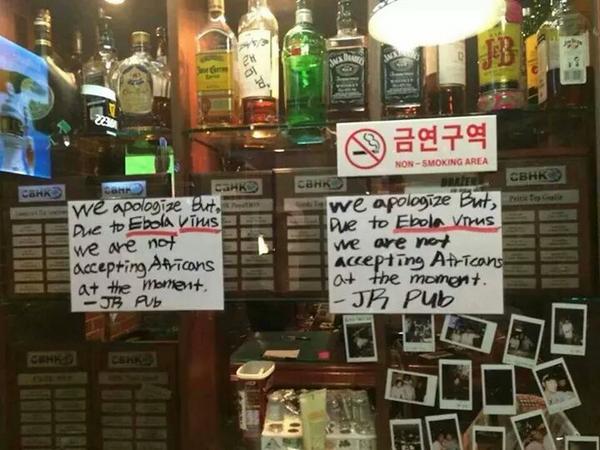
Today’s illustration comes from Twitter, where one restaurant in South Korea is refusing to serve black people due to fears over Ebola!
Imagine the outrage were this sign to appear anywhere in the United States:
Given that many American soldiers stationed in Korea are African-American, it’s hard to believe this isn’t generating more attention.
A race row has erupted at Nelson Mandela Metropolitan University after a project to mark 20 years of democracy in South Africa backfired.
The Port Elizabeth university’s “talking walls” project, aimed at encouraging staff and students to speak about democracy, yielded a range of offensive statements.
According to Herald Online, the white boards that served as the talking walls saw responses ranging from the silly – one student suggested free alcohol in the canteen – to the more serious “F**k whites” which fanned racial tension. Also upsetting to some was a statement that suggested fewer whites should be at the university.
The boards have been pulled off the walls and are currently lying in a passage. The offensive messages have been wiped off.
Management student Tiffany Francis, 21, said: “The past is in the past and we must work together to make the future better. They should have a disciplinary hearing to prevent it happening again”.
Marketing student Sanela Genu, 20, thought the students responsible should be expelled. “They brought the school name into disrepute.”
University spokeswoman Roslyn Baatjies said the university was saddened by the offensive comments, especially as it is presently celebrating Diversity Month.
“This behaviour is not in keeping with our core values. We would like to believe this is an isolated incident and does not reflect the feelings of the majority of staff and students.”
The comments had been written anonymously, so the university did not know who was responsible.
For the first time ever, U.S. public schools are projected this fall to have more minority students than non-Hispanic whites enrolled, a shift largely fueled by growth in the number of Hispanic children.
Non-Hispanic white students are still expected to be the largest racial group in the public schools this year at 49.8 percent. But the National Center for Education Statistics says minority students, when added together, will now make up the majority.
About one-quarter of the minority students are Hispanic, 15 percent are black and 5 percent are Asian and Pacific Islanders. Biracial students and Native Americans make up a smaller share of the minority student population.
Education Secretary Arne Duncan called the changing population a seminal moment in education. “We can’t talk about other people’s children. These are our children,” he said.
The shift creates new academic realities, such as the need for more English language instruction, and cultural ones, meaning changes in school lunch menus to reflect students’ tastes.
But it also brings some complex societal questions that often fall to school systems to address, including issues of immigration, poverty, diversity and inequity.
The result, at times, is racial and ethnic tension.
In Louisiana in July, Jefferson Parish public school administrators reached an agreement with the federal government to end an investigation into discrimination against English language learners.
A Maryland jury has awarded a white teacher $350,000 in damages for being discriminated against by his former principal, an African-American woman.
The Washington Post reports teacher Jon Everhart, 65, filed a lawsuit in 2010 against Prince George’s County Public Schools on the grounds that Largo High School Principal Angelique Simpson-Marcus subjected him to abuse because of his race.principal simpson-marcus with cut line
Everhart claims Simpson-Marcus called him “poor white trash” and “white b—-,” and told students that the “only reason a white teacher teaches in (Prince George’s) County is that they can’t get a job elsewhere.”
Simpson-Marcus’ hostility toward Everhart reportedly began in 2003 when both were working as teachers in Largo High School. Everhart says Simpson-Marcus told him that if she ever became principal, he would be the first person she would fire, the Washington Post reports.
Bryan Chapman, Everhart’s attorney, said that when Simpson-Marcus became the school’s principal in 2007, “Everhart, who was once named the school’s Teacher of the Year and who received stellar evaluations, started to receive unsatisfactory performance evaluations,” the news site reports.
Media reports indicate Everhart was fired after the 2009-10 school year.
Everhart says his years of harassment from Simpson-Marcus contributed to a decline in his health, including high blood pressure and heart problems.
Simpson-Marcus denies all wrongdoing.
“I never said any of those things,” she told the Post. “I don’t use that kind of language.”
However, a group of Largo High School employees claims otherwise.
According to a 2011 Washington Post article, several faculty members said Simpson-Marcus “routinely called her secretaries names, such as ‘chicken heads,’ ‘ghetto’ and ‘hood rats.’”
The teachers also said they were mistreated for vocally supporting Everhart.
A judge will decide if Everhart should also be awarded back pay, retirement and health benefits, and the restoration of his teaching certificate, the Post adds.
Prince George’s school leaders may appeal the $350,000 ruling.
Two white students photographed dressed up as black nannies for a private party, have been kicked out of their campus residence, the University of Pretoria (UP) said on Thursday.
The fancy dressers were called “racist” by a group of well-organised black haters on social networks with the hashtag #blackface.
The picture was taken at a private 21st birthday party but because they were white students at the institution a witch hunt was quickly launched against UP as well as the two girls.
The SA Students Congress (Sasco) said it felt “particularly angered” by the picture and accused all white people collectively as well as the university of teaching “its” youth to disrespect black people. The institution is actually a functioning multi-racial university.
The display of outrage to maintain and enforce current South African societal norms, once again showed how low whites are in the social hierarchy of tenderpreneurs, nepotists and freeloaders.
“It is clear to us that the white community assisted by institutions of white privilege, like UP, are teaching white youth to disrespect and poke fun at black suffering,” Sasco president Ntuthuko Makhombothi said on Wednesday.
“We have absolutely no confidence in the supposed disciplinary action the university seeks to institute against their precious white students,”
Makhombothi said the picture was distasteful and “racist to the extreme.”
“Black women in our country continue to suffer from triple oppression as black, female, and working class. This incident ridicules the situation of black women in our country and reinforces racist stereotypes about our mothers.”
He said the continued existence of “institutions of white privilege” was an untenable “crisis”, and that the patience of black people in South Africa was “quickly diminishing”.
“Black students will not fold their arms as their suffering and that of their parents is made fun of. The dignity of Africans cannot be trampled on without consequences to the perpetrators.”
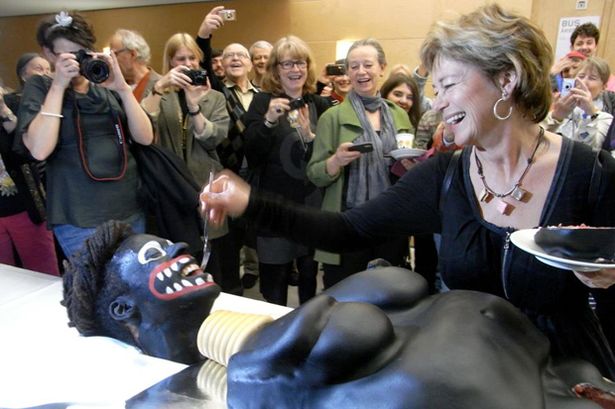
Praag has learned that Sasco also plans to write to the Swedish Embassy about a disturbing racist black face cake from 2012 that was discovered only yesterday by its members.
The National Afro-Swedish Association called for a minister of culture’s resignation after she was pictured laughing while cutting the racial stereotype cake and eating it. The event was branded a “racist spectacle” by the National Afro-Swedish Association.
Spokesman Kitimbwa Sabuni told The Local: “In our view, this simply adds to the mockery of racism in Sweden.
“According to the Moderna Museet, the ‘cake party’ was meant to problematize female circumcision but how that is accomplished through a cake representing a racist caricature of a black woman complete with ‘black face’ is unclear.”
Sabuni added that the fact that the minister particiapted in the event, which he argued was also marked by “cannibalistic” overtones, betrays her “incompetence and lack of judgement”.
In a statement, he added: “Her participation, as she laughs, drinks, and eats cake, merely adds to the insult against people who suffer from racist taunts and against women affected by circumcision.
South Africa is apparently experiencing another tedious outburst of moral outrage about an innocuous case of “blackface” put on by two women students at the University of Pretoria for a 21st-birthday party.
I try to keep the mass media at a safe distance and therefore do not listen to radio, watch TV or buy any newspapers. The internet is a more clinical way of accessing information without background shrieks, unless it is YouTube. Yet, judging from responses on Twitter, there is some hullabaloo going on and the two students have now been “charged” by the university and will be subjected to a disciplinary hearing. They could face expulsion or some other form of punishment.
South Africa has slid so far down into an abyss of sadism, crime, murder and rape that it seems entirely risible that anyone should care about how white students make up their faces at a fancy-dress party. Yet, as one of the zealous anti-racists in Johannesburg, Gillian Schutte, once intoned in desperation: “Where is the outrage?”
Indeed. We need outrage to distract us from our abject failure as a society and even the increasing signs of a failed state in what used to be called the “Republic of South Africa”. Hardened and jaded by armed robberies, shootings in broad daylight, car hijackings, murder and torture of farmers, endemic corruption and the highest incidence of rape on the planet, the average South African – black or white – could hardly care about the latest student prank in Pretoria.
Yet the media and academic elite, in their slavish imitation of American political correctness, have to have their outrage and moral hysteria. There is something particularly British about moral hysteria which I suppose one could trace back to the time of Cromwell’s puritanical rule and which Fleet Street still has on tap whenever the United Kingdom has to rally public opinion behind another BP or Shell oil war somewhere.
It is certainly ironic that these days British moral hysteria is often projected towards Russia where once the rigours of communist zeal held sway. I was surprised to learn that anti-Semitism in the USSR carried the death penalty. As I do not know any Russian, I could not tell you which words merited a bullet in the head. Were it not for the fact that the death penalty had been abolished in 1994, one could well imagine how “racism” or politically incorrect utterances might soon become a capital offence in South Africa.
Thus South Africa gets its propensity for anti-racist outbursts from both Britain and the ex-USSR where many of the post-1994 leadership spent their formative years. Also, the Marxist-Leninism of the USSR has migrated to the USA in the form of so-called “cultural Marxism” which is the staple at most American universities, slavishly imitated by our local campuses. As Paul Craig Roberts put it recently in one of his sharply-worded commentaries on US-UK war-mongering:
If we are honest and have the strength to face reality, we will realize that the Soviet Union did not collapse. It simply moved, along with Mao and Pol Pot, to Washington and London.
In 1934 or so, shortly before the University of Pretoria completely abolished tuition in English in favour of Afrikaans, a Union Jack was burnt in front of the Old Arts Building by a young poet, WJP Erlank, who wrote under the pen name Eitemal. The English press was outraged, leading to his expulsion as a student but he instantly became an Afrikaner hero.
How the tables have been turned! It is certainly indicative of Afrikaner powerlessness that an English-speaking student, Thorne Godinho of the liberal DA’s youth movement DASO on the campus, was able to engineer the current outburst by publishing the photograph of the two Afrikaans girls dressed up as black servants on Facebook and get the university to punish them. If you want to know the meaning of “kowtow”, just watch today’s Afrikaans university administrators in action.
In more senses than one, Afrikaners find themselves completely at the mercy of latter-day zealots who are endlessly beating their quasi-religious precepts about race and racism into them. The slightest semantic or symbolic deviation is immediately punished and the guilty ones pilloried or subjected to a witch-hunt that will ruin their careers or “shame” them for years to come. It was the case during the so-called “Reitz 4” incident, as well as earlier this year during the photographing of a women’s residence initiation ceremony in Potchefstroom where for one split second and from a certain angle it could resemble a Nazi salute. Now the University of Pretoria is experiencing the same spate of orchestrated “outrage”.
Mr Ponty Thuynsma, 76, in hospital. Photo: Lisa Hnatowicz, Beeld
Over the past few days an elderly Afrikaner, Koos Jonker, was literally beaten to death by blacks near Ellisras. In a separate incident, Mr. Ponty Thuynsma was tortured with a hot iron and made to drink petrol in his home east of Pretoria. Thuynsma had to be admitted to the intensive care unit of the Wilgers hospital (see picture). However, these murderous, sadistic incidents pale into insignificance next to purely linguistic or symbolic transgressions of the dominant anti-racist theology committed by Afrikaans students.
In the USA, African Americans have been endowed with a special “minority” status akin to a sacerdotal class with special privileges protecting them against public criticism. As a special caste they also need to be treated with above-average respect. All of this dogma has been imported wholesale into South Africa, where blacks form a majority. Declaring the majority, who already has a monopoly on political power, in need of special protection and beyond criticism or occasional mocking quickly leads to a Soviet-style totalitarian society.
There is increasing censorship and after this latest “blackface” incident, some people think that the movies of comedian Leon Schuster should be banned as he often dons blackface and imitates black slang and speech patterns.
It is also beyond my comprehension how the South African “nation” as it has been defined, can be so criminal and morally depraved, yet at the same time given to an acute sensitivity or what we call in Afrikaans kleinserigheid, touchiness. Logically, the same rapist or murderer who finds torture acceptable conduct, would object to a white girl in “blackface” or someone using a term that is ethnically off-colour.
Of course, in the media and the universities there is an entire language and thought police force waiting to denounce anyone who deviates from their increasingly puritanical norms. By force of “outrage” and moral hysteria, they impose their contradictory values on us. Everyone who does not agree with them is vilified as a “Nazi”, “fascist”, “racist”, “white supremacist”, “sexist”, “homophobe” or other label within their impoverished catechism.
I almost wrote “secular catechism”. But there is nothing secular about it and its acolytes certainly do not subscribe to the values of the European Enlightenment. Tolerance and freedom of speech are not part of their belief system. It is a real religion with a fairly simple dogma and enough zealots to patrol the boundaries of our words and our actions. They do not countenance any form of heresy and at best will allow “sinners” to repent and submit to a programme of re-education.
Or “discipline”, that Leninist word for those deviating from the party line.
However, the strategic thrust of the current campaign around the Afrikaans universities is to oust the last remaining Afrikaners from those institutions so that they may be entirely controlled by English cultural Marxists. In its wisdom, the ANC government has decided that “South Africa needs more PhDs” and is throwing money at the problem. So apart from serving the “Red Church” as Albert Camus called it, one may also eject some hapless Afrikaner academic from his post amid rising incomes in the tertiary-education sector. Hence the witch-hunts against dissident students and lecturers at all the Afrikaans universities.
In the nineteenth century, anglicisation in South Africa was justified by British imperialism; now it is based on race and political correctness. Signs of “racism”, as defined, detract from the language and cultural rights of Afrikaners and even their access to tertiary education.
Until the final victory of Sovietised English over Afrikaans is trumpeted in South Africa, the semantic war is bound to intensify. We might as well all put on “war paint”; if that can still be said without causing offence to native Americans.
Britain’s leading public health doctor today blames the failure to find a vaccine against the Ebola virus on the “moral bankruptcy” of the pharmaceutical industry to invest in a disease because it has so far only affected people in Africa – despite hundreds of deaths.
Professor John Ashton, the president of the UK Faculty of Public Health, says the West needs to treat the deadly virus as if it were taking hold in the wealthiest parts of London rather than just Sierra Leone, Guinea and Liberia.
Writing in The Independent on Sunday, Professor Ashton compares the international response to Ebola to that of Aids, which was killing people in Africa for years before treatments were developed once it had spread to the US and UK in the 1980s.
He writes: “In both cases [Aids and Ebola], it seems that the involvement of powerless minority groups has contributed to a tardiness of response and a failure to mobilise an adequately resourced international medical response.
“In the case of Aids, it took years for proper research funding to be put in place and it was only when so-called ‘innocent’ groups were involved (women and children, haemophiliac patients and straight men) that the media, politicians, scientific community and funding bodies stood up and took notice.”
Source: The Independent
This website uses cookies to improve your experience. We'll assume you're ok with this, but you can opt-out if you wish. Cookie settingsACCEPT
Privacy & Cookies Policy
Privacy Overview
This website uses cookies to improve your experience while you navigate through the website. Out of these cookies, the cookies that are categorized as necessary are stored on your browser as they are essential for the working of basic functionalities of the website. We also use third-party cookies that help us analyze and understand how you use this website. These cookies will be stored in your browser only with your consent. You also have the option to opt-out of these cookies. But opting out of some of these cookies may have an effect on your browsing experience.
Necessary cookies are absolutely essential for the website to function properly. This category only includes cookies that ensures basic functionalities and security features of the website. These cookies do not store any personal information.
Any cookies that may not be particularly necessary for the website to function and is used specifically to collect user personal data via analytics, ads, other embedded contents are termed as non-necessary cookies. It is mandatory to procure user consent prior to running these cookies on your website.