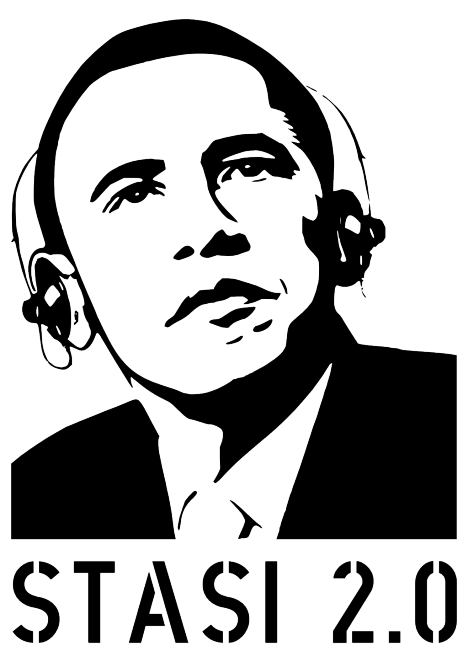
NSA is more than just a spy network, it’s global fascism

by Patrick Henningsen

Despite the size and scope of Edward Snowden’s NSA whistleblowing, there’s little sign of Washington DC changing its practices, and even less of an indication that any of its European allies will actually hold it to account.

Germany Flip-Flops

Germany’s change of direction on this issue reveals a lot about the scale of the problem. Angela Merkel’s initial public response seemed to be that of outrage. “We are no longer in the cold war,” said Angela Merkel’s spokesman, Steffen Seibert. “If it is confirmed that diplomatic representations of the European Union and individual European countries have been spied upon, we will clearly say that bugging friends is unacceptable”(Guardian July 1, 2013).

Merkel’s public façade didn’t hold up for long after Snowden revealed in Der Spiegel magazine only days later that the US and Germany were in fact partnering in the global spy network. “They are in bed with the Germans, just like with most other Western states”, the German magazine quotes Snowden as saying, adding that the NSA has a Foreign Affairs Directorate which is responsible for cooperation with other countries (RT July 8, 2013). The Der Spiegel report also indicated how German Federal Intelligence Service, the Bundesnachrichtendienst (BND) and NSA work together.

The embarrassment of this Snowden bombshell seemed to force Germany down a notch, with Merkel opting for a new policy of appeasement instead. So was the initial rift between the US and Germany mere political theatre?

Merkel told Die Zeit that there was “a need to discuss the balance between privacy and security, but protection against terrorism was not possible without the option of electronic surveillance”. She then added, “(I want) the necessary discussions with the United States to be conducted in the spirit which, despite the many justified questions, never forgets that America has been our most loyal ally over the decades and still is” (Reuters July 10, 2013).

But it’s Merkel’s last statement which indicates that she may be just as out of touch with public opinion as the culture of denial which still dominates Washington DC. “For me, there is no comparison at all between the state security (Stasi) of the GDR and the work of intelligence services in democratic states,”Merkel told Die Zeit (Reuters July 10, 2013). Incredible.

No real accountability

Putting the overall theme of government abuse of power into perspective, this week provided a solid example of what should happen in an advanced civilized democracy. Luxembourg’s long-serving Prime Minister Jean-Claude Juncker announced his resignation this week over a spying scandal involving illegal phone-taps, alongside a number other highly corrupt activities.

In normal times, what happened in Luxembourg should also happen in other countries like the US, or Great Britain – but these are far from normal times. What passes for normal in this bizarre epoch is anyone’s guess, and the same goes for what is deemed to be ‘legal’, especially in the United States.

Snowden’s revelations should have been a watershed moment, but instead in 2013, there appears to be no parliamentary controls to regulate the practice of warrantless digital surveillance and data theft on the part of government agencies, and even less chance of justice in the courts, where adjudicators have been rendered impotent to enforce the law which have been buried under an avalanche of emergency war-time edicts and executive orders.

Well before the Snowden affair this year, Germany effectively cleared the legal path for one of the corporations within the NSA collective. Through the use of administrative courts and the EU, the Administrative Court of Schleswig, Germany upheld two decisions on February 14th, 2013 which ruled that German data protection laws do not apply to data processing by Facebook (file numbers 8 B 60/12 and 8 B 61/1).These controversial judicial procedure were initiated by Facebook Inc. (USA) and by Facebook Ltd. (Ireland, EU), and reversed a previous order by the Independent State Center for Data Protection of Schleswig-Holstein (ULD) which had ruled to allow users to sign in on Facebook using a pseudonym and to unblock those user-accounts that had been blocked due to the users not using their real name and personal data. At the time this was seen as a victory for Facebook the corporation – when in fact it was really a victory for the NSA – who harvests its data from Facebook.

NSA and GCHQ: A Joint Venture

Based on these latest Snowden leaks, we’ve learned more about the true nature of America’s NSA and Britain’s GCHQ partnership in this international spy network, sharing their data and communications. Through the UK Government’s Communications Headquarters known as TEMPORA, the British agency is able to tap over 200 fiber optic cables landing in the UK, saving everything – up to 27 petabytes a day, which are then parsed out to 300 GCHQ analysts and 250 NSA colleagues who then sift through it.

Over a decade of Patriot Acts, FISA laws and Wikileaks cables has left Americans and Europeans alike in a precarious state akin to Stockholm Syndrome, where their love of digital communications almost trumps their concerns for privacy. This same ambiguity has been echoed by Obama and Merkel, who both claim that protection against terrorism is not possible without the option of electronic surveillance. But the narrative which was originally framed around Washington’s invasion of its citizens’ privacy has since gone international. It’s now about governments partnering with each other – and with corporations, in the largest global digital dragnet imaginable.

The extent of the US National Security Agency (NSA) overseas spying in Europe has stunned the European public for sure, and appears to have rattled the political classes in Germany and Brussels – but only for now.

According to Edward Snowden’s revelations in the German magazine Der Spiegel last week, the NSA snoops through approximately 20-60 million German phone connections, and 10 million internet data sets a day. According to the Snowden report, all in all, the NSA combs through around half a billion German phone calls, emails and text messages on a monthly basis.

To add insult to injury, it’s been said the US intelligence regards Germany as a “third class partner”, on par with the likes of China and Iraq, making them fair game for NSA targeting. It’s not just Berlin, as the NSA are also said to have bugged EU diplomatic offices and gained access to EU internal computer networks.

So where is the crisis of international diplomacy between the US and Europe? Under normal circumstances, this might morph into a major diplomatic crisis pitting the EU members on one side and the US on the other – but alas, these are not really normal times. Germany and the EU came out swinging, well, sort of.

President of the European Parliament, Martin Schulz hit out immediately stating:

“If the allegations prove to be true, it would be an extremely serious matter which will have a severe impact on EU-US relations”.

Brussels immediately passed a non-binding resolution, which said that unless the US provided full disclosure about its email and communications data, then two EU-US transatlantic information-sharing deals could be revoked. Those deals are the Terrorist Finance Tracking Program (TFTP) and Passenger Name Records (PNR). Both were rammed through the EU Parliament during the aftermath of the September 11, 2001 attacks. It seemed like the right thing to do at the time. It gives the US Treasury carte blanche on all European stored data on international financial transfers, and gives US Homeland Security carte blanche on all passenger check-ins and ticket bookings on flights.

Few believe that the EU will actually make good on their threats, seeing the initial reaction as a mere face-saving exercise, leading to no real action by MEPs in Brussels.

Global Data Industry: A Digital Cartel

The corporate aspect should not be underrated in terms of its central role in the international digital data trade. Edward Snowden’s PRISM revelations of government controlled NSA wiretapping and data theft are nothing new, as former CIA analyst Russell Tice prove almost a decade ago in 2005 by showing that the NSA were engaged in unlawful and unconstitutional wiretaps on American citizens. But the NSA cannot operate without the partnership of these companies – all of whom have offices and operational hubs in most foreign markets.

Herein resides the key aspect in all of this – that in order for agencies like the NSA and GCHQ to get easy access to all of our digital communications and data, they still need the cooperation of corporations to do it. In the US, it’s now known what role major ISPs and mobile carriers like Verizon and AT&T play in this equation within US borders, including the existence of NSA-controlled SG3 collection rooms embedded within the companies facilities. Shocking enough, but not nearly as shocking if you consider the role of transnational corporations in enabling the NSA access to your digital threads.

Internationally, citizens have already signed over most of their privacy simply by using the digital services of US multinationals like Google, Facebook, Apple, Microsoft, Skype, Yahoo and others. All of these corporation operate within a ‘profit-first’ ethical vacuum where, in many cases, they are actually charging the NSA for the privilege of consuming their customers’ communications and data. According to the recent Snowden leaks, the level of collusion between Microsoft Corp and the NSA is astonishing, where Microsoft allows the NSA to skirt encryption protocols on Outlook, Skype video and cloud services, and where data captured by the NSA is routinely passed on to both the FBI and the CIA (Guardian July 12, 2013).

The horrible irony here is too obvious to ignore: the US government, through its NSA, is giving away taxpayer dollars so these corporations can profit from handing over all of your personal communications and data.

Such an unholy alliance between partnering governments and transnational corporations could be defined as fascism, but the global nature of this operation might require a new term to define what means as a global phenomenon.

Amidst the international Snowden media circus, it’s important not to forget that what has enabled agencies like the NSA and GCHQ to act with impunity, is the fact that both these governments have excelled in capitalising on a post-September 11th paranoia that has hijacked the national consciousness in both the US and the UK. The entire basis upon which their relentless war-time remit has been erected can be described in three words: “War on Terror”.

henningsen_patrickIt’s already clear to the global citizenry that the US federal government and its NSA are out of control, and should be reined in as soon as possible in order to preserve any remaining moral standing for a country which has exhausted nearly all of its goodwill internationally – as well as domestically.

Judging by Washington’s stoic and unapologetic stance thus far, goodwill doesn’t seem to be a high priority yet. Until the problem is properly addressed, there will remain a gaping hole of moral leadership in the international community.

What political leaders are slow the realize is that when the goodwill has been exhausted, so has the trust, and that’s a very slippery slope indeed.

Patrick Henningsen is a writer, investigative journalist, and filmmaker and founder of the news website 21stCentury Wire.com.

This piece originally appeared on RT.com

Snowden: Fresh allegations against the British, Germans

snowden2For weeks now, officials at intelligence services around the world have been in suspense as one leak after another from whistleblower Edward Snowden has been published. Be it America’s National Security Agency, Britain’s GCHQ or systems like Prism or Tempora, he has been leaking scandalous information about international spying agencies. In an interview published by SPIEGEL in its latest issue, Snowden provides additional details, describing the closeness between the US and German intelligence services as well as Britain’s acquisitiveness when it comes to collecting data.

In Germany, reports of the United States’ vast espionage activities have surprised and upset many, including politicians. But Snowden isn’t buying the innocence of leading German politicians and government figures, who say that they were entirely unaware of the spying programs. On the contrary, the NSA people are “in bed together with the Germans,” the whistleblower told American cryptography expert Jacob Appelbaum and documentary filmmaker Laura Poitras in an interview conducted with the help of encrypted emails shortly before Snowden became a globally recognized name.

Snowden describes the intelligence services partnerships in detail. The NSA even has a special department for such cooperation, the Foreign Affairs Directorate, he says. He also exposes a noteworthy detail about how government decision-makers are protected by these programs. The partnerships are organized in a way so that authorities in other countries can “insulate their political leaders from the backlash” in the event it becomes public “how grievously they’re violating global privacy,” the former NSA employee says.

SPIEGEL reporting also indicates that cooperation between the NSA and Germany’s foreign intelligence service, the BND, is more intensive than previously known. The NSA, for example, provides “analysis tools” for the BND to monitor signals from foreign data streams that travel through Germany. Among the BND’s focuses are the Middle East route through which data packets from crisis regions travel.

BND head Gerhard Schindler confirmed the partnership during a recent meeting with members of the German parliament’s control committee for intelligence issues.

But it’s not just the BND’s activities that are the focus of the interview with Snowden.

The 30-year-old also provides new details about Britain’s Government Communications Headquarters (GCHQ). He says that Britain’s Tempora system is the signal intelligence community’s first “full-take Internet buffer,” meaning that it saves all of the data passing through the country.

The scope of this “full take” system is vast. According to Snowden and Britain’s Guardian newspaper, Tempora stores communications data for up to 30 days and saves all content for up to three days in a so-called Internet buffer. “It snarfs everything in a rolling buffer to allow retroactive investigation without missing a single bit,” Snowden says.

Asked if it is possible to get around this total surveillance of all Internet communication, he says: “As a general rule, so long as you have any choice at all, you should never route through or peer with the UK under any circumstances.”

In other words, Snowden says, one can only prevent GCHQ from accessing their data if they do not send any information through British Internet lines or servers. However, German Internet experts believe this would be almost impossible in practice.

The attempt to conduct total data retention is noteworthy because most of the leaks so far in the spying scandal have pertained to so-called metadata. In the interview, Snowden reiterates just how important metadata — which can include telephone numbers, IP addresses and connection times, for example — really are. “In most cases, content isn’t as valuable as metadata,” Snowden says.

Those in possession of metadata can determine who has communicated with whom. And using the metadata, they can determine which data sets and communications content they would like to take a closer look at. “The metadata tells you what out of their data stream you actually want,” Snowden says.

It is becoming increasingly clear to recognize the way in which surveillance programs from the NSA and GCHQ — including Prism, Tempora and Boundless Informant — cooperate. The metadata provides analysts with tips on which communications and content might be interesting. Then, Snowden says, with the touch of a button they can then retrieve or permanently collect the full content of communications that have already been stored for a specific person or group, or they can collect future communications. But a person can also be “selected for targeting based on, for example, your Facebook or webmail content.” – Der Spiegel

Germany prepares charges against US and British intelligence

spyinggermanyGermany is preparing to bring charges against US and British intelligence amid fresh allegations that the services spied far more extensively than thought on German phone and internet traffic and bugged European Union offices in America.

A report alleging a major and continuous US National Security Agency spying operation in Germany was published by Der Spiegel magazine yesterday, prompting outrage from Berlin MPs still reeling from reports about extensive British surveillance in their country.

The German Justice Minister, Sabine Leutheusser-Schnarrenburger, demanded an immediate explanation and said the behaviour of the intelligence services was “reminiscent of the actions against enemies during the Cold War”. “It defies belief that our friends in the US see the Europeans as their enemies,” she said.

The leak, which Der Spiegel said came from fugitive ex-CIA analyst Edward Snowden, claimed that the NSA tapped into half a billion German phone calls, emails and SMS messages each month. Reports last week revealed extensive tapping of German phone and internet traffic by British intelligence under its so-called Tempora programme. The information was said to be shared with the NSA.

A spokesman for the Federal Prosecutor said the office was preparing to bring charges against “persons unknown” in relation to the reports.

There was also widespread and mounting anger at official European Union level yesterday following disclosures that the NSA had spied on EU computer networks at its offices in New York and Washington and that it had also bugged the premises. Martin Schulz, head of the European Parliament, demanded “full clarification” from the US and said that if the disclosures proved true they would have a severe impact on US-EU ties.

It also emerged that the UK Government had invited German MPs and justice officials to attend a video conference at British Embassy in Berlin today during which the issue of spying would be addressed.

Der Spiegel said the NSA’s German phone and internet surveillance operation was the biggest in the EU. On 7 January 2013 it tapped into some 60 million German phone calls in a single day.

The magazine said that Canada, Australia, Britain and New Zealand were exempt from NSA surveillance but Germany was regarded as a country open for “spy attacks”. – Belfast Telegraph

Merkel to host EU talks on sky-high youth unemployment

Angela Merkel
Angela Merkel

Chancellor Angela Merkel on Wednesday hosts EU talks on felling sky-high youth unemployment less than three months before German elections after coming under fire for championing austere spending cuts and helping to create a “lost generation”.

Days after EU leaders okayed up to eight billion euros ($10.4 billion) for initiatives to help get the region’s 5.6 million jobless under 25-year-olds into work, Merkel will gather leaders and labour ministers in Berlin to thrash out the ways and means.

Merkel, whose conservatives have been cruising high in the polls, has shifted tone on fighting Europe’s financial woes in recent months, tempering her earlier insistence on budgetary rigour with an emphasis on growth.

And while she began co-opting major social policies from the main opposition Social Democratic Party (SPD) years ago, she has hardly missed a chance of late to warn that if Europe fails to foster more growth, it faces losing a whole generation.

Hard on the heels of a warning by US President Barack Obama on his Berlin visit this month that a change of tack was needed to avoid just that, Merkel said last week that Europe’s young people were “owed” chances for the future.

“And we particularly owe them it because they, the youth, are in no way to blame for the failures which have arisen in recent years,” she said in the Bundestag lower house of parliament.

French President Francois Hollande and EU Commission head Jose Manuel Barroso are due at the talks, which, according to a German government spokesman, will focus on “concrete measures” and “an exchange of best practices”.

“We want to share particular national experiences with each other — and Germany has broad experience from the time of German reunification — on advancing youth employment, and identify the most promising measures,” Merkel said.

Germany, Austria, the Netherlands and Denmark have experience to share on their systems of offering youngsters an apprenticeship at a company that combines vocational education, she added.

EU leaders agreed in Brussels Friday that the funding could be used from January to promote work placement programmes and help job seekers find work in other parts of the EU, although critics have called the amount a mere “drop in the ocean”.

The EU executive had announced in February its seven-year plan to ensure that young people are guaranteed either training, further education or employment within four months of leaving school.

Twice bailed-out Greece leads the way, with youth unemployment having reached more than 62 percent in April, but young adults in Spain, Portugal and Italy are also badly affected, while Germany struggles with a skilled labour shortage.

In Germany, some 34,000 apprenticeships in industry and trade were still unfilled shortly before programmes were due to begin, the Association of German Chambers of Commerce and Industry (DIHK), announced earlier this month.

DIHK Vice President Achim Drecks warned against too-high expectations. “When you speak of a ‘guarantee’ (of training, jobs or education), you hamper the acceptance of Europe” if it is not met, he told reporters.

But he said the jobs conference showed concern, after Germany and in particular Merkel have been skewered over their anti-crisis policies by angry protesters in the likes of Greece and Spain.

Gero Neugebauer, political scientist at Berlin’s Free University, said the conference had no bearing on the campaign for September 22 elections in which Merkel is seeking a third term — but also did her no harm.

“Germans are basically interested in what is happening here. They would like to be protected from the effects of the crisis.

“When Mrs Merkel then says ‘we’re giving money to fight youth unemployment in poor or economically weak countries…’ then they’ll say ‘as long as I don’t pay individually, that’s OK’ and Mrs Merkel is seen as a woman who only wants to do good.

“And who can have anything against that?” he said.

Her chief SPD rival Peer Steinbrueck heaped some of the blame for Europe’s high youth unemployment on what he called Merkel’s “one-sided” focus on austerity, criticising a “vicious circle of savings and growth setbacks”.

But labour market expert Karl Brenke, of the German Institute for Economic Research, cautioned against “disproportionately high” expectations over the migration of jobless youngsters to regions where labour is needed.

“The first thing to do isn’t to carry out action at the European level but to think about how at national level one can organise more solid training,” he said. – AFP

EU lashes out at new NSA spying report

stasi2A top German official accused the United States on Sunday of using “Cold War” methods against its allies, after a German magazine cited secret intelligence documents to claim that U.S. spies bugged European Union offices.

Justice Minister Sabine Leutheusser-Schnarrenberger was responding to a report by German news weekly Der Spiegel, which claimed that the U.S. National Security Agency eavesdropped on EU offices in Washington, New York and Brussels. The magazine cited classified U.S. documents taken by former NSA contractor Edward Snowden that it said it had partly seen.

“If the media reports are accurate, then this recalls the methods used by enemies during the Cold War,” Leutheusser-Schnarrenberger said in a statement to The Associated Press.

“It is beyond comprehension that our friends in the United States see Europeans as enemies,” she said, calling for an “immediate and comprehensive” response from the U.S. government to the claims.

Other European officials demanded an explanation from the U.S.

“I am deeply worried and shocked about the allegations,” European Parliament President Martin Schulz said in a statement, according to CNN. “If the allegations prove to be true, it would be an extremely serious matter which will have a severe impact on EU-US relations. On behalf of the European Parliament, I demand full clarification and require further information speedily from the U.S. authorities with regard to these allegations.”

The revelations come at a particularly sensitive time for U.S.-E.U. relations, as long-awaited talks about a new trade pact are scheduled to begin next week. It is unclear how the latest report on NSA spying are going to affect them, but the trade pact has been a centerpiece of the Obama administrations diplomatic efforts in Europe for some time.

According to Der Spiegel, the NSA planted bugs in the EU’s diplomatic offices in Washington and infiltrated the building’s computer network. Similar measures were taken at the EU’s mission to the United Nations in New York, the magazine said.

Der Spiegel didn’t publish the alleged NSA documents it cited or say how it obtained access to them. But one of the report’s authors is Laura Poitras, an award-winning documentary filmmaker who interviewed Snowden while he was holed up in Hong Kong.

The magazine also didn’t specify how it learned of the NSA’s alleged eavesdropping efforts at a key EU office in Brussels. There, the NSA used secure facilities at NATO headquarters nearby to dial into telephone maintenance systems that would have allowed it to intercept senior EU officials’ calls and Internet traffic, Der Spiegel report said.

Germany was allegedly the focus of the European spying, according to The Guardian, categorising Washington’s key European ally alongside China, Iraq or Saudi Arabia in the intensity of the electronic snooping.

During a trip through Europe two weeks ago, President Obama assured an audience in Germany that America is not indiscriminately “rifling” through the emails of ordinary European citizens, describing the National Security Agency’s surveillance programs as a “circumscribed” system that has averted threats in America, Germany, and elsewhere.

Leutheusser-Schnarrenberger urged EU Commission President Jose Manuel Barroso to take personal responsibility for investigating the allegations.

The United States has defended its efforts to intercept electronic communications overseas by arguing that this has helped prevent terror attacks at home and abroad. – CBS

Merkel fuming about joking Irish bankers

irishmerkelChancellor Angela Merkel forcefully condemned on Friday the conduct of Irish bankers who were caught on tape joking about a bailout deal and mocking Germany, saying their actions were an insult to working people and damaged democracy.

Transcripts of telephone conversations from 2008 between bankers at Anglo Irish Bank have caused outrage in Ireland and beyond in recent days.

In the tapes they made light of the Irish government’s decision at the height of the global financial crisis to guarantee their liabilities and talk about demanding “moolah” – slang for money – from the country’s central bank.

They were also heard singing the pre-war version of the German national anthem, with the words “Deutschland ueber alles”.

Asked about the recordings at a European Union summit in Brussels, Merkel said: “For people who go to work each day and earn an honest living, this kind of thing is very hard to take, it’s impossible to stomach.

“This is really damaging to democracy, the social market economy and all that we work for,” she said, adding that it made it harder for policymakers to convince their citizens to support aid for struggling European partners.

Ireland’s government offered a blanket guarantee to Anglo and other lenders in 2008 to keep them operating. The decision eventually cost Irish taxpayers some 30 billion euros, forcing Dublin to seek a European bailout in late 2010.

EU finance ministers agreed on Thursday new rules for dealing with failing banks which would hit shareholders, bondholders and wealthy depositors before taxpayers.

Germany, concerned it could be asked to rescue mismanaged banks in other European countries, has put the brakes on a push by some of its partners to create a single bank resolution mechanism and a deposit guarantee fund for the bloc. – Reuters

The US and Britain’s proxy war in Syria threatens planetary civilisation

roodt_fbfotoby Dan Roodt

[followbutton username=’danroodt’ count=’true’ lang=’en’ theme=’light’]

Like Dan Roodt’s Facebook page

The news that the UK, US and allies will provide ‘urgent military support to Syrian rebels’ has signalled the prolongation and possible escalation of the Syrian civil war. Not surprisingly, it was followed by news that Russia (is) to supply advanced weapons to Syria.

The so-called “Friends of Syria” group comprises Britain, France, the US, Germany, Italy, Jordan, Qatar, Saudi Arabia, Turkey, Egypt and the United Arab Emirates. We can safely say that America and Britain are the driving forces behind the initiative and that the other countries have merely been roped in to lend some international legitimacy to what is turning into a proxy war between the US-UK and Russia.

The Syrian conflict represents a threat to world peace. In fact, it could lead to the end of civilisation as we know it!

That may sound like an outrageous statement, but let me explain.

The civil war in Syria is not only a proxy war between the Atlantic powers (or Atlanticists) and Russia, but once Syria falls, the next target will be Iran and after that Russia itself.

Putin understands this. He is also correct when he accuses the American and British governments of disregarding the sovereignty of other states and nations. Especially Democratic and Labour governments have in recent decades embraced the doctrine of “regime change” whereby the two Anglo-Saxon powers see fit to start wars and uprisings in other countries to serve their own interests. However, a lot of the time they are not even serving their own interests but are acting to promote the new Soviet ideology of multiculturalism. Racial equality, or “equality of outcomes” is to the Atlanticists what class equality was to the former totalitarian states of Eastern Europe.

Elsewhere on this website, Felicity Arbuthnot quotes Sbigniew Brzesinski as saying that the United States is courting “large-scale disaster” in Syria:

“Having covertly provided arms and equipment to insurgents from numerous different countries for over two years, they have now moved to the overt stage, a move over which even arch hawks such as former National Security Advisor Zbigniew Brzezinski, and former Republican Senator Richard Luger, six term leader of the Senate Foreign Relations Committee urged caution.

“Luger said such action would boost extremists, with Brzezinski dismissing Obama’s talk of ‘red lines’ as thoughtless and risking “a large-scale disaster for the United States.”

Carl Schmitt
Carl Schmitt

The geostrategic scenario predicted by Russian writer and commentator Aleksandr Dugin, is being realised. I posted his essay The Great War of Continents on my personal blog some time ago. Dugin was influenced by the great German legal philosopher, Carl Schmitt, who was skeptical of democracy. In fact, we can see how democracy plays hardly any role in the decisions taken by the Atlanticists as the populations of both the US and the UK are vehemently opposed to further wars. A recent poll conducted by the Pew Research Center shows that Americans (are) overwhelmingly against arming Syrian rebels. Schmitt also wrote a book on Land and sea in which he theorised about the conflict between the Atlantic “sea powers” and the Eurasian “land powers”.

However, I think the Syrian conflict, together with the so-called “Arab Spring”, colour revolutions, as well as the South African revolution of 1994 portend a major movement with the ultimate objective of abolishing the nation state as we know it. Almost all of these revolutions were fomented from the outside by Atlanticists who discerned weaknesses in the ethnic, religious and multinational compositions of the states being attacked. The use of media and the arming or financing of “rebels” and terrorists were features of all these revolutions or “regime changes”.

Apart from the thalassocratic elements identified by Schmitt and Dugin – the USA and the UK being maritime powers – there is another, archaic driver behind Atlanticist overreach and that is the resurrection of a kind of Zombie British Empire (ZBE). America, being a republic, has always been ill at ease with its role as the New Rome. Americans are not well-versed in foreign languages, customs and geography. The average intern or staffer in Washington would not be able to find Syria on a map, let alone appreciate the ethnic, religious and political complexities of that society.

But in its economic and geostrategic decline, Britain has become the tail wagging the dog. It is clearly seeking to influence and direct the United States in re-establishing its nineteenth-century dominance as a global imperium. Earlier this year, an Historic strategy meeting between the USA and the UK was announced. More recently, it was revealed by Edward Snowden that the British are worse than US in spying. Just yesterday, it appeared that the UK (was) tapping the EU’s data flows and the “German Justice Minister… called the British spy agency’s massive eavesdropping of international fiber-optic cables ‘a catastrophe’.”

There is a long-standing hostility towards the nation state in Britain, which has become deeply rooted in academia, the media, the ubiquitous left-wing NGOs and especially in the Labour Party. European nationalism or the historical desire of European peoples to exercise their right to self-determination is routinely equated with Hitlerism. But even in the United States where Woodrow Wilson is remembered as a champion of self-determination and the nation state, there is another school of thought expressed by Wilson’s secretary of state, Robert Lansing, in the aftermath of World War I:

“The more I think about the President’s declaration as to ‘self-determination’, the more convinced I am of the dangers of putting such ideas into the minds of certain races. It is bound to be the basis of impossible demands on the Peace Congress, and create trouble in many lands. What effect will it have on the Irish, the Indians, the Egyptians, and the nationalists among the Boers? Will it not breed discontent, disorder and rebellion?”

The successful suppression of Afrikaner self-determination or “Boer nationalism” over more than a century, as well as the so-called “peaceful regime change” in South Africa in 1994, has emboldened neo-imperialists in the UK and the US to engineer many more regime changes, starting in Iraq, but also the Maghreb and Egypt, with the focus now on Syria.

This is what opponents of the Obama administration in the United States are starting to call the “New World Order”. The adherents of the NWO envisage such a radical change in global government, coupled with Big Brother spying techniques and sci-fi mind control, that we are indeed seeing the end, not only of Wilsonian self-determination, but even of the European order that arose at the end of the Thirty Years War in 1648. The so-called “Peace of Westphalia” in 1648 established national sovereignty and religious freedom as the two inviolable principles of European statecraft.

Under its current government, there is religious freedom in Syria, unlike in other Muslim states. On the other hand, we have seen Christian churches being attacked by the so-called rebels. The question has already been asked on this website: Who will the US really arm in Syria? Quoting from that RT report, we can only conclude that it must be radical Islamists opposed to the current modern-Arab regime of Bashar al-Assad:

“The US decision to arm the Syrian rebels fighting government troops has sparked feuds among various rebel factions dominated by radical Islamist fighters. As internal schisms among the rebels deepen, fighters from the Al-Qaeda-linked Al-Nusra Front have reportedly assassinated a large number of officers of the Free Syrian Army.”

The love-hate relationship that the USA is entertaining with Al-Qaeda may be conceptually difficult to grasp. But not if one takes a step back to look at the big picture, both present and past. On the one hand and especially after 9/11, Al-Qaeda was Enemy No. 1, the target for Bush’s “war on terror”. On the other hand, Al-Qaeda, the Muslim Brotherhood and similar fundamentalist groups are being funded, supported and armed by the United States to take over Arab countries and establish a form of theocracy, including shariah. Are the US and the UK being run by idiots who simply do not understand what they are doing?

The answer is no. The ostensible paradox of modern, so-called Western states with same-sex marriage laws, equality of the sexes, religious and political pluralism, aiding and abetting mediaeval, theocratic groups is no paradox at all.

Some years ago I realised with a shock that globalist capitalism would succeed where communism had failed, in establishing a denationalised, internationalist empire. Two Marxists, one American and one Italian – a former member of the Red Brigades – wrote a book looking forward to this global imperium  being created by the United States, appropriately entitled Empire. We all know that Lenin was apparently funded by a New York banker called Jacob Schiff.

Like globalism, fundamentalist Islam is also a doctrine that does not recognise secular government within a nation state, of the form established in Europe and America after 1648. Arabic Islamic culture is already transnational, as opposed to the Nasserist nationalist regimes of a Saddam Hussein or a Bashar al-Assad that must be destroyed at all costs. What the proponents of the New World Order, or the Atlanticists, are telling us is that Muslims and Arabs have no need of nation states. Neither do Europeans, Asians or Africans, for that matter. Within the globalist, new-world-order logic, only transnational entities such as the UN, the EU or the African Union matter. The nation state must be razed to the ground.

It follows that a failed state is always preferable to a functional one. Iraq was attacked and in its wake there is now a failed state, more or less bordering on chaos. Africa is littered with failed states, including Zimbabwe, the creation of British foreign policy. Many of these states cannot even supply potable water to their citizens, yet they are praised to high heaven as examples of “postcolonial democracy”. The New York Times recently declared Zimbabwe’s disastrous “land reform” a “success”, during which the property of private white land owners was confiscated. South Africa too, is on its way to becoming a failed state with rampant, crime, corruption and marauding bandits attacking houses and farms, often torturing white farmers to death.  But South Africa is the darling of the Anglo-American world, as a transnational state with more or less open borders – that which is envisaged for the whole planet as peoples, races and cultures mingle and we all sit at McDonald’s having a Coke. However, some of us will be wearing the burka and others will be sacrificing a goat outside to appease the forefathers.

Apart from the ideological imperative to destroy national identities and nation states wherever they are to be found, the globalist powers also have an economic imperative. As we all know, the United States has to a large extent transferred its manufacturing to China and the Far East. Both American and Britain have financial and service economies that depend on capital flows and trade. Up to a quarter of British GDP is generated in the City of London, by bankers, brokers, traders, consultants, accountants and other economic parasites that produce absolutely nothing. They are so-called “intermediaries”.

The British bank HSBC, one of the world’s largest, has been described as a criminal enterprise, for its role in money laundering.

The two bellicose countries are also bankrupt, amassing mountains of government and private debt. Successive bailouts of the banking industry have left them with amounts of debt that normal handheld calculators cannot even process unless one leaves out substantial numbers of zeroes. It is an old adage that war is the only way out of a prolonged economic downturn and financial melt-down. After the failure of quantative easing to kickstart the US economy, war is all that America has left.

The war economy is, by definition, a subsidised economy. The American taxpayer is funding the military-industrial complex, which can almost charge what it likes, having a captive market for its goods. Free weapons for Syrian rebels may therefore be seen as the latest round of quantitative easing and “stimulus”.

America will not attack China because, as some commentator put it the other day on a blog, that country represents “our T-bill sugar daddy”. China is the biggest buyer and holder of US debt, so for the moment no Chinese rebels will be armed.

Not so Russia, which competes with the USA in fhe only field where it has real industrial capacity left: armaments. With its military parades, patriotism and sense of tradition, Russia is the exact antithesis of globalist transnationalism. It also celebrates its own language, music and literature. In the USA and Britain, what passes these days for “literature” is mostly guilt-ridden, anti-white tracts attacking any sense of identity, tradition, genius or cultural standards. Nietzsche called it “nihilism”. Risking opprobium, one may even resuscitate a German term from the 1930s, Entartete Kunst or “degenerate art”. Let’s stick to “nihilism”.

The Nasserist, nationalist Arab regimes have fallen like the proverbial dominoes, pushed by American money and CIA tricks. Syria is proving a harder nut to crack. After Syria, Iran will be next, that citadel of Shiite power. Not only is Iran a country with a large population, but it also has a unique sense of self, with its religion and traditions.

However, the ultimate target is Russia. Whatever one may think of Russia and its role in the twentieth century, it is obvious that it has become a “guarantor of sovereignty” of sorts. Many Afrikaners muse today that we would have been better off if Vorster had surrendered to the Soviet Union in the 1970s than De Klerk’s capitulation to the Nordic and British-backed “rebels” of the ANC in 1994. Soviet nationalities policy was an enlightened way of allowing regional and national identities to flourish. Even as communists, Russians had respect for culture, including the culture of others.

Looking at pictures of Syrian churches being vandalised and sacked by the US-backed rebels, it saddens one to think that such acts are being condoned by some of the fresh-faced, all-American and probably Christian boys and girls that one still encounters in Washington offices, although they will probably soon be replaced by multicultural imports.

The modern civilisation whose fruits we are enjoying today came about during the European Renaissance and after the Peace of Wesphalia during 1648. French Socialist President François Mitterand was wrong when he stated: Le nationalisme, c’est la guerre. (“Nationalism means war.”) More often than not, nation states have created institutions, schools, universities, academies, opera houses, and theatres; such states have allowed peoples to determine their own destiny. As Woodrow Wilson put it to Congress a month after his famous Fourteen Points Speech, sometimes referred to as his “Four Point Speech” on 11 February 1918:

“National aspirations must be respected; people may now be dominated and governed only by their own consent. ‘Self-determination’ is not a mere phrase; it is an imperative principle of action…”

In Syria and elsewhere, Obama and Cameron, like Bush and Blair before them, are pitting themselves against this principle and that of sovereignty. If the Atlanticists succeed, a global disaster might ensue which could take us back to a high-tech version of the Middle Ages. We will be subjected to and even forcibly converted to various faiths, of which fundamentalist Islam is one and multicultural leftism is another. Heretics will again be persecuted, stoned to death or simply executed by various uniformed militiamen, either belonging to rebel movements or government forces.

Perhaps some of the global corporations and oil companies, employing their own private armies for protection, will do quite well in such a postnational world. But the rest of us will be terrorised by gangs, mobs and armed “rebels”, as is happening in many parts of Africa already.

Of course, South Africa is the guinea pig country, the first open-border, transnational state with hardly any sovereignty where any government official may be bought. Organised crime and multinational corporations share the spoils. Private property is open to interpretation and any Marxist historian’s vague theories about exploitation could jeopardise your title deed.

Is this the kind of world we want?

If Germany and France want to follow the arming of rebels and the destabilisation of whole countries, we should start boycotting their cars and buy Korean or Japanese. Russia should also do its best to wake Europe up to the dangers of the New World Order unfolding before our very eyes. Patriotic Americans and Britons who oppose the inteventionist role of their countries in wrecking the states and societies of other peoples, should also make their voices heard. Many are already doing so, via radio staions and the internet, but if we are to stop the powerful insiders taking control of the globe, much more action and information are needed.

[followbutton username=’danroodt’ count=’true’ lang=’en’ theme=’light’]

Like Dan Roodt’s Facebook page

‘Criminals are being exposed by Snowden’

gchqlisteningInformation that NSA leaker Edward Snowden is exposing can lead to trials against those involved in war crimes in Afghanistan or Iraq or in money laundering and that is why “the West is so afraid,” investigative journalist Tony Gosling told RT.

The 29-year-old whistleblower – who was charged with espionage in the US for revealing secret surveillance programs – arrived in Moscow from Hong Kong on Sunday. Snowden is on his way to a third country via Russia.

Gosling says Snowden’s got his options rather limited. “The real impact of what he’s done here is only now starting to be realized. Not only is he exposing the criminality of the GCHQ – the signals intelligence part of the British intelligence services – and the NSA, but he is also showing that much of that intelligence contains information which may bring criminal prosecutions. For example, of war crimes, or criminal prosecutions against bankers, people who’ve been doing money laundering, such as Lord Green who was in charge of HSBC. There’s a vast amount of information there.

“There’s one thing I can tell you though, is that he won’t be coming to London. He doesn’t want to end up in the Tower of London like Julian Assange, fugitive, is at the moment. 

“Here in Britain, we have a very poor record. Although the government and many of our media talk about protecting whistleblowers, the fact of the matter is if you blow the whistle on anything really big and important, or, in fact, even some trivial things, you’ll be bullied and you’ll be taken out of your job. And there’s total hypocrisy. One of the reasons for this is the way our entire network of government is paid –tax-payers money that is paying for all this intelligence service stuff. 

“Sir Malcolm Rifkind, for example, who chairs the Intelligence and Security Committee, is supposed to oversee all this secret stuff. He is actually also employed by financial services firm that works for defense contractors. We are losing any kind of proper democratic oversight of these intelligence services. And that’s one of the things that Snowden has started to expose.

“If I were him, I’d actually be thinking about maybe not going to South America but looking at Iceland. It has got a couple of very useful institutions. IMMI, the Iceland’s Modern Media Institute, which has been set up by the parliament to protect whistleblowers and to make sure that Iceland is seen is a safe heaven. There’s also the AWP, the Associated Whistleblowing Press in Iceland. These are really great institutions which have started to emerge now in Europe as a resistance to the intelligence, really, I suppose the military-industrial complex and the financial cults in the European world, taking over so much of our public life, essentially – leaving our democracies in tatters.” 

Gosling thinks Moscow will probably be a transit point, because maybe it would be a little too explosive for him to stay in Moscow for too long.

“I think what’s happening now is that there’s a lack of faith in much of what our intelligence services are up to. When we’ve got no proper democratic oversight of them they are running of on their own.

“The money system as well is involved in it. This is why I point out that much of this intelligence will be to do with economic warfare. We’ve got many new types of warfare in the world – economic is just one of them. Another one is psychological warfare which is using media wars, attacking the reputations of individuals and countries around the world. So, those are the sorts of information that contained in these PRISM leaks that we are now starting to see. 

“There have been serious crimes over the last ten years – particularly since 9/11 when the war on terror started – in Afghanistan, Iraq, in places like Yemen, Pakistan where many people were murdered through the use of drones and hellfire missiles completely illegally by mainly three countries – Israel, the US and the UK. But this is what people don’t necessarily understand: there will be information that Edward Snowden has that can actually bring some of these people to trial. That’s why the West is so afraid. If Britain was serious about any kind of real justice, we would be able invite him to London and say, ‘Yes, you can tell all your secrets or stories to people here in Britain, you’ll be safe here.’”

Gosling says Snowden is actually exposing criminals “and the criminals are going for him now”. – RT


UK tapping EU’s data flows a catastrophe – Germany

Sabine Leuthesser-Scharrenberger

The German Justice Minister has called the British spy agency’s massive eavesdropping of international fiber-optic cables ‘a catastrophe’. Sabine Leuthesser-Scharrenberger insisted European institutions should seek clarification “straight away”.

The exposure by former US National Security Agency contractor Edward Snowden of the global eavesdropping capabilities of the British Government Communications Headquarters (GCHQ) have sent European capitals into a stupor.

Having revealed the NSA’s PRISM global surveillance program, Snowden told the UK’s Guardian newspaper information about Britain’s top secret Tempora surveillance project under which the UK’s GCHQ spying agency intercepts and stores for 30 days huge volumes of data, like emails, social network posts, phone calls and much more, culled from international fiber-optic cables.

The most vociferous reaction has come from Berlin where politicians have demanded a thorough investigation of the activities of the British intelligence-gathering community.

“If these accusations are correct, this would be a catastrophe,” German Justice Minister Sabine Leutheusser-Schnarrenberger said in an email to the Reuters. She compared the news with a “Hollywood nightmare” and called on to the European institutions “to seek straight away to clarify the situation.”

“The accusations make it sound as if George Orwell’s surveillance society has become reality in Great Britain,” Thomas Oppermann, the leader of the opposition Social Democrats in the Bundestag told Reuters. German politicians called the situation ‘unbearable’ and demanded the government “act against a total surveillance of German citizens”.

A report in Britain’s Guardian newspaper has exposed that UK’s GCHQ has been spying on European capitals for at least 18 months intercepting data from over 200 fiber-optic cables.

Begun in 2008, by 2010 the Tempora project made GCHQ a true intelligence superpower, “’the biggest internet access’ of any member of the Five Eyes electronic eavesdropping alliance, comprising the US, UK, Canada, Australia and New Zealand,” The Guardian’s report claims.

By the end of 2012 the GCHQ agency reportedly had enough computational capacity to process information from 46 fibre-optic cables at a time, which amounted to 600 million international phone calls and internet messages daily.

While it was reported earlier that NSA shared classified information obtained through its tapping of the world’s largest internet providers with GCHQ, it became known that these were tit for tat relations and GCHQ shared the info it obtained with the NSA, too. The Guardian believes that the 850,000 NSA employees and US private contractors, like Edward Snowden, had access to GCHQ databases.

“The UK has a huge dog in this fight,” Snowden confirmed to the Guardian. “They [GCHQ] are worse than the US,” he stressed. – RT

Obama defends US surveillance programs in Berlin

Barack Obama and German chancellor Angela Merkel

Trying to tamp down concerns about government over-reach, President Barack Obama on Wednesday defended U.S. Internet and phone surveillance programs as narrowly targeted efforts that have saved lives and thwarted at least 50 terror threats.

“This is not a situation in which we are rifling through ordinary emails” of huge numbers of citizens in the United States or elsewhere, the president declared during a news conference with German Chancellor Angela Merkel. He called it as a “circumscribed, narrow” surveillance program.

“Lives have been saved,” Obama said, adding that the program has been closely supervised by the courts to ensure that any encroachment of privacy is strictly limited.

Merkel, for her part, said it was important to continue debate about how to strike “an equitable balance” between providing security and protecting personal freedoms.

“There has to be proportionality,” she said. She added that their discussion on the matter Wednesday was “an important first step” over striking a balance.

Merkel appeared to be looking to avoid a public rift with Washington over the surveillance program, particularly since Germans benefit from U.S. intelligence. Much of the German criticism of the program has come from her junior coalition partners, facing the prospect of losses in the September election and looking for an issue.

The two leaders spoke to the media after meeting privately on a range of issues confronting U.S. and European leaders, including the fragile effort to bring peace in Afghanistan, where peace talks with the Taliban are in the offing to find ways to end the nearly 12-year war. Earlier Wednesday, Afghan President Hamid Karzai suspended talks with the United States on a new security deal to protest the way his government was being left out of the initial peace negotiations with the Taliban.

Obama said the U.S. had anticipated “there were going to be some areas of friction, to put it mildly, in getting this thing off the ground. That’s not surprising. They’ve been fighting there for a long time” and mistrust is rampant.

Karzai said Wednesday that peace talks cannot begin amid “fighting and bloodshed.” But Obama said it was important to pursue a parallel track toward reconciliation even as the fighting continues, and it would up to the Afghan people whether that effort ultimately bears fruit.

On another world trouble spot, the 2-year-old Syrian civil war, the president declined to provide details on the type of military support the U.S. will provide to opposition forces. But he said the administration had been consistent in working toward the over-riding goal of a Syria that is “peaceful, non-sectarian, democratic, legitimate, tolerant.”

“I cannot and will not comment on specifics around our programs related to the Syrian opposition,” he said.

The president said while world leaders at the just-completed Group of 8 summit in Northern Ireland could not agree on whether Syrian President Bashar Assad must go, he believes Assad cannot regain legitimacy.

And the president offered reassurances on another issue of particular concern in Germany. In response to a question from a German reporter, Obama said the United States doesn’t use Germany as a launching point for unmanned drones to strike terrorist targets. He said he knows there have been some reports in Germany speculating that was the case, but it’s not so.

Later Wednesday, Obama planned to draw attention to his plan for a one-third reduction in U.S. and Russian arsenals, rekindling a goal that was a centerpiece of his early first-term national security agenda.

His 26-hour whirlwind visit to the German capital caps three days of international summitry for the president and marks his return to a place where he once summoned a throng of 200,000 to share his ambitious vision for American leadership.

Obama will make the case for his nuclear plan during a speech at Berlin’s iconic Brandenburg Gate. His address comes nearly 50 years after John F. Kennedy’s famous Cold War speech in this once-divided city, and five years after Obama spoke in the city during his 2008 run for president.

The president has previously called for reductions to the stockpiles and is not expected to outline a timeline for this renewed push. But by addressing the issue in a major foreign policy speech, Obama is signaling a desire to rekindle an issue that was a centerpiece of his early first-term national security agenda.

Five years later, Obama comes to deliver a highly anticipated speech to a country that’s a bit more sober about his aspirations and the extent of his successes, yet still eager to receive his attention at a time that many here feel that Europe, and Germany in particular, are no longer U.S. priorities. A Pew Research Center poll of Germans found that while their views of the U.S. have slipped since Obama’s first year in office, he has managed to retain his popularity, with 88 percent of those surveyed approving of his foreign policies.

Obama also has an arc of history to fulfill.

Fifty years ago next week, President Kennedy addressed a crowd of 450,000 in that then-divided city to repudiate communism and famously declare “Ich bin ein Berliner,” German for “I am a Berliner.” Since then, presidents from Ronald Reagan to Bill Clinton have used Berlin speeches to articulate broad themes about freedom and international alliances.

Obama, fresh from a two-day summit of the Group of Eight industrial economies, placed his hand over his heart outside the sunny presidential palace as a German military band played “The Star-Spangled Banner,” the American national anthem. He and German President Joachim Gauck inspected a lineup of German military troops before entering the palace, stopping to greet children who waved American and German flags.

The visit was attracting widespread attention in Germany. People waved and snapped photos as Obama sped by after his arrival and a thick cluster awaited the motorcade as it passed the Brandenburg Gate. An evening news show in Berlin devoted itself to the president’s visit, highlighting “Das Biest,” or “The Beast,” as the president’s armored limousine is called.

There have been a few small protests, including one directed against the National Security Agency’s surveillance of foreign communications, where about 50 people waved placards taunting, “Yes, we scan.”

Merkel has said she was surprised at the scope of the spying that was revealed and said the U.S. must clarify what information is monitored. But she also said U.S. intelligence was key to foiling a large-scale terror plot and acknowledged her country is “dependent” on cooperating with American spy services.

For Merkel, the visit presents an opportunity to bolster her domestic standing ahead of a general election in September.

The U.S. and the Germans have clashed on economic issues, with Obama pressing for Europe to prime the economy with government stimulus measures, while Merkel has insisted on pressing debt-ridden countries to stabilize their fiscal situations first.

But the two sides have found common ground on a trans-Atlantic trade pact between the European Union and the U.S. At the just-completed G-8 summit, the leaders agreed to hold the first talks next month in the U.S. – AP

‘American-style Stasi methods’

Markus Ferber

Germans are expressing outrage as details of a US internet spy program – revealed by a former CIA employee-turned-whistleblower – are prompting comparisons with that of former communist East Germany’s Ministry for State Security.

Unfortunately for Obama’s upcoming trip to Berlin, it was revealed that Germany ranks as the most-spied-on EU country by the US, a map of secret surveillance activities by the National Security Agency (NSA) shows.

German ministers are expressing their outrage over America’s sweeping intelligence-gathering leviathan, with one parliamentarian comparing US spying methods to that of the communist East Germany’s much-dreaded Ministry for State Security (Stasi).

Washington is using “American-style Stasi methods,” said Markus Ferber, a member of Chancellor Angela Merkel’s Bavarian sister party and member of the European Parliament.

“I thought this era had ended when the DDR fell,” he said, using the German acronym for the disposed German Democratic Republic.

Clearly, enthusiasm for the American leader’s upcoming visit will be much more tempered than it was in 2008 when 200,000 people packed around the Victory Column in central Berlin to hear Obama speak of a world that would be dramatically different from that of his hawkish Republican predecessor, George W. Bush.

Merkel will question Obama about the NSA program when he visits in Berlin on June 18, government spokesman Steffen Seibert told reporters on Monday. Some political analysts fear the issue will dampen a visit that was intended to commemorate US-German relations on the 50th anniversary of John F. Kennedy’s famous “Ich bin ein Berliner” speech.

One year into his second term, Barack Obama seems powerless to roll back the military and security apparatus bolted down by the Bush administration in the ‘War on Terror.’

One consequence of this failure of the Obama administration to reign in Bush-era excesses emerged last week when former National Security Agency employee Edward Snowden, 29, blew the whistle on a top-secret intelligence system named Prism, which collects data on individuals directly from the servers of the largest US telecommunications companies.

According to documents leaked to the Washington Post and Guardian newspapers, PRISM gave US intelligence agencies access to emails, internet chats and photographs from companies like Google, Facebook, Twitter, Verizon and Skype.

Justice Minister Sabine Leutheusser-Schnarrenberger said leaked reports that US intelligence services are able to track virtually all forms of Internet communication demanded an explanation.

“The more a society monitors, controls and observes its citizens, the less free it is,” she wrote in a guest editorial for Spiegel Online on Tuesday. “The suspicion of excessive surveillance of communication is so alarming that it cannot be ignored. For that reason, openness and clarification by the US administration itself is paramount at this point.” 

She has sent a letter to her “US counterpart Eric Holder” seeking clarification on the legal foundation of the PRISM program.

“I’ve observed with great concern reports about a possible program,”
Leutheusser-Schnarrenberger said in a statement emailed by her ministry in Berlin. “This may constitute massive access to telecommunications data without permission on a huge scale.”

All of the facts must be put on the table, the minister added.

Obama has defended the intelligence-gathering system as a “modest encroachment” that Americans should be willing to accept on behalf of security.

“You can’t have 100 per cent security and also then have 100 per cent privacy and zero inconvenience,” he said. “We’re going to have to make some choices as a society. There are trade-offs involved.”

The United States, however, is not legally restricted from eavesdropping on the communications of foreigners, meaning in theory that Washington could be listening to and collecting the private communications of individuals anywhere in the world.

Peter Schaar, Germany’s federal data protection commissioner, said the leaked intelligence was grounds for “massive concern” in Europe.

“The problem is that we Europeans are not protected from what appears to be a very comprehensive surveillance program,” he told the Handelsblatt newspaper. “Neither European nor German rules apply here, and American laws only protect Americans.”

Meanwhile, German opposition parties hope to gain from the scandal, especially with parliamentary elections approaching in September, and Merkel looking to win a third term.

“This looks to me like it could become one of the biggest data privacy scandals ever,” Greens leader Renate Kuenast told Reuters.

Obama is scheduled to hold talks and a news conference with Merkel on Wednesday followed by a speech in front of the Brandenburg Gate, the 18th triumphal arch that is one of Germany’s most recognizable landmarks. – RT

Germany most-spied-on EU country by US

Germany appears to be the most snooped on EU country by the US, the map of secret surveillance activities by the National Security Agency shows. ‘Boundless Informant’ is among the data disclosed by former CIA contractor and NSA consultant Edward Snowden.

The color-coded map of secret surveillance activities by the NSA ranks countries according to how much surveillance they are currently undergoing – green for the least and red for the most watched.

While all EU member states boast variant shades of green, Germany stands out color-coded orange.

The source behind the revelation of the top-secret NSA surveillance program, already referred to as one of the most significant intelligence leaks in US history, was uncovered late last week. 29-year-old Snowden asked The Guardian to reveal his identity, having fled to Hong Kong to escape retaliation by the US authorities.

“The NSA has built an infrastructure that allows it to intercept almost everything. With this capability, the vast majority of human communications are automatically ingested without targeting,” he told The Guardian.

“I, sitting at my desk, certainly had the authority to wire-tap anyone … even if you are not doing anything wrong, you are being watched and recorded,” he added.

The Boundless Informant documents show NSA collecting up to 3 billion pieces of intelligence from US computer networks over a 30-day period ending in March 2013, according to The Guardian. The tool reportedly allows users to select a country on a map, view the metadata volume and select details about the collections against this or that state.

Germany’s Interior Ministry had already been in contact with US officials to find out whether there had been any infringement of German citizens’ privacy lately. Chancellor Angela Merkel is due to raise the issue of the NSA’s eavesdropping on Germany with President Barack Obama, who said the monitoring program is a means of defense against terrorism.

Iran is on top of the surveillance list, with more than 14 billion data reports in March, while Pakistan came in a close second at 13.5 billion reports. Jordan, a close US ally, as well as Egypt and India are also near the top, according to the data.

Senior European Union officials are also expected to discuss the impact of NSA’s programs on the privacy of EU citizens during a trans-Atlantic ministerial meeting in Dublin on Thursday.

“This case shows that a clear legal framework for the protection of personal data is not a luxury or constraint, but a fundamental right,” European Commissioner for Justice Viviane Reding said.

The European Parliament said it is always firm on data protection within the EU, as well as when negotiating with third countries, including the US.

“It would be unacceptable and would need swift action from the EU if indeed the US National Security Agency were processing European data without permission,” Guy Verhofstadt of the parliament’s liberal bloc said.

NSA’s tradition to survey international communities reportedly goes back to the Cold War era, when the agency used monitoring sites in Germany, Britain and other countries to spy on communications within the Soviet Union and its East European allies.

UK Foreign Secretary William Hague has meanwhile cancelled his trip to Washington to speak about The Guardian’s latest NSA report.

He assured parliament that accusations that the UK government allegedly used information provided by the Americans to circumvent laws were “baseless.”

“Our agencies practice and uphold UK law at all times,”
he stated, “even when dealing with information from outside the UK.”

In an interview with the British newspaper, successful NSA consultant Snowden leaked top-secret documents that revealed the existence of the US National Security Agency’s extensive internet spying program PRISM, which records digital communications and allows for real-time online surveillance of US citizens. PRISM gives US intelligence agencies direct access to files stored on the servers of major internet companies, including Google and Facebook, to identify and target potential terror suspects. – RT

Second defendant starts testimony in Germany’s neo-Nazi trial

Beate Zschaepe

The second of the five defendants began testimony Thursday at Germany’s landmark trial over racially inspired murders – the work, according to prosecutors, of a trio of neo-Nazis.

Holger G, who is alleged to have aided the killer cell by lending it his identity documents, was to read out his own statement about the crime spree, but would not answer any questions about it, his lawyer announced as the hearing began.

At the start of the day, the judge asked Holger G standard questions about his vital data and family background. His surname has been withheld under privacy guidelines for the media.

The trial in Munich began May 6, but testimony on the origins of the self-styled National Socialist Underground (NSU) only began this week. Prosecutors say Beate Zschaepe, 38, is the sole survivor of the NSU. She stands accused as an accomplice to murders and bombings.

The other two members, Uwe Boehnhardt and Uwe Mundlos, are dead after an apparent 2011 suicide pact. They are believed to have gunned down nine immigrants and a policewoman from 2000 to 2007 in attacks that chilled Germany’s ethnic Turkish minority and baffled police.

Another accused, 33-year-old Carsten S, this week admitted couriering a gun and silencer to the gang about 13 years ago.

There was an adjournment of the court before 39-year-old Holger G could begin reading out his statement.

“Follow the reading of this declaration, our client will not for the time being answer any further questions,” his lawyer Stefan Hachmeister told the court. He said Holger G might add more testimony later in the trial.

Police have said the trio, who were living with fake identities and supporting themselves by robbing banks, turned to neo-Nazi Holger G to borrow his identity documents because he resembled one of the gang members.Author: Jean-Baptiste Piggin and Jochen Neumeyer – dpa

Germany drops its longest word

German is famous for its compound nouns, which frequently become so cumbersome they have to be reduced to abbreviations. The beef labelling law, introduced in 1999 to protect consumers from BSE, was commonly transcribed as the “RkReÜAÜG”, but even everyday words are shortened to initials so Lastkraftwagen – lorry – becomes Lkw.

Professor Anatol Stefanowitsch, a linguistics expert at the Free University of Berlin, told the German news agency dpa that the beef labelling law was the longest “authentic” word in the German language.

The longest word with a dictionary entry, according to Duden is at 36 letters, Kraftfahrzeug-Haftpflichtversicherung, motor vehicle liability insurance.

However a 39-letter word, Rechtsschutzversicherungsgesellschaften, insurance companies providing legal protection, is considered the longest German word in everyday use by the Guinness Book of World Records.

In theory, a German word can be infinitely long. Unlike in English, an extra concept can simply be added to the existing word indefinitely. Such extended words are sometimes known as Bandwurmwörter – “tapeworm words”. In an essay on the Germany language, Mark Twain observed: “Some German words are so long that they have a perspective.”

The Teutonic fondness for sticking nouns together has resulted in other famous tongue-twisters such as: Donaudampfschifffahrtsgesellschaftskapitän – Danube steamship company captain – which clocks in at 42 letters. It has become a parlour game to lengthen the steamship captain’s name, by creating new words such as Donaudampfschifffahrtsgesellschaftskapitänswitwe, the captain’s widow. And, Donaudampfschifffahrtskapitänsmütze – the captain’s hat.

At 80 letters, the longest word ever composed in German is Donaudampfschifffahrtselektrizitätenhauptbetriebswerkbauunterbeamtengesellschaft, the “Association for Subordinate Officials of the Head Office Management of the Danube Steamboat Electrical Services”.

The longest word in the Oxford Dictionary of English is pneumonoultramicroscopicsilicovolcanoconiosis – at 45 letters. Its definition is “an artificial long word said to mean a lung disease casued by inhaling very fine ash and sand dust.

The longest word to be found in Britain is the Welsh place name Llanfairpwllgwyngyllgogerychwyrndrobwllllantysiliogogogoch. The Telegraph