Black identity and racism in Brazil

Integration and miscegenation were actually government policy in Brazil.

Before teams representing their countries from around the world arrived in Brazil, the country’s president, Dilma Rousseff, took the opportunity to label 2014 the “anti-racism World Cup.”

The declaration came after a wave of racist incidents in soccer around the world targeting black players, many of whom are Brazilian. While it’s a well-intentioned gesture and a particularly important one for a World Cup being hosted in the country that’s home to the largest population of people of African descent outside of Africa, Brazil has a complex past and present when it comes to race.

That complexity can perhaps best be illustrated by the fact that many black Brazilians don’t think of themselves as black. Brazilian soccer star Neymar is a great example. Asked during an interview in 2010 if he had ever experienced racism, his response was, “Never.” He added, “Not inside nor outside of the soccer field. Even more because I’m not black, right?”

This denial of blackness may seem confusing to many Americans, because despite his long, straightened and occasionally blond hair, Neymar is clearly black. But for Brazilians, being black is very different from what it is in the United States.

“The darker a person is in Brazil, the more racism she or he is going to suffer. Light-skinned black people don’t identify as black most of the time,” says Daniela Gomes, a black Brazilian activist who is currently pursuing a doctorate in African Diaspora studies at the University of Texas. “A lot of people choose to deny their blackness. They don’t believe they are black, but they suffer racism without knowing why.”

Gomes calls it a “brainwash” that Brazilians go through in a country that likes to hold itself up as a model for racial harmony. But she also points to differences in the histories of the United States and Brazil. “We never had segregation, we never had the one-drop rule, we never had those kinds of things that are so normal for an African American,” she said. “What happened in Brazil was the opposite.”

Integration and miscegenation were actually government policy in Brazil. Around the time that slaves were freed, in 1888, the government sought to whiten its population through the importation of European immigrants. This idea was made law by Decree 528 in 1890 and opened the country’s borders to foreign immigrants, except for those from Africa and Asia.

The goal of this immigration effort was depicted in an 1895 painting by Brazilian artist Modesto Brocos known as The Redemption of Ham, which features a black grandmother, mixed-race mother, white father and white baby. The grandmother stands to the left with her hands raised in prayer, praising God that her grandson is white. This, says Brazilian entrepreneur and activist Carlos Alberto David, is the “final point” of racism in Brazil.

“Racism in Brazil is very sophisticated and structured,” says David. “The racism here is not physical. It works on people psychologically.”

Neymar, whose son looks very similar to the grandson in The Redemption of Ham, seems to have had quite a different experience in the four years since saying that he wasn’t black. The star forward has been subjected to monkey noises made by his own teammates, had multiple bananas thrown at him during international matches and even confronted an opposing coach he thought called him a monkey during a game.

Source: The Root

Brazil, Angola strengthen strategic partnership

Brazil offers Angola new credit line worth $2-billion

Brazil has offered Angola a new credit line worth $2-billion for use in the sub-Saharan African country’s energy and construction sectors, Angolan Finance Minister Armando Manuel said on Monday.

Several Brazilian companies are involved in energy and construction in Angola, Africa’s No. 2 oil producer, although China is the main foreign partner and buys nearly half of Angola’s oil.

Angolan President Jose Eduardo dos Santos, on a state visit to Brazil, was due to meet Brazilian President Dilma Rousseff later on Monday to discuss moves to strengthen a strategic partnership between the two Portuguese-speaking countries that began in 2010.

Angola is spending billions to rebuild transport, energy and communication networks destroyed by a 27-year civil war that ended in 2002.

This would be the sixth credit line extended by Brazil.

“The new line raises the total to $7.83-billion, which makes it clear that there is a growing link between the two countries,” Manuel said in comments broadcast by Angola state TV network TPA.

China has given an estimated $13.4-billion in so-called ‘oil-for-infrastructure’ loans to Angola. As a result, Chinese construction companies are heavily involved in the reconstruction projects.

Still, Brazil’s Odebrecht, Latin America’s biggest diversified construction conglomerate, which is engaged in the construction and agribusiness sectors, is Angola’s biggest private employer.

The US also has a strategic partnership with Angola, which the two parties are trying to strengthen.

The US-run Export-Import Bank this month financed a deal for Angola to buy $1-billion of railway and energy equipment from General Electric.


Demonstrators burn US flag at Soccer World Cup

The protesters in Natal shouted against “imperialism.”

Demonstrators burned a US flag near the stadium in northern Brazil where Vice President Joe Biden planned to attend the US soccer team’s opening World Cup match Monday evening.

The protesters in Natal shouted against “imperialism.” Security officers stopped them at a barricade about 2 kilometers (a mile) from the stadium’s gates.

Anti-World Cup demonstrations also took place in the southern city of Curitiba before a match between Iran and Nigeria.

After being repelled by police near that stadium, protesters regrouped downtown and used bricks and construction debris to smash windows of at least three banks. They also sprayed anti-World Cup slogans on city buses.

Mass protests against the World Cup erupted across Brazil last year and demonstrations have continued since the tournament began Thursday.

Spying on rivals with drones hits the World Cup

Spying on rivals has hit the World Cup on the tournament’s first day of matches.

After spotting a drone hovering over its practice yesterday, France’s team manager Didier Deschamps has called for an investigation into the possibility that the team was spied on, according to Yahoo Sports.

Deschamps told Football Italia the drone’s operator was likely one of France’s potential opponents, or a French news agency. France is in Group E with Switzerland, Honduras, and Ecuador.

The story is gaining traction in the French media.

The tweet translates to: “A drone flies over the Blues during training,” referring to a colloquial name for the French soccer team. It also alludes to an investigation.

BFMTV has reported that the drone wasn’t Honduran. The article says the drone’s pilot, who was apprehended by local police “wanted to have fun watching training since he could not be at the stadium.” The article doesn’t give the nationality of the pilot, though if BFMTV is right, it was probably a fan using it rather than a journalist or sports operative.

Regardless, the presence of a drone at the World Cup says a lot about how popular and relatively affordable drones have become.

Source: Business Insider


BRICS to set up own IMF

bricsmapVery soon, the IMF will cease to be the world’s only organization capable of rendering international financial assistance. The BRICS countries are setting up alternative institutions, including a currency reserve pool and a development bank.

The BRICS countries (Brazil, Russia, India, China and South Africa) have made significant progress in setting up structures that would serve as an alternative to the International Monetary Fund and the World Bank, which are dominated by the U.S. and the EU. A currency reserve pool, as a replacement for the IMF, and a BRICS development bank, as a replacement for the World Bank, will begin operating as soon as in 2015, Russian Ambassador at Large Vadim Lukov has said.

Brazil has already drafted a charter for the BRICS Development Bank, while Russia is drawing up intergovernmental agreements on setting the bank up, he added.

In addition, the BRICS countries have already agreed on the amount of authorized capital for the new institutions: $100 billion each. “Talks are under way on the distribution of the initial capital of $50 billion between the partners and on the location for the headquarters of the bank. Each of the BRICS countries has expressed a considerable interest in having the headquarters on its territory,” Lukov said.

It is expected that contributions to the currency reserve pool will be as follows: China, $41 billion; Brazil, India, and Russia, $18 billion each; and South Africa, $5 billion. The amount of the contributions reflects the size of the countries’ economies.

Source: Vz.ru

BRICS rejects sanctions against Russia

Singh, Putin , Xi
Xi, Putin , Singh

The group of five major emerging national economies known as the BRICS has rejected the Western sanctions against Russia and the “hostile language” being directed at the country over the crisis in Ukraine.

“The escalation of hostile language, sanctions and counter-sanctions, and force does not contribute to a sustainable and peaceful solution, according to international law, including the principles and purposes of the United Nations Charter,” foreign ministers of the BRICS countries – Brazil, Russia, India, China and South Africa – said in a statement issued on Monday.

The group agreed that the challenges that exist within the regions of the BRICS countries must be addressed within the framework of the United Nations.

“BRICS countries agreed that the challenges that exist within the regions of the BRICS countries must be addressed within the fold of the United Nations in a calm and level-headed manner,” the statement added.

The White House said earlier on Monday that US President Barack Obama and the leaders of Britain, Canada, France, Germany, Italy and Japan decided to end Russia’s role in the G8 over the crisis in Ukraine and the status of Crimea.

Meanwhile, the G7 group of top economic powers has snubbed a planned meeting that Russian President Vladimir Putin was due to host in the Black Sea resort city of Sochi in June.

The G7 said they would hold a meeting in Brussels without Russia instead of the wider G8 summit, and threatened tougher sanctions against Russia.

Russia brushed off the Western threat to expel it from the G8 on the same day. The Autonomous Republic of Crimea declared independence from Ukraine on March 17 and formally applied to become part of Russia following a referendum a day earlier, in which nearly 97 percent of the participants voted in favor of the move.

On March 21, Putin signed into law the documents officially making Crimea part of the Russian territory. Putin said the move was carried out based on the international law.

Source: Press TV

Meet the new middle class

Flashmobs sweep Brazil

When a million people swarmed on to the streets of Brazil last June there was consensus that the protest was a phenomenon of the “new middle class” – squeezed by corruption and failing infrastructure. As the Thai protests continue, these too are labelled middle class: office workers staging flashmobs in their neat, pressed shirts.

But what does middle class mean in the developing world? About 3 billion people earn less than two dollars a day, but figures for the rest are hazy. Now, fresh research by the International Labour Organisation (ILO) economists shows in detail what’s been happening to the workforce of the global south during 25 years of globalisation: it is becoming more stratified – with the rapid growth of what they term “the developing middle class” – a group on between $4 and $13 a day. This group has grown from 600 million to 1.4 billion; if you include around 300 million on above $13 a day, that’s now 41% of the workforce, and on target to be over 50% by 2017. But in world terms they’re not really middle class at all. That $13 a day upper limit corresponds roughly to the poverty line in the US in 2005. So what’s going on?

The ILO researchers mined data from 61 household surveys across the world to come up with these figures. In the process they adopted a rough definition of the lifestyle of the sub-$13 group. The key markers were: families had access to savings and insurance, were likely to have a TV in the home and to live in smaller households (four people).

They would typically spend 2% of their income on entertainment – plus they would have better access to water, sanitation and electricity. These, then, are the “winners” from globalisation: an expanding group for whom global growth has meant a serious rise in real income, year after year, compared with the recent near stagnation of incomes for working and lower-middle-class families in parts of the developed world.

Source: The Guardian

Brazil buys Gripen fighters instead of French planes

A Gripen fighter
A Gripen fighter

Swedish aerospace maker Saab beat competition from France’s Dassault and US aviation giant Boeing to win a $5 billion contract to equip the Brazilian air force with 36 new fighter jets (pictured), the Brazilian defence minister announced Wednesday.

“After analyzing all the facts, President Dilma Rousseff directed me to inform that the winner of the contract for the acquisition of the 36 fighter jets for the Brazilian Air Force is the Swedish Gripen NG,” Defense Minister Celso Amorim told a press conference.

The announcement came after more than 10 years of discussions and repeated delays due to budgetary constraints.

The Gripen is said to be cheaper than either Dassault’s Rafale or Boeing’s F/A-18. It is a state-of-the-art multi-role fighter jet capable of performing an extensive range of air-to-air, air-to-surface and reconnaissance missions. It is in use in the air forces of Britain, South Africa, the Czech Republic, Thailand and Hungary.

Brazil insisted on technology transfers so that the planes can be assembled locally and give a boost to the domestic defence industry.

President Rousseff had postponed a decision on the FX-2 replacement contract in early 2011 for budgetary reasons but Brazilian air force chiefs insisted they needed the new fighter aircraft to maintain an adequate air defence. The air force is to retire its 12 Mirage jets in late December.

Brazil bought the refurbished Mirage 2000 C/Bs from France in 2005 for $80 million to fly for five years. -france24.com

Oscar-entered movie hints at Brazil’s underlying racism

A poster advertising the movie

by Peter Debruge

Tucked among the 76 submissions competing for this year’s Oscar foreign-language prize is a film quite unlike any that has previously represented Brazil, whose cinematic output has been more directly associated with flashy, slum-set pics like “City of God” and the high-energy “Elite Squad” series.

Kleber Mendonca Filho’s “Neighboring Sounds,” by contrast, unfolds almost entirely on a residential block in the city of Recife — the same street where the filmmaker lives. Taking place in a world that everyday Brazilians might recognize, “Sounds” reveals the unspoken fear wealthier locals feel toward their neighbors, which drives them into private apartments high above the streets, and the ambiguous threat posed by the lower classes.
According to Mendonca (in Portuguese, “filho” means “son,” similar to “junior”), Brazilians live by a form of nonconfrontational racism — always present, but seldom acknowledged.

What makes “Sounds” so potent is the way it dares to examine these prejudices without identifying them outright, relying on audiences to recognize the phenomenon.

“I actually made it a point with the actors and my colleagues never to use the word ‘racism’ in the film, so we would be on the same realistic ground as Brazilian society, which doesn’t see itself as racist but practices racism every day,” explains Mendonca, who was heavily influenced by such American films as “Poltergeist,” “E.T.” and “Halloween,” in which fantastic things unfold within seemingly normal suburban environments.

“I thought it would be interesting to make a film that takes place in kitchens and living rooms, but to shoot it with the feel of 1970s Panavision, knowing that would create this tension between what you see and the situations being depicted,” explains Mendonca, who explored many of the same themes in previous short films. “If you watch all of them, you end up with ‘Neighboring Sounds,’ which is kind of embarrassing,” the director says, though he has hardly exhausted all he has to say in his first narrative feature.

In addition to two Brazil-based scripts he is developing, Mendonca stumbled across a project called “The Crew” after meeting screenwriter Mark Peploe on a jury at Locarno.

Highly impressed with “Neighboring Sounds,” Peploe (who penned Michelangelo Antonioni’s “The Passenger” and won an adapted screenplay Oscar for co-writing “The Last Emperor” with Bernardo Bertolucci) asked Mendonca if he would consider reading a script Peploe himself had written. “It’s adapted from something that Michelangelo and I worked on together for a number of years,” Peploe related. – variety.com

Soccer: France beats Ukraine 3-0 to qualify for World Cup

France's Karim Benzema (right) shoots and scores the second goal for the team during their 2014 World Cup qualifying second leg playoff football match against Ukraine at the Stade de France in Saint-Denis near Paris Nov 19, 2013.
France’s Karim Benzema (right) shoots and scores the second goal for the team during their 2014 World Cup qualifying second leg playoff football match against Ukraine at the Stade de France in Saint-Denis near Paris Nov 19, 2013.

by Andy Scott

France produced a stunning performance to overturn a two-goal first-leg deficit and qualify for the World Cup finals on Tuesday, beating Ukraine 3-0 in Paris.

In front of a raucous crowd at the Stade de France, Les Bleus took the lead on the night midway through the first half through Mamadou Sakho and levelled the tie on aggregate when Karim Benzema netted from an offside position on 34 minutes.

That strike came shortly after the Real Madrid man had seen a perfectly good goal disallowed, and the controversy continued as Ukraine defender Yevhen Kacheridi was sent off early in the second period.

France made their one-man advantage count as an Oleg Gusev own-goal put them ahead in the tie for the first time in the 72nd minute and Didier Deschamps’ side saw out the rest of the game to win 3-2 on aggregate.

As expected, Deschamps rang the changes, making five in all to his starting line-up from Friday’s 2-0 loss in Kiev, with Raphael Varane, Sakho, Yohan Cabaye, Mathieu Valbuena and Benzema coming in.

For Ukraine, there were three changes, notably in defence, where the banned Oleksandr Kucher and Artem Fedetskiy were replaced by Yaroslav Rakitskiy and Vitaliy Mandziuk respectively.

The visitors must have been braced for a backs-to-the-wall job, but they could scarcely have expected France to play with such a high level of intensity in the first half.

Ukraine were pinned back from kick-off, and goalkeeper Andriy Pyatov turned a Valbuena shot around the post inside three minutes before Paul Pogba headed a Valbuena corner over the bar.

And just as the away side thought they had taken some of the early sting out of the contest, their defence – which had gone eight successive matches without conceding before this game – was finally undone in the 22nd minute.

When a Valbuena set-piece delivery from the right fell to Franck Ribery on the edge of the box, the Bayern Munich man’s shot was blocked by Pyatov, but Sakho was on hand to convert the rebound from a tight angle, the Liverpool defender netting his first goal at international level.

France’s hope turned to genuine belief, and the home fans rose to their feet as a glorious shooting opportunity fell to Pogba on the edge of the box. However, the young midfielder could only blaze his effort over the bar.

Controversy was just around the corner, as Benzema bundled a low Ribery cross from the left into the net at the back post, only for the offside flag to cut short his joy.

It was the wrong decision by the Slovenian officials but remarkably another error on their part allowed France to level the tie on aggregate.

A scramble in the Ukrainian box saw the ball come off Valbuena and fall to Benzema barely six yards out. This time, he was offside but the assistant’s flag stayed down as he gleefully fired home.

Ukraine knew that an away goal would swing the tie right back in their favour, but they scarcely produced an attempt on target in the opening half and their hopes were dealt another massive blow just after the restart as Khacheridi, who had already been cautioned late in the first half, was booked again for a late challenge on Ribery.

Down to 10 men, Ukraine remained a threat and Roman Bezus just missed the target from long range, but France continued to press relentlessly in search of a third goal and they got their reward with under 20 minutes remaining.

When a Patrice Evra shot was pushed out by Pyatov, Ribery returned the ball across the face of goal and unfortunate substitute Gusev turned it into his own net under pressure from Sakho.

Pyatov saved from substitute Olivier Giroud’s header as France sought to put the final outcome beyond doubt, but they held on to secure their ticket to Brazil. – AFP

New BRICS cable a network free of US eavesdropping

bricscableBRICS countries are close to completing a brand new Internet backbone that would bypass the United States entirely and thereby protect both governments and citizens from NSA spying.

In light of revelations that the National Security Agency hacked German Chancellor Angela Merkel’s phone, in addition to recording information about 124 billion phone calls during a 30-day period earlier this year, the fallout against the NSA has accelerated.

Brazil is set to finalize a 34,000-kilometre undersea fiber-optic cable by 2015 that will run from Vladivostok, Russia to Fortaleza, Brazil, via Shantou, China, Chennai, India and Cape Town, South Africa.

According to the Hindu, the project will create, “a network free of US eavesdropping,” which via legislative mandates will also force the likes of Google, Facebook and Yahoo to store all data generated by BRICS nations locally, shielding it from NSA snooping.

“The BRICS countries have the muscle to pull this off,” notes Washington’s Blog. “Each of the BRICS countries are in the top 25 largest economies in the world. China has the world’s second largest economy, India is 3rd, Russia 6th, Brazil 7th, and South Africa 25th.”

However, some privacy experts fear that this will do little to stop the NSA, given that it has tapped undersea cables since the Cold War era. Others are more positive.

“Any alternative would be a positive thing, writes Michael Dorfman. “The more choice you have, the better. Yet no-one can say for sure whether this new Internet will be safer than its US counterpart and will be able to protect the rights of regular users, including the privacy of personal data and free access to resources, more effectively.”

The BRICS cable was already in development months before the revelations of whistleblower Edward Snowden first became public in June.

In September it emerged that the NSA had been spying on Brazilian government communications as well as Brazilian oil company Petrobras. Spooks hacked into the firm’s computer network to eavesdrop on conversations between CEOs.

The current Internet architecture is dominated by ICANN (the Internet Corporation for Assigned Names and Numbers), which is largely controlled by the United States.

Other entrepreneurs are also fighting back against NSA surveillance. Tech maverick John McAfee recently announced that he was to fund a $100 gadget named Decentral that would sync up with a modem to thwart NSA spying and provide total anonymity.

Asked what he would do if the US government banned the product, McAfee responded, “I’ll sell it in England, Japan, the Third World. This is coming and cannot be stopped.” – prisonplanet.com

BRICS agree on structure of bank

bricsbankThe BRICS bloc of large emerging economies have agreed on the capital structure for a proposed development bank that aims to reduce their reliance on Western financial institutions, the Wall Street Journal reported.

Officials from Brazil, China, India, Russia and South Africa agreed to set up the bank with a total capital of $50 billion, shared equally among them, it quoted an unnamed senior Indian government official as saying.

The decision was made at a meeting in New Delhi in the first week of August, the newspaper said. The move would likely end disagreements over the funding and management of the bank as China had earlier proposed total bank capital of $100 billion and sought a bigger share, it said.

The bank would support the financing needs in emerging and developing nations for roads, modern-day port facilities, and reliable power and rail services.

Officials have previously said the BRICS aimed to inject an initial $50 billion into the bank, but there was disagreement over whether each state should contribute $10 billion or if contributions should vary by the size of their economies.

China’s economy is about 20 times the size of South Africa’s and four times as big as Russia’s or India’s. Other key issues, such as proposals within the group to offer a stake to developed nations, needed further discussion, the Indian official said. The group is considering offering a stake of 40-45% to non-BRICS nations, the official added.

That would help the bank get a higher credit rating and enable it to raise cheaper funds from the market, the newspaper said. The bloc has yet to make a decision on where the bank would be located, the official added.

Those issues are likely to be discussed when finance ministers from the group meet on the side-lines of the annual meetings of the World Bank and International Monetary Fund in Washington in October, the official added.

The five countries represent a fifth of global GDP but have struggled to find common ground that would convert their economic weight into joint political clout. – Reuters

BRICS makes its presence felt

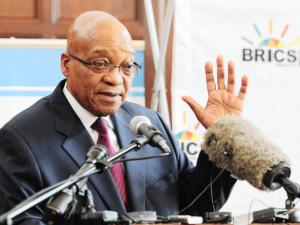
bricsTotal trade within the BRICS (Brazil, Russia, India, China, and South Africa) grouping amounted to $6.1 billion last year, President Jacob Zuma said on Tuesday.

“This represents 16.8 percent of global trade,” he told delegates at the BRICS business council meeting in Johannesburg.

“The presence and influence of the BRICS grouping continues to be felt.”

Zuma said the strength of BRICS was amplified by the fact that these countries accounted for 43 percent of the world’s population.

“Indeed, we are all gathered here because we see value in the BRICS partnership in many respects.”

In 2012, South Africa’s total trade with BRICS countries stood at R294bn, up from R264bn in 2011.

Total trade with Brazil grew from R18bn in 2011 to R20bn in 2012, and with Russia from R3bn in 2011 to R5bn in 2012.

Zuma said total trade with India, South Africa’s sixth largest trading partner, grew substantially from R53bn to R67bn.

Trade with China grew from R188bn in 2011 to R201bn in 2012.

“All these impressive statistics… should provide you with the determination and confidence to deliver on the imperatives…” he told delegates.

Trade and Industry Minister Rob Davies said the council meeting was intended to deepen the partnerships to enhance co-operation and development on the African continent.

BRICS council South African chairman Patrice Motsepe said it was crucial that the commitment to increase trade and investment was seen, and “quantifiable”.

“There’s a new sense of urgency,” Motsepe said.

He emphasised “value-added trade” and common objectives being sought.

“BRICS is not about excluding other countries,” said Motsepe.

“We want to see investments quantify… It is important to build on the BRICS partnership.” – Sapa

Brazil: Clashes in Rio slum over death of youth

Police officers investigating the death of a teenager clashed with residents of a Rio de Janeiro slum, police said Wednesday amid a series of protests on issues ranging from alleged police brutality to low wages. Rio police said in a statement that three buses were torched and a police car damaged in Tuesday's clash in the sprawling Penha slum. Police were called in to investigate the death of a 17-year-old boy, whose body was found in the neighborhood. "As the military police approached, a group of locals began a violent protest," the statement said. The teen, whose name was not released, went missing Monday. His body showed no bullet wounds, and the cause of death was not immediately clear, police said. But news reports suggested the protesters suspected the youth died in a confrontation with police. Police killings are not unusual in Rio, where officers are sometimes linked to armed militias. A demonstration was called for Wednesday in another Rio slum, Rocinha, to call for light to be shed on the disappearance of a local bricklayer who was last seen in police custody. The protest came on the one-month anniversary of the disappearance of Amarildo de Souza, a 42-year-old father of six who was hauled into a Rocinha police station for questioning July 14. Police have said he was released shortly after, but video surveillance shows no trace of Souza after he entered the police station. His family and supporters say they suspect he was killed by police and his body dumped in a clandestine graveyard. Souza's disappearance has become a hot-button issue in Rio, particularly among slum dwellers and critics of Rio de Janeiro state Gov. Sergio Cabral. Cabral has been the target of protests since June, when a wave of mass demonstrations against government corruption and calling for improved public services swept the country. Protesters allege Cabral is corrupt and have been calling for an investigation into spending on projects linked to next year's World Cup and the 2016 Olympics, which Brazil is hosting. A separate demonstration was scheduled outside the Guanabara Palace later Wednesday. Several thousand mostly university professors also marched through central Rio on Wednesday demanding higher pay and better working conditions, and people calling for improved legislation for the disabled staged a protest in the capital, Brasilia.
Brazilian actors perform in Rio on Tuesday in front of the legislative parliament, where a public hearing on cases of disappearing people was taking place.

Police officers investigating the death of a teenager clashed with residents of a Rio de Janeiro slum, police said Wednesday amid a series of protests on issues ranging from alleged police brutality to low wages.

Rio police said in a statement that three buses were torched and a police car damaged in Tuesday’s clash in the sprawling Penha slum.

Police were called in to investigate the death of a 17-year-old boy, whose body was found in the neighborhood. “As the military police approached, a group of locals began a violent protest,” the statement said.

The teen, whose name was not released, went missing Monday. His body showed no bullet wounds, and the cause of death was not immediately clear, police said. But news reports suggested the protesters suspected the youth died in a confrontation with police.

Police killings are not unusual in Rio, where officers are sometimes linked to armed militias.

A demonstration was called for Wednesday in another Rio slum, Rocinha, to call for light to be shed on the disappearance of a local bricklayer who was last seen in police custody.

The protest came on the one-month anniversary of the disappearance of Amarildo de Souza, a 42-year-old father of six who was hauled into a Rocinha police station for questioning July 14. Police have said he was released shortly after, but video surveillance shows no trace of Souza after he entered the police station.

His family and supporters say they suspect he was killed by police and his body dumped in a clandestine graveyard.

Souza’s disappearance has become a hot-button issue in Rio, particularly among slum dwellers and critics of Rio de Janeiro state Gov. Sergio Cabral.

Cabral has been the target of protests since June, when a wave of mass demonstrations against government corruption and calling for improved public services swept the country. Protesters allege Cabral is corrupt and have been calling for an investigation into spending on projects linked to next year’s World Cup and the 2016 Olympics, which Brazil is hosting.

A separate demonstration was scheduled outside the Guanabara Palace later Wednesday.

Several thousand mostly university professors also marched through central Rio on Wednesday demanding higher pay and better working conditions, and people calling for improved legislation for the disabled staged a protest in the capital, Brasilia. – AP