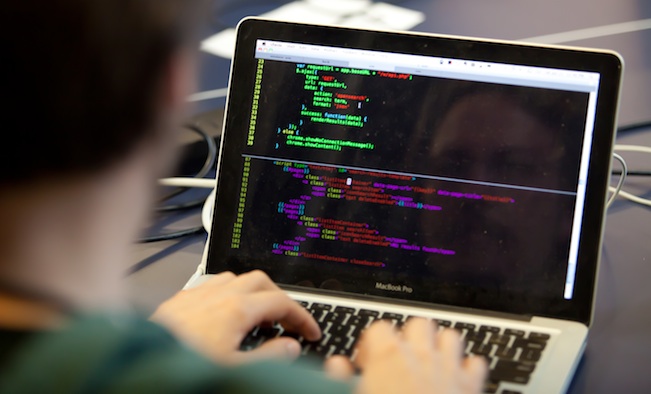
Russians hack US Joint Chiefs of Staff

Investigators say they believe the same Russian hackers that carried out attacks on the White House and State Department last year and the attempted penetration of the Pentagon last month were responsible for a major cyberattack that shut down the Joint Chiefs of Staff email for the past 11 days, The Daily Beast has learned.

In all of the attacks, hackers broke into unclassified email networks by sending legitimate-looking emails than turned out to be malware or “spear phishing” attempts. In April, President Obama’s unclassified emails were among those compromised, along with the State Department.

Ten days before the July 27 hacking of the Joint Staff system, the Pentagon sent an email warning “at least five” DOD computer users had been targeted, which was first reported by The Daily Beast. The notice linked those attacks to penetrations of unclassified networks at the White House and State Department that began last year.

The Joint Chiefs then suffered what one defense official called the “most sophisticated” attack on its unclassified network, one that has shut down communications ever since for the 4,000 employees on the Joint Staff unclassified server.

Source: Daily Beast

US ambassador to Vietnam promotes gay marriage

Since their December arrival in Vietnam, U.S. Ambassador Ted Osius and his mulatto husband have become the most prominent gay couple in the Southeast Asian country.

Osius and Clayton Bond landed with their toddler son shortly before the government abolished its ban on same-sex marriage. Now the couple, who recently adopted an infant girl, find themselves promoting the LGBT rights movement across the country.

“A lot of young people have reached out to me on Facebook, to say: ‘We are happy to see somebody who is gay and is happy in his personal life but also has had professional success’,” Osius said in an interview. “I don’t think of it as advocating as much as supporting Vietnamese civil society in doing what it is already doing.”

The Communist government’s revised marriage law, and while not officially recognizing same-sex marriage, potentially opened up opportunities to attract the tourist “pink dollar”.

Yet young gay Vietnamese say they can be ostracized in a patriarchal society in which heterosexual marriage and parenthood are seen as the path to happiness. The legal changes also sit oddly in a country that more broadly curbs political dissent, Phil Robertson, deputy Asia director at Human Rights Watch, said in an e-mail.

Osius, 53, and Bond frequently appear together at official government gatherings and media events. Osius — who is on his first posting as ambassador and has also worked in Indonesia and India — always introduces his husband and often talks about their children, who are 19 months and five months.

“This is a core interest of ours with regard to human rights,” said Bond, 39. “People see us as an openly gay couple with kids serving our country. I hope people find that inspiring.”

While a small number of celebrities have held same-sex weddings, Osius and Bond are the most prominent gay couple in Vietnam, said Tung Tran, director of ICS, a Ho Chi Minh City-based group that advocates for lesbian, gay, bisexual and transgender rights. They are also embraced by the larger population, reflecting the closer relationship being forged by Hanoi and Washington.

Osius and Bond plan to renew their vows before U.S. Supreme Court Associate Justice Ruth Bader Ginsburg during her visit to Hanoi later this month.

“They are the full package,” Tran said by phone. “They are married. They have a family. They are successful. They are our role models.”

Osius, a career diplomat, co-founded GLIFAA, a U.S. association for LGBT employees and families in foreign affairs agencies, in 1992. There are now six openly gay U.S. ambassadors, including Osius, Ambassador to Australia John Berry and Ambassador to Denmark Rufus Gifford, said Regina Jun, president of the group.

Osius’ posting to Vietnam comes amid improved relations between Vietnam and the U.S., former enemies that have shared economic goals and strategic concerns about an increasingly assertive China in the region. Vietnam’s civil society is relatively robust, Osius said, even as its human rights record in other areas remains a hindrance to even warmer ties.

In most parts of Southeast Asia including Thailand, the push for gay rights has stalled. Countries such as Brunei and Malaysia punish those who engage in gay behavior.

In Singapore, sex between men is illegal. The city-state banned a song and video by Taiwanese singer Jolin Tsai’s about same-sex relationships, the Straits Times reported May 26.

Source: Bloomberg

Africa’s population explosion over next 35 years

A United Nations report has projected the world’s population to reach 11.2 billion by the end of the century. Africa alone will account for half of the population growth over the next 35 years.

The world’s population is expected to grow from its current level of 7.3 billion to 11.2 billion people by end of the century, according to a UN report released Wednesday, with the earth expected to add more than a billion people in the next 15 years alone.

India is expected to surpass China as the world’s must populous country in less than a decade, with fast-growing Nigeria on course to overtake the United States as the third most populous nation by 2050, the UN predicted.

Most of the growth will happen in developing regions, especially Africa, which will account for more than half the world’s population growth in the next 35 years.

“The large number of young people (in Africa) who will reach adulthood in the coming years and have children of their own, ensures that the region will play a central role in shaping the size and distribution of the world’s population over the coming decades,” the report said.

The demographic predictions are essential for creating and implementing the new global development goals being put into place later this year in place the UN Millenium Development Goals.

“While the global projections should not be cause for alarm, we must recognize that the concentration of population growth in the poorest countries presents a distinct set of challenges,” said John Wilmoth, head of the UN population division.

Rapid population growth, Wilmoth said, will make it “more difficult to eradicate poverty and inequality, to combat hunger and malnutrition, and to expand educational enrollment and health systems.”

According to the UN, nine countries will account for half of the world’s population growth between now and 2050: India, Nigeria, Pakistan, Congo, Ethiopia, Tanzania, the US, Indonesia and Ghana.

The report also takes note of global ageing, projecting the number of people age 60 and above should more than double by 2050. In Europe, more than 34 percent of the population will be over 60 years old by 2050.

Source: Reuters/dpa/AP

China to give up one-child policy

All Chinese couples will be allowed to have a second child within six months, ​ say ​reports, amid concerns over shrinking labour force​ and ageing population.

A decades-old policy restricting many Chinese families to a single child will soon be relaxed.

The further relaxation of China’s family planning policy would allow all Chinese couples to have two children.

It could be implemented “as soon as the end of the year if everything goes well,” a government source told China Business Review on Wednesday.

China’s one child-policy, introduced in 1979 by leader Deng Xiaoping to limit the nation’s rapid population growth, has been responsible for millions of brutal forced abortions and mandatory sterilisations over the past three and a half decades.

Source: The Telegraph

SA steelmaker Evraz Highveld halts operations

South Africa’s second-largest steelmaker Evraz Highveld Steel and Vanadium confirmed on Monday that it had temporarily ceased steel production at its steelworks, citing working capital constraints and reduced domestic demand mainly owing to a “significant” increase in steel imports from China.

The group said in a statement that it was currently communicating with its employees, adding that it intended to resume production once adequate funding had been secured and steel trading conditions had improved to ensure the company’s sustained future financial viability.

The decision to halt production at the company’s ironmaking division was brought about by delayed debtors payments; inadequate cash to procure the required raw materials to continue with manufacturing operations; difficulties experienced with access to funding; and a continued inability to pay major creditors timeously, it outlined.

The company added that the feeding of raw materials into the ironmaking kilns had been halted to enable the furnaces to be safely drained and switched out, ready for a future start-up. “The steel plant will be stopped and made safe once all the hot metal has been processed. The two mills will continue operating until all the available stocks have been rolled into saleable products, whereafter these operations will also be safely stopped.

“All plant and equipment will, for the moment, be placed on care and maintenance and prepared for future start up,” it held.

South Africa’s largest steel producer ArcelorMittal South Africa (AMSA) had also recently spoken out about the difficult conditions facing local steel producers, with AMSA CEO Paul O’Flaherty last week confirming that the industry was seeking greater protection from steel imports through the implementation of a 10% ad valorem duty on such imports.

Source: engineeringnews.co.za

Apple future questioned

Apple Inc shares slumped nearly 7 percent in after-hours trading as its fourth-quarter revenue forecast fell short of estimates and it missed some targets for iPhone sales.

The shares dropped to $121 after the company released its results on Tuesday, from $130.75 at the close.

The forecast overshadowed Apple’s strong sales in China, which more than doubled to $13.23 billion from a year earlier.

Apple Chief Financial Officer Luca Maestri said in an interview the results in China were “spectacular” during the quarter and noted plans to open 40 stores there over the next 12 months.

Without disclosing specific figures, Maestri said sales of the Apple Watch beat the company’s expectations. He noted that in the nine weeks since its launch in late April, the device has sold better than either iPhones or iPads over a similar period after their launch.

Colin Gillis, an analyst for BGC Partners, said the results highlighted the vulnerability of Apple’s dependence on the iPhone and the Chinese market’s growing importance to the company.

“Where are you going to find growth in the world?” he said. “You’ve done an amazing job sucking all the smartphone profits into your balance sheet, but smartphone sales are slowing. What’s going to happen when the industry matures, just like PCs did?”

Source: Reuters

Hungary joins Silk Road

Hungary has become the first European country to sign a memorandum of understanding with China on promoting the Silk Road Economic Belt and Maritime Silk Road, China media report. The MoU was signed on Sunday, during Chinese Foreign Minister Wang Yi’s visit to Budapest, where he met with Prime Minister Viktor Orban. In a statement on the occasion, Wang said he hopes more European countries will join in.

Hungary may be the first country in Europe to officially sign an MoU relating to China’s “One Belt, One Road” strategy, but the subject has cropped up repeatedly during Chinese interactions with Europe. When Xi Jinping toured Europe in April 2014, with stops in The Netherlands, France, Germany, and Belgium, he urged the EU and China to work together to combine EU policies with China’s Belt and Road. When Li Keqiang attended the China-Central and Eastern European (CEE) Leaders’ Meeting in Serbia in December 2014, he also highlighted the role Europe has to play in the Belt and Road – and the role China can play in completing infrastructure and energy projects in Central and Eastern Europe under the aegis of that initiative.

More recently, during Xi’s visits to Russia and Belarus this May, both countries agreed to work with China on the Silk Road Economic Belt. Belarus agreed to the project hoping to win Chinese infrastructure investments, while Russia promised to link its new Eurasia Economic Union with China’s Belt and Road.

While the Belt and Road are often discussed primarily in the context of China’s near neighbors – particularly Southeast and Central Asia – Beijing has long been clear about the importance of Europe, particularly Central and Eastern Europe, to the project. A few months after Xi Jinping first unveiled the twin Belt and Road concepts in speeches in Kazakhstan (September 2013) and Indonesia (October 2013), Li extended the Belt and Road all the way to Europe during a November 2013 visit to Romania.

Likewise, the official action plan for the Belt and Road, issues by Chinese government agencies in March 2015, described the Silk Road as “a new Eurasian Land Bridge” that “focuses on bringing together China, Central Asia, Russia, and Europe.” That means the Belt and Road, by China’s own definition, will be incomplete without buy-in from European countries. And Central and Eastern European countries in particular have a special role to play. As Xinhua put it on Monday, “CEE nations will be essential links in the Belt and Road Initiative.”

European countries, like many of the Asian supporters of the Belt and Road, are primarily focused on the economics. “Chinese firms have invested more than 5 billion U.S. dollars in CEE countries in sectors such as energy, infrastructure and machinery,” Xinhua reports. In coming years, China will build a high-speed railway connecting Hungary and Serbia and construct two nuclear reactors at a Romanian nuclear power plant. According to U.S. law firm Baker and McKenzie, Chinese investment in Europe doubled from 2013 to 2014, reaching $18 billion.

In other words, the Silk Road in Europe was alive and well before Hungary signed the MoU – and it will only continue to grow as more government agreements officially tie existing investments and initiatives to China’s Belt and Road strategy.

Source: The Diplomat

China detains South Africans for ‘propaganda videos’

A total of 20 people sent to China by a religiously inspired charity have been detained, most of them British or South African, the organisation said, adding some had been accused of watching “propaganda videos”.

Gift of the Givers, a disaster relief charity based in Pietermaritzburg in South Africa, said 20 of its associates were detained Friday at Ordos airport in China’s Inner Mongolia region.

It said 10 were South Africans, nine British, and one an Indian national.

“No reasons were given for the arrest. The Chinese, now trying to find reasons for the detention suggested that some members were linked to a terror group,” it added.

As of Tuesday 11 had been released, it added on a Facebook page. “The other nine are being held without charge at a detention centre on the accusation that they were watching propaganda videos.”

The public security ministry in Beijing did not immediately respond to a request for comment by AFP.

Gift of the Givers describes itself on its website as being inspired by Muhammed Saffer Effendi al Jerrahi, a master of Sufism, a mystical form of Islam.

The group, which has provided medical equipment and training in multiple countries in Asia and Africa, says its staff are “facilitators of Almighty God’s Aid… distributing it from Him to all of mankind. This is made possible only by His Grace and Permission.”

“God Almighty Exists,” it adds. “This is a Gracious God to Whom belong the Most Beautiful Attributes.”

Chinese regulations passed in 2000 ban foreigners from all missionary activity including “distributing religious propaganda materials.”

The ruling Communist party, suspicious of overseas groups, has in recent months tightened controls on foreign charities working in the country.

State-run media have accused some foreign groups of attempting to foment revolution and overthrow the party.

Police too have cracked down on foreign missionaries in China, detaining a Canadian Christian couple near the North Korean border last year.

Beijing also blames what it calls Islamist terrorists for ongoing violence in the mainly Muslim far western region of Xinjiang.

The South Africans were originally detained “with no access to communication or legal representation” and included several doctors, Gift of the Givers said.

The group’s planned 47-day tour of China had gone “horribly wrong”, it added.

A spokeswoman for the British embassy in Beijing said Wednesday that 11 British citizens had been held in northern China, two of whom held South African dual nationality.

Officials were seeking “further clarifications” on the detentions, spokeswoman Natasha Simpson added.

South African foreign affairs ministry spokesman Nelson Kgwete told local television that the government had been informed “about the arrest of 10 South African citizens in China” and the embassy was providing consular assistance.

Source: AFP

Moscow hopes US will abandon AMD plans for Europe

Moscow hopes the US will fulfill its promise not to develop a system of missile defense in Europe after a deal with Iran has been reached, Russian Foreign Minister Sergey Lavrov said in Vienna on Tuesday.

“We all probably remember that in April 2009 in Prague [US] President [Barack] Obama said that if the Iran nuclear program issue is sorted out, then the task of creating the European segment of the missile defense system will disappear,” Lavrov said at press conference in Vienna.

He said that Tehran and the P5+1 powers (the United States, the UK, France, Germany, Russia and China) have agreed on “joint all-inclusive plan of actions, which consists of the main document and five very detailed technical appendices.”

A draft of UN Security Council resolution has also been agreed upon which all participants of the talks will present as co-authors in New York in the next few days, Lavrov said, adding that the resolution will be considered by the UN SC and voted on. “We believe, it will be unanimously approved,” he added.

China believes hostile short-sellers caused panic

A recent sell-off in China’s stock markets is the first major challenge facing the country since the introduction of margin trading, and is believed to have been caused by hostile short-sellers.

In a report on the Chinese news site ifeng.com, an analyst said the sell-off was similar to what took place in Hong Kong in 1997, when the territory’s benchmark Hang Seng Index plunged 60% after peaking at 16,673 points.

The steep drop in share prices in Hong Kong in 1997 was caused by financier George Soros, who shorted both the Hong Kong dollar and the Hang Seng Index futures, the analyst said, adding that similar practices were observed in the last two trading sessions in China.

According to the analyst, massive funds entered the futures market, building a short position and leading to declines in the stock markets. The size of the funds and the sophisticated trading methods are beyond the ability of Chinese institutional investors, the analyst said.

In fact, Bill Gross of Janus Capital, a co-founder of global investment firm PIMCO, said in early June that the Shenzhen Stock Exchange’s Component Index presented perfect short-selling opportunities.

At the time, the index was at a seven-year high but plummeted 30% on Gross’s comments. Morgan Stanley and Credit Suisse have also been bearish on Chinese shares recently.

Several measures introduced or announced by the Chinese government, such as lower interest rates, required reserve ratio cuts, and a plan to allow the investment of pension funds in equities, have failed to prop up the Chinese stock markets.

The Chinese government is expected to introduce new policies to rescue the market, since further a decline will hurt companies’ ability to borrow money and will put pressure on the economy.

The China Securities Regulatory Commission reportedly was soliciting proposals from institutions to rescue the market.

There have also been reports of brokerages promising not to force liquidation of shares held by investors facing margin calls.

Source: China Times

German missiles taken over by hackers

German-owned Patriot missiles stationed in Turkey were briefly taken over by hackers, according to media reports on Tuesday.

The attack took place on anti-aircraft ‘Patriot’ missiles on the Syrian border. The American-made weapons had been stationed there by the Bundeswehr (German army) to protect Nato ally Turkey.

According to the civil service magazine, the missile system carried out “unexplained” orders. It was not immediately clear when these orders were carried out and what they were.

The magazine speculates about two weak spots in the missile system which could be exploited by hackers.

One such weakness is the Sensor-Shooter-Interoperability (SSI) which exchanges real time information between the missile launcher and its control system.

The second exposed point is a computer chip which controls the guidance of the weapon.

Attackers might have gained access in two different ways, one that takes over the operating of the missile system and one that steals data from it.

The patriot missile has been in service in the US army since 1984 and was first used in operation in the first Gulf war in 1991.

In 2012 Turkey asked that its Nato partners support it by stationing Patriot missile systems there, after the civil war in Syria drew closer to its southern border.

In June 2015 Germany announced that it would replace its Patriot missiles with MEADS, an air defence system designed in cooperation with the USA and Italy.

Source: thelocal.de

Africa believes it will gain from BRICS bank

Africa’s ambitious infrastructure built programme is expected to get a boost from the BRICS New Development Bank.

The new bank was launched in Moscow ahead of the 7th BRICS Summit which starts in the city of Ufa on Wednesday evening. It is estimated that the continent’s infrastructure built has a R100 million a year gap in funding.

President Jacob Zuma, who is also the champion of the project, says the BRICS bank is meant to lift developing countries out of poverty and not to rival or compete with existing Western financial institutions such as the International Monetary Fund (IMF) and the World Bank.

The new BRICS Development Bank has an initial budget of R600 billion and it is expected to help finance infrastructure projects in all BRICS member states and other poor countries of the world.

There also seems to be growing interest in BRICS from – countries including Nigeria, Turkey, Mexico and Indonesia to join.

President Zuma says the bank is just an alternative to established financial institutions.

Pretoria is upbeat that South Africa and the rest of the continent have a lot to benefit from the new financial institution.

It is reported that Greece potentially joining the block will be discussed.

South Africa’s Lesley Maasdorp, is the vice president of the new bank while former Reserve Bank Governor, Tito Mboweni, is part of the board of governors.

Russian President Vladimir Putin who has been in a cold war with the western leaders over Ukraine is expected to set the tone when he addresses leaders’ gala dinner.

On Thursday, leaders are expected to sign several agreements on economic integration between Brics member states.

Rise of hypersonic missiles render fleets obsolete

With the rise of hypersonic missiles, fleets have become largely obsolete, reduced as they are to huge sitting ducks. There is simply no defense for a large ship against an incoming MACH5 missile. Carriers can destroy small countries like Libya or Iraq, but not Russia and China.

Hypersonic weapons can achieve speeds over five times faster than the speed of sound (Mach 5) and they are the latest version of precision guided munitions (PGM) that make up part of the larger family of long-range strike weapons systems.

“Hypersonic weapons add to the complexity and elusiveness of the escalatory dynamics and this is something both sides will need to plan for”, says Eleni G. Ekmektsioglou from the American University’s School of International Service.

In the United States, hypersonic weapons are pursued in the context of the conventional prompt global strike (CPGS) commonly defined by officials as a technology of “high-precision conventional weapons capable of striking a target anywhere in the world within one hour’s time.”

Outside the United States, states such as China or Russia have been pursuing this promising technology in secrecy.

Chinese fears skyrocketed after President Barack Obama’s Prague speech and the 2010 Nuclear Posture Review (NPR). The Chinese understood America’s decreasing reliance on nuclear weapons as being tantamount to a greater reliance on conventional weapons—especially CPGS—where the United States enjoys an undeniable superiority.

Thus, the Chinese regard President Obama’s vision for a nuclear-free world as a trap that aims at containing China’s rise to power, Ekmektsioglou believes.

Russia has built a revolutionary new weapon system that can render enemy satellites and weapons useless.

Its Russian makers say it is a ‘fundamentally new electronic warfare system’ which can be mounted on ground-based as well as air- and sea-borne carriers.

‘The system will target the enemy’s deck-based, tactical, long-range and strategic aircraft, electronic means and suppress foreign military satellites’ radio-electronic equipment,’ Russia’s Radio-Electronic Technologies Group (KRET) Deputy CEO Yuri Mayevsky told Russian news agency TASS.

To comply with international weapons laws, the system will be mounted on ground-based, air-and seaborne carriers and not on satellites.

‘It will fully suppress communications, navigation and target location and the use of high-precision weapons,’ said adviser to the KRET first deputy CEO Vladimir Mikheyev.

The system will be used against cruise missiles and will suppress satellite-based radio location systems.

ANC to appeal Bashir ruling

The government is to appeal the North Gauteng High Court’s judgment relating to Sudanese President Omar Al-Bashir.

A statement released by the government’s communications department on Monday said the reasons for the appeal would be stated in the affidavit.

Bashir left the country while the ruling was being made by the court on whether or not he should be detained under an International Criminal Court indictment for war crimes in Darfur.

In leaving the country, Bashir violated of an interim court interdict ordering him to stay.

The government’s affidavit stated that the reason Bashir left the country was that his passport had not been handed in at immigration control at the Waterkloof Air Force Base.

The court has asked the National Prosecuting Authority to investigate the possibility of pursuing criminal charges against the government for its role in allowing him to leave.

Source: eNCA