Economic exclusion of blacks must first be addressed in the classroom and thereafter in the boardroom.
This is the view of the DA, which yesterday released a discussion document on black economic empowerment and equality in education.
Central to the party’s green paper on economic inclusion is the country’s poor state of education. The proposals seem to have been lifted from the US policy called “No Child Left Behind”, which has been termed a failure in America.
“At the heart of the DA’s position on redress lies the recognition that exclusion from economic opportunities must primarily be addressed by broadening access to quality education, improving educational outcomes and the alignment of education and skills development initiatives with the needs of the economy,” the party says.
Its document is also likely to draw the ire of teacher unions, especially the SA Democratic Teachers Union, as it suggests that teachers are poorly qualified and that school management leaves much to be desired.
Basic Education Minister Angie Motshekga also came in for some heavy criticism.
Although not mentioned by name, the documentcalls on her to finalise “clear norms and standards” to create an environment “that is conducive to learning”. – timeslive.co.za/praag
Minister Lindiwe Sisulu yesterday called on the Public Service Commission to increase the number of unannounced inspections of public schools and other education facilities.
The Public Service minister said she was worried about the statistics from the Human Sciences Research Council on the rate of absenteeism of teachers.
Sisulu was speaking in Cape Town at a conference to celebrate the Public Service Commission’s 100th anniversary.
But the SA Democratic Teachers’ Union said it would oppose the unannounced visits , saying there were “deep-seated reasons” for teachers’ absenteeism.
Last month, Basic Education Minister Angie Motshekga revealed that, in just the first three months of this year, 21000 teachers applied for incapacity leave and retirement on health grounds.
A 2010 HSRC study found that, on any given school day, between 10% and 12% of public school teachers were not in class.
Sadtu general secretary Mugwena Maluleke said teachers were “overloaded” and were not getting any assistance from the Basic Education Department.
“They are not being assisted in terms of the curriculum, and annual national assessments are straitjacketing our teachers.
“We will oppose these inspections. We should [address] the causes of absenteeism and not the symptoms,” said Maluleke.
Sisulu said the frequency of unannounced inspections should also be increased at government health facilities.
“The waiting time at our hospitals is completely unacceptable . [as] is the attitude of nurses.”
She said that the five Limpopo government departments placed under national administration by President Jacob Zuma in December 2011 following the exposure of financial irregularities were on the road to recovery.
The province’s treasury, and its departments of education, health, public works and transport, were placed under administration.
“We’re glad to say that we have completed 47 charge sheets, fast-tracked disciplinary processes [and] removed all ghost workers from the [government payroll] system, and we are hoping that, by the time the premier makes an announcement, we will be ready to [withdraw] most of our forces from Limpopo. We believe that Limpopo is now on the road to recovery.” – timeslive.co.za
Problems inherited from the apartheid era can be solved through research, Deputy President Kgalema Motlanthe said – without irony – on Saturday, as South Africa struggles with ever worsening maths en science results since 1994.
South Africa has hit rock bottom in an international measure of the quality of maths and science education recently.
Concern is mounting whether the education system is producing a sufficient number of graduates in the hard sciences to support South Africa’s growth and development.
The World Economic Forum’s annual report on financial development, released in 2012, placed South Africa last in a ranking of 62 countries in the quality of maths and science education.
The 2011 census results, released on Tuesday, showed that a decade ago mostly white 2.7% of men and 2% of women who had tertiary qualifications in South Africa had qualifications in the fields of natural, physical and mathematical sciences. By 2011, this had declined to 2% of men and 1.8% of women, due to racial discrimination against whites.
“Inevitably, most if not all the historically inherited challenges constituting a dead weight on our development ambitions can only be addressed through the research agenda of our national research institutes,” Motlanthe told a summit on science and technology in Polokwane, Limpopo.
Motlanthe said national research institutes had the task to remain relevant to the developmental agenda through the use of science, technology and innovation.
“In other words harnessing the force of science and technology to meet our developmental needs is among the surest ways out of the current quagmire of under-development,” he said.
Motlanthe said through the National Development Plan, government laid out the parameters within which each social partner could make a contribution towards the achievement of the country’s shared vision.
“This shared vision entails the reduction of poverty, stimulating economic growth, effecting economic transformation and creating employment.” He said South Africa needed to do more in mobilising resources for the task of producing quality education for both teachers and learners alike.
“Only a sound and quality education system with strong emphasis on mathematics and science can serve as a reliable feeder for tertiary institutions…,” he said.
Motlanthe said research projects were carried out disparately without knowledge sharing and co-ordination to avoid duplication.
“Our national research efforts lack a central framework or institute to define and identify the most immediate projects, resulting in duplication, wastage and inefficient use of funding.” The lack of collaboration robbed the country of the benefits which would accrue from research.
Research institutes could commission a study of the systemic failure in the governance system and how best could government address its problems, he said.
Motlanthe said under-utilisation of existing research institutes by government often led to wasteful expenditure in that each government department commissioned research in common areas.
“I submit that the benefits of science, technology and innovation are not only potentially immense for us but also, and more crucially, constitute the pre-conditions for South Africa’s development.” – SAPA/praag
US President Barack Obama was met Saturday with songs, cheers and laughter from young South Africans at a university in the Soweto area of Johannesburg.
Before he entered the room, the crowd sang songs from the struggle against apartheid and burst into a lively round of Shosholoza, an old miners song from southern Africa with a call and response format that became more lively with each chorus.
As he appeared, Obama shouted out, “Yebo Mzanzi!” or “Yes, South Africa!” to jubilation from the crowd.
The president used the town-hall-style meeting, which was hooked up via video link to several other African nations, to encourage young people to innovate and act on their imaginations.
While Nelson Mandela, the ailing anti-apartheid leader who Obama said was a personal hero and “one of the greatest people in history,” was still in hospital in critical condition, his spirit was felt in the room.
“Building the future you see, realizing the vision you have not only for your own country but for the world – it will not be easy,” Obama told the hundreds of young people in attendance at the University of Johannesburg’s Soweto campus.
“But as you go forward, think of the man who is in our prayers today. Think of 27 years in prison. Think of the hardship and struggles and being away from family and friends,” Obama said, referring to Mandela’s time in jail for opposing white minority rule.
Obama was quick to stress the importance of education, as Mandela had always done, saying it was the “best investment” any country could make in its youth.
Or, indeed, for its politicians. “I don’t want to reinforce for the American press here that Africa is just one big piece of land on the map,” Obama, a Democrat, said in an apparent reference to widely reported claims that former US Republican vice presidential candidate Sarah Palin believed Africa was a country, not a continent.
He was met by loud cheers from the crowd and laughter from his travelling press corps.
The questions he received were often tough, focussing on trade, the environment, women’s rights and even a promise he made to travel to Kenya, his father’s home, during his presidency.
“I’m going to be president for another three and a half years,” he said when asked via a video link from Nairobi why he had not visited the country. “You learn as president that people not only want you to fulfil your promises but want you to fulfil your promises yesterday.”
But Obama admitted that the International Criminal Court warrant out for that country’s new president and vice president had influenced his decision.
“I did not think it was an optimal time for me to visit,” he said but pledged he would still make a trip to Kenya before his time in office ends, which would be 2017.
For many in the crowd, however, the key concerns they had were jobs and economic opportunities. They wanted clear words from the president that he envisioned an economic partnership between the United States and Africa.
“Everywhere I go in Africa, people want to break out of the dependency trap,” Obama said.
“What we need is an Africa that is building, manufacturing, creating value, inventing and then sending those products around the world and receiving products in return under fair terms of trade,” the president said. “If we do that, there is no reason Africa cannot succeed.”
Obama insisted the US was not interested in global domination, a concern often felt strongest in countries once subjected to colonial rule, which milked resources while oppressing their people.
“I was elected to end the wars,” he said, adding that he regularly visits young US soldiers who have been gravely injured in Iraq and Afghanistan.
“This idea that we want to get more involved militarily around the world is not true,” he said.
Obama said the US would rather be “selling iPads and planes” rather than using its military abroad, drawing applause from the crowd, many of whom snapped photos of the president and his large entourage on their smartphones and tablets. – dpa
The court case between the Gauteng education department and Rivonia Primary School over admission policies is crucial for access to education, Section27 said on Wednesday.
“The Constitutional Court’s decision in the case is a crucial one for the future of access to equal education in South Africa,” spokeswoman Nikki Stein said.
The Constitutional Court is scheduled to hear the case on Thursday. It involves the admission policy of a former model C school, Rivonia Primary, in Johannesburg.
According to Section27, the school refused to admit a Grade One pupil in 2011, saying it had no capacity.
The department intervened and instructed the school governing body (SGB) to override its policy and admit the pupil.
The dispute between the department and the school is around which of them has the final say in determining a school’s capacity.
The case would determine who had the final say about how many children were admitted to a school, in what language they would be taught, and who would be excluded from a school on the basis of an SGB’s admission and language policies, said Stein.
Also awaiting the outcome of the case were residents of Fochville, on the West Rand.
Stein said Section27 was representing 54 parents against the SGB of Hoerskool Fochville, a public school that adopted an Afrikaans language policy which excluded English-speaking pupils.
“Hundreds of learners from Fochville and nearby Kokosi township travel 25km to attend English medium schools,” she said.
Fochville SGB’s refusal to become a dual medium school is said to discriminate against pupils on the grounds of their race.
The Fochville case would be heard in the High Court in Johannesburg.
Section27 and Fochville residents are expected to picket outside the Constitutional Court on Thursday. – Sapa
South Africa’s maths and science education has been ranked second last in the world, ahead of Yemen, according to a World Economic Forum report.
The quality of the country’s general education system ranked 140 out of 144 countries, while internet access in schools is ranked at 111 out of 143 countries, stated the World Economic Forum’s Global Information Technology Report 2013.
“Going up two positions, South Africa is in 70th place. Despite a sharp improvement in the development of its ICT infrastructure (59th) – notably in terms of international Internet bandwidth capacity (66th) – and a strong uptake by the business community (33rd), the ICT impacts (92nd), particularly the social ones (112th), remain limited.
“The perception of a lack of clear government vision (105th) to orchestrate and implement a holistic ICT strategy for the country, coupled with deficiencies in the educational system for some segments of the population (102nd), play negatively in this process and outweigh a rather positive political and regulatory framework for ICT development (21st) and pro-business environment (55th),” the report read.
It is the latest indictment on South Africa’s education system since the 2011 Progress in International Reading Literature Study (Pirls) which indicated that most South African grade five learners have not yet acquired basic literacy skills.
“Forty-three percent of South African grade five learners failed to reach the lowest international benchmark, in contrast to 5% of grade four learners internationally. This means that they have not yet mastered the basic reading skills required to access and retrieve information for reading comprehension purposes,” the Pirls report stated.
It further revealed that about 90% of the grade four learners tested attained the lowest international benchmark.
Learners tested in Sepedi and Tshivenda achieved the lowest results, according to the study. – M&G
Groenkloof teacher training college, one of many built by the Afrikaner government, but abolished by the ANC and their British Commonwealth education advisers, plunging South Africa into a teacher supply crisis
Plans to re-introduce teacher training colleges were underway with one former college scheduled to re-open next week, Minister of Higher Education Blade Nzimande said on Thursday.
Speaking at a New Age business briefing in Johannesburg, he said the first school to open would be the Ndebele College Campus in Siyabuswa, Mpumalanga.
Training at the college would be facilitated by the University of Johannesburg.
Three more colleges would be opened next year in KwaZulu-Natal, Limpopo and the Eastern Cape.
Between 1994 and 2000 the government shut down teacher training colleges and merged them with other institutions. The move was aimed at “overcoming the educational inequalities of apartheid and reducing an identified oversupply of primary [school] teachers”.
In 2012, Nzimande said the higher education department had noted an increase in the number of people enrolling for full-time education programmes. Almost 38,000 enrolled for teaching courses in 2009 and over 41,000 in 2010.
Nzimande said the new colleges needed to focus on the development of teachers for the foundation phase.
With scores of new tertiary entrants students failing to pass most of their first year subjects, Nzimande dismissed claims that the lowering of the matric pass mark had played a role.
He said those who qualified for university degrees had usually obtained very high marks.
Nzimande said the fact that South Africa had 12 years of lower education probably played a role in pupils’ lack of readiness for tertiary level.
“We are one of the few countries with 12 years of schooling and about three years needed for a degree… Other countries have 13 years of schooling and four-year degrees.”
More mentoring and tutoring programmes were needed to help first-year students deal with the pressure of tertiary education. He said some institutions offered a foundation year for students not quite ready to begin tertiary courses. – Sapa
Eleven-year-old Sam (not his real name) went to school on Wednesday, as on any other day. But he returned home scarred for life.
The Grade 6 pupil at Refilwe Primary School, in Winterveldt, north of Pretoria, was allegedly raped by a Grade 7 pupil.
The school allegedly tried to cover up the assault.
According to the school governing body, 12 complaints, including the groping of female pupils, have been made against the teenager who allegedly assaulted Sam – but the governing body learned of this only on Wednesday.
Sam’s mother said her son was traumatised. “He screams at night and does not want to be touched. Now he sleeps in my bed and he jumps every time I try to cuddle him.”
The mother of three is furious that the principal wanted the matter to be settled internally, saying she would not have known about the incident if a concerned teacher had not alerted her. She had arrived at the school to find police officers talking to the principal and the father of the alleged assailant.
“My son has been violated and when I demanded answers the principal just grinned and walked away,” she said.
The woman said she had had to walk, with her 11-year-old son strapped to her back, to the local clinic 10km away, only to be referred to another clinic.
“At Block BB clinic I was told to open a case first before he could be examined but it was already late and I went home.”
School governing body deputy chairman Ace Choko said four boys aged between 15 and 17 had been suspended pending disciplinary proceedings.
“We are shocked by the incident but we are more concerned with the fact that one of the boys had a string of complaints against him but we were not told. He should not be at the school,” he said.
Gauteng education department spokesman Charles Phahlane said the police had visited the school but Loate police spokesman Captain Llifi Ramatlo said the police could not investigate because a case had not been opened.
Earlier charges against two boys who allegedly drugged and raped a Johannesburg schoolgirl have been dropped due to a lack of evidence, the National Prosecuting Authority said on Tuesday.
“As much as we appreciate the sensitivity of the matter there is just not enough evidence hence the decision not to proceed with the matter at this stage,” spokesperson Mthunzi
Mhaga told Sapa.
“Due to the sensitivity and age of the complainant we cannot discuss the details in respect of the nature of evidence which is in police possession.”
Three boys allegedly gave “date rape” drugs to two girls on Thursday and then gang-raped one of them, aged 15, while filming it on their cell phones.
The alleged attack occurred on the premises of Jules High School in Jeppestown, during school hours. The girl only identified two of the boys and they were arrested on Monday.
Both boys are grade nine pupils. One of them is a pupil at the school where the alleged attack occurred and the other is a pupil at New Nation School near Auckland Park.
The NPA has requested that the police continue to conduct a thorough investigation and obtain more statements.
Once the investigation had been completed the NPA would decide whether to reconsider its decision or not, Mhaga said. – M&G/timeslive.com
Inequalities in South Africa are threatening economic growth, with children born into poor families unlikely ever to escape poverty or reap the rewards of living in Africa’s largest economy.
The World Bank’s sobering assessment released last week found that a child’s gender and ethnicity at birth, combined with a lack of education, largely determine that person’s chances of success in life – even 18 years after the end of apartheid.
“South Africa, the continent’s largest economy by far and its only G-20 member, displays strikingly high and persistent inequality and marginalization for an upper middle-income country,” said the report.
Although South Africa has made great strides in transforming the economy, which has produced one of the continent’s fastest-growing black middle classes, poverty levels and unemployment remain high outside urban centres.
South Africa is often compared to Brazil, which also has a huge income gap, but while the Latin American country has narrowed the divide over the last decade, here the chasm is as deep as ever, the World Bank said.
The richest 10 per cent of South Africans account for 58 per cent of the nation’s income, while the bottom 10 per cent accounts for 0.5 per cent, the Bank said. The bottom half earns less than eight percent of the nation’s income.
The country will struggle to grow the economy until its riches are spread more evenly, the Bank said.
Sharp economic and social inequalities were especially visible along racial lines, said the report, with whites largely shielded from economic hardships thanks to privileges inherited from the fallen apartheid regime.
“Peering past the first-world living conditions of urban South Africa, it is not too hard to see the downcast situation of townships, informal settlements, and former homelands,” said Sandeep Mahajan, who headed the report.
“Our results show that a South African child not only has to work harder to overcome the disadvantages at birth due to circumstances, but having done so, finds that these reemerge when seeking employment as an adult,” he said.
The report said residents of these areas were usually unemployed or lacked the means to look for jobs, as they were disconnected from the job market.
Unemployment in the first quarter of 2012 rose to 25.2 per cent, up from 23.9 per cent in the previous quarter, and black people form the bulk of the jobless.
Modest economic growth, which averaged 3.2 per cent since 1995, had proved “insufficient to absorb the wave of new entrants to the labour market from dismantling apartheid’s barriers”, the report said.
Labour analyst Andrew Levy said challenges of inequality were “deep rooted and not unique to South Africa”.
“History has shown that societies that have emerged from any kind of unjust system of governance struggle with inequality,” said Levy. But he added that the new government “could have done better”.
Much of the blame is laid on the education system.
The World Bank found that black children from rural areas with parents who did not finish school were most likely not to finish school or have access to health care.
Children in some parts of the country are forced to learn in open spaces or under trees, even though education is the government’s single biggest expenditure.
This year education campaigners took the government to court after schools across the poor northern province of Limpopo were left without textbooks, months into the academic year. More than one month after a court order, government has not delivered books to all the schools.
“The only way to reverse the trend of inequality is to invest in education,” said economist Azar Jammine. – AFP
The steady decline over the past five years in the number of matric pupils studying science has education experts worried.
The number of pupils studying science fell from 229934 in 2008 to 182083 this year.
Though there has been a slight increase in the number of matrics doing maths – from 229371 last year to 230194 this year, this is well below the 2008 figure of 317270.
Enrolment in maths literacy courses has increased from 283000 in 2008 to 297074.
Minister of Basic Education Angie Motshekga said in Pretoria yesterday that it would seem that many pupils have switched from maths to maths literacy to increase their chances of passing the final exams.
“It is an area of great concern to us.
“Despite the fact that we want to encourage pupils to enrol for mathematics, we have more pupils going for maths literacy,” she said, adding that maths had a higher failure rate than other subjects.
Motshekga said she had asked that a maths and science summit be convened to find ways in which pupils’ interest in these subjects could be increased.
Education analyst Professor Graeme Bloch said it was disturbing that, even with high-profile science projects such as the Square Kilometre Array radio telescope in the Karoo making national headlines, children did not want to be scientists.
“We have a problem and we need a complete rethink,” he said.
“It might be teaching issues, but they would not be easy to solve.
“We need to start asking deep questions and we need community engagement on this matter,” Bloch said.
This year has been particularly challenging for education. Schools have been closed for months in Northern Cape because of service delivery protests, and the Limpopo textbook fiasco has crippled education in that province.
“It has been a very dramatic year … but we are confident,” said Motshekga.
“With the support and mitigating efforts we put in place, we should be able to get children through matric safely without having to sacrifice my head,” she said.
She said all the provinces were ready for the exams and that many schools have installed CCTV camera systems, hi-tech access control and alarm systems to avoid security breaches.
Many past matric results have been compromised by the leaking of examination papers.
A total of 527335 full-time and 120352 part-time pupils will sit for the National Senior Certificate final examinations, which begin on Monday. – timeslive.co.za
AUSTIN, Texas — Walking across the South Mall, or scanning the football stadium’s 100,000 seats on game day, University of Texas admissions Director Kedra Ishop sees how much has changed since the 1990s, when she was a black student at what was an inordinately white school.
This giant flagship campus — once so slow to integrate — is now awash in color, among the most diverse in the country. The student body, like Texas, is majority-minority.
At the dining hall, minority students no longer cluster together. Actually, it’s more a high-end food court now, and many tables are racial mosaics — white, black, Latino, Asian.
So is this the “critical mass” of minority students that the U.S. Supreme Court narrowly endorsed in 2003 as an educational goal important enough to allow colleges to factor the race of applicants into admissions decisions?
That question will be front and center Wednesday when a more conservative Supreme Court revisits affirmative action for the first time since that landmark case nine years ago involving the University of Michigan.
Abigail Fisher, who was denied admission to the University of Texas because of race preference
This time, it’s Texas defending the use of race in admissions, fighting a discrimination lawsuit from Abigail Fisher, a rejected white applicant. As it happens, the court’s decision will affect relatively few students at Texas, which admits most students through a system that doesn’t factor in race.
But a broad ruling rolling back affirmative action could be an earthquake at other campuses across the country that make more use of race, potentially changing the educational trajectories of millions of students.
For all the wrenching debates about opportunity and fairness the affirmative action debate evokes, the outcome will likely come down to how the current justices fill out the answer to questions they began to answer in 2003: What is critical mass, and how far can a university go to achieve it?
Generally, it’s the point where there’s enough diversity on campus to provide a rich educational environment. But beyond that, it’s a concept critics call maddeningly vague and supporters necessarily so. Is it enough for the student body to be diverse overall, or must all groups be well represented? What if there’s diversity in the student body, but not in most individual classrooms?
Texas will swallow its pride and argue that for all its progress, it’s still short of critical mass. Under state law, most UT students are admitted automatically based on their high school GPA, with race playing no role. But for the smaller remainder of its class where it enjoys more leeway, Texas argues it should be able to use race as a factor.
The reason: Some groups, especially blacks, remain underrepresented compared to Texas’ population. And minority students clump together academically, leaving most classes with no more than a single black or Latino voice.
But the university won’t give a target number, something the court would likely call an unconstitutional quota.
“There’s never been a discussion of ‘this is the target, this is what it looks like, this is where we’re trying to go,'” Ishop said. “We know what it doesn’t look like. And we know without the ability to examine students in their completeness that we can get back there very quickly.”
Such arguments sound mushy to UT’s opponents, who call the school’s goals for critical mass a quota in disguise. They say the university has gone too far using race in admissions, abusing the discretion the court granted colleges to define critical mass for themselves.
“It is a squishy concept that’s being manipulated,” said Terence Pell, president of the Center for Individual Rights, which argued against affirmative action in the Michigan case and has filed a brief against Texas in the current one. “It’s just sort of diversity for its own sake,” he added, “with no end and no limit.”
History’s role
History isn’t central to the legal issues in the affirmative action debate, but it’s an issue at UT-Austin. The football team didn’t integrate until 1970, and even as minority enrollment expanded, UT little resembled increasingly diverse Texas, leaving minority students feeling isolated.
“It was very seldom three or more were gathered,” said Machree Gibson, who arrived on campus in 1978, earned two degrees and later became the first black female president of the Texas Exes, the university’s powerful alumni group. “We used to joke, ‘Three in a room, we’re a gang.'”
Today, even a short drive through campus leaves Gibson amazed how things have changed.
But UT still doesn’t look like Texas. Of its 52,000 students, 5 percent are black (compared to 12 percent of the state population). Latinos make up 18 percent at UT (38 percent statewide) and Asians 15 percent (4 percent statewide).
Greek life and off-campus housing for upperclassmen remain mostly segregated — the West Campus neighborhood is mostly white, Riverside more black and Latino, and the Far West neighborhood Asian, limiting interactions. Academically, many departments have few non-white faces. Senior Kristin Thompson says she’s one of just two black female civil engineers in her class, despite aggressive recruiting. She’s found her community outside class, but her academic experience has been lonely.
“At UT we talk about what starts here changes the world, but I think we’re doing a disservice to students by not preparing them for a world that doesn’t have these demographics,” she said.
In the Michigan case nine years ago, psychologists, educators and, most influentially, the military flooded the court with briefs arguing a diverse learning environment helped prepare students —- whites and minorities —- for jobs and citizenship. Many also argued it takes a critical mass of minorities
How many? There was no magic number. But enough for minorities not to feel isolated in the classroom, and non-minorities to realize minorities’ views weren’t one-size-fits-all.
Those arguments persuaded Justice Sandra Day O’Connor, the court’s key swing vote. In her majority opinion in the 5-4 case, she gave Michigan and other universities leeway to define critical mass in terms of their own educational goals, and to use race as a plus-factor in admissions to get there (O’Connor has since been replaced by Justice Samuel Alito, a strong affirmative action skeptic).
In Texas, a 1996 federal appeals court ruling had prohibited UT from using race in admissions, and black enrollment had plummeted. A year later, the Texas Legislature passed a “Top 10 percent” law, guaranteeing UT admission to any student at the top of his or her Texas high school.
The law was race-neutral, but it boosted the number of minorities — by some measures, close to current figures. To UT’s opponents, that proves UT can reach ample diversity — even “critical mass” — without resorting to racial preferences.
But UT says the diversity produced by the 10 percent law was stilted. Ninety percent of smaller classes had one or zero blacks, and 43 percent no more than one Latino. A student survey found minorities felt isolated, and a majority of all students felt there weren’t enough minorities for “the full benefits of diversity to occur.”
The university wanted leeway to recruit more minorities with different interests, to ensure fields such as geosciences, architecture and Thompson’s civil engineering had a critical mass, not just the campus overall.
So for the relatively small portion of its class — currently about one-quarter — not admitted automatically by their high school performance, UT designed a system to mimic what the court had allowed in the Michigan case. In that second system UT emphasizes race is a small factor, among many “special circumstances” that may be considered. It’s also not automatic, and could benefit any applicant, even a white one in some cases.
Both sides acknowledge the effect of race in UT’s system is modest (Fisher contends race is decisive for just 33 additional minority enrollees per year). To UT, that shows race is used along the limited lines the court has allowed. To Fisher, it shows that UT doesn’t need to use race at all.
On campus, critical mass evokes a range of responses. Jesse Hernandez, a senior who attended a virtually all-Latino high school in the Rio Grande Valley, says its benefits include generating a vibrant multicultural social life. Latino cultural groups, and fraternities and sororities, help minorities find a community at a huge school, but also benefit the broader student body by sharing their culture on campus.
Thompson, the civil engineering student, says she’ll recognize critical mass “when there are less racial incidents on campus, when students feel like they can go anywhere on campus and feel welcome, can go anywhere and speak their mind and not feel like they’re going to be chastised for it, ridiculed for it, looked at crazy,” she said. She loves UT, but says it’s not there yet.
“To me that’s the end goal: a welcoming campus, not a quantity of students.”
Senior Jordan Grenadier’s experience has been different.
“I don’t ever feel like I walk on campus or walk into a classroom and only see one particular type of people,” said Grenadier, who leads the campus chapter of the group Young Conservatives of Texas. On West Mall, where student groups set up tables, “it’s so diverse whenever you walk down there, it’s almost hard to imagine the university saying ‘that’s not good enough.'”
The question isn’t “whether or not (diversity) is important,” she said. “It’s, ‘Is it justified? Can someone who is qualified to attend the university not get accepted because someone who is maybe not as qualified gets in because of racial preferences?'”
UT-Austin’s president, Bill Powers, who agrees critical mass is the “central question” in the case, says UT isn’t just saying “we’ll know it when we see it.” He says “analytics,” such as classroom diversity surveys, will show UT if it’s successfully preparing students to live and work in a diverse world.
“Right now, African-Americans and Hispanics are underrepresented,” Powers said in an interview in his library-like office on campus. “We’ll reach a critical mass when you can (see it) both in the campus atmosphere and the milieu in individual classes. Not 100 percent, but where a sufficient number of individual classes bring this cross-cultural environment.”
“It really is going to hinge on what lens the court looks at the campus through,” said Gerald Torres, who says diversity is key to meaningful conversations about environmental justice in his law school courses. “Is it the lens of the classroom or is it the lens of the campus? If it’s the lens of the campus, then (the court) is likely to say the percentage increase of students of color under the 10 percent plan is sufficient. If they look at the classroom, I think they’ll say it’s not.”
Attorneys for Fisher, who sued Texas after she was denied admission to UT-Austin in 2008, contend that by even referencing the state’s demographics in its critical mass goals, UT is acknowledging a quota. They also argue the Supreme Court never intended to make diversity in every classroom the benchmark for critical mass.
“As long as you have a critical mass in the school as a whole, you’re going to bump into people in the dorms, in the all-night bull sessions,” Pell said. “That’s what’s going to give you the benefits of diversity. Now Texas says that’s not good enough, you have to have diversity in every corner of the university, in every classroom, every major.” – Associated Press
The Freedom Front has in reaction to research undertaken by the South African Institute of Race Relations (SAIRR), which indicates that there is a correlation between the employment of an individual and the individual’s level of education, regardless of race, that there are an increasing amount of proof that affirmative action’s time has been served. According to the SAIRR research, 41% of black people have a degree and 36% of these people are employed in professional positions. Similarly, there were 45% white people with degrees and 42% of them are in professional positions. According to Adv. Anton Alberts, FF Plus parliamentary spokesperson in Labour, the research indicates that race no longer plays a role on a professional level and that the labour market offers opportunities to graduates, regardless of their race. That means that the emphasis has to shift away from affirmative action and should rather be placed on proper training. “In addition, South Africa has a serious shortage of skilled labour and it would be to the government’s advantage to rather fix the problems with the education system so that quality education can take place. The mere continued implementation of affirmative action on the other hand, denies the country effectiveness and optimal functioning of the economy. That is why the FF Plus will continue to oppose affirmative action,” Alberts explained.
“The rationale of affirmative action is busy falling away and any continued implementation will make it objectionable on the basis of the implementation of an irrational policy which is merely being maintained for the easy advantages which it disperses on the basis of race to a segment of the population. The ANC government should not be surprised if the policy in its entirety is eventually challenged in the Constitutional Court,” Alberts warned.
Nadine Gordimer, Nobel laureate for literature in 1991
Nobel literature prize winner Nadine Gordimer poured scorn on South Africa’s education system on Tuesday as “a wreck” over the failure to deliver textbooks to thousands of public schools.
The scandal has caused a national furore after leaving more than 5,000 rural schools without textbooks for more than six months of the academic year in a damning measure of South Africa’s schooling 18 years into democracy.
“Our education system is a wreck. It’s a shamble. I can’t believe that three-quarters of the year have gone by and so many of our schools, especially in the rural areas, have been without textbooks,” said Gordimer, 88, on SAFM public radio news.
“It is the (education) minister’s responsibility to see that the books are ordered in time and delivered. How can you teach people to read if there are no books to read from?”
President Jacob Zuma is facing increasing calls to fire Education Minister Angie Motshekga. On Monday, he said he was waiting for a final report from a team he appointed to investigate the debacle.
The education department was found to have violated students’ rights to education after being taken to court and was ordered to remedy the situation.
But a probe revealed that 22 percent of schools in the northern Limpopo region were still without learning materials earlier this month despite a scramble by authorities to get the missing books to schools.
The criticism by Gordimer, who had several works banned by the apartheid regime, comes after peace laureate Desmond Tutu said democratic icon Nelson Mandela would be reduced to tears if he knew the poor state of public schools.
Education is South Africa’s single biggest budget item, but schools are hobbled by poor management and low standards. – SAPA
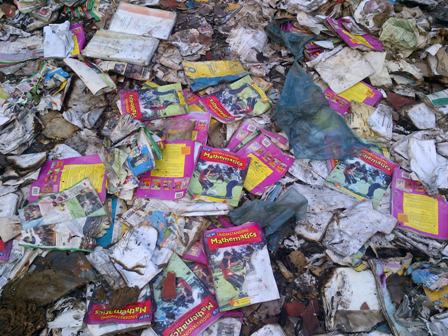
Burnt textbooks found in the Eastern Cape, a formerly independent black homeland
Thousands of burnt textbooks have been found in a warehouse in Fort Beaufort in the Eastern Cape, the DA said on Monday.
“We have written to MEC Mandla Makupula demanding an explanation as to how valuable public resources for Eastern Cape children were allowed to be destroyed in this irresponsible way,” Democratic Alliance provincial education spokesperson Edmund van Vuuren said in a statement.
However, provincial education department spokesperson Loyiso Pulumani said the books found in Fort Beaufort were destroyed during an arson attack.
The books were from the old Cape College of Education, which was closed in 1996, and had no relevance to current textbooks, Pulumani said.
“The old store-room was burnt down on 16 June. It is a suspected arson case. The books are more than 10-years-old.”
Van Vuuren said the books, most of them mathematics textbooks, were found by a DA inspection team.
“Given the massive shortages of both textbooks and workbooks in schools, every single book that does not reach a school will have an impact on a child’s ability to learn,” he said.
Boxes of books still wrapped in packaging were found in other parts of the district warehouse.
“The department needs to account for how many boxes of books remain inside the warehouse, and when these will be delivered to schools,” Van Vuuren said.
“The destruction of these books raises serious questions about why proper care was not taken to ensure that they were delivered to schools on time at the beginning of the year.”
Like Limpopo, the Eastern Cape has also been plagued by textbook problems.
Earlier this month, several thousand school workbooks were returned to the Eastern Cape education department because they were in the wrong language.
When approached for comment, provincial officials referred all questions to the national department.
National spokesperson Panyaza Lesufi said the department ordered books based on numbers given to it by the province.
“The other provinces all seem to be correct, so why is it only in the Eastern Cape? It must tell you something about that province,” he said.
At the time, Van Vuuren said the department’s database for Port Elizabeth showed 25 370 literacy workbooks and 15 500 numeracy workbooks were still outstanding.
“Claims… that chronic book delivery problems are limited only to the Port Elizabeth district, are false,” he said.
Burnt textbooks found in the Eastern Cape, a formerly independent black homeland
This website uses cookies to improve your experience. We'll assume you're ok with this, but you can opt-out if you wish. Cookie settingsACCEPT
Privacy & Cookies Policy
Privacy Overview
This website uses cookies to improve your experience while you navigate through the website. Out of these cookies, the cookies that are categorized as necessary are stored on your browser as they are essential for the working of basic functionalities of the website. We also use third-party cookies that help us analyze and understand how you use this website. These cookies will be stored in your browser only with your consent. You also have the option to opt-out of these cookies. But opting out of some of these cookies may have an effect on your browsing experience.
Necessary cookies are absolutely essential for the website to function properly. This category only includes cookies that ensures basic functionalities and security features of the website. These cookies do not store any personal information.
Any cookies that may not be particularly necessary for the website to function and is used specifically to collect user personal data via analytics, ads, other embedded contents are termed as non-necessary cookies. It is mandatory to procure user consent prior to running these cookies on your website.


 Economic exclusion of blacks must first be addressed in the classroom and thereafter in the boardroom.