Syria: Another Western war crime in the making

Dr Paul Craig Roberts

by Paul Craig Roberts

Update:

The war criminals in Washington and other Western capitals are determined to maintain their lie that the Syrian government used chemical weapons. Having failed in efforts to intimidate the UN chemical inspectors in Syria, Washington has demanded that UN Secretary General Ban Ki-moon withdraw the chemical weapons inspectors before they can assess the evidence and make their report. The UN Secretary General stood up to the Washington war criminals and rejected their demand. However, as with Iraq, Washington’s decision to commit aggression against Syria is not based on any facts.

The US and UK governments have revealed none of the “conclusive evidence” they claim to have that the Syrian government used chemical weapons. Listening to their voices, observing their body language, and looking into their eyes, it is completely obvious that John Kerry and his British and German puppets are lying through their teeth. This is a far more shameful situation than the massive lies that former Secretary of State Colin Powell told the UN about Iraqi weapons of mass destruction. Colin Powell claims that he was deceived by the White House and did not know that he was lying. Kerry and the British, French, and German puppets know full well that they are lying.

The face that the West presents to the world is the brazen face of a liar.

Washington and its British and French puppet governments are poised to yet again reveal their criminality. The image of the West as War Criminal is not a propaganda image created by the West’s enemies, but the portrait that the West has painted of itself.

The UK Independent reports that over this past week-end Obama, Cameron, and Hollande agreed to launch cruise missile attacks against the Syrian government within two weeks despite the lack of any authorization from the UN and despite the absence of any evidence in behalf of Washington’s claim that the Syrian government has used chemical weapons against the Washington-backed “rebels”, largely US supported external forces, seeking to overthrow the Syrian government.

Indeed, one reason for the rush to war is to prevent the UN inspection that Washington knows would disprove its claim and possibly implicate Washington in the false flag attack by the “rebels,” who assembled a large number of children into one area to be chemically murdered with the blame pinned by Washington on the Syrian government.

Another reason for the rush to war is that Cameron, the UK prime minister, wants to get the war going before the British parliament can block him for providing cover for Obama’s war crimes the way that Tony Blair provided cover for George W. Bush, for which Blair was duly rewarded. What does Cameron care about Syrian lives when he can leave office into the waiting arms of a $50 million fortune.

The Syrian government, knowing that it is not responsible for the chemical weapons incident, has agreed for the UN to send in chemical inspectors to determine the substance used and the method of delivery. However, Washington has declared that it is “too late” for UN inspectors and that Washington accepts the self-serving claim of the al Qaeda affiliated “rebels” that the Syrian government attacked civilians with chemical weapons.  See also Syria Accepts UN Inspectors, US Spurns Call as ‘Too Late’.

In an attempt to prevent the UN chemical inspectors who arrived on the scene from doing their work, the inspectors were fired upon by snipers in “rebel” held territory and forced off site, although a later report from RT says the inspectors have returned to the site to conduct their inspection.

The corrupt British government has declared that Syria can be attacked without UN authorization, just as Serbia and Libya were militarily attacked without UN authorization. In other words, the Western democracies have already established precedents for violating international law. “International law? We don’t need no stinking international law!” The West knows only one rule: Might is Right. As long as the West has the Might, the West has the Right.

In a response to the news report that the US, UK, and France are preparing to attack Syria, the Russian Foreign Minister, Lavrov, said that such unilateral action is a “severe violation of international law,” and that the violation was not only a legal one but also an ethical and moral violation. Lavrov referred to the lies and deception used by the West to justify its grave violations of international law in military attacks on Serbia, Iraq, and Libya and how the US government used preemptive moves to undermine every hope for peaceful settlements in Iraq, Libya, and Syria.

Once again Washington has preempted any hope of peaceful settlement. By announcing the forthcoming attack, the US destroyed any incentive for the “rebels” to participate in the peace talks with the Syrian government. On the verge of these talks taking place, the “rebels” now have no incentive to participate as the West’s military is coming to their aid.

In his press conference Lavrov spoke of how the ruling parties in the US, UK, and France stir up emotions among poorly informed people that, once aroused, have to be satisfied by war. This, of course, is the way the US manipulated the public in order to attack Afghanistan and Iraq. But the American public is tired of the wars, the goal of which is never made clear, and has grown suspicious of the government’s justifications for more wars.

A Reuters/Ipsos poll finds that “Americans strongly oppose U.S. intervention in Syria’s civil war and believe Washington should stay out of the conflict even if reports that Syria’s government used deadly chemicals to attack civilians are confirmed.”  However, Obama could not care less that only 9 percent of the public supports his warmongering. As former president Jimmy Carter recently stated, “America has no functioning democracy.” It has a police state in which the executive branch has placed itself above all law and the Constitution.

This police state is now going to commit yet another Nazi-style war crime of unprovoked aggression. At Nuremberg the Nazis were sentenced to death for precisely the identical actions being committed by Obama, Cameron, and Hollande. The West is banking on might, not right, to keep it out of the criminal dock.

The US, UK, and French governments have not explained why it matters whether people in the wars initiated by the West are killed by explosives made of depleted uranium or with chemical agents or any other weapon. It was obvious from the beginning that Obama was setting up the Syrian government for attack. Obama demonized chemical weapons–but not nuclear “bunker busters” that the US might use on Iran. Then Obama drew a red line, saying that the use of chemical weapons by the Syrians was such a great crime that the West would be obliged to attack Syria. Washington’s UK puppets, William Hague and Cameron, have just repeated this nonsensical claim. The final step in the frame-up was to orchestrate a chemical incident and blame the Syrian government.

What is the West’s real agenda? This is the unasked and unanswered question. Clearly, the US, UK, and French governments, which have displayed continuously their support for dictatorial regimes that serve their purposes, are not the least disturbed by dictatorships. They brand Assad a dictator as a means of demonizing him for the ill-informed Western masses. But Washington, UK, and France support any number of dictatorial regimes, such as the ones in Bahrain, Saudi Arabia, and now the military dictatorship in Egypt that is ruthlessly killing Egyptians without any Western government speaking of invading Egypt for “killing its own people.”

Clearly also, the forthcoming Western attack on Syria has nothing whatsoever to do with bringing “freedom and democracy” to Syria any more than freedom and democracy were reasons for the attacks on Iraq and Libya, neither of which gained any “freedom and democracy.”

The Western attack on Syria is unrelated to human rights, justice or any of the high sounding causes with which the West cloaks its criminality.

The Western media, and least of all the American presstitutes, never ask Obama, Cameron, or Hollande what the real agenda is. It is difficult to believe than any reporter is sufficiently stupid or gullible to believe that the agenda is bringing “freedom and democracy” to Syria or punishing Assad for allegedly using chemical weapons against murderous thugs trying to overthrow the Syrian government.

Of course, the question wouldn’t be answered if asked. But the act of asking it would help make the public aware that more is afoot than meets the eye. Originally, the excuse for Washington’s wars was to keep Americans safe from terrorists. Now Washington is endeavoring to turn Syria over to jihad terrorists by helping them to overthrow the secular, non-terrorist Assad government. What is the agenda behind Washington’s support of terrorism?

Perhaps the purpose of the wars is to radicalize Muslims and, thereby, destabilize Russia and even China. Russia has large populations of Muslims and is bordered by Muslim countries. Even China has some Muslim population. As radicalization spreads strife into the only two countries capable of being an obstacle to Washington’s world hegemony, Western media propaganda and the large number of US financed NGOs, posing as “human rights” organizations, can be counted on by Washington to demonize the Russian and Chinese governments for harsh measures against “rebels.”

Another advantage of the radicalization of Muslims is that it leaves former Muslim countries in long-term turmoil or civil wars, as is currently the case in Iraq and Libya, thus removing any organized state power from obstructing Israeli purposes.

Secretary of State John Kerry is working the phones using bribes and threats to build acceptance, if not support, for Washington’s war crime-in-the-making against Syria.

Washington is driving the world closer to nuclear war than it ever was even in the most dangerous periods of the Cold War. When Washington finishes with Syria, the next target is Iran. Russia and China will no longer be able to fool themselves that there is any system of international law or restraint on Western criminality. Western aggression is already forcing both countries to develop their strategic nuclear forces and to curtail the Western-financed NGOs that pose as “human rights organizations,” but in reality comprise a fifth column that Washington can use to destroy the legitimacy of the Russian and Chinese governments.

Russia and China have been extremely careless in their dealings with the United States. Essentially, the Russian political opposition is financed by Washington. Even the Chinese government is being undermined. When a US corporation opens a company in China, it creates a Chinese board on which are put relatives of the local political authorities. These boards create a conduit for payments that influence the decisions and loyalties of local and regional party members. The US has penetrated Chinese universities and intellectual attitudes. The Rockefeller University is active in China as is Rockefeller philanthropy. Dissenting voices are being created that are arrayed against the Chinese government. Demands for “liberalization” can resurrect regional and ethnic differences and undermine the cohesiveness of the national government.

Once Russia and China realize that they are riven with American fifth columns, isolated diplomatically, and outgunned militarily, nuclear weapons become the only guarantor of their sovereignty. This suggests that nuclear war is likely to terminate humanity well before humanity succumbs to global warming or rising national debts.

Dr. Paul Craig Roberts was Assistant Secretary of the Treasury for Economic Policy and associate editor of the Wall Street Journal. He was columnist for Business Week, Scripps Howard News Service, and Creators Syndicate. He has had many university appointments. His internet columns have attracted a worldwide following. His latest book, The Failure of Laissez Faire Capitalism and Economic Dissolution of the West is now available.

Copyright © Paul Craig Roberts 2013.

Originally published on Paul Craig Roberts – Institute for Political Economy. Reproduced with the author’s permission. Contact information for syndication rights.

EU warns Egypt it ‘will review ties’

eulawmakersEuropean Union leaders Herman Van Rompuy and Jose Manuel Barroso warned Egypt’s army and interim government Sunday the bloc would review its ties with the country unless the violence ended.

Further escalation could have “unpredictable consequences” for Egypt and its neighbours, the presidents of the European Council and European Commission said.

“This path will not succeed. It is crucial that violence ends immediately,” they said.

The 28-nation bloc would continue efforts to promote an end to violence, resumption of political dialogue, and return to a democratic process, the statement added.

“To this effect, together with its member states, the EU will urgently review in the coming days its relations with Egypt and adopt measures aimed at pursuing these goals.”

Senior diplomats from the 28 EU nations will Monday hold emergency talks on Egypt in Brussels in which they are expected to call for a snap meeting of foreign ministers within the next days.

The EU has pledged nearly five billion euros in loans and grants for Egypt for 2012-2013 and said shortly after the July 3 ouster of president Mohamed Morsi that aid provisions would be “under constant review” as the situation evolved.

“While all should exert maximum restraint, we underline the particular responsibility of the interim authorities and of the army in bringing clashes to a halt,” Van Rompuy and Barroso said.

“The calls for democracy and fundamental freedoms from the Egyptian population cannot be disregarded, much less washed away in blood.”

They regretted that international efforts and proposals for building bridges were set aside and confrontation chosen instead, and said there was no alternative to dialogue.

“All the Egyptian political forces must recommit to the country’s democratic future and engage in a political process leading to the early holding of elections and the establishment of a civilian government,” they said.

“The violence and the killings of these last days cannot be justified nor condoned. Human rights must be respected and upheld. Political prisoners should be released.”

The leaders of Germany and France, President Francois Hollande and Chancellor Angela Merkel, last week raised the spectre of the EU rethinking its cooperation with Egyptian authorities and called for a swift meeting of the bloc’s foreign ministers.

The next scheduled meeting of EU foreign ministers is in the Lithuanian capital, Vilnius, on September 6 and 7. – AFP

No longer a crime to mock French president

flanbyBeing rude to the President of France is no longer an automatic criminal offence, France’s parliament agreed today.

In the interests of free speech, MPs revoked legislation dating back to 1881 when anything judged to have ‘offended the head of state’ risked an automatic fine.

The change followed the European Court of Human Rights (ECHR) ruling in March that France violated a demonstrator’s right to freedom of expression when he referred to Nicolas Sarkozy as a ‘jerk’.

Mr Sarkozy, the notoriously aggressive 5ft 5ins conservative, became the butt of numerous jokes during his five years in office, which ended last year.

But when a demonstrator held up a placard reading ‘Get Lost Jerk’ at a Sarkozy meeting in western France in 2008, he received a criminal conviction and a fine of around 25 pounds.

This was despite exactly the same expression being used by Sarkozy himself months earlier while he was attending an agricultural show in Paris.

Last year ECHR deemed the punishment handed down to Sarkozy’s tormentor as being disproportionate and a violation of freedom of expression, as the act was a ‘satirical remark.’

The ECHR acknowledged that the insult constituted ‘criticism of a political nature’ for which ‘freedom of expression was of the highest importance.’

Now anyone who chooses to insult a serving French president will have to be pursued through the libel courts.

Francois Hollande, the current Socialist French president, is regularly mocked, often by people using his nickname of ‘Flanby’, after a wobbly caramel pudding.

Earlier this month it emerged that Sarkozy views his successor as a ‘ridiculous little fat man who dyes his hair’.

When Sarkozy was head of state, his third wife Carla Bruni put him on a fitness programme aimed at making him leaner, fitter and younger looking.

Before that the diminutive Sarkozy – nicknamed ‘Bling-Bling’ because of his love of tacky status symbols – was himself mocked for being a chubby little man.

He continued to wear platform heels, and to surround himself with smaller men in an attempt to look taller, but lost a great deal of weight through constant work-outs and giving up chocolate.

Hollande, in contrast, has failed to lose the tubby image and shake off the Flanby nick-name.

Opinion polls routinely reveal that Hollande is the most unpopular president in the history of the Fifth Republic, with Sarkozy a close second. – Daily Mail

Marine Le Pen loses parliamentary immunity, exposing her to ‘racism’ charge

Marine Le Pen
Marine Le Pen

The leader of France’s National Front lost her right to legal immunity as a European Parliament deputy on Tuesday, exposing her to possible prosecution over a racism charge.

Marine Le Pen’s loss of immunity came at the request of a Lyon court three years after she was accused of inciting racial hatred for comparing Muslim street prayers to the occupation of France by Nazi Germany.

A majority of parliamentarians voted to ratify the decision, as recommended by a judicial committee, a parliament official said after the hearing at the parliament’s seat in the northern French city of Strasbourg.

A public trial in France would be a setback for the National Front as it seeks to capitalize on her rising popularity to grab territory from the ruling Socialist Party and mainstream right in local and European Parliament elections next year.

Le Pen’s anti-immigrant, anti-EU party is notably gaining support at the expense of President Francois Hollande’s Socialists in a darkening economic context, as high and rising joblessness fuels the spread of her euro-skeptic views.

The National Front has also profited from a tax evasion scandal that prompted the resignation of ex-Budget Minister Bernard Cazeneuve, stealing votes in his former home district during a by-election last month.

It is tipped to make strong gains in May 2014 European elections, with one survey by pollster YouGov in June showing it could reap 18 percent of the vote — ahead of the Socialists but behind the center-right UMP party.

By comparison in 2009, when Le Pen won her EU parliament seat in the North-West France region, the National Front scored a total of just 6.3 percent of the vote, versus 16.4 percent for the Socialists and 27.8 percent for the UMP.

Le Pen was ranked France’s third most popular politician in a web-based poll conducted in May by web site L’Internaute. That placed her one position behind former President Nicolas Sarkozy, and 24 positions ahead of Hollande.

If found guilty of inciting racial hatred, she would face a maximum penalty of one year in prison and 45,000 euros in fines. – Reuters

Countdown to urgent elections after Mali ceasefire

mali_map2The clock is ticking for Mali as it scrambles to organise key elections in less than 40 days following a ceasefire deal between the government and separatist Tuareg rebels.

The agreement, reached on Tuesday after 10 days of tense negotiations, will enable Malian troops to enter the Tuareg-held city of Kidal in the northeast to secure polls scheduled to take place on July 28.

Malians have welcomed the truce but there are fears the deal will be difficult to implement and could unravel after the vote.

Malian military sources say the accord envisages the army entering the regional capital “without delay”, accompanied by French soldiers and troops from the African-led International Support Mission to Mali (AFISMA).

French President Francois Hollande told a meeting of his cabinet the agreement was “a major breakthrough”, his spokesman said.

The US also welcomed the deal.

“The agreement clears the way for the return of Malian administrative and security authorities to Kidal to permit the holding of presidential elections there on July 28,” State Department spokeswoman Jen Psaki said.

And the UN Security Council urged other armed groups who had cut ties with “terrorist organisations” in Mali to join the ceasefire.

But analysts raised a number of problems with securing a long-term ceasefire, such as difficulties monitoring any disarmament; and differentiating Tuareg militants from the diverse range of insurgents infesting Mali’s north.

“Ultimately, this is an interim agreement to allow the organisation of the presidential elections in Kidal, ” Malian analyst Mamadou Samake told AFP.

“It has not solved all the problems, it just put off some of the problems.”

The Malian government signed the accord with the National Movement for the Liberation of Azawad (MNLA) and a smaller Tuareg group in Ouagadougou, capital of neighbouring Burkina Faso.

The two sides agreed to halt hostilities and organise peace talks after the election, but the Tuaregs were not pressed to lay down their weapons.

“It was that or nothing, but we were heading for disaster if we hadn’t been able to get an agreement on presidential elections in the Kidal region,” said an aide to President Dioncounda Traore.

The Tuareg occupation of Kidal has been a major obstacle to holding the election, seen as crucial to Mali’s recovery from the conflict of the past 15 months.

Malian officers staged a coup in March 2012 but the weak army was overpowered by the MNLA, which seized key northern cities before being sidelined by its Al-Qaeda-linked allies.

The MNLA sided with a French-led military intervention, which reclaimed most of the lost territory from the Islamists. But the rebels have been reluctant to allow government troops into their Kidal bastion for the vote.

For analyst Samake, settling the major issues relating to Mali’s Tuareg separatist movement will have to wait.

“After the presidential elections, the legislative elections loom on the horizon. Former Tuareg rebels will certainly want to stand,” he said.

“But for now, they cannot because of an arrest warrant against them… That could create problems.”

Those warrants will likely be dropped, but the accord does state that international investigators will look into crimes against humanity and war crimes committed during the conflict.

Confronted with these problems, an official from the Ministry of Territorial Administration would only say: “Let’s take each day as it comes.”

The logistics of the disarmament is another obstacle to be cleared for all parties working for lasting peace in the Kidal region.

But the larger problem, say military sources, is that Islamist insurgents continue to hide out in northern Mali. They could launch attacks which might be wrongly attributed to former Tuareg rebels.

“We are the military — we don’t do politics,” a battalion commander from a neighbouring country’s army told AFP in the northern city of Gao.

“But just so there is no ambiguity, there will have to be some kind of mechanism in Kidal to prevent any infiltration of terrorists, otherwise it could complicate things.” – AFP

Two students, one black, ‘lynched’ in France

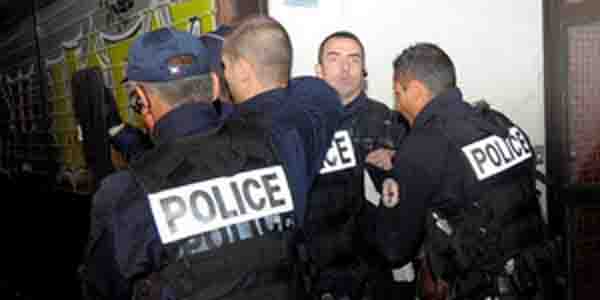
French police escort a suspect into custody

French police on Tuesday arrested 12 suspects over the killing of two students lynched by a mob armed with hammers, baseball bats and knives.

The killings last Friday in the Echirolles suburb of Grenoble sparked outrage in France and prompted President Francois Hollande to travel to the southeastern city late Monday to visit the families of the dead young men.

Hollande was accosted as he visited the poor suburb by a local resident who lambasted security forces for failing to stop the violence she said was plaguing the area.

Interior Minister Manuel Valls also travelled to the city and on Tuesday denounced what he called a “massacre” and vowed that the killers would be tracked down.

Three suspects, who may be of most interest and all have convictions for violent crimes, are still on the run, prosecutor Jean-Yves Coquillat told reporters.

Kevin Noubissi and Sofiane Tadburt, both aged 21, were beaten and stabbed to death by a gang of about a dozen people in a park. Noubissi was stabbed seven to eight times, and Tadburt 30 times, the prosecutor said.

The gang was reportedly seeking vengeance after a minor incident outside a high school involving Noubissi’s younger brother.

Funerals for the two friends were due to take place Wednesday at the local mosque.

On Tuesday evening police said about 10,000 people took part in a memorial march to honour the two young men, who were said by friends and families to be model students.

Participants marched in silence while carrying white balloons and holding up placards showing photos of the victims.

Most of those arrested Tuesday in Grenoble were aged between 18 and 21, and most have criminal records, officials said.

No one has admitted guilt, the prosecutor added.

Two brothers, both in the military, were the first to be arrested in the case, police said, after being brought in for questioning on Monday. One was found near Grenoble, the other in a town about 500 kilometres (300 miles) away.

Their mother was also brought in for questioning Tuesday. – AFP

French very pessimistic about the future

Reuters) – The French are bleaker about their country’s future than at any time since 2005, a new poll showed on Saturday, with 68 percent saying they are “rather” or “very” pessimistic, the highest level ever in the initial months of a new presidency.

The poll’s findings jibed with a survey released last weekend which found that Socialist President Francois Hollande’s approval rating had slipped to 54 percent, continuing a steady decline since he took office in May.

The level of pessimism fell just short of an all-time high of 70 percent registered in August 2005, when the poll was created near the end of Jacques Chirac’s government.

Hollande’s government has been reeling from unemployment at a 13-year high and a rash of job cuts in recent weeks at top employers like carmaker Peugeot and retailer Carrefour . The government launched a plan this week to create 150,000 state-sponsored jobs for youth.

Only 34 percent of those surveyed were confident in the government’s ability to battle unemployment, and just 20 percent expect the government to be able to improve their buying power.

“It’s the first time that anxiety is so high at the beginning of a presidential mandate,” said polling firm Ifop, which conducted the survey for Dimanche Ouest France newspaper, in a statement accompanying the findings.

Pessimism stood at just 34 percent at the equivalent point in Chirac’s presidency in 2002 and 50 percent in Nicolas Sarkozy’s in 2007, the firm said.

The government’s efforts to spur consumption have been complicated by its EU deficit-cutting commitments, which mean hitting a 3 percent deficit target next year. That will force it to find some 30 billion euros ($37.8 billion) in deficit cuts next year, half of which it has said would come from spending.

The poll found that the pessimism extended even to 58 percent of Socialist party supporters.

Nearly 60 percent lacked confidence in the government’s ability to strengthen law and order, which has emerged as a concern in the wake of riots last month in the city of Amiens.

Those surveyed were asked: “In thinking about the future, for you and your children, would you say that you are very optimistic, rather optimistic, rather pessimistic or very pessimistic,” along with queries about their confidence in the government’s ability to make progress on various issues.

The poll was based on the views of 1,004 people aged 18 and over, interviewed Aug. 30 and 31.

A racial revolution in France

by Timothy Spangler

When the Socialist Francois Hollande took over the French presidency this spring, many French voters hoped that his new government would bring about a distinct change in direction from the “bling-bling” administration of his predecessor, Nicholas Sarkozy. By filling his Cabinet with many fresh faces, Hollande seems committed to looking at complex and contentious issues from new perspectives.

This week, one of the most awkward and inviolate elements of the French political foundation – the issue of race – was explicitly called into question by one of Hollande’s new ministers.

Article Tab:  In this June 19, 2009, file photo, two women, one wearing the niqab, a veil worn by conservative Muslims that exposes only a woman's eyes,  walk side by side in downtown Marseille, France.
In this June 19, 2009, file photo, two women, one wearing the niqab, a veil worn by conservative Muslims that exposes only a woman’s eyes, walk side by side in downtown Marseille, France.
ASSOCIATED PRESS FILE PHOTO

According to the philosophic orthodoxy that cuts across partisan politics in France, there is only one type of Frenchman. Everyone is equal in France because in France every Frenchman is equally French. As a result, the “hyphenated identities” prevalent in the United States and a key feature in contemporary Britain have not been officially sanctioned in France.

Although there are “African Americans” and “Black Britons,” in France there is no such thing as a “French Algerian” or a “French African.”

This week, however, Yamina Benguigui, Minister of the French Language, made the radical proposal that the French government should recognize and accept that the concepts of ethnicity and race actually exist in the French Republic. To date, no official statistics are compiled based on ethnic or racial backgrounds, so no formal attempt to analyze the French nation, or any problems it faces, from this perspective can take place.

Benguigui, a film producer whose father was from Algeria, argues that France should recognize the effects of decades of immigration and the failure of assimilation has had on many communities. Despite the importance of “equality” and “fraternity” to successive generations of French government officials, a lack of pragmatism has meant that abstract ideals about how the French state should be constructed have limited the government’s ability to address important race-relation problems.

The television images of burning cars and nightly violence that regularly emerges from the dire suburbs that encircle Paris and other large French cities are a constant reminder that many men and women, born in France as the children or grandchildren of immigrants, still do not feel included in the Cartesian perfections of the French Republic.

According to Benguigui, the time has come for the government to take off its blindfold and begin to recognize that communities based on ancestry have always existed in France and will continue. Only then could a pragmatic new approach be fashioned to address the challenges France faces.

Unfortunately, for any French politician to stand before television cameras and say that France should look to America or Britain for inspiration on how to solve its problems is either the very definition of “political bravery,” “political suicide,” or both.

Will President Hollande back his minister’s controversial views on race relations?

His new government faces many pressing challenges, so it will be interesting to see how much political capital he is willing to devote to what is certainly a controversial new position on an intractable problem.

Hollande’s honeymoon period ended this week when he received a stark warning from the French government audit department, the Cour des Comptes, that he will need to cut more than $40 billion from government spending in order to meet stringent deficit-reduction targets. Hollande had campaigned on a platform for shifting the country away from austerity, but the reality of France’s spiraling debt and empty coffers may be superseding his personal political priorities.

Even if Hollande manages to increase taxes to 75 percent on every French citizen earning over 1 million euros (about $1.25 million), as he has proposed, he will still not have anywhere near the revenue necessary to close the budget gap.

In the face of such negative economic prospects, it remains unclear how much of a priority Hollande will give to Benguigui’s radical new rethinking of how French citizens should define themselves and, consequently, how the French government should develop policy to address the challenges facing this diverse country.

Like much abstract thought, there is something intellectually appealing about a government structured to deal with its citizens solely as philosophically undistinguished units devoid of individual characteristics and “back story.” If such an approach could work, it would satisfy the desire that many have for highest-possible level of equality before the law.

However, the reality of life in France shows that, rather than facilitate assimilation and integration, France’s inability to recognize or adapt to the ethnic and religious backgrounds of its citizens is causing more harm than good. Discussion of these issues is coded and indirect and awkward, but these issues are arising again and again, regardless of the intoxicatingly abstract desire that they did not.

As France tries to climb its way out of its deep fiscal hole, millions of its citizen remain excluded from the economy and society. At times like these, a country need all hands on the oars, in order keep the country moving forward as fast as possible. Hopefully, the French government eventually will recognize that there are times when the direct results of pragmatism trump the aesthetic pleasures of abstract idealism.

Read the whole article here.