Finland shuts door on black refugees

Refugee quotas have significantly been reduced by Finnish municipalities

Finnish municipalities have significantly cut quotas on receiving refugees from foreign countries.

Refugee quotas have significantly been reduced by Finnish municipalities, with just 40 of them signaling readiness to receive refuges, local media outlets reported.

Last year, the municipalities received more than 1,000 refugees, a record number that experts attributed to additional government funding and the Syrian conflict.

In addition, Finland increased the quota for refugees from 750 to over a thousand.

This year, the refugee quota stands at 1050, but it is unlikely to be implemented in time.

Meanwhile, the regions of Satakunta and South Ostrobothnia have said that they will not receive refugees this year.

The regions of Uusimaa, Ostrobothnia and Pirkanmaa will receive the majority of refugees — 160, 120 and 100 respectively.

As for the major cities, most refugees will be received by Tampere and Kuopio, while Helsinki and Turku will only receive a dozen people each.

People fleeing Syria remain refugees of choice for Finnish municipalities, while refugees from the Democratic Republic of Congo are reportedly the most unwelcome people.

Source: Sputnik News

Norway to ban aiding beggars

The scope of the law, which was originally intended to ban homeless people from begging on the street, has been extended to also criminalise those offering money or other help, outraging many in Oslo who believe they risked being charged simply for helping less fortunate people.

Inger Husby, from the Oslo suburb of Bøler, who frequently invites homeless people into her house, told NRK that she feared that her altruistic acts could also be deemed illegal should the bill pass as it is.

Vidar Brien-Karlsen, Secretary of State at the Ministry of Justice and member of the right-wing Progress Party said it was necessary to criminalise those aiding beggars, as the police needed authority to crack down on those running begging networks as an organised business.

“That’s because part of what we want to get rid of is actively organised. We need to give the police the legal authority to crack down on people who arrange for beggars to get here, often in large groups”.

Norway’s right-wing coalition struck a deal with the Centre Party in June last year, giving them the majority needed in parliament to bring in a begging ban.

The government has sent the bill out for consultation with a deadline of 15th of February. Under the law, organised begging would become a crime, punishable with a prison sentence of up to one year. The same punishment would apply to those aiding beggars.

Source: The Local

Hitler photo delivers blow to Pegida

In Pegida’s first ever press conference in Dresden on Monday, Lutz Bachmann insisted that the group was not racist, and distanced themselves from footage during a lively television debate showing Pegida demonstrators delivering racist remarks.

Bachmann has been most keen to stress his Muslim credentials, showing photographs on his Facebook site of his Turkish best man.

Meanwhile a Catholic priest who took part in a demonstration organised by the Pegida-offshoot group Dügida in the western city of Duisburg in Germany on Monday has been banned from preaching by his religious elders, after he compared the movement to the Crusades.

The head of the German anti-Islamisation has stepped down after a picture of him jokingly posing as Adolf Hitler was unearthed. Bachmann, 41, is a butcher’s son from Dresden.

Bachmann’s Facebook page, was accompanied by the line: “He’s Back,” after Timur Vermes’ best-selling 2012 satirical novel of the same name about Hitler.

The Dresden Morgenpost somehow got hold of a private Facebook conversation between Bachmann and one of his Facebook contacts, in which he described immigrants as “cattle”, “scumbags” and “trash”. The comments were posted on 19 September.

Pegida spokeswoman Kathrin Oertel, told Spiegel Online Bachmann’s resignation was the “only possibilty for the movement”.

A spokesman for Bernd Lucke, the head of the political party Alternative für Deutschland, an anti-euro party which has publicly expressed an allegiance with the aims of Pegida, said that with his “sad utterings and disgusting jokes”, Bachmann had “embarrassed the people of Pegida who have been compelled by honest concerns to take to the streets”.

Responding to the picture, Bachmann told Wednesday’s Bild: “I took the photo at the hairdresser’s, for the publication of the audiobook of the satire He’s Back … you need to be able to joke about yourself now and then”. Asked about the derogatory comments he allegedly made about immigrants, Bachmann replied: “We don’t comment about private matters.”

Bachmann, who has multiple convictions for burglary, assault and drug possession, was said by German intelligence services to be a target for Islamist terrorists who said on social media sites they intended to kill him.

Germans rally against Islam

Protesters marched in several German cities again on Monday against higher levels of immigration and what they see as the growing influence of Islam, in defiance of an appeal from Chancellor Angela Merkel to spurn rallies she views as racist.

The rallies, organized by a new grassroots movement known as PEGIDA, or Patriotic Europeans Against the Islamization of the West, have become an almost weekly event in the east German city of Dresden in recent months.

Some 18,000 people, the biggest number so far, turned out in Dresden on Monday but similar rallies in Berlin and the western city of Cologne were heavily outnumbered by counter-protesters who accuse PEGIDA of fanning racism and intolerance.

The PEGIDA protesters waved Germany’s black, red and gold flag and brandished posters bearing slogans such as “Against religious fanaticism and every kind of radicalism”.

One poster in Cologne called for “potatoes rather than doner kebabs”, a swipe at ethnic Turks who at around three million represent Germany’s largest immigrant community.

Germany has some of the world’s most liberal asylum rules, partly due to its Nazi past. The number of asylum seekers arriving in Germany, many from the Middle East, jumped to around 200,000 last year — four times as many as in 2012.

In her New Year address last week, Merkel urged Germans to shun the anti-Muslim protesters, saying their hearts were full of hatred.

“We need to … say that right-wing extremism, hostility towards foreigners and anti-Semitism should not be allowed any place in our society,” Merkel said on Monday in the eastern town of Neustrelitz.

In Cologne, home to a large Muslim population, there were 10 times as many counter-demonstrators as PEGIDA protesters. In similarly multi-ethnic Berlin, some 5,000 counter-demonstrators swamped around 400 anti-Muslim protesters, local police said.

“Germany is a country where refugees are welcome and the silent majority must not remain silent but rather go out onto the streets and show itself,” Justice Minister Heiko Maas said at the Berlin counter-demonstration.

Cologne Cathedral, one of Germany’s most famous landmarks, switched its lights off to protest against the anti-Muslim rallies. Berlin’s Brandenburg Gate turned off its floodlights in a similar gesture of solidarity.

PEGIDA has unsettled Germany’s political establishment and at first looked likely to help the Euroskeptic party Alternative for Germany (AfD). But the party, already suffering an internal power struggle, is split over how to deal with the movement.

Source: Reuters

Auf Deutsch bitte!

The rise of immigration in Germany is prompting one of the parties in the government coalition to seek a requirement that would oblige all foreigners to speak only German in public and at home. The proposal has caused a wave of criticism.

A comrade in the coalition led by Chancellor Angela Merkel’s Christian Democratic Union (CDU), the Christian Social Union (CSU), is due to approve a party draft policy paper proposal on Monday, requiring immigrants to practically abandon the use of their native tongue.

In the paper, as quoted by Reuters, the CSU says: “People who want to remain here on a permanent basis should be obliged to speak German in public and within the family.”

CSU argues that “social interaction works only when all speak the same language”, and says that all foreigners who enter to remain will be offered a language training course.

It was not immediately clear how the party proposes to enforce such a rule without invasive surveillance of immigrants’ homes.

Wolfgang Bosbach, a member of Merkel’s conservative CDU, agrees with the CSU proposal, arguing that speaking German is crucial for the immigrant integration process.

“Language skills are of paramount importance for good integration opportunities. Therefore, it is important to speak with children at home also in German,” Bosbach told Bayerische Rundfunk.

Yet the new proposal was swiftly denounced by the other parties in Merkel’s government, including a senior official from the chancellor’s Christian Democratic Union (CDU).

The latest data released by Germany’s statistics office show record immigration last year, with most of the new arrivals coming from European Union countries like Poland, Bulgaria and Romania in search of employment. The influx of 1,226,000 people to Germany in 2013 shows an increase of 13 percent from 2012, the highest on record since 1993.

“It is not the business of politicians whether I speak Latin, Klingon or Hessian at home,” Peter Tauber, general secretary of the CDU, said on Twitter.

Yasmin Fahimi, for the Social Democrats (SPD), called the proposal “totally absurd”.

“The state has no role to play in deciding what language people speak within the walls of their own home,” Fahimi told German newspaper Bild.

‘Black is all that matters’

While the migration of black Africans is not new, the number of sub-Saharan immigrants has grown swiftly, an influx that is shifting the demographic landscape across the country, including in New York City.

Between 2000 and 2010, the number of legal black African immigrants in the United States about doubled, to around one million. During that single decade, according to the most reliable estimates, more black Africans arrived in this country on their own than were imported directly to North America during the more than three centuries of the slave trade.

And while New York State is home to the largest proportion and many have gravitated to ethnic enclaves like Little Senegal in West Harlem or the Concourse Village section of the West Bronx, to live among fellow Ghanaians, black immigrants from Africa have tended to disperse more widely across the country — to California, Florida, Georgia, Illinois, Maryland, Texas and Virginia — than Caribbean-born blacks.

About a third of black New Yorkers were born abroad, mostly in the Caribbean. Africans constitute about 4 percent of the city’s foreign-born population, but as much as 10 percent in the Bronx. At last count, according to an analysis of census estimates by the Department of City Planning, from 2000 to 2011 the African-born population increased 39 percent to 128,000, although other estimates suggest that many more are living here without legal residency.

“They’ve been doubling every 10 years since 1980,” said Kim Nichols, an executive director of the African Services Committee, which is based in Harlem. “There’s a more established family and community network here to come to.”

Some come as refugees, some with work visas or special skills, many to stay and others to hone their talents and eventually apply them back home.

“Many black immigrants do not identify with the historical experiences of discrimination encountered by blacks in the United States,” said Kevin D. Brown, a law professor at Indiana University’s Maurer School of Law.

Kobina Aidoo, director of “The Neo-African-Americans,” a documentary, said, “I’ve heard people refer to themselves as everything from ‘African African-American’ to ‘Halfrican American’ to ‘White African-American’ to ‘Real African-American’ to ‘American African” to ‘Just black.’ ”

Dr. Khalil Gibran Muhammad, director of the New York Public Library’s Schomburg Center for Research in Black Culture, recalling the shooting by the police of Amadou Diallo, an unarmed immigrant from Guinea in the Bronx in 1999, and of Michael Brown, an unarmed teenager in Ferguson, Mo., last month, said color still trumped place of origin.

“Diversity among African-descended communities remains a black box and a mystery to most Americans,” he said. “[Being] Black is all that matters [to blacks].”

Source: NYT

UN urges US to welcome immigrants as refugees

United Nations officials are pushing for many of the Central Americans fleeing to the U.S. to be treated as refugees displaced by armed conflict, a designation meant to increase pressure on the United States to accept tens of thousands of people currently ineligible for asylum.

Officials with the U.N. High Commissioner for Refugees say they hope to see a regional agreement on that status Thursday when migration and interior department representatives from the U.S., Mexico, and Central America meet in Nicaragua. The group will discuss updating a 30-year-old declaration regarding the obligations nations have to aid refugees.

While such a resolution would lack any legal weight in the United States, the agency said it believes “the U.S. and Mexico should recognize that this is a refugee situation, which implies that they shouldn’t be automatically sent to their home countries but rather receive international protection.”

Central Americans would be among the first modern migrants considered refugees because they are fleeing violence and extortion at the hands of criminal gangs.“Unaccompanied children and families who fear for their lives and freedoms must not be forcibly returned without access to proper asylum procedures,” UNHCR official Leslie Velez said in testimony submitted to the House Judiciary Committee late last month.

Immigration experts in the U.S. and Central America say the flow of migrants from Honduras and El Salvador is likely to rise as the two countries experience gang-related violence. Honduras, a primary transit point for U.S.-bound cocaine, has the world’s highest homicide rate for a nation that is not at war.

Salvadorans heading north through Mexico who were interviewed by The Associated Press last month said there also was fear of the “Sombra Negra,” or “Black Shadow” – groups of masked men in civilian clothes who are believed responsible for extrajudicial killings of teens in gang-controlled neighborhoods. The Salvadoran government denies any involvement in death squads, but says it is investigating the reports.

Source: CBS

Immigrants drown after Spain fires rubber bullets

spainimmigrantsThe European Commission wants Spain to account for the drowning of 14 migrants who recently failed to swim to Ceuta, a Spanish enclave in North Africa. Spain earlier admitted that rubber bullets were fired at them, but claimed no one was injured.

“The commission will be requesting explanations from the Spanish authorities on these events,” EU Home Affairs spokesperson Michele Cercone said, adding that the commission has a right to act if there’s evidence that a member state has violated EU laws.

On Thursday, Spanish Interior Minister Jorge Fernandez Diaz admitted that local border police, in an effort to turn back around 200 migrants who tried to cross the frontier between Morocco and Spain’s Ceuta on February 6, had indeed fired rubber bullets at them.

While some tried to cross on land, at least fourteen migrants drowned in the Mediterranean trying to swim around a man-made breakwater that separates Moroccan and Spanish waters. Spanish police say they are still searching for more victims.

According to the Spanish Interior Minister, the rubber bullets were fired at a distance of 25 meters to deter people from entering Spain while they were in the water. Diaz told a parliamentary commission that the shots were never intended to hit the migrants, whose behavior he described as aggressive. Spanish police posted online video footage of migrants throwing stones at the border fence. The footage didn’t show what had happened when some of them tried to swim around to Spanish land, however. Ceuta, on the north coast of Africa across the Strait of Gibraltar on the Mediterranean Sea, has a population of about 83,000.

According to the online newspaper EUObserver, 23 people managed to make it to Ceuta’s El Tarajal beach, but were immediately turned over to Moroccan authorities. Under European asylum and migration law, anyone who steps foot on member states’ territory is eligible to have their asylum request reviewed before being deported. Although Spanish Interior Minister admitted a group of migrants made it to the beach, Diaz said the group did not enter Spanish territory, since they allegedly never made it past the line of waiting border guards.

Meanwhile, the EU Commissioner for Home Affairs Cecilia Malmstrom said she was “very concerned about Spanish police using rubber bullets to deter migrants.”

“I expect clarifications from the authorities,” Cecilia Malmstrom wrote on her Twitter account.

Spain’s interior minister has admitted police should not have fired rubber bullets at migrants trying to reach Ceuta last month.

Jorge Fernandez Diaz said that rubber bullets were unlikely to deter migrants from the country’s North African enclave.

At least 15 migrants drowned on February 6 as hundreds tried to swim to Ceuta from Morocco.

Niger migrants’ bodies found

saharaRescue workers in Niger say they have found the bodies of 87 people who died of thirst after their vehicles broke down as they tried to cross the Sahara.

Rescue worker Almoustapha Alhacen said the corpses were in a severe state of decomposition and had been partly eaten, probably by jackals.

Those found are thought to be migrant workers and their families. Most were women and children.

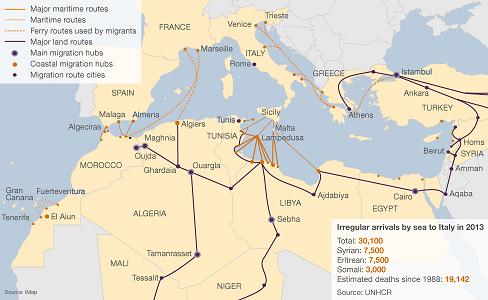
Niger lies on a major migrant route between sub-Saharan Africa and Europe.

But among those who make it across the desert, many end up working in North African countries.

According to Mr Alhacen, one of the vehicles that the migrants were travelling in broke down some time after they left Arlit at the end of September or beginning of October.

Continue reading the main story
Analysis

image of Thomas Fessy
Thomas Fessy
BBC West Africa correspondent
Thousands attempt to cross this stretch of Sahara desert to reach the coasts of North Africa, and from there Europe. I remember the exhaustion of migrants whom I met in Agadez in 2011.

Most were in their 20s and determined to continue their journey – despite the war in Libya at the time. “In our country, our talent is useless,” one young Nigerian said. “But in Europe, we’ll be able to thrive on it,” he added.

Agadez is still several hundred kilometres from either Libya or Algeria. There is nothing in between but sand – a perilous desert where the extreme heat can kill. Traffickers extort large sums of money from migrants seeking a one-way ticket for a better life. They all know that death may be on the way, but they’re ready to risk it, clinging onto hope.

Security officials have said the second vehicle broke down as it was on its way back to Arlit to get spare parts.

It appears that some of the group set out on foot, including up to 10 people who made it back to Arlit and raised the alarm, he said.

It was reported on Monday that five bodies had been found.

On Wednesday, volunteers and soldiers working in searing heat found other corpses about 10km (six miles) from the Algerian border.

Speaking from Arlit, a centre for uranium mining north of Agadez, Mr Alhacen said he had experienced the worst day of his life when he found the bodies.

“The corpses were decomposed; it was horrible,” he said.

“We found them in different locations in a 20km (12mile) radius and in small groups, often under trees, or under the sun. Sometimes a mother and children, but some lone children too,” AFP news agency quoted him as saying.

They were given Muslim burials where they were found, he added.

Given that at least 48 of those found were children or teenagers, Mr Alhacen said it was possible they were on their way to low paid jobs in neighbouring Algeria.

It is not clear which countries the migrants came from.

About 80,000 migrants cross the Sahara desert through Niger, according to John Ging, director of the UN Office for the Coordination of Humanitarian Affairs.

“They are basically economic migrants. They are in search of work. They are so impoverished that they have to make these hazardous journeys,” he told the BBC’s Newsday programme.

Niger is one of the world’s poorest countries and frequently suffers from drought and food crises.

– BBCmedmigrants2
Controversies around Greece’s Golden Dawn party: a timeline

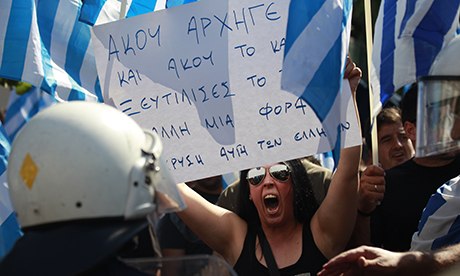
A protestor outside police headquarters in Athens holds a placard stating: 'Listen chief, listen again, you have ridiculed the system one more time - Golden Dawn of the Greeks'
A protestor outside police headquarters in Athens holds a placard stating: ‘Listen chief, listen again, you have ridiculed the system one more time – Golden Dawn of the Greeks’

Golden Dawn, the aggressive Greek right-wing party making headlines in the crisis-hit country after the murder of an anti-fascist musician, has gone from provocation to provocation in its short career in Greece’s parliament.

The party’s 18 lawmakers have been accused of using their parliamentary immunity to intimidate police and evade arrest, meaning that there are only a few cases of solid prosecution against them.

Until the murder of hip hop artist Pavlos Fyssas on Wednesday, police had failed to pursue most other cases of brazen aggression by suspected Golden Dawn members against migrants or political rivals.

– June 7, 2012: Golden Dawn party spokesman Ilias Kasidiaris, a former commando, strikes female Communist MP Liana Kanelli during a heated talk show debate. He escapes arrest by temporarily going into hiding. Parliament later lifts his immunity so Kasidiaris can face trial.

– June 12, 2012: Four Egyptian fishermen are attacked in their sleep in the working-class district of Perama by a gang of black-clad attackers. One victim is hospitalised with serious head injuries.

Six people arrested at the time denied involvement and were released. According to media reports, at least one of the assailants would take part in another beating of Communist party members in Perama a year later.

– September 7, 2012: Golden Dawn lawmakers George Germenis and Panagiotis Iliopoulos lead a black-clad detachment of party members to an open-air fair near Athens, where they proceed to smash the stalls of unlicensed migrant peddlers.

Another GD team headed by lawmaker Costas Barbaroussis carries out a similar operation in the western town of Messolonghi the following day.

Parliament has agreed to lift the immunity of all three MPs so they can be prosecuted.

– January 17, 2013: A Pakistani migrant is fatally stabbed in central Athens by two Greeks, one of them a fireman. Police later find Golden Dawn tracts at the one of the attackers’ homes.

– May 2, 2013: Athens Mayor George Kaminis bans a Golden Dawn food handout exclusively catering to Greeks as racist. Hours later, GD lawmaker George Germenis is detained after apparently trying to punch the mayor, and hitting a 12-year-old girl instead. Germenis’ immunity has again been lifted over the assault and he will be tried.

– September 12, 2013: Communists putting up posters in the working-class district of Perama are attacked by a large group of alleged Golden Dawn members bearing nail-studded clubs. Eight Communists are hospitalised but the attackers escape.

– September 18, 2013: Anti-fascist singer Pavlos Fyssas is fatally stabbed after an apparent ambush by suspected Golden Dawn members. The killer, George Roupakias, is immediately arrested and later confesses to police his Golden Dawn affiliation.

Golden Dawn continues to deny involvement and accuses its critics of slander, but pictures soon appear in the press, showing Roupakias participating in party events, wearing GD insignia. – AFP

Hundreds of migrants storm EU fence

melillaHundreds of migrants from Morocco were trying to cross the southern EU border at Melilla, a Spanish exclave, on Monday before dawn.

Having torn down a part of a triple six-meter high fence, about 100 made it through, Spanish government officials in the territory said in a statement.

They were the latest of thousands of migrants who try to reach Spain from Africa across the fence or by sea, forced to leave by unrest in Northern Africa, most of them from Algeria, Morocco and Tunisia. – RT

Swiss town discovers Apartheid

Bremgarten
Bremgarten

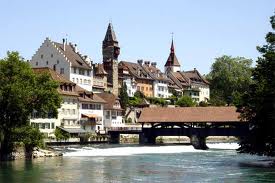
A town in Switzerland is being likened to apartheid-era South Africa, after the local mayor drew up plans to ban asylum-seekers from some public places.

A new centre to house migrants has been opened in Bremgarten, 20 kilometres west of Zurich.

The proposals would see the newcomers kept away from a sports centre, the swimming pool and areas around schools, in order to preserve the peace in the town of 6,500 residents, according to the mayor, Raymond Tellenbach.

“We wanted these restrictions in order to prevent tension with residents, especially with students. It’s for their security. We want to be sure that they are not molested,” said Tellenbach.

The idea of keeping the 150 asylum-seekers living at the centre away from certain areas has drawn criticism from politicians from a wide range of parties.

“This reminds me of apartheid. This leads to two classes of citizens – those who can go everywhere and those who cannot, only because of their residence status,” said Socialist MP Silvia Schenker

Switzerland is in the racial spotlight after Oprah Winfrey accused a shop assistant in Zurich of being racist. The black American TV-star apologised later for het rant.

The American media icon, who is one of the world’s richest women, claims the shop assistant refused to show her a handbag which cost more than 26,000 euros.

The shop-owner says the incident was a misunderstanding. euronews.com

French immigrant youths burn 1200 cars for fun

Muslim youths burning cars in France

A New Year’s Eve tradition for some in France of torching empty, parked cars has continued.

Interior Minister Manuel Valls said Tuesday that 1,193 vehicles were burned overnight around the country, where the stunt began in the 1990s.

There was no way to compare this figure to recent ones because the conservative government of former President Nicolas Sarkozy stopped making the numbers public while he was in office. But the rate of burned cars was apparently steady. On Dec. 31, 2009, 1,147 vehicles were burned.

For some, the decision of France’s current Socialist government to resume making public figures of New Year’s Eve’s torched cars is unwise.

Bruno Beschizza, a security chief for Sarkozy’s UMP party, said on iTele TV that publishing the numbers motivates youths to commit such crimes. – AP