Ukraine’s leverage evaporates

Vladimir Putin has scored a massive political victory in the heart of the Eurozone, after Austria openly defied NATO and sided with Russia.

Russia has an alternative pathway for its gas, one which bypasses Ukraine entirely and as the current South Stream framework is set up, crosses the Black Sea and enters Bulgaria before passing Serbia and Hungary on the way to the Central European energy hub located in Baumgarten, Austria.

The latest development comes only one short month after Putin concluded a game-changing deal with Beijing.

As Itar-Tass reports, citing Gazprom CEO Alexei Miller, “Russia’s gas giant Gazprom does not rule out gas transit via Ukraine may be stopped completely.”

“What happened once is a tendency, nothing happens incidentally. In 2009, gas supplies were stopped completely — so, we know precedents,” Miller told a briefing on Friday.

Clearly, this is bad news for Ukraine: Gazprom is no longer interested in participation in Ukraine’s gas transportation system (GTS).

“That train has departed”, the CEO said.

“It seems it departed yesterday,” Miller said. “It belongs to no one. The GTS has no owner,” he said. “The GTS of Ukraine does not belong to Naftogaz but to the Ukrainian government. Before discussing things with someone regarding modernization and cooperation, it should appear on the balance sheet of this or that economic entity.”

“Property and legal issues should be resolved first,” Miller said.

In fact, the civil war torn country may soon lose all leverage it had with both Europe and Russia as a transit hub for natural gas, which also means that it is quite likely that Ukraine is about to be abandoned by its western allies who will no longer have any practical use for it.

The Gazprom chief added that “a dozen Ukrainian laws need to be changed to be able to do something with the GTS.”

Confirming that Ukraine’s leverage at least with Russia is now effectively zero, Gazprom’s CEO also said that “As for the continuation of negotiations with Ukraine, today there is no subject for talks. First, they must repay their debts.”

“The gas price for Ukraine is fair – this price is fixed in the contract,” he stressed.

There have been no requests on the part of Ukraine’s national oil and gas company Naftogaz Ukrainy on a change of the transit deal with Russia, Alexei Miller said.

NATO will now turn its attention to the countries which the South Stream pipeline passes through.

Bulgaria, has just suffered its worst bank run in 17 years, and one which has paved the way to early elections.

This may provide the US with a government which will be more focused on their interests, instead of the current regime, whose allegiance to the Kremlin is said to take precedence.

The South Stream countries – starting with Bulgaria, and going through Serbia, Hungary,  Slovenia, Italy and of course, Austria – will suffer scrutiny.

Finally, and perhaps most notably, is last week’s announcement by Gazprom CEO Miller that Gazprom is interested in discussing buying a stake in the Baumgarten gas hub.

“They do everything to disrupt this contract. There is nothing unusual here. This is an ordinary competitive struggle. In the course of this competition, political tools are also being used,” the Russian president said after holding talks with his Austrian counterpart, President Heinz Fischer, in Vienna.

Fischer defended the South Stream project, saying: “No one can explain to me – and I can’t explain to the Austrian people – why a pipeline that crosses EU and NATO countries can’t go 50 km into Austria.”

The mood turned jovial during Putin’s recent visit when the head of Austria’s chamber of commerce reminded Putin that part of Ukraine had belonged to Austria in 1914.

“What is that supposed to mean? What are you proposing?” Putin quipped, eliciting laughter from the business elite.

The one place which now matters most for Europe’s energy future is Austria.

Gazprom chief Alexei Miller said earlier he was in weekly if not daily contact with European Energy Commissioner Guenther Oettinger about winning approval for the South Stream project.

Gazprom, Austria sign gas agreement

Russia’s Gazprom and Austria’s OMV oil and gas companies on Tuesday signed an agreement on the creation of a joint-stock company, South Stream Austria, outlining the principles for the construction and exploitation of the Austrian stretch of the South Stream gas pipeline.

The agreement was signed during Russian President Vladimir Putin’s visit to Vienna.

Gazprom and OMV will own a 50 percent stake each in the joint venture.

The agreement specifies the duties and responsibilities of the shareholders as well as the funding and profit-sharing principles.

In April, the sides sealed a memorandum on the construction of South Stream in Austria with annual gas supplies to that country through the future pipeline estimated at 32 billion cubic meters. Construction permit is expected to be issued in 2015 and the first supplies were initially set for 2017. The pipeline is due to reach its full operational capacity by 2018.

However, OMV hopes that Austria may get its first gas through South Stream earlier than planned – in late 2016.

Austria’s FM voices support for South Stream gas pipeline project
The pipeline with a total annual capacity of 63 billion cbm will connect the Russian port of Novorossiisk and the Bulgarian coast through the Black Sea and branch out towards Austria’s Baumgarten via Serbia and Hungary.

The agreement defines their specific rights and obligations and lays out the principles for financing and distribution of earnings among the shareholders.

The agreement signing was accompanied by approval of the final investment decision on construction of the Austrian segment of the pipeline under the previously agreed criteria, Gazprom said in a statement.

Source: Voice of Russia

NATO: Russia funding anti-fracking groups

Russian intelligence agencies are covertly funding and working with European environmental groups to campaign against fracking and maintain EU dependence on Russian gas, the head of Nato has claimed.

Answering questions after a speech in London, Anders Fogh Rasmussen, Nato secretary-general, said improving European energy security was of the “utmost importance” and accused Moscow of “blackmail” in its dealings with Europe.

“I have met allies who can report that Russia, as part of their sophisticated information and disinformation operations, engaged actively with so-called non-governmental organisations – environmental organisations working against shale gas – to maintain European dependence on imported Russian gas,” Mr Rasmussen, former Danish prime minister, told an audience at Chatham House, the international affairs think-tank.

Mr Rasmussen did not detail the nature of his suspicions about Russian involvement with environmental groups.

The 28-nation EU bloc depends on Russia for about a third of its oil and gas needs.

Shale gas enthusiasts want curb the EU’s high dependence on Russian imports.

A Nato official, speaking on condition of anonymity, told the Financial Times that  “some allies worry that Russia could try to obstruct possible projects on shale gas exploration in Europe in order to maintain Europe’s reliance on Russian gas.”

Royal Dutch Shell last year struck a production-sharing agreement to develop the Yuzuvska field, which spans 8,000 square kilometres in and around Donetsk.

Denis Pushilin, from the Donetsk People’s Republic organised rallies against shale gas exploration in Donetsk. In May, Mr Pushilin said the Donetsk People’s Republic had banned the extraction of shale gas in territory it controlled in eastern Ukraine.

Protests against fracking have been held in Bulgaria and Romania but green groups in both countries have angrily rejected charges that they are puppets and dismiss the idea of Russia’s influence as a conspiracy theory.

Romania’s president, Traian Basescu, suggested that Russia was playing a role in trying to thwart Chevron’s shale gas development near the village of Pungesti.

Environmentalists reject the charges and accuse the Romanian police of acting as a private security force for Chevron.

Demonstrators have vented their outrage about the danger that shale development would pose to drinking water and geological faults.

Source: FT

NATO acting out a deliberate charade in Europe

foolsjohnstoneby Diana Johnstone.

NATO leaders are currently acting out a deliberate charade in Europe, designed to reconstruct an Iron Curtain between Russia and the West.

With astonishing unanimity, NATO leaders feign surprise at events they planned months in advance. Events that they deliberately triggered are being misrepresented as sudden, astonishing, unjustified “Russian aggression”. The United States and the European Union undertook an aggressive provocation in Ukraine that they knew would force Russia to react defensively, one way or another.

They could not be sure exactly how Russian president Vladimir Putin would react when he saw that the United States was manipulating political conflict in Ukraine to install a pro-Western government intent on joining NATO. This was not a mere matter of a “sphere of influence” in Russia’s “near abroad”, but a matter of life and death to the Russian Navy, as well as a grave national security threat on Russia’s border.

A trap was thereby set for Putin. He was damned if he did, and damned if he didn’t. He could under-react, and betray Russia’s basic national interests, allowing NATO to advance its hostile forces to an ideal attack position.

Or he could over-react, by sending Russian forces to invade Ukraine. The West was ready for this, prepared to scream that Putin was “the new Hitler”, poised to overrun poor, helpless Europe, which could only be saved (again) by the generous Americans.

In reality, the Russian defensive move was a very reasonable middle course. Thanks to the fact that the overwhelming majority of Crimeans felt Russian, having been Russian citizens until Khrushchev frivolously bestowed the territory on Ukraine in 1954, a peaceful democratic solution was found. Crimeans voted for their return to Russia in a referendum which was perfectly legal according to international law, although in violation of the Ukrainian constitution, which was by then in tatters having just been violated by the overthrow of the country’s duly elected president, Victor Yanukovych, facilitated by violent militias. The change of status of Crimea was achieved without bloodshed, by the ballot box.

Nevertheless, the cries of indignation from the West were every bit as hysterically hostile as if Putin had overreacted and subjected Ukraine to a U.S.-style bombing campaign, or invaded the country outright – which they may have expected him to do.

U.S. Secretary of State John Kerry led the chorus of self-righteous indignation, accusing Russia of the sort of thing his own government is in the habit of doing. “You just don’t invade another country on phony pretext in order to assert your interests. This is an act of aggression that is completely trumped up in terms of its pretext”, Kerry pontificated. “It’s really 19th century behavior in the 21st century”. Instead of laughing at this hypocrisy, U.S. media, politicians and punditry zealously took up the theme of Putin’s unacceptable expansionist aggression. The Europeans followed with a weak, obedient echo.

It Was All Planned at Yalta

In September 2013, one of Ukraine’s richest oligarchs, Viktor Pinchuk, paid for an elite strategic conference on Ukraine’s future that was held in the same Palace in Yalta, Crimea, where Roosevelt, Stalin and Churchill met to decide the future of Europe in 1945. The Economist, one of the elite media reporting on what it called a “display of fierce diplomacy”, stated that: “The future of Ukraine, a country of 48m people, and of Europe was being decided in real time.” The participants included Bill and Hillary Clinton, former CIA head General David Petraeus, former U.S. Treasury secretary Lawrence Summers, former World Bank head Robert Zoellick, Swedish foreign minister Carl Bildt, Shimon Peres, Tony Blair, Gerhard Schröder, Dominique Strauss-Kahn, Mario Monti, Lithuanian president Dalia Grybauskaite, and Poland’s influential foreign minister Radek Sikorski. Both President Viktor Yanukovych, deposed five months later, and his recently elected successor Petro Poroshenko were present. Former U.S. energy secretary Bill Richardson was there to talk about the shale-gas revolution which the United States hopes to use to weaken Russia by substituting fracking for Russia’s natural gas reserves. The center of discussion was the “Deep and Comprehensive Free Trade Agreement” (DCFTA) between Ukraine and the European Union, and the prospect of Ukraine’s integration with the West. The general tone was euphoria over the prospect of breaking Ukraine’s ties with Russia in favor of the West.

Conspiracy against Russia? Not at all. Unlike Bilderberg, the proceedings were not secret. Facing a dozen or so American VIPs and a large sampling of the European political elite was a Putin adviser named Sergei Glazyev, who made Russia’s position perfectly clear.

Glazyev injected a note of political and economic realism into the conference. Forbes reported at the time on the “stark difference” between the Russian and Western views “not over the advisability of Ukraine’s integration with the EU but over its likely impact.” In contrast to Western euphoria, the Russian view was based on “very specific and pointed economic criticisms” about the Trade Agreement’s impact on Ukraine’s economy, noting that Ukraine was running an enormous foreign accounts deficit, funded with foreign borrowing, and that the resulting substantial increase in Western imports could only swell the deficit. Ukraine “will either default on its debts or require a sizable bailout”.

The Forbes reporter concluded that “the Russian position is far closer to the truth than the happy talk coming from Brussels and Kiev.”

As for the political impact, Glazyev pointed out that the Russian-speaking minority in Eastern Ukraine might move to split the country in protest against cutting ties with Russia, and that Russia would be legally entitled to support them, according to The Times of London.

In short, while planning to incorporate Ukraine into the Western sphere, Western leaders were perfectly aware that this move would entail serious problems with Russian-speaking Ukrainians, and with Russia itself. Rather than seeking to work out a compromise, Western leaders decided to forge ahead and to blame Russia for whatever would go wrong. What went wrong first was that Yanukovych got cold feet faced with the economic collapse implied by the Trade Agreement with the European Union. He postponed signing, hoping for a better deal. Since none of this was explained clearly to the Ukrainian public, outraged protests ensued, which were rapidly exploited by the United States… against Russia.

Ukraine as Bridge…Or Achilles Heel

Ukraine, a term meaning borderland, is a country without clearly fixed historical borders that has been stretched too far to the East and too far to the West. The Soviet Union was responsible for this, but the Soviet Union no longer exists, and the result is a country without a unified identity and which emerges as a problem for itself and for its neighbors.

It was extended too far East, incorporating territory that might as well have been Russian, as part of a general policy to distinguish the USSR from the Tsarist empire, enlarging Ukraine at the expense of its Russian component and demonstrating that the Soviet Union was really a union among equal socialist republics. So long as the whole Soviet Union was run by the Communist leadership, these borders didn’t matter too much.

It was extended too far West at the end of World War II. The victorious Soviet Union extended Ukraine’s border to include Western regions, dominated by the city variously named Lviv, Lwow, Lemberg or Lvov, depending on whether it belonged to Lithuania, Poland, the Hapsburg Empire or the USSR, a region which was a hotbed of anti-Russian sentiments. This was no doubt conceived as a defensive move, to neutralize hostile elements, but it created the fundamentally divided nation that today constitutes the perfect troubled waters for hostile fishing.

The Forbes report cited above pointed out that: “For most of the past five years, Ukraine was basically playing a double game, telling the EU that it was interested in signing the DCFTA while telling the Russians that it was interested in joining the customs union.” Either Yanukovych could not make up his mind, or was trying to squeeze the best deal out of both sides, or was seeking the highest bidder. In any case, he was never “Moscow’s man”, and his downfall owes a lot no doubt to his own role in playing both ends against the middle. His was a dangerous game of pitting greater powers against each other.

It is safe to say that what was needed was something that so far seems totally lacking in Ukraine: a leadership that recognizes the divided nature of the country and works diplomatically to find a solution that satisfies both the local populations and their historic ties with the Catholic West and with Russia. In short, Ukraine could be a bridge between East and West – and this, incidentally, has been precisely the Russian position. The Russian position has not been to split Ukraine, much less to conquer it, but to facilitate the country’s role as bridge. This would involve a degree of federalism, of local government, which so far is entirely lacking in the country, with local governors selected not by election but by the central government in Kiev. A federal Ukraine could both develop relations with the EU and maintain its vital (and profitable) economic relations with Russia.

But this arrangement calls for Western readiness to cooperate with Russia. The United States has plainly vetoed this possibility, preferring to exploit the crisis to brand Russia “the enemy”.

Plan A and Plan B

U.S. policy, already evident at the September 2013 Yalta meeting, was carried out on the ground by Victoria Nuland, former advisor to Dick Cheney, deputy ambassador to NATO, spokeswoman for Hillary Clinton, wife of neocon theorist Robert Kagan. Her leading role in the Ukraine events proves that the neo-con influence in the State Department, established under Bush II, was retained by Obama, whose only visible contribution to foreign policy change has been the presence of a man of African descent in the presidency, calculated to impress the world with U.S. multicultural virtue. Like most other recent presidents, Obama is there as a temporary salesman for policies made and executed by others.

As Victoria Nuland boasted in Washington, since the dissolution of the Soviet Union in 1991, the United States has spent five billion dollars to gain political influence in Ukraine (this is called “promoting democracy”). This investment is not “for oil”, or for any immediate economic advantage. The primary motives are geopolitical, because Ukraine is Russia’s Achilles’ heel, the territory with the greatest potential for causing trouble to Russia.

What called public attention to Victoria Nuland’s role in the Ukrainian crisis was her use of a naughty word, when she told the U.S. ambassador, “Fuck the EU”. But the fuss over her bad language veiled her bad intentions. The issue was who should take power away from the elected president Viktor Yanukovych. German Chancellor Angela Merkel’s party has been promoting former boxer Vitaly Klitschko as its candidate. Nuland’s rude rebuff signified that the United States, not Germany or the EU, was to choose the next leader, and that was not Klitschko but “Yats”. And indeed it was Yats, Arseniy Yatsenyuk , a second-string US-sponsored technocrat known for his enthusiasm for IMF austerity policies and NATO membership, who got the job. This put a U.S. sponsored government, enforced in the streets by fascist militia with little electoral clout but plenty of armed meanness, in a position to manage the May 25 elections, from which the Russophone East was largely excluded.

Plan A for the Victoria Nuland putsch was probably to install, rapidly, a government in Kiev that would join NATO, thus formally setting the stage for the United States to take possession of Russia’s indispensable Black Sea naval base at Sebastopol in Crimea. Reincorporating Crimea into Russia was Putin’s necessary defensive move to prevent this.

But the Nuland gambit was in fact a win-win ploy. If Russia failed to defend itself, it risked losing its entire southern fleet – a total national disaster. On the other hand, if Russia reacted, as was most likely, the US thereby won a political victory that was perhaps its main objective. Putin’s totally defensive move is portrayed by the Western mainstream media, echoing political leaders, as unprovoked “Russian expansionism”, which the propaganda machine compares to Hitler grabbing Czechoslovakia and Poland.

Thus a blatant Western provocation, using Ukrainian political confusion against a fundamentally defensive Russia, has astonishingly succeeded in producing a total change in the artificial Zeitgeist produced by Western mass media. Suddenly, we are told that the “freedom-loving West” is faced with the threat of “aggressive Russian expansionism”. Some forty years ago, Soviet leaders gave away the store under the illusion that peaceful renunciation on their part could lead to a friendly partnership with the West, and especially with the United States. But those in the United States who never wanted to end the Cold War are having their revenge. Never mind “communism”; if, instead of advocating the dictatorship of the proletariat, Russia’s current leader is simply old-fashioned in certain ways, Western media can fabricate a monster out of that. The United States needs an enemy to save the world from.

The Protection Racket Returns

But first of all, the United States needs Russia as an enemy in order to “save Europe”, which is another way to say, in order to continue to dominate Europe. Washington policy-makers seemed to be worried that Obama’s swing to Asia and neglect of Europe might weaken U.S. control of its NATO allies. The May 25 European Parliament elections revealed a large measure of disaffection with the European Union. This disaffection, notably in France, is linked to a growing realization that the EU, far from being a potential alternative to the United States, is in reality a mechanism that locks European countries into U.S.-defined globalization, economic decline and U.S. foreign policy, wars and all.

Ukraine is not the only entity that has been overextended. So has the EU. With 28 members of diverse language, culture, history and mentality, the EU is unable to agree on any foreign policy other than the one Washington imposes. The extension of the EU to former Eastern European satellites has totally broken whatever deep consensus might have been possible among the countries of the original Economic Community: France, Germany, Italy and the Benelux states. Poland and the Baltic States see EU membership as useful, but their hearts are in America – where many of their most influential leaders have been educated and trained. Washington is able to exploit the anti-communist, anti-Russian and even pro-Nazi nostalgia of northeastern Europe to raise the false cry of “the Russians are coming!” in order to obstruct the growing economic partnership between the old EU, notably Germany, and Russia.
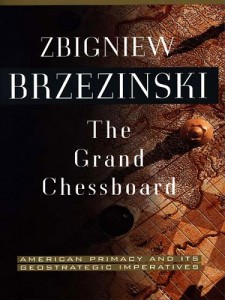
le-grand-echiquier-2Russia is no threat. But to vociferous Russophobes in the Baltic States, Western Ukraine and Poland, the very existence of Russia is a threat. Encouraged by the United States and NATO, this endemic hostility is the political basis for the new “iron curtain” meant to achieve the aim spelled out in 1997 by Zbigniew Brzezinski in The Grand Chessboard: keeping the Eurasian continent divided in order to perpetuate U.S. world hegemony. The old Cold War served that purpose, cementing U.S. military presence and political influence in Western Europe. A new Cold War can prevent U.S. influence from being diluted by good relations between Western Europe and Russia.

Obama has come to Europe ostentatiously promising to “protect” Europe by basing more troops in regions as close as possible to Russia, while at the same time ordering Russia to withdraw its own troops, on its own territory, still farther away from troubled Ukraine. This appears designed to humiliate Putin and deprive him of political support at home, at a time when protests are rising in Eastern Ukraine against the Russian leader for abandoning them to killers sent from Kiev.

To tighten the U.S. grip on Europe, the United States is using the artificial crisis to demand that its indebted allies spend more on “defense”, notably by purchasing U.S. weapons systems. Although the U.S. is still far from being able to meet Europe’s energy needs from the new U.S. fracking boom, this prospect is being hailed as a substitute for Russia’s natural gas sales – stigmatized as a “way of exercising political pressure”, something of which hypothetic U.S. energy sales are presumed to be innocent. Pressure is being brought against Bulgaria and even Serbia to block construction of the South Stream pipeline that would bring Russian gas into the Balkans and southern Europe.

From D-Day to Dooms Day

Today, June 6, the seventieth anniversary of the D-Day landing is being played in Normandy as a gigantic celebration of American domination, with Obama heading an all-star cast of European leaders. The last of the aged surviving soldiers and aviators present are like the ghosts of a more innocent age when the United States was only at the start of its new career as world master. They were real, but the rest is a charade. French television is awash with the tears of young villagers in Normandy who have been taught that the United States is some sort of Guardian Angel, which sent its boys to die on the shores of Normandy out of pure love for France. This idealized image of the past is implicitly projected on the future. In seventy years, the Cold War, a dominant propaganda narrative and above all Hollywood have convinced the French, and most of the West, that D-Day was the turning point that won World War II and saved Europe from Nazi Germany.

Vladimir Putin came to the celebration, and has been elaborately shunned by Obama, self-appointed arbiter of Virtue. The Russians are paying tribute to the D-Day operation which liberated France from Nazi occupation, but they – and historians – know what most of the West has forgotten: that the Wehrmacht was decisively defeated not by the Normandy landing, but by the Red Army. If the vast bulk of German forces had not been pinned down fighting a losing war on the Eastern front, nobody would celebrate D-Day as it is being celebrated today.

Putin is widely credited as being “the best chess player”, who won the first round of the Ukrainian crisis. He has no doubt done the best he could, faced with the crisis foisted on him. But the U.S. has whole ranks of pawns which Putin does not have. And this is not only a chess game, but chess combined with poker combined with Russian roulette. The United States is ready to take risks that the more prudent Russian leaders prefer to avoid… as long as possible.

Perhaps the most extraordinary aspect of the current charade is the servility of the “old” Europeans. Apparently abandoning all Europe’s accumulated wisdom, drawn from its wars and tragedies, and even oblivious to their own best interests, today’s European leaders seem ready to follow their American protectors to another D-Day … D for Doom.

Can the presence of a peace-seeking Russian leader in Normandy make a difference? All it would take would be for mass media to tell the truth, and for Europe to produce reasonably wise and courageous leaders, for the whole fake war machine to lose its luster, and for truth to begin to dawn. A peaceful Europe is still possible, but for how long?

Diana Johnstone is the author of Fools’ Crusade: Yugoslavia, NATO, and Western Delusions.

Source: Counterpunch

Marine Le Pen: EU indifferent to suffering in eastern Ukraine

france-le-penThe leader of the Front National party Marine Le Pen talks to Sophie Shevardnadze on RT.

SS: Obama said the security of America’s European allies is sacrosanct, promising to boost U.S. military deployments and exercises around Europe. Does Europe need this kind of support?

MP: To defend ourselves against whom? […] To defend ourselves against whom? Well, you know that we are for leaving NATO, for France leaving NATO, we have a Gaullian vision of what international politics must be like, we are for developing our relations with Russia, without breaking ties with the United States. We believe that France must maintain its relations with all of the world’s great nations, and we do not want to be imposed with a way of seeing things by anybody. We aspire to have the freedom to determine the quality and the level of our international relations. But… to defend ourselves against whom? When we asked this question to a French politician, his answer was “China”. It almost makes you laugh. We can clearly see that, as a matter of fact, this is an opportunity for the United States to carry out military integration, and maybe tomorrow, economic integration, to extend the scope of its influence. The free-trade agreement that the United States want to sign at any price is really just another way to tie the European Union, in a quasi-definitive way, to the United States. This is, once again, a loss of independence, not to mention the catastrophic consequences that this free-trade agreement would have for us in terms of agriculture, industry, defence, etc. So this is much more a geopolitical treaty than a purely commercial or economic treaty.

S: The G7 condemned Russia for the situation in Ukraine, vowed more sanctions…Why are Western leaders calling on Russia and President Putin to end the violence, and not the government in Kiev, the newly-elected president they’ve been meeting with?

MP: That’s a good question. Because we are at the culmination of a Cold War that has been fought against Russia by the United States, to which the European capitals have completely submitted on an international level. It’s as simple as that, and a shame as well. And I would like to seize this opportunity to express my compassion and my sadness and my disgust to see these civil victims in the East of Ukraine, who are dying surrounded by the general indifference of the European political world and media. It is a real scandal which is happening on our doorstep, and you are right to say that from the moment Ukraine has a legitimate government, it is the government which must take responsibility. But for this, we would need to demand that the Ukrainian government dismantle and disarm the reigning militia, which would most likely embarrass a number of people.

SS: The elections in Ukraine were quick to be accepted by the major powers in the West – despite the civil war that’s going on in the country and the fact that there was no vote in the country’s rebellious East. At the same time, the elections in Syria, were branded illegitimate even before they were held. Why?

MP: Yes, but this has been happening for years! I mean, such and such decides who is on the good side and who is on the bad side. And this can change at any moment. The good guys of today will be the bad guys of tomorrow, and maybe the bad guys of today will become good tomorrow, if Washington decides that it is to their advantage to make them good. It is a shame, since there is a substantial amount of mistakes that have been made at an international level under Washington’s influence, especially in Syria. We were the only ones among the French political parties to oppose intervention in Syria, the first and only ones who, from the beginning, said that we were arming Islamic fundamentalists, who would, if they did win, implement a reign of terror like they did in Libya. This was, once again, because of us. We helped them come to power. This is the American method, the international American method: they defend their interests, or they think that they are defending them, since sometimes they make serious mistakes. What is terrible is that European countries no longer have a say in things. There are no more sovereign nations in Europe that can be the voice of reason for peaceful settlement of conflicts, the voice of balance between different interests of different nations.

SS: You’ve said the EU is responsible for the situation in Ukraine – did it ever know what it was getting into?

MP: By definition, it is not up to me to defend the competency of these bodies. To not know this would be tragic – such geopolitical ignorance seems astounding to me. Nevertheless, the result is there – the European Union did not play the role that it could have played, and it contributed to aggravating the situation. What is really a shame is that countries like France no longer have a diplomatic voice – because here is a conflict in which France, if it had kept a strong political voice, a balancing voice like the one I want it to recover, it could totally manage to overcome these difficulties. The diplomacy of the European Union is a catastrophe, and not only in Ukraine – each time the European Union participates on the global stage, it is usually either to create a problem or to aggravate it.

SS: A little while back there was talk about the new rising superpower – the European Union. These elections showed that the bloc is far from being a universally approved, superstate. Will Europe never unite now?

MP: Europe is not at stake; it is the European Union that is at stake. Europe exists, and it consists of nations whose wealth lies in their uniqueness, their sovereignty, their freedom, their democracy. So, I am for a Europe of nations – I wish that tomorrow we can constitute a Europe that could expand, but to countries that have preserved their sovereignty and that would work together on cooperative projects. This is what works, and this is what I want to implement, but in order to do this, we have to deconstruct this European Union.

Source: RT

Are You Ready For Nuclear War?

pcrBy Paul Craig Roberts

Pay close attention to Steven Starr’s guest column, “The Lethality of Nuclear Weapons“. Washington thinks nuclear war can be won and is planning for a first strike on Russia, and perhaps China, in order to prevent any challenge to Washington’s world hegemony.

The plan is far advanced, and the implementation of the plan is underway. As I have reported previously, US strategic doctrine was changed and the role of nuclear missiles was elevated from a retaliatory role to an offensive first strike role. US anti-ballistic missile (ABM) bases have been established in Poland on Russia’s frontier, and other bases are planned. When completed Russia will be ringed with US missile bases.

Anti-ballistic missiles, known as “star wars,” are weapons designed to intercept and destroy ICBMs. In Washington’s war doctrine, the US hits Russia with a first strike, and whatever retaliatory force Russia might have remaining is prevented from reaching the US by the shield of ABMs.

The reason Washington gave for the change in war doctrine is the possibility that terrorists might obtain a nuclear weapon with which to destroy an American city. This explanation is nonsensical. Terrorists are individuals or a group of individuals, not a country with a threatening military. To use nuclear weapons against terrorists would destroy far more than the terrorists and be pointless as a drone with a conventional missile would suffice.

The reason Washington gave for the ABM base in Poland is to protect Europe from Iranian ICBMs. Washington and every European government knows that Iran has no ICBMs and that Iran has not indicated any intent to attack Europe.

No government believes Washington’s reasons. Every government realizes that Washington’s reasons are feeble attempts to hide the fact that it is creating the capability on the ground to win a nuclear war.
The Russian government understands that the change in US war doctrine and the US ABM bases on its borders are directed at Russia and are indications that Washington plans a first strike with nuclear weapons on Russia.

China has also understood that Washington has similar intentions toward China. As I reported several months ago, in response to Washington’s threat China called the world’s attention to China’s ability to destroy the US should Washington initiate such a conflict.

However, Washington believes that it can win a nuclear war with little or no damage to the US. This belief makes nuclear war likely.

As Steven Starr makes clear, this belief is based in ignorance. Nuclear war has no winner. Even if US cities were saved from retaliation by ABMs, the radiation and nuclear winter effects of the weapons that hit Russia and China would destroy the US as well.

The media, conveniently concentrated into a few hands during the corrupt Clinton regime, is complicit by ignoring the issue. The governments of Washington’s vassal states in Western and Eastern Europe, Canada, Australia, and Japan are also complicit, because they accept Washington’s plan and provide the bases for implementing it. The demented Polish government has probably signed the death warrant for humanity. The US Congress is complicit, because no hearings are held about the executive branch’s plans for initiating nuclear war.

Washington has created a dangerous situation. As Russia and China are clearly threatened with a first strike, they might decide to strike first themselves. Why should Russia and China sit and await the inevitable while their adversary creates the ability to protect itself by developing its ABM shield? Once Washington completes the shield, Russia and China are certain to be attacked, unless they surrender in advance.

The 10 minute report below from Russia Today makes it clear that Washington’s secret plan for a first strike on Russia is not secret. The report also makes it clear that Washington is prepared to eliminate any European leaders who do not align with Washington.

A transcript is provided by Global Research.

Readers will ask me, “What can we do?” This is what you can do. You can shut down the Ministry of Propaganda by turning off Fox News, CNN, the BBC, ABC, NBC, CBS, by ceasing to read the New York Times, the Washington Post, the LA Times. Simply exit the official media. Do not believe one word that the government says. Do not vote. Realize that evil is concentrated in Washington. In the 21st century

Washington has destroyed in whole or part seven countries. Millions of peoples murdered, maimed, displaced, and Washington has shown no remorse whatsoever. Neither have the “christian” churches. The devastation that Washington has inflicted is portrayed as a great success. Washington prevailed.
Washington is determined to prevail, and the evil that Washington represents is leading the world to destruction.

Paul Craig Roberts was Assistant Secretary of the Treasury for Economic Policy and associate editor of the Wall Street Journal. He was columnist for Business Week, Scripps Howard News Service, and Creators Syndicate. He has had many university appointments. His internet columns have attracted a worldwide following. His latest book, The Failure of Laissez Faire Capitalism and Economic Dissolution of the West is now available.

‘Russia has almost no troops abroad’


Vladimir Putin
Vladimir Putin

Russia is still ready for a dialogue with the US, which is the best way to reach mutual understanding, the Russian President Vladimir Putin said in an interview with French TF-1 TV channel and radio station Europe-1, according to ITAR-TASS news agency. Extracts from the interview were released on Wednesday morning.

“I have no reasons to believe the US president does not want to talk to the Russian president, but, after all, he is free to do so,” Putin said. “I am always ready for a dialogue and think this is the best way to build bridges.” Until now, the two leaders had spoken on the telephone several times, he added.

Putin pointed to Washington’s highly aggressive actions on the international arena.

“It is no secret that the most aggressive, the most rigid policy on protection of own interests, as understood by the US Administration, is pursued exactly by the US, year in, year out,” Putin said. “We have barely any troops abroad, whereas the US has troops everywhere, it has military bases all over the world, and everywhere they participate in deciding the fates of other nations that are thousands of miles away from their own borders.”

Source: Voice of Russia

Russia needs Marine Le Pen

marine3A hundred years ago, France was one of major world powers. Today, this is a country, to which one can dictate their conditions, on how, for instance, to build relations with Russia. The French can not agree with it – they vote for Marine Le Pen. The leader of the National Front (NF) supports the actions of the Russian Federation in Ukraine, but her reputation in Europe is the one of a “fascist.”

Today, Europe is ruled by Angela Merkel and the man in charge of the euro printing press – ECB President Mario Draghi. They turned national governments into the “puppets manipulated by the ECB, acting on the basis of a strange mixture of ideological dogmatism and interests of creditors,” Spanish sociologist Ignacio Sánchez-Cuenca said. It is unlikely that the role of Merkel and Draghi would become different, the analyst said. In Europe, though, there are real forces that do not like the transformation of their countries into the Fourth Reich. One of such countries is France, where the population lives to see centrist governments – right and left ones – replacing each other, but nothing changes in their life.

Against this background, the right party National Front chaired by Marine Le Pen won the elections to the European Parliament, having gained 25 percent of the vote which was twice the vote of the ruling Socialist Party. Today, Le Pen attracts a lot of media attention in the world, because she speaks for millions of French and could only care less about the rules of tolerance and political correctness. In a Sunday interview with Der Spiegel, Marine Le Pen dared to warn German Chancellor Angela Merkel that her short-sighted policy could lead to an explosion in the European Union, which Le Pen calls “the European Soviet Union.”

The policy of the chancellor is “positive for Germany, but, unfortunately, it causes damage to other countries,” said Marine Le Pen. “I am warning you: be careful, Mrs. Merkel. If you do not notice the suffering of the peoples of Europe, soon they will hate Germany.” “The EU is a natural disaster, an anti-democratic monster. It is in a state of economic war, and hostilities between the countries grow.” From the point of view of Marine Le Pen, the introduction of the joint European currency put an end to the sovereignty of countries. “Germany is the economic heart of the EU, but Germany must never forget that France remains its political heart,” said the politician. Obviously, there is a warning message that the collapse of the EU, from within, so to speak, may come from France.

In the same interview, Marine Le Pen accused the United States and the European Union of being involved in the crisis and bloodshed in Ukraine. The EU, on American orders, paint Russia in very unpleasant colors. “I stand for the immediate federalization of Ukraine. The European Union added its own fuel to the fire, when it decided to offer closer economic partnership to the state, where about a half of the population still looks to the East.” The leader of the National Front noted that “European politicians need to realize that the United States primarily pursues its own interests in Europe to expand its own presence in the world.”

“Putin was right when, in his speech on the accession of the Crimean peninsula, he said that the land, in terms of culture and history, was closer to Russia. He was right when he called the Russians and the Ukrainians brothers. The history of Ukraine and Russia is closely intertwined, but Kiev is closer to Western Europe,” summarized the NF leader.

Western analysts were puzzled by Marine’s arrogance, they even began to analyze the prospect of her victory at the next presidential election in France. The forecasts are not in her favor yet, but the key word here is “yet.”

Le Pen said that she would try to form a eurosceptic faction at the European Parliament. It will be a faction once it collects parties from seven different countries. They can be the British UKIP of Nigel Farage, right-wing parties from the Netherlands, Denmark, Italy, Austria, Finland and Hungary. Center-left parties can join the bloc too, for example, the German party Alternative for Germany (AFD), which sensationally won seven percent of the German electorate.

Frightened by the prospect of losing control, European bureaucrats launched persecution against Marine Le Pen. Last week, German Finance Minister Wolfgang Schaeuble called the National Front a fascist party. The West accuses Le Pen of anti-Semitism and racial hatred for her remarks about Muslims. The invasion of Muslims in France reminds her of the Nazi occupation of Germany, she said.

Noteworthy, France does not have Muslim historical roots, and the country must somehow defend itself against the loss of Christian cultural values. This sentiment is strong among the youth. According to a survey by Ipsos-Steria, not less than 30 percent of voters under the age of 35 supported the NF in the European vote; 37 unemployed individuals voted for the NF; the percentage among workers was 45.

Criticism comes not only on the line of the renunciation of European values, but also on the line of support to “Putin’s corrupt regime.” Farage of the UK joined Le Pen in calling Putin one of the world leaders, whom he “admires most.” “They (Marin and Farage) try to impose something on Europe, from which Ukraine is trying to escape,” wrote, for example, Anne Applebaum. Namely, it goes about corruption, media manipulation, ignoring boundaries and order. “Those, who do not have democracy, stability and European values, they want them desperately. And those, who do not appreciate them and perhaps are unable to assess them, they start to reach out to arsenic. The question is whether the rest can prevent them from swallowing a deadly dose,” concludes the author.

The elections to the European Parliament are a court of higher instance. “The whole of Europe is taking a step to the right in connection with two events – the economic crisis and changes in the ethnic composition, – Nikolai Mezhevich, Professor at the Faculty of International Relations of the St. Petersburg State University told Pravda.Ru. – The right become ultra, centrist forces – center-right, leftist – center-left and so on, because the European project is not experiencing its best times from an economic point of view and from the point of view of the changing ethnic composition.”

France is rapidly losing its ethnic solidity, which creates grounds for the popularity of ultra-right movements to grow. The same happens in other countries. The victory of the National Front is a third call to European political elites. They should adjust their policies, the expert said.

According to him, “ascribing Marine Le Pen to fascists is an exaggeration and distortion.” Extreme right forces are political realists in Europe. Le Pen supports Putin because she makes French national interests her first priority, just like Putin makes Russian national interests his first priority. “They are not some abstract postmodern trends of global peace, prosperity and disarmament. Le Pen also reasonably believes that the strong France must have strong friends, among which there was the Russian Empire and the Soviet Union in the 20th century,” said the expert.

“The National Front of Marine Le Pen is neither a fascist, nor a far-right party. This is just a right party,” historian and publicist Andrei Fursov told Pravda.Ru. “In today’s world, it is rather left-wing socialists that could be referred to as Nazis – they became velvet supporters of the genocide of humanity, working for transnational corporations. Those, who are referred to as rightist forces, are realists. They do not want Europe to lay down under the United States or the EU bureaucrats. Marine Le Pen and others of rightist beliefs express the point of view of those who are fed up with the artificial creation of the European Union. Moreover, Le Pen clearly points at those, who can be her ally against the backdrop of weakening Europe. Russia needs this support, and the number of such leaders will grow as the Europeans continue to show more and more indignation about the American course,” Fursov said.

Lyuba Lulko
Pravda.Ru

The death of money

 James Rickards
James Rickards

The collapse of the monetary system awaits the world in the near future, says financial expert James Rickards. Russia and China’s desire to rid the US dollar of its global reserve currency status is an early sign of the “increasingly inevitable” crisis.

“China has three trillion dollars, but they are buying gold as fast as they can. China worries that the US is going to devalue the dollar through inflation so they want to have a hedge if the dollar goes down, so the gold will go up,” Rickards told RT.

As one of the key events in support of his forecast, Rickards points to the words uttered by Russian President Vladimir Putin at the 18th International Economic Forum in St. Petersburg that took place earlier this month.

“Putin said he envisions a Eurasian economic zone involving Eastern Europe, Central Asia, and Russia. The Russian ruble is nowhere near ready to be a global reserve currency, but it could be a regional reserve currency,” he said, as quoted by ETF Daily News.

Rickards’ book about the demise of the dollar was released in April under quite an apocalyptic name – ‘The Death of Money.’ However, the author is surprised that the events are unfolding much faster than he predicted.

“If anything, the tempo of events is faster than expected. Therefore, some of these catastrophic outcomes may come sooner than I wrote about.”

Last Wednesday, China and Russia signed a historic US$400 billion gas deal which will provide the world’s fastest growing economy with the natural gas it needs to keep pace for the next 30 years. Experts say this could be the catalyst that dethrones the greenback as the world’s reserve currency.

The best-selling author writes that the “linchpin” of the collapse is the approaching failure of the dollar since it is at the foundation of the system. Powerful countries such as Russia, China, Iran, and India do not rely on the US in their national security and would benefit from the US economy being weaker, thus desiring to break free from the dollar standard.

He elaborates that the dual collapse “looks increasingly inevitable.”

“The mistakes have already been made. The instability is already in the system. We’re just waiting for that catalyst that I call the snowflake that starts the avalanche,” he said, as quoted by ETF.

There are three big international factors that are pressuring the dollar right now – Russia, China, and Saudi Arabia.

“Since the 1970s, Saudi Arabia [has been] the leader in what’s called the petrodollar. It basically means that Saudi Arabia and, by extension, OPEC, price oil in dollars, so the world market is in dollars.

“Russia is a major natural resource exporter; they price their exports in dollars as well. But Russia now is engaged in a financial war with the US around the issues in Crimea and Ukraine.”

The threats to the dollar are “ubiquitous,” the author states in his book. The only way the US can pay off its $17 trillion debt is with inflation, which would drive other countries away from the dollar while the accumulation of gold by Russia and China presages the shift to a new reserve asset.

“The next time we will have a liquidity crisis in the world it’s going to be bigger than the ability of central banks to deal with it. The IMF will basically have to bail out the world by printing the SDRs (an international reserve asset created by the IMF in 1969 to supplement its member countries’ official reserves). By that time, you will see the SDR emerge as the new global world currency,” Rickards told RT.

Russia to build 8 nuclear reactors in Iran

bushehrRussia plans to sign a contract with Iran this year to build two more nuclear reactors at its Bushehr power plant as part of a broader deal for up to eight reactors in the Islamic state, a source close to the negotiations told Reuters on Thursday.

Western powers want any lasting agreement with Iran to put to rest suspicions that it could develop nuclear weapons-making ability through enrichment. Iran denies any such intent.

The talks ended last week with little progress; they are to resume in Vienna in June.

Russia, one of the six powers, built Iran’s only operating nuclear power reactor, at Bushehr.

“Russia and Iran may sign an intergovernmental agreement this year on building from four to eight nuclear reactors, and, under the deal, the contract for the construction of the first two reactors as additions to Bushehr,” the source said.

Source: Reuters

UK politicians urge Prince Charles to abdicate

Taking himself seriously

Some UK politicians say Prince Charles should abdicate the throne and stand for an election if he wants to express his political views, local media reported.

Prince Charles’ remarks about Russian President Vladimir Putin have sparked great controversy both in the UK and Russia.

Sir Tony Brenton, who served as British Ambassador to Russia in 2004-2008, told the BBC, “You can’t be much more insulting about a Russian than to compare him to Hitler, who killed 26 million Russians,” according to Itar-Tass.

Nigel Farage, leader of the UK Independence Party, says Prince Charles was wrong in his comparisons. Farage went on to blame the EU and NATO for expansionist policy in Eastern Europe.

Labor MP Mike Gapes also commented on Prince Charles’ comparison: “If he wishes to be in public life speaking out, saying what he thinks on every issue then unfortunately he should abdicate and stand for election.” Gapes also stressed that he thinks the British monarchy should be seen and not heard. He said the “freedom of speech argument” does not apply to Prince Charles.

Source: Voice of Russia


Russia, China to sign historical deal

Vladimir Putin
Vladimir Putin

Cooperation of Russia’s and China’s defense ministries is an important factor for security in the region and the whole world, Russian President Vladimir Putin said after talks with China’s President Xi Jinping. “As far as military-technical cooperation contacts and contacts between defense ministries are concerned, such cooperation is a major factor for stability and security in the region and around the world,” Putin said. He noted joint projects in civil aircraft building.

“We have good prospects and good projects for creating a wide-body plane and heavy civilian helicopter,” Putin said.

Cooperation in the automobile industry was developing well, too, he said.

“We are working along all lines and there is progress everywhere,” Putin said.

“We shall be expanding financial infrastructures. Active work is underway to expand mutual settlements in the national currencies. We shall give thought to new instruments in the financial sphere,” he added, TASS reports.

Russia and China intend to raise their trade and business ties to a qualitatively new level as the two countries continue to boost their bilateral trade, Russian President Vladimir Putin said at negotiations with his Chinese counterpart Xi Jinping in Shanghai on Tuesday. According to Putin, he and the Chinese leader discussed bilateral issues and key international topics before they were joined by their countries’ delegations.

“Our countries have accomplished an enormous amount of joint work to reach this new historic landmark – a comprehensive partnership and strategic cooperation. China has gained a firm foothold as our main trade partner,” the Russian president said. Mutual trade between Russia and China grew by 2% to $90 billion in 2013 year-on-year, he said.

“Russian-Chinese cooperation has become a crucial factor of international stability. Our cooperation on the platform of the UN and other international organizations is becoming increasingly important. And we will continue to contribute to the development of regional ties, including within the SCO [Shanghai Cooperation Organization],” the Russian leader said.

Russia and China are resolved to resist the interference in internal affairs of other states urging to give up the language of unilateral sanctions, Russian President Vladimir Putin and Chinese leader Xi Jinping said in a joint statement following their talks in Shanghai. Russia and China also called for giving up funding or encouraging the activity aimed at changing the Constitutional order of other states.

“The parties underscore the necessity to respect the historical heritage of countries, their cultural traditions, the independently chosen social and political system, the system of values and ways of development, and resist the interference in internal affairs of other states, giving up the language of unilateral sanctions, the organization of assistance, funding or encouraging the activity aimed at changing the constitutional order of another state or its involvement in any multi-party association or union,” the document said.

The Russian and Chinese leaders call for “keeping the stability of international relations, peace and security at the regional and global levels, settling crises and disputes, fighting terrorism and cross border crime and resisting the proliferation of weapons of mass destruction.”

The parties agree that countries and peoples are increasingly dependent on each other in the modern world amid the convergence of the economies and cultures of different states, according to the joint statement, TASS reports.

Putin’s two-day visit to China may give momentum to restoring multipolar world

During the visit Putin will also hold separate bilateral meetings with some summit participants, in particular, Mongolian President Tsakhiagiin Elbegdorj, President of Afghanistan Hamid Karzai and Iranian President Hassan Rouhani.

A separate meeting of Putin with UN Secretary-General Ban Ki-moon is also planned. “The sides intend to exchange views on all important international issues, including on the situation in Ukraine,” Russian presidential aide Yuri Ushakov told TASS.

In addition, Putin will talk to the former President of the People’s Republic of China Jiang Zemin, “whom Vladimir Vladimirovich knows very well,” Ushakov added.

The current meeting between the heads of Russia and China is the second this year. They had previously met at the opening of the Sochi Olympics in February. According to Ushakov, the two heads of state plan to discuss important issues of the development of relations in various spheres, including interaction in the international arena. The side will pay major attention, in particular, to the work within the framework of the United Nations, BRICS group (bringing together Brazil, Russia, India, China and South Africa) and a number of regional structures, he said. On the talks’ results, the sides are expected to adopt a statement on a new stage in Russian-Chinese relations of comprehensive partnership and strategic interaction.

A package of documents that is planned to be signed in Shanghai would break a record in terms of the volume. “The package consists of 40 – 43 documents. The package that we have now is perhaps a record-breaking,” Ushakov said. He noted, in particular, that the sides continued the preparation of the contract between Russia’s natural gas monopoly Gazprom and China National Petroleum Corporation (CNPC).
China is Russia’s main trade partner. In 2013, the bilateral trade reached a record high level of 88.8 billion US dollars (1.7-percent increase from the 2012 level). In the first quarter of 2014, the growth of this indicator continued and reached 2.2%.

In the view of Ushakov, if this trend persists, the sides may reach by 2015 the level of 100 billion US dollars, and by 2020 – 200 billion US dollars.

The joint design of a long-haul wide-body aircraft and the production of Mil Mi-26 heavy helicopters in China will be the top priority military-technological cooperation areas discussed during the Chinese visit of Russian President Vladimir Putin, newspaper Kommersant said on Monday.

The newspaper quoted sources in the Russian delegation and said Russia’s United Aircraft Corporation (UAC) had drawn up a sketch project and a feasibility study of the prospective long-haul wide-body jet.
“This project is supposed to be a rival for US and European aircraft, and China is interested in building at least 1,000 jets. If the project is successful we may set up a joint venture at some point to compete full-scale against Airbus and Boeing. We are prepared to buy these aircraft for domestic needs, as well,” a source told Kommersant.

The second project will yield a heavy helicopter for Chinese military and civilian structures. “We offered them to buy Mil Mi-26 helicopters but our partners declined that option. They wished to design a helicopter capable of transporting up to 15 tonnes of cargo, so we suggested a concept of profound modernization of the Mi-26 and expressed readiness to start from scratch and to provide exclusive customization,” the source continued.

Putin said he believes the contract for the supply of gas to China will enable Russia to diversify its pipeline routes and will help China reduce its energy deficit. “We are consistently moving towards the formation of a strategic energy alliance,” Putin said. Simultaneously, “active work is being done to reduce the dependence of bilateral trade on external economic factors.”

Putin has said he is always glad to visit hospitable China. The expansion of ties with China is Russia’s indisputable foreign policy priority, Putin said in an interview for the Chinese media ahead of his visit to China. Bilateral cooperation has reached a higher level of comprehensive strategic partnership, he said.

He pointed out that the bilateral cooperation potential was far from exhausted.

Source: Voice of Russia

German press demolishes ‘humanitarian’ US

Headshot
Headshot

In what is becoming a weekly ritual, the German press continues to demolish the US case of “idealistic humanitarian” Ukraine intervention.

A week ago the German tabloid Bild am Sonntag, reaching the broadest audience, reported that dozens of CIA and FBI agents were “advising the Ukraine government.”

This conclusion is hardly a stretch and certainly based on facts considering the recent semi-secret jaunt by CIA head Brennan to Kiev.

The same Bild has now reported that about 400 elite mercenary commandos of the private US security firm, Academi, f/k/a Xe Services, f/k/a Blackwater “are involved in a punitive operation mounted by Ukraine’s new government” against east Ukraine separatists.

Bild cites sources who report that on April 29, Germany’s Federal Intelligence Service (BND) informed the Angela Merkel government about Academi commandos’ involvement in Kiev’s military operations in eastern Ukraine.

Spiegel adds that “the information originates from U.S. intelligence services and was presented during a meeting chaired by the Chancellor’s Office chief Peter Altmaier (CDU). At the meeting were present the president of the intelligence agencies and the Federal Criminal Office, as well as the intelligence coordinator of the Chancellor’s Office and senior Ministry officials.”

Bild am Sontag did not have information about who was paying the Blackwater commandos: it is well-known they do not come cheap.

The German press is aware of the emerging China-Russia axis. The relationship between Russia and Germany is the most notable story in the entire Ukraine conflict.

Murky forces behind Odessa massacre US ambassador admits

Armed thug does not bother Ukranian police
Armed thug in Odessa does not bother Ukranian police

There is no evidence of Russia’s involvement in the Friday massacre in Odessa, US Ambassador in Kiev, Geoffrey Pyatt had to admit Sunday as he spoke by telephone on a CNN program.

Friday, May 2, football fans who had come to Odessa from the northeast city of Kharkov as well as the combatants from two far-right extremist organizations, the Right Sector and the Maidan Self-Defense Force clashed with the supporters of federalization of Ukraine in downtown Odessa.

They set fire to the regional House of the Trade Unions and a tent camp near it where activists had been gathering signatures in favor of a referendum for federalization of Ukraine and for granting Russian the status of a second state language.

As a result of the tragic events, 46 people died and more than 200 survivors had to turn for medical aid.

“We don’t have evidence of the Russian role in […] the tragedy that transpired on Friday,” Pyatt said answering the anchor Candy Crowley’s downright aggressive question on whether he believed that Russia was behind “this bloodiest day thus far in this back-and-forth [the course of the Ukrainian crisis]”.

Pyatt mentioned the blunt accusations towards Russia that the prime minister of the incumbent Kiev government, Arseny Yatsenyuk, had made in Odessa earlier in the day.

“And this is something that we hope an impartial and systematic investigation will be able to get to the bottom of very quickly,” he said.

Pyatt indicated that he could not understand clearly why the Friday massacre had taken place.

“[…] having spent some time in Odessa just three weeks ago and spoken with a broad range of political and civil society leaders, there’s nothing that I heard and saw while I was in that city which would explain what transpired on Friday night,” Pyatt indicated.

“At this point, the whole country is trying to figure out what happened, how to pull together, and how to make sure that those who are trying to divide the country will not be successful,” he said.

“Most disturbingly, there seems to be evidence in social media that some of the police in Odessa may have been complicit in allowing the violence to explode out of control way it did.”

A private military company is in charge of suppressing protest movements in Eastern Ukraine, said a source in the country’s Security Service. According to him, the name of the company is Greystone Limited.

According to a source cited by ITAR-TASS, Ukrainian authorities believe that the Security Service is not able to suppress the protest mood and neutralize the leaders and activists of the pro-Russian movement in the eastern regions. In particular, the source said, the acting president Alexander Turchinov shares this opinion.

“Therefore it was decided to attract foreign mercenaries, who will serve as political police and state security protection, ” said the representative of the Security Service.

He informed that the initiative to attract mercenaries belongs to oligarchs Igor Kolomoisky and Sergei Taruta, appointed governors of Dnepropetrovsk and Donetsk regions.

Self-defense forces in the anti-Kiev stronghold of Slavyansk are Ukrainians, not Russians, who distrust the new regime and the Western powers that support it, New York Times reporters have discovered. The forces also said they are not being paid to fight.

Source: VoR/RT