‘Kosovo gives Crimea right to self-determination’

Gregor Gysi
Gregor Gysi

The recognition of Kosovo independence set a precedent that gives Crimeans, as well as Basques and Catalans, a right for self-determination, German opposition leader said, lashing out against Angela Merkel’s support of sanctions against Russia.

Gregor Gysi, a parliamentary head of the largest lower-house opposition party in Germany has spoken out on Thursday against German Chancellor’s unquestioning support of the coup-appointed Ukrainian government.

“They formed a new government….. Immediately recognized by president Obama by the EU and German government as well. Miss Merkel! The vice-prime minister, the defense minister, minister of agriculture, environment minister, the attorney general.. They are fascists!” he stated.

Gysi said that NATO opened Pandora’s Box by recognising the unilaterally proclaimed independence of Kosovo and that Crimea’s secession from Ukraine applies the same pattern of international law.

“With Kosovo, they opened Pandora’s box. What’s allowed for Kosovo, you should also allow for others. I told you this but you haven’t listened to me. Winning the Cold War has eclipsed everything for you, you forgot about everything else,” Gysi said.

“The Basques are asking why can’t they make their choice, whether they want to stay within Spain or not? Catalonians are asking, why can’t they decide whether they want to belong to Spain or not. Of course people living in Crimea are asking the same thing.”

“I think that Crimea breaking away from Ukraine is just the same as Kosovo. I knew Putin would use this argument, and he did,” the politician said. “It must be found, such status for the Crimea, which will be acceptable for Ukraine, Russia, and us.”

Gysi also commented on NATO’s expansion to the east and called on the German government and the West to acknowledge the “legitimate security interests of Russia.”

“When we restored Germany’s unity, the US, German and other foreign ministers proclaimed there will be no NATO expansion to the east. But this promise has been broken. There was an expansion of NATO in Russia’s direction,” said Gregor Gysi in an outburst directed at Merkel.

“Security in Europe, there are neither without nor against Russia, but with Russia. When the crisis is over one day, an advantage could be that international law is finally respected again from all sides,” Gysi concluded.

Right before Gysi’s emphatic statement Chancellor Angela Merkel addressed German MPs, expressing her support of imposing sanctions and warning Russia that it risks “massive political and economic consequences” if it sticks to its position on Ukraine.

Russia has repeatedly said it considers the actions of Crimean authorities reasonable and legal, and will respect the results of the referendum.

Source: RT

China warns West against escalation in Crimea

shi
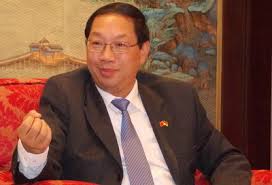
Ambassador Shi Mingde

China’s top envoy to Germany has warned the West against punishing Russia with sanctions for its intervention in Ukraine, saying such measures could lead to a dangerous chain reaction that would be difficult to control.

In an interview with Reuters days before the European Union is threatening to impose its first sanctions on Russia since the Cold War, ambassador Shi Mingde issued the strongest warning against such measures by any top Chinese official to date.

“We don’t see any point in sanctions,” Shi said. “Sanctions could lead to retaliatory action, and that would trigger a spiral with unforeseeable consequences. We don’t want this.”

The interview was conducted on Wednesday, the same day that the EU agreed a framework for sanctions that would slap travel bans and asset freezes on people and companies accused by Brussels of violating the territorial integrity of Ukraine.

German Chancellor Angela Merkel, has taken the side of the putschists supported by the United States, and warned that unless Russia accepts the idea of a “contact group” to resolve the crisis diplomatically, Russia risked “massive” political and economic damage if it did not change course in the coming days.

Source: Reuters

National sovereignty inconsistent with US dollar system

pcrFrom the moment that Washington launched its orchestrated coup in Kiev, Washington has been accusing Russia of “intervening in Ukraine.” This propaganda ploy succeeded. The Western presstitute media reported (nonexistent) Russian intervention to the exclusion of coverage of Washington’s obvious intervention.

Having falsely accused Russia of invading Crimea, the Obama regime now demands that Russia interfere in Crimea and prevent the referendum set for next Sunday. Unless Russia uses force to prevent the people of Crimea from exercising their right of self-determination, John Kerry declared that the Obama regime will not discuss the Ukrainian situation with Russia.

So, Kerry has given Russia the green light to send in troops to prevent Crimean self-determination.

The presstitute Western media has not noticed that out of one corner of his mouth Kerry denounces Russia for intervening and out of the other corner of his mouth Kerry demands that Russia intervene in behalf of Washington’s interest and suppress Crimean self-determination.

What is the point of such an absurd demand on Russia?

The Obama regime claims that the Crimean vote is not legal, because all of Ukraine is not voting on Crimea’s future. When Washington stole Kosovo from Serbia, Washington did not allow Serbia to vote on Kosovo secession. In the upcoming Scottish vote on whether to secede from the UK, only the Scottish are voting, not the British population. But these normal processes established in international law cannot be permitted to Crimeans, because the vote will not support Washington’s agenda.

Clearly, an Obama regime this shameless has no shame.

The neoconservative warmongers who control the Obama regime are boasting that unless Russia prevents Crimean self-determination, Washington will use sanctions to “badly damage the Russian economy.”

Sanctions are likely to backfire. Sanctions would damage economies of Washington’s NATO puppet states, making them think again about providing cover for Washington’s aggressive words and deeds. It is Europe that will pay for Washington’s aggressive actions.

Sanctions are likely to speed up the implementation of the BRICS negotiations to leave the dollar system and settle their international accounts in their own currencies. All countries with financial and economic links to the West can be intimidated, punished, and destabilized by Washington. National sovereignty is inconsistent with being part of the US dollar system.

From Washington’s standpoint, the importance of sanctions is not any economic effects.

The importance is the propaganda advantage of portraying Russia as an offending party who is punished by Washington. Not only does this propaganda put Russia in the wrong, it also portrays Russia as subservient to Washington.

The Crimean government is actually elected, whereas the Washington-installed government in Kiev is not. Here is a report on Global Research about the “democrats” who comprise the unelected government in Kiev:

During the Clinton, George W. Bush, and Obama regimes, Washington has established that whatever serves Washington’s agenda is legal. Laws inconsistent with Washington’s agenda are simply not applicable. They are dead letter laws. Therefore, it comes as no surprise that in violation of US law that prohibits giving financial assistance to governments whose leaders come to power via coup or other illegal means, Washington is offering its stooges in Kiev $1 billion to help the coup government get up and running.

Paul Craig Roberts was Assistant Secretary of the Treasury for Economic Policy and associate editor of the Wall Street Journal. He was columnist for Business Week, Scripps Howard News Service, and Creators Syndicate. He has had many university appointments. His internet columns have attracted a worldwide following. His latest books are, The Failure of Laissez Faire Capitalism and How America Was Lost. 

Ukrainian putschists can’t send army to Crimea

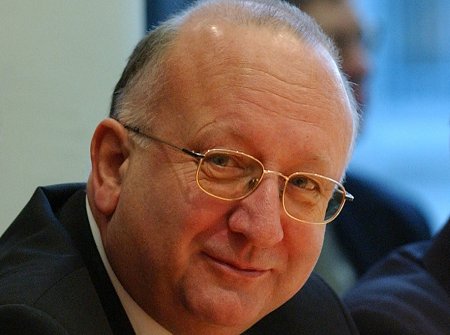
Willy Wimmer
Willy Wimmer

Ukraine’s acting president said the country could not use its army alone to stop Crimea from seceding, the latest sign that Crimean independence may be imminent.

Oleksandr Turchynov’s comments came after the Crimean parliament voted for independence ahead of a Sunday referendum on joining Russia, while Washington and Moscow engaged in one of the fiercest clashes since the Cold War.

The interim leader of Ukraine’s putschists said intervening in the Black Sea peninsula, where Crimeans have seized de facto control, would leave Ukraine exposed on its eastern border, close to Russia.

“We cannot launch a military operation in Crimea, as we would expose the eastern border and Ukraine would not be protected,” Turchynov told AFP.

Willy Wimmer, former vice president of the Organization for Security and Co-operation in Europe (OSCE) and state secretary at the German Defense Ministry, said the Black Sea territory might end up under US domination.

The veteran German politician warned more than a decade ago that NATO’s bombing of Yugoslavia was actually part of a US expansion plan.

Until the mid-90s however, all major powers agreed in international law, and in cooperation. But in the middle of the 90s, the US changed tack. They clearly no longer feel bound by international law.

The war in Yugoslavia was only the beginning, and since then, Afghanistan, Iraq, Syria, Libya, have shown that the US would rather rely on military power.

Wimmer said the current government in the Ukraine is not legitimate. “I think it was a putsch, a coup d’état, what happened in Kiev. And what we heard in the news before, the OSCE and other international bodies are doing what they can to create a legal framework for a government which is not legal at all.”

Wimmer said the US puppets in Ukraine are co-operating with Nazi groups, a punishable offence in Germany and other European countries. Many ban all elements associated with Nazism, including Nazi symbols. The coup in Ukraine have left many Europeans fearful of what the US might plan next.

At a political rally in Bavaria this week the main speaker addressed the audience with an appeal not to forget the friendship with the Russian people.

India backs Russia in Ukraine

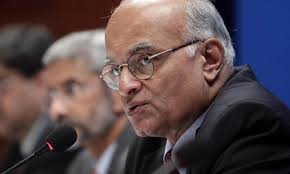
Shivshankar Menon
Shivshankar Menon

India broke with the international community in acknowledging that Russia has legitimate interests in Ukraine.

On Thursday a senior Indian official endorsed Russia’s position in Ukraine in recent days, even as Delhi urged all parties involved to seek a peaceful resolution to the diplomatic crisis.

When asked for India’s official assessment of the events in Ukraine, National Security Adviser Shivshankar Menon responded:

“We hope that whatever internal issues there are within Ukraine are settled peacefully, and the broader issues of reconciling various interests involved, and there are legitimate Russian and other interests involved…. We hope those are discussed, negotiated and that there is a satisfactory resolution to them.”

The statement was made on the same day that Crimea’s parliament voted to hold a referendum for secession from Ukraine.

India is the second major nation to publicly lean toward Russia after China’s public statements.

Ukraine’s puppet government reacted to India’s endorsement of Russia’s legitimate interests with hostility.

India and Russia have long-standing ties and Moscow is Delhi’s top arms provider. Moreover, Russia and the former Soviet Union has been nearly alone in the international community in continue to back India during crucial moments such as following its 1974 and 1998 nuclear tests.

Delhi believes Russia’s intervention offers the best chance of stabilizing Ukraine. India’s Foreign Ministry on Thursday also released a statement noting that there are “more than 5,000 Indian nationals, including about 4,000 students, in different parts of Ukraine.” At the same time, India’s overall interest in Ukraine is fairly negligible—certainly less than China’s, for instance—and thus Delhi might assess that it has more to gain by publicly sticking by Moscow at a time when it desperately needs support.

India also has plenty of interests in certain regions along its peripheral, and at certain times—such as during the Sri Lanka Civil War—has intervened to protect various societal groups with strong ties to India.

Indian officials have told Telegraph India that, in the newspaper’s words, Delhi is “convinced that the West’s tacit support for a series of attempted coups against democratically elected governments — in Egypt, Thailand and now Ukraine — has only weakened democratic roots in these countries.”

This rationale would be consistent with India’s long-standing, deep-seated abhorrence to anything that merely resembles Western imperialism. At the same time, India has not historically made supporting democracy abroad a central tenet of its foreign policy.

Source: The Diplomat

Will Baroness Ashton of Upholland lead the nuclear charge?

Baroness Catherine Ashton
Catherine Ashton adjusting her GU crown

When Victoria Nuland rejected the EU solutions in Ukraine with her “Fuck the EU” comment, the EU went it alone. Germany’s Foreign Minister, Frank-Walter Steinmeier proposed that he and his French counterpart, Laurent Fabius, fly to Kiev and try to reach a resolution of the violence before escalation. Polish Foreign Minister, Radoslaw Sikorski was asked to join.

The talks in Kiev included the EU delegation, Yanukovich, the three opposition leaders and a Russian representative. The US was not invited.

Then suddenly snipers began shooting into the crowd in Maidan Square. Panic ensued and riot police retreated in chaos according to eyewitnesses. Vitali Klitschko withdrew from the deal. Yanukovich fled Kiev.

Now that the “opposition” has driven a duly-elected president into exile and dissolved the national riot police, Berkut, Washington has demanded that Ukraine submit to very onerous IMF conditionalities. As Paul Craig Roberts writes:

According to a report in Kommersant-Ukraine, the finance ministry of Washington’s stooges in Kiev who are pretending to be a government has prepared an economic austerity plan that will cut Ukrainian pensions from $160 to $80 so that Western bankers who lent money to Ukraine can be repaid at the expense of Ukraine’s poor.

The corrupt Western media describes loans as “aid.” However, the 11 billion euros that the EU is offering Kiev is not aid. It is a loan. Moreover, it comes with many strings, including Kiev’s acceptance of an IMF austerity plan.

The austerity plan will cut social services, funds for education, layoff government workers, devalue the currency, thus raising the prices of imports which include Russian gas, thus electricity, and open Ukrainian assets to takeover by Western corporations.

Ukraine’s agriculture lands will pass into the hands of American agribusiness.

The conflict between the US and the EU has thus been exposed.

Meanwhile Vladimir Putin has made it clear that Moscow does not need to “invade” Ukraine. The 1997 Ukraine-Russia partition treaty specifically allows Russian troops in Crimea. No shots were fired and Russian “sons” were welcomed with open arms.

The US should start worrying about the white supremacists they so ardently and openly support in Ukraine, but shun elsewhere. If the Nazi’s take over – which seem more and more likely – the UN’s R2P (responsibility to protect) will come into play. Samantha Power, the architect of R2P, should be proud of herself for crafting the ultimate solution many hawks in the US wish for.

The three war-mongering women who represent the West’s foreign policy apparatus, US Assistant Secretary of State for European and Eurasian Affairs Victoria Nuland and EU official and onetime British Campaign for Nuclear Disarmament activist Catherine Ashton, and United States Ambassador to the United Nations Samatha Power, have been exposed. The first two by leaked phone calls, and the latter by her R2P plan.

Ashton, actually the grand and feudalistic Baroness Ashton of Upholland, also has an exaggerated view of her own accomplishments. She has scant knowlegde of what transpires in Europe, but flatters herself with the inflated title of High Representative for Foreign Affairs and Security Policy for the European Union.

Her title hasn’t lifted her dour expression and gloomy features yet, but it might be as a result of her closeness to the Great Unwashed, the GU.

The Baroness is married to former British journalist Peter Kellner, an executive of the British polling company YouGov. The pollster does political polling as well as the very dull infotainment media charts of Pop Idol and X-Factor, pandering to the GU. Only in Britain could a Labourite sink to such depths of grandeur.

In a phone call between herself and the Estonian foreign minister Urmas Paet, Ashton was told what had really happened in Kiev. The High Representative could no wait to throw cold water on the information that the “opposition” – actually a NATO force with looted Libyan weapons some say – was behind the shootings of protesters and policemen.

Ashton quickly defended the new members of the Ukrainian Rada, the parliament. The Estonian Foreign Ministry in the meantime has confirmed that the transcript is authentic.

Essentially, Ashton told the Estonian foreign minister that in the Machiavellian shaping of the fake opposition in the Rada, some “cannon fodder” had been required.

Ashton’s agenda complements that of Nuland whose January phone call with US ambassador to Ukraine Geoffrey Pyatt revealed that the Obama administration was hand picking and paying the future government of Ukraine even while Ashton, as well as Nuland’s co-ideologue Jeffrey Feltman, the United Nations Undersecretary General for Political Affairs, were feigning interest in a negotiated solution.

Nuland sounded certain that the US would achieve its political aims with the support of America’s bought-and-paid for UN team of Feltman and his boss, Secretary General Ban Ki-moon who was known to South Korean journalists as the “slippery eel” when he served as South Korean foreign minister.

The Calcutta-born Special UN envoy to Ukraine, Dutch diplomat Robert Serry, in which Nuland expressed great confidence must also not be forgotten in the coup plot.

Thanks to the intercept capabilities of loyal and proficient Ukrainian security agents, the world now understands the perfidy of chattering women who are helping lead Europe and, possibly, the rest of the world, into a massive conflagration, possibly a nuclear war.

German economist warns sanctions against Russia could harm EU

Economic sanctions against Russia would cause serious damage to Germany’s switch to alternative energy sources, the head of the German Economic Research Institute, Hans-Werner Sinn, said in an interview published in Germany’s Passauer Neue Presse on Friday.

Germany cannot afford such a policy of sanctions, as it considerably depends on Russian gas supply in the process of switching to alternative energy sources, the economist notes. According to him, EU sanctions will only harm the European countries.

Any attempt to bring such countries as Ukraine out of Russia’s influence and link with the West is naive, he believes.

Russia, along with Norway, is an important supplier of gas to Germany, the publication notes.

Source: Voice of Russia, Interfax

Russia surprised at EU refusal to comment on new leak

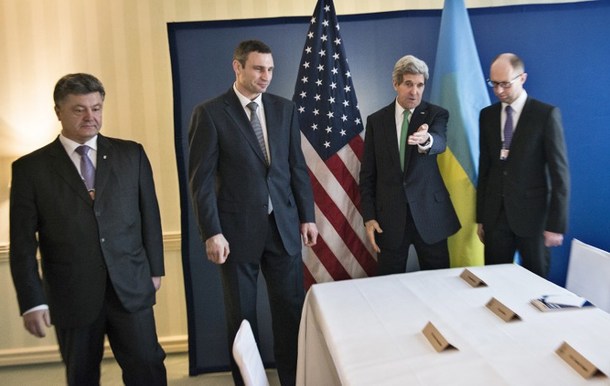
Kerry directing the script with Poroshenko, Klitch and Yats

Russian Foreign Ministry has expressed its surprise at the EU refusal to comment on the leaked phone conversation between the EU Foreign Policy Chief Catherine Ashton and Estonian Foreign Minister Urmas Paet. Earlier the Estonian Foreign Ministry confirmed the authenticity of the recording that suggested the snipers who shot at protesters and police in the Ukrainian capital Kiev were allegedly hired by the new coalition, and not ousted President Yanukovich. The Voice of Russia’s political analyst Dmitriy Babich expressed his opinion.

How can you comment on this conversation?
I think it is just astounding what Mr. Paet had to say because basically the Western press has been saying for all these days that the file only came from the government side and it was taken as an axiom by most of the media in the West. And now we find out from Mr. Paet who talked to some opposition activists of the civil society actually. So they acknowledged that the bullets and the weapons used to kill on both sides were basically the same and that the main suspicion is not actually with Yanukovych but with what Mr. Paet called ‘the opposition coalition’. But I would like to remind you that part of this opposition is the neo-Nazis party called ‘Svoboda’. Until 2004 it was called National Social Party of Ukraine. If you read its program, they suggest that people should identify their ethnic origin in their passports, that what the call Ukrainophobia should be punished, should be seen as the criminal offence and they make quite a few other suggestions which remind one of the Nazi Germany.

So the opposition is actually responsible for the killings?
Well, I think basically that the main problem is the bias of the Western media because just if you watch television, if you watch the television images of these three months, you can see that these so-called peaceful protesters attacked police much more often than the police attacked them. The most typical situation is the police standing on the street blocking the path to the Presidential administration, hiding behind their shields, and the “peaceful protesters” in the Western understanding of this word, first they throw at them stones and Molotov cocktails, and then they attack them with metal chains, metal sticks and this is all just civil society on protest against the corrupt government. I am afraid this lead conversation will not be investigated for the very simple reason. The new prosecutor general of Ukraine Mr. Makhnitskiy, he is a member of the Svoboda party. So for more than a decade he believed that people should be checked for their loyalty for the Ukraine state on the lie detector, that people who lied about having a double citizenship, most likely Russian citizenship should be deprived of their property. So you can imagine what this kind of person will do with this recorded conversation. He is not going to investigate it.

Is there any chance that Maidan, which is still a force in Ukraine will somehow press the authorities, force the authorities to start the investigation?
I think that what you call Maidan is just a crowd, which can be manipulated like any crowd. And crowds are incapable of investigations. Crowds are moved by hate or love, they are moved by primitive emotions. And the crowd that we have seen in the center of Kiev for these three months was an evil crowd. Even its supporters agree that about 50% was moved because of hatred for corruption and 50% moved by hatred for Russia and Russians. I think that ethnic hate is a lot worse than corruption and certainly these people are not going to push for a fair investigation and they are not going to accept the results of a fair investigation because in their hearts they have already blamed their enemies from everything.

Let’s get back to this tape. If we listen to it carefully, to what Mr. Paet and Catherine Ashton were talking about and to what they said, they actually never said that these facts should be concealed. So probably, is there a chance that international community, the so-called international community would somehow, especially now when it is leaked, press the authorities to still investigate it?
No, I don’t believe in it because the international community had every evening lots of television images before its eyes and it continues to pronounce the same lies. They have seen the Molotov cocktails, they have seen the policemen killed and mutilated, and they continued calling these people peaceful protesters for three months. So do you think that after this huge lie they are going to investigate just one small lie that conspired in the recorded phone conversation? No, the EU and the US engaged themselves 100% on the side of the opposition. They failed to guarantee the Agreement on division of power, which was signed between Yanukovych and the opposition on the 21st of February. Their attitude is not compromised in the investigation. Their attitude is media on slot and victory. And victory under the slogan “the winner takes all”. That’s their attitude, it is extremely destructive.

If we talk about situation in Ukraine. The two politicians are actually talking about credibility of Ukrainian politicians and they also say that the only one who is more or less popular both in so-called civil society and among Maidan and also in eastern Ukraine is Mr. Poroshenko. Do you think that actually reflects the state of affairs in Ukraine that no one is popular there except for one or two people?
The problem is that all their conversation is extremely amateurish. These are the people who have very superficial knowledge of Ukrainian politics. But they feel themselves empowered to discuss and decide who is going to be the next government and their attitude is based on hear-see things like “I liked this Olga, I think she should be the next Minister of Health”. Poroshenko is sympathetic to me; I think he should be a member of the new government. That reminds me of Victoria Nuland’s conversation that was also recorded how she says to the American Ambassador in Kiev “Okay, Yatzenuk, she calls him Yatz, he started with economics, so he probably should be in the next government”. You know, Klitch, this is the way she calls Klitchko “I don’t like him. He shouldn’t be in that government”. She probably doesn’t like him because he is a boxer and that doesn’t reflect well on her image of a member of government. So this talk is just laughable, it is extremely amateurish. And I think it is tragic that these kinds of people actually decide the fate of the country that has a population of 46 million. And this people lecture Russia and they lecture Ukrainians on how they should live, how bad we all are, and this is just pathetic. This is the only word I can find for it. Pathetic.

Source: Voice of Russia

Russia, Switzerland mark 200 years of diplomatic ties

ruskiswissRussia and Switzerland on Thursday mark the 200th anniversary of the establishment of diplomatic relations. On this occasion, the two countries’ foreign ministers exchanged congratulatory messages, where they reiterated their commitment to further development of bilateral cooperation in various areas and further political contacts, including top-level contacts.

“The jubilee is a good occasion to look back at the path our countries have travelled, to recall the common historic past and try to analyze its lessons, to draw intermediate results of cooperation and outline plans for the future,” Dmitry Lyubinsky, director of the Russian Foreign Ministry’s Third European Department, told Itar-Tass. “It is important that both we and our partners are looking at the future of the Russian-Swiss relations with optimism.”

On February 22 (March 6), 1814, Russian diplomat Count Ivan Antonovich Kapodistria presented his credentials as the Russian Ambassador to Switzerland. A year after that, the Vienna congress proclaimed the Russian Empire as one of the guarantee powers for permanent Swiss neutrality. Thus, Russia made its contribution to the structure of Switzerland’s political system, thanks to which Switzerland avoided disastrous wars of the 19th and 20th centuries.

“I cannot say that everything was always smooth in our relations,” Lyubinsky went on. “The murder of Russian diplomat Vorovsky in Lausanne in 1923 and subsequent acquittal of the killer by the jury lead to the severance of diplomatic relations, which were resumed only in March 1946. Ever since, bilateral cooperation has only been growing and now we have reliable and promising partners in Switzerland in all areas of cooperation.”

Moscow is set for constructive cooperation with Bern over the period of the latter’s presidency in the Organization for Security and Cooperation in Europe (OSCE) in 2014. Strengthening of the OSCE’s role and enhancing its authority in international affairs meets the interests of both countries. Increased attention should be focused on problems stemming from transnational threats, on protection of the interests on national minorities, on counteracting extremism, and on OSCE reforms. It is important to exert more effort to promote the Helsinki Plus 40 process in order to draft a conceptual strategic document on principles of cooperation and security in Europe by the anniversary of the Helsinki Final Act in 2015.

The Russian-Swiss relations have reached a qualitatively new level in the recent years. A milestone event in bilateral relations was the first-ever visit by the Russian president to Switzerland in September 2009. The visit gave an extra impetus to closer cooperation in all areas, including the sphere of high technologies and innovation. Close contacts are maintained by the foreign ministries of the two countries. In 2007, they signed a joint memorandum on closer cooperation. The documents provides for consultations on a wide range of international and bilateral issues. In 2013 alone, the two countries’ foreign ministers and top-ranking foreign ministry officials had more than 20 such rounds. Russian and Swiss foreign ministers have annual meetings, including on the sidelines of various international events. Russian-Swiss summit meetings have become a regular practice in the recent years.

Source: TASS

New leak: Current Ukranian leaders hired snipers

Anglo-American terrorists in Kiev

Details of a leaked phone call between EU foreign affairs chief Catherine Ashton and Estonian foreign affairs minister Urmas Paet presented evidence that the US-backed opposition was responsible for hiring snipers who gunned down protesters in Kiev and not the deposed government of Viktor Yanukovich, as the media widely claimed.

More than 90 people were killed and another 900 injured during the standoff between police and protesters at Maidan Saquare in Kiev last month.

During the phone call, Paet tells Ashton that evidence presented to him by a doctor, Olga Bogomolets, who treated victims of the sniper attacks clearly indicates both police and protesters were being shot at by the same people. She has also just turned down the position of Vice Prime Minister of Ukraine for Humanitarian Affairs offered by the coup-appointed regime.

“There is now stronger and stronger understanding that behind the snipers, it was not Yanukovich, but it was somebody from the new coalition,” said Paet during the phone call.

The Estonian FM has described the whole sniper issue as “disturbing” and added, “it already discredits from the very beginning” the new Ukrainian power.

His overall impressions of what he saw during his one-day trip to Kiev are “sad,” Paet said during the conversation.

He stressed that the Ukrainian people don’t trust the Maidan leaders, with all the opposition politicians slated to join the new government “having dirty past.”

The file was reportedly uploaded to the web by officers of Security Service of Ukraine (SBU) loyal to ousted President Viktor Yanukovich who hacked Paet’s and Ashton’s phones.

“And second, what was quite disturbing, this same Olga [Bogomolets] told as well that all the evidence shows that the people who were killed by snipers from both sides, among policemen and then people from the streets, that they were the same snipers killing people from both sides,” the Estonian FM added.

Ashton reacted to the information by saying: “Well, yeah…that’s, that’s terrible.”

The true narrative therefore suggests that forces within the opposition hired the snipers in order to kill protesters and then blame the deaths on Yanukovich’s administration, thereby delegitimizing his bid to hold onto power.

This is a classic example of the kind “false flag” attack that NATO, which has vehemently sided with the opposition, perfected in Europe with Operation Gladio.

“I think we do want to investigate. I mean, I didn’t pick that up, that’s interesting. Gosh,” Ashton said in response to Paet.

A secretive British “forensic team” who refused to tell the BBC who they were working for, concluded that the Yanukovich government was responsible for the “bloodbath” before any formal results were published. There is strong reason to believe they were quickly sent in to clean up the crime scenes and destroy evidence.

Paet indicated that the newly installed government had since launched a cover-up of the sniper attacks, remarking, “They don’t want to investigate what exactly happened.”

The phone call was conducted after Paet visited Kiev on February 25 at the height of the clashes between police and protesters.


Ukraine fever sweeps the Balkans

balkansAs the world watches the Ukrainians in their effort to defend themselves from Russia and become a fully European nation, close attention to the situation in Kiev and the crisis in Crimea is notable in the Balkan Muslim countries—Kosovo, Albania, Bosnia-Herzegovina—and in two with significant Muslim minorities, Montenegro and Macedonia.

In the Balkans, the threat of Serbian aggression has receded, but in a parallel with Ukraine, Russian influence is perceived behind intrigues from Belgrade. The events in Ukraine are seen in a context of the struggle against corruption and the phenomenon of the post-Communist “mafia state.”

In the first week of February, a wave of protest began in the Bosnian city of Tuzla, which is known for its tradition of multiethnic harmony among Bosnian Muslims, Croats, and Serbs. An old industrial redoubt now plagued with unemployment ranging between 40 and 60 percent, Tuzla boiled over quickly, as reported by BBC News, with attacks on official buildings.

Solidarity demonstrations spread to other Bosnian cities with economic problems, including Mostar in Herzegovina, which is divided between Muslims and Croats and has an aluminum industry, Zenica in central Bosnia, where a steel complex has been owned by ArcelorMittal since 1998, and then to Sarajevo, the capital. There, on February 7, demonstrators set fire to government buildings and fought police.

Local and foreign media, international observers, and politicians assigned blame for the Bosnian upheaval in all directions. Resentment of the excessively convoluted bureaucracy foisted by the 1995 Dayton Accords on Bosnia, which is partitioned between a so-called “Republic of Serbs” and the “Federation of Bosnia-Herzegovina,” grouping Muslims and Croats, is one issue. “Federation Bosnia” comprises 10 cantons, each with its own autonomous political and educational authorities, plus a special zone at Brcko in the northern part of the territory, all reporting—barely—to the supposed central government in Sarajevo. It has more varieties of statist delirium above and below the cantonal level: legislatures, ministries, municipalities, in a seemingly endless and redundant supply.

Economic opportunities mostly involve political malfeasance, financed by the European Union through the Office of the High Representative (OHR), the real government, with American support. The current high representative is an Austrian of Slovene background, Valentin Inzko. Bosnia-Herzegovina is therefore a place of profound despair, afflicted by brain drain. Its traditional Central European system of education, which produces well-trained graduates, sees them leave for other countries as soon as they can. A serious upheaval in Bosnia was, to anybody watching the country, obviously on the way—a matter of when, rather than why.

Also at the end of the first week of February, Kosovo saw turmoil as Ibrahim Gashi, rector of the University of Pristina, in the capital of that Balkan republic, was forced to resign after he was exposed as a falsifier of his academic work. Clashes between police and students left 29 officers hurt and 30 students arrested. Gashi’s departure from the university was followed by that of several of his colleagues.

In Podgorica, the capital of Montenegro, on February 18, hundreds of people gathered, throwing rocks at state offices, and injuring nine policemen. The Montenegrins called for “revolution.” Unemployed workers in Macedonia assembled in front of government buildings in that country’s capital, Skopje, on February 18. The next day, in Albania, after an informal strike by minivan drivers, in a country lacking a reliable public transportation system, a full one-day transport shutdown took place, with a rally in Tirana, the capital.The idiom of social rebellion is common in Balkan culture, which has undergone numerous such movements over the centuries, and where communism in the former Yugoslavia, under the charismatic dictator Joseph Broz Tito (1892-1980) kept memories of it alive in a civic myth that imposed much less conformity and silence than in other Communist lands. Lately, public acclaim for a “Balkan spring” gave way rapidly to visions of a “Bosnian-Ukrainian model.”

But in Bosnia-Herzegovina and Albania, entrenched elites quickly sought to profit from social conflict. The Bosnian politician Fahrudin Radoncic, leader of a party titled the Union for a Better Future, which holds four out of 28 seats in the weird, ineffectual House of Representatives crafted for the Muslim-Croat Federation, has been accused of organizing the assault on the government buildings in Sarajevo in an attempted coup d’etat. Radoncic, once a respected dissident, is now seen as a patron of shady deals with Serbian extremists—likewise an old motif in the Balkans. Dnevni Avaz (Daily Voice), a down-market tabloid owned by Radoncic, last week featured a column headed “Ukraine Is All of Us”—rhetoric viewed as cynical by many Bosnians.

Similarly, former Albanian prime minister Sali Berisha, an ex-Communist and leader of his country’s entrenched Democratic party, stirred the striking minivan drivers against the Socialist (i.e., neo-Communist) administration of Edi Rama, who took power last year.

As in Ukraine, allegations that discredited leaders are manipulating mass protests in Bosnia-Herzegovina and Albania to regain influence are widespread. But in the Balkan lands, they are more convincing than they appear to be in Kiev. On February 28, Zeljko Komsic, an ex-Communist and politically independent member of the three-person presidency of Bosnia-Herzegovina, declared “I am not with fascists, chauvinists, thieves, or racketeers.” Epitomizing the complexity of post-Dayton Bosnian governance, Komsic is the Croat representative in the presidency, which comprises a Bosnian Muslim, a Serbian, and a Croatian.

A legal complaint brought at the European Court of Human Rights in Strasbourg by Dervo Sejdic, a Bosnian Roma (Gypsy) representative, and Jakob Finci, president of the Bosnian Jewish Community, alleged discrimination in that, under Dayton, members of minorities are excluded from the Bosnian presidency. The Court found for the plaintiffs in the case, Sejdic and Finci v. Bosnia and Hercegovina, but a reform of the ethno-political structure has yet to be adopted.

Since the cathartic arson at government facilities in Sarajevo, protests have continued but with much-diminished participation, typically bringing together a few hundred elderly folk aggrieved mainly by the loss of pensions. Observing one such gathering on Saturday, March 1, which was Bosnian Independence Day, I noticed the prominent display of a portrait of Tito. Nostalgia for communism is an important motive for elderly Bosnians to take to the streets.

Leaflets for the March 1 assembly, taped up throughout Sarajevo, demanded “social justice for all.” Bosnia’s Muslim religious leadership, under moderate direction since the replacement of the Wahhabi-line chief cleric Mustafa Ceric by Husein Kavazovic last year, supports the call for social justice. But the Islamic approach to Bosnian problems is conservative.

At Friday prayers in Sarajevo’s exquisite and intimate 16th-century Cobanija mosque, the day before the March 1 protest, the elderly preacher, known as a khatib and different from the imam, who leads the service, pronounced blessings and immediately commenced an eloquent denunciation of violent demonstrations. With his voice repeatedly breaking, he said to stay away from barricades such as were seen in the recent uproar. He referred to violence as “Satan’s path” and called on the assembled Bosnian Muslims to be thankful for the existence of a state with a territory and constitution which they should protect and obey. He said he was a pensioner himself and that his wife had not worked for years. But he repeated, “do not go to the barricades. Do not be tempted to Satan’s path. Remember that we have a state, territory, political structures and freedom. Do not waste them or abuse them.”

Meanwhile, those who remain indignant about corruption, rulership from afar, joblessness, lack of pensions, and the other misfortunes of Dayton besetting Bosnians have been meeting in “plenums” for democratic debate and proposal of solutions.

Thus, its Balkan disarray notwithstanding, Bosnia may find a secure way to European standards of entrepreneurship, accountability, and popular sovereignty. In a land where rebellion seems deeply embedded in the culture, hope is not exhausted.

Source: www.weeklystandard.com

‘War with Russia the only solution’

General Robert Scales

The United States needs to “write Crimea off” after the invasion of Russian troops following last month’s Ukrainian uprising, retired Maj. Gen. Bob Scales said.

“They are now part of Russia. Paint them red. They have been reintegrated into the Russian republic. And there is absolutely nothing that we can do about it,” Scales, a retired Army major general, told Fox News’ “America’s Newsroom” on Tuesday, referring to the peninsula in Ukraine.

The important thing at this point was to anticipate what Russian President Vladimir Putin will do next, Scales said.

“From a military perspective, what’s important is what happens next, because of what’s at risk now. You have Russian minorities in Eastern Ukraine. You’ve got Russian minorities in Moldova, in Estonia. And all of those central European leaders are nervous,” he said.

There are numerous options for the United States from a military perspective, but Scales said he did not think President Barack Obama had plans to use forces in the conflict.

“The essence of any type of military activity in this region is to have a viable contingency plan, to have it worked out with your NATO allies. And frankly, that simply hasn’t happened,” Scales said.

Speaking on the crisis in Ukraine, Scales argued that “there should be a military option on the table.”

“Everyone I’ve seen on the news media this whole last few days talks about, ‘well, the first thing we are going to do is we’re gonna take the military option off the table,’” Scales, a former commandant of the U.S. Army War College, said: ”Oh, really? That’s our greatest advantage right now. [Russian President Vladimir] Putin doesn’t care about economic sanctions. He doesn’t care about what the E.U. thinks. The only thing he respects is power and he knows that America still is more powerful than he is.”

“I think we can commit as a demonstration,” Scales elaborated. “For example, let’s start that AMB initiative with the Czech Republic and Poland tomorrow. We have a perfect right to put ships in the Black Sea. Let’s put some ships in the Black Sea. Poland is one of the best maneuver areas in Central Europe. The U.S. military, the U.S. Army, maybe even the Marine Corps, ought to move into Poland to do maneuvers, perhaps stay awhile. We should move tier 1 and tier 2 Special Forces into the Ukraine — if the Ukraine asks for our support — so we can train their troops. Remember October ’73 when we kept Israel from collapsing by flying in high tech gear and high tech weapons? We could do that in the Ukraine.”

Source: Daily Caller/Newsmax

Largest oil refinery in Europe on fire

oilfireAmazingly, no one was injured when Europe’s largest oil refinery burned with the force of a thousand suns yesterday. And obviously it’s in Russia.

The refinery is OJSC TANECO, formerly known as the Nizhnekamsk refinery, in Tartarstan. If you get into your Lada and drive due East from Moscow, you’ll get there in about 14 hours.

Reuters reports that the fire was put out the same evening it started and there were no injuries. It will take a few months to get production back up.

It churns out 140,000 barrels of gas and diesel a day, and that production all goes to Russia.

This picture is on English Russia and gives you a sense of scale of the blaze.

Nato and Russia in talks over Ukraine

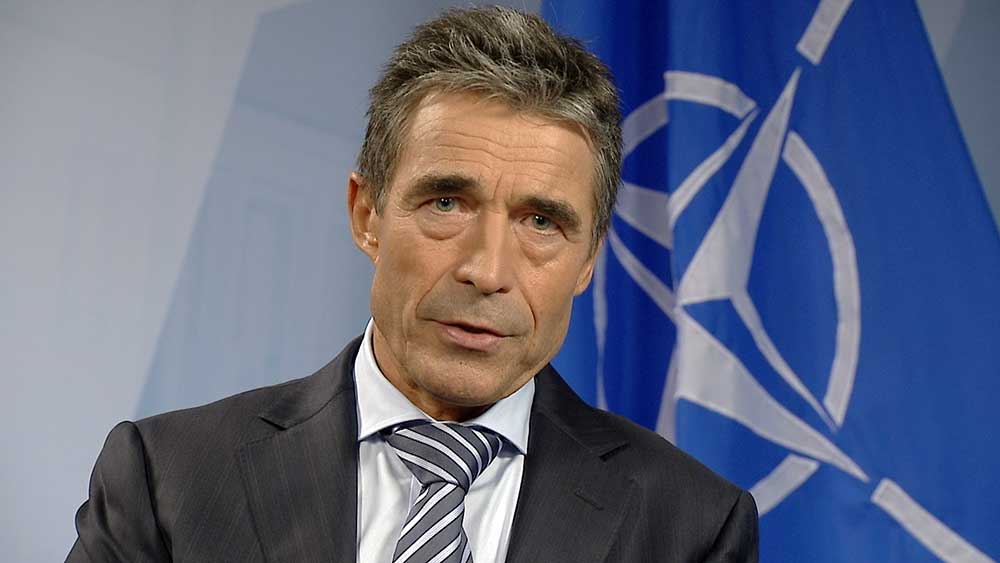
Anders Fogh Rasmussen

The NATO alliance and Russia have agreed to discuss the latest developments in Ukraine at a special meeting on Wednesday.

The alliance announced that an extraordinary NATO-Russia council will convene at the suggestion of alliance secretary-general Anders Fogh Rasmussen. Russia agreed to the meeting on Tuesday, when NATO ambassadors were further discussing the crisis among themselves.

Rasmussen has said Russia’s military intervention in Ukraine is in violation of the U.N. charter and threatens peace and security in Europe. Russian President Vladimir Putin said Tuesday that Moscow reserves the right to use its military to protect Russians there but voiced hope it won’t need to do so.

Russia took over the Crimean peninsula on Saturday, placing its troops around the region’s military bases and border posts.