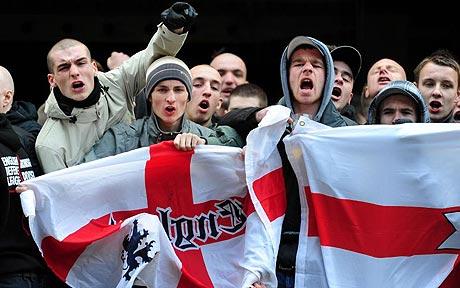
Record crowd turn up for PEGIDA rally

‘Today Paris, tomorrow Dresden,’ read one sign. Another’s message was: ‘Better to stand tall for Pegida today than to be on your knees for Mecca tomorrow’

The latest mass-rally of the self-styled “Patriotic Europeans Against the Islamisation of the West” came just hours after the chancellor Angela Merkel said that “Islam has a place in Germany.” German politicians previously called on Pegida to cancel their weekly march.

But in Germany, citizens are increasingly worried, with 57% of non-Muslims seeing Islam as a threat.

Overall, 61 percent of Germans say Islam isn’t compatible with life in the West, up from 52 percent three years ago. The country has 4 million Muslims out of a population of 81 million.

“There’s deep frustration over the silent Islamization taking place in Germany,” said Gerd Medger, 67, who advises companies seeking business contacts in Brazil and attended the Dresden rally waving a German flag. “If our governments let such violent people into Europe then we shouldn’t be surprised at these acts of violence.”

PEGIDA has said on its Facebook page that the killings at Charlie Hebdo in Paris confirmed its own views.

“The Islamists, which PEGIDA has been warning about for 12 weeks, showed France that they are not capable of democracy but rather look to violence and death as an answer,” it said.

The supporters of the populist movement claim solidarity with victims of the Paris attacks, with some of them carrying signs that read “They can’t kill our freedom” and “Je suis Charlie.”

According to the police estimates, some 25,000 people gathered in an anti-immigration rally in Dresden.

Besides Dresden, which serves as a central city for the movement, marches are organized in several other cities, including Berlin, Munchen, and, for the first time, Leipzig.

The number of people protesting against PEGIDA is also growing every week.

Monday’s rallies come ahead of a planned vigil for “tolerance and openness” in Berlin,which is set for Tuesday.

Germany’s Muslim leaders, with Chancellor Angela Merkel as well leaders of Germany’s Jewish community will attend.

“Politics cannot ignore this: they have to do something even if it’s only symbolic on immigration or security,” Joerg Forbrig, the senior program director at the German Marshall Fund of the U.S., said by phone from Berlin.“The CDU must take this seriously. They have to preempt the AfD otherwise there will be a stronger momentum building behind the party.”

Swiss activists have founded a local branch of the popular German anti-Muslim PEGIDA movement. The group is boasting a fast growth in supporters and plans to hold a demonstration next month.

The Swiss branch of PEGIDA (Patriotic Europeans Against the Islamization of the West) was launched two days after the attack on the Charlie Hebdo satirical magazine.

The PEGIDA group’s Facebook page calls on potential supporters to come to a demonstration planned for February 16 at an as yet undisclosed location.

The spokesman for Swiss PEGIDA is Ignaz Bearth, current head of the Swiss Direct Democracy Party, a small party with links to France’s Front National party, according to AFP. He is also a former member of the far-right Swiss Nationalist Party.

Russian blames Western-backed funding for Paris attack

Russian Foreign Minister Sergey Lavrov said on Monday that last Wednesday’s attack on a French satirical magazine was committed by militants who had fought in Syria for the West-backed aim of ousting Syrian President Bashar al-Assad from power.

“Cooperation [with the West on counter-terrorism] has been suspended. Meanwhile, terrorists do not suspend cooperation with each other. Terrorist activity knows no bounds,” Lavrov said. “The two brothers who attacked the editorial office of the Paris magazine had mastered ‘the art of terror’ in Syria, fighting with those who had been trying to oust Bashar al-Assad – an aim supported by our Western counterparts,” he added.

Seventeen people were killed in the French capital and its neighbourhoods in the terrorist attacks last week. Among them were ten journalists from the Charlie Hebdo satirical magazine, three policemen and four visitors of a kosher grocery store.

A video of supposedly Amedy Coulibaly, who murdered the five people, has emerged online. He swears his allegiance to the Islamic State in the clip and attempts to justify the wave of terror attacks.

The man much resembling Coulibaly talks of being a “soldier of the Caliphate” and states that he coordinated his plans with the brothers Cherif and Said Kouachi, who perpetrated a bloody massacre at the offices of French satirical magazine Charlie Hebdo on Wednesday.

The man asserted that ‘France is a legitimate target.’ He is referred to as Aboü Bassir AbdAllah al-Ifriqip and wears military body armor, displays an array of weapons and does push-ups.

He pledges his allegiance to “Caliph Ibrahim”, also known as Abu Bakr al-Baghdadi, the self-proclaimed leader of the Islamic State and speaks about the attack on the policewoman in the past tense, suggesting the attack had already been completed.

In the background of the video, radio news is already documenting the attacks on the Charlie Hebdo offices.

All the jihadists belonged to the same terrorist cell, according to French police. The man in the video discusses how they coordinated with one another.

Multiculturalism and ISIS blamed for Charlie Hebdo shooting

The attack on French magazine Charlie Hebdo was a result of Europe’s policy of multiculturalism, UK Independence Party (UKIP) leader Nigel Farage said Thursday.

“The real question is this: We in Britain – and I’ve seen some evidence in other European countries of it too – have pursued a really rather gross policy of multiculturalism and by that, what I mean, is that we’ve encouraged people who have come from different cultures to remain within those cultures and not to integrate fully within our communities.” Farage said during the Leaders’ Debate program on LBC radio.

British Deputy Prime Minister Nick Clegg accused Farage of using the incident to make political gains after the UKIP leader started speculating on the reasons behind the deadly attack on the magazine in France.

The head of Britain’s MI5 agency reportedly said that a group of core al-Qaeda terrorists in Syria is planning attacks, adding that intelligence services cannot hope to stop them all.

Militants in Syria were planning “mass casualty attacks” in the West, the head of Britain’s MI5 agency Andrew Parker said, adding that intelligence services may be powerless to stop them, AFP reported.

“We know… that a group of core al-Qaeda terrorists in Syria is planning mass casualty attacks against the West,” agency’s head was quoted as saying to journalists on Thursday.

Earlier the head of the agency spoke about the threat from extremists amid terrorist attack on the headquarters of French satirical newspaper Charlie Hebdo. “It is too early for us to come to judgements about the precise details or origin of the attack but it is a terrible reminder of the intentions of those who wish us harm,” he said in his Thursday speech in London.

He estimated that “600 extremists are among the many Britons who have travelled there (to Syria). A significant proportion has joined ISIL (IS),” and called the threat “ongoing and increasing,” CBS News cited.

Twelve killed in attack on French satirical magazine

Masked gunmen stormed the offices of a French satirical newspaper Wednesday, killing 11 people before escaping, police and a witness said. The weekly has previously drawn condemnation from Muslims.

French President Francois Hollande called the slayings a terrorist attack and said that several other terror attacks have been thwarted “in recent weeks.”

Xavier Castaing, head of communications for the Paris police prefecture, confirmed the deaths in the shooting at the offices of Charlie Hebdo, a satirical weekly that been repeatedly threatened for publishing caricatures of the Prophet Muhammad, among other controversial sketches.

Hollande rushed to the scene and top government officials planned an emergency meeting.

Luc Poignant, an official of the SBP police union, said the attackers escaped in two vehicles.

A witness to the attack, Benoit Bringer, told the iTele network he saw multiple masked men armed with automatic weapons at the newspaper’s office in central Paris.

Source: AP

Immigrants, Muslims and pregnant teens seen as threats

Americans, Italians and the French clearly see immigrants, Muslims and pregnant teens as threats.

They vastly overestimate the proportion of the population that are immigrants or Muslims and they have no idea what percentage of teenage girls get pregnant.

Swedes and Germans do best, although even they consistently get things wrong, according to a survey of 14 industrialized countries released on Wednesday.

The analysis by market research organization Ipsos MORI shows how far perceptions stray from reality across a range of issues as people struggle to get a precise handle on aspects of society that are seen as risks or worries.

Levels of immigration — a hot-button topic in many developed countries — are overestimated everywhere but the United States veers further from reality than most, with an average guess that 32 percent of the population are immigrants when the reality is 13 percent.

Italy fares even worse, with an average guess of 30 percent against a real figure of only seven percent.

Italians are also spectacularly bad at estimating the number of old people in the country, believing that 48 percent are over 65 years old. In reality, oldies make up only a fifth of the population.

Teenage pregnancy, an problem in mainly black neighborhoods, is another issue where people everywhere get it badly wrong.

Americans think 24 percent of girls aged 15 to 19 give birth each year, when the real figure is just 3 percent, and even the sensible Swedes are badly out, believing the annual teenage pregnancy rate is 8 percent compared to the actual 0.7 percent.

The current Ebola outbreak was not covered in the survey, which was conducted in August among more than 11,000 people across the 14 countries.

People hugely overestimate the proportion of Muslims living in their country, with the French putting the figure at 31 percent, when the real figure is 8 percent. The British guess at 21 percent (real figure 5 percent) and Americans estimate 15 percent (real figure 1 percent).

Even in countries such as Hungary, Poland, South Korea and Japan, where fewer than one percent of the population is Muslim, people put the figure at four to seven percent.

By contrast, majority-Christian countries tend to underestimate how many people count themselves as Christian.


Austria ammends 102-year-old law on Islam

Fear of extremism has led to Austria having drafted amendments to a 102-year-old law on Islam. Muslim organizations are to be banned from being financed from abroad, while the Koran is to get a unified German-language translation.

The amendments have already been criticized for singling out Islam, which has so far existed in Austria on equal terms with other religions like Catholicism, Lutheranism, Judaism and Buddhism.

Chancellery Minister Josef Mayer said that the new regulations were very carefully drafted based on discussions with the country’s Muslim community and that the changes to the 1912 law on Islam were needed as “a lot has changed” since it was adopted, according to Austria Press Agency.

Foreign Affairs and Integration Minister Sebastian Kurz was more specific on the purpose of updating the law on Islam.

“If you don’t have orderly legal regulation… this can always bring dangers. In this sense, if you like this is maybe a part of prevention,” he told reporters, as cited by Reuters.

The amendments to the law are being worked out amid Austrians growing increasingly worried over reports of around 140 Austrians fighting alongside jihadist groups in Iraq and Syria. Austria’s counter-terrorism body also warned in August that Vienna was “attracting foreign fighters from all over Europe,” being a convenient stop on their way to Syria.

The fear of extremist groups could be the reason Austria has witnessed right-wing Freedom Party (FPÖ) rising in popularity. An August opinion poll published by Der Standard showed the FPÖ had support of 28 percent of the poll participants, more than any other political party.

The new legislation on Islam will prohibit Austrian Imams from being employed by foreign countries and Muslim organizations obtaining finance from abroad.

That would outlaw the country’s 65 Imams currently employed by Turkey – roughly a fifth of all of Imams in Austria.

One of the two official Muslim organizations in Austria has already voiced its discontent.

“[The bill] mirrors in its overtone the spirit of the times we currently perceive, which is marked by blanket suspicion and mistrust against Muslims,” said Carla Amina Baghajati, spokeswoman of the Islamic Community of Faith in Austria (IGGIO).

Critics of the law point at it being unjust in creating unequal conditions for different religions.

“It will create an impression as if Muslims are a potential problem group,” Islam expert Thomas Schmid Inger told ORF. “I would have liked it better if you had one law for all religious communities and all religious communities in Austria were really treated equally.”

Another thing the new law demands is a standardized German-language translations of the Koran. Austrian leadership believes that’s not going to be a problem.

“Am I skeptical when I hear this is difficult or not easily done? Fundamentally no,” said Kurz, as cited by Reuters.

Meanwhile, representatives of the Muslim community argue that coming up with a unified translation of the Koran is against principles of the religion. The Arabic version of the Koran is perceived as the word of Allah in Islam, and no translation of it can be absolutely accurate.

That’s not the first legislative initiative in Austria inspired by the rise of extremism in Iraq and Syria. Austrian authorities announced in mid-September they were planning to ban terrorist-related symbols, starting with the flag of the Islamic State (IS, formerly ISIS or ISIL) extremist movement.

Source: RT

SA Muslims reject ISIS

The Islamic Unity Convention (IUC) has joined several South African Muslim bodies in condemning the actions of the Islamic State in Iraq and the Levant (Isis).

It said on Wednesday that core tenets of Islam included love, peace and unity and justice and that these values were not reserved only for Muslims. “It is therefore with abhorrence that the Islamic Unity Convention witnesses the crimes of the so-called ‘Islamic State’,” it said.

“How can a group claiming to act in the name of Islam … build a caliphate on mass murders and human rights abuses?”

Last week the Muslim Judicial Council (MJC) urged the United Nations to put an end to atrocities in the region. The MJC is a faith-based organisation, which was established in 1945. It is one of the oldest religious organisations in South Africa.

“The Muslim Judicial Council unequivocally condemns the group … for the mass murder and destruction committed against innocent civilians, religious minorities, scholars and places of worship,” it said.

“We reject this murderous group, which seeks legitimacy among Muslims by claiming the noble title of the caliphate while it violates Islamic sharia [law] and brings disrepute to the noble legacy of the house of Islam.”

In August, the scholarly body Jamiatul Ulama SA, a body comprising more than 900 Islamic scholars and guides and represents the majority of SA’s Muslims, condemned Isis.

“Warfare does not absolve the members of any Islamic caliphate, state or entity from the responsibility of observance of human rights and the rules of engagement where women, children and the elderly as well as all civilian non-combatants, their lives and property, are never targeted but safeguarded,” it said.

“It therefore comes strange to us that an Islamic state would be founded on atrocities, massacres and extrajudicial punishments that include summary executions of individuals suspected of crimes.”

Source: M&G

Gaza: France experiencing ‘torrent of internet hate’

Given the many threats of violence and murder they have to deal with, moderators struggle to cope psychologically.

The deadly Israeli offensive in Gaza has unleashed a torrent of hate on media websites and social networks in France that moderators find increasingly difficult to contain.

The bombardment by land, sea and air that has killed at least 425 Palestinians has enflamed tensions far afield from the Middle East, especially in France with its large Muslim and Jewish communities.

Paris protests in support of Gaza residents have degenerated into violence on several occasions.

“As soon as you talk about Israel, it crystallises all passions, with up to 20 000 or 30 000 comments sometimes after an article, of which we will only let five to 10 percent through,” said David Corchia, head of Concileo, a firm of moderators that counts the dailies Le Figaro and Liberation as clients.

Helped by software that automatically reports suspect keywords, online moderators can filter comments in accordance with special legal requirements in France as well as client requests. Those laws ban racist, anti-Semitic or discriminatory messages among others, as well calls for violence.

The moderators have little time to decide whether to let a remark through, and generally block 25 to 40 percent of comments.

But on the subject of the Israeli-Palestinian conflict, the rejection rate can reach 95 percent.

“There are three times as many comments than normal, all linked to the Israeli-Palestinian conflict,” said Jeremie Mani, head of Netino, which looks after the websites of the Le Monde daily, Europe 1 radio and major French television channels.

Netino’s 250 moderators, most of them based in Madagascar, deal with tens of millions of comments every month.

“We see racist or anti-Semitic messages, very violent, that also take aim at politicians and the media, sometimes by giving journalists’ contact details,” Mani said.

“This sickening content is peculiar to this conflict. The war in Syria does not trigger these kinds of comments.

“On the pro-Palestinian side, identical messages are posted on dozens of sites. On the pro-Israeli side, there are fewer messages but they are better organised,” he said.

The vitriolic messages about the conflict come up not only after content about the conflict itself — but can be found under any subject.

“On an article about the Tour de France, after four comments it’s about Gaza,” said Mani.

“On one story about salmon fishing, I saw a comment saying: ‘Stop talking about this, the problem is there are too many Jews’.

“Without any moderation, these hate messages would invade everything, particularly as they quickly breed followers.”

Media sites are not the only platforms that fall victim to violent messages. Public spaces on social networks such as the Facebook pages of famous people are targeted, and those comments are first published before they can be removed.

And while the current Israeli-Palestinian conflict may generate a large amount of vitriol, other issues with a racial or ethnic element do too.

Corchia said that when a teacher was stabbed to death by a student’s mother in front of her young pupils earlier this month, racist messages began pouring in as soon as the foreign-sounding name of the assailant was revealed.

And when a former local election candidate for the Front National was given a nine-month jail sentence this week for comparing France’s black justice minister, Christiane Taubira, to a monkey, Corchia said that on one story, moderators were only able to publish 500 comments out of 10,000.

“We watch for word associations. For example, any allusion to World War II is eliminated,” he said.

Pierre Duhau-Laurent, marketing director for Atchik Services, which moderates the websites of the French presidency and the Le Parisien daily, said “organised propaganda” was currently sweeping social networks at night.

“Israeli Prime Minister Benjamin Netanyahu has bought sponsored tweets for his messages. And Hamas’s response is just as organised,” he said.

Given the many threats of violence and murder they have to deal with, moderators struggle to cope psychologically.

Britain could ban Muslim school governers

A set of rules aimed at promoting “British values” in schools could ban conservative Muslims from becoming governors, a religious rights group says. The new regulations follow allegations of a “Trojan Horse” plot to Islamisize schools in the UK.

The UK has also banned the teaching of creationism theory in free schools.

The Department of Education has introduced a new set of rules governing free schools and academies in Britain. The regulations dictate that school governors and trustees should demonstrate “fundamental British values” and give the state powers to close the schools if they do not toe the line.

“The Academy Trust must ensure that principles are promoted which support fundamental British values,” say the rules. These include respect for democracy and the democratic process, support for gender equality and tolerance of different faiths and religions.

The Muslim Council of Britain (MBC) argues the new rules are discriminatory and allocate too much power to the Department of Education to define “British values.”

Source: RT

Front National member resigns due to Jean-Marie Le Pen’s ‘fournée’ remark

A regional leader of the Front National in France who has been a party member since 2002, has resigned, saying the “oven batch issue” has been one “little detail too much”.

The leader of the Bas-Rhin division of the Front National resigned from the party on Friday 13 June in protest against the recent polemical remarks by Jean-Marie Le Pen in which he used the word “fournée” or “oven batch”.

“I am leaving the Front National, full stop,” said Pascale Ellès, 48. “The little detail that finally caused it, was the issue of the oven batch, because I have always had good relations with the Jewish and Muslim communities,” she explained. She is also married to a Muslim.

Pascale Ellès was in tenth position on the Front’s list during the European elections in the east of France. She joined the party in 2002. On Wednesday she sent her letter of resignation to the party’s presidency, addressing it to vice-president Florian Philippot, the right-hand man of Marine Le Pen, its leader.

According to the ex-member from the Alsace region, Jean-Marie Le Pen’s remarks flew in the face of the “work” of Florian Philippot in the party, “who has criticised no-one druing his European campaign”.

“Florian Philippot campainged around the issues confronting France and appealed to all French people, whoever they might be,” she emphasised.

In October 2013, Pascal Ellès, also made known her disagreement with the controversial statement of Advocate André Kommann, who was then in line for the heading the FN’s municipal list in Strasbourg. He cause some controversy by suggesting that the Swiss police should use attack dogs against criminals. He finally withdraw and was replaced by Jean-Luc Shcaffhauser who has since been elected as a European MP in the Ile-de-France region around Paris.

Ukraine fever sweeps the Balkans

balkansAs the world watches the Ukrainians in their effort to defend themselves from Russia and become a fully European nation, close attention to the situation in Kiev and the crisis in Crimea is notable in the Balkan Muslim countries—Kosovo, Albania, Bosnia-Herzegovina—and in two with significant Muslim minorities, Montenegro and Macedonia.

In the Balkans, the threat of Serbian aggression has receded, but in a parallel with Ukraine, Russian influence is perceived behind intrigues from Belgrade. The events in Ukraine are seen in a context of the struggle against corruption and the phenomenon of the post-Communist “mafia state.”

In the first week of February, a wave of protest began in the Bosnian city of Tuzla, which is known for its tradition of multiethnic harmony among Bosnian Muslims, Croats, and Serbs. An old industrial redoubt now plagued with unemployment ranging between 40 and 60 percent, Tuzla boiled over quickly, as reported by BBC News, with attacks on official buildings.

Solidarity demonstrations spread to other Bosnian cities with economic problems, including Mostar in Herzegovina, which is divided between Muslims and Croats and has an aluminum industry, Zenica in central Bosnia, where a steel complex has been owned by ArcelorMittal since 1998, and then to Sarajevo, the capital. There, on February 7, demonstrators set fire to government buildings and fought police.

Local and foreign media, international observers, and politicians assigned blame for the Bosnian upheaval in all directions. Resentment of the excessively convoluted bureaucracy foisted by the 1995 Dayton Accords on Bosnia, which is partitioned between a so-called “Republic of Serbs” and the “Federation of Bosnia-Herzegovina,” grouping Muslims and Croats, is one issue. “Federation Bosnia” comprises 10 cantons, each with its own autonomous political and educational authorities, plus a special zone at Brcko in the northern part of the territory, all reporting—barely—to the supposed central government in Sarajevo. It has more varieties of statist delirium above and below the cantonal level: legislatures, ministries, municipalities, in a seemingly endless and redundant supply.

Economic opportunities mostly involve political malfeasance, financed by the European Union through the Office of the High Representative (OHR), the real government, with American support. The current high representative is an Austrian of Slovene background, Valentin Inzko. Bosnia-Herzegovina is therefore a place of profound despair, afflicted by brain drain. Its traditional Central European system of education, which produces well-trained graduates, sees them leave for other countries as soon as they can. A serious upheaval in Bosnia was, to anybody watching the country, obviously on the way—a matter of when, rather than why.

Also at the end of the first week of February, Kosovo saw turmoil as Ibrahim Gashi, rector of the University of Pristina, in the capital of that Balkan republic, was forced to resign after he was exposed as a falsifier of his academic work. Clashes between police and students left 29 officers hurt and 30 students arrested. Gashi’s departure from the university was followed by that of several of his colleagues.

In Podgorica, the capital of Montenegro, on February 18, hundreds of people gathered, throwing rocks at state offices, and injuring nine policemen. The Montenegrins called for “revolution.” Unemployed workers in Macedonia assembled in front of government buildings in that country’s capital, Skopje, on February 18. The next day, in Albania, after an informal strike by minivan drivers, in a country lacking a reliable public transportation system, a full one-day transport shutdown took place, with a rally in Tirana, the capital.The idiom of social rebellion is common in Balkan culture, which has undergone numerous such movements over the centuries, and where communism in the former Yugoslavia, under the charismatic dictator Joseph Broz Tito (1892-1980) kept memories of it alive in a civic myth that imposed much less conformity and silence than in other Communist lands. Lately, public acclaim for a “Balkan spring” gave way rapidly to visions of a “Bosnian-Ukrainian model.”

But in Bosnia-Herzegovina and Albania, entrenched elites quickly sought to profit from social conflict. The Bosnian politician Fahrudin Radoncic, leader of a party titled the Union for a Better Future, which holds four out of 28 seats in the weird, ineffectual House of Representatives crafted for the Muslim-Croat Federation, has been accused of organizing the assault on the government buildings in Sarajevo in an attempted coup d’etat. Radoncic, once a respected dissident, is now seen as a patron of shady deals with Serbian extremists—likewise an old motif in the Balkans. Dnevni Avaz (Daily Voice), a down-market tabloid owned by Radoncic, last week featured a column headed “Ukraine Is All of Us”—rhetoric viewed as cynical by many Bosnians.

Similarly, former Albanian prime minister Sali Berisha, an ex-Communist and leader of his country’s entrenched Democratic party, stirred the striking minivan drivers against the Socialist (i.e., neo-Communist) administration of Edi Rama, who took power last year.

As in Ukraine, allegations that discredited leaders are manipulating mass protests in Bosnia-Herzegovina and Albania to regain influence are widespread. But in the Balkan lands, they are more convincing than they appear to be in Kiev. On February 28, Zeljko Komsic, an ex-Communist and politically independent member of the three-person presidency of Bosnia-Herzegovina, declared “I am not with fascists, chauvinists, thieves, or racketeers.” Epitomizing the complexity of post-Dayton Bosnian governance, Komsic is the Croat representative in the presidency, which comprises a Bosnian Muslim, a Serbian, and a Croatian.

A legal complaint brought at the European Court of Human Rights in Strasbourg by Dervo Sejdic, a Bosnian Roma (Gypsy) representative, and Jakob Finci, president of the Bosnian Jewish Community, alleged discrimination in that, under Dayton, members of minorities are excluded from the Bosnian presidency. The Court found for the plaintiffs in the case, Sejdic and Finci v. Bosnia and Hercegovina, but a reform of the ethno-political structure has yet to be adopted.

Since the cathartic arson at government facilities in Sarajevo, protests have continued but with much-diminished participation, typically bringing together a few hundred elderly folk aggrieved mainly by the loss of pensions. Observing one such gathering on Saturday, March 1, which was Bosnian Independence Day, I noticed the prominent display of a portrait of Tito. Nostalgia for communism is an important motive for elderly Bosnians to take to the streets.

Leaflets for the March 1 assembly, taped up throughout Sarajevo, demanded “social justice for all.” Bosnia’s Muslim religious leadership, under moderate direction since the replacement of the Wahhabi-line chief cleric Mustafa Ceric by Husein Kavazovic last year, supports the call for social justice. But the Islamic approach to Bosnian problems is conservative.

At Friday prayers in Sarajevo’s exquisite and intimate 16th-century Cobanija mosque, the day before the March 1 protest, the elderly preacher, known as a khatib and different from the imam, who leads the service, pronounced blessings and immediately commenced an eloquent denunciation of violent demonstrations. With his voice repeatedly breaking, he said to stay away from barricades such as were seen in the recent uproar. He referred to violence as “Satan’s path” and called on the assembled Bosnian Muslims to be thankful for the existence of a state with a territory and constitution which they should protect and obey. He said he was a pensioner himself and that his wife had not worked for years. But he repeated, “do not go to the barricades. Do not be tempted to Satan’s path. Remember that we have a state, territory, political structures and freedom. Do not waste them or abuse them.”

Meanwhile, those who remain indignant about corruption, rulership from afar, joblessness, lack of pensions, and the other misfortunes of Dayton besetting Bosnians have been meeting in “plenums” for democratic debate and proposal of solutions.

Thus, its Balkan disarray notwithstanding, Bosnia may find a secure way to European standards of entrepreneurship, accountability, and popular sovereignty. In a land where rebellion seems deeply embedded in the culture, hope is not exhausted.

Source: www.weeklystandard.com

Fighting between Muslims and Christians leaves 3 dead in Central African Republic

Internally displaced refugees in the Central African Republic, being cared for by a Western aid agency

Fighting brorke out between Muslims and Christians in Central African Republic’s capital, causing the deaths of at least three people on Wednesday. According to reports, angry residents threw grenades and set dwellings alight.

French and African troops sent to the country have struggled to stop the internecine violence between Muslim Seleka rebels, who seized power in March, and Christian self-defence militia. The fighting killed more than 1 000 people in December.

Residents of Bangui said that Seleka militiamen in civilian clothes threw grenades at Christian homes in a northern district of the city, burning them to the ground. Christian youths then launched reprisal attacks, torching nearby Muslim dwellings.

“The Muslims came and set fire to the houses … everyone was affected,” said Aristide Yenga, resident of the Ngou Simon neighbourhood in the north of the capital Bangui.

“This morning they began shooting and when we heard that we left for the larger (displaced persons’) camps.”

The corpse of a Seleka fighter with his left hand cut off and missing lay in the middle of a large dirt avenue following the attacks. A resident of the neighbourhood who asked not to be named said that two other Muslims had been killed there during the night.

No peacekeepers were present, although a French helicopter flew overhead, according to eyewitness reports.

Despite the ongoing faction fighting, interim President Michel Djotodia called for reconciliation during a New Year’s speech on Wednesday, suggesting everyone should return to their homes.

In the meantime, the president of the neighbouring Republic of Congo, Denis Sassou-Nguesso, warned of the “tragic and fatal” consequences for the region of CAR’s descent into civil war.

“It is imperative that we avoid such a disastrous outcome,” he said in a speech on Wednesday.

A doctor of the French NGO, Médécins Sans Frontières, at Bangui airport where it provides refuge for over 100,000 displaced people said it had received around 15 injured and two dead.

“Among the two dead was an adolescent of 12 years with a gash on his skull,” said MSF’s Gaetan Adouaka.

It was not clear if those killed were the Muslims from the northern district. The previous day a four-month-old baby died from a gunshot wound, the charity said in an earlier statement.

Aid workers say they are battling to provide for the country’s more than 800,000 displaced people, most of whom are now living in crowded refugee camps, because the constant violence is disrupting supplies.

Others have fled via boats across the Congo River or by air to other countries.

The Central African Republic is one of Africa’s poorest states despite enjoying abundant mineral resources.  SInce independence from France in 1960, five coups have taken place. – News agencies and praag

France adamant about separating state and Islam

Islamic women protest in France

Riots over a full-face Islamic veil, a woman losing her unborn baby in another similar confrontation and tensions flaring over a supermarket chain’s ad for the end-of-day feast for the Muslim holy month of Ramadan, are almost a daily staple for France.

France’s enforcement of its prized secularism is inscribed in law, most recently in a ban on wearing full-face veils in public. The policy instead may be fueling a rising tide of Islamophobia and driving a wedge between some Muslims and the rest of the population.

Yet ardent defenders of secularism, the product of France’s separation of church and state, say the country hasn’t gone far enough, AP reported.

They want to continue the cause of Voltaire helped and Victor Hugo, with a law targeting headscarves in the work place. Political pressure from a resurgent far-right has increased the tension.

A new generation of French Muslims — which at some 5 million, or about eight percent of the population, is the largest in Western Europe —  are defending mosques, halal food and Muslim religious dress.

Women who wear Muslim apparel “are no longer safe,” said a 26-year-old mother of three living in Trappes, a town south of Paris known for its large immigrant population.

Women wearing Muslim headscarves, suffered three attacks in Reims and three more in Orleans. Investigations and court cases are underway.

Police clashed last week with crowds protesting the arrest of a man who allegedly attacked an officer after his wife was ticketed for veiling her face in public. Dozens of cars were set afire in two nights of unrest in Trappes and an adjoining town. A 14-year-old boy suffered an eye injury.

Weeks earlier, a man allegedly assaulted a pregnant woman and ripped off her veil— one of two separately accosted in the Paris suburb of Argenteuil. She lost her baby days later, although the link with the incident remains unclear.

Interior Minister Manuel Valls insisted that Islam and the French Republic are compatible and denounced “a rise of violence against the Muslims of France.” At a dinner celebrating the end of Ramadan at the Grand Mosque of Paris, he denounced “those who want to make France a land of conquest.”

People told a veiled woman who is of Algerian origin, “If you’re not happy, leave, go home,” she said. But, she pointed out, she was born in France.

Most French people are Catholic, but church attendance has been in decline for decades and secular ideals run deep. With the growth of France’s Muslim population, lawmakers have increasingly turned to legislation to try to stifle public displays of Islamic faith.

In 2004, a law banned “ostentatious” religious symbols in public schools, a measure clearly directed at Islamic headscarves. It has been enforced without resistance.

A two-year-old law banning burqa-style veils from the streets of France has met with more outcry, even though only some 2,000 Muslim women cover their faces. Most Muslim women in France wear neither, as Islam does not Islam does not require face veils or covered head

A report by the Observatory of Secularism, created in 2013 by President Francois Hollande, revealed that a handful of the 705 women stopped by police for covering their faces in public chalked up more than 10 tickets each – two of them more than 25 – suggesting that some are provoking authorities intentionally.

A local official in Nimes, posted on his Facebook account an ad by the Carrefour supermarket chain publicizing “oriental” dishes for the nightly breaking of the fast during Ramadan with the comment, “Our Republic, is it still secular? Everything is on the way out.” The post was hastily removed after an outcry from Muslims.

While several European countries embrace secular values, France has been at the forefront of enforcing them, with the separation of church and state enshrined in law since 1905.

“Laicite,” is the French word for secularism. Associations throughout France work to uphold it. Far-right groups use it as a mantra, and leftists embrace it as well. There is even a secularism prize.

Hicham Benaissa of the National Center for Scientific Research said today’s secularism “appears to be a sort of (protection) against the religious influence of Islam” when “its spirit is to protect the faiths.”

A pre-school has just fired a woman who refused to remove her headscarf. An appeals court ruling in March calling the firing illegal spurred a demand for laws protecting secularism in private companies that would govern, for instance, dress and schedule requirements for prayer time or religious holidays.

A resulting bill to regulate religion in companies, sponsored by the opposition conservatives, failed.

Another report, released in June by the Observatory, tried to tone down the controversy, suggesting that slights to secularism have been exaggerated and dialogue, not a new law, may solve problems.

Some Muslims believe they are being driven away from the mainstream, leading to the growth of private Muslim schools and propelling Muslims to open their own businesses.

The law and the media “with their constant finger-pointing at Muslims are the reason the French population has become aggressive,” one woman said. Because of her robes, she sells cosmetics from her home. “I myself couldn’t apply for a job in an office.”

British police arrest more than 160 conservatives at protest

English Defence League protestors

British police arrested more than 160 people on Saturday as they sought to separate far-right protesters and anti-fascist demonstrators gathered in an immigrant area of east London.

Scotland Yard had imposed conditions on a protest by the far-right English Defence League (EDL) to keep its members away from the centre of the Muslim community in Tower Hamlets.

Strict conditions were also imposed on a planned counter-demonstration by groups including Unite Against Fascism, to ensure the two sides did not meet.

EDL leader Tommy Robinson was arrested for breaching police conditions, while about 150 counter-demonstrators were also arrested for diverting from their agreed route, police said.

The EDL campaigns against what it says is the spread of radical Islam in Britain, but it has been accused of Islamophobia.

A handful of people were also arrested on Saturday for offences including carrying a knife, carrying fireworks, criminal damage and violent disorder.

“There have been 14 arrests as part of the policing operation for the demonstrations taking place in Tower Hamlets today,” a police statement said.

It added: “In addition we have made approximately 150 arrests for breaching section 12 and section 14 of the Public Order Act 1986. All these approximately 150 people were protesting against the EDL presence.” – AFP