UN tourism defends decision to convene in Zimbabwe

vicfallsThe United Nations World Tourism Organisation (UNWTO) has defended its decision to hold its General Assembly in Zimbabwe.

Speaking to the media at Victoria Falls, UNWTO Secretary-General Taleb Rifai says the agency wanted to bring hope to Zimbabweans.

“We as the secretariat feel that it was correct and it was the right decision to come here and if you need the reason go walk in the streets of Livingstone and Victoria Fall.  Ask the children, the men and women how do they feel about it and how much it has impacted their lives.  It is exactly what we are here to do, we are not here to deliberate on grand issues, we can do that anywhere else in the world but the excitement, optimism and the hope, that this meeting has created in this place makes everything worthwhile,” says Rifai.

On Sunday President Robert Mugabe officially opened the 20th UNWTO General Assembly in the resort town of Victoria Falls.

Delegates from 150 countries will attend the seven-day event which Zimbabwe and Zambia are co-hosting.

Bob threatens US, British firms

robertmugabeZimbabwean President Robert Mugabe on Sunday threatened “tit-for-tat” actions against Western countries that have imposed sanctions on his rule, suggesting US and British firms could be targeted.

“They should not continue to harass us,” said the 89-year-old veteran leader whose re-election last month drew Western doubts over the credibility of the polls.

“We have British and American companies here and we are treating them well. There will come a time when we will lose our patience.”

The United States and European Union imposed sanctions including travel bans and asset freezes on Mugabe and members of his inner circle and several companies following 2002 elections which western observers said were rigged.

“They have companies here and we have not imposed controls or sanctions against them but time will come when we will say tit-for-tat. You hit me, I hit you. You impose this on me, I impose this on you,” Mugabe said.

“Our attitude is not going to continue as it was in the past — passive. We have had enough and enough is enough.”

Mugabe won an extension to his 33-year rule in general elections on 31 July, which were slammed as “a farce” by his rival Morgan Tsvangirai and prompted serious concerns from Western nations.

Local observers said the elections were fraught with irregularities but observers from the African Union and the regional Southern African Development Community (SADC) bloc were less critical.

Mugabe was sworn in last week after the constitutional court declared the elections “free, fair and credible”.

He has vowed to forge ahead with his controversial equity drive to force foreign companies to cede majority shares to local investors.

So far mining companies including Zimplats, a subsidiary of the South African-based Impala Platinum, and Anglo American Corporation’s Unki mines have been forced to sell their majority stake to locals.

Companies in the retail sector are set to follow.

The EU earlier this year retained an asset freeze and travel ban on Mugabe but eased most of its decade-old restrictions on Zimbabwe.

The majority of those on the US sanctions list still remain, including a travel ban and asset freeze on individuals and entities with links to Mugabe.

Mugabe was addressing mourners at the burial of Mike Karakadzai, a retired air commodore and hero of the 1970s liberation war, who died aged 56 on Tuesday.

In his first public speech since Thursday’s swearing-in, he targeted Tsvangirai, his former partner in a shaky powersharing government, as “an ignoramus” and “a lone stray locust”.

This was in reaction to Tsvangirai’s attempt to seek a court’s help to overturn the polls and his calls to rid the security forces of officers allied to Mugabe and his Zanu-PF party.

“I hope our people will never repeat the same mistake and choose an ignoramus when you have bright children who went to university. I wonder what you admire in him,” he said.

On security reforms that were meant to precede the polls, he also hit out at Tsvangirai.

“What sector reform can you a lone stray locust implement? When has the frog aspired to be the crocodile?” he said.

“You are better off with an ignorant person who is conscious of his ignorance. It becomes a problem when you assume your ignorance is wisdom and lead people into trouble.”

The vote ended the pair’s regionally brokered compromise government forced by chaotic 2008 polls.

This time round the electoral commission declared Mugabe the winner with 61 percent of the vote, against 34 percent for Tsvangirai. – AFP

Mugabe’s inauguration ‘a victory against big Western powers’

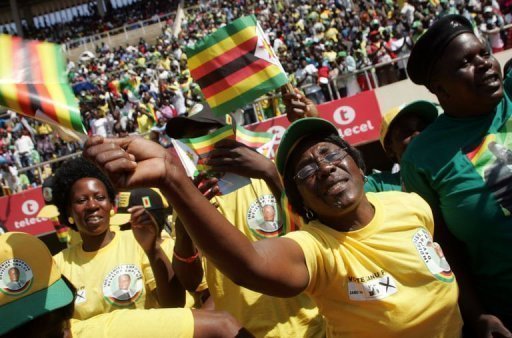
Flag-waving Mugabe supporters on 13 August 2013 in Harare (AFP file photo)

by Reagan Mashavave

Veteran Zimbabwean President Robert Mugabe hit out at “vile” Western critics as he was sworn in for another five-year term Thursday in a stadium packed with jubilant supporters.

Festooned in a sash, garland and medals, the 89-year-old dismissed accusations the July 31 election that returned him to power was rigged and vowed to rejuvenate the foreign-dominated banking and mining sectors.

Mugabe’s 33-year rule since Zimbabwe’s independence has been marked a drive to transfer foreign-owned and white-owned assets, including farms, to blacks.

“I promise you better conditions,” he told the 60,000 capacity crowd of supporters at a stadium in Harare.

“The mining sector will be the centrepiece of our economic recovery and growth. It should generate growth spurts across sector, reignite that economic miracle which must now happen.”

Mugabe’s inner circle has faced decades of international sanctions over rights abuses, and the veteran leader said he expected the punitive measures to continue.

“Most likely we shall remain under these sanctions for much longer.”

“We continue to look East,” Mugabe said lampooning, Western countries which have called into question the legitimacy of his election victory.

“We dismiss them as the vile ones whose moral turpitude we must mourn,” he said venting against Britain, Australia, Canada and the United States.

Former colonial power Britain called Thursday for an “independent investigation” into the conduct of the election, which Mugabe officially won by a landslide.

Unlike previous low-key investitures, Thursday’s event — replete with banners, flags and chants — carried strong echoes of Mugabe’s inauguration as prime minister of a newly independent Zimbabwe in 1980.

A no-show by many leaders from neighbouring countries — including President Jacob Zuma of regional power-broker South Africa — did little to dampen enthusiasm.

Neither did a boycott by opposition leader and former prime minister Morgan Tsvangirai, who insists the July 31 vote was stolen.

Mugabe was greeted in the stadium by thunderous cheers and whistling. On board a military truck he inspected assembled military personnel.

Gates to the Chinese-built stadium, the venue of Mugabe’s inauguration as president in 1987, opened shortly after dawn.

The day was declared a public holiday, helping boost attendance.

“Mr Mugabe, you are one of a kind,” sang a group of supporters slamming the sides of the minibus taking them to the stadium, while others waved fists as drivers honked their horns.

“It is a great day for Zimbabwe and the world will come to a standstill today,” said Alfred Tome, the Harare provincial administrator and spokesman for the organisers.

A concert will include artists from South Africa, Zambia and Jamaica –whose iconic singer Bob Marley played at Zimbabwe’s independence event.

Banners around the oval stadium carried messages praising African leaders and denouncing Western governments accused of meddling in Zimbabwe’s political affairs.

“Which African ever observed elections in Europe, America?” read one banner. “Africa has spoken, respect it’s voice,” said another.

The inauguration had been delayed after Tsvangirai challenged the poll results — which he denounced as “massive fraud” — in a petition to the Constitutional Court that was later withdrawn.

Among a series of complaints, Tsvangirai queried the suspiciously high number of voters who were turned away from polling stations in urban areas, which are considered opposition strongholds.

He also charged that his party’s supporters in rural areas were intimidated by Mugabe party backers into feigning illiteracy and voting in the presence of police and election officers.

The Constitutional Court confirmed Mugabe as president and declared the elections “free, fair and credible”, saying the results “reflected the free will of the people of Zimbabwe”.

‘Farewell event for Mugabe’

Eldred Masunungure, a political scientist from the University of Zimbabwe, said the event was at once Mugabe’s victory lap and his “last supper”.

“This inauguration is being projected as the crowning of a victory of a struggle for the past 13 years against big Western powers,” he said.

There is however also an “unintended meaning”, he said. “It can be read as a farewell event for Mugabe. It reminds one of Jesus’s Last Supper.”

The electoral commission declared Mugabe winner with 61 percent of the vote, against 34 percent for former prime minister Tsvangirai.

The vote ended a shaky power-sharing government formed by Mugabe and Tsvangirai four years ago to avoid a tip into all-out conflict following a bloody presidential run-off election in 2008.

Local observers judged the elections flawed and Western powers have raised serious doubts over the vote.

But regional groupings the Southern African Development Community and the African Union were less critical. – AFP

Zim genocidaire dies

Enos Nkala
Enos Nkala

Zimbabwean politician Enos Nkala, who co-founded Robert Mugabe’s ZANU party and was Defence Minister during a massacre of ethnic Ndebele that killed 20 000 people, has reportedly died.

“Nkala died at the Avenues Clinic, Harare, this morning after his admission at the hospital on August 7,” the News Day newspaper reported.

He was 81 years old. The cause of death is still unclear.

Nkala co-founded the Zimbabwe African National Union (ZANU) party in 1963 to fight against British colonial rule.

ZANU came to power after independence in 1980 and later joined the Zimbabwe African People’s Union (ZAPU) to form ZANU-PF, which remains in power.

Nkala served various posts in Mugabe governments, including as Finance Minister.

As Defence Minister he oversaw a state-ordered crackdown by North Korea-trained forces on dissidents in the Matabeleland and Midlands provinces between 1984 and 1987.

Around 20 000 people, including women and children, were killed during the massacre named “Gukurahundi”, which means “the wind that sweeps away the chaff before the spring rains” in the local Shona language.

Nkala sought to exonerate himself, saying Mugabe directed the deployment of the troops.

In the late 1990s Mugabe described the killings as “a moment of madness”, but stopped short of apologising for them.

Nkala left government following a corruption scandal in which cabinet ministers and officials bought cars for resale using special privileges.

He later became a staunch critic of Mugabe’s rule, but last year patched up his relationship with the 89-year-old ruler.

Mugabe is set to be inaugurated for a new five-year term on Thursday after winning a disputed election last month to extend his more than three-decade rule. – SABC

Mugabe to be sworn in on Thursday

Waiting for indigenization

Robert Mugabe will be sworn in on Thursday, beginning a fresh five-year mandate as Zimbabwe’s president following a disputed election, his spokesperson said Sunday.

“It is now this Thursday,” George Charamba told AFP on the sidelines of a summit of southern African leaders in Malawi.

On Friday Mugabe’s main challenger, opposition leader Morgan Tsvangirai, withdrew a legal challenge to the election result, claiming the courts would not be fair.

That removed the last hurdle to 89-year-old Mugabe’s inauguration for a seventh term.

Mugabe, Africa’s oldest leader, first took the reins of a newly independent Zimbabwe in 1980 as prime minister. He became president following a constitutional amendment in 1987.

Southern African leaders attending the summit had earlier endorsed the result of the election that extended his 33-year rule, congratulating him for holding peaceful elections.

Asked whether regional leaders would attend the swearing-in, Charamba said that “everybody will be invited”. – AFP

‘Congratulations to comrade Robert Mugabe’: SADC leaders

Robert Mugabe
Robert Mugabe

Southern African leaders opened an annual summit Saturday endorsing disputed elections in Zimbabwe that extended President Robert Mugabe’s 33-year rule by another five years.

“Congratulations to comrade Robert Mugabe for conducting peaceful elections,” said the incoming head of the Southern African Development Community (SADC), President Joyce Banda of Malawi.

“We wish to offer you continued support as a member of the family,” Banda said, to wild cheers from the audience at the start of the 15-nation summit.

A smiling Mugabe acknowledged the endorsement with his traditional clenched-fist salute.

Zimbabwean opposition leader Morgan Tsvangirai’s MDC party said Friday he had withdrawn a legal challenge to the elections, claiming the courts would not be fair.

This removed the last hurdle to 89-year-old leader Mugabe’s inauguration for a seventh term.

The SADC’s observer mission for the July 31 elections judged the vote was free, but have not yet commented on its fairness.

The SADC will publish its report on Zimbabwe’s polls during this weekend’s summit, according to South African President Jacob Zuma.

Banda took over the rotational one-year chairmanship of the SADC from Mozambican leader Armando Guebuza, becoming the first woman to head the bloc since its inception 33 years ago.

The two-day summit is expected to be dominated by the political stand-off in Madagascar and the conflict in eastern Democratic Republic of Congo, according to a Malawian official.

Madagascar has been suspended from the regional grouping since strongman Andry Rajoelina toppled Marc Ravalomanana in 2009.

The SADC has been pushing the rivals to follow through on a roadmap meant to steer the island nation toward elections, which Banda hinted could be due this year.

The vote has repeatedly been put on hold amid controversy over the candidacies of the three front-runners, including Rajoelina.

Regional mediators have called for Rajoelina, Ravalomanana’s wife Lalao and former leader Didier Ratsiraka to stand aside, but all three have refused.

In the DR Congo, a quarter-million people have fled their homes since last year when a rebel group calling itself the M23 took up arms against government troops in the mineral-rich but chronically unstable east. – AFP

Bob vows to intensify wealth transfer to blacks

bobZimbabwe’s President Robert Mugabe vowed Tuesday to intensify his controversial drive to transfer economic wealth to blacks and scoffed at calls to reform the security services following his disputed re-election.

“The indigenisation and empowerment drive will continue unabated in order to ensure that indigenous Zimbabweans enjoy a larger share of the country’s resources,” Mugabe told thousands of people at a rally in the capital to mark defence forces day.

“Now that the people of Zimbabwe have given us a resounding mandate in the governance of the country we will do everything in our power to ensure our objective of total indigenisation, empowerment, development and employment is realised.”

Mugabe was declared winner of the July 31 election with 61 percent of the vote against his main rival Morgan Tsvangirai’s 34 percent. Tsvangirai is challenging the victory, alleging vote rigging.

Zimbabwe passed an indigenisation law in 2007 forcing foreign-owned companies to cede 51 percent of shares to local investors in what Mugabe calls “the final phase of attaining total independence”.

Critics of the programme say it has benefitted Mugabe’s allies and frightened away potential investors.

In his second public speech after last month’s elections extended his 33-year rule, Africa’s oldest leader resisted opposition calls to rid the security forces of partisan officers.

Instead he praised the security forces for the peace that Zimbabwe has enjoyed over the past three decades.

He said the military has been “such a reliable pillar” of his government that he found it “surprising that some misguided fellow countrymen, at the behest of their Western allies, blatantly disregard the good work done by the (military) in maintaining peace and tranquility in the country.”

Mugabe said calls for reforms of the security sector were a disguise because “the enemy’s real ploy is to dilute the efficiency of the Zimbabwe Defence Forces”.

Some security chiefs have publicly declared their allegiance to Mugabe’s ZANU-PF party and vowed never to accept a leader who did not take part in the country’s 1970s liberation war. – AFP

Zim reporter denies uranium story

zbclogoZimbabwean police are looking for two journalists from the British newspaper, The Times over a story about a secret uranium export deal between Zimbabwe and Iran, a state newspaper reported Sunday.

The two Times journalists, Jan Raath and Jerome Starkey, are wanted for “spreading falsehoods” after the uranium deal story was published in the London paper on Saturday, Zimbabwe’s Sunday Mail reported.

The Times quoting outgoing deputy minister of mines, Gift Chimanikire, wrote that Zimbabwe signed a deal with Iran to supply the Islamic republic with the raw materials needed to develop a nuclear weapon.

The United States and the European Union have imposed crippling sanctions on Iran over its nuclear programme, which Tehran insists is for peaceful energy uses but which the Western powers fear is intended to build an atomic bomb.

Zimbabwe is also subject to international sanctions over its human rights record and alleged election fraud.

President Robert Mugabe, who won another five-year term in disputed polls last month, has publicly backed Iran’s nuclear drive.

During a visit to Harare in 2010 by then Iranian president Mahmoud Ahmadinejad, Mugabe said his guest should be assured of “Zimbabwe’s continuous support of Iran’s just cause on the nuclear issue”.

Chimanikire could not be reached for comment but The Sunday Mail quoted him denying the story as “silly, speculative and dangerous”.

“No licence has been issued. I never said such a silly thing,” the paper quoted Chimanikire as saying.

When contacted by AFP, The Times newspaper said it was not aware of the story in the Zimbabwean press and would prepare a response.

However, one of the two reporters, Starkey, tweeted about the report of the “manhunt” by Zimbabwean police. When asked if he planned to add the event to his CV, he tweeted: “Let’s wait and see that it ends ok.”

National police spokesperson Charity Charamba said she was not aware of a search for the journalists.

“I have not heard about it. I only got a call from someone else who was inquiring,” she told AFP, saying she would have to look into it. – SABC

‘The West is the real enemy’

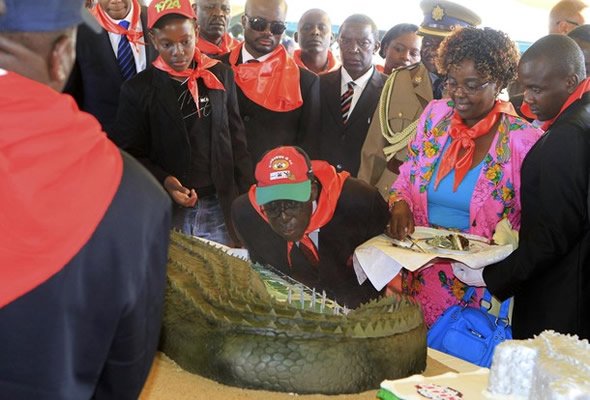
The Crocodile's birthday cake
The Crocodile’s birthday cake

Zimbabwe’s President Robert Mugabe on Wednesday declared his recent election victory a blow against Western powers which he accused of plotting to topple him using the opposition.

“We are very happy that we have dealt the enemy a blow, and the enemy is not (opposition leader Morgan) Tsvangirai,” Mugabe said in his first public remarks since winning a landslide victory in elections a week ago.

“Tsvangirai is a mere part of the enemy. The enemy is he who is behind Tsvangirai. Who is behind the MDC? The British and their allies. Those are the ones who were the real enemies.”

Mugabe has often accused Western powers, particularly Zimbabwe’s former colonial master Britain, of harbouring plans to depose him using the opposition as a front.

Zimbabwe’s electoral commission declared Mugabe winner with 61 percent of the vote, while three-time presidential hopeful Tsvangirai garnered 34 percent.

Tsvangirai, who has dismissed the elections as a “farce”, has demanded a forensic audit of the voters’ roll, ballot papers and voter registration certificates.

Mugabe said after the win that he will forge ahead with his indigenisation drive, compelling foreign-owned companies to cede majority shares to local black investors.

“We need to raise the standard of living of our people. But to do that we have to stand firm and all the time take into account our policy of indigenisation and empowerment,” he said.

“We need to look at our sectors and see how we can improve.

“With that victory, which is only a continuation of our freedom, our task is to look ahead. What we say we shall do, we do. The immediate past has tended to be retrogressive during the inclusive government.”

After seizing hundreds of white-owned farms in a campaign launched in earnest in 2000, Mugabe passed a law in 2007 stating that large foreign-owned entities may be liable to cede 51 percent of their ownership.

So far only mines have been targeted.

Mugabe understands democracy well

roodt_dan_wikiby Dan Roodt

[followbutton username=’danroodt’ count=’true’ lang=’en’ theme=’light’]

Like Dan Roodt’s Facebook page

Is it not astounding that so many people are criticising the outcome of the Zimbabwean elections, when that country went through an official poll in which Zanu (PF) won a clear majority?

In addition, Robert Mugabe’s view of democracy is entirely commensurate with that of most western leaders, especially those of Britain and the US. There exists a dichotomy between the spectacle of campaigning and voting – the soap opera of elections – and the real business of power that is normally settled outside of public scrutiny, in proverbial smoke-filled rooms.

Democracy is what follows a “state of exception” (Carl Schmitt) during which one regime is replaced by another. Both the American and French revolutions were examples of such states of exception. In the case of Zimbabwe, Britain virtually appointed Mugabe as permanent president during the state of exception known as the Lancaster House Conference  of 1979. Every election since in Zimbabwe has merely confirmed Britain’s support for revolutionary change in the ex-Rhodesia, hence the hypocrisy of complaints about largely minor deficiencies in the Zimbabwean electoral process.

Writing in the UK Daily Mail two days ago, columnist Stephen Glover said:

“Instead of expressing his anxieties, the Foreign Secretary could offer the Zimbabwean people a heartfelt apology on behalf of the British Government for inflicting Robert Mugabe on them in the first place, and then standing aside as he pillaged his country, murdered his enemies and ruined the economy… What has happened in Zimbabwe is to Britain’s eternal shame.”

Mr Mugabe is a self-styled “strong leader”. In so doing, he is simply displaying the “leadership” that everyone talks about, and that they even teach in business schools.

Modern democracy is indeed a process whereby the voter surrenders his freedom of action to members of the elite who may act on his behalf, tax him and even impoverish him to their heart’s content. During the banking crisis, we have seen how Western governments did the same and have burdened future generations with mountains of debt, simply to save their sponsors and cronies among members of the corrupt banking fraternity.

In most third-world countries, including Zimbabwe, you first queue to vote and then you stand in line for bread or some or other hand-out. The one is good practice for the other.

In South Africa, of course, those who queue to vote are rewarded with poverty, joblessness and grants of R250 a month, enough to buy beer and air time. Just look at the 10 biggest companies by market capitalisation on the JSE, and you will notice that smoking and drinking beer dwarf all other forms of economic activity, followed by mobile telephony.

Democracy is all about talking, drinking, smoking and making babies, for which you get child-support grants. The notion of freedom as defined by the philosophers of the western enlightenment is, of course, slightly more complex and subtle than subsisting for the sake of a pay-as-you-go cellphone connection.

Sadly, such classical ideas of freedom and what some people refer to as “higher ideals” have been derided by so-called “liberals” and Marxists as being tantamount to fascism. Taking pride in one’s language or culture, showing patriotism or constructing a society where people are not sheep to be lorded over by professional politicians, are all very suspect notions that are regularly denounced as “right-wing extremism”.

Aspiring to be one’s own master, holding one’s leaders accountable for public expenditure and the quality of their decision-making is reminiscent of the Tea Party programme in the US.

As the New York Times has assured us, the Tea Party is a racist movement of soon-to-be-outnumbered white Americans who hanker after the halcyon days of the Ku Klux Klan.

Private property, too, is a decidedly reactionary concept, which Mr Mugabe has “democratically” dispensed with. Most white-owned farms in Zimbabwe were bought after 1990 and after ZANU (PF)’s accession to power, yet the rights of these property owners were forfeited in favour of a revolutionary “land-reform programme”.

Most university professors in the West and in SA probably applauded him for trampling upon private property. Not to mention the nongovernmental organisations for whom starvation is big business and whose customers, the voters, will queue up again for hand-outs.

The destiny of man is to be a shopper. Everything else is Nazism, even though German Chancellor Angela Merkel still attends the annual Wagner Festival in Bayreuth.

No doubt the professors and media pundits will soon have Wagner banned worldwide and then everybody will just listen to Justin Bieber and Lady Gaga. Democracy entails the lowering of intellectual and aesthetic standards down to the basest level.

The verbiage of Barack Obama on “democracy” resembles the kitsch of fast food, wearing track suits and sports caps in public and the obsessive, banal voyeurism of most TV programmes. We are living through a modern version of Nero’s mob rule whereby a few powerful political and financial dictators occupy the minds of the masses with “bread and circuses”, an election being the ultimate circus, of course.

As Pat Buchanan has said somewhere, democracy cannot be foisted on people by carpet-bombing them from 40 000 feet. Zimbabwe is but one among a number of societies that have been destabilised by so-called democracy. In North Africa and the Middle East, the West has not balked at supporting Al-Qaeda and related fundamentalist movements in a kind of anti-modern fervour. The paradox is that modern democracy so often leads to fundamentalism, mayhem and even primitivism.

Systems of ethnic domination whereby one group is victimised by another are routinely approved as “democratic”. In fact, there is an element of sadism in South African democracy with its endemic violence, torture and persecution of ethnic minorities about which international silence is maintained. Far from making people free, democracy often leads to greater coercion and oppression than more traditional forms of rule. It seems that democracy may only be established through terror, coercion and war, while the most democratic countries, such as the U.S. and the U.K., are also the most aggressive when it comes to foreign military adventures and attacking other countries.

Not for nothing did the Russian leader Mr. Vladimir Putin state that he was revolted by the “pro-democracy rebels” of Syria who devoured the organs of their enemies. Under democracy, more and more such cannibalistic incidents are also occurring in South Africa.

Not only does Mr Mugabe understand democracy and its empty theatrics well, but his wife Grace has mastered the art of shopping better than any New York socialite.

Surely the elected leader of Zimbabwe deserves a better press?

This is an extended version of a letter published today in Business Day.

[followbutton username=’danroodt’ count=’true’ lang=’en’ theme=’light’]

Like Dan Roodt’s Facebook page


Zim Stock Exchange falls on Mugabe win

zimbeursThe Zimbabwe Stock Exchange’s top index fell 11 percent on Monday, the first day of trading after the results of disputed elections which enabled Robert Mugabe to extend his 33-year rule.

Several foreign-owned stocks registered steep losses, with South Africa-based clothing chain Edgars and hotel group African Sun losing more than 25 percent.
Amid fears foreign banks could become the next target for Mugabe’s indigenisation efforts, Barclays local listing had fallen by 15 percent on Friday, but the fall was arrested in Monday trading.
“This is indicative of the widespread concern that the election results are not going to inspire the anticipated economic recovery,” said Eric Bloch, an economist based in the second city of Bulawayo.
Zimbabwe’s electoral commission declared Mugabe winner with 61 percent of the vote while his long-time rival Morgan Tsvangirai garnered 34 percent.
Tsvangirai has dismissed the elections as a “farce”.
The elections were to end a shaky power-sharing government formed four years ago by Mugabe and Tsvangirai.

The compromise government was meant to stop a tip into conflict following a bloody presidential run-off election in 2008 and revive the country’s economy but its work was hampered by frequent haggling and charges of rights abuses. – AFP


Zuma congratulates Mugabe

Zuma and Mugabe
Zuma and Mugabe

President Jacob Zuma on Sunday congratulated Robert Mugabe on his re-election as president of Zimbabwe.

Zuma described Wednesday’s elections as “harmonised” and called for peace in the neighbouring country, the international relations department said in a statement.

“President Zuma urges all political parties in Zimbabwe to accept the outcome of the elections as election observers reported it to be an expression of the will of the people.

” (He) also encourages the people of Zimbabwe to seize this opportunity to collectively contribute towards building their country driven by a common desire for peace, stability and prosperity.”

Zuma said South Africa was ready to continue its relations with Zimbabwe. – Sapa

Early results show Mugabe’s Zanu-PF in the lead

bobmThe Zimbabwe Electoral Commission has begun announcing official results of Wednesday’s national elections.

The results announced on Thursday confirm earlier reports that Zanu-PF leader Robert Mugabe is headed for a big win, while his Zanu-PF party is set to claim a majority in Parliament.

ZEC deputy chairperson Joyce Kazembe released results of 31 constituencies in Bulawayo, Masvingo and Mashonaland West provinces, of which Zanu-PF claimed 28 of the seats.

Kazembe released results for 18 constituencies in Masvingo, all of which went to Zanu-PF.

Eight of the seats were won by MDC-T in 2008.

Zanu-PF officials and officials from the MDC formations say Zanu PF was likely to take all 26 seats in the province.

Kazembe also released results of 11 constituencies in Mashonaland West.

Ten of the constituencies were won by Zanu-PF, with MDC-T claiming the Chinhoyi Central seat.

MDC-T won the Pelandaba-Mpopoma and Nkulumane seats in Bulawayo and pointers were that the party would claim the 12 seats in the province.

Returns from polling stations indicated MDC-T would win less than 50 of the 210 contested seats in the House of Assembly, giving Zanu-PF the two-thirds majority it needs to change laws in Parliament.

The presidential election is also not likely to go to a runoff, as Mugabe is likely to garner the 50% plus one vote necessary for him to be sworn in as president without a second round. – mg.co.za

Mugabe, Ceausescu, Mussolini

bobqueen
Cheering liberation in 1994

A good number of people in Britain and beyond have had the honour of being stripped of their knighthoods and awards by the honours forfeiture committee since 1995.

Last year a former Manchester headteacher, Jean Else, became the first woman to have her damehood annulled.

The forfeiture committee was established to guard the system of knighthoods, peerages and other awards.

The committee’s recommendations are submitted to the Queen through the prime minister. Any decisions on forfeiture are formally published in the London Gazette.

It is composed of senior civil servants. Meeting at least once a year, the committee examines individual cases brought to its attention and reviews general policy about how the system should operate.

The Commonwealth award is removed by a different forfeiture committee.

Robert Mugabe, knighted in 1994, to cheers of African liberation and Mandela worshipping, had the honour withdrawn in 2008 following the international furore over violent, disputed elections. Bob had become slightly too black for his boots.

The Romanian dictator Nicolae Ceausescu, honoured by the British government in an attempt to improve relations within Europe during the cold war had his knighthood revoked just in time. He fell from grace the day before his execution by a revolutionary firing squad.

Anthony Blunt, the keeper of the Queen’s pictures, was knighted for his services to art only to have his status revoked in 1979 shortly after the prime minister, Margaret Thatcher, had exposed his double life as a Soviet spy in parliament.

Another victim of the hasty re-writing of history is the Italian dictator Benito Mussolini.

Mussolini had been the first Italian to receive the honour. He was given the Knight Grand Cross of the Order of the Bath in 1923 from King George V, no less.

Il Duce lost his knighthood when Italy joined Nazi Germany in 1940 in declaring war on the UK.

The case of Roger Casement remains one of the most controversial forfeitures. A distinguished diplomat and human rights campaigner, he was eventually hanged for treason. He had attempted to deliver weapons to Irish republicans before the Easter Rising in 1916.