Janet Yellen closer to becoming Fed chair

Janet Yellen
Janet Yellen

Federal Reserve Vice Chair Janet Yellen moved closer on Thursday to becoming the first woman to lead the U.S. central bank after a Senate committee approved her nomination and sent it to the full Senate for a final vote.

If confirmed, as is widely expected, Yellen would replace Fed Chairman Ben Bernanke when his term expires on January 31 and become the most powerful woman in world finance.

The vote was 14-8. Three Republicans backed her appointment and one Democrat voted no.

A Democratic leadership aide said the aim was to hold a confirmation vote in the full Senate in December.

Nominated by President Barack Obama, Yellen is viewed as a monetary policy dove more concerned about the costs to society of high unemployment than about the risk aggressive actions to lower it will ignite future inflation or fuel asset bubbles.

She will preside over a central bank that has taken dramatic and unconventional steps to spur economic growth, and which is now wrestling with a decision on when to scale back a bond-buying program that has sought to drive down long-term market interest rates.

The Fed has held benchmark U.S. interest rates near zero since late 2008 and has quadrupled the size of its balance sheet to $3.9 trillion through three massive asset purchase campaigns. It is currently buying $85 billion in bonds a month.

Both Yellen and Bernanke have emphasized in recent days that the Fed will keep interest rates low for some time even after it winds down its asset purchases, remarks that have bolstered expectations of policy continuity at the central bank.

Friends and foes

Minutes of the Fed’s October meeting released on Wednesday showed policymakers were debating how best to enhance their forward guidance on when to expect rates to rise to help temper any economically disruptive moves in financial markets once the central bank starts tapering its bond buying.

The Fed has said it would not raise rates before the U.S. jobless rate falls to 6.5 percent, as long as inflation looked set to stay below 2.5 percent. Unemployment stood at 7.3 percent in October.

When Bernanke first broached the possibility of a near-term reduction in the asset purchases in May and June, he sparked a bout of global financial market turmoil that sent bond yields soaring and hit emerging markets hard.

The Fed’s aggressive actions have drawn fire from Republican lawmakers worried about the risk of inflation and asset bubbles. Many also complain the central bank has abetted big spending by the Obama administration by snapping up the bulk of new Treasury debt issuance.

“The long-term costs of these policies are unclear and frankly worrisome,” Senator Michael Crapo, the top Republican on the banking panel, said before voting ‘no.’

Despite those concerns, Yellen is expected to handily win confirmation when the full Senate considers her nomination.

Democrats control 55 of the 100 votes in the Senate, which means she would need the backing of only a handful of Republicans to secure the 60 votes necessary to clear any procedural hurdles that might be thrown in her path.

She looks well on the way to reaching that threshold.

Yellen received support from three Republicans on the committee: Bob Corker of Tennessee, Tom Coburn of Oklahoma and Mark Kirk of Illinois.

In addition, Republican Senators Susan Collins of Maine and Lindsey Graham of South Carolina have also indicated they are inclined to back her.

The Democrat who voted against her in committee was Joe Manchin of West Virginia.

(Reporting by Alister Bull and Margaret Chadbourn; Editing by Tim Ahmann and Andrea Ricci) – Reuters

Obama: ‘Love means never having to say you’re sorry’

mercer_ilanaby Ilana Mercer

[followbutton username=’IlanaMercer’ count=’true’ lang=’en’ theme=’light’]

Like Ilana Mercer’s Facebook page

So where do we stand in the health care chain reaction, cooked-up in the Barack Obama command-and-control centers? Let’s see. Having destroyed the market for health insurance, the president turned to another parlor game, hailed by the daytrippers at CNN and the New York Times as a “health fix” and a “fix for canceled plans.”

Yes, the fix is in. Parsed, the president’s advice to the millions who’ve lost coverage is, essentially, “I’ll let you keep your already canceled policies through 2014. Feel free to take it up with your insurance company.”

In the preceding weeks, and against the backdrop of polls in which 50 percent of voters said, “President Obama knowingly lied when he repeatedly told Americans they could keep their plans under his signature health care law,” the paper of record took a “different” view. Obama, the apple of their eye, “wrongly assured Americans that they could retain their health care plans.”

An “incorrect promise” was another euphemism used by NYT story tellers.

Quite the opposite, opined Patrick J. Buchanan:

WHO’S THE BIGGEST LIAR OF THEM ALL? In the grand scheme of history, Obama’s rank lie “now enters presidential history alongside George H.W. Bush’s ‘Read my lips! No new taxes,’ Bill Clinton’s ‘I did not have sexual relations with that woman, Miss Lewinsky,’ and George W. Bush’s tales of yellow cake in Niger and hidden arsenals of WMDs.”

As wrecking balls go, Obama and “W” are tied in ignominy. Christopher Conover of Duke University estimates that “129 million, or 68 percent of Americans, may not be able to keep their current health-care plans once Obamacare is fully implemented. [Conover’s] study also suggests that 18 to 50 million people will lose their plans altogether.”

The butcher’s bill of human suffering—Bush’s—has been tallied. Obama’s is still to come.

LAWYERING OR LYING? Obama stool pigeon Jake Tapper of CNN went in search of character witnesses for the disgraced 44th U.S. president. Who better to galvanize than the mountain of opportunistic flesh, New Jersey Gov. Chris Christie? Fresh from his triumph in the New Jersey gubernatorial race, the popular Republican governor was eager to offer advice to the president whose political epitaph will be: “If you like your health care plan, you will keep it, period.”

Actually, the line Obama had repeated at every turn, from 2009 to 2012, morphed in November of 2013 to, “What I really meant was that Americans could keep their healthcare plan if it hasn’t changed since the law passed.”

“Don’t lawyer it,” cringed Christie. “People don’t like lawyers. I’m a lawyer. They don’t like ‘em. You know? Don’t lawyer it. When I saw that [namely, the Lie’s new iteration]… this morning for the first time, I thought, he’s lawyering it. That’s Barack Obama the lawyer.”

Correction, Gov. Christie: That’s Barack Obama the liar talking.

Still, some strides were made.

Into the Cannibal's Pot

THE GREAT LEAP FORWARD. A term reserved to denote Mao Zedong’s catastrophic transformation of China into a communist, collectivized society—a great leap forward of sorts was made by dummy Dana Bash. Four years on, this CNN reporter belatedly admitted that the Republicans had forewarned of the fiasco that is Obamacare:

… When the President made that statement [“If you like your health care plan, you will keep it”] during the heat of the health care legislative battle, Rep. Tom Price, R-Georgia, dismissed the commander in chief’s promise in a weekly Republican address.
“If you read the bill, that just isn’t so,” Price said. “For starters, within five years, every health care plan will have to meet a new federal definition for coverage, one that your current plan might not match, even if you like it.”
Fast forward three years, and that’s exactly what’s happening.

Indeed, 2:43 minuets into his August 22, 2009 address, Rep. Price explained the simple stuff with which the great hulking mass of America is only just grappling, thanks in no small part to a press whose members all sang from the same press releases.

LOVE MEANS NEVER HAVING TO SAY YOU’RE SORRY. Remember that line from the tender 1970 film, “Love Story”? Given the unconditional love Barack Obama has received from America, the president believed he would never have to say he was sorry.

Still, like jilted lovers, The People began to demand an apology from their beloved.

What is more obscene: the idea that one can apologize for the hubris and deceit that is Obama and his health care, or the actual need some have for an apology from an entity so evil that he would toy with the lives of millions as though they were insects and he God? This is hard to tell.

For what it’s worth, here’s Hussein’s “apology” for the pox he has unleashed on the land:

“I am sorry that they are finding themselves in this situation based on assurances they got from me. Obviously we didn’t do a good enough job in terms of how we crafted the law … And, you know, that’s something I regret. That’s something we’re gonna do everything we can to get fixed … We’re looking at a range of options.”

And what, pray tell, is the matter with Christians that they hunger to forgive evil, without any evidence of expiation? Some sins are simply unforgivable.

[followbutton username=’IlanaMercer’ count=’true’ lang=’en’ theme=’light’]

Like Ilana Mercer’s Facebook page

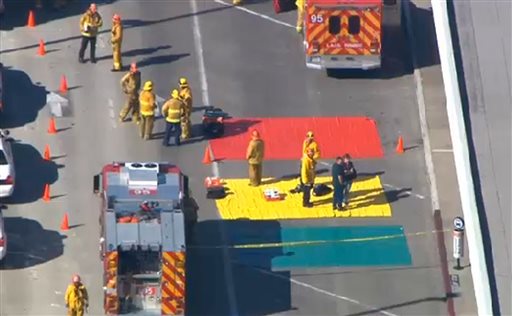
Shooting at Los Angeles airport kills one

In this aerial video frame grab provided by CBS-LA, fire and rescue personnel gather at Los Angeles International Airport on Friday Nov. 1, 2013.

A gunman opened fire with an assault rifle at Los Angeles International Airport (LAX) Friday, killing a security agent and wounding seven people, officials said.

Panicked travelers scrambled to escape after the lone suspect, named as 23-year-old Paul Anthony Ciancia, pulled out the gun and shot his way through a security checkpoint before being stopped in an exchange of fire with police.

The motive for the shooting was unclear, but the Federal Bureau of Investigation said it could not rule out terrorism. The gunman was reported to be in critical condition in hospital.

The shooter “came into Terminal Three, pulled an assault rifle out of a bag and began to open fire… He proceeded up into the screening area… and continued shooting,” said LAX police chief Patrick Gannon.

He then entered the main terminal area and reached a Burger King restaurant before officers “engaged him in gunfire… and were able to successfully take him into custody.”

The Transportation Security Administration (TSA), which employs screeners and guards at airports, confirmed one of its employees had died.

“Multiple Transportation Security Officers (TSOs) were shot, one fatally,” said a TSA statement emailed to AFP.

The Los Angeles Times initially cited sources saying the shooter, who opened fire shortly after 9:00 am in the crowded terminal was also believed to be a TSA employee at the airport, which is the country’s third-biggest hub.

Gannon would not comment on that report, but said: “We believe at this point that there was a lone shooter,” and that he “was the only person who was armed in this incident.”

Later, the FBI named him as Ciancia, saying he was a LA resident but giving no further details.

An NBC television report suggested Ciancia may have had some link to the TSA, and targeted TSA agents as his victims.

Of the seven people injured, six were taken to hospital, said the head of the LA Fire Department James Featherstone, briefing reporters for the first time a couple of hours after the incident.

One eyewitness recounted the shooter dressed in greyish-green clothing with an assault rifle opening fire as he went up an escalator and through the security area.

Live television footage showed armed police on the top of parking structures, apparently still looking for a possible gunman, while multiple ambulances were parked outside a terminal building.

Flights were disrupted as the Federal Aviation Administration (FAA) issued a national ground-stop, or hold, for all LA-bound flights that had not yet departed from their originating airports.

Eyewitness Brian Adamick, 43, said he was preparing to board a flight when he saw people running through the terminal, away from a security area. He and others responded by going through an emergency exit onto the tarmac.

A short time later shuttle buses began helping passengers to leave and he saw a wounded airport worker, from the TSA, board one bus, with a bloodied ankle.

“It looked like it was straight out of the movies,” said Adamick.

Another non-US passenger, named only as Alex, said he was waiting in line on an upper terminal level when the shooter opened fire on the floor below.

“He shot one guy downstairs,” he told KTLA 5, adding that the gunman then went up some escalators toward a security area.

“He fired several shots when he went through the security check,” he said, adding: “He just went straight through the security check.”

Eyewitness Eric Williams described the gunman to ABC7 television.

“We were standing in the TSA line to get checked through and all of a sudden we heard a shotgun. I saw the shooter and he was a Caucasian probably 18 to 25 years old,” he said.

Although there was no indication of other people being involved in the attack, the FBI said it could not rule out terrorism.

“It would be premature to comment on a motivation at this time and joint investigators have neither ruled out terrorism, nor ruled it in,” it said.

In Washington, President Barack Obama was kept up to date on the shooting. “Obviously, we’ve been monitoring it and we’re concerned about it,” Obama said.

Putin topples Obama in Forbes power ranking

Top of the heap
Top of the heap

Having outfoxed him on Syria, Russian President Vladimir Putin has pipped Barack Obama to the title of the world’s most powerful leader as ranked by Forbes on Wednesday.

It was the first time in three years that the US president has dropped to second place on the magazine’s list and came as US-Russia relations slid to a new low.

Putin, who has enjoyed 13 years of dominant rule over Russia, was again elected president in March 2012.

Obama, on the other hand, has just emerged scathed from an embarrassing 16-day US government shutdown caused by a budget and debt crisis in Washington.

“Putin has solidified his control over Russia, while Obama’s lame duck period has seemingly set in earlier than usual for a two-term president — latest example: the government shutdown mess,” wrote Forbes.

In August, Russia granted asylum to former National Security Agency contractor Edward Snowden, wanted in the United States over a mammoth intelligence leak.

A month later, Putin played the trump card again by averting Obama’s threatened missile strikes on Syria with a plan for Damascus to hand over chemical weapons.

“Anyone watching this year?s chess match over Syria and NSA leaks has a clear idea of the shifting individual power dynamics,” Forbes wrote.

The 2013 list of 72 powerbrokers was chosen to reflect one for every 100 million lesser mortals on Earth.

Third prize went to Chinese President Xi Jinping, who is expected to rule for a decade in which China is set to eclipse the US as the world’s largest economy.

Pope Francis made his debut at number four and German Chancellor Angela Merkel rounded out the top five.

Among 13 newcomers were Samsung Chairman Lee Kun-Hee at number 41 and Nigerian billionaire Aliko Dangote, the richest man in Africa, in at number 64.

There were 17 heads of state who run nations with a combined GDP of $48 trillion and 27 CEOs and chairs who control over $3 trillion in annual revenues.

Only nine women made the cut despite representing half the world’s population. – breitbart.com

Kerry talks tough in Syria meeting with Russia

John Kerry
John Kerry

by Matthew Lee and Nancy Benac

Striking a tough tone, U.S. Secretary of State John Kerry opened swiftly convened talks with Russia on Syria’s chemical weapons Thursday by bluntly rejecting a Syrian pledge to begin a “standard process” by turning over information rather than weapons – and nothing immediately.

That won’t do, Kerry declared at an opening news conference, a stone-faced Russian Foreign Minister Sergey Lavrov at his side. “The words of the Syrian regime in our judgment are simply not enough.”

“This is not a game,” Kerry said of the latest developments in a series that has rapidly gone from deadly chemical attacks to threats of retaliatory U.S. air strikes to Syrian agreement with a Russian plan to turn over the weapons and, finally, to the crucial matter of working out the difficult details.

“We believe there is nothing standard about this process at this moment because of the way the regime has behaved,” Kerry declared. And he kept alive the threat of U.S. military action, saying the turnover of weapons must be complete, verifiable and timely – “and finally, there ought to consequences if it doesn’t take place.”

Adding to the drama, Russian President Vladimir Putin weighed in from afar, raising eyebrows with an opinion piece in The New York Times that chided Americans for seeing themselves as “exceptional.” That was an apparent reference to a comment President Barack Obama made in his Syria speech Tuesday night, explaining why he felt the U.S. needed to take action. Congress has shown little inclination to authorize military action, and a vote on that has been put off.

Putin also warned that a U.S. strike against Syria because of chemical weapons use could unleash new terrorist attacks. And he still maintained there is “every reason to believe” the weapons were used by rebels and not by Assad’s military. In Washington, Obama’s spokesman said Russia was “isolated and alone” in that view.

Obama, for his part, said simply that he was hoping for “a concrete result” from the talks.

The back-and-forth was a stark indication of the challenging work ahead as Kerry, Lavrov and their teams of chemical weapons experts plunge into talks aimed at finding agreement on how to dismantle the chemical weapons amid the confusion and danger of Syria’s civil war.

Lavrov seemed to contradict Kerry’s negative view of Syrian President Bashar Assad’s offer to provide details on his country’s chemical arsenal beginning 30 days after it signs an international convention banning such weapons. Syria’s ambassador to the United Nations said that as of Thursday his country had become a full member of the treaty, which requires destruction of all chemical weapons. However, the United Nations said it will take at least another 30 days.

The Russian said the initiative must proceed “in strict compliance with the rules that are established by the Organization for the Prohibition of Chemical Weapons.” That suggests Russia does not agree with the U.S. that this is an exceptional case and that Syria should face tougher standards than other countries.

“We proceed from the fact that the solution to this problem will make unnecessary any strike on the Syrian Arab Republic, and I am convinced that our American colleagues, as President Obama stated, are firmly convinced that we should follow a peaceful way of resolution to the conflict in Syria.” Lavrov said.

The distrust in U.S.-Russia relations was on display even in an off-hand parting exchange at the news conference.

Just before it ended, Kerry asked the Russian translator to repeat part of Lavrov’s concluding remarks.

When it was clear that Kerry wasn’t going to get an immediate re-translation, Lavrov apparently tried to assure him that he hadn’t said anything controversial. “It was OK, John, don’t worry,” he said.

“You want me to take your word for it?” Kerry asked Lavrov. “It’s a little early for that.”

They were smiling at that point.

Shortly after making their opening statements, the two went into a private dinner. Talks were to resume Friday.

The meetings in Geneva got underway as Assad, in an interview with Russia’s Rossiya-24 TV, said his government would start submitting data on its chemical weapons stockpile a month after signing the convention. He also said the Russian proposal for securing the weapons could work only if the U.S. halted threats of military action.

But Kerry, who met earlier Thursday with Lakhdar Brahimi, the U.N.-Arab League envoy for Syria, made clear the threat remains.

“President Obama has been clear that should diplomacy fail, force might be necessary to deter and degrade Assad’s capacity to deliver these weapons,” he said. “It won’t get rid of them, but it could change his willingness to use them.”

Even as diplomacy took center stage, word surfaced that the CIA has been delivering light machine guns and other small arms to Syrian rebels for several weeks, following Obama’s statement in June that he would provide lethal aid to the rebels.

The U.S. is hoping that an acceptable agreement with the Russians can be part of a binding new U.N. Security Council resolution being negotiated that demands that Syria’s chemical weapons be put under international control and dismantled and condemns the Aug. 21 attack that led to the current crisis. Russia has long opposed U.N. action on Syria, has vetoed three earlier resolutions and has not indicated it is willing to go along with one now.

As for arming the Syrian rebels, White House National Security Council spokeswoman Bernadette Meehan said the administration could not “detail every single type of support that we are providing to the opposition or discuss timelines for delivery, but it’s important to note that both the political and the military opposition are and will be receiving this assistance.”

Current and former U.S. intelligence officials said the CIA has arranged for the Syrian opposition to receive anti-tank weaponry such as rocket-propelled grenades through a third party, presumably one of the Gulf countries that have been arming the rebels. They spoke on condition of anonymity because they were not authorized to discuss the classified program publicly.

Loay al-Mikdad, a spokesman for the Free Syrian Army, told The Associated Press that his group expected to receive weapons in the near future.

“We are cooperating with the American administration and have been receiving some logistical and technical assistance and there are commitments by the administration to arm us but until now we have not received any weapons,” al-Mikdad said by telephone.

The U.S. officials said the aid has been arriving for more than a month.

The U.S. team with Kerry in Geneva includes officials who worked on inspection and removal of unconventional weapons from Libya after 2003 and in Iraq after the first Gulf War. Officials with Kerry said the teams that eventually go into Syria would have to be an international mix.

The meetings are taking place in the same hotel where former Secretary of State Hillary Clinton in 2009 gave Lavrov a symbolic “reset button” as a goodwill gesture and a reminder of the Obama administration’s efforts to improve U.S.-Russian relations. – AP

British Parliament vote against Syrian attack

David Cameron
David Cameron

The British vote against military strikes in Syria is a tough blow to Prime Minister David Cameron’s domestic political fortunes.

Since taking office in 2010, he has on numerous occasions been undercut not just from opposition parties, but also from elements within both his own Conservative Party and the Liberal Democrats, the junior member of the UK’s governing coalition.

That was the combination that once again hurt Cameron late Thursday. The government lost a vote—by a tally of 285 to 272—that would have supported in principle military intervention in Syria. Members of all major parties—including his own Tories—opposed the measure.

Mr. Cameron said it is clear that the British Parliament, reflecting the view of the British people, doesn’t want to see the UK get involved in military action and “the government will act accordingly.”

The outcome marks a significant moment in British politics—it is highly unusual for a prime minister to be defeated on foreign policy and raises the prospect of whether the UK’s role on the world stage going forward.

It is also a rare setback for Anglo-American relations that will spur questions about the so-called “special relationship” between the two nations. In recent decades, the UK. has rarely if ever parted ways with the US on such a significant strategic issue.

While the government doesn’t require parliamentary approval to take military action, it would now be politically difficult to do so. A further parliamentary vote had been due to take place early next week on whether the UK should be directly involved in that action. A spokesman for the prime minister confirmed that the UK now won’t take part in the Syrian action.

The outcome of the UK. vote could make it more difficult for President Barack Obama and other Western allies—already weary from years of difficult military intervention in the Middle East—to convince their own publics of the need for intervention in Syria.

The defense secretary, Philip Hammond, said America “will be disappointed that Britain won’t be involved.” Mr. Hammond, speaking in an interview with BBC, said he still expected other countries to continue to look at a response.

The setback also raises questions about Cameron’s authority. The prime minister, who wasn’t required to hold a parliamentary vote but chose to, had personally laid out his case at length to parliament earlier in the day about why military action was needed and why it would be justified, citing humanitarian grounds and the need to prevent the use of chemical weapons in the future.

US officials said Mr. Obama is prepared to act in coming days without Britain. They added that unlike U.S. involvement in the 2011 military operations in Libya, the options being considered in Syria are on a smaller scale and wouldn’t require a coalition to be effective.

Britain’s about turn leaves France as the last European country still considering conducting air attacks on the Assad regime. French officials have said the country’s military had prepared plans for possible action in Syria but repeated on Thursday that no final decision had been made yet.

The French government can engage force overseas without prior Parliamentary approval.


Does Obama know he’s fighting on al-Qaida’s side?

obamasmirk
Too clever

By Robert Fisk.

If Barack Obama decides to attack the Syrian regime, he has ensured – for the very first time in history – that the United States will be on the same side as al-Qaida.

Quite an alliance! Was it not the Three Musketeers who shouted “All for one and one for all” each time they sought combat? This really should be the new battle cry if – or when – the statesmen of the Western world go to war against Bashar al-Assad.

The men who destroyed so many thousands on 9/11 will then be fighting alongside the very nation whose innocents they so cruelly murdered almost exactly 12 years ago. Quite an achievement for Obama, Cameron, Hollande and the rest of the miniature warlords.

This, of course, will not be trumpeted by the Pentagon or the White House – nor, I suppose, by al-Qaida – though they are both trying to destroy Bashar. So are the Nusra front, one of al-Qaida’s affiliates. But it does raise some interesting possibilities.

Maybe the Americans should ask al-Qaida for intelligence help – after all, this is the group with “boots on the ground”, something the Americans have no interest in doing. And maybe al-Qaida could offer some target information facilities to the country which usually claims that the supporters of al-Qaida, rather than the Syrians, are the most wanted men in the world.

There will be some ironies, of course. While the Americans drone al-Qaida to death in Yemen and Pakistan – along, of course, with the usual flock of civilians – they will be giving them, with the help of Messrs Cameron, Hollande and the other Little General-politicians, material assistance in Syria by hitting al-Qaida’s enemies. Indeed, you can bet your bottom dollar that the one target the Americans will not strike in Syria will be al-Qa’ida or the Nusra front.

And our own Prime Minister will applaud whatever the Americans do, thus allying himself with al-Qa’ida, whose London bombings may have slipped his mind. Perhaps – since there is no institutional memory left among modern governments – Cameron has forgotten how similar are the sentiments being uttered by Obama and himself to those uttered by Bush and Blair a decade ago, the same bland assurances, uttered with such self-confidence but without quite enough evidence to make it stick.

In Iraq, we went to war on the basis of lies originally uttered by fakers and conmen. Now it’s war by YouTube. This doesn’t mean that the terrible images of the gassed and dying Syrian civilians are false. It does mean that any evidence to the contrary is going to have to be suppressed. For example, no-one is going to be interested in persistent reports in Beirut that three Hezbollah members – fighting alongside government troops in Damascus – were apparently struck down by the same gas on the same day, supposedly in tunnels. They are now said to be undergoing treatment in a Beirut hospital. So if Syrian government forces used gas, how come Hezbollah men might have been stricken too? Blowback?

And while we’re talking about institutional memory, hands up which of our jolly statesmen know what happened last time the Americans took on the Syrian government army? I bet they can’t remember. Well it happened in Lebanon when the US Air Force decided to bomb Syrian missiles in the Bekaa Valley on 4 December 1983. I recall this very well because I was here in Lebanon. An American A-6 fighter bomber was hit by a Syrian Strela missile – Russian made, naturally – and crash-landed in the Bekaa; its pilot, Mark Lange, was killed, its co-pilot, Robert Goodman, taken prisoner and freighted off to jail in Damascus. Jesse Jackson had to travel to Syria to get him back after almost a month amid many clichés about “ending the cycle of violence”. Another American plane – this time an A-7 – was also hit by Syrian fire but the pilot managed to eject over the Mediterranean where he was plucked from the water by a Lebanese fishing boat. His plane was also destroyed.

Sure, we are told that it will be a short strike on Syria, in and out, a couple of days. That’s what Obama likes to think. But think Iran. Think Hezbollah. I rather suspect – if Obama does go ahead – that this one will run and run. – The Independent

John Stossel and the New Rome on the Potomac

Ilana Mercer
Ilana Mercer

by Ilana Mercer

[followbutton username=’IlanaMercer’ count=’true’ lang=’en’ theme=’light’]

Like Ilana Mercer’s Facebook page

Libertarian extraordinaire John Stossel asks the right questions. He doesn’t always arrive at the right answers.The questions Mr. Stossel poses on his Fox-Business TV show, small mercies, have little to do with the mindless things that busy Big Media.

For a couple of weeks, for example, the impetus among the mindless has been to provide the priapic Anthony Wiener with the boost his worthless life and life’s work have clearly needed. The sexting antics of this engorged organism—a New-York City mayoral candidate and once a Democratic congressman—have allowed Major Media to carry out its mission: knocking down one straw man (Weiner) to conceal the catastrophes of another (Obama).

Back to Stossel. To the question of “Are We Rome?” posed on the July 18 segment of his eponymous show, Mr. Stossel replied, “Not yet.” Wrong. Mr. Stossel takes comfort in the fact that “we don’t kill people for sport. When we go to war, misguided or not, we don’t conquer or plunder. And when we win, we usually leave.”

The popular host is utterly mistaken—just as he was wrong to summarily dismiss the threat to liberty of the “National Security Administration tracking patterns in our emails and phone calls,” to quote his nonchalant column.

Who is Stossel kidding? American assassins hunt down and kill very many innocents abroad by drone. Unmanned aerial U.S. “drones have killed thousands, many of them civilians,” attests Gabor Rona of Human Rights First. And talk about a Roman spectacle! Targeted killing is even a bit of a sport—so much so that the New Rome has established a “new medal that honors drone pilots and computer experts” for their long-distance killing prowess. It was to be called “The Distinguished Warfare Medal.”

Rome’s rulers were not nearly as efficient as the US is at killing. Uncle Sam has industrialized and streamlined war-time slaughter. No longer do thousands of legionnaires lay siege to a city with attack catapults; one pilot flattens it with a single “daisy cutter” (and few qualms).

Compare the demographic and economic indices of countries the US has invaded—for their own good, of course, but without their consent—before and after those faith-based initiatives. You’ll get a better idea of the carnage than John Stossel’s optimism allows.

Libya is no longer. Ditto Iraq. Afghanistan is not doing much better since Rome set up camp there.

Into the Cannibal's Pot

The Comitatus—”the sprawling apparatus that encompasses the ministries of government, the lawyers, the diplomats, the adjutants, the messengers, the interpreters, the intellectuals”—refused to keep count of the casualties in the Iraq war. Thus are the losses variously estimated to run from 110,600 violent deaths (Associated Press), to 601,027 (a Lancet survey), and likely even 1,033,000 (Opinion Research Business survey).

Likewise has “Operation Enduring Freedom” in Afghanistan, still ongoing, been the direct and indirect cause of the deaths and displacement of many thousands of Afghan civilians. (Wikipedia has tallied the “deaths caused by Coalition forces in Libya.”)

Again, contrary to Stossel’s assertion, the latter-day Rome has mechanized the warfare-state’s killing capabilities and has refined its propaganda wing to an art—so fine an art that John Stossel has bought it hook, line, and sinker.

Nobody attempting to tackle the “Are We Rome?” vexation should get away with a failure to mention Cullen Murphy’s book by that name. This question Murphy has asked and answered. Superbly so.

Murphy’s “Are We Rome? The Fall of an Empire and the Fate of Rome” draws the unflattering parallels between the imperial rule of ancient Rome and that of modern America, down to the contemporary “musicians” [like Beyoncé and Jay-Z], “the courtesans, diviners, buffoons [clearly categories are not mutually exclusive] … the people who taste the emperor’s food before he himself does … the core groups of bureaucrats and toadies who function within the nimbus of great power.”

The domain name “USA.gov.”, if you will.

Lest you forget, the D.C. hood is also home to your favorite, oh-so gritty media personalities, who gather inside or near the Bubble to reap “the benefits of being at the center of the Imperium.” This means rocking the ship of state just enough to retain street cred with “the folks.”

Ultimately, “All life in Washington today derives … from the capital’s own version of Rome’s annona — the continuous infusion not of grain and olive oil but of tax revenue and borrowed money,” avers Murphy. “Instead of ships and barges there are banks, 10,000 of them designated for this purpose, which funnel the nation’s tax payments to the city. This ‘never-ending flow of revenue creates a broad level of affluence that has no real counterpart anywhere in America. Washington simply doesn’t look like the rest of America.” But its residents “fail to view this as bizarre.”

The rest of the country doesn’t much flinch about the fleecing. The people of the provinces are programmed to go on pilgrimages to D.C., and genuflect to their opulent oppressors. The rest exist merely to serve the masters of modern Rome. Thanks to the graft flowing into the Beltway, the average income in and around Washington D.C. is $85,189 compared to $49,777 for the hinterland, where unemployment rates are almost double.

Unless the pauperized hoi polloi are willing to do something drastic, like repeal the “annona”—the number of that beast is 16: the 16th Amendment to the U.S. Constitution—we’ll continue to live as the Beltway’s bitches.

Yet another of Mr. Stossel’s less piercing insights consists in objecting “to President Obama’s $100 million dollar [African] trip,” but consoling himself that “The Romans were worse”: “Nero traveled with 1,000 carriages.”

By Murphy’s telling, when on-the-go, “just one element of the president’s U.S. security detail [is] a thousand strong”! It entails Air Force cargo planes which bring helicopters, Secret Service SUVs, and the official presidential limousine (plus the official decoy limousine). Along for the ride are ground forces, U.S. Naval vessels, with surface-to-air missiles as backup.

When the modern-day Xerxes is on the move, he travels with more auxiliaries than Nero, bringing smaller countries to a standstill.

There’s nothing Spartan or beneficent about the latter-day Rome’s rule.

[followbutton username=’IlanaMercer’ count=’true’ lang=’en’ theme=’light’]

Like Ilana Mercer’s Facebook page

Read Ilana’s website

Obama cancels meeting with Putin over Snowden

Putin, Obama
Putin, Obama

US President Barack Obama has canceled a meeting with President Vladimir Putin in Moscow which was scheduled for September. The move comes after Russia’s recent decision to grant temporary asylum to NSA leaker Edward Snowden.

The US decision is seemingly a diplomatic snub to Russia amid heightened tensions between the two countries over recent issues listed by the White House as “missile defense and arms control, trade and commercial relations, global security issues, and human rights and civil society in the last 12 months.”

“Russia’s disappointing decision to grant Edward Snowden temporary asylum was also a factor that we considered in assessing the current state of our bilateral relationship,” Washington said in a statement.

Citing lack of progress on this and other agenda items, the White House said the president deemed it more “constructive” to postpone the summit.

Instead of visiting Putin in Moscow, Obama will add a stop in Sweden to his early September travel itinerary.

Moreover, the US president will not be meeting alone his Russian counterpart while he stops over in St. Petersburg for the G20 summit, diplomats said.

Russia responded by saying it is “disappointed” by the move, with Putin’s aide Yury Ushakov adding that the situation showed the US “is still not ready to build relations with Russia on an equal footing.” It is “clear” that the decision is related to Snowden, he said, reminding that the US for its part has repeatedly refused Russia’s past extradition requests.

The cancelation comes just after President Obama expressed his “disappointment” on Snowden’s asylum – and talked of Moscow slipping into “Cold War” mode despite his calls for negotiations.

“There have been times where they slip back into Cold-War thinking and a Cold-War mentality,” Obama told to Tonight Show host Jay Leno Tuesday night. “And what I consistently say to them, and what I say to President Putin, is that’s the past and we’ve got to think about the future, and there’s no reason why we shouldn’t be able to cooperate.”

Edward Snowden, whose US passport has been revoked, was granted one year’s temporary asylum in Russia last Thursday, finally leaving the confines of the Moscow airport where he had been holed up since June 23. His new residence permit allows the former CIA employee to work and freely travel all across Russia.

The former CIA employee is wanted in the US on espionage charges after revealing secret NSA surveillance programs to the public.

Among other issues, Russia and the US have considerable differences over the situation in Syria, with the US government determined to see President Bashar Assad ousted from his position. The House and Senate Intelligence Committees gave a green light to arm Syrian rebels at the end of July.

Obama has also voiced antipathy towards Russian legislation against gay rights activism, saying on the Tonight Show that he has “no patience for countries that try to treat gays and lesbians and transgendered persons in ways that intimidate them or are harmful to them.”

The last time the two leaders met was in June at the G8 Summit in Ireland.

The G20 summit will be held on September 5-6, with the US deeming it sensible to still attend, as the annual gathering brings together the world’s largest economies. Obama said that it makes sense for the US to have high-level representation at the event. – RT

Mugabe understands democracy well

roodt_dan_wikiby Dan Roodt

[followbutton username=’danroodt’ count=’true’ lang=’en’ theme=’light’]

Like Dan Roodt’s Facebook page

Is it not astounding that so many people are criticising the outcome of the Zimbabwean elections, when that country went through an official poll in which Zanu (PF) won a clear majority?

In addition, Robert Mugabe’s view of democracy is entirely commensurate with that of most western leaders, especially those of Britain and the US. There exists a dichotomy between the spectacle of campaigning and voting – the soap opera of elections – and the real business of power that is normally settled outside of public scrutiny, in proverbial smoke-filled rooms.

Democracy is what follows a “state of exception” (Carl Schmitt) during which one regime is replaced by another. Both the American and French revolutions were examples of such states of exception. In the case of Zimbabwe, Britain virtually appointed Mugabe as permanent president during the state of exception known as the Lancaster House Conference  of 1979. Every election since in Zimbabwe has merely confirmed Britain’s support for revolutionary change in the ex-Rhodesia, hence the hypocrisy of complaints about largely minor deficiencies in the Zimbabwean electoral process.

Writing in the UK Daily Mail two days ago, columnist Stephen Glover said:

“Instead of expressing his anxieties, the Foreign Secretary could offer the Zimbabwean people a heartfelt apology on behalf of the British Government for inflicting Robert Mugabe on them in the first place, and then standing aside as he pillaged his country, murdered his enemies and ruined the economy… What has happened in Zimbabwe is to Britain’s eternal shame.”

Mr Mugabe is a self-styled “strong leader”. In so doing, he is simply displaying the “leadership” that everyone talks about, and that they even teach in business schools.

Modern democracy is indeed a process whereby the voter surrenders his freedom of action to members of the elite who may act on his behalf, tax him and even impoverish him to their heart’s content. During the banking crisis, we have seen how Western governments did the same and have burdened future generations with mountains of debt, simply to save their sponsors and cronies among members of the corrupt banking fraternity.

In most third-world countries, including Zimbabwe, you first queue to vote and then you stand in line for bread or some or other hand-out. The one is good practice for the other.

In South Africa, of course, those who queue to vote are rewarded with poverty, joblessness and grants of R250 a month, enough to buy beer and air time. Just look at the 10 biggest companies by market capitalisation on the JSE, and you will notice that smoking and drinking beer dwarf all other forms of economic activity, followed by mobile telephony.

Democracy is all about talking, drinking, smoking and making babies, for which you get child-support grants. The notion of freedom as defined by the philosophers of the western enlightenment is, of course, slightly more complex and subtle than subsisting for the sake of a pay-as-you-go cellphone connection.

Sadly, such classical ideas of freedom and what some people refer to as “higher ideals” have been derided by so-called “liberals” and Marxists as being tantamount to fascism. Taking pride in one’s language or culture, showing patriotism or constructing a society where people are not sheep to be lorded over by professional politicians, are all very suspect notions that are regularly denounced as “right-wing extremism”.

Aspiring to be one’s own master, holding one’s leaders accountable for public expenditure and the quality of their decision-making is reminiscent of the Tea Party programme in the US.

As the New York Times has assured us, the Tea Party is a racist movement of soon-to-be-outnumbered white Americans who hanker after the halcyon days of the Ku Klux Klan.

Private property, too, is a decidedly reactionary concept, which Mr Mugabe has “democratically” dispensed with. Most white-owned farms in Zimbabwe were bought after 1990 and after ZANU (PF)’s accession to power, yet the rights of these property owners were forfeited in favour of a revolutionary “land-reform programme”.

Most university professors in the West and in SA probably applauded him for trampling upon private property. Not to mention the nongovernmental organisations for whom starvation is big business and whose customers, the voters, will queue up again for hand-outs.

The destiny of man is to be a shopper. Everything else is Nazism, even though German Chancellor Angela Merkel still attends the annual Wagner Festival in Bayreuth.

No doubt the professors and media pundits will soon have Wagner banned worldwide and then everybody will just listen to Justin Bieber and Lady Gaga. Democracy entails the lowering of intellectual and aesthetic standards down to the basest level.

The verbiage of Barack Obama on “democracy” resembles the kitsch of fast food, wearing track suits and sports caps in public and the obsessive, banal voyeurism of most TV programmes. We are living through a modern version of Nero’s mob rule whereby a few powerful political and financial dictators occupy the minds of the masses with “bread and circuses”, an election being the ultimate circus, of course.

As Pat Buchanan has said somewhere, democracy cannot be foisted on people by carpet-bombing them from 40 000 feet. Zimbabwe is but one among a number of societies that have been destabilised by so-called democracy. In North Africa and the Middle East, the West has not balked at supporting Al-Qaeda and related fundamentalist movements in a kind of anti-modern fervour. The paradox is that modern democracy so often leads to fundamentalism, mayhem and even primitivism.

Systems of ethnic domination whereby one group is victimised by another are routinely approved as “democratic”. In fact, there is an element of sadism in South African democracy with its endemic violence, torture and persecution of ethnic minorities about which international silence is maintained. Far from making people free, democracy often leads to greater coercion and oppression than more traditional forms of rule. It seems that democracy may only be established through terror, coercion and war, while the most democratic countries, such as the U.S. and the U.K., are also the most aggressive when it comes to foreign military adventures and attacking other countries.

Not for nothing did the Russian leader Mr. Vladimir Putin state that he was revolted by the “pro-democracy rebels” of Syria who devoured the organs of their enemies. Under democracy, more and more such cannibalistic incidents are also occurring in South Africa.

Not only does Mr Mugabe understand democracy and its empty theatrics well, but his wife Grace has mastered the art of shopping better than any New York socialite.

Surely the elected leader of Zimbabwe deserves a better press?

This is an extended version of a letter published today in Business Day.

[followbutton username=’danroodt’ count=’true’ lang=’en’ theme=’light’]

Like Dan Roodt’s Facebook page


Thousands in US protest Zimmerman verdict

George Zimmerman
George Zimmerman

Thousands protested in US cities overnight as President Barack Obama appealed for calm following the acquittal in Florida of a man who gunned down an unarmed black teenager.

The angry protests highlight simmering racial tensions after a jury found volunteer watchman George Zimmerman not guilty of murdering 17 year-old Trayvon Martin.

Demonstrators held noisy rallies in US cities including New York, San Francisco, Boston, Detroit and Chicago.

At least six people were arrested in Los Angeles early Monday when riot police broke up an “unlawful assembly” in Hollywood near the CNN building.

To the chants of “No justice, no peace!” a separate crowd blocked traffic on an important freeway elsewhere in the giant metropolis, local media reported.

Memories are still fresh of the deadly April 1992 riots in Los Angeles, which broke out after a similar racially-tinged trial.

The most numerous rally Sunday was in New York City, where several thousand — including families with children — marched to Times Square under the watchful eye of police.

Zimmerman protest in Washington, DC

Many in the multi-racial crowd brandished signs bearing a portrait of Martin, while some, despite sweltering July heat, wore “hoodie” sweatshirts as the teen did the night he was killed.

“I am appalled,” said Carli VanVoorhis, a 21-year-old hairdresser.

“The man was armed, the kid was not, and the man with the gun got away,” she said. “If we say it was not a racial issue, we would be lying.”

“We have a big problem with race, and another problem is guns,” said protester Rodney Rodriguez. “If Zimmerman didn’t have a gun, he couldn’t have killed Trayvon Martin.”

Fellow protester Derreck Wilson, 46, said the group had come “to say in a peaceful way why we are angry. We are angry, scared and anxious.”

“It’s cathartic,” he said.

“We all have the same desires. I want to be able to have my son to come home,” added Wilson, who came to the protest from the traditionally African-American neighborhood of Harlem.

The case has pitted those who belive that Zimmerman, a 29-year-old Hispanic neighborhood watchman, killed Martin in self-defense, and those who believe it was a murder sparked by racist assumptions.

Obama, the first black US president, urged Americans to step back and accept the trial verdict.

“We are a nation of laws, and a jury has spoken,” the president said in a statement. “I now ask every American to respect the call for calm reflection from two parents who lost their young son.”

Zimmerman was accused of pursuing Martin through a gated community in the town of Sanford and shooting him during an altercation on the rainy night of February 26, 2012.

The defense successfully argued that Zimmerman fired his handgun in self-defense after the teen wrestled him to the ground and was slamming his head against the pavement.

According to Florida’s controversial “Stand Your Ground” law, people who fear for their lives can use deadly force to defend themselves without having to flee a confrontation.

“We should ask ourselves, as individuals and as a society, how we can prevent future tragedies like this,” Obama said. “As citizens, that’s a job for all of us. That’s the way to honor Trayvon Martin.”

Obama last year spoke emotionally about the case, noting that if he had a son he would “look like Trayvon.”

The racial divide was evident in Sanford pastor Valerie Houston’s Sunday sermon.

“Dr (Martin Luther) King (Jr) stated, the daily life of the Negro is still in the basement of the Great Society,” she said. “And today I state, the daily life of my people is still enslaved to a white supremacist society.”

Martin’s parents — father, Tracy, and mother Sybrina Fulton — asked the public before the verdict to respect the trial outcome, and afterwards gave thanks for the outpouring of support they received over the past year.

Martin family attorney Benjamin Crump declined to say whether they would file a civil lawsuit against Zimmerman, but said “they are going to certainly look at that as an option.”

“They deeply want a sense of justice. They deeply don’t want their son’s death to be in vain,” he told ABC News’s “This Week.”

The US Justice Department said Sunday it will resume its probe into whether hate crime charges can be brought against Zimmerman. The probe was put on hold until after the Florida trial.

Federal prosecutors “will determine whether the evidence reveals a prosecutable violation of any of the limited federal criminal civil rights statutes within our jurisdiction,” it said in a statement.

With the acquital, Zimmerman’s lawyers told the Washington Post that they will immediately resume a defamation lawsuit against NBC News for selectively editing a phone call to police which made their client seem like a racist. That case was also put on hold pending the trial results. – AFP

Merkel to host EU talks on sky-high youth unemployment

Angela Merkel
Angela Merkel

Chancellor Angela Merkel on Wednesday hosts EU talks on felling sky-high youth unemployment less than three months before German elections after coming under fire for championing austere spending cuts and helping to create a “lost generation”.

Days after EU leaders okayed up to eight billion euros ($10.4 billion) for initiatives to help get the region’s 5.6 million jobless under 25-year-olds into work, Merkel will gather leaders and labour ministers in Berlin to thrash out the ways and means.

Merkel, whose conservatives have been cruising high in the polls, has shifted tone on fighting Europe’s financial woes in recent months, tempering her earlier insistence on budgetary rigour with an emphasis on growth.

And while she began co-opting major social policies from the main opposition Social Democratic Party (SPD) years ago, she has hardly missed a chance of late to warn that if Europe fails to foster more growth, it faces losing a whole generation.

Hard on the heels of a warning by US President Barack Obama on his Berlin visit this month that a change of tack was needed to avoid just that, Merkel said last week that Europe’s young people were “owed” chances for the future.

“And we particularly owe them it because they, the youth, are in no way to blame for the failures which have arisen in recent years,” she said in the Bundestag lower house of parliament.

French President Francois Hollande and EU Commission head Jose Manuel Barroso are due at the talks, which, according to a German government spokesman, will focus on “concrete measures” and “an exchange of best practices”.

“We want to share particular national experiences with each other — and Germany has broad experience from the time of German reunification — on advancing youth employment, and identify the most promising measures,” Merkel said.

Germany, Austria, the Netherlands and Denmark have experience to share on their systems of offering youngsters an apprenticeship at a company that combines vocational education, she added.

EU leaders agreed in Brussels Friday that the funding could be used from January to promote work placement programmes and help job seekers find work in other parts of the EU, although critics have called the amount a mere “drop in the ocean”.

The EU executive had announced in February its seven-year plan to ensure that young people are guaranteed either training, further education or employment within four months of leaving school.

Twice bailed-out Greece leads the way, with youth unemployment having reached more than 62 percent in April, but young adults in Spain, Portugal and Italy are also badly affected, while Germany struggles with a skilled labour shortage.

In Germany, some 34,000 apprenticeships in industry and trade were still unfilled shortly before programmes were due to begin, the Association of German Chambers of Commerce and Industry (DIHK), announced earlier this month.

DIHK Vice President Achim Drecks warned against too-high expectations. “When you speak of a ‘guarantee’ (of training, jobs or education), you hamper the acceptance of Europe” if it is not met, he told reporters.

But he said the jobs conference showed concern, after Germany and in particular Merkel have been skewered over their anti-crisis policies by angry protesters in the likes of Greece and Spain.

Gero Neugebauer, political scientist at Berlin’s Free University, said the conference had no bearing on the campaign for September 22 elections in which Merkel is seeking a third term — but also did her no harm.

“Germans are basically interested in what is happening here. They would like to be protected from the effects of the crisis.

“When Mrs Merkel then says ‘we’re giving money to fight youth unemployment in poor or economically weak countries…’ then they’ll say ‘as long as I don’t pay individually, that’s OK’ and Mrs Merkel is seen as a woman who only wants to do good.

“And who can have anything against that?” he said.

Her chief SPD rival Peer Steinbrueck heaped some of the blame for Europe’s high youth unemployment on what he called Merkel’s “one-sided” focus on austerity, criticising a “vicious circle of savings and growth setbacks”.

But labour market expert Karl Brenke, of the German Institute for Economic Research, cautioned against “disproportionately high” expectations over the migration of jobless youngsters to regions where labour is needed.

“The first thing to do isn’t to carry out action at the European level but to think about how at national level one can organise more solid training,” he said. – AFP

Obama ‘deeply humbled’ by visit to Robben Island

Obama on Robben Island

President Barack Obama was “deeply humbled” by a visit Sunday to the cell where a now critically ill Nelson Mandela spent years as a prisoner, as he urged a young generation of Africans to take up his hero’s mantle.

The US leader lauded Mandela and other inmates of Robben Island who “refused to yield” in the face of white minority rule, as he paid homage to the ailing icon he was unable to see in hospital.

Obama, accompanied by his wife Michelle and young daughters Sasha and Malia, visited the bleak lime quarry where 34 communist and radical leaders –including Mandela — endured hours of backbreaking work on the rocky outcrop in the Atlantic Ocean.

After staring out the barred window of the small damp cell where Mandela spent two thirds of his 27 years in prison, and contracted tuberculosis, Obama took a few minutes to write a note in the visitors book.

“On behalf of our family we’re deeply humbled to stand where men of such courage faced down injustice and refused to yield,” he wrote.

“The world is grateful for the heroes of Robben Island, who remind us that no shackles or cells can match the strength of the human spirit.”

Obama later made Mandela the keystone of an address urging students at the University of Cape Town and elsewhere across the vast continent to make a difference.

“I took my first step in politics because of South Africa,” he said, recalling his attachment to the anti-apartheid movement in the 1970s as a student in California.

Echoing Robert Kennedy’s call for non-violent change that was made in the same wood panelled hall half a century ago, Obama urged the students to help shape a continent that is moving forward apace.

He recounted Kennedy’s electrifying words that June day in 1966.

“Each time a man stands up for an ideal, or acts to improve the lot of others, or strikes out against injustice, he sends forth a tiny ripple of hope.”

“And crossing each other from a million different centres of energy and daring, those ripples build a current which can sweep down the mightiest walls of oppression and resistance.”

Obama said leaders like Mandela and Kennedy were a challenge to him “but more importantly they stand as a challenge to your generation.”

“They tell you that your voice matters, your ideas, your willingness to act on those ideas, your choices can make a difference.”

“If there is any country in the world that shows the power of human beings to affect change, this is the one.

“You have shown us how a prisoner can become a president.”

While Obama acknowledged that Africa is moving forward, he said more work needed to be done.

“There is no question that Africa is on the move, but it is not moving fast enough for the child still languishing in poverty… It’s not moving fast enough for the protester who is beaten in Harare, for the woman who is raped in eastern Congo,” he said to a warm reception from the packed auditorium.

Obama’s warm welcome however was not universal. Riot police fired rubber bullets and stun grenades at around 300 hundred anti-Obama protesters on Saturday in the township of Soweto, once a flashpoint in the anti-apartheid struggle.

His tour of Senegal, South Africa and Tanzania is aimed at changing perceptions that he has neglected Africa since his election in 2008, while also countering China’s growing economic influence in the resource-rich continent.

Mandela’s illness placed Obama in a tricky political spot, forcing him to balance his desire to push for a new economic relationship with Africa, with the need to properly honour his hero, who has been in intensive care for more than three weeks.

On Saturday, Obama and his wife Michelle called Mandela’s wife Graca Machel, and the president then privately visited several daughters and grandchildren of Mandela, to offer support and prayers.

But he decided against rolling up in his massive entourage at the Pretoria hospital where the 94-year-old Mandela lies, worried that he would disturb his peace.

“I expressed my hope that Madiba draws peace and comfort from the time that he is spending with loved ones,” Obama said in a statement using Mandela’s clan name.

Machel said she drew “strength from the support” of the Obama family.

Mandela, once branded a terrorist by the United States and Britain, was freed in 1990 and became president after the first fully democratic elections in 1994. – AFP

Obama to honour slaves in Senegal

Barack ObamaAmerica’s first black president Barack Obama will acknowledge the historic stain of slavery and honour Senegal’s democratic resilience in an unstable region Thursday, at the start of an African tour.

Obama stepped off Air Force One into the African night late Wednesday in Dakar to launch a three-nation trip designed to fulfil neglected expectations for his presidency on a continent where he has deep ancestral roots.

But his itinerary, which also takes in South Africa and Tanzania, threatens to be disrupted as life apparently ebbs from Nelson Mandela, the anti-apartheid icon who is gravely ill in a Pretoria hospital.

Should Mandela die before Obama lands in South Africa on Friday, aides may be forced to tear up plans to visit Johannesburg and Cape Town. As it stands, the ex-South African president’s plight is already overshadowing Obama’s trip.

On Thursday, Obama will begin his day with talks and a press conference with Senegal President Macky Sall. Then he will discuss the importance of the rule of law at Senegal’s Supreme Court.

A ‘full circle’ moment then beckons as Obama, the son of a Kenyan, and his wife Michelle, the descendent of slaves, will pay a visit to Goree Island, a memorial to Africans swept up in the Atlantic slave trade.

Obama will journey by ferry to the island’s Slave House museum, off the Senegal coast, which epitomises a dark period of American and African history resonating on both sides of the Atlantic to this day.

“There’s this link between Obama, an American originating from Africa through his father, and his wife, an African-American originating from Africa through her ancestors,” said House of Slaves curator Eloi Coly.

“I think with all these ingredients gathered together, this visit by the Obamas should be very special.”

White House spokesman Jay Carney said that the visit would be an important moment for Obama.

“A visit like this by an American President, any American President, is powerful,” he told reporters.

“I think that will be the case when President Obama visits and I’m sure particularly so, given that he is African American.”

US officials are keen to highlight democracy, in Muslim majority Senegal, on the first leg of a visit focusing on francophone west Africa, the tip of the continent in South Africa, and the democratic west in Tanzania.

Obama will also likely bring up the situation in neighbouring Mali, before a UN peacekeeping force starts operations in a country where Islamists and radicals have exploited a power vacuum.

The US president’s arrival in Africa came at a delicate time as the world prepared to say a farewell to Mandela.

Napilisi Mandela, an elder in Mandela’s clan, told AFP that the former South African president was on life support, and South African President Jacob Zuma called off a scheduled trip to Mozambique.

Obama and Mandela met in 2005, when the former South African president was in Washington, and Obama was a newly elected senator, and the two have spoken several times since by telephone.

But the long awaited prospect of a public appearance between the first black presidents of South Africa and the United States is now impossible.

Obama claims a spiritual connection to Africa, but a crush of international crises in his first term thwarted his hopes to travel extensively in the continent. He did manage a short trip to Ghana in 2009.

His tour is designed to highlight Africa’s emerging economic potential and growing middle class, as well as youth and health programs, and to emphasise US engagement in a region benefiting from a wave of Chinese investment.

“We are not too late,” said Carney, pointing out that although Obama had been kept away, Vice President Joe Biden visited Africa in the first term, and there were also wide ranging diplomatic efforts by the administration on the continent.

But there has been disappointment in Africa, after Obama’s 2008 election caused euphoria and an expectation that he would put Africa policy at the top of his agenda.

There is one glaring missing stop on Obama’s itinerary: Kenya.

Officials said that the indictment of Kenyan President Uhuru Kenyatta at the International Criminal Court in The Hague, over previous election violence, made it politically impossible for Obama to stop by on this tour. – AFP