A Pretoria man who claims that fellow detainees in police cells spent a night raping and assaulting him after he was unlawfully arrested, is suing the minister of police for more than R1 million, Beeld reported on Monday.
According to documents handed in at the High Court in Pretoria, the victim was released unconditionally, but later in the same case re-arrested and assaulted in the police cells for a second time, before again being released unconditionally.
According to the victim’s lawyer, Robert van Wyk, his client, who lived in Brooklyn and was expected to testify on Monday, was extremely traumatised and humiliated by the attacks.
He reportedly had to undergo three courses of anti-retroviral drugs to combat HIV.
“Fortunately he was HIV-negative,” Van Wyk said.
The victim had brought two claims against the minister of police, the first of which, for R940,000, was due to the arrest and detention involving the alleged rape, and the second, for R150,000, was for the second arrest and detention.
The plaintiff was arrested on September 16, 2011 at the Rustenburg Mall on charges of human trafficking and taken to the Rustenburg police cells, where he was detained in a cell along with about 20 other men.
He alleged that they stripped him, sexually assaulted him, raped, and severely beat him until 6am the next morning.
He asked police several times the next day to see to his needs and told them that he had been assaulted and raped, but they reportedly did nothing, and refused to allow him to call his family.
Perhaps one of the most unpalatable truths of our time is that our government is planning a multi-pronged assault on the property rights of white South Africans.
The assault includes proposals in the 2011 Green Paper on Land Reform; Tokyo Sexwale’s announcement last week regarding the “deracialisation of white suburbs”; and the recently published draft Expropriation Bill.
The Green Paper advocates ‘Agrarian Transformation’ which would result in “a rapid and fundamental change in …systems and patterns of ownership and control… of land, livestock, cropping and community.” It proposes far-reaching changes to traditional forms of land ownership including the proposition that, in future, privately owned land will be freehold with ‘limited extent’.
Minister Sexwale’s plan to “deracialise white suburbs” might erode the value of the most important asset that most South Africans own – their homes. “De-racialisation” would be achieved by “obliging” banks “to provide loans to black people to purchase property in previously exclusive white suburbs”. However, there are no longer any “exclusively white suburbs”. People – whatever their race – can buy homes anywhere they like provided they can pay the prevailing market price.
The draft Expropriation Bill gives effect to the constitutional provision that property may be expropriated in the national interest which “includes the nation’s commitment to land reform, and reforms to bring about equitable access to all South Africa’s natural resources”. However, it then adds the words “and other related reforms in order to redress the results of past racial discriminatory laws or practices”. This could conceivably be used to justify the expropriation of virtually any property owned by white South Africans which might be obliquely linked in some way or the other to “past racial discriminatory laws and practices”.
What then is the origin of this multi-pronged attack on white property rights? The answer lies in the National Democratic Revolution (NDR) – which is the guiding ideology of the ruling alliance.
The NDR’s primary goal is “the resolution of the antagonistic contradictions between the oppressed majority (blacks) and their oppressors (whites); as well as the resolution of the national grievance arising from the colonial relations.”
According to the ANC’s Strategy and Tactics documents, “a critical element of the programme for national emancipation should be the elimination of apartheid property relations. This requires: the de-racialisation of ownership and control of wealth, including land; equity and affirmative action in the provision of skills and access to positions of management…”
According to the ANC, this is a continuing struggle “which, as a matter of historical necessity, will loom ever larger as we proceed along the path of fundamental change.”
In March last year, the ANC announced that the time had at last arrived for it to proceed more vigorously with its efforts to eradicate the socio-economic legacy of apartheid. Minister Jeff Radebe, the ANC’s Policy Chief, proclaimed that “having concluded our first transition with its focus in the main, on political democratization, we need a vision that must focus on the social and economic transformation of SA over the next 30 to 50 years”.
Radebe’s views were endorsed by President Zuma in his opening address to the ANC Policy Conference in June 2012. He said that the ANC intended “to democratise and de-racialise the ownership and control of the economy by empowering Africans and the working class in particular to play a leading role”.
The Policy Conference reached broad agreement that “this second phase of the transition should be characterised by more radical policies and decisive action to effect thorough-going socio-economic and continued democratic transformation…”
The ANC’s National Conference at Mangaung in December last year endorsed the central elements of the “Second Phase” approach. It proclaimed that “we are boldly entering the second phase of the transition from apartheid colonialism to a national democratic society. This phase will be characterised by decisive action to effect economic transformation and democratic consolidation, critical both to improve the quality of life of all South Africans and to promote nation-building and social cohesion.”
There can be very little doubt about the seriousness of the ANC’s commitment to the redistribution of white-owned land and property. It will proceed as quickly as the objective circumstances and developing balance of power will permit.
The ANC is preparing the ground for the Second Phase by concentrating on three basic arguments. The first arises from its version of South African history in terms of which everything that happened before 1994 was irredeemably evil. Increasing use is made of the term “apartheid colonialism” – implying that whites are transient alien interlopers.
The second leitmotif is the notion that economically and socially nothing has changed in South Africa since 1994.
The third theme is the ANC’s insistence that most of the country’s current problems – and especially the triple crisis of inequality, poverty and unemployment – can be ascribed to the legacy of the past.
Whatever the historic merit – or lack of merit – of these arguments, it would be surprising if they do not stir up some degree of racial animosity – or at the very least – reinforce perceptions of white moral inferiority and black entitlement. Inevitably they will fuel demands for restitution – particularly of land.
White South Africans should wake up to the unpleasant fact that they are the main target of the NDR. Their government has launched a multi-faceted campaign to undermine their legitimate interests and rights on the basis of their race. They are like the proverbial frogs in the pot: the water is simmering and the ANC is turning up the heat.
We should seek to engage the ANC leadership at the highest possible level in very frank debate about these issues. The really scary possibility is that the ANC actually believes its own propaganda.
Above all we should defend the Constitution, the values that it espouses and the rights it protects. We should also draw the ANC’s attention to section 9(3) of the Constitution in terms of which the state may not unfairly discriminate directly or indirectly against anyone on one or more grounds – including race.
The liberal Democratic Alliance protesting outside Kleinfontein
The Afrikaners-only community Kleinfontein outside Rayton, east of Pretoria, insisted in a debate with the DA on Thursday that the criteria for its residents were not based on race.
The community, which has existed for 21 years but came under the media’s spotlight this week, merely wanted to live out their values in seclusion, said controlling body chairman Jan Groenewald.
This would include providing themselves with their own “municipal” services.
“The people that have free access to Kleinfontein, who can apply, are Afrikaner. [They] are basically people who associate themselves with our Voortrekker history, the Blood River Covenant and all these historical facts relating to our struggle for independence for the Afrikaner people,” Groenewald told reporters.
The criteria to live in Kleinfontein was “based on cultural, language, traditional and religious beliefs”.
“You cannot use race as a base to determine anything,” said Groenewald.
The gated community, which covered almost 800 hectares, was in the spotlight this week following reports that Kleinfontein was a racially exclusive community.
On Thursday the Democratic Alliance Youth protested outside its gates.
The handful of youths were singing and dancing as they moved towards the gate to protest against the farm settlement’s policies.
Some held up placards reading: “Een nasie. Een toekoms (One nation. One future)”.
Guards in camouflage were stationed at the gates of the community. Also to be seen were some residents and a number of cars carrying the old Transvaal Republic flag, with an extra band of orange.
DA Youth leader Mbali Ntuli along with a few other members entered the community to speak with Kleinfontein leaders.
“We want to show you what South Africa looks like. We achieve nothing by creating secluded areas.”
But Groenewald insisted the Constitution allowed for the existence of their community.
He said Afrikaner self determination, as guaranteed by article 235 of the Constitution, was the cornerstone the community was built on.
“We feel that the discussion with the DA Youth and their leadership was eventually constructive.”
He said Kleinfontein was in discussion with the Tshwane municipality concerning service delivery.
“We would like to, as we have always done, deliver our own services.”
The community’s water was supplied by natural fountains and it bought its electricity in bulk from Eskom.
Local businessman Dannie de Beer said all construction and manual labour within Kleinfontein was done either by residents or workers approved by the board.
He said people had to apply for residency and were interviewed by a panel.
Kleinfontein, with about 1000 residents, has its own primary school, old age home and game reserve.
De Beer said Kleinfontein accommodated both rich and poor residents. He said often people would arrive at the gate with nothing more than a bag of clothes.
If they qualified they would be allocated a house in the caravan park and would usually work in Kleinfontein.
Single mother Ronelle Berrington explained she moved to Kleinfontein for her children.
“Your children have freedom of movement,” the mother of four said.
Fellow resident Gerhard Schutte, 34, said he has lived in Kleinfontein for seven years and owned his own business.
“When I was in school I became aware of Kleinfontein. It has been existing for 21 years. It was my desire to live here. It is how I want to live.”
He denied being racist, saying he just preferred living in the gated community as it prioritised his values and had no serious crime.
Double amputee Dries Oncke, who sustained his injuries when he was hit by a train almost 20 years ago, echoed these sentiments.
“I live here and I stay out of trouble.”
Orania Beweging president Carel Boshoff has since invited the DA Youth to visit Orania, the segregated Afrikaner community in the Northern Cape.
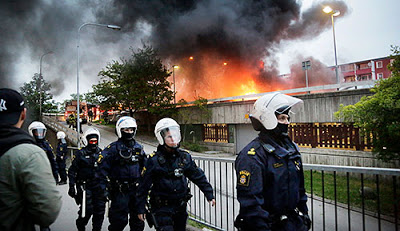
The scene of Sweden’s worst riots in years, Husby is on the surface at least a typically neat suburb of colorful playgrounds, manicured parks and low rise apartment buildings.
Conversations with residents of this immigrant neighborhood soon bring tales of fruitless job hunts, police harassment, racial taunts and a feeling of living at the margins that are at odds with Sweden’s reputation for openness and tolerance.
Riots that began in Husby have spread across Stockholm over the last four nights in scenes reminiscent of London in 2011 and Paris in 2005 – outbursts with their roots in segregation, neglect and poverty. The Swedish model of welfare – such as its 480 days of parental leave for each child – hides another side.
Some 15 percent of the population is foreign born, the highest in the Nordic region. The rise of the anti-immigrant Sweden Democrats party, which has called for a curfew in response to the violence, has polarized Swedes.
Metros and trains out of Stockholm center late at night are full of exhausted-looking Arabic or Spanish speaking immigrants returning home from menial jobs. Even second generation immigrants struggle to find white collar employment.
As one Asian diplomat puts it: “On the one hand Sweden has all these immigrants. On the other hand, where are they? It sometimes seems they are mostly selling hotdogs.”
In a further illustration of two very different worlds, the first riot happened as many Swedes celebrated winning the world ice hockey championship. Most immigrants play football – it is a common refrain that ice hockey kits are too expensive.
“The worst vandalism is not what we’ve experienced in recent days,” said community leader Arne Johansson at a protest rally in Husby. “It is the creeping, slow vandalism that this rightist government has exposed us to over the past seven years.”
Seven years of center-right Prime Minister Fredrik Reinfeldt – who has labeled the rioters hooligans – have lowered taxes and reduced state benefits. That has helped economic growth outpace most of Europe but Sweden also has the fastest growing inequality of any OECD nation.
Professor of criminology at Stockholm University Jerzy Sarnecki said society has become much more segregated, with a large, poor immigrant population living in areas of major cities where unemployment is dramatically higher than elsewhere.
Polls show a majority of Swedes still welcome immigration. Sweden has a reputation for treating new arrivals well – providing housing, Swedish lessons and allowing asylum seekers to live with relatives.
But the consensus is increasingly frayed.
“Those who, for whatever reason, don’t have work have not taken part in the general rise in prosperity,” said Ulf Bjereld, political science professor at Gothenburg University.
One recent government study showed up to a third of young people between 16-29 in some of the most deprived areas of Sweden’s big cities neither study nor have a job.
Sweden received 43,900 asylum seekers in 2012, a nearly 50 percent jump from 2011 and the second highest on record. Nearly half were from Syria, Afghanistan and Somalia. Many native Swedes worry welfare could become unaffordable if the trend continues.
Asylum seekers, in the short term, add a fiscal burden on the welfare state. OECD data show foreign-born unemployed rates, at 16 percent, compared with 6 percent for native Swedes. Sweden needs high employment levels to pay for its extensive welfare.
ANGRY, YOUNG MEN
The riots appeared organized. Cars were set alight near pedestrian bridges and youths hurled stones when police and emergency services arrived at the scene.
Witnesses said heavy handed policing made the situation worse. Locals in Husby said they were taunted by police who shouted “ape”.
“In the beginning it was just a bit of fun,” said one young man in his early 20s who did not wish to be named. He was one of a Husby group of 30-40 youths that battled with police.
“But then when I saw the police charging through here with batons, pushing women and children out of the way and swinging their batons, I got so damned angry.”
Police, who have called the rioters youth gangs and criminals, said accusations against the police were being investigated.
In interviews with youths in Husby, most were unemployed or interns. Many said they were bounced around intern schemes, seldom being offered full-time work, fostering resentment.
Local youths believe their Husby address is in part to blame for their lack of success. If they are lucky enough to be called to a job interview, many say they come from neighboring Kista – an IT hub symbolizing Sweden’s more modern, global image.
Many complained a conviction for a small amount of cannabis might stay on a teenager’s record for ten years, ruining job chances.
Stockholm has suffered riots and burning of cars before in recent years, although most fizzle out after one night. Other cities in the Nordic country have also experienced unrest.
Five years ago in Malmo, which has one of Sweden’s biggest immigrant populations, local youths threw home-made bombs and attacked emergency services to protest a police eviction.
In Husby, the shooting of a suspected machete wielding man by police earlier in the month was the spark. Local people – around 80 pct of whom have immigrant backgrounds – organized a peaceful protest for which more than 100 people turned up.
But their call for an inquiry into the death of the 69-year-old fell on deaf ears. Plugged in young locals complained about racist insults on Twitter, feeding anger.
“Young people wound each other up and started a small fire,” said Nefel, a beautician in her 20s. “I saw how the police came and treated them. I was in shock.”
“I was there and saw it happen. I wasn’t struck, but I did have a dog come at me. A police dog isn’t a nice little puppy.”
On the streets, resentment shows no signs of ebbing.
“My daughter comes home from school and says the kids say they can’t play with her because she’s dark,” said Maria Petersson, a 39 year old Ethiopan-born nurse. “I am both Ethiopian and Swedish but I will never be considered Swedish by the Swedes. To them, I am just another immigrant.” – Reuters
Mbali Ntuli, leader of the Democratic Alliance Youth
The reported racial exclusion policies of Kleinfontien farm settlement, near Pretoria, will be the target of a Democratic Alliance Youth protest on Thursday.
The settlement, which reportedly only accepts “white, Afrikaans Protestants who abide by the Blood River Covenant” as residents or workers, had no place in a democratic South Africa, DA Youth leader Mbali Ntuli said on Wednesday.
“We cannot allow racial nationalists on the extreme fringes of South African politics to try and bring apartheid back.”
The protest aimed to liberate Kleinfontein residents from their “apartheid mindsets”.
“While others divide, we will unite,” Ntuli said.
“Tomorrow we will show South Africa what a reconciled and prosperous nation looks like.”
Details of the planned protest would be released later.
Earlier, government expressed dismay that there were still citizens who did not want to integrate into a democratic South Africa.
“This disintegration is extremely disappointing, as it perpetuates the ills of the apartheid era,” acting government spokeswoman Phumla Williams said.
“Such acts were the main causes of a divided South Africa,” she said.
She was reacting to a report in The Times that residents of Kleinfontein settlement had vowed that only Afrikaners would be allowed to live there.
According to the newspaper, all the settlement’s residents, from the security guards at the gate to the gardeners, were Afrikaans.
Williams said all South Africans were governed by the Constitution, which catered for people of all races and religions. She said Kleinfontein residents benefited from government services.
“We strongly discourage them from lobbying for the town to be declared independent from the Tshwane municipality, as this will be contrary to the Constitution of this country.”
The Times reported that Kleinfontein’s controlling body chairman Jan Groenewald said it would lobby the Tshwane municipality for the settlement to be declared independent.
“Eventually, the African National Congress government will have to approve what we are doing here,” he was quoted as saying.
Groenewald told the newspaper a resident had to be “an Afrikaner with Voortrekker heritage, a Protestant Christian, and abide by the Blood River covenant”.
“We do not think in terms of race, we think in terms of culture… (but) you cannot ignore the fact that we have different races. That is the reality,” he reportedly said.
Residents included the leaders of several rightwing groups, but the community’s directors kept them in line, he said.
“We do not fly the South African flag because (South Africa) is a unitary state – the reason we find ourselves in this situation.” – Sapa
In today’s City Press newspaper, Frans Cronjé of the South African Institute of Race Relations claim that whites live in some kind of paradise.
He cites statistics claiming the following:
“Between 1994 and 2012, the rate of unemployment among white people increased from 3% to 5.7%…
The white unemployment rate was low, even when compared to a host of international benchmarks. In the US, for example, the rate in 2012 was 7.6%, in Britain 7.9% and in Canada 7.2%.”
Apparently praising South African white entrepreneurship, he goes on to say that “while a black university graduate is more likely than a white graduate to find a job within 12 months of graduation (due to strict affirmative-action laws-DR), white graduates are four times more likely to start and operate businesses”.
I would treat these statistics about low white unemployment with a great deal of caution. Many whites are not on the unemployment statistics as they do not claim benefits from the government. Driving around many white areas, you notice their old, decrepit cars, lack of maintenance to their properties and other signs of economic distress.
Go to any five-star hotel now and you will find blacks sitting around in designer clothes. The only whites there are foreign tourists. Most cars costing R1 million (about $100 000) and more that I see every day in Johannesburg are owned by blacks, not whites. Blacks get all the lucrative corporate directorships and make easy money as “tenderpreneurs” to the state and municipalities.
I know of thousands of whites who literally had to leave the country to find jobs, in the Middle and Far East where they do dismal work as part-time English teachers or pack groceries in Australian supermarkets.
Many small businesses started by whites have failed, not least because of the racial laws and regulations imposed by government and the corporate sector. The corporate sector – banks and large companies – are now arguably more anti-white than government. They do not trade with white-owned businesses and generally sue or harass small businesses at the drop of a hat. Many whites have lost their homes which the banks require them to pledge as collateral for a simple overdraft for their small businesses.
More whites now live in so-called “informal housing” than at any time since the Great Depression. Solidarity estimates that up to 800 000 whites – educated, literate and previously taxpayers – now live in squatter camps and other “informal areas” such as this one:
Poor South African whites living in cabins normally used as garden sheds
We are witnessing the greatest social-engineering programme whereby one race is economically subjugated to another that this country and perhaps the world has ever seen.
The very notion that whites could be “liberated” by such an unfair and racist system is so fundamentally cynical that it has an Orwellian ring to it. But that is why the mainstream media no longer has any credibility among middle-class whites.
The South African media are loyal to foreign and corporate interests who see South African whites as an unwanted presence in the country, preventing them from bribing their way into looting most of the remaining assets in South Africa. That is why the SA mass media are constantly attacking whites, accusing them of racism, “apartheid privilege”, and the like. White males even get blamed for the intense crime and lawlessness in the country! Every white person knows that 99% of the violence is committed by other races, yet we are blamed for everything. If all else fails, there is always ever-increasing “the legacy of apartheid” to blame.
What I find amazing is that Frans Cronjé published two contradictory articles today, one in Rapport and this one in City Press. The one in Rapport, written in Afrikaans and therefore intended for a mainly white audience, shows how 500 000 middle-class taxpayers essentially contribute 50% of all personal taxes in South Africa. White readers of that article would be understandably outraged that, while still contributing a large share of the country’s taxes, they are treated as second-class citizens.
English in South Africa is increasingly the language of blacks and the internationalist whites who are hostile to Afrikaners and the white middle class, for reasons explained in the paragraph above, namely that their ownership of land and role in the judiciary and the accounting profession prevents the wholesale looting of our country. Even though looting is already taking place, there is still some semblance of legality left. Clearly, this has to go.
This article in English about whites is therefore intended for a black and foreign audience, to convince them that South African whites “have never had it so good”. Understandably the very real hostility felt for those dastardly Nazis and perpetrators of a “crime against humanity” will only rise upon reading this article. It will undermine any inchoate sympathy whites enjoy with their less brainwashed brethren in the West and Europe.
The most absurd sentence of all is the following: “(Whites) were liberated, first, from the guilt and pariah status that had been attached to their support and enforcement of apartheid.”
On the contrary, South African whites are now more hated and stigmatised than ever! Over the past twenty years the SABC and the mainstream media have played their quasi-communist propaganda about white evil and viciousness over and over in South Africa. Most of the time this propaganda is literally the work of unreconstructed communists who occupy powerful positions in South Africa, being the “white face” of the ANC government, the SABC and other state agencies. The British media, including the BBC, see us whites as free game now that we are utterly without any political power and lack any form of state support. More
unfair and one-sided news stories have been published and broadcast about us since 1994 than ever before, barring perhaps the 1890s when the Uitlander press and the London newspapers were publishing war propaganda about the Boer republics.
As for white guilt, there is a whole industry meant to inculcate it into us, almost from birth. At school our children are exposed to compulsory subjects such as “Life Orientation” containing political propaganda of the worst kind, meant to persuade them that their parents were all war criminals killing thousands, if not millions, of blacks. In reality, of course, only 500 blacks died at the hands of the SA police from 1948 to 1994, fewer than die every year as a result of police brutality under black rule! However, the foreign whites and media do not write about police brutality anymore because it is now committed by blacks and therefore of no interest.
More than 80 000 whites have been murdered since 1994 and up to a million white women have been raped. Four thousand farmers, their wives and children have been killed, many of them spending their last hours under dehumanising torture.
While all this is going on in the ghoulish present, not a week goes by without newspapers and radio programmes calling for whites to “repent about apartheid”, surrender the meagre assets that they still control or simply leave the country as they “have outstayed their welcome”. People are constantly telling me to “go back to Europe” or “get lost”, even though my forebears came here in the early 1700s.
Apart from racial quotas in education that prevent whites from obtaining a tertiary education, especially in medicine and other fields, an aging white population now endures a third-world system of medical care. Prior to 1994, whites had one of the best healthcare systems in the world, with both a private and a well-managed public hospital system.
Corruption and mismanagement have reduced the public system to a shambles while the costs of private healthcare have gone through the roof. Only the corporate elite can now afford private healthcare. Whites are almost banned from studying medicine by the universities so that their parents and grandparents may just die from neglect in the state hospital system.
Despite being well-educated and hard-working, affirmative action and so-called BEE (black-economic empowerment) have reduced most South African whites to poverty. Their mean income per capita is far less than the minimum wage in many European countries.The following table shows annual per capita income growth from 2001 to 2011 for all racial groups in South Africa:
Source: Moneyweb/SA census
If the R365 134 earned by the average SA white is translated into dollar terms at $40 970, this is way below minimum wage levels in most European countries. However, this very modest white income gets taxed at 40% to fund the megalomaniac dreams of this make-believe government whose only interest is in seeking international prestige while it cannot even mend our roads, nor deliver school books on time. In a real sense, white poverty is caused by government, either through its high taxes or its racially interventionist policies.
Johannesburg High Court - too many white advocates there
by Andries Nel, Deputy Minister of Justice and Constitutional Development
It seems truly bizarre but in 1994, less than a generation ago, 160 of the 165 judges on the bench were white men. This is not a typographical error. White male judges were, to use biblical language, fourscore times two in number. The heavy onus of making the judiciary appear to resemble South Africa lay on the shoulders of three black men and two white women. As for black women, well….
Today, as “Mandela’s children” prepare to vote for the first time, 100 black men and 49 black women, 71 white men and 21 white women serve our nation as judges. They do so knowing that they are part of a judiciary that is coming closer to reflecting the racial and gender composition of South Africa, as is required by our Constitution.
Similar progress has been made in addressing race and gender imbalances in Magistrates Courts. Of the 1661 magistrates, 974 are black and 687 are white, 647 are women and 1014 are men.
Whilst this represents significant progress, there is still much to be done – especially regarding the gender imbalances in the upper echelons of the judiciary, the Constitutional Court, the Supreme Court of Appeal and the ranks of the Judges President.
Regrettably, some insist on propagating the untruth that it is constitutionally suspect to pursue the objective of a representative judiciary or, alternatively, that although legitimate, this objective is being advanced in a manner that is unconstitutional.
If some are to be believed, the Judicial Service Commission has simply transposed the “Non-Europeans Only” signs from the railway benches of yesteryear to the judicial benches of today.
A resigned combatant from what is often portrayed as the gladiatorial game of judicial selection punts the notion that, in the eyes of the JSC, white men have become as politically ineligible to judge as they have always been genetically incapable of jumping.
However, what tales do those inconveniently stubborn things known as facts tell?
Of the 71 white men currently on the bench, 61 were appointed after 1994 – and of them, 22 were appointed since 2009.
The “white men can’t judge” mythology being peddled is in fact anti-Constitution: It seeks to stymie the transformation required by the Constitution while attacking the integrity of the JSC and that of judges, black and white, appointed by it under the Constitution.
The Constitution is the supreme law of our land. It is also a supremely transformational constitution. It requires of us to follow a transformative course action in respect of access to justice and the transformation of the judiciary and legal system.
Let us be clear. Transformation, the big T-word, necessarily includes – but is not limited to – attaining demographic representivity.
Transformation in the South African context basically means making our society, look, work, think and be like the Constitution says it should. Anyone who thinks that it does, or is close to doing so, or will do so in a decade, simply doesn’t “get it.”
Firstly, the Constitution enjoins us to heal the divisions of the past and establish a society based on democratic values, social justice and fundamental human rights and to lay the foundations for a democratic and open society in which government is based on the will of the people and every citizen is equally protected by law.
Secondly, it guarantees everyone the right to have any dispute that can be resolved by the application of law decided in a fair public hearing before a court or, where appropriate, another independent and impartial tribunal or forum.
Thirdly, it provides that the need for the judiciary to reflect broadly the racial and gender composition of South Africa must be considered when judicial officers are appointed.
Fourthly, it says that all courts, including their structure, composition, functioning and jurisdiction, and all relevant legislation, must be rationalized with a view to establishing a judicial system suited to the requirements of the new constitution.
Government is committed to strengthening of the independence, the dignity, accessibility and effectiveness of the courts as part of this transformation process.
The Seventeenth Constitutional Amendment Act, the Superior Courts Bill, and the South African Judicial Education Institute Act, provide a strong legislative framework to realize this objective. Measures such as the establishment of the Office of the Chief Justice as a department advance the objective of greater administrative independence of the judiciary.
Access to justice is being promoted by, amongst others, the building of new courts the conversion of existing branch courts to full-service courts, the establishment of Small Claims Courts, the re-demarcation of magisterial districts, the Review of the Civil Justice System and the work of Legal Aid SA.
However, the untransformed state of the legal profession remains a stumbling block to the further transformation of the judiciary as well as to greater access to justice.
The legal profession is a key provider of services that promote access to justice and it also constitutes a pool from which the judiciary is appointed.
Of the 2384 advocates (as at April 2012) who fell under the umbrella of the General Council of the Bar, 1367 were white men, 366 white women, 295 African men, 89 African women, 47 coloured men, 37 coloured women, 114 Indian men and 69 Indian women.
The picture becomes even more skewed when one examines the profile of the 473 senior advocates (or “silks” as they are called – because of their right to wear silk robes): 382 white men, 20 white women, 29 African men, 4 African women, 9 coloured men, 1 coloured woman, 24 Indian men and 4 Indian women.
Traditionally, it is from the ranks of these “silks” that judges are appointed.
The attorneys’ profession is marginally more representative. As at June 2011 there were 20,077 practicing attorneys of whom 36% were black and 64% were white. Women constituted 34% and men 66%.
Interestingly, the profile of law students is much more reflective of South African society. In 2011 of all first year law students, 78% were black, 22% white, 54% were women and 46% men. In the same year, of the 3751 LLB graduates, 68% were black, 32% white, 59 % women and 41% men.
The question is to what extent these more reflective demographics will be carried through into the profession and what stumbling blocks exist in this regard.
One important intervention is the restructuring of state legal services announced by the Minister of Justice and Constitutional Development.
Another is the Legal Practice Bill currently before Parliament. The Bill proposes an institutional and statutory framework within which these challenges can be addressed in a systematic and inclusive manner.
The proposed South African Legal Practice Council will bring together advocates, attorneys and representatives of broader society to find solutions to the challenges of: entry to the legal profession, availability of quality legal training and education, quality workplace learnership opportunities, provision of pro bono services and community-based paralegal services, as well as the regulation of legal fees in order to promote access to affordable legal services for all, especially the poor.
The Council will be a mechanism through which the Legal Services Charter adopted in 2007 can be implemented.
The Bill does not prescribe solutions but mandates and facilitates their formulation. This will require the active participation of all sectors of the profession – and of broader society. Whether the solutions that emanate from the process take us forward will depend, amongst others, on the ability of those committed to the transformative vision of our Constitution to give leadership.
Andries Nel is the Deputy Minister of Justice and Constitutional Development. This article is based on notes for an address to a meeting of the Black Lawyers Association (BLA) – Student Chapter held at the University of South Africa (Unisa) on 4 May 2013.
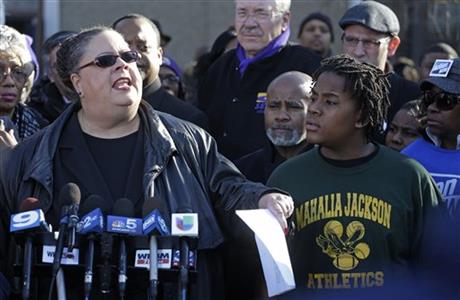
Karen Lewis of the Chicago Teacher's Union during a protest against the closure
CHICAGO (AP) — Tens of thousands of Chicago students, parents and teachers learned Thursday their schools were on a long-feared list of 54 the city plans to close in an effort to stabilize an educational system facing a huge budget shortfall.
Mayor Rahm Emanuel says the closures are necessary because too many Chicago Public School buildings are half-empty, with 403,000 students in a system that has seats for more than 500,000. But opponents say the closures will further erode troubled neighborhoods and endanger students who may have to cross gang boundaries to attend school. The schools slated for closure are all elementary schools and are overwhelmingly black and in low-income neighborhoods.
CPS officials say money being spent to keep underutilized schools open could be better used to educate students elsewhere as the district deals with a $1 billion budget deficit. About 30,000 students will be affected by the plan, with about half that number moving into new schools.
“Every child in every neighborhood in Chicago deserves access to a high quality education that prepares them to succeed in life, but for too long children in certain parts of Chicago have been cheated out of the resources they need to succeed because they are in underutilized, under-resourced schools,” said district CEO Barbara Byrd-Bennett. “As a former teacher and a principal, I’ve lived through school closings and I know that this will not be easy, but I also know that in the end this will benefit our children.”
As word of the closures trickled out, parents and teachers reacted with anger and shock, some even crying. Sandra Leon said she got a tearful call from her grandchildren’s kindergarten teacher saying the school was on the list to be closed. Her two grown children also attended the school, and Leon wiped her eyes as she waited outside for her grandchildren.
“It’s been so good for our kids,” Leon said. “This school is everything.”
Chicago officials have moved to close schools in the past, but never anywhere near the number designated at one time by the Emanuel administration. Former Mayor Richard M. Daley’s administration spread school closings over a number of years. CPS, the nation’s third-largest school district, now has 681 schools.
Chicago is among several major U.S. cities, including Philadelphia, Washington and Detroit to use mass school closures to reduce costs and offset declining enrollment. Detroit has closed more than 130 schools since 2005, including more than 40 in 2010 alone.
The issue has again pitted Emanuel against the Chicago Teachers Union, whose 26,000 members went on strike early in the school year, idling students for seven days. It has also put Emanuel and Byrd-Bennett at odds with parents, civic leaders and lawmakers, who have blasted the pair during highly charged community meetings throughout the city and at a legislative hearing earlier this week.
Union President Karen Lewis criticized Emanuel, who is out of town with his family, for being on vacation on the day of the announcement. She called the closings “an abomination.”
“This is cowardly and it is the ultimate bullying job,” Lewis said. “Our mayor should be ashamed of himself.”
The vast majority of the 54 schools are in overwhelmingly black neighborhoods that have lost residents in recent years. Chicago’s black population dropped 17 percent in the last census as African-Americans moved out to the suburbs and elsewhere. The other few schools are majority Hispanic or mixed black and Hispanic. Overall, 91 percent of Chicago public school students are minorities.
Many of the schools identified for closure are in high-crime areas where gang violence contributed to a marked increase in Chicago’s homicide rate last year. The district plans to have community groups help students get to their new locations safely.
Among the critics is Eular Hatchett, who lives in the violence-plagued neighborhood of North Lawndale and walks her 13-year-old nephew DaVontay Horace to school.
“Our parents know about this area,” she said. “They don’t know about those other areas. If they send him way north or way south, I’m not going to do that. It’s too dangerous.”
Because some schools have more than one building, a total of 61 structures will be closed. In addition to the closures, students at 11 other schools will be “co-located” with existing schools. Six schools have been targeted for academic interventions known as “turnaround.”
CPS says the plan will save the district $560 million over 10 years in capital costs and an additional $43 million per year in operating costs.
The district plans to invest $233 million into what it calls the “welcoming” schools, or the buildings that students in closed schools will be moving to. Those funds will be used for air conditioning, upgraded technology and security and to ensure every school has a library.
District officials said they couldn’t calculate how many teachers will be laid off as a result of the cuts because school leaders will make decisions about their own budgets.
Many teachers and parents expressed anger and frustration at how the news of the closures trickled out, leaving some to agonize over rumor and conjecture.
“In a word, the approach was brutal. It’s certainly not deserved by these parents and these kids,” said Mary Visconti, the director of the Better Boys Foundation, a youth organization in the Lawndale neighborhood.
At Lafayette Elementary, where 95 percent of its 483 students come from low-income families, teacher Rosemary Maurello said the principal read teachers a letter from the district Thursday morning saying the school is among those it plans to close. The letter said a final decision would be made in May after more community meetings are held and budget plans are reviewed.
But Maurello said letters and information packets were already being sent to parents and the district’s message to teachers included a mention of specific plans to move the Lafayette students to another school about 10 blocks away.
“It sounds like a done deal to me,” Maurello said.
A man was sentenced to 22 years’ imprisonment by the Pietermaritzburg High Court on Friday for rape, KwaZulu-Natal police said.
Sibusiso Didis Nkosi, 26, was found guilty of raping an 85-year-old disabled women in her room at an old age home in Paulpietersburg shortly after midnight on March 12, 2011, Captain Thulani Zwane said.
“He entered the room through a door that was not locked and raped the victim. The accused fled the scene on foot,” Zwane said.
Nkosi was arrested shortly after the attack and charged with the rape.
“The case was transferred to Vryheid family violence, child and sexual offences unit members, who collected all required evidence by the court for the purpose of good conviction.”
Zwane said Nkosi was denied bail and appeared in court on various occasions until he was convicted and sentenced in the High Court on Friday.
KwaZulu-Natal commissioner Lt-Gen Mmamonye Ngobeni said: “We as [the] South African Police Service condemn such brutal attacks on vulnerable elderly women by these heartless criminals who do not respect the rights of women and children.
“Sibusiso Nkosi, like any other criminals already convicted by our courts, do not deserve to be in our community and this sentence will send a strong message to others who might think of committing such crimes.” – Sapa
When was the last time you saw Uncle Tom’s Cabin in a theater? The answer is probably never. As far as I can tell, a theatrical version of Harriet Beecher Stowe’s controversial novel hasn’t been performed in the Philadelphia area for many decades, and that also appears to be true for the rest of the country, with the exception of a couple of attempts in New York City over the years. But one Philadelphia theater company says that it’s time to bring the story back to the stage, but with a twist.
EgoPo Classic Theater, a company that describes itself as “edgy, innovative, and inspiring,” is set to debut Uncle Tom in May at Delancey Place’s Plays & Players Theater. Auditions begin this weekend. The show will mark the end of EgoPo’s vaudeville-themed season, which started with their excellent all-female Assassination of Jesse James and continues in March with The Life (and Death) of Harry Houdini.
Uncle Tom was quickly transformed into a theatrical work after the novel’s 1852 publication. And although the book was immensely popular (its sales in the 1800s were only surpassed by those of the Bible), the various theatrical versions were even more so.
Because copyright laws were not what they are today, the scripts strayed freely from the original text, and the show eventually became a centerpiece of minstrel performances, complete with blackface and the most exaggerated racial stereotypes possible. Plus, the book itself wound up on some “banned book” lists, and the NAACP objected to its language and characterizations. No wonder the progressive theater world sought to distance itself in later years.
For the May production, EgoPo artistic director Lane Savadove and Glenn Odom, a literary studies professor at Rowan University, are creating a new script. “We’re doing a realistic, naturalistic version that will be incredibly respectful of the novel,” promises Savadove. “We’re not writing anything. We’re using the book word-for-word, cutting it just so that it works in a theatrical format. I really want the novel to speak for itself on the stage. This is not going to be some post-modern version of Uncle Tom’s Cabin.”
I asked him why it was important to do Uncle Tom now, why he wants to pick it up after all these years.
“The play got tagged as racist not because of the book but because of the minstrel shows,” he explains. “The book was written as an anti-racist piece, and in the last 10 years, the top African American scholars like Henry Louis Gates and Cornel West have gone back to reclaim it as an important part of racial history. And so, we wanted to go back now that it’s seen in this new light and create a new theater version.”
One person who is not convinced that this is necessarily a good idea is Philadelphia actor James Ijames, who teaches the most prominent version of the Uncle Tom scripts in his “Race on the Stage” course at Temple University.
“The citing of Henry Louis Gates and Cornel West to somehow say, ‘See, the black guy said it’s OK!’ is problematic,” says Ijames. “Citing the elder statesmen is akin to the ‘some of my best friends are black’ argument. That notion and rebuttal and defense doesn’t have anything to do with anything.”
Further complicating the matter is Savadove’s decision to swap races in the casting process. In other words, white actors will play slaves while black actors will play their owners.
I talked to one white actor who plans to audition for the show, even though his concerns are “numerous.” The actor, who asked to remain anonymous, points out that many of the stereotypes commonly associated with black culture can be traced back to Uncle Tom, from the “Aunt Jemima” figure to the hyper-educated, very proper black man.
“Those stereotypes were built off of white characterizations of blacks,” he says. “I don’t know how having white actors playing black characters introduces anything new to this story. I sincerely hope that there is an artistic objective beyond being edgy for the sake of being edgy.”
But his biggest and “admittedly selfish” concern is the dialect and language that he’ll be expected to use.
“I have a hard time listening to myself delivering the language,” he notes. “It sounds like a blatantly racist caricature.” He says that he can’t even read his lines in public.
Savadove tries to explain his unusual casting decision: “Even though, by all accounts, the dialogue is incredibly historically accurate, it’s a loaded subject to have a black man speak in a Southern slave dialect. And so we’re switching the races. And we’re painting a picture of an America where it happens to be that the whites became enslaved and the blacks became the slave owners. We’re pointing out the randomness with which the blacks became enslaved and the whites became empowered.”
When I asked Savadove if staging the play was the subject of much debate within EgoPo, he told me it wasn’t. “We are clear in what we are doing,” he says. “And we articulated it clearly to our board.”
In light of Savadove’s justification for the racial switch and his comments regarding “randomness,” Ijames wondered about the racial makeup of that board, as did Ardmore-based playwright Quinn Eli, whose newest play will debut at Plays & Players in April alongside works by Suzan-Lori Parks and other African American playwrights.
And so I asked Savadove point blank if there were any black people on his board. He refused to answer directly. Then he pointed to EgoPo’s 2012 production of A Dybbuk, perhaps the most important play in Jewish history and one with its own controversies surrounding mysticism and Kabbalah. “You didn’t call me then and ask me if any of my board members were Jewish,” he said. No, I didn’t. But, then, A Dybbuk is no Uncle Tom’s Cabin.
In any event, both Eli and Ijames say that they intend to go see EgoPo’s Uncle Tom. And so do I.
“I’ll find it difficult to absorb the image of whites in place of blacks as slaves,” says Eli. ”And I question how effective it will be for white members of the audience who won’t have to take the horror of what happened to those who it actually happened to. It presupposes that a lot of our notions about race have changed more dramatically than I think they have. But that doesn’t mean it won’t make for interesting theater.” – The Philly Post
Idle No More is forcing many Canadians to be Willfully Blind No More.
Ostensibly, the movement spearheaded by Attawapiskat Chief Theresa Spence is about the protection of First Nations’ treaty rights. At its core, though, might be something more profound, perhaps best described as a demand for all of us in this country to re-think the relationship between Aboriginal and non-Aboriginal Canadians. The relationship is, of course, an uneven one, though it might be far more uneven than most of us in this country care to acknowledge.
Against this backdrop, policy makers and average Canadians alike would be well advised to ring in the New Year by considering the lessons Michelle Alexander highlights in her important book, The New Jim Crow: Mass Incarceration in the Age of Colorblindedness. The context is American, but the lessons may hit closer to home. In the book, Alexander writes the following in regards to African-Americans and the United States’ criminal justice system:
“It is fair to say that we have witnessed an evolution in the United States from a racial caste system based entirely on exploitation (slavery), to one based largely on subordination (Jim Crow), to one defined by marginalization (mass incarceration). While marginalization may sound far preferable to exploitation, it may prove to be even more dangerous. Extreme marginalization, as we have seen throughout world history, poses the risk of extermination.”
It’s a narrative equally provocative and compelling. Alexander argues that Americans’ obsession with ‘law and order’ began as a conservative attempt to breed white opposition to the burgeoning civil rights movement. Politicians on the right labeled civil disobedience a precursor to criminality, and branded supporters of civil rights legislation as promoters of lawlessness. Exploiting the fears of poor and rural whites, Republican politicians invented and propagated the ‘War on Crime’ and, more specifically, the ‘War on Drugs’ as a means to incarcerate, and thus control, the black population.
The scheme was so successful that any politician that questioned the effectiveness or morality behind the supposedly colour-blind ‘War on Drugs’ was accused of being ‘soft on crime’ — the death knell for one seeking public office. In 1992, Bill Clinton recognized that Democrats could peel off right leaning white voters by outflanking the Republicans on issues like crime and welfare reform, and promptly advocated for a number of policies that resulted in the largest increases in federal and state prison inmates of any president in the history of the United States, the overwhelming majority of which were people of colour. The normalization of racial marginalization, according to Alexander, was finally, quietly complete.
The book is more than a lament; it’s a warning. Alexander paints a bleak portrait of a future in which the majority of African Americans — increasingly economically vulnerable in a nation of skyrocketing inequality — being under the control of the criminal justice system is not entirely inconceivable. It’s an ugly commentary on contemporary American society. Canadians should pay attention.
One in five Canadian prisoners are Aboriginal
Troublingly, there are significant parallels between the plight of African Americans in the United States, and the Aboriginal population in Canada.
As American history is steeped in institutional savagery toward African Americans, Canada’s history, too, is pockmarked by the white majority’s mistreatment of Indigenous peoples. Most notable among a litany of gross violations of justice are the permanent occupation of ancestral lands beginning in the 18th century, the noxious attempt to ‘civilize’ Aboriginal people in residential schools in the early 1900s, and the refusal to recognize Aboriginal Canadians as legal ‘persons’ until the middle of the 20th century. And the similarities, unfortunately, are not only historical.
Though Canada doesn’t yet lock up the same percentage of its citizenry as its southern neighbor — the most heavily incarcerated society in the world — measures passed by Prime Minister Harper’s Conservative government have resulted in a steady increase in the number of Canadians behind bars. Canadians of Aboriginal ancestries have borne the brunt of the surge of prisoners.
The proportion of African Americans and Aboriginal Canadians in prison far exceed their representation in the U.S. and Canada, respectively. In the U.S., black Americans account for 12 per cent of the total population, but represent nearly 40 per cent of the prison population. In Canada, Aboriginal peoples make up four per cent of the total population, but 20 per cent of the prison population.
These significant discrepancies are not shrinking. In the U.S., over 40 per cent of new offenders to state and federal prisons are African American. In Canada, more than one in five new admissions to men’s prisons are of Aboriginal descent. Among women offenders, over one in three are Aboriginal. In the U.S., one in three black men can expect to be incarcerated at some point in their lives. In Canada, young Aboriginal men are more likely to go to prison than complete a high school diploma. And once in custody, a significantly larger proportion of African American and Aboriginal Canadian prisoners are recommended for maximum levels of security than white prisoners charged with similar crimes.
Structural discrimination
While it might be unfair to claim that Canadian politicians and the Canadian criminal justice system have joined forces to consciously ensure that our Aboriginal communities remain repressed and disenfranchised, it cannot be denied that Aboriginals across the country suffer from poverty, injustice and lack of opportunity more than other type of Canadian. One in four Aboriginal children live in poverty.
The life expectancy for Indigenous people in Canada is eight to 20 years less than non-Aboriginal Canadians. On First Nations reserves, 60 per cent of children do not graduate high school, and the lack of suitable housing and access to clean water is endemic. To be Aboriginal in Canada today is to be a second-class citizen.
As a new year begins, we should take this opportunity to look closely at the society that we have created, and address the appalling inequalities of our criminal justice system. There is still time to prevent the prison state of our southern neighbors, but only if we hurry.
In our democracy – for we are no longer a republic that upholds individual rights and limits central power – you vote not for the representative who will defend your inalienable, individual rights. Rather, if you are The Rich – whom the left treats as a reified, rigid state-of-being – you vote defensively. If you are The Poor, you vote extractively – you empower your guy to steal The Other Guy’s stuff and hand it over.
Elections are when the politically dominant majority gets to thump the politically weak minority.
The Moron Media, left and right, are sticking to their story. Barack Obama had “out-hustled” Mitt Romney. Obama ran a better “ground game.” He triumphed “in the trenches,” “neutralized” his rival. He had not stopped campaigning since 2008. The president’s mega-machine was unbeatable, even though his vision was lacking. (As I like to say, a visionary bureaucrat is a voracious one. The best leader is one who leads in limiting his leadership.)
Had Romney, say some of the analysts, been a better tactician, scrappier, less of a patrician – he’d have won.
The media so arguing have advocated for immigration policies that have helped, over the decades, to replace the American people with a new, vastly different people. Although whites broke for Romney in a big way – as a proportion of the voting public, the founding majority is teetering on minority status. It has shrunk to the point where it is becoming powerless against a coalition in opposition.
As an extension of their life’s work, the “news” people aforementioned have anointed a string of progressive commentators who are distinguished from the Democrats with whom they cavort in studios in one way only: They call themselves Republicans.
This lot’s line on the Republicans’ Nov. 6 defeat went as follows: Be nicer to the axis of Asians, blacks, browns (and brown-nosing bimbos) who handed the Democrats a handy victory.
For years, those of us who’ve warned about demographics have been dubbed racists. But the D- Bomb has dropped. Its debris is scattered across “the field” upon which Mitt Romney said he “left everything.”
Asians, blacks and Latinos united for Obama.
As always, women voted with their wombs, although married sisters were less wild for big daddy O. (Oh, how we suffer for the female suffrage! I once vowed to “give up my vote if that would guarantee that all women were denied the vote.”)
To the pox of the 19th Amendment – it granted women the vote – add the 26th Amendment. Smuggled into the Constitution by statute, it artificially swelled the ranks of Democratic voters by millions of 18-, 19- and 20-year-olds. While they don’t work for a living, the vote grants youngsters a claim on the livelihood of those who do.
Overlapping voter categories notwithstanding, Obama thus curried favor with females – single ladies, in particular – the faithless, kids and minorities.
Put differently, those earning less than $50,000 trended Barack Obama; those earning more than $50,000, and certainly individuals in the upper-income tax bracket, preferred Mitt Romney.
People with higher incomes constitute a minority, an economically dominant minority (to paraphrase Amy Chua). People with low incomes are in the majority, a politically dominant majority.
The rich are politically impoverished; the poor politically rich. The rich dominate the economy; the poor dominate the polity.
When elections roll around, the politically powerful exact their revenge against the economically powerful.
What kind of a right gives one man control over another man’s life? In a democracy, the right to vote does just that.
As for demographics, they have become destiny. They were not necessarily so. Demographics have been the excuse central planners have advanced to persevere with immigration policies that destroy civil society and shore up the welfare state.
The now-waning West became great not because it outbred the rest of the world. The West was once great because of its human capital – innovation, exploration, science, philosophy; because of superior ideas and the willingness to defend such a civilization, not because it was more populated than the rest of the world.
America doesn’t need more people; it needs better people.
Making nice with constituencies that vote repeatedly and habitually for the candidate who promises them more stuff is tantamount to sleeping with the enemy. The only voters who could be swayed by the promise of the free market are the Democratic Party’s Asian supporters, since they enjoy higher incomes and stabler families than the party’s Hispanic and black devotees.
Ultimately, elections are about perception – the way in which the people perceive the political planks of the two parties.
The American people perceive the Democratic Party as the party of entitlements. They think of the Republican Party as the party of austerity.
History and reality tell us that both parties have grown government into the gigantic, intractable, wealth-gobbling Thing that it is. But in the age of reality TV, reason and reality are meaningless.
Perception is everything.
The idea of an American People is yet another misconception. The extravaganza that had one adorable, carrot-topped kid bawling “no more ‘Bronco Bamma’ and Mitt Romney, please” has ended. But if this advance auction of stolen goods – H. L. Mencken’s definition of an election – proved anything, it is that America is a mass of competing factions.
Some vie to keep more of their rightful property; others fight to get their paws on that very property.
And the tipping point has arrived. This, Nov. 6, 2012, has proven.
President Barack Obama’s election victory exposed tectonic demographic shifts in American society that are reordering the U.S. political landscape.
The 2012 presidential election likely will be remembered as marking the end of long-standing coalitions, as voters regroup in cultural, ethnic and economic patterns that challenge both parties—but especially Republicans.
Older voters and white working-class voters, once core elements of the Democratic Party, have drifted into the Republican column. Rural and small-town voters, whose grandparents backed the New Deal, now fill the swath of the U.S. that leans reliably GOP.
But in cities and dynamic suburbs, a rapidly growing force of Latinos, Asian-Americans, African-Americans and higher-income whites emerged this week as the strength of Mr. Obama’s winning Democratic coalition.
“The Democrats now own a coalition of emerging metro areas where the whites and minorities live together, and where they vote Democratic,” said Robert Lang, a demographer who directs the Brookings Mountain West, a research center at the University of Nevada, Las Vegas.
In northern Virginia’s Fairfax County, for example, Democratic Rep. Gerry Connolly represents a district where 20 years ago, he said, 3% of residents were born outside the U.S. Now, it is nearly 30%, with the majority Asian immigrants.
What County-by-County Results Tell Us About the Election
The most detailed results from the 2012 election show the voting patterns for each county in the country. Changes from the previous election give us an idea of what geographic and demographic trends are impacting national politics.
Mr. Obama won big there Tuesday, helping him to tally the once reliably Republican state of Virginia for the second straight general election.
Similar shifts throughout the U.S. help explain how Mr. Obama was returned to the White House on support from young people, minorities, women and upscale whites, a coalition virtually identical to the one that carried him to victory four years ago.
Some political analysts thought that coalition came together only because of the historic nature of Mr. Obama’s 2008 victory and wouldn’t prove durable. That belief didn’t hold up this week.
The question now is whether Mr. Obama and other members of his party can solidify this coalition into a foundation of the Democratic Party.
Republicans said their party won a smashing victory in congressional elections just two years ago, when they took control of the House of Representatives, illustrating that there is no clear claim for either party.
Decision Day in America
Voters headed to the polls Tuesday in a presidential contest defined by its intensity and razor-thin margins.
The 2010 election, they said, shows that even with modest inroads among Latino and Asian-American voters, the GOP can build a solid majority on the foundation of its strong white support. Republicans enjoy historically high levels of control over governorships and state legislatures, which they say shows the party’s potential if it can improve its message to minorities.
In any case, both Democrats and Republicans see new contours of a split electorate.
Twenty years after supporting former President Bill Clinton, a majority of white voters have returned to where they were during the Reagan administration, firmly planted in the Republican camp. Nearly six in 10 white voters told exit pollsters Tuesday that they sided with Republicans, up from 40% during Mr. Clinton’s 1992 presidential victory.
More striking is the GOP’s loose grip on minority voters: just 29% of Latinos, 25% of Asians and 8% of African-Americans said Tuesday they identified with the Republican Party.
The trend has strengthened the Democrats’ hold in cities and extended a new reach into once-white suburbs now filling with successful Asian and South Asian immigrants, as well as Hispanics.
Mr. Obama scored a big win, for example, in Denver’s Arapahoe County, a bedroom community of family farms and high-tech firms. The county, in turn, helped propel Mr. Obama to victory for the second time in Colorado, formerly a Republican-leaning state.
The presidential election also cast a spotlight on a generational shift under way.
Senior citizens, who swung to the Democrats during the Medicare and Social Security fights of the 1990s, have swerved to Republicans. Close to six in 10 seniors backed Republican presidential candidate Mitt Romney, according to exit polls Tuesday, up from the 51% of the group siding with Sen. John McCain in 2008.
The split by age reached even deeper: A majority of voters age 40 and older sided with Mr. Romney. The majority of every younger age group voted for Mr. Obama, according to exit polls.
When former President George H.W. Bush, Mr. Reagan and Mr. Clinton won their respective elections, they won among all ages. But no Republican presidential candidate has won a majority of voters under age 30 since Mr. Bush in 1988.
Polls earlier this year showed cooling interest among young voters in the Obama re-election campaign. But turnout among voters ages 18 to 29, in fact, eclipsed the 2008 election, with nearly 60% siding with the president.
The robust turnout by younger voters boosted Democrats nearly as much as the strong showing among Latinos.
Concerns grew Wednesday among some Republicans that the party’s base will be hobbled in national elections if it becomes too old, too rural and too white. “What worries me is that the GOP is about to become the WOP—the White Old Party,” said Norm Coleman, a former Minnesota senator.
Nothing casts more fear in the GOP than estrangement with the swelling U.S. Hispanic population, which now accounts for 10% of the electorate.
During the 1970s and 1980s, Republican presidential candidates routinely received a third or more of the Latino vote. Former President George W. Bush garnered just over 40% in 2004. That share has since plummeted amid sometimes harsh debate over legislation to deal with millions of illegal immigrants, mostly from Mexico, living in the U.S.
Mr. Romney got 29% of the Hispanic vote Tuesday, the lowest share since Sen. Bob Dole ran for president in 1996.
“The party has hit a new floor,” said Al Cardenas, the head of the American Conservative Union and former chairman of the Florida Republican Party. “The reality is we face a very big, very important shifting demographic in the country, and we saw how it played out in Colorado, Florida, Nevada and Virginia.”
Mr. Obama beat Mr. Romney among Latinos by 58% to 40% in Florida; 87% to 10% in Colorado; 80% to 17% in Nevada; and 66% to 31% in Virginia, according to an ImpreMedia/Latino Decisions poll.
“Texas probably has a huge potential to trend Democratic if the Democratic Party engages the electorate there,” said Matt Barreto, co-founder of the Latino Decisions polling firm.
The Romney campaign devoted attention to Asian voters, particularly in northern Virginia. Exit polls showed the Asian vote expanding to 3% of the total U.S. electorate—an all-time high—with 75% of those votes cast for Mr. Obama. – WSJ
Four years after Barack Obama was elected president, this is not exactly a “post-racial” America.
A new study from Washington University in St. Louis finds that under Obama, many black Americans feel less free than whites when it comes to political participation.
From 2005 to 2011, only 45 percent of blacks said they believed the government would allow them to make a public speech, while 67 percent of whites believed they could, the study found.
The study found that while the election of Obama initially boosted feelings of political empowerment among black Americans, those sentiments significantly faded in the years that followed—especially among conservative and religious blacks.
These two groups make up a large segment of the black population, with 56 percent of blacks identifying as “born again,” and 39 percent of blacks as “somewhat conservative,” according to the study.
“First we saw the ’empowerment effect,’ the boost that happens when a member of your group gets elected to an important political position,” says study author James L. Gibson, a professor of government and African-American studies at Washington University. Gibson’s findings are based on national surveys conducted between 2005 and 2011.
In 2009, the year after Obama was elected, 71 percent of blacks reported feeling as free to speak one’s mind as they used to.
“But then perceptions of political freedom deteriorated among conservative and religious blacks,” says Gibson. By 2011, the percentage of blacks who felt as free to speak their mind had dropped to 56 percent, back to pre-Obama levels. (White Americans also reported feeling less free to speak one’s mind under Obama, but the decline was far less than among blacks).
In part, says Gibson, this can be attributed to “ideological polarization.” That split may have begun when Obama dismissed Pennsylvania voters in 2008 who “cling to guns or religion.” But Gibson says many conservative and religions blacks likely believed when Obama was first elected that he would protect their interests as president. “Race produces a level of trust and confidence that one is on your side,” he says.
Over time, that confidence eroded. Gibson cites the contraception debate between the White House and some religious leaders that erupted last year. Black Americans, he notes, are traditionally conservative on social issues.
Another schism may have centered on gay marriage. The Democratic-leaning Coalition of African-American Pastors, for example, recently said they felt “marginalized” and “ignored” by Obama’s seemingly sudden support for same-sex marriage.
Religious fundamentalists and conservative blacks, Gibson says, “have seen their efforts to participate in public life [under Obama] being thwarted over and over and over again.”
Elizabeth Flock is a staff writer for U.S. News & World Report.
This website uses cookies to improve your experience. We'll assume you're ok with this, but you can opt-out if you wish. Cookie settingsACCEPT
Privacy & Cookies Policy
Privacy Overview
This website uses cookies to improve your experience while you navigate through the website. Out of these cookies, the cookies that are categorized as necessary are stored on your browser as they are essential for the working of basic functionalities of the website. We also use third-party cookies that help us analyze and understand how you use this website. These cookies will be stored in your browser only with your consent. You also have the option to opt-out of these cookies. But opting out of some of these cookies may have an effect on your browsing experience.
Necessary cookies are absolutely essential for the website to function properly. This category only includes cookies that ensures basic functionalities and security features of the website. These cookies do not store any personal information.
Any cookies that may not be particularly necessary for the website to function and is used specifically to collect user personal data via analytics, ads, other embedded contents are termed as non-necessary cookies. It is mandatory to procure user consent prior to running these cookies on your website.


 According to documents handed in at the High Court in Pretoria, the victim was released unconditionally, but later in the same case re-arrested and assaulted in the police cells for a second time, before again being released unconditionally.