White farmers 13 times more likely to be attacked

SAIRR has amended their view on farm attacks. According to Institute’s calculations white farming families may be 13 times more likely to be attacked.

This Research and Policy Brief paper seeks to determine the extent to which farmers are uniquely vulnerable to armed attack in South Africa. It draws comparisons between the rate of attack on farmers and their families to that of other citizens in South Africa.

On 5 October 2012 the South African Institute of Race Relations released a statement on farm attacks in South Africa. The statement was based on farm attack data by the Transvaal Agricultural Union (TAU). It has since been drawn to our attention by James Myburgh that the TAU data is compromised by a significant undercount of as much as 7:1 in terms of the actual number of farm attacks. Our initial analysis has therefore been revised accordingly. The revised analysis follows below.

The table below compares the farm attack rate for farmers and their families to the house robbery rate, aggravated robbery rate, and combined aggravated robbery and murder and attempted murder rates for the broader population.  It is based on three assumptions. The first is that there are 47 000 commercial farmers in South Africa. This is based on StatsSA’s Census of Commercial Agriculture 2007. The second is that the average household size for farmers is 3. This is the average household size for white South Africans. The third is that, following from James Myburgh’s analysis, TAU undercounts farm attacks by an average of 7 to 1. The fourth is that attacks on smallholdings should be included as attacks on farms.

  47 000 farmers + 2 dependants each = 141 000 people National population = 50.6 million people Ratio of farm attacks to attacks on general population
 

Rate per 100 000 people

Farm attacks vs house robberies 422 33 12.8 to 1
Farm attacks vs aggravated robbery 422 200 2.1 to 1
Farm attacks vs aggravated robbery + murder + attempted murder 422 260 1.6 to 1

Table 1: Attacks on farmers and their families compared to other citizens (smallholdings included)

The table shows that based on those four assumptions the number of attacks on farmers and their dependants is 422/100 000. The number of house robberies in the broader population is 33/100 000. In this comparison farming families are 13 times more likely to be attacked than other families. However, farm attacks also include all forms of robbery and not just house robbery.

For that reason the table also compares the farm attack rate to the broader armed robbery rate in the country. Here the farm attack rate, which remains at 422/100 000, must be compared to the national armed robbery rate of 200/100 000. In terms of this comparison farmers and their families are twice as likely to be attacked as other citizens. Farm attacks also involve murder and attempted murder.

For this reason the table also compares the farm attack rate to the joint aggravated robbery/murder/attempted murder rate for the broader population. Here the farm attack rate, which remains at 422/100 000, can be compared to the national murder and aggravated robbery rate of 260/100 000. Even on this analysis farmers remain more vulnerable to attack by a ratio of 1.6 to 1.

However, the argument can be made that smallholdings are basically large urban plots and not really farms. For that reason we have published the table below which compares farm attacks, excluding attacks on smallholdings, to criminal attacks in the broader population. The other three assumptions made about the data (above) are unchanged.

  47 000 farmers + 2 dependants each = 141 000 people National population = 50.6 million people Ratio of farm attacks to attacks on general population
 

Rate per 100 000 people

Farm attacks vs house robberies 262 33 7.9 to 1
Farm attacks vs aggravated robbery 262 200 1.3 to 1
Farm attacks vs aggravated robbery + murder + attempted murder 262 260 1 to 1

Table 2: Attacks on farmers and their families compared to other citizens (smallholdings excluded)

This table shows that when smallholdings are taken out of the equation the farm attack rate declines to 262/100 000 farmers and their families. Compared to the national house robbery rate of 33/100 000 farmers are on this measure eight times more likely to be attacked than other citizens.

However, the table shows that when this new farm attack rate is compared to the broader aggravated robbery rate of 200/100 000 this ratio comes down to 1.3 to 1. Furthermore, when the farm attack rate is compared to the broader aggravated robbery/murder/attempted murder rate of 260/100 000 that ratio reaches a level of parity of 1 to 1. In other words, on this measure farming families are no more likely to be attacked than other citizens.

We have also conducted an analysis of the murder of farmers, based on TAU’s more complete murder figures. In order to produce a figure for the highest possible murder rate the table below assumes that only the 47 000 farmers, and not their families, are targeted in farm murders.

  47 000 farmers National population = 50.6 million Ratio of farmer murders attacks to murders in the general population
 

Rate per 100 000 people

Farm murders vs all murders 68 31 2.2 to 1

Table 3: The murder of farmers

On this measure the table shows that in 2011 some 68/100 000 farmers in the country were murdered. This compares to a national murder rate of 31/100 000. On this analysis farmers are twice as likely to be murdered as ordinary citizens.  However, while farmers are particularly likely to be murdered, it is true that family members may also be murdered in attacks. It is for this reason that we have prepared the final table below, which compares the murder rate for farmers and their families to that of other citizens.

  47 000 farmers + 2 dependants each = 141 000 National population = 50.6 million Ratio of farmer/family murders to murders in the general population
 

Rate per 100 000 people

Farm murders vs all murders 33 31 1.1 to 1

Table 4: The murder of farmers and their families

This table shows that in 2011 the murder rate for farmers and their families was 33/100 000. The murder rate for the broader population was 31/100 000. On this comparison farmers and their families are not more likely to be murdered than other citizens.

Keep in mind that our analysis has excluded the 220 000 emerging commercial farmers, some of whom are large producers, who may also be attacked. We have also excluded from this analysis farm managers and extended families that may live on farms and become victims of attack. Our figures therefore suggest worst-case scenarios for farming families.

What conclusions can be drawn? The first is that the past week has seen a sharp increase in the quality and level of analysis of farm attacks in South Africa. It has also focused considerable media attention on the problem. Both of these are good things.

The second is that it is possible to argue that farmers are uniquely vulnerable to attack contrary to our initial conclusions drawn from the incomplete TAU data. This is especially so where a straight comparison is drawn between the house robbery rate and the farm attack rate. The same is true for the murder rate of farmers (excluding family members).

The third is that by changing some assumptions it is possible to reach somewhat different conclusions. For example, it is reasonable to compare farm attacks, which is a term inclusive of robbery and murder, to the broader robbery and murder rates of the society. When this is done farmers remain more at risk, although by a smaller measure. However, it is when the assumptions shift to exclude smallholdings that the picture changes significantly. Then the comparisons suggest that farmers are not uniquely vulnerable to violent attack.

However, even this result should not be taken to suggest that farmers are safe. Analysts of our data must consider that South Africa’s crime rates are uniquely high. Our murder rate, for example, is 500% higher than that of the United States and 3000% higher than parts of Western Europe such as the United Kingdom and Germany. This brings us to our fourth conclusion that all South Africans face an extraordinary criminal onslaught. People who have previously regarded farm attacks as a somewhat distant problem, nothing to do with them, must realise that they arguably live in as much peril as farmers do. It is clear therefore, regardless of how they rank compared to other citizens, that as a best-case scenario, farmers live a perilous existence in a largely lawless society.

The fifth conclusion is that, unlike urban middle class residents, farmers do not have the benefit of armed response companies or nearby police stations. Rather they depend on their own defences to secure themselves and their families. In addition, no analysis of the security position of farmers would be complete without noting the role of the State in exacerbating their vulnerability. The closure of the commandos and the Government and the African National Congress’s ambivalence at best toward the incitement by some of their own members to kill farmers creates an environment in which South Africa’s farmers are likely to be killed.

The final conclusion is that there can ultimately be no solution to farm attacks without a broader solution to the general problem of criminal violence in our society. In other words, farmers will not be safe until other citizens are safe and vice-versa. This is a point that advocacy groups can use to great effect in their important campaigns to alert policy makers and the international community to the murder of farmers in South Africa.

Issued by Frans Cronje, Lucy Holborn, Boitumelo Sethlatswe, South African Institute of Race Relations, October 10 2012

Peace Corps pedophile sentenced

A former Peace Corps volunteer apologised for sexually abusing young black girls while serving in South Africa and acknowledged the widespread fallout from his crimes before he was sentenced Wednesday to 15 years in prison.

Jesse Osmun, who had served at the Umvoti Aids Centre in Greytown, KwaZulu-Natal, apologised in court to the victims, his family and the Peace Corps.

He said he struggles with feelings of guilt and shame and acknowledged that his victims will live with the scars of abuse forever.

“I sometimes wish I could take my brain out and wash it of all the memories I have,” Osmun said in US District Court in Hartford, Connecticut.

Osmun, 33, said he besmirched his oath to the Peace Corps to represent his country with pride.

Prosecutors sought a harsh term, saying Osmun preyed on children who were among the most vulnerable in the world, persuading them to engage in illicit sexual acts by playing games with them and giving them sweets.

Osmun’s attorney, Richard Meehan, said his client spared the victims the ordeal of testifying by pleading guilty in June to travelling from the United States to engage in illicit sexual conduct with children.

He also said Osmun wants to get treatment.

Judge Alvin Thompson said Osmun’s efforts to gain insight into his crimes and to work toward rehabilitation were unusual for a sex offender.

Thompson read a letter in which Osmun described viewing child pornography, which became his “gateway drug” to abuse.

As a Peace Corps volunteer, Osmun worked at a centre that provides support to people affected by the Aids virus. He told the court in June that he helped supervise children and was left alone with them for 10 to 30 minutes and recognised that as an opportunity to abuse them.

Osmun admitted that he engaged in acts with one of his victims twice per week for about five months.

US Attorney David Fein said Osmun had shown remorse, but he called the crimes “heinous” and read a letter from an official at the centre who said the children were abused in the one place they could feel safe.

She said the children are in counselling and staff were traumatised as well.

“These children have so little, but Jesse has taken the very fundamentals of their lives away,” she wrote.

The Peace Corps has said it was made aware of the allegations after Osmun resigned in May 2011. The agency has condemned Osmun’s actions as “reprehensible” and agreed to contribute about R175 000 to a fund for the victims.

Peace Corps volunteers, who are provided with a living allowance and receive transition funds after they complete 27 months of service, provide hands-on assistance in areas including health education, information technology and environmental preservation.

The Peace Corps has sent more than 200 000 Americans to serve in 139 countries.

Black man longs for his homeland

The once beautiful old town

Mafikeng’s incorporation into the then homeland [bantustan] of Bophuthatswana in 1980, made it a great place, says a black town member. Mpho Moshe Matheolane bemoans how the ANC allowed the well-functioning town of Mafikeng to deteriorate into the sad state it is now.

The then president Chief Lucas Mangope, who had succeeded in outdoing chief Tidimane Pilane for the position of the first (and only) chief minister in 1972 following the inaugural meeting of the Bophuthatswana Legislative Assembly, found himself in what can only be described as a quagmire of note in the period leading up to South Africa’s first democratic elections. Unable to relinquish power, he put his faith in the AWB in the hopes that his “country” would resist incorporation back into South Africa.

Despite Mangope’s blunders and the clearly unwelcome position by many anti-apartheid political movements, that Bophuthatswana like all the other homelands was a step in the wrong direction regarding the collective struggle of the native peoples of South Africa, Bophuthatswana went on to become the best run and most successful of the homelands. The argument has been made before; under the Bophuthatswana black-run government many positive things were achieved, even in the face of relying on apartheid South Africa for backing and the subsequently unfortunate endorsement of the policy of racially based separate development.

Infrastructure such as an airport, a broadcasting centre (Bophuthatswana Broadcasting Corporation, or BBC), a quality university (UniBo) and internationally equipped and state of the art recording studio, to name but a few, were put in place. A strong sense of identity both culturally and socially was entrenched in many of the homeland’s inhabitants. It was required that one be as fluent and literate in their mother tongue as they were in English or Afrikaans.

Of course, this is not to say that the Bophuthatswana days were the halcyon days as the rest of the country continued to go through the motions of a land forcefully coming to terms with its destiny. Even within its borders, a constant awareness of the stark contrast of life outside permeated the minds of many. But the significance of this historical context becomes relevant when one looks at what the former Bophuthatswana homeland became after a democratic dispensation was achieved. Under the current ANC leadership and since 1994, Mafikeng as the apparent synecdoche of Bophuthatswana and its entire functioning infrastructure all but came to a tragic halt and dare one say, deliberate near-destruction.

Logic arguably dictates that given much of the work that had already been accomplished in Mafikeng, all that the ANC had to do was to build on top of it. But this was never the case. The former BBC which, according to some sources, already had the capacity to provide a number of national channels several times over its now embarrassingly incompetent parent body, the SABC, quickly deteriorated. The international recording studios, which were used for part of the award winning Lion King musical production, were put under lock and key, while the airport, which is still in the list of longest runways in the world, was passed on for some private use despite the brief SAA connecting flights that were operated from it.

Mafikeng as it stands does not have a town gallery even though many a talent came and continue to come out of it. The town museum is a dishevelled institution which currently sees its parking lot being utilised by the provincial department of public works. In any given year, a new shopping mall can spring up a mere five minutes from the next one, creating in turn, ghostly complexes whose interiors are filled with to-let signs and emptiness. These are but only a few of the many things that are now administratively wrong with Mafikeng.

The sprawling rural land that was tamed into a town as sensitively depicted in the photographic work of Paul Alberts, The Borders of Apartheid, is now nothing but a shadow of its former self. Thanks to black rule.

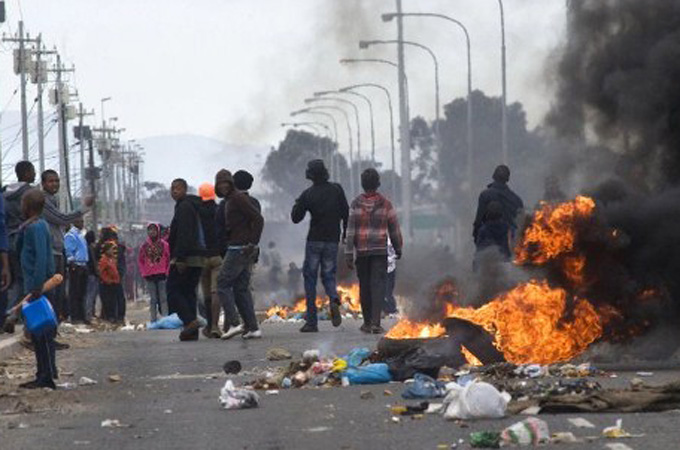
Violent protests rise dramatically

Rising expectations

Protest activity rose dramatically in the first eight months of this year, according to a report by the Multi-Level Government Initiative.

About 80% of the protests were violent.

The Multi-Level Government Initiative, which tracked protests between February 2007 and August 2012, released its protests barometer in Cape Town yesterday.

The research corroborates the findings of local governments and data collated by intelligence service Municipal IQ.

It shows that there has been an unprecedented increase in the number of protests and in the use of violence by protesters.

Western Cape felt most of the protesters’ wrath.

“Protest” is defined by the researchers as “any complaint or issue cited by protesters in reports, whether related to the delivery of municipal services or not, over which citizens decide to, and actually engage in, [sic] organised public protest activity”.

Findings included that:

  • Protest activity rose dramatically in the first eight months of 2012, with 226 protests;
  • If current trends continue, this year will have more than twice as many protests as last, and more than in 2010 and 2011 together;
  • Western Cape surpassed Gauteng as the province with the highest number of violent protests this year;
  • Before 2012, Western Cape recorded its highest protest activity during an election year;
  • Western Cape, Eastern Cape and Gauteng accounted for 56.98% of protests; and
  • Occupation and housing were the most cited issues, 303 in the six-year period. Poor service delivery was second, with 218 protests. Grievances related to broken promises and government officials ignoring protesters’ complaints have risen exponentially since 2010 but account for less than 10% of complaints.

This year , Western Cape shot past Gauteng as the province with the biggest number of violent protests.

The head of the research project, Professor Jaap de Visser, said the researchers had begun collecting information on a very complicated issue.

“Let us build up our knowledge about protests over a period of time.

“The government should put serious effort into analysing protest activity and use the information to improve its performance and engagement,” he said.

National broadcaster looted since black rule

It seems that we are really heading for ‘Mzansi fo sho’. A continuous looting spree at the SABC, has been laid bare in explosive forensic reports, board minutes and internal correspondence obtained by the Sunday Times.

The newspaper has established that the cash-strapped public broadcaster:

  • Spent R196-million on a deal with Siemens which the SABC’s internal auditors deemed an “irregular contract” that “delivered no significant value”. SABC spokesman Kaizer Kganyago owns 10% of Siemens BEE partner Sedibeng, but says the deal was done before he arrived in 2006 and that he recused himself fromdiscussions involving Siemens;
  • Was guilty of “irregular expenditure” in giving the scandal-plagued ICT Indaba R3-million in sponsorship, including R1-million cash;
  • Agreed to give the Guptas’ New Age newspaper free exposure worth millions on its Morning Live show, flood Auckland Park with thousands of newspapers staff don’t want, and pay the paper R147251 to run advertorials;
  • Blew R1.6-million on a July Handicap extravaganza for 200 people, including 46 SABC staff, this year, even after claims surfaced that its directors embarrassed the broadcaster at last year’s event by demanding extra booze be served worth R32000;
  • Bent its own rules to appoint politically connected Hlaudi Motsoeneng as chief operating officer at an annual salary of R1.6-million, then tried to suppress a report which found he had lied about failing matric twice;
  • Hired Justice Ndaba as its turnaround-strategy head and allowed him to keep working even after discovering he’d apparently forged three degrees, including an MBA, until he quit after reportedly becoming involved in a prostitution scandal when in London on SABC business; and
  • Has been told by the Special Investigating Unit to take disciplinary action against more than 300 staff for failing to declare their interests, while recommending criminal action in nine other cases.

In an interview with the Sunday Times, board chairman Ben Ngubane said they are still struggling with these issues.

However, e-mails show that forged qualifications were flagged in May 2011, but the culprits were still used by the SABC, including as an acting company secretary in July 2011.

Ndaba, a former employee at BHP Billiton, denies forging his qualifications or that he was caught with his pants down in London, claiming it was another unnamed person.

Ngubane was implicated in trying to bury an internal audit report that said Motsoeneng lied on an application form for an SABC job in 1995, when he claimed to have passed matric.

He admitted it was “definitely policy” at the SABC for senior executives to have a matric, but said the board had the discretion to waive this requirement.

“In a COO, you are not looking for a theoretician,” he said.

The revelations of new holes at the broadcaster come at a time when the SABC is looking for another R6-billion from taxpayers to implement its digital broadcast strategy, after getting an earlier R1.4-billion guarantee from the Treasury so it could borrow cash from Nedbank. Taxpayers already fund it to the tune of R1-billion in licence fees and government grants.

In a letter sent in April, Finance Minister Pravin Gordhan rejected the SABC’s request to change the conditions of the guarantee, because the SABC had already broken its promises by not meeting profit targets, which he said “increases the risk to government arising from the guarantee”.

Gordhan pointed out that the SABC’s salaries had soared to R1.95-billion, while it had received only R388-million in sponsorship revenue, just more than half its target. “The initial issues that were the cause of the financial instability – cost escalations in excess of revenue growth – have not been adequately addressed,” he said.

This week, the SABC released its annual report, which showed it was given a “qualified audit”. Its failings included poor internal controls, unreliable financial information and meeting only 31% of 89 “delivery targets” it had set itself, ranging from skills retention to financial health.

Though the SABC posted a profit of R343-milliom, after making a R129-million loss last year, this appeared to be the result of slashing the amount it spent on buying film and programme rights from R1.7-billion to R1.3-billion.

Yet, the SABC still managed to spend R136-million on “irregular, or fruitless and wasteful expenditure” this year.

One thing the SABC didn’t skimp on was striking a deal to buy New Age newspapers for its staff, a newspaper owned by the wealthy Gupta family, a benefactor of Jacob Zuma.

Motsoeneng, who entrenched his hold over the SABC this week by taking control of news, radio and sport, admitted he had met Nazeem Howa, CEO of New Age, to discuss buying the newspapers.

He agreed to buy 1800 copies a day. “As a person, I want everyone to read,” he said, adding that the SABC “will only take newspapers according to our needs”.

The Sunday Times has also seen an uncensored version of a report by the Special Investigating Unit, the redacted version of which was presented to parliament last month. The report mostly covers wrongdoing predating the current SABC leadership. It found the SABC guilty of blowing R438.2-million in fruitless, irregular and wasteful expenditure between 2004 and 2009, and detailed nine criminal investigations.

investigations@sundaytimes.co.za

Malema attacks Nkandla

Julius Malema

Julius Malema on Tuesday severely criticised President Jacob Zuma for the reported R203m upgrades to his Nkandla home in KwaZulu-Natal.

This amounted to stealing and was not right, Malema told striking mineworkers in Virginia, in the Free State.

“They want to give you [miners] R16 000 but they give another man R250m to build a house,” Malema said.

Malema was addressing a group at the Meloding Stadium. Many women and children were among the striking workers who arrived to hear him talk.

He asked why Zuma’s other three homes, in Johannesburg, Durban and Cape Town, maintained by the state, could not be used for international visitors.

“Who goes to Nkandla of all places? There’s no wisdom there, nothing to learn, unless its about cultural aspects,” Malema said.

Malema told the miners that  Zuma has no respect for the country’s Constitution.

“How can Zuma ask miners to respect the Constitution if he does not,” he asked them.

He was referring to a recent Constitutional Court judgment that found invalid the appointment of Menzi Simelane as National Director of Public Prosecutions.

In reading the unanimous judgment, Judge Zak Yacoob said the court reached a number of legal conclusions, including that the NDPP’s appointment was not a matter to be determined by the subjective opinion of the president.

Malema told the miners Zuma hired Simelane against the guidelines stipulated by the Constitution. It was Zuma’s responsibility to protect the Constitution, yet he ignored it.

He referred to a recent court decision when the National Prosecuting Authority (NPA) was ordered to hand over tapes to the Democratic Alliance in relation to corruption charges against Zuma being dropped.

The NPA dropped the charges against Zuma just before he was elected African National Congress president and president of the country.

Malema told the miners that their struggle was his struggle. He also urged the community to stand by the striking workers. – Sapa

Africa faces food insecurity

Three-quarters of African countries and several “Arab Spring” nations are at high or extreme risk of a food crisis, according to an analysis published on Wednesday.

In a survey of 197 countries, 59 are most at risk of food insecurity, the British consultancy Maplecroft said.

Thirty-nine of these are African, it said.

Out of the 11 countries that are in the “extreme risk” category, nine are in Africa.

They include Somalia and the Democratic Republic of Congo, which are ranked joint first, Burundi (4th), Chad (5th), Ethiopia (6th), Eritrea (7th), South Sudan (9th), the Comoros (10th) and Sierra Leone (11th).

Haiti (3rd) and Afghanistan (8th) are the other two countries in the extreme risk category.

“Although a food crisis has not emerged yet, there is potential for food-related upheaval across the most vulnerable regions,” including sub-Saharan African and Arab states, said Maplecroft’s Helen Hodge.

The 48 countries considered to be at “high” risk for food supplies include Yemen (15th), Syria (16th), Pakistan (27th), Papua New Guinea (33rd), North Korea (35th), Iraq (54th) and Libya (58th).

Egypt, ranked 71st of the 197 countries, and Tunisia, 100th, are among medium-risk countries.

Sources of food insecurity range from conflict and instability in the Sahel, DRC and eastern Africa to rising prices for corn, caused by the worst US drought in 50 years and declining production in former Soviet countries, Maplecroft said.

The report, called the Food Security Risk Index, is intended for governments, NGOs and businesses to identify countries that could be susceptible to hunger or unrest because of food shortages or price hikes.

“The drivers of the ‘Arab Awakening [Spring]’ were varied and complex and included long standing public anger at high levels of governmental corruption and oppressive tactics against populations and political opposition,” said Maplecroft.

“When these factors combine with food insecurity, sparked by rising global prices, it can create an environment for social unrest and regime change.”

Notable changes compared to last year’s rankings were North Korea (19th on the 2011 list); Egypt (88th) and Syria (89th). – AFP

White farmers are uniquely vulnerable

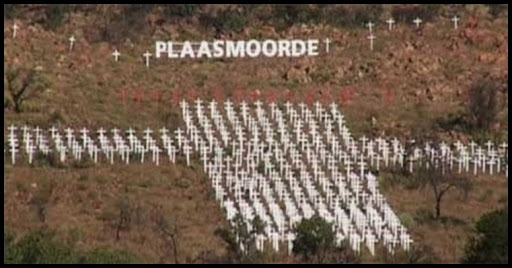
White crosses for victims of farm murders

Over the past fifteen years it has been taken as a given that commercial farmers have subjected to extremely high levels of violent and often murderous attack in South Africa. Many intellectuals and human rights organisations have however been anxious to underplay the import of this problem: The underlying concern apparently being that farmers might end up being regarded as ‘victims’ rather than as ‘perpetrators’. The line generally taken has been that there is no evidence that these attacks are in any way racially or politically motivated.

However, the question has now been raised whether farm attacks are such a unique problem at all. On Friday the South African Institute of Race Relations (SAIRR), a well-respected research organisation, issued a press statement – titled “Farmers not uniquely vulnerable to armed attack” – which claimed that the “number of farm attacks per 100 000 farmers and their families is comparable to the number of criminal attacks per 100 000 people in the general population.”

This claim has been widely reported on and could, if left unchallenged, end up being accepted as fact given the pre-existing biases of many in the media. The question needs to be asked: do the Institute’s claims hold up to scrutiny?

The SAIRR analysis was based upon farm attack figures compiled by the Transvaal Agricultural Union (TAU SA). The Institute used this data as the SAPS have not released farm attack figures since the 2006/2007 reporting period.

In 2011 TAU SA counted 85 farm attacks. Based on this figure the Institute calculated that “in 2011 the number of attacks per 100 000 farmers and farmworkers in the formal sector was 16.8. If it is assumed that farmworkers are not targeted and that attacks are aimed at commercial farmers and their families only, the rate of attack was 45.8 per 100 000 (assuming three dependants each).”

The Institute argued that although “It is difficult to benchmark farm attacks against other types of crimes… the rates calculated above are broadly comparable to rates per 100 000 people for other serious crimes among the general population. For example, in 2011 South Africa had a murder rate of 31.9 per 100 000 people. In that year the house robbery rate was 33.4 per 100 000. The total aggravated robbery rate was 203 per 100 000.”

On request the Institute provided the data on which it based its analysis. It reached the 45.8 per 100 000 figure by taking the number of commercial farmers in South Africa (46 400) and quadrupling the figure to 185 600 (on the assumption that each farmer has three dependents). The formula used was (85/185 600)X100 000 = 45.8 farm attacks per 100 000 people.

There are number of obvious flaws in the Institute’s methodology.

Firstly, it assumes that the average household size of a commercial farmer is four. This seems unlikely given that the average age of a commercial farmer is, according to Agri SA, 62 years. If one assumed the average household size of a commercial farmer was, for example, 2.6 the “rate of attack” would be 70.5 per hundred thousand (holding the Institute’s other assumptions constant).

Secondly, the Institute’s analysis effectively assumes that a single individual is victimised in each farm attack. In reality a single farm attack may involve several different crimes (murder, attempted murder, robbery, assault with intent to cause grievous bodily harm etc.) and more than one victim.

Thirdly, TAU SA’s figures for farm attacks include attacks on smallholdings (which do not necessarily fall under the 46 400 figure) as well as farms. This assumption, unlike the previous two, would tend to inflate the “rate of attack”. Offsetting this is the fact that Agri SA estimates that there are actually only 37,000 commercial farmers at present.

Finally, and most importantly, the TAU SA farm attack data is not comprehensive and does not claim to be. TAU SA’s data is collected from press reports and informal reporting networks. Their data on farm murders is pretty solid but there is significant under-counting of farm attacks. This can be seen by comparing TAU’s SA’s figures with those of the SAPS before the latter stopped publishing their data. See Graph 1 below.

Note: SAPS data from April to March the following year. TAU SA’s (via the SAIRR) from January to December.

In 2006/2007 the SAPS recorded 794 farm attacks as opposed to the 81 TAU SA recorded in 2006. It is unlikely that this level of under-counting has changed over the past few years. This can be illustrated by comparing TAU SA’s figures for farm attacks in KwaZulu-Natal with those collected by the KwaZulu-Natal Agricultural Union (Kwanalu). In 2011 TAU SA recorded 3 farm attacks in the province, Kwanalu 36. See Graph 2.

Sources: TAU SA figures (via the SAIRR); Koos Marais, KwaZulu-Natal Agricultural Union

All this goes to show that the Institute’s conclusions are based on incomplete data and some dubious assumptions, and they should not be regarded as reliable. The question raised by the Institute remains however: Are farmers less or more vulnerable to armed attack than other South Africans?

One alternative approach is to compare the farmer murder rate with the national murder rate. Drawing on TAU SA’s more complete statistics on confirmed farm murders Johan Burger of the Institute of Security Studies wrote that of the 50 victims in 2011 32 were farmers, 14 were direct family, three were workers and one was a visitor. He noted: “According to Statistics South Africa’s Census of Commercial Agriculture, there were 32,375 farmers (i.e. people farming either full-time or part-time) in South Africa in 2007. Therefore, the murder of 32 farmers (exclusive of their families and workers) in 2011 provides a ratio of 98.9 killings per 100,000.” This is three times the national murder rate.

One problem with this comparison is that most murders fall under the category of ‘social fabric crimes’ i.e. cases where someone is stabbed by an associate in a drunken brawl or a man beats his wife to death in a rage. A like-for-like comparison would be between the rate of farmer murders with the national rate of South Africans killed during robberies and other such crimes. In their report on the 2011/2012 crime statistics the SAPS state that 16% of murders are committed during the commissioning of other crimes. A back of the envelope calculation puts the national rate for this kind of murder then at just under 5 killings per 100 000 people.

An alternative approach to answering the question raised by the Institute would be to compare the rate of farm attacks (per 100 000 farms) with the rate of house robberies (per 100 000 households) using official SAPS data for both. The advantage of this approach is that it limits the assumptions that have to be made; uses data from the same source (the SAPS); and compares like-with-like.

There is however a limited period during which this comparison is possible. The SAPS only started collecting and publishing house robbery data in 2002/2003, and they stopped publishing “farm attack” data in 2007.

A further problem is that the headline SAPS data on farm attacks includes attacks on smallholdings. The Report of the Committee of Inquiry into Farm Attacks (July 2003) did however publish a breakdown of SAPS figures for 2001 which differentiated between attacks on farms and attacks on small holdings. See below.

Source: The Report of the Committee of Inquiry into Farm Attacks, July 2003

It is thus possible to compare the rate of farm attacks in 2001 at least with the rate of house robberies in 2002/2003. See the Table 2.

Table 2: Comparison of rate of household robberies (2002/2003) with rate of farm attacks by province (2001):

Province Households 2002 ‘000 House robberies 2002/03 House robberies per 100 000 households Farms(2002) Farm attacks 2001 Attacks per 100 000 farms Rate of farm attacks 2001/ Rate of house robberies 2002/3
Gauteng

2 683

4701

175.2

2206

18

816.0

4.7

KZN

2 073

1569

75.7

4038

108

2674.6

35.3

Mpum

768

316

41.1

5104

234

4584.6

111.4

E Cape

1 484

1397

94.1

4376

66

1508.2

16.0

W Cape

1 166

335

28.7

7185

40

556.7

19.4

N Cape

256

29

11.3

6114

12

196.3

17.3

N West

791

396

50.1

5349

87

1626.5

32.5

Limpopo

1 081

228

21.1

2915

35

1200.7

56.9

FState

713

92

12.9

8531

30

351.7

27.3

Total

11 015

9063

82.3

45818

630

1375.0

16.7

Note: These farm attack figures exclude attacks on smallholdings

On average then a farm was over fifteen times more likely to be attacked in 2001 than a household was likely to be robbed in 2002/2003. This however obscures wide variations by province. The lowest ratio of the rate of farm attacks to the rate of house robberies was in Gauteng (4.7/1) and the highest in Mpumalanga (111.4/1). The ratios in many provinces were probably, in reality, even greater given that many of those farm attack incidents (on farms and small holdings) would also have been counted as house robberies in the SAPS figures.

I do not have the breakdown for the figures for attacks on farms versus smallholdings for subsequent years. However, assuming that the proportions remained constant the rate of farm attacks compared to the rate of house robberies (per 100 000 units) would be as follows:

Assumption: 60% of recorded “farm attacks” are attacks on farms (not small holdings)

According to these estimates then the “rate of attack” on farms in South Africa has been over ten times the “rate of attack” on households. In the more rural provinces this ratio would be considerably greater. It is unlikely that this ratio has narrowed too much over the past five years. This can be seen by analysing the “rate of attack” in KwaZulu-Natal using the Kwanulu data referenced above. See Graph below.

The data collected by Kwanalu on attacks and murders on commercial farms in the province is all confirmed. However, it is a minimum not a maximum figure. It suggests however that the “rate of attack” on farms in the province was, at least, around seven times higher than the rate of attack on households in the province.

In conclusion then, the Institute based its analysis on some questionable assumptions and – more critically – highly incomplete data on the number of farm attacks. Simply correcting for the latter would effectively debunk the conclusions of its analysis. As the SAPS no longer publish data on farm attacks it is not possible to do a proper comparison between the rate of farm attacks and the rate of household robberies in 2011. It is clear however from both the historic data and the limited current data that farmers have been, and still are, uniquely vulnerable to armed and often murderous attack. – James Myburgh

This article was published with the assistance of the Friedrich-Naumann-Stiftung für die Freiheit (FNF).

Another political murder

Bongani Lushaba, an Inkatha Freedom Party (IFP) member, was shot dead yesterday on the South Coast of KwaZulu-Natal.

Police spokesman Colonel Jay Naicker said  no motive for the murder had yet been established. Naicker confirmed that a number of AK47 cartridges were recovered.

This is just the latest in a series of apparently politically-motivated killings in the province. At the weekend, IFP member Themba Xulu was abducted from  KwaMashu. His body was  found on Sunday near Durban.

Harris Mkhwanazi is to appear in the Durban Regional Court tomorrow over the murder of ANC councillor Mthembeni Shezi and attempted murder of branch deputy  chairman Sbu Mpanza and ward committee member Bulelani Mjoli.

The IFP’s Blessed Gwala said political tension was high. He feared that IFP members believed rogue cops may be involved in the murder of politicians.

“There is no doubt  following the murder of Shezi and the kidnapping and murder of Xulu that people are being targeted and murdered because of their political affiliations.

What makes things very dangerous is that the people who kidnapped and murdered Themba Xulu paraded around as if they were police, wearing police uniforms and claiming to be police.”

At the time of his abduction and murder, Xulu was out on bail of R10 000 for the attempted murder of National Freedom Party member Qashana Dlamini and for vandalising the home of Bungu Gwala, another NFP councillor.

Two weeks ago Zakhene Gwala, Bhungu’s son, was shot dead at the family’s KwaMashu home.
Yesterday Durban’s Daily News said  mourners at the funeral had vowed to avenge his death by murdering his killers.

In a separate case, a third man appeared in the Port Shepstone Magistrate’s Court charged with the murder of two ANC politicians, Oshabeni branch chairman Dumisani Malunga, 42, and branch secretary Bheki Chiliza, 39, who were gunned down on their way home from a meeting.

Alex Mbele appeared in court briefly.

His case was postponed until  October 19 for Mbele to make a bail application.

Mbele was named as the hitman by ANC Youth League chairman Sifiso Khumalo. Khumalo has pleaded guilty to organising the murder of Malunga who he feared would be nominated to stand in a municipal by-election in which he wanted to stand.

According to his testimony, Khumalo’s friend and co-accused Samuel Cele hired a hitman from the taxi industry.

Khumalo said Chiliza was shot dead when Mbele found him with Malunga and decided to kill them both.

Rape victim offered R1 for her silence

Two black minors were arrested on Monday for allegedly raping a 13-year-old girl.

The alleged rape took place on Sunday night.

Both the boys are from Mookgo Block 7 in Bolobedu

According to Bolobedu police spokesperson, Constable Rebotile Shai, the boys aged 14 and 16 were on their way back from watching TV at a nearby house when they stopped at the victim’s residence.

’The victim was asleep with her younger sister. Her grandmother was sleeping in a different house. The boys woke her up and raped her,’ said Shai.

The victim told the police that the suspects each gave her R1 and told her not to tell anyone.

The girl alerted the police and the suspects were arrested on Monday.

Constable Shai said they suspect the boys were watching pornography just before the incident.

Shai urged parents not to allow minors to watch pornographic material.

Kim Dotcom says he was spied on without warrant

Kim Dotcom

In the latest episode of the ongoing saga of accused hacker Kim Dotcom, the Megaupload founder says he suspects that the illegal intelligence New Zealand authorities collected on him was shared in real-time with American authorities.

The US government says Dotcom masterminded a multi-million-dollar copyright infringement conspiracy by running the Megaupload cyberlocker, and although the authorities refuse to release any evidence of the alleged wrongdoing, Dotcom says he thinks he was illegally targeted by a secretive snooping-collective with an international reach.

New Zealand’s Inspector-General of Intelligence and Security has already determined that the country’s spy agency, the Government Communications Security Bureau (GCSB), illegally monitored Dotcom when they subjected him to a rigorous undercover investigation reserved only for foreign nationals in the months leading up to the January 2012 raid on his home and his subsequent arrest. As a citizen of New Zealand at the time, the Germany-born Megaupload founder was targeted unlawfully and all intelligence gathered on him is now being brought into question. Speaking to the TorrentFreak website this week, Dotcom says the GCSB’s intricate involvement in the global Echelon intelligence network could have let US authorities come into possession with his personal communications.

“The interesting part is that the GCSB is one of the five partners in the Echelon project, the global spying project,” Dotcom says. “They are prying on every type of communication they can get their hands on, from wireless, to Internet, to satellite, to telephone.”

Last month, author and journalist Nicky Hager told Fairfax New Zealand News that the GCSB agents hired to conduct surveillance are “not spies in the normal sense” who have an array of technologies in their arsenal to monitor Dotcom’s activities. By locking into the Echelon network, Hager said the GCSB could “actually just plug in his email address, his name, his company name whatever and see what comes off it.”

Dotcom says he suspects the evidence the GCSB collected on him was fed into Echelon and offered to Americans on-the-spot, but says this could actually help his argument, “because all you can hear is that we were trying to do the right thing.”

“The GCSB was utilized to surveil all my communication in order to give the U.S. Government full access to all my communication, without the requirement of a warrant, and without the ability for me to get access to transcripts or discovery,” Dotcom adds to TorrentFreak. “The US has used this GCSB surveillance to get real-time access to my phone calls, Internet traffic and everything, and I can’t do anything about it. They refuse to cooperate with the court and say it’s all national security,”

The US is refusing to reveal the intelligence, however, despite their case against the file-sharing kingpin not advancing further than the indictment that has been unsealed since early 2012.

In a separate matter, Dotcom’s attorneys have hit another roadblock in their effort to have that indictment dropped, with the US Justice Department declining to play by their own rules as they try to keep their quickly collapsing investigation from fizzling to nothing. Attorneys for Dotcom have argued that the US must serve a company charged with a federal crime at their last American mailing address, but Megaupload never once operated out of the US.

“To this court’s knowledge, no court has ever dismissed an indictment for failure to meet Rule 4’s secondary mailing requirement,” Judge Liam O’Grady ruled last week when he dismissed the defense’s argument.

Dotcom’s attorneys first argued in July that “The Government bears the burden of proving that it has validly served Megaupload within the letter of the Rule… and effectively concedes it cannot carry it.”

Earlier this week, Dotcom’s US-based attorney Ira Rothken told the Inquirer, “Now that these procedures are coming under scrutiny they appear to have violated the law at nearly every part of the process,” adding, “From an illegal search warrant to what we believe is an illegal military style raid, to illegal data sharing with the US, illegal spying and ultimately what we believe is an overbroad takedown of the entire Megaupload enterprise.”

Care centres to protect elderly from rape

Adult daycare centres are being introduced in KwaZulu-Natal to protect grandmothers from rape.

The provincial social development department resolved to construct the centres following a spate of attacks on elderly women.

Social development MEC Weziwe Thusi said yesterday that the first centre will be in KwaSwayimane, in the Midlands, the village where two grannies were raped a week apart. Thusi yesterday said at least R7-million has been set aside for the KwaSwayimane centre.

A 94-year-old great-grandmother was raped in the village in August. A week later, an 84-year-old grandmother was raped in the same village. In the same month, a 74-year-old woman was raped, stabbed and robbed in her granny flat in Bisley, in Pietermaritzburg.

Last month, a 70-year-old woman was raped in her home in front of her grandchildren at Matsheketsheni Reserve, in Sundumbili on the north coast.

At the court appearance of a 26-year-old man, accused of raping the 94-year-old, frigthened the elderly.

“It will operate like creches. People will leave their grannies on the way to work and pick them up in the afternoon,” she said.

The centre will have a daycare facility for young children.

Head of department Bheki Nkosi said drugs played a role in the abuse of elderly women in the area.

“We have knowledge of the kinds of drugs that make young people high and they commit such crimes. We want to push a campaign of anti-drugs and substance abuse vigorously because it’s one of the contributors to the rapes,” he said.

Thusi conceded that old age homes were not popular in some communities.

Corrupt South African prosecutor arrested

The South African Police Service reports that yesterday, 8 October 2012, Ladysmith detectives arrested a 37-year-old Public Prosecutor at the Ladysmith Magistrates’ Court for corruption.

It is alleged that the prosecutor was working at a Traffic Offences court when he approached traffic offenders waiting to address the court for a reduction of their traffic fines. The prosecutor allegedly asked three of the offenders for cash in exchange for removing their names from the court roll. The three reported the matter to the police and the prosecutor was arrested.

He was charged for three counts of corruption and three counts of defeating the ends of justice and is due to appear in Ladysmith Magistrates’ Court soon.

Affirmative action challenge in US Supreme Court

Abigail Fisher in the Supreme Court building

The US Supreme Court is hearing arguments Wednesday on a case that could affect how universities across the United States consider race in their admissions.

The case, one of the most high-profile of the court’s agenda this year, pits Abigail Fisher, a white woman, against the University of Texas at Austin, which denied her admission.

Fisher accuses the university of discriminating against her because of her skin color, violating her constitutional rights.

“I was taught from the time I was a little girl that any kind of discrimination was wrong,” she proclaimed in an interview posted on YouTube.

Fisher was not among the top 10 percent of Texas high school graduates — who are all guaranteed spots at the state university and who make up the majority of students there.

But she argues she was denied admission in favor of other applicants with lower test scores and grades, who were accepted on the basis of racial preference for under-represented minorities.

The plaintiff claimed in her court filing she “suffered an injury that falls squarely within the language and spirit of the Constitution’s guarantee of equal protection.”

She believes that the university’s admission program “favors two groups, African-Americans and Hispanics, in one of the most ethnically diverse states in the United States.”

Fisher, who ultimately earned her financial analysis degree in neighboring Louisiana, is appealing her case to the nation’s highest court after failing in the lower courts.

The Supreme Court last took up this controversial issue in 2003, reaffirming a 1978 decision that affirmative action’s race-based quotas did not violate the constitution.

The policy, aimed at correcting historic imbalances in education by favoring US minorities in public university admissions and other circumstances, has come under increasing scrutiny in the wake of a growing minority population.

Now — more than 60 years after the high court forced the University of Texas to enroll the first African-American ever in its law school — the school is urging the court to reconfirm that “racial diversity is a legitimate goal” in higher education, according to law professor David Cole.

The university is backed by more than 70 motions from universities, human rights groups and businesses — as well as by the US government — all attesting the court’s decision will have a far-reaching impact.

“There’s a lot at stake and plenty of reasons to be concerned,” stressed Alan Morrison of The George Washington University Law School. He called the affirmative action decision “crucial,” saying it would be felt at all US universities, both public and private.

But it is not clear the court will rule as it did nearly a decade ago.

Since the last ruling on affirmative action, the makeup of the high court has changed, turning it into “the most conservative in a lifetime,” noted Georgetown Law professor Louis Seidman.

What’s more, Elena Kagan, generally considered one of the court’s more liberal judges, has recused herself, after having come down in favor of affirmative action while serving in her previous post as Solicitor General under Obama.

The Supreme Court will give its decision in 2013, after the presidential election. President Obama’s challenger, Republican Mitt Romney, has said he is opposed to the quotas in public institutions.-AFP