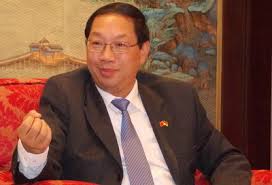
Canada is bracing for another fight with Quebec separatists.
Premier Pauline Marois today called an election for April 7 as she met Lieutenant-Governor Pierre Duchesne to ask him to dissolve the provincial legislature. Polls show Marois’ separatist Parti Quebecois may have enough support to form its first majority government in more than a decade.
“Today, I have summoned my ministers and we have taken the necessary steps to dissolve the National Assembly and call an election,” Marois said in televised remarks in Quebec City. “It’s now up to you, Quebeckers, to decide.”
A majority would set the stage in the French-speaking province for a possible referendum on secession from the rest of Canada, roiling credit markets and threatening to push the Canadian dollar lower.
“If they get a majority, I fully expect they will hold a referendum during their next mandate,” said Harold Chorney, a political science professor at Concordia University in Montreal. “Marois isn’t going to give up sovereignty.”
A majority victory for the Parti Quebecois would mark the third time since the mid-1970s the party has taken sole control of the province’s legislature, propelling Quebec into another confrontation with the rest of Canada that a former premier once likened to a never-ending visit to the dentist.
Quebec has held two plebiscites on splitting from Canada — in 1980 and 1995 — under previous Parti Quebecois majority governments. The party will hold a third vote if a victory is in sight, Jean-François Lisée, Quebec’s international relations minister, told ICI Radio-Canada television March 1. The separatists came within 0.6 of a percentage point of gaining majority support in the 1995 referendum, but support for the cause has been stalled in the 30 percent range in recent years.
One advantage the separatists may seek to exploit is the federal Conservatives’ lack of representation and low support in the province, where the party holds five of 75 districts. The Conservatives are in fourth place in support in Quebec, polling about 9.4 percent support in the province, according to a four- week rolling survey by Nanos Research of 208 Quebeckers that ended Feb. 15.
It’s a vulnerability for Harper that the opposition Liberal and New Democratic Party, both led by Quebeckers, will try to exploit ahead of federal elections in 2015.
Voting begins Sunday on a referendum on whether Venice and its surrounding region should secede from the rest of Italy, in an attempt to restore its 1,000-year history as a sovereign republic.
La Serenissima — or the Most Serene Republic of Venice — was an independent trading power for a millennium before its last leader was deposed by Napoleon in 1797. The republic encompassed not just Venice but what is now the surrounding region of Veneto and it is there that the vote will take place from tomorrow until Friday.
Campaigners have been inspired by the example of Scotland, which will hold its referendum on independence in September, and Catalonia, where around half the population say they want to break away from Spain.
Activists say that the latest polling shows that 65% of voters in the Veneto region, which includes historic cities such as Treviso, Vicenza and Verona, are in favour of cutting ties with Rome.
For decades there has been deep-seated dissatisfaction in the rich northern regions of Italy with what is widely regarded as inefficient and venal rule from Rome, as well as resentment that hard-won tax revenues are sent south and often squandered.
About 3.8 million people in Veneto are eligible to vote. Campaigners want a future state to be known as Repubblica Veneta — the Republic of Veneto.
They acknowledge that the vote is not binding on the national government in Rome and could cause a big constitutional upheaval, but insist that if it passes, they will start taking steps to withhold taxes, in what would effectively be a unilateral declaration of independence.
“If there is a majority yes vote, we have scholars drawing up a declaration of independence and there are businesses in the region who say they will begin paying taxes to local authorities instead of to Rome,” Lodovico Pizzati, the spokesman for the independence movement, told The Daily Telegraph.
…or not to be. The British puppet dreams of a new scorched earth
It never takes too long for any black politician in South Africa to become a paid puppet of a foreign colonial power.
Julius Malema wasted no time. Juju has suddenly turned all his attention on the white Afrikaners calling them the “Broederbond” or “Stellenbosch mafia”.
This happened strangely right after Malema’s interview with the FT which appeared on the front page last week.
They “control” South Africa, according to Economic Freedom Fighters (EFF) chief Malema. He declared Afrikaners a “mafia” on Saturday in Cape Town to launch his party’s provincial manifesto.
The new Boerhaat direction the EFF leader has adopted – a very old theme in Britain which led to thousands of white Afrikaners being killed in concentration camps – is directed mainly at white Afrikaner farmers.
It has long been suspected that Britain would like to see Afrikaners abandon their land as the British generously fund organisations such as PLAAS to bring about Zimbabwean-style “land reform”.
The British brought the ANC to power, some say, only so that South Africa could once again become part of the Commonwealth. It seems as though Malema has just been instructed to finish the ethnocide against Afrikaners.
The Broederbond was infiltrated and disbanded in the 1980’s and the few rich individuals in Stellenbosch do not represent Afrikaners. Nevertheless, South Africa could only achieve economic emancipation if the Broederbond was dismantled, Malema declared.
What Malema probably meant to say was that emancipation could only be achieved by “wiping out the last vestiges of Afrikanerdom”. Lord Kitchener, the architect of the phrase as well as the concentration camps that killed mostly women and children, also used black soldiers during the Anglo-Boer War to terrorise Afrikaners.
Malema mostly ranted on about the importance of the expropriation of white land without compensation, a centrepiece of his party’s election manifesto.
White farmers are being slaughtered daily while the South African Police Service watches idly, taking no interest in the ongoing internationally recognised genocide.
Malema entered the Mandela Park Stadium like a rock star, with marshalls struggling to hold back crowds of adoring fans.
“Don’t underestimate the Stellenbosch mafia. They control everything in South Africa,” Malema warned about 2.500 EFF supporters at the stadium in Khayelitsha.
“They control the judiciary, they control the economy, they control the land, they control the chain stores, they control the mines, they control the banks,” Malema said, ignoring the glaring reality of a firm British grip on the country since 1994.
A cursory glance at who owns what in South Africa shows that Afrikaners are, with the exception of a few lucky ones, barely represented in any sector, except education where they earn a pittance to teach blacks English.
The hate-filled rhetoric against Afrikaners sounded more like the old white Anglo-Saxon discourse, but blacks have often warmed to the theme.
Most Afrikaners are permanently locked out of the job market because they do not qualify for Affirmative Action and BBEE, and almost a million now live as squatters as a result. Nearly as many have emigrated to escape harsh racial laws and naked racial discrimination they have to face daily.
According to Malema, both the ANC and the DA take instructions from this “mafia”, even though both parties favour racial and ethnic discrimination against Afrikaners.
“If the Stellenbosch boys don’t want you to be anything, you will never become something in life.”
Malema said the Broederbond exerted influence through an “only white” and predominantly Afrikaner unit of the SA Revenue Service (Sars) to “destroy emerging individuals” and protect monopoly capital. “If the Broederbond says ‘this boy is a problem’, Sars (goes) after him,” he said.
Malema has been provisionally sequestrated by the High Court in Pretoria after an application by Sars over a R16 million tax debt.
He said this unit also had “one Indian who thinks like (a white)”.
“It is the unit in Sars that still reflects apartheid,” Malema said.
“Now that unit goes and terrorises every small business which is competing with the multinationals, including companies that are owned by Broederbond people.”
During his 45-minute speech, Malema also had the crowd in stitches with his insults to rivals.
Referring to President Jacob Zuma, whom he didn’t name, Malema said it was odd that someone with a head “that looks like butternut” still “couldn’t think”.
Turning his attention to “the madam” – Western Cape premier Helen Zille – he said when she “saw us from distance, she must be shivering in her heels”.
The Financial Times carried this story titled: Malema targets big game in ANC’s heartland on the front page:
Sitting in a plush lodge on the edge of Kruger National Park, the self-styled
revolutionary and spokesman for South Africa’s dispossessed outlines calmly his plans to expropriate land from white farmers, and nationalise banks and mines in Africa’s largest economy.
“We are worse than the way we were during apartheid,” he tells the Financial Times during a 90 minute interview. “The only thing that has changed is the government of white people has been replaced with a government of black people.”
The stout, boyish-looking 33-year-old, dressed in black tracksuit and black trainers, is a highly divisive figure. To critics, including many businesspeople, he is an opportunistic rabble-rouser tainted by corruption allegations. To supporters, he is a rare voice speaking to the divisions enduring in one of the world’s more unequal societies despite strides taken since the end of white rule.
Campaigning to the left of the ruling African National Congress he aspires to steal votes from the ruling party’s heartland, the rural and urban black poor, in elections on May 7. They are widely expected to be the most closely contested since the end of apartheid 20 years ago.
Mr Malema described president Jacob Zuma – the man he helped propel to the country’s top job – as a “monster”, and denounced the ANC’s 20-year record in power. He formally launched his Economic Freedom Fighters in October after being expelled from the ANC – where he led the militant youth league – for indiscipline in 2012.
He makes the point that while under the ANC more black people may have gained access to water and electricity, the water is often not clean and the electricity connection does not guarantee power. “So you are actually in more pain because these things are closer to you and, close as they are, you cannot use them,” he says.
This message resonates with the frustrated black majority in a country where youth unemployment is at least 50 per cent, and almost 40 per cent of the population live below the poverty line. It also carries weight with blacks of all classes who believe they are still economically marginalised in a country where the corporate world remains predominantly in white hands.
The challenge for Mr Malema is to turn disgruntlement into votes and survive court cases that could derail his career.
The politician, whose penchant for designer watches has come to symbolise his perceived opulent lifestyle, has had his properties auctioned off as the revenue authority has pursued him for R16m ($1.5m) in outstanding taxes. He is fighting a sequestration order and says he is willing to make a revised offer to resolve the matter.
Mr Malema has courted controversy in the past by saluting President Robert Mugabe of Zimbabwe but he says the EFF would not follow the path of Zimbabwe, where the forced and often violent seizure of white-owned land triggered a collapse of the economy.
But he says he wants government to be the custodian of land that grants licences to users and insists the state should control 60 per cent of mines.
“Foreign investors who are prepared to share with South Africans are more than welcome,” he says. “But if it is about individualism and maximisation of profit to the exclusion of indigenous people, such a foreign investor will not be entertained.”
Mr Malema and the EFF have brought a new dimension to the country’s political landscape. Pallo Jordan, an ANC intellectual, has said the ANC “might opt for more radical policies” if it faces an effective challenge from the left, “realigning South African politics in directions that few will have anticipated”.
The other threat to the ANC comes from the Democratic Alliance, the main opposition party. But it is still viewed by many – fairly or not – as a largely white party.
Yet for all his outward confidence Mr Malema acknowledges the campaign against the well-oiled ANC election machinery is a difficult one. And touting his radical policies can be a hindrance when seeking financial backers.
“It is a very difficult campaign in that we do not have resources and our policies are such that those who own resources will never finance us,” Mr Malema says. “Elections are very expensive things in South Africa, but if we had resources we would remove the ANC from power tomorrow.”
Source: FT. By Lionel Barber, Andrew England & Javier Blas
A group of Russian inspectors will fly an observation mission over Spain within the framework of the Treaty on Open Skies, the head of the National Nuclear Threat Reduction Center, Sergei Ryzhkov, told Tass on Saturday. The flight will be made on an Antonov-30B observation aircraft, he said.
“The observation flight will be made between March 16 and 22 from ‘Open Skies’ Getafe Airfield with a maximum range of up to 1,800 kilometers,” he added. Observation flights are made to promote bigger openness and transparency in the military activity of the states participants in the treaty, as well as to strengthen security through confidence building.
According to Ryzhkov, the Russian plane will make its flight on the itinerary coordinated with Spain, while Spanish specialists on board will control the use of the observation equipment and compliance with treaty provisions.
“This is the fourth observation flight of Russian inspectors over countries signatories to the treaty in 2014,” he noted. The Open Skies Treaty was signed in 1992, and brings together 34 countries. Observation flights are made over Russia, the United States, Canada and European countries. The main aims of the Open Skies are growth of transparency, control over the implementation of agreements on arms control, broader possibilities of crisis prevention and settlement of crisis situations within the framework of the Organization for Security and Co-operation in Europe and other international organizations.
An international observer from Finland, who sees the referendum on the status of Crimea as absolutely legitimate, has received death threats.
A referendum is due to be held in Crimea on the status of the peninsula tomorrow, on Sunday, March 16, so on Saturday, any campaigning is banned there. An ad-hoc commission is due to see to it that this is strictly observed.
Meanwhile, an international monitor from Finland, Johan Bäckman, has complained at Simferopol airport of pressure that has been brought to bear on him and his colleagues, and also said he’d received death threats, because he supports the referendum.
“It’s all threats and slander. I received a letter with death threats earlier today”, Bäckman said. “The letter is anonymous. The Western media are full of aggression against Russia. I can’t really make out the position of the West that the referendum is allegedly in breach of international law”.
He said the residents of Crimea have every right to determine their future. The US and the European Union are bending every effort to have the referendum cancelled, and are threatening with sanctions. That the EU is considering sanctions is absolutely absurd.
Bäckman said the attempts of western politicians to stop or cancel the referendum are prompted by their desire to downgrade Russia’s authority.
The All-Crimea plebiscite is due on Sunday from 8 a.m. to 8 p.m. local time. The minimum voter turnout to consider the referendum valid is 50%. International observers keep arriving in Crimea to monitor the plebiscite.The international observer stressed that he sees the referendum on the status of Crimea as absolutely legitimate.
The situation in Crimea is calm, Deputy of the Belgian parliament Frank Creelman, who arrived to monitor the referendum to be held on March 16, said on Saturday. Everything is very calm and normal, absolutely not the way it is being pictures abroad, he said.
There are many pro-Russian people among residents and many law enforcement officers are at streets, Creelman said.
Creelman said he intended to monitor the referendum on the status of Crimea not just in Simferopol but in relatively small Crimean settlements as well.
The former Republican congressman and three-time presidential candidate Ron Paul has launched a scathing attack on what he calls a US-backed coup in Ukraine, insisting the Crimean people have the right to align their territory with Moscow and characterising sanctions against Russia as “an act of war”.
“The evidence is pretty clear that the NGOs [non-governmental organisations] financed by our government have been agitating with billions of dollars, trying to get that government changed,” he said. “Our [American] hands are not clean.”
Voice of Russia, Interfax, Life News, The Guardian
An American scout-attack drone was intercepted in the Crimean sky, the Rostec state corporation reports. “Judging by side marking, the MQ-5B drone was part of the 66th US brigade of military intelligence with the main location in Bavaria,” the report on the website of the corporation reads.
According to the report, at the beginning of March, the American brigade was relocated to the Ukrainian Kirovohrad, from where drones commit reconnaissance raids in the direction of Crimea and Russian border areas.
Earlier, they reportedly appeared in the Kherson region, in the area of the Crimean roadblock Chongar.
The 66th Military Intelligence Brigade is a United States Army brigade, subordinate to United States Army Intelligence and Security Command and based at Wiesbaden Army Airfield, Wiesbaden, Germany. After years of history as a counter intelligence/intelligence group with headquarters in Munich and geographically dispersed detachments, it became a brigade on 16 October 1986, but was inactivated in July 1995. Reformed again as an intelligence group in 2002, it became a brigade again in 2008.
The unit’s mission is to provide intelligence support to U.S. Army Europe and U.S. Army Africa.
Part of the 66th Military Intelligence Brigade supports near real-time missions for deployed soldiers such as operations in Afghanistan and also Iraq.
“According to some data, the American reconnaissance brigade had 18 MQ-5B drones in its arsenal. This is the second time the American UAV is intercepted over Crimea,” the report says.
“The drone was at the height of about 4 thousand meters and was practically invisible from the earth. It was possible to break the drone’s link with its American operators with the help of the EW (electronic warfare) complex Avtobaza. As a result, the device made an emergency landing and passed into the possession of the self-defense forces almost unbroken,” the report says.
Ten years ago a German drone nearly collided with a passenger plane over Afghanistan. The classified drone camera footage drew public attention after the German defense ministry scrapped a drone program for its lack of anti-collision technology.
Footage taken by an EMT Luna X-2000 reconnaissance drone as it passed mere meters under the left wing of an Airbus A300 passenger plane surfaced on YouTube several years ago. After the encounter, the drone was caught in the plane’s wake turbulence, lost control, and crashed over the Afghan capital Kabul, Der Spiegel reported.
The Ariana Afghan Airlines plane was carrying about 100 people on board, the magazine said. The manufacturer of the 40kg drone has claimed that the near-collision occurred after the passenger jet veered off-course without informing ground control.
The video was leaked a week after German Defense Minister Thomas de Maizière decided to scrap the $652 million EuroHawk program meant to be a replacement for existing reconnaissance aircraft. EuroHawk is part of the NATO Global Hawk project.
Local German communities have expressed apprehension about US drones being in German airspace. Germans are concerned about potential violation of their freedoms after the drones come into operation. The recent scandal surrounding NSA spying activities in Germany and the protests that followed, has heightened public skepticism.
“It’s a big issue here in general, and it’s a very German topic,” Constanze Schulze, a reporter for ARD Bavaria stated. “There are many discussions going on about unmanned units, and of course there is some concern. I think that’s why you see so many reporters here. Everyone is talking about it.”
Politicians have also expressed concerns. Reinhold Strobl of the Social Democratic Party of Germany (SDP) said that the public was informed “too late” and that there was “inadequate” information provided by the German authorities and US military ahead of the deployment. If it was not for test flights conducted in July, the politician says, Germans would have been left completely in the dark.
Richard Reisinger from the Christian Social Union Party (CSU) also said that the way the public was informed about the issue lacked transparency. “What happens to the collected data?” he asks, expressing concern of potential risk of information misuse.
Public transport will be free from Friday until Sunday evening in Paris as the authorities try to encourage drivers to leave their cars at home, as much of France suffers severe air pollution caused by unusually warm weather.
The French capital and 30 other regions of France have been on maximum pollution alert for several days, with conditions set to continue until the end of the weekend.
The European Environment Agency says the pollution is the worst since 2007, and almost three-quarters of France is affected.
The air pollution has also affected neighboring Belgium where authorities have introduced a maximum speed limit to reduce the concentration of polluting particles. Free public transport has also been introduced in Belgium’s southern Wallonia region.
Jean-Paul Huchon, head of the STIF organization that manages Paris’s complex transport network, said that public transport would be free from Friday morning until Sunday evening.
“I am asking all residents in Paris and neighboring areas to favor the use of public transport,” Huchon said.
Subways, buses and trains will be free, as will bike-shares and one-hour sessions in electric cars.
The cities of Caen, Reims and Rouen, all in northern France, are following Paris’s lead and also offering free transport.
As air quality dipped Thursday to the same as Beijing, Ecology Minister Philippe Martin admitted that air quality was “an emergency and a priority for the government.”
A lack of wind and cold nights followed by balmy days have conspired to create conditions where polluting particles, most of them emitted by vehicle exhaust fumes, have been stuck under a warm layer of air.
Monitoring centers have been reporting a particularly strong concentration of so-called PM10 particles, which have a diameter of less than 10 microns.
Pollution alerts in France are issued when these PM10 particles reach 80 micrograms per cubic meter.
These tiny particles are also some of the most dangerous to public health and can cause asthma, allergies and other respiratory ailments.
The recognition of Kosovo independence set a precedent that gives Crimeans, as well as Basques and Catalans, a right for self-determination, German opposition leader said, lashing out against Angela Merkel’s support of sanctions against Russia.
Gregor Gysi, a parliamentary head of the largest lower-house opposition party in Germany has spoken out on Thursday against German Chancellor’s unquestioning support of the coup-appointed Ukrainian government.
“They formed a new government….. Immediately recognized by president Obama by the EU and German government as well. Miss Merkel! The vice-prime minister, the defense minister, minister of agriculture, environment minister, the attorney general.. They are fascists!” he stated.
Gysi said that NATO opened Pandora’s Box by recognising the unilaterally proclaimed independence of Kosovo and that Crimea’s secession from Ukraine applies the same pattern of international law.
“With Kosovo, they opened Pandora’s box. What’s allowed for Kosovo, you should also allow for others. I told you this but you haven’t listened to me. Winning the Cold War has eclipsed everything for you, you forgot about everything else,” Gysi said.
“The Basques are asking why can’t they make their choice, whether they want to stay within Spain or not? Catalonians are asking, why can’t they decide whether they want to belong to Spain or not. Of course people living in Crimea are asking the same thing.”
“I think that Crimea breaking away from Ukraine is just the same as Kosovo. I knew Putin would use this argument, and he did,” the politician said. “It must be found, such status for the Crimea, which will be acceptable for Ukraine, Russia, and us.”
Gysi also commented on NATO’s expansion to the east and called on the German government and the West to acknowledge the “legitimate security interests of Russia.”
“When we restored Germany’s unity, the US, German and other foreign ministers proclaimed there will be no NATO expansion to the east. But this promise has been broken. There was an expansion of NATO in Russia’s direction,” said Gregor Gysi in an outburst directed at Merkel.
“Security in Europe, there are neither without nor against Russia, but with Russia. When the crisis is over one day, an advantage could be that international law is finally respected again from all sides,” Gysi concluded.
Right before Gysi’s emphatic statement Chancellor Angela Merkel addressed German MPs, expressing her support of imposing sanctions and warning Russia that it risks “massive political and economic consequences” if it sticks to its position on Ukraine.
Russia has repeatedly said it considers the actions of Crimean authorities reasonable and legal, and will respect the results of the referendum.
Every year, an estimated 180,000 people die from the mosquito-carried malaria virus in the Democratic Republic of Congo. Yet a preventative government initiative to hand out mosquito nets has backfired, with people using the nets as garden fences.
A FRANCE 24 Observer in the eastern city of Goma recounted how insecticide-treated bed nets are increasingly being used to fence off gardens and hung up to protect fruit trees from insects.
This situation is not isolated to the Democratic Republic of Congo, but is also practiced in other malaria-blighted African countries such as in Kenya, Rwanda and Uganda, where mosquito nets have reportedly been used for making fishing nets, wedding gowns, house decorations and poultry enclosures.
“I don’t even think they care that others may catch malaria because they don’t have any nets,” says Charly Kasereka, a Goma-based journalist who works for a local radio station.
In at least 10 of the 18 neighbourhoods in the city, people misuse mosquito nets in this way. It’s a common sight outside of Goma too, he says.
The nets are being distributed by health centres that have been set up as part of the National Programme for the Struggle against Malaria (PNLP) which calculate the number of nets depending on the size of the household. A family of five, for example, will have the right to two bed nets.
China’s top envoy to Germany has warned the West against punishing Russia with sanctions for its intervention in Ukraine, saying such measures could lead to a dangerous chain reaction that would be difficult to control.
In an interview with Reuters days before the European Union is threatening to impose its first sanctions on Russia since the Cold War, ambassador Shi Mingde issued the strongest warning against such measures by any top Chinese official to date.
“We don’t see any point in sanctions,” Shi said. “Sanctions could lead to retaliatory action, and that would trigger a spiral with unforeseeable consequences. We don’t want this.”
The interview was conducted on Wednesday, the same day that the EU agreed a framework for sanctions that would slap travel bans and asset freezes on people and companies accused by Brussels of violating the territorial integrity of Ukraine.
German Chancellor Angela Merkel, has taken the side of the putschists supported by the United States, and warned that unless Russia accepts the idea of a “contact group” to resolve the crisis diplomatically, Russia risked “massive” political and economic damage if it did not change course in the coming days.
Washington, enabled by its compliant but stupid NATO puppets, is pushing the Ukrainian situation closer to war.
German Chancellor Merkel has failed her country, Europe, and world peace. Germany is the strength of the EU and NATO. Had Merkel said “No” to sanctions on Russia, that would have been the end of the crisis that Washington is brewing, a crisis unlikely to be ended short of war.
But Merkel has signed away the sovereignty of the German nation and assigned the fate of Germany to a province in the American Empire. Thus has Merkel and the weak German leadership consigned the world to war. Already blamed for World War 1 and World War 2, now Germany will be blamed for World War 3.
Washington’s mismanaged Ukrainian coup has cost Washington Crimea, which Washington wanted most of all in order to deprive Russia of its warm water naval base on the Black Sea. In addition, the mismanaged overthrow of an elected government in Ukraine is threatening to also lose the Russian cities of eastern Ukraine. Like Crimea, eastern Ukraine consists of former Russian areas that Khrushchev stuck into Ukraine in the 1950s.
In what is clearly a fruitless and pointless effort to get Crimea back, Washington is demanding that Russia interfere in Crimea and prevent Crimea from seceding from Ukraine. If the Russian government refuses to follow Washington’s orders, Washington has announced that it will inflict “damaging sanctions” on Russia. Initially, EU countries expressed an unwillingness to go along with Washington, but with bribes and threats, Washington has conquered Merkel and has its European puppets lined up following orders.
Washington understands that economic sanctions are a far less threat to Russia than the loss of its Black Sea naval base. Washington also understands that Putin cannot possibly abandon the millions of Russians in eastern and southern Ukraine to the mercy of the anti-Russian and unelected government imposed by Washington in Kiev. As Washington knows that its threat of sanctions is empty, why did Washington make it?
The answer is in order to drive the crisis to war. Washington’s neoconservative nazis have been agitating for war with Russia for a long time. They want to remove one of the three remaining restraints (Russia, China, Iran) on Washington’s world hegemony. Washington wants to break up the BRICS (Brazil, Russia, India, China, South Africa) before these countries form a separate currency bloc and avoid the use of the US dollar.
Russia will respond in kind to Washington’s sanctions. European peoples and Western banks and corporations will suffer losses. It would be at least two or three years before Washington has in place means of delivering US natural gas achieved by fracking and contamination of US water supplies to Europe to take the place of Russia’s cutoff of energy to Europe.
The Western presstitute media will dramatize the Russian response to sanctions and demonize Russia, while ignoring who started the fight, thereby helping Washington prepare Americans for war. As neither side can afford to lose the war, nuclear weapons will be used. There will be no winners.
All of this is perfectly clear, just as was the obvious conclusion of the march of events leading up to World War 1. Now, like then, the people who see the outcome are powerless to stop it. Delusion rules. Arrogance and hubris overflow. Statements and actions become ever more reckless, and then there is hell to pay.
Americans and Europeans, if they had any awareness at all, would be in the streets violently protesting the coming war toward which the insane criminals in Washington are driving the world.
Instead, the German chancellor, the French president, the British prime minister and the Western presstitute media continue to lie: It was legitimate for the West to steal Kosovo from Serbia and to steal the Ukrainian government, but it is not legitimate for the Russian population of Crimea to exercise self-determination and return to Russia. Washington and its EU puppets even have the audacity to declare falsely, after overthrowing an elected government in Ukraine and installing an unelected one, that Crimean self-determination violates the Ukrainian constitution, which no longer exists because Washington destroyed it.
The criminally insane government in Washington has pushed the Russian bear into a corner. The bear is not going to surrender.
Paul Craig Roberts was Assistant Secretary of the Treasury for Economic Policy and associate editor of the Wall Street Journal. He was columnist for Business Week, Scripps Howard News Service, and Creators Syndicate. He has had many university appointments. His internet columns have attracted a worldwide following. His latest books are, The Failure of Laissez Faire Capitalism and How America Was Lost.
As many as 8 million undocumented immigrants hold jobs in the U.S. In fact, they account for more than 5 percent of the U.S. labor force. Their unemployment rate might even be lower than that of the nation’s black citizens.
And, stereotypes aside, the undocumented are hardly relegated to agriculture and domestic service. Construction, manufacturing and retail are among their biggest employers, according to the Migration Policy Institute. So, either quite a few of the nation’s 6 million employers have welcomed undocumented workers into their factories and stores, or a smaller number of employers have hired an awful lot of them.
Either way, little is being done to stop the practice. Workplace enforcement is minimal. Fines are small. Amid all the political bellowing about the border, no one in Washington pays much attention to employers’ practices.
Yet with 95,000 miles of shoreline, 500 commercial airports and a northern border that’s twice as long as its southern one, the U.S. could transform its Southwest into North Korea and still not stem the flow of undocumented immigrants seeking work, many of whom simply overstay legitimate visas. The only way to make meaningful progress is to end the lure of employment.
That will require fewer additional resources for border patrol and more for workplace enforcement, such as E-Verify. This electronic employment verification system, administered by the Department of Homeland Security, has been a qualified success. From 2007 to 2012, E-Verify queries from employers increased to more than 21 million, from 3.3 million. As of February 2013, more than 432,000 employers were using the system to confirm the eligibility of prospective employees.
E-Verify can still be gamed. One independent study found that during a three-month period in 2008, about half the unauthorized workers whose backgrounds it checked were nonetheless approved for work. But DHS has been upgrading the system so that it can access additional databases and more carefully filter applications.
As the system improves, of course, the demand for high-quality identity fraud stands to increase commensurately — as does off-the-books employment of undocumented workers. If Congress is serious about turning off the flow of undocumented immigrants, it will have to give DHS the resources it needs for workplace enforcement, including on-site inspections.
This would not please some of the business interests that fund both political parties. Nor would it placate those for whom any extravagance is justified by a cry of “Secure the border!” But it would weaken the magnet that draws undocumented immigrants to the U.S. in the first place. The House has stalled progress on immigration reform. If it is going to make the nation wait for a solution, it should recognize that the place to stop the inflow is not at the point of entry, but at the point of hire.
The catch is that this crackdown will have little to do with the U.S.-Mexico border. The Senate bill already includes a staggering $46 billion for border control, doubling the size of the patrol force (which is already double its 2004 size).
The House Homeland Security Committee has put forward its own, far cheaper immigration security bill, but it still suffers from Washington’s obsession with the border. Politicians from varied and distant locales relish demanding militarization down yonder while continuing to ignore the reality of illegal immigration in their own backyards.
Uganda will announce the lead investor and operator for its planned oil refinery in July and expects to conduct a licensing round for its vacant petroleum exploration acreage next year.
The east African country first discovered crude deposits in the Albertine rift basin along its border with Democratic Republic of Congo in 2006 and reserves are estimated by the government at 3.5 billion barrels.
The government moved closer to getting the hydrocarbons industry off the ground last month when it signed a memorandum of understanding with three oil firms laying out a blueprint for the commercial development of its oil fields.
According to the deal, crude produced by the three firms – Britain’s Tullow Oil, France’s Total and China’s CNOOC – will be shared between a thermal power generation plant, a planned refinery and an export pipeline.
Commercial oil production is expected to begin in 2016 at the earliest.
In December the energy ministry announced five consortia and one individual firm had been shortlisted to bid for the $2.5 billion refinery.
The lead investor – which will also operate the plant – is expected to take up a 60 percent stake, with the remainder going to the Ugandan government.
The individual company shortlisted is Marubeni Corp , while the five consortia are respectively led by Petrofac, Global Resources, China Petroleum Pipeline Bureau, SK Energy and Vitol.
Robert Kasande, the energy ministry official overseeing the project, said the government had been holding pre-bidding talks with those shortlisted.
“They are expected to submit their final proposals in May, then evaluation will follow,” Kasande said. “In July we will announce the winner,” he added.
Uganda has scaled back its refining ambitions over the past two years. It now plans to start with a refinery with capacity of 30,000 barrels per day (bpd), gradually rising to 60,000 bpd.
It had initially wanted a plant that could process 120,000 bpd but oil firms argued that would not be commercially viable.
About 60 percent of the Albertine graben, which measures about 23,000 square kilometres, remains unlicensed, according to the energy ministry’s petroleum exploration and production department.
“We also hope next year we should be ready to license another batch of (exploration) blocks,” said Kasande.
Source: Reuters
This website uses cookies to improve your experience. We'll assume you're ok with this, but you can opt-out if you wish. Cookie settingsACCEPT
Privacy & Cookies Policy
Privacy Overview
This website uses cookies to improve your experience while you navigate through the website. Out of these cookies, the cookies that are categorized as necessary are stored on your browser as they are essential for the working of basic functionalities of the website. We also use third-party cookies that help us analyze and understand how you use this website. These cookies will be stored in your browser only with your consent. You also have the option to opt-out of these cookies. But opting out of some of these cookies may have an effect on your browsing experience.
Necessary cookies are absolutely essential for the website to function properly. This category only includes cookies that ensures basic functionalities and security features of the website. These cookies do not store any personal information.
Any cookies that may not be particularly necessary for the website to function and is used specifically to collect user personal data via analytics, ads, other embedded contents are termed as non-necessary cookies. It is mandatory to procure user consent prior to running these cookies on your website.


 Canada is bracing for another fight with Quebec separatists.