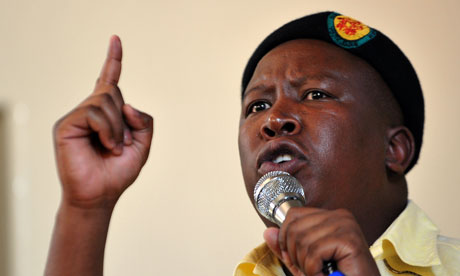
On August 16, 36 striking miners were shot dead by South African Police Service officers at the site of the Lonmin Platinum Mine, at Marikana—northwest of this writer’s birthplace, Johannesburg.Seventy eight of the 3000 rioting strikers were injured.
International response to the massacre at Marikana ran to variations on a theme: “They’re killing their own people”—although not quite so crudely put, as that would imply that the beleaguered white inhabitants of post-apartheid South Africa were not refracted through the Rainbow Nation’s national spectrum.
Nevertheless, as is to be expected of the pack animals that make up the press in the West, the incredulity over “black police firing at black mine workers” was unanimous.
Perhaps the journalistic herd intended to separate state-conducted violence from state-condoned violence. The latter is most certainly a black-on-black and black-on-white franchise. For in reality, most murders of Africans in Africa and, incidentally, of Africans in America, are courtesy of other blacks.
Needless to say, the luminaries of Western café society are not exercised when Nelson Mandela’s party, the African National Congress, inadvertently socks it to honky by denying the holocaust of the nation’s rural whites.
“A labor dispute between the oppressors (whites) and the oppressed (blacks)”: That is the mantra invariably mouthed by media whenever an innocent farmer is slaughtered—a weekly occurrence, on aggregate—in the country considered by cretins such as Anderson Vanderbilt Cooper, “a model of stability since racist white rule ended.”
But when the ANC, in control of the dominant-party state that is South Africa, engages in crowd control against what is deemed simplistically as “its own people,” that makes headlines. To wit, “The violent incidents on August 16were the single most lethal use of force by South African security forces against civilians since the end of the apartheid era.”
Allusions were made to the Sharpeville massacre.
Cut to March of 1960. A small band of panic-stricken policemen of the apartheid era—the media insists on appending the adjective “racist” in mentioning these men—shot dead 69 black demonstrators.
Prior to the 1960 Sharpeville massacre, nine white cops had been murdered in Durban.
Prior to the Marikana massacre, the strikers, all sweetness-and-light, had killed at least 10 individuals. There were police officers battered to death, mine security guards burned alive, and a union shop steward hacked to smithereens.
Let me hazard a guess: Contra their sympathizers in the West, who don’t scare fast enough—the marauding mob at Marikana put the fear of God in the misguided folks who fired upon them. The same law-enforcement officers had first tried to disperse and stop the rioters with tear gas, water cannons, stun grenades and barbed wire.
You’d have had to experience the onrush of a riled-up African crowd to comprehend the terror among these frightened, likely incompetent, cops entrusted with defending mine operators and other staff still at the site. The last would have endured hours, if not days, of menacing chanting, singing, stomping, all amplified through loudspeakers.
Likewise, the besieged police at Sharpeville would have been petrified, as the “unarmed” mob brandishing pangas, spears and sticks, advanced on their isolated outpost and breached the station’s fence, at the eponymous African township.
In both instances, the cops—white and black, then and now, right or wrong—fought to stay alive.
The media mob has already cut some slack to the black cops who were assailed at Marikana by 3000 miners. The frightened, outnumbered fellows at Sharpeville, who confronted 5,000 to 7,000 frenzied protesters: They’ve been condemned for eternity.
Sharpeville’s “villains” had also attempted to control the crowds with tear gas and batons before that fateful shooting.
Why not ask 800,000 Rwandan Tutsis what a tribe armed with indigenous weapons is capable of doing to a despised, helpless “Other”?
Ask the same of some 4000 white South Africans farmers, who once helped feed the continent.
Or, closer to home, let an all-American lass, Amy Elizabeth Biehl, tell you how furious her white skin and good intentions made an “unarmed” crowd, back in Cape Town of 1993.
Silly me. Question those Tutsis—whose blood turned the Kigara River red—all you like, but they will not reply. For they were torn asunder or macheteed by their longtime Hutu neighbors.
Ask the late Ms. Biehl about her ordeal, but she too has been silenced—stabbed and stoned, by an “unarmed” mob with murder on its mind.
As to the 4000 (and counting) Boers—they’re dead and buried too. Interred in the land they had farmed for centuries; culled like springbok on a hunting safari by the same, disarming, inadvertent enemies of peace and prosperity.
In a world awash in floating fiat currency, demand for platinum will remain consistent and predictably high, even as production plummets in one of platinum’s prime producers, South Africa.
That’s guaranteed.
The miners of Marikana told Time magazine that they would not return to work until their wages were doubled (poor productivity be damned). Any scab who stepped in to do “their” jobs would be eliminated. Or so they promised.
On Wednesday, hosts at MSNBC informed America that the words “golf” and “Chicago” are racist, especially if they are used while speaking of Barack Obama.
Newsbusters’ Rusty Weiss reported early Thursday morning that while covering the GOP convention, Chris Matthews “came to the conclusion that reminding people of the President’s roots in Chicago politics is racist.”
The Washington Post’s Eugene Robinson set the tone of the exchange.
“It’s all part of this Barack Obama as ‘other’ sort of blanket campaign that has been waged by the Republican Party for some time now. It may be gaining some traction now, though I wonder why now as opposed to a bit closer to election,” he said.
“Yea, well let me ask you about that, gentleman,” Matthews responded. “What about now, is this constant barrage of assaults, saying the guy is basically playing an old game of demagoguery politics, where you take the money from the worker bees and give it to the poor people to buy votes. That’s basically what they’re charging him with. Old big-style, big-city machine of 50 years ago.”
“They keep saying Chicago, by the way, you noticed?” he asked.
“Well, there’s a lot of black people in Chicago,” said New York Magazine’s John Heileman.
The same day, MSNBC’s Lawrence O’Donnell claimed that a reference to Obama’s golf outings was also racial code.
“For four years, Barack Obama has been running from the nation’s problems, he hasn’t been working to earn re-election. He has been working to earn a spot on the PGA Tour,” Sen. Mitch McConnell (R-KY) said.
Naturally, O’Donnell saw racism in the remark.
“Well, we know exactly what he’s trying to do there. He is trying to align to Tiger Woods and surely, the — lifestyle of Tiger Woods with Barack Obama,” he said.
Martin Bashir, another MSNBC host, asked O’Donnell to clarify his remarks.
“Lawrence — don’t you think — don’t you think that what he’s really trying to do is to suggest that the president is not paying attention to the central issues that come with the responsibility he has?” Bashir asked.
“Martin, there are many, many, many rhetorical choices you can make at any point in any speech to make whatever point up want to make. If he wanted to make the point that you just suggested and I think he does want to make that point, they had a menu of a minimum of ten different kinds of images that they could have raised,” O’Donnell said.
“And I promise you, the speech writers went through, rejecting three or four before they land order that one. That’s the one they want for a very deliberate reason. That — there’s — these people reach for every single possible racial double entendre they can find in every one of these speeches,” he added.
“You really believe that about Mitch McConnell?” Bashir asked.
“I know these people are insensitive. I know the speechwriters are insensitive. I know the way they work. They do not have the same sensitivity level that other speechwriters do. But when you get to the Tiger Woods reference, there were people in the speech writing room, I know this, without a shadow of a doubt, who said wait a minute, do we really want to go there?” O’Donnell responded.
“The singular focus of MSNBC for the past six days has been racism. There’s one subject that they’re talking about: racism. The racism of Romney; the racism of Ryan; the racism of every speaker the convention; the racism of the Republican Party; the racism of every Republican and conservative. It’s all they’re talking about. It’s laughably hilarious, except to them,” he said.
Limbaugh went on to say the network is “nothing more than an arm” of the Obama campaign.
“Their charge they’ve been given is to run around on TV and to say that everything every Republican is saying is racist. Because they don’t have anything else. It really demonstrates the depths to which they have descended,” he added.
Townhall’s Katie Pavlich noted that Obama “refers to Chicago often in his own speeches.” By Matthews’ own “logic,” that would make him a racist.
Rep. Allen West (R-FL) said that perhaps Matthews has “gotten off of his medications.” West also wondered what other cities he was not allowed to speak of.
South Africa as the major location for the Square Kilometre Array (SKA) telescope changes the character of Africa, Minister of Science and Technology Naledi Pandor said on Friday.
“Who comes to Africa to actually do their best research? People come here to examine us, to find out how poor we are, to look at diseases that we have, they never come here to say ‘I want to do Nobel science work’,” she said.
“But they are gonna be coming to do that with the SKA. An absolutely different image of the continent. Not here to exploit our diamonds, our gold, our platinum but here to say I want to do iconic research on an iconic instrument… “
Pandor was speaking at a The New Age business breakfast in Sandton.
She said that her department would like to involve all countries on the African continent to become part of the astrology sciences project.
She was excited at the potential of astronomy to be a valuable vehicle to encourage a greater interest in scientific careers among the youth.
Pandor said her department found that astronomy was proving to be an unrivalled instrument for science education in terms of the excitement it generates amongst the youth.
She said she was working with the department of basic education to ensure that schools in the rural areas have laboratories.
The treasury provided significant funding for the infrastructure for laboratories, she said.
“We will be supporting the department of basic education wherever we can… We work together in a number of areas that we have initiated,” she said.
“The pipeline is important to us — so we will support where we can.”
Pandor also took the time to praise women in science making a difference in the science industry.
A handbook for companies on how to apply affirmative action in South Africa
THE DA’S PLAN FOR BROAD-BASED BLACK ECONOMIC EMPOWERMENT THAT WILL BOOST ECONOMIC GROWTH AND JOB CREATION
During apartheid, racial separation and economic discrimination were the defining characteristics of South Africa. Black South Africans were subject to ruthless asset-stripping and restrictions: labour laws that prevented their advancement, land expropriation, business regulations banning black ownership, Bantu education, and laws that prevented black South Africans from living in metropolitan areas.
The DA looks forward to the time when everyone in South Africa can participate fully in a non-racial economy and society. South Africa must continue on the journey towards achieving justice for all. In order to achieve this, we need to make strategic interventions to counter the effects of apartheid’s asset stripping and restrictions. This can be done by growing our economy and creating more jobs for South Africans. Broad-Based Black Economic Empowerment (B-BBEE) is one of the interventions that will help to achieve this.
The Constitution provides a mandate for B-BBEE, as it supports measures to empower persons or categories of persons disadvantaged by discrimination. The majority of South Africa’s people have a legitimate claim to economic redress. If we not do succeed in providing redress, the process of reconciliation, and how South Africans relate to one another, is put at risk. Within this context, the DA supports the underlying principle of B-BBEE.
We are, however, concerned that the guiding principle of B-BBEE is being undermined by a number of factors that have played out in the public sphere and in the media. These include a ‘get rich quick mentality’ among some B-BBEEE tenderers; the emergence of ‘fronting’; the rise of ‘tenderpreneurs’; a lack of long-term sustainability, and the fact that some B-BBEEE beneficiaries do not feel incentivised to create opportunities for others.
The DA believes that we need to change how we implement B-BBEE by altering the scorecard, not discarding it. There have been some notable successes in B-BBEE, and the DA is today submitting working proposals that draw upon these successes to make it work better. This can be done by sharpening the definitions, streamlining and altering the weightings of the scorecard and introducing measures to address our most pressing challenges: job creation, education and skills development.
We will push for such changes in the Portfolio Committee for Trade and Industry, where three sets of regulatory frameworks will soon come under review: the B-BBEE Amendment Bill, amendments to the Preferential Procurement Policy Framework Act (PPPFA) and the Revised Codes of Good Practice on B-BBEE.
The PPPFA and B-BBEE Act
Amendments to the PPPFA and the B-BBEE Act were published in December last year. The DA is in broad agreement with them. Specifically,
* The DA supports the intention of the legislation to prohibit and punish fronting activity, its clarification of the definition of fronting, and the strict penalties the legislation proposes for those found guilty of fronting. It is important that fronting in respect of all B-BBEE elements is recognised as a criminal offence – and not just the misrepresentation of black ownership.
* The DA welcomes the alignment between the Codes of Good Practice and procurement regulations, and specifically the fact that the empowerment status of firms tendering for government business must be determined on the basis of all B-BBEE elements, rather than on the basis of ownership alone. This will encourage the business community to broaden its focus in terms of empowerment to include alternative empowerment mechanisms.
There are, however, some concerns which will need to be clarified in the committee:
* Section 12(A) of the B-BBEE amendment bill gives the Minister the right to allow organs of state and public entities to determine their own “transformation policies”, which would take precedence over the Codes of Good Practice. We remain concerned about the potential abuse that may arise from this.
* The appointment of the head of the B-BBEE Commission by the Trade & Industry Minister might bring into question the Commission’s impartiality. The DTI will thus have to give additional assurances that the Commission will remain impartial.
* The Commission has the power to investigate allegations of fronting and may delegate its “duties and functions” to the Special Investigating Unit or “any other person or organ of state”. We believe that it is necessary for these powers of delegation to be clarified.
* The Bill requires that all “public companies listed on the Johannesburg Stock Exchange” provide to the Commission (a) “the report on their compliance with B-BBEE” and (b) “any other prescribed information”. Given the already cumbersome regulatory environment in which South African businesses have to operate, we will question the limitations on the powers of the Commission to call for information.
* The B-BBEE Commission will now take responsibility for responding to technical questions. The DA will seek specific information on how the Commission will be capacitated to deal with these queries, so as not to repeat the lack of responsiveness by the DTI in handling queries in the past.
The Codes of Good Practice:
The DA believes that there has been an over-emphasis on the ownership component of the empowerment scorecard. Too few have benefited from the government’s insistence on focusing only on ownership for the past few years. This has been to the detriment of other B-BBEE components that have the potential to expand access to economic opportunities.
The Cabinet has approved the revised B-BBEE Codes of Good Practice to be published for public comment. The DA will use the public consultation around these proposals, as well as their consideration in the Portfolio Committee on Trade and Industry, to advocate for ten principled changes to the code. These are as follows:
1. Recognition for contributions to job creation
We will propose an increased weighting to the socio-economic development component, and call for points to be awarded in recognition of employment creation. Employment is the most sustainable way to lift people from poverty, and it acts as an economic multiplier by increasing people’s purchasing power. Specific recognition must be given for job creation by South African businesses.
2. Encouraging access to employment through the Youth Wage Subsidy
An alternative scorecard should recognise job creation via the DA’s proposed Youth Wage Subsidy programme. As it stands, the scorecard for the skills development element awards points for the percentage of black employees participating in learnership programmes offered through the Sector Education and Training Authorities (SETAs). SETAs are an unwieldy and ineffective tool to bolster skills development, lacking the flexibility to respond to the market.
3. Encouraging participation by black new entrants in ownership transactions
The DA will propose increased recognition for the participation of “black new entrants” in ownership equity programmes. The ownership element currently awards only 2 bonus points for equity deals that benefit individuals who have not previously held ownership in other entities with a total cumulative value of more than R20 000 000. These points can be increased, while reducing the threshold for qualification as a “black new entrant”. This will promote broad-based participation in equity transactions, and help reduce the incentive to “re-empower” those who have already gained access to wealth though B-BBEE.
The DA believes that there should be a cap on the monetary value for individuals and companies participating in B-BBEE deals. This will not prevent black entrepreneurs from accessing investment opportunities. Rather it will determine the extent to which their participation will be deemed to contribute to broad-based empowerment.
4. Allowing local companies to make use of equity equivalent programmes as an alternative to ownership reform
The present Codes allow foreign-owned companies to use specified development programmes as an alternative to equity transfers. Contributions are measured against 25% of the value of the entity’s operations in South Africa. These programmes have the potential to benefit many more people. They provide an alternative to ownership schemes that often tie up capital in B-BBEE, without creating productive participation by black South Africans in the economy. We believe that this option should also be available to local companies.
5. Incentivising both internal and externally focused skills development initiatives.
Cabinet indicated that a decision has been taken to make skills development more outwardly focused. The scorecard currently only recognises contributions to skills development for an entity’s own employees in the skills development component. This excludes South Africa’s large unemployed population from capacity-building initiatives initiated by the business community.
The DA will propose that contributions to skills development opportunities for any South African earning less than R15 000 per month be recognised in the skills development component. Recognition of skills development contributions for non-employees will encourage businesses to invest in equipping South Africans to participate in the formal economy.
6. Increasing the weight of the enterprise development element
We support the proposed merger of the management control and employment equity elements to create an integrated measurement of black participation in strategic decision-making and key management roles. This would allow for additional points to be allocated to both enterprise development and socio-economic development.
To ensure that enterprise development initiatives assist emerging entrepreneurs who add productive value, the Codes must incentivise support to enterprises with black owner-managers, rather than simply firms with black shareholding. Given the potential job-creating power and growth contribution of small businesses, consideration could be given to the recognition of all enterprise development initiatives in support of businesses below a specified turnover threshold – regardless of the racial profile of the small business owners.
7. Recognition for talent management strategies
Employment equity drives will only be sustainable if they are coupled with appropriate strategies to attract, develop and retain talented staff. Recognition for the development of effective talent management strategies should be included in the employment equity element of the scorecard.
8. Recognising support for local industry
Businesses that use local resources should be rewarded for their investment in the South African economy. The DA will support changes to the preferential procurement component that increases recognition for procurement from locally owned businesses, and removes the exclusion benefit for imports. Industries that rely on imports will not be adversely affected as they will continue to be benchmarked against their peers who face the same global supply realities. The aim must be to retain as much capital as possible in the local economy, especially in the rural areas.
9. Easing the regulatory burden on small businesses
Small and medium size enterprises employ 68% of South Africa’s labour force, but carry a very high administrative burden. We welcome the intention to make an upward adjustment in the thresholds for compliance for exempted micro enterprises. We similarly welcome the move to qualify the B-BBEE scorecard and propose that these thresholds are regularly adjusted for inflation.
We are, however, concerned about the proposal that requires Qualifying Small Enterprises (QSEs) to comply with the full B-BBEE scorecard and believe that it is likely to make it much more difficult for small businesses to become compliant with the Codes and reap the potential benefits of a good empowerment status.
10. Reducing the cost of compliance
The cost of compliance to B-BBEE regulations for QSEs can be reduced by introducing B-BBEE audits, once every two years, that produce scorecards which will be valid for 24 months. This would also allow businesses to implement empowerment programmes with slightly longer timeframes.
In sum, the DA’s approach is a unified one: ensuring that the Constitution continues to frame the principles of B-BBEE, and creating the right policy environment for it to succeed. For B-BBEE to succeed, millions of poor and unemployed black South Africans must benefit from it, so that they can lift themselves and their families out of poverty, acquire new skills and ensure that their children are able to gain access to the formal economy.
It’s been a week since the most notorious modern day mass murderer on Norwegian soil has been sentenced to 21 years, the maximum sentence the Norwegian state could offer. Given the severe nature of Breivik’s crimes – the killing of 77 innocent citizens – there would be little doubt that had the Nordic state recognised the death penalty, he would have been incarcerated in a cell next to the gallows, awaiting his final ordeal. Legal experts and various news makers from all over the world would have concurred that a sentence of death would have been apposite.
Throughout the entire hearing he did not cease from flaunting his extreme ideals in the courtroom, hoisting his fist to his chest and raising it in the air, saluting an ideal not entirely clear to us. He considered himself to be at one with his ideals that were thoroughly elaborated in his 1500 page manifesto, and refused to appeal the sentence after it was passed.
The overwhelming reaction to Breivik is shock, disgust and contempt. Yet underneath, he managed to attract a scant number of admirers, if one were to take a look at certain news excerpts. French author Richard Millet appears to be the first in line to be seduced by his skill to “write marvellously well” and his “questionable ideas [that] do not reduce his literary qualities”. The Italian Euro politician Mario Borghezio landed himself in hot water when he stated forthright that Breivik had some “excellent ideas”.
One could argue that it is human nature to seek what is hidden, to peek behind the mask of public opinion. Noblemen are scrutinised for their frailties and ignominy, while thieves and murderers are subject to sympathy once they open up and reveal a dram of victimhood. In Breivik’s case however, he exudes a certain strength and an unfailing belief in what he did. One could argue that his admirers are in a way attracted to the strength of his conviction, as if some primitive mechanism drives people to seek the strong. Strength after all is protection, and protection is security. Instead of being a hothead or displaying incoherent ramblings, his comportment reveals a calm and collected man, well in control of his thoughts, actions and words. Here we see a perfect alignment between high ideals, actions and the most basic emotions mankind possesses: a condition we call charisma.
We saw this same thing happening earlier.
Fortunately for many South Africans at that time, Nelson Mandela was thwarted from committing a similar yet much larger onslaught in South Africa. After having been found guilty of manufacturing enough explosive material for 210 000 hand grenades, 48 000 anti-personnel mines, 1500 timers, 144 tonnes of ammonium nitrate, 21.6 tonnes of aluminium powder and one tonne of black powder, he was sentenced to life long imprisonment, just barely escaping death row. In a ghastly similarity, legal experts from all over attended the Rivonia trials, stating the death penalty would have been justified. The onslaught he helped facilitate had already started, and the government could not stop all his acts of terrorism, downplayed to sabotage. Various factories government facilities, newspapers and people were targeted and assailed with pipe bombs.
Once he was arrested and placed in the docks, he refused to be sworn in and could therefore not be cross-examined, but his writings were unequivocal in their meaning. In his essay “How to be a good Communist” whom he claimed was written by someone else even though he couldn’t identify that particular person, he supported a campaign of ruthless elimination of all traitors and informers. Neither did he shy away from cutting off the noses of those impimpis who dare cross the line. (Interestingly, in recent google searches of How to be a good Communist, the “eliminate” sentence itself seems to have been eliminated.)
What has remained of all this is clear to see. All through the eighties, Mandela refused to call his people to order, countenancing the savage necklace killings and people’s war in the townships, while “signing off” the Church Street bomb in 1983 that killed 19 and injured 200 people, black and white. Mandela was awarded The Nobel Peace Prize by the selfsame people who locked up Breivik, even though Mandela never swore himself to peace, right up to this day. However, Mandela’s sympathisers and fellow activists also recalled his calm and sober demeanour during his protracted trial, masterfully deluding people into buying his good intentions, not much different to Breivik apparently.
With the help of his connections within the ANC and communist agents across the world, he managed to turn the tidal wave in his favour. He is nowadays considered as one of the world’s most revered men and his actions justified. His country has unfortunately little to show for it except for debasement, extreme poverty, farm murders and self-serving tenderpreneurs. Babyrapes, muti murders and other superstitious practices are all part of daily life. Savagery is considered civil and civil is the new savagery. All the while, politicians and their juiced-in friends are leeching off the state coffers and taxpayers are considered as no more than charity workers for the rich.
Yet, regardless of this, Mandela’s integrity is beyond question, proving how the amazing power of conviction could outlast any factual proof. The Age of Reason has passed and the Age of Sentiment has taken its place, beaming its brave new world into the living room of every spoiled child and misguided adult.
People have a remarkably short-term memory when it comes to politics, as Mandela’s life has taught us. It is plausible to assume that Mandela was not up to an urban lifestyle when he first came to Johannesburg, feeling the pressure of being a nobody while descending from Xhosa aristocracy back home. Did this cognitive dissonance propel him into politics?
Conversely, Breivik hails from a homogeneous nation, and as many foreigners in Norway can attest, the Norwegians are far from worldly in their approach, shamelessly discriminating against those who are not of their own. The well-laid rules and codes that commanded Norwegian life for so long are now challenged by the foreign born and many Norwegians are feeling the same pressure.
Only time will tell where Breivik will end up over 21 years, should he still be alive by then. His firm conviction and the changing demographics of Norway may possibly serve him.
However, between Breivik and Mandela there is a much larger yet hidden battle going on of which they are nothing more but its ramifications. It is the nationalists versus the internationalists. The handlers of the nation state versus the handlers of the world’s richest enterprises. The internationalists seem to be winning, with Mandela acting as their pied piper and the sheeple following in blind obedience. Breivik on the other hand is their bogeyman. Similarly, Hitler’s killing spree of 6 million Jews is seen as a stark warning against any form of nationalist upsurges, while the 100 million victims of communism is all but forgotten and didn’t even make it to the courtroom.
We live in a world where justice itself has become an object of questioning. No longer is it a matter of right and wrong, but which is the lesser of the two evils, since justice also has a nasty habit of following the money.
Perhaps in the end we could only rest ourselves in the words of historian Carroll Quigley when he wrote: “I have objected to a few of [the international Anglophile network’s] policies but in general my chief difference of opinion is that it wishes to remain unknown, and I believe its role in history is significant enough to be known.”
Should their role be known, however, the centuries of injustice they masterminded would spill out for all to see, and Mandela’s true empire builders will scatter like vampires in the sun, seeking that last bit of shadow to cower behind along with their dirty little tricks.
And that may just be the opportunity that Breivik is secretly waiting for.
TAMPA, Fla. (AP) — One way to think about this year’s election is as a contest between the impact of a sour economy (advantage Romney) and the power of the nation’s shifting demographics (advantage Obama).
Put simply, the groups that support President Barack Obama most strongly – blacks, Hispanics, young people, unmarried women – have been growing as a share of the electorate. Those who support Mitt Romney the most – white working men and older people – have not.
This demographic tide is so strong that some Democrats came away from their 2008 victory feeling that a political reordering was in the works that could be as important as the New Deal realignment that ushered in a generation of Democratic strength after the Great Depression.
The Great Recession put a deep dent in that hope of theirs, as it soured most other optimism around America.
But now both Republicans and Democrats see that the demographic tide is still running. But it is running into the effects of the bad economy.
As Republicans convened here this week, Jeb Bush, the former Florida governor, issued a warning to his fellow Republicans. Perhaps the economic hard times would get them through this year. But soon they would have to face the longer-term implications of America’s population shifts.
“Our demographics are changing, and we have to change. Not necessarily our core beliefs, but the tone of our message and the message and the intensity of it for sure,” Bush said. “I don’t think that’s going to have an impact in this election though. . But long-term, conservative principles, if they’re to be successful and implemented, there has to be a concerted effort to reach out to a much broader audience than we do today.”
—
DEMOCRATS ARE hoping Bush is wrong about the impact this year. In fact, it could be said they are hoping the continuing demographic shifts will salvage Obama from the wreckage of the economy.
Charles Cook, one of the country’s foremost analysts of election trends, says that basic public opinion about the election has been so stable now for so many months “that the makeup of the electorate is one of the few critical questions.”
There are different ways to express the changes that electoral makeup is undergoing.
The percentage of the electorate that is white and not of Hispanic origin has been dropping steadily. It was about 90 percent of the vote in the 1970s. By 2008 it was 74 percent. The white vote has declined an average of 3 points each presidential election since 1992.
Will the trend continue into 2012?
Yes, concludes a study by a liberal think tank that looked at census data in battleground states. The researchers, Ruy Teixeira and John Halpin of the Center for American Progress, combined declines in the white electorate (3 percent) with growth among blacks and Hispanics (2 percent) as well as college-educated whites (1 percent), who are more sympathetic to Democrats than white voters in general. That produced a total swing of 6 percent toward voters more likely to favor Obama.
But demographics are not always destiny. Population trends don’t actually register voters or bring them to the polls. The drubbing Democrats took in 2010 was largely explained by the very low turnout among some of their normally loyalist voters. Young voters who helped elect Obama in 2008 stayed away in droves at the midterm. So did blacks and Hispanics
The same thing could happen this year. “Will Democratic apathy and Republican energy make the electorate much more conservative leaning than its underlying demographics would suggest?” Teixera and Halpin asked.
That question is driving both sides, and the effects can be seen everywhere in the presidential campaign.
Just Wednesday, Obama campaigned among University of Virginia students in Charlottesville, one of four college-town appearances he is making in a week to gin up enthusiasm among young voters.
“Go out there, register,” he implored the students, “Stand up. If you do, we will win Virginia and if we win Virginia we will win this election and we will finish what we started.”
Meantime, Ann Romney went to the Latino Coalition lunch here at the Republican convention, part of a concerted Republican effort to reduce Obama’s margins among Hispanics. “I admire your community so much because I know how much you value family and what sacrifices you make for your families,” she said.
She stressed the Republican theme that Obama was unsympathetic to small business. “The Latino community is the huge engine of small business,” she said, and “they are mistaken if they think they are going to be better off” if Obama is re-elected.
—
REVIVING THE economy is an appeal Republicans hope will be heard by all voters, including those who have leaned Democratic. The downturn hit everyone, after all. Pat Mullins, Republican chair in Virginia, said party polling had found that Hispanic voters were less worried about immigration policy than unemployment.
“They’re concerned about the same things we are – that their kids have the advantage to better themselves,” he said. “That’s what they moved here for.”
But around the convention there is a palpable subtext, exemplified by Jeb Bush, that just relying on the economic message was a recipe for trouble, certainly in the long term. “We need to start being certain these various communities have leadership roles,” Mullins said.
The question of roles sparked some blunt exchanges this week.
The chairman of next week’s Democratic National Convention, Los Angeles Mayor Antonio Villaraigosa, took a shot at the Republicans for lining up a string of minority speakers at the opening night of the convention. “You can’t just trot out a brown face or a Spanish surname and expect people are going to vote for your party or your candidate,” Villaraigosa said.
Indeed, the racial fault lines between the parties are creating conversations that are not always pretty.
A search for black faces at the Republican convention has become a kind of game on Twitter under the hashtag “negrospotting.” The pop singer Clay Aiken wrote that he and his brother had been watching and taking a drink each time they spotted a black face and were, as their hashtag put it, “soberasamormon.” This prompted the country star John Rich to tweet that Aiken “should be ashamed for racist comments like that.”
The Republican Party says delegates aren’t asked to identify their race, so they don’t know how many are black. The Joint Center for Political and Economic Studies, which has been counting just that since 1974, says there are 46 black delegates, or about 2 percent.
And when it comes to Hispanics, Romney hurt himself during the primaries, particularly when he refused to support Republican Florida Sen. Marco Rubio’s legislation to address the problem of young illegal aliens who were brought to the United States by their parents and have lived here for years, gone to school and built lives but remain illegal. Obama then outmaneuvered Romney by unilaterally suspending deportations of these residents.
To counter this, Romney took a step that reflects the very notion Jeb Bush raised – to look at the makeup of the electorate, shape the message and change its intensity. For his speech Thursday evening, the newly minted nominee has chosen someone to introduce him who reflects that changing demographic and can, not coincidentally, help to deliver it: Marco Rubio.
Black people are worse off than they were during the apartheid years, expelled ANC Youth League leader Julius Malema said on Thursday.
“We are worse [off] than during the times of apartheid. We are being killed by our own people. We are being oppressed by our own government,” he told mineworkers at the Aurora mine in Grootvlei, Springs.
More than 1000 mineworkers from the liquidated Aurora Empowerment Systems and the neighbouring Gold One arrived to hear Malema speak.
He said politicians could not help the workers because they benefited from the mines and had shares in them.
“Every mine has a politician inside. They give them money every month, they call it shares. But it is protection fee to protect whites against the workers.”
He said the fact the Aurora crisis had lasted for four years showed there was no leadership in the country. Aurora Empowerment Systems bought the mines when the previous owner, Pamodzi Gold, went into liquidation. Since then workers have not been paid and the mines have been stripped of assets.
“If there was leadership in this country it can’t take four years. Four years shows that there is not leadership. When they (politicians) arrive to represent you, they give them money and they forget you.”
Malema told the workers they should form a committee to speak to the lawyers and present their complaints to the liquidators of Aurora.
He announced what he labelled the start of a revolution in the mining sector.
“We are going to lead a mining revolution in this country. We are going to each mine. We will run these mines ungovernable until the boers come to the table,” he said.
“We want them to give you a minimum wage of R12,500. These people can afford R12,500. Mining in South Africa amounts to trillions of rands.”
About 5000 people had been left jobless at Aurora. It was currently under liquidation.
The prospective buyers of Aurora mines, Gold One, have allegedly fired over 1500 workers who went on strike demanding a minimum wage of R6500.
The miners claimed management then replaced them with contract workers. – Sapa
London: Madonna shared some piece of advice with fans during her Philadelphia gig, telling them not to get fat and lazy.
The 54-year-old singer made the comment as she kicked off the North American leg of her MDNA world tour before promptly stripping off.
The pop diva got racy during ‘Like a Virgin’ and ‘Human Nature,’ taking off her shirt to reveal her bra, and pulling down her pants to reveal her thong.
“Sometimes it’s easier to show your (butt) than show your feelings,” the Daily Mail quoted Madonna, who had the words “No Fear” on her back, as saying.
“Maybe tonight we can all live dangerously,” she said.
Earlier, the ‘Like A Virgin’ hitmaker had told the assembled crowd at the Fargo Center in Philadelphia: “Don’t get fat and lazy and take that freedom for granted.
Her remark had come on the back of comments that she was making about how lucky Americans were to live in a country where freedom of expression was allowed.
She said that she was happy to party in the USA after touring Europe for three months.
She also told the crowd on Tuesday night that they should “never forget how lucky you are to live where you live and to have the freedom that they have.”
She made the comments after talking about the arrest of three members of the Russian punk-rock female band Pussy Riot.
The women have been sentenced to two years in prison after they performed a “punk prayer” at Moscow’s Christ the Savior cathedral in which they called on the Virgin Mary to deliver Russia from its leader, Vladimir Putin.
“In my travels around the world the one thing I truly witnessed is we in America have freedom of speech, freedom of expression,” Madonna said.
She has called for the Pussy Riot members to be freed.
“I don’t think that it’s a coincidence that I’m in the city where the Declaration of Independence was signed,” she said at the Wells Fargo Center to nearly 20,000 fans.
“We are in the land of democracy,” she added.
When speaking about the Pussy Riot, she said that about 80 gay men were jailed in St. Petersburg because of their sexual orientation. She told the crowd that the arrests were unfair, who booed back in her support.
Madonna had kicked off her concert late on Tuesday, apologising to the crowd, who began to boo before she hit the stage around 10:30 pm.
“We had many changes to make from Europe to America, and I wanted the show to be perfect for you because my fans deserve it and quite frankly I deserve it,” she said. – ANI
BANGKOK (AP) — Thailand has long been known as the massage capital of the world. Now, it has a Guinness World Record to prove it.
A record-breaking 641 massage therapists mass-massaged 641 people simultaneously for 12 minutes to win the honor Thursday at an indoor exhibition hall in Bangkok. The event was organized by the Ministry of Public Health to promote the Southeast Asian nation’s massage and spa industry.
The therapists more than doubled the previous record – attained in Australia in 2010 – of 263 people being massaged at the same time for five minutes.
“It was easy because this is what we do every day for a living,” said 53-year-old Chayanan Chanwuttisawan, one of the mostly female masseuses who took part in the event. “I’m proud of myself and my profession. I never thought we’d have a chance to be recognized like this.”
Prime Minister Yingluck Shinawatra presided over the spectacle, and a senior representative from Guinness Records, Rob Molloy, was on hand to certify the feat.
Although some of Thailand’s massage parlors notoriously double as fronts for prostitution, the vast majority are legitimate spas offering everything from aromatherapy to foot rubs to Thai “traditional massage” – an ancient art offered at shops across Bangkok that is still practiced and taught at the city’s revered Wat Pho temple.
A traditional massage lasts two hours. An abbreviated version was on display Thursday as therapists, dressed in traditional garb, demonstrated their skills on a sea of thin sky blue mats spread across the floor. To a soundtrack of dreamy music that included the sound of chirping crickets, they went through their repertoire with a series of massage positions choreographed by the tinkling of a bell.
The event ended quietly, but hands went up and therapists cheered after Mollow confirmed they had won a Guinness Record shortly afterward.
“I felt I was enchanted,” Yingluck told reporters afterward. “I felt calm and relaxed watching them. I felt really relaxed.”
Chayanan said the therapists who participated were given a video from the Ministry of Public Health to practice with. They are part of an army that the Health Ministry estimates numbers 50,000 nationwide and an industry that generates at least 13 billion baht ($415 million) annually.
Health Minister Wittaya Buranasiri has said he wants to see the industry bring in even more revenue. The National News Bureau of Thailand reported last week that the government “is aiming to make Thailand the world’s ultimate destination for massage, with plans to improve the quality of the workers, offer more massage classes to the public and set up a massage center in every hospital.”
South Africans need to work together to prevent the country from giving in to a culture of greed and corruption, Finance Minister Pravin Gordhan said on Thursday.
“Let me tell you that from where I stand and what I see, this [corruption] is a disease that a hospital or health system cannot solve,” he said at the Discovery Invest Leadership Summit in Johannesburg.
The millions of honest people in the country needed to have their voices heard.
Gordhan said the country’s leadership and its people had to fight the underlying factors that influenced corruption, such as greed and selfishness.
“If we don’t do that we give in to culture that says ‘I want everything now. I want to be a millionaire now… I want the best car even if I can’t afford it’. We are creating a wrong type of culture.”
South African leaders, whether they came from politics and business, needed to be humble, Gordhan said.
“In South Africa we have too many pretenders, who say one thing in public, but do other things in private.”
The country needed to be careful about “over-hyping” the ANC’s national conference in Mangaung at the end of the year.
“Mangaung will come… We must be careful not to over-hype what are normal political contests in any society around the globe,” Gordhan said.
“It will have its own South African character, it will have its own South African noises, but at the end of the day it is a political contest. That’s what democracy is about.”
South African leaders needed to talk more instead of “shouting at each other in the public space”.
Gordhan said the country needed greater economic and political inclusivity.
“Unless the world and South Africa find a solution to economic inclusivity, combined with really serious and deep political inclusivity, we will have serious faultlines.
“Nations will fail if they have non-inclusive economic and political institutions.”
He said the lack of development for small companies and businesses was a problem that needed to be rectified.
At the beginning of his address, Gordhan called for a moment of silence for the 34 Lonmin mineworkers shot dead during a clash with police in the North West on August 16. – Sapa
Dozens of delegates for White House also-ran Ron Paul walked out of the Republican National convention for a second straight day Wednesday, angered by rule changes they say squelch grass roots political rights.
It was a rowdy end to Texas congressman Paul’s presidential bid, which fell short against rival Mitt Romney, the former Massachusetts governor who accepts the party’s nomination on Thursday.
Paul was not given a speaking slot at the convention in Tampa, Florida, but organizers aired a video tribute to the longtime lawmaker, and his son, Senator Rand Paul, did get to address the delegates Wednesday, praising the American system which led an immigrant’s son like Ron Paul to run for president.
Several loud supporters headed into the halls of the Tampa Bay Times Forum where they marched around the building chanting “As goes Maine, so goes the nation.”
The reference was to last-minute efforts by the Republican Party to award half of Maine’s delegates to Romney, and preventing the ousted Paul delegates from being seated at the convention.
“This walkout was specifically in support of the Maine delegation and how it was treated,” Ann Barnet of Nevada said.
GOP officials “have violated a lot of their own rules. It’s not a clean process,” she added.
Ron Paul won 154 delegates in this year’s state-by-state primary race, coming in third behind Romney and ex-senator Rick Santorum.
But Paul’s backers, through savvy and persistent maneuvering, managed to control additional delegates in the process, and they were pressing –unsuccessfully, in the end — to have Paul’s name entered into nomination before the roll call vote on Tuesday.
“We feel that this process has become a sham. How can these people stand up there and talk about the constitution if they don’t follow their own rules?” said Adam Bates, a Ron Paul supporter from Oklahoma who heard the chants and joined the group.
“The GOP can’t even run a convention, and want us to believe they can run the country.”
Paul lit a fuse under the party’s libertarian wing, uniting legions of young supporters behind his anti-tax, anti-war message.
The surge in popularity for the movement has coincided with US weariness at expensive overseas wars and seething anger at the 2008 financial crisis that made fiscal discipline more appealing to voters.
Paul, 77, retires in January, leaving the causes of personal liberty and small government without their Washington champion just as they appear to be gaining traction.
Son Rand, elected in 2010 as part of the Tea Party surge, is a constitutional conservative and libertarian, and he is the most logical person to take up the baton from his father.
But his endorsement of Romney alienated many in the movement who say the nominee, and former multimillionaire businessman, shares none of their beliefs. – AFP
Ululation, whistles and jubilation greeted expelled ANCYL leader Julius Malema’s arrival at the Aurora mine in Grootvlei, Springs, on Thursday.
Workers sang “Ngisebenzela izingane zami emgodini” (I’m working for my children in the mine).
Malema arrived in a Mercedes-Benz Viano minibus dressed in a white shirt, black pants and his trademark beret.
Workers at the mine told Malema how President Jacob Zuma promised to help them, but never honoured his words.
“Zuma was here… took payslips and promised to attend to our problems. He then disappeared and then brought his kids to run the mine,” said one of the workers.
Aurora’s directors include Zuma’s nephew Khulubuse Zuma and former president Nelson Mandela’s grandson, Zondwa Mandela.
Workers told Malema how the liquidators of Aurora Empowerment Systems demolished their hostel, leaving them on the street.
“We were paid R500 and told that was 40 percent of our provident fund,” one of the workers claimed. – Sapa
Malema was expected to address the workers, left without wages for months after Aurora took over the liquidated Pamodzi Gold mines. Aurora’s directors have been accused of stripping the mine’s assets and not paying workers their salaries. An inquiry into the matter is underway.
Tampa – Two people were ejected from the Republican National Convention for throwing nuts at an African-American camera operator for CNN and telling her: “This is how we feed animals,” the cable network said.
The incident happened on Tuesday in the Tampa Bay Times Forum where delegates officially nominated Mitt Romney as the Republican candidate to face President Barack Obama in the Nov. 6 election.
“Two attendees tonight exhibited deplorable behavior. Their conduct was inexcusable and unacceptable. This kind of behavior will not be tolerated,” CNN quoted the convention as saying in a statement.
Multiple witnesses saw the incident and RNC security and police immediately removed the two people from the forum, CNN said. – Reuters
This website uses cookies to improve your experience. We'll assume you're ok with this, but you can opt-out if you wish. Cookie settingsACCEPT
Privacy & Cookies Policy
Privacy Overview
This website uses cookies to improve your experience while you navigate through the website. Out of these cookies, the cookies that are categorized as necessary are stored on your browser as they are essential for the working of basic functionalities of the website. We also use third-party cookies that help us analyze and understand how you use this website. These cookies will be stored in your browser only with your consent. You also have the option to opt-out of these cookies. But opting out of some of these cookies may have an effect on your browsing experience.
Necessary cookies are absolutely essential for the website to function properly. This category only includes cookies that ensures basic functionalities and security features of the website. These cookies do not store any personal information.
Any cookies that may not be particularly necessary for the website to function and is used specifically to collect user personal data via analytics, ads, other embedded contents are termed as non-necessary cookies. It is mandatory to procure user consent prior to running these cookies on your website.

 by Ilana Mercer