The ‘Great Leader’ Mandela

by Karin Roodt

This week South Africa, and seemingly the entire planet, celebrated Nelson Mandela’s birthday.  Around Mandela a personality cult has been built that exceeds that of a Stalin, a Mao, a Kim Jong Il and a Hitler. In a global survey it was found that Mandela was a more famous brand than Coca-Cola.

The Soviet author A.O. Avdienko wrote the following:

“Thank you, Stalin. Thank you because I am joyful. Thank you because I am well. No matter how old I become, I shall never forget how we received Stalin two days ago. centuries will pass, and the generations still to come will regard us as the happiest of mortals, as the most fortunate of men, because we lived in the century of centuries, because we were privileged to see Stalin, our inspired leader. Yes, and we regard ourselves as the happiest of mortals because we are the
contemporaries of a man who never had an equal in world history.

“The men of all ages will call on thy name, which is strong, beautiful, wise and marvelous. Thy name is engraven on every factory, every machine, every place on the earth, and in the hearts of all men.

“Every time I have found myself in his presence I have been subjugated by his strength, his charm, his grandeur. I have experienced a great desire to sing, to cry out, to shout with joy and happiness. And now see me–me!–on the same platform where the Great Stalin stood a year ago. In what country, in what part of the world could such a thing happen.

“I write books. I am an author. All thanks to thee, O great educator, Stalin. I love a young woman with a renewed love and shall perpetuate myself in my children–all thanks to thee, great educator, Stalin. I shall be eternally happy and joyous, all thanks to thee, great educator, Stalin. Everything belongs to thee, chief of our great country. And when the woman I love presents me with a child the first word it shall utter will be : Stalin.”

The consecration of Stalin as a kind of divine human, was supposed to overcome the ethnic and geographic divisions within the Soviet Union. The entire exercise was seen as necessary, as building unity and consensus in those days perhaps posed the biggest challenge to the Soviet government.

The end result was a cult of the “Great Leader”, a deliberate project to focus dedication and loyalty on the omnipotent leader, whose persona had to show the way in creating the ideal socialist man or woman out of the diverse ethnic groups that found themselves within the same territory.

The parallels with South Africa are obvious: a country of eleven official languages, tribes, races and religions grappling with the oft-repeated governmental wish of “nation building”.

Stalin was not the only “Big Leader” in history. Hitler and Mao were two other well-known examples of successful personalities that attained cult status, incarnating immense power. The tentacles and violations that resulted from such power, are also known today, unfortunately.

Political analysts believe that China’s present success is partially due to the dismantling or deconstruction of the Maoist personality cult which led to the Cultural Revolution.

In April 2003 a train in North Korea caught fire, with the fire spreading to nearby buildings. Several people died because they had tried to rescue portraits of their “Great Leader”, Kim Jong Il, from the flames. A few dubious pictures of the puffy dictator were saved while people, not photos, were consumed by the fire.

The familiar soap opera of the “Great Leader” greets every North Korean opening his daily newspaper over breakfast. If he is having breakfast at all, that is. For North Korean communism causes food shortages, like elsewhere.

To those who believe in slavery and the subjugation of people, cults of personality may make perfect sense. To the propagandists creating and maintaining such cults, so much more so. It is sometimes amusing to contemplate their ridiculousness, if it were not so tragic that people’s souls are stripped of all meaning.

In Togo and Turkmenistan there exists a similar devotion to the “Big Leader”. The Western media like to laugh at such grotesque celebrities, but strangely they do not practise introspection when it comes to their own “Great Leader”, Nelson Mandela.

He is presented as without blemish, without sin, the ideal man, the personification of the only political ideal worth aspiring to; he typically displays all the qualities of the “Great Leader”.

World leaders, the most influential among the influential, fell over each other in the Western media this week to confess their devotion to the Xhosa, to sing the praises of his political ideals and purity.

Worrying, to say the least. Never in history has a personality cult led to anything worthwhile. The smiling “Great Leader” has always brought death and destruction, as well as the worst misery and slavery.

Translated from the Afrikaans by Dan Roodt.

ANC Youth League help at Afrikaner old-age home

ANC Youth League members did volunteer work on Wednesday at a family welfare organisation in Khutsong on the West Rand run by an Afrikaner women’s body.

They did so as part of their 67-minute contribution to mark former president Nelson Mandela’s birthday on Wednesday.

SA Vrouefederasie regional manager for Carletonville, Suzette Oosthuizen, said: “There were a lot of people.”

She said the league visited a centre for the aged in the area and helped with the food gardens, which residents had been struggling to establish.

“For the elderly to work in the garden is a challenge,” said Oosthuizen.

They enjoyed having the young people over. “We should have it more often,” she said. Her wish was that someone would make a year-long commitment to help out.

League spokeswoman Khusela Sangoni-Khawe said: “As much as we speak about economic freedom, we understand the key components are about looking after people in general, including the elderly.”

It was irrelevant that the family welfare organisations they visited were run by Afrikaners. – Sapa

“I don’t think the divisions in our society are such that we [should] forget that we are one people,” she said.

Every year on Mandela’s birthday, people are encouraged to donate 67 minutes of their time to some form of community service in his honour.

ANC vandalising Afrikaans, says Zulu nationalist party

Inkatha Freedom Party chief whip Koos van der Merwe has accused the ANC government of vandalising Afrikaans.

“The ANC is continuing its cultural vandalism of Afrikaans,” he said in a statement on Monday.

“The latest blatant example is government placing six full pages of advertising for vacant positions in Rapport [newspaper] of Sunday 15 July 2012 — all only in English.”

Van der Merwe said he had urgently placed questions on Parliament’s order paper asking why English had been used in an Afrikaans newspaper.

The questions were put to the ministers of local government, arts and culture, social development, transport, tourism, and public enterprises.

He wanted to know, among other things, whether the adverts in only English “are aimed at eliminating prospective Afrikaans applicants”.

“It is becoming clearer by the day that the ANC is vandalising Afrikaans and Afrikaner culture,” Van der Merwe said.

“It is not only happening to our language, but also to Afrikaans schools, [which are] being turned into English schools.”

Correspondence by state departments was being conducted almost exclusively in English.

Hardly one percent of court reports were now in Afrikaans, while this used to be almost 50 percent, he said.

The ANC was not immediately available for comment. – Sapa

Fewer South African babies infected with HIV

A slightly higher proportion of babies were saved from HIV infection in 2011 than in the previous year, Health Minister Aaron Motsoaledi said on Thursday.

“It has proven that putting mothers and infants on treatment early on really works,” Motsoaledi told media in Johannesburg.

An estimated 104,000 babies out of 117,000 (89 percent) were saved from HIV infection in 2010.

In 2011, another 3000 babies were saved to increase the proportion to 91 percent of 117,000 babies.

This was established by research done by the Medical Research Council on the effectiveness of mother-to-child transmission programmes on babies aged four to six weeks.

The figures are based on the assumption that 32.2 percent of live births were HIV exposed and that 30 percent of HIV-exposed babies would be HIV-infected by eight weeks if there was no intervention.

Motsoaledi said it was particularly pleasing that the biggest drop in HIV transmissions was in KwaZulu-Natal, which had the highest prevalence of HIV/Aids.

At this rate, South Africa should be on course to achieve the United Nations target of eliminating new HIV infections among children by 2015. – Sapa

Commonwealth to probe SA human rights violations after complaint by PRAAG

After a complaint by PRAAG, an Afrikaner NGO, the Commonwealth of Nations is to probe human rights violations currently being committed in South Africa against Afrikaners, foreigners and other minorities.

According to a response from the office of Commonwealth Secretary General Kamalesh Sharma, PRAAG’s complaint has been referred to the Human Rights Unit for further investigation.

Dr. Dan Roodt, director of the Pro-Afrikaans Action Group, has expressed his satisfaction that the Commonwealth responded within two to three weeks from the date of lodging the complaint. “Until now, we have found international organisations such as the UN and the International Criminal Court slow to react to South Africa’s growing human rights crisis. We have high hopes that the Commonwealth and Queen Elizabeth II will address our concerns as quickly as possible.”

South Africa is a founding member of the Commonwealth of Nations, regrouping 54 English-speaking states around the world. As a member of the Commonwealth it is bound by international human rights standards as well as the 2009 Affirmation of Commonwealth Values and Principles.

In its letter to the Commonwealth, PRAAG complained of the persecution, discrimination and extra-judicial killings taking place against Commonwealth subjects in South Africa, such as Malawians, Mozambicans and Zimbabweans. However, regarding Afrikaners, PRAAG averred that there was a “systemic violation of human rights”, including “racial discrimination in jobs, education and access to capital; language and cultural discrimination; murder, extra-judicial killings and ethnic persecution; rape of Afrikaner women and girls; displacement from traditional Afrikaner lands and farms; as well as the forcible transfer of children from the Afrikaner group to the South African group through anglicisation, indoctrination and assimilation”.

PRAAG is also concerned about “interference in traditional Afrikaner schools and educational practices so as to break them down and prevent the transmission of the Afrikaans language, culture and identity to the next generation, vandalism directed against Afrikaner heritage, museums, literature, arts and historic sites through neglect, lack of funding or willful destruction, as well as name changes of towns, streets and places to eradicate Afrikaners’ heritage and historical presence in South Africa”.

The Commonwealth has suggested that PRAAG should also raise these issues with the South African Human Rights Commission. But Dr. Dan Roodt is skeptical about the bona fides of the SAHRC. “In our previous dealings with the SAHRC we have encountered ethnic bias from that organisation. It is not taking Afrikaner complaints seriously. But for the record we will lodge the same complaint with the SAHRC so that there can be no doubt that it was aware of these human rights violations against foreigners, Afrikaners and other minorities,” he said.

The Commonwealth had previously taken steps against South Africa when it imposed sanctions against the country in 1986, upon the recommendation of Bishop Trevor Huddleston of the Anglican Church. Commonwealth sanctions eventually led to regime change in South Africa.

The Commonwealth had also suspended Zimbabwe for its human rights violations in 2002, after which the country withdrew from the Commonwealth in 2003.

South African businesses to pay crippling affirmative-action fines

Businesses could pay an enormous price – up to 10% of their turnover – if they do not strictly observe provisions regarding affirmative action, says a report on the Sake24.com site.

Attempts at Nedlac to reach a compromise about proposed radical amendments to the Employment Equity Act came to naught and the next step is to take them through the parliamentary process. The proposed amendments are said to be so radical that the business sector will have them tested in court if they remain unchanged by the parliamentary process. Should the proposals be accepted not only could considerably larger fines be levied, but they would also make it much easier for government to impose them, notes the report. The 1998 Employment Equity Act prescribes relatively small fines of between R500 000 and a maximum of R900 000. The new fines being proposed follow the model of competition legislation and are linked to companies’ turnover. They range from 2% of a company’s annual turnover to 10% for repeated violations. The report says the proposed fines are largely in line with those outlined at the end of 2011 in the Black Empowerment Bill for companies using fronts to claim that they are empowered. Not only are fines of up to 10% envisioned, but also imprisonment of up to 10 years for those who lie about their company’s empowerment status.
Full Sake24 report

Meanwhile, the controversy over proposed changes to the Act, which it was feared would cause coloured and Indian workers to lose their jobs in some provinces, turned out to be a storm in a teacup, says a Business Day report. The contentious issue of whether employers should use national or regional demographic statistics to calculate the employment equity target for their workforce has not been significantly changed, says the report. Under the present law, employers have a choice to use national or regional demographics to determine their racial targets. There was an uproar last year when an initial draft of the amendments proposed that employers be forced to use national demographics as a measure, which would have meant that the workforce had a disproportionate number of coloureds in the Western Cape and of Indians in KZN. However, the amendment Bill is believed to leave the present regulatory regime much the same, with the exception that the Labour Minister will have the power to produce regulations on the matter. The regulations will allow a company – that is designated as a national company – to use national demographics as its employment equity measure. Companies that are not national will not use national demographics, notes the report.
Full Business Day report

– LegalBrief

Clinton visits Mandela

Former US president Bill Clinton paid former president Nelson Mandela a visit on Tuesday at his home in the Eastern Cape village of Qunu.

A statement from the Clinton Foundation said last week that Clinton would visit Qunu on Tuesday, to attend the opening of a container library at the No-Moscow Primary School.

It was unclear whether he would be attending Mandela’s birthday celebrations on Wednesday.

His visit was part of a round-trip of the African continent.

Qunu was besieged by the media ahead of Mandela Day.

Close friends and family were seen being smuggled into Mandela’s home by convoys of vehicles.

Photographers positioned themselves outside the entrance to the home, and attempted to follow exiting vehicles in hopes of confirming whoever had visited Mandela.

Several people thought Mandela would have attended his cousin Morris Mandela’s funeral last Sunday.

Mourners were told he could not make it because of the cold winter weather.

“He is old, he could not have come to the funeral and on Sunday it was very cold,” said Mzwakhe Mandela, Morris’s son.

The guest list for Wednesday’s lunch with Mandela has been closely guarded. Only key employees and local caterers are allowed entry into the homestead.

Inside the Mandela yard, a South African flag was seen hanging high. It is known among villagers that when the flag is up, Mandela is home and is feeling “sound and well”.

Across the N2 highway from Mandela’s house is the home of Silumko Mandela, a close family relative.

He said he had been bothered since last week by the media making enquiries, but was used to them.

“Look, those guys come here often, but at one time the chief in the village told us to be kind to visitors, so we are. The journalists are here to record the history of our own son, uMadiba Omhle [the great Madiba],” he said.

Silumko said he was waiting for a call from Chief Mandla Mandela, the former president’s grandson, to tell him about tomorrow’s proceedings.

“By now, we would usually be knowing what is happening tomorrow, but I do think Mandla has been too busy. Since his arrival, there have been number of things in the family,” said Silumko.

About a kilometre from Mandela’s house, events are underway at the Nelson Mandela Museum.

On Tuesday, the focus was on legacies and the state of archives in honour of Nelson Mandela.

Reverend Frank Chikane and African National Congress chairwoman Baleka Mbete were scheduled to give speeches on Tuesday morning, said museum spokeswoman Nokuzola Tetani. – Sapa

Cycling: Tour de France to honour Mandela

Former South African president Nelson Mandela’s 94th birthday will be celebrated before the start of the Tour de France’s 16th stage in Pau, organisers said on Tuesday.

France-South Africa Seasons 2012/2013 organisers have joined forces with Mandela’s family and Tour de France race officials to honour the anti-apartheid icon and a large banner reading “Happy Birthday Nelson Mandela” will be held up by local children before Wednesday’s stage.

Laurent Clavel, Commissioner General of France-South Africa Seasons on the French side, said the event will be witnessed by millions of people across the world.

“While thousands line the route in France, millions follow it on TV,” he added.

“It is an honour to be able to salute Nelson Mandela. The event … will generate a lot of interest in South Africa and will contribute to further cementing the relations between France and South Africa.” – AFP

Dlamini-Zuma becomes head of African Union

South African media on Monday said the election of Home Affairs Minister Nkosazana Dlamini-Zuma as the first female head of the African Union Commission was a watershed and a victory for the region.

Dlamini-Zuma beat incumbent Jean Ping of Gabon in a closely fought election over several rounds of voting late Sunday at the AU summit in Addis Ababa.

She is the first person from the region to head the organisation since its birth in South Africa 10 years ago.

“SADC victory” said the Business Day in a front-page headline, referring to the 15-member Southern African Development Community which backed her candidacy.

“First female AU boss” was a front-page teaser in The Star daily, with the inside story headlined “Dlamini-Zuma finally pips Ping to AU post”.

Local radio stations interrupted scheduled programming late Sunday to break the news of Dlamini-Zuma’s election. Her election also dominated radio talk shows Monday morning.

Her victory ends a six-month impasse over the job, which had divided the continent.

Her former husband, South African President Jacob Zuma, was one of the first to offer his congratulations after the vote.

South African Communist Party wants to nationalise chemicals giant Sasol

Kwadlangezwa – The SA Communist Party would like to see Sasol [JSE:SOL] nationalised, but if this could not be achieved immediately the petro-chemical giant should then be subjected to a windfall tax on extra profits.

SACP deputy general secretary Jeremy Cronin said this was one of the many draft resolutions that emerged from the party’s four-day long congress that wrapped up on Sunday at the University of Zululand near Empangeni on.

Speaking at a press briefing following the end of the 13th National Congress, Cronin said that while the party’s aim was for the total nationalisation of Sasol, there was “no reason why we should not propose a windfall tax”.

He said the SACP believed Sasol was raking in huge profits. It cost the company $40 (about R331) to produce the equivalent of a barrel and it was being paid at the going world market price for oil, which was close to $100 (about R826) a barrel.

Cronin said a resolution to call for the re-nationalisation of AcelorMittal SA [JSE:ACL] (formerly Iscor) was based on the fact that the SACP believed it was being stripped by its international parent company.

He said another draft resolution called for the transformation of the SA National Defence Force (SANDF).

Cronin said the colour composition of the SANDF was not at the centre of the call for transformation, but rather they way it was run and operated.

Media ownership was also an issue that was hotly debated by delegates, according to Cronin.

The role of the national broadcaster in particular received much attention with a draft resolution calling for 60 percent of the broadcaster’s budget to come from public funding.

Cronin said there was also a move against foreign ownership of media in the country and that there should be greater diversity.

General secretary Blade Nzimande’s failure to arrive at an SACP fundraising gala dinner was raised at the press conference – with Nzimande saying it was not a snub to deputy president Kgalema Motlanthe, who spoke at the event on Saturday night.

“I was simply exhausted. There was nothing else.”

During his closing address to the congress, Nzimande said others were laying claim to Nelson Mandela’s legacy and using it against the SA Communist Party and its allies.

“Our revolution is not for sale.”

Without making a direct reference to the Democratic Alliance, but referring to “those in the Western Cape”, he warned that the former president’s legacy was being used against the party to discredit it.

In his speech the long-serving party member again repeated calls for “tender-trepeneurs” to be flushed out of the party.

He also called on municipalities to stop outsourcing work, but instead to increase their own capacity and employ more people.

Referring to the African National Congress’ recent policy conference, Nzimande said he welcomed the resolutions from that conference.

The ANC had accepted that “it can no longer be business as usual”.

The SACP was more united than ever and a clear indication of this fact was that the party’s leadership had been elected by consensus, Nzimande said.

Clashes between Zuma and Malema supporters in Limpopo province

A scuffle broke out between police and ANC Youth League supporters outside a hall in Thohoyandou, Limpopo, on Tuesday ahead of an address by President Jacob Zuma.

The fight broke out after supporters of expelled youth league leader Julius Malema were chased out of a memorial lecture hall where Zuma was to speak.

About 300 of them were seen carrying banners, with the image of Malema, and singing: “Zuma is troubling us”.

Police arrested five people on the scene.

Some youth league supporters were apparently assaulted inside the venue by police and Zuma supporters.

Jacaranda FM’s news team tweeted that police fired teargas during the scuffle and that security was tight.

Police Minister Nathi Mthethwa condemned the incident and told SABC radio: “Those people should have known what kind of a leader Madiba was… very radical, very militant, but a very disciplined cadre of the movement and that’s how we grew through the echelons of the movement to be where he was as he left office.”

Police spokesman Brigadier Hangwani Mulaudzi and Presidency spokesman Mac Maharaj could not immediately be reached for comment. – Sapa

Affirmative Action premium: black females receive 36% more than whites

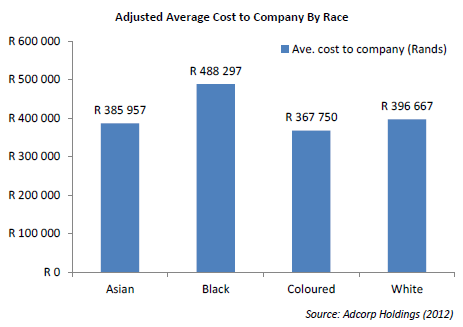
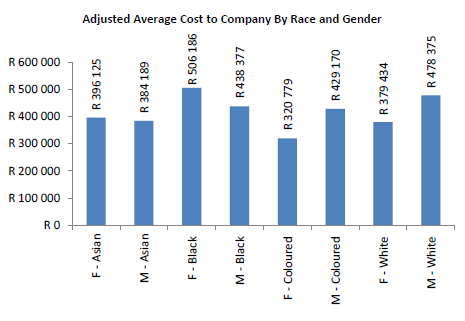
Data from the Adcorp Employment Index suggest that – all else being equal – black females receive 36,4% more than whites in South Africa.

This month, we take a closer look at the wage premium of affirmative action candidates in South Africa. The premium for blacks is now 23.1% – and for black females is now 36.4% – above their white counterparts.

One of the most important labour market indicators in South Africa is the “affirmative action premium” – the wage premium of affirmative action candidates over their non-affirmative action counterparts, holding constant the level of skills, qualifications, experience, on-the-job performance and other pertinent information so as to reflect purely the race-linked pay discrepancies between candidates. Since much of the required information is not recorded or readily available, Adcorp was able to obtain the required information for only 1,604 permanent placements for the 12-month period June 2011 to May 2012, on which the following analysis is based.

As indicated in the figure, Asians and coloureds earn 2.7% and 7.3% less than whites respectively, whereas blacks earn 23.1% more than whites, for equivalent levels of skills, qualifications, experience and on-the-job performance.

Interestingly, when the figures are dissected further by gender, Asian and black females earn 3.1% and 15.5% more than their male counterparts; whereas coloured and white females earn 25.2% and 20.6% less than their male counterparts.

The data is not consistently available over time, so it is impossible to say for the moment whether the affirmative action wage premium – which applies exclusively to blacks, and most notably to black females – has been rising or falling over time. But Adcorp will track and report on these figures in coming editions of the Adcorp Employment Index.

This is an edited extract from the Adcorp Employment Index for June 2012, July 10 2012

Apartheid revisionism needed

About two weeks ago, Hermann Giliomee, the well-known liberal Afrikaner historian, wrote a scandalous piece in the Afrikaans Sunday newspaper, Rapport. The title was, “Apartheid: was it only evil?” (Afrikaans link)

I have since responded with two articles of my own to his, and we are more or less in agreement that there has been a colossal misrepresentation of what the apartheid system of racial segregation in South Africa was. However, at least one academic from the University of Stellenbosch, Anton van Niekerk, has already attacked Giliomee, describing his piece as “immoral” and “unjustifiable”.

But for decades white South Africans have spent an ever-increasing portion of their taxes on black education, health and welfare, something which the rest of the world has characterised as a “crime against humanity”.

The other day I was speaking to a friend and she told me that Afrikaans was such a nice language because one could still express how one felt, whereas “everything in English had to be so politically correct”. At least that is the way it is in South Africa. Probably in the USA and other countries, it is different. Although I have been astounded to see how intolerant American liberals can get about views on race that differ from their own.

To appreciate what a major step Giliomee took in coming out with the view that some alternatives to apartheid would have been worse, one has to live in South Africa where every day we are inundated with propaganda about our “evil past”. I grew up in the 1960’s and 1970’s, rode a bicycle in our crime-free streets, saw happily dancing black mineworkers and generally was completely unaware that anybody in South Africa was desperately unhappy. As opposed to today when acrimonious exchanges fly almost continuously between black, white, coloured and Indian, race relations in those days were cordial and uncomplicated. We each lived in our own compartments and did not feel threatened by others. That too, in juxtaposition with contemporary South Africa where whites constantly worry whether they are going to be attacked en masse, chased into the sea by angry, frustrated blacks or fall victim to the daily criminal incidents such as rape, murder, robbery and theft. Whereas South African whites go out of their way to be civil to blacks, even calling them “sir”, which would have been unheard of in the old South Africa, blacks do not seem to return the compliment. Instead they behave absolutely abominably, whether in the extreme form of violent crime or in the imperious arrogance of their politics.

However, that almost idyllic South African past before we adopted the American model of affirmative action, white guilt and forced integration, is nowadays equated with Nazism. In 1939 large numbers of white South African men volunteered to fight Germany together with Britain and the rest of the Commonwealth, yet at some point we became the Nazis. Even Germans look upon us as Nazis. Not only do the Germans feel morally superior to us, but they would rather sell their sleek Mercedes-Benzes and BMW’s to corrupt black politicians than to us. These days, being impoverished, lower middle-class victims of affirmative action, “black economic empowerment” and all the other race-preference measures, we cannot afford German cars anymore and are driving second-hand Korean cars.

After all, the Germans only gassed a few million Jews. We Afrikaners or white South Africans oppressed blacks, which is far worse. We provided them with separate toilets. The fact that they did not have toilets at all before and somehow did it behind bushes or even in full view (as many still do next to our decaying roads), is besides the point, but next to whites-only toilets, Auschwitz and Dachau pale into insignificance.

Many South African liberals have already told me that denying that “apartheid was a crime against humanity” was tantamount to holocaust denial. In fact, two billionaire Jews, the twin brothers Krok, have given us their version of a South African holocaust museum, the so-called Apartheid Museum. That part of the deal was getting a casino licence from the new black government so they could make even more money, is never mentioned. Suffice it to say that we now have a tourist attraction where people can come and participate in the re-imagining of the South African past as a quasi-Nazi nightmare, replete with our own holocaust museum.

Except six million did not die. At least not in South Africa. It was more a case of: six million were born, grew up and proliferated and out of that population explosion and “youth bulge” all the chaotic urbanisation and familiar riots ensued.

Today there are as many, if not more, black riots in South Africa, than ever before. Yet the BBC, ABC, France 2, Reuters and whoever are not filming it. It seems that for blacks to riot under a black government is considered normal whereas every stone thrown or building set alight “under apartheid” was seen as pregnant with meaning, the expression of an entire political philosophy, a deep yearning for democracy. Just today I read in a report from the SA Institute of Race Relations that the most signifcant shift in the South African voting pattern is not that a lower percentage of people want to vote for this well-nigh useless and incompetent ANC government, but that fewer blacks express the desire to vote at all.

But I digress. The fact is that for Hermann Giliomee to have set off his apartheid revisionism, took a lot of courage. In a private letter, he told me that to his great relief he had severed all ties with universities. No-one wishing to keep his post at a university or even get published in academic circles would dare write a piece with such a heretical title: “Apartheid: was it only evil?”

To most sane people, his is a rhetorical question. One only needs to drive around South Africa and see all the overweight, contented blacks walking around in brand-name clothes, driving cars and chatting away on expensive cellphones to appreciate that, contrary to popular belief, our “evil past” had not affected them in any negative way.

Whenever I hear the litany of complaints by blacks about how they have been “disadvantaged” by apartheid – that is another shibboleth of the new South Africa, the “previously disadvantaged” – I feel like asking them: But what would South Africa have looked like without apartheid? Would our GDP have rivalled America’s? Would you have sent rockets to the moon from Soweto? If, despite affirmative action, only a thousand blacks could so far manage to pass the board examination to become a chartered accountant, how on earth would this economy ever have performed better than it actually has under mostly white management and entrepreneurship?

However, the issue goes further. Again, contradicting received wisdom, apartheid, at least the kind of policy espoused by the successive Afrikaner governments after 1948, was not only about providing separate amenities to black and white, so-called “petty apartheid”. It was also a colossal attempt at kick-starting black development. In today’s money, billions were poured into black education, healthcare, training, agricultural development, social services and so on. That was so-called “grand apartheid”, something which few of the hysterical liberals screaming “boycott South Africa” at the time wanted to talk about.

If we are to be heretics, after Hermann Giliomee’s example, we might as well start talking about grand apartheid  now.

By the way, I firmly believe that what a few of us “dissident Afrikaner intellectuals” are doing at present, questioning the racial orthodoxies of South Africa, is of great significance to us, to this country and perhaps even to the wider world that is grappling with similar problems.  For a long time now, we have been labouring under a type of censorhip. Whenever we dared to question our abject guilt, the Luciferian malevolence of our forebears, we would immediately be silenced, ostracised or vilified, so as to suppress those facts or aspects of our past that do not fit in with the “Nazi model”.

What we are really dealing with, and that was the starting point of my recent piece in Afrikaans, published on www.praag.co.za on Sunday, is yet another confrontation between dogma and reason. To Van Niekerk, Leop0ld Scholtz and many of the Media24 or Naspers commentators, it is about maintaining the apartheid dogma as it was established by the foreigners and by the South African Marxists.

Anton van Niekerk feels that it is “immoral” to question the apartheid dogma by simply referring to the facts of National Party policy between 1948 and 1994. At the very least it represents an argumentum ad populum or appeal to the “accepted wisdom” created in the past by left-wing historians and British newspapers.

Therefore, to be an apartheid rationalist today, requires a great deal of courage! A year or two ago at the offices of the South African Human Rights Commission, when I questioned the assertion by an Indian academic from Wits University that “apartheid had killed millions of people”, I was seen as some sort of lunatic. The Wits professor concerned promptly burst into tears and in general I was deemed a heretic.

The point about apartheid is that just about any lie or misrepresentation of if is acceptable today, simply because so many Afrikaners no longer have the courage to speak the truth about our past. Many of the National Party cabinet members are still alive and would easily be able to rectify the falsifications and half-truths by means of a few statistics and statements to the media, but they are simply too lily-livered for that.

Mr. Flip Buys too, of the mighty Soliforum group, says in almost every one of his radio interviews: “I am fighting for a better future, not a better past.” Buys knows very well on which side his bread is buttered and that the questioning of the apartheid dogma would quickly cost him the support of Media24.

But like George Orwell said: ” He who controls the present, controls the past. He who controls the past, controls the future.”

Actually, it is quite ironic that someone like Hermann Giliomee, who has a reputation as a liberal thinker and who spent some time at the University of Cape Town, should defend the current reputation of mostly conservative Afrikaners from the past. But I think part of Giliomee’s feeling that he has to do it, stems precisely from the classic nineteenth-century liberal idea that “there is more than one truth” or that every issue has at least two sides. Of course, that is also a principle of our Roman-Dutch law in South Africa, that every party to a suit has at least the right to put his case.

After my first response to Giliomee on Sunday a week ago, a reader sent me a clipping from The Citizen newspaper. It was made up of a letter that Jaap Marais wrote sometime in the nineties to the newspaper in which he pointed out a few interesting facts and figures, for the benefit of one W.J. Sachs who wrote that “the apartheid government withheld basic education from the black majority”. Naturally, it has become a generally accepted part of the apartheid dogma that blacks had received no education before the ANC took over in 1994. The fact that members of the ANC government are able to read and write at all, will no doubt soon by declared an official miracle by the Pope.

Among other things, Marais shows how only 20% of black children went to school under the United Party government prior to 1948. However, by 1967 the historian C.J. Scheepers Strydom wrote: “one of the changes with most far-reaching effect is undoubtedly the advancement of Bantu in education. Today 85% of the Republic’s Bantu of school-going age are literate – an increase of 600% since 1925. 32 000 teachers are employed in 8 500 schools with 2 million pupils”.

Jaap Marais adds: “In 1948 there were 8 000 Bantu teachers and 336 437 pupils in 3 310 schools. So it is evident that the so-called ‘apartheid regime’ did more for black education than its predecessor.”

While white taxes today are being spent largely on blacks, this was already the case during South Africa’s previous political system. Jaap Marais shows in his letter that the contribution per individual taxpayer according to race in 1970 was the following:

Whites R126

Indians R10

Coloureds R3

Blacks R0,85

In other words, blacks paid only 1/130th of the taxes paid by whites, but received far more from the state treasury!

Marais points out further that the total contributions of the different race groups in the 1980/81 fiscal year were still the following:

Whites R2 053 million

Indians R43 million

Coloureds R39 million

Blacks R100 million

In fiscal 1982/83 whites continued to pay 92,5% of all personal income tax.

After giving these figures, Marais emphasises the stupendous fact denied by today’s dogmatists, namely that in the same decade from 1973 to 1983 we again saw a tremendous rise in expenditure on black education: from R27 million per annum to R475 million per annum. From 1981 to 1985 the increase was equally rapid and shot up from R225 million per annum to R950 million per annum.

Referring to fiscal 1983/84, Marais says: “The government took from the 1,5 million taxpayers a total of R1 733 million for non-white education, averaging R1 107 per white taxpayer. This is how the former government practised affirmative action.”

In 1971 blacks had received 16 percent of the total education budget, but by 1991 it was already 58%, which indicates to what extent the apartheid dogma that “whites withheld education from blacks” rests on a myth.

But Anton van Niekerk and other dogmatists will respond to this by saying that they are not interested in the numbers and hard reality, but in the “moral” aspects of apartheid and segregation to which they refer as “an assault on human dignity” and “dehumanising”.

Van Niekerk writes in Rapport:

“We can therefore not judge apartheid in terms of a sinical, semi-Machiavellian estimation, merely what would have happened to the economy if there were no apartheid. Apartheid is gnawing at our conscience as whites because we have wounded the basic humanity of our fellow South Africans in its essence.”

The question is: why is apartheid “gnawing at our conscience as whites” when all the leaders and inhabitants of the formerly independent black homelands, as well as the Indians and Coloureds who also enjoyed certain privileges above blacks, may walk around with “clean consciences”?

And one wonders why Anton van Niekerk’s version of white guilt only applies to white South Africans or whether he also subscribes to Susan Sontag’s slogan: “The white race is the cancer of history.” Are all whites guilty? At any rate, most Western countries practised some or other form of colonialism or segregation. Until the seventies some of the southern states of the USA, as well as Britain, still applied forms of apartheid or segregation. Why should we be singled out as the scapegoats of the Western world?

Evidently, Afrikaners and SA whites do not need to take moral lessons from Americans, Britons or former National Party supporters like Anton van Niekerk. Today we have the opposite problem: in South Africa and to a lesser extent in the USA and other countries, there exists a system of reverse discrimination and permanent affirmative action by which we are reduced to permanently second-class citizens. Blacks also commit violence against us on a scale which may, at the very least, be called a violation of our human rights and at worst may be seen as a form of genocide.

In the recent past, the silence on black-on-white violence by the media in the USA has been coming under the magnifying glass. It is a disconcerting tendency that black violence, also in our country, is not being examined with the same “moral” spectacles as those used to stare at the South African past. During the conflict between the ANC and the National Party, newspapers regularly published statistics about deaths in police detention, but these days it is not being done anymore. In his book Trou tot die dood toe, gen. Johan van der Merwe mentions that nowadays approximately 700 deaths in police detention occur per annum, which is far higher than at any time during so-called “apartheid”. When are Prof. Anton van Niekerk and other politically correct academics going to start looking at that?

Those who prefer to make use of “moral criteria” should apply the same criteria to the methods used by the ANC to come to power. That is another issue raised by Van der Merwe: The ANC simply ignored the Geneva Convention and committed terror against civilians, both black and white. How are we supposed to feel guilty about the apartheid past when we are being governed by a group of monsters that exploded the Church Street Bomb on 20 May 1983 and committed over 400 necklace murders. (The method of execution by which a tyre is place around someone’s neck, filled with petrol and set alight, the person literally burnt alive.)

It will also be an interesting exercise to compare the human rights record of “Apartheid South Africa” with those of the group of countries that declared apartheid a “crime against humanity” at the United Nations.

Two years ago I visited Sweden. At times I had to stop myself from feeling morally superior to the Swedes, those supporters of the ANC and the anti-apartheid movement. Because our people have done so much more for blacks than Swedes or Norwegians – with all their development programmes in Africa. We only have to look at the extraordinary affluence of South African blacks, against the abject poverty pertaining elsewhere in Africa.

Where apartheid was wrong in my view, was in the burden and responsibility we took upon ourselves to look after other nations and racial groups, administer them, train them and in general assume responsibility for their well-being. In this way, the economic and political failure of the black homelands also became our failure. To this day, the dogmatists are trying to place the blame for deficient black performance on us.

While paternalism in many Western countries is still fashionable and aid money is being handed out in Africa by the billions, we Afrikaners must never again assume Kipling’s “white man’s burden”. The paradox of apartheid is: We are today damned, not so much because we oppressed blacks, but because we demonstrated compassion for blacks, as well as their education, health and welfare.

At present many people want to continue with this, in the name of so-called “reconciliation between the races”. It would be a grave mistake and would only lead to further misery and recriminations. Currently the black man prefers to stand on his own two feet and certainly does not need our help, assistance or even taxes anymore.

Zapiro’s cartoon of Zuma is ‘vulgar’ – Afriforum

Zapiro’s latest cartoon is a “vulgar portrayal” of President Jacob Zuma, lobby group AfriForum said on Monday.

The cartoon was “a vulgar portrayal of the president [and] unproductive and in poor taste.” AfriForum spokesman Ernst Roets said in a statement.

The cartoon by Jonathan Shapiro depicts an erect penis with a showerhead and legs standing before a mirror with an accompanying limerick about Zuma.

It was published in the Mail & Guardian on Friday.

Roets said the cartoon did not contribute towards finding a solution to South Africa’s problems.

“AfriForum is of the opinion that controversial issues in South Africa must be approached constructively and that it does not contribute to finding a solution when other people’s cultures are insulted in the process.”

Roets said although AfriForum supported freedom of speech and artistic experience, this cartoon called into question the matter of dignity.

He suggested artists “evaluate the possible consequences of their work before displaying it to the public”.

On Friday, government called for the removal of the cartoon from the Mail and Guardian website.

Spokesman Jimmy Manyi said the cartoon was a “defamatory attack” on Zuma’s character and violated his rights to dignity as enshrined in the Constitution.

SA Communist Party spokesman Malesela Maleka called it “B-grade schoolboy lavatory stuff, unworthy of a once talented cartoonist and unworthy of a newspaper that pretends to be serious”.

The African National Congress found it ” unacceptable and shocking”, while its Women’s League condemned it.

“The Zapiro cartoons rely on their shock value to make an impact, but calling the president of this great nation a ‘dick’ is unacceptable…” ANC Women’s League spokeswoman Troy Martens said.

Responding to criticism of the cartoon, Shapiro said on Friday the public should have the democratic right to be irreverent about leaders, especially those who “display hypocrisy”.

“My latest cartoon is meant to be scathing but humorous,” he said in an email, issued by his office, to Sapa.

“It’s also serious commentary about a seriously flawed, hypocritical leader.” – Sapa