A Malawian minister on Thursday criticised Western donors for withholding aid worth $150 million after the government exposed corruption, saying it could prompt other African leaders to stop fighting graft fearing they will lose funds.
“The government does not understand the decision taken by donors to withhold support because the (Malawi President) Joyce Banda administration has exposed fraud and corruption in the civil service,” Information Minister Brown Mpinganjira said at a ceremony to launch a community radio station for the main Protestant church in Malawi.
“Instead of people supporting the president for exposing corruption, they are busy withholding support. With this do you see some African leaders exposing corruption in their countries?” he asked.
His comments were the first official reaction to Western donors shutting down aid. Malawi depends on donors to bankroll up to 40 percent of its development budget.
Mpinganjira, a veteran politician and unsuccessful presidential candidate in 2004, said: “This could have been a time when all wellwishers could come forward and support President Banda since she had thrown a first stone.”
Donors under the Common Approach to Budgetary Support (CABS) have said they will not disburse pledged aid until February after an International Monetary Fund review. They have also warned that the next aid tranche depends on government efforts to fight the rampant corruption.
“We will not be able to resume support through government systems until we have a clear assurance, independently verified, that our resources are all being used for their intended purpose,” said Sara Sanyahumbi, a British diplomat who heads the donor grouping which includes European countries, the European Union and the World Bank.
Malawi has been rocked by widespread corruption, losing millions of funds to theft by mostly civil servants which the government blames on financial loopholes.
Donors have called on the poor nation to act swiftly on the plunder of public resources, known as Capital Hill Cashgate scandal.
Vice President Khumbo Kachali has said loopholes in the state’s payment system have seen state workers “siphoning huge sums of money using private companies with no contracts with government.” – AFP
Israeli Prime Minister Benjamin Netanyahu’s visit to Moscow to push Russia into taking a harder line on Iranian nuclear negotiations has fallen flat, Israel’s media said on Thursday.
Premier Netanyahu and President Putin
Netanyahu flew to Moscow Wednesday in what was seen as a last-minute bid to influence an emerging nuclear deal with Iran strongly opposed by the Jewish state and being discussed by world powers and Iranian diplomats in Geneva.
Right-leaning Maariv newspaper said Russian President Vladimir Putin’s comments after meeting Netanyahu at best gave little away, and suggested the Israeli premier’s visit had left no lasting impression.
“When the two men gave their joint press conference (Wednesday), it appeared Putin’s statement had been given to journalists in advance, and he only changed certain passages afterwards to make them more palatable to Netanyahu,” it said.
Speaking as the talks got under way in Geneva between Iran and world powers, Putin only said he hoped that “in the nearest future a mutually acceptable solution is found” to end the crisis.
Top-selling Yediot Aharonot said Netanyahu’s visit to Moscow was an unnecessary “put-down” to the United States after tension with Israel over a possible Iran deal.
“Every reader knows Putin supports and will continue to support the ayatollahs’ regime in Iran,” Yediot said.
“If there’s the slightest chance of persuading world powers to take a harsher line on Iran, Israel should engage in discreet dialogue (with the US), instead of bickering publicly with Washington,” it said.
And left-leaning daily Haaretz suggested Netanyahu’s visit was futile, pointing out Russia was traditionally much more closely aligned with the Islamic republic than with other world powers.
“Russia, which built Iran’s first nuclear power plant and remains on better terms with Tehran than Western powers, has expressed less suspicion than them about Iran’s nuclear work,” it said.
Netanyahu insisted on the need for a “real” solution to the Iranian nuclear crisis, after his talks with Putin.
“We would all like a diplomatic solution, but it needs to be a real solution,” said Netanyahu, adding that this would involve Iran halting nuclear work in the same way that Syria was allowing its chemical weapons arsenal to be destroyed.
Iran would have to halt uranium enrichment, stop work on centrifuges, have enriched uranium material taken out from Iran and dismantle the Arak heavy water reactor, he said.
“We think it is possible to get a better agreement but that requires determination,” Netanyahu warned.
Israel, the region’s sole if undeclared nuclear-armed state, has not ruled out the use of force against the Iranian atomic drive.
Tehran says its nuclear programme is purely for peaceful purposes. – AFP
A US drone killed six people in northwest Pakistan Thursday in only the second such strike outside the country’s lawless tribal districts, threatening to inflame tensions between Washington and Islamabad.
The missile attack targeted a religious seminary that security officials said belonged to the Haqqani network — blamed for some of the deadliest attacks in neighbouring Afghanistan — in the Hangu district of Khyber Pakhtunkhwa province.
Earlier this month the network’s chief financier Nasirudddin Haqqani was gunned down in mysterious circumstances in a village on the edge of Islamabad.
Thursday’s drone strike was the first in the country since Pakistani Taliban chief Hakimullah Mehsud was killed in a similar attack in the North Waziristan tribal district on November 1.
That attack prompted a furious response from Pakistan, with the interior minister accusing Washington of sabotaging fledgling peace efforts with the Taliban and opposition parties calling for a blockade of NATO supply lines to Afghanistan.
“The drone strike targeting the seminary killed six people,” police official Farid Khan told AFP.
Two local security officials identified two of the dead as Mufti Ahmad Jan and Mufti Hameedullah and said they were both members of the Haqqani network.
“The seminary belonged to one Qari Noor Muhammad, a previously unknown figure. It was not clear if he was present in the seminary at the time of attack”, an official said.
Washington has long demanded that Pakistan take action against the Haqqanis, who are blamed for numerous bloody attacks in Afghanistan including one on the US embassy in Kabul in 2011.
US officials have in the past accused Pakistani intelligence agencies of links to the Haqqani network, which has bases in the tribal districts.
Since 2004 the United States has carried out hundreds of missile attacks from unmanned aircraft on suspected militants linked to the Taliban and Al-Qaeda.
The vast majority of them have hit targets in the seven tribal areas bordering Afghanistan, which have a separate legal and political governance system from the rest of the country.
Thursday was the first time a US drone hit a district inside Khyber Pakhtunkhwa. The only previous strike outside the tribal areas came in Bannu district, a so-called “frontier region”.
The number and identity of casualties is often hard to determine because the tribal areas are off-limits to foreign journalists and aid organisations, but the London-based Bureau of Investigative Journalism estimates deaths at between 2,500 and 3,700.
Hundreds of civilians have died in the attacks, according to various estimates, prompting outrage in Pakistan and abroad.
A major report last month from rights campaigners Amnesty International said the US may be guilty of war crimes.
The Pakistani government officially condemns drone strikes as a violation of its sovereignty, and last month Sharif urged US President Barack Obama to halt the programme during a meeting in Washington.
Despite their deep unpopularity in Pakistan, the US sees them as a vital tool in the fight against militants in the tribal areas.
Blackwater founder Erik Prince personifies the hidden hand in America’s terror wars.
His company secretly armed and maintained drones in Pakistan, trained CIA hit teams and collected $2 billion as a U.S. government security contractor.
Mr. Prince said he looks back on that adventure as “13 lost years.” The billions of dollars are gone now, and he blames the U.S. government.
After a series of federal investigations, government contract battles and critical congressional hearings, Mr. Prince sold Blackwater in 2010. In the wake of continued controversy over his most recent pursuits while based in Abu Dhabi, Mr. Prince has returned to Virginia to write a new chapter of his life—as an entrepreneur buying oil, land and minerals in Africa.
In interviews, Mr. Prince and former Blackwater officials provided previously unreported details of the company’s dealings with the CIA and its former director, Leon Panetta. Blackwater’s fortunes, which dimmed as the Iraq war dragged on, sank markedly when President Barack Obama took office in 2009 and sought distance from President George W. Bush’s war policies.
A chief target of Mr. Prince’s ire is Mr. Panetta, who in 2009 shut down the covert training operation for CIA “hit teams” that former Blackwater officials said took place on Mr. Prince’s Virginia property.
At the time, former Blackwater officials said, the company also was working on America’s clandestine drone program. Former company officials said that a few dozen Blackwater employees, taking the place of American military forces, maintained drones armed with Hellfire missiles in Pakistan. The company didn’t fly them, but prepared them to launch attacks.
When that information became public in 2009, right after Mr. Panetta canceled the Blackwater hit-team training, the CIA director ended the company’s role in maintaining the drones.
Mr. Prince said he is convinced that Mr. Panetta outed him as a CIA “asset” at a closed congressional hearing that year, adding that it was unthinkable for a CIA director to reveal the real name of a covert operative to lawmakers.
“No one was out to scapegoat anyone in the relationship with Blackwater, but there were some issues that arose that prompted a serious look at contracts with the company,” said one former CIA official involved in the discussions. “There was a perception that they were trying to run some of their own operations untethered from agency oversight.”
Along with its clandestine work, Blackwater had a much more public role providing security for American diplomats and CIA personnel in Iraq and Afghanistan. Blackwater guards were caricatured as war-zone cowboys.
Blackwater convoys were feared in Iraq. The drivers were under State Department orders to do everything necessary to protect the department’s workers—directives that Mr. Prince alleges forced Blackwater to use aggressive tactics.
The State Department didn’t comment on the allegation.
Paul Bremer, the Neo-Con American diplomat who oversaw the U.S. government’s early invasion in Iraq liked them. “Their job was to keep me alive,” said Mr. Bremer. “I can say they never fired a shot in my presence, so they weren’t a bunch of cowboys running around shooting at people.”
Blackwater guards were involved in a series of deadly shooting incidents that alienated Iraqi citizens and the government. In September 2007, they killed 17 Iraqis in Baghdad’s Nisour Square.
Last month, the Justice Department renewed the prosecution of four Blackwater guards involved in the shooting, which still generates anger in Iraq.
“On balance, I think [Blackwater] operated in irresponsible ways which led to a lot of hostility toward our country,” said Rep. Henry Waxman, a California Democrat and former chairman of the House Committee on Oversight and Government Reform, who grilled Mr. Prince during a 2007 hearing. “They were overpaid for their work, and there was little, if any, accountability to the U.S. or the Iraqi governments.”
Following the Nisour Square shooting, the U.S. tightened its oversight and training of contractors to try to prevent another such incident, said Alex Gerlach, a State Department spokesman.
After the Obama administration cut most ties with Blackwater, Mr. Prince sold the company and moved to Abu Dhabi, where he quickly became embroiled in further controversy. Mr. Prince said he served as an adviser in setting up a privately trained antipiracy security force in Somalia that was accused of violating a United Nations arms embargo. And he was a consultant on a failed effort to set up a security force in Abu Dhabi made up largely of former Colombian soldiers.
In August 2012, Blackwater – now called Academi – paid a $7.5 million fine relating to allegations of arms smuggling when Prince was in charge.
Now, Mr. Prince said, he is done working for the U.S. government. He has invested millions in setting up Frontier Resource Group, a private-equity firm that operates in more than a dozen African countries. The company raised $100 million to invest in infrastructure Africa in conjunction with Chinese companies.
The firm is building an oil refinery in South Sudan, owns a cement factory in the Democratic Republic of Congo, conducts aerial gas and oil surveys across the continent, and is looking at taking over idle oil wells damaged by insurgents in Nigeria, he said.
“Africa is so far the most unexplored part of the world, and I think China has seen a lot of promise in Africa,” Prince, who served with SEAL Team 8 in Haiti and the Balkans, said during a visit to Hong Kong, later telling the South China Morning Post: “The problem is if you go alone, you bear the country risk on your own. You have to get support and maintenance there.”
Which means exactly what? Well, no one really seems to know. Prince’s objectives in Africa are obscured, while FRG’s goals are vague and convoluted.
“The view of his new company is very limited, and very opaque. If you look at his website it seems like a front for funding and training local security forces to provide security for resource projects in African nations, particularly for the Chinese,” Geoffrey Ingersoll, a former member of the Marine Corps and a Military and Defense reporter for Business Insider, told Guyism.com.
Will FRG’s new business partners care how the company achieves its goals? Not really, no.
“The Chinese are cut-throat capitalists. They’re much more concerned with their workers not getting kidnapped, and with making money. the over-arching concern is that they want to dominate Africa, geopolitically and economically,” Ingersoll said.
“What I think he wants to do is bring in contractors to employ and train organic security forces. That way, you only need a handful of former SEALs to command 200 men, and those 200 men you can pay small salaries because they’re from sub-Saharan Africa The tactic is called a ‘force multiplier’ – and comes straight out of the Marine Corps ‘small wars’ manual.”
FRG could face competition from… Blackwater.
“Academi is supposedly moving it’s operation to Africa, because the Americans have grown tired of their uncontrollable, heavily subsidized child acting like a rich kid addicted to cocaine and crashing Lamborghinis,” Ingersoll said.
As it turns out, Prince might need more than an army to conquer Africa. WSJ/guyism.com
India is planning to put its rising population of primates on the pill to tackle the growing “monkey menace” in its towns and cities, government wildlife officials have confirmed.
Vasectomies and sterilisation programmes are also being developed as part of a broader plan to curb the chaos being caused by troupes of marauding monkeys as urban India expands into their traditional forests.
Thousands of red-bottomed Rhesus Macaques or Bhandar monkeys are the scourge of New Delhi, where they roam through government buildings, chew Internet cables, bite the unwary carrying food and steal from people’s homes.
Delhi’s deputy mayor was killed when he was knocked from his balcony by clambering monkeys in 2007.
Until earlier this year, the Indian capital’s employed “monkey catchers” deployed larger, black-faced Langur monkeys to scare away the macaques.
But since the use of and trade in Langur monkeys was banned earlier this year, the Indian government has been looking for a new solution.
Earlier this year officials from the Central Zoo Authority collaborated with the National Primate Centre in California to develop a new strategy with the Wildlife Institute of India. The researchers in California recommended a programme of oral contraceptives, female sterilisation and vasectomies, officials said.
Now Indian officials are exploring ways to administer the contraceptives and the likely impact of the drugs on primate behaviour before pressing ahead. One official said a mixed approach is likely to be adopted in Uttarakhand, in the Himalayan foothills where thousands of monkeys patrol the main roads and terrorise people in the hill towns.
Monkeys that can be caught will be sterilised while oral contraceptives will be put in food left for those primates that remain at large.
Professor P.C. Tyagi of the Wildlife Institute of India said he and his colleagues would move forward with the plans only when they are sure it will not have any harmful effect on the animals or their behaviour.
The need however is urgent, he said: “The population is increasing in the cities, they are causing a disturbance. People can’t come out of their houses, they’re taking clothes, biting people.
“One of the main advantages [of oral contraception] is that it is non-surgical. We’ll look at how it works in other countries, carry out a trial, then we’ll go ahead. If there are problems with the dosage, we’d need to work that out,” he said. – The Telegraph
Toronto’s City Council voted overwhelmingly Friday to strip Mayor Rob Ford of some of his powers, trying to box in the brash leader who has rebuffed huge pressure to resign over his drinking and drug habits and erratic behavior. Ford vowed to challenge the measure in court.
The motion, approved in a 39-3 vote, suspends Ford’s authority to appoint and dismiss the deputy mayor and his executive committee, which runs the budget process. In a separate vote, the council voted to give the deputy mayor authority to handle any civic emergency. The effort will continue Monday when the council moves to strip the mayor of most of his remaining powers.
The votes capped another frenzied week of twists and turns in the scandal that has consumed Canada’s largest city and financial capital for months.
Newly released court documents showed that the mayor became the subject of a police investigation after news reports surfaced in May that he had been caught on video smoking crack. In interviews with police, former staffers accused the mayor of frequently drinking on the job, driving while intoxicated and making sexual advances toward a female staffer. Ford stirred up further controversy – even offending Canada’s oldest football team – when he used profanity Thursday while angrily addressing the latest allegations.
Most city councilors are frustrated by Ford’s refusal to step aside but they lack the authority to force him out of office unless he is convicted of a crime.
An unusually subdued Ford said he had no choice but to fight the motion in court while also saying he understood why the council was taking the measures – a typical display of defiance followed by a flash of remorse.
“If I would have had a mayor conducting themselves the way I have, I would have done exactly the same thing,” Ford said.
The mayor, a conservative who touts his efforts to curb public spending and keep taxes low, later made it clear he intends to seek re-election next year.
“Councilors spoke today. The taxpayers of this great city will have their say Oct. 27,” Ford told a crush of reporters, referring to the date of the municipal elections. City Hall. A few hecklers shouted “Resign! Resign!”
Ford’s lawyer, Dennis Morris, called the council’s actions a “coup” and said they have hired a municipal law expert to challenge it.
The vote came a day after yet another series of antics from Ford that outraged city councilors, anti-drunk driving advocates and even Toronto’s football team, which protested when Ford wore a team jersey while making a profanity-laced statement.
“We need to take away his power for the good of the city,” said Councilor Denzil Minnan-Wong, a former ally. “The tide has turned and there are very few people that are prepared to defend him given his vulgar comments and his admission that not only does he takes drugs but that he seems to be comfortable drinking and getting behind the wheel.”
Morris, Ford’s lawyer, said he thought the council’s overwhelming support to strip the mayor’s power came about because of the public outcry over the obscenity that Ford spouted a day earlier while denying that he pressured a female employee for oral sex. The mayor said on live television that he was “happily married” and used crude language to say he enjoys enough oral sex at home.
“If it wasn’t for that stupid comment he made yesterday no one would have thought this (the council’s action) was appropriate,” Morris told The Associated Press. “It was a turning point for public sympathy. That type of remark is never every appropriate in public. There’s no doubt about it, he’s going to have to do a lot of leg work to gain back public confidence in him.”
Morris said the “media have been attacking him like jackals” and Ford “lost it.”
Ford announced Thursday that he was seeking help form a team of medical professionals, though he declined to provide details. Although the mayor has admitted to excessive drinking and using and buying illegal drugs, he and his family have insisted he is not an addict and does not need rehab.
But even Morris said the recently released court documents corroborate the fact that the mayor has a problem with alcohol. Morris said he doesn’t understand how police allowed him to drink and drive while the mayor was under surveillance the past six months.
“The problem drug Rob has is alcohol, that’s obvious,” Morris told The AP. “What I found very strange is that the police allowed a lot of this to go on under their supervision. If he was drinking and driving and he was impaired they should have stopped him.”
Ford’s troubles began escalating in May when news reports of the crack video surfaced. After months of evading the question, the mayor admitted to having smoked crack when Toronto police announced they had obtained the video. Police have said the video does not amount to enough evidence to charge the mayor and it has not been released because it is evidence before the court.
Revelations have rapidly surfaced of other startling behavior, including a video showing the mayor threatening to kill someone in an incoherent rant.
It has been a stunning decline for the 44-year-old mayor who was elected three years ago with fervent support from Toronto’s conservative-leaning outer suburbs, where many voters felt angry about they considered wasteful spending and elitist politics at City Hall.
John Filion, the councilor who introduced Friday’s motion, has said the goal is to prevent Ford from firing executive committee members who speak out against him. A motion to be considered Monday, already signed by 28 of the 44 council members, will take away his budget and appoint the deputy mayor as head of the executive committee.
Earlier this week, the council voted overwhelmingly to ask Ford to take a leave of absence, but the motion was non-binding. – AP
African nations will Friday launch one of the biggest challenges yet to the International Criminal Court by forcing a UN Security Council vote on suspending the trial of Kenya’s president.
A resolution seeking to defer crimes against humanity charges against President Uhuru Kenyatta and Vice President William Ruto for one year is almost certain to fail through lack of support.
But diplomats and justice experts say the action risks heightening tensions between the ICC and Africa.
The two leaders are accused of masterminding unrest after a 2007 presidential election in 2007 in which at least 1,100 people died. Kenyatta and Ruto took office after an election this year.
Ruto’s trial has started, while that of Kenyatta gets underway February 5 after being delayed three times.
Both have so far cooperated with the ICC. But Kenya has made two written requests to the council to suspend or halt the cases.
Scores of Kenyan victims of the violence have also withdrawn from the ICC case because of what diplomats and experts call “intimidation.”
The resolution to be voted Friday is the most serious bid yet to suspend proceedings.
The Security Council can ask for an ICC case to be deferred for a year under Article 16 of the court’s founding Rome Statute if a trial is considered a threat to international peace.
The resolution has been pressed by Rwanda, a temporary Security Council member, but not an ICC signatory, with strong backing by Ethiopia, another ICC opponent.
It would need at least nine votes on the 15 member council to pass. But with the council’s seven ICC signatories and the United States against them, the resolution has no chance, diplomats said.
The draft resolution says the court case is “distracting and preventing” Kenyatta and Ruto from their duties.
It takes up African Union complaints that the two should be left to handle Kenya’s role in battling Islamist militants in Somalia and the aftermath of September’s Westgate mall attack in Nairobi which left 67 dead.
But western diplomats and activists see a largely political campaign to halt the proceedings and more generally by countries opposed to the ICC to discredit the court.
African leaders frequently complain that the ICC discriminates against their continent.
All eight cases being investigated by the ICC concern Africa. But nearly all were called by the countries involved and Africa’s 34 members make up a key chunk of the court’s 122 signatories.
“The Africans have now reached a stage where they are talking about this is as a test of whether you are in favour of Africa or against Africa,” said one UN diplomat who has taken part in the often highly emotive talks on the resolution.
This was “deeply resented” by countries who oppose the resolution, added the diplomat, who highlighted how the Security Council voted this week to increase an African force in Somalia which is almost entirely paid for by the European Union.
“This is turning into the biggest challenge to the court since it was set up,” added a second council diplomat.
“Undoubtedly, the pressure exerted by Kenya, by Rwanda, by Ethiopia increases strain on the court as it tries to strengthen its impact,” commented Richard Dicker, justice specialist with the Human Rights Watch group.
He said part of the motivation for the vote was to “ratchet up pressure” ahead of an assembly of the Rome Statute member countries in The Hague starting next Wednesday.
The assembly is to discuss possible measures such as allowing defendants to take part by video-conference and to give courts’ extra leeway to allow absences, which could help Kenyatta and Ruto.
Some African leaders have agitated for an African withdrawal from the ICC.
“I don’t think this would lead to a mass walkout, but if this vote goes ahead the atmosphere will be so bad at the assembly it is going to make it so much more difficult to reach agreement on things that could make a difference,” said the UN diplomat.
“And it would increase the likelihood that Kenyatta will not cooperate with the court,” the official added. – AFP
The Australian military has sacked six male officers over their role in the so-called “Jedi Council”, a group which allegedly produced and shared videos of themselves having sex with women.
The Australian Defence Force said six officers and non-commissioned officers had been fired over the production or distribution of “highly inappropriate material demeaning women” on defence computers and the Internet.
“The standard of behaviour we expect of our serving members is clear,” chief of army Lieutenant-General David Morrison said in a statement received Friday.
“It is also clear that if you engage in misconduct, or you fail to uphold the army’s standards, then you will be held to account.”
Reports in June said the officers had allegedly filmed themselves having sex with women, including colleagues and civilians, and distributed the images to military personnel around the country without the women’s knowledge.
The revelations, which followed a government report detailing more than 1,000 claims of sexual or other abuse in the forces from the 1950s to the present day, prompted Morrison to tell troops to respect women or quit the military.
“I will be ruthless in ridding the army of people who cannot live up to its values,” he said at the time.
The six men sacked ranged in rank from sergeant to major and three of them have been investigated by New South Wales police. A further seven also face termination while four are subject to administrative sanctions.
Disciplinary and/or administrative action was also being considered against a further 172 people, predominately army personnel, who were identified as peripheral to the group’s email exchanges, defence said.
Morrison said a total of 122 regular army and reservists had had their service terminated so far this year due to serious misconduct or unacceptable behaviour, taking drugs and civilian offences.
The Australian Defence Force has been hit by a series of sex scandals, including the 2011 Skype incident in which a young male recruit had sex with a female classmate and streamed the encounter online to cadets in another room without her knowledge.
Last week the male cadet officer at the centre of that incident was kicked out of the army following his conviction in court. – AFP
Toronto Mayor Rob Ford admitted during a heated City Council debate Wednesday that he had bought illegal drugs in the past two years, but he firmly refused to step down even after nearly every councilor stood up to ask him to take a leave of absence.
The mayor made the confession under direct questioning by a former ally, Councilor Denzil Minnan-Wong. Ford publicly admitted last week that he smoked crack cocaine last year in a “drunken stupor,” but his comments Wednesday marked the first time he acknowledged having bought illegal drugs.
Ford paused for a long time after Minnan-Wong asked him if he had bought illicit narcotics in the past two years.
Then Ford replied, “Yes I have.”
“I understand the embarrassment that I have caused. I am humiliated by it,” Ford said.
But he then turned defiant, saying he was not an addict of any sort and rebuffing suggestions from council members that he should seek help. He insisted he is a “positive role model for kids who are down and out.”
“I’m most definitely keeping this job,” he said. “I am not leaving here. I’m going to sit here and going to attend every meeting.”
Moments earlier, all but two of the 43 councilors present for the debate voted to accept an open letter asking Ford to step aside.
Although it was a stark demonstration of his political isolation, the vote was symbolic because the City Council does not have the authority to force the mayor from office unless he is convicted of a crime.
“Together we stand to ask you to step aside and take a leave of absence,” Councilor Jaye Robinson said, reading the open letter.
The packed council chamber erupted with applause when Robinson ended her speech, saying “Let’s get on with city business.”
Outside City Hall, hundreds of protesters changed “resign!” And organizers of Toronto’s Santa Claus Parade asked that Ford not walk in the procession this year.
Ford’s refusal to resign has confounded the City Council, where many members agree that his erratic behavior – from public drunkenness to threatening to kill someone in a videotaped tirade – has consumed Toronto’s politics and undermined efforts to tackle other challenges.
But with no clear legal path to force him out, the Council is grasping for ways to shunt the larger-than-life leader aside and govern without him until next year’s municipal elections.
The open letter was separate from a non-binding motion, also being debated Wednesday, that would formally call on Ford to take a leave of absence, apologize to Toronto residents for misleading them and cooperate with police.
Deputy Mayor Norm Kelly, a Ford ally, announced shortly before the debate that he would support the motion, introduced by Minnan-Wong.
“I’m publicly advising the mayor to take some time,” Kelly said.
Minnan-Wong said he would drop another proposal to ask the province of Ontario to pass legislation to remove the mayor from office if he refuses to take a leave. Other councilors had expressed concern that asking the provincial government to intervene would set a dangerous precedent.
Councilor Doug Ford, the mayor’s brother, heckled Minnan-Wong throughout the debate.
One Ford ally, Councilor Giorgio Mammoliti, called the motion a waste of time. “We can’t tell him what to do. Only the electorate can tell him what to do,” he said.
Toronto police said last month they had obtained a long-sought video of Ford apparently smoking from a crack pipe but that it does not constitute evidence to charge him. Toronto Police spokesman Mark Pugash said Ford’s acknowledgement Wednesday that he bought illegal drugs would be passed on to investigators.
News reports of the crack video’s existence first surfaced in May, but it has not been released publicly.
Another proposed motion would curtail Ford’s powers, suspending his authority to appoint and dismiss the deputy mayor and his executive committee, which runs the budget process. It likely won’t be debated until Friday.
Toronto’s mayor already has limited powers compared to the mayors of many large cities in the United States. He is just one voting member in the council and his power stems mostly from his ability, as the only councilor elected by citywide vote, to build consensus and set the agenda. That authority, many council members say, has evaporated in the crack scandal.
Ford, 44, was elected three years ago, riding a backlash from suburbanites who felt alienated by what they deemed Toronto’s downtown-centric, liberal-dominated politics.
Despite his eroding political leverage, Ford promises to seek re-election. He maintains a hardcore of supporters he refers to as “Ford Nation,” who applaud him for abolishing an annual $60 vehicle registration tax, squeezing valuable concessions out of the labor unions and other cost-saving measures.
Councilors have expressed concern that more revelations about the mayor’s will surface and plague city politics.
On Tuesday, a judge agreed to release more documents from a drug case against a friend and occasional driver of the mayor, Alexander Lisi. Previously released documents revealed the mayor’s ties and covert meetings with Lisi.
Police said they obtained the crack video in the course of the investigation against Lisi and a gang. They say they cannot release the video because it is evidence before the court.
Ford was grilled by councilors about his links to a Toronto home where he was photographed with three suspected gang members. A police informant has described the residence as a “crack house” and police have said it relates to the crack video.
“That is not a crack house,” Ford said. “Have you been in that house?”
Councilor Michael Thompson retorted: “I have no interest in being in that house. I am not a crack user.” – AP
Justin Bieber says he’s sorry and the hopes Argentines can forgive him. Now he may need to tell that to some judges.
The 19-year-old pop star faces two criminal complaints after his wild tour in Argentina, in addition to trouble with police for allegedly spraying graffiti in Brazil and Colombia.
One Argentine lawyer is accusing Bieber of sending bodyguards to attack a photographer outside a Buenos Aires nightclub.
Another accuses him of defiling the national symbol by dragging two Argentine flags off stage with his feet and a microphone stand. If tried and convicted in the flag incident, that could mean up to four years in prison.
Bieber tweeted Thursday that he’s sorry. He says he “would never do anything to disrespect Argentina.” – AP
While Sudan, Libya, and Saudi Arabia can been seen in the right spots on a map, Israel is fully covered by Jordan with the territories of both states evenly colored in red in a book by the world’s biggest publisher of children’s titles.
In another similar Israel-missing case, Apple and its much-anticipated operating system, iOS 7, presented the new world clock options on the iOS 7. It listed Jerusalem without a country.
A senior vice president for corporate communications at Scholastic, Kyle Good, is looking into this.
“The Geronimo Stilton series is published in Italy and Scholastic translates the books for the US audience,” Good said in an emailed comment. “I’m awaiting a response from the editorial team regarding the timing of reprints and whether this will be corrected. I will get back to you as soon as I have their response.”
Scholastic, founded in Pennsylvania in 1920, is the world’s largest publishing companies known for publishing educational materials for children, parents, schools and teachers. It distributes children’s books through its book clubs, teaching resources and popular book fairs held inside many North American schools as well as online.
The company has exclusive publishing rights for the Harry Potter series in the United States.
It is not the first time Israel has not been found on the world’s map.
According to a recent study, 96 percent of Palestinian school textbooks did not mention Israel by name in their maps. At the same time, 87 percent of Israeli school textbooks did not have lines between Israel and the Palestinian Territories, or did not name it at all.
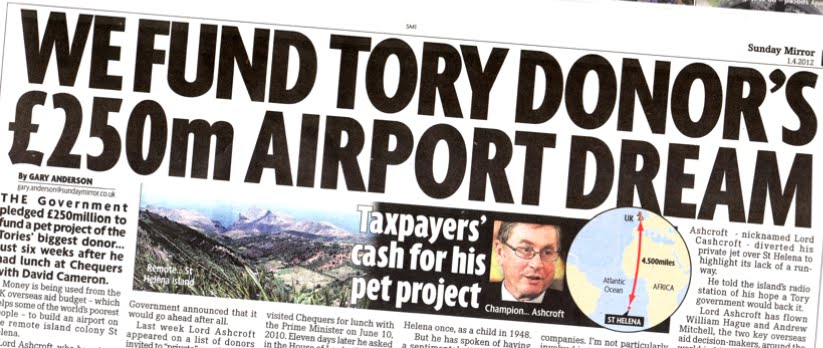
The press reports that the British international development secretary Andrew Mitchell has approved £200 million to be spent building an airport for the South Atlantic island of St Helena.
As its colonial British owners have long known, St Helena is best suited as a fortress of incarceration for upstarts most irritating to the empire. They include Napoleon Bonaparte and Dinuzulu kaCetshwayo and about 6 000 Boer prisoners of war.
The South African company Basil Read won the tender from the British government to design, build, operate and transfer the airport against several competitors. They dropped out chiefly, as Basil Read’s island director Deon de Jager says, because “it could not be done”.
The island has an apartheid-style society. Class distinctions are along racial lines, with British expats working for the government on top of the pile and the darker descendants of slaves and labourers imported over centuries at the lower end.
Prospects of education and wealth for them are limited. When the British established a naval station on the island in the 1840s to gain from the African slave trade across the South Atlantic, about 15 000 slaves were left there.
When news first broke of the proposals last July, MP Denis MacShane slammed it as: “A scandal of Pergau Dam proportions.”
Why? Because the decision comes after lobbying from Tory donor and £127m tax avoider Lord Ashcroft.
In July 2010, just months after the Tories came to power following an election campaign he bankrolled, Ashcroft demanded to know: “What the current plans are for an airport in St Helena?”
The Guardian reported at the time:
Ashcroft showed his commitment to the airport in December last year when he diverted his private jet, during a flight from Nairobi to Brazil, to fly low over the island.
As his jet swept over the island, Ashcroft was interviewed from the plane by a St Helena radio station. “I’m about 25,000 feet in the air descending, slowly descending at the moment so I should be over there in about 15 minutes time,” he said in the broadcast.
“I believe that you should have an airport, you should be able to open St Helena up to the world and I hope that an incoming Conservative government in due course will strongly support an airport there.”
Mitchell says the project will help boost tourism and help reduce the island’s dependency on aid, but given that £200 million earmarked for this airport is equivalent to the entire amount spent by the Department for International Development on water and sanitation in 2010, is this really the most effective use of British aid?
The number of boats bringing undocumented migrants from various countries other than Cuba is on the increase, according to American federal authorities, who say smugglers have turned to other nationalities as the smuggling of Cubans has dried up.
One Oct. 16, a boat carrying migrants from Haiti capsized east of Miami Beach. Just two weeks before, on Oct. 3, federal authorities spotted a boat leaving Bimini, in the Bahamas, and traveling west toward U.S. shores without navigation lights.
On Aug. 28, smugglers dumped a group of Haitian migrants near Palm Beach and ordered them to swim ashore. A 14-year-old girl was later found dead on the beach.
And between 2009 and 2010, boats traveling between the Bahamas and South Florida smuggled dozens of Brazilians who first traveled to Europe and then flew to the Bahamas to board the smuggling boats to South Florida.
Federal officials say there’s an increase in migrant boat traffic toward South Florida involving the smuggling of undocumented foreign nationals of various nationalities. The boat traffic appears to have drawn smugglers who once primarily transported Cuban migrants across the Florida Straits and who now are focusing on nationals from other countries because the Cuban migrant smuggling organization have largely been dismantled, the officials said.
“Smugglers look for business anywhere,” said a federal official familiar with the issue.
The dismantling of the Cuban migrant smuggling networks along with improved Coast Guard patrolling and interdiction tactics are credited with a dramatic decrease in the number of Cuban migrants arriving by sea.
As a result, the majority of undocumented Cuban migrants are now arriving through the Mexican border. They come not only by boat from the island to the Yucatán peninsula but also overland from South and Central America.
Homeland Security Investigations (HSI), a unit of U.S. Immigration and Customs Enforcement, is the lead agency investigating boat migrant-smuggling networks.
Over the last two or thee years, investigators have noticed an increase in the number of boats operated by smugglers and transporting undocumented migrants of various nationalities.
The federal official familiar with the issue said that while several smuggling organizations were involved, they seemed to share similar traits. A significant number of them, the official added, operated boats that began voyages toward South Florida in the Bahamas – but carried migrants who came from as far away as Brazil, Ecuador or Colombia. Some of the migrants also started out in Haiti or the Dominican Republic but then made their way to the Bahamas to board smuggling boats for the final leg to South Florida.
In some cases, small boats overloaded with migrants begin their trips in Haiti.
That was the case in the ill-fated voyage of the 25-foot fishing boat that flipped over five miles east of Miami Beach, killing four female Haitian migrants Oct. 16. It carried 15 migrants, some of whom started the voyage in the northwestern Haitian coastal city of Port-de-Paix, according to Louisias Pierre, one of the survivors interviewed recently by the Miami Herald.
An affidavit in Miami federal court from an HSI special agent quoted one of the witnesses in the tragedy as saying that people boarded the boat in the Bahamas,
Pierre told the Miami Herald that the smugglers promised to transfer the migrants to a larger boat in the Bahamas, but that never happened. The boat did stop in the Bahamas, but only to pick up more migrants.
In the Oct. 3 voyage, the 24-foot boat began its trip in Bimini, according to an affidavit from another HSI special agent.
When a Customs and Border Protection vessel intercepted the suspect boat it disobeyed orders to stop.
“The operator of the suspect vessel then proceeded to increase his speed and performed evasive maneuvers, such as aggressively making left and right turns in an S-pattern, in an attempt to avoid interdiction,” the HIS affidavit said. “Due to the failure of the suspect vessel to stop, CBP fired two warning shots forward of the bow.”
The affidavit said the boat finally stopped about 10 miles east of Elliott Key, just south of Key Biscayne.
When CBP officers approached, they saw five men on the boat. One told officers that he was testing the boat, possibly to purchase it. A second man claimed he was brokering the sale. The three other men, they claimed, were migrants they had rescued from a makeshift boat adrift in the sea.
But once everyone was brought ashore, federal agents learned that two of the men were migrant smugglers and the other three were Cuban migrants without visas.
The federal official familiar with the issue said migrants pay a wide range of prices to be smuggled in — from as little as $1,000 or $2,000 per person to cross from the Bahamas to South Florida to as much as $15,000 for a comprehensive travel package from Brazil that includes flights to Europe and the Bahamas and then the boat ride to South Florida.
It’s unclear whether most boats are interdicted or get through to South Florida.
“We don’t catch them all,” the official said. “It’s a cat-and-mouse game.” – Miami Herald
G4S is a UK-based private security contractor that is wildly profitable and rapidly expanding. They’re also terrible. They totally blew security for the London Olympics (but not before illegally harassing photographers).
They’ve been stripped of their contract to run a South African prison after total incompetence and torture.
They’ve had new contracts with the UK government frozen while they’re being investigated by the Serious Fraud Office for criminal overbilling (and despite this, the Home Office is quietly trying to expand their contract to abuse house migrants facing deportation).
Now, they’re facing criminal charges for forging migrants’ documents. A high court judge found that three G4S employees representing the secretary of state forged documents used to deport an asylum seeker who claims he was tortured on his return.
The three officials behaved disgracefully, the judge said, adding: “When agents of the state falsify documents it undermines, if not fatally then certainly very seriously, the trust of the people in the operation of the rule of law.
“It makes no difference if, as here, the agents are private contractors to whom the secretary of state has outsourced her powers. Corruption by state officials is insidious and corrosive and it is the duty of the authorities where it is found to root it out ruthlessly.”
Mostyn referred his findings of forgery and providing false witness testimony to the DPP and the attorney general. However, he added that his “finding as to the turpitude of the agents of the secretary of state” did not detract from the “lack of credibility of the claimant”, and he dismissed the appeal. – boingboing.net
This website uses cookies to improve your experience. We'll assume you're ok with this, but you can opt-out if you wish. Cookie settingsACCEPT
Privacy & Cookies Policy
Privacy Overview
This website uses cookies to improve your experience while you navigate through the website. Out of these cookies, the cookies that are categorized as necessary are stored on your browser as they are essential for the working of basic functionalities of the website. We also use third-party cookies that help us analyze and understand how you use this website. These cookies will be stored in your browser only with your consent. You also have the option to opt-out of these cookies. But opting out of some of these cookies may have an effect on your browsing experience.
Necessary cookies are absolutely essential for the website to function properly. This category only includes cookies that ensures basic functionalities and security features of the website. These cookies do not store any personal information.
Any cookies that may not be particularly necessary for the website to function and is used specifically to collect user personal data via analytics, ads, other embedded contents are termed as non-necessary cookies. It is mandatory to procure user consent prior to running these cookies on your website.


 A Malawian minister on Thursday criticised Western donors for withholding aid worth $150 million after the government exposed corruption, saying it could prompt other African leaders to stop fighting graft fearing they will lose funds.