Fracking a disaster in drought-stricken regions

fracking2US states suffering a drought are facing a dire water crisis exacerbated by hydraulic fracturing. The procedure consumes vast amounts of water, which has driven up prices and depleted certain aquifers and rivers.

In drought-stricken regions, fracking is taking a serious toll on the water availability of local communities, in some cases turning water into a scarce and expensive resource. The procedure powerfully blasts water, fine sand and chemicals into the ground to shatter rock formations and release oil or gas.

Fracking is occurring in several counties in Arkansas, Colorado, New Mexico, Oklahoma, Texas, Utah and Wyoming, which are currently suffering a severe drought, the Associated Press reports. Although the procedure requires less water than farming or overall residential uses, it contributes to the depletion of an already-scare resource.

Some oil and gas companies manage to drain states of their water supply without spending any money, by depleting underground aquifers or rivers. But when unable to acquire the resource for free, the corporations can purchase large quantities at hefty prices.

“There is a new player for water, which is oil and gas,” Colorado farmer Kent Peppler told AP, noting that he is fallowing some of his corn fields because he can’t afford to irritate them. “And certainly they are in a position to pay a whole lot more than we are.”

Peppler, president of the Rocky Mountain Farmers Union, said that the price of water has skyrocketed since oil companies have moved in. The Meade, Colo. Farmer said he used to pay $9 to $100 per acre-foot of water at city-held auctions, but that energy companies are now buying the excess supplies for $1,200 to $2,900 per acre-foot.

Last year, the city of Aurora sold 2.4 billion gallons of sewer water to the oil company Anadarko for $9.5 billion, AP reports.

With oil and gas companies willing to spend large sums of money on excess sewer water, the cost of this valuable resource has risen across several drought-stricken states. Some local farmers, unable to afford crucial irrigation for their fields, say they are praying for rain.

“I was going to bed every night and praying to the good Lord that we would get just one rain on the crop,” West Texas cotton farmer Charlie Smith told AP, noting that he is selling some of his groundwater to drillers, since it is not enough to irrigate his crops. “I realized we’re not making any money farming, so why not sell the water to the oil companies? Every little bit helps.”

Environmental activists are calling for limitations on drilling in drought-stricken regions.

“We don’t want to look up 20 years from now and say, ‘Oops, we used up all our water,” said Jason Bane of the Western Resources Advocates.

Last summer’s record-breaking drought, which was the worst since the 1930’s Dust Bowl, resulted in a crop shortages that raised prices in US grocery stores. With a lack of water to irrigate crops across the US this year, Americans may once again find rising prices of both water and food.  – RT

Tech giants deny knowledge of PRISM spy operation

techgiantsAs the dust settles on the revelation that the U.S. government has been mining data from most of Silicon Valley’s largest companies in a program called “PRISM,” one question stands out: How did the NSA get access?

Apple, Google, Yahoo! and Microsoft, the largest companies involved in PRISM, the existence of which was revealed last night in a simultaneous Washington Post and Guardian scoop, have categorically denied knowledge of or participation in the program in a series of statements, while acknowledging that they do provide targeted access to the government when required to do so by law, generally according to court orders.

“We have never heard of PRISM,” says Apple’s spokesman. “If the government has a broader voluntary national security program to gather customer data we don’t participate in it,” says Microsoft’s. “We do not provide the government with direct access to our servers, systems, or network,” says Yahoo!’s. “Google does not have a ‘back door’ for the government to access private user data,” says Google’s.

Even unofficially, the tech companies seemed baffled by the allegations. The Guardian spoke with tech executives off the record, all of whom were “confused” by the documents published in the paper. None had ever heard of PRISM.

So what gives? Does the government have backdoor access so secret that not even their targets are aware? Are the tech companies lying? Or are they forbidden—as Verizon allegedly is with its NSA arrangement—from acknowledging its existence to an absurd extent? – gawker.com

Tens of thousands protest Confed Cup costs in Brazil

Brazilians protest
Brazilians protest

Tens of thousands of people took to the streets of major Brazilian cities Monday protesting the billions of dollars spent on the Confederation Cup and higher public transport costs, police said.

In Sao Paulo, the country’s economic capital and most populous city, an estimated 30,000 marched toward the main Paulista Avenue, with no repetition so far of the violence that marred similar protests last week.

“I came because I want Brazil to wake up. It’s not just to protest the higher transport fares, but also because of shortcomings in education and health,” said 20-year-old Diyo Coelho, who marched with friends carrying flowers.

Police said 6,000 protesters thronged central Rio, while organizers said 5,000 marched toward the National Congress in Brasilia, blocking the main avenue.

There were also protests in Belo Horizonte, Fortaleza, Salvador an other cities.

“I am here to show that Brazil is not just about football and festival. We have other concerns, such as the lack of investments in things that really matter, like health and education,” said Daiana Venancio, a 24-year-old lawyer marching in Rio.

Earlier, Sports Minister Aldo Rebelo warned that that authorities would not allow the protests to disrupt international football tournaments Brazil has pledged to host — the Confederations Cup and next year’s World Cup.

“The government assumed the responsibility and the honor to stage these two international events and will do so, ensuring the security and integrity of the fans and tourists,” he said.

Demonstrators in several major cities are up in arms over hikes in mass transit prices — from $1.5 to $1.6 — as well as over the $15 billion earmarked for the two sports events amid calls for more health and education funding.

The Confederations Cup, a dress rehearsal for the 2014 World Cup that runs through June 30, got under way in Brasilia’s national stadium Saturday with Brazil trouncing Japan 3-0. – AFP

China, Germany press US to explain NSA-spying allegations

South China Morning PostChina on Monday joined calls for Washington to provide explanations following disclosures of National Security Agency (NSA) programmes, which collect millions of telephone records and track foreign internet activity on US networks.

Foreign Ministry spokesperson Hua Chunying told reporters that Washington needs to heed international concerns expressed since the programmes were made public earlier this month by former NSA contractor Edward Snowden.

Officials and lawmakers in Germany and other countries are already pressing Washington for information about the collection of information that might affect their citizens’ privacy.

“We think that the United States should regard seriously the concerns and demands of the global community and people from all countries and furnish the global community with a necessary explanation,” Hua said at a regularly scheduled briefing.

Snowden flew to the Chinese autonomous region of Hong Kong on May 20 and is believed to still be there, though in hiding at an unknown location. China hasn’t said whether it would cooperate with any US demands for his extradition, and Hong Kong’s Western-style legal system that is distinct from that on the Chinese mainland allows opportunities for him to appeal.

US officials have defended the surveillance programmes as essential to disrupting terrorist plots.

Former vice-president Dick Cheney said on Sunday that he was “very, very worried” that Snowden would pass on sensitive information to China in return for immunity or sanctuary.

Asked whether Snowden was a Chinese spy or co-operating with Beijing, Hua answered, “This is complete nonsense.”

Max Keiser called Cheney out for being duplicitous as he was instrumental in selling American military equipment to China.

Addressing the backlash against him in the US, Snowden said much of it was predictable. He said: “It’s important to bear in mind I’m being called a traitor by men like former vice president Dick Cheney. This is a man who gave us the warrantless wiretapping scheme as a kind of atrocity warm-up on the way to deceitfully engineering a conflict that has killed over 4,400 and maimed nearly 32,000 Americans, as well as leaving over 100,000 Iraqis dead. Being called a traitor by Dick Cheney is the highest honor you can give an American.”– Sapa-AP

British spying claims outrage Russia, Turkey and South Africa

Russian Prime Minister Dmitry Medvedev, also spied upon

Russia, Turkey and South Africa expressed outrage on Monday over revelations that Britain and the United States spied on foreign delegates at G20 meetings in London in 2009.

The Turkish government summoned Britain’s charge d’affaires to explain a newspaper report that London put Finance Minister Mehmet Simsek under surveillance during the talks.

Moscow meanwhile expressed concern that US spies had intercepted communications made by then president Dmitry Medvedev while he was in Britain, and some Russian lawmakers warned it could harm US-Russian ties.

British Prime Minister David Cameron said he would not comment on intelligence matters, but the revelations were likely to be embarrassing as he hosts G8 leaders at a summit in Northern Ireland.

The claims are based on documents leaked by former US spy Edward Snowden, who has already invoked the ire of Washington by lifting the lid last week on a massive US Internet surveillance system.

According to The Guardian newspaper, Britain’s GCHQ electronic eavesdropping agency used “ground-breaking intelligence capabilities” to monitor communications at two G20 meetings in April and September 2009.

Delegates were allegedly tricked into using specially prepared Internet cafes which allowed British spies to intercept and monitor email messages and phone calls through BlackBerry devices.

GCHQ was also able to track when delegates were contacting each other and the agency targeted certain officials, including the finance minister of NATO ally Turkey.

Ankara responded with outrage, contacting the British ambassador and summoning the deputy head of mission to demand an explanation, a foreign ministry diplomat said.

Earlier, the ministry said that if the report was true, “such an action by an ally country is unacceptable”.

“This will constitute a scandal in terms of relations between the two countries if any truth is found in the allegations,” it said.

The British Foreign Office confirmed that its deputy head of mission had met Turkey’s director general for intelligence and security at the foreign ministry in Ankara, but gave no details.

Officials travelling to Northern Ireland with Russian President Vladimir Putin meanwhile expressed concern over claims that US agents spied on his predecessor while he was in London.

“As a country which takes steps to protect its own information, we are worried,” said Russia’s G8 negotiator Alexei Kvasov.

The reaction in Moscow was less diplomatic.

“It’s a scandal!” fumed Alexei Pushkov, the head of the lower house of parliament’s foreign affairs committee, on Twitter.

Senator Igor Morozov, a member of the international affairs committee of the upper house of parliament, said it risked hurting ties with Washington.

“In this situation how can we trust the current announcements of US President Barack Obama, who is talking about a new ‘reset’ (of relations)?” he told the RIA Novosti news agency.

Cameron earlier told Sky News television: “We never comment on security or intelligence issues, and I am not about to start now.”

The Guardian said that South African computers were also singled out for special attention, prompting Pretoria to warn against the abuse of privacy and “basic human rights”.

“We have solid, strong and cordial relations with the United Kingdom and would call on their government to investigate this matter fully with a view to take strong and visible action against any perpetrators,” the foreign ministry said.

The leaked documents suggest that orders to gather intelligence on G20 delegates came from a senior level within the government of Britain’s then prime minister Gordon Brown.

A briefing paper prepared for GCHQ director Iain Lobban, dated January 9, 2009, said the agency’s remit was “to ensure that intelligence relevant to Her Majesty’s government’s desired outcomes for its presidency of the G20 reaches customers at the right time and in a form which allows them to make full use of it”.

Snowden, currently in hiding in Hong Kong, has vowed to fight any attempt by the United States to extradite him, as it pursues a criminal investigation into the Internet surveillance leaks.

In a live question-and-answer session on The Guardian’s website on Monday, he said there were more revelations to come about the US National Security Agency’s access to Internet data. – AFP

Britain, not US, prepared for war in Syria two years before the crisis

Roland Dumas
Roland Dumas

Former French Foreign Minister Roland Dumas said that Britain had been preparing gunmen to invade Syria two years before the crisis there flared up in 2011

During a TV show, Dumas said ”I was in Britain two years ago, and I met British officials, some my friends…they admitted that they were up to something in Syria.”

”They even asked me to join them in my capacity as a foreign minister, but I declined,” he added.

He indicated that the plan of striking Syria had been prepared in advance long before the 2011 events, adding that the goal was to overthrow the Syrian government that considers Israel an enemy.

The TV show was dedicated to discussing the war in Syria.

French magazine: ‘Jihadists’ involvement in Syria much bigger than Afghanistan

The French magazine “Le Nouvel Observateur” quoted a senior French official as saying that the participation of French Jihadists in Syria is bigger that their involvement in Afghanistan war.

The French magazine said that the French intelligence verified the identities of 270 French nationals who are fighting in Syria, indicating that their return has become a major concern for the French interior ministry.

The magazine said that the number of European ‘Jihadists’ fighting in Syria ranges between 1,500 and 2,000, in addition to hundreds of Tunisians. – SANA

11-year old New Zealand boy fathers child to 36-year old woman

map_of_new-zealandAn 11-year-old New Zealand boy was reported Saturday to have fathered a child with the 36-year-old mother of a school friend, raising questions on why women cannot be charged with rape in the country.

Counsellors working in the area of child sexual abuse said the case highlighted a lack of attention to women as potential offenders, according to the New Zealand Herald, which reported the story.

The case has also prompted an examination of the law, under which the crime of rape applies only to men.

Justice Minister Judith Collins said she would investigate, the paper reported.

“This case raises an important point. I will seek advice from officials on whether or not a law change is required,” Collins said.

The woman and boy, whose names were not released, live in the main North Island district of Auckland.

The boy’s school principal told the New Zealand Herald that he was shocked when the child told him what was happening.

“You won’t be very happy with me,” he recalled the boy saying late last year. He said he had been having sex with his friend’s mother “and it needs to stop”.

The organisation Male Survivors of Sexual Abuse said if the case is proved then the woman should be held accountable.

Under New Zealand law, the crime of rape applies only to men and carries a maximum jail sentence of 20 years.

Women who force a male to have sex face a charge of sexual violation which carries a maximum 14-year sentence.

According to the newspaper, government welfare officials — who took the baby into care about two months ago — confirmed they were dealing with a case at the boy’s school and that it was before the courts, but refused to comment further. The police also refused to comment.

The Herald reported that the young father, who has now turned 12, was also understood to have been taken into care.- AFP

McDonald’s closes down in Bolivia

With over 31,000 restaurants serving 58 million people throughout the world every day, McDonald’s pretty much wrote the book on how a corporation can conquer the world. But despite its global domination as a cheap and easy burger joint, the fast-food monolith proved no match against the people of Bolivia and its cultural standards of culinary decency. For 14 years, McDonald’s attempted to court Bolivians into making a habit out of eating their processed menu items — only to experience an overwhelming, nation-wide rejection. And as a result, for the first time ever, the cogs of McDonald’s international burger-slinging machine have ground to a halt, forcing the company to close its doors in Bolivia in 2002. Bolivians, its seems, are happy enough without the Happy Meal — but why?

As the Hispanically Speaking News reports, for well over a decade McDonald’s, with eight locations in the South American nation of 10 million people, worked to win over the Bolivian public with its Big Macs and McNuggets, but consistently found itself losing money. So, in light of the loss of revenue, McDonald’s Corporation made an unprecedented announcement: that it would close its restaurants in Bolivia — making it the only country in the Americas without a McDonald’s.

But what makes Bolivia different from nearly every other country in its apparent distaste for McDonald’s fare? A group of filmakers have attempted to answer that question in the documentary Why did McDonald’s Bolivia go Bankrupt? According to a review from Hispanically Speaking News, the McDonald’s failure in Bolivia lies in the very marketing strategy that made it so popular elsewhere: The documentary includes interviews with cooks, sociologists, nutritionists and educators who all seem to agree, Bolivians are not against hamburgers per sé, just against ‘fast food,’ a concept widely unaccepted in the Bolivian community.

Fast-food represents the complete opposite of what Bolivians consider a meal should be. To be a good meal, food has to have be prepared with love, dedication, certain hygiene standards and proper cook time.

One might be hard-pressed to find consumers even outside of Bolivia who wouldn’t agree with that definition of ‘a good meal’, yet none have expressed it so profoundly by simply choosing not to eat at McDonalds. There may be something a bit snarky about celebrating a corporate failure, even if it hardly dents the fast-food giant’s bottom line, but it’s difficult not to judge Bolivia better off for having rejected a restaurant so often associated with a menu of dubious nutritional value and less-than eco-friendly business practices.

Perhaps if we all valued our meals as much as Bolivians, McDonald’s corporate health would suffer at a rate inverse to improvements in our physical health and the health of our planet, which is already so full of people too removed from the food they put inside them. – treehugger.com

Obama hopes for big bucks from African visit

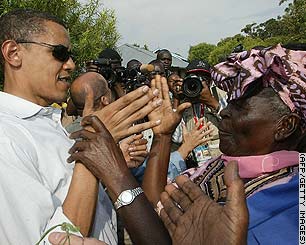
Obama does local

The White House has insisted President Barack Obama’s looming trip to Africa is long overdue and it will be a great ‘bang for the buck’.

The White House was, on Friday pushing back at concerns over the journey’s cost.

Ben Rhodes, a top foreign policy aide to Obama, admitted that the president, despite his Kenyan heritage, had focused far more on other regions, including Asia and Europe, than Africa, despite crucial US interests there.

“For the United States to say we’re a world leader except in this continent doesn’t make any sense,” said Rhodes, a deputy national security advisor.

“The US would be ceding its leadership position in the world if the president of the United States was not deeply engaged in Africa,” Rhodes said.

Obama is due to travel to Senegal, South Africa and Tanzania on a trip beginning at the end of this month for his first prolonged stay on the continent since taking office.

He has previously visited sub-Saharan Africa only once as president, with a short stay in Ghana in 2009.

Rebalancing
Rhodes noted that Obama had travelled multiple times to the Asia-Pacific region, as part of a rebalancing of US foreign policy there and had made many trips to Europe, so Africa needed some attention.

“Africa’s a critically important region of the world. We have huge interests there. You’ve got some of the fastest growing economies in Africa. You’ve got a massively growing youth population.

“You’ve got key security and counterterrorism issues that we work on with African countries,” he said, adding that key US interests in combating HIV/AIDS, and in supporting global health were also rooted in the continent.

“This is a deeply substantive trip and one that has been highly anticipated on the continent. Frankly, there’s been great disappointment that the president hasn’t travelled to Africa until this point other than a brief stop in Ghana.”

“The president is not going to retreat from an entire continent.”

The Washington Post reported on Thursday that plans for Obama to take a safari with his family in Tanzania had been cancelled due to budgetary concerns.

The newspaper, citing a Secret Service planning document, said the excursion would have required Obama’s counter-assault team to carry sniper rifles with high-caliber rounds that could neutralise cheetahs, lions or other animals.

Budget cuts
The paper said Obama’s Africa tour, his first since taking office in January 2009, could cost the US government between $60-million and $100-million, based on cost of similar trips in recent years.

The report comes as many government agencies struggle with mandatory budget cuts that took effect in March because US lawmakers failed to strike a wider budget deal.

Hundreds of Secret Service agents are dispatched for the president’s overseas visits along with dozens of vehicles, planes and other military and security assets.

The White House said that it was up to the Secret Service to determine costs and security needs for the US leader abroad – as was the case under former presidents George W. Bush and Clinton for instance.

Both Bush and Clinton undertook significant tours of Africa as president, requiring the vast security and logistical infrastructure that follows the US leader wherever he goes.

Rhodes, noting that other powers, including China, were seeking to increase their influence in Africa, portrayed Obama’s upcoming visit as a smart investment.

“There will be a great bang for our buck for being in Africa.

“When you travel to regions like Africa that don’t get a lot of presidential attention, you tend to have very long-standing and long-running impact from the visit.” – Sapa-AFP

‘American-style Stasi methods’

Markus Ferber

Germans are expressing outrage as details of a US internet spy program – revealed by a former CIA employee-turned-whistleblower – are prompting comparisons with that of former communist East Germany’s Ministry for State Security.

Unfortunately for Obama’s upcoming trip to Berlin, it was revealed that Germany ranks as the most-spied-on EU country by the US, a map of secret surveillance activities by the National Security Agency (NSA) shows.

German ministers are expressing their outrage over America’s sweeping intelligence-gathering leviathan, with one parliamentarian comparing US spying methods to that of the communist East Germany’s much-dreaded Ministry for State Security (Stasi).

Washington is using “American-style Stasi methods,” said Markus Ferber, a member of Chancellor Angela Merkel’s Bavarian sister party and member of the European Parliament.

“I thought this era had ended when the DDR fell,” he said, using the German acronym for the disposed German Democratic Republic.

Clearly, enthusiasm for the American leader’s upcoming visit will be much more tempered than it was in 2008 when 200,000 people packed around the Victory Column in central Berlin to hear Obama speak of a world that would be dramatically different from that of his hawkish Republican predecessor, George W. Bush.

Merkel will question Obama about the NSA program when he visits in Berlin on June 18, government spokesman Steffen Seibert told reporters on Monday. Some political analysts fear the issue will dampen a visit that was intended to commemorate US-German relations on the 50th anniversary of John F. Kennedy’s famous “Ich bin ein Berliner” speech.

One year into his second term, Barack Obama seems powerless to roll back the military and security apparatus bolted down by the Bush administration in the ‘War on Terror.’

One consequence of this failure of the Obama administration to reign in Bush-era excesses emerged last week when former National Security Agency employee Edward Snowden, 29, blew the whistle on a top-secret intelligence system named Prism, which collects data on individuals directly from the servers of the largest US telecommunications companies.

According to documents leaked to the Washington Post and Guardian newspapers, PRISM gave US intelligence agencies access to emails, internet chats and photographs from companies like Google, Facebook, Twitter, Verizon and Skype.

Justice Minister Sabine Leutheusser-Schnarrenberger said leaked reports that US intelligence services are able to track virtually all forms of Internet communication demanded an explanation.

“The more a society monitors, controls and observes its citizens, the less free it is,” she wrote in a guest editorial for Spiegel Online on Tuesday. “The suspicion of excessive surveillance of communication is so alarming that it cannot be ignored. For that reason, openness and clarification by the US administration itself is paramount at this point.” 

She has sent a letter to her “US counterpart Eric Holder” seeking clarification on the legal foundation of the PRISM program.

“I’ve observed with great concern reports about a possible program,”
Leutheusser-Schnarrenberger said in a statement emailed by her ministry in Berlin. “This may constitute massive access to telecommunications data without permission on a huge scale.”

All of the facts must be put on the table, the minister added.

Obama has defended the intelligence-gathering system as a “modest encroachment” that Americans should be willing to accept on behalf of security.

“You can’t have 100 per cent security and also then have 100 per cent privacy and zero inconvenience,” he said. “We’re going to have to make some choices as a society. There are trade-offs involved.”

The United States, however, is not legally restricted from eavesdropping on the communications of foreigners, meaning in theory that Washington could be listening to and collecting the private communications of individuals anywhere in the world.

Peter Schaar, Germany’s federal data protection commissioner, said the leaked intelligence was grounds for “massive concern” in Europe.

“The problem is that we Europeans are not protected from what appears to be a very comprehensive surveillance program,” he told the Handelsblatt newspaper. “Neither European nor German rules apply here, and American laws only protect Americans.”

Meanwhile, German opposition parties hope to gain from the scandal, especially with parliamentary elections approaching in September, and Merkel looking to win a third term.

“This looks to me like it could become one of the biggest data privacy scandals ever,” Greens leader Renate Kuenast told Reuters.

Obama is scheduled to hold talks and a news conference with Merkel on Wednesday followed by a speech in front of the Brandenburg Gate, the 18th triumphal arch that is one of Germany’s most recognizable landmarks. – RT

‘Intersex’ included on Australia’s new gender guidelines


The Australian government has announced new guidelines on gender recognition which state that individuals should be given the option of selecting “male”, “female” or “intersex” on their personal documents.

Attorney-General Mark Dreyfus said the new guidelines, which come into operation from July 1, will make it simpler for people to establish or change their sex or gender in personal records held by federal government departments and agencies.

“We recognise individuals may identify, and be recognised within the community, as a gender other than the gender they were assigned at birth or during infancy, or as an indeterminate gender,” Dreyfus said in a statement Thursday.

“This should be recognised and reflected in their personal records held by departments and agencies.”

The move comes after the Australian Human Rights Commission in 2009 recommended the government consider developing national guidelines concerning the collection of sex and gender information.

The new guidelines state that “where sex and/or gender information is collected and recorded in a personal record, individuals should be given the option to select M (male), F (female) or X (Indeterminate/Intersex/Unspecified)”.

They state that sex reassignment surgery and/or hormone therapy are not pre-requisites for the recognition of a change of gender in Australian government records.

When someone requests the sex on their personal record be changed, Dreyfus said the government would accept a statement from their doctor or psychologist, a valid Australian passport (which have allowed X under sex for several years), or a state or territory birth certificate or other document which shows their preferred gender status.

“Transgender and intersex people in Australia face many issues trying to ensure the gender status on their personal records matches the gender they live and how they are recognised by the community,” Dreyfus said.

“These guidelines will bring about a practical improvement in the everyday lives of transgender, intersex and gender diverse people.” – AFP

South Africa to return Gaddafi billions to new Libyan government

Muammar Gaddafi

An agreement has been reached on the repatriation of Libyan funds and assets from South Africa, the Treasury said on Thursday.

“The Minister of Finance, Pravin Gordhan, has agreed with the Libyan government that the repatriation from South Africa of Libyan funds and assets will be handled in terms of United Nations (UN) protocols,” it said in a statement.

The agreement was reached at a meeting between Gordhan and a Libyan government delegation on June 4. The Libyan delegation was led by Usama al Abid, the Minister in the Office of the Libyan prime minister.

“The decision was informed by the fact that the government of Libya established a single body in 2012 to co-ordinate the repatriation of assets to Libya,” Treasury said.

This body co-operated with the committee formed in terms of the UN Security Council Resolution 1970 (2011) and the panel of experts which co-ordinated repatriation to Libya of assets frozen in various countries.

In particular, the panel identified and monitored hidden assets of the Libya Investment Authority, the Libya Africa Investment Portfolio and the Libya Africa Investment Company, as well as the assets of individuals listed under the relevant UN Security Council resolutions. – Sapa

Namibian PM wants to close down ‘racist outposts’ after interracial brawl

Dr. Hage Geingob, prime minister of Namibia (ex-South West Africa)

Windhoek — The days are numbered for Buffalo’s bar in Gobabis, the latest flashpoint in an alleged racist attack, warned Prime Minister Dr Hage Geingob.

He said “undesirable establishments like Buffalo’s bar and similar places which are scattered all over the country,” should be closed down for being racist outposts. Geingob made the remarks on Tuesday in the National Assembly when he launched a strong denunciation of the alleged act of racism in which Levi Katire was allegedly assaulted by Nico Kotze and Frederick ‘Boeta’ du Plessis who now face charges of assault and racial discrimination.

“The heinous actions of a group of racist criminals in the town of Gobabis took the entire nation back to a dark past from which we have all so dearly wanted to emerge. It seems there are some people living within our borders who are intent on continuing the sinister legacy of racial discrimination and brutal violence of the past,” said the Prime Minister who joined the growing chorus of voices condemning the barbaric attack.

Geingob went on to say the two suspects are amongst a large number of “so-called Namibian citizens” who look upon the country’s policy of national reconciliation as a “policy of weakness”. The policy of national reconciliation was adopted to heal a nation, which was emerging from a dark history of racial discrimination, and to mitigate acts of revenge following the attainment of independence, Geingob said.

He condemned in the strongest terms the attack on Katire and promised that no stone would be left unturned until “we uproot and expose each and every one of these racist elements, who participated in this act of barbarism.” According to Geingob there are people who still think they can establish “pseudo republics and homelands” on the territory of an independent Namibia that courageously fought and triumphed over a discriminatory system.

He said it is high time that the government awakens racially intolerant individuals from “their absurd dreams and remind them that the apartheid republic is now nothing but a relic of psychosis”. He further warned that Namibia is a free and sovereign state and any individual who cannot comprehend that after 23 years should do him or herself a favour to “pack and go”.

“If you cannot pack yourself fast enough we will assist you. Make no mistake. The days are numbered for undesirable establishments like Buffalo’s bar and similar places which are scattered all over the country.”

He said so-called private establishments should be outlawed in public areas and implored the Attorney-General to find ways of closing down such places and to conduct a thorough investigation into the Gobabis incident.

“We need to identify the nationality of these perpetrators and if they are not Namibians, they should be shipped off immediately. I am aware that there is a criminal investigation which is ongoing, but we must ensure that a place such as Buffalo’s bar is permanently shut down,” he urged the Attorney-General.

The two men were denied bail on Friday in the Gobabis Magistrate’s Court and their quest to secure bail resumed on Wednesday and continues today. – New Era

Colombia sees troops join Arab mercenary force

Erik Prince

Colombia’s defense ministry is alarmed about an exodus of top soldiers to the United Arab Emirates to join a highly paid U.S.-led mercenary force organized by Erik Prince, billionaire founder of the security firm Blackwater.

Prince, who sold Blackwater in 2010 after it was involved in killings and scandals in Iraq, went to Abu Dhabi, capital of the Persian Gulf federation, in 2011.

He signed on to form an 800-man battalion of mercenaries for what emirati officials termed “anti-terrorism operations” inside and outside the country.

But it’s widely believed in Gulf security circles the force, being assembled under considerable secrecy by Prince’s Reflex Responses registered in the emirates, will be used for undisclosed special operations for the seven desert emirates that make up the federation.

That’s expected to include putting down “internal unrest” that might challenge the ruling families, as happened in Egypt, Libya, Tunisia and Yemen, and which is growing in Kuwait and Bahrain.

The Reflex Responses force, which is officially described in a contract leaked to the New York Times in 2011 as “independent of formal command and support structures throughout the United Arab Emirates,” will have its own air wing, with fixed wing aircraft and helicopters, plus its own private navy.

The naval wing’s tasks will primarily be “small boat operations … maritime interdiction operations and securing oil delivery platforms.”

The mercenaries have a custom-built high-security base in the desert where troops live and train.

U.S. military analyst Spencer Ackerman says Prince’s new project “might run afoul of U.S. laws prohibiting citizens from training foreign militaries,” which requires a government license. The State Department has not said whether Reflex Responses has one.

But it’s unlikely that Prince, who sold off Blackwater amid a blizzard of adverse publicity over his men’s excesses in Iraq where the company was accused of wantonly killing civilians, would embark on this new project without making sure he wasn’t open to legal action, particularly if he found himself having to send troops to fight Muslims seeking sweeping democratic reform from rulers who are U.S. allies.

The Sunni Muslim Arab monarchies of the gulf are increasingly concerned about their future amid the political upheaval and conflict sweeping the Arab world, fueled, they claim, by Shiite Iran.

The emirates currently are trying 94 citizens for sedition and seeking to overthrow the political system. The defendants, including two prominent human rights lawyers, face a possible 15 years in prison.

But the over-riding security threat is widely perceived to be Iran, 100 miles across the gulf and which occupies several islands claimed by the Emirates.

Prince’s mercenary force is made up largely of Colombian soldiers, including senior officers and men with a Special Forces background

There are also many veterans of Executive Outcomes, a South African security firm that became notorious in the 1990s for suppressing rebellions in mineral-rich African dictatorships and staging coups to gain control of such assets.

EO personnel included many veterans of Britain’s Special Air Service and special operations units in South Africa’s apartheid-era military.

Prince, an ex-U.S. Navy SEAL, is setting up his new force under a reputed $529 million contract with the royal family of oil-rich Abu Dhabi, the emirates’ leader and economic powerhouse. The contract expires in 2015.

Analysts say soldiers from Colombia’s 450,000-strong U.S.-trained military are held in high regard in the emirates and other gulf states because of their combat experience fighting leftist guerrillas and because they’re not as expensive as Western veterans.

Colombian officials estimate 500 soldiers, including pilots of Black Hawk helicopters widely used in special operations, have gone to join Prince’s force, where they earn $3,000 a month against $600 back home.

Bogota has complained to Abu Dhabi to stop hiring its best soldiers, so far without any apparent result.

“These are soldiers with a lot of experience, and it took a great effort to train them,” Jorge Bedoya,Colombia’s deputy defense minister, told The Financial Times.

The gulf monarchies are used to paying foreigners to do their dirty work. They have traditionally hired foreigners, mainly Pakistanis and Baluchis, to stiffen their armed forces. – UPI