Russia to conduct anti-nuclear observer flight over Spain

antonov30BA group of Russian inspectors will fly an observation mission over Spain within the framework of the Treaty on Open Skies, the head of the National Nuclear Threat Reduction Center, Sergei Ryzhkov, told Tass on Saturday. The flight will be made on an Antonov-30B observation aircraft, he said.

“The observation flight will be made between March 16 and 22 from ‘Open Skies’ Getafe Airfield with a maximum range of up to 1,800 kilometers,” he added. Observation flights are made to promote bigger openness and transparency in the military activity of the states participants in the treaty, as well as to strengthen security through confidence building.

According to Ryzhkov, the Russian plane will make its flight on the itinerary coordinated with Spain, while Spanish specialists on board will control the use of the observation equipment and compliance with treaty provisions.

“This is the fourth observation flight of Russian inspectors over countries signatories to the treaty in 2014,” he noted. The Open Skies Treaty was signed in 1992, and brings together 34 countries. Observation flights are made over Russia, the United States, Canada and European countries. The main aims of the Open Skies are growth of transparency, control over the implementation of agreements on arms control, broader possibilities of crisis prevention and settlement of crisis situations within the framework of the Organization for Security and Co-operation in Europe and other international organizations.

Source: Voice of Russia

International observer in Crimea receives death threats

Johan Bäckman
Johan Bäckman

An international observer from Finland, who sees the referendum on the status of Crimea as absolutely legitimate, has received death threats.

A referendum is due to be held in Crimea on the status of the peninsula tomorrow, on Sunday, March 16, so on Saturday, any campaigning is banned there. An ad-hoc commission is due to see to it that this is strictly observed.

Meanwhile, an international monitor from Finland, Johan Bäckman, has complained at Simferopol airport of pressure that has been brought to bear on him and his colleagues, and also said he’d received death threats, because he supports the referendum.

“It’s all threats and slander. I received a letter with death threats earlier today”, Bäckman said. “The letter is anonymous. The Western media are full of aggression against Russia. I can’t really make out the position of the West that the referendum is allegedly in breach of international law”.

He said the residents of Crimea have every right to determine their future. The US and the European Union are bending every effort to have the referendum cancelled, and are threatening with sanctions. That the EU is considering sanctions is absolutely absurd.

Bäckman said the attempts of western politicians to stop or cancel the referendum are prompted by their desire to downgrade Russia’s authority.

The All-Crimea plebiscite is due on Sunday from 8 a.m. to 8 p.m. local time. The minimum voter turnout to consider the referendum valid is 50%. International observers keep arriving in Crimea to monitor the plebiscite.The international observer stressed that he sees the referendum on the status of Crimea as absolutely legitimate.

The situation in Crimea is calm, Deputy of the Belgian parliament Frank Creelman, who arrived to monitor the referendum to be held on March 16, said on Saturday. Everything is very calm and normal, absolutely not the way it is being pictures abroad, he said.

There are many pro-Russian people among residents and many law enforcement officers are at streets, Creelman said.

Creelman said he intended to monitor the referendum on the status of Crimea not just in Simferopol but in relatively small Crimean settlements as well.

The former Republican congressman and three-time presidential candidate Ron Paul has launched a scathing attack on what he calls a US-backed coup in Ukraine, insisting the Crimean people have the right to align their territory with Moscow and characterising sanctions against Russia as “an act of war”.

“The evidence is pretty clear that the NGOs [non-governmental organisations] financed by our government have been agitating with billions of dollars, trying to get that government changed,” he said. “Our [American] hands are not clean.”

Voice of Russia, Interfax, Life News, The Guardian

Second US drone intercepted over Crimea

mq5b_g2mAn American scout-attack drone was intercepted in the Crimean sky, the Rostec state corporation reports. “Judging by side marking, the MQ-5B drone was part of the 66th US brigade of military intelligence with the main location in Bavaria,” the report on the website of the corporation reads.

According to the report, at the beginning of March, the American brigade was relocated to the Ukrainian Kirovohrad, from where drones commit reconnaissance raids in the direction of Crimea and Russian border areas.

Earlier, they reportedly appeared in the Kherson region, in the area of the Crimean roadblock Chongar.

The 66th Military Intelligence Brigade is a United States Army brigade, subordinate to United States Army Intelligence and Security Command and based at Wiesbaden Army Airfield, Wiesbaden, Germany. After years of history as a counter intelligence/intelligence group with headquarters in Munich and geographically dispersed detachments, it became a brigade on 16 October 1986, but was inactivated in July 1995. Reformed again as an intelligence group in 2002, it became a brigade again in 2008.

The unit’s mission is to provide intelligence support to U.S. Army Europe and U.S. Army Africa.

Part of the 66th Military Intelligence Brigade supports near real-time missions for deployed soldiers such as operations in Afghanistan and also Iraq.

“According to some data, the American reconnaissance brigade had 18 MQ-5B drones in its arsenal. This is the second time the American UAV is intercepted over Crimea,” the report says.

“The drone was at the height of about 4 thousand meters and was practically invisible from the earth. It was possible to break the drone’s link with its American operators with the help of the EW (electronic warfare) complex Avtobaza. As a result, the device made an emergency landing and passed into the possession of the self-defense forces almost unbroken,” the report says.

Ten years ago a German drone nearly collided with a passenger plane over Afghanistan. The classified drone camera footage drew public attention after the German defense ministry scrapped a drone program for its lack of anti-collision technology.

Footage taken by an EMT Luna X-2000 reconnaissance drone as it passed mere meters under the left wing of an Airbus A300 passenger plane surfaced on YouTube several years ago. After the encounter, the drone was caught in the plane’s wake turbulence, lost control, and crashed over the Afghan capital Kabul, Der Spiegel reported.

The Ariana Afghan Airlines plane was carrying about 100 people on board, the magazine said. The manufacturer of the 40kg drone has claimed that the near-collision occurred after the passenger jet veered off-course without informing ground control.

The video was leaked a week after German Defense Minister Thomas de Maizière decided to scrap the $652 million EuroHawk program meant to be a replacement for existing reconnaissance aircraft. EuroHawk is part of the NATO Global Hawk project.

Local German communities have expressed apprehension about US drones being in German airspace. Germans are concerned about potential violation of their freedoms after the drones come into operation. The recent scandal surrounding NSA spying activities in Germany and the protests that followed, has heightened public skepticism.

“It’s a big issue here in general, and it’s a very German topic,” Constanze Schulze, a reporter for ARD Bavaria stated. “There are many discussions going on about unmanned units, and of course there is some concern. I think that’s why you see so many reporters here. Everyone is talking about it.”

Politicians have also expressed concerns. Reinhold Strobl of the Social Democratic Party of Germany (SDP) said that the public was informed “too late” and that there was “inadequate” information provided by the German authorities and US military ahead of the deployment. If it was not for test flights conducted in July, the politician says, Germans would have been left completely in the dark.

Richard Reisinger from the Christian Social Union Party (CSU) also said that the way the public was informed about the issue lacked transparency. “What happens to the collected data?” he asks, expressing concern of potential risk of information misuse.

Source: Voice of Russia/BBC/RT

Paris as polluted as Beijing

parispollutedPublic transport will be free from Friday until Sunday evening in Paris as the authorities try to encourage drivers to leave their cars at home, as much of France suffers severe air pollution caused by unusually warm weather.

The French capital and 30 other regions of France have been on maximum pollution alert for several days, with conditions set to continue until the end of the weekend.

The European Environment Agency says the pollution is the worst since 2007, and almost three-quarters of France is affected.

The air pollution has also affected neighboring Belgium where authorities have introduced a maximum speed limit to reduce the concentration of polluting particles. Free public transport has also been introduced in Belgium’s southern Wallonia region.

Jean-Paul Huchon, head of the STIF organization that manages Paris’s complex transport network, said that public transport would be free from Friday morning until Sunday evening.

“I am asking all residents in Paris and neighboring areas to favor the use of public transport,” Huchon said.

Subways, buses and trains will be free, as will bike-shares and one-hour sessions in electric cars.

The cities of Caen, Reims and Rouen, all in northern France, are following Paris’s lead and also offering free transport.

As air quality dipped Thursday to the same as Beijing, Ecology Minister Philippe Martin admitted that air quality was “an emergency and a priority for the government.”

A lack of wind and cold nights followed by balmy days have conspired to create conditions where polluting particles, most of them emitted by vehicle exhaust fumes, have been stuck under a warm layer of air.

Monitoring centers have been reporting a particularly strong concentration of so-called PM10 particles, which have a diameter of less than 10 microns.

Pollution alerts in France are issued when these PM10 particles reach 80 micrograms per cubic meter.

These tiny particles are also some of the most dangerous to public health and can cause asthma, allergies and other respiratory ailments.

Source: RT

‘Kosovo gives Crimea right to self-determination’

Gregor Gysi
Gregor Gysi

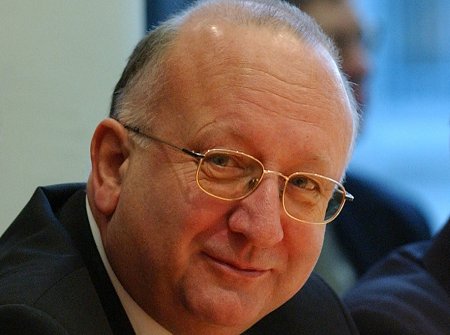
The recognition of Kosovo independence set a precedent that gives Crimeans, as well as Basques and Catalans, a right for self-determination, German opposition leader said, lashing out against Angela Merkel’s support of sanctions against Russia.

Gregor Gysi, a parliamentary head of the largest lower-house opposition party in Germany has spoken out on Thursday against German Chancellor’s unquestioning support of the coup-appointed Ukrainian government.

“They formed a new government….. Immediately recognized by president Obama by the EU and German government as well. Miss Merkel! The vice-prime minister, the defense minister, minister of agriculture, environment minister, the attorney general.. They are fascists!” he stated.

Gysi said that NATO opened Pandora’s Box by recognising the unilaterally proclaimed independence of Kosovo and that Crimea’s secession from Ukraine applies the same pattern of international law.

“With Kosovo, they opened Pandora’s box. What’s allowed for Kosovo, you should also allow for others. I told you this but you haven’t listened to me. Winning the Cold War has eclipsed everything for you, you forgot about everything else,” Gysi said.

“The Basques are asking why can’t they make their choice, whether they want to stay within Spain or not? Catalonians are asking, why can’t they decide whether they want to belong to Spain or not. Of course people living in Crimea are asking the same thing.”

“I think that Crimea breaking away from Ukraine is just the same as Kosovo. I knew Putin would use this argument, and he did,” the politician said. “It must be found, such status for the Crimea, which will be acceptable for Ukraine, Russia, and us.”

Gysi also commented on NATO’s expansion to the east and called on the German government and the West to acknowledge the “legitimate security interests of Russia.”

“When we restored Germany’s unity, the US, German and other foreign ministers proclaimed there will be no NATO expansion to the east. But this promise has been broken. There was an expansion of NATO in Russia’s direction,” said Gregor Gysi in an outburst directed at Merkel.

“Security in Europe, there are neither without nor against Russia, but with Russia. When the crisis is over one day, an advantage could be that international law is finally respected again from all sides,” Gysi concluded.

Right before Gysi’s emphatic statement Chancellor Angela Merkel addressed German MPs, expressing her support of imposing sanctions and warning Russia that it risks “massive political and economic consequences” if it sticks to its position on Ukraine.

Russia has repeatedly said it considers the actions of Crimean authorities reasonable and legal, and will respect the results of the referendum.

Source: RT

US definitely wants war in Ukraine

It’s about to get much worse

Dr. Paul Craig Roberts talks to Greg Hunter’s USAWatchdog.com

Former Assistant Treasury Secretary Dr. Paul Craig Roberts thinks the Neoconservatives in the U.S. government want war in Ukraine. Dr. Roberts says, “They definitely want war, of course. They’ve wanted it ever since Reagan was President. The Neocons were always saying we have to attack the Soviet Union, and Reagan said we are not going to win anything, we are going to end it. The Neocons got to where they really disliked Reagan because he wouldn’t take advantage of Soviet weakness to attack them. So, they are war minded. They produce documents that say nuclear war is winnable. So, they are basically crazy people; and, yet, they have determined the course of foreign policy since the Clinton Administration. Under George Bush, they controlled the show; and today, under Obama, the Neoconservatives control it.”

Some say the U.S. wants war so they have something to blame the fall of the U.S. economy. Not so, says Dr. Roberts, “They (Neocons) have been very clear about their ideology of American hegemony over the world. It’s like Adolf Hitler all over again. You know, the Germans are the chosen people and have the right to override others. Neoconservatives don’t use the Nazi language. Instead, we’re (Neocons) said to be the ‘exceptional’ people, the ‘indispensable country.’ They use these adjectives to elevate the United States above law, its own law and international law. So, it’s alright if we commit war crimes with naked aggression. It’s alright if we torture. It’s alright if we kidnap people in foreign countries and take them to other foreign countries. This is all just part of America achieving hegemony. Notice the way we achieve it is not by argument or reason or persuasion or anything like that. It’s by force.”

Roberts goes on to say, “So, why is Ukraine important? Well, there is the Black Sea naval base that Russia has there. They have a lease on it until 2042. You have Eastern Ukraine, which is former Soviet military industrial complex . . . for Washington, they say, look we can really bring a serious strategic threat to Russia here. We can devalue their nuclear deterrent by putting anti-nuclear bases in Ukraine on their border. So, when we put pressure on them, they have to think much harder when they stand up to us because we will have the upper hand. . . . So, that’s the real reason for what they are doing. There are other economic reasons. They want to get their hands on Ukraine. They want to loot it.”

On the economy, and if we are headed for another crash, Dr. Roberts says, “I think what we are headed for is continuous sinking. How fast it would be? I don’t know. Everyone’s running out of savings. People have been living off their savings for 5 years. For example, the elderly don’t get any interest income. So, what people are doing is spending down their capital to maintain their lives. As this capital is spent down, there is nothing left to spend. So, consumer spending and retail spending just gradually fall and fall. I don’t think there is going to be a sudden collapse, but there could be a sudden collapse because of all the money the Fed is pumping into the system. This is inconsistent with the dollar’s value and the dollar being the reserve currency.”

On gold, Dr. Roberts says, “To protect the dollar from Quantitative Easing (QE), the Fed is selling naked shorts in the gold market to keep the gold price from rising so rapidly that it exposes the worthlessness of the dollar. . . . The physical stock of gold in the West to meet delivery demand is diminishing rapidly. So, one day the Chinese will buy 100 tons of gold, and we won’t be able to make delivery. That would crash the system. It would just pop. So, there are things that could crash it suddenly. Regardless . . . the economy is going to gradually sink because there are no jobs, or no good jobs. . . So, there is not a recovery. The U.S. is a busted state. It’s completely busted.”

On the Federal Reserve money printing to prop up the economy, Dr. Roberts, who has a PhD in economics, contends, “I think they realize all the money printing does undermine the dollar, and if they lose the dollar, the game is over. So, they have to protect the dollar.” But what happens if the economy falls hard? Will they crank back up QE? Roberts says, “Suppose the economy does move down fairly fast, then all the pressure will be on them to support the economy. Given the stupidity of the media and stupidity of economists and the stupidity of Congress, supporting the economy will mean more QE. If it gets really bad, you could see the Fed cave in and start printing more money . . . at some point, it’s going to cost them the dollar.”

Ukrainian putschists can’t send army to Crimea

Willy Wimmer
Willy Wimmer

Ukraine’s acting president said the country could not use its army alone to stop Crimea from seceding, the latest sign that Crimean independence may be imminent.

Oleksandr Turchynov’s comments came after the Crimean parliament voted for independence ahead of a Sunday referendum on joining Russia, while Washington and Moscow engaged in one of the fiercest clashes since the Cold War.

The interim leader of Ukraine’s putschists said intervening in the Black Sea peninsula, where Crimeans have seized de facto control, would leave Ukraine exposed on its eastern border, close to Russia.

“We cannot launch a military operation in Crimea, as we would expose the eastern border and Ukraine would not be protected,” Turchynov told AFP.

Willy Wimmer, former vice president of the Organization for Security and Co-operation in Europe (OSCE) and state secretary at the German Defense Ministry, said the Black Sea territory might end up under US domination.

The veteran German politician warned more than a decade ago that NATO’s bombing of Yugoslavia was actually part of a US expansion plan.

Until the mid-90s however, all major powers agreed in international law, and in cooperation. But in the middle of the 90s, the US changed tack. They clearly no longer feel bound by international law.

The war in Yugoslavia was only the beginning, and since then, Afghanistan, Iraq, Syria, Libya, have shown that the US would rather rely on military power.

Wimmer said the current government in the Ukraine is not legitimate. “I think it was a putsch, a coup d’état, what happened in Kiev. And what we heard in the news before, the OSCE and other international bodies are doing what they can to create a legal framework for a government which is not legal at all.”

Wimmer said the US puppets in Ukraine are co-operating with Nazi groups, a punishable offence in Germany and other European countries. Many ban all elements associated with Nazism, including Nazi symbols. The coup in Ukraine have left many Europeans fearful of what the US might plan next.

At a political rally in Bavaria this week the main speaker addressed the audience with an appeal not to forget the friendship with the Russian people.

Remember Chernobyl?

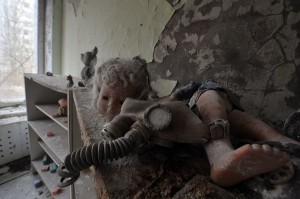
chernobyl09The 1986 Ukrainian nuclear disaster of Chernobyl was in nuclear weapons-equivalent terms a very large-sized nuclear device, probably releasing 130 kilograms of very highly enriched uranium and plutonium, as well as other long-lived deadly nuclides.

In very approximate terms this was equivalent to about 15 times the radiological inventory of the 1945 Hirsoshima A-bomb. Economic damage to date from the Chernobyl disaster which requires a 2827 square kilometer total exclusion zone, is variously estimated at $350 – $500 billion, with at least 30 000 fatalities to date across Europe.

Despite the Ukraine having known, proven and published natural gas reserves able to cover about 185 years of national gas consumption, for conventional gas reserves, and about 600 years when probable unconventional gas reserves are included, the country was designated by the Soviet Union as needing intensive development of nuclear power. From the late 1960s, nuclear power was developed on a massive basis.

As of 2009, according to the World Nuclear Association, total electricity production was about 50% nuclear and this nuclear supply amounted to about 87 billion kWh. Only 20% of Ukraine’s power supply was gas-based, with 4 billion kWh net exported. Ukraine’s hydropower resources, which have been treated like gas as “poor cousins”, but are large, contributed about 9.3% of electricity generation in 2009, according to the WNA.

All of Ukraine’s remaining 15 civil-type reactors still in service are Russian VVER types, two being 440 MW models, and the other 13 larger 1000 MW units. All of these reactors are potentially “dual use”, due to their original format – exactly like US Westinghouse industry standard 900 MW reactors – derived from Soviet nuclear submarine and nuclear ship reactor models, the design requirements of which demand very high power densities without consideration of plutonium production during their service lifetimes, or the reprocessing of “reactor core pollutants”. Being semi-military design, spunoff plutonium was regarded as a bonus rather than handicap.

The original Soviet design lifetime for VVER reactors was 30 years. The more-dangerous or “naked reactor” Soviet design format, called RBMK, as used at Chernobyl, have since 1997 all been closed down in the Ukraine, but not fully decommissioned.

As many as 15 new reactors of around 1000 MW capacity each with much higher safety standards were “proposed and part funded” in a 2006 Ukrainian energy plan, but none of these reactors were ever completed, although some are in part-completed condition. Significantly, reactor development strategies published by Ukraine’s Energoatom, the state semi-private atomic energy corporation, envisage the possible replacement of unfinished PWR-type reactors by Canadian CANDU heavy water reactors – the type utilized by both Pakistan and India to “brew” sufficient weapons grade plutonium to clandestinely produce their atomic weapons. Reasons for possibly using CANDU reactors notably included the ability of these reactors to operate on the low-clarke or low quality of uranium ore reserves in Ukraine.

Since independence from the USSR in 1991 attempts were made to “close the nuclear fuel cycle”, that is to fund, build and operate nuclear fuel reprocessing facilities and long-term nuclear waste disposal facilities, rather than continue simply storing used fuel rods and nuclear wastes on site – as at Fukushima. This failed civil-sector attempt to reduce the very large residual nuclear pollution resulting from the Chernobyl disaster (1986) and accumulated “temporary measures” for used fuel rod and waste disposal, has been joined by explicitly military-nuclear attempts at reducing the quantities of weapons-capable nuclear material in Ukraine.

In 2013, a four-year Ukraine-NATO project started with the aim of cleaning up radioactive waste at 9 military facilities in the country, with a 25 million euro budget.

Collected and regrouped wastes were scheduled to be buried in the Chernobyl total exclusion zone. Since 2011, very high-level military nuclear wastes originating in Ukraine are scheduled to be “repatriated” to Russia, for burial in Russia’s central dry storage facility. This program which was never funded is now evidently on hold, since late February 2014

A new facility for treatment solid radioactive waste is under construction at the site of Zaporozhe nuclear power plant, to be commissioned in 2015. It will be fitted with a state-of-the-art nuclear waste incinerator of Danish design but this program has suffered from lack of political commitment inside the country, and lack of funding from EU sources. The completion date is only “indicative” and the program is also now on hold.

The Nuclear Threat Initiative (NTI), and its linked World Institute for Nuclear Security (WINS) has tracked the heavily-funded but semi-secret US-Russian Cooperative Threat Reduction project started in 1991 and aimed at repatriating thousands of nuclear warheads and military-nuclear materials, both short-range and long-range, that the USSR had spread between Russia, Belarus, Ukraine and Kazakhstan. While Belarus and Kazakhstan agreed in short order to give up their nuclear weapons, Ukraine initially refused.

In 1992, however, the Ukrainian government recognized it lacked both the resources and the technical know-how to maintain its status as a nuclear-armed nation, and its “inherited” nuclear weapons were literally two-edged swords. It then engaged to repatriate its entire stock – but also demanded financial compensation terms that Russia refused. As cited in interview with Associated Press, former Ukrainian president Leonid Kravchuk said that Russia “….threatened us with all kinds of economic sanctions, they wanted to get this issue over with fast”.

The financial haggling with Ukraine has continued although it is denied or qualified as unimportant by both sides, and by US observers. The haggling led to Russian general Alexander Lebed, in 1997, stating that Ukraine’s military was unable to account for dozens of “compact” or small-sized short-range nuclear devices.

The general gave differing figures regarding the count of lost or stolen weapons, but the Kremlin dismissed his allegations. Leading US politicians cited by NTI claim that the simple absence of “no nuclear detonations by terrorists or organized crime” is the proof that Lebed was being too pessimistic and the program has worked.

Ukraine is therefore a deadly storehouse of dangerous reactors, including the crippled Chernobyl reactor which as yet, to date, does not have a final entombment sarcophage.

Nuclear wastes, in Ukraine, are widely dispersed and poorly accounted for. The country could or might have a certain number of operational or repairable smaller-sized nuclear warheads, the radioactive materials of which also makes them prime assets for the production of “dirty bombs”, that is non-explosive nuclear waste-dispersing weapons.

This is serious business, so Washington’s diplomatic suicide-run to derail nuclear cooperation with Russia through START should raise alarms for anyone genuinely concerned about moving the globe towards a peaceful future.

Source: 21stcenturywire.com

Immigrants drown after Spain fires rubber bullets

spainimmigrantsThe European Commission wants Spain to account for the drowning of 14 migrants who recently failed to swim to Ceuta, a Spanish enclave in North Africa. Spain earlier admitted that rubber bullets were fired at them, but claimed no one was injured.

“The commission will be requesting explanations from the Spanish authorities on these events,” EU Home Affairs spokesperson Michele Cercone said, adding that the commission has a right to act if there’s evidence that a member state has violated EU laws.

On Thursday, Spanish Interior Minister Jorge Fernandez Diaz admitted that local border police, in an effort to turn back around 200 migrants who tried to cross the frontier between Morocco and Spain’s Ceuta on February 6, had indeed fired rubber bullets at them.

While some tried to cross on land, at least fourteen migrants drowned in the Mediterranean trying to swim around a man-made breakwater that separates Moroccan and Spanish waters. Spanish police say they are still searching for more victims.

According to the Spanish Interior Minister, the rubber bullets were fired at a distance of 25 meters to deter people from entering Spain while they were in the water. Diaz told a parliamentary commission that the shots were never intended to hit the migrants, whose behavior he described as aggressive. Spanish police posted online video footage of migrants throwing stones at the border fence. The footage didn’t show what had happened when some of them tried to swim around to Spanish land, however. Ceuta, on the north coast of Africa across the Strait of Gibraltar on the Mediterranean Sea, has a population of about 83,000.

According to the online newspaper EUObserver, 23 people managed to make it to Ceuta’s El Tarajal beach, but were immediately turned over to Moroccan authorities. Under European asylum and migration law, anyone who steps foot on member states’ territory is eligible to have their asylum request reviewed before being deported. Although Spanish Interior Minister admitted a group of migrants made it to the beach, Diaz said the group did not enter Spanish territory, since they allegedly never made it past the line of waiting border guards.

Meanwhile, the EU Commissioner for Home Affairs Cecilia Malmstrom said she was “very concerned about Spanish police using rubber bullets to deter migrants.”

“I expect clarifications from the authorities,” Cecilia Malmstrom wrote on her Twitter account.

Spain’s interior minister has admitted police should not have fired rubber bullets at migrants trying to reach Ceuta last month.

Jorge Fernandez Diaz said that rubber bullets were unlikely to deter migrants from the country’s North African enclave.

At least 15 migrants drowned on February 6 as hundreds tried to swim to Ceuta from Morocco.

MANPADS stolen from Ukraine’s military depots

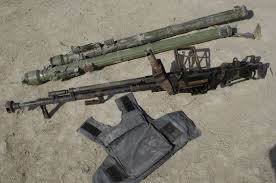
manpads2Several, maybe even a few dozen ‘Igla’ man-portable air-defense systems (MANPADS) were stolen from Ukraine’s military depots during the incidents in this country, a senior Ukrainian military man told RIA Novosti.

The lack MANPADS was particularly registered at the 80th separate airmobile regiment, where there were 54 sets of such systems and at the 27th separate mobile brigade, stationed 45 kilometres from Lviv city, where there were 90 MANPADS, according to the information.

The new leadership of Ukraine’s Defense Ministry is taking urgent measures to “disguise this difficult situation” with old and experimental MANPADS, according to the source.

‘Igla’ man-portable air defense missile system is an extremely dangerous weapon designed to destroy low-flying air targets, so its dissemination is regulated by several international agreements, in particular by the agreements between Russia and the U.S. Such a weapon getting into the terrorists’ hands is extremely dangerous.

In autumn 2012, it was reported that a large consignment of MANPADS was stolen from a military base in Benghazi in Libya, where Muammar Gaddafi’s regime was deposed as a result of an armed conflict.

Later, it was reported that the MANPADS could have also got into the hands of rebels fighting in Syria.

Source: RIA Novosti

A bad START

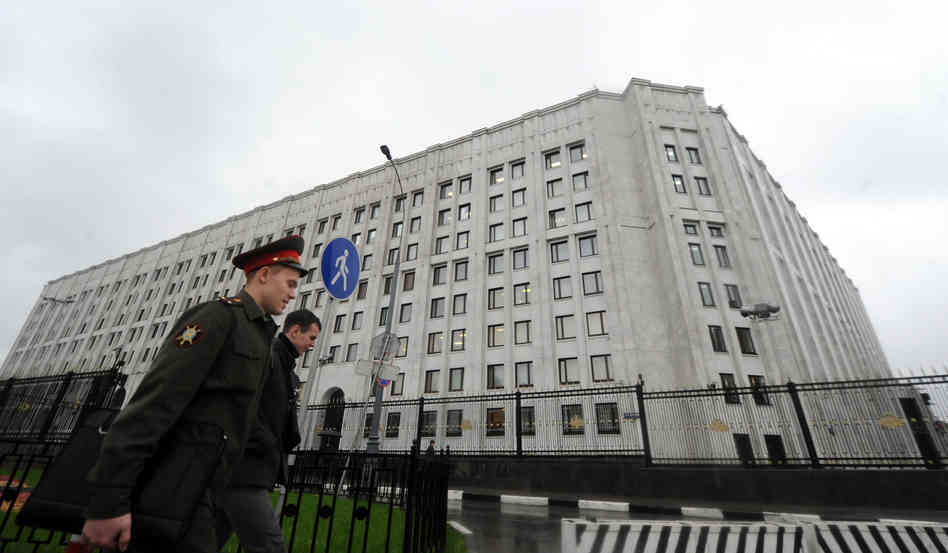
defenceThe Russian Defence Ministry will stop receiving foreign inspectors under the New START Treaty and the Vienna Document of 2011, a highly-placed source in the ministry told ITAR-TASS on Saturday, March 8.

“We are ready to take this step in reply to the Pentagon’s statement on the suspension of cooperation between the defence ministries of Russia and the United States,” he said.

“Since such inspections are a confidence-building measure, there can be no normal regular bilateral contacts on compliance with the treaty now that the U.S. has basically announced ‘sanctions’,” the source said. “We take the unjustified U.S. and NATO threats against Russia over its policy with regard to Ukraine as an unfriendly gesture that allows us to declare force majeure,” he added.

New START that entered into force on February 5, 2011 allows each country to have 1,500 deployed warheads and 700 intercontinental ballistic missiles, sea-based ICBMs and bombers on combat duty.

The new START Treaty was signed by President Obama and then Russian President Dmitry Medvedev in Prague on April 8, 2011. The previous Strategic Arms Reduction Treaty (START) expired on December 5, 2009.

The main instrument for mutual control over compliance with the treaty is inspections, during which inspectors have to confirm the declared number of strategic offensive weapons.

The Vienna Document on Confidence and Security-Building Measures and Disarmament in Europe was adopted by the Organisation for Security and Cooperation in Europe (OSCE) in November 2011. It calls for inspections of specific areas and units in order to oversee military activities and make annual assessments of information provided by each member state. The U.S. is a member of the OSCE since 1973, Russia since 1992.

Source: ITAR-TASS

‘Security at Ukraine’s nuclear plants unreliable’

Rosatom, or the Russian Federal Atomic Energy Agency, has asked the IAEA to check the security and safety of Ukraine’s nuclear power plants. This was reported by Deputy Russian Prime Minister Dmitry Rogozin, who briefed President Vladimir Putin on Rosatom’s plans. Given that the political and economic situation in Ukraine is absolutely unstable, security and safe operation of NPPs in Ukraine is becoming both a domestic and international problem.

Today Ukraine has 15 operational power-generating units at four nuclear power plants and four shutdown units at the Chernobyl nuclear plant. The plants are operating in standard mode, but there is every reason to suspect that security officers are unreliable, Dmitry Rogozin says. Extremists invariably grow interested in facilities like that amid anarchy and chaos, to resort to blackmail for political purposes.

Besides, there have been problems recently around the transportation of nuclear fuel from Russia to Eastern Europe via Ukraine. Nor has Russia been supplying Ukraine with that fuel. The reserves that Ukraine currently has will last it for no more than a month. The situation that’s taken shape poses both a physical threat to Ukraine proper (due to likely acts of sabotage) and threatens Russia with economic risks. Ukraine may also have its energy balance upset. This is a dangerous factor, a nuclear expert Igor Ostretsov says, and elaborates.

Nuclear power production in Ukraine, Igor Ostretsov says, is of paramount importance, given that Ukraine is the world’s second-biggest nuclear power generator. Ukraine has the Rovno and Khmelnitsky nuclear power plants (four and two power generating units respectively), with the most powerful unit located at the Zaporozhe nuclear plant. In other words, Ukraine depends a lot on nuclear power production. But it’s become dangerous to run nuclear power plants in the current situation in Ukraine, above all, in the west of the country. But then, ending nuclear power generation abruptly would cause horrific consequences.

Today it is private security firms, Interior Ministry and National Security Service units that guarantee security along the perimeter of the facilities. But the security problem has become one of crucial importance, given the current anarchy and chaos in Ukraine.

This is what Deputy Head of the Duma Committee for Natural Resources, Management of Nature and Ecology, Maxim Shingarkin, said in this context in an interview with the Voice of Russia.

Today it is important in terms of ensuring security of nuclear facilities, Maxim Shingarkin says, not only to abide by energy production safety standards, but also to protect nuclear power plants as hazardous facilities. Acts of sabotage against nuclear power plants, above all, if nuclear reactors are operational there, will have unpredictable consequences. To prevent the nuclear fuel from exploding, the reactor, the plant perimeter and the power supply system should be effectively protected.

Maxim Shingarkin adds that the means of protection that Ukraine has been using to that end, namely armed security officers and covert observation cameras are clearly insufficient to guarantee security to sensitive survival facilities in a crisis situation. International practice shows that if the situation around nuclear power plants is aggravated, these plants should be protected by specially trained units. But it’s a big question whether such units are battle-worthy or available at all in Ukraine today.

Source: Voice of Russia

German economist warns sanctions against Russia could harm EU

Economic sanctions against Russia would cause serious damage to Germany’s switch to alternative energy sources, the head of the German Economic Research Institute, Hans-Werner Sinn, said in an interview published in Germany’s Passauer Neue Presse on Friday.

Germany cannot afford such a policy of sanctions, as it considerably depends on Russian gas supply in the process of switching to alternative energy sources, the economist notes. According to him, EU sanctions will only harm the European countries.

Any attempt to bring such countries as Ukraine out of Russia’s influence and link with the West is naive, he believes.

Russia, along with Norway, is an important supplier of gas to Germany, the publication notes.

Source: Voice of Russia, Interfax

Russia surprised at EU refusal to comment on new leak

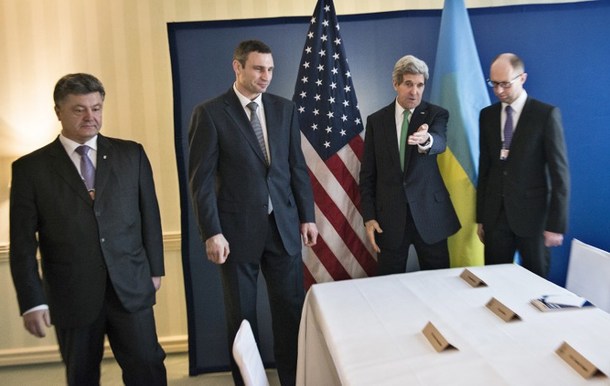
Kerry directing the script with Poroshenko, Klitch and Yats

Russian Foreign Ministry has expressed its surprise at the EU refusal to comment on the leaked phone conversation between the EU Foreign Policy Chief Catherine Ashton and Estonian Foreign Minister Urmas Paet. Earlier the Estonian Foreign Ministry confirmed the authenticity of the recording that suggested the snipers who shot at protesters and police in the Ukrainian capital Kiev were allegedly hired by the new coalition, and not ousted President Yanukovich. The Voice of Russia’s political analyst Dmitriy Babich expressed his opinion.

How can you comment on this conversation?
I think it is just astounding what Mr. Paet had to say because basically the Western press has been saying for all these days that the file only came from the government side and it was taken as an axiom by most of the media in the West. And now we find out from Mr. Paet who talked to some opposition activists of the civil society actually. So they acknowledged that the bullets and the weapons used to kill on both sides were basically the same and that the main suspicion is not actually with Yanukovych but with what Mr. Paet called ‘the opposition coalition’. But I would like to remind you that part of this opposition is the neo-Nazis party called ‘Svoboda’. Until 2004 it was called National Social Party of Ukraine. If you read its program, they suggest that people should identify their ethnic origin in their passports, that what the call Ukrainophobia should be punished, should be seen as the criminal offence and they make quite a few other suggestions which remind one of the Nazi Germany.

So the opposition is actually responsible for the killings?
Well, I think basically that the main problem is the bias of the Western media because just if you watch television, if you watch the television images of these three months, you can see that these so-called peaceful protesters attacked police much more often than the police attacked them. The most typical situation is the police standing on the street blocking the path to the Presidential administration, hiding behind their shields, and the “peaceful protesters” in the Western understanding of this word, first they throw at them stones and Molotov cocktails, and then they attack them with metal chains, metal sticks and this is all just civil society on protest against the corrupt government. I am afraid this lead conversation will not be investigated for the very simple reason. The new prosecutor general of Ukraine Mr. Makhnitskiy, he is a member of the Svoboda party. So for more than a decade he believed that people should be checked for their loyalty for the Ukraine state on the lie detector, that people who lied about having a double citizenship, most likely Russian citizenship should be deprived of their property. So you can imagine what this kind of person will do with this recorded conversation. He is not going to investigate it.

Is there any chance that Maidan, which is still a force in Ukraine will somehow press the authorities, force the authorities to start the investigation?
I think that what you call Maidan is just a crowd, which can be manipulated like any crowd. And crowds are incapable of investigations. Crowds are moved by hate or love, they are moved by primitive emotions. And the crowd that we have seen in the center of Kiev for these three months was an evil crowd. Even its supporters agree that about 50% was moved because of hatred for corruption and 50% moved by hatred for Russia and Russians. I think that ethnic hate is a lot worse than corruption and certainly these people are not going to push for a fair investigation and they are not going to accept the results of a fair investigation because in their hearts they have already blamed their enemies from everything.

Let’s get back to this tape. If we listen to it carefully, to what Mr. Paet and Catherine Ashton were talking about and to what they said, they actually never said that these facts should be concealed. So probably, is there a chance that international community, the so-called international community would somehow, especially now when it is leaked, press the authorities to still investigate it?
No, I don’t believe in it because the international community had every evening lots of television images before its eyes and it continues to pronounce the same lies. They have seen the Molotov cocktails, they have seen the policemen killed and mutilated, and they continued calling these people peaceful protesters for three months. So do you think that after this huge lie they are going to investigate just one small lie that conspired in the recorded phone conversation? No, the EU and the US engaged themselves 100% on the side of the opposition. They failed to guarantee the Agreement on division of power, which was signed between Yanukovych and the opposition on the 21st of February. Their attitude is not compromised in the investigation. Their attitude is media on slot and victory. And victory under the slogan “the winner takes all”. That’s their attitude, it is extremely destructive.

If we talk about situation in Ukraine. The two politicians are actually talking about credibility of Ukrainian politicians and they also say that the only one who is more or less popular both in so-called civil society and among Maidan and also in eastern Ukraine is Mr. Poroshenko. Do you think that actually reflects the state of affairs in Ukraine that no one is popular there except for one or two people?
The problem is that all their conversation is extremely amateurish. These are the people who have very superficial knowledge of Ukrainian politics. But they feel themselves empowered to discuss and decide who is going to be the next government and their attitude is based on hear-see things like “I liked this Olga, I think she should be the next Minister of Health”. Poroshenko is sympathetic to me; I think he should be a member of the new government. That reminds me of Victoria Nuland’s conversation that was also recorded how she says to the American Ambassador in Kiev “Okay, Yatzenuk, she calls him Yatz, he started with economics, so he probably should be in the next government”. You know, Klitch, this is the way she calls Klitchko “I don’t like him. He shouldn’t be in that government”. She probably doesn’t like him because he is a boxer and that doesn’t reflect well on her image of a member of government. So this talk is just laughable, it is extremely amateurish. And I think it is tragic that these kinds of people actually decide the fate of the country that has a population of 46 million. And this people lecture Russia and they lecture Ukrainians on how they should live, how bad we all are, and this is just pathetic. This is the only word I can find for it. Pathetic.

Source: Voice of Russia