Class-based affirmative action?

The US Supreme Court in April upheld Michigan’s ban on race-based affirmative action in university admissions.

Indeed, affirmative action as we know it is probably doomed: voters have banned it at universities in at least eight states, and four more look likely to follow suit.

The Economist has argued against race-based admissions policies. Instead, we encourage selection procedures that offer modest preferences to economically disadvantaged students. This is the plan set out in “Place, Not Race”, a new book from Sheryll Cashin of Georgetown Law School.

She proposes a race-blind, class-based type of affirmative action whereby students who have thrived in poor schools or rough neighbourhoods are given special consideration. Some worry that this may lead colleges to accept ill-prepared applicants, who may then drop out (a problem that has plagued some universities with race-based preferences). But new research suggests that these concerns may be unjustified.

In an article published in the latest issue of the Economics of Education Review, Sigal Alon of Tel Aviv University and Ofer Malamud of University of Chicago write about the promising results of a colour-blind, class-based affirmative-action programme in Israel. In the early 2000s, four of Israel’s most selective universities began giving preferential treatment to poorer students, as indicated by an applicant’s neighbourhood and high school. Based largely on these two factors, an applicant is scored on an index of socioeconomic disadvantage; those who meet a pre-determined threshold are eligible for special consideration, but not guaranteed admission. After analysing the academic outcomes of more than 5,000 students, the authors found three particularly noteworthy results.

First, those who met the threshold were more likely than average students to have come from deprived neighbourhoods, to be of Asian, African or Arabic origin, to have immigrated and to be poor. Second, the policy had a significant impact on admissions; applicants who met the threshold were 13% more likely to have been accepted to one of the four elite institutions than those who fell just short of the required number of points. Third, the students who were likely to have been admitted in part because of their disadvantaged backgrounds did not fall behind; they had the same average GPA and graduation rate as their peers who were ineligible for the programme. The researchers concluded that the programme works. It has increased the diversity of the student bodies at top universities by helping the poor without increasing the risk of admitting unqualified applicants. Students admitted through the programme “are not falling behind academically, even at the most selective majors,” the authors found.

Israel is a unique—and uniquely small—country with its own social complications, and there is no guarantee that a programme that works there would work in America. But the study offers some hope for those who seek to create more diverse student bodies and perhaps improve social mobility without explicitly privileging groups based on race.

Source: The Economist


Narcissists nail job interviews

We all remember from Greek myths about the guy Narcissus, who fell in love with his own reflection, how unpleasant and hard such people are to deal with, especially at work – they believe they are the center of the universe, and actually, manage to convince others in this. However, one new piece of research suggests that narcissists are much better at job interviews.

A new study from the University of British Columbia in Canada shows narcissists to be the best performers in job interviews – and more successful “than equally qualified candidates who act more modestly,” The Telegraph reports.
“A job interview is one of the few social situations where narcissistic behaviors such as boasting actually create a positive impression,” said Del Paulhus, Psychology Professor at the University of British Columbia and the study’s lead author. “Normally, people are put off by such behavior, especially over repeated exposure.” While people hate such behavior in real life, this works in an interview when one has to promote oneself and boast around in a confident manner – “narcissists tended to talk about themselves, make eye contact, joke around and ask the interviewers more questions. As a result, the study found that people rated narcissists as more attractive candidates for the position,” said the study published in Journal of Applied Social Psychology.
“They are very comfortable with self-promoting, and the job application situation is one where you really do have to self-promote. People who are natural self-promoters are going to have an advantage and modest people will be at a disadvantage,” Paulhus told CBC.
The study involved videotaping 72 applicants, half of them of Asian heritage (to have various cross-cultural backgrounds) simulating a job interview. After this, a team of expert and non-expert HRs, were asked to rate their performance and say which of the applicants they were most likely to hire.
Before participants were placed in the job interview scenarios, researchers measured their levels of narcissism using a standard questionnaire called the narcissistic personality inventory questionnaire.
The experts observed that narcissists tended to talk about themselves, make eye contact, joke around and ask the interviewers more questions.
Interestingly, the findings also showed that job seekers of Japanese, Chinese and Korean heritage, cultures with traditional modesty, exhibited lower levels of narcissism and were less likely to be “definitely hired.”
People of European descent were most likely to be hired and most likely to demonstrate bragging or other narcissistic traits – no matter if they were men or women.
“People from Western cultures seem to be more predisposed to telling how good they are, while people from more modest cultures like East Asia seem to be very uncomfortable. They were raised to feel uncomfortable by bragging,” Paulhus said.
When narcissists were interviewed by someone who knew more than they did, they become even bigger braggarts.
“Narcissists actually increased their self-promotion in the face of an expert interviewer,” Paulhus said.
Thus, the study has substantive implications for human resources and managers, as well as for job candidates
Paulhus said that employers must learn to look beyond self-presentation in evaluating job candidates, as well as selecting interviewers who can focus on what they want from an employee, rather than exterior qualities, Forbes reported. For job applicants, the message is different — a little self-promotion is the number one must-learn skill.
“If you’re a naturally modest person, you might want to try to be a narcissist for the day and maybe practice self-promoting. Even though you feel uncomfortable with it, you’ve got to do it for this one situation,” he said.

Source: Voice of Russia

RIP Nelson Mandela

Nelson Mandela Muntz, the main bully in The Simpsons.

By Brian Goldfarb.

Ben Cohen has written a most perceptive remembrance of Nelson Mandela on 5 December, the day he died, in The Algemeiner. Before quoting some of that, I’d like to add my own memories of Mandela.

Early on, Cohen remembers where he was when Mandela walked free from prison. Well, we watched it on television at home, and then listened on the radio. I remember being astounded when the radio commentator expressed surprise, not to say astonishment, when Mandela got out of his car and walked out of the prison gates.

I am old enough to have been a student with a poster remembering the Sharpeville Massacre (those reading this aged less than 30 may need to Google that) on my wall, as well as other anti-apartheid posters thereon. Indeed, the Sharpeville massacre was the final straw in creating my own personal boycott of South African goods (from then – in 1960, two years before I became a university student – until 1991, when Mandela was released from prison), and I can remember when Mandela and his comrades were sentenced to jail for “treason”. Just imagine it, being called a traitor for demanding equal treatment, indeed freedom, for your people: difficult for those under 40, perhaps even for those under 50 (sorry, I’m trying not to be a reverse ageist here, but you have to have been there, in the 60s and 70s to understand this): we saw it unfold and wondered at the stupidity of the Afrikaaner South Africans – not difficult, they did appear to have a problem in coming to terms with the modern world.

I remember thinking, when the apartheid regime (the real one: the one at the tip of the African continent) sentenced him to life imprisonment that maybe, just maybe, they had avoided the obvious risk of creating a martyr. It turned out that that they had, instead, created the only avenue of escape from the corner they were painting themselves into, even it did take 27 painful years to become a reality.

I also remember Steve Biko, effectively beaten to death, who might otherwise have been one of the contenders for the succession to Mandela as President. And I also remember that other far right whites killed another likely (and potentially great) successor to Mandela: Chris Hani, leaving only, sadly, mediocre people to succeed Mandela.

But I also remember that many of Mandela’s comrades were Jews: I remember Joe Slovo, who survived to become Housing Minister in the Rainbow Nation, before succumbing to cancer; I remember Ruth First, his wife, assassinated by BOSS (the South African Bureau of State Security) with a parcel bomb when she had been exiled to Mozambique; I remember Benjamin Pogrund, anti-apartheid fighter who, having made aliyah, now rejects the equation of Israel=apartheid; and I remember Arthur Goldreich, of whom Cohen says:

“[Mandela] recalls that he learned about guerilla warfare not from Fidel Castro, but from Arthur Goldreich, a South African Jew who fought with the Palmach during Israel’s War of Independence.” Further, Mandela “relates the anecdote that the only airline willing to fly his friend, Walter Sisulu, to Europe without a passport was Israel’s own El Al.”

Of course, many of these Jews were Stalinists (such as Joe Slovo and the viciously anti-Israel Ronnie Kasrils). To understand their position (if it’s possible to do that), I would remind readers of the book by Colin Shindler “Israel & The Left“, mentioned in my report on London’s Jewish Book Week, 2012, on this blog.

On the other hand, there are those non-Stalinists Jews, such as Albie Sachs, who lost an arm and an eye to the struggle, and the Jewish lawyers who took Mandela on as an articled clerk, when this just wasn’t done. This enabled Mandela to complete his qualifications and become an accredited lawyer of the South African system. Just as we all know that there are anti-Zionist Jews (would we condemn all Haredi Jews just because of Naturei Kartura? I hope not), similarly, we shouldn’t condemn all anti-apartheid South African Jews because of those who were and are anti-Zionist (and by implication, cast doubts on Mandela’s own philo-semitism and support for Israel).

Furthermore, for anyone who still wants to believe that Mandela was an anti-Zionist, Cohen goes on to say (re Mandela autobiography) that

“the ultimate smoking gun — the equation of Israel’s democracy with apartheid — doesn’t exist.”

There is more. Cohen goes on to note that:

“Mandela once wrote that Jews, in his experience, were far more sensitive about race because of their own history. Now, it is absolutely true that there are parallels between the oppression suffered by South African blacks under racist white rulers, and Jews living under hostile non-Jewish rulers. The notorious Group Areas Act, which restricted black residency rights, brings to mind the enforced separation of Jews into the “Pale of Settlement” by the Russian Empress Catherine in 1791. Many of the other apartheid regulations, like the ban on sexual relationships between whites and blacks, carried echoes of the Nazi Nuremburg Laws of 1935.”

Indeed, whatever their political orientation, Jews are noted for their respect for human rights, both for themselves and their fellow Jews and, just as importantly, for others, having their own flouted so often. Why else create Israel as parliamentary democracy?

All this culminates in Cohen noting that:

“Mandela’s diagnosis was that Africans should be the sovereigns of their own destiny. Similarly, the founders of Zionism wanted nothing less for the Jews.”

That is, Nelson Mandela was not only did not oppose Zionism and the idea of self-determination for Jews (i.e., a state of their own), he also recognised that South African Jews had played a great part in the fight for equality in South Africa, out of a conviction that, as the American Declaration of Independence has it, “All [people] are created equal”.

Source: Blog

NATO acting out a deliberate charade in Europe

foolsjohnstoneby Diana Johnstone.

NATO leaders are currently acting out a deliberate charade in Europe, designed to reconstruct an Iron Curtain between Russia and the West.

With astonishing unanimity, NATO leaders feign surprise at events they planned months in advance. Events that they deliberately triggered are being misrepresented as sudden, astonishing, unjustified “Russian aggression”. The United States and the European Union undertook an aggressive provocation in Ukraine that they knew would force Russia to react defensively, one way or another.

They could not be sure exactly how Russian president Vladimir Putin would react when he saw that the United States was manipulating political conflict in Ukraine to install a pro-Western government intent on joining NATO. This was not a mere matter of a “sphere of influence” in Russia’s “near abroad”, but a matter of life and death to the Russian Navy, as well as a grave national security threat on Russia’s border.

A trap was thereby set for Putin. He was damned if he did, and damned if he didn’t. He could under-react, and betray Russia’s basic national interests, allowing NATO to advance its hostile forces to an ideal attack position.

Or he could over-react, by sending Russian forces to invade Ukraine. The West was ready for this, prepared to scream that Putin was “the new Hitler”, poised to overrun poor, helpless Europe, which could only be saved (again) by the generous Americans.

In reality, the Russian defensive move was a very reasonable middle course. Thanks to the fact that the overwhelming majority of Crimeans felt Russian, having been Russian citizens until Khrushchev frivolously bestowed the territory on Ukraine in 1954, a peaceful democratic solution was found. Crimeans voted for their return to Russia in a referendum which was perfectly legal according to international law, although in violation of the Ukrainian constitution, which was by then in tatters having just been violated by the overthrow of the country’s duly elected president, Victor Yanukovych, facilitated by violent militias. The change of status of Crimea was achieved without bloodshed, by the ballot box.

Nevertheless, the cries of indignation from the West were every bit as hysterically hostile as if Putin had overreacted and subjected Ukraine to a U.S.-style bombing campaign, or invaded the country outright – which they may have expected him to do.

U.S. Secretary of State John Kerry led the chorus of self-righteous indignation, accusing Russia of the sort of thing his own government is in the habit of doing. “You just don’t invade another country on phony pretext in order to assert your interests. This is an act of aggression that is completely trumped up in terms of its pretext”, Kerry pontificated. “It’s really 19th century behavior in the 21st century”. Instead of laughing at this hypocrisy, U.S. media, politicians and punditry zealously took up the theme of Putin’s unacceptable expansionist aggression. The Europeans followed with a weak, obedient echo.

It Was All Planned at Yalta

In September 2013, one of Ukraine’s richest oligarchs, Viktor Pinchuk, paid for an elite strategic conference on Ukraine’s future that was held in the same Palace in Yalta, Crimea, where Roosevelt, Stalin and Churchill met to decide the future of Europe in 1945. The Economist, one of the elite media reporting on what it called a “display of fierce diplomacy”, stated that: “The future of Ukraine, a country of 48m people, and of Europe was being decided in real time.” The participants included Bill and Hillary Clinton, former CIA head General David Petraeus, former U.S. Treasury secretary Lawrence Summers, former World Bank head Robert Zoellick, Swedish foreign minister Carl Bildt, Shimon Peres, Tony Blair, Gerhard Schröder, Dominique Strauss-Kahn, Mario Monti, Lithuanian president Dalia Grybauskaite, and Poland’s influential foreign minister Radek Sikorski. Both President Viktor Yanukovych, deposed five months later, and his recently elected successor Petro Poroshenko were present. Former U.S. energy secretary Bill Richardson was there to talk about the shale-gas revolution which the United States hopes to use to weaken Russia by substituting fracking for Russia’s natural gas reserves. The center of discussion was the “Deep and Comprehensive Free Trade Agreement” (DCFTA) between Ukraine and the European Union, and the prospect of Ukraine’s integration with the West. The general tone was euphoria over the prospect of breaking Ukraine’s ties with Russia in favor of the West.

Conspiracy against Russia? Not at all. Unlike Bilderberg, the proceedings were not secret. Facing a dozen or so American VIPs and a large sampling of the European political elite was a Putin adviser named Sergei Glazyev, who made Russia’s position perfectly clear.

Glazyev injected a note of political and economic realism into the conference. Forbes reported at the time on the “stark difference” between the Russian and Western views “not over the advisability of Ukraine’s integration with the EU but over its likely impact.” In contrast to Western euphoria, the Russian view was based on “very specific and pointed economic criticisms” about the Trade Agreement’s impact on Ukraine’s economy, noting that Ukraine was running an enormous foreign accounts deficit, funded with foreign borrowing, and that the resulting substantial increase in Western imports could only swell the deficit. Ukraine “will either default on its debts or require a sizable bailout”.

The Forbes reporter concluded that “the Russian position is far closer to the truth than the happy talk coming from Brussels and Kiev.”

As for the political impact, Glazyev pointed out that the Russian-speaking minority in Eastern Ukraine might move to split the country in protest against cutting ties with Russia, and that Russia would be legally entitled to support them, according to The Times of London.

In short, while planning to incorporate Ukraine into the Western sphere, Western leaders were perfectly aware that this move would entail serious problems with Russian-speaking Ukrainians, and with Russia itself. Rather than seeking to work out a compromise, Western leaders decided to forge ahead and to blame Russia for whatever would go wrong. What went wrong first was that Yanukovych got cold feet faced with the economic collapse implied by the Trade Agreement with the European Union. He postponed signing, hoping for a better deal. Since none of this was explained clearly to the Ukrainian public, outraged protests ensued, which were rapidly exploited by the United States… against Russia.

Ukraine as Bridge…Or Achilles Heel

Ukraine, a term meaning borderland, is a country without clearly fixed historical borders that has been stretched too far to the East and too far to the West. The Soviet Union was responsible for this, but the Soviet Union no longer exists, and the result is a country without a unified identity and which emerges as a problem for itself and for its neighbors.

It was extended too far East, incorporating territory that might as well have been Russian, as part of a general policy to distinguish the USSR from the Tsarist empire, enlarging Ukraine at the expense of its Russian component and demonstrating that the Soviet Union was really a union among equal socialist republics. So long as the whole Soviet Union was run by the Communist leadership, these borders didn’t matter too much.

It was extended too far West at the end of World War II. The victorious Soviet Union extended Ukraine’s border to include Western regions, dominated by the city variously named Lviv, Lwow, Lemberg or Lvov, depending on whether it belonged to Lithuania, Poland, the Hapsburg Empire or the USSR, a region which was a hotbed of anti-Russian sentiments. This was no doubt conceived as a defensive move, to neutralize hostile elements, but it created the fundamentally divided nation that today constitutes the perfect troubled waters for hostile fishing.

The Forbes report cited above pointed out that: “For most of the past five years, Ukraine was basically playing a double game, telling the EU that it was interested in signing the DCFTA while telling the Russians that it was interested in joining the customs union.” Either Yanukovych could not make up his mind, or was trying to squeeze the best deal out of both sides, or was seeking the highest bidder. In any case, he was never “Moscow’s man”, and his downfall owes a lot no doubt to his own role in playing both ends against the middle. His was a dangerous game of pitting greater powers against each other.

It is safe to say that what was needed was something that so far seems totally lacking in Ukraine: a leadership that recognizes the divided nature of the country and works diplomatically to find a solution that satisfies both the local populations and their historic ties with the Catholic West and with Russia. In short, Ukraine could be a bridge between East and West – and this, incidentally, has been precisely the Russian position. The Russian position has not been to split Ukraine, much less to conquer it, but to facilitate the country’s role as bridge. This would involve a degree of federalism, of local government, which so far is entirely lacking in the country, with local governors selected not by election but by the central government in Kiev. A federal Ukraine could both develop relations with the EU and maintain its vital (and profitable) economic relations with Russia.

But this arrangement calls for Western readiness to cooperate with Russia. The United States has plainly vetoed this possibility, preferring to exploit the crisis to brand Russia “the enemy”.

Plan A and Plan B

U.S. policy, already evident at the September 2013 Yalta meeting, was carried out on the ground by Victoria Nuland, former advisor to Dick Cheney, deputy ambassador to NATO, spokeswoman for Hillary Clinton, wife of neocon theorist Robert Kagan. Her leading role in the Ukraine events proves that the neo-con influence in the State Department, established under Bush II, was retained by Obama, whose only visible contribution to foreign policy change has been the presence of a man of African descent in the presidency, calculated to impress the world with U.S. multicultural virtue. Like most other recent presidents, Obama is there as a temporary salesman for policies made and executed by others.

As Victoria Nuland boasted in Washington, since the dissolution of the Soviet Union in 1991, the United States has spent five billion dollars to gain political influence in Ukraine (this is called “promoting democracy”). This investment is not “for oil”, or for any immediate economic advantage. The primary motives are geopolitical, because Ukraine is Russia’s Achilles’ heel, the territory with the greatest potential for causing trouble to Russia.

What called public attention to Victoria Nuland’s role in the Ukrainian crisis was her use of a naughty word, when she told the U.S. ambassador, “Fuck the EU”. But the fuss over her bad language veiled her bad intentions. The issue was who should take power away from the elected president Viktor Yanukovych. German Chancellor Angela Merkel’s party has been promoting former boxer Vitaly Klitschko as its candidate. Nuland’s rude rebuff signified that the United States, not Germany or the EU, was to choose the next leader, and that was not Klitschko but “Yats”. And indeed it was Yats, Arseniy Yatsenyuk , a second-string US-sponsored technocrat known for his enthusiasm for IMF austerity policies and NATO membership, who got the job. This put a U.S. sponsored government, enforced in the streets by fascist militia with little electoral clout but plenty of armed meanness, in a position to manage the May 25 elections, from which the Russophone East was largely excluded.

Plan A for the Victoria Nuland putsch was probably to install, rapidly, a government in Kiev that would join NATO, thus formally setting the stage for the United States to take possession of Russia’s indispensable Black Sea naval base at Sebastopol in Crimea. Reincorporating Crimea into Russia was Putin’s necessary defensive move to prevent this.

But the Nuland gambit was in fact a win-win ploy. If Russia failed to defend itself, it risked losing its entire southern fleet – a total national disaster. On the other hand, if Russia reacted, as was most likely, the US thereby won a political victory that was perhaps its main objective. Putin’s totally defensive move is portrayed by the Western mainstream media, echoing political leaders, as unprovoked “Russian expansionism”, which the propaganda machine compares to Hitler grabbing Czechoslovakia and Poland.

Thus a blatant Western provocation, using Ukrainian political confusion against a fundamentally defensive Russia, has astonishingly succeeded in producing a total change in the artificial Zeitgeist produced by Western mass media. Suddenly, we are told that the “freedom-loving West” is faced with the threat of “aggressive Russian expansionism”. Some forty years ago, Soviet leaders gave away the store under the illusion that peaceful renunciation on their part could lead to a friendly partnership with the West, and especially with the United States. But those in the United States who never wanted to end the Cold War are having their revenge. Never mind “communism”; if, instead of advocating the dictatorship of the proletariat, Russia’s current leader is simply old-fashioned in certain ways, Western media can fabricate a monster out of that. The United States needs an enemy to save the world from.

The Protection Racket Returns

But first of all, the United States needs Russia as an enemy in order to “save Europe”, which is another way to say, in order to continue to dominate Europe. Washington policy-makers seemed to be worried that Obama’s swing to Asia and neglect of Europe might weaken U.S. control of its NATO allies. The May 25 European Parliament elections revealed a large measure of disaffection with the European Union. This disaffection, notably in France, is linked to a growing realization that the EU, far from being a potential alternative to the United States, is in reality a mechanism that locks European countries into U.S.-defined globalization, economic decline and U.S. foreign policy, wars and all.

Ukraine is not the only entity that has been overextended. So has the EU. With 28 members of diverse language, culture, history and mentality, the EU is unable to agree on any foreign policy other than the one Washington imposes. The extension of the EU to former Eastern European satellites has totally broken whatever deep consensus might have been possible among the countries of the original Economic Community: France, Germany, Italy and the Benelux states. Poland and the Baltic States see EU membership as useful, but their hearts are in America – where many of their most influential leaders have been educated and trained. Washington is able to exploit the anti-communist, anti-Russian and even pro-Nazi nostalgia of northeastern Europe to raise the false cry of “the Russians are coming!” in order to obstruct the growing economic partnership between the old EU, notably Germany, and Russia.
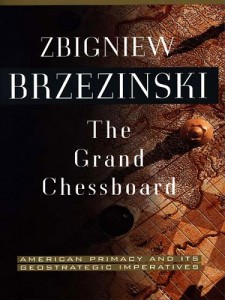
le-grand-echiquier-2Russia is no threat. But to vociferous Russophobes in the Baltic States, Western Ukraine and Poland, the very existence of Russia is a threat. Encouraged by the United States and NATO, this endemic hostility is the political basis for the new “iron curtain” meant to achieve the aim spelled out in 1997 by Zbigniew Brzezinski in The Grand Chessboard: keeping the Eurasian continent divided in order to perpetuate U.S. world hegemony. The old Cold War served that purpose, cementing U.S. military presence and political influence in Western Europe. A new Cold War can prevent U.S. influence from being diluted by good relations between Western Europe and Russia.

Obama has come to Europe ostentatiously promising to “protect” Europe by basing more troops in regions as close as possible to Russia, while at the same time ordering Russia to withdraw its own troops, on its own territory, still farther away from troubled Ukraine. This appears designed to humiliate Putin and deprive him of political support at home, at a time when protests are rising in Eastern Ukraine against the Russian leader for abandoning them to killers sent from Kiev.

To tighten the U.S. grip on Europe, the United States is using the artificial crisis to demand that its indebted allies spend more on “defense”, notably by purchasing U.S. weapons systems. Although the U.S. is still far from being able to meet Europe’s energy needs from the new U.S. fracking boom, this prospect is being hailed as a substitute for Russia’s natural gas sales – stigmatized as a “way of exercising political pressure”, something of which hypothetic U.S. energy sales are presumed to be innocent. Pressure is being brought against Bulgaria and even Serbia to block construction of the South Stream pipeline that would bring Russian gas into the Balkans and southern Europe.

From D-Day to Dooms Day

Today, June 6, the seventieth anniversary of the D-Day landing is being played in Normandy as a gigantic celebration of American domination, with Obama heading an all-star cast of European leaders. The last of the aged surviving soldiers and aviators present are like the ghosts of a more innocent age when the United States was only at the start of its new career as world master. They were real, but the rest is a charade. French television is awash with the tears of young villagers in Normandy who have been taught that the United States is some sort of Guardian Angel, which sent its boys to die on the shores of Normandy out of pure love for France. This idealized image of the past is implicitly projected on the future. In seventy years, the Cold War, a dominant propaganda narrative and above all Hollywood have convinced the French, and most of the West, that D-Day was the turning point that won World War II and saved Europe from Nazi Germany.

Vladimir Putin came to the celebration, and has been elaborately shunned by Obama, self-appointed arbiter of Virtue. The Russians are paying tribute to the D-Day operation which liberated France from Nazi occupation, but they – and historians – know what most of the West has forgotten: that the Wehrmacht was decisively defeated not by the Normandy landing, but by the Red Army. If the vast bulk of German forces had not been pinned down fighting a losing war on the Eastern front, nobody would celebrate D-Day as it is being celebrated today.

Putin is widely credited as being “the best chess player”, who won the first round of the Ukrainian crisis. He has no doubt done the best he could, faced with the crisis foisted on him. But the U.S. has whole ranks of pawns which Putin does not have. And this is not only a chess game, but chess combined with poker combined with Russian roulette. The United States is ready to take risks that the more prudent Russian leaders prefer to avoid… as long as possible.

Perhaps the most extraordinary aspect of the current charade is the servility of the “old” Europeans. Apparently abandoning all Europe’s accumulated wisdom, drawn from its wars and tragedies, and even oblivious to their own best interests, today’s European leaders seem ready to follow their American protectors to another D-Day … D for Doom.

Can the presence of a peace-seeking Russian leader in Normandy make a difference? All it would take would be for mass media to tell the truth, and for Europe to produce reasonably wise and courageous leaders, for the whole fake war machine to lose its luster, and for truth to begin to dawn. A peaceful Europe is still possible, but for how long?

Diana Johnstone is the author of Fools’ Crusade: Yugoslavia, NATO, and Western Delusions.

Source: Counterpunch

‘Freemasons planted seeds of Apartheid’

masoniclodgeOn the grounds of Parliament, close to Tuynhuys in the heart of Cape Town, the Lodge De Goede Hoop is hidden behind a parking lot filled with expensive ministerial cars.

It is an old, white, plastered building, writes City Press.

Only the Freemason symbol on the window and the Star of David above the large wooden doors show that this is not just another ­parliamentary building.

There are many conspiracy theories, ­alleged links with murders, and those who ­believe the Freemasons “planted the seeds” of Apartheid.

The building was inaugurated as the first masonic temple in South Africa in 1803 and is still used daily by its members.

This week, City Press took a tour of the ­temple with the newly appointed Grand Master of the SA Freemasons, Geoff ­Edwards.

On a table in the foyer are a square and a pair of compasses – well-known masonic symbols. On the wall is an engraved list of the names of former masters and the wall beside the front door is adorned with a framed ­photograph of Watty Watson, former ­DA chief whip and retiring Grand Master.

“People say we’re on parliamentary grounds, but that’s not true. Actually, Parliament is on our grounds,” he says.

The first Freemason lodge was formed in Cape Town in 1772 and the temple was built about 30 years later.

The Cape government of the time and the Freemasons were so intertwined that the Cape Parliament used the masonic banquet hall as a venue from 1854 to 1884 until the old House of Assembly was completed.

Others say that from the organisation’s ­inception in the 14th century, it has been the ­secret hand that is quietly ruling the world.

Not true, according to Edwards, taking us into the meditation chamber with its sinister statue of a dead man with a dagger, a book and an hourglass, and the words “know thyself”.

Two artificial human skulls add a chilling edge to the room. “People say the Freemasons have ruled the world over the centuries, but the truth is ­that many rulers were simply ­masons,” he says.

“Like many other organisations, we have been attacked aggressively in the past. During World War 2, Hitler tried to wipe out the ­Freemasons.

The most fascinating room in the Lodge De Goede Hoop is undoubtedly the middle chamber. With only two small windows letting in a sliver of light, the room is dark even in the ­middle of the day. Here, ceremonies are held at night in the pitch dark to remind members just how fleeting their lives are.

The organisation is open to all races, but does not accept women as members. There are female lodges in some parts of the world, but they are not recognised by the Freemasons’ constitution.

“In our lodge we have members of ­Parliament from three different political ­parties and they all get on tremendously well together,” he boasts.

Source: City Press

False Flag Attacks

Prof. Daniel Ganser
Prof. Daniel Ganser

By Professor Daniele Ganser, University of Basel

As evidence has accumulated that the official story of 9/11 is false, the dwindling number of defenders of the official conspiracy theory have been reduced to two arguments. One is that no government would attack its own people or stand aside while terrorists did so. The other argument is that if such a thing had happened, someone would have talked.

Professor Daniele Ganser of the University of Basel in Switzerland demonstrates that there is no basis in history for either of these two arguments. He provides details of two officially acknowledged government conspiracies to murder citizens for political reasons.

One is Operation Gladio, officially exposed by Italian Judge Felice Casson and Italian Prime Minister Giulio Andreotti. This conspiracy involved the CIA, NATO, and Italian intelligence. The conspirators set off bombs in public places in European cities, killing and maiming citizens. The series of attacks were officially blamed on communists and discredited the Italian Communist Party, thus terminating its rise in polls and elections.


Nonconformity and freethinking now a mental illness

nonconformIs nonconformity and freethinking a mental illness?

Well shockingly it is according to the latest addition of the DSM-IV, (Diagnostic and Statistical Manual of Mental Disorders). This publication has identified a new mental illness known as “oppositional defiant disorder”or ODD. The official Defintion it as an“ongoing pattern of disobedient, hostile and defiant behavior,” such as argumentativeness, the questioning of authority, general defiance and negativity as well as getting annoyed particularly easily. But is this really a mental illness or just individuality.

Psychiatrists often refer to the DSM-IV as a diagnostic tool for a variety of mental illnesses. However with each issue naming new mental illnesses are we to therefore deduce that as a population we are getting sicker, or is it misdirected advice that then leads to incorrect labels on non existent mental issues. Authors of the DSM-IV say that it is simply a result of them being better able to identify these illnesses today, althought they have faced criticism for many quarters for simply looking for conditions where none actually exist.

For example some of the ‘new mental illnesses’ identified by the DSM-IV includearrogance, narcissism, above-average creativity, cynicism, and antisocial behavior .Of course previously we merely thought of these as “personality traits,” but if we are to believe this influential publication they are now “diseases” – all of which now have associated treatments.

We now live in a culture of over-diagnosing and over-medicating illustrated by the fact that according to the DSM-IV, the figures for the number of different mental illnesses recorded by them has rocketed from 130 to 357 in the last 50 years – with the majority of these affecting children.

Whilst the publication has been an important diagnostic tool for the much of the psychiatric industry, it has also been responsible for major social changes. It is partly responsible for the huge rise in ADD, bipolar disorder, and depression in children, as they describe certain behaviour in children as symptoms rather than merely as character traits. A Washington Post article stated that “if Mozart were born today, he would be diagnosed with ADD … and medicated into barren normality.”

The DSM-IV state the diagnosis guidelines for identifying various oppositional or defiant disorders are for children, but that adults can just as easily suffer from the disease. So should any freethinking citizen consider themselves as mentally ill?

The Soviet Union has used new “mental illnesses” for political repression in the past and the people who refused to accept the beliefs of the Communist Party were said to have developed a new type of schizophrenia – they suffered from the ‘delusion of believing communism was wrong’. These people who refused to toe the line were isolated, even forcefully medicated, and many suffered brutal repressive “therapy” to bring them back to sanity!

The last edition of the DSM-IV identified the symptoms of various ‘mental illnesses’ in children – there then followed a large spike in the number of children in the diagnosis and related medication of those children. This is happening in vast numbers and children in some states have even passed Laws that can enable protective agencies to forcibly medicate these misunderstood children. These laws also mean that if there is resistance from parents or legal guardians of these children refuse to cooperate this is regarded as a punishable offence.

This is a frightening development and is shockingly widespread – we are teaching our children that if they think for themselves or display any originality or non- conformity then they will be labelled and ‘controlled’ with dangerous medication. When we will even see the long term effects of these drugs?

Spokespeople for the DSM-IV claim that their only desire is to improve diagnostics, however they have been shown to be very influential in this dangerous practice of labelling freethinking and nonconformity as various mental illnesses could have a lot of potential for abuse, misdiagnosing, mistreating and unnecessarily medicating huge swathes of the population.

Source: naturalcuresnotmedicine.com

Americans turn anti-War

warlibertyThe American people are now overwhelmingly opposed to more war in Ukraine, Syria, Iran and elsewhere.

A new Wall Street Journal/NBC poll shows:

Americans in large numbers want the U.S. to reduce its role in world affairs even as a showdown with Russia over Ukraine preoccupies Washington ….

In a marked change from past decades, nearly half of those surveyed want the U.S. to be less active on the global stage, with fewer than one-fifth calling for more active engagement—an anti-interventionist current that sweeps across party lines.

A Pew poll from December found a majority of Americans – more than ever before in Pew’s 50-year history of polling this question – think the U.S. “should mind its own business internationally and let other countries get along as best they can on their own.”

A Pew/USA Today poll conducted over the weekend found that Americans oppose – by a 2-1 margin – any U.S. military aid to Ukraine.

A YouGov poll conducted last month found that only 14 percent of Americans said the U.S. has “any responsibility” to get involved in Ukraine, and only 18 percent think the U.S. “has any responsibility to protect Ukraine if Russia were to invade.”

Huffington Post reports:

Americans are more likely than not to say that the United States has no responsibility to get involved in Ukraine even under extreme circumstances, the new survey shows ….

Pluralities of Democrats, Republicans and independents agreed that the U.S. does not have a responsibility to protect Ukraine.

Support for a war against Syria is less than one-sixth the approval level Americans had for the Iraq war in 2003 (Americans would rather have a root canal or a colonoscopy than bomb Syria).

A USA Today/Pew Poll from January shows that Americans now believe by a 50%-38% margin that war against Iraq was stupid.

Support even for the Afghanistan war has collapsed. For example, only 35% of all Americans support the Afghanistan war, according to a 2011 CNN poll.

Most Americans are now strongly opposed to intervention in any Arab country.

The warmongers, however, are desperate to drum up business.

Obama has also declared a war on inequality. But given that income inequality has increased more under Obama than under Bush, and that bad policy enacted on a bipartisan basis is making inequality worse and worse, we may be in real trouble.

Of course, neither mainstream political party represents the interests of the people … as revealed by polls.

Source: washingtonsblog.com

The new SA colonials have arrived

fujianWithout as much as a whisper the South African government allowed at least 400.000 Chinese to swamp the country during the past six years. Chinese migrants, mainly from the overpopulated Fujian province in China, have been shipped off to South Africa at an alarming rate. Spreading all over the country, even in the remotest parts, between 6 000 and 12 000 “Chinese shops” sprang up.

New York also began to witness an influx of Fuzhounese Chinese-Americans. Fuzhou is the capitol city of the Fujian province of China, located in the southeast. Fuzhounese immigrants were attracted by promises of opportunity in New York (other destinations of interest were Japan, Australia, and Europe). Many undocumented immigrants came to New York as well, brought to the United States through human smuggling practices that had become widespread in the towns outside Fuzhou.

Today there are over 400.000 Chinese-Americans living in New York.

Emigrants who traveled to New York lived both in Fuzhou itself and in smaller villages outside of Fuzhou. The quantity of Fuzhounese immigrants measure into the tens of thousands. Fuzhounese immigrants in New York now outnumber Cantonese immigrants. Parts of the Lower East Side Chinatown and Sunset Park Chinatown are coming to be described as “Little Fuzhou” to acknowledge the growing Fuzhounese population.

Since the arrival of Fuzhounese people in Manhattan, Chinatown has expanded dramatically. Parts of the Lower East Side that originally belonged to Little Italy were now being assimilated into the ever-growing “Little Fuzhou”

Prof Colin McCarthy, retired from the University of Stellenbosch, first noted the “Chinese colonization” in South Africa. Says Prof McCarthy: “All the evidence indicates that the project to set up such an extensive network of Chinese shops, all following the same pattern and targeting the same market, was well researched, well planned, well organized and well financed”.

The young, unemployed couples from Fujian province settled into the network – pushing up cheap Chinese plastic, products and clothing into a lucrative retail chain far bigger than Pick ‘n Pay, Pep Stores or Edgars. To make matters worse: most of the Chinese shops are not registered and do not pay any taxes in South Africa’ not even import or export duties – in fact, China puts its clothing exports to South Africa to R11,3 billion in 2010; whilst South Africa’s failing statistics put the Chinese clothing imports at only R6,7 billion! It means that in one single year R4,6 billion worth of Chinese clothing entered South Africa illegally.

A South African Revenue Services employee spilled the beans on a small Chinese shop in a rural area where, when raided by SARS, R1,2 million was found under the counter.

Janet Wilhelm of the HSRC observes: “It is amazing how so many people can enter a country seemingly unnoticed!” She quotes the SAPS Aliens Investigation Unit as saying “Many Chinese travel to South Africa via Mbabane, Maputo and Maseru from where they enter South Africa with false identity documents by road”.

Patrick Chong, chairman of the Chinese Association of South Africa, says: “Many would enter on tourist or student visas then simply stay”.

Researches of Noseweek followed the Chen family where one pioneer settled illegally in South Africa, spreading within four years to 172 members of the family scattered across Lesotho trading Chinese products.

The South African ANC government officially proclaimed Chinese as “honorary blacks”, making them exempt from affirmative action, quotas and Black Economic Empowerment.

It is ironic that while populists like Malema and Shivangu walk about claiming “land and minerals for the South African people”, the ANC government has allowed at least 400 000 additional Indians and Pakistanis, at least 400 000 Chinese and at least 10 million illegal’s from Zimbabwe, Nigeria, Mozambique, Angola and now also Zambia into the country.

Source: southafricatoday.net

I’m confused. Can anyone help me?

By Neil Clark.

Iraq mourning millions of their dead
Iraq mourning a million of their dead 

I’m confused. A few weeks ago we were told in the West that people occupying government buildings in Ukraine was a very good thing. These people, we were told by our political leaders and elite media commentators, were ‘pro-democracy protestors’.

The US government warned the Ukrainian authorities against using force against these ’pro-democracy protestors’ even if, according to the pictures we saw, some of them were neo-Nazis who were throwing Molotov cocktails and other things at the police and smashing up statues and setting fire to buildings.

Now, just a few weeks later, we’re told that people occupying government buildings in Ukraine are not ‘pro-democracy protestors’ but ’terrorists’ or ’militants’.

Why was the occupation of government buildings in Ukraine a very good thing in January, but it is a very bad thing in April? Why was the use of force by the authorities against protestors completely unacceptable in January, but acceptable now? I repeat: I’m confused. Can anyone help me?

The anti-government protestors in Ukraine during the winter received visits from several prominent Western politicians, including US Senator John McCain, and Victoria Nuland, from the US State Department, who handed out cookies. But there have been very large anti-government protests in many Western European countries in recent weeks, which have received no such support, either from such figures or from elite Western media commentators. Nor have protestors received free cookies from officials at the US State Department.

Surely if they were so keen on anti-government street protests in Europe, and regarded them as the truest form of ’democracy’, McCain and Nuland would also be showing solidarity with street protestors in Madrid, Rome, Athens and Paris? I’m confused. Can anyone help me?

A few weeks ago I saw an interview with the US Secretary of State John Kerry who said, “You just don’t invade another country on phony pretexts in order to assert your interests.” But I seem to recall the US doing just that on more than one occasion in the past 20 years or so.

Have I misremembered the ’Iraq has WMDs claim’? Was I dreaming back in 2002 and early 2003 when politicians and neocon pundits came on TV every day to tell us plebs that we had to go to war with Iraq because of the threat posed by Saddam’s deadly arsenal? Why is having a democratic vote in Crimea on whether to rejoin Russia deemed worse than the brutal, murderous invasion of Iraq – an invasion which has led to the deaths of up to 1 million people? I’m confused. Can anyone help me?

We were also told by very serious-looking Western politicians and media ’experts’ that the Crimea referendum wasn’t valid because it was held under “military occupation.” But I’ve just been watching coverage of elections in Afghanistan, held under military occupation, which have been hailed by leading western figures, such as NATO chief Anders Fogh Rasmussen as a “historic moment for Afghanistan”and a great success for “democracy.” Why is the Crimean vote dismissed, but the Afghanistan vote celebrated? I’m confused. Can anyone help me?

Syria too is rather baffling. We were and are told that radical Islamic terror groups pose the greatest threat to our peace, security and our ’way of life’ in the West. That Al-Qaeda and other such groups need to be destroyed: that we needed to have a relentless ’War on Terror’ against them. Yet in Syria, our leaders have been siding with such radical groups in their war against a secular government which respects the rights of religious minorities, including Christians.

When the bombs of Al-Qaeda or their affiliates go off in Syria and innocent people are killed there is no condemnation from our leaders: their only condemnation has been of the secular Syrian government which is fighting radical Islamists and which our leaders and elite media commentators are desperate to have toppled. I’m confused. Can anyone help me?

Then there’s gay rights. We are told that Russia is a very bad and backward country because it has passed a law against promoting homosexuality to minors. Yet our leaders who boycotted the Winter Olympics in Sochi because of this law visit Gulf states where homosexuals can be imprisoned or even executed, and warmly embrace the rulers there, making no mention of the issue of gay rights.

Surely the imprisonment or execution of gay people is far worse than a law which forbids promotion of homosexuality to minors? Why, if they are genuinely concerned about gay rights, do our leaders attack Russia and not countries that imprison or execute gay people? I’m confused. Can anyone help me?

We are told in lots of newspaper articles that the Hungarian ultra-nationalist party Jobbik is very bad and that its rise is a cause of great concern, even though it is not even in the government, or likely to be. But neo-Nazis and ultra-nationalists do hold positions in the new government of Ukraine, which our leaders in the West enthusiastically support and neo-Nazis and the far-right played a key role in the overthrow of Ukraine’s democratically elected government in February, a ‘revolution’ cheered on by the West. Why are ultra-nationalists and far-right groups unacceptable in Hungary but very acceptable in Ukraine? I’m confused. Can anyone help me?

We are told that Russia is an aggressive, imperialist power and that NATO’s concerns are about opposing the Russian ‘threat’. But I looked at the map the other day and while I could see lots of countries close to (and bordering) Russia that were members of NATO, the US-led military alliance whose members have bombed and attacked many countries in the last 15 years, I could not see any countries close to America that were part of a Russian-military alliance, or any Russian military bases or missiles situated in foreign countries bordering or close to the US. Yet Russia, we are told, is the ‘aggressive one’. I’m confused. Can anyone help me?

Source: RT

Swede helps nationalists in Ukraine

Mikael Skillt
Mikael Skillt

Three weeks ago Mikael Skillt worked for a construction company in Stockholm, Sweden. Today, he is a volunteer in a nationalist organization in Kiev. In an interview with Fria Tider, Skillt tells the story of a Ukraine where the role of the police has been assumed by paramilitary Right-wing groups.

At the end of February, mere days after Ukraine’s president, Viktor Yanukovych, was overthrown, Mikael Skillt boarded a plane bound for Kiev. He left behind a relationship that had just ended, a terrace house in a Stockholm suburb and a well-paid job as a planner at a construction company.

The purpose of his trip was to volunteer for one of the nationalist organizations which, as a result of their central role in the Ukrainian revolution, have gone from being relatively marginal to controlling the streets of Kiev.

It was not an easy decision to make, Skillt said when Fria Tider spoke to him over Skype. His former employer, also a personal friend, was not happy when Skillt suddenly quit his job to go to Ukraine. Skillt said he went anyway because of a sense of solidarity with the Ukrainian nationalists. “Nationalists have died on the streets of Kiev,” he recounted. “And I was able to help them. That is more important than my personal well-being.”

Skillt is 37 years old and has been involved in various Swedish nationalist groups for more than a decade. Between 2002 and 2010 he was active in the National Socialist organization Svenska motståndsrörelsen (Swedish Resistance Movement). Today, he is a member of a small, nationalist political party, Svenskarnas parti (Party of the Swedes), but holds no official position within it. He says he is no longer a National Socialist and describes himself as an “ethnic nationalist.” “You are born Swedish,” he explained. “It’s not something you can become.”

After arriving in Ukraine, Skillt joined the organization C14, also known as Sich, which is closely affiliated with the nationalist party Svoboda. In an interview with the BBC, C14′s leader, Yevhen Karas, says that his organization has approximately 200 members and that its main objective is to sever all ties between Ukraine and Russia. Some have called him a Nazi, but he firmly denies that accusation. “I don’t think I’m a Nazi, I’m a Ukrainian nationalist,” Karas told the BBC. “The main confrontation is about that some ethnic groups have control of many business structures, some economical and political forces.”

When asked which ethnic groups he was referring to, Karas clarified, “Russians and Jews. Some non-Ukrainian groups control a huge percent of the economic and political power. And of course, in this situation you have some tension with the Ukrainian people.”

According to Skillt, C14 has been in existence for quite some time. Prior to the revolution, C14 often intervened to protect tenants threatened by illegal eviction. “Ukrainian landlords, similar to so-called ‘slum lords’ in America, have often evicted tenants illegally in order to tear down an existing building and put up something newer and more profitable in its place. They often do that by bribing corrupt politicians. In many cases, C14 has occupied such buildings and chased away the police when they arrive to evict the tenants.”

When the protests against Yanukovych’s government began last autumn, C14 was one of the groups that fought the riot police, Berkut, as they tried to drive the protesters off the Maidan Square. “Most of the members of C14 have been very active in the Maidan riots. If you sit down and talk to these guys, I can give you ten names right off the bat of people who have lost a friend in the fighting. So, they’ve been on the front lines,” Skillt said. “I have never heard anyone here call himself a National Socialist. They fight for a Ukraine based on ethnic unity.”

Today, C14 is a force to be reckoned with. Together with the so-called Right Sector, C14 patrols the streets of Kiev, fights crime and guards public buildings. Skillt and several other Swedish volunteers participate in the patrols. “The police force still exists, but isn’t seen much,” he said. “Most of the police officers you see on the streets are only traffic police. Maintaining order is primarily being done by C14 and the Right Sector.”

The reason why there is a power vacuum that is currently being filled by these groups is that the special police force, Berkut, was disbanded following the overthrow of Yanukovych, and many officers of the regular police force were also sacked. “Corruption among the police has been massive and many have been dismissed,” Skillt explained. “Some have fled for their lives because they were guilty of corruption, or otherwise behaved like bastards. The officers that remain are pro-Ukrainian and not corrupt. But because of their low-life former comrades, people don’t have much confidence in them either.”

“Berkut was really disgusting,” he continued. “I have met some people who were arrested by them. They were tortured, sometimes even maimed. People had toes and fingers cut off. Some were doused in gasoline, while police officers stood next to them, smoking. Others had water poured over them and were then thrown out into -10 degrees C temperatures.”

The nationalist groups, rather than the police, enjoy a great deal of confidence among the public, Skillt told us. “They have acted in an exemplary manner, as far as the people are concerned. They have stood up to armed police officers, in many cases while unarmed, and at great risk to their own lives. This won the confidence of the people.”

When the Ukrainian parliament convened on March 17 to discuss the situation in Crimea, C14 and the Right Sector provided security. Skillt was part of the group that C14 sent to guard the parliament. A photo showed him wearing a uniform, a bulletproof vest, a ski mask and sunglasses. He carried a gun case on his back, but he didn’t want to tell us what it contained. “A fishing pole,” he said.

Other photographs from the parliament, however, show uniformed, masked men openly carrying automatic rifles. Skillt confirms that both C14 and the Right Sector possess firearms, even though guns are not part of their standard equipment. The ability to handle guns safely varies widely from person to person. “Some of the guys in the Right Sector are like monkeys with guns,” he said. “You put your life at risk just by being near them, when they’re armed. It’s pure slapstick, they have guns but handle them carelessly, as if they were wooden sticks. In C14, safety routines are much better. It’s almost up to the standard of the Swedish military.”

Skillt described C14 as a more professional and disciplined unit than the Right Sector. Before Skillt was approved for service in C14 his physical fitness and marksmanship were tested. Candidates are expected to be able to run five kilometers in under 25 minutes while wearing a full uniform, a bulletproof vest and carrying other personal equipment. “It’s not as easy as it sounds,” Skillt said. “Part of the course is a steep uphill slope. I made it in 24 minutes and a few seconds.”

The Right Sector was formed last autumn, when the protests began. It first functioned as an umbrella organization for various nationalist groups that wanted to stop the police from driving the protesters from their encampments on the Maidan in central Kiev. Its members range from soldiers with combat experience from Afghanistan and Chechnya, to students and soccer hooligans.

According to Skillt, the different groups within the Right Sector have now coalesced into one organization with a common leadership. Its leader, Dmytro Yarosh, has announced his candidacy in the upcoming presidential election in May. He opposes integration with the European Union, which he described as a “monster” that imposes “anti-Christian and anti-national laws” upon its members. In a widely-distributed promotional video, the Right Sector has claimed to fight against “totalitarian liberalism” and for the “rebirth of Europe.”

One incident from last week illustrates the influence of these paramilitary, Right-wing groups in post-revolutionary Ukraine. Skillt told us that he was one of approximately 20 activists from C14 who went to the office of the Ukrainian prison authorities in Kiev. The purpose of the visit was to secure the release of one of the organization’s members, who had been jailed for participating in the street-fighting with the police while Yanukovych was still in power.

“There were four guards there,” Skillt said. “They locked themselves in a sentry booth as soon as we got there. We told the head of the prison authority that if he wouldn’t come outside and talk to us, we would come inside and talk to him. He actually did come outside and, after a brief discussion, promised the C14 activists that he would do what was necessary to have their comrade released.”

Source: friatider.se

A system that rewards confidence-gaming sociopaths

The eyes are telling

By Charles Hugh Smith.

What is the shelf life of a system that rewards confidence-gaming sociopaths rather than competence?

Let’s connect the dots of natural selection and the pathology of power.

In his 2012 book The Wisdom of Psychopaths: What Saints, Spies, and Serial Killers Can Teach Us About Success, author Kevin Dutton described how the attributes of sociopathology are in a sense value-neutral: the sociopathological attributes that characterize a dangerous criminal may also characterize a cool, high-performing neurosurgeon.

As Dutton explains in his essay What Psychopaths Teach Us about How to Succeed(Scientific American):

Psychopaths are fearless, confident, charismatic, ruthless and focused. Yet, contrary to popular belief, they are not necessarily violent. Far from its being an open-and-shut case–you’re either a psychopath or you’re not–there are, instead, inner and outer zones of the disorder: a bit like the fare zones on a subway map. There is a spectrum of psychopathy along which each of us has our place, with only a small minority of A-listers resident in the “inner city.”

While there is obviously a place for high-functioning sociopaths in professions which reward those characteristics, what about sociopaths who substitute deviousness and deception for competence? For some context, let’s turn to the Pathology Of Power by Norman Cousins, published in 1988.

Cousins was particularly concerned with the National Security State, a.k.a. the military-industrial complex, which at that point in U.S. history was engaged in a Cold War with the Soviet Empire. Cousins described the pathology of power thusly:

Connected to the tendency of power to corrupt are yet other tendencies that emerge from the pages of the historians:
1. The tendency of power to drive intelligence underground;
2. The tendency of power to become a theology, admitting no other gods before it;
3. The tendency of power to distort and damage the traditions and institutions it was designed to protect;
4. The tendency of power to create a language of its own, making other forms of communication incoherent and irrelevant;
5. The tendency of power to set the stage for its own use.
In broader terms, we might add: the tendency of power to manifest hubris, arrogance, bullying, deception and the substitution of rule by Elites for rule of law.

Natural selection isn’t only operative in Nature; it is equally operative in human organizations, economies and societies. People respond to whatever set of incentives and disincentives are present. If deceiving and conning others is heavily incentivized, while integrity and honesty are punished, people will gravitate to running cons and embezzlement schemes.

What behaviors does our Status Quo reward? Misrepresentation, obfuscation, legalized looting, embezzlement, fraud, a variety of cons, gaming the system, deviousness, lying and cleverly designed deceptions.

Let’s connect the pathology of power and the behaviors selected by our Status Quo. What we end up with is a system that selects for a specific category of sociopaths: those whose only competence is in running cons.

No wonder we have a leadership that is selected not for competence but for deviousness. What’s incentivized in our system is spinning half-truths and propaganda with a straight face and running cons that entrench the pathology of power.

What is the shelf life of a system that rewards confidence-gaming sociopaths rather than competence? Unless we change the incentives and disincentives, the system is doomed.


Ukraine, Chevron and Condi Rice… the broken record

Condi Rice, a dark force

High principles dominate the rhetoric on freedom-loving Ukraine, writes JP Sottile. But more mundane realities – like the interests of US oil corporations and Ukraine’s vast shale gas capacity – are part of the volatile equation.

In Ukraine, Chevron’s deal continues a long tradition of intermarriage between ‘national’ and corporate interests under the guise of national security.

Everybody’s got an opinion about the ‘showdown’ with Russia.

Some say it’s about freedom and the right to self-determination. Some say it’s about standing up to aggression and halting a dictator’s march.

Some say it’s about the future of everything-from Syria to North Korea to Iran’s nuclear program – and, according to Sen. Lindsey Graham, it all stems from Obama’s failure to kill the people who killed Americans at Benghazi.

But the most-revealing voice in the chorus is Condi Rice. She penned a tension-filled op-ed on Ukraine for the Washington Post – the newspaper of broken records.

Her nostalgic, “Baby, It’s a Cold War Outside” ditty on the “Ukrainian Problem” came just two days after a Teflon-coated Henry Kissinger opined about the “art of establishing priorities” in his own Ukraine-themed op-ed for the Post.

Why should we care about Condi?

As the world learned through painful experience, Condi Rice, much like Henry Kissinger, was all about establishing priorities. But now that she’s out of power, why should anyone waste any time considering Ms. Rice’s opinion about anything, much less about the ‘crisis’ in Ukraine?

Why? Because it’s telling. Like most American Exceptionalists, her bluster and posturing can be reverse-engineered to find the banal truth about US foreign policy.

For example, her steadfast belief that Ukraine “should not be a pawn in a great-power conflict but rather an independent nation” might have something to do with Chevron’s 50-year lease to develop Ukraine’s shale gas reserves.

It’s the gas, stupid

When that lease was signed on November 5, 2013, it stoked Russian fears about losing its influence on, and a major gas market in, a former satellite.

It also came on the eve of the much-disputed trade deal with the European Union that, once abandoned due to Russian pressure, led to the toppling of Ukraine’s government.

Reuters characterized Ukraine’s “$10 billion shale gas production-sharing agreement with US Chevron” as “another step in a drive for more energy independence from Russia.”

Of course, Ms. Rice knows something about driving for more energy. She sat on Chevron’s board of directors for ten years before resigning to become President Bush’s National Security Adviser in January of 2001.

She was such a titanic figure at Chevron and so beloved by their corporate captains that they even named a 129,000-ton oil tanker ‘Condoleezza Rice’. Do people name tankers after people? People do!

But four months after leaving Chevron, they “quietly renamed” the tanker, apparently sensitive to the implication that she might prioritize their interests in places like Kazakhstan (a de facto dictatorship never targeted by American Exceptionalists) or the Caspian Sea (where Chevron is heavily invested) or Afghanistan (where they’ve long sought a pipeline from the Caspian region to the Indian Ocean).

Corporate Interests Abroad

In the case of Ukraine, Chevron’s deal continues a long tradition of intermarriage between ‘national’ and corporate interests under the guise of national security.

As the International Business Times stated immediately after the deal, “Chevron’s agreement with Ukraine was supported by the US as part of its national security strategy to help reduce Russia’s hold on Europe and Kiev.”

As quoted in the article, US Ambassador Geoffrey Pyatt said, “I’m very determined to cooperate with the Ukrainian government in strengthening Ukraine’s energy independence.”

That “cooperation” is couched in the language of “independence” – but it’s actually about shifting to financial interdependence with powerful, American corporate interests. It’s not about freedom or self-determination or human rights.

It’s about the ‘Open Door’.

Since the US proposed the Open Door Policy in China at the end of the 19th Century, American ‘soft imperialism’ has exploited resource opportunities for American corporate interests in dozens of ‘friendly’regimes – their commitment to freedom notwithstanding.

We have been there before

Whether it was oil in Iran, bananas in Guatemala or sugar-cane in Cuba, any move to close the door on US business interests has traditionally been met with dire warnings about the dangers of isolationism and specious claims about America’s national interests – which, oddly enough, always seem to be located in another country.

Throughout the Cold War, those ‘endangered’ national interests inspired CIA hijinks around the world. US foreign policymakers supported regime change in places like Chile (calling Dr. Kissinger) and around Central America.

And they doled out generous foreign aid packages to a motley crew of anti-communist ‘strongmen’. If push came to shove, the US military might even get involved.

Since the end of the Cold War, US policy has been kicking open doors around the world and particularly around the edges of the former Soviet Union. Expansion of NATO and US involvement in the former ‘Soviet Stans’ around Afghanistan extended a semi-circle of US military might around Russia.

A declaration of economic war

And the Ukrainian energy independence trumpeted by Ambassador Pyatt amounted to a declaration of economic warfare on Russia’s oil and gas-based economy. Like Condi Rice before him, Ambassador Pyatt’s well-established priority is to ensure that well-connected businesses get in on the ground floor.

Once on the ground floor, they need insurance – either from local clients or from a neighborhood patrol by US forces. Perhaps that’s why Ms. Rice used her Ukraine op-ed as an opportunity to advocate leaving a permanent military force in Afghanistan.

She doesn’t want to hear “talk of withdrawal from Afghanistan whether the security situation warrants it or not.” For her, nothing less than 10,000 troops will do. Otherwise, the US is “not serious about helping to stabilize that country.”

Freedom, liberty, justice … and hydrocarbons

Yet, one wonders if she – like all the professional hand-wringers, truculent think tankers, and once and future policymakers who’ve grandstanded on the showdown with Russia – isn’t quietly more concerned about something more basic than freedom, liberty and justice for all.

Perhaps the former Secretary of State, former Chevron big-wig and former oil tanker is more concerned with the ability of Chevron to realize its Turkmenistan-Afghanistan-Pakistan-India (TAPI) pipeline dream.

Her old cohorts practicing soft imperialism at the US State Department have certainly been doing their part to help Chevron score that lucrative contract.

The banal truth is that America’s long-standing policy is to help people anywhere and everywhere when those people just so happen to be living on or near valuable resources.

Unless, of course, it’s Bahrain, Nigeria, Kazakhstan or anywhere else repressive and corrupt governments are already interdependent upon US corporate interests.

Source: The Ecologist

Ukraine: The coup to install billionaires

oligarchs-ukraineBy Dmitri Menin.

It has long been known that revolutions are carried out by romantics, and their fruits harvested by cynics. But Ukraine has now put them all to shame with the unbelievable speed with which it has rushed from romanticism to cynicism. The final few dazed revolutionaries are still wandering across Maidan Square shouting «Down with thieves and oligarchs!» and «Long live the government of national confidence», while at the same time it is these same oligarchs who are confidently taking up the more substantial government posts, such as multimillionaire Arsen Avakov, for example, who has been appointed Minister of Internal Affairs, as well as getting entire regions to feed on, such as billionaires Ihor Kolomoyskyi in Dnepropetrovsk and Sergey Taruta in Donetsk. The other appointees may have fewer millions at the moment, but they will soon catch up. New changes are also afoot. The New York Times reports that the nomination of Vadim Novinsky, the owner of Smart Holding Company whose net worth is estimated to be USD 1.9 billion, for the post of Kiev’s representative to Crimea is on the cards.

There is a rumour that the author of this ‘forced’ staffing strategy is former prisoner Yulia Tymoshenko, who went to see the people on Maidan Square in a wheelchair, but who was able to stand and walk about in the American Embassy. It turns out that is the place where one can breathe the salubrious air of freedom. It is assumed that the oligarchs, who represent the country’s business elite, will be able to exert a controlling influence over workers in eastern Ukraine. Yuriy Lutsenko, an ally of the magically-cured maiden Yulia Tymoshenko, has said that the reason oligarch’s are being appointed is so that big business can be as involved as possible in protecting the country’s territorial integrity, which will not just make use of public resources, but all available private resources as well. Only now, something tells us that this plan is far from spontaneous and that this is exactly the reason why the turmoil and undertaking took place to begin with. And as far as which citizens are primarily going to be saved by these private and public resources, there is absolutely no doubt at all – the most worthy, which is to say the oligarchs themselves. In essence, the era of the complete triumph of the oligarchy in Ukraine has arrived. Masks are being thrown off even more quickly than any kind of decency allows. There is a terrible hurry before the people befuddled by the incense of the burning tyres finally see the light. By then, however, it may very well be too late.

Simon Jenkins, a journalist for The Guardian, writes: «Romantics sometimes refer to the «wisdom of crowds», but they ignore the capacity of totalitarians to manipulate the masses to their will. They forget the hysteria and cruelty of which programmed crowds are capable. Any upheaval can offer the hope of better times. But history is always a sceptic».

Despair is discernible in the words of one of those who took part in the events in Ukraine: «In any case, good intentions like these without any constructive suggestions to take and create a people’s council, popular control or a people’s government are going to be faced with the fact that foreigners are once again going to end up in these public offices.

«Because the trend of Ukrainian desperation lies in the fact that the vermin we for some reason keep electing to govern us do not come from outer space. They live among us! Which is why any recombination of elements that make up the current system of power, which is represented by a political circle of particularly active, deceitful and cynical vermin, is going to come to nothing».

Another disillusioned revolutionary believes that «Maidan is probably waiting for the next grandiose ‘flop’ – something like what happened in 2005. There is no ‘elite’ in Ukraine that would be able to replace the corrupt domestic bedlam. The ‘Donetsk clan’ has been moved aside, and the ‘liubi druzi’ (the ‘dear friends’ of Viktor Yushchenko) are returning. What’s more, they are clearly hungry for revenge and in the mood for it. These are the same ‘liubi druzi’ that successfully ‘carved’ and ‘sawed’ under Tymoshenko in the previous attempt. Except that while they came to power in 2005 under the slogan ‘the Orange Revolution’, now they are chomping at the bit under the rhetoric of Maidan. Tymoshenko was released after all the human fatalities, and she and Turchynov were immediately hoisted to the top of the power pyramid. What is that about? Why such an unprecedented honour? Who exactly are these Elders of Zion? Whilst averting their eyes, some deputies say that such figures exist. All the rest are a closely guarded secret».

But they are not being kept secret any more. Let us look at two of them now.

The new head of the Dnipropetrovsk Regional State Administration is Israeli citizen Ihor Kolomoyskyi, a well-known Ukrainian businessman and head of the European Jewish Council. He is ranked the second richest person in Ukraine (2013) with a net worth of USD 3.645 billion. He is a member of various supervisory boards, the co-owner of PrivatBank, the Neftekhimik-Prykarpattya oil refinery, and the oil and gas extracting company Ukrnafta, the vice-president of the Football Federation of Ukraine, and, according to a number of political analysts, one of the most influential people in Ukraine. It was Kolomoyskyi who was always the financial sponsor of the ‘Yulia Tymoshenko’ political project. He lives in Switzerland. The fact that his PrivatBank was one of the first major lending institutions in the country to stop issuing money to the people because of the ‘Maidan troubles’ is evidence of how much of his own money Kolomoyskyi is willing to share with the people of Ukraine. In reality, he needs additional money himself to rectify affairs in his business empire. Much to the joy of Kiev’s new rulers, he has already registered his presence through his offensive remarks towards Russian president Vladimir Putin. Evidently there will be no point waiting for money, only insults.

Sergey Taruta has been appointed the governor of Donetsk region and is co-owner of the Industrial Union of Donbas Corporation, as well as president of FC Metalurh Donetsk. In February 2008, his net worth was USD 2.65 billion and Taruta ranked 8th in the Top-130 Richest Ukrainians. After the global financial crisis, however, his net worth fell dramatically to approximately USD 750 million. He is urgently in need of fresh infusions to restore his former greatness and save his assets. Governing a region as affluent as Donetsk will give him a good chance to do this, where he will be busy collecting objects of ‘high antiquity’. For this reason, he has spent a long time getting closer to former Ukrainian president Viktor Yushchenko.

Looking at these men, and knowing that it is these men who are standing behind the regime’s main figures, you start to wonder why Turchynov and Yatsenyuk are referring to themselves as a «kamikaze government» quite so insistently, and giving themselves a political life of 3-4 months. Why had it been necessary to rush to power quite so fiercely? Acting President Alexander Turchynov says that the provisional government is doomed because it will have to implement unpopular decisions. «Not those promised by the populists, but those that are needed to save Ukraine from default and restore the faith of creditors and investors. It will be criticised and vilified, but it must fulfil its duties and burn for the sake of Ukraine». Once again there is the question of whether it is for the sake of Ukraine or for the sake of its most worthy sons like Kolomoyskyi, Taruta and others. Yatsenyuk has already announced the unconditional acceptance of all IMF conditions, which will have a serious impact on the further deterioration of life for the Ukrainian people. But then on the other hand, fresh money will be received to save big business, which will then move along the already familiar route to offshore accounts and precious safety deposit boxes that will be hidden much more securely than those of the simpleton Yanukovych. It seems that the ‘kamikaze’ of Turchynov and Yatsenyuk is not going to involve anything except cutting out coupons to transfer power to the oligarchs.

And as far as Maidan’s «Circle of National Trust» is concerned, do they really believe in this fairytale about the fat cats being saviours of the homeland? After until, until fairly recently its leaders had been saying that Ukraine’s new government of national confidence would be closed to anyone on the list of the 100 richest people in Ukraine. Well what are they keeping quiet for?

They, for example, announced that they were going to convene a national popular assembly on Maidan Square on 2 March to listen to a report on the first results of the new government’s work. «And let Turchynov, Yatsenyuk, Tyahnybok, Klitschko and Avakov just try not to come!» it said in a statement on their social network site. People did actually gather on the square. But what did they talk about? About deflecting the threat of Russian ‘aggression’, both invented and over-exaggerated, seemingly so that no kind of report could be given. In truth, nobody has stuttered anything at all about the results of the new government’s work. And maybe nobody is going to ask, either. So what did the young people from the «Heavenly Hundred» and Berkut actually die for?