Immigrants drown after Spain fires rubber bullets

spainimmigrantsThe European Commission wants Spain to account for the drowning of 14 migrants who recently failed to swim to Ceuta, a Spanish enclave in North Africa. Spain earlier admitted that rubber bullets were fired at them, but claimed no one was injured.

“The commission will be requesting explanations from the Spanish authorities on these events,” EU Home Affairs spokesperson Michele Cercone said, adding that the commission has a right to act if there’s evidence that a member state has violated EU laws.

On Thursday, Spanish Interior Minister Jorge Fernandez Diaz admitted that local border police, in an effort to turn back around 200 migrants who tried to cross the frontier between Morocco and Spain’s Ceuta on February 6, had indeed fired rubber bullets at them.

While some tried to cross on land, at least fourteen migrants drowned in the Mediterranean trying to swim around a man-made breakwater that separates Moroccan and Spanish waters. Spanish police say they are still searching for more victims.

According to the Spanish Interior Minister, the rubber bullets were fired at a distance of 25 meters to deter people from entering Spain while they were in the water. Diaz told a parliamentary commission that the shots were never intended to hit the migrants, whose behavior he described as aggressive. Spanish police posted online video footage of migrants throwing stones at the border fence. The footage didn’t show what had happened when some of them tried to swim around to Spanish land, however. Ceuta, on the north coast of Africa across the Strait of Gibraltar on the Mediterranean Sea, has a population of about 83,000.

According to the online newspaper EUObserver, 23 people managed to make it to Ceuta’s El Tarajal beach, but were immediately turned over to Moroccan authorities. Under European asylum and migration law, anyone who steps foot on member states’ territory is eligible to have their asylum request reviewed before being deported. Although Spanish Interior Minister admitted a group of migrants made it to the beach, Diaz said the group did not enter Spanish territory, since they allegedly never made it past the line of waiting border guards.

Meanwhile, the EU Commissioner for Home Affairs Cecilia Malmstrom said she was “very concerned about Spanish police using rubber bullets to deter migrants.”

“I expect clarifications from the authorities,” Cecilia Malmstrom wrote on her Twitter account.

Spain’s interior minister has admitted police should not have fired rubber bullets at migrants trying to reach Ceuta last month.

Jorge Fernandez Diaz said that rubber bullets were unlikely to deter migrants from the country’s North African enclave.

At least 15 migrants drowned on February 6 as hundreds tried to swim to Ceuta from Morocco.

Will Baroness Ashton of Upholland lead the nuclear charge?

Baroness Catherine Ashton
Catherine Ashton adjusting her GU crown

When Victoria Nuland rejected the EU solutions in Ukraine with her “Fuck the EU” comment, the EU went it alone. Germany’s Foreign Minister, Frank-Walter Steinmeier proposed that he and his French counterpart, Laurent Fabius, fly to Kiev and try to reach a resolution of the violence before escalation. Polish Foreign Minister, Radoslaw Sikorski was asked to join.

The talks in Kiev included the EU delegation, Yanukovich, the three opposition leaders and a Russian representative. The US was not invited.

Then suddenly snipers began shooting into the crowd in Maidan Square. Panic ensued and riot police retreated in chaos according to eyewitnesses. Vitali Klitschko withdrew from the deal. Yanukovich fled Kiev.

Now that the “opposition” has driven a duly-elected president into exile and dissolved the national riot police, Berkut, Washington has demanded that Ukraine submit to very onerous IMF conditionalities. As Paul Craig Roberts writes:

According to a report in Kommersant-Ukraine, the finance ministry of Washington’s stooges in Kiev who are pretending to be a government has prepared an economic austerity plan that will cut Ukrainian pensions from $160 to $80 so that Western bankers who lent money to Ukraine can be repaid at the expense of Ukraine’s poor.

The corrupt Western media describes loans as “aid.” However, the 11 billion euros that the EU is offering Kiev is not aid. It is a loan. Moreover, it comes with many strings, including Kiev’s acceptance of an IMF austerity plan.

The austerity plan will cut social services, funds for education, layoff government workers, devalue the currency, thus raising the prices of imports which include Russian gas, thus electricity, and open Ukrainian assets to takeover by Western corporations.

Ukraine’s agriculture lands will pass into the hands of American agribusiness.

The conflict between the US and the EU has thus been exposed.

Meanwhile Vladimir Putin has made it clear that Moscow does not need to “invade” Ukraine. The 1997 Ukraine-Russia partition treaty specifically allows Russian troops in Crimea. No shots were fired and Russian “sons” were welcomed with open arms.

The US should start worrying about the white supremacists they so ardently and openly support in Ukraine, but shun elsewhere. If the Nazi’s take over – which seem more and more likely – the UN’s R2P (responsibility to protect) will come into play. Samantha Power, the architect of R2P, should be proud of herself for crafting the ultimate solution many hawks in the US wish for.

The three war-mongering women who represent the West’s foreign policy apparatus, US Assistant Secretary of State for European and Eurasian Affairs Victoria Nuland and EU official and onetime British Campaign for Nuclear Disarmament activist Catherine Ashton, and United States Ambassador to the United Nations Samatha Power, have been exposed. The first two by leaked phone calls, and the latter by her R2P plan.

Ashton, actually the grand and feudalistic Baroness Ashton of Upholland, also has an exaggerated view of her own accomplishments. She has scant knowlegde of what transpires in Europe, but flatters herself with the inflated title of High Representative for Foreign Affairs and Security Policy for the European Union.

Her title hasn’t lifted her dour expression and gloomy features yet, but it might be as a result of her closeness to the Great Unwashed, the GU.

The Baroness is married to former British journalist Peter Kellner, an executive of the British polling company YouGov. The pollster does political polling as well as the very dull infotainment media charts of Pop Idol and X-Factor, pandering to the GU. Only in Britain could a Labourite sink to such depths of grandeur.

In a phone call between herself and the Estonian foreign minister Urmas Paet, Ashton was told what had really happened in Kiev. The High Representative could no wait to throw cold water on the information that the “opposition” – actually a NATO force with looted Libyan weapons some say – was behind the shootings of protesters and policemen.

Ashton quickly defended the new members of the Ukrainian Rada, the parliament. The Estonian Foreign Ministry in the meantime has confirmed that the transcript is authentic.

Essentially, Ashton told the Estonian foreign minister that in the Machiavellian shaping of the fake opposition in the Rada, some “cannon fodder” had been required.

Ashton’s agenda complements that of Nuland whose January phone call with US ambassador to Ukraine Geoffrey Pyatt revealed that the Obama administration was hand picking and paying the future government of Ukraine even while Ashton, as well as Nuland’s co-ideologue Jeffrey Feltman, the United Nations Undersecretary General for Political Affairs, were feigning interest in a negotiated solution.

Nuland sounded certain that the US would achieve its political aims with the support of America’s bought-and-paid for UN team of Feltman and his boss, Secretary General Ban Ki-moon who was known to South Korean journalists as the “slippery eel” when he served as South Korean foreign minister.

The Calcutta-born Special UN envoy to Ukraine, Dutch diplomat Robert Serry, in which Nuland expressed great confidence must also not be forgotten in the coup plot.

Thanks to the intercept capabilities of loyal and proficient Ukrainian security agents, the world now understands the perfidy of chattering women who are helping lead Europe and, possibly, the rest of the world, into a massive conflagration, possibly a nuclear war.

German economist warns sanctions against Russia could harm EU

Economic sanctions against Russia would cause serious damage to Germany’s switch to alternative energy sources, the head of the German Economic Research Institute, Hans-Werner Sinn, said in an interview published in Germany’s Passauer Neue Presse on Friday.

Germany cannot afford such a policy of sanctions, as it considerably depends on Russian gas supply in the process of switching to alternative energy sources, the economist notes. According to him, EU sanctions will only harm the European countries.

Any attempt to bring such countries as Ukraine out of Russia’s influence and link with the West is naive, he believes.

Russia, along with Norway, is an important supplier of gas to Germany, the publication notes.

Source: Voice of Russia, Interfax

Ukraine fever sweeps the Balkans

balkansAs the world watches the Ukrainians in their effort to defend themselves from Russia and become a fully European nation, close attention to the situation in Kiev and the crisis in Crimea is notable in the Balkan Muslim countries—Kosovo, Albania, Bosnia-Herzegovina—and in two with significant Muslim minorities, Montenegro and Macedonia.

In the Balkans, the threat of Serbian aggression has receded, but in a parallel with Ukraine, Russian influence is perceived behind intrigues from Belgrade. The events in Ukraine are seen in a context of the struggle against corruption and the phenomenon of the post-Communist “mafia state.”

In the first week of February, a wave of protest began in the Bosnian city of Tuzla, which is known for its tradition of multiethnic harmony among Bosnian Muslims, Croats, and Serbs. An old industrial redoubt now plagued with unemployment ranging between 40 and 60 percent, Tuzla boiled over quickly, as reported by BBC News, with attacks on official buildings.

Solidarity demonstrations spread to other Bosnian cities with economic problems, including Mostar in Herzegovina, which is divided between Muslims and Croats and has an aluminum industry, Zenica in central Bosnia, where a steel complex has been owned by ArcelorMittal since 1998, and then to Sarajevo, the capital. There, on February 7, demonstrators set fire to government buildings and fought police.

Local and foreign media, international observers, and politicians assigned blame for the Bosnian upheaval in all directions. Resentment of the excessively convoluted bureaucracy foisted by the 1995 Dayton Accords on Bosnia, which is partitioned between a so-called “Republic of Serbs” and the “Federation of Bosnia-Herzegovina,” grouping Muslims and Croats, is one issue. “Federation Bosnia” comprises 10 cantons, each with its own autonomous political and educational authorities, plus a special zone at Brcko in the northern part of the territory, all reporting—barely—to the supposed central government in Sarajevo. It has more varieties of statist delirium above and below the cantonal level: legislatures, ministries, municipalities, in a seemingly endless and redundant supply.

Economic opportunities mostly involve political malfeasance, financed by the European Union through the Office of the High Representative (OHR), the real government, with American support. The current high representative is an Austrian of Slovene background, Valentin Inzko. Bosnia-Herzegovina is therefore a place of profound despair, afflicted by brain drain. Its traditional Central European system of education, which produces well-trained graduates, sees them leave for other countries as soon as they can. A serious upheaval in Bosnia was, to anybody watching the country, obviously on the way—a matter of when, rather than why.

Also at the end of the first week of February, Kosovo saw turmoil as Ibrahim Gashi, rector of the University of Pristina, in the capital of that Balkan republic, was forced to resign after he was exposed as a falsifier of his academic work. Clashes between police and students left 29 officers hurt and 30 students arrested. Gashi’s departure from the university was followed by that of several of his colleagues.

In Podgorica, the capital of Montenegro, on February 18, hundreds of people gathered, throwing rocks at state offices, and injuring nine policemen. The Montenegrins called for “revolution.” Unemployed workers in Macedonia assembled in front of government buildings in that country’s capital, Skopje, on February 18. The next day, in Albania, after an informal strike by minivan drivers, in a country lacking a reliable public transportation system, a full one-day transport shutdown took place, with a rally in Tirana, the capital.The idiom of social rebellion is common in Balkan culture, which has undergone numerous such movements over the centuries, and where communism in the former Yugoslavia, under the charismatic dictator Joseph Broz Tito (1892-1980) kept memories of it alive in a civic myth that imposed much less conformity and silence than in other Communist lands. Lately, public acclaim for a “Balkan spring” gave way rapidly to visions of a “Bosnian-Ukrainian model.”

But in Bosnia-Herzegovina and Albania, entrenched elites quickly sought to profit from social conflict. The Bosnian politician Fahrudin Radoncic, leader of a party titled the Union for a Better Future, which holds four out of 28 seats in the weird, ineffectual House of Representatives crafted for the Muslim-Croat Federation, has been accused of organizing the assault on the government buildings in Sarajevo in an attempted coup d’etat. Radoncic, once a respected dissident, is now seen as a patron of shady deals with Serbian extremists—likewise an old motif in the Balkans. Dnevni Avaz (Daily Voice), a down-market tabloid owned by Radoncic, last week featured a column headed “Ukraine Is All of Us”—rhetoric viewed as cynical by many Bosnians.

Similarly, former Albanian prime minister Sali Berisha, an ex-Communist and leader of his country’s entrenched Democratic party, stirred the striking minivan drivers against the Socialist (i.e., neo-Communist) administration of Edi Rama, who took power last year.

As in Ukraine, allegations that discredited leaders are manipulating mass protests in Bosnia-Herzegovina and Albania to regain influence are widespread. But in the Balkan lands, they are more convincing than they appear to be in Kiev. On February 28, Zeljko Komsic, an ex-Communist and politically independent member of the three-person presidency of Bosnia-Herzegovina, declared “I am not with fascists, chauvinists, thieves, or racketeers.” Epitomizing the complexity of post-Dayton Bosnian governance, Komsic is the Croat representative in the presidency, which comprises a Bosnian Muslim, a Serbian, and a Croatian.

A legal complaint brought at the European Court of Human Rights in Strasbourg by Dervo Sejdic, a Bosnian Roma (Gypsy) representative, and Jakob Finci, president of the Bosnian Jewish Community, alleged discrimination in that, under Dayton, members of minorities are excluded from the Bosnian presidency. The Court found for the plaintiffs in the case, Sejdic and Finci v. Bosnia and Hercegovina, but a reform of the ethno-political structure has yet to be adopted.

Since the cathartic arson at government facilities in Sarajevo, protests have continued but with much-diminished participation, typically bringing together a few hundred elderly folk aggrieved mainly by the loss of pensions. Observing one such gathering on Saturday, March 1, which was Bosnian Independence Day, I noticed the prominent display of a portrait of Tito. Nostalgia for communism is an important motive for elderly Bosnians to take to the streets.

Leaflets for the March 1 assembly, taped up throughout Sarajevo, demanded “social justice for all.” Bosnia’s Muslim religious leadership, under moderate direction since the replacement of the Wahhabi-line chief cleric Mustafa Ceric by Husein Kavazovic last year, supports the call for social justice. But the Islamic approach to Bosnian problems is conservative.

At Friday prayers in Sarajevo’s exquisite and intimate 16th-century Cobanija mosque, the day before the March 1 protest, the elderly preacher, known as a khatib and different from the imam, who leads the service, pronounced blessings and immediately commenced an eloquent denunciation of violent demonstrations. With his voice repeatedly breaking, he said to stay away from barricades such as were seen in the recent uproar. He referred to violence as “Satan’s path” and called on the assembled Bosnian Muslims to be thankful for the existence of a state with a territory and constitution which they should protect and obey. He said he was a pensioner himself and that his wife had not worked for years. But he repeated, “do not go to the barricades. Do not be tempted to Satan’s path. Remember that we have a state, territory, political structures and freedom. Do not waste them or abuse them.”

Meanwhile, those who remain indignant about corruption, rulership from afar, joblessness, lack of pensions, and the other misfortunes of Dayton besetting Bosnians have been meeting in “plenums” for democratic debate and proposal of solutions.

Thus, its Balkan disarray notwithstanding, Bosnia may find a secure way to European standards of entrepreneurship, accountability, and popular sovereignty. In a land where rebellion seems deeply embedded in the culture, hope is not exhausted.

Source: www.weeklystandard.com

Iceland moves to withdraw EU application

Faroe Islands
Faroe Islands

Iceland’s government will seek parliamentary approval to withdraw its application to join the European Union, opting not to restart accession talks that were put on ice a year ago.

A bill proposing the withdrawal was sent to parliament late on Friday and was due to be debated next week, a foreign ministry spokesperson said on Saturday.

The move came after the parliamentary caucuses of the ruling parties – the centrist Progressive Party and the conservative Independence Party – voted on Friday to withdraw the application.

In comments on the proposal quoted by online news site Visir.is, the government said it “did not have a support base” to complete the accession process.

Opinion polls have consistently shown a majority of Icelanders oppose joining the EU.

A year after its banks collapsed, Iceland declared it would stop observing mackerel quotas agreed with the European Union, Norway and the Faroe Islands — a small archipelago north of Scotland and under the protection of Denmark.

Iceland and the Faroe Islands argue that the rise in sea temperatures caused by a combination of global warming and natural factors has sent such large quantities of mackerel and herring further north that the allocations should have been amended to reflect that.

Observers say the main problem the EU faces is obvious: Fish go where they find the best feeding and spawning grounds, oblivious to the political rows they create in their wake.

“The fact that these fish aren’t necessarily carrying a passport and flying a flag for a particular nation means that it starts to get interesting when they start to move out of EU jurisdiction,” marine biologist Stephen Simpson of the University of Exeter said in an interview.

A meeting of Coastal States (European Union, Faroe Islands, Iceland and Norway) was held in London on the in October 2013 under the chairmanship of the European Union to discuss management measures for 2014 for the mackerel stock in the North-East Atlantic. The meeting was also attended by observers from Greenland and the Russian Federation.

The discussions focused on the latest scientific advice from the International Council for the Exploration of the Sea (ICES), which has recommended a significant increase in fishing possibilities as compared to 2013.

Snipers fire at Russian media in Kiev

ruptlyRT’s camera crews have been fired upon by rioters as they tried to film the escalating violence on Kiev’s Independent Square. Armed protesters have taken control of Hotel Ukraine, trapping members of the RT crew inside.

“We were just shot at. It broke a window over here. We were standing centimeters away when a gunshot hit the room where we have our live position,” RT correspondent Aleksey Yaroshevsky said, pointing to the window that had been smashed by the gunfire. He said there were unidentified snipers firing from buildings all around Independence Square.

“There’s no truce at all,” Yaroshevsky added, describing how, a few hours earlier, he witnessed rioters pushing police back from the barricades amid weapons fire.The camera team of RT’s video agency Ruptly was shot at during filming. One of the bullets grazed the bulletproof vest of journalist Danil Asimov as he stood by the window on the 14th floor of a Kiev hotel.

Correspondent Egor Piskunov and his camera crew were also caught in the crossfire as they tried to film Independence Square from Hotel Ukraine.

“The cameraman tried to film what was happening on the other side of the hotel and he was fired at. Thankfully they missed. As soon as they [cameramen] realized there was a bullet they dropped down to the floor,” Piskunov told RT.

Armed rioters have taken control on Hotel Ukraine and are using it as a base to fire on Independence Square, reports Ruptly news agency. Piskunov and his team have barricaded themselves in their hotel room and covered the windows.

“There are live rounds being fired all around this building. Rioters are occupying the floors right now,” said Piskunov.

He confirmed that EU Foreign Ministers from Poland, France and Germany had quit the Ukrainian capital because of security concerns. They were scheduled to meet with Ukrainian President Victor Yanukovich and members of the opposition on Thursday to discuss a solution to the unrest.

US and EU are paying Ukrainian rioters and protesters

pcrBy Paul Craig Roberts.

A number of confirmations have come in from readers that Washington is fueling the violent protests in Ukraine with our taxpayer dollars. Washington has no money for food stamps or to prevent home foreclosures, but it has plenty of money with which to subvert Ukraine.

One reader wrote: “My wife, who is of Ukrainian nationality, has weekly contact to her parents and friends in Zhytomyr [NW Ukraine]. According to them, most protesters get an average payment of 200-300 grivna, corresponding to about 15-25 euro. As I additionally heard, one of the most active agencies and ‘payment outlets’ on EU side is the German ‘Konrad Adenauer Stiftung’, being closely connected to the CDU, i.e. Mrs. Merkel’s party.”

As I reported on February 12, “Washington Orchestrated Protests Are Destabilizing Ukraine,” Assistant Secretary of State Victoria Nuland, a rabid Russophobe and neoconservative warmonger, told the National Press Club last December that the US has “invested” $5 billion in organizing a network to achieve US goals in Ukraine in order to give “Ukraine the future it deserves.” Nuland is the Obama regime official who was caught red-handed naming the members of the Ukrainian government Washington intends to impose on the Ukrainian people once the paid protesters have unseated the current elected and independent government.

What Nuland means by Ukraine’s future under EU overlordship is for Ukraine to be looted like Latvia and Greece and to be used by Washington as a staging ground for US missile bases against Russia.

From the responses I received to my request for confirmations of the information sent to me from Moldova, there is enough evidence that Washington fomented the violent riots for western newspapers and TV channels to investigate. But they haven’t. As we know, the presstitutes are enablers of Washington’s crimes and duplicities. However, the US media has reported that the Ukrainian government is paying Ukrainians to rally in favor of the government.

As Karl Marx wrote, money turns everything into a commodity that is bought and sold. I wouldn’t be surprised if some protesters are working both sides of the street.

Of course, not all of the protesters are paid. There are plenty of gullible dupes in the streets who think they are protesting Ukraine government corruption. I have heard from several. There is little doubt that the Ukraine government is corrupt. What government isn’t? Government corruption is universal, but it is easy to go from the frying pan into the fire. Ukrainian protesters seem to think that they can escape corruption by joining the EU. Obviously, these gullible dupes are unfamiliar with the report on EU corruption issued February 3 by the EU Commissioner for Home Affairs. The report says that a business-political nexus of corruption affects all 28 EU member countries and costs the EU economies $162.2 billion per annum. Clearly, Ukrainians will not escape corruption by joining the EU. Indeed, the corruption will be worse.

I have no objection to Ukrainians protesting government corruption. Indeed, such gullible people could benefit from the lesson they would learn once their country is in the hands of corrupt Brussels and Washington. What I object to is the lack of awareness on the part of the protesters that by permitting themselves to be manipulated by Washington, they are pushing the world toward a dangerous war. I would be surprised if Russia is content to have US military and missile bases in Ukraine.

It was fools like Nuland playing the great game that gave us World War I. World War III would be the last war. Washington’s drive to exploit every opportunity to establish its hegemony over the world is driving us all to nuclear war. Like Nuland, a significant percentage of the population of western Ukraine are Russophobes. I know the case for Ukrainian dislike of Russia, but Ukrainian emotions fueled with Washington’s money should not direct the course of history. No historians will be left to document how gullible and witless Ukrainians set the world up for destruction.

Paul Craig Roberts was Assistant Secretary of the Treasury for Economic Policy and associate editor of the Wall Street Journal. He was columnist for Business Week, Scripps Howard News Service, and Creators Syndicate. He has had many university appointments. His internet columns have attracted a worldwide following. His latest book, HOW AMERICA WAS LOST, is now available. 

EU, US exploiting nationalism in Ukraine

EU exploiting nationalism to Russia
EU, US exploiting nationalism to fend off Russia in Ukraine

Ukraine’s opposition will march on parliament to pressure lawmakers struggling to end a deadly three-month political standoff, jeopardizing compromises that eased tensions over the past week.

Vitali Klitschko, a former boxing champion and EU man, and Arseniy Yatsenyuk, a lawmaker and former central banker, plan to lead thousands of demonstrators today on the first mass action outside their Independence Square compound since Jan. 19, when the last attempt to reach parliament erupted in clashes with police.

“If politicians don’t make a decision, we the people will,” Serhiy, a 23-year-old from the Lviv region near Poland, said inside the encampment, wearing camouflage and a bulletproof vest adorned with a paper “self defense” badge. “We’ve had enough. We’re fighters. We haven’t come here to listen to talks. If we decide to act, we’ll act.”

The standoff began Nov. 21, when Yanukovych pulled out of a free-trade deal with the EU, opting instead for President Vladimir Putin’s offer of $15 billion of aid and cheaper gas.

Russia, which stopped buying bonds from Ukraine’s cash-strapped government after Yanukovych’s Russian-born prime minister, Mykola Azarov, resigned on Jan. 28, said yesterday it will resume purchases, including $2 billion this week. Russian Finance Minister Anton Siluanov made the announcement just as Klitschko and Yatsenyuk were meeting with German Chancellor Angela Merkel in Berlin to seek financial and political backing to form a new government.

Source: Business Week

Switzerland votes a narrow ‘yes’ to cap EU immigration

Swiss referendum posters in French

Switzerland has voted 50.3 percent in favor of limiting annual migration from the EU, thus ending the policy of free movement within the bloc that was established in 2002.

Swiss voters narrowly decided that immigration quotas would be reintroduced, thereby overturning the free movement policy introduced in the European Union 12 years ago. Early results showed the country to be very divided in opinion over the ‘Stop mass immigration’ initiative.

‘Stop mass immigration’ was introduced by the nationalist Swiss People’s Party (SVP). Its goal is to introduce annual quotas on the number of foreign workers entering the country. The result will likely vex multinational companies based there; Roche, Novartis, UBS, and other industry giants frequently utilize foreign labor.

Before Sunday’s results were fully confirmed, it appeared that Swiss voters were completely divided over the issue, with early projections gauged from partial results and estimates showing a 50-50 split (with a three percent margin of error). Ten out of 26 cantons – state districts – and half-cantons had voted in favor of the initiative.

Public opinion institute Gfs.bern stated at first that the outcome seemed too close to call. However, it emerged by Sunday evening that more than half of Swiss cantons supported the move, according to Reuters.

Many in Switzerland – which is surrounded by the EU but is not a member – believe that rising immigration levels are putting pressure on infrastructure, rent prices, the social security system, and unemployment rates.

The SVP party has been campaigning for the amendment, saying that immigrants are destroying the nation’s Alpine identity and taking away skilled jobs.

“Many people feel this is challenging their identity, even if there isn’t any concrete economic impact on a personal level,” Georg Lutz, professor of political science at the University of Lausanne Georg, told Reuters.

“I don’t want to live like a sardine in a tin can,” independent politician Thomas Minder, who supports the initiative, told tabloid newspaper Blick.

According to the latest data, 23 percent of the country’s eight million inhabitants are foreigners – the second largest proportion in Europe after Luxembourg.

Many fear the initiative would have a negative impact on the economy, which relies on foreign workers for progress and a competitive edge.

Italians and Germans reportedly comprise the largest contingent of immigrants to Switzerland, most of whom seek work in IT, healthcare, and financial sectors.

Severin Schwan, Austrian CEO of Roche Pharmaceuticals, said about half of the employees at the research and development site in Basel, Switzerland are foreigners.

Hans Hess, head of Swissmem – a leader in electrical and mechanical engineering – believes that Switzerland’s economy is successful because of innovation, which requires a steady stream of qualified immigrants.

“Innovation is the driver of the Swiss economy. That’s why we need highly qualified workers inside Switzerland and from abroad,” Hess said.

Indeed, four in every ten new companies were founded by foreigners, according to Orell Fuessli Wirtschaftsinformationen AG. Those new companies also created 30,000 jobs in 2013.

Other than a skilled workforce, immigrants benefit the economy through consumer spending. Credit Suisse reported that about 25 percent of private consumption growth since 2008 was thanks to foreigners.

The constitutional amendment could potentially erode Switzerland’s relationship with the EU, which views the freedom of movement policy as a fundamental right. – RT.COM

‘F–k the EU’

nulandThe State Department’s top official for Europe apologized today after being caught making a crude and dismissive remark about the European Union, one of America’s top allies.

A leaked phone call posted on YouTube caught Assistant Secretary of State for European and Eurasian Affairs Victoria Nuland saying “f–k the EU” while speaking with U.S. ambassador to Ukraine Geoffrey Pyatt.

Nuland used the expletive while complaining that the European Union hasn’t done enough to get Ukraine to break an agreement with Russia and instead sign on to a trade agreement with Europe.

Dmitry Loskutov, an aid to Russian Deputy Prime Minister Dmitry Rogozin, tweeted, “Sort of controversial judgment from Assistant Secretary of State Victoria Nuland speaking about the EU.”

State Department spokeswoman Jen Psaki said today that Nuland has apologized for the remark.

Psaki would not say to whom Nuland apologized.

The four-minute conversation was about a Jan. 25 offer by Ukranian President Viktor Yanukovich to two opposition leaders, who want him to sign the EU deal, to become prime minister and deputy prime minister.

Nuland said she wanted one of the two leaders to join the government, but that another was too inexperienced and should stay outside officialdom.

Asked if Nuland’s expletives reflected a wider frustration within the State Department towards the EU, Psaki said she had a certain comfort level with expletives.

Russia proposes free-trade zone with EU

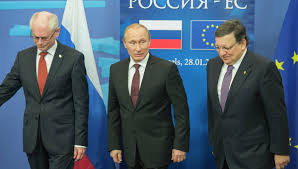
eurussiaMoscow wants to establish a free-trade zone between the European Union and the Russian-led economic union of former Soviet States, Russian President Vladimir Putin said Tuesday.

“As a specific proposal, we have suggested that the EU leadership study the possibility of establishing a free-trade zone between the EU and the Eurasian Economic Union, which is currently being established by Russia, Belarus and Kazakhstan,” Putin told reporters on Tuesday after an EU-Russia summit.

“A lot of problems are yet to be discussed, and a lot of issues are to be addressed at an expert and technical level,” Putin said. “But I think that we should start thinking about it right now.”

Putin said the next EU-Russia summit would be held on June 3, on the eve of the G8 summit in the southern Russian city of Sochi.

Source: RIA Novosti

EU fines 8 big banks for rigging rates

jpmorganThe European Commission has slapped record fines of 1.7 billion euro on eight major banks for manipulating lending rates that play a key role in the global economy. The penalties will add to already escalating costs for leading global lenders.

The EU fines marks the latest to be levied on banks and financial institutions for making profits or masking their problems by fraudulently rigging the rates that reflect the cost of lending money to each other.

The banks fined are Citigroup, Deutsche Bank, Royal Bank of Scotland, JPMorgan, Barclays, Societe Generale, UBS and RP Martin, the EC said in a statement.

The borrowing rates involved – the London interbank offered rate (Libor), the Tokyo and the euro area equivalents – are used to set price of trillions of dollars of financial products, ranging from mortgages to derivatives.

“What is shocking about the Libor and Euribor scandals is not only the manipulation of benchmarks, which is being tackled by financial regulators worldwide, but also the collusion between banks who are supposed to be competing with each other,” said Joaquín Almunia, European Commission Vice-President in charge of competition policy.

“Today’s decision sends a clear message that the Commission is determined to fight and sanction these cartels in the financial sector,” Almunia said in the EC statement. “Healthy competition and transparency are crucial for financial markets to work properly, at the service of the real economy rather than the interests of a few.”

The EC ruling said that the fine for each lender was calculated on the basis of the level of its involvement in the manipulations and how well it was cooperating with the investigation.

The fines from the EU are the first time a US bank has been involved in the rate-rigging scandal, as Citigroup has been fined 70 million pounds.

The record antitrust penalties comes as a reminder of the banks’ past “financial sins,” when global lenders artificially lowered the cost of interbank lending, partially to hide their financial troubles.

The Libor rate is seen as an indicator of a lender’s stability. Put simply, the stronger the bank, the lower the interbank lending rate it has.

Barclays, RBS, UBS, Rabobank and brokerage ICAP have already paid out a total of $3.5 billion in fines to settle the accusations related to Libor rate-rigging, the Financial Times reported. – RT

Fire of Freedom Ignites in Europe

europeBy Ronald L. Ray

Since the worldwide financial crisis of 2008, caused by avaricious investment and banking houses, longstanding ethnic tensions in several European countries have been exacerbated by the ongoing financial problems. As a result, separatist movements from the Balkans to the British Isles have been gaining ground among the people,much to the chagrin of the Bilderbergers and other one-world-government types. Apparently, historical heritage and culture cannot be completely bulldozed by the bureaucrats. Interestingly, while the methods for seeking independence vary, nearly all of the separatist regions enjoy a greater degree of prosperity than the ruling countries—a key aspect of the conflicts.

For instance, the small island of Corsica in the Mediterranean, birthplace of Napoleon, has been ruled by France for more than two centuries. The popular tourist destination received a limited amount of autonomy in 1982, and in a 2003 referendum, just 50.98% of Corsicans voted against greater self-rule. For 50 years, however, the urge for independence has been growing. In the 2010 regional elections, nationalists made their best showing ever, with autonomists and separatists combined achieving nearly 35% of the vote.

Until now, the French government seems to have followed a policy of appeasement, but it is not enough for some. The National Liberation Front of Corsica (FLNC) has engaged in terrorist activity for over 30 years, including tragic attacks on the French mainland and bombings of island vacation and summer homes.

Hard Assets Alliance

In Belgium, artificially created in the 19th century out of parts of the Netherlands and France, the majority of Dutch-speaking Flemings are increasingly dissatisfied with having to subsidize the poorer, French-speaking Walloons. This is nothing new, as troubles have been ongoing for half of the country’s history.

But after more than 18 months without a federal government, Flemish nationalists achieved a stunning victory in October 2012. Currently, according to a recent poll, more support a confederation than separatism but the recently-abdicated King Albert may have stirred additional dissension by publicly chastising “populists” last December, comparing nationalists as reminiscent of 1930s fascists. Pundits predict that the 2014 elections could be decisive for the future.

Spain possesses the distinction of not just one but two independence-minded minority groups: the Catalonians and the Basques. Catalonia, which enjoyed a great degree of autonomy under the Habsburgs, was forcibly annexed by King Philip V of Spain in 1714. But the people retain their own language and culture and are markedly more prosperous than the majority of Spain.

As elsewhere, the disproportionate taxation of the region by Spain’s national government is a significant sore point. This year, hundreds of thousands of Catalonians formed a “via catalana,” a human chain some 250 miles long, to protest for freedom on their national day in September. In 2012, 1.5 million of the 7.5 million inhabitants demonstrated for independence. So far, though, the socialist government in Madrid has been unresponsive.

Meanwhile, in the Spanish Basque region the ETA terrorist organization gave up its weapons after 50 years, in 2011. Since then, peaceful efforts by the people,who also have a unique language and culture—and claim to be survivors of Atlantis—continue on the political front. But by contrast, primary emphasis is given to overcoming Spain’s financial crisis first. The French Basques have yet to achieve even their own, united political region.

More remotely, the semi-autonomous island of Greenland seeks independence from Denmark, but development of its rich ore mining and crude oil potential is necessary first to eliminate the need for Danish subsidies. China has become a key trading partner in this regard.

South Tyrolia, forcibly incorporated into Italy after World War I, is perhaps the leading light of separatism. The people still consider themselves to be Austrian, retaining the German language, customs and drive, despite decades of efforts by the Italians to wipe out that culture. Just as people in the regions mentioned above, Tyrolians resent increasing taxation by Rome, which serves only to subsidize the less industrious Italians. While a modus vivendi, or temporary agreement, continues to exist, most of the people possess a strong desire for reunification with North Tyrolia, a focus that exerts major influence on the political climate.

Finally, there is Scotland. Here again, the enterprising Scots seek freedom from economic exploitation by the Anglo-Normans to the south. While the plurality still favor the United Kingdom, a growing number seeks complete independence from the rest of Great Britain. The Scottish National Party obtained an absolute majority in the restored Scottish Parliament two years ago, and a national referendum on independence is to be held on September 18, 2014.

It is uncertain whether the British monarch would continue to reign over a free Scotland, but republicans seem presently to have the upper hand.

One note of concern, however, is that of voices who would seek entry into the European Union after independence. In fact, this may be the new tack by the New World Order to ensure that even the newly independent remain under international bankster hegemony. – American Free Press


‘Free Ukraine, not me,’ Tymoshenko urges EU leaders

Yulia Tymoshenko
Yulia Tymoshenko

Jailed opposition leader Yulia Tymoshenko called on EU leaders to drop all demands and sign a historic pact with Ukraine without any preconditions at a summit that opens Thursday.

The EU demanded that Ukraine boost the rule of law and free the jailed former prime minister before the two could sign a landmark political and free trade deal.

But last week President Viktor Yanukovych’s government stunned the West by halting all negotiations on the deal that would have set it on a path to EU membership, saying it wanted better terms.

Yanukovych said he would still travel to the two-day summit in Vilnius to continue negotiations but his government’s shock decision sparked the biggest rallies since the pro-democracy Orange Revolution in 2004.

“If Yanukovych takes a positive decision, I passionately ask you to sign the agreement on Friday without any hesitation and conditions including those that are related to my release,” Tymoshenko, 53, said in a message read out by her daughter Yevgenia late Wednesday.

“I thank you for steadfastly defending democracy in Ukraine. But today it’s necessary to release not just separate political prisoners,” said Tymoshenko who on Monday launched a hunger strike in solidarity with pro-European protesters.

“It’s necessary to free Ukraine. That means it’s necessary to sign the agreement if Yanukovych agrees to it.”

“By signing the agreement with him, you would help an entire nation to overcome a civilisational abyss created by erroneous ideologies and agressive empires, you would make another important step towards re-uniting the entire Europe.”

The Ukrainian government’s decision to scrap the EU pact has brought tens of thousands onto the streets since Sunday.

Setting up camp in central Kiev and led by opposition leaders including world boxing champion Vitali Klitschko, protesters has staged mass rallies since Sunday.

Yanukovych has called for calm after the protests turned violent, with riot police firing tear gas and protesters hurling traffic cones and rocks at the security forces.

Yanukovych stressed he would wait for better EU terms including financial aid before considering signing the deal. He said the bloc offered insufficient compensation for the damages Ukraine would suffer by rupturing ties with historic master Russia.

The EU said it was still ready to talk about the deal but the ball was in Ukraine’s court.

“Our offer stays on the table,” said the EU’s Enlargement Commissioner Stefan Fuele.

The debate over Ukraine’s future has turned into a heated diplomatic tussle between the EU and the Kremlin.

Russia wants its smaller neighbour to join a Moscow-led Customs Union which already includes the ex-Soviet states of Belarus and Kazakhstan. Moscow has repeatedly threatened Ukraine, which heavily depends on Russian natural gas, with economic retaliation if it signed the EU pact.

Top EU officials have said they “strongly disapprove” of Russian pressure on Kiev.

Russian President Vladimir Putin has responded by advising “our friends in Brussels, my personal good friends in the European Commission, to hold back on the sharp words”.

Kiev’s move to scrap the deal with the EU came after parliament failed to adopt legislation that would have freed Tymoshenko.

Shortly after she lost to Yanukovych in a 2010 presidential election, she was sentenced to seven years on abuse of power charges that the West sees as politically motivated.

Ukrainian opposition leaders Klitschko, Arseniy Yatsenyuk and Oleg Tyagnybok are also expected at the Vilnius summit. – AFP