South African businesses to pay crippling affirmative-action fines

Businesses could pay an enormous price – up to 10% of their turnover – if they do not strictly observe provisions regarding affirmative action, says a report on the Sake24.com site.

Attempts at Nedlac to reach a compromise about proposed radical amendments to the Employment Equity Act came to naught and the next step is to take them through the parliamentary process. The proposed amendments are said to be so radical that the business sector will have them tested in court if they remain unchanged by the parliamentary process. Should the proposals be accepted not only could considerably larger fines be levied, but they would also make it much easier for government to impose them, notes the report. The 1998 Employment Equity Act prescribes relatively small fines of between R500 000 and a maximum of R900 000. The new fines being proposed follow the model of competition legislation and are linked to companies’ turnover. They range from 2% of a company’s annual turnover to 10% for repeated violations. The report says the proposed fines are largely in line with those outlined at the end of 2011 in the Black Empowerment Bill for companies using fronts to claim that they are empowered. Not only are fines of up to 10% envisioned, but also imprisonment of up to 10 years for those who lie about their company’s empowerment status.
Full Sake24 report

Meanwhile, the controversy over proposed changes to the Act, which it was feared would cause coloured and Indian workers to lose their jobs in some provinces, turned out to be a storm in a teacup, says a Business Day report. The contentious issue of whether employers should use national or regional demographic statistics to calculate the employment equity target for their workforce has not been significantly changed, says the report. Under the present law, employers have a choice to use national or regional demographics to determine their racial targets. There was an uproar last year when an initial draft of the amendments proposed that employers be forced to use national demographics as a measure, which would have meant that the workforce had a disproportionate number of coloureds in the Western Cape and of Indians in KZN. However, the amendment Bill is believed to leave the present regulatory regime much the same, with the exception that the Labour Minister will have the power to produce regulations on the matter. The regulations will allow a company – that is designated as a national company – to use national demographics as its employment equity measure. Companies that are not national will not use national demographics, notes the report.
Full Business Day report

– LegalBrief

Apartheid revisionism needed

About two weeks ago, Hermann Giliomee, the well-known liberal Afrikaner historian, wrote a scandalous piece in the Afrikaans Sunday newspaper, Rapport. The title was, “Apartheid: was it only evil?” (Afrikaans link)

I have since responded with two articles of my own to his, and we are more or less in agreement that there has been a colossal misrepresentation of what the apartheid system of racial segregation in South Africa was. However, at least one academic from the University of Stellenbosch, Anton van Niekerk, has already attacked Giliomee, describing his piece as “immoral” and “unjustifiable”.

But for decades white South Africans have spent an ever-increasing portion of their taxes on black education, health and welfare, something which the rest of the world has characterised as a “crime against humanity”.

The other day I was speaking to a friend and she told me that Afrikaans was such a nice language because one could still express how one felt, whereas “everything in English had to be so politically correct”. At least that is the way it is in South Africa. Probably in the USA and other countries, it is different. Although I have been astounded to see how intolerant American liberals can get about views on race that differ from their own.

To appreciate what a major step Giliomee took in coming out with the view that some alternatives to apartheid would have been worse, one has to live in South Africa where every day we are inundated with propaganda about our “evil past”. I grew up in the 1960’s and 1970’s, rode a bicycle in our crime-free streets, saw happily dancing black mineworkers and generally was completely unaware that anybody in South Africa was desperately unhappy. As opposed to today when acrimonious exchanges fly almost continuously between black, white, coloured and Indian, race relations in those days were cordial and uncomplicated. We each lived in our own compartments and did not feel threatened by others. That too, in juxtaposition with contemporary South Africa where whites constantly worry whether they are going to be attacked en masse, chased into the sea by angry, frustrated blacks or fall victim to the daily criminal incidents such as rape, murder, robbery and theft. Whereas South African whites go out of their way to be civil to blacks, even calling them “sir”, which would have been unheard of in the old South Africa, blacks do not seem to return the compliment. Instead they behave absolutely abominably, whether in the extreme form of violent crime or in the imperious arrogance of their politics.

However, that almost idyllic South African past before we adopted the American model of affirmative action, white guilt and forced integration, is nowadays equated with Nazism. In 1939 large numbers of white South African men volunteered to fight Germany together with Britain and the rest of the Commonwealth, yet at some point we became the Nazis. Even Germans look upon us as Nazis. Not only do the Germans feel morally superior to us, but they would rather sell their sleek Mercedes-Benzes and BMW’s to corrupt black politicians than to us. These days, being impoverished, lower middle-class victims of affirmative action, “black economic empowerment” and all the other race-preference measures, we cannot afford German cars anymore and are driving second-hand Korean cars.

After all, the Germans only gassed a few million Jews. We Afrikaners or white South Africans oppressed blacks, which is far worse. We provided them with separate toilets. The fact that they did not have toilets at all before and somehow did it behind bushes or even in full view (as many still do next to our decaying roads), is besides the point, but next to whites-only toilets, Auschwitz and Dachau pale into insignificance.

Many South African liberals have already told me that denying that “apartheid was a crime against humanity” was tantamount to holocaust denial. In fact, two billionaire Jews, the twin brothers Krok, have given us their version of a South African holocaust museum, the so-called Apartheid Museum. That part of the deal was getting a casino licence from the new black government so they could make even more money, is never mentioned. Suffice it to say that we now have a tourist attraction where people can come and participate in the re-imagining of the South African past as a quasi-Nazi nightmare, replete with our own holocaust museum.

Except six million did not die. At least not in South Africa. It was more a case of: six million were born, grew up and proliferated and out of that population explosion and “youth bulge” all the chaotic urbanisation and familiar riots ensued.

Today there are as many, if not more, black riots in South Africa, than ever before. Yet the BBC, ABC, France 2, Reuters and whoever are not filming it. It seems that for blacks to riot under a black government is considered normal whereas every stone thrown or building set alight “under apartheid” was seen as pregnant with meaning, the expression of an entire political philosophy, a deep yearning for democracy. Just today I read in a report from the SA Institute of Race Relations that the most signifcant shift in the South African voting pattern is not that a lower percentage of people want to vote for this well-nigh useless and incompetent ANC government, but that fewer blacks express the desire to vote at all.

But I digress. The fact is that for Hermann Giliomee to have set off his apartheid revisionism, took a lot of courage. In a private letter, he told me that to his great relief he had severed all ties with universities. No-one wishing to keep his post at a university or even get published in academic circles would dare write a piece with such a heretical title: “Apartheid: was it only evil?”

To most sane people, his is a rhetorical question. One only needs to drive around South Africa and see all the overweight, contented blacks walking around in brand-name clothes, driving cars and chatting away on expensive cellphones to appreciate that, contrary to popular belief, our “evil past” had not affected them in any negative way.

Whenever I hear the litany of complaints by blacks about how they have been “disadvantaged” by apartheid – that is another shibboleth of the new South Africa, the “previously disadvantaged” – I feel like asking them: But what would South Africa have looked like without apartheid? Would our GDP have rivalled America’s? Would you have sent rockets to the moon from Soweto? If, despite affirmative action, only a thousand blacks could so far manage to pass the board examination to become a chartered accountant, how on earth would this economy ever have performed better than it actually has under mostly white management and entrepreneurship?

However, the issue goes further. Again, contradicting received wisdom, apartheid, at least the kind of policy espoused by the successive Afrikaner governments after 1948, was not only about providing separate amenities to black and white, so-called “petty apartheid”. It was also a colossal attempt at kick-starting black development. In today’s money, billions were poured into black education, healthcare, training, agricultural development, social services and so on. That was so-called “grand apartheid”, something which few of the hysterical liberals screaming “boycott South Africa” at the time wanted to talk about.

If we are to be heretics, after Hermann Giliomee’s example, we might as well start talking about grand apartheid  now.

By the way, I firmly believe that what a few of us “dissident Afrikaner intellectuals” are doing at present, questioning the racial orthodoxies of South Africa, is of great significance to us, to this country and perhaps even to the wider world that is grappling with similar problems.  For a long time now, we have been labouring under a type of censorhip. Whenever we dared to question our abject guilt, the Luciferian malevolence of our forebears, we would immediately be silenced, ostracised or vilified, so as to suppress those facts or aspects of our past that do not fit in with the “Nazi model”.

What we are really dealing with, and that was the starting point of my recent piece in Afrikaans, published on www.praag.co.za on Sunday, is yet another confrontation between dogma and reason. To Van Niekerk, Leop0ld Scholtz and many of the Media24 or Naspers commentators, it is about maintaining the apartheid dogma as it was established by the foreigners and by the South African Marxists.

Anton van Niekerk feels that it is “immoral” to question the apartheid dogma by simply referring to the facts of National Party policy between 1948 and 1994. At the very least it represents an argumentum ad populum or appeal to the “accepted wisdom” created in the past by left-wing historians and British newspapers.

Therefore, to be an apartheid rationalist today, requires a great deal of courage! A year or two ago at the offices of the South African Human Rights Commission, when I questioned the assertion by an Indian academic from Wits University that “apartheid had killed millions of people”, I was seen as some sort of lunatic. The Wits professor concerned promptly burst into tears and in general I was deemed a heretic.

The point about apartheid is that just about any lie or misrepresentation of if is acceptable today, simply because so many Afrikaners no longer have the courage to speak the truth about our past. Many of the National Party cabinet members are still alive and would easily be able to rectify the falsifications and half-truths by means of a few statistics and statements to the media, but they are simply too lily-livered for that.

Mr. Flip Buys too, of the mighty Soliforum group, says in almost every one of his radio interviews: “I am fighting for a better future, not a better past.” Buys knows very well on which side his bread is buttered and that the questioning of the apartheid dogma would quickly cost him the support of Media24.

But like George Orwell said: ” He who controls the present, controls the past. He who controls the past, controls the future.”

Actually, it is quite ironic that someone like Hermann Giliomee, who has a reputation as a liberal thinker and who spent some time at the University of Cape Town, should defend the current reputation of mostly conservative Afrikaners from the past. But I think part of Giliomee’s feeling that he has to do it, stems precisely from the classic nineteenth-century liberal idea that “there is more than one truth” or that every issue has at least two sides. Of course, that is also a principle of our Roman-Dutch law in South Africa, that every party to a suit has at least the right to put his case.

After my first response to Giliomee on Sunday a week ago, a reader sent me a clipping from The Citizen newspaper. It was made up of a letter that Jaap Marais wrote sometime in the nineties to the newspaper in which he pointed out a few interesting facts and figures, for the benefit of one W.J. Sachs who wrote that “the apartheid government withheld basic education from the black majority”. Naturally, it has become a generally accepted part of the apartheid dogma that blacks had received no education before the ANC took over in 1994. The fact that members of the ANC government are able to read and write at all, will no doubt soon by declared an official miracle by the Pope.

Among other things, Marais shows how only 20% of black children went to school under the United Party government prior to 1948. However, by 1967 the historian C.J. Scheepers Strydom wrote: “one of the changes with most far-reaching effect is undoubtedly the advancement of Bantu in education. Today 85% of the Republic’s Bantu of school-going age are literate – an increase of 600% since 1925. 32 000 teachers are employed in 8 500 schools with 2 million pupils”.

Jaap Marais adds: “In 1948 there were 8 000 Bantu teachers and 336 437 pupils in 3 310 schools. So it is evident that the so-called ‘apartheid regime’ did more for black education than its predecessor.”

While white taxes today are being spent largely on blacks, this was already the case during South Africa’s previous political system. Jaap Marais shows in his letter that the contribution per individual taxpayer according to race in 1970 was the following:

Whites R126

Indians R10

Coloureds R3

Blacks R0,85

In other words, blacks paid only 1/130th of the taxes paid by whites, but received far more from the state treasury!

Marais points out further that the total contributions of the different race groups in the 1980/81 fiscal year were still the following:

Whites R2 053 million

Indians R43 million

Coloureds R39 million

Blacks R100 million

In fiscal 1982/83 whites continued to pay 92,5% of all personal income tax.

After giving these figures, Marais emphasises the stupendous fact denied by today’s dogmatists, namely that in the same decade from 1973 to 1983 we again saw a tremendous rise in expenditure on black education: from R27 million per annum to R475 million per annum. From 1981 to 1985 the increase was equally rapid and shot up from R225 million per annum to R950 million per annum.

Referring to fiscal 1983/84, Marais says: “The government took from the 1,5 million taxpayers a total of R1 733 million for non-white education, averaging R1 107 per white taxpayer. This is how the former government practised affirmative action.”

In 1971 blacks had received 16 percent of the total education budget, but by 1991 it was already 58%, which indicates to what extent the apartheid dogma that “whites withheld education from blacks” rests on a myth.

But Anton van Niekerk and other dogmatists will respond to this by saying that they are not interested in the numbers and hard reality, but in the “moral” aspects of apartheid and segregation to which they refer as “an assault on human dignity” and “dehumanising”.

Van Niekerk writes in Rapport:

“We can therefore not judge apartheid in terms of a sinical, semi-Machiavellian estimation, merely what would have happened to the economy if there were no apartheid. Apartheid is gnawing at our conscience as whites because we have wounded the basic humanity of our fellow South Africans in its essence.”

The question is: why is apartheid “gnawing at our conscience as whites” when all the leaders and inhabitants of the formerly independent black homelands, as well as the Indians and Coloureds who also enjoyed certain privileges above blacks, may walk around with “clean consciences”?

And one wonders why Anton van Niekerk’s version of white guilt only applies to white South Africans or whether he also subscribes to Susan Sontag’s slogan: “The white race is the cancer of history.” Are all whites guilty? At any rate, most Western countries practised some or other form of colonialism or segregation. Until the seventies some of the southern states of the USA, as well as Britain, still applied forms of apartheid or segregation. Why should we be singled out as the scapegoats of the Western world?

Evidently, Afrikaners and SA whites do not need to take moral lessons from Americans, Britons or former National Party supporters like Anton van Niekerk. Today we have the opposite problem: in South Africa and to a lesser extent in the USA and other countries, there exists a system of reverse discrimination and permanent affirmative action by which we are reduced to permanently second-class citizens. Blacks also commit violence against us on a scale which may, at the very least, be called a violation of our human rights and at worst may be seen as a form of genocide.

In the recent past, the silence on black-on-white violence by the media in the USA has been coming under the magnifying glass. It is a disconcerting tendency that black violence, also in our country, is not being examined with the same “moral” spectacles as those used to stare at the South African past. During the conflict between the ANC and the National Party, newspapers regularly published statistics about deaths in police detention, but these days it is not being done anymore. In his book Trou tot die dood toe, gen. Johan van der Merwe mentions that nowadays approximately 700 deaths in police detention occur per annum, which is far higher than at any time during so-called “apartheid”. When are Prof. Anton van Niekerk and other politically correct academics going to start looking at that?

Those who prefer to make use of “moral criteria” should apply the same criteria to the methods used by the ANC to come to power. That is another issue raised by Van der Merwe: The ANC simply ignored the Geneva Convention and committed terror against civilians, both black and white. How are we supposed to feel guilty about the apartheid past when we are being governed by a group of monsters that exploded the Church Street Bomb on 20 May 1983 and committed over 400 necklace murders. (The method of execution by which a tyre is place around someone’s neck, filled with petrol and set alight, the person literally burnt alive.)

It will also be an interesting exercise to compare the human rights record of “Apartheid South Africa” with those of the group of countries that declared apartheid a “crime against humanity” at the United Nations.

Two years ago I visited Sweden. At times I had to stop myself from feeling morally superior to the Swedes, those supporters of the ANC and the anti-apartheid movement. Because our people have done so much more for blacks than Swedes or Norwegians – with all their development programmes in Africa. We only have to look at the extraordinary affluence of South African blacks, against the abject poverty pertaining elsewhere in Africa.

Where apartheid was wrong in my view, was in the burden and responsibility we took upon ourselves to look after other nations and racial groups, administer them, train them and in general assume responsibility for their well-being. In this way, the economic and political failure of the black homelands also became our failure. To this day, the dogmatists are trying to place the blame for deficient black performance on us.

While paternalism in many Western countries is still fashionable and aid money is being handed out in Africa by the billions, we Afrikaners must never again assume Kipling’s “white man’s burden”. The paradox of apartheid is: We are today damned, not so much because we oppressed blacks, but because we demonstrated compassion for blacks, as well as their education, health and welfare.

At present many people want to continue with this, in the name of so-called “reconciliation between the races”. It would be a grave mistake and would only lead to further misery and recriminations. Currently the black man prefers to stand on his own two feet and certainly does not need our help, assistance or even taxes anymore.

A racial revolution in France

by Timothy Spangler

When the Socialist Francois Hollande took over the French presidency this spring, many French voters hoped that his new government would bring about a distinct change in direction from the “bling-bling” administration of his predecessor, Nicholas Sarkozy. By filling his Cabinet with many fresh faces, Hollande seems committed to looking at complex and contentious issues from new perspectives.

This week, one of the most awkward and inviolate elements of the French political foundation – the issue of race – was explicitly called into question by one of Hollande’s new ministers.

Article Tab:  In this June 19, 2009, file photo, two women, one wearing the niqab, a veil worn by conservative Muslims that exposes only a woman's eyes,  walk side by side in downtown Marseille, France.
In this June 19, 2009, file photo, two women, one wearing the niqab, a veil worn by conservative Muslims that exposes only a woman’s eyes, walk side by side in downtown Marseille, France.
ASSOCIATED PRESS FILE PHOTO

According to the philosophic orthodoxy that cuts across partisan politics in France, there is only one type of Frenchman. Everyone is equal in France because in France every Frenchman is equally French. As a result, the “hyphenated identities” prevalent in the United States and a key feature in contemporary Britain have not been officially sanctioned in France.

Although there are “African Americans” and “Black Britons,” in France there is no such thing as a “French Algerian” or a “French African.”

This week, however, Yamina Benguigui, Minister of the French Language, made the radical proposal that the French government should recognize and accept that the concepts of ethnicity and race actually exist in the French Republic. To date, no official statistics are compiled based on ethnic or racial backgrounds, so no formal attempt to analyze the French nation, or any problems it faces, from this perspective can take place.

Benguigui, a film producer whose father was from Algeria, argues that France should recognize the effects of decades of immigration and the failure of assimilation has had on many communities. Despite the importance of “equality” and “fraternity” to successive generations of French government officials, a lack of pragmatism has meant that abstract ideals about how the French state should be constructed have limited the government’s ability to address important race-relation problems.

The television images of burning cars and nightly violence that regularly emerges from the dire suburbs that encircle Paris and other large French cities are a constant reminder that many men and women, born in France as the children or grandchildren of immigrants, still do not feel included in the Cartesian perfections of the French Republic.

According to Benguigui, the time has come for the government to take off its blindfold and begin to recognize that communities based on ancestry have always existed in France and will continue. Only then could a pragmatic new approach be fashioned to address the challenges France faces.

Unfortunately, for any French politician to stand before television cameras and say that France should look to America or Britain for inspiration on how to solve its problems is either the very definition of “political bravery,” “political suicide,” or both.

Will President Hollande back his minister’s controversial views on race relations?

His new government faces many pressing challenges, so it will be interesting to see how much political capital he is willing to devote to what is certainly a controversial new position on an intractable problem.

Hollande’s honeymoon period ended this week when he received a stark warning from the French government audit department, the Cour des Comptes, that he will need to cut more than $40 billion from government spending in order to meet stringent deficit-reduction targets. Hollande had campaigned on a platform for shifting the country away from austerity, but the reality of France’s spiraling debt and empty coffers may be superseding his personal political priorities.

Even if Hollande manages to increase taxes to 75 percent on every French citizen earning over 1 million euros (about $1.25 million), as he has proposed, he will still not have anywhere near the revenue necessary to close the budget gap.

In the face of such negative economic prospects, it remains unclear how much of a priority Hollande will give to Benguigui’s radical new rethinking of how French citizens should define themselves and, consequently, how the French government should develop policy to address the challenges facing this diverse country.

Like much abstract thought, there is something intellectually appealing about a government structured to deal with its citizens solely as philosophically undistinguished units devoid of individual characteristics and “back story.” If such an approach could work, it would satisfy the desire that many have for highest-possible level of equality before the law.

However, the reality of life in France shows that, rather than facilitate assimilation and integration, France’s inability to recognize or adapt to the ethnic and religious backgrounds of its citizens is causing more harm than good. Discussion of these issues is coded and indirect and awkward, but these issues are arising again and again, regardless of the intoxicatingly abstract desire that they did not.

As France tries to climb its way out of its deep fiscal hole, millions of its citizen remain excluded from the economy and society. At times like these, a country need all hands on the oars, in order keep the country moving forward as fast as possible. Hopefully, the French government eventually will recognize that there are times when the direct results of pragmatism trump the aesthetic pleasures of abstract idealism.

Read the whole article here.

‘Farm attacks not racially motivated’ – South African president

Farm attacks should be viewed within the context of the country’s high crime statistics, and not as racially motivated, President Jacob Zuma has told Beeld newspaper.

Many attacks took place on the farms of white commercial farmers, and had the appearance of being racially motivated, but this was not the case, Zuma told the newspaper in an interview on Tuesday.

He said that many murders took place in South Africa’s townships, and these were not always reported in the media.

The government rejected farm attacks and would attend to farmers’ concerns that the comprehensive rural safety plan was not getting off the ground.

Asked why farm murders were not being made a priority crime, Zuma said Police Minister Nathi Mthethwa had said in Parliament that farm attacks were just as much of a priority as any other crime.

The recent court case against the murderers of Afrikaner Weerstandsbeweging leader Eugene Terreblanche had again shown that crime, rather than politics, was the driving factor behind the attacks, he said.

Praising the country’s commercial farmers, Zuma said: “Wherever I go, established farmers tell me that they’re prepared to act as mentors for emerging farmers.”

Freedom Front Plus said Zuma was ill-informed.

“President Zuma is clearly ill-informed about farm murders if he says that race does not play a role,” the party’s spokesman Pieter Groenewald said in a statement.

He claimed research had shown in 2003 that 2 percent of farm murders were racially driven.

“The reality is that the cruelty with which the farm murders are perpetrated attests that it is not ordinary criminality.”

“The president should firstly tell us how many farm murders have taken place since 2007 for him to be able to prove his statement.”

He claimed the figure for murders of farmers stood at around 313 per 100,000 of the population while the figure for the murder of “ordinary people” was 32 per 100,000.

“If Zuma wants to resolve farm murders he has to concede to the request of the Freedom Front Plus…to make crime statistics on farm murders available and to declare farm murders as a priority crime,” said Groenewald.

‘Black aspiration and white fear causing tension in South Africa’

Much patience is needed for South Africa to develop social cohesion, black church leader Reverend Frank Chikane said in Kliptown, Soweto on Thursday.

“We need to be ready to listen to each other,” he said during a report back from commissions at the national social cohesion summit.

“To build social cohesion and a common nation, a national identity is needed.”

Chikane, former director general in the presidency, was reporting back on the commission which dealt with prejudice and discrimination.

He said it was a difficult commission. High levels of sensitivity and humility were needed.

“We need to listen to each other… We must also listen when people speak in strange tongues.”

The two-day summit, organised by the department of arts and culture, broke up into five commissions on Thursday. Language was a recurring theme in each commission.

Wits University Professor Yunus Ballim, reporting back from the commission on economic inequalities, said South Africa needed to develop a shared discourse.

“Just to have the ability to greet each other in an African language or say goodbye in an African language.”

It was embarrassing that many people could not do that after 18-years of democracy.

Social historian Luli Callinicos said minority groups had done very little to try learn an African language.

“Our own culture is being undermined… We need to restore ubuntu,” she said. “Because this is something we can teach the rest of the world. We must be careful not to lose it.”

Callinicos was part of the commission on social interaction, co-operation and solidarity. Poverty and inequality added to the lack of social cohesion.

“Cohesion, if you are deprived, is going to be very difficult,” she said.

People in most of the commissions also called for a public dialogue and said the development of social cohesion started at a local level and needed to be ongoing.

Former ambassador to France and jazz legend Hugh Masekela’s sister Barbara Masekela said the relevance of the Constitution should not be set aside only for when needed but should be used in people’s daily lives.

This was part of the commission on national identity and unity.

Chikane said delegates questioned the Constitution.

“There were questions about the foundation of our new society in terms of the Constitution,” he said.

He said there were good structures and institutions but they were not doing enough to develop social cohesion.

Another commission on special divisions focused on the issue of land.

Leonard Martin, who reported back, said there was an urgent need for a land audit because of the persistent problem of “landlessness”.

He said land had caused great tension in South Africa. There was “black aspiration and white fear”.

He said the commission urged people to build a unified country.

“Build a South Africa that belongs to all.”

Martin said there needed to be robust and honest discussions about South Africa’s past. – Sapa

The bullshit vilification of whites in South Africa

By Mike Smith

“Dog bites man” is not news, but “Man bites dog” is.

It also applies to spotting bullshit in the news. Stabbing someone to death is just not a white thing in South Africa. It is a black or coloured move. It is what they do, not we. Now if you hear of a white man who shot someone to death, then you can believe it, because that is what whites do…but stabbing? Nahhh. Who are they trying to fool here?

That is what I thought when I read a few weeks ago about five white men and a woman arrested in Boksburg after a 15 year old black boy was stabbed to death in an open field between a black township called Primrose and the white suburb of Boksburg.

Two boys, one 15 the other 18 walked through the field and the 15 yo was beaten up and stabbed to death…apparently by whites wearing balaclavas. Apparently the black mother of Sibusiso Titimani was alerted by a boy who told her. ‘mama ka Sibusiso! uyashaywa uSibusiso ngamabhunu’ [Sibusiso is being beaten up by the boers],”

Nearby, an innocent white family lived, so the police kicked their doors down at 03h00 in the morning and arrested them. The media splashed it out that 16 guns and 15 swords were found together with camouflage clothing and wait for it…the obligatory “Nazi-badge” that was obviously thrown in by the police.

Apparently, presumably and allegedly, according to the media, they carried out the killing of the 15-year old black boy in revenge for the killing of rightwing leader Eugene Terreblanche.

The story made international headlines. British newspaper’s vilification of white South Africans

Even their names were splashed all over the newspapers. “Susanna Harmse, 50, was arrested on Friday with Wesley Courtney, 27, Christopher Duvenage, 25, Daniel Harmse, 19, Abraham Harmse, 50, and Christopher Harmse.” Source

All Afrikaners then. All rightwing fanatics and murderers… right?

Now at this stage anybody who grew up in South Africa would know exactly what happened here.

The 18-year old friend of Sibusiso beat him up and stabbed him to death in the field and then blamed it on the “white peoples”… but proclaiming the obvious truth would be akin to sacrilege, for these noble savages are little angels who can do no wrong and the whites are the evil devils, yadda yadda bullshit!

The sensationalist black newspaper Sowetan and its 3rd-rate reporters such as Mogomotsi Selebi obviously tried to climb on the mudslinging band wagon and rubbed it in… “Heavy caliber guns, ammunition and rightwing emblems…” were found. Sowetan sensationalist bollocks

The MSM tried their best to turn this into a racial hate crime and blacks demonstrated against the whites outside the court.

Well it subsequently turned out that the police ended up with egg on their mugs seeing that the “heavy caliber guns” were mere pellet guns and the rest of the weapons and ammunition were all legal and registered. Further… all charges were withdrawn because the state found “no connection whatsoever” between these people and the murdered boy. They had solid alibis and none of them could be pointed out in an identity parade.

The judge had the following to say. “Somebody is going to have mud on their face,” said Snyman. “We heard that many firearms were found in your possession, but they were pellet guns. People get so upset, they come outside court toyi-toying, (but in the) meantime these people have not even been pointed out… It’s always much better if you hear all the evidence. There is nothing against the accused as it stands.” ET revenge murder charges withdrawn

The family’s lawyer, Boela van der Merwe, said the wrong message had been sent about his clients to the community of Primrose.

“The whole matter was not properly investigated. As the magistrate said, there will be mud on someone’s face.

“People jumped to the wrong conclusions.”

But you see… this is how propaganda works. Because the articles that were originally posted, were on the front pages all over the world. But then when the people were acquitted, the international media never mentioned it. They have slung the mud and some stuck… they are not going to wash it off now.

They achieved exactly what they wanted to. The vilification and blackening of the White South African, especially the Afrikaners.

Obesity affected by surrounding race groups

The racial and ethnic composition of a community is associated with the obesity risk of individuals living within the community, according to a study led by researchers at the Agency for Healthcare Research and Quality (AHRQ) and the Johns Hopkins Bloomberg School of Public Health. The findings, published in the June 14 edition of the American Journal of Public Health, may help explain disparities in obesity rates among racial groups and point to some of the environmental factors that may contribute to obesity in the United States.

For the study, the researchers analyzed data from the Medical Expenditure Panel Survey, which represented a cross-section of the U.S. population. The data were matched with geographical information from the U.S. Census. Obesity was calculated based on each study participant’s body mass index (BMI), a measure of weight in relation to height.

Analysis of the data found that community ethnic composition might affect residents’ likelihood of being obese, and the effect varied by the residents’ own ethnicity, for example, living in a community with a Hispanic population of 25 percent or greater was associated with 21 percent higher odds for obesity for Hispanics in that community. Non-Hispanic whites had 23 percent higher odds for obesity living in the same community.

The opposite was true for communities with high concentrations of non-Hispanic Asians. In those communities, the odds for obesity were 28 percent lower for non-Hispanic whites in those communities. While non-Hispanic blacks have the highest rates of obesity in U.S., living in a community with a high concentration of non-Hispanic blacks did not raise the odds of obesity even among non-Hispanic blacks.

“Obesity is one of the nation’s most pressing health problems, and our findings suggest that community characteristics related to racial and ethnic composition may have an important effect on residents’ weight,” said James B. Kirby, PhD, of the Agency for Healthcare Research and Quality, who was the lead author of the study. “This study will enhance understanding of the disparities in the U.S. obesity epidemic and how certain racial and ethnic minorities are disproportionately affected.”

“Social and built environments play an important role in influencing individuals’ health outcomes including obesity. Future research needs to better understand the mechanisms, but clearly interventions are needed to reduce obesity disparities in the United States,” said Youfa Wang, MD, PhD, MS, coauthor of the study and director of the Johns Hopkins Global Center on Childhood Obesity and Associate Professor at the Bloomberg School of Public Health.

Source: redOrbit (http://s.tt/1g8TE)

Trayvon Martin case shows up American racial divide

(Reuters) – Tracy Martin had been looking for his son Trayvon since the night before. He went to bed figuring the teen must have gone to the movies and turned off his phone. When Trayvon still wasn’t home in the morning, Martin called the police.

After a flurry of phone calls back and forth, an officer told him a police unit was on the way. “So I went outside waiting for Trayvon to show up,” Martin said.

Instead of one squad car with his son in the backseat, three vehicles pulled up: a police cruiser, an unmarked sedan and another official-looking car. Martin would discover the third car belonged to a chaplain.

It was not yet 8 in the morning, barely 12 hours since the shooting that took place about 100 yards away, and Martin was still unaware of the fate of his son.

The February 26 shooting death of Trayvon Martin, 17, at the hands of George Zimmerman, 28, a neighborhood watch captain who said he acted in self-defense, has riveted the nation, largely because of race. Trayvon Martin was black. George Zimmerman is white and Hispanic.

For about 10 days, the story remained obscure. Television news from nearby Orlando aired a few segments. The Orlando Sentinel published two brief articles, and the twice-weekly Sanford Herald ran 213 words. Otherwise, there was media silence. This is an account of what happened before everyone knew Trayvon Martin’s name.

BREAKING THE NEWS

When Tracy Martin greeted the police that morning, a plainclothes detective asked him to describe his son. “He asked me what he last had on. He asked me if I had any recent pictures,” Martin said.

“I showed him a recent picture in the camera and he shook his head and said, ‘OK, let me go to my car and get something.'” The detective returned with a folder.

It was drizzling, and he asked Martin if they could go inside. When they were seated he pulled out a photo. It was Trayvon, dead at the scene – his eyes rolled back, a tear on his cheek, saliva coming from his mouth. “From that point, our nightmare,” Martin said.

“YOU GOT ME”

The night his son was killed, Martin, 45, was out to dinner with his fiancée, Brandy Green. Martin, who was divorced from Trayvon’s mother, Sybrina Fulton, in 1999, is a truck driver from Miami who has a long-distance relationship with Green, a resident of the Retreat at Twin Lakes subdivision in Sanford where Zimmerman also lived.

Martin would visit Green on weekends, making the four-hour drive to the Orlando suburb of Sanford. In late February he was able to bring his son because Trayvon, a junior, was serving a 10-day suspension from Miami’s Dr. Michael M. Krop Senior High School. He’d been caught with a plastic baggie that contained traces of marijuana.

On Wednesday, the day after receiving the news, Martin went to the Sanford Police Department looking for answers – and his son’s body. Police took him to a room and played some of the 911 recordings of neighbors who called to report a disturbance followed by a gunshot.

They did not play an earlier call to a police non-emergency line, during which Zimmerman reported a “suspicious guy” and ignored the operator’s suggestion to quit following him. Investigator Chris Serino then took Martin to another room and told him Zimmerman’s version of events.

Sanford police have stopped talking to reporters about the case, and Serino has never spoken publicly about his role in it, but here is how Martin recalls what Serino said: “He told me Zimmerman’s story was that Zimmerman was of course following him and that Trayvon approached his vehicle, walked up to the car and asked Zimmerman, ‘Why are your following me?’ Zimmerman then rolls his car windows down, tells Trayvon ‘I’m not following you.’ He rolls his car windows up.

“Trayvon walks off. Zimmerman said he started running between the buildings. Zimmerman gets out of his car. He comes around the building. Trayvon is hiding behind the building, waiting on him. Trayvon approaches him and says, ‘What’s your problem, homes?’ Zimmerman says ‘I don’t have a problem.’

“Zimmerman starts to reach into his pocket to get his cellphone, and at that point Trayvon attacked him. He says Trayvon hits him. He falls on the ground. Trayvon jumps on top of him, takes his left hand and covers Zimmerman’s mouth and tells him to shut the F up and continues to pound on him.

“At that point Zimmerman is able to unholster his weapon and fire a shot, striking Trayvon in the chest. Trayvon falls on his back and says, ‘You got me.'” The Martin family has been telling their story as part of a campaign to have Zimmerman arrested. He himself has kept quiet.

Sanford police have declined numerous requests for comment on any aspect of the story, even before a special prosecutor overseeing the case invoked a state law that restricts otherwise public information in the course of an active criminal investigation.

Zimmerman has not spoken publicly, since any statements he makes could affect future litigation against him. Though he is free, he remains in hiding.

His father, brother, and defense lawyer, Craig Sonner, have said in interviews that Zimmerman is not racist and has been unfairly vilified. He feared for his life during his altercation with Trayvon Martin, they say, and was justified in using deadly force. In his conversation with Martin, Serino referred to Zimmerman’s background as “squeaky clean.”

Zimmerman had been arrested in 2005 for shoving a state alcohol agent officer during an argument at a bar. Charges were dropped after he entered a special program for first-time offenders. Later that year, his then-girlfriend took out a restraining order, accusing him of domestic violence.

Sanford police released Zimmerman without charge, but Martin says Serino told him he would challenge Zimmerman’s account. “The detective’s words were, ‘I want to interview him again to catch him in a lie,'” Martin said.

A law-enforcement source, who had been informed of the case by investigators, told Reuters that Serino was eager to bring a charge but encountered resistance from the office of the prosecutor, State Attorney Norman Wolfinger.

“Chris (Serino) would have made a recommendation for manslaughter, but Norm Wolfinger’s office wanted it to be a slam dunk,” said the source, who spoke on condition of anonymity. “They don’t want to hear that this is wrong or that is wrong with the case. That’s the way this county does business.” Wolfinger on Monday broke a long silence about the case, denying reports he quashed police intentions to charge Zimmerman with manslaughter.

Although police found no contradictions within Zimmerman’s story, their decision not to arrest Zimmerman was lambasted by critics and has sparked demonstrations around the country.

For now there is one arbiter who matters. Special Prosecutor Angela Corey, a state attorney from northern Florida appointed by Scott on March 22, has taken over the investigation and will decide whether charges are warranted.

ZIMMERMAN DROPS OUT OF SIGHT

Immediately after the shooting, while waiting for police to arrive, neighbor Selma Mora Lamilla saw Zimmerman pacing back and forth, holding his head in his hands. “He was like, ‘Oh my God, what just happened?'” said Mora Lamilla’s roommate, Mary Cutcher.

Zimmerman understood the magnitude of his situation right away, said Joe Oliver, a family friend and colleague of Zimmerman’s at mortgage risk management firm Digital Risk LCC.

“The day after, he went into his job to let them know what was going on,” said Oliver, who has spoken to Zimmerman at least twice since the shooting. “That is the last I know of anyone seeing George.”

Zimmerman and his wife moved out of the townhouse they rented in the Twin Lakes complex almost immediately, Oliver said, and they are now living in seclusion. Across town in Sanford’s black neighborhood, word spread quickly that a black teenager had been killed.

The shooter, said to be white, had gone free. As in many cities in the South, Sanford has a long history of racial tension, and black mistrust of the police runs deep. In 2011, a previous Sanford police chief was forced out of the job after a white police officer’s son was captured on video sucker-punching a black homeless man outside a bar.

Sanford police did not arrest the assailant until video of the attack surfaced on local TV and provoked an outcry from Sanford civil rights leaders. Now, once again, anger was building. A rumor that superiors had quashed an investigator’s intent to charge Zimmerman had already made the rounds in the black community, said Velma Williams, the only black member of the five-person Sanford city commission.

“People were getting suspicious, saying we knew that was going to happen based on history,” Williams said in an interview. She went to see Police Chief Bill Lee on Thursday, March 1, four days after the shooting.

“I told him, ‘I can see a train coming down the track at 50 miles an hour, and you better get a handle on this,'” Williams said. “He said to me, ‘You can rest assured that it’s a thorough and objective and fair investigation.'”

Three weeks later, on March 22, when there was still no arrest and the city commission had voted “no confidence” in Lee by 3-2, the chief announced his temporary resignation. Lee told a news conference that while he stood by the Sanford Police Department, he was stepping aside.

“It is apparent that my involvement in this matter is overshadowing the process,” he said. “I do this in the hopes of restoring some semblance of calm to the city, which has been in turmoil for several weeks.”

TRAYVON MARTIN AS JOHN DOE

At the time of the shooting, Trayvon Martin was not carrying identification – only $22, a cellphone, and the now familiar bag of candy and can of iced tea. His body, taken to the Volusia County Medical Examiner’s office, was tagged as a John Doe.

Although Martin had identified his son to police on Monday, February 27, and asked Serino the next day to issue police clearance for releasing the body, not until Wednesday was a funeral director permitted to drive it back to South Florida. In Miami, the boy’s mother, Sybrina Fulton, 46, a program coordinator for the Miami Dade Housing Authority, stayed home in bed.

“Every little thing kind of frustrates you, especially if you don’t have the body … Just to know the funeral home had the body gave us some comfort,” Fulton said.

“I cried every day. There was nothing else I could do as a mother. Thank God his dad was able to run around and take care of things,” she said. The family held a viewing on Friday, March 2. The memorial service and interment were Saturday. The painful work of laying Trayvon to rest was complete. Now would begin the more difficult search for justice.

FINDING BEN CRUMP

Tracy Martin and Sybrina Fulton wanted George Zimmerman arrested. They believe he stalked their son because he was black, and they were outraged that Sanford police had accepted Zimmerman’s claim of self-defense.

Lee, the police chief, would contend under Florida’s “Stand Your Ground” law that police could not arrest Zimmerman without evidence to contradict his story. Martin turned to Patricia Jones, his sister-in-law.

An attorney herself, she knew whom to call: Benjamin Crump, the state’s best-known civil rights attorney, based in Tallahassee. Crump and law partner Daryl Parks had previously gained renown representing the family of a black teenager who died in a boot-camp-style youth detention center in 2006, winning the boy’s family $7.2 million in damages from the state of Florida and Bay County.

On Tuesday, February 28, Crump was at the Duval County Courthouse in Jacksonville, about 125 miles north of Sanford, arguing that public records should be released in civil litigation over Antonio Cooks. Cooks, a black bail bondsman, had been shot and killed by Jacksonville Sheriff’s Officer Jason Bailey while Cooks was serving a warrant and Bailey was responding to a burglary call.

During a break in the hearing, Crump noticed messages from Tyrone Williams, another attorney he knows, and Jones. They urgently asked for his help. Soon Jones put him in touch with Tracy Martin.

“I told him to believe in the system,” Crump said of that first call. “I really believed they were going to arrest Zimmerman. I said, ‘He’s a neighborhood watch person with a gun. Of course they are going to arrest him just for that.'” “Then 48 hours passed and they still hadn’t arrested him,” Crump said. “After that we just had to do what we had to do.”

He took the case pro bono. Realizing he needed a lawyer who knew Sanford and Seminole County, Crump turned to Natalie Jackson, a former Navy intelligence officer who founded the Women’s Trial Group, which specializes in cases for women and children. Her mother lives in Sanford.

Now Crump and Jackson needed a media strategy. On March 5, Jackson brought in Ryan Julison, a publicist who had worked with her on a number of high-profile cases. After speaking with Tracy Martin, Julison said he also took the job for free and went to work pitching the story to national media.

Crump knew from his experience on the boot-camp case that publicity could force officials to act, but it would require persuading two people who had never stood before a television camera to withstand the spotlight.

“I got on the phone with Tracy Martin and I told him, ‘It’s not going to be any fun, but this is the only way to find justice,'” Julison said. “You are going to have to bare your soul and express your emotions and your inner grief.” Martin and Fulton agreed. There was only one problem. At first, the media weren’t interested. Julison pitched the story to a long list of media contacts.

Eventually, on March 7, Reuters published a story titled “Family of Florida Boy Killed by Neighborhood Watch Seeks Arrest.” The next day, CBS News aired a segment on “This Morning,” and by 10 a.m. a crowd of reporters gathered at Natalie Jackson’s law office for a news conference with Ben Crump and Tracy Martin. A media firestorm had begun.

EPILOGUE: THE 911 RECORDINGS

The day after the news conference, on March 9, Velma Williams went back to see Police Chief Bill Lee with community activist Kenneth Bentley. “We said, look, chief. Last time I was here I told you a train was coming down the tracks and it was going 50 miles an hour,” Williams recalled.

“I said it’s going 150 miles an hour now. And it doesn’t have any brakes.” Back in New York, civil rights activist Al Sharpton was monitoring events, his interest piqued by an earlier call from Crump.

After the police chief told reporters on March 12 he lacked a probable cause to arrest Zimmerman, Sharpton took up Trayvon Martin’s cause on his MSNBC show, fueling cable television competition.

The twist that catapulted Martin’s shooting into a world story was the release of recorded 911 emergency calls, including one that captures screams for help in the background that end with a gunshot.

Chief Lee had resisted Crump’s requests to make the tapes public, but he was overruled by Sanford Mayor Jeff Triplett. On the night of Friday, March 16, Triplett invited Trayvon Martin’s parents and their legal team into his office to listen to each of the calls, which he played on his computer.

“When we got to the cries for help, that was when Sybrina burst into tears,” recalled Jackson. “She said, ‘That’s Trayvon. That’s our son.’ She ran out of the room crying.” (Zimmerman’s brother, Robert, would later swear the voice belonged to George.)

“The mayor himself started to cry,” Jackson said. “Everybody in the room was in tears.” Mayor Triplett overruled his police chief and distributed disks of the phone calls to the media that night. They have been broadcast unceasingly ever since.

(Reporting by Daniel Trotta; Editing by Lee Aitken and Prudence Crowther)

Xhosa-speaking magistrate refuses Afrikaner woman bail, citing racial issues

A Pretoria magistrate has said black people are having to pay more bail than whites, and are effectively receiving harsher punishments than whites who have committed the same offences.

Magistrate Ndileka Ndamase made the statement in the Hatfield district court on Monday, during the bail application of Carol Smith, Beeld newspaper reported.

She wrote on the charge sheet that blacks who stole items worth under R1000 were granted bail of between R1000 and R2000.

“[On] the other hand, white people who commit serious offences are released with a warning, or on bail of under R1000,” Ndamase wrote.

Smith, who is accused of cashing a fraudulent cheque of R30,000 at an Absa branch, was effectively denied bail.

Smith’s lawyer, Mariette Jansen van Vuuren, told Beeld the State had not opposed bail, and that the docket had not been brought to court.

“The magistrate had a problem with the confirmation of my client’s address, but her [Smith’s] husband gave a statement and rendered proof of residence,” Jansen van Vuuren said.

Ndamase insisted on the submission of police confirmation of Smith’s proof of residence, and effectively refused bail on these grounds.

“My client is being disadvantaged because Ndamase is prejudiced against her,” Jansen van Vuuren said.

According to Beeld, the Law Commission is currently engaged in a disciplinary hearing against Ndamase, because of firstly, her alleged refusal to carry out judicial orders and secondly, her alleged refusal to accept authority.

Beeld reported Ndamase and Jansen van Vuuren earlier had an altercation in the same court, due to Ndamase addressing the court in isiXhosa, instead of English.

– Sapa

‘I’m no racist’ – Pieter Mulder

Freedom Front Plus leader Pieter Mulder has defended his controversial remarks on land in an interview with the Sunday Independent.

Mulder, who is also the deputy minister of agriculture, forestry and fisheries, said recently that there was sufficient evidence that there were no Bantu-speaking people in the Western Cape and north-western Cape, which constitute 40 percent of South Africa’s land.

Mulder told the weekly he was being misunderstood by his critics.

He said he was reacting to arguments that white people had stolen land.

“Technically, no one can lay claim to land in SA. We have got a complicated system. Nobody can say this is my total land,” he said.

Mulder said his argument came from history.

“When whites arrived (in the Western Cape), there were Khoi people, not blacks. In the Western Cape, brown people are complaining that they are not getting promotion in the Department of Correctional Services, but the ANC is using the land question,” he said.

He defended his use of the word “Bantu”, saying it was an internationally recognised word, and said he was angry about being called a racist.

“How would I have accepted the (government) post if I was racist? I get really angry about that.” – Sapa

ESPN Fires, Suspends Employees Over Racist Jeremy Lin Remarks

Jeremy Lin
Jeremy Lin

by Lucas Shaw, The Wrap

ESPN has fired one employee and suspended another for using the same racist word in connection to New York Knicks’ guard Jeremy Lin.

In both cases, an employee used the word “chink” in reference to Lin, a Palo Alto native of Chinese descent.

“We again apologize, especially to Mr. Lin,” ESPN wrote. “His accomplishments are a source of great pride to the Asian-American community, including the Asian-American employees at ESPN. Through self-examination, improved editorial practices and controls, and response to constructive criticism, we will be better in the future.”

One employee used the word in a mobile headline — “Chink in the Armor” — after the Knicks lost to the New Orleans Hornets Friday night.

The headline was only up from 2:30 a.m. ET to 3:05 a.m., but an SB Nation employee captured it.

A few days earlier, Max Bretos, an anchor on ESPN News used the same phrase while speaking with Knicks legend Walt Frazier. A radio commentator on ESPN’s airwaves also used the word, but the person is not an ESPN employee.

ESPN first apologized on Saturday, then issued the following statement:

“”We are conducting a complete review of our cross-platform editorial procedures and are determining appropriate disciplinary action to ensure this does not happen again. We regret and apologize for this mistake.”

The Asian American Defense League also issued a statement on Saturday calling the phrase “racist and inexcusable.” The organization called on ESPN to issue an apology “aired prominently on ESPN’s television programs,” and also offered to meet with ESPN employees to prevent future racism.

ESPN’s employees are not alone in demonstrating poor judgment when it comes to Lin. MSG, which owns the Knicks, aired an image of Lin popping out of a fortune cookie while Fox Sports columnist Jason Whitlock posted an offensive tweet about basketball’s newest star last weekend.

Whitlock soon apologized, saying he surrendered to the “immature, sophomoric, comedic” part of his personality.

Lin, a Harvard graduate, has come out of nowhere the past few weeks to lead the Knicks to respectability.

Sunday, Lin led the Knicks over the NBA champion Dallas Mavericks at Madison Square Garden, 104-97. He scored 28 points and had 14 assists.

His instant popularity has landed him a spot in the NBA’s All-Star Weekend — in the events Saturday Feb. 25 but not the game Feb. 26 — and also helped MSG and Time Warner Cable resolve a dispute. The two sides had been warring over fees, robbing New Yorkers of local sports programming.

His ascendance has also led to a great deal of discussion about his race and whether it inspired greater fan support.

KZN University to probe racial comments

The University of KwaZulu-Natal’s Westville campus is probing racial comments posted on its facebook page earlier this week, spokeswoman Nomonde Mbadi said on Friday.

“All matters in this regard are currently under investigation. The university’s internal disciplinary processes will be applied,” she said.

The Times reported that a facebook post on Wednesday said: “Indians will never understand us blacks because we are raced [sic] differently. We are born to kill that why tomorrow we will wipe out all the Indians on campus.

“Don’t come, otherwise you will go straight to heaven.”

Another posting on Friday read: “Blacks are stupid and want everything for free.”

A third one called for Indians and whites to be killed.

The comments have since been removed from the university’s facebook page.

Mbadi said: “We are extremely disappointed that at this point in our democracy young students, who are the future leaders of our country, are engaging in racial slander on the social media network.”

Students at the university protested on Monday and Tuesday because they wanted funding to be made available to over 1000 students.

They also wanted the university to provide housing for more students.

The students went on a rampage on Tuesday after being told about a court interdict against the protests of the past weeks.

Police spokesman Colonel Vincent Mdunge said students barricaded roads with burning tyres and rocks, preventing vehicles from coming entering or leaving the institution.

Four students were arrested for malicious damage to property and three students were injured.

Mbadi said the protests were not about racial prejudices.

“The university prides itself as a diverse institution of higher learning where different cultures are welcomed and celebrated.” – SAPA

South African Mineworkers Union issues communist-style call for nationalisation

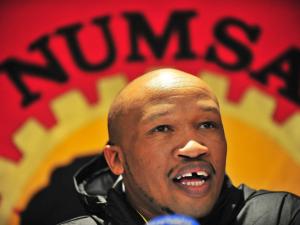
Irvin Jim
Irvin Jim

Yesterday NUMSA, the National Mineworkers Union of South Africa, issued a document replete with Marxist references to the class struggle, calling for the nationalisation of mines in South Africa. It based its policy position on two fundamental ANC documents: the Freedom Charter and the Morogoro Conference of 1969 when the ANC was still firmly tied to the old Soviet Union.

Here follows the whole statement by NUMSA:

White domination persists in South Africa – Irvin Jim

Irvin Jim
08 February 2012

NUMSA GS says without nationalisation black people doomed to remain at bottom of society

Press Statement on the Nationalisation Report of the ANC

“In our country – more than in any other part of the oppressed world – it is inconceivable for liberation to have meaning without a return of the wealth of the land to the people as a whole. It is therefore a fundamental feature of our strategy that victory must embrace more than formal political democracy. To allow the existing economic forces to retain their interests intact is to feed the root of racial supremacy and does not represent even the shadow of liberation.” (Morogoro Conference of the ANC, meeting at Morogoro, Tanzania, 25 April – 1 May 1969)

The National Union of Metal Workers of South Africa (NUMSA) is extremely disturbed and dismayed by the statements made by two ANC Ministers in the Mining Indaba during the course of this week, in Cape Town.

Numsa as part of a Cosatu delegation in the ANC Economic Transformation Committee (ETC) did have the opportunity to see the Nationalisation Report last week but we were not given copies as the Report was embargoed.

We were advised that the Report would be tabled in the ANC NEC and the NEC was to define the process on how the Report was to be circulated in the branches of the ANC and to components of the Alliance for debate in preparing for the coming ANC National Policy Conference.

WE find it very disturbing that the Report has been unofficially released to the media before the structures of the ANC and its Alliance could see it.

We further find it quite unfortunate that two ANC ministers have found it fit to use the Report in support of their private views against nationalisation of mines and other strategic economic sectors. As we show below, the ANC NGC in 2010 was unanimous in support of the nationalisation of mines and other strategic economic assets in the country.

Numsa takes the view that both Minister Susan Shabangu and Trevor Manuel have acted completely without any ANC mandate in deciding to speak for the ANC government and for the ANC and the Alliance that there will be no nationalization of mines and key strategic sectors in the economy. Their unilateral pronouncement goes completely against the ANC’s position which says – it is the ANC who leads government and not government leading the ANC. Numsa therefore reject with contempt their cheap manipulation of our democratic processes in the movement.

We have also noted that in the recent past right-wing global rating agencies have been doing the same in threatening our movement should nationalisation take place. These seek to make sure that there is no fundamental change in the vested Apartheid white monopoly economic interests, thus guaranteeing that black people in general and Africans in particular remain at the bottom of South Africa’s economy and society and detained forever in poverty, unemployment and inequality.

Below we restate in our view, the current and historic position of the ANC and its Alliance on this extremely important matter of nationalisation of mines and strategic economic assets of the country. 

A. Nationalisation and ANC Policy

1. The basic revolutionary socio-economic programme of the ANC is the Freedom. The core tenet of the Freedom Charter states that:

“The national wealth of our country, the heritage of South Africans, shall be restored to the people; The mineral wealth beneath the soil, the Banks and monopoly industry shall be transferred to the ownership of the people as a whole; All other industry and trade shall be controlled to assist the well-being of the people; All people shall have equal rights to trade where they choose, to manufacture and to enter all trades, crafts and professions.”

In this regard we fail to understand the constant refrain that nationalisation is the ANC policy because in our understanding the representatives of our people who gathered in Kliptown in 1955 adopted this policy position of the ANC.

2. The restoration of the wealth of the country to the people is, has been, and will always be, at the heart of the struggle to liberate all South Africans, today and tomorrow. 

3. The transferring to the ownership of the people as a whole of the mineral wealth beneath the soil, the banks and monopoly industry is the basic foundation and only basis upon which lasting peace and a common nationhood can be created in South Africa.

4. To reinforce these fundamentals of the liberation struggle, the ANC at its Morogoro Conference further stated that:

“In our country – more than in any other part of the oppressed world – it is inconceivable for liberation to have meaning without a return of the wealth of the land to the people as a whole. It is therefore a fundamental feature of our strategy that victory must embrace more than formal political democracy. To allow the existing economic forces to retain their interests intact is to feed the root of racial supremacy and does not represent even the shadow of liberation.”

5. The roots of South African racial supremacy would be well nourished if the existing economic forces were to be allowed to retain their interests intact. This is a very self-evident truth. In South Africa, real poverty is black and African, and wealth is white and European.

6. In the 2010 ANC National General Council – the policy forum of the ANC – the Economic Transformation Commission reported thus:

“There was greater consensus in the commission on the nationalisation of mines and other strategic sectors of the economy. The NGC therefore mandated the NEC to ensure further work be done, including research, study tours and discussions, and to report to the Policy Conference for decision at National Conference in 2012.”

7. We have quoted the documents above to show the centrality, the revolutionary significance, of the unchanging core demand of the liberation struggle in South Africa – to return the basic wealth of the country to the people as a whole.

8. All ANC Policy and other documents have always faithfully reiterated this demand. The demand to return the wealth of the country to the people as a whole, including by transferring this wealth into the hands of the people (nationalisation) is a central and defining feature of the ANC. To deviate from this is un-ANC.

B. Revisionism, distortion and vulgarisation of the main strategic objective of the struggle for liberation in South Africa

1. The restoration of the basic wealth of the country to the people was, and still is, the essence, the reason, the strategic objective, of the struggle for liberation in South Africa. Only this could end racial supremacy and Colonialism of a Special Type (CST). Only this could guarantee peace, equality and restore the dignity of all the people of South Africa.

2. It is now clear that long before the 1994 democratic breakthrough, elements of English, Afrikaner and African elites had begun to work very hard to dilute the essence of the struggle for liberation in South Africa, by peddling a version of freedom and democracy that would allow the essential existing economic forces to retain their interests intact. Thus the new South Africa after 1994 was handed down a constitution offering democratic freedoms but in essence made private property sacred in a country in which the majority had no property – to be more precise, the country’s constitution fails to address the land stolen from our people through the 1913 Land Act!

3. Since 1994, we have seen a progressive watering down, weakening and erosion of the essential and basic revolutionary demand of the liberation struggle – the returning of the wealth of the land into the hands of the people as a whole.

4. A very dangerous revisionist tendency is one that simply re-interprets the demand in narrow legalistic and technical terms, and thus attempts to convince us that some of the reforms (charters, taxation, and BBBEE) the ANC government has put in place since 1994 amount to “transferring the wealth of the land into the hands of the people”.

5. A further equally dangerous tendency is simply to vulgarise and distort the core revolutionary demand of the liberation struggle – the demand to transfer all the major wealth of the country into the hands of the people, thus restoring the country to all its people – by simply reducing it to the question of the nationalisation of mines, and even this is further mired in financial and technical obstacles!

6. The core revolutionary demand of the freedom struggle in South Africa is very clear: The national wealth of our country, the heritage of South Africans, shall be restored to the people! It is all the “national wealth” and not just the mines, which must be restored to the people. All other industries must be subordinated to the imperative to develop the people and provide for them. This distortion seeks to diminish and conceal the other wealth which must equally be restored and transferred to the people as a whole.

7. Implicit in the demand is not just the revolutionary need to uproot racial supremacy and restore the dignity of all our people, but also a very strong anti-imperialist demand.

8. A most vulgar postulation is one that simply says after 1994, we are all free to share in the country’s wealth, and it is now each person for themselves and all the government has to do is make the country business friendly. Thus all over the country we find business and enterprise promotion NGOs and sometimes these are assisted by monopoly industries.

C. The persistence of white monopoly capitalism in South Africa, post 1994

1. Anyone with the barest minimum of knowledge about the state of the South African economy and society, 17 years after “democracy” will not fail to notice the persistence of white domination of the economy and society, notwithstanding the small sprinkling of black and African capitalists.

2. The South African economy continues to be dominated by the Minerals/Energy/Finance Complex which is largely white owned. The white population continue to in fact grow their domination of social and cultural life of the country.

3. Poverty and unemployment are largely black, and African, with African females and youths faring the worst.

4. South Africa has become the most unequal place on Earth today. At the bottom, of course are black and African people, and at the top, are white people. The facts to illustrate this are there for all to see.

5. Black and African people are condemned to inferior public sector education and health facilities, while the white population enjoys first world schools, hospitals and shopping malls. Of course the trick today is that there is no Group Areas Act and you are simply told to get on with it as an individual and make your money and you will join the white population!

6. As a result of the lamentable failure to radically restore the basic wealth of the country to the people as a whole, 11 percent of the South African School system accounts for more than 70 percent of Matric passes.

7. An average white male in South African earns anything above R19 000, 00 per month while a black male earns just about R2 400, 00!

8. Ultimately of course, the life expectance of a white person in South Africa today stands at about 70 years, while that of a black person is at 48 years – some 22 years less!

D. The struggle continues, and it is a class struggle!

1. At Numsa we are not surprised that the 2010 ANC NGC Resolutions which clearly indicated that there was consensus on nationalisation are being manipulated and shoved into the dustbin.

2. At Numsa we are not surprised that rather than investigate what the most appropriate forms of nationalisation of mines and other strategic sectors of the economic would be, the ANC Report has done everything to confirm that nationalisation of the mines would be a “disaster” for South Africa. Knowing the dominance of white monopoly capital in general and white mining and financial capital in particular, our political and social life post 1994 we did not expect anything less than this distortion of the ANC NGC Resolutions.

3. Further, we at Numsa do not think that the struggle to restore the wealth of the country to the people as a whole will ever be won via research teams and Conference Resolutions. As a working class, and industrial working class formation our experience teaches us that capital concedes nothing without a fight!

4. Thus we are not surprised that elements deployed by the ANC in government to implement ANC policies have been very busy trying to assure capitalists that government in South Africa does not belong to the ANC and that it is not government policy to nationalise! Those ANC deployees who advocated the neo liberal macro economic framework in 1996 continues to champion a failed and discredited neo liberal policy framework which stands in direct opposition to the ANC’s progressive and revolutionary agenda as contained in the Freedom Charter.

5. The people who voted this government into office suddenly do not exist. This is as it should be, as the dominant class in this country is that of white monopoly capitalists!

6. At Numsa we must serve notice to the people of this country: the black and African working class are fast losing patience at the pace at which their conditions of extreme poverty are being dealt with.

7. The success and sustainability of the 1994 democratic breakthrough in this country rests on the extent and speed of restoration of the wealth of the country to the people as a whole, including transferring the national wealth to the people. Anything less than this is a recipe for disaster.

8. At Numsa we will continue to mobilise the working class and to demand in the revolutionary alliance for the speedy implementation of the entirety of the Freedom Charter.

9. In the ANC Policy Conference Numsa will demand for the restoration of the basic wealth of the country to all the people as a whole.

10. In the National Conference of the ANC this year Numsa will demand the transferring – nationalisation – of the mines and other strategic economic sectors into the hands of the people as a whole. This is what we understand the struggle for liberation, democracy and equality in South Africa to be all about. Anything short of this is a betrayal of all our 100 years of struggle and sacrifice against racist white monopoly capitalism.

Statement issued by Irvin Jim, NUMSA general secretary, February 8 2012