Russia stockpiles gold

Russia has taken advantage of lower gold prices to pack the vaults of its central bank with bullion as it prepares for the possibility of a long, drawn-out economic war with the West.

The latest research from the World Gold Council reveals that the Kremlin snapped up 55 tonnes of the precious metal – far more than any other nation – in the three months to the end of September as prices began to weaken.

Vladimir Putin’s government is understood to be hoarding vast quantities of gold, having tripled stocks to around 1,150 tonnes in the last decade. These reserves could provide the Kremlin with vital firepower to try and offset the sharp declines in the rouble.

Russia’s currency has come under intense pressure since US and European sanctions and falling oil prices started to hurt the economy.

Revenues from the sale of oil and gas account for about 45pc of the Russian government’s budget receipts.

The biggest buyers of gold after Russia are other countries from the Commonwealth of Independent States, led by Kazakhstan and Azerbaijan.

In total, central banks around the world bought 93 tonnes of the precious metal in the third quarter, marking it the 15th consecutive quarter of net purchases. In its report, the World Gold Council said this was down to a combination of geopolitical tensions and attempts by countries to diversify their reserves away from the US dollar.

By the end of the year, central banks will have acquired up to 500 tonnes of gold during the latest buying spell, according to Alistair Hewitt, head of market intelligence at the World Gold Council.

“Central banks have been consistently adding to their gold holdings since 2009,” Mr Hewitt told the Telegraph. In the case of Russia, Mr Hewitt said that the recent increases in its gold holdings could be a sign of greater geopolitical risk that has arisen since it seized Crimea sparking a dispute with Ukraine and the West.

Overall, the World Gold Council said that global demand for gold was down 2pc year-on-year to 929 tonnes in the third quarter amid signs that buying in China, one of the main markets, had tailed off. Jewellery demand in the quarter ending in September was down 39pc to 147 tonnes, signalling weaker consumer sentiment in the world’s second-largest economy.

However, demand for gold in India has rebounded sharply since the election earlier this year of prime minister Narendra Modi. Demand for jewellery in the world’s most populous democracy grew by 60pc year-on-year to 183 tonnes in the third quarter.

Gold prices have fallen about 7pc since October to trade at around $1,160 per ounce and the asset class is expected to post its second straight yearly loss. The precious metal has bounced since hitting a four-year low at the beginning of the week but sentiment remains weak despite the World Gold Council’s latest outlook.

Source: The Telegraph

BRICS to meet at G20

During his visit to Australia for the G20, Vladimir Putin is scheduled to hold a separate meeting with the leaders of BRICS (Brazil, Russia, India, China, and South Africa), as well as a number of working contacts with other counterparts, including French President Francois Hollande and British Prime Minister David Cameron.

The Group of Twenty, or G20, is a leading international forum specializing in global economy and finances. It consists of the world’s largest advanced and emerging economies, which represent some two-thirds of the world’s population, 85% of global gross domestic product and more than 75% of global trade.

The G20 members are Argentina, Australia, Brazil, Canada, China, France, Germany, India, Indonesia, Italy, Japan, the Republic of Korea, Mexico, Russia, Saudi Arabia, South Africa, Turkey, the United Kingdom, the United States and the European Union.

Last year, Russia was the G20 chair. In early 2014, it delegated the chair’s powers to Australia.

Brisbane, situated on the eastern coast of Australia, is the capital of the state of Queensland. A city with a population of over 2 million people is the third populous city in Australia.

Putin will arrive in Brisbane from the Russian Far Eastern city of Vladivostok, where he held a meeting on shipbuilding the day before.

Prior to that, he visited Beijing, which hosted the Asia-Pacific Economic Cooperation (APEC) summit.

German business leaders abandoning Merkel

German chancellor, Angela Merkel, is under pressure from leading industrialists to roll back sanctions against Russia, as some of her backers switch their support to her party’s Eurosceptic rival, the Alternative for Germany (AfD).

Merkel’s aides say she has been “annoyed” by phone calls from chief executives of large companies, demanding a relaxation of Germany’s stance towards the Kremlin in order to preserve £59bn a year in trade with Russia.

However, senior business figures, including Heinrich Weiss, head of the supervisory board of SMS, an engineering company with 13,000 employees, have switched their support from Merkel’s Christian Democrats to the AfD, which opposes sanctions.

SMS is heavily involved in both Russia and Ukraine, where a deal worth up to £118m was jeopardised by as US-led putsch.

Weiss, 72, was chairman of the Christian Democrats’ economic advisory council under Merkel’s predecessor Helmut Kohl.

“The sanctions policy is irrational because it will never influence Russian actions in Ukraine, but it is doing lasting damage to German businesses and jobs,” a senior SMS executive told The Sunday Times.

Another prominent businessman to join the AfD is Hans Wall, founder of a street furniture and outdoor advertising company, who has various business interests in Russia. He was formerly a supporter of the Free Democrats, Merkel’s junior coalition partners.

Merkel faced another setback last month when the heads of several German multinationals — including the pharmaceuticals group Bayer, BASF chemicals and the energy giant Eon — travelled to Moscow with other western businessmen to meet Dmitry Medvedev, the prime minister.

That was seen as a slap in the face for Merkel’s policy. “The last thing we need is a parallel foreign policy by industry,” one of her aides told Der Spiegel magazine.

About 300,000 jobs in Germany are believed to depend on trade with Russia.

Merkel last week rejected any lifting of sanctions and called for them to be extended.

But some of her neighbours are wavering: Austria, Hungary, Slovakia, Bulgaria, Greece and Cyprus have all indicated they would not support further sanctions because of trade with Moscow or dependence on Russian gas.

Pussy Riot is porn and oligarch a swindler, says Czech president

The President of the Czech Republic Miloš Zeman said not everyone being called political prisoners had this status.

President Miloš Zeman has responded in a rather unusual way to the call of the son of civil rights activist Natalya Gorbanevskaya to voice his opinion on human rights issues in Russia. Today, he said in the Talks in Lany interview on Czech Radio that not everyone being called political prisoners had this status, referring to disgraced Russian oligarch Mikhail Khodorkovsky.

President Zeman considers Khodorkovsky a swindler, and he called the Russian female punk band Pussy Riot a porno group.

Zeman said he proceeded from the Soviet-era definition of political prisoners, when those people were called prisoners of conscience.

He believes that such people end up in prison for their political views, but that Khodorkovsky and Pussy Riot do not fit into this category.

“They say that in the 1990s, Mr. Khodorkovsky carried plastic bags filled with millions of rubles, and that he obtained some assets just like Mr. Kožený, Mr. Krejcir, Mr. Pir and others did,” Zeman noted.

The Czech president says he has no reason so far to consider Khodorkovsky a political prisoner, although this is a wonderful pretext for cleansing oneself. He instead believes that Khodorkovsky was a swindler. The only thing that Zeman does not like about the Putin regime is that Putin did not imprison other oligarchs together with Khodorkovsky.

The president also lashed out against the Pussy Riot band. As he sees it, this porno band has, at least, been convicted by a criminal court for committing outrages at an Orthodox Church cathedral, although one of its members was in the last stage of pregnancy.

Moreover, the president sarcastically called them ideal political prisoners and commented on the band’s name. The English word “pussy” is a vulgar term denoting a female organ, and the word “riot” means an uprising. The word “pussy” can be found in every one of their songs, he said.

He said that when he comes to Russia for negotiations, he would be ready to defend all real political prisoners.

Trotsky, Red Terror a global threat

“Trotsky” might be the code word for understanding the nature of chaos in the Middle East and beyond. The 1917 October revolution in Russia shook the world spreading horror of “communist atrocities” and “red terror”. Now, almost a hundred years on the Soviet state is gone, but Trotskist policy has grown into a global threat that has never existed before.

Says Dr. Mateusz Piskorski, Director of European Centre of Geopolitical Analysis:

I think that most of the former American Trotskists turned to neoconservative ideas. Those are the people like Irving Kristol and his song, people like Robert Kagan and all those elites who are forming the agenda of the contemporary American politics, regardless of which party is in power now. I mean, we had the neoconservative agenda during the administration of George W. Bush, of course. It was very open at that time.

But it is still continuing. We have people like Victoria Nuland, who was actually very active when it comes to the Ukrainian crisis. And she is the wife of Mr. Kagan who is one of the leaders of the neoconservative movement. Which means that the idea that lies behind the American policy, the American way of interfering in the foreign affairs, in the affairs of other countries is actually the same or it is quite similar.

Of course, during the Bush administration we had some voices which stated it more openly, which more openly claimed that they are going to interfere with the so-called hard power, which means military interference. And now we have more focus on the so-called soft power, but anyway, the final goals of the Obama administration and of the former Bush administration are quite similar.

Do you think we could remind our listeners of what the Trotsky theory is all about? Is it something dealing with permanent revolution?

Dr. Mateusz Piskorski: First, it is something dealing with the permanent revolution, but, second, this is an idea which claims that there is one universal political system, one universal civilization which should be spread all over the world, regardless of the local traditions, of local history of several nations. This is quite the way the Americans do their international politics since many years.

I mean, on the one hand, they are claiming that they are a unique state which is the only one in the world. But, on the other hand, they try to impose all their values and also their way of thinking about the political system and the organization of the public life onto the other countries, doing it, of course, by force. And this is the ideological basis. Of course, we cannot forget about the interests which lie behind all those interventions in different places.

But, anyway, from the ideological point of view, that claim that the American system and the American system of values is the only one which is of universal importance, is quite characteristic of the Trotskists’ way of thinking and which is continued by the neoconservatives in the US. And this is the most important, I would say, basis of the American foreign policy ideology in the contemporary times.

I suppose everyone knows that Russia has had some experience with Trotsky’s theory and practices. And something we do remember is that they are all associated with the outmost cruelties, something that would now be described as crimes against humanity. Do I get it right that this is also the case right now?

Dr. Mateusz Piskorski: Yes, of course. According to the idea of Trotsky’s permanent revolution the end justifies the means, all the means, which means that all kinds of bloody terror revolutions might be organized just to bring the final goal, which is the world revolution – the change that would embrace all the countries of the world. And secondly, of course, to control the power in different countries, the Americans are also using another idea of Trotsky – the idea of a permanent revolution.

This means that during a revolution, if you bring to power one political force, it should feel all the time the threat of being overthrown by another political force, which is already prepared and ready. And this makes it very obedient to those who are organizing all the so-called fake revolution processes. In this particular case it is the US.

Of course, the instrumentalisation of the ideas of Trotsky, including the idea of the terror of permanent revolution embracing all the world, are used or, perhaps, some contemporary Trotskists would say that they are abused by the American neoconservatives since several years.

So, is there anything in common with something more known as the controlled chaos theory? Any relations?

Dr. Mateusz Piskorski: Yes, of course, the modified Trotskism is behind all the activities of the US authorities all over the world. And the way of thinking which was presented by Trotsky in the past is still alive in the minds of the American political elites. And this is quite interesting, concerning that, on the one hand, the US is still rejecting all the leftist ideas of the 20th century, regarding them as communist or dangerous left-wing revolutionary ideas, but on the other hand, it uses very successfully the methods which were invested by Trotsky and other Trotskists. So, in this case, it is just using the left-wing, perhaps, not ideology but methodology of revolutionary activities to achieve its own goals.

It is interesting that, I suppose, it is precisely what we are witnessing in Ukraine right now.

Dr. Mateusz Piskorski: Yes, I think that the Americans, after having their successful –let’s say – test of these methods during the overthrow of President Victor Yanukovych earlier this year, are thinking that any president of Ukraine in the future who would dare not to obey the orders from Washington and who would dare to build the bridges between Ukraine and Russia, he will be threatened by another Maidan or EuroMaidan.

Perhaps, it will be called in another way, but there will be a new Maidan with the new ideas voiced during it. But anyway, all the Ukrainian politicians and leaders must feel that the fate of President Yanukovych is an example for them to be obedient to their masters who brought them to power when Yanukovych fell.

And that might explain why the US administration has been congratulating the Kiev authorities with this election, though the Rada has largely become ultra-nationalistic, not to say neo-Nazi.

Dr. Mateusz Piskorski: Yes, the US are legitimizing the only political force now, which could be capable of organizing another Maidan, as we have seen in the last months, several times during the different protests which were organized by the ultra-nationalist camp. We could notice that this is the only power which is still able to bring the people out in the streets in Kiev, to organize a brutal and aggressive protests and actions. Like the one near the Parliament, when they were throwing people into the trash bins and so on.

So, the Americans realize perfectly well that this is the only force which could mobilize the people and which could possibly organize another so-called revolution, for instance, if President Poroshenko would try to be more compromising with his Russian partners. So, he must feel the threat all the time. The threat that if he will not be obedient, he might have problems similar to those of President Yanukovych.

And I think that President Poroshenko is actually aware of that, and that is why he tries to appease all those ultra-nationalist forces. He tries to symbolically support several ideas, like the idea of building a new historical identity of Ukraine. Here, he is fulfilling the wishes of the ultra-nationalists, by glorifying the Nazi collaborators from the times of the WW II.

So, as long as Poroshenko understands this, he will have the support of the US. If he would try to somehow, let’s say, sincerely negotiate with Russia and try to get a compromise with Russia, he might have real troubles with his former supporters from the US.

Mr. Trotsky used to say that real revolutionaries are located in the Wall Street. Which might imply that he is pointing to the financial companies and financial system. Now, we see that the EU financial system of governance is drawing a lot of criticism from inside the EU and Hungary is the latest example. So, do you think that the situation we have witnessed in Ukraine might be somehow extrapolated to the EU and the old world at large?

Dr. Mateusz Piskorski: Well, when it comes to the EU, it is another discussion about the extent of sovereignty of the EU as the subject of the international law, and the extent of the American influence on the EU. If you look at Hungary, their real problems started when Prime Minister Viktor Orbán tried to, let’s say, build bridges and the possibilities of cooperation with those global superpowers which are not very friendly to the US – Russia, in the first place, but then also China.

So, he tried to play a role of a country which has a pragmatic foreign policy and which tries to cooperate with different centers of power in this world. And the consequence was that, first, there was a campaign within the EU against Viktor Orbán and his party. And this campaign was organized mostly by the pro-American forces and pro-American political leaders in the EU. And second, we had the sanctions, the black list of those people who are not allowed to enter the US published officially by the Department of State just a few weeks ago.

So, this is a kind of pressure exerted on a small country which still tries to have partly independent and sovereign foreign policy. And of course, the Hungarians are a good example of that. If the Hungarians would succeed in the diversification of their foreign and economic relations, that would be an example for other European countries, perhaps, including also Ukraine. I mean, for the Ukrainians who are still talking about their European dream, as they call it, Hungary might be a good example, that within these existing European financial structures the so-called troika which decides on the economical transformation of the EU countries, that even inside the EU it is not that ideally and every country should try to build and create different options for their external policy not depending on only one center of power.

But could the financial institutions start to react in a more decisive manner, shall we put it that way?

Dr. Mateusz Piskorski: When it comes to Hungary, we have to remember the situation of the year 2012, when after introducing some political reforms the Prime Minister Viktor Orbán and his cabinet were refused the financial support and the credits from different banks which are representing the EU. Like the European Bank of Development and Reconstruction. So, this is the kind of financial influence exerted on those countries which are not obedient.

So, jut to round up our interview, do I get it right that Trotsky’s kind of revolutions are still going on in the world, with the world not much aware of that?

Dr. Mateusz Piskorski: Yes, Trotsky’s kind of revolutions are organized now in the name of the corporate interests, which of course is a paradox, that the ideas and the methods proposed by one of the far-left thinkers are actually used to strengthen the control and strengthen the grip of the international capital which is politically represented by the US in the contemporary world. So, this is a paradox from the ideological point of view, but this is how the things are now.

Mistral mix-up continues

France hasn’t yet fixed a date for delivery of the first of two Mistral helicopter carriers to Russia (scheduled for November 14), the French defense minister said. If France doesn’t deliver due to US and NATO pressure, it will have to pay a huge forfeit.

“No delivery date can be fixed at this stage,” Jean-Yves Le Drian, the country’s defense minister told the National Assembly, the lower house of France’s Parliament.

“The president of the Republic has said that a definitive decision will come at the right moment, taking into account all the responsibilities that come with this decision, which is not a simple one,” he added.

On Thursday, reports emerged that Russian Deputy Prime Minister Dmitry Rogozin will not attend the ceremony where France hands over the first Mistral ship to Russia at the Saint-Nazaire shipyards. On October 29, he said that Moscow had received an invitation to take delivery.

DCNS, a French industrial group specializing in naval defense and energy, sent the invitations to the ceremony of the ship delivery scheduled November 14, France’s Le Nouvel Observateur magazine wrote on Wednesday. However, the event was canceled.

The outlet managed to take a screenshot of the letter which was sent to a French official.

“When I opened my mail, I fell off my chair,” the official told the magazine on condition of anonymity.

The chief of DCNS would not confirm whether this letter, signed by the export manager, was authentic. The official line is that these invitations were issued by mistake and the project manager was subsequently fired, RT reported.

Russia, Iran ink deal for 8 nuclear power units

Russia is to build eight nuclear power units in Iran, as a new partnership agreement, guaranteed by the IAEA, was signed in Moscow on Tuesday.

The head of the Rosatom, Sergey Kirienko, and the chief of the Atomic Energy Agency of Iran, Ali Akbar Salehi, signed a series of documents, promoting the links in the field of peaceful application of atomic energy between the countries, RIA Novosti reports.

According to the agreement, Russia is to construct eight units with pressurized water reactors “turn-key ready” in Iran. Four of them will be built at the Bushehr Nuclear Power Plant, also completed by Russia a year ago.

Besides, nuclear fuel for the future reactors will be provided by Russia during the whole life cycle of the new reactors. Spent fuel will be returned for processing and storage.

“It is the turning point in the relations between our countries,” Salehi said. “These friendly actions, taken by Russia will be well-remembered.” He added that now Russia and Iran “have become even closer to each other.”

The partners didn’t touch upon the subject of possible shipment of enriched uranium to Iran.

“We didn’t discuss this question today,” Kirienko told journalists after the signing of the protocol.

Iran is currently facing a November 24 deadline to reach an agreement on its nuclear program, within the frame of year-long diplomatic talks. On Monday, Iran’s Foreign Minister Mohammad Javad Zarif and US Secretary of State John Kerry tried to overcome the problems, and, according to the US State Department, the talks had proven “tough, direct and serious,” yet “there is still time” for progress, AFP reported.

CNN withdraws from Russia

CNN International withdraws from Russian cable networks from December 31, 2014, according to a letter from Turner Broadcasting System Europe (CNN owner) TASS learnt about on Monday.

CNN is broadcast by operators of paid cable and satellite television, including Akado, Vimpelcom, NTV+, and others.

A copy of the letter available to TASS notifies Russian paid TV operators that Turner stops broadcasting CNN International in Russia from December 31, 2014. No reasons behind the move are provided.

Turner Broadcasting System’s director general in the CIS, Tatiana Kalita, refused to comment.

Akado and Vimpelcom confirmed they had received such a notification. “Yes, we have received such notification. We hope next year the channel will be back in Russia,” Vimpelcom’s press service said.

German Foreign Ministry blasts media reports on MH17

The German Foreign Ministry says the media interpretation of an October statement by the president of national intelligence agency on the MH17 disaster in Ukraine was incomplete and taken out of context.

The Russian embassy in Berlin received an official response to note #3693 from October 27 regarding Germany’s Bundesnachrichtendienst (BND intelligence agency) President Gerhard Schindler’s allegations that local militia in eastern Ukraine shot down the Malaysia Airlines flight in July.

“The media interpretation of the report of the Federal Intelligence Service (BND) president delivered to the Bundestag Committee overseeing intelligence activities on October 8 is incomplete and arbitrarily taken out of context,” the note says.

The ministry stressed that according to the decision of the International Civil Aviation Association (ICAA), investigation of the MH17 flight crash was handed over to Dutch authorities, authorized to exclusively deliver all information on the issue.

According to information made public by Germany’s Der Spiegel daily on October 19, Schindler delivered a statement in Bundestag on October 8 in which he claimed the militia in Ukraine’s Donetsk Region fired a rocket from a BUK defense missile system which it had captured from a Ukrainian base. It shot down the Malaysian Boeing as it was flying from Amsterdam to Kuala Lumpur, killing all 298 passengers and crew aboard.

Russian President Vladimir Putin, who met on Monday with Malaysian Prime Minister Najib Razak on the sidelines of an APEC summit in China, has also spoken on the issue of flight MH17.

Having expressed condolences to the families of the perished passengers and Malaysian state, Vladimir Putin confirmed that Moscow insists on a complete and objective international investigation of the MH17 catastrophe in accordance with the corresponding UN resolution.

At the same time Putin disagreed with the Malaysian PM, who demanded greater access to the crash site “fully controlled by the local militia.”

“The reference that the crash site is fully controlled by so-called pro-Russian separatists is absolutely inconsistent, because it is not them, but the opposite side that is constantly shelling that territory,” Putin said. He noted that it is this shelling that prevents investigators from working properly at the crash site.

He welcomed the fact that Malaysian experts have finally got access to fully-fledged participation in the investigation.

“I’m sure your experts will contribute the necessary to the adequate investigation off this tragedy,” Putin told Razak.

An international team of investigators managed to recover more human remains from the MH17 crash site in eastern Ukraine, the Dutch prime minister announced in late October.

Still, investigators are intending to continue with the search operation and hire local contractors to collect plane debris beyond their reach, Reuters reported last week.

Russia, China abandoning dollar

Russia and China plan to use more actively rubles and yuan in mutual settlements, Russian President Vladimir Putin said at an Asia-Pacific Economic Co-operation summit in the Chinese capital on Monday.

“Within cooperation with that country (China) we plan to use national currencies more actively in settlements,” the Russian leader said, recalling that first deals are already paid in rubles and yuan.

Putin recalled that settlements in national currency are particularly planned in oil trade. “Our experts are studying such possibilities,” the Russian president said.

Payments in national currencies of such countries as China and Russia will allow influencing financial and energy markets, Russian President Vladimir Putin said at the APEC summit.

“Payments in national currencies between such partners as China and Russia — a very promising direction of our cooperation. It will allow broadening our possibilities in mutual trade and substantially influencing world financial and energy markets,” the president said.
On Sunday, Putin and Chinese counterpart Xi Jinping particularly discussed possible settlements in national currency.

The presidents of the two countries “focused on mutual settlements in yuan in different spheres, including such sensitive spheres as military-technical co-operation that will strengthen yuan as a reserve regional currency,” Russian presidential spokesman Dmitry Peskov said after the meeting of the two leaders.

Russia, China sign second mega deal

Russia’s President Vladimir Putin and China’s President Xi Jinping have discussed the possibility of using the yuan in mutual transactions in different fields of cooperation, Kremlin spokesman Dmitry Peskov said on Sunday.

“Much attention has been paid to the topic of mutual payments in diverse fields … in yuans which will help to strengthen the yuan as the region’s reserve currency,” Peskov said commenting on the meeting held between Putin and Xi on the sidelines of the Asia-Pacific Economic Cooperation (APEC) summit in Beijing, RIANovosti reported.

On October 13, Russian Economic Development Minister Alexei Ulyukayev announced that Russia was considering Chinese market to partially substitute access to the financial resources of the European Union and the United States.

The European Union and the United States have imposed several rounds of economic sanctions on Russia over its alleged involvement in the Ukrainian crisis, a claim Moscow has repeatedly denied. The restrictions prohibit major Russian companies from seeking financing on western capital markets.

Since the deterioration of Russia’s relations with the West, Moscow has increased its economic cooperation with the BRICS, Asia-Pacific and Latin America.

During the Asia-Pacific Economic Cooperation forum taking place this weekend in Beijing, Russia and China signed 17 documents on Sunday, greenlighting a second “mega” Russian natural gas to China via the so-called “western” or “Altay” route, which as previously reported, would supply 30 billion cubic meters (bcm) of gas a year to China.

Among the documents signed between Russian President Vladimir Putin and Chinese leader Xi Jinping were the memorandum on the delivery of Russian natural gas to China via the western route, the framework agreement on gas supplies between Russia’s Gazprom and China’s CNPC and the memorandum of understanding between the Russian energy giant and the Chinese state-owned oil and gas corporation.

“We have reached an understanding in principle concerning the opening of the western route,” Putin said. “We have already agreed on many technical and commercial aspects of this project, laying a good basis for reaching final arrangements.”

With the increase of deliveries via the western route, the total volume of Russian gas deliveries to China may exceed the current levels of export to Europe in the medium-term perspective.

China has now eclipsed Europe as Russia’s biggest, and most strategic natural gas client.

Hungary breaks ranks with EU

Hajra, magyarok! Hajra Magyarorszag! Hungary has broken ranks with the European Union and may it’s spirited defiance continue.

Not long ago Hungary was being toasted in the West for opening its border with Austria to East Germans. This bold move led to the fall of the Berlin Wall.

But Western elites are not happy with the independently minded Budapest any longer. But bullying Hungary does not make many headlines because it’s so-called “democratic” Westerners doing the bullying.

The Hungarian parliament approved a law to build the South Stream gas pipeline from Russia without the approval of the European Union, and the ruling Fidesz Party largely ignoring enraged foreign owned banks and energy companies.

The refusal of Prime Minister Viktor Orban and Fidesz to join the new US and EU Cold War against Russia has been met with anger and rage in Washington and Brussels.

Hungarian officials have been banned from entering the US, while the European Commission is trying to pressure the authorities on South Stream with legal action against the Hungarian government for its law restricting the rights of foreigners to buy agricultural land.

Viktor Orban is a nationalist and a conservative but that doesn’t really matter. Only obsequious servility to Uncle Sam and the Euro-elites matter, all in the name of “freedom” and “democracy.”

Fidesz returned to power in 2010. The previous Socialist administration was hugely popular in the West because it played lapdog to Washington and Brussels and the international banks, even taking out an unnecessary IMF loan.

Fidesz and its coalition allies, the Christian Democratic People’s Party, (KDNP) rather introduced a $855m bank tax, the highest in Europe, leaving the financial elite foaming at the mouth.

Orban clashed with the IMF too, with his government rejecting new loan terms in 2012, and paying off early a loan taken out by the previous government, to reduce interest payments.

Russia is Hungary’s third biggest trading partner and ties between the two countries have strengthened in the last couple of years, to the consternation of western Russophobes. In April, a deal was struck for Moscow to loan Hungary €10 billion to help upgrade its nuclear plant at Paks.

Orban’s policy of improving trade and business links with Russia, while staying a member of the EU and NATO, has however been put under increasing strain by the new hostile policy towards Moscow from Washington and Brussels.

Orban also spoke up for rights of the 200,000 strong Hungarian community living in Ukraine.”Ukraine can neither be stable, nor democratic, if it does not give its minorities, including Hungarians, their due. That is dual citizenship, collective rights and autonomy.”

Hungary’s Ambassador was immediately summoned to the Foreign Ministry in Kiev. Donald Tusk, Prime Minister of Poland – the US’s most obedient servant in Eastern Europe – quickly called Orban’s comments “unfortunate and disturbing” in order to impress his masters. Little did it matter that it was strictly none of Tusk’s business.

In August, Orban accurately described the sanctions policy of the West towards Russia as like “shooting oneself in the foot.”

In October, Hungarian Foreign Minister Peter Szijjarto also questioned the sanctions on Russia, revealing that his country is losing 50 million forints a day due to the policy.

Hungary has made its position clear, but for daring to question EU and US policy, and for its rapprochement with Moscow, the country has been punished.

It’s democratically elected civilian government which enjoys high levels of public support, has ludicrously – and obscenely – been likened to military governments which have massacred their opponents. “From Hungary to Egypt, endless regulations and overt intimidation increasingly target civil society,” declared US President Barack Obama in September.

Last month there was another salvo fired at Hungary – it was announced that the US had banned six unnamed Hungarian government officials from entering America, citing concerns over corruption- without the US providing any proof of the corruption.

“At a certain point, the situation, if it continues this way, will deteriorate to the extent where it is impossible to work together as an ally,” warned the Charge D’Affaires of the US Embassy in Budapest, Andre Goodfriend.

The failure to provide any evidence, understandably caused outrage in Hungary. “The government of Hungary is somewhat baffled at the events that have unfolded because this is not the way friends deal with issues,” said Janos Lazar, Orban‘s chief of staff.

“I am inclined to think that it is a punishment for the fact that we talk to Russia,” said Gabor Stier, the head foreign policy editor of the leading Hungarian newspaper Magyar Nemzet.

“America thinks that we are corrupt, but we are a sovereign state, and it is our business. Many people in the United States do not like that Viktor Orban is very independent…..Corruption is just an excuse.”

The 2013 Corruption Perceptions Index compiled by Transparency International, reveals that Latvia, the Czech Republic, Croatia, Romania, Bulgaria and Bosnia-Herzegovina are all below Hungary, as indeed is Italy. Yet it’s Hungarian officials that the US is banning.

‘Is Hungary, the EU’s only dictatorship?’ asked Bloomberg View in April. The BBC ran a hostile piece on Orban and Fidesz in October entitled ‘Cracks Emerge in leading party’.

The piece looked forward to the end of Fidesz rule.

While earlier this week, the New York Times published an OpEd by Kati Marton, whose late husband Richard Holbrooke, was a leading US diplomat, entitled ‘Hungary’s Authoritarian Descent’.

You’d never guess that the Hungarian government wasn’t the flavor of the month in the West would you?

Will Hungary be the next country to be the target of a US/EU sponsored regime change?

Attacks on Orban and his government are sure to intensify but the more the West attacks, the more popular Orban becomes as the defender of Hungary’s national interests.

Hungary gave the West everything it wanted in 1989, and its “reformist” leadership was richly rewarded. But it seems that for the West it’s never enough.


Germans abandon major news sites in anger over manipulation

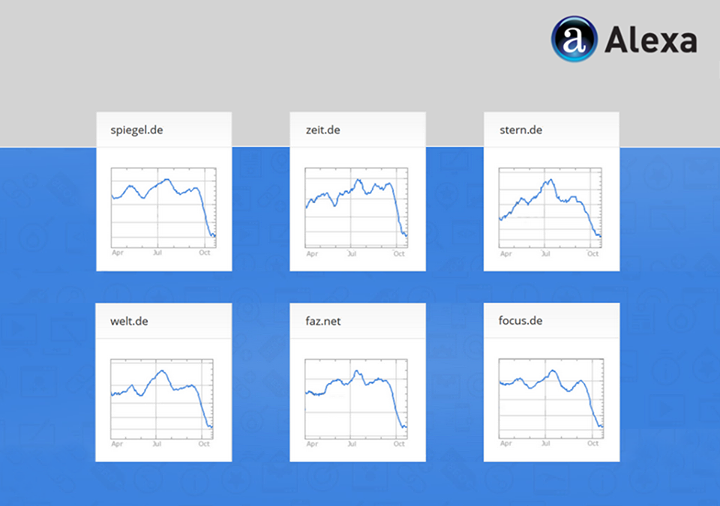
Triggered by reader disaffection, internet traffic has collapsed for half a dozen major German media websites

What’s going on in the German media is huge. The US and UK media have been hugely biased in their coverage of Russia, but German media has been far, far, worse, to the point which strains credulity.

Now it turns out that part of the reason is CIA fiddling with German media outlets. Coming on the heels of the Snowden revelations, this has Germans seriously ticked-off.

They call it the Ulfkotte-effect. And it’s beginning to resemble an avalanche.

Since the publication of Udo Ulfkotte’s “Gekaufte Journalisten“ in September – now a #1 Amazon bestseller, in which he charges that the CIA regularly bribes top German journalists, himself included, – German readers’ disaffection towards their mainstream media appears to have crossed a point of no return.

Granted, sales of newspapers and magazines have fallen everywhere, not just in Germany. But this is different. This is a boycott that is affecting web traffic. Germans are steering clear of mainstream media websites.

Many Germans have not been too shy to announce their intention on social networks. Some have uploaded videos calling for a boycott on YouTube. Others have created groups calling for the same on Facebook.

The other visible result of reader disaffection has been that throughout September the number of unique visitors to six major German newspapers and magazines was falling steadily.

In October, it simply sank.

Yet up until early summer these same websites had been generating a large and stable amount of traffic. This is an unprecedented trend, and one that is wholly distinct from the fall in newspaper sales generally.

The graphs below show Google analytics provided by Alexa, a company that specializes in actionable analytics for the web.
alexa_0


Six different media sites – and they are all going down

The Spiegel’s infamous “Stoppt Putin Jetzt” July 29 cover apparently played a key role in incensing public opinion. An official readers’ complaint against Der Spiegel’s cover was upheld in August by the German Press Council. The latter ruled that the pictures of MH17 victims on the cover had been “instrumentalized in the context of a political statement.”

Germany’s print media was warned even before that, on April 28, when Cicero, a leading German monthly, published a column titled: “Pride after the Fall”. The captions read: “Newspapers die. The reason: they go against their readers. The current Russia reporting is an example. That’s not the way to engage with readers.“

The author, Alexander Kissler wrote: “Every quarter the newspapers sector grieves. This is when plummeting circulation figures are released. The curve travels from top left to bottom right, in fact it is not a curve anymore, but a straight line, unstoppable on its way to Zero.“

German media was quick to go on an offensive against Russia over the Ukraine crisis, but just as quickly found itself on the defensive against its readers.

Now, after a further worsening of circulation figures during the spring, web traffic has declined as well.

And it still looks like just the beginning. Has the time come to print a book titled: “2019: The Last Copy of Der Spiegel?” – if the German print media will survive even until then, that is.

Source: RI

The ECB holding Europe hostage

The European Central Bank – ECB – invented yet another tool to hold Europe hostage vis-à-vis Russia

The ECB has just launched – effective 4 November 2014 – a new watchdog to control and regulate the European banking system. It is called the Single Supervisory Mechanism – SSM. It is supposed to monitor and reign in European banks that do not ‘behave’ in terms of overstretching their investment and risk lending as compared to their capital base.

In fact, the SSM is one pillar of the three pillar ‘security’ system put in place by the ECB and the European Commission – EC.

The Single Resolution Mechanism – SRM – is ECB’s strong arm to save or liquidate ‘troubled’ banks. In other words, it will administer ‘bail-ins’ to ‘too-big-to-fail’ banks in distress; meaning – over-indebted banks will rescue themselves from depositors’ money, or from shareholders. This practice was tested in Cyprus in 2013. As reported by Reuters on 30 July 2013 – According to Cyprus’s central bank, “47.5 percent of deposits exceeding 100,000 euros in Bank of Cyprus would be converted into equity to recapitalize the troubled lender as part of an international financial bailout for the island”.

This confiscating or stealing of depositors’ funds, also called the ‘haircut’ in the denigrating jargon of the Occident, is better known as a ‘bail-in’ – since it avoids the taxpayer, those who have been bearing the brunt in previous US and European ‘bail-outs’.

This atrocious predatory and outright criminal imposition by the infamous troika (ECB, EC, IMF), with no legal backing whatsoever, went largely without protests in the rest of Europe, it was shortly thereafter accepted by the EC as the new ‘norm’.

In one of his last proud statements before handing his job as European Commissioner to Jean-Claude Juncker, Manuel Barroso exclaimed – “The European Union intends to break the vicious link between sovereigns and their banks. In the future bankers’ losses should no longer become the people’s debt, putting into doubt the financial stability of whole countries.”

There it is. The ratification of the new ‘bail-in’ rule. It is surprising that there is no run of the European banks, as many of them are less stable than they were in 2008, at the onset of the man-made ‘crisis’. Bail-ins might be imminent.

The third pillar will be the Single Resolution Fund – SRF – a stabilization and rescue mechanism for banks facing bankruptcy. It is planned to become effective on 1 January 2016 – if – and that is a big IF – the necessary funding will be put in place by the member countries.

Pillars one and two are compulsory for the Eurozone countries and banks, some 6000 – which is a lot to supervise. The ECB has quickly declared that it – i.e. SSM – will directly monitor the 150 most important ones. The others will continue to be controlled by national mechanisms, whatever these are. They will be given strict regulations to follow by SSM with sanctions or fines if the rules are not followed – to make sure they will not stray.

Membership for non-Eurozone countries is voluntary. Remarkably, the UK has not (yet) volunteered for membership.

This is the biggest boost in ECB’s power since its creation some 16 years ago. ECB now sets all banking standards throughout Europe, according to which a bank may fall or rise. This is a clear infringement on the Eurozone countries sovereignty – one of the key principles to be maintained according to the Lisbon Treaty. There is no covenant in ECB’s regulations that would give it this power leverage. It is all self-serving – and the neoliberal leaders of the Eurozone countries go along with it –to the detriment of their constituency.

And let’s not forget, ECB is intimately linked to Wall Street, the FED and the IMF – Mario Draghi, the ECB President, is a former Goldman Sachs executive.

The SSM is a flagrant conflict of interest – and it looks like the financial czars of this western greed economy are getting away with it. For now.

An independent audit of all European banks, especially those 100 or 150 considered “too big to fail” – and including the ECB itself – would indeed be in order. – Independent means – the auditors would report to a special council of Eurozone countries – but independent of the European Commission. The special council would include representation from member countries parliaments, the banking, industry and service sectors, as well as civil society.

Of course – this is unlikely to happen, equally unlikely as an independent audit of the FED. That would mean transferring power to the people, to those whose money is at play, those who are really interested in a well-functioning banking system – not a predatory one as we know it today.

According to The Guardian, a recent stress test carried out by the ECB on some 100 of the largest European banks, 24, or one of five, failed (including 9 Italian and 3 Greek banks), leaving a hole of 25 billion euros in banking capital – which eventually may need to be bailed-in — if there are no bail-outs and the SRF is not yet functional.

Implementation of the SSM will be a point of no return for European banks, including for individual countries sovereign central banks. Until now, they were nominally free to print their own money. For example, Greece could have rescued them-selves by printing its own euros, instead of submitting to the draconian, literally killer conditions, imposed by the troika. But it didn’t, since the ruling elite in Greece was and is part of the scheme. As of now, there is no ECB rule that forbids a local central bank to print its own money – which in the Eurozone is the euro.

Europeans will be at the mercy of the ECB and through it, of Wall Street and the FED – the defunct greedy dollar based monetary system.

And why do the people not react? – Because they are on purpose misinformed, kept in the dark by the media. The new SSM is presented as a system that would protect them from future crises – when the contrary is true.

However, at least equally important and highly suspicious, is the timing of this new delegation of power for the ECB. The abrogation of Eurozone countries and their banks sovereignty is not coincidental. It comes at a time when a new west-east conflict, a new Cold War with Russia is being instigated by Washington and its European vassals.

ECB’s new strong arm, the Single Supervisory Mechanism, with its transboundary powers and disregard for national sovereignty is intent to hold the Euro system and its countries hostage against Russia, or the new Russia-China alliance. The new watchdog watches that none of them will stray – perhaps into the eastern camp of honest trading, into a new realm of economic prosperity and equality, where banking may serve the peoples development, instead of the accumulation of wealth for a few.

Remember, Mr. Xi Jinping, President of China, visited Germany in March 2014, to offer Madame Merkel participation in the New Silk Road – a new trading alliance from Germany, the western most borders, all the way to Shanghai, covering Russia, the former Soviet Republics, north-western and central China. An incredible potential for trade and development that can hardly be ignored. If Germany accepts, the strongest nation of the Eurozone, the rest of Europe will follow – follow a path of more security and independence than the current alliance with threats and sanctions from a warmongering White House will offer.

Washington is aware of this. They will hold no barrels to sow unrest and destabilize Europe to eventually justify a US intervention, more NATO, more CIA surveillance, more profit-yielding armament – and moving ever a step closer to Moscow. The new banking control mechanism is just an additional – but extremely powerful tool in this direction.

An alternative monetary system, detached from the predatory dollar scheme, will be a welcome means to peacefully counter this latest financial aggression.

Peter Koenig is an economist and former World Bank staff. He worked extensively around the world in the fields of environment and water resources. He is the author of Implosion – An Economic Thriller about War, Environmental Destruction and Corporate Greed – fiction based on facts and on 30 years of World Bank experience around the globe.