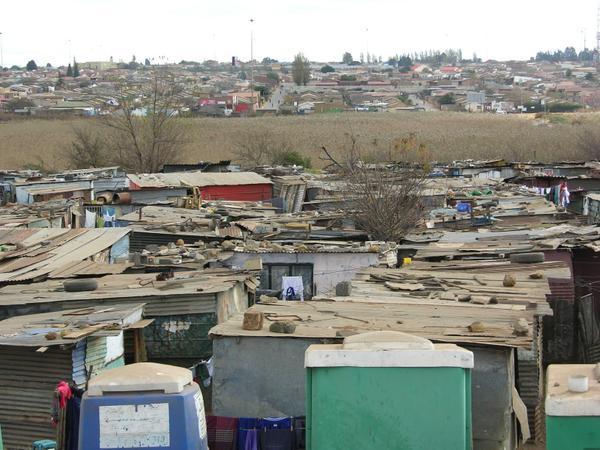
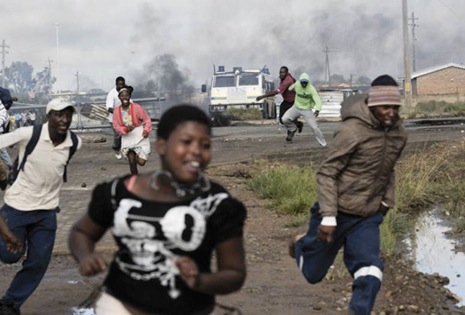
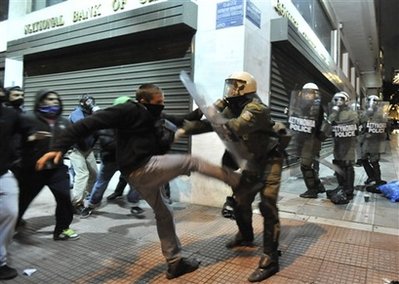
Violent service delivery protests erupted on Wednesday in the Protea area outside Randfontein, said police.
Warrant Officer Kay Makhubela described the scene as chaotic as hundreds of community members from the Waterworks informal settlement clashed with police.
“Police are firing rubber bullets at the protesters. We also have our nyalas and choppers on the scene but these protesters are attacking police,” said Makhubela.
Riot scene in South Africa
He said the demonstrators were throwing stones and rocks at police and motorists making their way past.
“The N12 road from Potchefstroom and Randfontein and Impala Road has been closed. We advise motorists to use alternative routes,” said Makhubela.
The protests began at around 2am. No arrests had been made.
Makhubela said no injuries had been reported thus far.
Earlier, the metro police department said the protests were in Zuurbekom.
Egypt’s military-backed rulers are pressing on in their crackdown against the Muslim Brotherhood with the arrest early Tuesday of the group’s spiritual leader who had been in hiding near the huge sit-in in support of the country’s ousted Islamist president, which security forces violently dispersed a week ago, leaving hundreds dead.
The arrest of Mohammed Badie – the supreme leader of the Brotherhood, the Islamist group from which ousted president Mohammed Morsi hails -followed a chaotic day of bloodshed that saw 25 policemen killed in a militant ambush in Sinai and a court ruling announcing the possibility that the jailed ex-president Hosni Mubarak could walk free later this week.
Mubarak’s release could fuel the unrest roiling the country after Morsi, Egypt’s first democratically elected president and the autocratic Mubarak’s successor, was removed in a military coup on July 3.
Underscoring the growing anger over Morsi’s ouster, suspected Islamic militants on Monday ambushed two minibuses carrying off-duty policemen in Egypt’s Sinai Peninsula, forcing the men to lie on the sand and shooting 25 of them dead.
The brazen daylight attack raised fears that the strategic desert region bordering Israel and the Gaza Strip could be plunged into a full-fledged insurgency.
Badie was captured early Tuesday in an apartment in the eastern Cairo district of Nasr City, according to security officials and state television, very close to where Morsi’s supporters held a six-week sit-in protest that was cleared by security forces last Wednesday.
The private ONTV network showed footage of a man the network said was Badie after his arrest. In the footage, a somber looking Badie in an off-white Arab robe, or galabiyah, sits motionless on a sofa as a man in civilian clothes and carrying an assault rifle stands nearby.
Badie and his powerful deputy Khairat el-Shater, who is in custody, go on trial later this month for their alleged role in the killing of eight protesters outside the Brotherhood’s Cairo headquarters in June. His arrest is a serious blow to the group at a time when authorities are cracking down on its leaders and mid-ranking officials, detaining scores of them across the country.
The officials spoke on condition of anonymity because they were not authorized to speak to the media.
Late Monday, the 25 slain police officers were given a funeral with full military honors. The men’s coffins, draped in red, white and black Egyptian flags, were jointly carried by army soldiers and policemen, and Egypt’s interim President Adly Mansour declared a nationwide state of mourning to mark their deaths.
Mubarak, 85, has been in detention since April 2011, two months after he was ousted in a revolution against his rule.
He was found guilty and sentenced to life in prison last year for failing to stop the killing of some 900 protesters in the 18-day uprising. His sentence was overturned on appeal and he is now being retried, along with his security chief and six top police commanders.
Two judicial officials said Mubarak could walk free this week or next after a criminal court on Monday ordered his release in a corruption case in which he and his two sons were accused of embezzling funds for the maintenance of presidential palaces. His sons were ordered kept in custody.
Monday’s ruling, along with the fact that Mubarak had previously been ordered released in the killings of the protesters opened the possibility of freedom for the former president, the officials said, speaking on condition of anonymity because they were not authorized to speak to the media.
There will no longer be any grounds to hold him if a court accepts a petition by his lawyer requesting his release in a third case later this week or next.
But freeing Mubarak, widely hated for widespread abuses and repression during his 29 years in power, during one of the worst bouts of turmoil since his ouster would be a huge risk for the military-backed government.
It could lend credibility to allegations that the mass protests that preceded the July 3 coup that toppled Morsi were the work of Mubarak-era figures searching for a way to reinstate the former regime.
Last week, the military raided two protest camps of Morsi’s supporters in Cairo, killing hundreds of people and triggering a wave of violence that has left at least 1,000 people dead.
Human Rights Watch, in a report Monday, accused Egyptian security forces of using excessive force when they moved to clear the larger of the two camps. The New York-based group said the assault amounted to the “most serious incident of mass unlawful killings in modern Egyptian history.”
It called on authorities to reverse a recent decision authorizing the use of deadly force by security forces when they come under attack or when key government facilities are assaulted.
The Sinai Peninsula has long been wracked by violence by al-Qaida-linked fighters, some who consider Morsi’s Brotherhood to be too moderate, and tribesmen who have used the area for smuggling and other criminal activity. Attacks, especially those targeting security forces, have been on the rise since Morsi’s ouster.
Monday’s attack targeting the police officers took place near the border town of Rafah in northern Sinai. A few hours later, militants shot to death a senior police officer as he stood guard outside a bank in el-Arish, another city in the largely lawless area, security officials said.
There was no immediate claim of responsibility for either attack. The United States condemned the slaying of the police officers and repeated its commitment to help Egypt combat terrorism in Sinai. U.N. Secretary-General Ban Ki-moon also denounced the attack.
The Sinai attack came a day after security forces killed 36 detainees during a riot on a prison-bound truck convoy north of Cairo. The killings came as police fired tear gas to free a guard who was trapped in the melee, security officials said.
The government ordered an inquiry into the deaths, which it blamed on armed men allegedly trying to help the 600 Muslim Brotherhood detainees escape. It gave no details.
The Brotherhood blamed military chief, Gen. Abdel-Fattah el-Sissi, and the interior minister for Sunday’s killings. The group also called for an international inquiry into the deaths.
The United States said it was troubled by the “suspicious deaths” of the prisoners.
“We call on all Egypt’s leaders and the international community to condemn such attacks without equivocation,” said Psaki, the State Department spokeswoman.
Amnesty International demanded a “full, impartial and effective” probe into the events.
Morsi has been held in an undisclosed location since his ouster. On Monday, prosecutors ordered his detention for 15 days in connection with allegations that he conspired to kill and torture protesters during mass demonstrations by the opposition outside his presidential palace in December 2012. – AP
Barack Obama was barely 15 years old when riots erupted in the South African township of Soweto over a circular concerning the use of Afrikaans and other African languages in black schools. Decades later, its residents are preparing to welcome the US president as a “fellow African”.
Obama, now 51, will host a town hall meeting at a university campus as part of his visit to a crucible of the fight against apartheid, which saw protests break out in 1976 that spread across the country.
Although the white nationalist regime was not defeated, the 1976 riots spawned a new generation of black liberation leaders who continued the struggle while senior figures like Nelson Mandela and others languished in prisons.
While hundreds of anti-Obama protesters marched on the US Embassy in the capital Pretoria, 80 kilometres (50 miles) to the north on Friday, many Sowetans were keenly anticipating the visit by the first black US president.
“I want it to be a message of hope. I hope he talks about important things like education and the importance of going to school,” Christopher Mutangwa, a 20-year-old accounting student, said outside the University of Johannesburg’s (UJ) satellite Soweto campus.
“But I also hope that he can learn something about us and what happened here in Soweto during the struggle,” Mutangwa told AFP.
“He should, because I think he is an African.”
While there were few signs of preparation ahead of the highly anticipated visit at the UJ campus, many residents said they planned to line the streets, or watch the event on television.
“I was planning to visit my grandmother … but now I think I would rather go see Obama,” said Sibongiseni Kekana, 22, who makes a living as a struggling artist.
“Maybe I’ll even sell something to him,” Kekana laughed as he showed AFP around his tin shack, which also doubles as his art studio.
“In any case, I hope for inspiration from him,” Kekana said.
But even with Obama visiting Soweto, the continuing illness of South Africa’s own first black president, Nelson Mandela, never strays far from the conversation.
Mandela, 94, spent a third week in the intensive care section of a Pretoria hospital where he is being treated for a recurring lung infection.
After taking a turn for the worse last weekend, Madiba, as he is popularly known by his clan name, has been showing tentative signs of recovery.
— Two generations of black leaders —
With a possible visit by Obama to the ailing statesman on the cards over the weekend, inevitable comparisons are being drawn in many conversations.
“To me, Madiba represents an older and perhaps more traditional generation of black leaders, while Obama represents the new generation,” Tshepo Mofokeng, 43, told AFP.
“I’m sure he will be welcomed here as an African,” said Mofokeng, as he took some pictures on his mobile phone of his children at the Hector Pieterson Museum, which covers the 1976 uprising.
“I just think he (Obama) is sexy,” his wife Nomsa, 36, added with a laugh.
Even though many people will flock to welcome the US head-of-state, not all Sowetans were happy with his presence and demonstrations were planned for Saturday.
“I don’t think it’s a good thing that he’s coming here,” said Freddy Mhaule, 25.
“Especially with him spying on the world,” he added, referring to the recent revelations about PRISM, the US Internet surveillance programme.
“Obama’s visit will have zero impact on us,” said an art vendor, who only wanted to be identified as “Lebo”, at the Hector Pieterson Museum, which commemorates the death of the youth activist, shot dead in 1976 by apartheid police at the age of 12.
“To me he’s just another politician,” Lebo added, as he tried to sell tourists a wooden model of the Soweto home where Mandela once lived, which today serves as a museum. – AFP
Today is 16 June, a public holiday (vacation to our American friends) commemorating the race riots of 1976 in Soweto. Every year I dread the arrival of 16 June, incongruously called “Youth Day”, because it represents the acme of the anti-white propaganda calendar in South Africa.
Even the country’s biggest beer company, SAB Miller, participates in the onslaught, with an “artistic” rendition of the dead Hector Pieterson’s famous photo which you can see lower down here. I will save you the real photo, either because you have seen it many times already, or because we are all aware of how images are debased through constant repetition. You needn’t have read any of the theories of Walter Benjamin or Jean Baudrillard about the loss of authenticity or receding reality to understand that.
US First Lady Michelle Obama visits Hector Pieterson Memorial, 22 June 2011
To South African leftists, black nationalists, radical theologians and persons of that ilk, Hector Pieterson or his image represents common currency. There is even now a Hector Pieterson Memorial which is touted to tourists. It has already been visited by Michelle Obama and will soon be inspected by her husband, Barack, whose first visit to South Africa is imminent. It seems that Chinese tourists go to the Voortrekker Monument while American tourists prefer the Hector Pieterson Memorial. Probably, it speaks to them of their own race riots, as well as the interminable arguments around them and how whites are always, in the final analysis, to blame for black violence and mayhem.
Now get this: Hector Pieterson was shot by a black policeman., not a white one. To the crazed, left-wing propagandists on their crusade against the last vestiges of white or Western civilization, the race of the policeman is immaterial. It suffices that the previous white South African government “made him pull the trigger”, like whites always “make blacks do things” or by some intricate racial dialectic cause them to commit crime, not to do well at school or undermine their value system so they end up taking bribes in positions of authority. According to eyewitness reports, Hector Pieterson, who was supposed to be at school that day but sauntered along to see some of the protest action, simply “wandered into the line of fire” between a large crowd of stone-throwing youths and a small group of policemen defending themselves after the mob had not responded to earlier warning shots fired over their heads.
South African Breweries (SAB Miller) has just published this version of the Hector Pieterson image, as a “positive” message to the multiracial youth of South Africa (Click to enlarge)
The photograph in question was taken by one Sam Nzima who worked for a black newspaper called The World at the time. It shows Hector Pieterson being carried by Mbuyisa Makhubo after being hit by a stray bullet not intended for him. The shooter being black, you could call it “friendly fire” or black-on-black violence. Hector’s sister, Antoinette Sithole, runs beside them and is obviously distressed. Here is the beer commercial version of the photograph which puts an entirely new “spin” on it, as being a message addressed to the multiracial youth of South Africa. Note also that Hector Pieterson has suddenly become white in SAB Miller’s “reworking” of Sam Nzima’s image.
SAB Miller became the second biggest beer company in the world as a result of two things:
The thirst of black South Africans for its products.
The fact that apartheid or white rule in the country placed enough buying power in the hands of blacks to afford so-called “clear beer”, as opposed to the African or “Bantu beer” traditionally consumed by blacks.
Not so long ago, I read someone’s Ph.D. thesis on the role of advertising in post-1994 South Africa and SAB, having the biggest “ad spend” in the country, also did the most “to shape our new identity”.
Until I saw SA Breweries’ appropriation of the Sam Nzima photograph, I had not been aware of how intimately the beer company had been involved in the whole Hector Pieterson cult! Apparently there exists a “shebeen route”, the Soweto equivalent of the Cape wine route, whereby one may visit “The world of beer”, showing a traditional (and in those days, illegal) black tavern or “shebeen”, and then move onto the Hector Pieterson Memorial and Winnie Mandela’s garage museum. After reading Rian Malan’s article in the latest Noseweek, one could safely say that Winnie Mandela has so many skeletons in her cupboard that she needs a garage to put them in. Unfortunately, the article is not available online, but perhaps someone needs to scan and OCR it to make a bootleg or “shebeen copy” available to enlighten the public on the real Winnie Mandela. Nelson Mandela’s wife (they have since been divorced) had 14-year old Stompie Moeketsi murdered but was protected by both the ANC and the dying National Party government from prosecution. Why? Because she was famous. And black, no doubt.
But let’s not digress and keep to our main topic, which is the 1976 race riot, flatteringly referred to by journalists and academics as an “uprising”. An article in the New Age newspaper, written by Zwelinzima L Sizani, an ANC official, is subtitled: “How we lost our fear of the regime in the days leading to June 16 1976 and the events that changed history.” Like SA Breweries, Sizani is also busy appropriating the riot for his party which played a very marginal, if any, role at the time.
Within the mythology of the New South Africa – why our country’s name has not been changed during all the other name changes I do not know – the Soweto riots were the “turning point”. On 16 June blacks “rose up against the white regime” which was “forcing Afrikaans down the throats of black schoolchildren”. In response – or so we are told – the rioters went on the rampage, killed a Jewish doctor caring for their sick, looted some beer halls and burned down government buildings, including some of their own schools.
‘The recent slogan of “Kill a Boer, kill a farmer” represents a prolongation of the Jew-killing, school-burning mentality of 37 years ago.’
I know that in South Africa there exists a certain inversion of values, at least among our ubiquitous leftist commentators and historians. They consider terrorism, which is decried elsewhere in the world, as the apotheosis of virtue. Every time Afrikaans street names are changed, they ransack the lists of past terrorists and killers of civilians for “heroes” to name streets in Pretoria after, such as Solomon Mahlangu. Within this mindset it is perhaps understandable that killing a philanthropic Jew, Dr. Melville Edelstein, and burning schools are considered exemplary acts which we should celebrate every year on a national holiday. With SAB Miller and other big companies tossing in some ad spend to keep the propaganda going.
The recent slogan of “Kill a Boer, kill a farmer” represents a prolongation of the Jew-killing, school-burning mentality of 37 years ago. If the Gauteng education department under Mrs. Barbara Creecy could burn down a few schools, especially Afrikaans schools, they would consider it a great contribution to this country’s intellectual development. No functional school must be left alone, is the revamped version of the slogan of yore: “Liberation before education.”
The Soweto riots of 1976 are used retroactively to justify the extremist racism and chauvinism meted out to Afrikaners today. In 1976, only a small minority of blacks and white English leftists were anti-Afrikaans. Thanks to the constant stream of ethnic hatred and propaganda, a real hatred against Afrikaans exists at present, fuelling farm murders and ethnic attacks.
The notion that anybody in the history of South Africa – or Azania as the Left calls it – has ever been forced to learn Afrikaans or learn in Afrikaans is so preposterous, it is almost laughable. Yet it suits a lot of people to repeat this fallacy mindlessly every year, including the adherents to the creed that Azania is really a British colony that should speak English only. The multiculturalist, anti-Western British Council probably loves it. For 200 years Afrikaans has survived against all odds, being suppressed under the British Empire and now under its successor, the Bantu Empire.
The denial of language rights to Afrikaners is even more pervasive in the twenty-first century than in the nineteenth in the Cape Colony. English has always been “rammed down our throats”, together with the sickening propaganda that our children are forced to learn for exams at school. It includes history, which means ANC history and the biography of Nelson Mendala, and an idiotic subject called “Life Orientation”. Given the preponderance of English in business and in the media, Afrikaans has never been the dominant language in South Africa. Yet in the Life Orientation handbook at school it is stated: “Under apartheid Afrikaans was the dominant language in South Africa.” I suppose we wrote more books than anybody else in this country, which must have been a crime.
One of those prolific Afrikaans writers is Jaap Steyn, a retired professor of linguistics and one of the greatest minds to come out of South Africa. He wrote a 500–page tome on Afrikaans entitled Tuiste in eie taal (At home in one’s own language). The section on the Soweto riots contains some interesting facts:
In only one of the seven Soweto schools protesting against Afrikaans as a medium of instruction in 1976 was the language used as such, and then only in one subject, History;
the English Academy of South Africa was waging a major campaign in black schools to get them to use English, whereas there was no such campaign by any Afrikaans organisation;
unlike a small coterie of white English leftists in Cape Town, Johannesburg and Durban, blacks did not hate Afrikaans. During a competition for school choirs in Soweto, twelve of the sixteen choirs in the senior division sang in Afrikaans and only four in English.
According to Steyn, the economic damage of the riots included the following:
More than 100 buildings of the West Rand Bantu Administration Council were damaged or destroyed;
250 liquor stores and beer halls were looted or destroyed;
170 shops were looted or destroyed;
25 health clinics were burnt down;
8 banks were destroyed;
a number of libraries, post offices, hotels, churches, community halls, magistrate’s courts and gas stations were burnt down;
several 100 vehicles were burnt and up to a third of the 926 buses belonging to the Public Utility Transport Corporation (Putco) were attacked.
While liberals and leftists consider such acts of arson and wanton destruction as “heroic”, the question has to be asked: Why? After all, the ANC government announced only recently that from next year all children in the country will have to learn an African language at school, including white children. No predominantly white and Afrikaans school is preparing to riot and their teachers are not encouraging them to do so.
On 27 June 1976 the editor of the Zulu newspaper, Ilanga, Obed Kunene, wrote in the Sunday Tribune: “Blacks do not destroy facilities… They destroy symbols of the entire system devised by Whites for them… When riots come… all the institutions and services that bear the stamp of White authority become prime targets…”
By the same token, Afrikaners should now be burning every government building in sight, as the reverse holds true: Thanks to their demographic superiority, blacks enjoy political power over us at all levels and decide what is good for us, including what our children should learn at school and in what language they may study at university.
But seeing the Soweto riots as a merely black-white affair, as did the editor of Ilanga in 1976, is simplistic. For long periods white and black have been able to coexist more or less peacefully, but separately, in South Africa. Whenever there was outside interference or incitement of blacks, mayhem broke loose. A deeper analysis of the Soweto riots would reveal the role played by the British Churches such as the Anglican Church and by the so-called Christian Institute, funded by the German churches. They organised and encouraged the Soweto pupils, many of whom were in their twenties as blacks in those days started school at a higher age than whites, to protest and oppose even the study of Afrikaans literature.
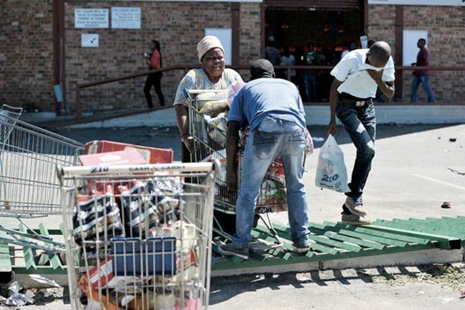
‘Affirmative shopping’ as theft is euphemistically called in South Africa, takes place openly in a supermarket in Sasolburg
The problem with the riot-as-revolt theory is that since the advent of black rule in South Africa, we have had as many, if not more, riots than ever before! When someone had stolen cables along the railroad tracks, making trains late, the historic Pretoria statioin was set alight by blacks. Other trains were burnt out too. Not a day goes by when one does not read about “service delivery protests”. Tyres are burnt and vehicles stoned, similarly to the riots of 1976. Blacks seem to be revolting against their own government and municipalities, which they themselves had voted in. They also burn the same “symbols of oppression” as before: councillors’ homes, community centres, municipal offices, libraries, cars and still loot shops and liquor stores. In January this year, black South Africans exercised their right to loot in Sasolburg, south of Johannesburg and pictures again show burnt-out vechicles and a liquor store being ransacked.
In the United States too, race riots have been a feature of that country’s political life. When the four policemen who had assaulted Rodney King were acquitted in 1992, the Los Angeles riots ensued. During those riots, 53 people were killed and more than 2000 injured. In Britain, France, Sweden and elsewhere, burning and looting have become a way for their immigrant communities to express themselvesA recent modish term in South Africa has been the “grammar of blackness” on which I commented a few days ago in White guilt, Coloured faith. Perhaps riots are the grammar of blackness, as they often seem incomprehensible to the white mind. Winnie Mandela famously said: “With our boxes of matches and our necklaces we shall liberate this country”, the “necklace” being placing a petrol-filled tyre around the victim’s neck and igniting it.
The point to understand is that the burning has never stopped and “liberation” continues to this day.
In the Johannesburg Sunday Times I discovered the following amazing pronouncement this week, on the subject of a name change for Pretoria, our capital: “What we should accept is that victors always rewrite history and ensure their dominance is not only felt but seen.”
I may be alone in this, but I refuse to accept that because we have been conquered by propaganda, we should perpetuate the disinformation ourselves. None of the leftist fairy tale of South African history, including the Soweto riots, will stand up to closer scrutiny. There is no continuous “march to freedom” performed by South African blacks. Between the Rivonia trial where Mandela and his comrades were jailed and the Soweto riots, we discern a discontinuity or “epistemological break”. The Soweto riots must be seen as a more or less isolated event.
Neither is there continuity between the riots and the National Party’s ultimate capitulation and absorption by the ANC. FW de Klerk and Roelf Meyer betrayed their own electorate and supporters in all but surrendering to the ANC. Perhaps they were bribed or influenced by foreign powers, but they took that decision by themselves and for peculiarly idiosyncratic and personal reasons.
Like schoolchildren are fond of saying: “It’s random!” There is nothing in South Africa’s past that made the present nightmare a necessity. The Soweto riots could have been triggered by some other event that may have had nothing to do with Afrikaans at all. Like a Rodney King or soccer violence or the presence of foreign Africans in Soweto. Currently, we are seeing a lot of looting and killing around so-called xenophobia. The shops of Somali traders in black areas are regularly attacked, looted and their proprietors assaulted or murdered. So “liberation” continues.
Michelle Obama has already reaffirmed the myth of Soweto by visiting the Hector Pieterson memorial and no doubt her husband Barack will do the same during his coming visit to South Africa. He has already booked a visit to Mandela’s prison cell on Robben island, off Cape Town.
As in the dystopian novels of George Orwell, we are living through a powerful artificial consciousness, a pseudo-reality fabricated by the mass media, academia and the advertising industry. In this story the rioters are the heroes and Dr. Melville Edelstein or the Afrikaner education officials of Soweto are the villains
It constitutes rule by propaganda, domination by (dis)information. We have seen how Tony Blair lied to the world about weapons of mass destruction in Irak. The truth is what you can get away with. Or as it is bluntly put by the Sunday Times:
“What we should accept is that victors always rewrite history and ensure their dominance is not only felt but seen.”
I wonder what Orwell would have thought about that axiom.
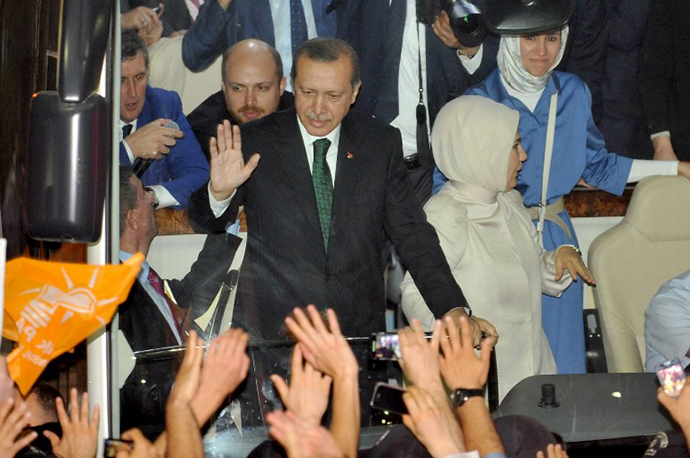
Turkey’s PM has vowed that development of Taksim Square will go ahead, despite ongoing protests. Tayyip Erdogan made the remark in Tunisia on his way back to Turkey. Erdogan is also under scrutiny, with opponents blasting him as authoritarian.
As the protests entered their seventh day, casualties have risen, with three people dead and more than 4,000 injured. What began as an environmental protest against the demolition of Taksim Gezi Park in Istanbul to build a mall has turned into Turkey’s biggest wave of anti-government protest in years.
“There is a problem called Twitter right now and you can find every kind of lie there. The thing that is called social media is the biggest trouble for society right now,” Erdogan said before leaving for North Africa. The Turkish prime minister also slammed the protests as undemocratic, and dismissed them as being organized by extremists.
In their list of demands issued to Erdogan, activists are calling for the firing of the chiefs responsible for the violent police crackdown, the release of protesters detained by police, and for a ban on the use of teargas. If these demands are fulfilled, protesters said they would end the riots.
The period of time after Erdogan returns Thursday from his three-day tour of North Africa is vital for Turkey, as public pressure may force the prime minister to reverse several of his own policies.
So far, Erdogan has only singled out scapegoats in the unrest, RT’s Irina Galushko reported from Istanbul.
He assailed the social networks used by demonstrators to organize protests and post updates; many demonstrators turned to Twitter and Facebook as a mobilization tool, as local media were largely silent during the initial stages of the protests.
However, Deputy Prime Minister Bulent Arinc, who is formally in charge while Erdogan is abroad, apologized on Tuesday for the police brutality against demonstrators. Turkish police have been roundly criticized for their widespread use of teargas and water cannons to disperse crowds of protesters.
Erdogan has been described as a man who rarely bows to opposition, and cannot handle criticism.
“He completely dislikes opposition to his ideas. He takes it as a personal offense. He’s used to having agreement from the country after having gained 50 percent of the votes. This time he didn’t assume the protest would be so big”, columnist and TV host Mutlu Tonbekci told RT.
Journalists Cengiz Candar told Reuters that “Erdogan takes things very personally and has developed a very authoritarian style.”
“Everybody here was being gassed, and people here were trying to resist and trying to keep this park, and he was telling that we are looters and there’s no project going on, and then he changed his mind, saying there’s of course a project and I will do what I want to do,” activist Nazan Ustundag said to RT.
“Our intelligence work is ongoing [to determine the foreign actors behind the protests],” Erdogan said on Monday. “It’s not possible to reveal their names. But we will have meetings with their bosses.”
Conservative Turkish newspaper Yeni Safak reported that foreign mercenaries were among the protesters, according to authorities: “750 to 1,000 people, agents, many of whom are foreign nationals, infiltrated the ranks of the demonstrators, and who are being paid by foreign intelligence.”
As clashes continue, some believe that Erdogan will go to great lengths to avoid embarrassment, as any sign of weakness could break up his party. “Erdogan cannot backtrack now. It would mean defeat,” car dealer Ali Aydin told Reuters. “Weakness would destroy the party.”
The prime minister may also be ill-equipped to dealing with the recent developments. “This is an unprecedented situation for Erdogan. Some people in [the ruling AKP party] think that his policies have to soften, but they remain loyal to party discipline and to Erdogan himself,” Reuters quoted a source close to the AKP as saying.
Many protesters believe that the prime minister has lost touched with reality, and is inflexible and unwilling to compromise.
Erdogan has alleged that hundreds of foreign agents are working to create unrest in the country. He maintains that these agents instigated the protests and are continuing to lurk among the crowds, encouraging dissent and turmoil.
Authorities have arrested some 15 foreign nationals across the country in connection with the protests, Today’s Zamaan newspaper quoted an unnamed governmental source as saying. Many were reportedly Iranian nationals, a country on Erdogan’s blacklist.
Despite the widespread protests, Erdogan remains a popular politician. He is known for his assertive leadership style, and his AK Party holds around two-thirds of the seats in parliament. But a key question remains: How will he handle the protests that are continuing to rock Turkey?
Erdogan is famous for his concrete human rights reforms, including granting rights to the country’s Kurdish minority, the opening of European Union entry talks, and a separation of the government and military. He has lately faced criticism for pressuring the media and for restrictions on alcohol sales.- RT
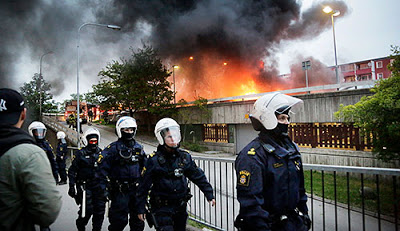
Automobiles were torched and police confronted stone-wielding youths in Stockholm’s suburbs early Sunday as riots, which erupted following reports that police had killed an elderly immigrant, enter their first week.
Pockets of violence and vandalism continue to pose a challenge to police in Stockholm, the Swedish capital that is home to an increasingly diverse 2 million residents. “When it comes to car fires, there have been a few, spread out in various locations, but not as many as in recent days,” Stockholm police spokesperson Lars Bystroem told Swedish Radio.
In Vaarberg, a suburb south of Stockholm, police were attacked by stone-throwing youths, while in Jordbro, another southern neighborhood, police resorted to teargas as they met resistance while attempting to arrest several individuals, AFP reported.
Violence has broken out in other parts of the country as well. In Orebro, a town in central Sweden, some two dozen masked youths set fire to three cars and a school and attempted to torch a police station, Reuters reported, citing police. About 200 km (124 miles) to the southwest in the city of Linkoping, several vehicles were set alight and youths tried to torch a school and a kindergarten.“With the strong presence on the streets of the good forces, and the police reinforcements, I think we are well on our way towards calmer times in the coming days.” The riots began one week ago in Husby, a predominantly immigrant suburb of Stockholm, following the fatal police shooting of an elderly man who police said was brandishing a machete in his home.
Analysts believe the shooting ignited deep-seated frustration among disenfranchised youths – many of whom have not assimilated into Swedish society and are unemployed – who claim to have suffered from police brutality and racism to the country due to its attractive social programs.
The Scandinavian country is ranked as one of Europe’s most popular destinations for immigrants, both in absolute numbers and relative to its size, but critics say the new arrivals are failing to learn even the basic language skills necessary to find employment, and despite free government assistance programs.
Ingrid Carlqvist, editor-in-chief of Dispatch International, told RT that Sweden is an attractive destination for immigrants because the government gives them “money for nothing.”
“For the last 20 years or so, we have seen so many immigrants coming to Sweden [who] really don’t like Sweden,” Carlqvist said. “They don’t want to integrate, they don’t want to live in this society – working and paying taxes, and so on – they come here because they know Sweden will give them money for nothing.
“[The police] could use water cannons, they could [enforce curfews]; there are so many things they could do within the law, but they don’t do it.” The change in Sweden’s domestic dynamics comes at a time when far-right groups are commanding attention across the EU, with many residents furious over austerity measures, high unemployment and the general consensus that the individuals most responsible for triggering the collapse of the global economy have escaped responsibility.
“We have tried harder than any other European country to integrate, spending billions on a welfare system that is designed to help jobless immigrants and guarantee them a good quality of life,” Marc Abramsson, leader of the National Democrats Party, told the Telegraph.
“Yet we have areas where there are ethnic groups that just don’t identify with Swedish society. They see the police and even the fire brigade as part of the state, and they attack them. Multiculturalism does not recognize how humans actually function, Abramsson added, emphasizing that such a stance should not be confused with racism.
According to the OECD, Sweden still ranks among the nine most equal member-states of the organization, but inequality rates surged by one-third between 1985 and 2008 – the largest increase among OECD countries, the organization said in a report released earlier this year. – RT
The scene of Sweden’s worst riots in years, Husby is on the surface at least a typically neat suburb of colorful playgrounds, manicured parks and low rise apartment buildings.
Conversations with residents of this immigrant neighborhood soon bring tales of fruitless job hunts, police harassment, racial taunts and a feeling of living at the margins that are at odds with Sweden’s reputation for openness and tolerance.
Riots that began in Husby have spread across Stockholm over the last four nights in scenes reminiscent of London in 2011 and Paris in 2005 – outbursts with their roots in segregation, neglect and poverty. The Swedish model of welfare – such as its 480 days of parental leave for each child – hides another side.
Some 15 percent of the population is foreign born, the highest in the Nordic region. The rise of the anti-immigrant Sweden Democrats party, which has called for a curfew in response to the violence, has polarized Swedes.
Metros and trains out of Stockholm center late at night are full of exhausted-looking Arabic or Spanish speaking immigrants returning home from menial jobs. Even second generation immigrants struggle to find white collar employment.
As one Asian diplomat puts it: “On the one hand Sweden has all these immigrants. On the other hand, where are they? It sometimes seems they are mostly selling hotdogs.”
In a further illustration of two very different worlds, the first riot happened as many Swedes celebrated winning the world ice hockey championship. Most immigrants play football – it is a common refrain that ice hockey kits are too expensive.
“The worst vandalism is not what we’ve experienced in recent days,” said community leader Arne Johansson at a protest rally in Husby. “It is the creeping, slow vandalism that this rightist government has exposed us to over the past seven years.”
Seven years of center-right Prime Minister Fredrik Reinfeldt – who has labeled the rioters hooligans – have lowered taxes and reduced state benefits. That has helped economic growth outpace most of Europe but Sweden also has the fastest growing inequality of any OECD nation.
Professor of criminology at Stockholm University Jerzy Sarnecki said society has become much more segregated, with a large, poor immigrant population living in areas of major cities where unemployment is dramatically higher than elsewhere.
Polls show a majority of Swedes still welcome immigration. Sweden has a reputation for treating new arrivals well – providing housing, Swedish lessons and allowing asylum seekers to live with relatives.
But the consensus is increasingly frayed.
“Those who, for whatever reason, don’t have work have not taken part in the general rise in prosperity,” said Ulf Bjereld, political science professor at Gothenburg University.
One recent government study showed up to a third of young people between 16-29 in some of the most deprived areas of Sweden’s big cities neither study nor have a job.
Sweden received 43,900 asylum seekers in 2012, a nearly 50 percent jump from 2011 and the second highest on record. Nearly half were from Syria, Afghanistan and Somalia. Many native Swedes worry welfare could become unaffordable if the trend continues.
Asylum seekers, in the short term, add a fiscal burden on the welfare state. OECD data show foreign-born unemployed rates, at 16 percent, compared with 6 percent for native Swedes. Sweden needs high employment levels to pay for its extensive welfare.
ANGRY, YOUNG MEN
The riots appeared organized. Cars were set alight near pedestrian bridges and youths hurled stones when police and emergency services arrived at the scene.
Witnesses said heavy handed policing made the situation worse. Locals in Husby said they were taunted by police who shouted “ape”.
“In the beginning it was just a bit of fun,” said one young man in his early 20s who did not wish to be named. He was one of a Husby group of 30-40 youths that battled with police.
“But then when I saw the police charging through here with batons, pushing women and children out of the way and swinging their batons, I got so damned angry.”
Police, who have called the rioters youth gangs and criminals, said accusations against the police were being investigated.
In interviews with youths in Husby, most were unemployed or interns. Many said they were bounced around intern schemes, seldom being offered full-time work, fostering resentment.
Local youths believe their Husby address is in part to blame for their lack of success. If they are lucky enough to be called to a job interview, many say they come from neighboring Kista – an IT hub symbolizing Sweden’s more modern, global image.
Many complained a conviction for a small amount of cannabis might stay on a teenager’s record for ten years, ruining job chances.
Stockholm has suffered riots and burning of cars before in recent years, although most fizzle out after one night. Other cities in the Nordic country have also experienced unrest.
Five years ago in Malmo, which has one of Sweden’s biggest immigrant populations, local youths threw home-made bombs and attacked emergency services to protest a police eviction.
In Husby, the shooting of a suspected machete wielding man by police earlier in the month was the spark. Local people – around 80 pct of whom have immigrant backgrounds – organized a peaceful protest for which more than 100 people turned up.
But their call for an inquiry into the death of the 69-year-old fell on deaf ears. Plugged in young locals complained about racist insults on Twitter, feeding anger.
“Young people wound each other up and started a small fire,” said Nefel, a beautician in her 20s. “I saw how the police came and treated them. I was in shock.”
“I was there and saw it happen. I wasn’t struck, but I did have a dog come at me. A police dog isn’t a nice little puppy.”
On the streets, resentment shows no signs of ebbing.
“My daughter comes home from school and says the kids say they can’t play with her because she’s dark,” said Maria Petersson, a 39 year old Ethiopan-born nurse. “I am both Ethiopian and Swedish but I will never be considered Swedish by the Swedes. To them, I am just another immigrant.” – Reuters
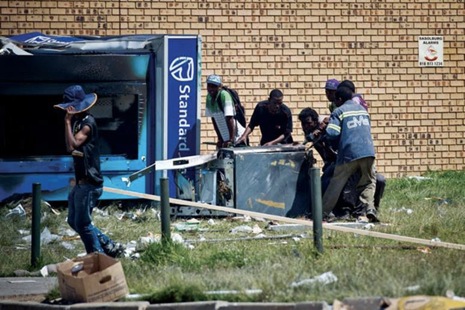
The following photographs will warm any white liberal’s heart: Liberated South African exercising their right to loot in the town of Sasolburg, south of Johannesburg over the last two days.
Prior to 1994, such pictures were disseminated all over the world by the BBC and American network television, as being ineffable manifestations of a desire for democracy and “freedom”. The freedom to loot, among other things. Interestingly, looting in South Africa at present takes two forms: either it is done violently as in these pictures, or it is done in a more or less legal way through the so-called democratic process by pillaging national, provincial and municipal finances.
One could say that the right to loot is one of the New South Africa’s fundamental “human rights”.
Apparently a municipal vehicle was used to "crack open" this Standard Bank ATM
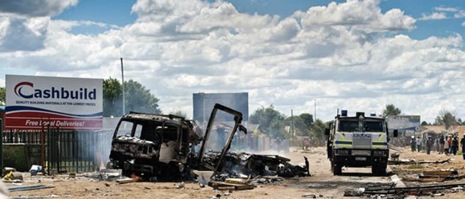
'Affirmative shopping' as theft is euphemistically called in South Africa, takes place openly in a liquor store in SasolburgMore affirmative shopping, a scene outside the liquor storeBurn, baby burn! Heart-warming stuff for the politically correct who will no doubt find multifarious socio-psychological justifications for this kind of behaviourA piece of conceptual art, freshly burnt out by cooperative "artists" and ready for analysis by liberal pundits and critics. To the right of the art work is a "symbol of oppression", probably built and purchased during the "apartheid era": a police armoured vehicle known as a Casspir.
Western Cape premier Helen Zille warned on Wednesday that the province was “heading towards anarchy” as farmworker protests continued.
The Democratic Alliance leader said in statement she had sent ANC provincial leader Marius Fransman an SMS detailing her concerns.
The SMS read: “We are heading towards anarchy. 1000s of jobs will be lost and an industry potentially destroyed.
“I am receiving horrific reports of farmworker intimidation. [Labour Minister Mildred] Oliphant must be recalled from abroad and begin negotiations on the national minimum wage with all stakeholders.
“It is essential that we remove politics from this matter and stabilise the situation. That is the call you must make. I am extremely worried that lives are in danger and that people will retaliate.”
Zille said later in a statement that Fransman had to distance himself from alleged incitement in the province by the Congress of SA Trade Unions (Cosatu).
Last Wednesday, Cosatu Western Cape secretary Tony Ehrenreich said talks about the protest had to find a way for workers to get decent wages.
“The ill treatment and under-payment of workers by some farmers must stop, otherwise we will see a Marikana in De Doorns,” he said.
Freedom Front Plus spokesman Pieter Groenewald said on Tuesday the party would ask the SA Human Rights Commission to investigate the “correctness” of statements attributed to Ehrenreich.
According to Groenewald, Ehrenreich allegedly told farmers: “There is already blood on the farmworkers, and unless it stops there will be blood on the farmers of these farms.”
On Tuesday Zille said she asked President Jacob Zuma to intervene in the De Doorns farmworkers’ wage dispute, and had called for the defence force to get involved.
Farmworkers continued protests in the Western Cape and burned tyres on Wednesday morning while police fired rubber bullets to disperse a crowd.
Police spokeswoman Constable Lybey Swartz could not confirm this, saying no reports had reached the Western Cape media centre.
Farmworkers in the area started protesting last week in demand of R150-a- day wage and better working conditions.
Last Thursday, Zille was heckled by supporters of expelled ANC Youth League president Julius Malema while visiting the area.
She had to be escorted away by police when her entourage was pelted with stones by the striking farmworkers.
Agriculture Minister Tina Joemat-Pettersson was expected to meet Zuma on Wednesday to obtain his support for higher wages for farmworkers. – Sapa
Tear gas was fired at protesting residents of Kya Sand, north of Johannesburg, on Monday afternoon, Gauteng police said.
Lt-Col Lungelo Dlamini said a small group of protesters started throwing stones at police escorting them back to the Inadan informal settlement.
Police retaliated by firing gas canisters at those who were being unruly, and restored calm, he said.
The protesters had dispersed around 1.30pm, but later regrouped and blocked Riverbend and Aghulas Roads, said Democratic Alliance ward councillor Matome Mafokwane.
He said police fired rubber bullets at the crowd, but Dlamini denied this.
Earlier, members of the mayoral committee (MMC) addressed the protesters.
Housing MMC, Dan Bovu, told the community he would engage with them to prioritise their needs for planned development in the area.
When he said he would check his diary to find a suitable time for this, the protesters jeered at him.
Public safety MMC Matshidiso Mfikoe said a meeting would be convened with the residents’ leadership next Tuesday.
She said a broad, integrated programme of development was needed, and she said she would ask the provincial government, before the meeting, about long-term solutions to problems facing the community.
“We need money for building roads, for sewers… this needs to be quantified,” Mfikoe said.
Mafokwane said that the possible relocation of residents from Inadan, an informal “mini-settlement”, to the greater Kya Sand informal settlement was the reason initially given for the protest.
A small group had turned out on Wednesday to protest against the relocation, but this had escalated into demands for housing and sanitation.
Bovu said about 2000 people living at the informal settlement needed to be moved because it was on a wetland and not conducive to development.
Possible solutions included moving families to Kya Sand or Cosmo City and speaking to local private land owners to find suitable land.
Around 500 protesters sang and waved sticks, watched by a large police contingent on Monday.
Police cordoned off Malibongwe road in the vicinity of the protest. A water cannon was on standby, but was not used.
Earlier, Mafokwane said the protest was not political.
“I don’t want to believe that this is political, I want to separate this from politics,” he said.
Mafokwane said it was unclear what had sparked the renewed protests.
“Obviously something must have happened… It started with one grievance, now it’s packing on top with others,” he said.
A spokesman for the informal settlement dwellers, Ephraim Lifuwas, said employers were likely to bear the brunt of the protest as workers were unable to get to work.
The intention was to pressurise the government into yielding to their demands.
“Build houses. That is what we need,” he said.
Regarding the relocation of residents, Mafokwane said normally a decision was made on an issue only after departments had given councillors a detailed brief, and feedback had been obtained from the community.
Even he, as a councillor, was not sure of the situation regarding the relocation, he said.
“I’m in the face of this protest. I need to give them answers, but even I don’t know what is going on.
“A meeting was secured for tonight, but now the situation has overtaken us, and we are talking about a big crowd wanting answers now.
“It’s no longer about the move, it’s now about water, housing, sanitation.”
Mafokwane said that although the DA controlled the ward politically, the African National Congress-run council controlled the resources.
“Leaving aside whether the protest is legal or illegal, their concerns are legitimate, they are valid, make no mistake,” he said.
The Kya Sand protest is the latest in a number of protests around the country in the past 10 days, including protests in Heidelberg in Gauteng and Hangberg in the Western Cape.
Apart from a protest at a church in Evaton, that appeared to be connected to allegations of Satanism, the other protests were intended to draw attention to housing, water, electricity and education complaints.
Police Minister Nathi Mthethwa visited the site of protests in the farming area of Heidelberg last week.
The ANC has urged people to be patient with the government’s pace of installing utilities and providing housing.
The Kya Sand informal settlement was established in the past two decades, on a tract of land originally surrounded by farms and agricultural holdings.
Since then it has changed into a light industrial and retail zone. – Sapa
Calm was restored to a Johannesburg high school after pupils went on a destructive spree following the murder of a fellow pupil, according to reports on Saturday.
The Saturday Star reported that learners at Vorentoe High School in Auckland Park went on the rampage on Friday morning after learning that the boys accused of the murder might be let out on bail.
A grade 11 pupil was stabbed to death outside the high school on Wednesday.
Police, armed with rubber bullets, metro police and an ambulance arrived after school authorities called for help to deal with the rowdy group of teenagers.
The group smashed windows, wrote on walls and disrupted classes. Many parents came to take their children home for the day, the paper reported.
Five pupils from another school were arrested in connection with the murder.
The five appeared in the Newlands Magistrate’s court on Friday, but police were unavailable to confirm the outcome. – Sapa
Greece’s parliament approved a deeply unpopular austerity bill Monday to secure a second EU/IMF bailout and avoid national bankruptcy, as buildings burned across central Athens and violence spread around the country.
Cinemas, cafes, shops and banks were set ablaze in central Athens and black-masked protesters fought riot police outside parliament before lawmakers voted on the package that demands deep pay, pension and job cuts — the price of a 130 billion euro ($172 billion) bailout needed to keep the country afloat.
State television reported the violence spread to the tourist islands of Corfu and Crete, the northern city of Thessaloniki and towns in central Greece. Police said 150 shops were looted in the capital and 34 buildings set ablaze.
Altogether 199 of the 300 lawmakers backed the bill, but 43 deputies from the two parties in the government of Prime Minister Lucas Papademos, the socialists and conservatives, rebelled by voting against It. They were immediately expelled by their parties.
Asian shares and the euro gained modestly Monday, relieved by the Greek parliament’s passage of austerity measures that put the country a step closer to securing a much-needed bailout fund and avoiding a messy default.
MSCI’s broadest index of Asia Pacific shares outside Japan edged up as much as 0.3 percent on the news.
The rebellion and street violence foreshadowed the problems the Greek government faces in implementing the cuts, which include a 22 percent reduction in the minimum wage — a package critics say condemns the economy to an ever-deeper downward spiral.
Papademos, a technocrat brought in to get a grip on the crisis, denounced the worst breakdown of order since 2008, when violence gripped Greece for weeks after police shot a 15-year-old schoolboy.
“Vandalism, violence and destruction have no place in a democratic country and won’t be tolerated,” he told parliament as it prepared to vote.
“SHORT-TERM SACRIFICES”
But he admitted that imposing the austerity on a nation that has already endured several years of cuts would be tough.
“The full, timely and effective implementation of the program won’t be easy. We are fully aware that the economic program means short-term sacrifices for the Greek people,” Papademos said.
Greece needs the international funds before March 20 to meet debt repayments of 14.5 billion euros, or suffer a chaotic default which could shake the entire euro zone.
Outside parliament chaos reigned. A Reuters photographer saw buildings in Athens engulfed in flames and huge plumes of smoke rose in the night sky.
“We are facing destruction. Our country, our home, has become ripe for burning, the center of Athens is in flames. We cannot allow populism to burn our country down,” conservative lawmaker Costis Hatzidakis told parliament.
The air in Syntagma Square outside parliament was thick with teargas as riot police fought running battles with youths who smashed marble balustrades and hurled stones and petrol bombs.
Terrified Greeks and tourists fled the rock-strewn streets and the clouds of stinging gas, cramming into hotel lobbies for shelter as lines of riot police struggled to contain the mayhem.
State NET television reported that trouble had also broken out in Heraklion, capital of Crete, as well as the towns of Volos and Agrinio in central Greece.
On the streets of Athens many businesses were ablaze, including the neo-classical home to the Attikon cinema dating from 1870 and a building housing the Asty, an underground cinema used by the Gestapo as a torture chamber during World War Two.
NO GOOD CHOICES
The EU and IMF say they have had enough of broken promises and that the funds will be released only with the clear commitment of Greek political leaders that they will implement the reforms whoever wins an election potentially in April.
Euro zone paymaster Germany ratcheted up the pressure on Sunday. “The promises from Greece aren’t enough for us any more,” German Finance Minister Wolfgang Schaeuble said in an interview published in Welt am Sonntag newspaper.
“Greece needs to do its own homework to become competitive, whether that happens in conjunction with a new rescue program or by another route that we actually don’t want to take.”
When asked if that other route meant Greece quitting the euro zone, Schaeuble said: “That is all in the hands of the Greeks themselves. But even in the event (Greece leaves the euro zone), which almost no one assumes will happen, they will still remain part of Europe.”
The bill sets out 3.3 billion euros ($4.35 billion) of extra budget cuts for this year alone.
It also provides for a bond swap to ease Greece’s debt burden by cutting the real value of private-sector investors’ bond holdings by some 70 percent. Greece would have missed a February 17 deadline to offer a debt “haircut” to private bondholders if the vote had not been passed.
Many Greeks believe their living standards are collapsing already and the new measures will deepen their misery.
“Enough is enough!” said 89-year-old Manolis Glezos, one of Greece’s most famous leftists and a national hero. “They have no idea what an uprising by the Greek people means. And the Greek people, regardless of ideology, have risen.”
Glezos is a national hero for sneaking up the Acropolis at night in 1941 and tearing down a Nazi flag from under the noses of the German occupiers, raising the morale of Athens residents. – Reuters
This website uses cookies to improve your experience. We'll assume you're ok with this, but you can opt-out if you wish. Cookie settingsACCEPT
Privacy & Cookies Policy
Privacy Overview
This website uses cookies to improve your experience while you navigate through the website. Out of these cookies, the cookies that are categorized as necessary are stored on your browser as they are essential for the working of basic functionalities of the website. We also use third-party cookies that help us analyze and understand how you use this website. These cookies will be stored in your browser only with your consent. You also have the option to opt-out of these cookies. But opting out of some of these cookies may have an effect on your browsing experience.
Necessary cookies are absolutely essential for the website to function properly. This category only includes cookies that ensures basic functionalities and security features of the website. These cookies do not store any personal information.
Any cookies that may not be particularly necessary for the website to function and is used specifically to collect user personal data via analytics, ads, other embedded contents are termed as non-necessary cookies. It is mandatory to procure user consent prior to running these cookies on your website.