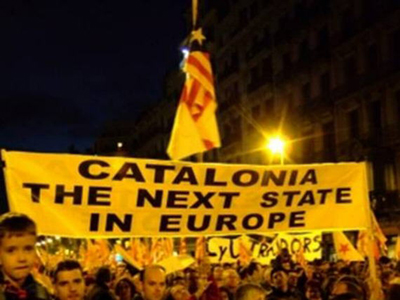
Catalan president defies Spanish premier to his face

Catalan President Artur Mas has pledged to go ahead with the region’s independence vote, defying the Spanish Prime Minister in person. Madrid has branded the referendum as “illegal” and resolved to block the Catalan bid to separate from Spain.

Mas met with Spanish Prime Minister Mariano Rajoy on Wednesday in their first encounter in over a year.

“We have the determination and the political strength, but we would like to hold [the vote] in a legal manner and with the backing of the state,” said Mas following the meeting, referring to Scotland’s upcoming independence vote in September.

Mas said it was impossible to hold a legal consultation because Rajoy refused to budge on his stance the Catalan vote is a violation of Spanish sovereignty and therefore illegal.

“I thought that Rajoy was going to propose something concrete. I came prepared to listen, but there was no proposal,” said Mas, adding that he believed Madrid’s stance was more to do with politics than the actual legality of the independence vote.

Rajoy has been unmoving in his dialogue over the Catalan vote from the very beginning, and has resolved to block the referendum. Alicia Sanchez-Camacho, president of Rajoy’s party in Catalonia, said the vote would be a violation of Spanish law.

There has been growing resentment in the region that their taxes are being redistributing to other parts of the country and 45 percent of Catalans believe the region would be better off on its own, according to an April poll.

Catalonia is not the only region of Spain campaigning for independence. The long-rebellious Basque country has also called for a referendum to decide on their future in Spain. In late May, Basque lawmakers adopted a declaration of self-determination to follow on the footsteps of Catalonia.

Last month, at least 100,000 Basque citizens formed a human chain measuring 123 kilometers in solidarity with the Basque independence movement.

100 blacks storm EU fence, only 20 get in

Officials say around 100 migrants of sub-Saharan origin have stormed the barbed-wire border fence separating Spain’s North African enclave of Melilla from Morocco, with 20 managing to get across.

An Interior Ministry statement Tuesday said the storming occurred at 6 a.m. The migrants who avoided being repelled by police made their way to the city’s temporary migrant accommodation center. Police eventually repatriate the migrants or let them go.

There were no reports of injuries.

Also, Spain’s maritime rescue service said 10 migrants were intercepted trying to reach Spain by boat after crossing the Strait of Gibraltar.

Thousands of African immigrants living illegally in Morocco regularly try to enter Spain’s enclaves of Melilla and Ceuta in a bid to reach Europe in search of a better life.

Source: mailonline

Spanish Concourt rules Catalonia referendum unconstitutional

cataloniaSpain’s Constitutional Court has ruled that a referendum in Catalonia on independence from the rest of the country would violate the law, saying that regions within Spain “cannot unilaterally call a referendum on self-determination.”

According to a summary of the ruling, any “right to decide” their future by Catalans has to be in accordance with Spain’s 1978 constitution, which stipulates Spanish unity.

The Constitutional Court ruled “unconstitutional and null” a declaration by the regional parliament in Barcelona which claimed that Catalonia has the right of self-determination.

Kingdom of Spain Constitutional Court of Justice Building (AFP Photo / Dominique Faget)Kingdom of Spain Constitutional Court of Justice Building (AFP Photo / Dominique Faget)

The fate of the region rests on the power struggle between Catalan President Artur Mas who had promised a referendum on independence from Spain on November 9 and the Spanish Prime Minister Mariano Rajoy who insists that such a vote would be illegal.

“No one can unilaterally deprive the entire Spanish people of the right to decide on their future,” Rajoy told the national parliament last month insisting that the referendum “can’t take place.”

Rajoy remains certain that Catalonia cannot be compared to Scotland’s aspiration of succession from the UK, because the Spanish written constitution, unlike British, rules out such a move.

But in Catalonia, March’s public opinion poll showed that 59.6 percent of the population want independence from the rest of Spain and want their region to become a “new state of Europe.”

Catalonia, an autonomous community with a population of 7.5 million is responsible for around one-fifth of the country’s GDP and one-quarter of its taxes. Public sentiment believes that the region will be much better off financially if they secede from Madrid.

The situation is aggravated by the economic crisis, which is forcing the Spanish government to adopt painful austerity policies.

In January the Catalan Parliament voted to send a petition to the national legislature seeking the power to hold the vote. That initiative is still in the process. If successful the referendum in Catalonia will be a month after a similar vote in Scotland, which is slated for September 2014.

Source: RT

Russia to conduct anti-nuclear observer flight over Spain

antonov30BA group of Russian inspectors will fly an observation mission over Spain within the framework of the Treaty on Open Skies, the head of the National Nuclear Threat Reduction Center, Sergei Ryzhkov, told Tass on Saturday. The flight will be made on an Antonov-30B observation aircraft, he said.

“The observation flight will be made between March 16 and 22 from ‘Open Skies’ Getafe Airfield with a maximum range of up to 1,800 kilometers,” he added. Observation flights are made to promote bigger openness and transparency in the military activity of the states participants in the treaty, as well as to strengthen security through confidence building.

According to Ryzhkov, the Russian plane will make its flight on the itinerary coordinated with Spain, while Spanish specialists on board will control the use of the observation equipment and compliance with treaty provisions.

“This is the fourth observation flight of Russian inspectors over countries signatories to the treaty in 2014,” he noted. The Open Skies Treaty was signed in 1992, and brings together 34 countries. Observation flights are made over Russia, the United States, Canada and European countries. The main aims of the Open Skies are growth of transparency, control over the implementation of agreements on arms control, broader possibilities of crisis prevention and settlement of crisis situations within the framework of the Organization for Security and Co-operation in Europe and other international organizations.

Source: Voice of Russia

Immigrants drown after Spain fires rubber bullets

spainimmigrantsThe European Commission wants Spain to account for the drowning of 14 migrants who recently failed to swim to Ceuta, a Spanish enclave in North Africa. Spain earlier admitted that rubber bullets were fired at them, but claimed no one was injured.

“The commission will be requesting explanations from the Spanish authorities on these events,” EU Home Affairs spokesperson Michele Cercone said, adding that the commission has a right to act if there’s evidence that a member state has violated EU laws.

On Thursday, Spanish Interior Minister Jorge Fernandez Diaz admitted that local border police, in an effort to turn back around 200 migrants who tried to cross the frontier between Morocco and Spain’s Ceuta on February 6, had indeed fired rubber bullets at them.

While some tried to cross on land, at least fourteen migrants drowned in the Mediterranean trying to swim around a man-made breakwater that separates Moroccan and Spanish waters. Spanish police say they are still searching for more victims.

According to the Spanish Interior Minister, the rubber bullets were fired at a distance of 25 meters to deter people from entering Spain while they were in the water. Diaz told a parliamentary commission that the shots were never intended to hit the migrants, whose behavior he described as aggressive. Spanish police posted online video footage of migrants throwing stones at the border fence. The footage didn’t show what had happened when some of them tried to swim around to Spanish land, however. Ceuta, on the north coast of Africa across the Strait of Gibraltar on the Mediterranean Sea, has a population of about 83,000.

According to the online newspaper EUObserver, 23 people managed to make it to Ceuta’s El Tarajal beach, but were immediately turned over to Moroccan authorities. Under European asylum and migration law, anyone who steps foot on member states’ territory is eligible to have their asylum request reviewed before being deported. Although Spanish Interior Minister admitted a group of migrants made it to the beach, Diaz said the group did not enter Spanish territory, since they allegedly never made it past the line of waiting border guards.

Meanwhile, the EU Commissioner for Home Affairs Cecilia Malmstrom said she was “very concerned about Spanish police using rubber bullets to deter migrants.”

“I expect clarifications from the authorities,” Cecilia Malmstrom wrote on her Twitter account.

Spain’s interior minister has admitted police should not have fired rubber bullets at migrants trying to reach Ceuta last month.

Jorge Fernandez Diaz said that rubber bullets were unlikely to deter migrants from the country’s North African enclave.

At least 15 migrants drowned on February 6 as hundreds tried to swim to Ceuta from Morocco.

Defeated by the Taliban, Washington decides to take on Russia,China

pcrby Paul Craig Roberts

The several days of organized protests in Ukraine are notable for the relative lack of police violence. Unlike in the US, Canada, Thailand, Greece, and Spain, peaceful protesters have not been beaten, tear gassed, water cannoned, and tasered by Ukrainian police. Unlike in Egypt, Palestine, and Bahrain, Ukrainian protesters have not been fired upon with live ammunition. The restraint of the Ukrainian government and police in the face of provocations has been remarkable. Apparently, Ukrainian police have not been militarized by US Homeland Security.

What are the Ukrainian protests about? On the surface, the protests don’t make sense. The Ukrainian government made the correct decision to stay out of the EU. Ukraine’s economic interests lie with Russia, not with the EU. This is completely obvious.

The EU wants Ukraine to join so that Ukraine can be looted, like Latvia, Greece, Spain, Italy, Ireland, and Portugal. The situation is so bad in Greece, for example, that the World Health Organization reports that some Greeks are infecting themselves with HIV in order to receive the 700 euro monthly benefit for the HIV-infected.

The US wants Ukraine to join so it can become a location for more of Washington’s missile bases against Russia.

Why would Ukrainians want to be looted?

Why would Ukrainians want to become targets for Russia’s Iskander Missiles as a host country for Washington’s aggression against Russia?

Why would Ukrainians having gained their sovereignty from Russia want to lose it to the EU?

Obviously, an intelligent, aware, Ukrainian population would not accept these costs of joining the EU.

So, why the protests?

Part of the answer is Ukrainian nationalists’ hatred of Russia. With the Soviet collapse, Ukraine became a country independent of Russia. When empires break up, other interests can seize power. Various secessions occurred producing a collection of small states such as Georgia, Azerbaijan, the former central Asian Soviet Republics, Ukraine, the Baltics, and the pieces into which Czechoslovakia and Yugoslavia were broken by “nationalism.” The governments of these weak states were easy for Washington to purchase. The governments of these powerless states are more responsive to Washington than to their own people. Much of the former Soviet Empire is now part of Washington’s Empire. Georgia, the birthplace of Joseph Stalin, now sends its sons to die for Washington in Afghanistan, just as Georgia did for the Soviet Union,

These former constituent elements of the Russian/Soviet Empire are being incorporated into Washington’s Empire. The gullible nationalists, naifs really, in these American colonies might think that they are free, but they simply have exchanged one master for another.

They are blind to their subservience, because they remember their subservience to Russia/Soviet Union and have not yet realized their subservience to Washington, which they see as a liberator with a checkbook. When these weak and powerless new countries, which have no protector, realize that their fate is not in their own hands, but in Washington’s hands, it will be too late for them.

With the collapse of the Soviet Union, Washington quickly stepped into the place of Russia. The new countries were all broke, as was Russia at the time and, thus, helpless. Washington used NGOs funded by Washington and its EU puppets to create anti-Russian, pro-American, pro-EU movements in the former constituent parts of Soviet Russia. The gullible peoples were so happy to have escaped the Soviet thumb that they did not realize that they now had new masters.

It is a good bet that the Ukrainian protests are a CIA organized event, using the Washington and EU funded NGOs and manipulating the hatred of Ukrainian nationalists for Russia. The protests are directed against Russia. If Ukraine can be realigned and brought into the fold of Washington’s Empire, Russia is further diminished as a world power.

To this effect NATO conducted war games against Russia last month in operation Steadfast Jazz 2013. http://www.strategic-culture.org/news/2013/10/17/nato-steadfast-jazz-exercise-chill-of-cold-war.html Finland, Ukraine, Georgia, and neutral Sweden have offered their military participation in the next iteration of NATO war games close to Russia’s borders despite the fact that they are not NATO members.

The diminishment of Russia as a powerful state is critical to Washington’s agenda for world hegemony. If Russia can be rendered impotent, Washington’s only concern is China.

The Obama regime’s “Pivot to Asia” announced Washington’s plan to surround China with naval and air bases and to interject Washington into every dispute that China has with Asian neighbors. China has responded to Washington’s provocation by expanding its air space, an action that Washington calls destabilizing when in fact it is Washington that is destabilizing the region.

China is unlikely to be intimidated, but could undermine itself if its economic reform opens China’s economy to western manipulation. Once China frees its currency and embraces “free markets,” Washington can manipulate China’s currency and drive China’s currency into volatility that discourages its use as a rival to the dollar. China is disadvantaged by having so many university graduates from US universities, where they have been indoctrinated with Washington’s view of the world. When these American-programmed graduates return to China, some tend to become a fifth column whose influence will ally with Washington’s war on China.

So where does this leave us? Washington will prevail until the US dollar collapses.

Many support mechanisms are in place for the dollar. The Federal Reserve and its dependent bullion banks have driven down the price of gold and silver by short-selling in the paper futures market, allowing bullion to flow into Asia at bargain prices, but removing the pressure of a rising gold price on the exchange value of the US dollar.

Washington has prevailed on Japan and, apparently, the European Central Bank, to print money in order to prevent the rise of the yen and euro to the dollar.

The Trans-Pacific and Trans-Atlantic Partnerships are designed to keep countries in the US dollar payments system, thus supporting the dollar’s value in currency markets.

Eastern European members of the EU that still have their own currencies have been told that they must print their own currencies in order to prevent a rise in their currency’s value relative to the US dollar that would curtail their exports.

The financial world is under Washington’s thumb. And Washington is printing money for the sake of 4 or 5 mega-banks.

That should tell the protestors in Ukraine all they need to know.

Paul Craig Roberts was Assistant Secretary of the Treasury for Economic Policy and associate editor of the Wall Street Journal. He was columnist for Business Week, Scripps Howard News Service, and Creators Syndicate. He has had many university appointments. His internet columns have attracted a worldwide following. His latest book, The Failure of Laissez Faire Capitalism and Economic Dissolution of the West is now available.

Citrus farmers will have to look to BRICS

lemoenSouth African citrus farmers may have to find markets other than the European Union (EU) for their citrus exports. This follows the EU’s decision to ban this season’s citrus crop as a result of fungal black spot.

AgriSA president, Johannes Moller, says the EU’s ban on local citrus is an artificial trade barrier imposed at the request of European farmers fighting for a bigger market share.

South Africa is the biggest citrus exporter to the EU ringing up R13 billion sales a year.

But this year EU inspectors were on the lookout for black spots, fearing that it might spread to Europe’s citrus groves, especially in Spain. Before the South African season ended last month, 36 shipments were turned back and on Thursday a ban was placed on further exports this year.

The European Food Safety Authority is to release a decision next month about future exports. Letsitele farmers say they have exported citrus to Europe for the past 80 years without transmitting black spot.

AgriSA meanwhile says farmers will have to look for new markets regardless of whether the ban is maintained in the New Year. These will include South Africa’s fellow BRICS nations – Brazil, India, China and Russia.

While harmless to humans, citrus black spot causes unsightly lesions on the fruit and leaves, reducing both harvest quality and quantity.

Britain denies resorting to gunboat diplomacy

HMS Westminster
HMS Westminster

Britain said Wednesday it was reviewing its military presence off Gibraltar following a lengthy stand-off between the Royal Navy and a Spanish ship, but denied it was resorting to “gunboat diplomacy”.

Foreign Office minister Mark Simmonds said he wanted to de-escalate the situation but would not put up with “bullying and intimidation” of the British territory at the mouth of the Mediterranean.

Britain summoned the Spanish ambassador on Tuesday to explain the most serious incursion for months in the waters off Gibraltar, which Spain has long claimed as its own.

A Spanish state oceanographic research ship, backed up by three military Spanish police boats, ignored orders to leave for 22 hours before departing Tuesday, coming within 250 metres (yards) of Gibraltar’s harbour.

Gibraltar’s chief minister Fabian Picardo responded by urging Britain to deploy bigger military ships to deter similar incursions.

“We constantly review as to whether the Royal Navy’s deployment around Gibraltar is accurate. We are reviewing that at this current time as well,” Simmonds told parliament in an emergency debate on the incursion.

He said he wanted a “political solution” to the dispute, adding: “We do not believe that gunboat diplomacy and tit-for-tat escalation is in anyone’s interest.

“Bullying and intimidation, wherever it occurs, in unacceptable and that is what appears to be happening in relation to Gibraltar.”

Spain ceded Gibraltar to Britain in perpetuity in 1713 but has long argued that it should be returned to Spanish sovereignty, and the territory remains a source of diplomatic tension.

The Foreign Office has recorded a huge surge in the number of incursions into British territorial waters since Prime Minister Mariano Rajoy took office in December 2011, and has also summoned the ambassador three times.

There were demands in the British parliament on Wednesday for the ambassador to be thrown out, calls for “real action”, plus comparisons made with Iran and Spain’s Franco-era dictatorship.

One lawmaker called for the tit-for-tat measure of a special slow queue at London’s Heathrow Airport for Spanish passport holders, in response to Spain’s introduction of stringent border checks to enter Gibraltar in August.

Picardo said he would support anything that would have a “positive deterrent effect”, telling BBC radio: “I have discussed before the possibility of more senior assets from the Royal Navy.”

He said the situation was a long way from shots being fired, but warned of the possibility of misunderstandings resulting from Guardia Civil vessels entering Gibraltar waters.

Such ships “might then find themselves shot at because they are not identified as the vessel of a friendly nation… and they may be mistaken for terrorists”. – stratrisks.com

The two missiles that ended a confrontation in Syria

TridentA well informed diplomatic source told a Lebanese newspaper that “the US war on Syria had started and ended the moment those two ballistic missiles were fired, leaving inconsistent information, as Israel denied and Russia confirmed, until an Israeli statement was issued indicating they were fired in the context of an Israeli-US joint drill and fell in the sea, and that they were not related to the Syrian crisis.”

The source further told the Lebanese daily As-Safir that “the US forces fired these two rockets from a NATO base in Spain, and were instantly detected by the Russian radars and confronted by the Russian defense systems, so one of them exploded in the airspace and the second one diverted towards the sea.”

In this context, the source pointed out that “the statement issued by the Russian Defense Ministry, which stated the detection of two ballistic missiles fired towards the Middle East, intended to neglect two points: the first was the location from which the two rockets were fired, and the second was their downing. Why? Because the moment the full military operation was launched, Head of the Russian Intelligence Service contacted the US intelligence and informed it that “hitting Damascus means hitting Moscow, and we have removed the term “downed the two missiles” from the statement to preserve the bilateral relations and to avoid escalation. Therefore, you must immediately reconsider your policies, approaches and intentions on the Syrian crisis, as you must be certain that you cannot eliminate our presence in the Mediterranean.”

“This unannounced direct confrontation between Moscow and Washington increased the Obama Administration’s confusion and certainty that the Russian side was ready to move until the end with the Syrian cause, and that the US did not have a way out of its impasse except through a Russian initiative which would save America’s face…” he added.

From this point, the diplomatic source clarified that “in order to avoid further US confusion, and after Israel denied knowing anything about the rocket firing in its first statement, which is the truth, Washington demanded Tel Aviv to adopt the rocket firing to save its face in front of the International Community, especially since these two rockets were the beginning of the US aggression on Syria and the announcement of the beginning of military operations, after which US President Barack Obama was supposed to go to the G20 Summit in Russia to negotiate the destiny of Syrian President Bashr Al-Assad. However, he went to find a way out of the impasse he’s in.”

The source further indicated that “after the US-Russia rocket confrontation, Moscow intended to increase its number of military experts in Russia, and added to its military units and destroyers to enhance its military presence in the Mediterranean. It also set a time for announcing about its initiative on stopping the aggression on Syria after the G20 Summit, after drawing a side scene on the sidelines of the summit which was followed by two successive visits for Iranian Foreign Minister, Hussein Amir Abdul Lahyan, and Syrian Foreign Minister, Walid Al-Moallem, in which a way out was agreed on with the Russian side, and it included a Syrian announcement on approving the Russian initiative regarding putting Syrian chemical weapons under international supervision and preparing Syria for joining the non-proliferation treaty.

Finally, the source pointed out that “One of the first results of the US-Russian military confrontation was the British House of Commons’ rejection to participate in a war on Syria. This was followed by European stances, most significantly, the German stance announced by Chancellor Angela Merkel.” – almanar.com

British warship sets sail for Gibraltar

HMS Westminster frigate

A British war ship set sail for the Mediterranean on Tuesday amid diplomatic tensions between Britain and Spain over the contested British overseas territory of Gibraltar. The HMS Westminster frigate will dock in Gibraltar as part of a Royal Naval deployment of ten vessels to the Mediterranean and Gulf.

The departure of the ship from Portsmouth, played down by the British and Spanish governments as part of a long planned, routine exercise, has underscored heightened tensions over the territory.

A helicopter carrier also left Portsmouth for Gibraltar on Monday.

Britain has warned Spain it might take legal action to try to force Madrid to abandon tighter controls at the border with Gibraltar in what it called an “unprecedented” step against a European ally.

A spokesman for British Prime Minister David Cameron said the Spanish border checks, imposed after Gibraltar created an artificial reef which Spain said blocked its fishing vessels, were “disproportionate” and “politically motivated”.

Tensions over the rocky outpost at the mouth of the Mediterranean, to which Spain lays claim, have turned into one of the worst rows in years between the two European Union states.

Opposition politicians in Spain have accused Prime Minister Mariano Rajoy of using the situation to distract Spaniards from the country’s severe recession and a corruption scandal.

Spain has said it will not back down over the border controls, which it says are a legal and proportionate step to prevent money laundering and the smuggling of tobacco and other products.

If Britain chooses to test whether those restrictions breach EU law on freedom of movement, the case is likely to end up in the European Court of Justice. Judgments there can take years, although special cases can be fast-tracked. – SABC

Soccer: Spain off to flying start against Uruguay

Spain's Pedro Rodriguez in a happy mood after Spain took the lead yesterday
Spain’s Pedro Rodriguez in a happy mood after Spain took the lead yesterday

World champions Spain got their Confederations Cup campaign off to a winning start on Sunday with a 2-1 win over South American champions Uruguay in the northern Brazilian city of Recife.

The Spaniards dominated throughout but after Pedro Rodriguez’s deflected opener had cause to be grateful to Roberto Soldado’s 32nd-minute clincher as Luis Suarez netted a late freekick for the Uruguayans.

Although the Uruguayans came closer to pinching a point than they deserved, Spain coach Vicente Del Bosque was exultant afterwards as his side laid the foundation for reaching the last four from a group also containing Uruguay and minnows Tahiti.

“These are three magnificent points which stand us in great stead when it comes to reaching the semi-finals,” said Del Bosque.

“It was a great match played out in conditions which sapped the players’ strength,” he added, referring to the warm, humid weather.

“We dominated almost the whole match but the margin was a slim one in the event. At 2-0 we thought we had it won already and we stepped off the gas a little.”

Uruguay counterpart Oscar Tabarez said: “Spain were superior and they deserved to win – we lacked a bit of discipline. In the second half it was a little more balanced as we dug deep to play for our pride.”

Cesc Fabregas came within the width of a post from giving Spain the lead in the 10th minute with a low strike before the favourites made the breakthrough after just 20 minutes — Lady Luck smiling on them as Diego Lugano deflected home Pedro’s shot to bamboozle keeper Fernando Muslera.

As is their habit, Spain were giving the Uruguayans almost no chance to touch the ball in the opening quarter and Xavi almost made it two when he sent a freekick whizzing just off target after 26 minutes.

Without the ball, Uruguay grew frustrated and resorted to some strong-arm tactics as first Edinson Cavani earned a booking for clattering into Sergio Ramos as they challenged for a header.

Ramos responded by shoving Gaston Ramirez before Uruguayan Cristian Rodriguez caught Jordi Alba with his elbow.

Suarez, in the news for intimating he would be partial to a move from Liverpool to Real Madrid, tried to rally the Celeste, who qualified for this event by winning the 2011 Copa America in Argentina, finding Cavani with a freekick, but the latter’s header was too close to Iker Casillas.

Del Bosque elected to keep faith with his veteran keeper despite Casillas missing a chunk of the second half of the season with a hand injury –once he had recovered the then Real coach Jose Mourinho left him on the bench.

After 32 minutes it was 2-0 courtesy of beautiful vision from Fabregas, who shimmied away from two defenders, then played in Soldado, who took one touch before drilling the ball into the roof of the net.

Uruguay made a change at the break with Ramirez giving way to Alvaro Gonzalez but Spain were still on fire as Xavi and Iniesta interlinked brilliantly before Xavi’s flick fed Pedro and his cross just eluded the diving Soldado.

Pedro then mishit an effort wide after a neat Fabregas through ball sent Alba into space.

With 20 minutes left Uruguay sent on veteran striker Diego Forlan for Diego Perez.

That sparked a revival of sorts for the South Americans and Suarez drove home a curling freekick with two minutes remaining to give the scoreline a more respectable look and also join Forlan as his country’s joint all-time scorer on 33 goals.

Spain came to the event having already become the only team in history to win three major events on the bounce – the 2010 World Cup sandwiched by Euro 2008 and 2012.

A win in this dress rehearsal for next year’s World Cup finals in Brazil would see the Spanish join Argentina and France as the only countries to win the trio of World Cup, the Olympics and the Confederations Cup. – AFP

Separatists winning in Catalonia

Four separatist parties in Spain’s Catalonia looked set to win a majority in regional elections on Sunday, partial results showed, but the main one was on course to lose some seats, possibly undermining its bid to call an independence referendum.

With half of votes counted, the ruling Convergence and Union alliance, or CiU, was winning 48 seats in the 135-seat local parliament, well down from its current 62 seats.

The separatist Republican Left, or ERC, was winning 20 seats, with two other smaller separatist parties taking a total of 16 seats, giving the four parties 60 percent between them.

Regional President Artur Mas, of CiU, had campaigned on a pledge to hold a referendum on independence, in response to a resurgent separatist movement among Catalans who are frustrated with Spain in a deep economic crisis.

Opinion polls had forecast that CiU would retain 62 or more seats in the local Parliament and that all four separatist parties would have more than two-thirds of the seats. Neither of those projections was met as the results began to come in.

Without the psychological backing of a two-thirds majority, analysts have said, it may be hard for Mas to defy the constitution and the central government in Madrid and try to hold a referendum.

Turnout was very high in the election, 68 percent, 10 percentage point higher than in the previous vote two years ago.

With more people than Denmark and an economy almost as big as Portugal’s, Catalonia has its own language. Like Basques, Catalans see themselves as distinct from the rest of Spain.

Growing Catalan separatism is a huge challenge for Prime Minister Mariano Rajoy, who is trying to bring down painfully high borrowing costs by persuading investors of Spain’s fiscal and political stability.

Mas converted to separatism after huge street demonstrations in September.

Up until recently Mas was a moderate nationalist who had pushed Spain to give Catalonia more self-governing powers. He has followed the popular mood in converting to a more radical separatism, but it is not clear he can hold a referendum legally.

Many Catalans are angry that Rajoy has refused to negotiate a new tax deal with their largely self-governing region. Annually, an estimated 16 billion euros ($21 billion) in taxes paid in Catalonia, about 8 percent of its economic output, is not returned to the region.

Home to car factories and banks that generate one fifth of Spain’s economic wealth, and birthplace of surrealist painter Salvador Dali and architect Antoni Gaudi, the region also has one of the world’s most successful football clubs, FC Barcelona. – Reuters

‘The American Dream is a Myth’

The finance industry must take the blame for the growing divide between the rich and poor in the United States, says Nobel Prize-winning economics professor Joseph Stiglitz. In an interview with SPIEGEL, he accuses the industry of preying on the poor and buying government policies that help them get richer

American economist and 2001 Nobel Prize winner Joseph Stiglitz works as a professor at Columbia University. Stiglitz discusses how wealth disparity is dividing America and how Europe can best overcome the euro crisis.

SPIEGEL: What is the scale this inequality?

Stiglitz: In the last decades, income and wealth disparity have grown dramatically in this country. Let me give you an example: In 2011, the six heirs to the Walmart empire commanded wealth of almost $70 billion, which is equivalent to the wealth of the entire bottom 30 percent of US society.

SPIEGEL: What has become of the American dream?

Stiglitz: This belief is still powerful, but the American dream has become a myth. The life chances of a young US citizen are more dependent on the income and education of his parents than in any other advanced industrial country for which there is data. The belief in the American dream is reinforced by anecdotes, by dramatic examples of individuals who have made it from the bottom to the top — but what matters most are an individual’s life chances. The belief in the American dream is not supported by the data.

There has been no improvement in well-being for the typical American family for 20 years. On the other side, the top one percent of the population gets 40 percent more in one week than the bottom fifth receive in a full year. In short, we have become a divided society. America has created a marvelous economic machine, but most of the benefits have gone to the top.

SPIEGEL: With five more weeks to go in the presidential campaign, inequality hasn’t played a serious role yet, though.

Stiglitz: It has been a topic, but typically only underneath the surface. One cannot expect a scientific debate on the Gini coefficient, the statistical measure of inequality.

SPIEGEL: But who exactly represents the one percent?

Stiglitz: It is the group of people who get 20 to 25 percent of the income. Their share has doubled in the last 30 years. And they own about 35 percent of the wealth or more. They have the best houses, the best education and the best lifestyles.

SPIEGEL: Don’t the rich also give something in return? In Germany, the upper one percent contributes almost a quarter to the tax revenue, and the top ten percent more than half of the taxes. Isn’t that an appropriate share?

Stiglitz: I don’t know about the German numbers. What I can say is that the top one percent in the United States has an average tax rate of less than 30 percent of their reported income, and the large proportion who take much of their income as capital gains pay far less. And we know that they are not reporting all of their income.

SPIEGEL: We thought that as a rule Americans don’t begrudge the rich their wealth, though.

Stiglitz: There is nothing wrong if someone who has invented the transistor or made some other technical breakthrough that is beneficial for all receives a large income. He deserves the money. But many of those in the financial sector got rich by economic manipulation, by deceptive and anti-competitive practices, by predatory lending. They took advantage of the poor and uninformed, as they made enormous amounts of money by preying upon these groups with predatory lending. They sold them costly mortgages and were hiding details of the fees in fine print.

SPIEGEL: Why didn’t the government stop this behavior?

Stiglitz: The reason is obvious: The financial elite support the political campaigns with huge contributions. They buy the rules that allow them to make the money. Much of the inequality that exists today is a result of government policies.

SPIEGEL: Can you give us an example?

Stiglitz: In 2008, President George W. Bush claimed that we did not have enough money for health insurance for poor American children, costing a few billion dollars a year. But all of a sudden we had $150 billion to bail out AIG, the insurance company. That shows that something is wrong with our political system. It is more akin to “one dollar, one vote” than to “one person, one vote.”

SPIEGEL: Ninety-nine percent against 1 percent: That actually sounds like the perfect setting for a revolution. Why are things still so calm in the US?

Stiglitz: The United States doesn’t have much of a revolutionary spirit. My real concern is that people get alienated from politics. In the last election we had a voter turnout among young people of around 20 percent. These are the people whose future is most at stake, and 80 percent of them think it’s not worth to vote because it is a rigged system and in the end the banks are going to run the country anyway.

SPIEGEL: With a debt burden of $16 trillion there is not much room for maneuvering.

Stiglitz: The United States can borrow at close to a zero percent interest rate, we would be stupid not to invest more money and create jobs. And we could also make efforts to ensure that the super-wealthy pay their fair share. We could raise more money in a variety of ways. Look at the mining companies: The government grants them the right to extract resources for far less than it should, but auctions could make sure that they pay appropriately.

SPIEGEL: So your answer to the inequality problem is to transfer money from the top to the bottom?

Stiglitz: First, transferring money from the top to the bottom is only one suggestion. Even more important is helping the economy grow in ways that benefit those at the bottom and top, and ending the “rent seeking” that moves so much money from ordinary citizens to those at the top.

SPIEGEL: Is redistribution also the strategy when it comes to Europe and the euro crisis — moving money from the north to the south?

Stiglitz: The main problem in Europe right now are the austerity packages, they depress demand and weaken economic growth. The reversal of this policy is absolutely essential to develop growth and more equality. Spain, for example, gets weaker and weaker, money flows out of the country, and it is a vicious downward spiral.

SPIEGEL: Isn’t the real problem the lack of competitiveness? Spain and the other countries in crisis have lived beyond their means, that’s why they are in trouble.

Stiglitz: No, Europe’s crisis is not caused by excessive long-term debts and deficits. It is caused by cutbacks in government expenditures. The recession caused the deficits, not the other way around. Before the crisis Spain and Ireland ran budget surpluses. They cannot be accused of fiscal profligacy. More fiscal discipline will only worsen the downturn. No economy ever recovered from a downturn through austerity.

SPIEGEL: You assume that a government knows best where to create jobs. Don’t you overestimate that ability?

Stiglitz: We need roads, bridges and airports. That’s obvious. The returns from public investments in technology on average have been very high — think about the Internet, the Human Genome Project and the telegraph.

SPIEGEL: There are also many examples of public money that was wasted. The US space program cost a fortune, and the results were questionable.

Stiglitz: But even those expenditures are still less than the money wasted by America’s private financial sector, and the billions spent to bail out companies from the financial sector. One corporation alone, AIG, got more than $150 billion — more than was spent on welfare for needy families from 1990 to 2006.

SPIEGEL: The government also became owner of these companies and even managed to sell parts of them with a profit, though. Aren’t you afraid that this strategy of ever bigger stimulus packages might lead to inflation?

Stiglitz: Not necessarily. The central bank has the ability to take out liquidity from the system.

SPIEGEL: But it is much harder getting the liquidity out than getting it in.

Stiglitz: A well-managed central bank has lots of tools. It can raise interest rates or reserve requirements for private banks. So I think there is actually relatively little danger. The weakness in the European economy poses much more of a risk than any risk of moderate inflation. Better some job where the pay has declined in real terms by a few percent than no job at all.

SPIEGEL: What do you think Europe’s future prospects are?

Stiglitz: Europe is facing a critical point. The alternatives are “more Europe” or “no Europe.” The halfway configuration is unstable.

SPIEGEL: Which option would be better for Germany?

Stiglitz: Both strategies will cost Germany money, but the “more Europe” option will cost less. Europe needs a common banking system and a common financial framework. If Europe borrows as a whole it could have even better access to credit than the United States. So “more Europe” is not only better for Spain or Italy, but also for Germany.

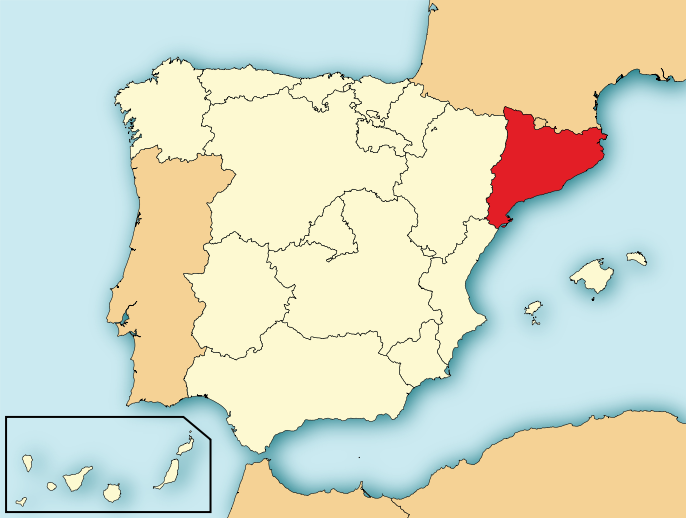
Clashes with police as Spain announces more austerity measures

Spanish protest scene

Protesters clashed with police in Spain’s capital on Tuesday as the government prepares a new round of unpopular austerity measures for the 2013 budget that will be announced on Thursday.

Thousands gathered in Neptune plaza, just a few meters away from El Prado museum in central Madrid where they formed a human chain around parliament, surrounded by barricades, police trucks and more than 1,500 police in riot gear.

Police fired rubber bullets and beat protesters with truncheons, first as several protesters were trying to tear down barriers and later to clear the square. The police said at least 15 people had been arrested and at least 6 injured.

The protest, promoted over the Internet by different activist groups, was younger and more rowdy than recent marches called by labor unions. Protesters said they were fed up with cuts to public salaries and health and education.

“My annual salary has dropped by 8000 euros and if it falls much further I won’t be able to make ends meet,” said Luis Rodriguez, 36, a firefighter who joined the protest. He said he is considering leaving Spain to find a better quality of life.

With this year’s budget deficit target looking untenable, the conservative government is now looking at such things as cuts in inflation-linked pensions, taxes on stock transactions, “green taxes” on emissions or eliminating tax breaks.

The 2013 budget is the second one conservative Prime Minister Mariano Rajoy has had to pass since he took office in December. Spain must persuade its European partners that it can cut the budget shortfall by more than 60 billion euros by 2014.

Rajoy has already passed spending cuts and tax hikes worth slightly more than that over the next two years, but half-year figures show the 2012 deficit target slipping from view as tax income forecasts will not be hit due to economic contraction.

He said earlier this month the 2013 budget would cut spending further in all areas of government apart from pensions and borrowing costs.

Spain is at the centre of the euro zone debt crisis on concerns the government cannot control its finances and those of highly indebted regions, bitten by a second recession since 2009 which has put one in four workers out of a job.

Regional tension

On the regional front, Catalonia, which generates about 20 percent of the national output, announced on Tuesday it would hold early elections on November 25 after its call for more tax autonomy was rejected last week by Rajoy.

Political uncertainty in cash-strapped Catalonia, along with an announcement from southern region Andalucia it might seek a 4.9 billion euros credit line from the central government, will pile more pressure on Madrid to seek European aid.

Rajoy is holding back from applying for help, which would activate a European Central Bank bond-buying programme and bring down Spain’s punishing debt premiums.

With the threat of the plan alone reducing 10-year yields by around 2 percentage points, the cautious leader, known for keeping his cards close to his chest, is playing for time.

Rajoy says he is mulling the conditions of a bailout application, but suspicion that he may wait until after regional elections on October 21 pushed short-term yields higher at auction on Tuesday.

The government is also expected on Thursday or Friday to set a fresh timetable for economic reforms, seen as an attempt to pre-empt strict EU-imposed conditions for aid.

“Let us in, we want to evict you,” protesters chanted outside parliament. Evictions have soared in Spain as thousands of people have defaulted on bank loans.

Demonstrators said they were angry that the state has poured funds into crumbled banks while it is cutting social benefits.

“We’re protesting against the cuts. I’ve had to give up my apartment,” said Ondina, a 30-year-old fine arts graduate who is without a job. She said she can’t survive on an unemployment benefit of 260 euros ($340) a month.

Running out of options

Half-year deficit data indicate national accounts are already on a slope that will drive Spain into a bailout. The deficit to end-June stands at over 4.3 percent of gross domestic product, including transfers to bailed out banks, making meeting the 6.3 percent target by the end of the year almost impossible.

On Tuesday, the treasury ministry said the central government deficit to end-August had reached 4.77 percent of GDP, already above its year-end target of 4.5 percent of GDP.

“Its going to be difficult keeping the deficit to around 2 percent in the second half, when the first half was closer to 4 percent, especially since traditionally, the second half deficit is higher than the first,” said Juan Ignacio Conde-Ruiz, economist at Madrid’s Complutense University.

For 2012, the measures aim to reap savings of over 13 billion euros, but economists see the deficit missing the target by almost 1 percentage points implies further saving needs of up to 10 billion euros for this year alone.

Rajoy has been careful to highlight the importance of next year’s deficit target of 4.5 percent of GDP though any shortfall this year will weigh on 2013’s accounts. After slashing civil servants’ wages, raising value added tax and cutting health and education spending, Rajoy is running out of options. – Reuters