The Russian lawyer for Edward Snowden says the National Security Agency leaker has determined where he will live, but is still figuring out what he will do during his stay in Russia.
Russia granted Snowden temporary asylum on Thursday, allowing him to leave the Moscow airport where he had been holed up for almost six weeks. He can now remain in Russia for at least a year as he evades charges of espionage in the United States.
His lawyer, Anatoly Kucherena, told Russian news agencies on Friday that Snowden “is in a safe place,” but the location will remain secret out of concerns for his security. Kucherena says as soon as Snowden decides what he will do in Russia, he will announce his decision himself. – AP
THEY sought him here and there and everywhere. But in the end, Edward Snowden slipped away unnoticed from Moscow’s Sheremetyevo airport in a cab.
The US fugitive walked out of the airport and took a taxi, his lawyer Anatoly Kucherena revealed to disappointed journalists who have haunted the international airport since Mr Snowden flew in from Hong Kong on June 23, wanting to catch him inside the terminal’s capsule hotel or the passenger lounges.
Rossiya 24 television aired a blurred photograph apparently showing Snowden from the back carrying a black rucksack as he is about to enter a grey saloon car, with a blonde-hair woman standing next to him.
He is shown talking to Mr Kucherena, with four other unidentified men nearby, one talking on a cell phone. The channel did not reveal who took the photograph.
WikiLeaks wrote on its Twitter feed that Mr Snowden left the airport “under the care of WikiLeaks’ Sarah Harrison,” one of the site’s employees who arrived with him from Hong Kong.
She appeared at his side at his only public appearance since landing, when he met rights activists inside the airport on July 12.
Asked in a live interview on Rossiya 24 whether Mr Snowden really caught an ordinary taxi, his lawyer said drily: “I understand that it was a taxi.”
Mr Kucherena refused to reveal Mr Snowden’s location for security reasons, saying only that he “may stay in a flat or a hotel.”
Mysteriously, Mr Kucherena seemed not to be involved in Mr Snowden’s initial stay outside the airport, saying that unnamed American friends living in Russia were taking care of him.
“Of course he has gained friends, including within Russia – American friends – who possibly at the start will be able to provide his security, for some time, let’s say,” Mr Kucherena told Rossiya 24 television.
“I did not get involved in this part, it’s not my competence. So in this case, I hope that all will be well.”
He also refused to comment on whether Mr Snowden would be staying in Moscow itself.
“Let’s not lift up that veil since Edward himself will decide that question,” he told Rossiya 24, adding that he planned to talk on the telephone to Mr Snowden’s father Lon and his US lawyer later that day to discuss his future.
Mr Snowden did not take long to pack after receiving a document certifying that he has temporary asylum in Russia, dated July 31, said Mr Kucherena, who has revealed that he had to buy Mr Snowden extra jeans and shirts while he was in the airport.
“He has few things, so we didn’t have to pack suitcases,” he told the television channel.
It remained unclear where Mr Snowden had spent more than a month, with the public areas of the airport thoroughly combed by journalists.
Mr Kucherena last week spoke to journalists after emerging from a meeting with Mr Snowden via a door in the arrivals zone of Terminal E marked “staff only.”
On Thursday, Mr Kucherena made clear that Mr Snowden was in an area for “problem” passengers who lacked documents, dismissing a question about whether he could have been spotted by waitresses in the airport.
“Have you ever seen a waiter in the transit zone? I never did,” he said.
“It’s the place where a person who flies in, if he doesn’t have a passport or doesn’t have a visa, say, or he has some problems with documents, he stays in that zone.”
However, he also half-confirmed reports that Mr Snowden had been staying in a capsule hotel that has full public access in the transit zone.
“There is a capsule hotel. Those people who stay in the (transit) zone, if they can’t fly out anywhere, they sit there and wait for their problem to be resolved.” – news.co.au
NSA whistleblower Edward Snowden has been granted temporary asylum in Russia and is allowed to enter the country’s territory, a source close to the matter told Itar-Tass.
The whistleblower has been granted temporary political asylum in Russia, Snowden’s legal representative Anatoly Kucherena said, with his words later confirmed by Russia’s Federal Migration service.
“I have just handed over to him papers from the Russian Immigration Service. They are what he needs to leave the transit zone,” he added.
Kucherena showed a photocopy of the document to the press. According to it, Snowden is free to stay in Russia until at least July 31, 2014. His asylum status may be extended annually upon request.
With his newly-awarded legal status in Russia, Snowden cannot be handed over to the US authorities, even if Washington files an official request. He can now be transported to the United States only if he agrees to go voluntarily.
Snowden departed at around 15.30 Moscow time (11.30 GMT), airport sources said. His departure came some 30 minutes before his new refugee status was officially announced.
His present location has not been made public nor will it be disclosed, Kucherena said.
Since June 23, the former CIA employee, Edward Snowden, has been staying in Moscow’s Sheremetyevo International Airport, where he came from Hong Kong as a transit passenger. In the middle of July he requested for a temporary political asylum in Russia.
Snowden is accused of revealing details about the U.S. surveillance services. He was charged with unauthorized communication of national defense information and providing U.S. classified intelligence to an unauthorized person under the 1917 Espionage Act. Moreover, he is accused of government property theft. Snowden will face up to 10 years in prison under every article. RT/Itar-Tass
President Robert Mugabe on Thursday reiterated the Zimbabwe government’s position to bar Western observers from general elections set for Wednesday, insisting that only officials from friendly nations would be allowed to monitor the polls.
The veteran Zimbabwean leader said the United States, United Kingdom and other Western countries would never be invited to observe elections in Zimbabwe until they remove economic sanctions against top Harare officials.
“Our position is very clear. We will never allow the Americans and the British to come and observe our elections as long as their sanctions continue to burden our people,” he told supporters during a campaign rally in Chinhoyi farming town, about 100km northwest of Harare.
Zimbabwe has since 2002 refused to allow Western observers to witness the country’s general elections, accusing them of bias in favour of the opposition.
The Zimbabwe government however, said it has no problems welcoming election observers from the United Nations, Asia, the Southern African Development Community, the African Union and the BRICS group of countries comprising Brazil, Russia, India, China and South Africa.
Mugabe also said Thursday that the US and UK had no moral ground to lecture Zimbabwe on democracy when their own histories are tainted with cases of human rights abuses.
The US said earlier this week that it was concerned about the conditions prevailing in Zimbabwe ahead of general elections set for July 31.
A State Department spokesperson said Washington was wary about lack of transparency in electoral preparations and continued partisan behaviour by security organs, particularly the army and police. – APA
Seventeen lawmakers from the European Parliament have called on President Barack Obama to put an end to the persecution of US soldier Bradley Manning accused of aiding the enemy after he handed over a bunch of sensitive military documents to the WikiLeaks website.
In an open letter to President Obama and Defense Secretary Chuck Hagel, the group of seventeen praised Manning for shedding light on “evidence of human rights abuses and apparent war crimes in Iraq and Afghanistan.”
“We hereby urge you to end the persecution of Bradley Manning, a young gay man who has been imprisoned for over three years, including ten months in solitary confinement, under conditions that the UN Special Rapporteur on Torture Juan Mendez deemed ‘cruel and abusive.’ Bradley Manning has already suffered too much, and he should be freed as soon as humanly possible,” MEPs from Spain, France, Sweden, Germany, Portugal, Ireland, and Ukraine wrote.
The lawmakers specifically stressed that the “aiding the enemy” offense thrown at him by the US court martial would set a terrible precedent.
“To consider releasing information about war crimes to the public to be ‘aiding the enemy’ would be a terrible setback for the defense of Human Rights and International Humanitarian Law worldwide,” they underscored.
“Army prosecutors closed their arguments in the case without having provided any real evidence that Bradley Manning aided the enemy, or that he intended to do so,” they said.
Army Pfc. Bradley Manning faces a potential life sentence for passing hundreds of thousands of classified military and diplomatic cables to the transparency website WikiLeaks, which exposed America’s crimes in its wars in Iraq and Afghanistan and further abuses around the world.
The military judge in Manning’s trial is expected to deliver a final verdict today, July 30. The sentencing stage of the trial is expected to run for several weeks in August.
Manning faces life imprisonment if found guilty
The sentence a US court will pass upon Wikileaks informant Private Bradley Manning will show what fugitive former US intelligence contractor Edward Snowden would get should he return to his country, a senior Russian lawmaker Alexei Pushkov said.
“When the sentence is passed upon Manning for handing files to the Wikileaks website, it would be clear what would await Snowden if he returned to the United States,” Alexei Pushkov, the head of the Russian lower house’s international committee, said on Twitter on Monday.
Snowden, who is wanted by the United States for leaking classified data about the US National Security Agency’s surveillance programs, formally requested temporary asylum in Russia on July 16. Washington has repeatedly called on Moscow to reject Snowden’s request for asylum and send him back to the United States to stand trial on charges of espionage and theft. – Voice of Russia, RIA, RT, Express Tribune, TASS, Scoop
By Richard Haass. Whenever something bad happens – Iran moving closer to acquiring nuclear weapons, North Korea firing another missile, civilian deaths reaching another grim milestone in Syria’s civil war, satellites revealing an alarming rate of polar-ice melt – some official or observer will call upon the international community to act. There is only one problem: there is no “international community.”
Part of the reason stems from the absence of any mechanism for “the world” to come together. The United Nations General Assembly comes closest, but little can be expected from an organization that equates the United States or China with, say, Fiji or Guinea-Bissau.
To be fair, those who founded the UN after World War II created the Security Council as the venue in which major powers would meet to determine the world’s fate. But even that has not worked out as planned, partly because the world of 2013 bears little resemblance to that of 1945. How else could one explain that Britain and France, but not Germany, Japan, or India, are permanent, veto-wielding members?
Alas, there is no agreement on how to update the Security Council. Efforts like the G-20 are welcome, but they lack authority and capacity, in addition to suffering from excessive size. The result is “multilateralism’s dilemma”: the inclusion of more actors increases an organization’s legitimacy at the expense of its utility.
No amount of UN reform could make things fundamentally different. Today’s major powers do not agree on the rules that ought to govern the world, much less on the penalties for breaking them. Even where there is accord in principle, there is little agreement in practice. The result is a world that is messier and more dangerous than it should be.
Consider climate change. Burning fossil fuels is having a measurable impact on the earth’s temperature. But reducing carbon emissions has proved impossible, because such a commitment could constrain GDP growth (anathema to developed countries mired in economic malaise) and impede access to energy and electricity for billions of people in developing countries, which is unacceptable to China and India.
Stopping the spread of nuclear weapons would seem a more promising issue for global collaboration. The Nuclear Non-Proliferation Treaty (NPT) limits the right to possess nuclear weapons to the Security Council’s five permanent members, and then only temporarily.
But agreement is thinner than it appears. The NPT allows countries the right to develop nuclear energy for purposes such as electricity generation, a loophole that allows governments to build most of what is necessary to produce the fuel for a nuclear weapon.
The inspection regime created in 1957 under the International Atomic Energy Agency (IAEA) is a gentlemen’s agreement; inspectors can inspect only those facilities that are made known to them by the government in question. Governments (such as Iran’s) can and do carry out illegal nuclear activities in secret sites that international inspectors either do not know about or cannot enter. At least as important, there is no agreement on what to do when a country violates the NPT, as Iran and North Korea (which withdrew from the treaty in 2003) have done.
More international cooperation exists in the economic realm. There has been real progress toward reducing tariff barriers; the World Trade Organization has also established a dispute-resolution mechanism for its 159 members. But progress on expanding free trade at the global level has stalled, as many countries disagree on the treatment of agricultural goods, the elimination of subsidies, and trade in services.
Meanwhile, cooperation in the realm of cyberspace is just getting started – with difficulty. The US is most concerned about cyber security and the protection of intellectual property and infrastructure. Authoritarian governments are more concerned about information security – the ability to control what is available on the Internet in order to maintain political and social stability. There is no agreement on what, if anything, constitutes an appropriate target for espionage. The prevalence of non-state actors is further complicating efforts.
Another area where there is less international community than meets the eye is human suffering. Governments that attack their own people on a large scale, or allow such attacks to be carried out, expose themselves to the threat of outside intervention. This “Responsibility to Protect,” or R2P, was enshrined by the UN in 2005.
But many governments are concerned that R2P raises expectations that they will act, which could prove costly in terms of lives, military expenditure, and commercial priorities. Some governments are also worried that R2P could be turned on them. Russian and Chinese reticence about pressuring governments that deserve censure and sanction stems partly from such concerns; the absence of consensus on Syria is just one result.
In short, those looking to the international community to deal with the world’s problems will be disappointed. This is not reason for despair or grounds for acting unilaterally. But so long as “international community” is more hope than reality, multilateralism will have to become more varied.
In the trade area, this implies regional and bilateral accords. On climate change, it makes sense to seek “mini-agreements” that set minimum common standards for fuel efficiency, slow deforestation, or limit the largest economies’ carbon output.
In these and other areas, governments will need to rally around regional undertakings, form coalitions of the relevant or willing, or simply seek understandings among countries to do their best to adopt common policies. Such approaches may lack the reach and legitimacy of formal global undertakings, but they do have the advantage of getting something done.
Richard N. Haass is President of the Council on Foreign Relations
Amitai Etzioni has raised an important question: “Who authorized preparations for war with China?” Etzioni says that the war plan is not the sort of contingency plan that might be on hand for an improbable event. Etzioni also reports that the Pentagon’s war plan was not ordered by, and has not been reviewed by, US civilian authorities. We are confronted with a neoconized US military out of control endangering Americans and the rest of the world.
Etzioni is correct that this is a momentous decision made by a neoconized military. China is obviously aware that Washington is preparing for war with China. If the Yale Journal knows it, China knows it. If the Chinese government is realistic, the government is aware that Washington is planning a pre-emptive nuclear attack against China. No other kind of war makes any sense from Washington’s standpoint. The “superpower” was never able to occupy Baghdad, and after 11 years of war has been defeated in Afghanistan by a few thousand lightly armed Taliban. It would be curtains for Washington to get into a conventional war with China.
When China was a primitive third world country, it fought the US military to a stalemate in Korea. Today China has the world’s second largest economy and is rapidly overtaking the failing US economy destroyed by jobs offshoring, bankster fraud, and corporate and congressional treason.
The Pentagon’s war plan for China is called “AirSea Battle.” The plan describes itself as “interoperable air and naval forces that can execute networked, integrated attacks-in-depth to disrupt, destroy, and defeat enemy anti-access area denial capabilities.”
Yes, what does that mean? It means many billions of dollars of more profits for the military/security complex while the 99 percent are ground under the boot. It is also clear that this nonsensical jargon cannot defeat a Chinese army. But this kind of saber-rattling can lead to war, and if the Washington morons get a war going, the only way Washington can prevail is with nuclear weapons. The radiation, of course, will kill Americans and most of the rest of the world as well.
Nuclear war is on Washington’s agenda. The rise of the Neocon Nazis has negated the nuclear disarmament agreements that Reagan and Gorbachev made. The extraordinary, mainly truthful 2012 book, The Untold History of the United States by Oliver Stone and Peter Kuznick, describes the post-Reagan breakout of preemptive nuclear attack as Washington’s first option.
During the Cold War nuclear weapons had a defensive purpose. The purpose was to prevent nuclear war by the US and USSR each having sufficient retaliatory power to ensure “mutually assured destruction.” MAD, as it was known, meant that nuclear weapons had no offensive advantage for either side.
The Soviet collapse and China’s focus on its economy instead of its military have resulted in Washington’s advantage in nuclear weaponry that, according to two US Dr. Strangeglove characters, Keir Lieber and Daryl Press, gives Washington first-strike capability. Lieber and Press write that the “precipitous decline of Russia’s arsenal, and the glacial pace of modernization of China’s nuclear forces,” have created a situation in which neither Russia nor China could retaliate to Washington’s first strike.
The Pentagon’s “AirSea Battle” and Lieber and Press’ article in Foreign Affairs have informed China and Russia that Washington is contemplating pre-emptive nuclear attack on both countries. To ensure Russia’s inability to retaliate, Washington is placing anti-ballistic missiles on Russia’s borders in violation of the US-USSR agreement.
Because the American press is a corrupt government propaganda ministry, the American people have no idea that neoconized Washington is planning nuclear war. Americans are no more aware of this than they are of former President Jimmy Carter’s recent statement, reported only in Germany, that the United States no longer has a functioning democracy.
The possibility that the United States would initiate nuclear war was given reality eleven years ago when President George W. Bush, at the urging of Dick Cheney and the neocons that dominated his regime, signed off on the 2002 Nuclear Posture Review.
This neocon document, signed off on by America’s most moronic president, resulted in consternation and condemnation from the rest of the world and launched a new arms race. Russian President Putin immediately announced that Russia would spend all necessary sums to maintain Russia’s retaliatory nuclear capability. The Chinese displayed their prowess by knocking a satellite out of space with a missile. The mayor of Hiroshima, recipient city of a vast American war crime, stated: “The nuclear Non-Proliferation Treaty, the central international agreement guiding the elimination of nuclear weapons, is on the verge of collapse. The chief cause is US nuclear policy that, by openly declaring the possibility of a pre-emptive nuclear first strike and calling for resumed research into mini-nukes and other so-called ‘useable nuclear weapons,’ appears to worship nuclear weapons as God.”
The Neocons do not accept any accountability whatsoever to international law, to human rights, to the Geneva Conventions, or to any statutory law.
The post World War II wars originate in the so-called “free world”. Other countries do not have imperial expansionary ambitions. The Chinese government has not seized Taiwan, which China could do at will. The Russian government has not seized former constituent parts of Russia, such as Georgia, which, provoked by Washington to launch an attack, was instantly overwhelmed by the Russian Army. Putin could have hung Washington’s Georgian puppet and reincorporated Georgia into Russia, where it resided for several centuries and where many believe it belongs.
For the past 68 years, most military aggression can be sourced to the “superpower”.Washington has drafted a war plan based on nuclear first strike, a direct threat to life on earth.
Paul Craig Roberts was Assistant Secretary of the Treasury for Economic Policy under Ronald Reagan and associate editor of the Wall Street Journal.
NSA leaker Edward Snowden plans to settle in Russia and is ready to begin a court battle if the country’s migration service denies his asylum plea, Anatoly Kucherena, a Russian lawyer who assists the whistleblower, told RT.
“It’s hard for me to say what his actions would be in terms of a positive decision [on the asylum plea],” Kucherena said. “We must understand that security is the number one issue in his case. I think the process of adaptation will take some time. It’s an understandable process as he doesn’t know the Russian language, our customs, and our laws.”
“He’s planning to arrange his life here. He plans to get a job. And, I think, that all his further decisions will be made considering the situation he found himself in,” he added.
Kucherena expressed hope that the whistleblower’s plea will be granted, because the reasons which prompted Snowden ask for political asylum in Russia “deserve attention.”
“He fears for his health and his life. He’s afraid that if he’ll be handed to the US, torture can be used against him down to death penalty,” he said.
In case of a negative ruling on the plea, Kucherena said that Snowden has “an opportunity to go to court and appeal against the decision of the Federal Migration Service.”
“He intends to do so,” the attorney stressed. “During our meeting, our dialogues, and our consultations, he made detailed inquiries on those procedures. And I informed him of what possibilities he has according to Russian law.”
Snowden still remains holed up in the international transit zone of the Moscow’s Sheremetyevo airport. His asylum plea, which was filed on July 16, has not been yet formalized by migration officials.
“According to the existing practice, it may take five, seven, or eight days. I’m calling them on a daily basis. They tell me that they’re about to finish the formalization,” Kucherena said.
The NSA leaker will then be handed a paper confirming that his asylum application is being reviewed. Once this document is received, Snowden will be allowed to leave the airport where he has spent an entire month.
“There are no travel restrictions. Therefore, receiving the paper will give him an opportunity to leave the transit zone of the Sheremetyevo airport and choose a place of residence – rent a hotel or a flat. [He can] live in any place within the Russian federation,” Kucherena explained.
According to the lawyer, consideration of the plea will then take up to three months. If his request is approved, Snowden will receive a certificate which will “guarantee him the same rights and freedoms possessed by the citizens of the Russian Federation.”
“The temporary asylum is given on a one-year term. After it expires, the term can be prolonged for another year and this can be repeated an indefinite number of times afterwards,” he said.
Snowden arrived in Moscow from Hong Kong on June 23 after revealing secret NSA government surveillance programs to the public.
The 30-year-old whistleblower is wanted in the US on charges of espionage and theft of government property.
Several Latin American states have offered him asylum, but the whistleblower believes it is unsafe for him to leave Russia following the July 2 incident in which the Bolivian president’s plane was grounded on suspicion that Snowden was aboard the craft. – RT
Police outside Sheremetyevo international airport in Moscow
US intelligence leaker Edward Snowden was set Wednesday to leave the Moscow airport transit zone where he has been holed up for the last month after being provided with a document allowing him to officially enter Russia, reports said.
The state RIA Novosti news agency said the document confirms that his application for asylum in Russia is being considered and allows him to cross into Russia proper so long as border guards do not object, it said.
The news agency added that the document was initially given to the lawyer helping him, Anatoly Kucherena, who was now at Sheremetyevo airport and meeting Snowden in a secure zone.
A large crowd of media was already outside a door marked “staff only” on the lower floor of Terminal E at Sheremetyevo, with police and security guards keeping tight control, an AFP correspondent at the scene said.
The Interfax news agency said Snowden, who is wanted by the US on espionage charges for revealing a vast spying programme, could leave the airport in the “next hours”.
“The American is currently getting ready to leave. He is being provided with new clothes. The document will be given to him by Kucherena,” Interfax said.
RIA Novosti cited a source within the Russian border guards service as saying he would be allowed to leave the airport as soon as he presents the document.
He would not cross the border with regular passengers but through a special channel, the Interfax news agency reported.
The migration service declined to comment and there was no official confirmation that he was preparing to cross into Russian territory.
Snowden earlier this month applied for asylum in Russia, a process that could take up to three months.
Kucherena has said Snowden may even apply for Russian citizenship and is interested in looking for work in Russia.
Hosting Snowden risks further straining relations between Russia and the United States. But Russia has refused to hand Snowden over, saying it has no extradition treaty with Washington.
Snowden arrived in Moscow from Hong Kong on June 23.
The former contractor for the National Security Agency was checked-in to fly on to Cuba the next day but he never boarded the plane to Havana.
He ended up marooned at the Moscow airport after the United States revoked his passport.
With the help of Sarah Harrison, an employee of anti-secrecy group WikiLeaks, the 30-year-old applied for asylum in 27 countries but most of the nations denied him a safe haven under pressure from Washington.
Three countries in Latin America known for their anti-US stance –Nicaragua, Bolivia and Venezuela — have said they would be willing to give refuge to Snowden.
But there are doubts about whether the American will be able to travel on to Latin American after Bolivian President Evo Morales’s plane flying from Moscow earlier this month was forced to land in Vienna and searched amid suspicions Snowden was on board.
Breaking his silence for the first time since arriving from Hong Kong, Snowden on July 12 summoned several rights activists and Kremlin-friendly lawyers for a dramatic, closed-door meeting at Sheremetyevo airport.
He told them he would apply for asylum in Russia and asked them to petition President Vladimir Putin on his behalf.
On July 16, Snowden applied for temporary asylum with the help of Kucherena, a pro-Kremlin lawyer who participated in the airport meeting.
The Kremlin has sought to keep Snowden’s case at arm’s length but observers said the activists’ meeting at the state-controlled airport would have never been possible without government involvement. – AFP
When the Obama administration discusses matters of sensitive diplomacy, it isn’t always a model of clarity.
But this week reporters have struggled to get a direct answer to what would seem to be a simple question: Is President Barack Obama still planning to attend a summit meeting with Russian President Vladimir Putin in Moscow in early September?
What’s become increasingly evident is the planned summit meeting is now entangled in the delicate negotiations between Messrs. Obama and Putin over the fate of former NSA contractor Edward Snowden.
Let’s back up to mid-June.
Mr. Obama was in Northern Ireland, meeting with various counterparts, including Mr. Putin. The two men held a private session, at which they agreed to take part in a summit meeting in Moscow prior to a separate Group of Twenty meeting in St. Petersburg, Russia.
Ben Rhodes, deputy national security adviser for strategic communications, said in a press briefing at the time: “So we’ll be going to Moscow before we go to St. Petersburg for the G-20.”
But the following week, Mr. Snowden left his hiding place in Hong Kong and showed up in Russia. Since then, the Obama administration has been imploring Russia to return Mr. Snowden to the U.S. to face criminal charges. So far, Mr. Putin hasn’t complied.
Now the summit may be a casualty of the Snowden negotiations.
In his daily briefings this week, White House Press Secretary Jay Carney has been giving careful answers to questions about whether the Obama-Putin summit is still on.
On Wednesday, he was asked if Russia’s handling of the Snowden case has any bearing on Mr. Obama’s decision to attend the scheduled summit meeting with Mr. Putin.
Mr. Carney replied that “the president intends to travel to Russia for the G20 Summit. And I have no further announcements to make beyond what we’ve said in the past about the President’s travel to Russia in the fall.”
Can he definitively say whether Mr. Obama will go to Moscow?
“I can say that the president intends to travel to Russia for the G20 Summit. I don’t have anything to add to what we’ve said in the past about that trip,” Mr. Carney said.
Later in the briefing, another reporter asked him to clarify that answer.
Mr. Carney replied that he “might have been deliberately vague, so I’m not sure I can clarify.”
He went on to say that “I have no further announcements on our travel to Russia. The President intends to go to Russia in September.”
“But you won’t say Moscow?” the reporter said.
“I just have nothing else to say on it,” Mr. Carney said.
All this seems to leave open the possibility that Mr. Obama might call off the summit. In any case, the White House statements may be a signal to Moscow that Mr. Snowden’s status and the summit’s future are now linked, one foreign policy expert said.
“I do think it is a signal,” said Heather Conley, director of the Europe Program at the Center for Strategic & International Studies.
The White House, she said, is “having to rethink [the Moscow summit] right now. This is going to be a very fluid situation.” – WSJ
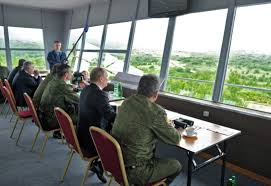
Russia is in the midst of its biggest war games since Soviet times, with 160,000 troops, 130 planes, 70 ships and thousands of tanks and armored vehicles participating in the country’s Far East, according to media reports.
Russian President Vladimir Putin ordered the drills last Friday and they began that night, according to reports from the RIA Novosti news agency. Putin flew to Sakhalin island off the eastern coast to oversee the games on Tuesday, Russia’s presidential press service reported.
“The main purpose of the activities is to check the readiness of the military units to perform assigned tasks and evaluate of the level of personnel’s training and technical preparation as well as the level of equipment of units with arms and military equipment,” the Russian Defense Ministry said in a statement reported by Russian Television.
“The Sakhalin part of the maneuvers was intended to simulate a response to a hypothetical attack by Japanese and U.S. forces,” Konstantin Sivkov, who is retired from the Russian military’s General Staff, told the Nezavisimaya Gazeta newspaper, according to a report from the BBC.
But Russia’s deputy defense minister, Anatoly Antonov, said the games were designed to “enhance the army’s combat readiness” and were not directed against any specific nations, the BBC reported.
Some of the units involved in the exercises moved more than 3,000 kilometers (1,800 miles) from their bases to participate, according to the Russian media reports.
The current drills, which are expected to last through the week, are the latest in a series of snap exercises conducted by the Russian military this year, Russian Television reported. Similar drills have been conducted in the country’s west, south and central military districts, the report said. – CNN
The South African sevens rugby will compete for the bronze medal in the rugby sevens tournament at the World Student Games after going down in a narrow 17-14 defeat to hosts Russia in the semifinals, in Kazan, on Tuesday.
Clearance Khumalo dotted down to give the South Africans the early lead, but Russia hit back to take a 12-7 advantage into the interval.
And while Khumalo scored again in the second half — both his tries were converted by Stefan de Villiers — the host nation managed to bag a surprise win.
Earlier, in the quarterfinals, the SA men, who had gone unbeaten in the group stages, charged into a 21-7 half-time lead and held off some resistance from Belgium for a 26-12 victory.
South Africa will face Great Britain, who were defeated 33-12 by France in their semifinal, in the bronze medal match on Wednesday, the final day of the Games.
Meanwhile, Alistair Davis finished fifth with a score of 25 from 10 shots in the men’s double trap shooting semifinals, narrowly missing out on a place in the bronze medal contest.
Earlier on Tuesday, the 20-year-old Olympian had been fourth best of the first-round qualifiers, progressing to the penultimate round.
In the pool, the SA 4x100m medley relay quartet — Richard Ellis, Nico Meyer, Leith Shankland and Giulio Zorzi — finished seventh in the final in 3:42:22. Russia secured the gold medal in 3:34.27. – Sapa
Russia’s President Vladimir Putin says Edward Snowden, who has been stuck in a Moscow airport for weeks, will leave Russia as soon as he is able to.
Putin on Monday also accused Washington of preventing the fugitive, US intelligence leaker Edward Snowden, from leaving Russia after he arrived from Hong Kong on June 23. “He arrived on our territory uninvited, he did not fly to us,” Russian news agencies quoted Putin as saying.
“They themselves [Washington] scared off all the other countries, no one wants to take him, and therefore they essentially themselves trapped him on our territory,” added the president, according to the agencies.
Meanwhile, Putin said on Monday that he saw signs that Snowden was shifting towards stopping “political activity” directed against the United States.
Putin, who previously refused to hand Snowden over to the US authorities, said the fugitive’s situation remained unresolved after Washington had blocked his further movements.
Asked on an island in the Gulf of Finland about Snowden’s future, Putin said: “How do I know? It’s his life, his fate.”
Putin has stated Snowden should stop activity harmful to the United States if he wanted refuge in Russia, and said he saw signs that the former contractor with the National Security Agency was moving in this direction.
“As soon as there is an opportunity for him to move elsewhere, I hope he will do that. The conditions for granting political asylum are known to him. And judging by his latest actions, he is shifting his position. But the situation has not been clarified yet,” Putin said.
Breaking weeks of silence, Snowden on Friday said at a Moscow airport where he has been camped since late June that he was seeking temporary asylum in Russia before he can safely travel to Latin America. Venezuela, Bolivia and Nicaragua have offered him asylum. – AFP, Reuters
Samples taken at the Syrian town where chemical weapons were allegedly used indicate that it was rebels – not the Syrian army – behind the attack, Russia’s UN envoy Vitaly Churkin has said.
Russia has handed over the analyzed samples to the UN, he added.
“I have just passed the analysis of samples taken at the site of the chemical attack to the UN Secretary General (Ban Ki-moon),” Churkin said on Tuesday.
Evidence studied by Russian scientists indicates that a projectile carrying the deadly nerve agent sarin was most likely fired at Khan al-Assal by the rebels, Churkin pointed out.
“It was determined that on March 19 the rebels fired an unguided missile Bashair-3 at the town of Khan al-Assal, which has been under government control. The results of the analysis clearly show that the shell used in Khan al-Assal was not factory made and that it contained sarin,” he said.
Churkin added that the contents of the shell “didn’t contain chemical stabilizers in the toxic substance,” and therefore “is not a standard chemical charge.” The RDX – an explosive nitroamine commonly used for industrial and military applications – found in the warhead was not consistent with what the armed forces use.
According to Moscow, the manufacture of the ‘Bashair-3’ warheads started in February, and is the work of Bashair al-Nasr, a brigade with close ties to the Free Syrian Army.
Churkin stressed that unlike other reports which have been handed to the UN, the samples were taken by Russian experts at the scene, without any third party involvement.
More than 30 people died in the Khan al-Assal incident in the northern province of Aleppo in March. Damascus was the first to ask for the UN investigation, accusing opposition fighters of launching a chemical weapon attack. Syrian rebel groups denied the accusations, in turn blaming government forces.
However, the UN investigation has largely become stalled after a group of Western nations insisted on launching an inquiry into a separate case of alleged chemical weapons use in Homs in December 2012. The inquiry requires access to military objects, which Damascus has been unwilling to give.
The UN has also decided to exclude Russian and Chinese experts from the investigation team, with Syria protesting this decision.
So far, the UN commission of inquiry for Syria has not found any conclusive evidence proving that either side of the conflict used chemical weapons. This is despite several reports submitted by the US, UK and France, which claim to show that Syrian President Bashar Assad’s forces used such weapons.
Syria finds enough chemicals to ‘destroy the whole country’
The Syrian government invited chief UN chemical weapons investigator Ake Sellstrom and UN disarmament chief Angela Kane for talks in Damascus on Monday, announcing that a rebels-linked storage site containing piles of dangerous chemicals had been discovered.
“The Syrian authorities have discovered yesterday in the city of Banias 281 barrels filled with dangerous, hazardous chemical materials,” Syrian UN Ambassador Bashar Ja’afari said, adding that the chemicals were “capable of destroying a whole city, if not the whole country.”
The chemicals, which included monoethylene glycol and polyethylene glycol, were found in a storage site used by “armed terrorist groups,” Ja’afari explained. He said that Syria has started an investigation into the discovery.
The Syrian envoy expressed Damascus’ confidence that there will be “constructive negotiations with the Syrian officials in order to reach an agreement,” particularly in terms of “reference, mechanism, and time frame” of the UN mission.
Ja’afari added, however, that one should not “jump to the conclusion” that the Monday invitation means that Syria would consider allowing the UN team access to sites beyond Aleppo.
UN Secretary-General Ban Ki-moon’s spokesman, Martin Nesirky, reacted by calling the invitation “a move in the right direction,” but did not say whether UN investigators would accept it. The UN has been demanding that Sellstrom’s team be granted access across Syria “without further delay and without conditions,” ordering the Aleppo investigation not to begin until those demands were reached.Following Churkin’s announcement, both US and UK officials voiced their disbelief over any evidence suggesting that Syrian rebels used chemical weapons, stating they have yet been unable to see the whole report of Russia’s UN envoy.
The US has “yet to see any evidence that backs up the assertion that anybody besides the Syrian government has the ability to use chemical weapons, has used chemical weapons,” White House spokesman Jay Carney said.
When asked whether Washington had seen the Russian report, Carney replied that it had not.
The UK also voiced its skepticism regarding the report, stating that it didn’t believe the opposition could have obtained chemical weapons.
“We will examine whatever is presented to us, but to date we have seen no credible reporting of chemical weapons use by the Syrian opposition, or that the opposition have obtained chemical weapons,” BBC quoted a UK government spokesman as saying. – RT
This website uses cookies to improve your experience. We'll assume you're ok with this, but you can opt-out if you wish. Cookie settingsACCEPT
Privacy & Cookies Policy
Privacy Overview
This website uses cookies to improve your experience while you navigate through the website. Out of these cookies, the cookies that are categorized as necessary are stored on your browser as they are essential for the working of basic functionalities of the website. We also use third-party cookies that help us analyze and understand how you use this website. These cookies will be stored in your browser only with your consent. You also have the option to opt-out of these cookies. But opting out of some of these cookies may have an effect on your browsing experience.
Necessary cookies are absolutely essential for the website to function properly. This category only includes cookies that ensures basic functionalities and security features of the website. These cookies do not store any personal information.
Any cookies that may not be particularly necessary for the website to function and is used specifically to collect user personal data via analytics, ads, other embedded contents are termed as non-necessary cookies. It is mandatory to procure user consent prior to running these cookies on your website.