Steeped in amnesia and anosognosia

Theo Venter
Theo Venter

by Riana Malan

This week, with the world “remembering” South Africa’s transition to democracy presided over by former terrorist Nelson Mandela, was one steeped in amnesia and worse, anosognosia.

As Mandela was taken to lie in state at the Union Buildings, the seat of government in the capital Pretoria, South Africans recalled the day he was sworn in as the country’s first black president, 19 years ago.

Back then, many whites saw a dark future as the white generals and police chiefs of the apartheid government saluted their new boss, watched by dozens of world leaders, most of whom supported the long terror campaign against whites.

For the Afrikaans-speaking minority, which had wielded political power for half a century, it was an uncertain time. Mandela feverishly tried to reassure whites that he bore no grudge, but most Afrikaners were skeptical. And their fears have yet to be assuaged.

Whites feared that the black majority would seek revenge for perceived injustices. They were not wrong.

Cheered on by nations like the US, Britain and Australia — who until recently practised much worse forms of racial discrimination — the governing black majority embarked on a path of anti-white and discriminatory measures to disenfranchise the minority white population.

Mandela continued to make overtures to whites to placate them while he set in motion draconian racial laws to punish whites. Conscious of the power of symbols, he famously donned the jersey of the all-white Springboks rugby team — once an emblem of apartheid — to award the Rugby World Cup trophy when South Africa lifted the tournament on home soil.

This was the morphine the Afrikaners needed to forget the ever increasing attacks on and torture of white farmers, the scourge of child rape and the bold stripping of all their assets.

Jim Goad writes eloquently about what the obituaries all omit.

As postmortem tributes oozed sanctimonious brown-nosing, it should have been called Up Mandela’s Ass. I doubt that this saccharine chunk of carefully packaged propaganda was any more idealized, unrealistic, or one-sided than the thousands of other tributes that burst forth like millions of sugarcoated tears after his passing, but I was only able to handle one Mandela tribute lest my eyes roll so violently that they pop out of my head.

The 20/20 special peddled such obviously fraudulent lies as the allegation that Mandela’s African National Congress was “committed to nonviolent resistance.” Not a peep was made about the fact that Mandela was sentenced to prison not only for “treason”, but that he pled guilty to an indictment accusing him of complicity in “the preparation, manufacture and use of explosives—for the purpose of committing acts of violence.” Nothing was said about the radical guerrilla army he founded called “Spear of the Nation” that was linked to hundreds of acts of violence and sabotage. Nothing was said about his claim that “violence in this country was inevitable.” Nor was it mentioned that he was offered freedom from prison in February 1985 if he agreed to foreswear violence but that he refused. And they certainly didn’t dare to show a clip of an ANC “necklacing” that’s one of the most brutal snippets of mob violence I’ve ever witnessed. Nothing was said about the Church Street Bombing or any of the other bombings and violent acts committed in the ANC’s name that in other contexts would have Mandela dubbed a violent terrorist. Instead, 20/20 referred to him with the much cheerier sobriquet of “freedom fighter.”

The show argues that Mandela was able to quell racial tensions in South Africa and bring together a “rainbow nation” merely by being big-hearted enough to endorse the country’s rugby team. We are not informed that two years after his release from prison, Mandela joined ANC members in a group sing-along of a cheery ditty whose lyrics reputedly included “kill the whites.” Nothing was mentioned of other ANC slogans such as “kill the Boers” and “one settler, one bullet,” nor of ANC officials’ comments such as “When Mandela goes, we will kill you whites like flies.” And they didn’t dare show any photos of the thousands of white farmers that have been savagely massacred since apartheid ended. And we were not informed that rather than ushering in a post-racial utopia, South Africa’s Black Economic Empowerment program dictates wealth redistribution along racial lines.

The program refers to his second wife, Winnie Mandela, as “fiery and controversial” but neglects to include the fact that she headed a criminal gang that was responsible for the beatings, murder, and torture of adults and children. Nor did it mention his first wife’s divorce filing that included allegations of repeated physical abuse and threatening her with an axe.

We hear glowing reminiscences that Mandela was a voice of “democracy” but not a word about the fact that he was a lifelong committed Marxist. Even though he shrugged off accusations of being a communist, the South African Communist Party claimed on Friday that “At his arrest in August 1962, Nelson Mandela was not only a member of the then underground South African Communist Party, but was also a member of our Party’s Central Committee.” Nothing was mentioned about allegations that he handwrote a tract called “HOW TO BE A GOOD COMMUNIST” that claimed “THE CAUSE OF COMMUNISM IS THE GREATEST AND MOST ARDUOUS CAUSE IN THE HISTORY OF MANKIND.”

The 20/20 special left out many other inconvenient facts. Not a whisper was made about the fact that Israel was a huge supporter of South African apartheid and the last country on Earth to sever ties with the regime.

Also left unmentioned is the fact that since apartheid ended in 1994, South Africa has slipped from #93 on the Human Development Index to #121 in 2013. We are not told that the nation now boasts the world’s highest Gini coefficient, highest per-capita rate of rape, highest total number of HIV infections, and a per-capita murder rate seven times that of the USA. We don’t hear about deliberate gang rapes that are jovially referred to as “jack rolling,” nor the impenetrable metal “rape gates” that several Afrikaners have placed on the entrances to their bedrooms like jail doors. We don’t hear about the gated communities and the flame-throwing cars. We don’t hear the merest suggestion that South Africa is likely only a decade or two away from becoming Zimbabwe.

Instead, we get Michelle Obama and Oprah Winfrey creaming their jeans over His Holiness. And at the very end, we see children’s choirs in South Africa and New York City singing a version of John Lennon’s “Imagine.” The final frames show a black boy hitting sour notes as he sings the line “And the world shall live as one.”

Consciously or otherwise, that coda may encapsulate what Mandela truly represents and why he’s being canonized to such an absurd degree—he was a charismatic footservant of globalism. In the end, despite his image as the foe of colonialism, he may have been nothing more than a useful tool of global finance. He is a token of white colonialism’s surrender to a specifically anti-white breed of global financial colonialism. If he’d been white and fought bravely in the name of blood and soil, his eulogists would be singing a much different tune.

The financial Powers That Be will continue to rape and exploit South Africa’s bounteous mineral riches, and the great masses of the country’s blacks will continue to wallow in violence, poverty, disease, and hunger. The main difference will be that the pesky and irksome Boers who pulled the region out of the Stone Age will no longer be in the way. Like the pioneers who tamed the American West, they have served their purpose and are now being discarded.

Mandela famously visited the Afrikaner enclave of Orania in 1995 to have tea with Betsie Verwoerd, widow of the architect of apartheid, Hendrik Verwoerd.

Perhaps this visit caused hundreds of thousands of whites to leave the country for good, because they finally began to understand the disingenuousness of the man.

Theo Venter, a “political analyst” who lectures at North-West University, and paid sycophant of the New World Order, says “one of the legacies of black emancipation has been the emergence of a black middle class that shares the same fears as whites”.

This nonsense is a popular theme with foreign powers that believe they have the money and influence to make racial differences and cultural mores go away.

The boos that current President Jacob Zuma, who has been dogged by Anglo-American criticism, elicited at Tuesday’s memorial service, according to Venter, was a good thing.

“The people who booed Zuma were black not white,” he says, forgetting that South Africa now has a far left and an extreme left vying for power. Whites, who make up around 9 per cent of the population, are helpless observers of the situation, rather than protagonists.

“In national politics the role of Afrikaners as a distinct group is gone forever,” Venter smiles, himself an Afrikaner. As the ANC becomes embroiled in infighting and scandal he sees South Africa’s 1993 constitution as “one of the most progressive in the world” and “the glue that binds the nation henceforth”.

Venter clearly means the “eraser” that binds the nation, for the demise of whites is eagerly sought by all black parties. He would never be mistaken for a real thinker, and his masters must be pleased since they probably believe they have enough money to smooth over the white genocide with spin.

‘Too much of a saint’

bobzim
Mugabe’s not impressed

State media in Zimbabwe largely ignored Mandela’s death. On Zimbabwe’s only television channel – the state-controlled Zimbabwe Broadcasting Corporation – Mandela’s death was not given any prominence.

The station focused on the late Brigadier General Misheck Tanyanyiwa, who has been declared a national hero.

President Robert Mugabe sent his condolences however, in which he hailed “the great icon of African liberation, freedom fighter, a beacon of excellence and a humble and compassionate leader”, despite many Zimbabweans declaring that Mandela was not a hero.

Mugabe was clearly referring to Mandela’s legacy of terror and violence, but Zimbabweans in general were less forgiving.

“The problems South Africa is facing today are originating from the time when he was the president. He is a famous prisoner who sacrificed the dream of his people on the alter of expedience,” one said scathingly.

Mandela’s death stirred debate in Zimbabwe as the former terrorist is often compared to Mugabe.

Mandela was 95 and Mugabe is 90, and both spent long periods in jail in their quest for independence – Mugabe spent more than 10 years held by the Ian Smith regime against Mandela’s 27.

They clashed publicly in 1998 when Mandela over the Democratic Republic of Congo (DRC) following a rebel offensive in that country.

Mandela as chairperson of the Southern African Development Community opposed bailing out Laurent Kabila when Mugabe wanted military intervention. Zimbabwe sent its forces to back Kabila.

Mandela’s most scathing attack on the Zimbabwean leader came in June 2008 when he spoke at a dinner in London against Mugabe. Mugabe had just lost the first round of elections against Morgan Tsvangirai from the opposition MDC.

Mandela then spoke of “the tragic failure of leadership in our neighbouring Zimbabwe”.

Mugabe also lambasted Mandela for going out of his way to please white South Africans.

“They [whites] will praise you only if you are doing things that please them. Mandela has gone a bit too far in doing good to the non-black communities, really in some cases at the expense of [blacks],” Mugabe said. “That is being too saintly, too good, too much of a saint.”


Rolihlahla the celebrity magnet

mandelaspiceGeri Halliwell in a chinese outfit, clutching his arm and the rest of the Spice Girls cuddling him for the picture, caught Nelson Mandela grinning broadly.

If nothing else, that photo opportunity proved that the revered global statesman is a sucker for celebrity froth. Once freed from decades spent in apartheid jails, Mandela’s star-pulling power was legendary.

He was feted by the world’s biggest names in entertainment, sport and music, from the most ghoulish to the downright ridiculous.

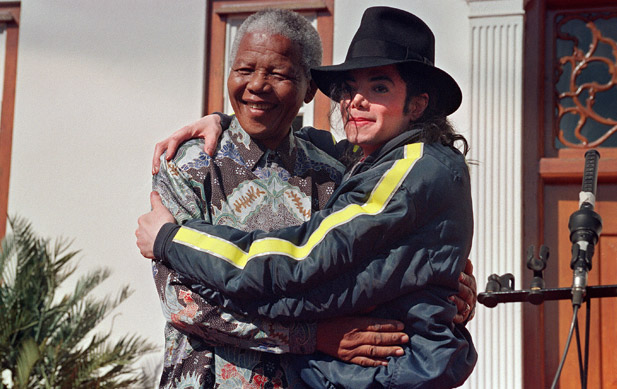
Free of the stuffiness usually inbred into politicians, Mandela was more at home bantering with celebrities like Michael Jackson, who clutching the US State Department’s listed former terrorist, donned his best make-up.

With an ability both to inspire and delight, his calls for tolerance were blended with a penchant for breaking into a gleeful shuffle dance in public and wearing colourful shirts.

Few stars were immune to the “Madiba magic” and a photo opportunity with one of the world’s most recognisable personalities was seen as an essential part of a stop in South Africa.

His rock star-like 85th birthday drew guests ranging from U2 frontman Bono to actor Robert de Niro, who were invited alongside his cook and gardener.

Yet when faced with overcome admirers, Mandela also knew how to turn on the charm with trademark humility.

“I love you so much,” an emotional Oscar-winning actress Charlize Theron, born in South Africa, said at his side.

“I love you too, you know,” was Mandela’s stammered.

Canadian singer Celine Dion even named one of her twin boys Nelson after meeting him — an occasion she prepared for by taking a history course.

Mandela drew stars from Beyonce to the late Amy Winehouse to perform for his AIDS efforts.

In 2004, aged 85, he told the world “don’t call me, I’ll call you” while announcing that he was stepping out of the public eye.

Growing increasingly frail, his last star-studded mega-bash was a 90th birthday concert in London in 2008.

Mandela made his final public appearance at South Africa’s 2010 World Cup final.

Supermodel Naomi Campbell reportedly called him her “honorary grandfather”.

Former US leader Bill Clinton described him as “a ferociously loyal friend”.

mjmandela

The strange transformation of Mandela’s prison cell

Nelson Mandela’s old prison cell on Robben island has undergone a strange transformation.

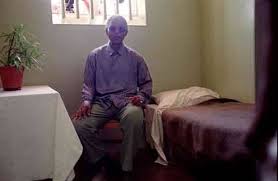
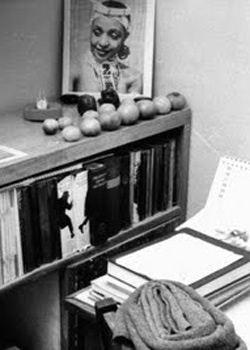
Photos from the Johannesburg archives show a cosy cell with furniture and books and above all, a bed and mattress.

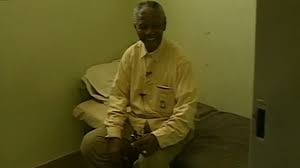
On many later visits by Mandela to his old cell in the company of foreign journalists and film crews, not much had changed. His books were no longer there, but the furniture looked the same.

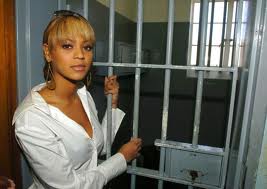
Even recent visits by the likes of Beyoncé showed the cell as it had been while the famous South African was imprisoned there for inciting violence and terrorism.

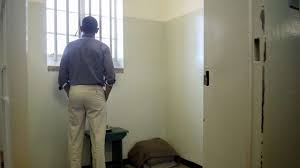
With president Barack Obama’s most recent visit however, the cell suddenly strangely took on the appearance of a bare, 19th century gaol, stripped of all furniture.

Mandela in his cell after his release


mandelacell2
Mandela on a later visist to the same cell
Beyonce at Mandela's cell with the furniture visible
Beyonce at Mandela’s cell with the furniture visible
From the Joburg Artchives, his desk, books and shelf with a photo of his wife Winnie
Obama visiting the now bare cell
The new 19th century look bears no resemblance to the original cell

‘We are a nation united in our grief’: Helen Zille

Helen Zille, supporting the ANC icon Mandela
Helen Zille

DEMOCRATIC ALLIANCE STATEMENT BY HELEN ZILLE LEADER OF THE DA A NATION UNITED IN GRIEF

06 December 2013

Today, South Africa lost the greatest son of its soil. Today the rainbow nation lost its father.

Today, we are a nation united in grief.

It is with deep and profound sadness that we say: Lala ngoxolo Tata. Asoze sikulibale (Rest in peace Tata, we will never forget you).

Our deepest condolences, thoughts and prayers are with Madiba’s wife, Graca, his former wife, Winnie, his daughters Makaziwe, Zenani and Zindziswa, his grandchildren and his great grandchildren.

May they find the strength to overcome the pain of this great loss. And may the entire Mandela family be accorded the respect they deserve at this time. May they be accorded the right to mourn in peace. The nation mourns with them.

We all belong to the South African family – and we owe that sense of belonging to Madiba. That is his legacy. It is why there is an unparalleled outpouring of national grief at his passing. It is commensurate with the contribution he made to our country.

Through his humility, moral conviction and bold leadership, Madiba gave us a gift for which we, and successive generations will be forever grateful. He gave us his vision of a free and inclusive South Africa and the unwavering belief that such a society could be achieved in his lifetime.

He was, quite simply, the greatest South African that ever lived. We shall never see his like again.

Let all South Africans join hands as we mourn Madiba’s passing and celebrate his life. Let us re-affirm his values and recapture his spirit in all we do.

ANC statement on the passing of Comrade Nelson Mandela

ancIssued by: ANC

STATEMENT ON THE PASSING OF CDE NELSON ROLIHLAHLA MANDELA

 AFRICAN NATIONAL CONGRESS

Secretary General’s Office

 Comrades and friends,

The Mandela family,

Fellow South Africans,

 “In the life of every nation, there arise men who leave an indelible and eternal stamp on the history of their peoples; men who are both products and makers of history. And when they pass they leave a vision of a new and better life and the tools with which to win and build it.”

 With deep sorrow and a profound sense of loss, the African National Congress received the sad news of the passing of our Isithwalandwe and former President, Comrade Nelson Rolihlahla Mandela.

 Our nation has lost a colossus, an epitome of humility, equality, justice, peace and the hope of millions; here and abroad.

Madiba loved South Africa. We recall the strength of his fist punching the air as he stepped out of prison after 27 years; and his sternness during the negotiations for the freedom of our beloved country. We celebrate his ever-present smile, the cheerful Madiba jive, his love for children and great respect for the women of this country.

 The large African Boabab, who loved Africa as much as he loved South Africa, has fallen. Its trunk and seeds will nourish the earth for decades to come.

Nelson Mandela, Isithwalandwe – Seaparankwe, born in the village of Qunu in the erstwhile Bantustan of the Transkei, recognised the burden of colonial and racial oppression and exploitation. He then joined the African National Congress in 1942. He was convinced by the belief his wise tutor, Walter Sisulu, had in the ANC as the means to effect change in South Africa. As he said,

“Sometimes one can judge an organization by the people who belong to it, and I knew that I would be proud to belong to any organization of which Walter was a member”.

He loved the ANC. Hence his frequent words that upon his death he would join “the nearest branch of the ANC in heaven”

In his lifetime of struggle through the African National Congress, he assumed and was assigned various leadership positions. He served with distinction. He was part of the ANC leadership collective and did not make decisions without first reflecting with his comrades. Yet he would fight for the principle of what was the right thing to do.

Madiba was also a member of the South African Communist Party, where he served in the Central Committee.

His was a choice to not only be a product but the maker of his and his people’s history.

Soon after prison he took the mantle of the President of the ANC and, ultimately the country – becoming the first President of a democratic South Africa. He worked tirelessly for the ANC and a free South Africa. He hated racism and bigotry; sought a united, non-racial, non-sexist and democratic society where all are equal. As he said while in prison,

“Ours is not to ask for equality on a lower scale; Ours is to fight to win on an equal but higher level”.

He passed the baton to the younger generation of his beloved movement, the ANC, to carry on with the vision of bringing about an equal and just society. The ANC continues in this task as set forth by him and those of his generation, living and deceased. Indeed, men and women such as Nelson Mandela,

“… when they pass they leave a vision of a new and better life and the tools with which to win and build it.

His life gives us the courage to push forward for development and progress towards ending hunger and poverty. As we said of him while still alive, and we say so now,

“We have you, Madiba, as our nearest and brightest star to guide us on our way. We will not get lost.”

To the entire family of Mandela, we extend our heartfelt condolences. He was as much yours as he was ours, probably his dedication to the ANC family robbed you of a father. We will, from this minute on, as always, walk this journey with you to the end. To his friends, in the ANC and across the globe and across all divide, be comforted. To the people of South Africa, may your hearts be not in distress. He lives in each and every one of you and in your homes, because he gave of himself to all of us.

Let us celebrate the gift of his life from this moment on. Let us honour his memory in a dignified way as his leadership and stature deserves. Let us participate in all the activities organised in his honour in a disciplined and respectful manner, until he is laid to rest.

Rest in peace, Comrade President,

Isithwalandwe-Seaparankwe,

Nelson Rolihlahla Mandela.

Amandla ngawethu

Matla ke a rona

All power to the people

Mandela daughters at movie premiere: ‘The show must go on’

The actor Idris Elba on a poster advertising the movie

People attending the London premiere of a new film about Nelson Mandela were told of his death as the closing credits rolled, reported Associated Press.

Stopping the screening of “Mandela: Long Walk to Freedom” was discussed, but Mandela’s daughters asked that the premiere continue, a film spokesman said Thursday night.

Producer Anant Singh announced Mandela’s death once the film was over, and he called for a moment of silence.

The audience included the film’s stars and Prince William and his wife, Kate.

“It was extremely sad and tragic news,” William said upon leaving the film.

Zindzi Mandela, Mandela’s daughter, also was there. When asked on the red carpet on her way into the premiere about her father, she had said, “My father is fine.”

Nelson Mandela was 95.

Harvey Weinstein and his wife Georgina Chapman (25 years his junior)

The North American rights for the film were acquired by the Weinstein brothers’ The Weinstein Company (TWC). Apart from Long walk to freedom, the Weinstein brotherrs and prroducer Anant Singh have also colaborated on Sarafina, Cry the beloved country and other films.

“I am extremely passionate about Mandela: Long walk to freedom,” said TWC Co-Chairman Harvey Weinstein. “Anant Singh first gave the book to me in 1994, when the first edition came out. We have been talking about making this film since 1999. There have been a number of stop and goes, but sometimes things work out for a reason, and Anant Singh has done a masterful job in producing this epic story of our times. Through Anant and Bob De Niro, I met Nelson Mandela, and it was one of the best experiences of my life.”

Boeremag show trial exposes South African legitimation crisis

roodt_dan_wiki

by Dan Roodt

[followbutton username=’danroodt’ count=’true’ lang=’en’ theme=’light’]

Like Dan Roodt’s Facebook page

The exceedingly harsh sentences handed down by Judge Eben Jordaan in the Boeremag trial have had a mixed reception in South Africa. On the one hand, members of the black elite and the white neo-Marxist Left have reacted with unbridled Schadenfreude. On the other, patriotic Afrikaners – while not agreeing with the Boeremag’s reasoning or methods – have nonetheless evinced instinctive sympathy with them and their long-suffering families.

Jordaan has taken a very formalistic approach to the South African constitution and the country’s recent history, refusing to see the many mitigating factors that would have elicited more humane sentences.

First of all, only one person died as a result of the Boeremag explosions, some distance away from the scene. This was rightly seen by the court as a case of culpable homicide. As first offenders, in a country where even the most sadistic child murderers get released after ten years, it should not have carried a heavy penalty.

The many outlandish elements of the trial were no doubt included by the state in its evidence for the maximum propaganda effect. How could fewer than two dozen white men ever hope to displace thousands of South African blacks, let alone the whole population of forty million?

However, the most important factor that detracts from the guilt of the Boeremag trialists was the intimate involvement of state agents who did not attempt to dissuade them from pursuing their attempts at sabotage but in fact encouraged them. Not so long ago there was a similar “sting” operation in Germany during which the secret service or Verfasssungsschutz had infiltrated both the NDP, a political party and a group known as Sturm 34 which was at one point led by a government agent. German courts rejected governmental attempts to ban the NDP due to its heavy infiltration by state agents, finding that responsibility between the state and illegal political activity had actually blurred. In the USA too, courts take a dim view of overzealous state agents who “persuade” citizens to break the law.

Many people claim or suspect that the state organised the Boeremag “rebellion” in order to “mop up” right-wing dissidents. The detailed and incriminating “Document 12” was apparently supplied to the Boeremag members by the state who, through its agents, was intimately involved in so-called “strategic planning”.

The extreme, dehumanising violence associated with South African farm murders acted as a trigger for the Boeremag’s activities. One could argue that under conditions of lawlessness and violence, men are more easily persuaded to answer violence with violence. Certainly that is the line taken by Nelson Mandela and his fellow accused at the Rivonia trial who saw their sabotage campaign as justified by the police shooting at Sharpeville.

This leads to another problem of post-1994 South Africa to which Judge Eben Jordaan has not been attentive: violence is often seen as a legitimate vehicle for political objectives. With the exception of Clive Derby-Lewis and Eugene de Kock, among others, those who had committed acts of terror prior to 1994 were all amnestied by the Truth and Reconciliation Commission. Even the cold-blooded murderers of Amy Biehl were exonerated by the TRC because they supposedly killed her for “political reasons”.

So-called “democracy” has not led to a pacification of the South African population. There are more riots by South Africa’s black population now than ever under so-called “apartheid”. Together with farm attacks and house robberies, the general instability produces a climate of fear and insecurity that engender radical ideas like secession, rebellion or insurrection. In this respect, South Africa is a victim of the notion that it is “just another decolonising African country” that must be “liberated” through the kind of cleansing violence described by a theorist such as Franz Fanon.

During sentencing, Judge Eben Jordaan described South Africa as a constitutional democracy. But does that stand up to scrutiny? During the negotiations in the early 1990s, one of the objectives of the Slovo-Mandela camp was to disenfranchise ethnic Afrikaners. Both provinces and towns were demarcated in such a way that not a single area of the country is ruled by Afrikaners who have been here for 360 years. The largest concentration of Afrikaners in the country, Pretoria and environs where about 500 000 of them live, does not even control a local government and are made to undergo unpopular decisions, including humiliating name changes.

While not condoning sabotage and terrorism, at least the disenfranchisement of the Afrikaner national minority should have been taken into account in judging the actions of the Boeremag accused.

There is a further paradox in South Africa: Violence and terror are eulogised by the media, politicians and historians, as long as such violence was committed against whites or against Afrikaners. Both Communist Party leader  Joe Slovo and Nelson Mandela, who had ordered the Church Street bomb and other horrific attacks on civilians, are presented as “good men” who had selflessly fought for freedom. In Amanzimtoti, terrorist  Andrew Zondo who had placed a bomb in a shopping centre full of Christmas shoppers on 23 December 1985, has had the main street of the town named after him, in the very place where victims and relatives still nourish the wounds of their nightmare experience.

We see then that the South African state is increasingly suffering a legitimation crisis caused by:

  • the effective disenfrenchisement of the Afrikaner minority;
  • corruption and profligacy at all levels of government;
  • a plethora of racial laws limiting the employment and educational opportunities of Afrikaners, in the name of “affirmative action” for the majority;
  • physical insecurity which is only mitigated to some extent by private security companies, neighbourhood watches and so on;
  • anti-white and anti-Afrikaner rhetoric by leading ANC political figures;
  • the deterioration of infrastructure such as roads, electricity and water supply, as well as state hospitals where many whites are simply left to die without proper care;
  • systemic cultural and language discrimination, with Afrikaans schools and universities under attack by government bureaucrats and ANC politicians;
  • the impending radical land reform which could plunge the country into Zimbabwe-style famine and chaos;
  • the general perpetuation of communist/Marxist ideas in South Africa that have lost their legitimacy or attraction elsewhere in the world.

If the Boeremag trial had lasted six months and the accused had been sentenced in 2003 or 2004, shortly after their arrest, probably the Afrikaans public would have seen them simply as extremists out of touch with the new reality of ANC rule. However, given the protracted length of the trrial and the changing perceptions of our much-lauded “democracy”, public sympathies for the accused have definitely been in the asendance, even among those law-abiding middle-class Afrikaners who accept the fait accompli of National Party capitulation and a concomitant loss of Afrikaner sovereignty.

Afrikaner history is replete with martyrs after unsuccessful rebellions who received harsh treatment from a hostile government. There was the infamous death by firing squad suffered by Jopie Fourie on 20 December 1914, but also the Slagtersnek hangings of 1816 that gave rise to the Great Trek inland from the Cape.

Judge Eben Jordaan may just have given Afrikaners another Slagtersnek, apart from adding to the legitimation crisis of the current South African regime.

[followbutton username=’danroodt’ count=’true’ lang=’en’ theme=’light’]

Like Dan Roodt’s Facebook page

Boeremag accused to be sentenced

Some of the Boeremag accused in court

A South African court began sentencing Monday 20 right-wing extremists convicted of high treason for a plot to kill Nelson Mandela and drive blacks out of the country.

The “Boeremag” organisation had planned a right-wing coup in 2002 to overthrow the post-apartheid government.

The trial lasted almost a decade until the organisation’s members were convicted in August last year — the first guilty verdicts for treason since the end of apartheid in 1994.

“The accused had aimed to overthrow the government through unconstitutional methods that included violence,” said High Court judge Eben Jordaan as he began the two-day sentencing hearing.

“They planned a violent attack against people of colour that would certainly be followed by retaliation attacks against whites as a result,” Jordaan said at the hearing taking place in the same Pretoria courtroom where Mandela was convicted of treason in 1964.

One woman died and dozens of people were injured in blasts that shook the Johannesburg township of Soweto in October 2002.

All 20 accused were convicted of treason, but only five of murder and the plot to kill Nobel peace laureate Mandela, South Africa’s first black president.

The state is seeking life sentences for the group’s leaders and bomb specialists, and 10 to 15 years in prison for the other defendants.

South Africa does not have the death sentence.

“We are hoping for a good conviction,” said Paul Ramoloka, spokesman for specialist police unit the Hawks, who investigated the plot.

Security was tight around the courtroom, with police carrying out body searches of the public.

The Boeremag — Afrikaans for “Boer Force”, a reference to the descendants of the first Dutch colonisers — had planned to sow chaos through bomb blasts then take over military bases, replace the government with white military rule and chase all blacks and Indians from the country.

Far-right organisation the Boer Republicans bussed in its members to support the defendants during sentencing.

“I support them 100 percent because their plan was right,” the group’s leader Piet Rudolph told AFP.

“Our people are being oppressed, we are servants, and people should revolt against that.”

The sentences are expected to be handed down on Tuesday. – AFP

Mandela portrayed as Jesus in London painting


Painting of Mandela as Jesus by Dean Simon

A portrait of Nelson Mandela by British artist Richard Stone and a portrayal of him playing the role of Jesus at the Last Supper are some of the works on display in London’s “We Love Mandela” exhibition.

Some 22 artists, all South African with the exception of Stone, are displaying around 50 works reflecting the “emotions of people”, their feelings and ideas about South Africa’s first black president, exhibition curator Natalie Knight told AFP.

Many of the artists showcased were forced to work underground during the era of apartheid.

Peace icon Mandela featured “at the top” of the list of personalities whom Stone, portraitist of Queen Elizabeth II and former British prime minister Margaret Thatcher, wanted to paint.

“It was the most daunting experience I had ever had” and also “the greatest privilege”, the artist told AFP.

“Here we have quite possibly the most famous man on the planet,” he said.

“My goal was to capture something of the soul of this very great man.”

Natalie Knight in front of a Mandela painting in London Photo: AFP

Stone recalled how Mandela “allowed a little window to be open into his soul” during the six sittings which took place in his Johannesburg office in 2008.

The painting, which features a dignified white-haired Mandela wearing one of his trademark colourful shirts, was sold at auction in 2008 for around 480,000 euros ($650,000) during a London concert celebrating his 90th birthday.

The exhibition gives equal billing to numerous cartoons by South African animator Zapiro, one of which shows Mandela sat in a carriage next to the queen as they travel through the streets of London.

A policeman turns to his colleague and says: “The next bloody tourist who asks who’s the little old lady with Mandela…!”

For Knight, the drawing epitomises “the importance of Mandela in the world.”

Another work explores the power of Mandela’s clenched fist, the symbol of his fight against apartheid, while another imagines Mandela as the central figure at the Last Supper, surrounded by “his” disciples, including Mahatma Gandhi, Martin Luther King and Rosa Parks.

The exhibition was postponed on several occasions due to health concerns over 95-year-old Mandela, who was hospitalised in June and is now receiving intensive care at home.

The exhibition is free to the public and will open on October 16 at the South African embassy in London. It will then travel to Paris, while Berlin and the United States have expressed interest in hosting the works.

Beware the Black Borg!

Borg Art  Pic

by Albert Brenner

[followbutton username=’albertbrenner1′ count=’true’ lang=’en’ theme=’light’]

The greatest bogeyman ever conjured up in order to keep rebellious white South Africans in line, comes in the form of an amorphous, same-thinking, same-feeling, black entity. This all-dominant Jungian (archetypal) mass of collective agency was reinvigorated by the half-wit CEO of the South African Institute of Race Relations (SAIRR), Fransie Cronjé, in a Rapport (read Naspers Pravda) column last weekend.

According to Fransie, whites in Mandelatopia must stop rebelling against their de facto enslavement forthwith, lest blacks destroy them utterly in a “second revolution”. In short – in line with the finest Stockholm Syndrome diagnosis – Fransie is screaming; “Keep quiet, otherwise they will kill us!”.

Now the thing is just whether the little bald pseudo-intellectual shyster is actually dim-witted or just plain ignorant. For he neither knows or represents white South Africans, nor does he know or represent black South Africans. Yet he presumes to do both, in public!

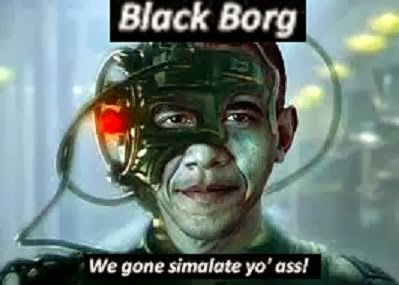
The simple fact is that this amorphous collective black entity that he so dreads, simply does not exist. It is simply another bogeyman created by the MSM and Hollywood – an entity akin to the Borg in the science-fiction series Star Trek. The former fictional being – written in the singular because they all share the same consciousness, and conscience – is famous for their (dreaded) command; “This is the Borg. We`ll assimilate you now. Resistance is futile”!

All fiction, all guano… in the real world. Never in recorded history has there been absolute hegemony among Africans – and, especially not in South Africa. The various black groupings – mostly tribal, in nature – were at each others throat before Apartheid, during Apartheid, and even now… after Apartheid.

To even think that all blacks share the exact same thoughts, feelings, moral sentiments, et cetera, – just because they share the same skin colour – is not only incredibly naive, it is also downright patronising and racist. In short; there is no absolute hegemony among the other races; so why should blacks be different in this regard?!

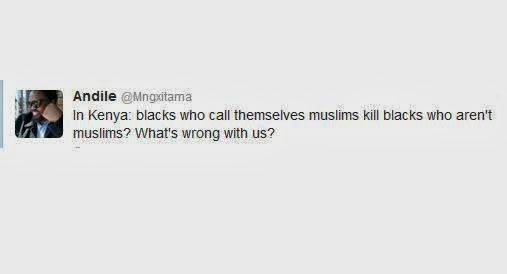
It therefore beggars belief when even (self-appointed) black intellectuals, like the awfully trite Hegel-emulating “Bikoist”, Andile Mngxitama, throw tantrums when blacks – wherever they may find themselves in space and time – do not act as “one” (see picture below).

andilem

Be that as it may; the “Black Borg” myth is only topped by its inverse, the myth of the Noble Savage. The latter, a neo-Romantic Rousseauian-regurgitating MSM/Hollywood creation, sees all blacks as inherently cherubic beings who only want the best for humanity, the universe… and the environment, of course. All little Mandela`s in heart, soul and suffering… all “one” in their eternal victimhood at the hands of the White Devil.

It is, frankly, beyond belief that even blacks themselves ascribe to this sickening denigration of their very being. I mean honestly, how can they acquiesce to a perception that only allows them collective agency, and not individual agency? But then, hey; they have been baby-sat for so long by bleeding-heart White Guilt-driven liberals that they, blacks, have left it up to others, like little lentil Fransie, to speak on their behalf.

Whatever the moral weather on that one; it is a fact that blacks have never, and will never, act as “one”. And the threat by the SAIRR vegetable, Fransie, that disillusioned (`”bitter”) whites will cause the Black Borg to suddenly appear from the Delta-quadrant wormhole just because they, the whites, are justifiably recalcitrant, is equally preposterous. Nothing, in the context of Mandelatopia, illustrates this more succinctly than the transition period to black rule in the early 90s.

During this time, the blacks did not rise up as “one” to take revenge on their Tutu-myth Holocaust oppressors, the whites. On the contrary; once the blacks realised that FW (fuck-wit) De Klerk was just going to hand over the whole caboodle, they went straight for each other’s throats…to get at the loot first.

Near-civil war circumstances prevailed as the Zulus of Buthulezi’s IFP fought the (mostly Xhosa) ANC of Mandela. More than 16 000 blacks died during that period. Hardly any whites were harmed, except for the cowardly APLA attacks on the St George’s Pub and the Roseview Church.

In her brilliant bookThe People’s War, Anthea Jeffery painstakingly researched the true facts behind the so-called “liberation struggle”. Her findings illustrate, beyond any doubt, how blacks used fellow blacks as a mere means to an end. It is an indisputable fact that the vast majority of blacks in South Africa were coerced, by threat of physical violence, to partake in Joe Slovo’s callous revolution.

  • `”the ANC had little compunction about attacking black civilians, including its own supporters, for the formula for people’s war draws no distinction between combatants and others and regards all civilians (irrespective of their political affiliation) as expendable in conflict;
  • the ANC had a motive to unleash violence, for it wanted to create enough mayhem and unrest either to spark an insurrection or to weaken its opponents to the point where it could triumph in negotiations;
  • the ANC had the means to unleash violence, for the peace process allowed it to bring back into South Africa some 13 000 armed and trained combatants whom it then refused to disarm or disband; and
  • the ANC was the only organisation to draw benefit from the 15 000 political killings that took place in the early 1990s (after all major apartheid laws had been repealed), for it used these to;
  1. stigmatise De Klerk and the IFP,
  2. stampede negotiators into giving it what Joe Slovo called ‘a famous victory’ in negotiations, and
  3. put great pressure on the first all-race election, while making it unthinkable for anyone to demand a re-run of the deeply flawed April 1994 poll in which it was accorded (no accurate count being possible) some 63% of the vote.” (source)

The above-quoted just illustrates, once more, that Fransie is as dumb as mud… especially given the fact that Dr Jeffery is his chief researcher at the SAIRR!

Hell, one does not even need to read a single book to understand that blacks are not “one”. Just look at the dismal moral state of all post-colonial sub-Saharan countries. The chief “liberator” and his inner circle have always enriched themselves shamelessly, at the expense of their own people.

In Mandelatopia, Mandela, like his cronies Sexwale, Zuma, Ramaphosa, et cetera, are drowning in money, while the vast majority of their fellow blacks are suffering under extreme poverty. It suffices to say that they, the former, couldn’t`t give a continental damn. There is no “oneness”, no ubuntu, no Noble Savage and no Black Borg. Period!

That a “second revolution” will take place in Mandelatopia is a fact. But it will not be because whites are standing up for their rights. It will be because blacks will revolt against their own leaders because of the broken promises of the past 20 years of typically-African mis-governing. That whites will bear the brunt of the coming (inevitable) revolution is obvious, because they (still) have those things that the black leaders promised their black sheeple, but failed to deliver… as always.

It is thus abundantly clear that the motive behind Fransie`s reinvigoration of the Black Borg myth is everything but noble, in the sense of heroically”saving” the enslaved backsides of whites in Mandelatopia.

For you see, for Fransie – as one of the main Afrikaner H-G men in Mandelatopia – it is all about keeping his ill-earned privileges and prestige. Had the playing-field with his white peers been level, half-wits like Fransie, Piet Croucamp, JP Landman, Tim du Plessis, Pierre de Vos, etc. would never have reached the level they have attained now.

But then; Fransie`s DNA is coward-based. His survival instincts and skills were honed in his dad’s nutsack… where he used to cower in the most remote corner because he was the lesser of 60 million. Now he is still cowering, in front of 60 million blacks. But that is his saving grace, his claim to fame. For unlike the one million whites who were forced to emigrate in order to seek employment, Fransie is in league with the new Master of South Africa. He is a made-man!

So the next time Fransie screams at you, as a white South African, to shut the fcuk up and continue paying unquestioningly for the `”sins of your forefathers”, just think of the picture below.

frans

FW’s Folly, a cautionary tale

Cartoon_ZAPIRO_FW_De_Klerk_speaks_with_a_forked_Tongueby Gustav Venter

[followbutton username=’GustavSVenter’ count=’false’ lang=’en’ theme=’light’]

FW de Klerk, pink peeling face bloated as if by cortisone, funereal smile stretched under dull eyes, his political ideas as obsolete as a typewriter, his opinion blighted by the ridicule of opponents – and his opponents are everywhere and everybody – his memory distorted by his misapprehensions and his reputation finally tarnished by extra-marital dalliance, will have what he has desired above all else: he will leave a legacy. “Legacy” in the mind of the career politician means “place in history.” And a place in history FW de Klerk will have and it will be that of a rare enough political bird, and though he represents a well-developed example of a certain category, he certainly is not without company in his corner of history. There future historians will find him with a coterie of some of history’s most flamboyant figures. Montezuma, the Aztec king, will be there, as will Rehoboam the grandson of ancient Israel’s great king David, as will France’s “Sun King” Louis XIV and Phillip II of Spain, a lineage of Renaissance popes and England’s “Farmer” George the Third.

What distinguishes these men; why are they in that particular corral of history? They were leaders sure, as were thousands of others, but they are remarkable for having devastated their countries and their people, not by one massive miscalculation, but in persisting in a course of action that was so foolish that historians are at a loss to explain the slow meltdown of mental processes.

Popular historian Barbara Tuchman (popular historians are the same as regular or “academic” historians except that they write readable prose) considers the effect in her pondering (as opposed to ponderous) work, The March of Folly. She beautifully describes the nature and mechanisms of folly, but concedes that she does not understand why the leaders in our list persisted in it. And persist in it, that they did.

Farmer George lost America forever for England, Louis expelled the Huguenots and thus impoverished his country and then vaingloriously waged unnecessary wars which bankrupted France and shoved the country over the precipice towards revolution, popes Sixtus IV to Clement VII through their perversions and arrogance triggered the Reformation which split the church and eventually led to it forever losing its pre-eminent position in the world, but only two of the leaders in the list – Montezuma and FW de Klerk – rushed from heights of enormous power to prostrate themselves – and their people – at the feet of a ruthless but weak and outmanoeuvred foe.

Montezuma was the mighty leader of the Aztecs, a people so ruthless they habitually sacrificed people in an effort to cajole some goodwill from their imaginary gods. They were safely ensconced in the natural fortresses of the high mountains and were a prosperous lot. There was no reason to even contemplate a radical change in position or fortune. They had every reason to feel safe behind the aggressive bulk of a standing army exceeding six hundred thousand men. Then, at the height of their power, one Hernán Cortés came calling. He’d sailed from the Old to the New World, not with an armada, but with a few dainty wooden ships containing 600 men, seventeen horses and 17 small cannons in all.

Cortés was a conquistador, a Spanish invader and fortune seeker. He was utterly ruthless, decisive and fearless. And outmanned. His enemy had the decisive advantage of 1,000 men under arms for every one of Cortés’s adventurers. Montezuma could have summoned his cooks to do his fighting and still overwhelmed Cortés and his avaricious band. This he did not do. What he in fact did was to meekly submit to the conquistador, thereby cracking the door to his country for the thin edge of the wedge. Soon he was deposed and his people subjugated under the unsympathetic heel of Catholic Spain.

This stunning capitulation still renders historians nonplussed. Tuchman has a tentative stab at an answer, but if she is not convincing it is because she is not convinced. She timidly ascribes Montezuma’s meltdown to the superstition of the Aztecs. “Their ‘gray’ faces, their ‘stone’ garments, their arrival at the coast in waterborne houses with white wings, their magic fire that burst from tubes to kill at a distance, their strange beasts that carried the leaders on their backs…” apparently was too much evidence for the idol-worshipping Montezuma who forthwith caved in. But who can tell?

If Tuchman cannot explain Montezuma’s brain freeze, she is in her own mind sure what constitutes folly. In her “inquiry” she defines it as “policy contrary to self-interest” and lists three requirements for a policy to receive full recognition as folly. She writes that “it must have been perceived as counter-productive in its own time, not merely by hindsight.” “Secondly a feasible alternative course of action must have been available.” The third requirement is that “the policy in question should be that of a group, not an individual ruler, and should persist beyond any one political lifetime.”

Montezuma’s actions were decidedly contrary to his self-interest and that of his followers. He was ignominiously stoned to death and the Aztecs subjected under the iron heel of the avaricious conquistadors and eventually removed as a culture and distinct people from the face of the earth.

It can be argued that the demise of Montezuma and his people was inevitable. They were in the way of the ambitions of a restless and ruthless force. If Cortés did not wipe them out, some other trigger-happy European conqueror would have been all too happy – and capable – to perform the deed. Western expansion was an unstoppable force and the primitive Aztec hardly an unmoveable object.

Myth, superstition, obsolete defence equipment, political naiveté and the appearance of an unknown foe will all make good strands to weave a case in mitigation of Montezuma’s disastrous handling of his ultimate political crisis. But what to make of a leader who was not hobbled by any of these debilitations and yet unexpectedly, cravenly and completely caved in to a defeated enemy? And, since history is not merely a repository of interesting snippets, what can one learn from it and what should its influence be on our planning for the future? Tuchman’s examination of folly ends with the Vietnam war but one can only imagine the glee with which she would have picked through the debris of National Party policy to explain the unnecessary, completely self-defeating and irrevocable surrender of FW de Klerk to that comical “liberation movement,” the ANC.

While there are clear similarities between the way in which Montezuma and De Klerk pursued “policies contrary to” their “self-interest,” there are also obvious differences. The Aztec had to deal with an unknown foe. De Klerk cannot possibly make use of this defence. His people, the Afrikaners, had been living among the Bantu for three and a half centuries. Nothing about the nature, history, customs and capabilities – and  lack thereof – of black Africans was unknown to the National Party. Even the modern cant of the ANC, its Marxist and Afro-nationalist roots were well-known to the Nationalists. FW very well knew that the black people of South Africa were incurably envious of the very capable and successful whites, especially the Afrikaner.

Before the arrival of Cortés Montezuma had no data of the capabilities of a Western force and he could never be certain how an armed clash between Aztec and conquistador would turn out. De Klerk, by contrast, was well aware of the power of the armed forces under his control. The South African Defence Force had dispersed its foes during the Border War. It had severed SWAPO’s supply chain in Angola and devastated its bases and forced the terrorist organization to scurry to the negotiation table, leading to a tame Namibian independence. The “Boers” had seen off the communist threat, culminating in the severe mauling it handed the Cuban forces at Cuito Cuanavale before staring down Castro’s last charge to the border of Namibia. The South African security forces in the early nineties were a lean, tough, hell-for-leather outfit.

There is also the quality of opposition to bear in mind when comparing Motezuma’s folly with that of FW de Klerk. The Aztec king had every right to be taken aback by the sheer daring of Cortés and his merry men. A man who brazenly sails to the shores of a hostile and unknown country and then burns his ships to prevent a premature withdrawal, might very well know something the king does not. This valiant approach is not something to be found in the ANC playbook.

The ANC were the Keystone Kops of the revolutionary world. They bungled so many operations that they killed more of their own than of the enemy. Their leadership was corrupt and mostly in the pocket of the state. It is indicative that their most revered induna failed miserably under arms and was, by the mercy of the Afrikaner government, reshaping rocks on an island prison.

The South African government had to confront the two-faced sanctions of the world, yet the economy proved surprisingly robust, so much so that the very sanctions designed to smother it was forcing it to bloom in surprising areas. The South African armaments industry, for instance, was thriving. The ANC’s loss of its communist sponsor after the unravelling of the Iron Curtain also meant that new markets were opening up to South African products, while the country’s stranglehold on certain strategic minerals could be used to lever trade with other countries.

FW’s South Africa, then, was militarily strong, its people resourceful and hardworking, its economy stable, its foes vanquished and its agriculture so productive it could feed the region. For goodness sake, South Africa had six self-developed nuclear devices which represented the ultimate bargaining chip.

FW de Klerk had nothing to gain by a transition of government and everything to lose. The Afrikaner possessed the strength to retain everything and the ANC was too weak to force the president’s hand. And yet, in a mad rush, within a few months, in the face of furious warnings, FW de Klerk and his National Party completely surrendered as if they’d been whipped by an overwhelming foe.

It remains a modern political mystery. De Klerk is certainly not unintelligent. He was a deft political operator and by stealth, decisiveness and sometimes calumny disarmed the right-wing threat to his plans. He was a good communicator and a skilled debater. In an SABC TV debate, for instance, he easily outclassed a glum, muttering, somewhat confused Nelson Mandela. Why then the abrupt change of course, from an untouchable position to utter defeat? Barbara Tuchman’s “inquiry” only stretched to Vietnam, but with what glee would she have poked through the debris of the National Party’s ruinous folly!

Tuchman has a dim view of politicians. Right in the beginning of her book she ruminates about the nature of people in government. “Mankind,” she writes, “makes a poorer performance of government than of almost any other human activity… Why do holders of high office so often act contrary to the way reason points and enlightened self-interest suggests?”

When Tuchman refers to “self-interest” she clearly sees the interest of the ruler and the interests of his people as the same. Yes, on the face of it De Klerk served his own interests very well, thank you. He was for a heady period touted by tout le monde – and still by some die-hard liberal ex-Nats – as the enlightened vanquisher of evil. He pocketed half a Nobel Prize, was financially sumptuously greased and even waltzed out of his marriage with the glamorous wife of a Greek friend on his arm.  All in all FW was personally well served by his political folly. The lot of his people is an entirely different issue. They were stripped of their power and rendered at the mercy of a merciless people. They are subjected to discrimination and have to stare in horror from the sidelines as the fine country they built is ransacked and ruined by the cupidity and stupidity of inept rulers.

This hardly resonates with De Klerk. Having ingested too much of his own political snake oil, he still stubbornly believes that he did not only do the right but a noble and admired thing. That is why he still feels called upon to chide other African countries on their treatment of minorities – this from the man who stripped the powers of the most envied and therefore feared and hated minority in the world.

He may try and duck behind the ruse that his people are all the races in the country, but it will ultimately not serve him well. Only a small collection of people benefited from his folly. The rest – the overwhelming majority – of South Africans will reap misery from his actions. The economy is wrecked and the hoof beats of the grey horseman, famine, are already thudding through the dry crust of abandoned farms.

De Klerk, then, has fooled so many people, worst of all himself. And it is just too tempting to avoid answering the most intriguing question of all: Why?

The few people who can definitively answer the question aren’t talking, so we are free to conjecture. While his precise motives are murky leaves on the bottom of the tea cup, we can be more certain of when he took the fateful and fatal decision to betray his people and surrender himself to the currents of folly. The FW de Klerk of October 1989 does not resemble the determined fool of February 1990. During that particular October he primly scolded his elder brother, Willem, for hobnobbing with the enemy, the ANC, during the infamous “Dakar Safari.” Not even four months later he released the brakes on the wagon of surrender by unbanning the ANC and setting their terrorist-in-chief, Nelson Mandela, free.

The elder De Klerk brother, in a biography he wrote on his kid brother, puzzles over this abrupt change of tack. He calls it an astonishing political conversion.

Who got hold of FW and what was said? Maybe one day all will be revealed. In the meantime it seems clear that the carrot jiggled in front of his nose is the one so very few party-political animals can resist – the possibility of a legacy.

For the modern party politician a legacy is a big deal.

Winston Churchill (in words quoted by FW de Klerk in his lecture to African leaders) damned democracy with faint praise. “Democracy,” he said, “is the worst form of government in the world – apart from all the others.”

This is somewhat bombastic for somebody who has not experienced a single day of pure democracy. The warped version of democracy so beloved by him and touted as the panacea for all political ills by the West is in fact little more than a popularity contest run by unscrupulous, self-serving people.

Ever since the invention of the political party the fortunes of the country has been embedded with the self-serving interests of a collection of vainglorious shysters. Cynics, yoked with the modern press, have gradually made the manipulation of voters and election results a finely tuned science.

This system inevitably produces a warped hierarchy of interests. For the modern-day politician the party comes first, followed by whichever partners helped it to beat the ballot box. The country and its people come a very distant third.

The very nature of political office in the party system necessarily produces a peculiar political animal. What kind of person exactly does it take to be enamoured by the prospect of rising through the ranks to gain political favour? A very determined individual, yes, one that is so focused on the success of campaign and career that he will sacrifice anything to attain it. In this strident selection process morality and integrity are drawbacks. Even when couched in terms of ends justifying means, the politician of necessity must first of all do what is best, not for his constituents, but his political career. This demands an intense focus on himself. Therefore the successful party politician is almost invariably self-obsessed. And narcissism is hardly the right stuff for a righteous ruler.

Running a country is heady stuff. The political self is so well served by the office.  People come when he calls and go forth when he commands. The only shame, to the very few who obtain the position, is that it cannot last forever. Political leaders will gladly strike a deal with any devil to prolong the situation. The manful struggle to obtain political power does not compare in desperation with the fight to retain it. And that is why the “legacy” is of such all-consuming importance. It is often the only way to let the effect linger. To leave a proper legacy, however, the leader has to perform deeds of such heroism, courage and flamboyance that other people will find it necessary to preserve his memory.

Between October 1987 and 2 February 1990 FW de Klerk came to believe he had found the one thing, in his mind of such courage and dash, which would leave him touted for the ages to come. And so he delivered his people into the hands of their enemies.

Folly, remember, is an act contrary to self-interest and ultimately FW’s treachery undermined himself and his ultimate goal of leaving a treasured legacy. The only people who truly celebrate him as the national saviour he imagines himself to be are a few NP dinosaurs, his immediate family, FW himself and Dave Steward who runs the ex-president’s feeble attempt to manufacture the scaffolding of his own legacy, the FW de Klerk Foundation. The press consigned him to the status of an oddity. His main competitor, that old terrorist, Nelson Mandela, was swept away on tides of adulation. He usurped all the praise De Klerk expected to garner.

So he will leave a legacy. His tale will be part of the anthology that includes the history of Montezuma, the Renaissance popes, Louis XIV, Farmer George III and other incompetents. If ever a future leader carefully but with great determination follows a program of self-destruction – where the “self” is not just the ruler but his people – observers will grin knowingly and say: “Just like FW de Klerk.” His legacy then is having been a fool.

Oh, they will be talking about FW de Klerk for a while longer. There are lessons to be drawn from his career and actions. But not in the way he hoped for. FW de Klerk’s life has become a cautionary tale.

He was not the first leader to devastate his country through his own folly. And, more importantly, he will not be the last.

The current South African regime, that foul political party, the ANC, would do well to consider the tale of FW and his folly. They are marching to their own demise, deaf to the entreaties of caution. They know that history will cold-shoulder FW de Klerk but they are so cock-sure that it will treat them well. However, there is a rule of history: From those to whom much has been given, much will be expected. Nowhere in history has so much been given as to the undeserving ANC. And when future historians peer through the smoke above the debris of a once magnificent country, their judgment of the ANC, starting with the failed terrorist and statesman Nelson Mandela, will be harsh.

And yet they will also see pockets of prosperity among the ruins. A betrayed people will be at work, rebuilding the country as their forefathers once did.

And that will be the legacy of the Afrikaner.

[followbutton username=’GustavSVenter’ count=’false’ lang=’en’ theme=’light’]

Did Mandela’s friend supply chemical weapons to Syrian rebels?

Prince Bandar bin Sultan and Nelson Mandela

by Terry Crawford-Browne

REPORTS from Syria by Jordanian journalists allege that it was Prince Bandar bin Sultan of Saudi Arabia who distributed those chemical weapons to the Syrian rebels.( Here he is shown with that other unrepentant terrorist)

If true, it indicates the chemical attack in Damascus to have been a false-flag operation by the American war business.

This would be entirely in keeping with Prince Bandar’s history of organising the Afghan mujahideen in the 1980s, the Iran-Contra weapons exchanges, Libya in 2011, the suppression of the Shia uprising in Bahrain, Saudi support for the coup d’etat in Egypt and support for Syrian rebels.

Other reports confirm that Prince Bandar also went to see Russian President Vladimir Putin last month and offered to buy $15bn worth of Russian weapons provided Mr Putin abandoned Syrian President Bashar al-Assad. Mr Putin gave him short shrift.

Prince Bandar was not only the Saudi ambassador in Washington for 22 years and friends of Ronald Reagan and the Bush family, but he also negotiated the 1985 £43bn Al-Yamamah weapons deal with Margaret Thatcher, which Tony Blair renewed in 2007 with the Al-Salaam weapons deal.

When the British Serious Fraud Office investigated the bribes which BAE Systems paid him, Prince Bandar allegedly threatened blood in the streets of London.

Mr Blair squelched the investigation citing “national security.” The Guardian newspaper revealed a couple of months later how BAE with collusion of the British government had laundered bribes to Prince Bandar of over £1bn through Riggs Bank in Washington DC and other US banks.

Most importantly, Prince Bandar and Ms Thatcher negotiated the Al-Yamamah deal under the British Official Secrets Act, meaning that it cannot be investigated in Britain.

Saudi Arabia ships thousands of barrels per day of oil consigned to the Bank of England, which is then distributed to Shell and BP.

Over the years a surplus has developed, which is guesstimated to be worth over $150bn. Its purpose is a) to guarantee British and US support for the Saudi royal family against domestic insurrection and b) to fund covert destabilisation of resource-rich countries in Asia and Africa under the guise of the war on terror.

Having targeted Afghanistan, Iran, Iraq, Yemen, Somalia, Libya and other countries over the years, Syria and Egypt are Prince Bandar’s current targets. When will SA be targeted by the American and British “war business” given our country’s mineral wealth?

Saudi Arabia made lavish donations to the African National Congress. Prince Bandar was also the only foreigner present at Nelson Mandela’s secret wedding to Graca Machel, and was a frequent visitor to SA when the arms deal was being negotiated.

Source of Mandela ‘death reports’ revealed

Laura Oneal
Laura Oneal

A source of reports claiming that Nelson Mandela has died is a financial manager from Joburg, who describes herself as “proudly South African” and “about to make her mark on the writing scene”.

Laura Oneale, a mother of three, is the reporter who has given the Las Vegas Guardian Express reports about Mandela’s health over the past few months.

On June 26, Oneale wrote that the elderly statesman had died the previous night on June 25, but did not name any official source. Guardian Express suggested that the source was from the SABC.

“Speculation surrounding his health continued and now we have been informed that the great man is deceased. Sources said that he was on a life support system and remained in critical condition. His family was given time to share their loss before the world was informed of his passing,” the report stated.

While saying that there had actually not been any official confirmation on the death, Oneale went on to say that there were speculations that the government and family did not tell the truth because of US President Barack Obama’s then upcoming trip to South Africa. Announcing Mandela’s death, she wrote, could overshadow the visit.

The fact that the presidency kept updating the nation about Mandela’s condition did nothing to sway Oneale’s opinion of the former statesman’s alleged death, writing more opinion-based articles on how his family and the government were keeping the truth from everyone.

On July 17 she wrote: “The ongoing lies and deceit remain a worrying factor, as the truth is not being told. Tomorrow will mark forty-one days of intensive care treatment, and this is arguably the most devious lie of all. We know that intensive care treatment is for severe life-threatening illnesses, and on his fifteen days of treatment, it was reported that his kidneys were functioning at 50 percent only. So terribly sad indeed.”

As the Presidency continued to assure the nation that Mandela was still in hospital and still receiving treatment, it was clear that Oneale was not buying what Mac Maharaj, spokesman for the Presidency, was saying. In August she wrote: “A man of 95 years in hospital, critically sick, but stable, for almost three months seems like the ultimate fabrication – and with the history of how dishonest the current government is, maybe they will find a Nelson double and say he had a miraculous recovery. It is possible that they are scheming on how to deal with the nightmare of their own making and construct a well-devised plan to deceive the public and maintain their power with the upcoming election.”

When it was announced that Mandela was discharged from hospital on Sunday, Oneale wrote another article, backtracking her original story by saying there was a possibility that Mandela was still alive.

“One possible explanation is to keep him alive until they obtain their court ruling and even until the 2014 general election has ended. The direct and disrespectful approach the family and government have reported about his hospital stay is nothing short of manipulative.

“Whether he is dead or alive, only the government or the Mandela family will know the truth.”

The Star tried to get in touch with Oneale on Monday morning about her articles but was unable to speak to her before deadline.

“I do not mind talking to you regarding my articles, however I do suggest you read them first. I believe this will give a clearer indication of what I said,” was her response.

She declined to be contacted by phone, claiming a radio reporter had recorded her without permission.

A website page (www.independentauthornetwork.com/laura-oneale.html) provides the self-proclaimed journalist’s achievements: she’s a financial manager for a business in Benoni and her three sons are in the music industry. She has “completed” (but not published) several short stories, and her self-published first novel is available on Amazon.com.

In a short bio, she describes her hometown of Johannesburg as a “majestic ever-changing country where mountains soar; wild animals roam and a Rainbow Nation is emerging”.

Nothing on the site suggests she has had any journalistic training, or experience in the field.

The site seems primarily a way to promote Oneale’s fantasy-scifi-historical-fiction-religious-allegory-in-the-form-of-a-novel “Sipho And The Star Pearl”.

The novel focuses on a universe where Earth has a sister planet called Anglur, whose denizens can communicate with their “God Most High”.

“The Anglurians wish to end evil on Earth and create a more idyllic environment like theirs; that is their; To that end, they have decided to recruit the Zulu people of Africa to assist them,” the summary reads.

In what appears to be an attempt to appeal to international markets, she describes Zulus as “colourful…a real clan of people that exist today in Africa”.

But the real focus of the book is on a Zulu-Anglurian hybrid named Sipho, who, accompanied by two English children have to descend into hell to retrieve objects known as “Star Pearls” from Satan himself.

The book’s sepia cover shows an uncomfortable-looking young child on some unidentified African plain, a bolt of lightening striking in the distance.

The website says this first novel is but the first in the Anglurian Odyssey series, with a massive banner on the site reading: “COMING SOON: THE SEQUAL (sic) – RETURN TO ANGLURIA”.

The Star